1. Introduction
The parallel mechanism typically consists of a moving platform, a fixed base, and at least two branch chains. It belongs to a kind of mechanism with multi-chain closed loops [Reference Wu, Zhang, Yue, Lv, Chen, Wang and Zhang1,Reference Yan, Huang, Li and Zhou2]. Parallel mechanism has a wide development prospection because of its strong load ability, high stiffness, and excellent dynamic performance [Reference Wu, Yue, Chen, Nie and Zhang3]. Therefore, many scholars and enterprises have been committed to the design and research of parallel mechanisms with engineering application value [Reference Lacombe and Gosselin4].
The number of degrees of freedom (DOF) of traditional parallel mechanisms is usually the same as the number of branches with driving joints. In other words, the number of branches with driving joints determines the number of DOF of traditional parallel mechanisms [Reference Zou, Zhang, Luo, Huang, Li and Zhang5]. However, when the parallel mechanism has more than 3-DOF, multiple branch chains will not only cause the mechanisms’ complex structure but also lead to easy interference between branch chains [Reference Karnam, Baskar, Srivatsan and Bandyopadhyay6]. In order to avoid a series of disadvantages of multi-branch parallel mechanisms, many scholars have carried out systematic research on the structural configuration. At present, hybrid mechanism, which is composed of parallel and series structures, is the mainstream idea to solve this kind of problem [Reference Laryushkin, Antonov, Fomin and Essomba7]. The number of DOF of hybrid mechanism is determined by series structure and parallel structure. The hybrid mechanism not only makes up for the shortage of working space of the pure parallel mechanism but also overcomes the low stiffness and cumulative error of the pure series mechanism [Reference Li, Ye, Shen, Wang and Geng8]. The typical hybrid mechanism is represented by Trivaiant, Tricept and Exechon, etc. [Reference Wang, Chen and Liu9]. Nevertheless, due to the existence of serial structure, the end stiffness and positioning accuracy of hybrid mechanisms are not as good as that of the pure parallel mechanism.
Double-driven parallel mechanism [Reference Zhao, Zhao, Xu, Bian and Ding10] is an alternative to reduce the number of branch chains while ensuring the number of DOF. Different from the traditional parallel mechanism, the double-driven parallel mechanism contains one or more double-driven branch chains (i.e. there are two or more drives on one branch chain). The double-driven parallel mechanism still belongs to the closed-loop structure, which retains the advantages of large stiffness and high positioning accuracy. The research on the double-driven parallel mechanism is still in its infancy, and there are few design cases. Lu et al. [Reference Lu, Wang, Zhao, Hu, Han and Sui11] proposed a three branch chain 5-DOF mechanism with two double-driven branch chains, namely the 2UPS-SPR dual-drive parallel mechanism, and proved that the single-branch multi-drive mechanism had the advantages of reducing vibration interference between branches, easy to avoid singularity, and high dexterity. Zhao et al. [Reference Zhao, Zhao, Wang, Tian and Chen12] proposed and studied a double-driven parallel mechanism with sub-closed loops, concluding that the double-driven parallel mechanism with sub-closed loop structure has strong posture adjustment and vibration isolation ability. Louis et al. [Reference Louis and Clement13] analyzed a double-driven parallel mechanism with three double-driven branch chains and three precisely constrained branch chains. This mechanism has three redundant DOFs, which can be used to avoid singulars and expand the rotating workspace, although above scholars have designed several double-driven mechanisms and verified that they have many advantages. Nevertheless, as a new research direction, considering that the structural strategy has a great influence on the performance of the whole mechanism, driving mode and the corresponding layout of double-driven chains are still open issues to be further studied [Reference Wen and Gosselin14].
Optimal design is an important research direction in parallel mechanism development [Reference Ren, Li, Liu and Dou15]. Among, the kinematic design mainly involves the determination of optimal geometric parameters [Reference Shibu, Shankar, Babu and Degaonkar16]. Establishing performance indexes [Reference Burkus, Odry, Awrejcewicz, Kecskes and Odry17] is the first step of kinematic multi-objective optimization. Workspace and dexterity of the mechanism are mainly used as the kinematic performance optimization indexes so far [Reference Alessandro and Rosario18,Reference Luan, Zhang, Gui, Zhang, Lin and Wu19]. Considering compactness and economy of parallel mechanisms, the mechanism volume is also used as the performance index frequently. Wu et al. [Reference Wu, Wang, Zhang and Huang20] used kinematic performance such as mechanism workspace and volume as optimization indexes for multi-objective optimization of a novel 6-DOF painting robot. Huang et al. [Reference Huang, Guo, Zhang, Qu and Tang21] used the performance of workspace, stiffness, and dexterity as optimization indexes for multi-objective optimization to improve the overall performance of a reconfigurable parallel mechanism. In conclusion, this paper mainly carries out the kinematic multi-objective for the new proposed mechanism by using workspace, volume, and dexterity as performance indexes.
Multi-objective optimization mainly includes two aspects: optimization method and optimization algorithm [Reference Xu, Cheng, Yang, Ji, Wang, Sun, Liu and Zhang22]. As for the multi-objective optimization method, there are mainly two strategies [Reference Rosyid, El-Khasawneh and Alazzam23]. The first method is to define the sum of the weights of multiple performance indexes as a comprehensive index (the sum of the weight factors is equal to 1), commonly called the comprehensive objective method [Reference Li, Wang, Chen and Zhang24]. The second method is known as the Pareto optimization method, which obtains non-dominated solution sets for multiple performance indexes [Reference Zhao, Zhu and Hayes25]. The determination of weight factors in the comprehensive objective method is subjective and requires a large amount of computing time, so its optimization efficiency is low [Reference Guigue, Ahmadi, Langlois and Hayes26]. Because Pareto optimization is an after-the-fact decision, this method is usually given priority in multi-objective optimization [Reference Herrero, Pinto, Diez and Zubizarreta27]. The Pareto front is defined as the set of all optimal solutions produced by Pareto optimization. Solutions on the Pareto front are all equal and can be regarded as the optimal solution of Pareto optimization [Reference Sato, Izui, Yamada and Nishiwaki28]. Russo et al. [Reference Russo, Herrero, Altuzarra and Ceccarelli29] designed a parallel mechanism with 3-UPR architecture based on the Pareto optimization method. The kinematic performance of this mechanism, such as workspace and manipulator dexterity, is improved. Qi et al. [Reference Qi, Sun and Song30] used Pareto optimization to determine the optimal structural parameters of a novel parallel tracking mechanism. However, in the above studies, it is a challenge to select the optimal solution according to weight combinations in Pareto optimization. Generally, the performance graph that displays the relation between design variables and the performance can be used intuitively to select the final optimization result from the Pareto front [Reference Elsisy, Sayed, Abo-Elnaga and Elsayed31]. And for the traditional Pareto optimization, Pareto front of the two optimization indexes can be drawn as a curve, which can be visually displayed on a two-dimensional plane. However, the Pareto front of three or more optimization indexes is a hypersurface, which cannot be visually displayed by two-dimensional graphics, thus increasing the difficulty in determining the final optimization results [Reference Wang, Hu, Xu, Zhao and Su32]. Therefore, it is very meaningful to improve the traditional Pareto optimization process so as to intuitively select the final optimization results and reduce the difficulty of optimization results selection. Finally, as for the optimization algorithm, the intelligence optimization algorithm, such as genetic algorithm (GA) and particle swarm optimization (PSO) algorithm [Reference Sun and Lian33], is often used in a real-life engineering setting. The main disadvantage of GA is that many parameters need to be selected by experiences, such as the operator parameters of crossover rate and mutation rate [Reference Bounab34]. Different from the crossover and mutation operating of GA, PSO is easier to be implemented because the search is determined according to its speed [Reference Farooq, Baqai and Shah35]. Yun et al. [Reference Yun and Li36] found that fitness value of the PSO algorithm is better than that of the GA in the optimization of a 3PUPU parallel mechanism. Wang et al. [Reference Wang, Zhang, Chen and Huang37] used the PSO algorithm to optimize the workspace, input coupling rate, natural frequency, and stiffness performance of a planar 3-DOF parallel mechanism. The efficiency of PSO algorithm is widely recognized. Therefore, the PSO algorithm is selected as the optimization algorithm in this paper.
In this paper, a novel 5-DOF parallel mechanism with two double-driven branch chains is proposed and analyzed based on the idea of double-driven. And the kinematic multi-objective optimization problem is systematically studied based on a novel stage-by-stage Pareto optimization method. The structure of this paper is as follows. Section 2 introduces design ideas of the proposed mechanism and carries out the DOF analysis. In Section 3, the kinematics problem is studied. The inverse kinematic solution and 5
 $\times$
5 dimensional Jacobian matrix are obtained. Section 4 analyzes the kinematic performance of the proposed mechanism. In Section 5, a stage-by-stage Pareto optimization method is proposed to perform multi-objective optimization of the parallel mechanism. Conclusions are drawn in Section 6.
2. Design and DOF analysis of the parallel mechanism
2.1. Mechanism design
Based on the idea of double-driven, this paper is devoted to designing a double-driven parallel structure with 5-DOF. The parallel mechanism with three branch chains, especially 3-PRS [Reference Ruiz, Campa, Roldan-Paraponiaris, Altuzarra and Pinto38] (P denotes actuated prismatic joint, R denotes revolute joint, S denotes spherical joint) parallel mechanism, is usually used as the base mechanism for designing double-driven parallel mechanism because of its simple structure and high stability, etc.
The topology structure of the 3-PRS parallel mechanism is shown in Fig. 1(a). The 3-PRS parallel mechanism has three PRS branch chains of the same structure. Two ends of the three branches are connected with the moving platform and fixed base, respectively. At present, the 3-PRS parallel mechanism has been widely used in the field of machine tool processing, such as Sprint
 ${Z}_3$
[Reference Chen, Liu, Xie and Sun39] shown in Fig. 1(b).
The 3-PRS parallel mechanism. (a) Topology structure of 3-PRS parallel mechanism. (b) Sprint Z3.

Inspired by the idea of double-driven, a novel 5-DOF parallel mechanism is designed based on the 3-PRS parallel mechanism, shown in Fig. 2(a). As the main improvement, an additional actuated revolute joint (i.e. R) is added to two branch chains of the 3-PRS parallel mechanism, respectively. And, the third PRS branch chain is replaced with a PUU branch chain to meet the movement requirements of the mechanism. Here, U represents universal joint. As a result, the proposed PUU-2PRRS parallel mechanism can realize 5-DOF of moving platform with only three branch chains. However, the structure uses rotationally driven double-driven branch chains, resulting in a load close to the moving platform. The layout of the drive motor of the parallel mechanism has an important influence on its overall performance. Generally speaking, the drive motor close to the fixed base can ensure the maximum stiffness. Therefore, thePUU-2PRRS parallel mechanism needs to be improved.
Novel double-driven parallel mechanism. (a) PUU-2PRRS parallel mechanism. (b) PUU-2PR(RPRR)S parallel mechanism.

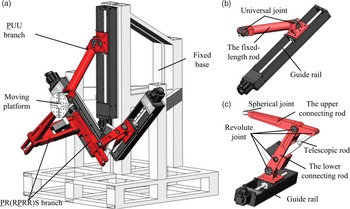
It is notable that the actuated revolute pair on the double-driven branch chains would cause large deformation and great difficulty in control. To solve this problem, the PUU-2PR(RPRR)S parallel mechanism with sub-closed-loop is designed. The actuated revolute joint is designed as a sub-closed-loop (i.e. RPRR). The sub-closed-loop changes the rotation drive to a linear drive. By introducing the sub-closed-loop structure, drive the motor and other loads near the fixed base. What is more, the vibration, manufacturing costs, and control difficulty of the mechanism can be reduced effectively. Finally, the topology of thePUU-2PR(RPRR)S parallel mechanism is shown in Fig. 2(b). According to the topological structure of Fig. 2(b), the 3D model structure of this mechanism is designed. As shown in Fig. 3(a), a PUU branch chain and two double-driven branch chains connect the moving platform to the fixed base in the PUU-2PR(RPRR)S parallel mechanism. Figure 3(b) shows the structure of the PUU branch chain. PUU branch consists of a guide rail and a fixed-length rod which are connected by a universal joint. Figure 3(c) shows the structure of the double-driven branch chain (i.e. PR(RPRR)S branch chain). PR(RPRR)S branch consists of a guide rail, the lower connecting rod, and the upper connecting rod which are in turn connected by two revolute joints. The connection between the upper connecting rod and the lower connecting rod also adopts a telescopic rod-driven sub-closed-loop rotation component (i.e. RPRR).
3D model of the PUU-2PR(RPRR)S parallel mechanism. (a) The PUU-2PR(RPRR)S parallel mechanism. (b) PUU branch chain. (c) Double-driven branch chain.

All three chain guides are mounted on the same plane of the fixed base. The guide rails of the two double-driven branch chains are perpendicular to each other.
In order to facilitate the study of the PUU-2PR(RPRR)S parallel mechanism, its mechanism schematic structure is established as shown in Fig. 4.
 $O_1$
is taken as the origin to set up the fixed Cartesian coordinate system
 ${O_1} -{x_1}{y_1}{z_1}$
. It is the intersection point of three linear guides on the plane
 ${C_1}{C_2}{C_3}$
.
 $z_1$
-axis is perpendicular to the base guide rail installation plane,
 $y_1$
-axis is in the same direction as
 $\overline{{\boldsymbol{{O}}_1}{\boldsymbol{{C}}_1}}$
, and
 $x_1$
-axis satisfies the right-hand rule. The structure parameters of the PUU-2PR(RPRR)S parallel mechanism are shown in Table I.
Simplified schematic diagram of the PUU-2PR(RPRR)S parallel mechanism.

Structure parameters of the PUU-2PR(RPRR)S parallel mechanism.

 $O_2$
is taken as the origin to set up the moving Cartesian coordinate system
 ${O_2} -{x_2}{y_2}{z_2}$
. It is the geometric center of the isosceles right triangle
 $\Delta{B_1}{B_2}{B_3}$
.
 $x_2$
-axis is in the same direction as
 $\overline{{\boldsymbol{{B}}_3}{\boldsymbol{{B}}_2}}$
,
 $y_2$
-axis is in the same direction as
 $\overline{{\boldsymbol{{O}}_2}{\boldsymbol{{B}}_1}}$
, and
 $z_2$
-axis satisfies the right-hand rule.
2.2. DOF of the PUU-2PR(RPRR)S parallel mechanism
Screw theory is the main method to calculate the DOF of parallel mechanisms [Reference Kang, Feng, Dai and Yu40]. As shown in Fig. 5, the local coordinate system
 ${C_1} -{x_{11}}{y_{11}}{z_{11}}$
is established in the PUU branch chain.
 $x_{11}$
-axis and
 $y_{11}$
-axis are in the same direction as the two axes of universal joint, respectively.
 $\boldsymbol{{R}}_{O1}^{C1}$
is the transformation matrix from
 ${O_1} -{x_1}{y_1}{z_1}$
to
 ${C_1} -{x_{11}}{y_{11}}{z_{11}}$
. It can be expressed as
 \begin{equation} \boldsymbol{{R}}_{O1}^{C1} = \left [{\begin{array}{c@{\quad}c@{\quad}c}{{\rm{c}}{\beta _{12}}}&0&{{\rm{s}}{\beta _{12}}}\\[3pt] 0&1&0\\[3pt]{ -{\rm{s}}{\beta _{12}}}&0&{{\rm{c}}{\beta _{12}}} \end{array}} \right ] \end{equation}
where s denote sine and c denote cosine.
 $\beta _{12}$
is the angle between
 $x_{11}$
-axis and
 $x_1$
-axis.
Sketch of the PUU branch chain.

The coordinates of
 $B_1$
in
 ${C_1} -{x_{11}}{y_{11}}{z_{11}}$
can be denoted as
 \begin{equation} \boldsymbol{{B}}_1^{C1} ={(\begin{array}{c@{\quad}c@{\quad}c} 0&{ -{l_1}{{\textrm{c}}}{\alpha _{13}}}&{{l_1}{\textrm{s}}{\alpha _{13}}} \end{array})^{\rm{T}}} \end{equation}
where
 $\alpha _{13}$
is the angle between
 $\overline{{\boldsymbol{{C}}_1}{\boldsymbol{{B}}_1}}$
and
 $\overline{{\boldsymbol{{C}}_1}{\boldsymbol{{O}}_1}}$
.
The kinematic screw system of the PUU branch chain in
 ${C_1} -{x_{11}}{y_{11}}{z_{11}}$
can be expressed as
 \begin{equation}{\boldsymbol{\$}_1} = \left \{{\begin{array}{*{20}{l}}{{\boldsymbol{\$}_{11}} = ({\boldsymbol{{O}}_{3 \times 1}};\,{\boldsymbol{{e}}_2}) = (\begin{array}{*{20}{c}} 0&0&0&;&0&1&{0{)^{\rm{T}}}} \end{array}}\\[3pt]{{\boldsymbol{\$}_{12}} = ({\boldsymbol{{e}}_2};\,{\boldsymbol{{O}}_{3 \times 1}}) = (\begin{array}{*{20}{c}} 0&1&0&;&0&0&{0{)^{\rm{T}}}} \end{array}}\\[3pt]{{\boldsymbol{\$}_{13}} = ({\boldsymbol{{e}}_1};\,{\boldsymbol{{O}}_{3 \times 1}}) = (\begin{array}{*{20}{c}} 1&0&0&;&0&0&{0{)^{\rm{T}}}} \end{array}}\\[3pt]{{\boldsymbol{\$} _{14}} = ({\boldsymbol{{e}}_1};\,\overline{{\boldsymbol{{C}}_1}\boldsymbol{{B}}_1^{C1}} \times{\boldsymbol{{e}}_1}) = (\begin{array}{*{20}{c}} 1&0&0&;&0&{{l_1}{\textrm{s}}{\alpha _{13}}}&{{l_1}{\textrm{c}}{\alpha _{13}}{)^{\rm{T}}}} \end{array}}\\[3pt]{{\boldsymbol{\$}_{15}} = ({\boldsymbol{{s}}_{15}};\,\overline{{\boldsymbol{{C}}_1}\boldsymbol{{B}}_1^{C1}} \times{\boldsymbol{{s}}_{15}}) = (\begin{array}{*{20}{c}} 0&{{\textrm{c}}{\theta _{25}}}&{{\textrm{s}}{\theta _{25}}}&;&{ -{l_1}({\textrm{c}}{\alpha _{13}}{\rm{s}}{\theta _{25}} +{\rm{s}}{\alpha _{13}}{\rm{c}}{\theta _{25}})}&0&{0{)^{\rm{T}}}} \end{array}} \end{array}} \right. \end{equation}
where
 ${\boldsymbol{{e}}_1} ={[\begin{array}{*{20}{c}} 1&0&0 \end{array}]^{\rm{T}}}$
,
 ${\boldsymbol{{e}}_2} ={[\begin{array}{*{20}{c}} 0&1&0 \end{array}]^{\rm{T}}}$
,
 ${\boldsymbol{{O}}_{3 \times 1}} ={[\begin{array}{*{20}{c}} 0&0&0 \end{array}]^{\rm{T}}}$
,
 $\overline{{\boldsymbol{{C}}_1}\boldsymbol{{B}}_1^{C1}}= B_1^{C1}$
.
 ${\boldsymbol{{s}}_{15}} ={\left [{\begin{array}{*{20}{c}} 0&{{\textrm{c}}{\theta _{25}}}&{{\rm{s}}{\theta _{25}}} \end{array}} \right ]^{\rm{T}}}$
is the unit vector along
 $\boldsymbol{\$}_{15}$
, and
 $\theta _{25}$
is the angle between
 $y_{11}$
-axis and
 $\boldsymbol{{s}}_{15}$
.
Based on the reciprocity between screw systems, the reciprocal screw system of the PUU branch chain can be expressed as
 \begin{equation} \boldsymbol{\$}_1^r ={\left ({\begin{array}{*{20}{c}}{{\textrm{s}}{\theta _{25}}}& \quad 0& \quad 0& \quad 0& \quad 0& \quad {{L_1}} \end{array}} \right )^{\rm{T}}} \end{equation}
where
 ${L_1} ={l_1}({\textrm{c}}{\alpha _{13}}{\rm{s}}{\theta _{25}} +{\rm{s}}{\alpha _{13}}{\rm{c}}{\theta _{25}})$
.
Similarly, the screw theory is used to prove that two double-driven branch chains have no constraints.
The reciprocal screw system of Eq. (4) needs to be converted to the fixed Cartesian coordinate system
 ${O_1} -{x_1}{y_1}{z_1}$
. It can be calculated by
 \begin{equation}{\boldsymbol{\$}^r} = \left [{\begin{array}{*{20}{c}}{\boldsymbol{{R}}_{O1}^{C1}}&{{\boldsymbol{{O}}_{3 \times 3}}}\\&&\\{\left [{{\overline{{\boldsymbol{{O}}_1}{\boldsymbol{{C}}_1}} } \times } \right ]\boldsymbol{{R}}_{O1}^{C1}}&{\boldsymbol{{R}}_{O1}^{C1}} \end{array}} \right ]{\rm{ }} \cdot{\rm{ }}\boldsymbol{\$}_1^r \end{equation}
where
 $\left [{\overline{{\boldsymbol{{O}}_1}{\boldsymbol{{C}}_1}} } \times \right ] = \left[{\begin{array}{*{20}{c}} 0&\quad 0&\quad {{g_1}}\\[3pt] 0&\quad 0&\quad 0\\[3pt]{ -{g_1}}&\quad 0&\quad 0 \end{array}} \right]$
.
Submitting Eqs. (1) and (4) into Eq. (5),
 $\boldsymbol{\$}^r$
can be represented as
 $${\$ ^r} = {\left( {\matrix{ {{\rm{s}}{\theta _{25}}{\rm{c}}{\beta _{12}}\;0\; - {\rm{s}}{\theta _{25}}{\rm{s}}{\beta _{12}}\;({L_1} - {\rm{s}}{\theta _{25}}{g_1}){\rm{s}}{\beta _{12}}\;0\;({L_1} - {\rm{s}}{\theta _{25}}{g_1}){\rm{c}}{\beta _{12}}} \cr } } \right)^{\rm{T}}}$$
From Eq. (6), the PUU-2PR(RPRR)S parallel mechanism has only one constraint. In other words, the PUU-2PR(RPRR)S parallel mechanism has 5-DOF. Additionally, in
 ${O_1}-{x_1}{y_1}{z_1}$
,
 $\boldsymbol{\$}^r$
is a spiral rather than pure rotation or line displacement. So the PUU-2PR(RPRR)S parallel mechanism has a parasitic motion [Reference Li, Chen, Chen, Wu and Hu41] in the generalized coordinate system.
The correctness of the result is judged by the modified Grübler–Kutzbach formula. The DOF of the parallel mechanism can be calculated as
 \begin{equation} N=d({n_0}-g-1)+\sum \limits _{k=1}^g{{f_k}}+{v_0}-\xi =6\times (10-11-1)+17+0-0=5 \end{equation}
where
 $N$
is the number of DOF,
 $d$
represents the space dimensionality,
 $n_0$
is the number of components,
 $g$
is the number of various hinges,
 $f_k$
means the number of DOF for the
 $k$
-th motion pair,
 $v_0$
is the number of redundant constraints, and
 $\xi$
is the number of local DOF.
3. Kinematics of the parallel mechanism
3.1. Parasitic motion analysis
For the limited DOF parallel mechanism (i.e. the number of DOF is less than 6), motions in the desired DOF directions generally would generate constrained motions in the remaining directions (i.e. parasitic motion). From Section 2.2, the PUU-2PR(RPRR)S parallel mechanism has a parasitic motion. In order to obtain the inverse kinematic solution, it is necessary to analyze this parasitic motion thoroughly.
The orientation of
 ${O_2}-{x_2}{y_2}{z_2}$
with respect to
 ${O_1}-{x_1}{y_1}{z_1}$
is expressed by XYZ Euler angle, (
 $\alpha$
 $\beta$
 $\gamma$
). It can be expressed as
 \begin{equation} \boldsymbol{{R}} ={\rm{Rot}}\left ({x,\alpha } \right ) \cdot{\rm{Rot}}\left ({{y^{'}},\beta } \right ) \cdot{\rm{Rot}}\left ({{z^{''}},\gamma } \right ) = \left [{\begin{array}{*{20}{c}}{{\rm{c}}\beta{\rm{c}}\gamma }& \quad { -{\rm{c}}\beta{\rm{s}}\gamma }&\quad {{\rm{s}}\beta }\\[4pt]{{\rm{c}}\alpha{\rm{s}}\gamma +{\rm{s}}\alpha{\rm{s}}\beta{\rm{c}}\gamma }&\quad {{\rm{c}}\alpha{\rm{c}}\gamma -{\rm{s}}\alpha{\rm{s}}\beta{\rm{s}}\gamma }&\quad { -{\rm{c}}\beta{\rm{s}}\alpha }\\[4pt]{{\rm{s}}\alpha{\rm{s}}\gamma -{\rm{c}}\alpha{\rm{s}}\beta{\rm{c}}\gamma }&\quad {{\rm{s}}\alpha{\rm{c}}\gamma +{\rm{c}}\alpha{\rm{s}}\beta{\rm{s}}\gamma }&\quad {{\rm{c}}\alpha{\rm{c}}\beta } \end{array}} \right ] \end{equation}
where
 $\boldsymbol{{R}}$
is the corresponding transformation matrix from
 ${O_1}-{x_1}{y_1}{z_1}$
to
 ${O_2}-{x_2}{y_2}{z_2}$
.
The coordinates of point
 $O_2$
in
 ${O_1}-{x_1}{y_1}{z_1}$
are expressed as
 \begin{equation}{\boldsymbol{{O}}_2} = (\begin{array}{*{20}{c}} x&y&{z{)^{\rm{T}}}} \end{array} \end{equation}
The position coordinates of point
 ${C_i}{\rm{ (}}i{\rm{ = 1,2,3)}}$
in
 ${O_1}-{x_1}{y_1}{z_1}$
can be expressed as
 \begin{equation}{\boldsymbol{{C}}_1} = \left(0 \quad {{g_1}} \quad 0 \right)^{\rm{T}}, {\boldsymbol{{C}}_2} = \left ({\frac{{\sqrt 2 }}{2}{g_2}} \quad {\frac{{\sqrt 2 }}{2}{g_2}} \quad 0 \right )^{\rm{T}}, {\boldsymbol{{C}}_3} = \left (- \frac{{\sqrt 2 }}{2}{g_3} \quad {\frac{{\sqrt 2 }}{2}{g_3}} \quad 0 \right )^{\rm{T}} \end{equation}
The position coordinates of point
 ${B_i}{\rm{ }}(i = 1,2,3,4)$
on the moving platform in
 ${O_2}-{x_2}{y_2}{z_2}$
can be expressed as
 \begin{equation} \boldsymbol{{B}}_1^{O2} ={\left ( 0 \quad {\frac{{2b}}{3}} \quad 0 \right )^{\rm{T}}},{\rm{ }}\boldsymbol{{B}}_2^{O2} ={\left ( b \quad { - \frac{b}{3}} \quad 0 \right )^{\rm{T}}}\boldsymbol{{B}}_3^{O2} ={\left ({ - b} \quad { - \frac{b}{3}} \quad 0 \right )^{\rm{T}}},{\rm{ }}\boldsymbol{{B}}_4^{O2} ={\left ( 0 \quad { - \frac{b}{3}} \quad 0 \right )^{\rm{T}}} \end{equation}
Using the coordinate transformation approach, the position coordinates of point
 ${B_i}{\rm{ }}(i = 1,2,3,4)$
in
 ${O_1}-{x_1}{y_1}{z_1}$
can be expressed as
 \begin{equation}{\boldsymbol{{B}}_i} ={\boldsymbol{{O}}_2} + \boldsymbol{{R}}\boldsymbol{{B}}_i^{O2}{\rm{ }}(i = 1,2, \cdot \cdot \cdot,4) \end{equation}
Because the fixed-length rod in the PUU branch chain is connected by two universal joints, the guide axis
 ${\boldsymbol{{e}}}_2$
of the PUU branch chain and the center line
 ${O_2}{B_1}{\rm{ }}$
of the moving platform are coplanar with the fixed-length rod. Submitting Eqs. (9), (10), and (12), then this geometric relationship can be expressed as
 \begin{equation} x\sin \alpha + \left ({z\cos \beta + x\sin \beta \cos \alpha } \right )\tan \gamma = 0 \end{equation}
After the simplification of Eq. (13), the analytical form of
 $\gamma$
can be expressed as
 \begin{equation} \gamma = \arctan \left ({\frac{{ - x\sin \alpha }}{{z\cos \beta + x\sin \beta \cos \alpha }}} \right ) \end{equation}
It can be obtained from Eq. (14) that the PUU-2PR(RPRR)S parallel mechanism has five independent DOFs (i.e.
 $x$
,
 $y$
,
 $z$
,
 $\alpha$
, and
 $\beta$
).
 $\gamma$
is the parasitic motion of the PUU-2PR(RPRR)S parallel mechanism.
3.2. Inverse kinematics
Inverse kinematic problem (IKP) [Reference Chen, Chen, Gao, Zhao, Zhao and Li42] is the premise for kinematic performance analysis and motion control of the parallel mechanism. The IKP of the PUU-2PR(RPRR)S parallel mechanism is defined as follows: when the position and orientation of the moving platform (i.e.
 $x$
,
 $y$
,
 $z$
,
 $\alpha$
, and
 $\beta$
) are known, solve the actuator parameters (i.e.
 $g_1$
,
 $g_2$
,
 $g_3$
,
 $g_4$
and
 $g_5$
).
According to the geometric relations shown in Fig. 4, the following equation can be obtained as:
 \begin{equation} \left |{\overline{{\boldsymbol{{B}}_1}{\boldsymbol{{C}}_1}}} \right | = \left |{\overline{{\boldsymbol{{O}}_1}{\boldsymbol{{C}}_1}} - \overline{{\boldsymbol{{O}}_1}{\boldsymbol{{B}}_1}} } \right | \end{equation}
Submitting Eqs. (10) and (12) into Eq. (15),
 $g_1$
can be expressed as
 \begin{equation}{g_1} = y + \frac{{2b}}{3}\left ({{\rm{c}}\alpha{\rm{c}}\gamma -{\rm{s}}\alpha{\rm{s}}\beta{\rm{s}}\gamma } \right ) + \sqrt{{l_1}^2 -{{\left ({x - \frac{{2b}}{3}{\rm{c}}\beta{\rm{s}}\gamma } \right )}^2} -{{\left ({z + \frac{{2b}}{3}\left ({{\rm{s}}\alpha{\rm{c}}\gamma +{\rm{c}}\alpha{\rm{s}}\beta{\rm{s}}\gamma } \right )} \right )}^2}} \end{equation}
 $\overline{{\boldsymbol{{B}}_i}{\boldsymbol{{C}}_i}}$
and
 $\overline{{\boldsymbol{{O}}_1}{\boldsymbol{{C}}_i}}$
 $(i=2,3)$
are perpendicular to each other. This geometric relationship can be expressed as
 \begin{equation} \overline{{\boldsymbol{{B}}_i}{\boldsymbol{{C}}_i}} \cdot{\rm{ }}\overline{{\boldsymbol{{O}}_1}{\boldsymbol{{C}}_i}} = 0{\rm{ (}}i = 2,3) \end{equation}
Submitting Eqs. (10) and (12) into Eq. (17),
 $g_2$
and
 $g_3$
can be represented as
 \begin{equation} \left \{ \begin{array}{l}{g_2} = \dfrac{{\sqrt 2 }}{2}\left ({x + y + b\left ({{\rm{s}}\alpha{\rm{s}}\beta{\rm{c}}\gamma +{\rm{c}}\alpha{\rm{s}}\gamma +{\rm{c}}\beta{\rm{c}}\gamma } \right ) - \dfrac{b}{3}\left ({{\rm{c}}\alpha{\rm{c}}\gamma -{\rm{s}}\alpha{\rm{s}}\beta{\rm{s}}\gamma -{\rm{c}}\beta{\rm{s}}\gamma } \right )} \right )\\[11pt]{g_3} = \dfrac{{\sqrt 2 }}{2}\left ({ - x + y - b\left ({{\rm{c}}\alpha{\rm{s}}\gamma +{\rm{s}}\alpha{\rm{s}}\beta{\rm{c}}\gamma -{\rm{c}}\beta{\rm{c}}\gamma } \right ) - \dfrac{b}{3}\left ({{\rm{c}}\alpha{\rm{c}}\gamma +{\rm{c}}\beta{\rm{s}}\gamma -{\rm{s}}\alpha{\rm{s}}\beta{\rm{s}}\gamma } \right )} \right ) \end{array} \right. \end{equation}
Similarly, as shown in Fig. 6, the geometric relations for the PR(RPRR)S branch chain can be written as
 \begin{equation}{\left |{\overline{{\boldsymbol{{E}}_i}{\boldsymbol{{F}}_i}} } \right |^2} ={\left |{\overline{{\boldsymbol{{D}}_i}{\boldsymbol{{E}}_i}} } \right |^2} +{\left |{\overline{{\boldsymbol{{D}}_i}{\boldsymbol{{F}}_i}} } \right |^2} - 2\left |{\overline{{\boldsymbol{{D}}_i}{\boldsymbol{{E}}_i}} } \right | \cdot \left |{{{\overline{{\boldsymbol{{D}}_i}{\boldsymbol{{F}}}} }_i}} \right | \cdot \cos{\phi _i}{\rm{ }}(i = 1,2) \end{equation}
where
 ${\phi _i} = \pi - \arccos \left .{\left ({\frac{{{l_2}^2 +{l_3}^2 -{{\left |{\overline{{{\boldsymbol{{B}}}_{i - 1}}{\boldsymbol{{C}}_{i - 1}}} } \right |}^2}}}{{2{l_2}{l_3}}}} \right .} \right )$
is the angle between
 $\overline{{\boldsymbol{{D}}_i}{\boldsymbol{{E}}_i}}$
and
 $\overline{{\boldsymbol{{D}}_i}{\boldsymbol{{F}}_i}}$
 $(i = 1,2)$
.
Partial sketch of the PR(RPRR)S branch chain.

Submitting the data in Table I into Eq. (19),
 $g_4$
and
 $g_5$
can be represented as
 \begin{equation} \left \{ \begin{array}{l}{g_4} = \sqrt{{l_4}^2 +{l_5}^2 - 2{l_4}{l_5}\cos{\phi _1}} \\[6pt]{g_5} = \sqrt{{l_4}^2 +{l_5}^2 - 2{l_4}{l_5}\cos{\phi _2}} \end{array} \right. \end{equation}
3.3. Homogeneous dimension Jacobin matrix
Jacobian matrix represents the relationship between the end-effector velocity and the drive speeds, which is the key to the kinematic performance analysis. Its condition number is often used to analyze the dexterity of the mechanism. However, if the mechanism has both translational and rotational DOF, the velocity dimension of the moving platform is inconsistent, and its Jacobian matrix has non-homogeneous physical units, which leads to significant problem in which the computation of the condition number will vary with the scaling of dimensions [Reference Khan, Andersson and Wikander43,Reference Nurahmi and Caro44]. To solve this problem, the Jacobian matrix needs to be normalized, and the dimensionally homogeneous Jacobian matrix could be derived by transforming actuator velocities into linear velocities of points on the moving platform [Reference Cui, Liu, Hu, Zhang and Hou45]. Here, the key to establishing 5
 $\times$
5 dimensionally homogeneous dimensional Jacobian matrix of the PUU-2PR(RPRR)S parallel mechanism is to find five independent linear velocity components of three non-collinear points on the moving platform to replace the six-dimensional velocity vector of the moving platform.
Firstly, by taking the time derivative of Eqs. (16), (18), and (20), the following equation can be obtained:
 \begin{equation} \mathop{\boldsymbol{{G}}}\limits ^. ={\boldsymbol{{J}}_1}\mathop{\boldsymbol{{q}}}\limits ^. \end{equation}
where
 $\mathop{\boldsymbol{{G}}}\limits ^. ={\left [{\begin{array}{*{20}{c}}{\mathop{{g_{\rm{1}}}}\limits ^. }&{\mathop{{g_{\rm{2}}}}\limits ^. }&{\mathop{{g_{\rm{3}}}}\limits ^. }&{\mathop{{g_{\rm{4}}}}\limits ^. }&{\mathop{{g_{\rm{5}}}}\limits ^. } \end{array}} \right ]^{\rm{T}}}$
means the vector composed of five linear driving velocities,
 $\mathop{\boldsymbol{{q}}}\limits ^. ={\left [{\begin{array}{*{20}{c}}{\mathop{x}\limits ^. }&{\mathop{y}\limits ^. }&{\mathop{z}\limits ^. }&{\mathop{\alpha }\limits ^. }&{\mathop{\beta }\limits ^. }&{\mathop{\gamma }\limits ^. } \end{array}} \right ]^{\rm{T}}}$
is the six-dimensional velocity vector of the moving platform,
 $\boldsymbol{{J}}_1$
is denoted as the inverse Jacobian matrix, and it can be expressed as
 \begin{equation}{\boldsymbol{{J}}_1} ={\left [{\begin{array}{*{20}{c}}{\dfrac{{\partial{g_{\rm{1}}}}}{{\partial x}}}& \quad {\dfrac{{\partial{g_{\rm{1}}}}}{{\partial y}}}& \quad {\dfrac{{\partial{g_{\rm{1}}}}}{{\partial z}}}& \quad {\dfrac{{\partial{g_{\rm{1}}}}}{{\partial \alpha }}}& \quad {\dfrac{{\partial{g_{\rm{1}}}}}{{\partial \beta }}}& \quad {\dfrac{{\partial{g_{\rm{1}}}}}{{\partial \gamma }}}\\[9pt]{\dfrac{{\partial{g_2}}}{{\partial x}}}& \quad {\dfrac{{\partial{g_2}}}{{\partial y}}}& \quad {\dfrac{{\partial{g_2}}}{{\partial z}}}& \quad {\dfrac{{\partial{g_2}}}{{\partial \alpha }}}& \quad {\dfrac{{\partial{g_2}}}{{\partial \beta }}}& \quad {\dfrac{{\partial{g_2}}}{{\partial \gamma }}}\\[9pt] \ldots & \quad \ldots & \quad \ldots & \quad \ldots & \quad \ldots & \quad \ldots \\[9pt]{\dfrac{{\partial{g_{\rm{5}}}}}{{\partial x}}}& \quad {\dfrac{{\partial{g_{\rm{5}}}}}{{\partial y}}}& \quad {\dfrac{{\partial{g_{\rm{5}}}}}{{\partial z}}}& \quad {\dfrac{{\partial{g_{\rm{5}}}}}{{\partial \alpha }}}& \quad {\dfrac{{\partial{g_{\rm{5}}}}}{{\partial \beta }}}& \quad {\dfrac{{\partial{g_{\rm{5}}}}}{{\partial \gamma }}} \end{array}} \right ]_{5 \times 6}} \end{equation}
Secondly, the velocity vector of the moving platform can be expressed as
 \begin{equation} \mathop{\boldsymbol{{q}}}\limits ^. ={{\boldsymbol{{J}}}_2} \cdot \mathop{{{\boldsymbol{{q}}}_{_{O2}}}}\limits ^. \end{equation}
where
 $\mathop{{{\boldsymbol{{q}}}_{_{O2}}}}\limits ^. ={\left [{\begin{array}{*{20}{c}}{{{{\boldsymbol{{v}}'}}_{O2}}}& &{{{{\boldsymbol{\omega '}}}_{O2}}} \end{array}} \right ]^{\rm{T}}}$
,
 ${{{\boldsymbol{{v}}'}}_{O2}}$
and
 ${{{\boldsymbol{\omega '}}}_{O2}}$
represent the representation of
 $\big[{\mathop{x}\limits ^. } \quad {\mathop{y}\limits ^. } \quad {\mathop{z}\limits ^. }\big]^{\rm{T}}$
and
 $\big[{\mathop{\alpha }\limits ^. } \quad {\mathop{\beta }\limits ^. } \quad {\mathop{\gamma }\limits ^. } \big]^{\rm{T}}$
in
 ${O_2}-{x_2}{y_2}{z_2}$
, respectively.
 ${{\boldsymbol{{J}}}_2} ={\left [{\begin{array}{*{20}{c}} \boldsymbol{{R}}& \quad {{\boldsymbol{{O}}_{3 \times 3}}}\\{{\boldsymbol{{O}}_{3 \times 3}}}&\quad \boldsymbol{{R}} \end{array}} \right ]_{6 \times 6}}$
is the velocity transformation matrix from
 ${O_1}-{x_1}{y_1}{z_1}$
to
 ${O_2}-{x_2}{y_2}{z_2}$
.
Thirdly, the mapping between the six-dimensional velocity vector of
 $B_1$
in
 ${B_1}-{x_3}{y_3}{z_3}$
and the six-dimensional velocity vector of
 $O_2$
in
 ${O_2}-{x_2}{y_2}{z_2}$
needs to be established. Here,
 ${B_1}-{x_3}{y_3}{z_3}$
is set at point
 $B_1$
. It has the same axis direction as
 ${O_2}-{x_2}{y_2}{z_2}$
.
The relationship between the linear velocities of
 $B_1$
and
 $O_2$
can be expressed as
 \begin{equation} \begin{array}{*{20}{c}}{{{\boldsymbol{{v}}}_{B1}} ={{{\boldsymbol{{v}}'}}_{O2}} +{{{\boldsymbol{\omega '}}}_{O2}} \times \overline{{{\boldsymbol{{O}}}_2}{{\boldsymbol{{B}}}_1}} }&,&{{{{\boldsymbol{{v}}'}}_{O2}} ={{\boldsymbol{{v}}}_{B1}} +{{\boldsymbol{\omega }}_{B1}} \times \overline{{{\boldsymbol{{B}}}_1}{{\boldsymbol{{O}}}_2}} } \end{array} \end{equation}
where
 ${{\boldsymbol{{v}}}_{B1}} ={\left [{\begin{array}{*{20}{c}}{{v_{B1x}}}&{{v_{B1y}}}&{{v_{B1z}}} \end{array}} \right ]^{\rm{T}}}$
,
 ${{\boldsymbol{\omega }}_{B1}} ={\left [{\begin{array}{*{20}{c}}{{\omega _{B1x}}}&{{\omega _{B1y}}}&{{\omega _{B1z}}} \end{array}} \right ]^{\rm{T}}}$
.
 $v_{Bix}$
,
 $v_{Biy}$
,
 $v_{Biz}$
,
 $\omega _{Bix}$
,
 $\omega _{Biy}$
and
 $\omega _{Biz}$
are the linear velocity of
 ${B_i}\left ({i = 1,2,3} \right )$
along
 $x_3$
,
 $y_3$
,
 $z_3$
and the angular velocity around
 $x_3$
,
 $y_3$
,
 $z_3$
, respectively.
Combining Eq. (24), the mapping matrix between the six-dimensional velocity vector of
 $B_1$
in
 ${B_1}-{x_3}{y_3}{z_3}$
and the six-dimensional velocity vector of
 $O_2$
in
 ${O_2}-{x_2}{y_2}{z_2}$
can be denoted as
 \begin{equation} \left [ \begin{array}{l}{{\boldsymbol{{v}}}_{B1}}\\[4pt]{{\boldsymbol{\omega }}_{B1}} \end{array} \right ] ={{\boldsymbol{{J}}}_3} \cdot \left [ \begin{array}{l}{{{\boldsymbol{{v}}'}}_{O2}}\\[4pt]{{{\boldsymbol{\omega '}}}_{O2}} \end{array} \right ] \end{equation}
where
 ${{\boldsymbol{{J}}}_3} ={\left [{\begin{array}{*{20}{c}}{{\boldsymbol{{E}}_3}}& \quad {\boldsymbol{{J}}_3^1}\\[3pt]{{\boldsymbol{{O}}_{3 \times 3}}}& \quad {{\boldsymbol{{E}}_3}} \end{array}} \right ]_{6 \times 6}}$
,
 ${\boldsymbol{{E}}_3} = \left [{\begin{array}{*{20}{c}} 1& \quad 0& \quad 0\\[3pt] 0& \quad 1& \quad 0\\[3pt] 0& \quad 0& \quad 1 \end{array}} \right ]$
,
 $\boldsymbol{{J}}_3^1 = \left [{\begin{array}{*{20}{c}} 0& \quad 0& \quad { - \frac{{2b}}{3}}\\[3pt] 0& \quad 0& \quad 0\\[3pt]{\frac{{2b}}{3}}& \quad 0& \quad 0 \end{array}} \right ]$
.
Fourthly, the mapping matrix between the velocity vector of
 ${B_i}\left ({i = 1,2,3} \right )$
in
 ${B_1}-{x_3}{y_3}{z_3}$
and the six-dimensional velocity vector of
 $B_1$
in
 ${B_1}-{x_3}{y_3}{z_3}$
needs to be established. According to the rigid body motion relation,
 \begin{equation}{\rm{ }}\begin{array}{*{20}{c}}{{{\boldsymbol{{v}}}_{B2}} ={{\boldsymbol{{v}}}_{B1}} +{{\boldsymbol{\omega }}_{B1}} \times \overline{{{\boldsymbol{{B}}}_1}{{\boldsymbol{{B}}}_2}}{\rm{ }}}&,&{{\rm{ }}{{\boldsymbol{{v}}}_{B3}} ={{\boldsymbol{{v}}}_{B1}} +{{\boldsymbol{\omega }}_{B1}} \times \overline{{{\boldsymbol{{B}}}_1}{{\boldsymbol{{B}}}_3}} } \end{array} \end{equation}
where
 ${{\boldsymbol{{v}}}_{B2}} ={\big [{\begin{array}{*{20}{c}}{{v_{B2x}}}&{{v_{B2y}}}&{{v_{B2z}}} \end{array}} \big ]^{\rm{T}}}$
,
 ${{\boldsymbol{{v}}}_{B3}} ={\big [{\begin{array}{*{20}{c}}{{v_{B3x}}}&{{v_{B3y}}}&{{v_{B3z}}} \end{array}} \big ]^{\rm{T}}}$
.
The following expression can be obtained by associating Eq. (26):
 \begin{equation}{\left [ \begin{array}{l}{{\boldsymbol{{v}}}_{B1}}\\[4pt]{{\boldsymbol{{v}}}_{B2}}\\[4pt]{{\boldsymbol{{v}}}_{B3}} \end{array} \right ]_{9 \times 1}} = {\left [{\begin{array}{*{20}{c}}{{\boldsymbol{{E}}_3}}& \quad {{\boldsymbol{{O}}_{3 \times 3}}}\\[4pt]{{\boldsymbol{{E}}_3}}& \quad {\boldsymbol{{J}}_4^1}\\[4pt]{{\boldsymbol{{E}}_3}}& \quad {\boldsymbol{{J}}_4^2} \end{array}} \right ]_{9 \times 6}} \cdot{\rm{ }}{\left [ \begin{array}{l}{{\boldsymbol{{v}}}_{B1}}\\[4pt]{{\boldsymbol{\omega }}_{B1}} \end{array} \right ]_{6 \times 1}} \end{equation}
where
 $\boldsymbol{{J}}_4^1 = \left [{\begin{array}{*{20}{c}} 0& \quad 0& \quad b\\[4pt] 0& \quad 0& \quad b\\[4pt]{ - b}& \quad { - b}& \quad 0 \end{array}} \right ]$
,
 $\boldsymbol{{J}}_4^2 = \left [{\begin{array}{*{20}{c}} 0& \quad 0& \quad b\\[4pt] 0& \quad 0& \quad { - b}\\[4pt]{ - b}& \quad b& \quad 0 \end{array}} \right ]$
.
According to the DOF analysis in Section 2.2, the moving platform cannot rotate around
 $z_3$
, which means that
 ${\omega _{B1z}} = 0$
. Then Eq. (27) can be reduced to
 \begin{equation}{{\boldsymbol{{J}}}_4} \cdot{\boldsymbol{{v}}} = \left [ \begin{array}{l}{{\boldsymbol{{v}}}_{B1}}\\[4pt]{{\boldsymbol{\omega }}_{B1}} \end{array} \right ] \end{equation}
where
 ${{\boldsymbol{{J}}}_4} ={\left [ \begin{array}{l}{{\boldsymbol{{E}}}_{5 \times 5}}\\[4pt]{{\boldsymbol{0}}_{1 \times 5}} \end{array} \right ]_{6 \times 5}} \cdot{\left [{\begin{array}{*{20}{c}}{\rm{0}}& \quad {\rm{0}}& \quad {\rm{1}}& \quad {\rm{0}}& \quad {\rm{0}}\\[4pt]{\rm{1}}& \quad {\rm{0}}& \quad {\rm{0}}& \quad {\rm{0}}& \quad {\rm{0}}\\[4pt]{\rm{0}}& \quad {\rm{0}}& \quad {\rm{1}}& \quad {{\rm{ - }}b}& \quad {{\rm{ - }}b}\\[4pt]{\rm{0}}& \quad {\rm{1}}& \quad {\rm{0}}& \quad {\rm{0}}& \quad {\rm{0}}\\[4pt]{\rm{0}}& \quad {\rm{0}}& \quad {\rm{1}}& \quad {{\rm{ - }}b}& \quad b \end{array}} \right ]^{ - 1}}_{5 \times 5}$
,
 ${\boldsymbol{{v}}} ={\left [{\begin{array}{*{20}{c}}{{v_{B1z}}}& \quad {{v_{B2x}}}& \quad {{v_{B2z}}}& \quad {{v_{B3y}}}& \quad {{v_{B3z}}} \end{array}} \right ]^{\rm{T}}}$
.
Finally, combining Eqs. (21), (23), (25), and (28), a 5
 $\times$
5 homogeneous Jacobian matrix of the PUU-2PR(RPRR)S parallel mechanism can be derived as
 \begin{equation}{\boldsymbol{{J}}} \cdot{\boldsymbol{{v}}} ={\kern 1pt} \mathop{\boldsymbol{{G}}}\limits ^ \cdot \end{equation}
where
 ${\boldsymbol{{J}}} ={{\boldsymbol{{J}}}_1}{{\boldsymbol{{J}}}_2}{{\boldsymbol{{J}}}_3}^{ - 1}{{\boldsymbol{{J}}}_4}$
.
4. Performance analysis
Based on the above IKP and Jacobian matrix, the kinematic performance of the proposed mechanism can be analyzed. This section mainly analyzes the workspace, mechanism volume, and dexterity of the PUU-2PR(RPRR)S parallel mechanism.
4.1. Workspace
Workspace is a collection of points that the moving platform can reach under the constraints of rod length, joint rotation angle, and interference. The workspace size is one of the most important indexes of parallel mechanisms. The numerical discrete method [Reference Guan, Zhang, Zhang and Guan46] is a commonly used method for parallel mechanism workspace analysis.
The PUU-2PR(RPRR)S parallel mechanism has 5-DOF. Using the numerical discrete method, the workspace solving problem of this mechanism can be converted to solving the position workspace with a constant posture. The posture space range of the moving platform is given by its design requirements, that is,
 $ - 10^\circ \le \alpha,\beta \le 10^\circ$
.
The stroke of driving joints is one of the factors that determine the workspace size. Because the five driving joints of this mechanism are all linear moving actuators, the travel limit of five driving joints is composed of the maximum and minimum values that they can reach. The constraints of each driving joint can be expressed as
 \begin{equation} \begin{array}{*{20}{c}}{g_{i\min }} \le{g_i} \le{g_{i\max }}&{(i = 1,{\rm{ }}2,{\rm{ }} \cdot \cdot \cdot{\rm{, }}\,5)}\end{array} \end{equation}
where
 $g_{i\max }$
and
 $g_{i\min }$
, respectively, represent the maximum and minimum limit length that can be reached by the
 $i$
-th linear actuator.
Additionally, the rotation angle of spherical joint will affect the working space of this mechanism. As shown in Fig. 7, the rotation angle of spherical joint (i.e.
 $\theta _i$
) can be represented by the angle between the normal direction of spherical joint support and axis direction (i.e.
 $\overline{{\boldsymbol{{B}}_{i + 1}}{\boldsymbol{{F}}_i}}$
) of the upper connecting rod.
 $\theta _i$
can be denoted as
 \begin{equation} {{\theta _i} = \arccos \frac{{{\boldsymbol{{n}}_i}{\rm{ }} \cdot{\rm{ }}\overline{{\boldsymbol{{B}}_{i + 1}}{\boldsymbol{{F}}_i}} }}{{{\rm{ }}\left |{\overline{{\boldsymbol{{B}}_{i + 1}}{\boldsymbol{{F}}_i}} } \right |}}} {(i = 1,{\rm{ }}2)} \end{equation}
where
 $\boldsymbol{{n}}_i$
is the unit normal direction vector of the spherical joint support.
Schematic diagram of rotation angle of spherical joint.

In order to avoid interference between each component, the constraint angle of spherical joint is given by
 \begin{equation} \begin{array}{*{20}{c}}{0 \le{\theta _i} \le{\theta _{\max }}}&{{\rm{(}}i{\rm{ = 1,2)}}} \end{array} \end{equation}
where
 $\theta _{\max }$
is the maximum limit rotation angle of the spherical joint.
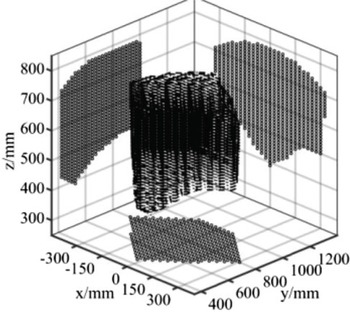
On the premise of meeting the above constraints, the workspace of this mechanism is shown in Fig. 8. The workspace of the mentioned mechanism is continuous. And the shape is approximately a regular cylinder. The projection of the working space on the three projection planes shows that this mechanism has a certain range of motion in all directions.
Workspace of the PUU-2PR(RPRR)S parallel mechanism.

4.2. Dexterity
The dexterity index is another important index to evaluate the kinematic performance of parallel mechanisms. After establishing the homogeneous dimensional Jacobian matrix, the dexterity index can be expressed as the reciprocal of Jacobian matrix’ condition number.
 \begin{equation} \kappa = \frac{{{\sigma _{\min }}}}{{{\sigma _{\max }}}} \end{equation}
where
 $\sigma _{\min }$
and
 $\sigma _{\max }$
, respectively, represent the minimum singular value and the maximum singular value of
 $\boldsymbol{{J}}$
.
Obviously, from Eq. (33),
 $0 \le \kappa \le 1$
. The larger the
 $\kappa$
is, the better the transmission performance is. On the contrary, when
 $\kappa = 0$
, the mechanism will be in a singular position and the transmission performance is the worst.
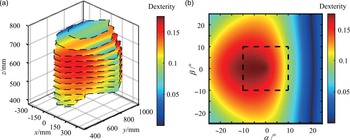
As shown in Fig. 9(a), it is the distribution of dexterity in the position workspace, when the moving platform is at a constant posture (i.e.
 $\alpha = 0^\circ$
and
 $\beta = 0^\circ$
). From Fig. 9(a), the highest dexterity appears at the center point of the workspace, that is,
 ${\boldsymbol{{O}}}_2^{\rm{dM}} ={(0\, 750\, 650)}^{\rm{T}}$
. The closer the distance to the edge of the workspace, the worse the dexterity is. To further analyze the influence of posture, Fig. 9(b) shows the distribution map of dexterity in the posture workspace, when the moving platform is at a constant position, that is,
 $\boldsymbol{{O}}_2^{{\rm{dM}}}$
. The dotted box is the required posture of this mechanism. It can be seen that the posture space of this mechanism is roughly located in the area with excellent dexterity.
Distribution map of the dexterity in workspace. (a) The distribution map of dexterity in position workspace. (b) The distribution map of dexterity in posture workspace.

4.3. Mechanism volume
Mechanism volume refers to the space occupied by the mechanism, which is directly determined by the structure layout and structure size of the mechanism [Reference Lin, Jo and Tseng47]. Mechanism volume directly affects the size of the mechanism station. Under the same working conditions, the smaller the size of mechanisms, the smaller the station reserved for mechanisms in the workshop. The energy consumption for workshop cleaning and temperature control can be also reduced to ensure the economy of the mechanism.
Mechanism volume is positively correlated with the size and number of branch chains [Reference Li, Fang, Yao and Wang48]. Due to the adoption of double-driven branch chains, the proposed mechanism reduces two branch chains compared with the traditional 5-DOF mechanism, reducing mechanism volume.
Generally, mechanism volume can be defined as a cube volume, as shown in Fig. 10. The boundary of the cube can be calculated from the limiting positions of
 $O_2$
,
 $F_1$
,
 $C_1$
(i.e.
 $O_{2\lim }$
,
 $F_{1\lim }$
and
 $C_{1\lim }$
) and
 $O_1$
in the fixed coordinate system. The calculation formula is
 \begin{equation}{V_{\rm{m}}} = h \cdot \max \{{O_{2z}}\} \cdot 2\max \{{F_{1x}}\} \end{equation}
where
 $h = \max \{{g_1}\}$
represents the height of the mechanism volume,
 $\max \{{g_1}\}$
is the distance from
 $C_{1\lim }$
to
 $O_1$
,
 $\max \{{O_{2z}}\}$
is the coordinate of
 $O_{2\lim }$
on the
 $z_1$
-axis, and
 $\max \{{F_{1x}}\}$
represents the coordinate of
 $F_{1\lim }$
on the
 $x_1$
-axis.
Schematic diagram of the mechanism volume.

5. Multi-objective optimization designs
In order to make the proposed mechanism more suitable for practical engineering, it is necessary to optimize the structural parameters to exert its best performance. In this section, a stage-by-stage Pareto optimization method is proposed to conduct multi-objective optimization design of the PUU-2PR(RPRR)S parallel mechanism.
5.1. Problem statement of multi-objective optimization
5.1.1. Performance indexes for optimization
For the proposed parallel mechanism, the optimization design would focus on working space, mechanism volume, and mechanism dexterity. Therefore, the following indicators are established based on the dimensionless principle.
Workspace volume ratio. The workspace volume ratio of this mechanism is defined as
 \begin{equation}{\lambda _1} = \frac{V_{\rm{cw}}}{V_{\rm{ow}}} \end{equation}
where
 $V_{\rm{ow}}$
and
 $V_{\rm{cw}}$
represent the workspace of the mechanism before and after optimization, respectively. And,
 ${\lambda _1} \ge 1$
means that the optimized workspace volume is larger than the original workspace volume.
Compactness. The compactness of this mechanism is defined as
 \begin{equation}{\lambda _2} = \frac{{{V_{\rm{cm}}}}}{{{V_{\rm{om}}}}} \end{equation}
where
 $V_{\rm{om}}$
and
 $V_{\rm{cm}}$
represent the mechanism volume obtained before and after optimization, respectively.
Average dexterity ratio. The workspace of the mechanism is discretized into
 $n$
points. Then the average dexterity is defined as
 \begin{equation} \begin{array}{*{20}{c}}{\bar \kappa = \dfrac{{\sum \limits _{i = 1}^n{{\kappa _i}} }}{n}} \end{array} \end{equation}
where
 $\bar \kappa$
is the average dexterity, and
 $\kappa _i$
represents the dexterity of the
 $i$
-th point.
Then, the average dexterity ratio of this mechanism is expressed as
 \begin{equation}{\lambda _3} = \frac{{\overline{{\kappa _{\rm{c}}}} }}{{\overline{{\kappa _{\rm{o}}}} }} \end{equation}
where
 $\overline{{\kappa _{\rm{c}}}}$
represents the optimized average dexterity, and
 $\overline{{\kappa _{\rm{o}}}}$
means the average dexterity calculated by the initial structural parameters.
5.1.2. Constraints for optimal design
The main purpose of optimization design is to determine each rod length of the proposed PUU-2PR(RPRR)S parallel mechanism. Here, it is notable that the sub-closed-loop (i.e. RPRR) in the double-driven branch chain is treated as a rotation driver, and main lengths of the sub-closed-loop can be derived according to the angle range of the actuated revolute joint, that is,
 $\phi _i$
. Therefore, for simplicity, the position of
 $E_i$
and
 $D_i$
(
 $i = 1,2$
) is regarded as fixed. In other words,
 $l_4$
and
 $l_5$
are set to fixed values, that is,
 ${l_4} = 200\,{\rm{mm}}$
,
 ${l_5} = 400\,{\rm{mm}}$
. As the constraints, the design variables and their value ranges are shown in Table II.
Design variables and value range of the mechanism.

5.1.3. Objective function
From the perspective of kinematic performance and economy, the objective of the optimal design is to obtain a parallel mechanism with large workspace, high compactness, and high dexterity. According to the above-defined performance indices, the larger the index
 $\lambda _1$
is, the larger the workspace of the parallel mechanism will be. The smaller the index
 $\lambda _2$
is, the better the compactness of the parallel mechanism is. And the larger the index
 $\lambda _3$
is, the better the dexterity of the parallel mechanism will be. Therefore, for consistency, the objective function of the multi-objective optimization problem can be defined as
 \begin{equation} f(\boldsymbol{{X}}) = \max ({f_1},{f_2},{f_3}) = \max \left({\lambda _1},\frac{1}{{{\lambda _2}}},{\lambda _3}\right) \end{equation}
where
 $\boldsymbol{{X}}$
is the vector composed of design variables.
5.2. Optimization method
Pareto optimization is a widely applied method of multi-objective optimization, and the set of all optimal solutions produced by Pareto optimization is called the Pareto front. All solutions on the Pareto front can be treated as equally good [Reference Miranda and Zuben49]. However, how to select the final optimization solution on the Pareto front will be a difficult problem. Generally, the performance graph produced by the Pareto front is utilized to select the final optimization result [Reference Wu, Wang and You50]. The performance graph graphically presents the relation between design variables and the performance indices. And for the optimization design with two objective functions, the Pareto front is a curve. However, for the optimization design with more than two objective functions, the Pareto front is usually a hypersurface, so its performance graph cannot be visually displayed [Reference De Oliveira, Delgado and Britto51].
The traditional Pareto optimization method directly obtains the Pareto front which contains all the indexes, but it cannot be displayed intuitively by the graph. To solve this problem, this paper proposed to convert the traditional Pareto optimization problem with multiple objectives into a stage-by-stage Pareto optimization problem, as shown in Fig. 11. The stage-by-stage Pareto optimization only should determine the priority of each optimization index according to the design requirements. The Pareto front between two indexes is obtained at each stage and the optimized space can be reduced stage by stage.
Flowchart of multi-objective optimization.

For clearly, main steps of the proposed stage-by-stage Pareto optimization are presented as follows.
-
Step 1. After the priority of optimization indexes is determined, single-objective optimization is carried out with
 $\lambda _1$
to determine the upper limit of
$f_1$
.
-
Step 2. Pareto front of
$f_1$
and
$f_2$
is obtained by the first stage Pareto optimization. This determines the range of
$f_2$
in the second stage Pareto optimization. -
Step 3. According to the step 2, Pareto optimization of the following stage is carried out, until the Pareto front of
$f_{n - 1}$
and
$f_n$
is obtained, where
$n$
is the number of optimization indexes.


From Fig. 11, the final optimization result can be selected on the Pareto front of the final stage. The specific calculation process will be given in the next section with a numerical simulation.
5.3. Final optimized result using stage-by-stage Pareto
In order to verify the proposed multi-objective optimization method, the PUU-2PR(RPRR)S parallel mechanism is taken as an example.
According to the flowchart of multi-objective optimization as shown in Fig. 11, a single objective algorithm with
 $f_1$
should be conducted first. Here, the PSO is applied, and the corresponding flowchart is shown in Fig. 12. It is notable that different from the traditional PSO algorithm, the concept of particle aggregation degree [Reference Rios, Hernandez and Valdez52] is introduced to avoid the local optimal solution. Figure 13 shows the change law of
 $\lambda _1$
, and the value of
 $\lambda _1$
has converged to the optimal solution after 300 iterations. The maximum value of
 $\lambda _1$
is 3.28. It is taken as the upper limit of
 $f_1$
in the first stage Pareto optimization.
Flowchart of particle swarm optimization algorithm.

The optimization results of
 $\lambda _1$
.

The stage-by-stage Pareto is also optimized using PSO. Figure 14(a) shows the Pareto front of first stage. The intersection of
 ${f_1} \ge 1$
and
 ${f_2} \ge 1$
on the Pareto front (i.e. the set of solid points in Fig. 14(a)) is the region where both objectives are optimized. Here, points
 $\boldsymbol{{A}}=\left [{\begin{array}{*{20}{c}}{f_{_{1{\rm{m}}}}^{\textrm{I}}}&{f_{_{{\rm{2M}}}}^{\textrm{I}}} \end{array}} \right ]$
and
 $\boldsymbol{{B}}=\left [{\begin{array}{*{20}{c}}{f_{_{1{\rm{M}}}}^{\textrm{I}}}&{f_{_{{\rm{2m}}}}^{\textrm{I}}} \end{array}} \right ]$
are two boundary points in this region as shown in Fig. 14(a).
The Pareto front of stage-by-stage Pareto. (a) The first stage. (b) The second stage.

In order to further reduce interval of feasible solutions, the minimum values of
 $f_1$
and
 $f_2$
that meet the optimization requirements can be set. The setting principle can be expressed as
 \begin{equation} \begin{array}{*{20}{c}}{f_{_{i\rm{m}}}^{\textrm{I}\textrm{I}} = f_{_{i\rm{m}}}^{\textrm{I}} +{\varepsilon _i}\left(f_{_{i\rm{M}}}^{\textrm{I}} - f_{_{i\rm{m}}}^{\textrm{I}}\right)}&{(i = 1,2,3)} \end{array} \end{equation}
where
 $\varepsilon _i$
is the optimized proportion of the
 $i$
-th index. It is set according to the optimization requirements. The range of
 $\varepsilon _i$
is
 $0 \le{\varepsilon _i} \le 1$
. And in this example, the values of
 $\varepsilon _1$
and
 $\varepsilon _2$
are, respectively, set to 0.3 and 0.1, then
 $f_{1{\rm{m}}}^{\textrm{I}\textrm{I}}$
and
 $f_{2{\rm{m}}}^{\textrm{I}\textrm{I}}$
can be obtained. The range of the next stage of Pareto optimization is determined by the maximum and minimum values of
 $f_2$
in the intersection of
 ${f_1} \ge f_{1{\rm{m}}}^{\textrm{I}\textrm{I}}$
and
 ${f_2} \ge f_{{\rm{2m}}}^{\textrm{I}\textrm{I}}$
(i.e. the blue solid dot area in Fig. 14(a)).
On the premise that
 ${f_1} \ge f_{1{\rm{m}}}^{\textrm{I}\textrm{I}}$
, the Pareto front of the second stage can be obtained, as shown in Fig. 14(b). The Pareto front of
 $f_2$
and
 $f_3$
is reduced in the same way.
 $f_{{\rm{3m}}}^{\textrm{I}\textrm{I}}$
can be calculated by setting
 ${\varepsilon _3} = 0.3$
. The intersection of
 ${f_2} \ge f_{{\rm{2m}}}^{\textrm{I}\textrm{I}}$
and
 ${f_3} \ge f_{3{\rm{m}}}^{\textrm{I}\textrm{I}}$
is chosen as the optimal solution set (i.e. the blue solid dot area in Fig. 14(b)).
All the points in the optimal solution set meet the requirements of the optimal design. In order to select the final solution, ref. [Reference Luan, Zhang, Gui, Zhang, Lin and Wu19] proposed to establish a comprehensive performance index. In other words, the final optimization result can be selected by normalizing the performance index. Each performance index can be specified as
 \begin{equation} {f_i^{\rm{N}} = \frac{{f_i^{} - f_{i\rm{m}}^{}}}{{f_{i\rm{M}}^{} - f_{i\rm{m}}^{}}}} {(i = 1,2,3)} \end{equation}
where
 $f_i^{\rm{N}}$
is the established normalized performance index.
 $f_{i\rm{M}}^{}$
and
 $f_{i\rm{m}}^{}$
are, respectively, the maximum and minimum values of the
 $i$
-th objective function on the Pareto front after reduction in Fig. 14(b).
 \begin{equation} f = f_2^{\rm{N}} + f_3^{\rm{N}} \end{equation}
The higher the value of
 $f$
is, the better the comprehensive performance of the mechanism is. Therefore, the solution with the best comprehensive performance in the optimal solution set is chosen as the optimal solution. Its structural parameters and corresponding indexes are shown in Table III.
Parameters and performance indices of the final solution.

Based on the optimized structural parameters, the optimal mechanism is obtained. The kinematic performance of the mechanism is improved. Workspace volume is increased by 25
 $\%$
, average dexterity is increased by 36
 $\%$
, and the volume of the mechanism is reduced by 7
 $\%$
.
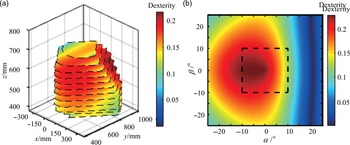
Figure 15 shows the distribution map of the optimized dexterity. The dexterity is more evenly distributed compared to Fig. 9(a) in the same posture, and the maximum dexterity has been improved from 0.165 to 0.206 in the position workspace. Figure 15(b) shows dexterity of
 $O_2^{{\rm{dM}}}$
in posture workspace. Compared with Fig. 9(b), the distribution trend of dexterity does not change, but its maximum dexterity is improved from 0.169 to 0.220.
Distribution map of optimized dexterity. (a) The distribution of the optimized dexterity in position space. (b) The distribution of the optimized dexterity in posture space.

6. Conclusions
This paper focuses on the design and multi-objective optimization of a 5-DOF double-driven parallel mechanism. The main contributions are (1) a novel PUU-2PR(RPRR)S parallel mechanism with two double-driven chains is proposed. This 5-DOF parallel mechanism has less branch chains (i.e. three branch chains), reducing interference between branch chains. (2) A multi-objective optimization method based on modified stage-by-stage Pareto is presented to improve multiple kinematics indexes. The proposed stage-by-stage Pareto can achieve intuitive selection of optimization results, reducing the difficulty of selecting final optimization result from the Pareto front. Conclusions of this paper can be drawn as follows.
Firstly, based on the idea of double-driven chains, the novel PUU-2PR(RPRR)S mechanism is proposed. On the premise of guaranteeing the number of DOF, the number of branch chains is reduced, simplifying mechanism’s structure and reducing interference between branch chains. The DOF of this mechanism is analyzed by using screw theory, which shows that the proposed mechanism has five independent DOFs and a parasitic motion. Secondly, according to the geometric characteristics of this mechanism, the analytic form of inverse kinematics solution is derived. Then the 5
 $\times$
5 homogeneous Jacobian matrix is obtained by transforming actuator velocities into linear velocities at three points on the moving platform. Furthermore, kinematics characters of the mechanism are analyzed. The proposed mechanism has a continuous and regular workspace. Due to less number of branch chains, the mechanism has the advantages of small size, better economy, and higher compactness. And it has high dexterity in both posture space and position space. Finally, a modified stage-by-stage Pareto optimization method is proposed to solve the multi-objective optimization problem of the parallel mechanism. As the main improvement, the multi-objective optimization of three or more objectives is transformed into a stage-by-stage Pareto optimization method with only two objectives in each stage. Therefore, the optimization range of each objective can be intuitively selected in the form of performance graph, thus reducing the difficulty of selecting the final optimization results from the Pareto front. After the optimization, optimal structural parameters of the mechanism are obtained. The volume of working space is increased by 25
 $\%$
, average dexterity increased by 36
 $\%$
, and volume of the mechanism is reduced by 7
 $\%$
. These results also prove the effectiveness of the proposed stage-by-stage Pareto optimization method.
In order to further promote the practical engineering application of this proposed novel 5-DOF parallel mechanism as a machine tool, stiffness modeling and analysis will be focused in our future work. Multi-objective optimum design also will be systematically studied by considering both kinematic and stiffness performance indexes.
Author contributions
Xuhao Wang was in charge of the whole design and analyses. Yufei Lin wrote the manuscript and also took part in the design and analyses. Yiran Cao and Mengli Wu took part in writing the manuscript. Shuo Sun helped in data analyses. All authors read and approved the final manuscript.
Financial support
This work was supported by the Fundamental Research Funds for the Central Universities (No. 3122020030).
Competing interests
The authors declare none.