Introduction
Behavioral and psychological symptoms of dementia (BPSD) have a significant impact on quality of life for both the person with dementia and those who care for them. As the disease progresses, most people with dementia will experience at least one type of BPSD (Brodaty et al., Reference Brodaty2001). These may include wandering, verbally disruptive behaviors (calling out), disinhibition, anxiety, aggression, agitation, or psychosis.
Antipsychotic medications, developed for the treatment of acute psychoses in the context of schizophrenia and bipolar disorder (Kane and Correll, Reference Kane and Correll2010), are often used to manage BPSD. Modest benefits with antipsychotic medications have been demonstrated for agitation, aggression (Ballard et al., Reference Ballard2009) and hallucinations, and delusions (Katz et al., Reference Katz, Jeste, Mintzer, Clyde, Napolitano and Brecher1999). The effects of these medications on function and quality of life have received less attention.
Rates of antipsychotic prescribing for people with dementia, who live in long-term care (LTC) facilities, remain high: 28% in Australia, 22% in the USA and just over 20% in the UK (Snowdon et al., Reference Snowdon, Galanos and Vaswani2011; Briesacher et al., Reference Briesacher, Tjia, Field, Peterson and Gurwitz2013; Maguire et al., Reference Maguire, Hughes, Cardwell and O'Reilly2013). In 2009, a report into this issue commissioned by the NHS in England estimated just one in five people with dementia treated with antipsychotics were deriving any benefit (Banerjee, Reference Banerjee2009). Concern about the use of antipsychotics in older people, and particularly those with dementia, is driven mainly by their potential adverse effects as well as their limited efficacy. Adverse effects include over-sedation, anticholinergic actions (e.g. constipation and dry mouth resulting in poor oral health and delirium), pneumonia, parkinsonism, falls, hospitalization, accelerated cognitive decline, and higher rates of stroke and death (Zaudig, Reference Zaudig2000; Ballard et al., Reference Ballard2009).
Two key antipsychotic withdrawal studies in people with dementia delivered mixed results. In Ballard et al.'s (Reference Ballard2008 and Reference Ballard2009) double-blind randomized withdrawal trial, the majority of people who discontinued antipsychotic medication (placebo) experienced no negative effects on function, cognition or BPSD; showed improved cognition and had lower mortality at 6 and 12 months. Cognition assessed using the Standardized Mini-Mental State Examination (Folstein et al., Reference Folstein, Folstein and McHugh1975) was also better in the placebo group at follow-up. However, Devanand et al. (Reference Devanand2012) reported re-emergence of behavioral symptoms when antipsychotics were withdrawn, and in Ballard et al.’s study, a small sub-group with more severe BPSD had symptom relapse. A possible reason for the difference between these studies is the selection of participants randomized. In Devanand et al. (Reference Devanand2012), participants were recruited from a variety of sources, were outpatients or residents of LTC facilities and were prescribed an antipsychotic (risperidone) within the context of agitation or psychosis in Alzheimer's disease; only “responders” were randomized to continuation or placebo. By contrast, Ballard et al. randomized LTC residents already taking any antipsychotic for more than 3 months for any type of BPSD to participate in the randomized withdrawal trial. While Devanand et al. (Reference Devanand2012) provide rigorous outcomes for ideal, appropriate use of antipsychotics for BPSD, the dilemma is that in routine care these drugs are often used first line for any BPSD and for long periods without regular review, despite being indicated for severe agitation/aggression and psychotic symptoms; as in Ballard et al.'s (Reference Ballard2009) study.
Many reasons exist for the potentially excessive and often inappropriate use of antipsychotic and other psychotropic medications to manage BPSD (Cornegé-Blokland et al., Reference Cornegé-Blokland, Kleijer, Hertogh and van Marum2012; Hilmer and Gnjidic, Reference Hilmer and Gnjidic2013), including the perceived (but erroneous) lack of evidence for non-pharmacological alternatives (Cabrera et al., Reference Cabrera2015). In this context, “inappropriate,” refers to prescribing not in line with current clinical and best practice guidelines; including indication, dose, and duration. To assist clinician decision-making in regard to prescribing antipsychotics, the NSW Health Guidelines (The Royal Australian & New Zealand College of Psychiatrists, 2013) recommend employing the “3 T approach” to prescribing: Target behaviors that potentially respond to antipsychotics; Titrate the dose carefully starting low and monitoring for side effects; and Time limit the use of antipsychotics. Other barriers to good prescribing include, resistance to practice development, negative attitudes towards people with dementia, pressure from nurses and other LTC staff on general practitioners (GPs) to “do something” about BPSD, and a lack of skills and resources for both GPs and direct care staff to implement alternatives (Hinton et al., Reference Hinton, Franz, Reddy, Flores, Kravitz and Barker2007; Kada et al., Reference Kada, Nygaard, Mukesh and Geitung2009; Ervin et al., Reference Ervin, Cross and Koschel2014). Further to this, nurses and GPs may be reluctant to instigate medication review and the potential for antipsychotic withdrawal of newly admitted residents because of limited clinical information on presentation (O'Connor et al., Reference O'Connor, Griffith and McSweeney2010).
Non-pharmacological behavior management is recommended as a first-line treatment approach for BPSD (Azermai et al., Reference Azermai, Petrovic, Elseviers, Bourgeois, Van Bortel and Vander Stichele2012). The person-centered approach to dementia care is an effective way of preventing and reducing BPSD (Fossey et al., Reference Fossey2006; Edvardsson et al., Reference Edvardsson, Winblad and Sandman2008; Chenoweth et al., Reference Chenoweth2009; Brooker et al., Reference Brooker2016). Challenges to implementing person-centered dementia care focus on critical buy-in from LTC executives, management, and staff in terms of time, money investment, and commitment to culture change (McCormack et al., Reference McCormack2010; Chenoweth et al., Reference Chenoweth2014).
Against this background, the Halting Antipsychotic use in Long-Term care (HALT) project aims to “deprescribe” antipsychotic medications through a multi-component intervention, including promotion of person-centered care in participating LTC facilities. Deprescribing is the “process of tapering or stopping of drugs aimed at minimizing polypharmacy and improving outcomes” (Scott et al., Reference Scott2015). This implies a more complex protocol of review, planning, and follow-up than merely cessation or withdrawal of a drug as described in the studies mentioned. Given the barriers to deprescribing antipsychotics and the conflicting results in the two influential studies mentioned, we considered that deprescribing would require both person-centered dementia care education for direct care staff, as well as GP education on antipsychotic prescribing and subsequent risks.
The HALT project aims to achieve a reduction in inappropriate use of antipsychotic medications in participating LTC facilities without re-emergence of BPSD and without use of substitute psychotropic prescribing. Based on Banerjee's estimate of benefit, we hypothesize that sustained (12-month) deprescribing (defined as cessation or a dose reduction), can be achieved for at least half of residents living in LTC prescribed antipsychotics regularly. This will be without an associated rise in BPSD when care staff use person-centered dementia care approaches at the same time that the resident's GP employs a recommended deprecribing protocol.
Methods
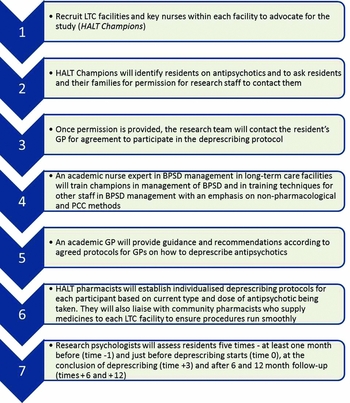
The HALT project is a single-arm longitudinal study involving LTC facilities from the greater Sydney area and their staff and residents, GPs, and pharmacists. Study approval was obtained from the lead institution's Human Research Ethics Committee (approval number HC13203). The trial was registered with the Australian New Zealand Clinical Trials Registry (ANZCTR), number 12614000309684. The protocol includes several steps as outlined in Figure 1 and detailed below.
Steps involved in the HALT protocol from appointment of a HALT Champion within each LTC facility, to identification of potential participants and through to follow-up. Further details provided in the text. Abbreviations: LTC – long-term care; GP – general practitioner (primary care physician); BPSD – behavioral and psychological symptoms of dementia; PCC – person-centered care.

Participants
A sample of LTC facilities from across greater Sydney, Australia, with more than 60 beds will be approached to participate. We aim to recruit facilities that are diverse in size, funding source and geographical location. To be eligible to participate, LTC facilities require agreement from the Director of Nursing (DON) or equivalent manager, and must appoint at least one HALT Champion. The HALT Champion will be a registered nurse, who is committed to the requirements of the project, including training other staff in person-centered care approaches, identifying potential residents to participate in the intervention, and monitoring participants throughout the duration of the project. A position description for HALT Champions will be circulated to participating LTC facilities' DONs who will be responsible for selecting suitable candidates (see supplementary/appendix, available as supplementary material attached to the electronic version of this paper at www.journals.cambridge.org/jid_IPG).
Champions will be asked to establish a list of all potential participants within their facility according to the following eligibility criteria: resident aged 60 years or older; taking an antipsychotic regularly for >3 months; residing at the LTC facility for at least one month; and not having a primary psychotic mental illness (e.g. schizophrenia and bipolar disorder). Two additional eligibility criteria will be checked following contact with potential participants’ family members/designated carer. The first of these is an agreement from the resident's GP to review antipsychotic prescribing and follow the study deprescribing protocol; this is a requirement of the Australian Aged Care Act (www.legislation.gov.au/Details/C2014C00698), which governs all Australian accredited LTC facility protocols. Residents will not be eligible to participate if their GP does not agree that they are suitable for deprescribing, or does not wish to be involved with the deprescribing and follow-up. Second, in view of greater likelihood of recurrence of BPSD in those with more severe symptoms (Ballard et al., Reference Ballard2009), residents meeting criteria for extreme severity (see below) will be excluded.
Participants’ current BPSD will be assessed using the Neuropsychiatric Inventory–Nursing Home edition (NPI–NH) (Cummings et al., Reference Cummings, Mega, Gray, Rosenberg-Thompson, Carusi and Gornbein1994). Threshold NPI scores for exclusion due to severe BPSD will be based on the Australian Government's “Dementia Supplement,” which is an additional payment to LTC facilities based on residents that exhibit “severe” behaviors (active during study planning but no longer operational). Information on the Dementia Supplement can be found at https://www.dss.gov.au/sites/default/files/files/about-fahcsia/publication-articles/foi/14_15_014/doc_011_0.pdf. Accordingly, “severe” BPSD are characterized by a total NPI score >50, individual domain scores ≥12 in >2 of five of the domains, delusions, hallucinations, agitation/ aggression, anxiety and disinhibition, and an occupational disruptiveness score ≥4 for > 2 of the domains above.
Consent
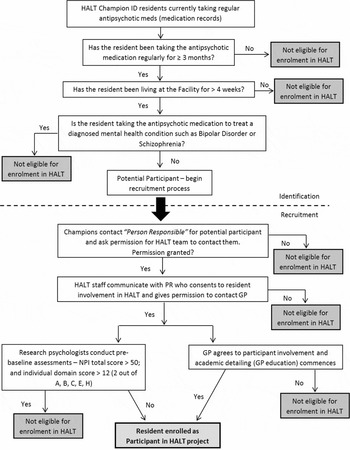
In New South Wales, Australia, the Guardianship Act provides a hierarchy of people who can give proxy consent for a person who, because of disability, is unable to consent to treatment themselves; the proxy is called the Person Responsible. Following the identification of potential participants within their LTC facility, Champions will be asked to contact residents’ person responsible and ask for their assent to allow the study team to contact them regarding participation, in accordance with approved ethical procedures. If verbal assent to contact is given, details of the resident and person responsible will be passed to the research team. The study team will contact assenting persons responsible by telephone unless otherwise requested. During this first contact, the team member will introduce the project aims, respond to questions or concerns from the person responsible and obtain verbal assent to contact the potential participant's GP. If in agreement, a study Participant Information Statement and Consent Form will be posted to the person responsible who will be given at least two weeks to respond, after which a follow-up phone call will be made. During this period, the study team will be in touch with the potential participant's GP to establish suitability for deprescribing and agreement. Once consent has been obtained, the first assessment will be scheduled. In the event that a potential participant is deemed by senior LTC staff to have capacity to consent, then the same process will be followed with the resident rather than with the person responsible. See summary of the participant identification and recruitment process in Figure 2.
HALT participant identification and recruitment flow chart, which depicts the procedure involved in identifying potential participants for deprescribing and the recruitment process passing from HALT Champion to the research team. Abbreviations: PR – person responsible; GP – general practitioner (primary care physician); NPI – Neuropsychiatric Inventory.

Interventions
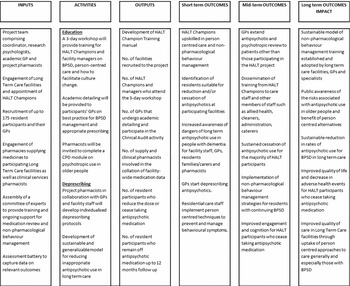
The intervention will consist of two components: training and education of LTC staff and clinicians, and deprescribing antipsychotic medications, a summary of which is presented in Figure 3. Education will be offered to Champions, GPs of participants and pharmacists involved in supply of medicines or clinical services to participating facilities. All training will occur prior to the initiation of deprescribing for residents within each facility; details are provided below. The deprescribing intervention will commence on a rolling basis contingent upon receipt of consent and any facility requirements (i.e. Champions may wish to limit the number of residents undergoing deprescribing at one time).
Program Logic Model of HALT interventions. The HALT protocol includes a complex process combining an education intervention with the deprescribing intervention (“activities”). Abbreviations: BPSD – behavioral and psychological symptoms of dementia; GP – general practitioner (primary care physician).

Champion training
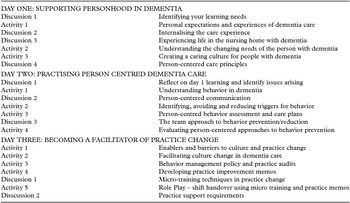
To support deprescribing for participating residents, Champions, and where possible a facility manager, will attend a 3-day workshop facilitated by an experienced professor of aged care nursing (LC) at the commencement of the facility's involvement. This workshop will be the first step in a “train-the-trainer” approach to provide education to all staff within participating LTC facilities. This workshop will provide Champions with information about dementia, BPSD, person-centered, non-pharmacological approaches to BPSD prevention, and reduction. In addition, Champions will learn techniques in up-skilling other staff and operationalizing practice change, and will be provided with a manual of resources to support this task. This includes information on creating 5-minute “micro-tutorials” that can be used to relay information on strategic person-centered approaches for individual residents at staff handover times, and activities designed to improve documentation and care planning for residents using a person-centered approach (Table 1). Following the 3-day workshop, Champions, along with support from their manager, are expected to implement these training strategies so that all staff in participating areas of the facility are working together on the person-centered care approaches by the time resident deprescribing commences. Participating facilities will be financially compensated for the time invested by Champions to complete training and HALT-related duties. It will be an expectation that upon agreeing to participate in the study, LTC facility managers support Champions to quarantine time and provide relief from normal duties for HALT activities with the understanding that this time can be claimed. The HALT coordinator will be in regular contact with Champions, especially during the deprescribing period. This will be primarily via email, however, Champions will be free to contact the coordinator by telephone or arrange for the coordinator to visit the facility at any time. Research psychologists will also be available to discuss participant progress during their visits to each facility. Should BPSD re-emerge following deprescribing, or Champions have any other concerns about the well-being of participants, the HALT team will utilize their expertise to provide extra support to Champions as needed, primarily via authors HB (psychogeriatrician) and LC (specialist nurse). Monthly multi-disciplinary team meetings will be held involving HB, AS (academic GP), research psychologists and project coordinator, at which cases will be presented and discussed to determine eligibility, report information provided by Champions and to determine advice to be given to Champions.
Program for HALT Champion 3-day training workshop. HALT Champions were provided with a comprehensive training folder containing educational material as well as activities and worksheets to be completed over the training period

General practitioner education
A Category 1 Clinical Audit has been established by the project team and approved by the Royal Australian College of General Practitioners (RACGP) under their Quality Improvement and Continuing Professional Development Program (activity number 23359). This activity is designed to promote regular antipsychotic review and update GPs’ knowledge of current best practice in this area. To fulfill the conditions of the audit, participants’ GP's will be offered academic detailing by the project GP (AS). This will involve a 30–60 minute education session accompanied by reading material on antipsychotic use in people with dementia provided via the National Prescribing Service. GPs will be required to undertake medication reviews for their patients living in LTC and will participate in a follow-up educational seminar and evaluation. Australian GPs are required to undertake a minimum number of Quality Improvement and Continuing Professional Development activities every three years. GPs not wishing to participate in the activity will be offered reimbursement for the time invested reviewing and making appropriate changes to their resident participants’ medication.
Pharmacist education
A Continuing Professional Development module will also be offered to pharmacists, who dispense medicines for each participating LTC Facility (Westbury, Reference Westbury2014).
Deprescribing intervention
Current antipsychotic prescription information for eligible and consented residents will be forwarded to HALT project pharmacists following the first data collection point – “Pre-baseline” (see below). An individualized deprescribing protocol will be developed for each participant, following a general rule of reducing the dose by 50% every two weeks and then ceasing after two weeks on the minimum dose, in line with current clinical guidelines (Royal Australian and New Zealand College of Psychiatrists, 2011). All deprescribing will be completed within a maximum period of 12 weeks. If a participant is taking more than one antipsychotic, only one will be withdrawn at a time, leaving risperidone (if prescribed) to be withdrawn last. Risperidone is the only antipsychotic approved in Australia for use for behavioral symptoms, specifically aggression and psychosis, in persons with dementia. Individualized deprescribing protocols will be sent to the participant's GP for approval prior to the Baseline assessment (see below), shortly after which deprescribing will commence. Once deprescribing starts, Champions will be responsible for close monitoring of the participant and informing the research team about any issues or recurrence of BPSD. If an increase in behavioral disturbances such as agitation or psychotic symptoms are experienced following deprescribing, Champions and staff will be encouraged to follow best practice guidelines and implement person-centered non-pharmacological strategies suggested during HALT training. GPs will be given the option of including a PRN (as required) order of an appropriate benzodiazepine as “rescue medication,” according to current Best Practice Guidelines (Peisah et al., Reference Peisah, Chan, McKay, Kurrle and Reutens2011; The Royal Australian & New Zealand College of Psychiatrists, 2013), i.e. to be used in case of an acute behavioral disturbance that cannot be managed using the non-pharmacological interventions and/or if there is a risk to the participant and/or those around them. If BPSD recur and all person-centered non-pharmacological interventions fail then the GP will review the resident and antipsychotic therapy may be restarted. During academic detailing at the commencement of participation, GPs will be informed of current guidelines for commencing an antipsychotic (Royal Australian and New Zealand College of Psychiatrists, 2011); it is expected that these guidelines will be followed if recommencement is indicated.
Data collection
The first assessment will be scheduled following receipt of written consent from the residents’ Person Responsible or from the residents themselves, if they have capacity. Below is the timeline for data collection for participants.
-
T−1 Pre-baseline (approximately 1 month prior to baseline; all assessments and data collection plus demographic information, NPI to confirm eligibility)
-
T0 Baseline (deprescribing to commence within 7–10 days following)
-
T+3 Post 3 months from baseline
-
T+6 Follow-up 6 months from baseline
-
T+12 Follow-up 12 months from baseline
At each time point, data will be collected from LTC facility records, staff interview and resident interview if capable. Additional items relating to demographics and medical history, including vision and hearing status plus LTC facility admission details will be collected from resident files during the first visit (Table 2).
Demographic information collected from HALT participants at the pre-baseline assessment

Re-prescribing
Based on previous studies, the risk of relapse of behavioral symptoms is acknowledged (Devanand et al., Reference Devanand2012) and there may be participants for whom antipsychotic medication will be re-prescribed following reduction or cessation. In the instance, where re-prescribing is deemed appropriate, LTC staff will follow usual practices and contact the participant's GP or medical specialist for review. If re-prescribing an antipsychotic is indicated, it will be recommended that the initial dose be low and titrated slowly, consistent with guidelines (Royal Australian and New Zealand College of Psychiatrists, 2011). Following this, GPs, HALT Champions/LTC staff, and persons responsible will be asked to complete a short questionnaire about the events leading up to the medication re-instatement with the aim of understanding the factors that may predict re-prescribing.
Assessment Tools
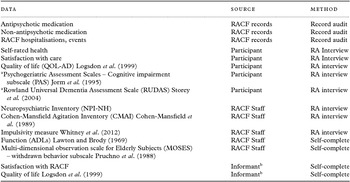
Trained research psychologists will undertake assessments with staff and residents using a variety of validated tools to collect data on resident quality of life, agitation, engagement, activities of daily living, and current BPSD (Table 3) (Lawton and Brody, Reference Lawton and Brody1969; Pruchno et al., Reference Pruchno, Kleban and Resch1988; Cohen-Mansfield et al., Reference Cohen-Mansfield, Marx and Rosenthal1989; Jorm et al., Reference Jorm1995; Logsdon et al., Reference Logsdon, Gibbons, McCurry and Teri1999; Storey et al., Reference Storey, Rowland, Conforti and Dickson2004; Whitney et al., Reference Whitney, Close, Lord and Jackson2012). Inter-rater reliability analysis will be carried out. Resident file audits will be undertaken at each time point to collect data on documented incidents of aggression, falls, hospitalizations, and medical diagnoses. Current medication data on drug name, dose, and frequency for all prescription medicines will be collected at each time point and for the 12 months preceding the trial from residents’ medication charts. Non-prescription medication data will also be collected but will exclude creams, eye drops, mouth washes, and vitamin supplements.
Data collection list organized by collection method (record audit, resident assessment, staff interview, and person responsible self-complete). Medication data and information on adverse events such as hospitalizations will be collected at each time-point. For the pre-baseline assessment, this will take in the previous 12 months; for subsequent assessments data will be collected for the intervening period. Validated assessment tools will be used to collect data on neuropsychiatric symptoms, agitation, function, cognition, impulsivity, engagement, and quality of life across all time-points. Abbreviations: RACF – residential aged care facility; RA – research assistant

Notes: aParticipants only complete one of PAS or RUDAS. RUDAS is an alternative for people with English as a second language.
bPR informant to provide these data if consented to participation for themselves in addition to resident.
Facility-wide psychotropic prescribing
Facility-wide psychotropic medication usage will be collected for each participating LTC facility 12 months prior to commencement of involvement, at commencement and 6 and 12 months following. This will include name of drug, dose, and frequency for antianxiety drugs, antidepressants, anticonvulsants, antiemetics, sedative agents, and medication for movement disorders (ATC codes N05 and N06A). Quality Use of Medicines (QUM) pharmacists for each facility will be invited to supply this information via a Psychotropic Drug Use Evaluation report. This is not a compulsory activity for QUM pharmacists servicing LTC facilities in Australia and is dependent on the request of the facility; however, this activity is often included in the annual contracted services. The report provides information on drug class, type, and dose for each resident at a given point in time though formats vary between pharmacists. Medication usage from each facility will be compared with national averages as well as between HALT facilities. LTC facility-specific information, such as size, staffing ratios, GP policy, organizational structure, and geographic location will also be collected.
Data analysis
Sample size
Approximately 1,600 aged care residents will be screened from 12–18 LTC facilities. We predict up to 30% (n = 480) of residents will be prescribed long-term antipsychotics, and thus eligible to participate, based on previously published local data (Snowdon et al., Reference Snowdon, Galanos and Vaswani2011). We anticipate deprescribing for 175 residents on long-term antipsychotics, based on a recruitment rate of 40%. Allowing for 25% withdrawals over 12 months (based on similar sample and study duration in literature) (Barca et al., Reference Barca, Engedal, Laks and Selbaek2010; Ballard et al., Reference Ballard2016), this sample size (approx. n = 131 after accounting for attrition) provides 82% power to demonstrate a reduction of at least 25% in antipsychotic use (proportion test; effect size = 0.25, α = 0.05). To detect an effect size of 0.50, this sample size will result in >95% power.
Statistical methods
SPSS version 22 will be used for data analysis. Statistical significance will be set at 0.05 for the primary outcome. Demographic factors and clinical characteristics of all participants will be summarized as counts and percentages for categorical variables and as means ± SD or median and IQR for normally or non-normally distributed continuous variables, respectively. Non-normally distributed outcome measures will be transformed. Missing covariate data will be imputed using the multiple imputation procedure in SPSS. Variables that will be included in the multiple imputation are socio-demographics, medical history, and other potential covariates in the analyses. Other pre-baseline covariates will be included in multiple imputation. Depending on the actual percentage of missing values, we will perform four to ten imputations.
Outcome measures
The primary outcome measure will be reduction of regular antipsychotic medication without use of substitute psychotropic medications. The doses of different antipsychotic medications administered to each participant at all time-points, will be converted into olanzapine-equivalent doses (Leucht et al., Reference Leucht, Samara, Heres, Patel, Woods and Davis2014) allowing for standardized measure of the primary outcome across all participants. Time on or off antipsychotics post intervention will be monitored and this outcome will be dichotomized, either based on deprescribing (complete cessation) of antipsychotic medication, or a dose reduction. The intervention will be considered successful, if antipsychotic use can be reduced for at least 50% of participants and sustained for 12 months. Secondary outcome measures will be NPI total and domain scores (Cummings, Reference Cummings1997) and CMAI total score (Cohen-Mansfield et al., Reference Cohen-Mansfield, Marx and Rosenthal1989) as well as adverse events, including falls and hospitalizations. Secondary outcome measures will be analyzed over time using multi-level linear models, which take correlations between repeated measures into account. Data gathered from the period prior to baseline will allow us to compare changes pre and post-deprescribing for all participants. Covariates for each model will be identified through univariate testing of their association with dependent variables. In this model, differences across participants and across care facilities will be handled as random effects, and time will be handled as a fixed variable. We hypothesize that antipsychotic reduction will not be accompanied with a significant rise in BPSD.
Discussion
Prescription of antipsychotics for people experiencing BPSD is a significant concern due to the growing evidence for adverse events such as increased risk of stroke and death (Brodaty et al., Reference Brodaty2003; Ballard and Waite, Reference Ballard and Waite2006). Interventions to reduce the inappropriate use of antipsychotics for BPSD are challenging for LTC facilities because of the resources needed: LTC staff time plus the cost of training in non-pharmacological behavior management, as well as the need for culture change to facilitate implementation of training. While government guidelines and quality standards are promoting a shift to person-centered care approaches for the person with dementia in LTC, as well as in acute care settings (National Institute for Health and Care Excellence, 2006; Australian Commission on Safety and Quality in Health Care, 2011; Australian Government, 2015), the current systems require a number of structural changes to accommodate this approach.
We anticipate barriers to staff's ability to adopt person-centered non-pharmacological approaches to preventing and reducing BPSD, as has occurred in similar studies, where low-level commitment and engagement from LTC executive and management have disabled direct care staff's attempts to individualize resident care and collectively work on strategies to prevent or reduce the psychosocial triggers for BPSD. Without the strong support of managers and reallocation of resources, the Champions will be unable to spend the required amount of time on the project due to competing priorities. Another potential issue will be the ambivalence, concern, or refusal by GPs and families/carers to allow the resident's medications to be deprescribed (Stein-Parbury et al., Reference Stein-Parbury, Chenoweth, Jeon, Brodaty, Haas and Norman2012; Chenoweth et al., Reference Chenoweth2015). In taking a holistic, multi-disciplinary approach to deprescribing, HALT will attempt to address some of these barriers and improve communication between LTC management and staff, clinicians, and families, not only relating to BPSD and antipsychotic use, but also more generally to improve the care and well-being of residents living in LTC facilities.
Limitations of the study include the single-arm longitudinal design rather than a randomized controlled trial, meaning higher risk of bias and making findings difficult to generalize. Taking into account the idiosyncratic nature of dementia, however, our repeated measures approach may have more “real world” applicability and be more sensitive to the effect of deprescribing on individual residents. There is also potential for any positive effects of deprescribing to be masked by the natural decline in resident cognition, health and/or function over the 12-month follow-up period. A number of requirements within the protocol rely heavily on Champion time investment, commitment, and an unbiased approach to identification of potential participants. Being bound by ethical responsibilities, recruitment at arms-length is necessary and thus the importance of following the established eligibility criteria will be reiterated to Champions by the research team. The potential for Champions and GPs to be subjective when nominating residents for participation will be taken into account in the analysis. Should the results using the recruitment protocol demonstrate feasibility and safety of deprescribing antipsychotics in the context of BPSD, it will be useful to look at applying the model more generally to remove any potential bias created by the GP and LTC facility staff involvement in participant selection. Finally, the quality of the data on BPSD relies on staff reporting of presence, frequency, and severity of symptoms that can be subjective. While a direct observational methodology would reduce this uncertainty, the intense resources required would not be feasible for this study.
Being mindful of the organizational and design limitations imposed on the HALT project, the planned protocol will, however, be a more nuanced approach as regards reducing reliance on antipsychotic medications to address BPSD in people living in LTC facilities. Specifically, the HALT project will promote better use of non-pharmacological management strategies through the adoption of person-centered non-pharmacological approaches to preventing and reducing BPSD, avoidance of antipsychotics where possible, best psychotropic prescription practices and more informed and more skillful GPs and direct care staff. Should the study outcomes be achieved and limitations successfully addressed, it is anticipated that with the support of the Australian government and the aged care sector, a model of deprescribing antipsychotics in residents with BPSD will be developed for widespread roll out.
Conflicts of interest
H. Brodaty: Over the last three years, Professor Brodaty's department has received grants for drug trials from Lilly, Servier and Tau Therapeutics. Professor Brodaty is on the advisory board for Nutricia and is a member of clinical advisory committees for the Montefiore Homes and the Cranbrook Care, which operate residential care homes.
J. Westbury: Dr Westbury was supported by an NHMRC fellowship during the duration of this project and receives support from the Australian Government Department of Health as part of the Dementia and Aged Care Service Fund for the Expansion of the Reducing Use of Sedatives project (RedUSe).
Description of authors’ roles
T. Jessop wrote the manuscript, contributed to design, coordinated study implementation. F. Harrison contributed to design, collected data, edited manuscript. M. Cations contributed to design, collected data, edited manuscript. B. Draper contributed to design, edited manuscript. L. Chenoweth contributed to design, developed and provided the Champion training program, edited manuscript. S. Hilmer contributed to design, edited manuscript. J. Westbury contributed to design, edited manuscript. L.F. Low contributed to design, edited manuscript. M. Heffernan contributed to design and writing of the study method, edited manuscript. P Sachdev contributed to design, edited manuscript. J. Close contributed to design, edited manuscript. J. Blennerhassett contributed to design and establishing deprescribing process, edited manuscript. M. Marinkovich contributed to design and establishing deprescribing process, edited manuscript. A. Shell developed and provided the GP training program, edited manuscript. H. Brodaty designed the study, obtained the grant, oversaw the conduct of the study, and assisted with writing and editing the manuscript.
Acknowledgments
This project is funded by the Australian Department of Health under the Aged Care Service Improvement and Healthy Ageing Grant Fund. The project is supported by the Dementia Collaborative Research Centre – Assessment and Better Care, UNSW. Dr Liesbeth Aerts and the UNSW Statistical Consulting Unit advised on the statistical analyses.
Supplementary material
To view supplementary material for this article, please visit https://doi.org/10.1017/S1041610217000084