Introduction
Mental illnesses are one of the most disabling conditions worldwide (Collins et al. Reference Collins, Patel, Joestl, March, Insel, Daar, Anderson, Dhansay, Phillips, Shurin, Walport, Ewart, Savill, Bordin, Costello, Durkin, Fairburn, Glass, Hall, Huang, Hyman, Jamison, Kaaya, Kapur, Kleinman, Ogunniyi, Otero-Ojeda, Poo, Ravindranath, Sahakian, Saxena, Singer and Stein2011; Whiteford et al. Reference Whiteford, Degenhardt, Rehm, Baxter, Ferrari, Erskine, Charlson, Norman, Flaxman, Johns, Burstein, Murray and Vos2013). Major depression, bipolar disorder and schizophrenia constitute three of the four most burdensome disorders globally and, together, individuals with these disorders accrue, on average, 3 days out of role per month (Gore et al. Reference Gore, Bloem, Patton, Ferguson, Joseph, Coffey, Sawyer and Mathers2011). Disability associated with mental illness cost the global economy 2.5 trillion dollars in 2010, and is projected to cost 6 trillion dollars by 2030 (World Health Organization, 2011). It is well known that both neuropsychological disruptions (e.g. concentration difficulties, memory impairment) and negative symptoms (e.g. anhedonia, avolition) contribute to disability in chronic psychiatric illness (Harvey et al. Reference Harvey, Koren, Reichenberg and Bowie2006), and are associated with higher rates of unemployment (Fergusson et al. Reference Fergusson, Horwood and Lynskey1997), and poorer social and vocational functioning (Bowie et al. Reference Bowie, Depp, McGrath, Wolyniec, Mausbach, Thornquist, Luke, Patterson, Harvey and Pulver2010). However, whether cognitive dysfunction and negative symptoms are similarly associated with disability in young people, early in their course of mental illness, is less clear (Milev et al. Reference Milev, Ho, Arndt and Andreasen2005). Identifying key cognitive and clinical factors underpinning functional disability in younger, recent-onset cases is paramount given mental illnesses typically emerge before the age of 25 years (Kessler et al. Reference Kessler, Angermeyer, Anthony, De Graaf, Demyttenaere, Gasquet, De Girolamo, Gluzman, Gureje, Haro, Kawakami, Karam, Levinson, Medina Mora, Oakley Browne, Posada-Villa, Stein, Adley Tsang, Aguilar-Gaxiola, Alonso, Lee, Heeringa, Pennell, Berglund, Gruber, Petukhova, Chatterji and Ustün2007) – a critical period of cognitive development when functional skills are being acquired and consolidated. Interventions delivered earlier will therefore have a greater impact on years lived with disability and are best positioned to play a preventative role with respect to chronic disease. Emerging evidence from our group has shown that cognitive deficits and negative symptoms are strong predictors of patient- and clinician-rated social and vocational disability in recent-onset cases of mental illness (Lee et al. Reference Lee, Hermens, Redoblado-Hodge, Naismith, Porter, Kaur, White, Scott and Hickie2013, Reference Lee, Hermens, Naismith, Lagopoulos, Jones, Chitty, White, Robillard, Scott and Hickie2015).
Over and above continuous and subjectively rated measures of disability in individuals who remain engaged (e.g. Social and Occupational Functioning Assessment Scale), the proportion of young people who prematurely exit the education system, or fail to transition into employment or vocational training, remains largely understudied. To our knowledge, no previous study has concurrently examined the relative contribution of cognitive dysfunction and negative symptoms to objective rates of academic and vocational participation in young individuals with recent-onset mental disorders. Identifying factors associated with academic and vocational engagement is critical given these individuals are more likely to experience social exclusion and isolation (Bynner & Parsons, Reference Bynner and Parsons2002), have greater disability, poorer quality of life (Wanberg, Reference Wanberg2012), more physical illness and disease (Mustard et al. Reference Mustard, Bielecky, Etches, Wilkins, Tjepkerna, Amick, Smith and Aronson2013), decreased access to healthcare, increased levels of psychological distress, and higher rates of substance misuse (Pemberton, Reference Pemberton2008; Eurofound, 2012) and criminal activity (Nardi et al. Reference Nardi, Arimatea, Giunto, Lucarelli, Nocella and Bellantuono2013). Chronic disengagement has significant costs to the economy as a result of lost productivity and tax contributions, increased burden on social welfare and healthcare systems, and has substantive impacts on the mental health and well-being of affected individuals (Fergusson et al. Reference Fergusson, Horwood and Lynskey1997). Preventing or limiting disengagement has been shown to reduce rates of mental illness by up to 17% (Fergusson et al. Reference Fergusson, Horwood and Lynskey1997). A recent systematic review found that employment was associated with a reduced need for out-patient care and greater self-esteem (Luciano et al. Reference Luciano, Bond and Drake2014). As such, academic and vocational engagement can be viewed as both a cause and a consequence of mental ill health, although this remains to be empirically established (Scott et al. Reference Scott, Fowler, McGorry, Birchwood, Killackey, Christensen, Glozier, Yung, Power, Nordentoft, Singh, Brietzke, Davidson, Conus, Bellivier, Delorme, Macmillan, Buchanan, Colom, Vieta, Bauer, McGuire, Merikangas and Hickie2013, Reference Scott, Scott, Hermens, Naismith, Guastella, White, Whitwell, Lagopoulos and Hickie2014).
Academic and vocational participation among adolescents and young adults (aged 15–29 years) has traditionally been indexed by the rate that individuals are ‘not in education, employment or training’ (NEET; Elder, Reference Elder2015). In Western countries, NEET rates have typically fluctuated between 11% and 16%. The latest Organization for Economic Co-operation and Development (OECD) figures (2014) show that the rate of NEET in Australia currently stands at 13%. In a prospective, 12-month follow-up study of 696 individuals aged between 15 to 25 years with mental illnesses in Australia, 19% were NEET at baseline (O'Dea et al. Reference O'Dea, Glozier, Purcell, McGorry, Scott, Feilds, Hermens, Buchanan, Scott, Yung, Killacky, Guastella and Hickie2014). NEET individuals were more likely to be male, older and have higher levels of depression. Although improvements in depression were associated with reductions in self-reported disability, NEET rates did not correspondingly reduce with symptom remission. Clearly other factors have an impact on role engagement.
A limitation to past, prospective studies has been the difficulty in discerning cause and effect, since variables are not actively manipulated (Hoe et al. Reference Hoe, Nakagami, Green and Brekke2012). One statistically defensible approach to interrogating causality is to use a cross-lagged panel design in a prospective cohort, involving the repeated measurement of the same variables across time (McArdle, Reference McArdle2009). Traditional, ‘frequentist’ approaches to data analysis (e.g. analysis of variance, structural equation modelling) are often unable to capture the complex inter-relationships among categorical and/or non-normally distributed factors (Arbuckle, Reference Arbuckle2011). Commonly used frequentist techniques also have highly restrictive sets of assumptions (e.g. linearity of associations, multivariate normality), which bear little resemblance to the likely state of affairs in psychological phenomena (Lee & Song, Reference Lee and Song2004). By comparison, Bayesian estimation is advantageous because it inherently lends itself to the analysis of non-normally distributed data, and permits the study of smaller sample sizes, given it does not rely on large sample theory (Wolf et al. Reference Wolf, Harrington, Clark and Miller2013). Monte Carlo simulation has shown that, whereas frequentist approaches require a sample size that is four to five times the number of parameters to be estimated, Bayesian estimation can achieve this same analysis with just two to three manifolds (Lee & Song, Reference Lee and Song2004).
The current study sought to determine the cognitive and clinical factors that underpin NEET status in a transdiagnostic, prospective cohort of young people (aged 15–25 years) with a mental illness. As endorsed by the National Institute of Mental Health Research Domain Criteria initiative in order to advance psychiatric research (Casey et al. Reference Casey, Craddock, Cuthbert, Hyman, Lee and Ressler2013), a transdiagnostic approach is ideal in that it permits the identification of cognitive and clinical factors that cut across diagnostic boundaries (Lee et al. Reference Lee, Hickie and Hermens2014b ), allows for greater statistical variability to detect more subtle effects, and can provide a unifying framework in which to understand education, employment and training outcomes. The validity of diagnostically constrained approaches is also potentially confounded by significant diagnostic instability among young people with a mental illness (Bukh et al. Reference Bukh, Andersen and Kessing2016; Tohen et al. Reference Tohen, Khalsa, Salvatore, Zarate, Strakowski, Sanchez-Toledo and Baldessarini2016). Here, Bayesian factor analyses were conducted to confirm the factor structure of predictors. The complex interplay between predictors and NEET status was modelled using a cross-lagged panel design by Bayesian structural equation modelling to disentangle potential directions of cause and effect. Given previous findings, it was hypothesized that cognition, and depressive and negative symptoms, would determine NEET status at 24-month follow-up. By contrast, we hypothesized that baseline NEET status would predict follow-up NEET status, as well as follow-up depressive and negative symptoms, but not cognitive functioning.
Method
The study was approved by the University of Sydney Human Research Ethics Committee. Data included in the current study were collected between July 2008 and November 2015.
Participants
Participants were out-patients attending youth mental health services at the Brain and Mind Centre. Inclusion criteria included persons aged 15–25 years presenting with a major mood (non-psychotic depression or bipolar disorder) and/or psychotic syndrome (affective or non-affective psychosis). Participants were excluded if they (or their guardians, if aged under 16 years) were unwilling or unable to provide written informed consent, if they had a pre-existing neurological condition (e.g. epilepsy), current substance dependence, insufficient English language skills or intellectual disability, as determined by their treating clinician or as identified during assessment at baseline or at follow-up.
Procedure
Both psychiatrists and research psychologists conducted an assessment at baseline and at follow-up. Formal diagnoses were determined by psychiatrists at baseline and at follow-up based on the Diagnostic and Statistical Manual of Mental Disorders, 4th edition, text revision (DSM-IV-TR; only diagnoses at follow-up are reported here). All patients continued to receive their prescribed course of treatment as independently determined in consultation with their clinician.
Measures
NEET status was determined using multiple sources of information, including an unstructured clinical interview and multiple-choice questions probing whether individuals were currently enroled in education or vocational training, or in current paid employment (yes/no). Individuals were classified as NEET if they were not engaged in any employment, training or education, irrespective of their volunteering or caring roles. All others were classified as non-NEET.
Neuropsychological measures were chosen on the basis of validity and reliability (Strauss et al. Reference Strauss, Sherman and Spreen2006), relevance to the disorders under study (Lezak et al. Reference Lezak, Howieson, Bigler and Tranel2012), and overlap with the instruments used in the Measurement and Treatment Research to Improve Cognition in Schizophrenia initiative – to assist with comparability (Nuechterlein et al. Reference Nuechterlein, Green, Kern, Baade, Barch, Cohen, Essock, Fenton, Frese, Gold, Goldberg, Heaton, Keefe, Kraemer, Mesholam-Gately, Seidman, Stover, Weinberger, Young, Zalcman and Marder2008). Predicted intellectual functioning (predicted intelligence quotient; IQ) was estimated using the Wechsler Test of Adult Reading (Wechsler, Reference Wechsler2001) or the Wide Range Achievement Test – fourth edition (for participants younger than 16 years; Wilkinson & Robertson, Reference Wilkinson and Robertson2006). Psychomotor speed and attentional control were measured using the Trail Making Test – part A (TMT-A) and part B (TMT-B; Franzen et al. Reference Franzen, Paul and Price1990). Verbal learning and memory were indexed using the total score (over five trials) from the Rey Auditory Verbal Learning Test (RAVLT; Taylor, Reference Taylor1959). Sustained attention, spatial working memory span, visual learning and memory, and conceptual flexibility were assessed using Rapid Visual Processing A-prime, spatial span task, Paired Associates Learning-adjusted errors (PAL) and intra-/extradimensional shift test-total errors score, respectively, from the Cambridge Neuropsychological Test Automated Battery (CANTAB; Sahakian & Owen, Reference Sahakian and Owen1992). All neuropsychological raw scores were standardized into Z-scores (higher scores denoted better performance) based on established normative data (Tombaugh, Reference Tombaugh, Spreen and Strauss1998; Rickert & Senior, Reference Rickert and Senior1998). This was to control for age-related changes in cognitive development, given that the current age range coincides with a critical period of cognitive and brain development.
Symptoms were rated using the expanded Brief Psychiatric Rating Scale (Ventura et al. Reference Ventura, Green, Shaner and Liberman1993), and empirically derived (Dingemans et al. Reference Dingemans, Linszen, Lenior and Smeets1995) symptom subscores were calculated (depression, mania, positive symptoms and negative symptoms).
Statistical analyses
SPSS version 22 and the add-on module, Analysis of Moment Structures (AMOS) version 22 (IBM, USA), were used for all statistical analyses. One-way analyses of variance and χ2 tests were conducted to characterize the sample and examine the rate of NEET status at baseline and follow-up, and to ascertain potential predictors of NEET status for Bayesian modelling. Bayesian modelling was conducted in three steps.
-
1. Factor analysis was conducted to confirm the factor structure of significant predictors of follow-up NEET status.
-
2. Confirmatory factor analysis was replicated in the follow-up data to establish structure invariance (i.e. validity and reliability).
-
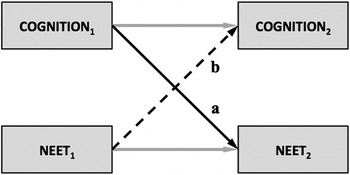
3. Structural equation modelling was employed to examine the cross-lagged effects between baseline variables that were significantly associated with follow-up NEET status to determine the direction of associations while concurrently adjusting for each other and other relevant confounds (age, gender and educational attainment). As shown in Fig. 1, if one can demonstrate, for instance, that baseline cognition predicts follow-up NEET status (path a; while controlling for baseline NEET status), whereas baseline NEET status does not predict follow-up cognition (path b; while controlling for baseline cognition), then one has established a potential causal relationship where cognition is antecedent to, and upstream of, NEET status. The posterior distribution of Bayesian estimation was achieved through an iterative Markov chain Monte Carlo (MCMC) algorithm using the Gibbs sampler method (Muthen & Asparouhov, Reference Muthen and Asparouhov2012). The convergence was assessed using the Gelman–Rubin convergence diagnostic (with a conservative value of less than 0.002 adopted). Our model had the default 500 burn-in samples with greater than 95 000 post-burn-in samples used with thinning occurring twice. Here, we report the standard likelihood estimates and the 95% credible intervals. To compare different measurement models in the Bayesian factor analyses, the posterior predictive p value (PPP) was used to determine the overall fit between the specified model and the empirical data, with a PPP closest to 0.50 indicating a better fit (PPP < 0.05 indicating very poor fit). In the current study, we chose not to specify informative priors during Bayesian estimation since there are limited data demonstrating the potential influence of cognition on NEET status and, to our knowledge, this has never been examined in a young, clinical cohort of individuals with severe mental illnesses.
Fig. 1.Cross-lagged panel design testing the causal influence of cognition on ‘not in education, employment or training’ (NEET) (path a), and no causal influence of NEET on cognition (path b). Grey lines denote expected significant relationships that do not constitute the primary hypotheses.


Results
In total, 163 participants met eligibility criteria and were included [approximately 80% of this sample overlapped with a previous study (Lee et al. Reference Lee, Hermens, Naismith, Lagopoulos, Jones, Chitty, White, Robillard, Scott and Hickie2015), although this is the first time the follow-up data from this sample have been subjected to structural equation modelling; further, Bayesian analysis, or investigation of NEET status, had not been conducted on this dataset previously]. Of these individuals, 63 were diagnosed with a non-psychotic depressive disorder, 41 were diagnosed with a non-psychotic bipolar disorder, and 59 were diagnosed with a primary psychotic disorder (see online Supplementary Tables S1 and S2 for a full diagnostic breakdown and sample characteristics by diagnosis). The average age across all individuals was 19.9 years (s.d. = 2.7), with 58.3% being female (n = 95). Participants, on average, had completed high school (mean = 12.1 years, s.d. = 1.9) with predicted IQs broadly in the average range relative to age-peers (mean = 104.6, s.d. = 9.2). Depressive, manic, positive and negative symptoms generally fell in the mild to moderate range. At baseline, 23.3% were NEET (n = 38). The only characteristic that differed between diagnoses was positive symptoms (F 2,97.6 = 6.6, p < 0.01; please refer to online Supplementary Table S2), where the psychosis group was significantly more severe than the major depression or bipolar disorder groups (Bonferroni p’s < 0.01).
Sample characteristics by follow-up NEET status
Individually, being NEET at baseline was a significant predictor of being NEET at follow-up (odds ratio 2.9, 95% confidence interval 1.3–6.3, p < 0.01). Individuals who were NEET at follow-up were not significantly different from those who were non-NEET in terms of time to follow-up, and baseline age, gender, educational attainment, predicted IQ, medication use, proportion with psychiatric co-morbidities, or clinician-rated functional disability (all p’s > 0.05, see Table 1). However, those who were NEET at follow-up displayed more severe negative symptoms at baseline (F 1,160 = 4.7, p < 0.05) and performed more poorly across four neuropsychological measures at baseline (TMT-A, F 1,160 = 4.0, p < 0.05; TMT-B, F 1,161 = 13.3, p < 0.000; RAVLT, F 1,161 = 6.4, p < 0.05; PAL, F 1,156 = 9.1, p < 0.01). Therefore, these four neuropsychological measures along with negative symptomatology were included in the Bayesian modelling as key cognitive and clinical predictors.
Baseline demographic, clinical and neuropsychological characteristics according to NEET status at T1 and T2

Data are given as mean (standard deviation) unless otherwise indicated.
NEET, Not in education, employment or training; T1, baseline; T2, follow-up; n.s., non-significant; IQ, intelligence quotient; BPRS, Brief Psychiatric Rating Scale; TMT-A, Trail Making Test – part A; TMT-B, Trail Making Test – part B; SSP, spatial span; RVP, rapid visual processing; RAVLT, Rey Auditory Verbal Learning Test; PAL, paired associates learning; IED, intra-/extradimensional shift test.
a Welch's statistic correction for violation of homoscedasticity.
Factor analysis of neuropsychological functioning
The one-factor model was an excellent fit for the baseline data (PPP = 0.50; Fig. 2). At follow-up, the one-factor model was a similarly excellent fit (PPP = 0.50).
Bayesian confirmatory factor analysis of a one-factor solution. Round variables denote latent variables; rectangular variables denote measured variables. TMT-A, Trail Making Test – part A; TMT-B, Trail Making Test – part B; RAVLT, Rey Auditory Verbal Learning Test; PAL, paired associates learning.

Bayesian structural equation modelling
A fully saturated Bayesian structural equation model was tested first to ascertain credible v. non-credible paths. Next, non-credible paths with the lowest standardized coefficient were consecutively eliminated from the model in an iterative procedure until only credible paths remained. The final model is shown in Fig. 3. All credible paths in the final model were initially credible in the original saturated model, suggesting that no paths emerged due to suppressor effects. A post-hoc calculation of sample size adequacy was also conducted. Given a conservative estimate from Monte Carlo simulation, which prescribes a sample size three times the number of parameters to be estimated, the sample size required for the current final model would be 90 (3 multiplied by 30 parameters), which is exceeded by the current sample size of 163. Although our sample size considerably exceeded the minimum number of cases required for the amount of estimated parameters, the sufficiency of our sample size would also depend on the magnitude of effect, which has not yet been established in the literature.
Final Bayesian structural equation model. Black lines denote significant paths. Grey lines denote non-significant paths. Round variables denote latent variables. Rectangular variables denote measured variables. Single-headed arrows denote causal paths. Double-headed arrows denote correlations. TMT-A, Trail Making Test – part A; TMT-B, Trail Making Test – part B; RAVLT, Rey Auditory Verbal Learning Test; PAL, paired associates learning; NEET, not in education, employment or training.

From the final model, there were four key findings. Both cognition and negative symptoms were predictive of respective follow-up measures (T1 cognition to T2 cognition, β = 0.98, 95% credible interval 0.92–1.00; T1 negative symptoms to T2 negative symptoms, β = 0.37, 95% credible interval 0.22–0.52). Baseline cognition was predictive of follow-up NEET status (T1 cognition to T2 NEET status, β = −0.40, 95% credible interval −0.58 to −0.19). In Bayesian terms, for every 1 s.d. deficit in the latent cognition construct (a composite of the four neuropsychological measures weighted according to their factor loadings), the probability of being NEET at follow-up increased by 40%. Baseline NEET status was also predictive of negative symptoms at follow-up (T1 NEET status to T2 negative symptoms, β = 0.24, 95% credible interval 0.04–0.43). Therefore, being NEET at baseline increased the probability of a 1 s.d. increase in follow-up negative symptoms by 24%. Baseline NEET status was not predictive of follow-up NEET status in the multivariate model. Of the three demographic variables, only age remained predictive of follow-up NEET status. For every 1 s.d. increase in age (equating to 2.8 years), the probability of being NEET increased by 23% (T2 age to T2 NEET status, β = 0.23, 95% credible interval 0.02–0.42). We additionally ran the model to allow for the residuals in the regression of T2 variables on T1 variables to be correlated, and there were negligible changes to the findings (β = −0.42 for T1 cognition predicting T2 NEET, and β = 0.24 for T1 NEET predicting T2 negative symptoms).
Discussion
The current findings confirm that NEET status is highly prevalent among young people with mental illness. The key role that cognition plays in academic and/or vocational engagement probably reflects the frequent finding that cognitive abilities tend to be relatively more immutable and, accordingly, are likely to be more critical to functional recovery over 24 months, than symptom factors. This has been previously shown across both first-episode mood (Lee et al. Reference Lee, Hermens, Porter and Redoblado-Hodge2012, Reference Lee, Hermens, Scott, Redoblado-Hodge, Naismith, Lagopoulos, Griffiths, Porter and Hickie2014a ) and psychotic disorders (Mesholam-Gately et al. Reference Mesholam-Gately, Giuliano, Goff, Faraone and Seidman2009). As hypothesized, higher rates of disengagement also determined more severe negative symptomatology, and corroborates previous work showing that, in addition to being an outcome of mental illness, rates of academic and vocational participation can also in turn have an impact on mental health outcomes (Fergusson et al. Reference Fergusson, Horwood and Lynskey1997; Luciano et al. Reference Luciano, Bond and Drake2014). By contrast, findings from our Bayesian modelling did not support a role for negative symptoms in determining rates of disengagement, which represents a significant departure from previous work in the psychosis literature, which has reliably found negative symptoms to be predictive of functional outcome (Milev et al. Reference Milev, Ho, Arndt and Andreasen2005; Bowie et al. Reference Bowie, Depp, McGrath, Wolyniec, Mausbach, Thornquist, Luke, Patterson, Harvey and Pulver2010; Green et al. Reference Green, Hellemann, Horan, Lee and Wynn2012). One likely explanation for this discrepancy is that past studies have typically focused on psychosis cohorts, which tended to include individuals with more severe negative symptoms and so were more likely to find subtle relationships germane to a particular diagnosis. This interpretation is consistent with our data, which showed that our psychosis cohort had similar levels of negative symptoms compared with our mood disorders groups. Indeed, the majority of individuals in the current cohort were diagnosed with a primary mood disorder, with the severity of negative symptoms falling on the milder end of the spectrum. Interestingly, severity of depressive symptoms did not contribute to the multivariate Bayesian model, and may be reflective of the large overlap between depressive and negative symptoms, with the latter appearing to be more strongly associated with academic and vocational outcomes.
In keeping with previous literature, older individuals were more likely to be disengaged than younger individuals, irrespective of their cognitive and clinical profile. One interpretation of this finding is that younger individuals are more likely to remain engaged through continuing tertiary education or vocational training. Individually, whether an individual was initially academically or vocationally engaged was predictive of whether they were engaged at follow-up, consistent with previous findings (O'Dea et al. Reference O'Dea, Glozier, Purcell, McGorry, Scott, Feilds, Hermens, Buchanan, Scott, Yung, Killacky, Guastella and Hickie2014). However, when factors such as cognition were introduced into a multivariate model, baseline NEET status was no longer a significant predictor of follow-up NEET status. That is not to say there is no role for current disengagement in predicting future disengagement. This finding indicates that a significant proportion of the predictive value of current NEET status on future NEET status is potentially driven by a common, underlying vulnerability, such as cognitive dysfunction. Indeed, there is cogent evidence to suggest that disengagement leads to chronic disadvantage that can in turn lead to further, more prolonged disengagement (Fergusson et al. Reference Fergusson, Horwood and Woodward2001). Our data suggest that the relative value of NEET status in predicting future disengagement is difficult to discern once cognitive and clinical factors are incorporated into a more comprehensive, multivariate model.
The present findings highlight the need to broaden the conceptualization of academic and vocational outcomes to include cognitive functioning, and strongly suggest that neuropsychological evaluation needs to be earnestly considered as a standard screening tool on presentation to youth mental health services, irrespective of diagnosis. The present data also suggest that mental health outcomes are likely to be influenced by ‘top-down’ mechanisms. That is, being educationally or occupationally engaged is likely to influence the severity of negative symptoms at follow-up, which has important implications for treatment, since it suggests that vocational rehabilitation approaches may have utility in promoting symptom alleviation. The results also have important implications for understanding the underlying structure of cognitive dysfunction across major psychiatric disorders. Traditionally, factor analyses have focused on older individuals with chronic schizophrenia and have typically identified a single, common latent factor that best captures the breadth of cognitive impairment across multiple, measured cognitive variables (Burton et al. Reference Burton, Vella, Harvey, Patterson, Heaton and Twamley2013). The current data suggest that this notion is not constrained to psychosis cohorts and is relevant on a broader scale across the major mental illnesses. Further, neuropsychological dysfunction can be reliably captured by a single cognitive factor. Given that predicted IQ did not predict follow-up NEET status, however, this single latent factor is unlikely to be a generalized intelligence factor, such as g (Spearman, Reference Spearman1927). Nevertheless, prior evidence in prospective birth cohort studies has identified a robust link between intellectual functions and vocational and academic outcomes (Trouton et al. Reference Trouton, Spinath and Plomin2002; Deary et al. Reference Deary, Gow, Pattie and Starr2012) and, as such, this proposition clearly warrants more detailed examination. Clinically, the identification of four key neuropsychological tests having strong prospective associations with NEET status suggests that even a short 20- to 25-min battery has sufficient utility in indexing likelihood of future disengagement with education, employment and training, allowing for more targeted and intensive treatments for these identified individuals.
Future transdiagnostic studies need to incorporate a greater number of individuals with non-affective psychoses to more definitively clarify the potential role that negative symptoms play in academic and vocational outcomes. Our findings are constrained by our relatively small cohort of NEET individuals, and future studies would benefit from selectively recruiting and targeting NEET individuals to enhance the statistical power of this subgroup. We also did not choose to specify informative priors in the present Bayesian analyses, since no previous studies have generated the necessary data required for such a specification in a young, transdiagnostic mental health cohort. It is, thus, pertinent for future Bayesian analyses to incorporate the current parameter estimates in their modelling in order to arrive at more precise posterior distribution.
This was the first time that Bayesian analysis has been applied to a transdiagnostic, youth mental health sample to interrogate the mechanisms underlying academic and vocational disengagement in early-course psychiatric illness. On balance, disengagement from traditional societal roles, namely education, employment or training, is especially prevalent in those with a severe mental illness. Cognitive functions appear to be a core, unique contributor to rates of economic participation. Novel treatment approaches targeting functional and cognitive abilities are likely to have downstream effects on mental health and the likelihood of re-engagement with work or study, and warrant more concerted research development.
Supplementary material
The supplementary material for this article can be found at https://doi.org/10.1017/S0033291717000484
Acknowledgements
R.S.C.L. was supported by funding from the National Health and Medical Research Council Centre of Research Excellence in Optimising Early Interventions for Young People with Emerging Mood Disorders (no. 1061043). This funding agency had no further role in study design, collection, analysis and interpretation of data, writing of the report and decision to submit the paper for publication.
Declaration of Interest
I.B.H. has led projects for health professionals and the community supported by governmental, community agency and drug industry partners (Wyeth, Eli Lily, Servier, Pfizer and AstraZeneca) for the identification and management of depression and anxiety. He has served on advisory boards convened by the drug industry in relation to specific antidepressants, including nefazodone, duloxetine and desvenlafaxine, and has participated in a multicentre clinical trial of agomelatine effects on sleep architecture in depression. He has participated in Servier-sponsored educational programmes related to circadian-based therapies. D.F.H. has previously received honoraria for educational seminars from Janssen-Cilag. The research by J.S. has been supported by funds provided to the Northumberland, Tyne and Wear National Health Service Trust by AstraZeneca and Janssen-Cilag for investigator-initiated studies on medication adherence. She has received honoraria for educational seminars supported by the pharmaceutical industry and has served on advisory boards convened by the pharmaceutical industry (including AstraZeneca, Janssen-Cilag, Lundbeck, Pfizer, Sanofi-Aventis and Servier). E.M.S. has received honoraria for educational seminars related to the clinical management of depressive disorders supported by Servier and Eli-Lilly pharmaceuticals. She has also participated in a national advisory board for the antidepressant compound Pristiq, manufactured by Pfizer. The remaining authors declare no conflict of interest.