1 Introduction
In the study of the dynamics of the quadratic family
 $f_c(z) := z^2 + c$
,
 $c \in \mathbb {C}$
, a central object of interest is the Mandelbrot set
 $$ \begin{align*}\mathcal{M} := \{ c \in \mathbb{C} \ : \ (f_c^{(n)}(0))_{n \geq 0} \text{ is bounded} \}.\end{align*} $$
The Mandelbrot set contains two notable smooth curves: namely, the intersection with the real axis
 $\mathcal {M} \cap \mathbb {R} = [-2, 1/4]$
, and the main cardioid of
 $\mathcal {M}$
, which is the set of parameters c for which
 $f_c$
has an attracting or indifferent fixed point (of course, this is smooth except at the cusp
 $c = 1/4$
).
Let
 $\mathcal {R}$
denote the set of angles of external rays landing on the real axis, and
 $\Xi $
the set of angles of external rays landing on the main cardioid. The following ‘magic formula’ is due to Douady (for a proof see [Reference BléBl]):
Theorem 1. (Douady)
The map
 $$ \begin{align*}\displaystyle T(\theta) := \left\{ \begin{array}{@{}ll} \displaystyle\frac{1}{2} + \frac{\theta}{4} & \mathrm{if}\ 0 \leq \theta < \displaystyle\frac{1}{2}, \\\\[-10pt] \displaystyle\frac{1}{4} + \displaystyle\frac{\theta}{4} & \mathrm{if}\ \displaystyle\frac{1}{2} < \theta \leq 1 \end{array}\right.\end{align*} $$
sends
 $\Xi $
into
 $\mathcal {R}$
.
In this note, we prove the following generalization of Theorem 1 to other hyperbolic components. Let
 $D(\theta ) := 2 \theta \mod 1$
denote the doubling map; moreover, given a finite binary word S and a real number
 $\theta $
, by
 $S \cdot \theta $
we denote the real number whose binary expansion is the concatenation of S and the expansion of
 $\theta $
.
Theorem 2. Let H be a hyperbolic component in the upper half plane which belongs to a vein V of the Mandelbrot set, not in the
 $1/2$
-limb. Let
 $\mathbf {A}_H$
,
 $\mathbf {B}_H$
be the binary expansions of the root of H, with
 $\mathbf {A}_H < \mathbf {B}_H$
, and let
 $\delta _V$
be the complexity of V. Then the map
 $$ \begin{align*}\Phi_H(\theta) := D^{\delta_V}(\mathbf{B}_H \mathbf{A}_H \cdot \theta)\end{align*} $$
sends the set of external angles of rays landing on the upper part of H into the set
 $\mathcal {R}$
of angles of rays landing on the real axis.
For a precise definition of a vein and its complexity, see §2.3. To illustrate such a formula, let us consider the ‘Kokopelli’ component of period
 $4$
, which has root of angles
 $\theta _1 = 3/15 = .\overline {0011}$
,
 $\theta _2 = 4/15 = .\overline {0100}$
, thus
 $\mathbf {A}_H = 0011$
,
 $\mathbf {B}_H = 0100$
. See Figure 1. This component lies on the principal vein with tip
 $\theta = 1/4$
, hence its complexity is
 $\delta _V = 1$
. Thus,
 $$ \begin{align*}\Phi_H(\theta) = 1000011 \cdot \theta = \frac{67}{128} + \frac{\theta}{128}.\end{align*} $$
Let us note that if H is the main cardioid, then
 $\delta _V = 0$
,
 $\mathbf {A}_H = 0$
,
 $\mathbf {B}_H = 1$
, hence we recover Douady’s original formula from Theorem 1. By symmetry, a formula analogous to Theorem 2 holds for hyperbolic components in the lower half plane.
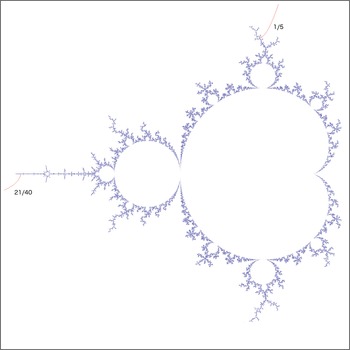
The magic formula for the Kokopelli component. The angle
 $\theta = 1/5$
which lands at the root of its component is sent to
 $\Phi _H(\theta ) = 21/40$
which lands on the real axis.

Note that the map
 $\Phi _H$
is very far from being surjective: indeed, the set of angles of rays landing on a hyperbolic component has Hausdorff dimension
 $0$
, while the set
 $\mathcal {R}$
has dimension
 $1$
[Reference ZakeriZa].
We will prove our formula (Theorem 2) in two parts. First (§2.2), we will construct a map which sends the hyperbolic component into the real slice of the corresponding small Mandelbrot set. Then (§2.3), we will map the vein to which this small Mandelbrot set belongs to the real vein. This will be done by developing some notion of combinatorial veins and combinatorial Hubbard trees, which may be of independent interest. The final formula will be the composition of the two formulas. Then, in §3, we will prove that the rays given by the image of the formula actually land, by showing they are not renormalizable. Finally, in §4 we will prove an alternative formula, which does not depend on the vein structure of
 $\mathcal {M}$
.
During the preparation of this paper we have been informed of the generalization of Douady’s formula by Blé and Cabrera [Reference Blé and CabreraBC]. Let us remark that our formula is quite different, as the one in [Reference Blé and CabreraBC] does not map into the real axis but rather into the tuned copies of the real axis inside small Mandelbrot sets. We will describe their formula and how it relates to ours in §2.2.
2 Combinatorics of external rays
2.1 Real rays and the original formula
Consider the Riemann map
 $\Phi _M : \mathbb {C}~\setminus ~\overline {\mathbb {D}} \to \mathbb {C} \setminus \mathcal {M}$
, which is unique if we normalize it so that
 $\Phi _M(\infty ) = \infty $
,
 $\Phi _M'(\infty ) = 1$
. For each
 $\theta \in \mathbb {R}/\mathbb {Z}$
, we define the external ray of angle
 $\theta $
as
 $$ \begin{align*}R_M(\theta) := \{ \Phi_M(r e^{2 \pi i \theta}) \ : \ r> 1 \}.\end{align*} $$
The ray
 $R_M(\theta )$
lands if there exists
 $\gamma (\theta ) := \lim _{r \to 1^+} \Phi _M(r e^{2 \pi i \theta })$
. It is conjectured that the ray
 $R_M(\theta )$
lands for any
 $\theta \in \mathbb {R}/\mathbb {Z}$
; to circumvent this issue, we define as
 $\widehat {R}_M(\theta )$
the impression of
 $R_M(\theta )$
, and the set of real angles as
 $$ \begin{align*}\widehat{\mathcal{R}} := \{ \theta \in \mathbb{R}/\mathbb{Z} \ : \ \widehat{R}_M(\theta) \cap \mathbb{R} \neq \emptyset \}.\end{align*} $$
Conjecturally, this is exactly the set of angles for which the corresponding ray lands on the real axis. For further details, see, for example, [Reference ZakeriZa].
The following lemma gives a characterization of
 $\widehat {\mathcal {R}}$
in terms of the dynamics of the doubling map.
Lemma 2.1. [Reference Douady, Branner and HjorthDo]
The set of real angles equals
 $$ \begin{align*}\widehat{\mathcal{R}} := \{ \theta \in \mathbb{R}/\mathbb{Z} \ : \ |D^n(\theta) - 1/2| \geq |\theta - 1/2|\ \mathrm{for\ all}\ n \in \mathbb{N} \}.\end{align*} $$
Proof of Theorem 1
By symmetry, we can assume
 $0 < \theta < \tfrac {1}{2}$
. Since the external ray of angle
 $\theta $
lands on the main cardioid, the forward orbit
 $P := (D^n (\theta ))_{n \in \mathbb {N}}$
of the angle
 $\theta $
does not intersect the half-circle
 $I = ({\theta }/{2} + {1}/{2}, {\theta }/{2})$
(the one which contains
 $0$
); see [Reference Bullett and SentenacBS]. The preimage of I by the doubling map is the union of two intervals
 $(-{\theta }/{4}, {\theta }/{4}) \cup ({1}/{2} - {\theta }/{4}, {1}/{2} + {\theta }/{4})$
. In particular, the forward orbit of
 $\theta $
does not intersect
 $J = ({1}/{2} - {\theta }/{4}, {1}/{2} + {\theta }/{4})$
. Thus, if we look at the orbit of
 $\theta ' = T(\theta )$
, we have
 $2 \theta ' = {\theta }/{2} \notin J$
and
 $D^n(\theta ') \in P$
for any
 $n \geq 2$
, hence the forward orbit of
 $\theta '$
does not intersect J, hence
 $\theta '$
is a real angle by Lemma 2.1. This shows that
 $T(\Xi ) \subseteq \widehat {\mathcal {R}}$
, completing the combinatorial part of the theorem. Finally, the fact that any ray corresponding to angles in
 $T(\Xi )$
lands will follow by Proposition 3.1.
Remark 2.2. By Lemma 2.1, one recognizes that a way to map any angle
 $\theta \in \mathbb {R}/\mathbb {Z}$
to the set of real angles is to consider the function
 $$ \begin{align*}\Psi(x) := \tfrac{1}{2} + \inf_{k \geq 0} \big| D^k(x) - \tfrac{1}{2} \big|,\end{align*} $$
which indeed satisfies
 $\Psi (\mathbb {R}/\mathbb {Z}) \subseteq \widehat {\mathcal {R}}$
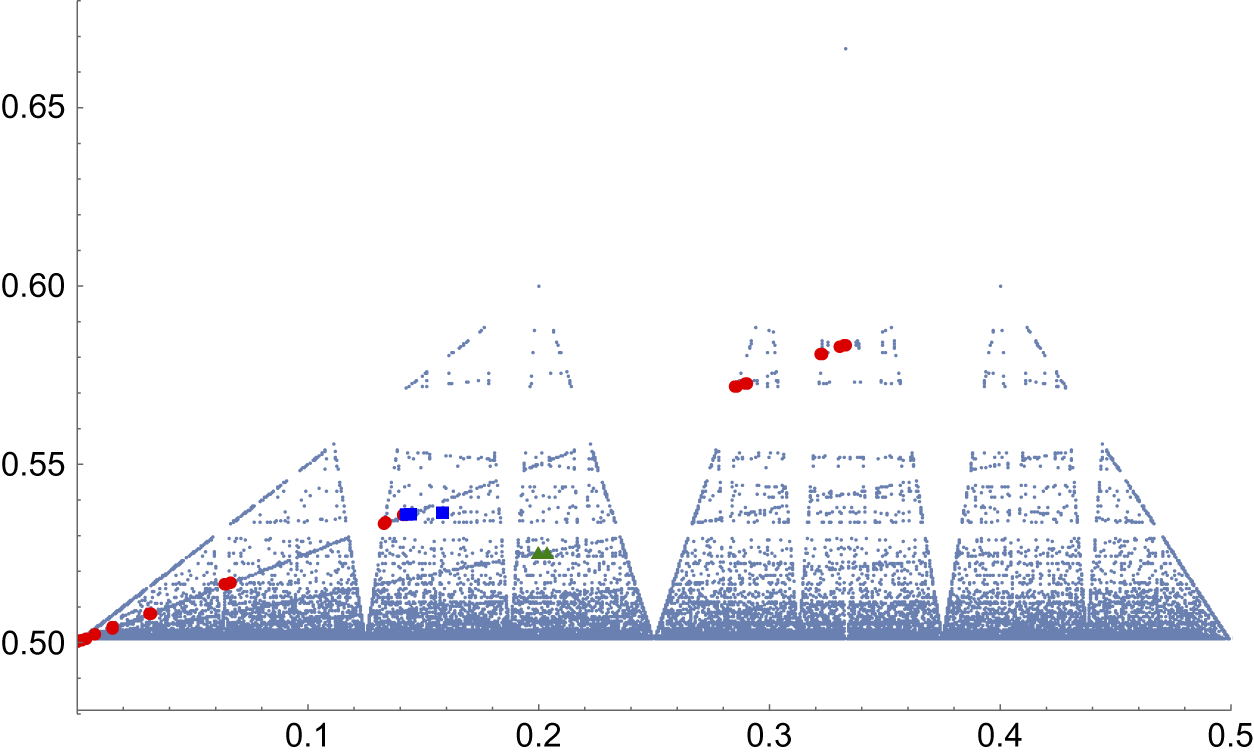
. As you can see from Figure 2, this function is discontinuous, while its graph ‘contains’ the graphs of all the magic formula functions
 $\varphi _H$
given by Theorem 2 (which are indeed continuous) for all components H.
The graph of the function
 $\Psi (x)$
discussed in Remark 2.2. The red round dots correspond to points on the graph of Douady’s magic formula function
 $T = \varphi _H$
for the main cardioid, the blue square dots to the image of
 $\varphi _H$
for the rabbit component, and the green triangular dots to the Kokopelli component.

2.2 Tuning and the Blé–Cabrera magic formula
Given any hyperbolic component H in the Mandelbrot set, let us recall that there is a tuning map which sends the main cardioid to the hyperbolic component H, and the Mandelbrot set to a small copy of itself which contains H.
In order to define the map precisely, let
 $\mathbf {a}_H = .\overline {a_1\cdots a_k} < \mathbf {b}_H =.\overline {b_1 \cdots b_k}$
denote the two external angles of rays landing at the root of H, and denote by
 $\mathbf {A}_H = a_1\cdots a_k$
and
 $\mathbf {B}_H = b_1 \cdots b_k$
the two corresponding finite binary words. Moreover, denote
 $\mathbf {a}^{\prime }_H = .\overline {a_1\cdots a_k b_1 \cdots b_k}$
and
 $\mathbf {b}^{\prime }_H = .\overline {b_1 \cdots b_k a_1\cdots a_k }$
. We call the set of external angles that belong to
 $(\mathbf {a}_H, \mathbf {a}^{\prime }_H]$
and land on H the upper part of the hyperbolic component, and the set of angles landing on H and belonging to
 $[\mathbf {b}^{\prime }_H, \mathbf {b}_H]$
the lower part.
The tuning map
 $\mathfrak {T}_H$
on the set of external angles is now defined as follows. If
 $\theta =. \epsilon _1 \epsilon _2 \cdots $
is the binary expansion of
 $\theta $
, then the angle
 $\mathfrak {T}_H(\theta )$
has binary expansion
 $$ \begin{align*}\mathfrak{T}_H(\theta) = .A_{\epsilon_1} A_{\epsilon_2} \cdots\end{align*} $$
where
 $A_0 = \mathbf {A}_H$
,
 $A_1 = \mathbf {B}_H$
. Then the set
 $\Xi _H := \mathfrak {T}_H(\Xi )$
is the set of rays landing on the boundary of H.
If
 $\theta \in \mathbb {T} = \mathbb {R}/\mathbb {Z}$
has infinite binary expansion (that is, it is not a dyadic number) and
 $S = s_1\cdots s_n$
is a finite word in the alphabet
 $\{0,1\}$
, we denote by
 $S \cdot \theta $
the element of
 $\mathbb {T}$
given by
 $$ \begin{align*}S \cdot \theta := \sum_{k=1}^n s_k 2^{-k} + 2^{-n} \theta,\end{align*} $$
that is, the point whose binary expansion is the concatenation of S and the binary expansion of
 $\theta $
. Recall that tuning behaves well with respect to concatenation; namely, for any
 $S, H$
and
 $\theta $
, we have
 $$ \begin{align*}\mathfrak{T}_H(S \cdot \theta) = \mathfrak{T}_H(S) \cdot \mathfrak{T}_H(\theta).\end{align*} $$
We define the small real vein associated to H, and denote it by
 $\mathbb {R}_H$
, to be the real vein of the small Mandelbrot set associated to H. Let us denote by
 $\mathcal {R}_H$
the set of external angles of rays landing on
 $\mathbb {R}_H$
, and by
 $\widehat {\mathcal {R}}_H$
the set of external angles of rays whose impression intersects
 $\mathbb {R}_H$
. Clearly,
 $\mathbb {R}_{H_0} = \mathbb {R}$
if
 $H_0$
is the main cardioid, and
 $\mathcal {R}_{H_0} = \mathcal {R}$
.
Proposition 2.3. (Blé and Cabrera [Reference Blé and CabreraBC])
The map
 $T_H := \mathfrak {T}_H \circ T \circ \mathfrak {T}_H^{-1}$
maps
 $\Xi _H$
into the small real vein
 $\widehat {\mathcal {R}}_H$
. Moreover, this map (restricted to
 $\Xi _H$
) is piecewise affine: in fact, it can be written in terms of binary expansions as
 $$ \begin{align*}T_H(\theta) = \mathbf{B}_H \mathbf{A}_H \cdot \theta\end{align*} $$
if
 $\theta \in (\mathbf {a}_H, \mathbf {a}^{\prime }_H)$
, and
 $$ \begin{align*}T_H(\theta) = \mathbf{A}_H \mathbf{B}_H \cdot \theta\end{align*} $$
if
 $\theta \in (\mathbf {b}^{\prime }_H, \mathbf {b}_H)$
.
Proof By construction, the tuning map
 $\mathfrak {T}_H : \Xi \setminus \{ 0\} \to \Xi _H \setminus \{ \mathbf {a}_H, \mathbf {b}_H \}$
is a bijection, so the first statement follows by looking at the following diagram:

Moreover, since
 $T(\theta ) = 10 \cdot \theta $
for
 $\theta <1/2$
and tuning behaves nicely with respect to concatenation, we have
 $$ \begin{align*}T_H(\theta) = \mathfrak{T}_H ( 10 \cdot \mathfrak{T}_H^{-1}(\theta) ) = \mathfrak{T}_H(10) \cdot \theta,\end{align*} $$
which proves the second claim.
2.3 Veins, pseudocenters and complexity
Given a dyadic number
 $\theta \in S^1 = \mathbb {R}/\mathbb {Z}$
, we define its complexity as
 $$ \begin{align*}\Vert \theta \Vert := \min \{ k \geq 0 \,{:}\, D^k(\theta) = 0 \kern-1pt\!\mod \kern-1pt1 \}.\end{align*} $$
Of course, if
 $\theta = {p}/{2^q}$
with p odd, then
 $\Vert \theta \Vert = q$
. Given an interval
 $(\theta ^-,\theta ^+)$
with
 $\theta ^- < \theta ^+$
, we define its pseudocenter
 $\theta _0$
to be the dyadic rational of lowest complexity inside the interval
 $(\theta ^-, \theta ^+)$
.
A pair of elements
 $(\theta ^-, \theta ^+)$
in
 $\mathbb {T}$
is a ray pair if the two external rays of angle
 $\theta ^-$
and
 $\theta ^+$
combinatorially land at the same parameter on the boundary of the Mandelbrot set. To be precise, one starts by defining a relation on
 $\mathbb {Q}/\mathbb {Z}$
by setting
 $\theta _1 \sim _{\mathbb {Q}} \theta _2$
if
 $R_M(\theta _1)$
and
 $R_M(\theta _2)$
land at the same point. Then one takes the transitive closure of this relation and finally its topological closure to define an equivalent relation
 $\sim $
on
 $\mathbb {R}/\mathbb {Z}$
. As constructed by Thurston [Reference Thurston, Schleicher and SelingerTh], there is a lamination
 $QML$
on the unit disk such that its induced equivalent relation is precisely
 $\sim $
. If the Mandelbrot set is locally connected, then
 $\theta _1 \sim \theta _2$
if and only if
 $R_M(\theta _1)$
and
 $R_M(\theta _2)$
land on the same point.
Ray pairs are partially ordered: in fact, we say that
 $(\theta _1^-, \theta _1^+) \prec (\theta _2^-, \theta _2^+)$
if the leaf
 $(\theta _1^-, \theta _1^+)$
separates
 $(\theta _2^-, \theta _2^+)$
from
 $0$
. Let us denote by
 $N(\theta )$
the number of ends of the Hubbard tree associated to the angle
 $\theta $
. Recall that if
 $\theta _1 \prec \theta _2$
, then
 $N(\theta _1) \leq N(\theta _2)$
.
A dyadic number
 $\theta _0$
defines a combinatorial vein in the Mandelbrot set as follows.
Definition 2.4. Given a dyadic rational number
 $\theta _0$
, we define the combinatorial vein of
 $\theta _0$
as the set of ray pairs
 $(\theta _1, \theta _2)$
such that:
-
(1)
 $\theta _0$
is the pseudocenter of
$(\theta _1, \theta _2)$
;
-
(2)
$N(\theta _0) = N(\theta _1)$
.


For instance, if
 $\theta _0 = \tfrac {1}{4}$
, then the vein extends all the way to
 $(\tfrac {1}{7}, \tfrac {2}{7})$
, since
 $N(\tfrac {1}{4}) = 3$
, and one can check easily that
 $N(\tfrac {1}{7}) = 3$
(the ‘rabbit’). On the other hand, if
 $\theta _0 = {3}/{16}$
, then the vein extends up to, but not including, the pair
 $({39}/{224}, {43}/{224})$
. Indeed,
 ${N({3}/{16}) = 5}$
, while
 $N({39}/{224}) = N({43}/{224}) = N({37}/{224}) = 3$
. Moreover,
 ${N(\theta _1) = N(\theta _2) = 5}$
for any ray pair
 $(\theta _1, \theta _2)$
which separates
 $({39}/{224}, {43}/{224})$
from
 ${3}/{16}$
, and
 ${N(\theta _1) = N(\theta _2) = 3}$
for any ray pair
 $(\theta _1, \theta _2)$
which separates
 $({39}/{224}, {43}/{224})$
from
 $0$
.
Note that condition (2) in the above definition is needed. For instance, if one considers the ray pair
 $(\theta _1, \theta _2) = ({77}/{255}, {78}/{255})$
, then its pseudocenter is
 $\theta _0 = 39/128$
. However, one checks that
 $N({77}/{255}) = 6 < 8 = N({39}/{128})$
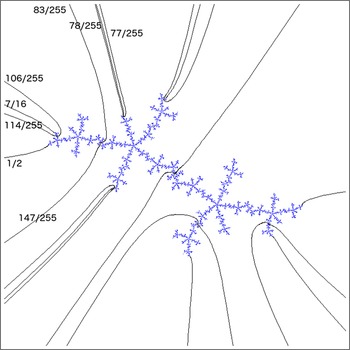
(see Figure 3).
The Julia set for the ray pair
 $(\theta ^-, \theta ^+) = ({77}/{255}, {78}/{255})$
. One can see that the Hubbard tree for
 $\theta ^-$
and
 $\theta ^+$
has six ends, while the Hubbard tree for the pseudocenter
 $\theta _0 = {39}/{128}$
has eight ends. Here,
 $\Vert \theta _0 \Vert = 7$
, so the vein V associated to
 $\theta _0$
has
 $\delta _V = 6$
, but
 $\theta ^+$
does not belong to V. This shows that the formula of Proposition 2.6 cannot be extended beyond the vein V; indeed, the point in the forward orbit of
 $\theta ^+$
which is closest to
 $\tfrac {1}{2}$
is
 ${114}/{255} \in \widehat {\mathcal {R}}$
, while
 $D^{\delta _V}(\theta ^+) = {147}/{255}$
, so the formula would break down.

Definition 2.5. The complexity of a vein V with pseudocenter
 $\theta _0$
is given by
 $$ \begin{align*}\delta_V = \Vert \theta_0 \Vert - 1.\end{align*} $$
The complexity
 $\delta _V$
equals:
-
• the smallest k such that
$D^k(\theta _0) = 1/2$
; -
• the smallest k such that
$D^k(\theta ^-)$
and
$D^k(\theta ^+)$
lie on opposite connected components of the set
$\mathbb {T}\setminus \{0, 1/2\}$
; -
• the smallest k such that
$f^k_c(c)$
lies on the spine
$[-\beta , \beta ]$
of the Julia set of
$f_c$
for c which belongs to the vein.


Clearly,
 $\delta _V = 0$
if and only if V is the real vein. Given a vein V in the upper half plane (that is with
 $\theta _0 <1/2$
), its lower side is the set of angles
 $\theta ^+$
for which there exists
 $\theta ^- < \theta ^+$
such that
 $(\theta ^-, \theta ^+)$
belongs to the vein.
Proposition 2.6. Let V be a vein in the upper half plane, and
 $\delta _V$
be its complexity. Then for each ray pair
 $(\theta ^-, \theta ^+)$
which belongs to V we have
 $$ \begin{align*}D^{\delta_V}(\theta^+) \subseteq \widehat{\mathcal{R}}.\end{align*} $$
In order to prove the proposition, we need the following lemma.
Lemma 2.7. Let
 $(\theta ^-, \theta ^+)$
be a ray pair, and
 $\theta _0$
be its pseudocenter, with
 $\theta _0 < 1/3$
(that is the hyperbolic component lies in the upper half plane, and not in the
 $1/2$
limb). Then we have
 $$ \begin{align*}\theta^+ - \theta_0 < \theta_0 - \theta^-.\end{align*} $$
Proof Recall that, for each rational
 ${p}/{q}$
with
 $p, q$
coprime, there exists a unique set
 $C_{p/q}$
of q points on
 $\mathbb {T}$
such that the doubling map acts on
 $C_{p/q}$
with rotation number
 $p/q$
, that is,
 $D(x_i) = x_{i+p}$
, where the indices are considered modulo q. We know that the set
 $C_{p/q}$
is precisely the set of external rays which land on the
 $\alpha $
fixed point for
 $f_c$
, when c belongs to the
 $p/q$
-limb. Let us call sectors the q connected components of
 $\mathbb {T} \setminus C_{p/q}$
. In particular, we call critical sector
 $\mathcal {S}_1$
the smallest sector, and central sector
 $\mathcal {S}_0$
the largest sector. We say that an interval
 $I \subseteq \mathbb {T}$
is embedded if it is entirely contained within one sector. Let us consider the interval
 $I_0 = [\theta ^-, \theta ^+]$
, which is embedded by construction.
Let
 $k \geq 0$
be the smallest integer such that
 $I_{k+1} := D^{k+1}(I_0)$
is not embedded (it must exist, since D doubles lengths, and the length of an embedded interval is bounded above by a constant
 $c < 1$
). Note that the doubling map is a homeomorphism between each non-central sector and its image, so
 $I_k$
must be contained in the central sector.
Let us now consider the set
 $\widehat {C}_{p/q} = C_{p/q} + 1/2$
, which is a subset of the central sector and equals the set of external rays which land on
 $-\alpha $
, the preimage of the
 $\alpha $
fixed point. Thus, let us call subsectors the connected components of
 $\mathcal {S}_0 \setminus \widehat {C}_{p/q}$
. In particular, exactly two subsectors
 $\mathcal {S}^-$
and
 $\mathcal {S}^+$
map to the critical sector
 $\mathcal {S}_1$
; let us call them central subsectors. Since the rays
 $D^k(\theta ^-)$
and
 $D^k(\theta ^+)$
land together, then either they are both contained in the same subsector, or one is contained in one central subsector and the other one in the other. If they are contained in the same subsector, then the whole
 $I_k$
is contained in the same subsector, hence its image
 $I_{k+1}$
is still embedded, contradicting the definition of k. Thus, the two endpoints of
 $I_k$
are contained in two distinct central subsectors. Since
 $I_k$
is embedded, then it must contain
 $0$
; moreover, since
 $0$
is the dyadic of lowest possible complexity, this means that
 $D^k(\theta _0) = 0$
. Now, by construction the images
 $D^{k+1}(\theta ^-)$
and
 $D^{k+1}(\theta ^+)$
lie in the critical sector
 $\mathcal {S}_1$
, which is contained inside the arc
 $[0, 1/2]$
since the hyperbolic component lies in the upper half plane. This means that
 $$ \begin{align*}\ell([0, D^{k+1}(\theta^+)]) < 1/2 < \ell([D^{k+1}(\theta^-), 0])\end{align*} $$
(where
 $\ell $
denotes the length of the intervals) and, since
 $D^{k+1}$
is a homeomorphism when restricted to
 $[\theta _0, \theta ^+]$
and to
 $[\theta ^-, \theta _0]$
,
 $$ \begin{align*}2^{k+1} \ell([\theta_0, \theta^+]) = \ell(D^{k+1}[\theta_0, \theta^+]) = \ell([0, D^{k+1}(\theta^+)]) < 1/2,\end{align*} $$
and similarly,
 $$ \begin{align*}2^{k+1} \ell([\theta^-, \theta_0]) = \ell(D^{k+1}[\theta^-, \theta_0]) = \ell([D^{k+1}(\theta^-), 0])> 1/2;\end{align*} $$
hence by comparing the previous two equations
 $$ \begin{align*}\ell([\theta_0, \theta^+]) < \ell([\theta^-, \theta_0]),\end{align*} $$
which proves the claim.
2.4 Combinatorial Hubbard trees
Recall that every angle
 $\theta \in \mathbb {T}$
has an associated lamination on the disk which is invariant by the doubling map (see [Reference Thurston, Schleicher and SelingerTh]). The (two) longest leaves of the lamination are called major leaves, and their common image is called the minor leaf and will be denoted by m. Moreover, we let
 $\beta $
denote the leaf
 $\{0 \}$
, which we will take as the root of the lamination (the notation is due to the fact that the ray at angle
 $0$
lands at the
 $\beta $
-fixed point). The dynamics on the lamination is induced by the dynamics of the doubling map on the boundary circle. In particular, let us denote
 $f : \overline {\mathbb {D}} \to \overline {\mathbb {D}}$
to be a continuous function on the filled-in disk which extends the doubling map on the boundary
 $S^1$
. Let us denote by
 $\Delta $
the diameter of the circle which connects the boundary points at angles
 $\theta /2$
and
 $(\theta +1)/2$
. Then we shall also choose f so that it maps homeomorphically each connected component of
 $\mathbb {D}\setminus \Delta $
onto
 $\mathbb {D}$
.
Let
 $\mathcal {L}_1$
and
 $\mathcal {L}_2$
be two distinct leaves. Then we define the combinatorial segment
 $[\mathcal {L}_1, \mathcal {L}_2]$
as the set of leaves
 $\mathcal {L}$
of the lamination which separate
 $\mathcal {L}_1$
and
 $\mathcal {L}_2$
. Some simple properties of combinatorial segments are the following:
-
(a) if
$\mathcal {L} \in [\mathcal {L}_1, \mathcal {L}_2]$
, then
$[\mathcal {L}, \mathcal {L}_1] \subseteq [\mathcal {L}_1, \mathcal {L}_2]$
; -
(b) for any choice of leaves
$\mathcal {L}_1, \mathcal {L}_2, \mathcal {L}_3$
we have
$[\mathcal {L}_1, \mathcal {L}_2] \subseteq [\mathcal {L}_3, \mathcal {L}_1] \cup [\mathcal {L}_3, \mathcal {L}_2]$
; -
(c) the image of
$[\mathcal {L}_1, \mathcal {L}_2]$
equals
$$ \begin{align*}f([\mathcal{L}_1, \mathcal{L}_2]) = \left\{ \begin{array}{@{}ll} \lbrack f(\mathcal{L}_1), f(\mathcal{L}_2) \rbrack & \mathrm{if}\ \Delta \mathrm{does\ not\ separate}\ \mathcal{L}_1\mathrm{and}\ \mathcal{L}_2, \\ \lbrack f(\mathcal{L}_1), m \rbrack \cup \lbrack f(\mathcal{L}_2), m \rbrack & \mathrm{if}\ \Delta \mathrm{separates}\ \mathcal{L}_1\mathrm{and}\ \mathcal{L}_2; \end{array} \right.\end{align*} $$
-
(d) in any case, for any leaves
$\mathcal {L}_1, \mathcal {L}_1$
we have
$$ \begin{align*}[f(\mathcal{L}_1), f(\mathcal{L}_2)] \subseteq f([\mathcal{L}_1, \mathcal{L}_2]) \subseteq \lbrack f(\mathcal{L}_1), m \rbrack \cup \lbrack f(\mathcal{L}_2), m \rbrack.\end{align*} $$


Finally, we shall say that a set S of leaves is combinatorially convex if whenever
 $\mathcal {L}_1$
and
 $\mathcal {L}_2$
belong to S, then the whole set
 $[\mathcal {L}_1, \mathcal {L}_2]$
is contained in S.
We now define
 $$ \begin{align*}H_n := \bigcup_{0 \leq i \leq n} [\beta, f^i(m)]\end{align*} $$
and
 $$ \begin{align*}H := \bigcup_{n \in \mathbb{N}} H_n.\end{align*} $$
We call the set H the combinatorial Hubbard tree of f, as it is a combinatorial version of the (extended) Hubbard tree.
Lemma 2.8. The combinatorial Hubbard tree H has the following properties.
-
(1) The set H is the smallest combinatorially convex set of leaves which contains
$\beta $
, m and is forward invariant. -
(2) Let
$N \geq 0$
be an integer such that
$f^{N+1}(m) \in H_N$
. Then we have
$H = H_{N}$
.


Note that
 $N + 2$
coincides with the number of ends of the extended Hubbard tree.
Proof (1) Let us check that H is combinatorially convex. Suppose
 $\mathcal {L}_1, \mathcal {L}_2$
belong to H, so that, say,
 $\mathcal {L}_1 \in [\beta , f^i(m)]$
and
 $\mathcal {L}_2 \in [\beta , f^j(m)]$
. Then
 $$ \begin{align*}[\mathcal{L}_1, \mathcal{L}_2] \subseteq [\mathcal{L}_1, \beta] \cup [\beta, \mathcal{L}_2] \subseteq [f^i(m), \beta] \cup [\beta, f^j(m)] \subseteq H\end{align*} $$
as required. In order to check that H is forward invariant, note that by point (d) and using that
 $f(\beta ) = \beta $
yields the inclusion
 $$ \begin{align} f([\beta, f^i(m)]) \subseteq [f(\beta), m] \cup [m, f^{i+1}(m)] \subseteq [\beta, m] \cup [\beta, f^{i+1}(m)] \end{align} $$
and the right-hand side is contained in H by construction, so
 $f(H) \subseteq H$
.
In order to check the minimality, let S be a combinatorially convex, forward-invariant set of leaves which contains
 $\beta $
and m. Then, by convexity, S contains
 $[\beta , m]$
. Moreover, by forward invariance for any
 $i \geq 0$
we have
 $$ \begin{align*}S \supseteq f^i([\beta, m]) \supseteq [f^i(\beta), f^i(m)] = [\beta, f^i(m)],\end{align*} $$
thus
 $S \supseteq H$
.
(2) Note that by construction
 $H_N \subseteq H$
, and the same proof as in (1) shows that
 $H_N$
is combinatorially convex. In order to prove the claim it is thus enough to check that
 $H_N$
is forward invariant, because then by minimality we get
 $H_N \supseteq H$
and the claim is proven. To prove forward invariance, note that
 $$ \begin{align*}f(H_N) = \bigcup_{0 \leq i \leq N} f([\beta, f^i(m)]) \subseteq H_N \cup [\beta, f^{N+1}(m)],\end{align*} $$
and since
 $f^{N+1}(m) \in H_N$
it follows that
 $[\beta , f^{N+1}(m)] \subseteq H_N$
, proving the claim.
Lemma 2.9. Let
 $m_1 < m_2$
, and
 $H_1, H_2$
be the corresponding combinatorial Hubbard trees. Then
 $$ \begin{align*}H_1 \subseteq H_2.\end{align*} $$
As a corollary,
 $$ \begin{align*}\#Ends(T_1) \leq \#Ends(T_2).\end{align*} $$
Proof By definition,
 $m_1 < m_2$
means that
 $m_1 \in [\beta , m_2]$
. Thus,
 $m_1 \in H_2$
, and since
 $H_2$
is forward invariant we have
 $f^i(m_1) \in H_2$
for any
 $i \geq 0$
. Since also
 $\beta \in H_2$
and
 $H_2$
is combinatorially convex,
 $[\beta , f^i(m_1)] \subseteq H_2$
for any
 $i \geq 0$
, thus
 $H_1 \subseteq H_2$
as required. For the corollary, note that since the trees are dual to the laminations,
 $T_1 \subseteq T_2$
, and in general a connected subtree of a tree cannot have more ends than the ambient tree.
Lemma 2.10. Let
 $(\theta ^-, \theta ^+)$
be a ray pair, and
 $\theta _0$
its pseudocenter, with
 $\Vert \theta _0 \Vert = q$
. Then
 $$ \begin{align*}\#Ends(T_{\theta^+}) = \#Ends(T_{\theta_0})\end{align*} $$
if and only if the arcs
 $I_k = (D^k(\theta ^-), D^k(\theta ^+))$
for
 $k = 0, \ldots , q - 1$
are disjoint.
Proof Note that the forward orbit of
 $\theta _0$
has cardinality
 $q+1$
, and since its minor leaf is a point (and so are all its forward iterates), the number of ends of
 $T_{\theta _0}$
is also
 $q+1$
. Now, consider the minor leaf
 $m = (\theta ^-, \theta ^+ )$
and its forward iterates. Note that by Lemma 2.11 the arc
 $I_k$
for
 $k \leq q -1$
never contains
 $0$
. Thus, the intervals
 $I_j$
and
 $I_k$
are disjoint if and only if neither
 $f^j(m) \in [\beta , f^k(m)]$
nor
 $f^k(m) \in [\beta , f^j(m)]$
. Now, if all the intervals are disjoint, then
 $f^k(m) \notin [\beta , f^i(m)]$
for any
 $0 \leq i < k \leq q-1$
, hence the number of ends of
 $T_{\theta ^+}$
is at least
 $q+1$
, which implies it is exactly
 $q+1$
since by the previous lemma it cannot exceed the number of ends of
 $T_{\theta _0}$
. Conversely, if
 $0 \leq i < k \leq q- 1$
and
 $f^k(m) \notin [\beta , f^i(m)]$
, then either
 $I_k$
is disjoint from
 $I_i$
, or
 $f^i(m) \in [\beta , f^k(m)]$
. This, however, is impossible, as it implies
 $I_k \subseteq I_i$
with
 $i < k$
. Indeed, let us denote by
 $x_k$
and
 $x_i$
the pseudocenters of, respectively,
 $I_k$
and
 $I_i$
. As the complexity of the pseudocenter decreases precisely by
 $1$
under iteration, since
 $i < k$
one has
 $\Vert x_i \Vert> \Vert x_k \Vert $
. However, since
 $I_k \subseteq I_i$
, we have
 $x_k \in I_i$
, hence by definition of pseudocenter
 $\Vert x_k \Vert \geq \Vert x_i \Vert $
, contradicting the previous statement.
Lemma 2.11. Let
 $[\alpha , \beta ]$
be an embedded arc in
 $S^1$
which does not contain
 $0$
, and
 $\theta _0$
its pseudocenter, with
 $q = \Vert \theta _0 \Vert $
. Then, for all
 $0 \leq k \leq q-1$
, the arc
 $[D^k(\alpha ), D^k(\beta )]$
is embedded and does not contain
 $0$
.
Proof We claim that there exists a minimal k such that
 $[D^k(\alpha ), D^k(\beta )]$
contains
 $1/2$
, and, moreover, all arcs
 $[D^h(\alpha ), D^h(\beta )]$
for
 $0 \leq h \leq k$
are embedded. Indeed, the map D doubles lengths of arcs of length less than
 $1/2$
, hence eventually the length of one of its images is more than
 $1/2$
. Let k be minimal such that the length of
 $J = [D^k(\alpha ), D^k(\beta )]$
is at least
 $1/2$
. Note that all previous iterates are embedded arcs; moreover, J must contain either
 $0$
or
 $1/2$
. However, by minimality of k, since the preimages of
 $0$
are
 $0$
and
 $1/2$
and the initial arc does not contain
 $0$
, J must contain
 $1/2$
. Since J contains
 $1/2$
and does not contain
 $0$
its pseudocenter is
 $1/2$
, and since
 $J = D^k([\alpha , \beta ])$
one has
 $D^k(\theta _0) = 1/2$
, hence
 $k = q-1$
, which completes the proof of the claim.
Proof of Proposition 2.6
Let
 $k = \delta _V$
, and let
 $\theta ^- < \theta ^+$
be the two endpoints of the leaf. We need to show that
 $D^k(\theta ^+)$
belongs to
 $\widehat {\mathcal {R}}$
. Let us set
 $I_0 := (\theta ^-, \theta ^+)$
and
 $I_h := D^h(I_0)$
. Since the component belongs to V, we have by Lemma 2.10 that the intervals
 $I_h$
for
 $0 \leq h \leq k+1$
are pairwise disjoint. Moreover, by definition of
 $\delta _V$
the interval
 $I_k$
contains
 $1/2$
. Now if one looks at the lamination it follows that
 $f^{k+1}(m) \in H_k$
, so we are in the hypothesis of Lemma 2.8. Thus, all higher iterates
 $f^i(m)$
for
 $i \geq k+1$
belong to
 $H_k$
. This means that the leaf
 $f^k(m)$
separates the point
 $\{1/2\}$
from all postcritical leaves
 $f^i(m)$
with
 $i \geq 0$
. Thus, if we consider the orbit
 $\{ D^i(\theta ^+), i \geq 0 \}$
, we have that no iterate lies in the interior of
 $I_k$
, and points in complement of
 $I_k$
are by Lemma 2.7 at least at distance
 $|D^k(\theta ^+) - 1/2|$
from
 $1/2$
, hence the element in the orbit closest to
 $1/2$
is
 $D^k(\theta ^+)$
, so
 $D^k(\theta ^+)$
belongs to
 $\widehat {\mathcal {R}}$
, as required.
3 Renormalization and landing
We proved that any element in the image of
 $\Phi _H$
combinatorially lands on the real axis. To complete the proof of the main theorem, we need to show it actually lands. In order to do so, we will prove that it is not renormalizable, hence it lands by Yoccoz’s theorem.
Proposition 3.1. Let H be a hyperbolic component which does not lie in the
 $1/2$
-limb, and let
 $\theta \in \mathbb {R}/\mathbb {Z}$
be an irrational angle of an external ray which lands on the boundary of H. Then the external ray at angle
 $\Phi _H(\theta )$
is not renormalizable, hence the corresponding ray lands.
The proof uses the concept of maximally diverse sequence from [Reference ShallitSh], which we discuss in the following section.
3.1 Maximally diverse sequences
Definition 3.2. A sequence
 $(s_n) \in \{0, 1\}^{\mathbb {N}}$
is maximally diverse if the subsequences
 $$ \begin{align*}(s_{i + n p})_{n \in \mathbb{N}}\end{align*} $$
with
 $p \geq 1$
,
 $0 \leq i \leq p-1$
, are all distinct.
Lemma 3.3. A sequence
 $(s_n)$
is maximally diverse if and only if the subsequences
 $$ \begin{align*}(s_{i + np})_{n \in \mathbb{N}}\end{align*} $$
with
 $p \geq 1$
,
 $i \geq 0$
, are all distinct.
Proof Suppose that the two subsequences
 $(s_{i + np})_{n \in \mathbb {N}}$
and
 $(s_{j + nq})_{n \in \mathbb {N}}$
, with
 $p, q \geq 1$
and
 $i, j \geq 0$
, are equal. Then, for any
 $k \geq 1$
, we also have that
 $(s_{i + n pk})_{n \in \mathbb {N}}$
and
 $(s_{j + n qk})_{n \in \mathbb {N}}$
are equal. Now, we can choose k large enough so that
 $i < pk$
and
 $j < qk$
; then s is not maximally diverse by definition.
Corollary 3.4. If s is maximally diverse, then for any
 $i \geq 0$
and
 $p \geq 1$
the subsequence
 $$ \begin{align*}(s_{i + np})_{n \in \mathbb{N}}\end{align*} $$
is maximally diverse.
Lemma 3.5. Let
 $s \in \{0, 1\}^{\mathbb {N}}$
and
 $s' = \sigma (s)$
its shift, that is,
 $(s')_n = s_{n+1}$
for any n. Then s is maximally diverse if and only if
 $s'$
is maximally diverse.
Proof If s is not maximally diverse, then there exist
 $i, j \geq 0$
and
 $p, q \geq 1$
such that
 $s_{i+np} = s_{j + nq}$
for all
 $n \geq 0$
. Hence, also
 $s_{i+p+np} = s_{j +q+ nq}$
for all
 $n \geq 0$
. Since
 ${i + p \geq 1}$
and
 $j+q \geq 1$
, this also implies
 $s^{\prime }_{i+p-1+np} = s^{\prime }_{j +q-1+ nq}$
for all
 $n \geq 0$
, hence
 $s'$
is not maximally diverse. Conversely, if
 $s'$
is not maximally diverse then there exist
 $i, j \geq 0$
and
 $p, q \geq 1$
such that
 $s^{\prime }_{i+np} = s^{\prime }_{j + nq}$
for all
 $n \geq 0$
, which implies
 $s_{i+1+np} = s_{j+1 + nq}$
for all
 $n \geq 0$
, hence s is not maximally diverse by the previous lemma.
Recall that an infinite sequence
 $(\epsilon _n)$
is Sturmian if there exists
 $\alpha \in (0, 1) \setminus \mathbb {Q}$
,
 $\beta \in \mathbb {R}$
such that
 $$ \begin{align*}\epsilon_n = \lfloor (n+1) \alpha + \beta \rfloor - \lfloor n \alpha + \beta \rfloor - \lfloor \beta \rfloor\end{align*} $$
for all
 $n \geq 0$
.
Theorem 3.6. (Shallit [Reference ShallitSh])
Sturmian sequences are maximally diverse.
3.2 Proof of Proposition 3.1
Let
 $\theta $
be an external angle of a ray landing on the boundary of the hyperbolic component H, of period p. If
 $\theta $
is irrational, then
 $\theta $
is the tuning of an irrational angle
 $\eta $
of a ray landing on the main cardioid. Thus, the binary expansion of
 $\theta $
is
 $$ \begin{align*}\theta := S_{\epsilon_0} S_{\epsilon_1} S_{\epsilon_2} \ldots\end{align*} $$
where
 $(S_0, S_1)$
are the binary expansions of the two rays landing at the root of H, and
 $(\epsilon _n)$
is the binary expansion of the angle of a ray landing on the main cardioid. Thus, by [Reference Bullett and SentenacBS] the sequence
 $(\epsilon _n)$
is a Sturmian sequence, hence by Theorem 3.6 it is a maximally diverse sequence.
Hence, for any
 $\alpha = 0, \ldots , p-1$
we have that
 $(\theta _{\alpha + np})_{n \in \mathbb {N}}$
is either maximally diverse (if
 $(S_0)_\alpha \neq (S_1)_\alpha $
) or constant (if
 $(S_0)_\alpha = (S_1)_\alpha $
). Thus, if we consider the image
 $\sigma := \Phi _H(\theta )$
we have by Lemma 3.5 that
 $(\sigma _{\alpha + np})_{n \in \mathbb {N}}$
is either maximally diverse or eventually constant (e.c.).
Note that since H does not intersect the real axis, either
 $(S_0)_1 = (S_1)_1 = 0$
(if H lies in the upper half plane) or
 $(S_0)_1 = (S_1)_1 = 1$
(if H lies in the lower half plane). In both cases, the subsequence
 $(\theta _{1 + np})_{n \in \mathbb {N}}$
is e.c. Thus, there exists
 $j \geq 1$
such that the subsequence
 $$ \begin{align*}(\sigma_{j + np})_{n \in \mathbb{N}}\end{align*} $$
is e.c.
Let us now suppose by contradiction that the angle
 $\sigma $
is renormalizable. This implies that there exist two words
 $Z_0, Z_1$
with
 $|Z_0| = |Z_1| = q$
such that
 $\sigma \in \{ Z_0, Z_1 \}^{\mathbb {N}}$
. Since by construction the angle
 $\sigma $
is real, the only possibility is that
 $(Z_1)_i = 1 - (Z_0)_i$
for any
 $i = 1, \ldots , q$
.
Case 1. Let us first assume that p is not a multiple of q. Then let
 $l := \text {lcm}(p, q)$
, and consider all remainder classes modulo l.
Definition 3.7. Let us define two remainder classes
 $\alpha , \alpha '$
modulo p to be q-equivalent if there exist
 $m \in \{0, \ldots , ({l}/{q})-1\}$
and
 $\beta , \beta ' \in \{0, \ldots , q-1\}$
such that
 $\alpha \equiv qm + \beta \mod\! p$
and
 $\alpha ' \equiv qm + \beta '\! \mod\! p$
.
Lemma 3.8. Let
 $p, q \geq 1$
be two integers, with p not a multiple of q. Now, suppose that a set
 $A \subseteq \{ 0, \ldots , p-1 \}$
is not empty and has the following property: if
 $\alpha \in A$
and
 $\alpha ' \in A$
is q-equivalent to
 $\alpha $
, then
 $\alpha ' \in A$
. Then
 $A = \{ 0, \ldots , p-1\}$
.
Proof If
 $p \leq q$
, the claim is almost trivial: indeed, the set
 $\{0, \ldots , q-1\}$
projects to all possible classes modulo p. Let us suppose now that
 $p> q$
, and let
 $k := \lfloor {p}/{q} \rfloor $
. Then each interval
 $A_m := [qm, qm+ q-1]$
with
 $0 \leq m \leq k$
lies in some equivalence class. Moreover, if we choose
 $j \in \{0, \ldots , p-1\}$
such that
 $j \equiv (k+1)q \mod p$
, then also each interval
 $B_m := [qm + j, qm + j + q-1]$
with
 $0 \leq m \leq k$
lies in some equivalence class. Then note that
 $B_m$
intersects both
 $A_m$
and
 $A_{m+1}$
, hence all remainder classes must belong to the same equivalence class.
Now, let us pick
 $\alpha \in \{0, \ldots , p-1\}$
such that
 $(\sigma _{\alpha + np})$
is e.c. Find
 $\gamma $
in
 $\{0, \ldots , l-1\}$
such that
 $\gamma \equiv \alpha \!\mod\! p$
, and let
 $\beta \in \{0, \ldots , q-1\}$
such that
 $\beta \equiv \gamma \!\mod\! q$
. Then one can write
 $\gamma = \beta + m q$
with
 $0 \leq m \leq ({l}/{q}) - 1$
.
Suppose that one has
 $$ \begin{align*}\sigma = Z_{\epsilon_0} Z_{\epsilon_1} \cdots\end{align*} $$
with
 $\epsilon _i \in \{0, 1\}$
.
If for some
 $\alpha \in \{ 0, \ldots , p-1 \}$
the sequence
 $(\sigma _{\alpha + np})_{n \in \mathbb {N}}$
is e.c., then so is its subsequence
 $(\sigma _{\gamma + n l})_{n \in \mathbb {N}}$
, which coincides with
 $((Z_{\epsilon _{m + nl/q}})_\beta )_{n \in \mathbb {N}}$
. Since
 $(Z_0)_\beta \neq (Z_1)_\beta $
, this implies
 $(\epsilon _{m + nl/q})_{n \in \mathbb {N}}$
is also e.c. On the other hand, if
 $(\sigma _{\alpha + np})_{n \in \mathbb {N}}$
is not e.c., then it is maximally diverse, hence by Lemma 3.4 so is
 $(\sigma _{\gamma + n l})_{n \in \mathbb {N}}$
, hence also
 $(\epsilon _{m + nl/q})_{n \in \mathbb {N}}$
is not e.c.
Let us now consider another
 $\alpha ' \in \{0, \ldots , p-1 \}$
which is q-equivalent to
 $\alpha $
. Then by the above discussion,
 $$ \begin{align*}(\sigma_{\alpha + np})_{n \in \mathbb{N}}\, \mathrm{e.c.}\ \Leftrightarrow (\epsilon_{m + nl/q})_{n \in \mathbb{N}}\, \mathrm{e.c.}\ \Leftrightarrow (\sigma_{\alpha' + np})_{n \in \mathbb{N}} \,\mathrm{e.c.} \end{align*} $$
By Lemma 3.8, since we know that there exists at least some
 $\alpha $
for which
 $(\sigma _{\alpha + np})_{n \in \mathbb {N}}$
is e.c., then each sequence
 $(\sigma _{\alpha '+np})_{n \in \mathbb {N}}$
is e.c. for any
 $\alpha ' \in \{0, \ldots , p-1\}$
, hence
 $\sigma $
is also eventually periodic, thus the angle
 $\theta $
cannot be irrational.
Case 2. Finally, let us consider the case when p is a multiple of q. Then recall one can write
 $$ \begin{align*}\sigma = P S_{\epsilon_0} S_{\epsilon_1} \cdots = Z_{\eta_0} Z_{\eta_1} \cdots\end{align*} $$
where P is a finite word of some length
 $k \geq 0$
.
Now let us suppose that k is not a multiple of q. Note that since H is contained in either the upper or the lower half plane, we have
 $(S_0)_1 = (S_1)_1$
. Moreover, we claim that
 $(S_0)_p \neq (S_1)_p$
: in fact, if one considers the external angles
 $\theta _0 = .\overline {S_0}$
and
 $\theta _1 = .\overline {S_1}$
, the number of periodic external rays of period dividing p and which lie in the interval
 $(\theta _0, \theta _1)$
is even, since on each landing point exactly two rays land. Hence, in their binary expansion the last digit of
 $S_0$
must be opposite to the last digit of
 $S_1$
.
Now, for each
 $i \geq 0$
, there is some index j such that
 $Z_{\eta _j}$
overlaps with both
 $S_{\epsilon _i}$
and
 $S_{\epsilon _{i+1}}$
. As the last part of
 $Z_i$
must coincide with the first part of
 $S_{\epsilon _{i+1}}$
, and since
 $S_0$
and
 $S_1$
start with the same symbol, this forces
 $Z_{\eta _j}$
to be either
 $Z_0$
or
 $Z_1$
, independently of i. However, since the last symbols of
 $S_0$
and
 $S_1$
are different, this means that
 $S_{\epsilon _i}$
is also fixed, hence the sequence
 $(\epsilon _i)$
must be e.c., which contradicts the irrationality of
 $\theta $
.
Finally, if k is multiple of q, then
 $S_0$
and
 $S_1$
are finite concatenations of
 $Z_0, Z_1$
, which means that
 $\theta $
lies already in the small copy of the Mandelbrot set with roots
 $\{Z_0, Z_1\}$
. Since
 $\{Z_0, Z_1\}$
represent a real pair, such a small copy of the Mandelbrot set lies in the
 $1/2$
-limb, which contradicts the fact that H is outside such limb and completes the proof of Proposition 3.1.
3.3 Proof of the magic formula
Proof of Theorem 2
If
 $\theta $
belongs to the upper part of
 $\Xi _H$
, then by Proposition 2.3 the angle
 $\mathbf {B}_H \mathbf {A}_H \cdot \theta $
belongs to the combinatorial vein V on which H lies. Hence, by Proposition 2.6 the angle
 $\Phi _H(\theta ) := D^{\delta _V}( \mathbf {B}_H \mathbf {A}_H \cdot \theta )$
belongs to
 $\widehat {\mathcal {R}}$
. Finally, by Proposition 3.1 the ray actually lands, hence
 $\Phi _H(\theta )$
belongs to
 $\mathcal {R}$
, as claimed.
4 An alternative formula
We conclude with another possible generalization of Douady’s formula. This version does not depend on the vein structure of
 $\mathcal {M}$
.
Proposition 4.1. Let H be any hyperbolic component, and
 $\Theta _H$
be the set of external angles of rays landing on the small Mandelbrot set with root H (in particular, this set contains the set of external angles landing on the boundary of H). Then there exists an affine map
 $\varphi _H$
such that
 $$ \begin{align*}\varphi_H(\Theta_H) \subseteq \mathcal{R}.\end{align*} $$
We first establish a preliminary lemma.
Lemma 4.2. For each hyperbolic component H of period
 $p> 1$
, one has
 $$ \begin{align*}\bigg|D^n (\theta) -\frac{1}{2} \bigg| \geq \frac{1}{2^{2p}}\end{align*} $$
for all
 $\theta \in \Theta _H$
, for all
 $n \geq 0$
.
Proof Let
 $\Sigma _ 0 = \mathbf {A}_H$
and
 $\Sigma _1 = \mathbf {B}_H$
be the binary words which give the binary expansion of the two angles landing at the root of H, and let p be the period of H, which equals the length of both
 $\Sigma _0$
and
 $\Sigma _1$
. By the construction of tuning operators, any external angle
 $\theta $
landing on the small Mandelbrot copy associated to H has binary expansion of type
 $$ \begin{align*}\theta = .\Sigma_{\epsilon_0} \Sigma_{\epsilon_1} \cdots \Sigma_{\epsilon_n} \cdots\end{align*} $$
where
 $\epsilon _i \in \{0,1\}$
for all i. Since H is not the main cardioid, then both
 $\Sigma _0$
and
 $\Sigma _1$
contain both the symbol
 $0$
and the symbol
 $1$
. As a consequence, any block of consecutive equal digits in the binary expansion of
 $\theta $
cannot have length larger than
 $2p - 2$
. However, all numbers in the interval
 $U_p = ( \tfrac {1}{2} - \tfrac {1}{2^{2p}}, \tfrac {1}{2} + \tfrac {1}{2^{2p}})$
have binary expansion of type either
 $$ \begin{align*}.0\underbrace{1\cdots1}_{2p-1} \qquad \mathrm{or}\qquad .1\underbrace{0\cdots0}_{2p-1},\end{align*} $$
hence none of the iterates
 $D^n(\theta )$
can lie in the interval
 $U_p$
.
Proof of Proposition 4.1
The map is given by
 $$ \begin{align*}\varphi_H(\theta) := 0\underbrace{1\cdots1}_{2p-1} \cdot \theta.\end{align*} $$
In fact, by the above observation,
 $\varphi _H(\theta ) \in U_p = ( \tfrac {1}{2} - \tfrac {1}{2^{2p}}, \tfrac {1}{2} + \tfrac {1}{2^{2p}})$
. On the other hand, consider the other iterates
 $D^n(\varphi _H(\theta ))$
for
 $n \geq 1$
. If
 $n < 2p-1$
, then
 $D^n(\varphi _H(\theta ))$
begins with
 $11$
so it does not lie in
 $U_p$
. For
 $n = 2p-1$
, then
 $D^n(\varphi _H(\theta )) = 1 \cdot \theta $
also does not belong to
 $U_p$
, as
 $\theta $
cannot begin with
 $2p-1$
zeros by the above lemma. Finally, if
 $n \geq 2p$
, then
 $$ \begin{align*}D^n(\varphi_H(\theta)) = D^{n-2p}(\theta) \notin U_p\end{align*} $$
again by the lemma. In conclusion, since
 $\varphi _H(\theta )$
belongs to
 $U_p$
and none of its forward iterates does,
 $\varphi _H(\theta )$
is closer to
 $1/2$
than all its iterates, hence
 $\varphi _H(\theta )$
belongs to
 $\widehat {\mathcal {R}}$
.
Now, let us also show that
 $\sigma = \varphi _H(\theta )$
is either rational or not renormalizable, hence the corresponding ray lands and
 $\sigma $
belongs to
 $\mathcal {R}$
. Indeed, if
 $\sigma $
is renormalizable, then there exist a pair of words
 $Z_0, Z_1$
(of equal length
 $q \geq 2$
) such that
 $\theta _0 = .\overline {Z_0}$
,
 $\theta _1 = .\overline {Z_1}$
land at the root of a hyperbolic component of period q of the Mandelbrot set and such that
 $$ \begin{align*}\sigma = 0 \underbrace{1\cdots}_{2p-1} \Sigma_{\epsilon_0} \Sigma_{\epsilon_1} \cdots = Z_{\eta_0} Z_{\eta_1} \cdots\end{align*} $$
for some choice of sequences
 $(\epsilon _i) \in \{0,1\}^{\mathbb {N}}$
and
 $(\eta _i) \in \{ 0, 1\}^{\mathbb {N}}$
, and
 $\Sigma _0, \Sigma _1$
as in the previous lemma. Note that the prefix of
 $\sigma $
of length
 $2p$
contains a subsequence of
 $2p-1$
consecutive equal symbols, while the rest of
 $\sigma $
does not contain any subsequence of
 $2p-1$
equal symbols. Now, there are a few cases.
-
(1) If
$q \geq 2p$
, then
$Z_{\eta _0}$
contains a subsequence of
$2p-1$
consecutive equal symbols, while
$Z_{\eta _1}$
cannot contain such a sequence. Hence, the word
$Z_{\eta _0}$
must appear exactly once in the expansion of
$\sigma $
, and the only possible choice is
$\sigma = Z_{\eta _0} \overline {Z_{\eta _1}}$
, which is rational, thus
$\theta $
must also be rational. -
(2) If
$q \leq p$
, then we must have
$Z_{\eta _1} = \underbrace {1\cdots 1}_{q}$
, which is impossible as then
$\theta _0 = .\overline {1}$
lands at the root of the main cardioid, which has period
$1$
, while
$q \geq 2$
. -
(3) If
$p < q < 2p$
, then
$Z_{\eta _0}Z_{\eta _1}$
contains a subsequence of
$2p-1$
consecutive equal symbols. Since the rest of
$\sigma $
does not contain such a sequence, then we must have
$\sigma = Z_{\eta _0}\overline {Z_{\eta _1}}$
, which again implies that
$\theta $
is rational.


This concludes our proof.
Acknowledgements
We thank S. Koch and C. T. McMullen for useful conversations, and C. Heiland-Allen for some comments on the first draft of the paper. G.T. is partially supported by the NSERC and the Alfred P. Sloan Foundation.