

Introduction
Over the period of the late second to the late seventh century ad in present-day Lithuania and south-western Latvia, human graves containing specially selected parts of a horse or a whole horse were quite common (Vaitkunskienė, Reference Vaitkunskienė1981, Reference Vaitkunskienė1995; Michelbertas, Reference Michelbertas1986; Bertašius, Reference Bertašius2002, Reference Bertašius2009a, Reference Bertašius2009b; Bliujienė & Butkus, Reference Bliujienė and Butkus2007, Reference Bliujienė and Butkus2009; Bliujienė, Reference Bliujienė2013). Horses were also buried by people who lived in the Sambian Peninsula (present-day Kaliningrad region, Russian Federation, part of former East Prussia) and in the Mazury and Suwałki lake districts in Poland. In the Roman period, all these people were associated with the Balts of the western Lithuanian stone-circle grave culture, the Sambian-Natangian or Dollkeim-Kovrovo, Bogaczewo, and Sudovian cultures (Jaskanis, Reference Jaskanis and Antoniewicz1966, Reference Jaskanis2013: 253–55; Ibsen & Skvorzov, Reference Ibsen and Skvorzov2004; Karczewska et al., Reference Karczewska, Karczewski and Gręzak2009). In the Migration period, in the Elbląg (formerly Elbing) upland and Masurian lake district, the Elbląg and Olsztyn groups came into existence, and their funeral rites also included horse sacrifices (Baranowski Reference Baranowski1996; Szymański, Reference Szymański2005: 96–99; Kontny et al., Reference Kontny, Okulicz-Kozaryn and Pietrzak2011: 116–21). In the Balt cultural area, the funerary practice of burying a whole horse or parts of it alongside humans over the period under discussion underwent changes, and the cultural contexts of burial customs and territories varied, until ultimately (in the eighth to the ninth/thirteenth centuries ad) it became an almost universal sociocultural characteristic of the Balt tribes, attesting to their common worldview. In the period between the eighth to the ninth/thirteenth centuries, the custom of horse burial spread widely in the Baltic region and became more diverse in terms of burial practices. The burying of a complete horse and of cremations of armed horsemen first spread in the Sambian Peninsula (Shiroukhov, Reference Shiroukhov2012). In the central and eastern Lithuanian burial sites, a very large number of horses buried in a different manner, but separately from the humans, are known from the eighth to the ninth/thirteenth centuries ad. Besides an affinity in concept, mass horse sacrifices can be explained by competition between leading families or social groups whose use of impressive rituals was intended to display their social status and position in society (Shiroukhov, Reference Shiroukhov2012). On the other hand, mass horse sacrifices or even offerings of horse symbols in the period preceding state formation (the case of Lithuania) clearly indicated the concentration of power in the hands of the ruling elite (see Bliujienė Reference Bliujienė1992; Bertašius Reference Bertašius2002, Reference Bertašius2009a, Reference Bertašius2009b).
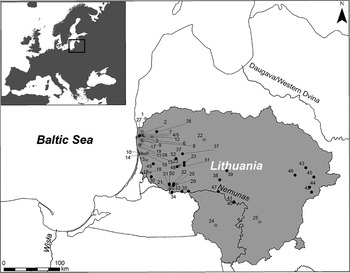
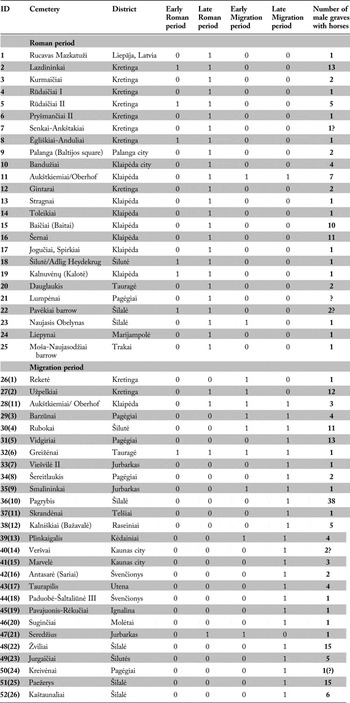
Our article is based on all the currently known archaeological evidence of human-horse burials from present-day Lithuania and south-western Latvia in the period between the late second and the seventh century ad. The dataset consists of fifty-two burial sites and 227 graves (Figure 1; Table 1).
Location of burial sites with horse graves in Lithuania (late second to late seventh centuries ad).  : Roman period; ●: Migration period. For the site list, see Table 1.

List of burial sites with human-horse grave, late second to late seventh centuries ad.

For location, see Figure 1. Data from Bezzenberger, Reference Bezzenberger1909; Kulikauskas, Reference Kulikauskas and Tautavičius1968; Michelbertas, Reference Michelbertas and Tautavičius1968; Vaitkunskienė, Reference Vaitkunskienė1981, Reference Vaitkunskienė1995; Jablonskis, Reference Jablonskis1986; Kazakevičius, Reference Kazakevičius1991, Reference Kazakevičius1993; Abaravičius, Reference Abaravičius1993; Bliujienė & Butkus, Reference Bliujienė and Butkus2007, Reference Bliujienė and Butkus2009; Bertašius, Reference Bertašius2009a; Petkus, Reference Petkus2012; Baltramiejūnaitė & Tamulynas, Reference Baltramiejūnaitė and Tamulynas2015.
A substantial part of this evidence is only known from excavations carried out in the late nineteenth century and patchy descriptions of their results in the popular and scientific reports, although there are also several more substantial publications. Moreover, some of the archaeological material and excavation reports disappeared during the Second World War. In other words, we have few complete archaeological datasets from the excavations (orientation of the burials, size and depth of the grave, position of the human and horse within, distribution of finds, etc.); this is supplemented by excavation reports, finds in museums, and bones in storage facilities. For these reasons, thorough information on human burials with horses is quite scarce.
Attempts to reconstruct and summarize the burials accompanied by a horse and the funerary practices of the period in question are frequently based on the analysis of just a few cemeteries and their assemblages. They are therefore a partial reflection of a complex problem. Thus, the aim of our article is to review and summarize all the excavated data, including little known evidence, published information, and the latest data, in order to reconstruct human-horse burials and associated mortuary rites in present-day Lithuania, in a multidisciplinary approach that prioritizes the archaeological evidence. Moreover, we have tried to refine the chronology not only by traditional means, but also by applying accelerator mass spectrometry (AMS) and conventional radiocarbon dating methods. This is most relevant for western Lithuania, where human bones, except for teeth, hardly ever survive. The horse bones, being somewhat more robust, tend to survive better. The poor preservation of human and horse bones is determined by natural processes (vegetation, different micro-organisms, and natural geochemical processes in the soil; see O'Connor, Reference O'Connor2000: 19–27); in western Lithuanian the soil is acid, fertilized with organic and mineral fertilizers, and intensive farming practices tend to destroy shallow graves. Besides the richly equipped human-horse graves, there are burials without any grave goods. Therefore, this article constitutes a first attempt at dating horse teeth or bones from Lithuanian sites of the late second to late seventh century ad by mass spectrometric methods. In many cases, only specially selected parts of a horse were buried, e.g. the head from which only the teeth survived; hence we focused on the opportunity of dating horse teeth by AMS methods.
The excavation reports and the information in the scientific press indicate that quite large quantities of whole horses (Equus caballus L.) and parts of them were found in the cemeteries of the late second to seventh century ad (Bezzenberger, Reference Bezzenberger1909; Vaitkunskienė, Reference Vaitkunskienė1981, Reference Vaitkunskienė1995; Jablonskis, Reference Jablonskis1986; Kazakevičius, Reference Kazakevičius1991, Reference Kazakevičius1993; Abaravičius, Reference Abaravičius1993; Bliujienė & Butkus, Reference Bliujienė and Butkus2007, Reference Bliujienė and Butkus2009; Bertašius, Reference Bertašius2009a; Petkus, Reference Petkus2012; Baltramiejūnaitė & Tamulynas, Reference Baltramiejūnaitė and Tamulynas2015). Yet, for different reasons, some horse bones did not survive, the remains of the horses were often incompletely described in the reports, and the methodology for calculating the withers height, build, sex, and age of the animals was not indicated. Therefore, after measuring the skeletal remains of some horses anew or after reviewing the known measurements, the results obtained—i.e. the age and the withers height of the horses—did not always coincide with the data indicated in the reports or earlier publications (Aleksa, Reference Aleksa1955; Barauskas, Reference Barauskas1971; Barauskas & Antanavičius, Reference Barauskas and Antanavičius1976; Tautavičius, Reference Tautavičius1981; Kazakevičius, Reference Kazakevičius1993; Baublienė et al., Reference Baublienė, Daugnora, Daugnorienė, Piličiauskienė, Trainienė and Veličkaitė2005; Veličkaitė, Reference Veličkaitė2006; Bliujienė & Butkus, Reference Bliujienė and Butkus2007). While working on the present article, all the horse burial material available was stored in the repositories of the Lithuanian National Museum, the Kretinga Museum, the Lithuania Minor Museum in Klaipėda, and Vilnius University.
Archaeological Evidence of Human-Horse Burials: An Overview
The Late Roman period (late second to late fourth century ad)
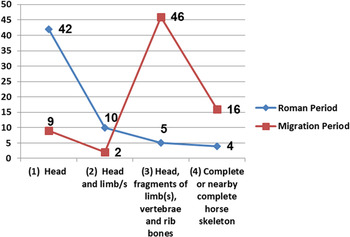
In twenty-seven cemeteries of the Roman period, 154 human-horse graves were found, but only just over half provided reasonably exhaustive information (Figure 1; Table 1). Most of these graves were found in western Lithuania, in the so-called western Lithuanian stone-circle graves cultural area and in its small peripheral zone in south-western Latvia. In the latter cultural area, graves of armed men of high social status with parts of horses alongside appeared in the late second to early third century ad (Michelbertas, Reference Michelbertas1986: 40–41; Bliujienė & Butkus, Reference Bliujienė and Butkus2007). In western Lithuania, human-horse graves emerged under the cultural influence of the Sambian-Natangian culture (Jaskanis, Reference Jaskanis and Antoniewicz1966, Reference Jaskanis2013: 253–55; Ibsen & Skvorzov, Reference Ibsen and Skvorzov2004). In the cemeteries of the Roman and Migration periods, parts of horses or whole horses were found in male graves only; here we refer to them as human-horse graves. However, in western Lithuania, unlike in the Sambian-Natangian culture, most often specially selected horse body parts were found in the graves rather than a whole horse. For the Roman period, informative data are available for only sixty-one graves, from which we note that the head of the horse was the most frequent element (forty-two cases), representing the largest group of symbolically sacrificed horses. The head and limb(s) were buried much less frequently (ten cases), and constitute the second-largest horse sacrifice group. In only five cases were the head, limb(s), ribs, and vertebrae present (third group); a whole horse was buried in four cases (fourth group). In western Lithuania, such instances of burying a whole horse, on the left of the individual, are known from the cemeteries of Reketė (grave 35) and Baitai (grave 31); it is likely two other destroyed graves of this type were found in the Aukštkiemiai cemetery (formerly Oberhof; grave 238 and grave found in 2015) (Navickaitė-Kuncienė, Reference Navickaitė-Kuncienė and Tautavičius1968: 165–66; Banytė-Rowell, Reference Banytė-Rowell2007: 29–30; Bliujienė & Butkus, Reference Bliujienė and Butkus2007: 111; Baltramiejūnaitė & Tamulynas, Reference Baltramiejūnaitė and Tamulynas2015: 136) (Figures 2 and 3).
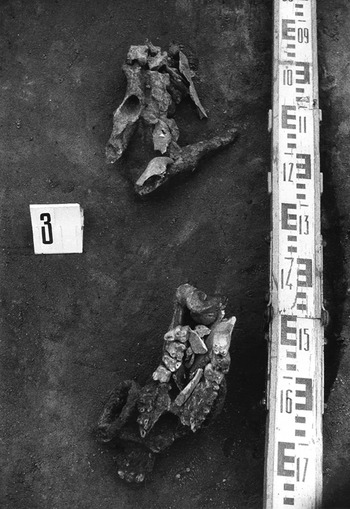
Horse body parts found in Lithuanian burial sites of the late second to late seventh centuries ad.

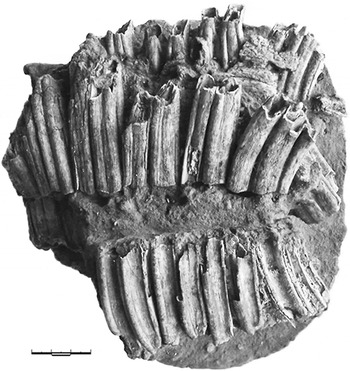
Remains of a horse head found in a human-horse grave (57/1998) in the Lazdininkai cemetery.

The poor preservation of human bones means that the sex of the individuals buried was established on the basis of weapon sets and elements of weaponry (one to two, or even three, spears, an axe, a fighting knife, a shield, a shoulder-strap, etc.); some men were buried with weapons only (one or two spears and an axe), and ultimately some other men were buried with just a universal working tool and a weapon, i.e. an axe (Bliujienė & Butkus, Reference Bliujienė and Butkus2007: 98–104). It is specifically in such graves of armed men that horse parts were found. Human-horse graves spread quite fast, as the mid-third century ad marked the apogee of the custom: at that time, graves of this type account for 9.1 per cent of a total number of researched graves in the stone-circle graves cultural area (Bliujienė, Reference Bliujienė2013: 283–88). Starting in the second part of the third century, the number of such graves decreased consistently in western Lithuania until, finally, in the first half of the fifth century, the custom of burying an armed man with parts of a horse finally disappeared (Bliujienė & Butkus, Reference Bliujienė and Butkus2007: 105). In the Migration period and later, a horse was symbolized merely by a snaffle-bit in western Lithuanian cemeteries (Bliujienė & Butkus, Reference Bliujienė and Butkus2009: 152).
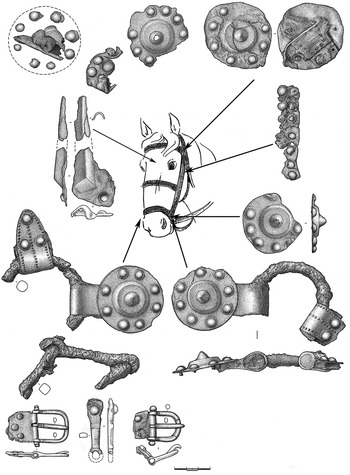
The graves of the Roman period found in western Lithuania can be divided into three main groups on the basis of the repeated correlation between man and horse (Bliujienė & Butkus, Reference Bliujienė and Butkus2007: 100–04). The first group includes graves where an armed man and parts of a horse were buried in the same stone circle and in the same grave, with the heads oriented in the same direction, mostly to the north-west. Graves where just one or two, or occasionally more, horse teeth were found are included in this group. It is most likely that in such graves bone decay and other destructive processes resulted in the teeth being the only remains of a horse's head. The second group consists of graves where an armed man and parts of a horse were buried in the same stone circle, but in different graves, only some 30 to 50 cm distant from each other. In other words, the parts of the horse were at arm's length from the armed man. The third group of human-horse graves consists of complexes where the ritual offering of a horse was surrounded with the graves of armed men. The groups of men buried with parts of horses indicate a community's efforts to distinguish between armed men buried with parts of a horse and men buried merely with weapons and elements of weaponry. Moreover, the graves of armed men with parts of a horse stood out for the wealth and abundance of their grave goods. The graves include miniature cups, a whetstone or a fire steel, a sickle, bronze or even silver jewellery, a set of female jewellery, Roman sestertii, an ornate wrought-iron bridle with noseband, snaffle-bits, curb bits, and spur(s) (Bliujienė, Reference Bliujienė2013: fig. 29.1–3). An ornate bridle was not just a decorative element: in battle, it facilitated control of the horse and protected its head from blows. The bridles, as well as other artefacts discovered in western Lithuanian cemeteries, have parallels in the Sambian-Natangian, Bogaczewo, and Sudovian cultural sites of north-eastern Poland and among the offerings found in the wetlands of Jutland (La Baume, Reference La Baume1944: 2–3; Wilbers-Rost, Reference Wilbers-Rost1994: 202, 204, 209; Bitner-Wróblewska, Reference Bitner-Wróblewska2007: 81; Nowakowski, Reference Nowakowski2009: fig. 5; Bliujienė, Reference Bliujienė2013: fig. 29.1–3, 189–88; Lau, Reference Lau2014: 24–66) (Figure 4).
Details of bronze bridles found in human-horse grave 4/1991 (ad 220–260) in the Lazdininkai cemetery. After: Bliujienė, Reference Bliujienė2013: fig. 29.3.

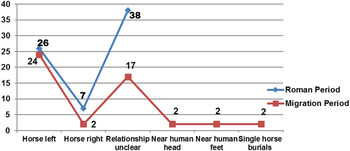
Human-horse relationships in Lithuanian burial sites of the late second to late seventh century ad.

In the western Lithuanian cemeteries of the Roman period, the relationship between man and horse was accentuated by elements of burial practice. The parts of the horse were more frequently placed on the left than on the right of the individual. The trend continued in the Migration period, when human-horse graves spread to other regions of Lithuania. It is conceivable that the burial of parts of horses on the left of the human was based on real-life practice: a right-handed man would mount his horse from the left (Figure 5). Horse mounting on the left is documented in iconographic sources: the horse mounting blocks in Far Eastern cultures were also depicted on the left side (Shuvalov, Reference Shuvalov, Sinitsyn and Kholod2014: 568).
While in other Lithuanian regions only single human-horse graves were found, in the burial sites of the lower reaches of the river Nemunas (Dauglaukis) and the Trans-Nemunas region (Liepynai), as well as in the south-eastern Lithuanian stone mounds (Moša–Naujasodžiai barrow), humans were buried with whole horses (Abaravičius, Reference Abaravičius1993; Jovaiša & Asadauskas, Reference Jovaiša, Asadauskas and Jovaiša1993) (Figure 6). Single burials where horse teeth have been found include the Pavėkiai barrow cemetery and the Naujasis Obelynas cemetery in the Samogitian highlands (a specific ethnographic part of western Lithuania) (Michelbertas, Reference Michelbertas1986: 66–67; Astrauskas, Reference Astrauskas1998: 178).
A horse found in barrow 2 in the Moša-Naujasodžiai barrow cemetery. Photograph reproduced by kind permission of G. Abaravičius.

The Migration period (fourth/fifth to seventh century ad)
In the period of the fourth/fifth to the seventh century, which in the eastern Baltic is equated with the Migration period (see Bliujienė, Reference Bliujienė2011: tab. A), Lithuania remained the northernmost part of Eastern Europe where men were quite frequently buried with parts of a horse, a whole horse, and even several horses. Such burial sites are scattered over the lower reaches of the Nemunas, the Samogitian highlands, and central and eastern Lithuania (Tautavičius, Reference Tautavičius1981; Kazakevičius, Reference Kazakevičius1991, Reference Kazakevičius1993: 42–45;Vaitkunskienė, Reference Vaitkunskienė1995; Bertašius, Reference Bertašius2002: 43–44, Reference Bertašius2009a: 54; Bliujienė & Butkus, Reference Bliujienė and Butkus2009: tab. 1; Bliujienė & Steponaitis, Reference Bliujienė and Steponaitis2009: 185–97). In the graves of that period, the quantity of sacrificed horse parts increased, and the burial of whole horses became more frequent. In the Migration period, the number of burial sites rose to twenty-seven, and the number of human-horse graves more than doubled (to 154 in total). However, only seventy-three graves provide information on the kind of burial practised. Human-horse burials in the same grave predominate, with the horse or parts of a horse most frequently placed on the left of the human (Figure 5). However, horse graves unrelated to specific individuals made an appearance, and the distribution of such graves changed. Human-horse graves disappeared from western Lithuania, while their number increased in the lower reaches of the river Nemunas, and they appeared in central and eastern Lithuania (Figure 1). A general observation about the period concerns the increase in horse body parts (head, legs, vertebrae, and fragments of ribs) selected for burial (forty-six cases) and of complete horses/horse burials (sixteen cases). Moreover, the instances where just the head of a horse was buried (nine cases) or the head and several leg bones (two cases) decreased (Figures 2 and 7). The head of the horse remained a constant part of the symbolic horse sacrifices.
Horse parts found in horse grave 6/3 in the Užpelkiai cemetery.

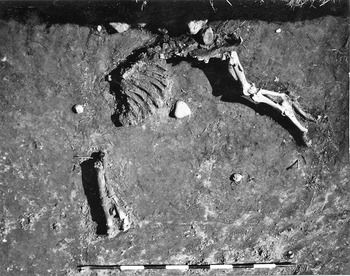
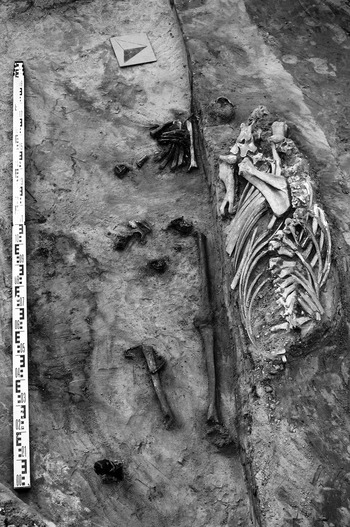
Besides inherited custom, some different relationships between humans and horses are reflected in their graves: the head and legs of a horse were placed at the individual's feet either on the left or the right side, or were placed on a coffin over the deceased's head (Vaitkunskienė, Reference Vaitkunskienė1995: 73–76). When a whole horse was buried, it was most frequently laid on its left side, sometimes slightly higher than the buried individual, and sometimes as if on a separate step formed while digging the pit (Šimėnas, Reference Šimėnas1999, Reference Šimėnas2000; Petkus, Reference Petkus2012) (Figure 8).
Smalininkai cemetery, human-horse grave 4. Photograph reproduced by kind permission of M. Petkus.

In the Migration period in Lithuania, horses were further buried next to well-armed men whose graves were rich in grave goods and contained indicators of their high social status (such as silver jewellery, imported weapons, and elements of weaponry). Several fifth to seventh century high-status graves are known to have contained parts of two horses or both parts of a horse and a whole horse. Such graves were found in the cemeteries of Užpelkiai (grave 66 and horse grave 5/2), Vidgiriai (graves 35 and 36), Kalniškiai (grave 39), Taurapilis (barrows 1, 4, 5, and 6), and Paduobė-Šaltaliūnė (barrow 17) (Tautavičius Reference Tautavičius1981; Kazakevičius, Reference Kazakevičius1991, Reference Kazakevičius1993; Šimėnas, Reference Šimėnas1999, Reference Šimėnas2000; Bliujienė & Steponaitis, Reference Bliujienė and Steponaitis2009).
At the end of the Migration period, the spread of the cremation rite changed the relationship between men and horses in graves to a degree, although burials in the same grave survived; either parts of a horse or a complete horse were buried. Moreover, there are graves where the remains of the cremated people were placed in a pit over the complete horse (Bertašius, Reference Bertašius2009a: 145). Graves of armed men cremated together with their horses appear as early as in the second half of the sixth century (in the Šereitlaukis cemetery, cremation of an adolescent, 10–15 years old) (Jankauskas, Reference Jankauskas and Zalepūgienė2013: 84; Piličiauskienė, Reference Piličiauskienė2013a: 79). At the end of the period under discussion, around the sixth/seventh century, the first horse graves unrelated to humans emerge: such burials were found in the cemeteries of central Lithuania, e.g. at Plinkaigalis (graves I to III) and Marvelė (grave 26) (Kazakevičius, Reference Kazakevičius1993: 42–45; Bertašius, Reference Bertašius2005: 90). The emergence of graves of horses buried separately from people, and their rapid spread, is related to the dissemination of the practice of cremation. Around the early seventh century, graves of horses unrelated to specific individuals also appeared in north-western Europe and Anglo-Saxon Britain (Oexle, Reference Oexle1992: 123, 139; Fern, Reference Fern and Pluskowski2005: 43–44).
Burial Sites and Results
Zooarchaeological data
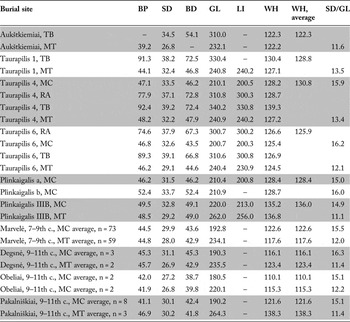
The horse bones investigated were measured in accordance with von den Driesch's (Reference von den Driesch1976) methodology, and the age was estimated following the criteria established by Levine (Reference Levine, Wilson, Grigson and Payne1982) and Kolda (Reference Kolda1936). The withers height of the horses was determined by the length of the long bones, with the exception of the femur (Johnstone, Reference Johnstone2004: 161, 248), by means of the coefficient corrected and proposed by May (Reference May1985); the withers height of the horse discovered in the Paduobė-Šaltaliūnė barrow was established from the dimensions of its skull. Where both length measurements were present, the average of the two estimates was used. The metacarpal slenderness index was described according to the criteria listed by Brauner (Reference Brauner1916).
Horses of the late second to late fourth century
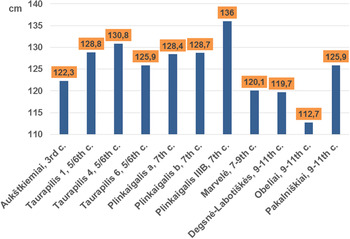
Although several human graves of that period containing parts of horses and whole horses are reported in the literature, the bones that have survived are very fragmentary, decayed, and not very informative. Lazdininkai is one of the central cemeteries in western Lithuania where thirteen human-horse graves were found. Only six fragments of skull and jaws were examined (graves 2/1991, 3/1991, 4/1991, 6/1992; 9/2000, 57/1998) (Figure 3). The age of the horses ranged between three and ten years. In some cases, only an approximate age could be established: one grave (grave 6/1992) contained a horse aged 3–7 years old. In the Anduliai-Ėgliškiai cemetery, the remains of a horse skull, the lower jaw, and the first two cervical vertebrae were found in grave 43 (2002). According to our data, the age of the horse was 7–8 years old, while previous research estimated it to be no older than 3.5 years (Baublienė et al., Reference Baublienė, Daugnora, Daugnorienė, Piličiauskienė, Trainienė and Veličkaitė2005: 292). The skull was possibly cut off below the second cervical vertebra; however, the bones were substantially decayed, and no traces of potential cuts could be recorded. Given the characteristics of the burial process in the Roman period and the poor preservation of the horse bones, we have almost no data on the horses’ withers height, sex, and other physical traits or pathologies. Only the horse discovered in a disturbed grave in the Aukštkiemiai cemetery in 2014 can be described more exhaustively (Baltramiejūnaitė & Tamulynas, Reference Baltramiejūnaitė and Tamulynas2015: 136). The remains of the skull, vertebrae, the front and hind limbs, and pelvic bones suggest that a complete horse must have been buried there. Its withers height was calculated as 122.2 cm, and it was older than five years (Figure 9; Table 2).
Horses' withers height in cm. For data, see Table 2.

Morphological data of horse long bones from burial sites.

MC: metacarpus, RA: radius, TB: tibia, MT: metatarsus. Data for Plinkaigalis a, Plinkaigalis b, Marvelė, Degsnė-Labotiškės, Obeliai, Pakalniškiai from Veličkaitė, Reference Veličkaitė2006.
Judging from the sets of grave goods in the graves of the late second to late fourth century, it was the horses that were ridden by warriors that were buried, and this from the very beginning of the custom of burying them alongside humans. The examination of horse bones in neighbouring countries has indeed revealed specific pathologies caused by riding, but also by cart pulling, or other farming activities (Piątkowska-Małecka, Reference Piątkowska-Małecka2000; Serwatka, Reference Serwatka and Bitner-Wróblewska2007; Karczewska et al., Reference Karczewska, Karczewski and Gręzak2009; Kobryń & Świeżyński, Reference Kobryń, Świeżyński, Kontny, Okulicz-Kozaryn and Pietrzak2011: 159; Bendrey, Reference Bendrey2012: 144–47). For comparing the withers height of the horses found in Lithuanian burial sites, the data from the Sambian-Natangian, Bogaczewo, and Sudovian cultural sites, where whole horses were buried, are relevant. The withers heights of the horses buried in the Paprotki Kolonia cemetery of the Bogaczewo culture ranged from 115 to 127 cm and from 139 to 143 cm (Karczewska et al., Reference Karczewska, Karczewski and Gręzak2009), and those from the Sudovian barrow cemeteries measured 135 to 136 cm (Krysiak & Serwatka, Reference Krysiak and Serwatka1970; Serwatka, Reference Serwatka and Bitner-Wróblewska2007: 143–45). The withers of the horses of the Sambian-Natangian culture in the Roman period were 120 to 132 cm high (Zinoviev, Reference Zinoviev2009). The studies of horses in the Balt cultures as a whole showed that almost exclusively male horses were buried, but it is impossible to establish whether they were stallions from the material available (Piątkowska-Małecka, Reference Piątkowska-Małecka2000; Kobryń & Świeżyński, Reference Kobryń, Świeżyński, Kontny, Okulicz-Kozaryn and Pietrzak2011: 159). The horses of Roman and German warriors were mostly stallions (but mares were also present; see Johnstone, Reference Johnstone2004: 51). Nevertheless mares are known to have been used, and indeed make up a significant proportion of the horses from funerary contexts in Vendel-period Sweden (Fern, Reference Fern and Pluskowski2005: 66).
Therefore, one may assume that the same tradition existed among the Balts. They were mainly adult horses, fit for riding and farming activities, more often healthy than showing pathologies caused by exertion, trauma, or disease (Gręzak & Piątkowska-Małecka, Reference Gręzak, Piątkowska-Małecka and Bitner-Wróblewska2009; Karczewska et al., Reference Karczewska, Karczewski and Gręzak2009).
Horses of the fourth/fifth to seventh century
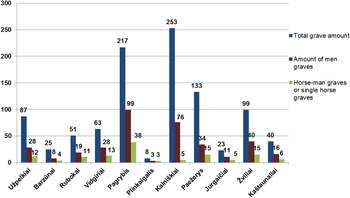
In the Migration-period burial sites, human-horse graves account for thirteen to twenty-two per cent of all the graves examined and for twenty-five to fifty-eight per cent of all the investigated male graves (Figure 10). In addition, previously unavailable information now includes the withers height and the sex of the horses (Figure 9; Table 2).
Relationship between excavated graves, male graves, and human-horse graves in the late second to late seventh centuries ad (data from Bezzenberger, Reference Bezzenberger1909; Vaitkunskienė Reference Vaitkunskienė1981, Reference Vaitkunskienė1995; Kazakevičius Reference Kazakevičius1991, Reference Kazakevičius1993; Šimėnas, Reference Šimėnas1999, Reference Šimėnas2000).

In the Užpelkiai cemetery, dated to the transitional stage between the late Roman and the early Migration period, twelve graves were found, i.e. almost forty-three per cent of all the investigated male graves. The remains of the horse found in grave 3/1 consisted of its front legs, scapula, skull, and the remains of the mandible (Figure 7). Its age was estimated as six to seven years old. In the Barzūnai, Rubokai, and Vidgiriai cemeteries in the lower reaches of the river Nemunas, parts of horses were recovered in as many as forty-six to fifty-eight per cent of the male graves investigated. In thirteen graves of the Vidgiriai cemetery, men were buried with a horse's head, while graves 35, 36, and 38 had two heads per grave. The age of these horses was six to nine years old. Meanwhile, in the cemetery of Viešvilė II, only one grave with the remains of a 3–4.5-year-old horse was discovered. These modest but informative statistics show that the number of human-horse graves in the cemeteries of the lower reaches of the Nemunas and the Samogitian upland were associated with these communities’ cultural contexts and were an integral part of the burial custom for males, while the horse as a manifestation of the buried man's social status and its relationship with warfare apparently remained in the background.
Meanwhile, in central Lithuania, the custom of burying men together with horses was only just appearing; only single human-horse graves have been found in the region (Kalniškiai, graves 36, 39, 139, 200, and 206; Plinkaigalis, grave 61; and Marvelė, grave 177). Out of seventy-six male graves excavated in the Kalniškiai cemetery, only five contained horses. Grave 39, however, had at least two horses buried at different depths (Kazakevičius, Reference Kazakevičius1991).
In the eastern part of Lithuania, in the Taurapilis barrow cemetery, four horse skeletons or their fragmented parts were found. The horses were buried in the graves of armed men. The withers height of the horse buried in barrow 1 was estimated to be around 128.8 cm, and it was over 3–3.5 years old. Barrow 4 contained a male horse, 5.5 years old and 130.8 cm at the withers. The metacarpal index of the horse was 15.9, which, following Brauner's criteria, classifies the animal as slightly massive-legged. In barrow 6, a horse was found with some still unfused epiphyses of the long bones: its age is estimated at 2–3.5 years old and the animal would have grown larger. The height of the horse, estimated by the length of the long bones, was 125.9 cm. The metacarpal index of 16.2 makes this animal slightly massive-legged. In barrow 5, the horse buried next to a military chieftain of the highest social level was two years old and 144–145 cm tall, according to previous studies (Barauskas, Reference Barauskas1971). As we have calculated the withers height of the horses found in other barrows as 7–9 cm smaller than those reported by Barauskas, one can assume that the withers height of the horse found in barrow 5 could have been 135–138 cm; in any case, it was taller than the other horses recovered in the barrow cemetery.
In the barrow cemetery of Paduobė-Šaltaliūnė in eastern Lithuania, the withers height of a 7–8-year-old horse in barrow 17, buried in a man's grave, came to 136–144 cm. The grave had been robbed in antiquity, but the horse burial was left undisturbed because the animal had no grave goods. In the cemetery at Plinkaigalis, three horse graves and four horse skeletons were recovered: they are the first horse graves not directly related to human cremations. We measured the metacarpal and metatarsal bones of three horses. The withers height of the first horse was 128.4 cm and the metacarpal index was 15.0. According to Brauner's criteria, it was a medium slender-legged animal. The withers height of a second horse was estimated to be 128.7 cm and its metacarpal index was 16.0, which classifies the animal as slightly massive-legged. A third horse, a 6–7-year old male from grave III B, was 136 cm at the withers and its metacarpal index of 14.9 classifies him as medium slender-legged. The average stature of the men buried in the Plinkaigalis cemetery was 174.83 cm, and among the richly furnished graves their stature could be as much as 176.89 cm (Jankauskas, Reference Jankauskas1998: fig. 1). This is tall for the period in question (even if today this would not be considered unusual); men had horses that would seem small in our eyes, but they were a perfect fit for them.
Chronology
The chronology of Lazdininkai, Senkai-Ankštakiai, Smalininkai, and Šereitlaukis cemeteries was investigated by using new radiocarbon measurements obtained from the horses’ bones and teeth. Previously, the chronological attribution of the sites listed here was solely based on the typology of the artefacts recovered. By applying AMS and conventional radiocarbon dating methods, seven horse bones from archaeological sites in western Lithuania and the lower Nemunas region were analysed at the Poznan Radiocarbon Laboratory in Poland and the Laboratory of Nuclear Geophysics and Radioecology (Nature Research Centre) in Lithuania. All the dates were calibrated using OxCal 4.2 software and the IntCal13 atmospheric curve (Bronk Ramsey, Reference Bronk Ramsey2009; Reimer et al., Reference Reimer, Bard, Bayliss, Beck, Blackwell, Bronk Ramsey, Buck, Cheng, Edwards, Friedrich, Grootes, Guilderson, Haflidason, Hajdas, Hatté, Heaton, Hoffmann, Hogg, Hughen, Kaiser, Kromer, Manning, Niu, Reimer, Richards, Scott, Southon, Staff, Turney and van der Plicht2013). The dates are cited at 95.4 per cent probability when calibrated.
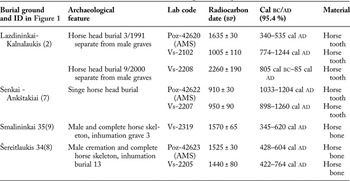
Based on the typology of the finds and their parallels, the human-horse grave with horse head (3/1991) from the cemetery of Lazdininkai was dated to ad 220–260 (Bliujienė & Butkus, Reference Bliujienė and Butkus2007: 110). The AMS determination of 1635 ± 30 bp (Poz-42620), 340–535 cal ad, on the horse's teeth makes the date of the grave at least eighty years more recent than that established by typology. Thus, the date does not fit the conventional archaeological chronological framework. The dating by conventional radiocarbon resulted in a determination of 1005 ± 110 bp (Vs-2102), 774–1244 cal ad, as much as 500 years later than its conventionally dated archaeological context. Another horse grave (9/2000) in the Lazdininkai cemetery was also dated to ad 220–260 (Bliujienė, Reference Bliujienė2013: fig. 333), based on the grave goods and context. The radiocarbon determination of 2260 ± 190 bp (Vs-2208) has a large standard deviation, which highlights this determination as problematic. Furthermore, the calibrated date in the range from 805 bc to 85 cal ad is too early and does not fit the general level of the material culture and the character of graves of the Late Bronze Age and the end of the La Tène period in western Lithuania, as at that time the deceased were cremated and buried in urns without grave goods; there is no evidence of horse burying from this period (Grigalavičienė, Reference Grigalavičienė1995: 230).
The teeth of the Senkai-Ankštakiai horse were dated by conventional radiocarbon and AMS methods. From an archaeological viewpoint, the date of the grave is not quite clear, as no grave goods were found by the horse’s head; it was surrounded by totally destroyed inhumation graves of the Late Roman period inside stone circles and the cremations buried in those circles were dated to the eleventh century ad (Jablonskis, Reference Jablonskis1986; Bliujienė & Butkus, Reference Bliujienė and Butkus2007: 111). The radiocarbon determinations for the horse's tooth of 910 ± 30 bp (Poz-42622), 1033–1204 cal ad, and 950 ± 90 bp (Vs-2207), 898–1260 cal ad, are similar and allow us to assign the horse to a grave of the tenth to twelfth century ad. In western Lithuanian archaeology, such late horse graves have so far not been discovered.
In grave 4 of the Smalininkai cemetery, which had been robbed in antiquity, a headless horse skeleton was found in the grave of a male; it had the same orientation as the latter, and was placed on its left side, 10–15 cm higher up, as if on a step (Petkus, Reference Petkus2012: 23–24) (see Figure 8). There were no grave goods in the horse's grave, but the grave goods in the man's grave date it to the middle or the second half of the fifth century ad. The radiocarbon determination of 1570 ± 65 bp (Vs-2319), 345–620 cal ad, fits the chronological framework established on the basis of the archaeological material, but cannot refine the date of the grave.
In cremation grave 13 of the Šereitlaukis cemetery, a man of forty to fifty, a child of ten to fifteen, another individual (?), and a 6–8-year-old non-cremated horse were buried (Jankauskas, Reference Jankauskas and Zalepūgienė2013: 80–84). The finds in the human grave and parallels in the Elbląg and Olsztyn groups allow us to date the complex to the first to third quarters of the sixth century ad. The radiocarbon determinations of the horse bone were 1525 ± 30 bp (Poz-42623, AMS date), 428–604 cal ad, and 1440 ± 80 bp (Vs-2205, conventional radiocarbon date), 422–764 cal ad. The AMS date is in agreement with the previous assumption about the age of the grave and its finds, while the conventionally obtained radiocarbon date gives a wider range.
Discussion
In present-day Lithuania, human-horse mortuary practices were diverse. In the Roman period, in western Lithuania and south-western Latvia, we encounter almost always parts of horses, while in the lower reaches of the Nemunas, in central Lithuania, the Trans-Nemunas region, and south-eastern Lithuania, whole horses were buried. In the cemeteries of western Lithuania and south-western Latvia, horses were no longer buried in the Migration period, while in the rest of Lithuania the custom became more diversified and continued to spread.
As far as can be judged by the evidence from burials dated to the late second to late seventh century in Lithuania and surrounding lands, 2–10-year-old horses (i.e. the most valuable age) were buried; they were male, most probably stallions. The average withers height of the horses in the graves of ordinary warriors-riders (except for Taurapilis 5 and Paduobė-Šaltaliūnė) was 130 cm. Limited studies of horse bones from the graves of warriors of an exceptionally high social status, such as Taurapilis (grave 5) and the Paduobė-Šaltaliūnė military chieftain's grave, would indicate that their horses measured 135 to 144 cm at the withers. They would be exceptionally large horses, seldom seen in the territory of Lithuania until the sixteenth and seventeenth centuries (Piličiauskienė et al., Reference Piličiauskienė, Veličkaitė and Daugnora2006; Veličkaitė, Reference Veličkaitė2006). On the other hand, the horses of the individuals buried in the barrows surrounding the Taurapilis chieftain's grave and the two horses discovered in the Plinkaigalis cemetery were much smaller (Figure 9; Table 2). The index of metapodial slenderness of most of the horses suggests that they were tall and quite robust. In Lithuania, an interesting trend can be observed: the horses buried in cemeteries of the later period, i.e. the seventh to eleventh century (Marvelė, Pakalniškiai, Degsnė-Labotiškės, Obeliai), were smaller and somewhat more slender than those discovered in the burial sites of Taurapilis, Plinkaigalis, or Paduobė-Šaltaliūnė. The average withers height of the horses in the Marvelė cemetery was 120.1 cm, in Pakalniškiai, 125.9 cm, in Degsnė-Labotiškė, 119.7 cm, and in Obeliai, 112.7 cm; further, a slight decrease in the metapodial shaft breadth index can be observed, indicating smaller and slightly more slender animals (Figure 9; Table 2). Therefore, we can assume that individuals of high social status could have owned larger horses of exceptional build and appearance. Horses for warriors were likely to have been selected for certain physical traits or were specially bred. Similar data exist for Langobard, Anglo-Saxon, central European, and Vendel and Välsgarde cemeteries in central Scandinavia (Müller, Reference Müller1980: 150; Fern, Reference Fern and Pluskowski2005: 65–66; Salvatori, Reference Salvatori and Pluskowski2012: tab. 8.1). Specially bred and selected horses were also used by the cavalry in the Roman Empire, and their exclusivity is reflected in the osteological material found on sites of different types (Johnstone, Reference Johnstone2004: 49–55, 248–46, 249–33). In the Roman Empire, horses were characterized by their tall stature and strong build, and the culture of horse breeding, care, and feeding was well-developed; the horses of the Balkan-Danube region were also large. Although the horse trade outside the boundaries of the Empire was not developed, the expansion of the Empire caused horses of exclusive morphology to spread and improved the herds of local horses (Johnstone, Reference Johnstone2004: 38–64; 412–19, 437, 442). It is quite likely that horses reached the lands of the Balts as booty, and some horses could have arrived with migrating people. The ratio of the strontium isotopes 87Sr and 86Sr in the equine dental enamel could be an indication of the place of origin of the animals and the livestock exchange of the time (Bendrey et al., Reference Bendrey, Hayes and Palmer2009: 140–49). However, so far, we do not have detailed maps of strontium distribution and only around a dozen strontium and oxygen isotope analyses of human and animal bones from the Stone and Bronze Ages (Antanaitis Jacobs et al., Reference Antanaitis Jacobs, Stančikaitė and Kiselienė2002).
One can assume that after the collapse of the Roman Empire, the larger and more robust horses that had spread outside the boundaries of the former Empire left their stamp in the Migration-period animals. The horses used in later periods lost their exclusive morphological qualities due to poor nutrition, welfare, and breeding with local horses, and the descendants of the latter were characterized by the rather slender build and short stature typical of local horses. They were closer to Germanic horses, with withers heights around 122.5 cm (Johnstone, Reference Johnstone2004: tab. 6.26). The only known horse of the Roman period found in the Aukštkiemiai cemetery was of that stature (Figure 9; Table 2).
The AMS and conventional radiocarbon dates from horse teeth and bone discussed here are the first to come out of Lithuania. Lately in Lithuania, close to forty human bones of the first half of the first millennium ad have been dated, and the outcomes were similar: either the date range was chronologically wider than the context of the graves or inappropriately old dates were obtained (Kurila, Reference Kurila2015: 69–72). Radiocarbon dates that appear too old were usually affected by the so-called fresh water reservoir effect (Piličiauskas, Reference Piličiauskas2012; Philippsen, Reference Philippsen2013). However, the fresh water reservoir effect does not apply to herbivorous horses. In western Lithuania, only one horse-related date turned out to be later than expected (grave 9/2000 in Lazdininkai). The date of another horse grave at Lazdininkai (3/1991) also showed significant errors. The conventional radiocarbon date of the horse showed a 500-year discrepancy with the AMS date and the archaeological context. The dates should thus be considered unreliable (see Table 3). The condition of the teeth and the chemical pre-treatment protocol applied may explain the discrepancies: for example, in teeth with very little collagen, simply demineralizing a bone in acid may concentrate organic contaminants in the insoluble fraction (Piličiauskas & Heron, Reference Piličiauskas and Heron2015: 542).
AMS, conventional radiocarbon, and archaeological dates of horse teeth and bones.

All dates calibrated by OxCal 4.2 and IntCal13 atmospheric curve (Bronk Ramsey, Reference Bronk Ramsey2009; Reimer et al., Reference Reimer, Bard, Bayliss, Beck, Blackwell, Bronk Ramsey, Buck, Cheng, Edwards, Friedrich, Grootes, Guilderson, Haflidason, Hajdas, Hatté, Heaton, Hoffmann, Hogg, Hughen, Kaiser, Kromer, Manning, Niu, Reimer, Richards, Scott, Southon, Staff, Turney and van der Plicht2013).
Parts of horses or whole horses found in human-horse graves provide plentiful information about the cultural, spiritual, and economic practices of the period. In the Roman period in western Lithuania, parts of horses were most frequently found in the graves of well-armed men who must have enjoyed a high or the highest social status in their communities and belonged to the elite of society (Bliujienė & Butkus, Reference Bliujienė and Butkus2007; Banytė-Rowell et. al., Reference Banytė-Rowell, Bitner-Wróblewska and Reich2012). Since human-horse graves were accompanied by sets of weapons or by single weapons, they were associated with men, although human skeletons had usually not survived or had not been examined by anthropologists. However, since the Roman period, single human-horse graves were intermixed with women and children's graves, or were arranged in small groups (Banytė Rovell, Reference Banytė Rovell2001, fig. 3, 59; Bliujienė & Butkus, Reference Bliujienė and Butkus2009: 158, fig. 5; Reich, Reference Reich2009: fig. 5, 7). In other words, the arrangement of such graves in a cemetery allows us to discuss the existence of high-status individuals and families and could be used as evidence in the argument in favour of a strengthening of relationships among family members.
The analysis of the central Lithuanian Migration-period cemetery assemblages seems to indicate that the graves of men and horses were associated with increasing social stratification, the emergence of military chieftains, and the professionalization of warriors. Similar processes are reflected in the highest social stratum―the military chieftain's grave found in the eastern Lithuanian barrow cemetery of Taurapilis (barrow 5) and the surrounding graves of armed men, who may have been members of the chieftain's retinue, part of whom were buried with horses; this is also reflected in a man's grave with a horse in the Paduobė-Šaltaliūnė barrow cemetery (barrow 17) (Tautavičius, Reference Tautavičius1981; Bliujienė & Steponaitis, Reference Bliujienė and Steponaitis2009). The finds in these men's graves are unique among Lithuanian archaeological assemblages: they were produced in workshops of the middle reaches of the Danube, northern Italy, or even the Iberian Peninsula (Werner, Reference Werner, Kossak and Reichstein1977; Tautavičius, Reference Tautavičius1981; Bliujienė & Steponaitis, Reference Bliujienė and Steponaitis2009). Yet, in the Migration period in Lithuania, horses, even those of people of the highest social status, were buried with the simplest leather bridles with an iron snaffle-bit or without a bridle, contrary to the burial sites of the Sambian-Natangian, Elbląg, and Olsztyn groups, or to German burial sites (Kontny et al., Reference Kontny, Okulicz-Kozaryn and Pietrzak2011; Skvortsov, Reference Skvortsov, Krapunov and Stylegar2013: 357–60).
Either purposefully selected parts of the horse or whole horses were buried. The parts of the horse presupposed a totality, i.e. a horse, and reflected an important provision of the pagan worldview, i.e. pars pro toto or part for the whole (Vaitkunskienė, Reference Vaitkunskienė1995: 169). The function of a horse or its symbolic parts in funeral rites reflected dualism. On the one hand, it was obvious that a horse or its parts were a significant offering; on the other hand, they belonged to exclusive grave goods or even served as an indicator of the highest social status. One side of this dualism was expressed through rituals, the other through the demonstration of the social status of the buried man and his relationship to warfare. Which side was dominant at any given time and specific cultural environment can only be revealed through a comprehensive analysis of the manner of burial, the sociocultural environment, and the worldview. Even though in the Migration period in some regions horses became more closely associated with the cultural aspirations of the communities and turned into an element of the men's burial custom, the offering aspect continued to be valid in these contexts. This is clearly shown by the examples of Kalniškiai Taurapilis, Paduobė-Šaltaliūnė, and elsewhere, where a horse was buried next to individuals of the highest social status, linked with warfare.
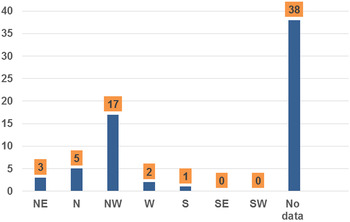
The range of functions of an offering of a horse or its parts as a substitute was rather broad. An actual horse or part of it undoubtedly functioned as a mediator (or liminal animal) between different sacred and profane spaces, and that idea is illustrated in the archaeological evidence from western Lithuania and south-western Latvia as a common cultural region in the Roman period. There, humans were buried alongside parts of horses with their heads commonly oriented towards the north-west (seventeen graves out of twenty-eight where the orientation of the head is known), towards the north (five graves), or with a deviation towards the north-east (three graves); the shortage of information means that the orientation of thirty-eight graves is unclear (Figure 11).
Orientation of Roman-period human-horse graves in western Lithuania and south-western Latvia.

Most other male members of the community buried without horse offerings, as well as women and children, were buried with their heads oriented in the same direction, although cases of individuals buried with their heads oriented to the south also exist. Whatever the case, the general orientation of human-horse graves allows us to argue that a man and his horse travelled to the afterlife by the same route and in the same direction. The human-horse graves of the Migration period, as compared to the Roman period, are known from culturally different territories. Men and their horses were buried with their heads oriented towards the north-west, north-east, south-west, and west, depending on the cultural area in which the graves are found. The most important fact to be noted is that the Migration-period humans and their horses still moved to the afterlife in an identical way and in the same direction. Thus, as mentioned above, the horse in the land of the Balts was a mediator between sacred and profane spaces and possibly also between the living members of the community, their ancestors, and their gods.
The most common human-horse grave orientation suggests that it was related to the sun travelling from the sunrise in the north-east to the sunset in the north-west; the emphasis was placed on the sunset, in other words on the afterlife. The Sun Chariot from the Trundholm Mose bog in north-western Zealand illustrates the idea that the sun was drawn by a divine horse on its eternal journey (Randsborg, Reference Randsborg2014: 60–63), i.e. the horse was seen as a mediator. Moreover, horse sacrifices were closely related to the ancestry and the cults of the gods Odin and Freyr in north-western Europe, and to Perkūnas (Thunder God) in the Baltic area (see Vaitkunskienė, Reference Vaitkunskienė1981; Puhvel, Reference Puhvel1989; Loumand, Reference Loumand, Andrén, Jennbert and Raudvere2006; Westerdahl, Reference Westerdahl2009; Fern, Reference Fern and Pluskowski2012). In the western Lithuanian cemeteries, some hammer-, staff-, and axe-shaped amber pendants are known to have come from human-horse graves (e.g. at Baitai, grave 30, and Lazdininkai, grave 66/2000; see: Bliujienė, Reference Bliujienė2011: 124–26, figs. 39.43, 51, Reference Bliujienė2013, fig. 288.3). These pendants were regarded as symbolic representations of the Thunder God and as amulets in the land of the Balts. Consequently, relationships can be established between the burial rites, human-horse graves, some of the grave goods (amulets), and finally the people's beliefs.
The parts of horses found in graves suggest that the remaining horse meat was eaten at a feast held during the wake (Jaskanis, Reference Jaskanis and Antoniewicz1966; Vaitkunskienė Reference Vaitkunskienė1981), especially since the skeletal parts found in the graves, i.e. the skulls and metapodials, at were of little value in terms of meat, being just the primary butchery waste (Uerpmann, Reference Uerpmann1973; Johnstone, Reference Johnstone2004: 85). There is no evidence that the horse was put in the grave as food for the deceased; that aspect could have been secondary. On the other hand, parts of pigs or goats/sheep were sometimes put in the grave as food for the deceased (Bliujienė, Reference Bliujienė2013: 293–96). A butchered horse produces some 150–180 kg of meat. The Lithuanian native horse breed of the Žemaitukai pony type, with an average withers height of 133–138 cm, usually weighed 360–415 kg (Macijauskienė & Juras, Reference Macijauskienė and Juras2003: 38) and edible horse meat, like that of other large ungulates, accounted for about forty per cent of the animal's weight (Calkin, Reference Calkin1962). Zooarchaeological evidence and the analysis of the graves suggest that horse meat was not taboo among the Balts (Vaitkunskienė, Reference Vaitkunskienė1981: 72, Reference Vaitkunskienė1995: 73–78; Stella, Reference Stella2004: 51). When justifying the tradition of eating horse meat in the Baltic Sea region, one should remember that from the Mesolithic to the late Middle Ages, the eastern and south-eastern Baltic regions had wild horses which were hunted for meat, just like other herbivores (Paaver, Reference Paaver1965; Beauplan, Reference Beauplan1990; Stella, Reference Stella2004: 51). In the territory of the Grand Duchy of Lithuania, their hunting was prohibited as early as in the fifteenth century, with heavy fines imposed (Statuta Lithuaniae, 1529: Chapter 9, § 2). Even though Pope Gregory III's decree of ad 732 banned the consumption of horses because it was linked to rituals and sacrifices from Roman custom (Bartosiewicz, Reference Bartosiewicz1995: 187; Cross, Reference Cross2011: 193–94), the butchery marks on horse bones suggest that horse meat was used as food and/or fodder in Lithuania up to the nineteenth or even twentieth century. Horse bones of different ages—from foals to c. 20-year-old horses—with chopping or cutting marks were found in several Lithuanian hillforts and settlements of the first millennium bc (Piličiauskienė, Reference Piličiauskienė2013a, Reference Piličiauskienė2013b, Reference Piličiauskienė and Daubaras2014, Reference Piličiauskienė2016). Horsemeat was more popular as food among the Gauls, Celts, Sarmatians, and some Germanic tribes (Arbogast et al., Reference Arbogast, Clavel, Lepetz, Méniel and Yvinec2002; Johnstone, Reference Johnstone2004: 82, 84; Istvánovits & Kulcsár, Reference Istvánovits and Kulcsár2015: 59). In Anglo-Saxon Britain there are some indications that eating horse meat was taboo (Cross, Reference Cross2011: 195). However, the zooarchaeological evidence indicates that horsemeat was eaten by humans, albeit on rare occasions, throughout the Anglo-Saxon period. The consumption of horseflesh continued for some time in some sections of society and in different regions, while some other aspects of horse beliefs, including the practice of divination and mutilation, may also have endured (Poole, Reference Poole2013: 322–30).
Conclusions
Based on archaeological and zooarchaeological data of the late second to late seventh century and their radiocarbon dates, we have attempted to characterize the emergence and spread of human-horse graves and the diversity and changes in funeral rites. The analysis of horse body parts, specially selected for burial, showed that the head or the head plus limb fragments were dominant in such offerings; the head remained a stable aspect of ritual horse sacrifice. The parts of horses buried together with men reflected the latter's social status and link to warfare, as illustrated by the analysis of burials dated to the fourth/fifth to seventh century. The analysis of the human-horse relationship in the graves thus brings new insights into the social, cultural, and worldview of Baltic society.
The zooarchaeological data indicate that the withers height of horses in the late second to fourth/fifth centuries in all Baltic culture areas was around 122 cm. The horses were 3–10 years old, i.e. young adults or adults. The horses in the graves of the fourth/fifth to seventh century were 125–130.9 cm at the withers; in the graves of people of high social status the withers height reached 136–144 cm. The horses’ ages ranged between 2.5–9 years.
To resolve dating problems by means of AMS and conventional radiocarbon methods, seven horse bones or teeth were dated. Some of the results fitted the chronological framework established on the basis of the archaeological material, even if they did not refine the chronology of individual graves, and some of the previously established dates were clearly too early. However, the teeth of the Senkai-Ankštakiai horse dated by means of conventional radiocarbon and AMS methods revealed that single horse graves can occur in cemeteries in western Lithuania in the tenth to twelfth centuries, a result that had previously not been recorded by conventional archaeological means.
The discrepancies between the radiocarbon dates and the archaeological context may be due to an incorrect interpretation of the archaeological material, influenced by the complex equipment of the graves, and especially barrows, the manner of burial, and mistakes in conventional dating perhaps due to the condition of the teeth and the chemical pre-treatment protocol.
Acknowledgements
We are deeply grateful to our colleagues Gintaras Abaravičius, Dovilė Baltramiejūnaitė, Linas Tamulynas, Marius Petkus, and Valdas Steponaitis for permission to use unpublished material from their research. We owe special thanks to colleagues and museologists at the Lithuanian National Museum, the History Museum of Lithuania Minor, and Kretinga Museum, who gave us the opportunity to investigate the horse bones stored there.