INTRODUCTION
Although human activity has caused a major loss of tropical forests, studies have also recently documented the expansion of tropical forests into open vegetation areas, such as savannas and woodlands, in many parts of the world (Bowman et al. Reference BOWMAN, MURPHY and BANFAI2010, Geiger et al. Reference GEIGER, GOTSCH, DAMASCO, HARIDASAN, FRANCO and HOFFMANN2011, Hennenberg et al. Reference HENNENBERG, GOETZE, MINDEN, TRAORE and POREMBSKI2005, Mitchard et al. Reference MITCHARD, SAATCHI, GERARD, LEWIS and MEIR2009). Nucleation is an important model of forest expansion (Yarranton & Morrison Reference YARRANTON and MORRISON1974), in which trees in open vegetation act as nuclei for the colonization of forest trees, leading to the formation of forest patches (Favier et al. Reference FAVIER, NAMUR and DUBOIS2004, Russell-Smith et al. Reference RUSSELL-SMITH, STANTON, WHITEHEAD and EDWARDS2004). Nucleation can be generated by at least two different ecological processes (Corbin & Holl Reference CORBIN and HOLL2012, Zahawi et al. Reference ZAHAWI, HOLL, COLE and REID2013): seed dispersal and establishment facilitation. Fruiting trees in open areas can attract frugivores from nearby forests, increasing the abundance of forest tree seeds beneath their crowns. Alternatively, trees in open areas can facilitate forest tree establishment by providing favourable humidity and temperature conditions beneath their crowns.
Seed dispersal has rarely been investigated during the nucleation process, but a small number of studies have indicated that frugivorous birds, present in both forests and open areas, play a role in seed arrival (Hartz et al. Reference HARTZ, PINHEIRO, DE MENDONCA-LIMA and DUARTE2012, Puyravaud et al. Reference PUYRAVAUD, DUFOUR and ARAVAJY2003, Russell-Smith et al. Reference RUSSELL-SMITH, STANTON, WHITEHEAD and EDWARDS2004). For instance, based on the observation of frugivore assemblages in both forests and grasslands in southern Brazil, Hartz et al. (Reference HARTZ, PINHEIRO, DE MENDONCA-LIMA and DUARTE2012) suggested that the olivaceous elaenia (Elaenia mesoleuca) occurs in both habitats and is an important seed disperser. However, not all frugivores act as seed dispersers. ‘Legitimate seed dispersers’ that swallow whole fruit and either regurgitate or defecate intact seeds can contribute to tree seed arrival in open areas. But ‘fruit thieves’ that handle the pulp of the fruit but do not disperse the seeds are unlikely to do so. To assess the potential role of frugivores as seed dispersers during the nucleation process, seed-handling behaviours must be observed.
Trees in the genus Ficus (Moraceae) are efficient nuclei because their syconia attract a number of frugivores, and the microhabitat beneath their dense crowns is suitable for the establishment of forest trees (Schlawin & Zahawi Reference SCHLAWIN and ZAHAWI2008, Slocum Reference SLOCUM2001, Slocum & Horvitz Reference SLOCUM and HORVITZ2000). In northern Malawi (South-east Africa), circular patches of tropical forest can be found within tropical woodlands; large fleshy-fruited trees, especially Ficus natalensis, are located at their centres. These structures are a common feature of nucleated forest patches, rather than fragmented forests (Duarte et al. Reference DUARTE, CARLUCCI, HARTZ and PILLAR2007, Favier et al. Reference FAVIER, NAMUR and DUBOIS2004). Thus, this region represents an ideal field site for testing the nucleation process.
I hypothesized that F. natalensis trees in woodlands initiate nucleation by promoting seed arrival and facilitating forest tree establishment. To address the topic, first, seedling abundance of forest tree species under F. natalensis was compared with that in other woodland habitats. Then the seed rain and post-dispersal fate of Syzygium guineense ssp. afromontanum (Myrtaceae), a common forest species, under F. natalensis were compared with those in other habitats. Second, to estimate dispersal vectors of S. guineense ssp. afromontanum under F. natalensis, seed-handling behaviour of S. guineense ssp. afromontanum fruit consumers were observed, and the visitation rates of animals at F. natalensis were monitored, when both species were fruiting. Specifically, I tested the following research hypotheses: (1) The number of forest tree seedlings and the seed rain of S. guineense ssp. afromontanum under F. natalensis are greater than in other habitats; (2) Germination and seedling survival of S. guineense ssp. afromontanum are enhanced under F. natalensis compared with those in treeless habitats; and (3) Legitimate seed dispersers of S. guineense ssp. afromontanum frequently visit F. natalensis in the woodlands.
STUDY AREA
This study was conducted in northern Malawi (south-east Africa). In south-eastern Africa, ~2.7 million km2 of land is covered with miombo woodlands, which consist of leguminous species in three closely related genera: Brachystegia, Julbernardia and Isoberlinia (Fabaceae subfamily Caesalpinioideae; Campbell et al. Reference CAMPBELL, FROST, BYRON and Campbell1996). This region also contains patchy montane rain forest which differ from miombo woodlands in floristic composition and structure (White et al. Reference WHITE, DOWSETT-LEMAIRE and CHAPMAN2001). The distributions of miombo woodlands and both types of forest have undergone widespread shifts (Vincens et al. Reference VINCENS, WILLIAMSON, THEVENON, TAIEB, BUCHET, DECOBERT and THOUVENY2003). Ekblom (Reference EKBLOM2008) suggested that climatic conditions after 1850 AD were favourable for forest expansion. At present, forest expansion is evident in the results of fire-exclusion experiments (Trapnell Reference TRAPNELL1959).
The study was conducted in December–March 2011 and 2012 on customary land located in a rural zone that is managed by the village of Ntchuka (10°58′S, 34°04′E) on the north Vipya Plateau in northern Malawi. The study site contained predominantly miombo woodlands, although some montane rain forest exists on mountain crests (above ~1800 m asl) and in valleys, and several circular forest patches (~10–1800 m2) exist on mountainous slopes (1700–1800 m asl). The mean annual rainfall on the north Vipya Plateau exceeds 1270 mm, which is distributed across a wet season from December to April, with a dry season from May to November (Chapman Reference CHAPMAN, Chapman and White1970). The Vipya Plateau is underlain by undifferentiated basement complex rocks that are mainly gneisses (Chapman Reference CHAPMAN, Chapman and White1970). The soil of the study area is a well-drained red and sandy clay loam. Most of the customary land area, with the exception of montane rain forests, is burnt at intervals of ~2–3 y as a result of human activity during the late dry season (September–December). Fires are set to clear footpaths, as paths overgrown by tall grass become difficult to traverse and dangerous due to the presence of snakes. Montane rain forests are typically less flammable due to the dense canopy that excludes grasses and maintains a more humid understorey. Therefore, fire is unlikely to penetrate far into the forest. Few trees are harvested from this area of customary land because it is located far from the local villages.
METHODS
Numbers of forest tree seedlings among microsites
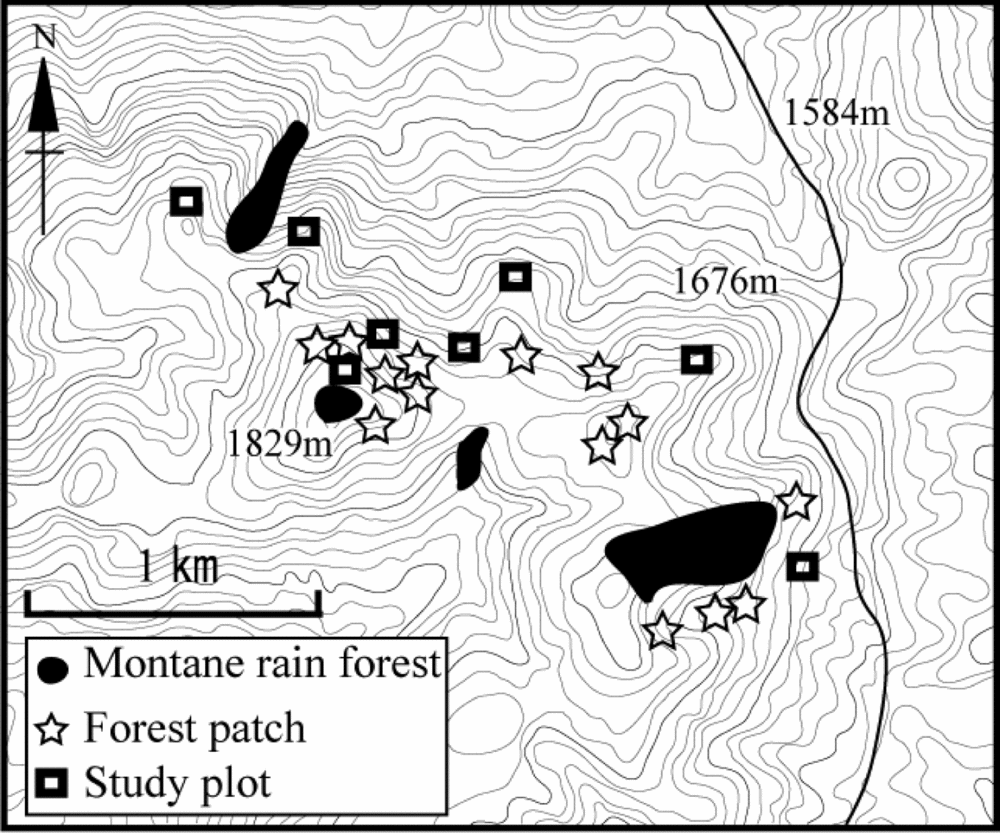
In December 2012, seedlings of forest tree species under fruiting Ficus natalensis Hochst. were enumerated. Ficus natalensis is a medium to tall tree (up to 30 m), distributed from eastern to southern Africa. It mainly grows in miombo woodlands in this study area and is also located in the centres of montane rain forest patches (Figure 1). Its syconia (1.1 ± 0.1 × 1.0 ± 0.1 cm, n = 10) turn from green to yellowish when ripening. Eight F. natalensis individuals were chosen in miombo woodlands. These were at least >50 m away from montane rain forest or forest patches. The mean distance between F. natalensis trees and forest or forest patches was 169 m (range = 56–307 m). Three quadrats (2 × 2 m) were placed 1 m from each F. natalensis bole. The direction of the first quadrat was determined randomly, and the others were placed at 120° and 240° from the direction of the first. In addition, seedlings were counted under eight Brachystegia floribunda Benth. individuals and in eight open sites (3-m radius lacking both trees and canopy cover) in miombo woodlands. Brachystegia floribunda is the dominant tree in miombo woodlands in the study area. It produces dry pods of seeds that are explosively dispersed. Individuals of B. floribunda that were growing within a 50-m radius of observed F. natalensis and were similar to the F. natalensis individuals in diameter at breast height (dbh) and height were selected. Ficus natalensis and B. floribunda did not exhibit canopy overlap. Open microsites were located within a 50-m radius of a F. natalensis tree. Three quadrats were placed under B. floribunda and in open microsites as for F. natalensis. The total number of quadrats was 72 (3 microsites × 3 quadrats/microsite × 8 replicates). Tree species occurring mainly in montane rain forest were considered forest trees (Friis Reference FRIIS1992, White et al. Reference WHITE, DOWSETT-LEMAIRE and CHAPMAN2001). All seedlings of these species 0.2–1 m in height were enumerated.
Map of the study plots.

Seed rain, germination and seedling survival of Syzygium guineense ssp. afromontanum
Seed rain, germination and seedling survival of Syzygium guineense ssp. afromontanum F. White were monitored in the same three microsites (open, under B. floribunda and under F. natalensis) used for forest tree seedlings. Syzygium guineense ssp. afromontanum is endemic to the montane rain forest and is a common species in the forest on Vipya Plateau (White et al. Reference WHITE, DOWSETT-LEMAIRE and CHAPMAN2001). This species is a medium to tall tree (up to 30 m tall) that bears purple berries from January to March, with a mean fruit size of 1.6 × 1.4 cm (n = 6). Seed rain was quantified from January to March 2012 using seed traps. The traps were 70 × 70 cm of fine-mesh net secured to the ground. The net had 5-cm-high sides that prevented collected seeds from washing away. Three seed traps were placed in each microsite in which seedling sampling had been conducted. The total number of seed traps was 72. Seeds from each trap were combined for analysis. Each microsite was visited twice each week, and seeds were removed for counting. Initially, a conventional method was used to measure the seed rain in 2011 (traps were inverted cones of polyethylene cloth with circular mouths of polyethylene pipe; each was supported by three vertical PVC plastic pipes adjusted so that the receiving face was 1 m above the ground). However, these traps were easily visible and damaged by local villagers.
Germination was monitored in the three microsites to determine the post-dispersal fate of S. guineense ssp. afromontanum in miombo woodlands. The seeds of seven individuals were collected in montane rain forest, either directly from trees or from recently fallen fruit. The fruit pulp was manually removed and seeds were checked for viability using a floating test. In January 2012, 25 viable seeds were sown at one sampling station per microsite. The seeds were placed in 5 × 5 grids with seeds 10 cm apart. The sampling station was protected with 50 × 50-cm cages of wire mesh to prevent seed predation by mice. The total numbers of sampling stations and seeds for germination trials were 24 and 600, respectively. Each sampling station was monitored once a week for 10 wk.
Seedling survival was also measured for 10 mo. In January 2012, seeds of S. guineense ssp. afromontanum were placed in a nursery. Seedlings were transplanted to each sampling station 4 wk after bearing their first true leaves. Sixteen seedlings, separated by 50 cm, were transplanted in 4 × 4 grids. The total number of planted seedlings was 384. Immediately following transplantation, seedlings were watered but no additional treatments were implemented. Survival was determined 1 wk after planting and seedlings that had died were replaced. Seedling survival was monitored approximately at 1, 6, 7 and 10 mo following planting.
Frugivore observation
Focal observations of four fruiting F. natalensis trees were conducted from January to March 2011 in miombo woodlands to determine the potential dispersers of S. guineense ssp. afromontanum seeds. Observations were conducted in three equal time blocks: 05h30–08h30, 08h30–12h30 and 12h30–15h30. Each tree was observed for 2 d (six time blocks). Each tree was observed for one time block per day, and was not observed on successive days. Total observation time was 80 h. Each tree was observed from a distance of ~20 m. All visitors, the duration of their stay in the tree and their behaviour (i.e. whether the animal consumed the fruit, fed on arthropods or just perched on the tree) were recorded. Bird and animal species were identified with reference to Dowsett-Lemaire & Dowsett (Reference DOWSETT-LEMAIRE and DOWSETT2006), Fry & Keith (Reference FRY and KEITH1988), Keith et al. (Reference KEITH, URBAN and FRY1992), Kingdon (Reference KINGDON1974) and Urban et al. (Reference URBAN, FRY and KEITH1997). Based on these sources, bird and animal species were classified into forest, forest/woodland and woodland species.
To estimate dispersers of S. guineense ssp. afromontanum seeds, focal watches were conducted from January to March 2011 at five trees, >70 m apart, in montane rain forest. All individuals consuming the fruit of S. guineense ssp. afromontanum were observed using the same method as that used for F. natalensis. During the feeding activity of each animal, their seed treatment behaviour and the number of treated fruit were recorded. Seed treatment was categorized into four types: whether the animal swallowed the whole fruit, dropped or spat parts of the fruit, pecked the fruit or carried them away in their beak. If more than one individual of the same species entered the tree, it was not possible to collect data accurately on all of them. Therefore, data were collected only for one focal individual.
Data analysis
Statistical analyses were conducted using R software ver. 2.14.0 (R Development Core Team; http://www.r-project.org/). The number of forest tree seedlings was analysed using Steel–Dwass multiple comparisons test. The seed rain of S. guineense ssp. afromontanum was analysed using a GLM with a log link function for Poisson distributions. Multiple comparison tests (Tukey tests) were used to detect differences in the number of dispersed seeds among microsites. The tests were conducted via the glht function in the R multicomp package. Final germination percentages were analysed using a GLM with a log link function for binomial distributions. Tukey's tests were also used to detect differences in the percentage of germination among microsites. Log-rank tests were used to detect differences of seedling survival among microsites.
RESULTS
Comparisons of seedling number, seed rain, germination and seedling survival among microsites
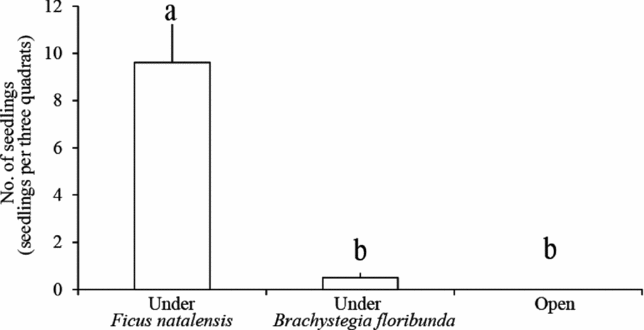
In total, 81 individuals from following six forest tree species were recorded: Cussonia spicata Thunb. (Araliaceae), Diospyros whyteana (Hiern) F. White (Ebenaceae), Parinari excelsa Sabine (Chrysobalanaceae), Apodytes dimidiata E. Mey. (Icacinaceae), S. guineense ssp. afromontanum and Canthium schimperiana A. Rich. (Rubiaceae). Numbers of seedlings differed significantly among microsites (Kruskal–Wallis test χ2 = 19.1, df = 2, P < 0.001), and 95% of seedlings were found under F. natalensis. The number of seedlings was significantly greater under F. natalensis than in the other two microsites (Figure 2). Syzygium guineense ssp. afromontanum was the most abundant species among the seedlings. Diaspores of all recorded species possessed characteristics associated with dispersal by vertebrates.
Mean number of seedlings of forest tree species (±1 SE) at three microsites in northern Malawi. Three quadrats (2 × 2 m) were placed in each microsite. All microsites were located in miombo woodlands. Means with the same letter are not significantly different (P > 0.05) among microsites based on Steel–Dwass's post hoc test.
Sixty-seven seeds of S. guineense ssp. afromontanum were found. The seeds were found in all three microsites (open, under B. floribunda and under F. natalensis). The seed deposition rate differed significantly among microsites (Kruskal–Wallis test χ2 = 12.2, df = 2, P < 0.01). Most (85%) were found under F. natalensis. The number of dispersed seeds was significantly higher under F. natalensis than at the other two microsites (Table 1). Dispersed seeds of S. guineense ssp. afromontanum were found under all eight F. natalensis trees.
Mean number of dispersed seeds, mean seed germination percentage and seedling survival of Syzygium guineense ssp. afromontanum (±1 SE) at three microsites in northern Malawi. All microsites were located in miombo woodlands. Seed rain was monitored from January to March 2012. Germination (n = 600) was also monitored from January to March 2012. Seedling survival (n = 384) was measured from February to December 2012. Means followed by the same letter are not significantly different (P > 0.05) among microsites based on Tukey's post hoc tests for seed rain and germination and on a log-rank test for seedling survival.

Overall, 48% of S. guineense ssp. afromontanum seeds germinated 10 wk after sowing and seed germination was highly variable among microsites (Kruskal–Wallis test χ2 = 15.3, df = 2, P < 0.001). Germination percentage was significantly higher under F. natalensis and under B. floribunda than in open sites, and no differences were found between F. natalensis and B. floribunda sites (Table 1).
Ten months after planting, 54% of S. guineense ssp. afromontanum seedlings survived, and microsite had a significant effect on seedling survival. Survival analyses showed that the seedling survival under F. natalensis was significantly higher than the survival in open sites (Log rank, χ2 = 87.0, df = 1, P < 0.001), whereas no differences were found between F. natalensis and B. floribunda sites (Log rank, χ2 = 1.0, df = 1, P = 0.31).
Animal visits to fruiting Ficus natalensis
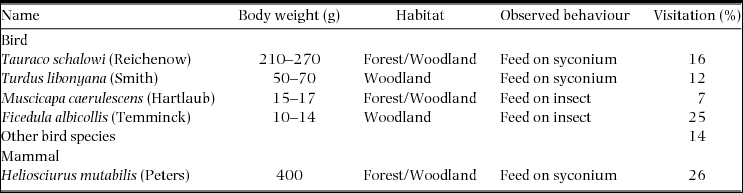
In total, 186 individuals from 21 bird and one mammal species visited fruiting F. natalensis during the 80 h of focal observations (Table 2). Of these animals, 122 individuals from 10 species were frugivores and 97 individuals from seven species were forest-related frugivores. These accounted for 52% of all visiting animals. The sun squirrel (visitation rate 0.6 h−1) was the main visitor to F. natalensis, followed by collared flycatcher (0.6 h−1) and Schalow's turaco (0.4 h−1). Of these animals, the sun squirrel and Schalow's turaco are forest-related frugivores. These two frugivores were observed feeding on syconia (Table 2).
Animal visiting Ficus natalensis in miombo woodland, their body weight (g), habitat, observed behaviour and proportion of visits (%) in northern Malawi.
Seed dispersers of Syzygium guineense ssp. afromontanum
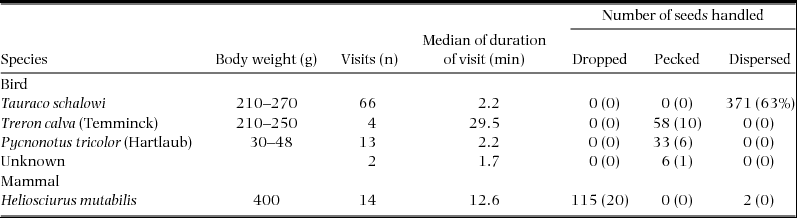
In total, 99 feeding visits including four bird and one mammal species were recorded on fruiting S. guineense ssp. afromontanum (Table 3). All these animal species were found on fruiting F. natalensis. Schalow's turaco was the main consumer of S. guineense ssp. afromontanum, with an average of 0.66 feeding visits h−1. The secondary consumers were sun squirrel with 0.14 feeding visits h−1 and dark-capped bulbul with 0.13 feeding visits h−1.
Frugivores visiting Syzygium guineense ssp. afromontanum in montane rain forest, their body weight (g), number of visiting animals (n) and the duration of visit (median and quartile ranges) in northern Malawi.
These animals handled a total of 585 fruits. Schalow's turaco consumed the highest number of S. guineense ssp. afromontanum fruits. Although the birds consumed a small number of fruits per visit (median = 5), they consumed 371 (63%) fruits in total (Table 3). Schalow's turaco swallowed all of the pecked fruit. Although the sun squirrel was also a major consumer of S. guineense ssp. afromontanum fruits (20%), it did not function as a seed disperser. Nearly 100% of seeds were dropped beneath the parent tree. Similarly, other bird species could not swallow the fruits and were never observed taking fruit out of the tree. The median length of a visit by Schalow's turaco was relatively short (2.2 min).
DISCUSSION
Importance of Ficus natalensis as a nucleus
This study demonstrates that more S. guineense ssp. afromontanum seeds are deposited under F. natalensis than under B. floribunda and in open sites. In addition, germination and seedling survival percentages of S. guineense ssp. afromontanum were greater under F. natalensis compared with those in open sites. These results, combined with spatial patterns of forest tree seedlings (Figure 2), suggest that F. natalensis trees act as efficient nuclei during nucleation in miombo woodlands.
An overlapping fruiting season may drive the observed pattern of seed deposition between S. guineense ssp. afromontanum and F. natalensis. An overlapping fruiting season among plants that share seed dispersal agents can promote facilitative plant–plant seed dispersal interactions (Clark et al. Reference CLARK, POULSEN, CONNOR and PARKER2004). The fruit of S. guineense ssp. afromontanum ripen from December to February, i.e. the rainy season (Dowsett-Lemaire Reference DOWSETT-LEMAIRE1988). In this region, some F. natalensis trees bear syconia from August to October (dry season), but others do so from January to April. During the overlapping periods, frugivores that consume fruit from both species are likely to transfer S. guineense ssp. afromontanum seeds to miombo woodlands.
Consistent with previous research (Hoffmann Reference HOFFMANN1996, Shararn et al. Reference SHARARN, SINCLAIR, TURKINGTON and JACOB2009), germination and seedling survival percentages beneath crowns (under F. natalensis and B. floribunda) were greater than those in open spaces. This likely ensues from reduced exposure to desiccation and lower flammability resulting from shading (Hoffmann Reference HOFFMANN1996, Shararn et al. Reference SHARARN, SINCLAIR, TURKINGTON and JACOB2009). Thus, the presence of F. natalensis not only increases seed arrival, but also facilitates the establishment of forest tree species, promoting the formation of forest patches in miombo woodlands.
Potential importance of Schalow's turaco in forest colonization
Individual frugivore species are likely to vary in their contribution to the seed dispersal of S. guineense ssp. afromontanum (Table 3). Schalow's turaco was the most important seed disperser of S. guineense ssp. afromontanum. During focal observation, Schalow's turaco visited S. guineense ssp. afromontanum frequently (67% of the total number of animals observed), consumed most of the fruit (63% of the total number of fruit consumed) and swallowed all pecked fruit. Schalow's turaco spent much shorter periods of time (2.2 min) in S. guineense ssp. afromontanum relative to reported gut passage rates (40 min for similarly sized and closely related species; Lehouck et al. Reference LEHOUCK, SPANHOVE, DEMETER, GEMETER and LENS2009). Therefore, the probability of depositing consumed seeds under parent trees is low. Although the present study did not examine the effect of gut passage for Schalow's turaco, Lehouck et al. (Reference LEHOUCK, SPANHOVE and LENS2011) showed that seeds passing through the gut of similarly sized turaco remain viable.
The sun squirrel, observed consuming 20% of S. guineense ssp. afromontanum fruit, was the second-most important consumer. However, the sun squirrel frequently cleaned the fruit pulp and dropped seeds under parent trees, rendering it ineffective as a disperser. Other bird species (30–210 g) were also observed feeding on S. guineense ssp. afromontanum fruit, but they did not disperse the seeds. The large seeds of S. guineense ssp. afromontanum may be difficult, if not impossible, for the majority of small birds to swallow due to their limited gape-width (Wheelwright Reference WHEELWRIGHT1985).
Seeds deposited by birds accumulate under fruiting trees frequented by birds (Berens et al. Reference BERENS, FARWIG, SCHAAB and BOHNING-GAESE2008, Clark et al. Reference CLARK, POULSEN, CONNOR and PARKER2004, Herrera & Garcia Reference HERRERA and GARCIA2009) because most seed defecation and regurgitation by birds occurs when they are perched or immediately after they take wing, but only rarely in flight (McDonnell & Stiles Reference MCDONNELL and STILES1983). Seed deposition of S. guineense ssp. afromontanum under F. natalensis was much higher compared with deposition under B. floribunda or open interspace. Schalow's turaco was also observed frequently visiting fruiting F. natalensis (Table 2). These observations suggest that the deposition of S. guineense ssp. afromontanum seeds under F. natalensis was mediated by Schalow's turaco.
The probability of seed dispersal across a forest boundary can be related to the ability to disperse seeds over a distance and the degree of habitat dependency of dispersal agents (Lehouck et al. Reference LEHOUCK, SPANHOVE, DEMETER, GEMETER and LENS2009). Previous studies have estimated dispersal distance for tree species with similar seed sizes by similarly sized turacos (Lehouck et al. Reference LEHOUCK, SPANHOVE, DEMETER, GEMETER and LENS2009, Sun et al. Reference SUN, IVES, KRAEUTER and MOERMOND1997). According to these studies, turaco can disperse seeds over a maximum distance of 600 m. Although Schalow's turaco prefers a forest habitat (Fry & Keith Reference FRY and KEITH1988), it is known to be a non-biome-restricted species (Mills et al. Reference MILLS, VAZ PINTO and DEAN2008). During the focal observations in this study, Schalow's turaco frequently flew to miombo woodlands after feeding on fruit of S. guineense ssp. afromontanum in the montane rain forest (Fujita, pers. obs.). These traits also support my proposal that Schalow's turaco functions as a disperser of S. guineense ssp. afromontanum seeds into miombo woodlands.
Schalow's turaco apparently transferred S. guineense ssp. afromontanum seeds into miombo woodland, but I could not entirely discount the possibility that other animals, such as fruit bats, also contributed to seed transfer. Future studies should conduct night observations for an extended period to clarify this issue.
In conclusion, although some frugivore species occur both in forests and miombo woodlands, the seed transfer of S. guineense ssp. afromontanum (a montane rain-forest tree) into miombo woodland is most likely to occur due to the action of Schalow's turaco. As frugivores differ markedly in their ability to disperse seeds across a forest boundary, the rate of forest colonization through nucleation in different regions will likely be influenced by the composition of the local frugivore assemblage.
ACKNOWLEDGEMENTS
I thank K. Mizuno, S. Kobayashi, G. Yamakoshi, H. Sato, C. Yamashina and two reviewers for useful comments on earlier drafts of this manuscript. I would like to acknowledge the Department of Forestry and the Forestry Research Institute of Malawi for their hospitality and helpful advice in the field. This research was funded by the Japan Society for the Promotion of Science Global COE Programme (E-04): In Search of Sustainable Humanosphere in Asia and Africa.