Introduction
Stepping into adulthood is usually viewed in terms of normative developmental tasks. International encyclopaedias and dictionaries refer to ‘developmental tasks’ as a series of problems that a developing/growing person has to solve (Thomas Reference Thomas1990, 118-120). According to Havighurst, a person moves on from one stage to another, solving problems typical of a particular stage (Havighurst Reference Havighurst1981). One such problem is how to participate in social life and co-shape it. The notion of social participation has been further elaborated by, for instance, J. Modrzewski (Reference Modrzewski2004). Social participation is understood in this study as the subject’s engagement in creating social events and situations in their actual historical and biographical dimensions, felt by individuals in the course of experiencing their life and forming its social image. Education plays a particularly significant role in the process of shaping youth’s participation in social life, as it should support the individual in his or her unceasing self-creation, in understanding the world, in fostering positive relations with other people, in activating his or her social powers, and in exercising particular activities. In my analysis, I start from Modrzewski’s view that social participation is manifested by: taking or standing for a particular position in the social structure; socially visible activities typical of every social system; revealing the possession or acquisition (in compliance with the cultural model) of particular psychosocial traits which shape the subject’s awareness in many forms (Modrzewski Reference Modrzewski2004, 52).
My assumption is that the sine qua non of a particular type of social participation is socialization. During their educational socialization young people acquire competences that are indispensable when taking up their future social roles. In adolescence, people not only internalize social norms but also build their own activity patterns, frequently going beyond the generally accepted framework. What is recognized in this study as a condition and indicator of youth’s participation in social and public life is their fulfilling of such developmental tasks as understanding the phenomena of the social world (unemployment, politics, economy) as a preparation for holding citizen roles, and changing and shaping their surrounding reality.
Methodology
In the current article, a section of the empirical material collected in nationwide quantitative-qualitative studies is used. The analysis involved the results of quantitative studies among the youth living in South Poland, conducted in the school year 2003/2004, and partial results of research conducted in the same territory in the school year 2016/2017. The survey follows the comparative model (Frankfort-Nachmias and Nachmias Reference Frankfort-Nachmias and Nachmias1996, 153–154). It was carried out with the use of an authorial questionnaire based on Erikson’s theory of psychosocial development (Erikson Reference Erikson1994), Havighurst’s concept of developmental tasks (Havighurst Reference Havighurst1981), Lewowicki’s theory of identity behaviours (Lewowicki Reference Lewowicki and Lewowicki1994), and sociological theories of conflict (Simmel Reference Simmel1955). The applied research tool was of my own construction – the reliability coefficient, Cronbach’s alpha (α), of 0.730 (within the interval 0–1) confirms the appropriate construction of the questionnaire (Szczurek-Boruta Reference Szczurek-Boruta2007, 178–183). The questionnaire comprises 48 questions in Part A (developmental tasks) and 41 in Part B (social conditions of education). Eight questions relate to personal particulars (the questionnaire published in: Szczurek-Boruta Reference Szczurek-Boruta2007, 381–384).
Research into mental development traditionally uses any one of three strategies – cross-sectional, longitudinal and oblique. In this study, the oblique design was used (Trempała and Olejnik Reference Trempała, Olejnik and Trempała2016, 134-135) – a particular variable (developmental tasks and social conditions of education) was measured with the same tool (the authorial questionnaire used for the first time in 2003) in a repeatable way in different time periods (in school years 2003/2004 Footnote 1 and 2016/2017Footnote 2 ) in the same cohort (adolescents). Nonprobability and random sampling were used. Nonprobability elements are: learners’ age – 18; type of school (technical, general education secondary school), residence place – South Poland. In both measurement periods, the sample fulfilled the criteria of representativeness.
The collected empirical material was verified by using the methods of quantitative and qualitative description of the research. The processing of the empirical data took place with the application of the following statistical methods: cluster analysis, canonical analysis and descriptive statistics (Ferguson and Takane Reference Ferguson and Takane1989). This was done with the use of a statistical analysis suite – STATISTICA 13.
Analysis and Interpretation of the Research Results
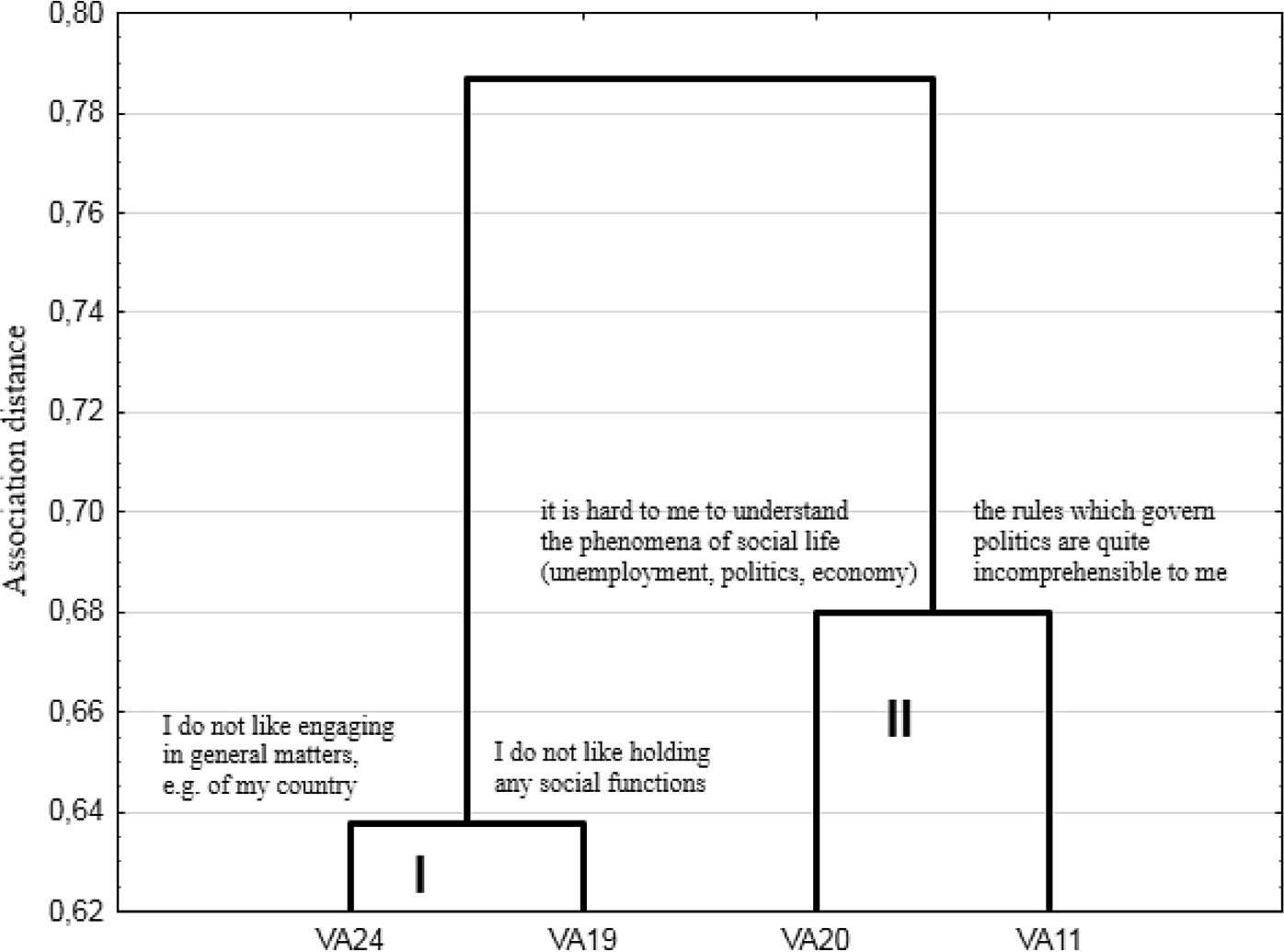
Of ten developmental tasks, eight (i.e. acquiring a social role appropriate for one’s sex; achieving emotional and economic independence from others; seeking a partner – love; establishing the system of values; choosing and preparing for a professional career; achieving more mature relations with friends – peers; obtaining self-knowledge; acquiring competences to fulfil school tasks) obtained the highest mean. Two tasks (understanding the phenomena of the social world (unemployment, politics, economy) as preparation for holding citizen roles, and changing and shaping the surrounding reality) were not fulfilled.Footnote 3 Noticing the existing deficiencies in school education was the reason to make an attempt at defining the elements of tasks that are not fulfilled. The assumption was to confirm cluster structures composed by the sentences ‘understanding the phenomena of the social world (unemployment, politics, economy) as preparation for holding citizen roles’ and ‘changing and shaping surrounding reality ’ and to indicate the occurring dominations. With the use of cluster analysis, the associations were calculated between particular identity behaviours which compose these developmental tasks. The distance of the association was expressed by the correlation coefficient: Pearson’s r – 1. The analysis of the studies conducted in 2003/2004 and in 2016/2017 revealed the occurrence of similarities in cluster structures of the examined sentences not only in the number of clusters and their inner structure but also in the strength of the association between particular behaviours. This can be exemplified by the dendrogram presenting the 2016/2017 research results (Figure 1).
Dendrogram 1. Cluster structure of the developmental task: understanding the phenomena of the social world (unemployment, politics, economy) as preparation for holding citizen roles. N=248 – the studies of youth in 2016/2017. Agglomeration with the method of average weighted associations. Association distance: Pearson’s r – 1. (Source: own research.)

In the image of the sentence ‘understanding the phenomena of the social world (unemployment, politics, economy) as preparation for holding citizen roles’, the bipolar structure is clearly seen. Two substructures appeared (Figure 1). The first, with a clear strength of association (r = 0.362) (the interpretation of correlation coefficients r according to Guilford Reference Guilford1960), is composed of the behaviour patterns indicating the negative attitude to any forms of activity: ‘I do not like engaging in general matters, e.g. of my country’ /VA24/ and ‘I do not like holding any social functions’ /VA19/. The second substructure, with the strength of association r = 0.320, is composed of the behaviours manifesting a lack of understanding of the social world: ‘the rules which govern politics are quite incomprehensible to me’ /VA11/ and ‘it is hard for me to understand the phenomena of social life (unemployment, politics, economy’ /VA20/. Substructures I and II remain in a distinct but weak dependence (r = 0.213). This interrelation shows that identity behaviours determine one another to a distinct extent in such a way that fulfilling some of them in practice results in the occurrence of other behaviours.
Fulfilling this task mostly consists of developing instrumental skills, indispensable in shaping citizen competences, which determine the social participation of youth. The activities of educational institutions are aimed at developing the skill of understanding the notions of law, government, politics, geography and social institutions responsible for the modern world. All this enhances the shaping of competences to handle the problems of democracy and the development of interpersonal relations.
Broadening one’s influence on society’s functioning takes place through undertaking citizen duties and responsibilities. Reaching the age of majority implies active voting rights, the use of which can be viewed as a mechanism that influences the development of social and political life.
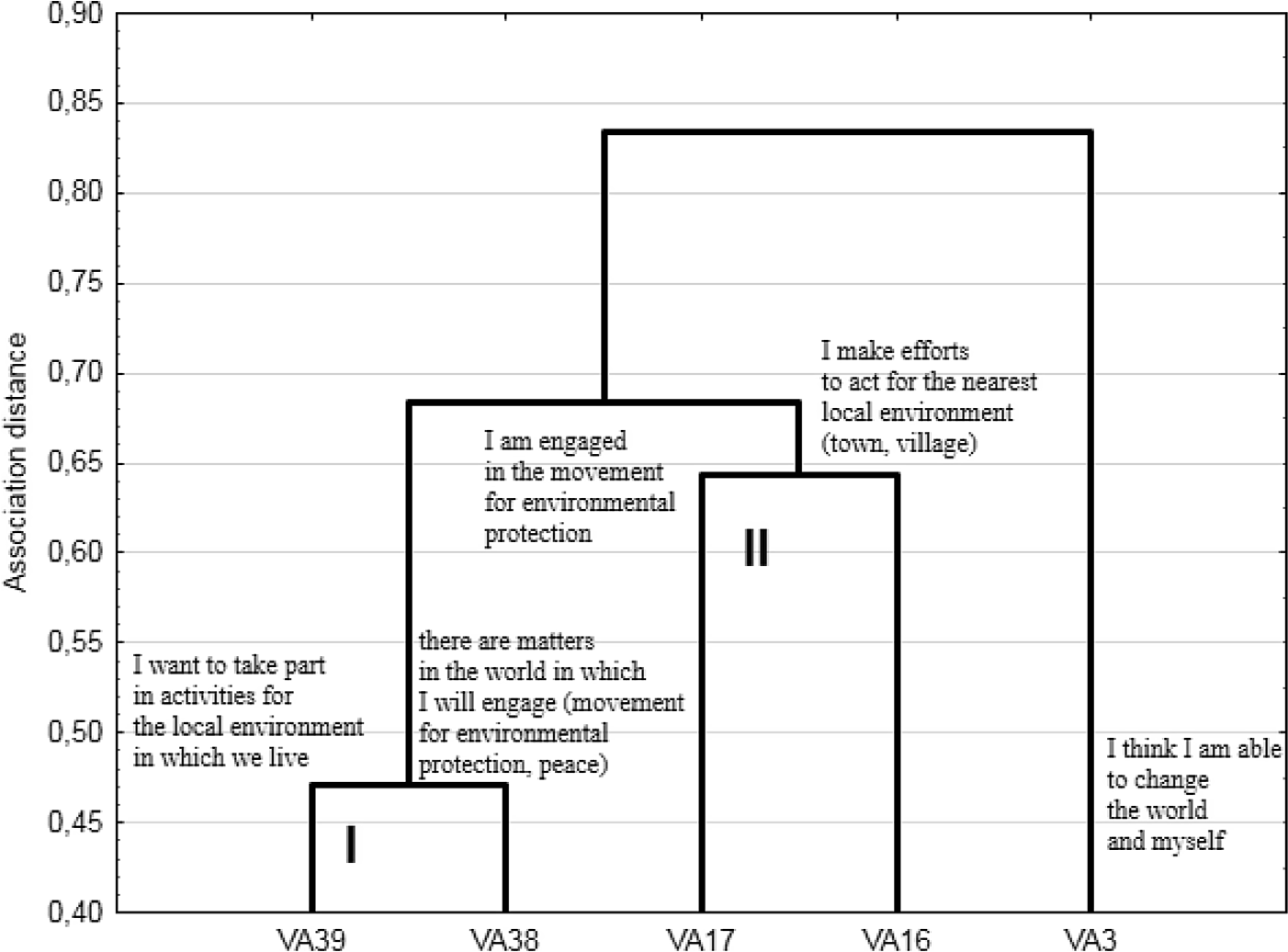
In the image of the sentence ‘changing and shaping surrounding reality’, the bipolar structure appears as well. The behaviour patterns constituting the image of this developmental task reveal divergences between wishes (substructure I is composed of the variables: ‘I want to take part in activities for the local environment in which we live’ /VA39/ and ‘there are matters in the world in which I will engage (movements for environmental protection, peace)’ /VA38/, r = 0.529) and the actual activity of the surveyed youth (substructure II is composed of the behaviours ‘I am engaged in the movement for environmental protection’ /VA17/ and ‘I make efforts to act for the nearest local environment (town, village)’ /VA16/, r = 0.357). Both substructures (I and II) are interrelated – r = 0.316, the dependence is evident (Figure 2). They are completed with the identity behaviour ‘I think I am able to change the world and myself’ /VA3/. The rank of this relation r = 0.166 implies a weak correlation. This correlation indicates a broader context of fulfilling this task – youth’s low feeling of self-effectiveness.
Dendrogram 2. Cluster structure of the developmental task: changing and shaping surrounding reality. N=248 – the studies of youth in 2016/2017. Agglomeration with the method of average weighted associations. Association distance: Pearson r – 1. (Source: own research.)

The results of both the 2003/2004 and 2016/2017 studies revealed some educational deficiencies when it comes to youngsters fulfilling the two discussed tasks: ‘understanding the phenomena of the social world (unemployment, politics, economy) as preparation for holding citizen roles’ and ‘changing and shaping surrounding reality’. Compared with the results of the earlier studies, young people’s feeling of understanding the phenomena of the social world has slightly decreased (from =1.84 to = 1.89; change: 2.5%) and the belief in the capability of changing and shaping the surrounding reality has increased (from =1.93 to =1.89; change: –2.3%).
What can be noticed in the case of the discussed tasks is the lack of explicit support in elaborating them by society and school education. Society seems to be very poor in educational programmes which – in a pragmatic sense – bring adolescents closer to the problems of functioning in adult social life.
Fulfilling developmental tasks should be viewed in the context of social expectations correlated with school curricula. The curriculum of the school subject ‘knowledge of society’, implemented by the surveyed group, was not aimed at the practical preparation of learners for fulfilling various social roles. It was focused on knowledge rather than skills and experiencing or solving social problems. In the core curriculum of this subject, binding in the school year 2016/2017, the teaching goals were formulated in six fields: (I) The use and production of information. (II) Recognizing and solving problems. (III) Collaboration in public matters. (IV) Knowledge of the principles and procedures of democracy. (V) Knowledge of the foundations of the political system in the Republic of Poland. (VI) Knowledge of human rights and their protection. Transfer of knowledge and its familiarization dominate these general requirements. Only field III (collaboration in public matters) comprises the following statement: ‘The learner collaborates with others – plans, shares tasks and fulfils them; skilfully uses the procedures and possibilities offered by the institutions of public life; knows and makes use of the principles of self-organization and self-support’ (Core curriculum of the subject ‘knowledge of society’ 2011).
The deficiencies in youth’s fulfilling the discussed tasks seem to confirm that Polish school education is dominated by teaching that is detached from practice and that learners are not prepared for taking up adult social roles through active participation in public life. The lack of fulfilling these tasks by the young results from a process of legitimizing that ensures ‘the loyalty of the masses’ and perpetuates existing cultural patterns without co-participation in social or public life (some explanations of this might be provided by, for example, Jürgen Habermas’s theory of communicative action; Habermas Reference Habermas1981).
It should be noticed that despite the occurrence of some problems typical of the whole population of youth, girls and boys attribute different ranks to the developmental tasks. The natural biological differences overlap with social views on male and female roles, binding behaviour patterns and methods of upbringing. Gender is a factor that differentiates the feeling of fulfilling the task ‘understanding the phenomena of the social world (unemployment, politics, economy) as preparation for holding citizen roles’ (r = 0.295 for p < 0.001 in the studies conducted in 2003/2004; r = 0.196 for p < 0.05 in 2016/2017), as well as the task ‘changing and shaping surrounding reality’ (r = 0.201 for p < 0.001 in the studies conducted in 2003/2004; r = 0.168 for p < 0.05 in 2016/2017). Gender determines the way and the quality of a person’s functioning. Girls and boys react differently to particular tasks. The sources of this phenomenon can be found in their unequal physical development and in educating the youth depending on their sex. The stereotypes, into which the young get routed due to socialization practices, impose certain expectations on girls and boys. The traditional family model, which dominates in Polish culture, as well as the cultural context of assigning male and female duties, determine the significance attributed to the developmental tasks in adolescence.
The research carried out in 2016/2017 also revealed that parents’ education (r = 0.184 for p < 0.028) and the type of school (r = 0.179 for p < 0.015) determine the fulfilment of the task ‘understanding the phenomena of the social world (unemployment, politics, economy) as the preparation for holding citizen roles’. The type of school determines fulfilling the task ‘changing and shaping the surrounding reality’ as well (r = 0.193 for p < 0.013). Family and school are educational environments with a particular sociocultural capital which determines the acquisition of developmental tasks. Better potentialities of collecting experience, of managing in real situations, and of increasing their competences are typical both of the youth coming from families with a higher status of parental education and of learners from vocationally profiled schools, who efficiently combine theory and practice.
Social participation as viewed by Modrzewski is an aspect and manifestation of the individual’s life. One of these manifestations is ‘taking or standing for a particular position in the social structure’ (Modrzewski Reference Modrzewski2004, 52). In the studies relative to 2016/2017 the surveyed youth place themselves in the space of school, class, group of peers or friends. The young take particular social positions, they have a certain social status and belonging to a group is of special significance to them (declared by 84.11% of the respondents).
The implementation of social participation takes place through the functioning and behaviour of the individual as well as through contacts with others. Most of the respondents do not act for the nearest local environment (town, village), they are not engaged in, for example, activities for environmental protection (69.01%). In the future, 46.35% of the respondents do not intend to engage in issues important to the wider world (e.g. the movement for peace).
The research has revealed a certain bipolarization of youth’s declarations and behaviours (42.70% of the young declare their commitment to general issues, 39.32% decline all forms of engagement).
Social participation is defined, among other things, by notions such as social knowledge and social identity. The social knowledge of the examined youth mostly concerns the region in which the respondents live. The majority claim to be familiar with their cultural heritage (71.61%). Without doubt, this results from school activities promoting regional education. Over half of the respondents (54.42%) want to maintain the customs, rituals and traditions of their region, and 66.93% identify themselves with the territory, region, local area, place (as earlier studies have shown, place is an important dimension of identity (Szczurek-Boruta Reference Szczurek-Boruta2016, 59–73). In the examined group, the dominating form of identity is local identity – it provides the foundation for engaging in activities for people and groups from the nearest environment with whom the individual identifies. This becomes a favourable condition for building other forms of identity, which in my opinion might lead to shaping citizen identity.
Conclusion
Youth, as an inexperienced group with some shortages of skills, seek their place in the social structure – their identification. Facing a lack of clear answers to the raised existential questions, in a culture full of contradictions yet requiring unceasing adaptation (Melosik Reference Melosik2013), the culture of supremacy of individualism over collectivism (Cybal-Michalska Reference Cybal-Michalska2006), and the lack of engagement due to the erosion of social capital (Marzec-Holka Reference Marzec-Holka, Matysiak-Błaszczak and Włodarczyk2016), solving natural developmental tasks by youth is now – more than ever before – fraught with difficulties.
School education should aim at creating opportunities for the young to participate in completing developmental tasks. These opportunities are not directly offered by society but transmitted by ‘exercising’ the individual. A sine qua non for the acquisition of developmental tasks is exercising – going through certain types of experience and acquiring some tools (knowledge, emotions, activities) to achieve these tasks. In the context of school activities, it is of key significance to enable the exploration of decision-making habits as well as handling the consequences of such decisions. Education ought to create chances for such individual exercises that on the strategic platform enhance shaping the identity of an understanding individual, on the tactical platform allow for ensuring proper developmental conditions, and on the operational platform guarantee the highest level of performance.
What is responsible for shaping the foundations of the individual’s identity is the development of cognitive and emotional processes, reinforced by processes of social learning. If young people have no cognitive competences that allow for noticing and describing themselves in the categories of their own features or the features of other people, groups or institutions, they cannot take part in social life in a conscious way. The lack of these competences hinders the acquisition and broadening of the knowledge concerning these fields in later developmental stages. As a result, developing different types of identity (social, national, cultural, European, global) is only an assumed, not a fulfilled, goal. In various types of schools, the implementation of the curriculum of the subject ‘knowledge of society’ is illusory and inefficient. The results of the studies conducted over a 13-year span show that Polish youth feel neither a strong need for understanding the phenomena of the social world nor for participation in its change. They sit on the sidelines and simply wait things out. Such a cultural model of psycho-social qualities and behaviours results from socialization, from education in the family, school and local environment, and from the current objective and subjective conditions. Polish society is disappointed with the democratic process (corruption, lies) and improved living standards are mostly attributed to the social policy of the current government. The poor understanding of social phenomena has short-term consequences but in the longer run may lead to support for a strong state.
Quite likely, these studies – even though they concern youth living in Southern Poland – can be related to the entire generation of contemporary Polish youth, with respect to social expectations and cultural patterns. What seems a sine qua non for the permanence and stability of democracy is a well-developed citizen society, consisting of active citizens, who are aware of their rights and responsibilities. A lack of citizen knowledge and, first of all, the practical citizen skills of youth or the understanding of complex political and social problems are just some of the issues that education should face. It is equally important to create and develop ethical and moral attitudes, in which citizen and prosocial activeness are positively valued.
Education is the field for acquiring experience and knowledge and for forming behaviour patterns. Due to the impact of educational socialization, the individual develops, in compliance with the cultural model, some particular psychosocial qualities, the feeling of uniqueness and self-identification, as well as social behaviours and aspirations associated with active participation in public life.
About the Author
Alina Szczurek-Boruta is a Professor at the University of Silesia in Katowice, and Head of the Department of Social Pedagogy and Intercultural Education. Her research interests focus on multiculturalism and interculturalism, intercultural education, a sense of reflective identity and educational support for young adults, early school education, social pedagogy and pedagogy of youth. She is the author of six monographs, co-editor of 15 monographs in the series Edukacja Międzykulturowa (Multicultural Education) and five in the series Pedagogika Społeczna (Social Pedagogy), and Deputy Editor-in-Chief of the journal Edukacja Międzykulturowa (Multicultural Education).