Delirium is a serious condition in older adults in nursing homes; it leads to higher risk for adverse health outcomes and increased healthcare costs.Reference Inouye1,Reference Kiely, Bergmann, Murphy, Jones, Orav and Marcantonio2 Although its clinical features may go unrecognized, factors that contribute to delirium include systemic infection, fever, dehydration, adverse reaction to medications, and other forms of acute illness.Reference Inouye1 Various tools for delirium assessment exist; however, the validated Confusion Assessment Method (CAM)Reference Inouye, van Dyck, Alessi, Balkin, Siegal and Horwitz3 and its adaptations are among the most widely used.Reference Wei, Fearing, Sternberg and Inouye4 The CAM approach to assessing delirium is approximated in the CMS minimum dataset (MDS) version 3.0, and it is used in the revised McGeer Criteria for healthcare-associated infection (HAI) surveillance in nursing homes to define ACMS as a constitutional criterion.Reference Stone, Ashraf and Calder5
At its core, the CAM assesses the presence of confirmed delirium using 4 elements: (1) acute onset with fluctuating course; (2) inattention; and either (3) disorganized thinking or (4) altered level of consciousness.Reference Inouye, van Dyck, Alessi, Balkin, Siegal and Horwitz3 Despite this standardized algorithm,Reference Inouye, van Dyck, Alessi, Balkin, Siegal and Horwitz3 nursing staff often lack formal education or training in the recognition of CAM elements,Reference Voyer, Richard and McCusker6,Reference Inouye, Foreman, Mion, Katz and Cooney7 or they may fail to appropriately document resident symptoms.Reference Voyer, McCusker and Cole8 Given these challenges, we assessed the documentation of the 4 CAM elements in a large sample of US nursing home residents, and we evaluated the impact of using a more sensitive, modified ACMS criterion in infection surveillance definitions.
Methods
In 2017, the Centers for Disease Control and Prevention (CDC) Emerging Infections Program (EIP) conducted a nursing home prevalence survey of HAIs in 10 states: California, Colorado, Connecticut, Georgia, Maryland, Minnesota, New Mexico, New York, Oregon, and Tennessee.Reference Thompson, Penna and Eure9 Trained EIP staff reviewed resident medical records for any possible signs or symptoms of infection present on the survey date or the day prior. If present, a more detailed review of documentation was conducted to identify all infection criteria present, including for any ACMS that were new or different from baseline, on the survey date and in the 6 days prior. The revised McGeer Criteria were used to identify HAIs and included the CAM-defined constitutional criterion, confirmed ACMS (ie, documentation of acute onset with fluctuating course, inattention, and either disorganized thinking or altered level of consciousness), alongside specific signs or symptoms in the following infection surveillance definitions: catheter-associated urinary tract infection (CAUTI), lower respiratory tract infection (LRTI), pneumonia (PNEU), and cellulitis and/or soft tissue and/or wound infection (SSTI).Reference Stone, Ashraf and Calder5 Standardized forms and written guidance for these definitions, including confirmed ACMS, were provided to EIP staff to aid data collection.
We calculated the prevalence of each CAM element, combinations of elements, and confirmed ACMS. We defined possible ACMS as the documentation of any of the 4 CAM elements. The number of residents meeting CAUTI, LRTI, PNEU, and SSTI definitions using the confirmed and possible ACMS constitutional criteria were calculated and compared. The χ2 test and Wilcoxon’s rank-sum test were used to compare differences between residents with possible ACMS and those with no CAM elements documented for selected characteristics. P values <.05 were considered statistically significant. All data were analyzed using SAS version 9.4 software (SAS Institute, Cary, NC).
Results
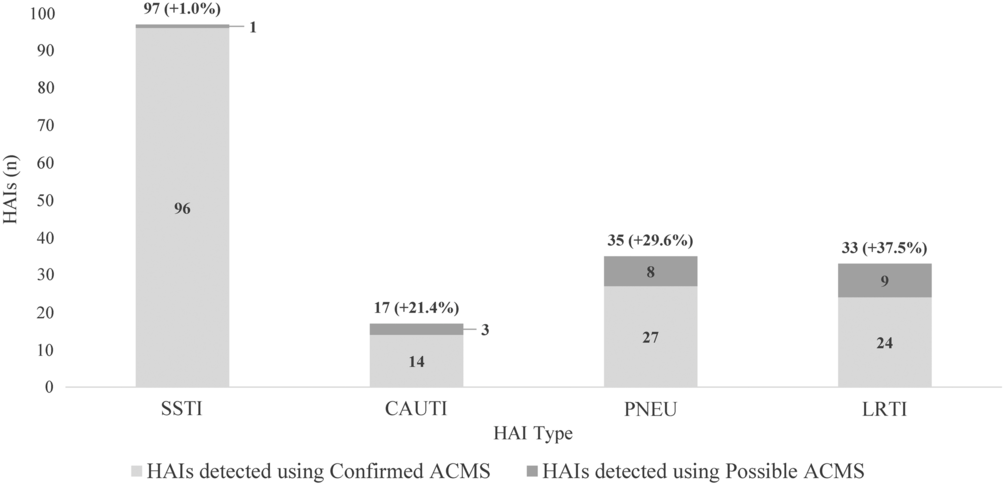
Among 15,276 eligible residents in 161 participating nursing homes, no resident had the required documentation to meet the confirmed ACMS criterion. The most frequently documented CAM element was disorganized thinking (n = 164, 1.1%), followed by altered level of consciousness (n = 117, 0.8%), fluctuating behavior (n = 59, 0.4%), and inattention (n = 9, 0.1%). In total, 296 (1.9%) residents had at least 1 CAM element documented, meeting the possible ACMS criterion. Disorganized thinking and altered level of consciousness were the most common elements in combination (Table 1). Residents meeting the possible ACMS criterion were older than those with no CAM elements documented: median age, 82 years (interquartile range [IQR], 14) versus 80 years (IQR, 19; P = .009). They also had shorter nursing home stay duration than those with no CAM elements documented: median days from nursing home admission date to survey date: 132 days (IQR, 585) versus 334 days (IQR, 891; P < .0001). Compared with confirmed ACMS, the use of the possible ACMS criterion resulted in the detection of 21 additional HAIs (5.6% overall increase) (Fig 1.). The greatest increases were for LRTI (n = 9, 37.5%) and PNEU (n = 8, 29.6%).
Confusion Assessment Method (CAM) Element Documentation Among Nursing Home Residents with Possible Acute Change in Mental Status (ACMS) (N = 296)

a Element combinations are mutually exclusive.
Number and percent increase in cellulitis and/or soft-tissue and/or wound (SSTI), catheter-associated urinary tract (CAUTI), pneumonia (PNEU), and lower respiratory tract (LRTI) healthcare-associated infections (HAIs) identified among nursing home residents using the confirmed acute change in mental status (ACMS) and possible ACMS criteria.

Discussion
Among a large number of nursing home residents, no resident had the required documentation to meet the revised McGeer confirmed ACMS criterion, as defined using the CAM. This finding was surprising given that other long-term care and post-acute care settings have reported estimates of CAM-defined delirium ranging from 16% to 60%.Reference Inouye1,Reference Kiely, Bergmann, Murphy, Jones, Orav and Marcantonio2,Reference Voyer, Richard and McCusker6 Documentation of the individual core CAM elements was also lower than expected when compared with a study of CAM documentation in Canadian nursing homes, where the frequency of delirium symptoms ranged from 1.9% for inattention to 13.0% for altered level of consciousness.Reference Voyer, McCusker and Cole8 Notably, inattention was also the least frequently documented element (0.1%) in our survey. Because inattention is a required element in the CAM-based delirium definition, its absence had a large effect on the prevalence of residents meeting the confirmed ACMS criterion.
Although it is unclear why so few of the CAM elements were documented in our survey, explanations proposed in the literature include high resident-to-nurse staffing ratios, a preference of nursing staff to provide verbal reports of resident status, and time constraints for completing documentation.Reference Voyer, Richard and McCusker6–Reference Voyer, McCusker and Cole8 One study comparing delirium assessment between trained researchers and untrained clinical staff showed that due to the complexity of bedside assessments and the presence of resident factors such as dementia, specialized training is required for nursing home staff to adequately assess delirium.Reference Voyer, Richard and McCusker6 Additional explanations may include failure of clinical staff to perform formal CAM assessments or failure of staff to appreciate the severity of delirium symptoms.Reference Inouye, Foreman, Mion, Katz and Cooney7,Reference Voyer, McCusker and Cole8
When creating the possible ACMS criteria, we evaluated all combinations of the CAM elements and ultimately selected the most sensitive—any 1 of 4 CAM elements. Our proposal for use of a possible ACMS criterion in infection surveillance is supported by the findings of Inouye et al,Reference Inouye, Leo-Summers, Zhang, Bogardus, Leslie and Agostini10 who validated a chart-based delirium detection method among older persons in acute care settings. In their study, chart documentation of any key descriptive CAM term yielded good sensitivity (74%) and specificity (83%) compared to direct delirium assessment using the formal CAM. These authors recommended use of this more sensitive, chart-based method for patient safety or quality improvement initiatives but not for clinical assessment or establishing a diagnosis of delirium.Reference Inouye, Leo-Summers, Zhang, Bogardus, Leslie and Agostini10 In a separate study, chart-based detection was also recommended for use in research settings to augment formal assessments and to identify additional persons with possible delirium.Reference Saczynski, Kosar and Xu11
Using a possible ACMS criterion, the prevalence of ACMS in our survey increased from 0 to 1.9%. This change resulted in the identification of 21 additional HAIs (5.6% increase in HAIs), and most were respiratory infections (n = 17, 81.0%). Because other diagnostic or localizing criteria must also be present to meet the revised McGeer infection surveillance definitions,Reference Stone, Ashraf and Calder5 misclassifications of residents with HAIs were not anticipated. We also found that residents meeting the possible ACMS criterion were more recently admitted to nursing homes and were significantly older than those with no CAM elements documented. Characteristics associated with the prevalence of delirium symptoms in nursing home residents include recent hospitalization and increasing age.Reference Inouye1,Reference Kiely, Bergmann, Murphy, Jones, Orav and Marcantonio2 This finding increases our confidence that the possible ACMS criterion identifies a resident population of interest for delirium symptoms.
Notably, the assessment of ACMS documentation was not the primary objective of the prevalence survey, and our findings may be limited by incomplete medical record documentation in nursing homes.Reference Voyer, McCusker and Cole8 However, given the need for specialized CAM assessment training and evidence of suboptimal documentation of the core CAM elements in nursing homes,Reference Voyer, Richard and McCusker6–Reference Voyer, McCusker and Cole8 our findings suggest that use of the CAM to define confirmed ACMS in infection surveillance definitions is likely too stringent. Although investigators have emphasized the importance of formal CAM assessments to clinically diagnose delirium,Reference Inouye, Leo-Summers, Zhang, Bogardus, Leslie and Agostini10 a possible ACMS criterion may be better suited for retrospective infection surveillance. Additional research to assess barriers associated with incorporating CAM assessment and documentation practices in nursing homes is needed when evaluating residents suspected of infection to improve infection surveillance and resident safety.
Acknowledgments
We thank the staff and nursing homes that participated in the 2017 Centers for Disease Control and Prevention (CDC)/Emerging Infections Program (EIP) Nursing Home Point Prevalence Survey. We also thank EIP and CDC staff for their contributions to survey coordination, data collection, data entry, and data management. The findings and conclusions in this report are those of the authors and do not necessarily represent the official position of the Centers for Disease Control and Prevention /the Agency for Toxic Substances and Disease Registry, or the Department of Veterans’ Affairs.
Financial support
This work was supported through a cooperative agreement by the Centers for Disease Control and Prevention (CDC) and the Emerging Infections Program (EIP).
Conflicts of interest
M.A.K. reports nonfinancial support from Council of State and Territorial Epidemiologists (CSTE), nonfinancial support from Society for Healthcare Epidemiology of America (SHEA), personal fees and nonfinancial support from Infectious Disease Consulting Corporation (IDCC), personal fees and nonfinancial support from WebMD, nonfinancial support from Association for Professionals in Infection Control and Epidemiology (APIC), from American Society for Microbiology, personal fees and nonfinancial support from Pfizer, outside the submitted work. R.L. reports being a coeditor for a book on surveillance and an associate editor for the American Academy of Pediatrics Red Book (“Report of the Committee on Infectious Diseases”); royalties from the textbook and compensation from Red Book have been donated to the Minnesota Department of Health.