Janez Janša is a prominent, right-wing politician and former prime minister of Slovenia, who writes to members of his political party, ‘The more of us there are, the faster we'll reach our goal!’Footnote 1 This slogan, which was designed to strengthen his political party, met with a surprising response when three artists working in Slovenia decided to take Janša at his word and to change their names to his. Instead of one famous Janez Janša, there now appeared four prominent figures in Slovenia named Janez Janša – one politician and three artists. In this article, I analyse this bizarre act of renaming in relation to concepts of subversive affirmation, the author-function in society and postdramatic theatre.
First, I might observe that it is not so unusual for artists to change their names. Film and theatre artists regularly take stage names to separate their public life from their private life, or to disguise their identity, or to differentiate themselves from other artists. (For example, in the UK and Ireland, Actors' Equity requires that someone entering the profession adopt a new name if his/her name is the same as that of another Equity member.) However, in the case of the Slovenian artists who changed their name to Janez Janša, none of these reasons apply. Rather, in the act of renaming, these three artists confused both their private and public identities.
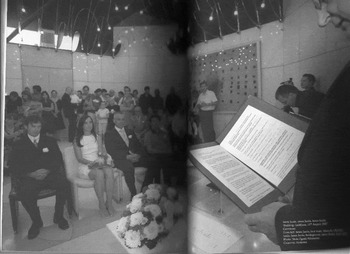
The three artists – Emil Hrvatin (a theatre director who was born in Croatia), Žiga Kariž (a painter who was born in Slovenia) and Davide Grassi (a visual artist who is originally from Italy) – went to the trouble of legally changing their names and obtaining new identity documents. Both their private and their public names were changed. So when one Janez Janša married, both of his best men were also Janez Janša (see Fig. 1). Because these artists are Janez Janša both in public and in private, their name change caused considerable confusion and resentment among their friends, their families and the artistic community.Footnote 2 The Slovenian equivalent of Who's Who at first refused to deal with their new names, and some other cultural institutions reacted in similar fashion.Footnote 3 (It is even a problem for scholars to write about these artists because of the question of whether to use their old or new names. In this article I will use their new names but occasionally indicate which of the three artists is being discussed by referring to the previous name in parentheses.)
Wedding of Janez Janša. Photo: Nada Žgank/Memento. Courtesy Aksioma.

Nor does their change of name make them more easily marketable as individual artists. Stars such as Cary Grant, Marilyn Monroe and Madonna adopted or accepted what they or their managers thought were marketable names. Writers such as Sean O'Casey and Amiri Baraka changed their names to fit social and political positions. Could it be argued that by adopting the name of a famous politician the three artists sought to gain recognition and improve their commercial viability? Certainly, their action astounded the Slovenian cultural world, resulting in much publicity leading to a degree of notoriety. However, it also undermined their individuality and caused confusion among their potential clients. For not only do the artists share the politician's name, but each bears the name of the other.
Changing and duplicating their names would seem to undermine rather than strengthen the artists’ marketability in the art world, where, normally, the individual name of an artist serves as a kind of commodity-making or branding mechanism. Typically, for example, a signed painting by a known artist or a stage or film appearance by a star enormously increases the value of their art or performance work. However, in this instance, the three artists have sacrificed their individual identities in the renaming process and thereby diminished the possibility of promoting their work as individually recognizable artists. Might this mean that their decision to change their names was intended to gesture towards a new utopian art world where art and the artist could no longer be commodified?
Eve Chiapello explains how, especially since the 1960s, artists have questioned the celebration of the unique and permanent artwork of the individual artist. She writes,
The importance given to the originality and unicity of the work came to be contested by artists themselves with the emergence of multiple or series-produced works and the recuperation of manufactured objects for artistic purposes. The work is also affected in the desire for durability, which is deeply inscribed at the very heart of the artistic enterprise. Artists create ephemeral works, linked to the use of fragile and perishable materials, or reduced to events, fleeting interventions of temporary installations, of which only traces or sketches (films, drawings, tissue samples, photographs, and so on) can be conserved. With Conceptual art, all presentation of an object or a performance of any kind is abolished to the benefit of the idea: the very materiality of the work itself is abolished.Footnote 4
By changing their names, the three artists have questioned the traditional role of artists to claim a permanent and identifiable place in the art world. Like the multiple authors who adopted the pen name of Luther Blissett for their novel Q, the three Janšas could be said to be renouncing their commodification as individual artists. As one of the three Janšas explained in an interview,
If we talk about names as brands in the art world, we must see this as a counter-marketing gesture; a brand must be pushed forward, it must become more and more visible, whereas in our case, the appearance of the new name is necessarily connected with the gradual disappearance of the old one.Footnote 5
Foucault, in his famous essay ‘What Is an Author?’, suggests that the author-function in society limits the discourse of the writer. By establishing the author's individuality, her/his work is made safe: ‘The author is therefore the ideological figure by which one marks the manner in which we fear the proliferation of meaning.’Footnote 6 The renaming act is thus threatening to social discourse. By creating uncertainty about their identity, one might argue that the Slovenian artists have destabilized their author-function in society and their comprehensibility. As a consequence, their actions require more interpretative work by their audience because their identity, their legacy and their purpose are more complex.
Subversive affirmation
While an anti-capitalist and anti-authorial approach to art seems to be part of their agenda, there is clearly something else at stake here. As Blaž Lukan points out, the three artists ‘have remained silent regarding their decisions . . . stating only that this was an intimate, personal decision’. However, ‘the three artists did not pick just any name, they chose Janez Janša – the name of the Slovenian Prime Minister . . . the front man of the Slovenian right wing. No doubt, the choice of name indicates a certain agenda’.Footnote 7 The fact that the ‘choice of name’ was unlikely to be favourably received by artistic communities points to the idea that the act of renaming was designed to undermine and to ridicule Janša's right-wing political agenda.
To interpret the act of renaming in this way suggests a correspondence with the notion of subversive affirmation: affirmation as overidentification in the interests of sociopolitical subversion. As Inke Arns and Sylvia Sasse more fully explain,
Subversive affirmation is an artistic/political tactic that allows artists/activists to take part in certain social, political, or economic discourses and to affirm, appropriate, or consume them while simultaneously undermining them. It is characterised precisely by the fact that with affirmation there simultaneously occurs a distancing from, or revelation of, what is being affirmed. In subversive affirmation there is always a surplus which destabilises affirmation and turns it into its opposite.Footnote 8
In the case of the Slovenian artists, by changing their names to that of the politician and joining his political party, they overidentified with someone whose policies they deplored and in doing so caused confusion in their artistic communities. One can observe such a tactic in the work of comedians such as Stephen Colbert in his impersonation of a right-wing commentator sympathetic to President George W. Bush at the 2006 Washington press corps dinner,Footnote 9 and Sacha Baron Cohen in his televised and filmed impersonations of the racist and chauvinistic figures of Borat from Kazakhstan and Ali G from the London suburbs, personae designed to embarrass and provoke unsuspecting individuals with their sexist, homophobic and racist comments. Similar tactics have been employed in impersonations by the Yes Men of corporate businessmen, such as Dow Chemical representatives apologizing on the BBC World news programme in 2004 for the Bhopal disaster. A further example is when German director Christoph Schlingensief encouraged Austrians to expel foreigners in the ‘Bitte liebt Österreich’ Big Brother event at the Vienna Festspiel of 2000. In brief, as Slavoj Žižek has argued, ‘By bringing to light the obscene superego underside of the system, over-identification suspends its efficiency.’Footnote 10
Performative reconstructions
Subversive affirmation or overidentification seems clearly to be a tactic in some of Janez Janša's work. For example, in 2007, the theatre director Janez Janša (Hrvatin) directed a play entitled the Slovene National Theatre which recalled Slovenians shouting abuse at a Roma family (named Strojan) and erecting barricades to prevent them from living in their midst, and being encouraged in this by Prime Minister Janša's government. The incident had been sparked in 2006 when a neighbour was severely injured by a Slovene who was living amongst the Strojan family. The neighbourhood overreacted, assuming wrongly that the Slovene was Roma, and three hundred armed residents surrounded the Strojan family and threatened to kill them if they did not leave. Rather than simply arresting the wrongdoer, the government complied with the community's wishes and removed the Roma family of thirty-one members (including fourteen children) from their homes and placed them in emergency accommodation for asylum-seekers while attempting to relocate them in other areas. The government had still not succeeded in providing them with a suitable home by the time the theatre performance was staged a year later, exacerbating racist sentiments in the community rather than curbing them.
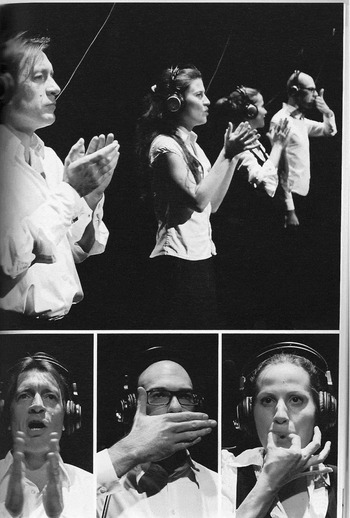
In the theatre production, four actors listen with headphones to archival news recordings of people involved in the incident, which they repeat to the audience (see Fig. 2). The actors reproduce for the theatre audience the voices of Slovenes shouting abuse at the family, including the ‘extremely vulgar and aggressive language, used by the angry mob’,Footnote 11 as well as statements by politicians, with the director Janša (Hrvatin) himself pacing back and forth across the stage for an hour and a half, muttering the somewhat pejorative term ‘Gypsies, gypsies’. (The director explained that his pronunciation of the Slovenian word for gypsies, ‘zigane’, also sounded like ‘no gypsies’ in Slovenian, so that the repetition of the word seemed to imply the eradication of gypsies from Slovenia.)Footnote 12 The performance reaches a high point when some of the family try to come back to their home on Christmas Day and the government bring in bulldozers to destroy their homes, leaving them out in the cold.Footnote 13 In the performative reconstruction of the actual events, the president of Slovenia, who disagreed with the prime minister's policies, attempts to intervene by delivering two mobile homes for the family, but he encounters the same mob reaction. According to Blaž Lukan,
This scene is reconstructed on stage with a shivering precision and intensity. However, when one adds the content of what is actually being said by people who are the real (live) protagonists among us, the hate-speech of the mob and the fact that this kind of language – legitimized by the Ambrus case – became the language of the political ‘elite’ . . . [it] represents a complete break down of state institutions, which are supposed to guarantee and protect the very fundamental law of ‘all being equal under the law’ . . . This sad story without a doubt stands for one of the most shameful and tainted moments in Slovenian history since Slovenia became independent.Footnote 14
Janez Janša, Slovene National Theatre, Stara Elektrarna, Ljubljana, 2007. Performance Photo: Marcandrea. Courtesy Maska.
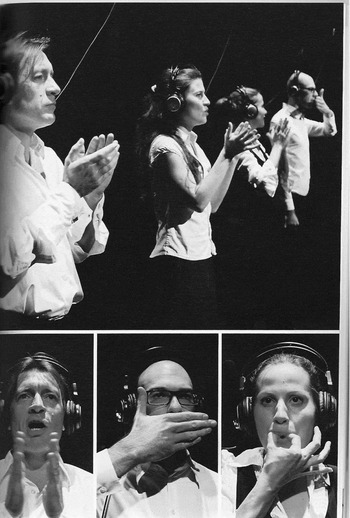
The title of the performance, the Slovene National Theatre, raised several questions for the audience. On the one hand, it is an ironic duplication of the name of the main theatre in Ljubljana, and, like the doubling of the name Janez Janša, it draws a comparison with the originally named theatre, which tends to be more conventional in its output, and it asks what the function of the National Theatre should be, such as whether it should address important social and political issues more forcefully. Also, the title implies that the original events depicted in the play were a normative national expression of racism and xenophobia. The reconstruction of events, with a chorus of actors who do not comment on but only repeat the recorded words verbatim, confronted the audience not only with a theatrical representation of Slovenian society, but also with real events. The performance contained no contextualization or interpretation, and compelled the audience to make their own political critique of the actions by the Slovenian people and politicians. As a form of postdramatic verbatim theatre, the piece did not try to create the dramatic illusion of a fourth wall with psychologically developed and identifiable characters. The actors entered the stage as themselves in their own physicality and corporeality, dressed in ordinary clothes and wearing headphones, and simply repeated the speech of real people in the recent turbulent events as a kind of social chorus. Without laying blame, the performance, however, seemed clearly designed to attack the xenophobic attitudes of Janez Janša (the prime minister) and to condemn his role in oppressing a particular minority group and exploiting racist sentiments in the country.
In analysing postdramatic theatre, Hans-Thies Lehmann calls attention to the ‘irruption of the real’Footnote 15 into the fictional framework, whereby it deliberately confuses the spectator as to how to react to a performance, and thereby activates a political or moral involvement of an otherwise passive spectator because of this ‘indecidability’. Lehmann argues, ‘When the staging practice forces the spectators to wonder whether they should react to the events on stage as fiction (i.e. aesthetically) or as reality (for example, morally), theatre's treading of the borderline of the real unsettles this crucial predisposition of the spectators.’Footnote 16
In this, we can see a parallel between the Janez Janšas’ act of destabilizing the author-function and their use of postdramatic theatrical forms. Just as the lack of a coherent author-function engages the observer in trying to discern what is behind the artistic output, the ‘indecidability’ of a postdramatic performance throws the spectator back on his or her own interpretation. ‘Strategies of framing and estranging force the spectator to view objects and events phenomenologically, and to investigate not the fictional world created by a text, but the perceptual process of one's own conscious’ in order to make sense of the event.Footnote 17 Postdramatic theatre, without providing a synthesis of the dramatic events on stage, disturbs the spectators into coming to grips with what is real and what is fictional in a performance.
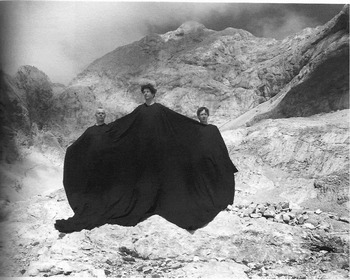
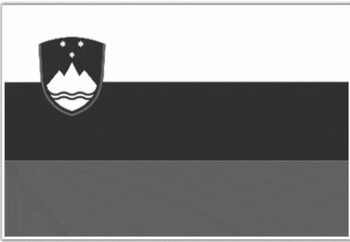
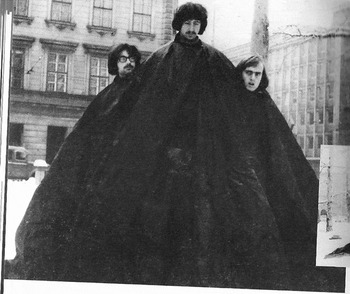
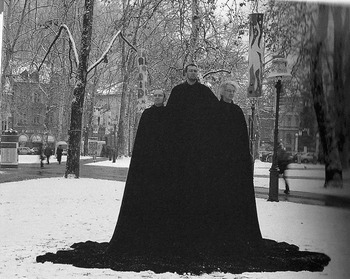
Other artistic events by the three Janez Janša artists seem to have had a much wider target, ironizing normative nationalist rhetoric and questioning the relation between the individual and the state. For example, in 2007 they staged an event called ‘Mount Triglav on Mount Triglav’ (see Fig. 3), taking a photograph of themselves in front of the three peaks of the highest mountain in Slovenia that serve as a national symbol for Slovenia and have featured on the Slovenian flag since independence in 1991 (see Fig. 4). Covered in a black cloth, with their heads peering out of the top, they staged a comic doubling of the national symbol. The image reconstructed earlier representations of the mountain by two other groups of artists: OHO, a neo-avant-garde group (see Fig. 5), and Irwin (see Fig. 6), a visual-art company that was part of the retro-avant-garde group Neue Slowenische Kunst (NSK). By reproducing this work in a third incarnation, they were reinscribing the earlier work into Slovenian cultural history as another performative reconstruction, executing a series of trinities – three heads of three artists with the same name embodying a three-headed mountain in a third enactment. By reconstructing this national symbol with their own bodies, the three Janez Janšas (like their fellow artists) were making a seemingly nationalist gesture look faintly ridiculous, thereby queering nationalist cultural practices. According to Rok Vevar, cultural nationalist discourse in Slovenia places obligations on the artist to work within certain conventions: the ‘anachronistic cultural horizon . . . more than 15 years after the creation of the Slovenian state still conceives art as state-forming, because the official (cultural) policy conceives the state as a kind of reserve for the endangered Slovenian ethnic group’.Footnote 18
‘Mount Triglav on Mount Triglav’. Photo: Gaja Repe. Courtesy Aksioma.

Flag of Slovenia.

OHO, ‘Mount Triglav’, 1968. Courtesy Moderna galerija, Ljubljana.

Irwin, ‘Like to Like/Mount Triglav’, 2004. Photo: Tomaž Gregorič. Production: Cornerhouse. Courtesy Gregor Podnar Gallery.

The three artists seem to take much of their inspiration from the NSK, who, a generation earlier, also used subversive tactics and irony to ridicule nationalist expression at a time when Slovenia was part of Yugoslavia. Rejecting the notion of Slovenian culture as distinct and authentic, NSK claimed that all cultures borrow from each other, and so they appropriated other cultural elements as a way of asserting (and subverting) Slovenian culture. One of their most sensational acts was to enter an adapted Nazi poster (Richard Klein's Third Reich), depicting youths carrying batons and Yugoslav flags in an overt display of nationalist sentiment, into a poster competition for a Yugoslav Youth Day celebration. When the poster won the contest and its source was revealed, the Yugoslav government tried to prosecute the artists for promoting fascist propaganda!Footnote 19
NAME Readymade and government identity documents
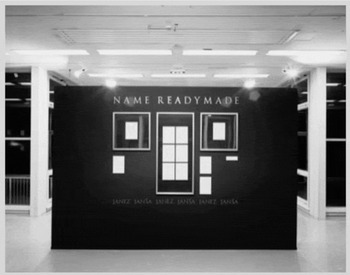
In a more recent artistic event, the Janez Janšas critiqued state control of the individual by ironizing the usage of government identity documents. In their ‘NAME Readymade’ installation in Graz, Austria, in 2008 (see Fig. 7), they exhibited their own identity documents, raising questions not only about the nature of art but also about the limitations on the rights of the individual. Individual documents are state property as well as personal property. The individual cannot do whatever she/he wants with them. Moreover, state identity documents are considered to be authentic documents that cannot normally be duplicated unless they need to be replaced in case of loss or damage. However, by displaying them in an art exhibition, the artists turned their personal documents into works of art. The artists requested temporary replacement documents from the Slovenian government so that they could travel to and from the exhibition, but the authorities refused because they considered the documents to be government property. On the one hand, the exhibition was ‘using reality to challenge art’.Footnote 20 The documents are what Lev Kreft calls ‘ultimately the true work of art’Footnote 21 because no one can buy them, since, as well as being art objects, they are at the same time still legal documents belonging to their owners and cannot be purchased by art collectors. On the other hand, the exhibition contested the way that the state forces its citizens to carry identity documents. A heightened sense of this critique was achieved by exhibiting the documents in a country where the artists are not citizens and each artist has the same name but a different signature and a different country of origin. One of the artists explained,
If you have documents but you do not carry them on you, then you cannot function normally. The exhibition places you within the relationship of power between the spheres of art and administration . . . When these objects become exhibited works of art, you cannot function as a citizen, because you lose certain basic human rights.
NAME Readymade exhibition, http://www.aksioma.org/name/

Another rejoined, ‘You are literally sans papier.’Footnote 22 Thus the exhibition of their documents calls attention to the limitations on the rights of the individual in an increasingly regulated state. ‘You are hardly a person without your papers’Footnote 23 – a point that now resonates strongly in the light of the new measures adopted by Italy requiring all citizens and non-citizens to carry personal identity documents.Footnote 24 Similarly, it reminds viewers of the perilous status of others who are stateless (like asylum-seekers) and do not have identity papers.
‘NAME Readymade’ also serves as an implicit critique of the sociopolitical changes that have taken place in central and eastern Europe during the last two decades, with national identity documents of citizens of such disappearing countries as the USSR, Yugoslavia, the DDR and Czechoslovakia no longer being valid, and new documents being issued, for example, to people in the Baltic countries, Germany, the Czech Republic, Slovakia and especially the new Balkan nation states. The renaming of the countries implies an instability not only of national identity but also of government and society that resonates in the instability of the artists’ identity cards and the whole renaming performance. As Michel Foucault argues, ‘the state is no more than a composite reality and a mythicized abstraction, whose importance is a lot more limited than many of us think’.Footnote 25 At the same time, the ‘NAME Readymade’ installation gestures to the limitations on freedom of movement in the post-9/11 world and the anti-terrorist security measures that have created new types of identity documents and increased border controls.
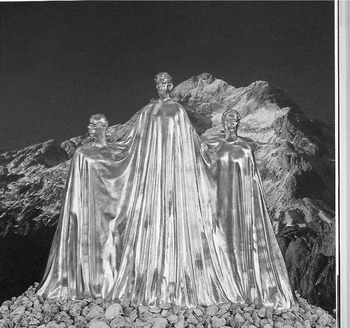
As part of this ‘NAME Readymade’ exhibition, the Janez Janša artists turned their photograph on the Triglav mountain into a golden sculpture entitled Monument to the National Contemporary Art (Golden Triglav) (see Fig. 8). In so doing, they were transforming their initial parodic and reconstructive gesture into a monument – three figures with the same name embodying the three-headed mountain, the symbol of the nation, and with all three Janez Janšas looking towards their home countries (Italy, Croatia and Slovenia). Thus in this sculpture we can see another critical dimension to their artistic work: rather than celebrating the purported cultural unity and homogeneity of Slovenia, it calls attention to the pluralist texture of Slovenian society.
Monument to the National Contemporary Art (Golden Triglav). Photo: Peter Rauch. Production: Aksioma, Steirisher Herbst. Courtesy Aksioma.

The renaming process has led to surprises not only for the public but also for the artists themselves, who have sacrificed the security of their original identity for an unknown future. One of three Janez Janšas said, ‘If the public is experiencing a certain uncanniness, the authors are living a certain uncertainty . . . It is what renders the whole situation extremely risky.’Footnote 26 The news media have capitalized on the amusing confusion with the prime minister, printing headlines such as ‘Janša dances in Berlin’ and ‘Janez Janša got married’. Newspapers have also allowed the artists considerable license to perform their new identity. For example, in 2008 Dnevnik, a leading newspaper, provided them with a column for several weeks in which they wrote letters to each other discussing their artistic work as well as their personal lives. Part of the game here was that the readership anticipated that they would use the space to make political interventions, but they kept the dialogue surprisingly light and benign. In another instance, a newspaper reported that an opposition party was intending to select one of the Janez Janša artists as a candidate at a forthcoming election. All three artists were then allowed considerable space in the section of the paper for letters to the editor to deny that they were candidates. The artists were even given prime-time television coverage when the three of them, having joined the Slovenian Democratic Party of the prime minister, arrived at the party headquarters during the presidential election of 2007 and were interviewed by a television journalist. All of this attention has enabled their renaming to ripple through society as a media event, often with comic and/or subversive effect. Their surprising appearance on television in the context of the presidential election seemed to one commentator ‘like an idiosyncratic interrogation of the entire Slovenian political scene and its established rules of functioning’.Footnote 27
Renaming the Holocaust Memorial
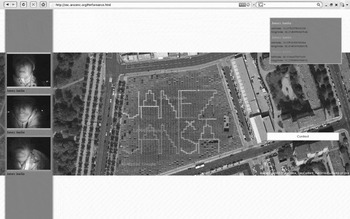
Perhaps the most perplexing and disturbing action by the three artists has been their media event at the Holocaust Memorial in Berlin in 2008. They attracted international news coverage when they were banned from creating a virtual signature of their names (as well as that of the prime minister) across the length and breadth of the memorial on the Google Map via satellite connection. Their performance at the Transmediale international festival, called Signature Event Context, which was meant to be projected in real time in the Haus der Kulturen der Welt on 29 January 2008, was cancelled by the curator a few days before the event because of ‘personal–curatorial and ethical convictions’.Footnote 28 Despite the ban, the three artists proceeded with the event on the night of 28 January, each taking a different route through the Holocaust Memorial with a GPS device that collectively created a virtual signature of their name that was only visible via the Internet, chanting their name as they walked (see Fig. 9). The title of the performance took its name from Derrida's essay in which he discusses the notion that a signature is an indication of both the presence and the non-presence of the signer:
By definition, a written signature implies the actual or empirical nonpresence of the signer. But, it will be claimed, the signature also marks and retains his having-been present in a past now or present [maintenant] which will remain a future now or present [maintenant], thus in a general maintenant, in the transcendental form of presentness [maintenance].Footnote 29
Signature Event Context, Berlin, 2008, http://www.aksioma.org/sec/index.html

The signature is thus a memory of an event, that of signing, but in this case it is inscribed into a place of memory: a monument to the Holocaust. Peter Eisenman, the architect of the memorial, explained his concept of the memorial as follows:
In this monument there is no goal, no end, no working one's way in or out. The duration of an individual's experience of it grants no further understanding, since understanding is impossible. The time of the monument, its duration from top surface to ground, is disjoined from the time of experience. In this context, there is no nostalgia, no memory of the past, only the living memory of the individual experience. Here, we can only know the past through its manifestation in the present.Footnote 30
Presumably the German curator tried to ban the event because of the special status of the memorial and the sensitivity to anything that might be seen as disrespectful. Moreover, there may have been concern about the association of the name of a current prime minister of another country in such an artistic event that might result in a diplomatic incident, especially as Slovenia had just taken over the presidency of the European Union. What haunts the performance event in Berlin is a question that the artists do not address: what does this virtual signing of their name on the Holocaust Memorial have to do with their namesake, the right-wing politician in Slovenia, and his attitude towards the Roma people and other minorities? Are they implying that Janša's treatment of the Roma today echoes the treatment of such people by the Nazis, or are they trying to imply a connection between Janša and Hitler?
Changing back?
Now that Janez Janša is no longer prime minister, the renaming project has lost much of its power. Clearly, the renaming implies more than a subversive act against a particular political figure. But at the same time it seems defined in time and may well seem irrelevant in the future. Already there are signs that the renaming performance is coming to an end. Some of the artists’ friends and colleagues, who were originally uncertain whether to call them by their old names or their new name, have reverted to calling them by their old names. Two of the artists hold dual identities because of their national origins. One Janez Janša remains Emil Hrvatin in his Croatian identity documents, and another remains Davide Grassi in Italy.Footnote 31 The Slovenian-born artist has recently changed his name back to Žiga Kariž, and so we can anticipate that Emil and Davide will do likewise or possibly change their name to something else.Footnote 32
Some commentators have criticized the three artists as crassly exploiting their renaming as a media event, continuing to receive state grants as artists under their new names because of their increasing celebrity, not really subverting the status quo through their actions, but ‘wasting money on new and legal identification documents at a time when there are thousands of “erased” in Slovenia, who have been left with no documents at all’.Footnote 33 Given that they were allowed their own column for writing letters to each other, it was argued that they should have used this opportunity to critique society rather than to write personal letters.
However, it could equally be argued that part of the reason there has been so much media interest in the renaming performance is that while seemingly comic and trivial, it constitutes an artistic practice that deeply disturbs the ideological structures underpinning society and questions many aspects that we take for granted, such as national and personal identity, social control and documentation, and the relationship between art and politics. By destabilizing their author-function in society and using postdramatic forms and a tactic of subversive affirmation, the artists generate uncertainty about their work and its purpose. As they do not explain their motives, spectators, critics and scholars of their work are left to provide possible interpretations and, in particular, to speculate on the political efficacy of the project.
In the final analysis, it has to be said that the Janša renaming project provides no easy or straightforward answers to contemporary political issues. Nonetheless, I am tempted to conclude that its parasitical feeding off the Janša name, its use of subversive affirmation, succeeds in undermining the ‘signature’ of right-wing politics. As Derrida reminds us, citation, or in this case renaming, destroys the pureness of what it cites.Footnote 34 In the economy of renaming or citation as practised by the three artists, the structures and values of capitalism that the Janša name stands for are made present and legible as a ‘readymade’ social, political and cultural fabric. For all its ambiguity and complexity, the artists’ project confronts us with the urgent necessity of ‘unmaking’ that fabric. ‘The more of us there are, the faster we'll reach [that] goal!’