Introduction
Animals can display a preference to remain in a context that has been associated consistently with access to a mate over a context that has not. This has been referred to as ‘conditioned place preference’ (Pfaus et al., Reference Pfaus, Kippin and Centeno2001) and has been demonstrated in laboratory rats (Everitt, Reference Everitt1990; Pfaus et al., Reference Pfaus, Kippin and Centeno2001; Coria-Avila et al., Reference Coria-Avila, Ouimet, Pacheco, Manzo and Pfaus2005) and humans (O'Donohue & Plaud, Reference O'Donohue and Plaud1994; Hoffmann et al., Reference Hoffmann, Janssen and Turner2004). In insects, learning has been proposed as a relevant mechanism to improve mating skills, courtship and recognition of the receptive females (Wcislo, Reference Wcislo1987, Reference Wcislo1992; Hirsch, Reference Hirsch1994; Dukas, Reference Dukas2005). However, the possibility of associative learning in mate searching has rarely been studied in insects (Robacker et al., Reference Robacker, Weaver and Hendry1976). Learning stimuli derived from the copulatory environment may be an important mechanism for interspecific recognition during mate searching by experienced individuals and also for reproductive isolation (Colwell, Reference Colwell, Karlin and Nevo1986; Butlin, Reference Butlin1990; Rice & Hostert, Reference Rice and Hostert1993; Bush, Reference Bush1994; Dieckmann & Doebeli, Reference Dieckmann and Doebeli1999). Among insects, parasitoids are a very suitable model for studying the connection between reproductive behaviour and learned habitat preferences, given their lifestyle in tight dependence with the reproductive habitat constituted by the host and its feeding environment (Quicke, Reference Quicke1997). Plant and herbivore hosts are together referred to as the host plant complex (HPC) due to the fact that these two interacting organisms can generate an array of more or fewer specific cues (such as volatile blends) that can be detected by parasitoids, among others (reviewed by Dicke & van Loon, Reference Dicke and van Loon2000). Thus, learning HPC cues may constitute a relevant mechanism for the recognition and maintenance of the association between the parasitoid and the host plant complex. The ability to learn cues from the copulatory environment composed by the plant and the herbivorous insect has been demonstrated in female parasitoids foraging for hosts (Lewis & Tumlinson, Reference Lewis and Tumlinson1988; Du et al., Reference Du, Poppy, Powell and Wadhams1997), whereas the skills of males to use habitat cues in their searching for females has rarely been addressed (Robacker et al., Reference Robacker, Weaver and Hendry1976). A previous study demonstrated that male Aphidius ervi (Hymenoptera: Braconidae) can learn to associate and respond, with sexual display, to an artificial odour (vanilla) when males are trained to associate the vanilla odour with the encounter with a conspecific female (Villagra et al., Reference Villagra, Vásquez and Niemeyer2005). In the present work, we investigated whether male copulation experience in a given host plant habitat can later generate olfactory preferences in these males towards the odour blend derived from the host plant habitat associated with copulation. We hypothesised that this may occur by associative learning of the odour cues derived from the host plant habitat found during the sexual experience by the male parasitoid. The role of olfactory sexual learning in the aphid parasitoid, A. ervi, was evaluated on the preference for two alternative HPCs: alfalfa (Medicago sativa L.) infested with the pea aphid, Acyrthosiphon pisum Harris (Hemiptera: Aphididae), and wheat (Triticum aestivum L.) infested with the grain aphid, Sitobion avenae (Fabricius) (Hemiptera: Aphididae). In addition, we tested the response of males trained with a given HPC towards the odours of the alternative HPC (not present during training) in order to assess the specificity and fidelity to the HPC of the trained response. We hypothesised that experienced A. ervi males respond specifically to the stimuli present in the mating environment during training (HPC odours) through learning by association with the odour blend present during the first copulation with the female. The results are discussed in terms of parasitoid mate searching strategies and in the context of the possible role of learning processes on the specificity and diversification of parasitic wasps.
Materials and methods
Insects
Aphidius ervi is a solitary, oligophagous koinobiont endoparasitoid of aphids. In its native range, it is mainly associated with Macrosiphinae aphids, such as A. pisum on legumes and related species (Mackauer & Finlayson, Reference Mackauer and Finlayson1967; Němec & Starý, Reference Němec and Starý1985; Takada & Tada, Reference Takada and Tada2000). Although S. avenae on cereals is a suitable host for A. ervi, this parasitoid has a minor relevance on cereal tritrophic agroecosystems in Europe (Cameron et al., Reference Cameron, Powell and Loxdale1984). In Chile, since its introduction nearly 28 years ago, A. ervi has been reported to parasitise both A. pisum (prevalent on alfalfa) and S. avenae (prevalent on wheat) and has also expanded its host range to include the Russian wheat aphid, Diuraphis noxia (Mordvilko), a species it does not attack in its area of origin (Zuñiga, Reference Zúñiga and Burnett1990; Starý et al., Reference Starý, Gerding, Norambuena and Remaudière1993). This scenario represents a country-scale natural arena where research could contribute to the understanding of the behavioural and ecological aspects of the active diversification currently occurring within the genus Aphidius (Atanassova et al., Reference Atanassova, Brookes, Loxdale and Powell1998).
Parasitoids were obtained from a laboratory culture maintained on alfalfa. To avoid parasitoid population inbreeding (see Unruh et al., Reference Unruh, White, Gonzáles and Luck1983) field collected parasitoids derived from the alfalfa-pea aphid system, mainly from around Santiago, were introduced to the laboratory stocks on several occasions. In order to provide a neutral initial experience for the adult parasitoids used, aphid ‘mummies’ were isolated in Petri dishes containing a piece of wet filter paper, enabling adult parasitoid to eclose under these controlled conditions. Newly born insects, both males and females, were provided only water to feed on. Adults were used around 15 h after eclosion, which corresponds to the most active sexual period for male-female interactions in A. ervi (He & Teulon, Reference He and Teulon2004).
Behaviour
The sequence of sexual behaviours of A. ervi during mating has been subdivided into two periods: a pre-mating period comprising the courtship behaviour of the male, which ends with the acceptance or rejection by the female; and a copulation period (Mackauer, Reference Mackauer1969). Courtship starts as soon as the male becomes aware of the close presence of a female (generally at a distance of 2 to 3 cm). The male pursues the female with its antennae held forward at approximately right angles with respect to its body and the wings spread out horizontally. It then performs a characteristic wing fanning courtship display. When the female recognises and accepts her sexual partner, mounting takes place. Finally, the female will accept copulation after an antennal contact phase, and the male will engage its genital clasps with the corresponding parts of the female genitalia (Mackauer, Reference Mackauer1969; Battaglia et al., Reference Battaglia, Isidoro, Romani, Bin and Pennacchio2002; He & Teulon, Reference He and Teulon2004). Attraction to an olfactory stimulus was determined in two ways: (i) by observing the parasitoid first choice of arm in a glass Y-olfactometer, and (ii) by assessing the times devoted to different behaviours triggered by a stimulus in both olfactometer arms. The following behaviours displayed in each arm of the Y-olfactometer were recorded: time spent antennating, running, standing still, grooming the abdomen, grooming the antennae, and fanning the wings. Running is the time that males spent in active exploration. Antennation has been described as part of the parasitoid foraging behaviour (see Olson et al., Reference Olson, Rains, Meiners, Takasu, Tertuliano, Tumlinson, Wäckers and Lewis2003). Grooming behaviours have been associated with insect body cleaning and with homogenising the chemicals present on the body (Sumana & Starks, Reference Sumana and Starks2004), a behaviour generally associated with mating and social interaction in wasps and other holometabolous insects (Wuellner et al., Reference Wuellner, Porter and Gilbert2002). Wing fanning has been shown to be an important part of courtship in many insect species, including parasitoids (Mackauer, Reference Mackauer1969; Hirsch, Reference Hirsch1994), and is, hence, a good indicator of sexual attraction.
Olfactometry
Glass Y-tube olfactometers were used to investigate the responses of A. ervi males when presented with a choice of odours. The olfactometers used (9-cm-long trunk with 1.3 cm internal diameter, and 6-cm-long arms with 0.6 cm internal diameter forming an angle of 80°) allowed parasitoids to explore both arms and to move from one arm to the other (Villagra et al., Reference Villagra, Vásquez and Niemeyer2005). Olfactometry experiments followed the recommendations of Ramírez et al. (Reference Ramírez, Fuentes-Contreras, Rodríguez and Niemeyer2000) to avoid pseudoreplication. Olfactometers were changed after each test and cleaned successively with ethanol, odour-free soap and distilled water. Pure air, which was fed into the stimulus chambers, was obtained from an ultra pure synthetic air cylinder (Indura® Santiago, Chile). The air flow during the tests was maintained at 250 ml min−1, light intensity at 3600 lux and temperature at 20°C. The relative humidity was between 40 and 50%. Experimental parasitoids were exposed to air flow from an olfactometric jar containing a pot with soil only in the control arm. In the other arm, they were exposed to air from an olfactometric jar containing either a 3-week-old alfalfa plant infested with ca. 100 A. pisum (alfalfa HPC) from all instars or a 2-week-old wheat plant infested with S. avenae with the same aphid load (wheat HPC). Both plants were infested 24 h prior to their use as stimuli. Each replicate was video-recorded for 5 min, and behavioural data was collected with the JWatcher software 0.9®, using seconds as the time scale (Blumstein et al., Reference Blumstein, Evans and Daniel2000).
Training to host plant complexes
Insects were tested ca. 15 h after eclosion to record their initial response (IR). Immediately thereafter, they were trained for 10 min and left in an empty Petri dish. After this experience, male parasitoids were tested in order to record their trained response (TR). Male parasitoids were randomly assigned to three groups, which were subjected to different training protocols. In the first group, males were exposed to a virgin female as the only source of stimulation; in the second group, males experienced the presence of either alfalfa HPC or wheat HPC; and in the third group, males were exposed to a virgin female together with either the alfalfa HPC or the wheat HPC. All males included in the analysis copulated with the female presented during the training period within a few minutes.
If a given training protocol generates sexual attraction to a given odour, males previously exposed to the odour are expected to choose first the olfactometer arm with the conditioning stimulus and also to express sex-related behaviours in a higher proportion than in the initial responses or with respect to males from other (non-associative) treatments.
Analysis
Percentages of individuals first choosing the stimulus or control arms of the olfactometer were compared using the McNemar test for two correlated proportions. This analysis is useful to test two dichotomous responses of each individual from each treatment (McNemar, Reference McNemar1947; Kateri et al., Reference Kateri, Papaioannu and Dellaportas2001).
The times spent performing the different behaviours described above were combined into a variable equal to the difference between the proportion of time spent performing a given behaviour in the stimulus arm minus the proportion of time spent performing this behaviour in the control arm. Thus, behavioural responses to a stimulus were analysed as a single data variable. We consider the responses obtained in the olfactometer correspond to attraction more than arrestment because of the triggering of specific courtship behaviours, such as wing fanning, that allow us to identify the consequent behavioural activity. Data was analysed using a protected multivariate analysis of variance for repeated measures (Scheiner, Reference Scheiner, Scheiner and Gurevitch1993) comprising a MANOVA for global effects and repeated measures ANOVA if the MANOVA showed significant results. This analysis allows the evaluation of general trends in the data prior to evaluating each variable individually. Finally, post hoc LSD tests for planned comparisons were performed if the ANOVA showed significant effect. Wing fanning data were not normally distributed; hence, they were transformed to ranks before the analysis (Conover & Iman, Reference Conover and Iman1982).
Results
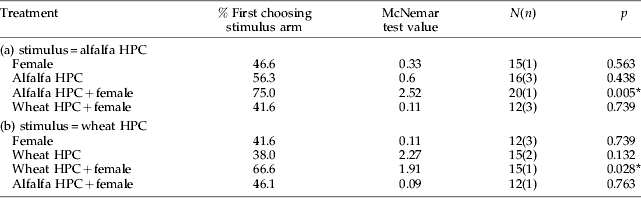
When alfalfa HPC was used as stimulus in the Y-olfactometer bioassays (alfalfa HPC volatile blend vs. only soil control) males that were trained with female+alfalfa HPC preferred significantly the HPC arm in the first choice (table 1a). Neither the males that experienced only the alfalfa HPC nor copulation alone showed a significant preference towards any of the olfactometer arms (table 1a). Furthermore, males trained with female plus wheat HPC (cross-trained) spent similar times in both olfactometer arms (table 1a). In the alternative experiment (wheat HPC blend vs. only soil control), males trained with female+wheat treatment preferred the wheat HPC arm of the Y-tube olfactometer (table 1b). Neither the males trained with wheat HPC only nor with a female only showed a significant preference in the olfactometric bioassay (table 1b). Also in this experiment, males trained with female+alfalfa HPC but tested with wheat HPC vs. control (cross-trained) showed the same level of first choice as the ones from the only female non-associative training. Thus, in both conditioning treatments, copulation with the female in a given odour context provided by the HPC generated learned preferences towards the odours of these environments in the experienced male parasitoids.
Percentages of individuals first choosing the stimulus or control arms of the olfactometer after training.
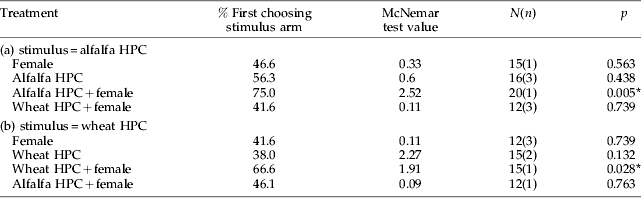
(a) Responses from the treatments where the males were tested using alfalfa HPC as stimulus and only soil as control in the Y-tube olfactometer. (b) Responses when males were tested using wheat HPC as stimulus vs. soil control in the olfactometer. N, number for responding insects; n, number of individuals per treatments that did not display any preference in the Y-olfactometer tests. Astericks show significant values.
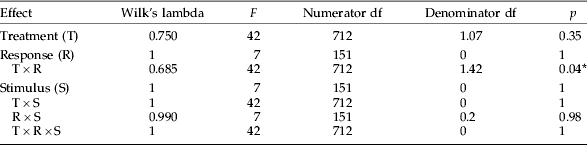
With regard to the different behaviours performed by males, the global effects MANOVA of treatment (HPC, virgin female and HPC+virgin female), response (IR or TR), stimulus (alfalfa HPC or wheat HPC) and interaction effects on the different behaviours measured (time spent antennating, running, standing still, grooming the abdomen, grooming the antennae and fanning the wings) showed a significant global effect only of the training×response interaction (table 2), which allows the exploration of the temporal change in behaviours between the different treatments performed in conditioning HPC (alfalfa or wheat) experiments. It is important to stress that no effect of stimulus was found, meaning that both alfalfa and wheat HPC volatiles affected the insect in the same way and hence do not exert specific effects by themselves.
MANOVA of treatment (HPC, virgin female and HPC+virgin female), response (IR or TR), stimulus (alfalfa HPC or wheat HPC) and interaction effects on the different behaviours measured.
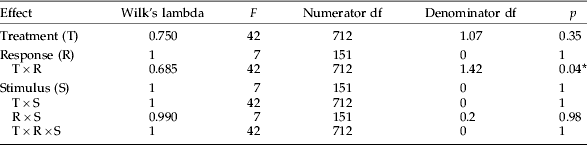
Asterick shows significant value.
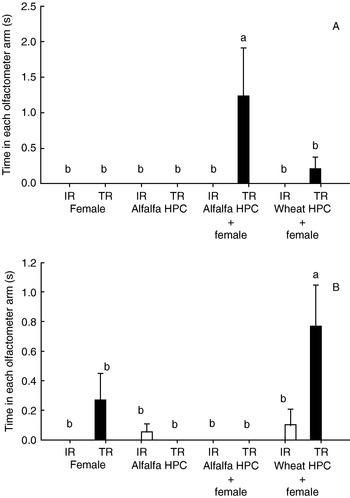
After the associative training, only wing fanning behaviour showed significant differences (table 3). Males trained with females+alfalfa HPC and males trained with females+wheat HPC displayed the courtship wing fanning towards the alfalfa HPC and wheat HPC, respectively (fig. 1). This behaviour was expressed almost exclusively in the sexually conditioned males that were exposed to the same HPC blend offered in the olfactometer, demonstrating that the context in which copulation takes place reinforces mate searching in males as cues for mate finding.
(A) Duration (seconds) of wing fanning (mean and standard error) in the olfactometer arms permeated by alfalfa HPC volatile blend (black bars) or only air control (white bars) by males before (IR) and after (TR) being exposed to female+alfalfa HPC or female+wheat HPC (cross-training) treatments. (B) Time-performing wing fanning (mean and standard error) in the olfactometer arms permeated by wheat HPC volatile blend (black bars) or only air control (white bars) by males before (IR) and after (TR) being exposed to female+alfalfa HPC (cross-training) or female+wheat HPC. Different letters correspond to statistically different results between treatments (LSD post-hoc test, p<0.05) from the variable equal to the difference between the proportions of time spent performing wing fanning in the stimulus arm minus the proportion of time spent performing this behaviour in the control arm, during the five-minute trials (■, alfalfa HPC; □, control).

Repeated measured two-way ANOVA for the effects of treatment, response and their interaction on wing fanning behaviour.

Astericks show significant values.
Discussion
To the best of our knowledge, this is the first study to address learning during mate searching by a parasitoid in the context of the chemical ecology of a tritrophic environment. We evaluated the effect of HPCs as conditioning stimuli, demonstrating that the male parasitoid can utilise secondary olfactory stimuli derived from the HPC. Conditioned males associated them with copulatory experience, over any other stimuli that may have emanated directly from the female (such as pheromones) (tables 1 and 2; fig. 1), while males that experienced a female only or the HPC stimuli alone did not show a bias towards the HPC in the Y-tube olfactometer. Even males that experienced copulation in a given HPC, but were tested in the other HPC, did not show a bias in the first choice of olfactometer arm. These results suggest that choice is strongly influenced by the kind of stimulus experienced by the insect during training. In this case, presence of a given HPC during copulation acted as the conditioning stimulus that biased preferences for the HPC.
The fact that males trained by copulating in a given HPC habitat but tested with the alternative HPC (for example, males trained with wheat HPC and tested with alfalfa HPC) did not prefer the alternative HPC volatile blend in the olfactometer suggests that training affects the preference toward relatively specific HPC odours. Thus, the male will be conditioned to show place preference sensu Pfaus et al. (Reference Pfaus, Kippin and Centeno2001) only when the given ‘place’ has been related to access to females. Furthermore, as all parasitoids were reared on pea aphid feeding on alfalfa, the fact that males can learn to respond to wheat HPC after sexual conditioning on wheat HPC demonstrates that this learning can override the effect of the rearing conditions and may bias preference towards cues of the mating environment. This is supported by the finding that the type of conditioning stimuli (i.e. volatile blends of alfalfa or wheat HPC) used was not relevant as a source of variance (stimulus effect in the MANOVA; table 2). Previously, in the ichneumonid parasitoid, Itoplectis conquistor, associative learning had been found in females searching for oviposition hosts and in males searching for mates; male wasps inspected a blank ‘cup disperser’ if they had previously encountered cups containing the pheromone (Robacker et al., Reference Robacker, Weaver and Hendry1976; Robacker & Hendry, Reference Robacker and Hendry1977). In vertebrates, as well as in some invertebrates, copulation experience in the presence of a given odour can generate conditioned place preference (Pfaus et al., Reference Pfaus, Kippin and Centeno2001, and references therein). In a previous experiment, we found a similar phenomenon in males of A. ervi (Villagra et al., Reference Villagra, Vásquez and Niemeyer2005). In this study, we assessed the possible effects of odour-sexual associative learning under a set of stimuli that the parasitoid could encounter during sexual experiences in nature. These levels of fidelity to the conditioned HPC may be a consequence of conditioned place preference. These trends may be important not only for understanding behavioural and ecological aspects of this system but also for biological control; training of males to find females in a given crop may improve their mating performance and, hence, increase parasitoid abundance in that particular crop.
Many insects living on or indirectly interacting with a given plant perform their reproductive behaviours near or on plants in the immediate vicinity to insects. Thus, learning olfactory cues (or other stimuli) present during courtship and mating could represent an important influence for these insect-plant interactions. This may represent another level of insect-plant interactions beyond the direct influence of the plant on insect sexual communication through changes in pheromone production and composition (see Landolt & Phillips, Reference Landolt and Phillips1997, and references therein). This phenomenon, as shown by our experiments, seems not to be restricted to phytophagous insects but also occurs in third trophic level organisms such as parasitoids (reviewed by Steiner, Reference Steiner2007).
Mating ecology
Our results suggest that conditioning to the HPCs may not be exclusive to female parasitoids searching for oviposition sites, but also occurs in male parasitoids searching for mates. Commonly, female parasitoid pheromones elicit a strong and relatively short-range attractive response in males (van den Assem, Reference Assem and Waage1986). We propose that, through male associative learning, contextual cues present during mating, such as HPC volatile blends, may become a highly detectable (and attractive) conditioning stimuli after male copulation experience occurs in the presence of such environmentally-derived olfactory cues. However, more extensive work is needed in order to learn whether other cues from the tritrophic context where mate searching takes place can also be exploited by experienced males in their ‘naturally-trained’ mate searching. Examples of such cues include those derived from the host female parasitoid interaction, such as the aphid alarm pheromone (Glinwood et al., Reference Glinwood, Du and Powell1999) or female host-marking signals.
Learning and host fidelity – future directions
Our results suggest that associative learning during mate searching by A. ervi parasitoids is influenced by the effects of the ecological context where copulation occurs, which constitutes a source of reliable and detectable cues. Future research combining sexual conditioning with field observations of the fate of the trained individuals would be needed to elucidate the extent to which learning during copulation may affect parasitoid fidelity to the HPC. Such context-dependent learning may constitute the first steps in the diversification of host-dependent organisms, in which behavioural mechanisms, such as ecological imprinting sensuImmelman (Reference Immelman1975) may play an important role (Maturana & Mpodozis, Reference Maturana and Mpodozis2000). Indeed, this mechanism has been proposed as the first step in the stable generation of new niches by Aphidiine parasitoids (Tremblay & Pennacchio, Reference Tremblay, Pennacchio and Gupta1988). The same may be true for a broad range of highly host-dependent animals. Learned preferences of mating habitat, together with preferences to breed offspring on a given habitat, have been proposed as the basis for sympatric specialisation (Walsh, Reference Walsh1864; Bush, Reference Bush1968; Frías, Reference Frías and Santibáñez-Lara1988). Finally, future studies should examine how a learned habitat bias in the field affects population dynamics. Such studies would determine how behaviour may affect the distribution and abundance of host-dependent animals and the possible contribution of these mechanisms on host specificity and diversification.
Acknowledgements
CAV is grateful to CONICYT for a doctoral fellowship and project funding (AT-4040221), and to Universidad de Chile for financial support (N° 31-2004). The manuscript has been reviewed by Dr Mark Hershkovitz, Daniel Stanton, Dr Derek R. Artz, and Annie Simonin, all of whom contributed with valuable suggestions. Finally, CAV thanks the Decenio Biology Discussion Group, Macarena Faunes and the Villagra-Gil family for all kinds of support.