Introduction
Singleton children show sex differences in early speech development, with girls producing a greater amount and variety of words and sentences at an earlier age than boys (Berglund, Eriksson & Westerlund, Reference Berglund, Eriksson and Westerlund2005; Choudhury & Benasich, Reference Choudhury and Benasich2003). Twin children – particularly boy-boy twins – lag behind their singleton peers in early speech development, producing fewer number and variety of words (Gücüyener, Arhan, Soysal, Ergenekon, Turan, Onal, Koç, Türkyılmaz & Atalay, Reference Gücüyener, Arhan, Soysal, Ergenekon, Turan, Onal, Koç, Turkyilmaz and Atalay2011; Hay & O'Brien, Reference Hay and O'Brien1983; Rice, Zubrick, Taylor, Gayán & Bontempo, Reference Rice, Zubrick, Taylor, Gayán and Bontempo2014). However, we know relatively little about the early gestures singleton boys and singleton girls produce and whether these patterns remain similar in twin children. We know from previous work with singletons that gesture and speech form a tightly integrated system, with gesture preceding and predicting children's spoken language abilities (Iverson & Goldin-Meadow, Reference Iverson and Goldin-Meadow2005; Özçalışkan & Goldin-Meadow, Reference Özçalışkan and Goldin-Meadow2005a). In this study, we focus on the gestures and speech produced by three groups of fraternal twins (boy-boy, girl-girl, boy-girl), comparing them to the gestures and speech produced by boy vs. girl singletons at the early ages. We ask whether children show sex (girls vs. boys) or group (singletons vs. twins) differences in the amount, diversity, and complexity of the speech and gestures that they produce. We also ask whether twin dyad composition (boy-boy, girl-girl, boy-girl) influences the patterns of speech and gesture production among twin children.
Sex differences in early speech and gestures produced by singletons
Girls outperform boys in nearly all domains of language development (Hyde & Linn, Reference Hyde and Linn1988) including their vocabulary development (Berglund et al., Reference Berglund, Eriksson and Westerlund2005; Eriksson, Marschik, Tulviste, Almgren, Pérez Pereira, Wehberg & Gallego, Reference Eriksson, Marschik, Tulviste, Almgren, Pérez Pereira, Wehberg and Gallego2012; Fenson, Dale, Reznick, Bates, Thal & Pethick, Reference Fenson, Dale, Reznick, Bates, Thal and Pethick1994; Lange, Euler & Zaretsky, Reference Lange, Euler and Zaretsky2016). More specifically, girls develop larger vocabularies, producing greater diversity of words than boys, at both the earlier (0;8-2;6; Eriksson et al., Reference Eriksson, Marschik, Tulviste, Almgren, Pérez Pereira, Wehberg and Gallego2012; Fenson et al., Reference Fenson, Dale, Reznick, Bates, Thal and Pethick1994) and the later ages (3;0-6;0; Lange et al., Reference Lange, Euler and Zaretsky2016), as assessed by parental checklist measures (e.g., the MacArthur-Bates Communicative Development Inventories; MCDI; Fenson et al., Reference Fenson, Dale, Reznick, Bates, Thal and Pethick1994). The sex differences become evident not only in vocabulary but also in children's emerging syntactic abilities. Three- to five-year-old girls produce longer sentences with more diverse and complex structures than boys in one-on-one interactions with their parents (Tse, Chan, Li & Kwong, Reference Tse, Chan, Li and Kwong2002). These patterns remain similar in the onset of first sentences. An earlier large-scale study (7078 girls, 6705 boys) with 0;8-2;6-year-old children, using parent checklists, showed that girls produce their first sentences earlier than boys (Eriksson et al., Reference Eriksson, Marschik, Tulviste, Almgren, Pérez Pereira, Wehberg and Gallego2012).
Compared to speech, we know relatively little about sex differences in gesture production. The few existing studies, however, mostly suggest an advantage for girls in early gesture production (Eriksson et al., Reference Eriksson, Marschik, Tulviste, Almgren, Pérez Pereira, Wehberg and Gallego2012; Fenson et al., Reference Fenson, Dale, Reznick, Bates, Thal and Pethick1994; but see Eriksson & Berglund, Reference Eriksson and Berglund1999 for lack of a sex difference in early gesture). These studies, relying primarily on parental checklists (e.g., MCDI) to assess the diversity of gestures 0;8-2;6-year-old girls and boys produced, showed a small but consistent advantage for girls on early communicative gesture use. The female advantage in the diversity of gesture production also becomes evident in the onset of gestures, with girls producing their first pointing gestures about a month earlier than boys (Butterworth & Morisette, Reference Butterworth and Morisette1996), also assessed by parental checklists. Thus, the existing research, largely based on parental report, suggests that girls show an advantage over boys in terms of the time of onset and diversity of the gestures that they produce. The existing research on early gesture-speech combinations (i.e., gesture+speech) that convey sentence like meanings also shows a similar female advantage. An earlier study that examined the emergence of sentence-like constructions in speech (e.g., “eat cookie”) and in gesture+speech (e.g., “eat”+point at cookie) in 22 girls and 18 boys from ages 1;2 to 2;10 in parent-child interactions showed that girls produced not only their first sentences on average three months earlier than boys, but also used gesture+speech combinations to convey similar sentence-like meanings 3 months earlier than boys, suggesting a close link between the onset of sentences in speech and in gesture+speech (Özçalışkan & Goldin-Meadow, Reference Özçalışkan and Goldin-Meadow2010).
Overall, girls outperform boys in speech production. They use a greater amount and diversity of words and sentences than boys of comparable age, and produce their first words and sentences earlier than boys. The relatively scarce existing research on gesture – based almost exclusively on parental reports – suggests patterns similar to speech in the production of gestures and gesture+speech combinations, with a female advantage both in the diversity and time of onset of first gestures and first gesture+speech combinations.
Sex differences in early speech and gestures produced by twins
Most of the earlier research on twins focused on same-sex twin dyads. Several of these studies investigated the effect of child sex on language development and showed that boy-boy twins lag behind girl-girl twins in their language abilities (Davis, Reference Davis1937; Day, Reference Day1932; Galsworthy, Dionne, Dale & Plomin, Reference Galsworthy, Dionne, Dale and Plomin2000; Garitte, Almodovar, Benjamin & Canhao, Reference Garitte, Almodovar, Benjamin and Canhao2002; Gücüyener et al., Reference Gücüyener, Arhan, Soysal, Ergenekon, Turan, Onal, Koç, Turkyilmaz and Atalay2011; Hay & O'Brien, Reference Hay and O'Brien1983; Rice et al., Reference Rice, Zubrick, Taylor, Gayán and Bontempo2014). On average, boy-boy twins have been shown to be 6-to-8-months behind girl-girl twins in their expressive and receptive language skills, as assessed by parent report at age 2;6 (Hay & O'Brien, Reference Hay and O'Brien1983). Studies that focused primarily on vocabulary development also showed that girl-girl twins develop larger vocabularies than boy-boy twins of comparable age. This pattern was evident both at the younger ages (2;0) when vocabulary was assessed by parent report (Galsworthy et al., Reference Galsworthy, Dionne, Dale and Plomin2000; Rice et al., Reference Rice, Zubrick, Taylor, Gayán and Bontempo2014), and at the slightly later ages (2;0-5;0) when vocabulary was assessed using spontaneous parent-child interactions (Day, Reference Day1932). A more recent study examining same-sex twins learning Turkish showed similar results, with girl-girl twins outperforming boy-boy twins in vocabulary development (Gücüyener et al., Reference Gücüyener, Arhan, Soysal, Ergenekon, Turan, Onal, Koç, Turkyilmaz and Atalay2011). Even though the discrepancy in vocabulary size decreases by age, girl-girl twins continue to have larger vocabularies than boy-boy twins between ages 5;6 and 9;6 based on language samples elicited in spontaneous parent-child interactions (Davis, Reference Davis1937). Thus, the overall patterns of vocabulary development across several studies suggest that boy-boy twins lag behind girl-girl twins.
Studies that focus on early sentences also show a female advantage among twin children. In a study involving observation of parent-child interactions between 2;0- to 5;0-year-old twins, girl-girl twins used a more diverse and complex set of sentences, also with more accurate grammatical marking, than boy-boy twins of comparable age (Day, Reference Day1932) – a pattern that was also evident at the later ages (5;6-9;6; Davis, Reference Davis1937). Similar patterns were also observed in younger age groups: 2;0-year-old girl-girl twins received higher scores on the sentence scale of MCDI, a self-report measure where parents were asked if their child started to produce word-word combinations (i.e., doggie bite; Galsworthy et al., Reference Galsworthy, Dionne, Dale and Plomin2000; Rice et al., Reference Rice, Zubrick, Taylor, Gayán and Bontempo2014).
Compared to several studies with same-sex twin dyads, there are only a few studies that examine the language development of mixed-sex twin dyads (i.e., boy-girl). Some studies suggest that girl-girl twins outperform both boy-boy and boy-girl twins in their spoken language abilities (Galsworthy et al., Reference Galsworthy, Dionne, Dale and Plomin2000), while other studies suggest that girl-girl and girl-boy twins show similar levels of performance in their spoken language abilities (Garitte et al., Reference Garitte, Almodovar, Benjamin and Canhao2002; Gücüyener et al., Reference Gücüyener, Arhan, Soysal, Ergenekon, Turan, Onal, Koç, Turkyilmaz and Atalay2011).
The existing studies thus far suggest an advantage in early spoken language development (i.e., early words and sentences) for girl-girl twins compared to boy-boy twins, mirroring the patterns observed in singletons: boy-boy twins lag behind girl-girl twins not only in their vocabulary but also in the complexity, length and grammaticality of the sentences that they produce. There is, however, no research that has examined patterns of gesture production in twin dyads. Nonetheless, the parallels observed in patterns of speech and gesture production in singletons raise the possibility that gestures might follow a similar pattern in twins as well, with girl-girl twins outperforming boy-boy twins in the amount, diversity, and complexity of the gestures that they produce.
Differences between singletons and twins in early speech and gesture
Twin children lag behind singletons in most domains of language development (Conway, Lytton & Pysh, Reference Conway, Lytton and Pysh1980; Davis, Reference Davis1937; Day, Reference Day1932; Gücüyener et al., Reference Gücüyener, Arhan, Soysal, Ergenekon, Turan, Onal, Koç, Turkyilmaz and Atalay2011; Hay & O'Brien, Reference Hay and O'Brien1983; Lung, Shu, Chiang & Lin, Reference Lung, Shu, Chiang and Lin2009; Mcdiarmid & Silva, Reference Mcdiarmid and Silva1979; Rice et al., Reference Rice, Zubrick, Taylor, Gayán and Bontempo2014; Rutter, Thorpe, Greenwood, Northstone & Golding, Reference Rutter, Thorpe, Greenwood, Northstone and Golding2003). Several studies that focused on vocabulary development showed an advantage for singletons across ages: early vocabulary assessment (ages 0;6-1;6) with parental checklists as well as later vocabulary assessment with spontaneous speech samples (age 2;6; Conway et al., Reference Conway, Lytton and Pysh1980; ages 5;6-9;6; Davis, Reference Davis1937; ages 2;0-5;0; Day, Reference Day1932; Gücüyener et al., Reference Gücüyener, Arhan, Soysal, Ergenekon, Turan, Onal, Koç, Turkyilmaz and Atalay2011) or with parental checklists (age 3;0; Mcdiarmid & Silva, Reference Mcdiarmid and Silva1979; ages 2;0; Rice et al., Reference Rice, Zubrick, Taylor, Gayán and Bontempo2014; ages 1;8-3;0; Rutter et al., Reference Rutter, Thorpe, Greenwood, Northstone and Golding2003) showed that twins lag behind singletons in the size of their vocabularies. In addition, a large-scale longitudinal project (La Trobe Twin Study; Hay & O'Brien, Reference Hay and O'Brien1983), using standardized language assessments, also found that twins score lower than singletons in both expressive and receptive language at every age from 3;0-15;0. A recent study also suggests that, along with weaknesses in vocabulary development, twins start to use their first words later than their singleton peers (Rice et al., Reference Rice, Zubrick, Taylor, Gayán and Bontempo2014).
Twins also lag behind singletons in the diversity and complexity of the sentences they produce (Conway et al., Reference Conway, Lytton and Pysh1980; Davis, Reference Davis1937; Day, Reference Day1932; Rutter et al., Reference Rutter, Thorpe, Greenwood, Northstone and Golding2003). Twins not only produce shorter and fewer grammatical sentences than singletons at both earlier (age 2;6; Conway et al., Reference Conway, Lytton and Pysh1980) and later ages (ages 5;6-9;6; Davis, Reference Davis1937), they also show slower progression in early syntactic development (ages 1;8-3;0) compared to singletons, as assessed by parent reports and standardized assessments (Rutter et al., Reference Rutter, Thorpe, Greenwood, Northstone and Golding2003). The emergence of first sentences is also reported to be later for twins compared to singletons (Rice et al., Reference Rice, Zubrick, Taylor, Gayán and Bontempo2014). In addition to syntactic skills, twin children are also slower than singleton children in terms of their morphological development (age 3;0; Ketrez, Reference Ketrez, Güven, Akar, Öztürk and Kelepir2016; age 2;0; Ketrez, Reference Ketrez, Ketrez, Küntay, Özçalışkan and Özyürek2017). Even though twin children show steady improvements in spoken language skills over time, they do not catch up with their singleton peers up until age 9;6 (Davis, Reference Davis1937).
The overarching findings across numerous studies thus suggest that twins lag behind singletons in early language development. Even though all twin pairs (boy-boy, girl-girl, girl-boy) lag behind singletons in their language measures, boy-boy twins show the most marked difference when compared to singletons (Conway et al., Reference Conway, Lytton and Pysh1980; Davis, Reference Davis1937; Day, Reference Day1932; Hay & O'Brien, Reference Hay and O'Brien1983; Mcdiarmid & Silva, Reference Mcdiarmid and Silva1979; Lung et al., Reference Lung, Shu, Chiang and Lin2009; Rutter et al., Reference Rutter, Thorpe, Greenwood, Northstone and Golding2003; Rice et al., Reference Rice, Zubrick, Taylor, Gayán and Bontempo2014). In fact, a few studies that compared girl-girl twins to singletons showed that the two groups were comparable in their early spoken language skills. Both younger (2;6; Hay & O'Brien, Reference Hay and O'Brien1983) and older (5;0; Gücüyener et al., Reference Gücüyener, Arhan, Soysal, Ergenekon, Turan, Onal, Koç, Turkyilmaz and Atalay2011) girl-girl twins were comparable to singleton girls in the size of their vocabularies, as well as the grammatical complexity of the sentences that they produced (Hay & O'Brien, Reference Hay and O'Brien1983). Apart from these two studies showing strengths in vocabulary development among girl-girl twins, majority of the research thus far suggests that twin children lag behind singletons in their overall language development. Compared to numerous studies examining differences in the speech production of twins and singletons, research that focus on patterns of gesture production in singletons compared to twins remains scarce. The only existing study, conducted with relatively older children in a narrative elicitation task (Carelli & Benelli, Reference Carelli and Benelli1987), showed that 5;0-11;0 year old twins produced more communicative gestures than their singleton peers when re-narrating a story told by an experimenter, even though they produced similar amounts of speech as singletons. There is, however, no existing work that has examined early gesture production in twins compared to singletons.
The present study
Existing work provides strong evidence for sex differences in speech, with singleton girls outperforming singleton boys in early language development (Berglund et al., Reference Berglund, Eriksson and Westerlund2005; Eriksson et al., Reference Eriksson, Marschik, Tulviste, Almgren, Pérez Pereira, Wehberg and Gallego2012) – a pattern that extends to twin dyads, with girl-girl twins performing better than boy-boy twins (Galsworthy et al., Reference Galsworthy, Dionne, Dale and Plomin2000; Gücüyener et al., Reference Gücüyener, Arhan, Soysal, Ergenekon, Turan, Onal, Koç, Turkyilmaz and Atalay2011; Rice et al., Reference Rice, Zubrick, Taylor, Gayán and Bontempo2014). However, most of this earlier work focused on either diversity or complexity of speech, leaving the amount of speech production unexamined. Compared to speech, even less is known about sex differences in gesture production of both singleton and twin children. The few existing studies, using parent checklist measures, showed an advantage for girls in the diversity of gestures singleton children produced (Eriksson et al., Reference Eriksson, Marschik, Tulviste, Almgren, Pérez Pereira, Wehberg and Gallego2012; Fenson et al., Reference Fenson, Dale, Reznick, Bates, Thal and Pethick1994), but no research has yet examined differences in gesture use in different twin dyads.
Most of the earlier studies that compared boy and girl singletons and twins on speech production were also conducted with English-speaking children (Galsworthy et al., Reference Galsworthy, Dionne, Dale and Plomin2000; Rice et al., Reference Rice, Zubrick, Taylor, Gayán and Bontempo2014), with the exception of one study, which was conducted with Turkish-speaking children (Gücüyener et al., Reference Gücüyener, Arhan, Soysal, Ergenekon, Turan, Onal, Koç, Turkyilmaz and Atalay2011). Turkish differs from English in systematic ways, from the relative distribution of the types early vocabularies children produce (e.g., greater verb production) to the ordering of linguistic elements in a sentence (i.e., flexible word order, with argument omissions; Aksu-Koç & Ketrez, Reference Aksu-Koç, Ketrez, Bittner, Dressler and Kilani-Schoch2003; Erguvanlı, Reference Erguvanlı1984). Also, the studies that focus on the gesture production of Turkish-speaking children are scarce, and the existing research suggests systematic differences in the semantic content of children's gestures. For example, Turkish children start producing their iconic gestures earlier than English-speaking children (1;10 vs. 2;2; Furman, Küntay & Özyürek, Reference Furman, Küntay and Özyürek2014; Özçalışkan, Gentner & Goldin-Meadow, Reference Özçalışkan, Gentner and Goldin-Meadow2014; Özçalışkan & Goldin-Meadow, Reference Özçalışkan, Goldin-Meadow, Gale and Mika2011), which might be related to the greater frequency of relational words (e.g., verbs) in the input addressed to Turkish children in early development (Küntay & Slobin, Reference Küntay, Slobin, Slobin, Gerhardt, Kyratzis and Guo1996). As such, this study fills an important gap in the literature, helping us understand how sex and group differences affect the speech and gesture production of children learning a structurally different language, namely Turkish.
In this study, we aim to address these gaps in the literature by exploring the effect of sex and dyad composition on the amount, diversity, and complexity of speech and gesture production in singletons (boys vs. girls) and twins (boy-boy, girl-girl, boy-girl). (1) We first ask whether children show sex (girls vs. boys) or group (singletons vs. twins) differences in the amount, diversity and complexity of the speech and gestures that they produce. We predict that the previously reported sex differences in speech (Eriksson et al., Reference Eriksson, Marschik, Tulviste, Almgren, Pérez Pereira, Wehberg and Gallego2012; Lange et al., Reference Lange, Euler and Zaretsky2016) will also be evident in our data, with girls producing a greater number, diversity, and complexity of speech than age-comparable boys. We also predict that children will show sex differences in the amount, diversity, and complexity of the gestures that they produce, mirroring the patterns found in their speech, based on earlier parent reports of gesture production showing a female advantage (Eriksson et al., Reference Eriksson, Marschik, Tulviste, Almgren, Pérez Pereira, Wehberg and Gallego2012; Fenson et al., Reference Fenson, Dale, Reznick, Bates, Thal and Pethick1994). We also expect group differences, with singletons producing greater number, diversity, and complexity of speech and gestures than twins, also based on earlier work on speech (Gücüyener et al., Reference Gücüyener, Arhan, Soysal, Ergenekon, Turan, Onal, Koç, Turkyilmaz and Atalay2011; Rutter et al., Reference Rutter, Thorpe, Greenwood, Northstone and Golding2003). (2) We next focus only on twins and ask whether dyad composition influences patterns of speech and gesture production. For speech, we predict that the previously reported differences (Gücüyener et al., Reference Gücüyener, Arhan, Soysal, Ergenekon, Turan, Onal, Koç, Turkyilmaz and Atalay2011; Rice et al., Reference Rice, Zubrick, Taylor, Gayán and Bontempo2014) will also be evident in our data, with girl-girl twins producing a greater amount, diversity, and complexity of speech than boy-boy and boy-girl twins. For gesture, we predict that girl-girl twins will follow the same patterns in their speech, showing greater amount, diversity, and complexity in their gesture production, based on earlier work that showed a female advantage in gesturing among singleton girls (Eriksson et al., Reference Eriksson, Marschik, Tulviste, Almgren, Pérez Pereira, Wehberg and Gallego2012; Fenson et al., Reference Fenson, Dale, Reznick, Bates, Thal and Pethick1994).
Methods
Sample
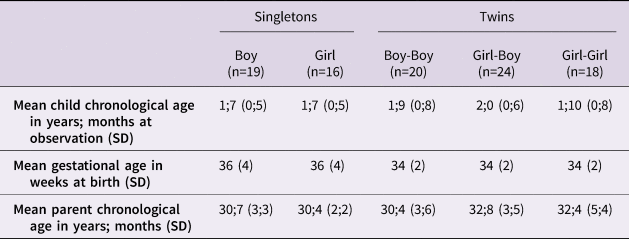
The participants included three groups of fraternal twins (10 boy-boy, 9 girl-girl, 12 girl-boy) and two groups of singletons (19 boys, 16 girls), resulting in 35 singleton and 62 twin children, all acquiring Turkish as their native language and observed as part of a larger project on morpho-syntactic development. Participants were recruited through web platforms and foundations serving twin and singleton families in the greater metropolitan Istanbul area. The children in this study were selected so that they were comparable in chronological age at the time of our observations with no reliable age differences between all five groups of children (F(4, 92) = 1.78, p=.14) or between the three groups of twins (F(2, 59) =.72, p=.49). The mean gestational age at birth was also comparable across the five groups (F(4, 92)=2.08, p=.09), or between the three groups of twins (F(2, 59)=0.40, p=.67). Similarly, the rate of preterm birth was comparable across singleton vs. twin children and girls vs. boys: 31% (11/35) of the singleton and 41% (26/62) of the twin children were born preterm; similarly, 39% (20/51) of the boys and 37% (17/46) of the girls across the five groups were born preterm (range=26 to 36 weeks of gestation; see Table 1, top two rows). We, therefore, included all preterm children in our sample, along with the children born at term. Parents were also comparable in age (Table 1, bottom row) and education: most of the participants in each group had either a college (56-100%) or a high school degree (10-37%). All but 6 of the parents we observed during parent-child interaction were mothers. The six remaining parents included both the mother and father co-present (n=5), or only the grandmother (n=1) present during our observation.
Sample Characteristics

SD=Standard Deviation, n=number of children
Data collection
Children were observed in their homes in a room designated by the parent (i.e., living room or child's room) while they interacted with their primary caregivers using a set of toys (e.g., animal barn, animal puzzle) provided by a female experimenter. The experimenter presented the toys to the parents and asked them to play with their children using the toys for 10-15 minutes. The experimenter video-recorded the parent-child play without any further interaction until the dyad stopped playing with the toys. The parent-child play included singleton child - parent for singletons and both of the twin children - parent for twins, with the goal to attain a sample of parent-child interaction that approximated children's natural home environment. The overall mean length of the interactions across groups was 12 minutes (SD=4.93); it also varied across participants, largely based on how long the parent-child dyad wanted to play with the toys, with significant variability between groups (Msingleton=10.06 [SD=4.31], Mtwin=14.32 [SD=4.65], F(1, 64) = 14.95, p<.001), but not by sex (Mgirls=12.40 [5.65] vs. Mboys=10.97 [4.31], F(1, 52) = 1.12, p=.29) or by twin dyad type (Mtwin boy-boy=13.40 [SD=3.41], Mtwin girl-girl=15.78 [SD=6.16], Mtwin boy-girl=14.00 [SD=4.39], F(2, 28) =.65, p=.53). The study was approved by the Board of Ethics at an urban university in Istanbul, Turkey; parents provided informed consent for their and their child's participation prior to any data collection.
Transcription and coding
Speech
All speech produced by the children were transcribed using Codes for Human Analysis Transcript (CHAT) system (CHILDES; MacWhinney, Reference MacWhinney2000) from video-records by native Turkish speakers who were trained in speech transcription. Sounds referring to entities, events, properties, along with onomatopoeic (e.g., “hav-hav” = woof-woof, “cik-cik” = chirp-chirp), and conventionalized evaluative sounds (e.g., “tüh” = oopsie, “oley” = yay) were counted as words following earlier work (Özçalışkan, Adamson, Dimitrova & Baumann, Reference Özçalışkan, Adamson, Dimitrova and Baumann2017), and further coded for morphemes. Incomplete words that approximated real words (e.g., “kurabi” for “kurabiye” = cookie and that were intelligible to the coder were also transcribed and counted as words. All speech was further segmented into utterances, defined as a segment of speech that is preceded and followed by a change in conversational turn, intonation, or pause, following the CHAT system guidelines (MacWhinney, Reference MacWhinney2000).
Gesture
All gestures that accompany each speech utterance (e.g., pointing at a cow picture while saying “inek” = cow) and that were produced on their own (e.g., pointing at a cow picture without any speech) were coded by Turkish native speakers trained in gesture coding, following guidelines outlined in earlier work (Özçalışkan & Goldin-Meadow, Reference Özçalışkan and Goldin-Meadow2005a). A gesture was defined as a communicative hand or body movement that did not involve direct manipulation of objects.
Each gesture was coded further for its meaning (i.e., what the gesture conveys: e.g., pointing at the cat to indicate ‘cat’) to assess the diversity of meanings conveyed in gesture, and for its complexity (i.e., types of gestures, types of gesture+speech combinations). For types, each gesture was coded as deictic (i.e., gestures that indicate referents; e.g., point at bike), conventional (i.e., gestures that convey culturally-prescribed meanings; e.g., nod head for affirmation), or iconic (i.e., gestures that convey characteristic actions or features associated with referents; e.g., circle arms for pedaling). For types of gesture+speech combinations (i.e., gesture+speech), each gesture was coded for the informational relation it held to the accompanying speech as either complementary gesture+speech, in which gesture conveys the same information as speech (e.g., “koyun” = sheep + point at sheep) or supplementary gesture+speech, in which gesture either disambiguates the information conveyed in speech (e.g., “bu” = this + point at bike) or conveys different information from speech (e.g., “bak” = look + point at the cat).
Reliability
Speech
All verbal responses were transcribed by two coders who were native speakers of Turkish, using the video-recorded interactions. A third coder, who was also a native speaker of Turkish, independently checked all initial transcription by watching the video-recorded interactions to ensure transcription accuracy for speech. Any disagreements – which were very minimal – were resolved with a further discussion between coders.
Gesture
We assessed the reliability for gesture coding by two trained independent coders who were blind to the hypotheses of the study. Each of them coded a randomly selected 20% of the video-records for gesture detection, gesture meaning, and for the types of gestures and gesture+speech combinations, separately in each of the five groups; for the twin children, the mean agreement was calculated for the dyad. The agreement between coders was 92%, κ=.89 (singleton girl = 90%, singleton boy = 92%, twin boy-boy = 92%, twin girl-girl = 100%, twin girl-boy = 87%) for the identification of the gestures, 96%, κ=.92 (singleton girl = 89%, singleton boy = 100%, twin boy-boy = 96%, twin girl-girl = 100%, twin girl-boy = 96%) for assigning gesture gloss, 98.5%, κ=.96 (singleton girl = 94%, singleton boy = 100%, twin boy-boy = 100%, twin girl-girl = 100%, twin girl-boy = 98.5%) for the classification gestures into types, 96.8%, κ=.95 (singleton girl = 94%, singleton boy = 100%, twin boy-boy = 91.5%, twin girl-girl = 100%, twin girl-boy = 98.5%) for the classification gesture-speech combinations into types.
Scoring
Speech
We assessed the number of words and the number of different words produced by each singleton and each twin child. We used the number of words as a measure of amount, number of different types of words (e.g., “kedi” = cat vs. “at” = horse) as a measure of diversity, and the number of morphemes per utterance (i.e., MLU: mean length of utterance) as a measure of complexity for speech production. We treated words with the same stem but with different derivational morphemes (e.g., “oyun” = play vs. “oyuncu” = player) as different word types and words with the same stem but with different inflectional morphemes (e.g., “oyun” = play vs. “oyunlar” = plays) as the same word type.
Gesture
We assessed the number of gestures and the number of different gesture referents produced by each child. We used the number of gestures as a measure of the amount, and the number of different referents conveyed in gesture (e.g., point at cat vs. point at dog) as a measure of diversity for gesture production. We also counted the number of each type of gesture (deictic, conventional, iconic) and gesture+speech combination (complementary, supplementary) as measures of complexity of gesture production for each individual child. Iconic gestures and supplementary gesture+speech combinations were considered as more complex than deictic gestures and complementary gesture+speech combinations, following earlier work (Özçalışkan & Goldin-Meadow, Reference Özçalışkan and Goldin-Meadow2005a).
Data analysis
To control for the variability in the duration of parent-child play interaction across different child-parent pairs, we used each child's per-minute production of speech. The only exception was MLU, which we computed by dividing the number of morphemes by the total number of spoken utterances produced by each child. Considerable within and between-group differences were observed in the per minute speech and gesture production of children; we, therefore, transformed all speech and gesture scores by using square root transformations. Iconic gesture production was also very low in each group (singleton girls: 7, singleton boys: 2, boy-boy twins: 2, girl-girl twins: 5, boy-girl twins: 3 instances); we, therefore, excluded all iconic gestures from our statistical analysis.
We first examined sex differences in the speech and gestures produced by singletons and twins, using two-way ANOVAs with sex (boy, girl) and group (singleton, twin) as between-subject factors, or three-way ANOVAs with sex and group as between and gesture or gesture+speech type as within subject factors, separately for the amount, diversity, and complexity of speech and gesture production. For the sex and group differences analysis, we used per minute production of gestures and speech by each individual child. We next examined dyad composition differences in the speech and gestures produced by children in the three twin dyads, with a set of one-way ANOVAs – with the type of twin-dyad (boy-boy, girl-girl, boy-girl) as a between-subject factor, or two-way ANOVAs with twin dyad type as between and gesture or gesture+speech type as within subject factors – separately for the amount, diversity, and complexity of speech and gesture production. For the dyad composition analysis, we used the per-minute production of speech or gesture in each dyad (collapsed across the two children) as our unit of analysis.
Results
Do children show sex or group differences in the amount, diversity, and complexity of speech and gestures that they produce?
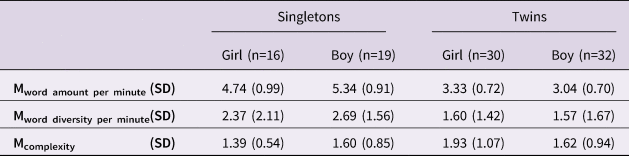
Children's speech production did not show an effect of sex for either the amount (F(1, 93) = .04, p = .85), diversity (F(1, 93) = .16, p = .69), or complexity (F(1, 93) = .09, p = .77) of speech. On the other hand, there was an effect of group for both the amount (F(1, 93) = 5.57, p = .02, ηp2 = .06) and diversity (F(1, 93) = 6.79, p = .01, ηp2 = .07), but not complexity (F(1, 93) = 1.67, p = .20) of speech production. Singleton children produced greater number and variety of words than twin children. There was no interaction between sex and group for either amount (F(1, 93) = .25, p = .62), diversity (F(1, 93) = .38, p = .54) or complexity (F(1, 93) = 1.72, p = .19) of speech production (see Table 2).
Speech production of singleton and twin children

SD: Standard Deviation, n=number of children
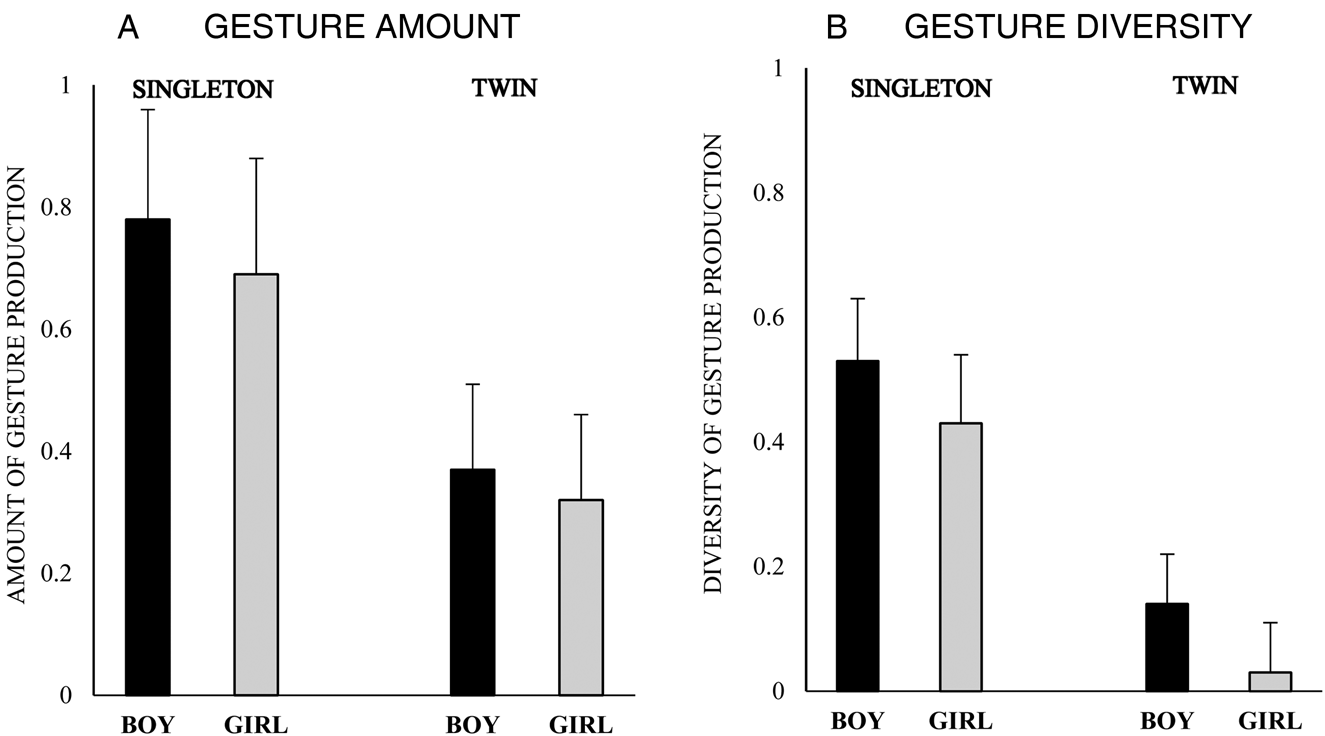
Children's gesture production followed the same pattern as their speech. Gesture production did not show an effect of sex for either the amount (F(1, 93) = .02, p = .89) or diversity (F(1, 93) = .30, p = .58) of gestures (See Fig. 1A-1B). However, mirroring the pattern found in speech, there was an effect of group for both the amount (F(1, 93) = 5.88, p = .02, ηp2 = .06) and diversity (F(1, 93) = 34.21, p < .001, ηp2 = .27) of gesture production: singletons produced greater amount and diversity of gestures than twins. There was however no interaction between sex and group for either the amount (F(1, 93) = .04, p = .85) or the diversity (F(1, 93) = .09, p = .76) of gestures produced.
Mean amount (1A) and diversity of gestures (1B) produced per minute by singleton and twin boys (dark bars) and singleton and twin girls (light bars); error bars represent standard error.

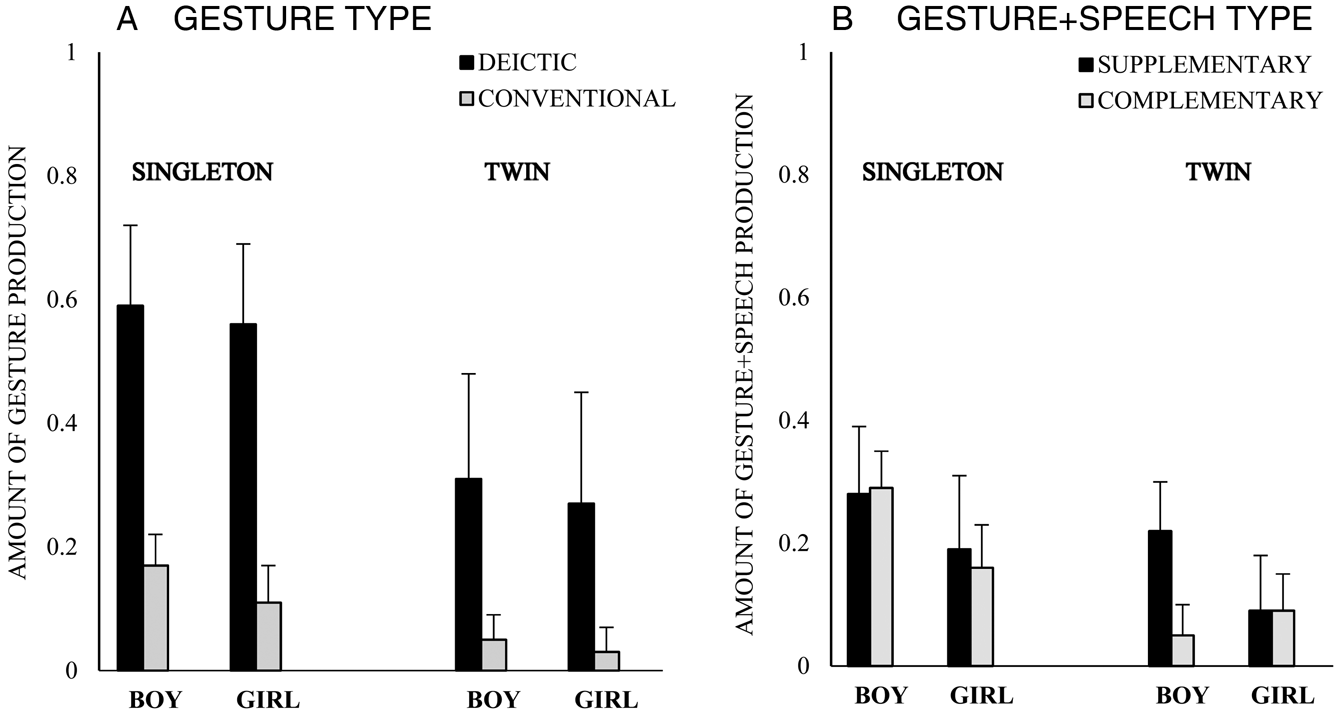
Next, we examined the complexity of children's gesture production. First looking at gesture type, children's production showed an effect of gesture type (F(1, 93) = 18.89, p <.001, ηp2 = .285) and group (F(1, 93) = 5.50, p = .02, ηp2 = .054), but no effect of sex (F(1, 93) = .24, p = .6). None of the two-way interactions, including sex x group (F(1, 93) = .28, p = .87), gesture type x sex (F(1, 93) = .65, p = .42), gesture type x group (F(1, 93) = 1.80, p = .18), or the three-way interaction: gesture type x sex x group (F(1, 93) = .00, p = .98) were significant. Overall, children across groups produced greater number of the relatively simpler deictic gestures than conventional gestures; and singletons produced more of each type of gesture than twins (see Fig. 2A).
Mean number of different types of gestures (2A) and gesture+speech combinations (2B) produced per minute by singleton and twin boys (left bars) and singleton and twin girls (right bars); error bars represent standard error.

In contrast, children's production of gesture+speech combinations did not show an effect of combination type (F(1, 93) = 0.69, p = .41), sex (F(1, 93) = 0.06, p = .80), or group (F(1, 93) = 2.63, p = .11); none of the two-way interactions, including sex x group (F(1, 93) = .22, p = .64), gesture+speech type x sex (F(1, 93) = .59, p = .44), gesture+speech type x group (F(1, 93) = .91, p = .34), or three-way interaction: gesture+speech type x sex x group (F(1, 93) = .38, p = .54) were significant (See Fig. 2B).
Do twin children show dyad composition differences in the amount, diversity, and complexity of speech and gestures that they produce?
We next turn to three twin dyads and examine the patterns of speech and gesture production in each dyad. As Table 3 shows, twin dyads did not differ in the amount (F(2, 28) = .58, p=.57), diversity (F(2, 28) = .34, p=.71), or complexity (F(2, 28) = .72, p=.50) of their speech production.
Speech production of the children in the three twin dyads

SD: Standard Deviation, n=number of children
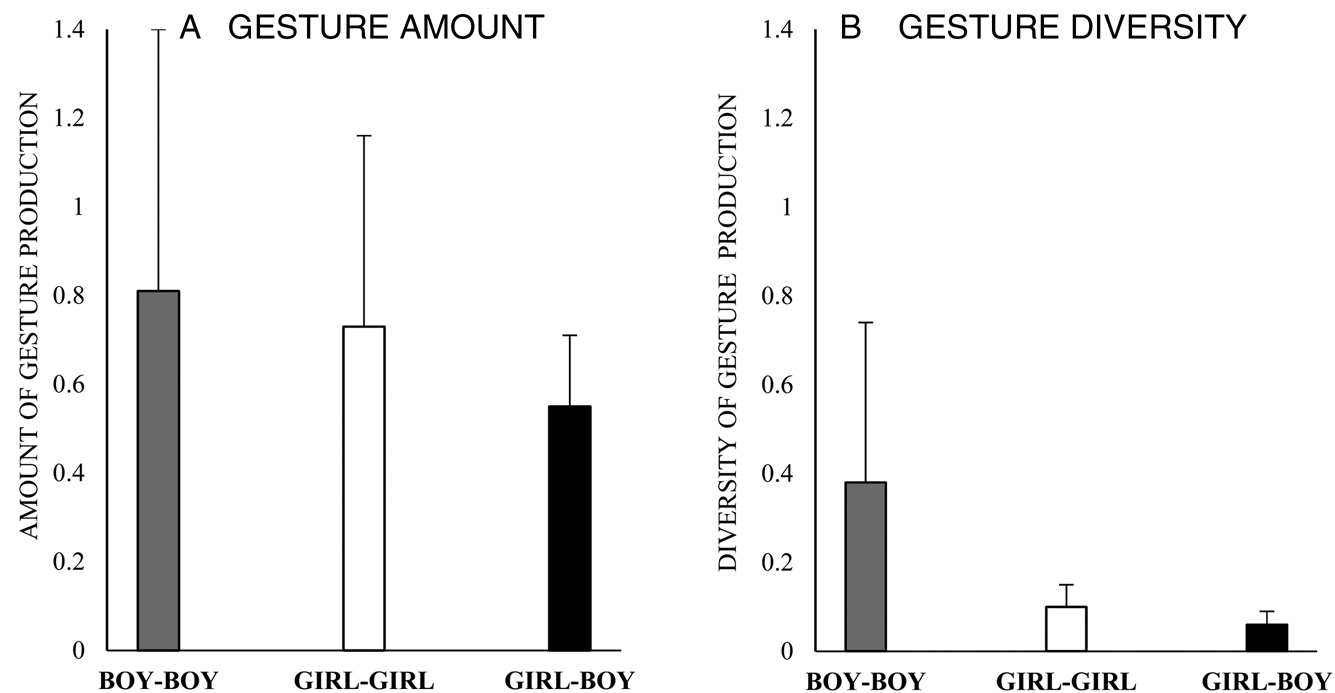
Turning to gesture, we also found that the three twin dyads were comparable in the amount (F(2, 28)=.03, p=.97) and diversity (F(2, 28)=.21, p=.81) of the gestures that they produced (see Fig.3A-3B).
Mean amount (3A) and diversity of gestures (3B) produced per minute by boy-boy, girl-girl, and girl-boy twin dyads; error bars represent standard error.

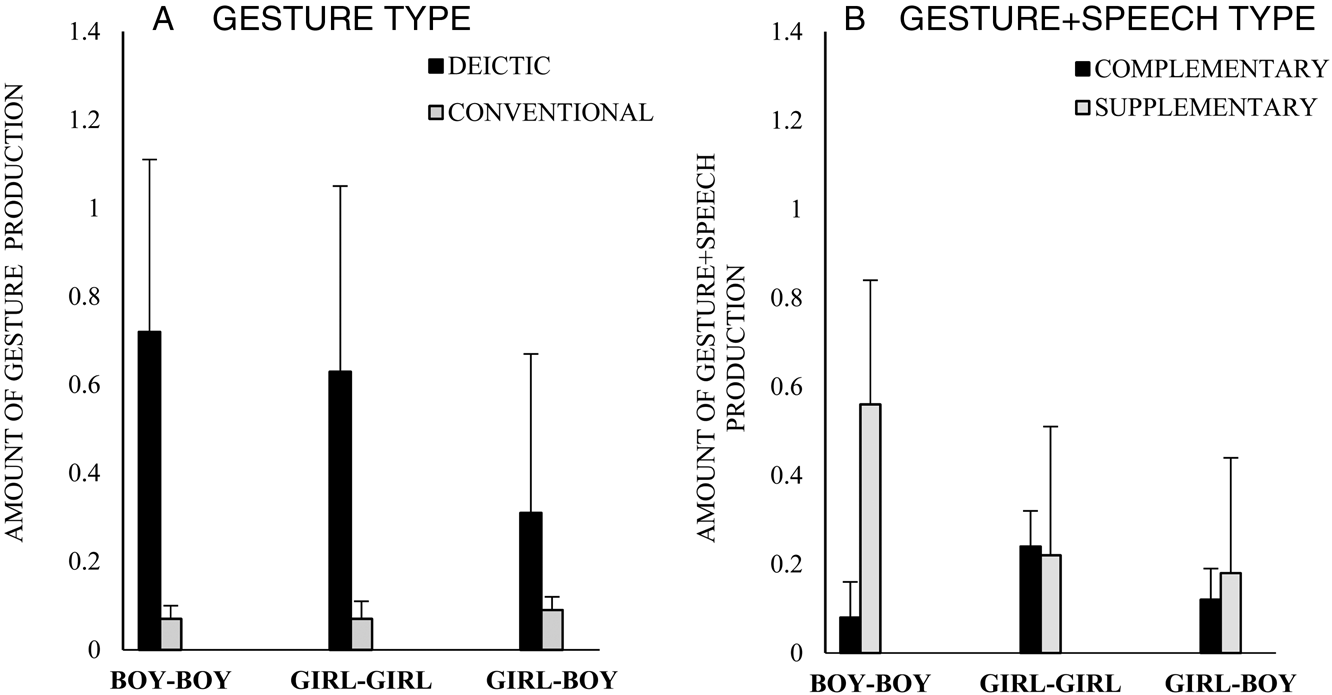
Turning to complexity of gestures, we found differences. First looking at gesture type, we found no effect of group (F(2, 28)=.09, p = .91) and no interaction between group and gesture type (F(2, 28)=.50, p = .61), but we found an effect of gesture type (F(1, 28) = 9.95, p = .004, ηp2 = .262; see Fig. 4A). Twins in each dyad produced greater number of deictic than conventional gestures. Turning next to gesture+speech combinations, however, children's production did not show an effect of group (F(2, 28) = 0.13, p = .83), gesture+speech combination type (F(1, 28) = 0.79, p = .38), or an interaction between group and gesture+speech combination type (F(2, 28) = 0.66, p = .52; see Fig. 4B).
Mean number of different types of gestures (4A) and gesture+speech combinations (4B) produced per minute by boy-boy, girl-girl, and girl-boy twin dyads; error bars represent standard error.

Discussion
In this study, we focused on the early gestures and speech produced by two groups of singletons (19 boys: Mage=1;7, 16 girls: Mage=1;7) and three groups of twins (10 boy-boy: Mage=1;9, 9 girl-girl: Mage=1;10, 12 girl-boy: Mage=2;0), and examined whether the production of gesture and speech varies by child sex (boy vs. girl), group (singleton vs. twin) and dyad composition of the twins. In contrast to previous research (Berglund et al., Reference Berglund, Eriksson and Westerlund2005; Eriksson et al., Reference Eriksson, Marschik, Tulviste, Almgren, Pérez Pereira, Wehberg and Gallego2012), our results did not show any evidence of sex differences in the amount, diversity, and complexity of the speech children produced. We, however, found group differences (singleton vs. twin) in the amount and diversity–but not complexity – of speech – with an advantage for singletons. Mirroring the patterns in speech, we found no evidence of a sex difference in the amount, diversity, and complexity of children's gestures, but we did observe a group (singleton vs. twins) difference in both the amount and diversity of gestures. Twin children produced a lower amount and diversity of gestures compared to their singleton peers – a pattern that became evident in both their deictic and conventional gestures, but not in their gesture+speech combinations. The three twin dyads were comparable in their production of speech and gesture with no group differences in amount, diversity, or complexity of the communications that they produced, showing no effect of dyad composition on patterns of speech and gesture production. Across groups and dyads, children preferred to use predominantly the relatively simpler deictic gestures and were equally likely to use either complementary or supplementary gesture+speech combinations.
Differences between singletons and twins
Why do twins lag behind singletons in their production of gesture and speech? One possible reason could be the developmental level of the child, which is indexed by both gesture and speech. We know from earlier work that gesture and speech form a closely integrated system, with gesture preceding and predicting oncoming changes in speech (Iverson & Goldin-Meadow, Reference Iverson and Goldin-Meadow2005; Özçalışkan et al., Reference Özçalışkan, Adamson, Dimitrova and Baumann2017; Özçalışkan & Goldin-Meadow, Reference Özçalışkan and Goldin-Meadow2005a; Thal & Tobias, Reference Thal and Tobias1992; Thal, Tobias & Morrison, Reference Thal, Tobias and Morrison1991). We also know from previous work that late talkers who use more gestures to compensate for their weaknesses in speech production, are more likely to catch up with their peers in one year (Thal & Tobias, Reference Thal and Tobias1992). On the other hand, language problems persist in later years in children who use fewer gestures (Thal et al., Reference Thal, Tobias and Morrison1991). As such, the lower production of gesture among twin children compared to singletons could be an indicator of potential differences in later spoken language development between the two groups. Taking into account the fact that most of the children in our sample were at the one-word stage in their language development, the twin vs. singleton group difference in gesture production can be a signal of potential differences in reaching the next linguistic milestone (i.e., sentence production; Özçalışkan & Goldin-Meadow, Reference Özçalışkan and Goldin-Meadow2005a).
Another explanation for the gap in speech and gesture production of singleton and twin children might be the difference in parental input. Previous research showed that parents of singleton and twin children differ in the way that they talk to their children (Lytton, Reference Lytton2013; Rutter et al., Reference Rutter, Thorpe, Greenwood, Northstone and Golding2003; Tomasello, Mannle & Kruger, Reference Tomasello, Mannle and Kruger1986). Even though twin parents produce sentences at similar levels of complexity as parents of singleton children, they nonetheless, use less interactive language (Lytton, Reference Lytton2013). They not only provide fewer responses to their children (Stafford, Reference Stafford1987), but also engage in shorter conversations with their children (Tomasello et al., Reference Tomasello, Mannle and Kruger1986). The only study that examined parental gesture input in twins vs. singletons (Pınar et al., Reference Pınar, Ozturk, Ketrez and Özçalışkan2021) showed that parents of singletons produced a greater number of gestures than parents of twins during one-on-one interactions with their children, marking parental gesture input as a potential contributor to the differences observed in twin vs. singleton children's gesture production. In addition, joint attention between parent and child is crucial to recognize and understand gestures, and existing research suggests that twin children receive overall less joint attention from their parents (Lytton, Reference Lytton2013).
Thirdly, the communication between twin siblings can also be one of the reasons why twins lag behind singletons in their gesture production. In terms of speech, we know that having a twin sibling can negatively affect the speech development of a child (Reznick, Reference Reznick, Sternberg and Grigorenko1997; Savić, Reference Savić1979; Savić, Reference Savić1980). One reason why this might be the case is that having a sibling can create greater competition for communication space, resulting in fewer opportunities to contribute to ongoing conversation than there would be in a conversation with just one other person, as in the case of singleton children. This, in turn, would reduce the child's overall communication, which could be reflected in amount and diversity of speech use, and consequently, gesture production. Future research that examines twins' production of speech (and gesture) when interacting with their parents together vs. separately can shed further light on this possibility.
Another factor could be the use of twin language, namely communicative system twins develop on their own to communicate exclusively with one another, but not with others in their environment (Malmstrom & Silva, Reference Malmstrom and Silva1986). The use of twin language, in turn, has been shown to negatively impact twins’ language development, with twins who develop twin language showing greater lags in their achievement of language milestones (e.g., expressive vocabulary; Bishop & Bishop, Reference Bishop and Bishop1998; Thorpe, Greenwood, Eivers & Rutter, Reference Thorpe, Greenwood, Eivers and Rutter2001). Even though no research has yet explored the effect of ‘twin language’ on gesture production, it is a distinct possibility that the twin siblings can negatively impact each other's gesture production, mirroring the pattern reported for speech – with later onset of pointing gestures to indicate referents. This, in turn, might lead to less one-on-one communication between child and parent, resulting in reduced rates of parental speech input to child gesture in twin dyads. We know from previous work that parental verbal translation of child gesture in singletons help facilitate child vocabulary development: children are more likely to learn the verbal labels for their gesture referents when those gestures are translated into words by their parents than when they are not translated (Goldin-Meadow, Goodrich, Sauer & Iverson, Reference Goldin-Meadow, Goodrich, Sauer and Iverson2007; Limia, Özçalışkan & Hoff, Reference Limia, Özçalışkan and Hoff2019). As such, lags in gesture production among twins – if observed – might affect spoken language development.
We also found that the gesture production of children was affected by the different gesture types. All groups of children used deictic gestures more than conventional and iconic gestures – a pattern that is likely to be the outcome of the relatively younger age of the children in our study. Developmentally, deictic gestures are the first gestures that are produced by children. Infants start using deictic gestures (e.g., pointing, showing) to elicit adult attention, beginning around 10 months (Bates, Bretherton, Camaioni & Volterra, Reference Bates, Bretherton, Camaioni and Volterra1979; Folven & Bonvillian, Reference Folven and Bonvillian1991). On the other hand, iconic gestures, which are typically produced in the absence of a referent (Goodwyn & Acredolo, Reference Goodwyn and Acredolo1993), are produced after a child reaches a certain level in language acquisition (i.e., 25 words; Caselli, Reference Caselli1990; Nicoladis, Mayberry & Genesee, Reference Nicoladis, Mayberry and Genesee1999) and become more frequently used as children begin to produce more extended forms of speech (e.g., narratives; Colletta, Pellenq & Guidetti, Reference Colletta, Pellenq and Guidetti2010; Demir, Levine & Goldin-Meadow, Reference Demir, Levine and Goldin-Meadow2015; Stites & Özçalışkan, Reference Stites and Özçalışkan2017). Since the children in our sample were at the early stages of their language development, it is not surprising that children produced a greater number of deictic gestures. In our study, children's deictic gesture production was followed by conventional gestures, and then by the relatively scarce iconic gestures. Earlier studies (Furman et al., Reference Furman, Küntay and Özyürek2014, Özçalışkan et al., Reference Özçalışkan, Gentner and Goldin-Meadow2014) showed that children produced iconic gestures much later than deictic gestures (1;10 for Turkish children, 2;2 for American children learning English). Most of the children in our study were younger than 1;10, also limiting their ability to produce the relatively more complex iconic gestures.
Another possible explanation for the gap in children's relative use of different gesture types could be the gestures they observe their parents produce. We know that parents simplify their speech and use more pronounced intonation and pitch while communicating with younger children (Fernald, Reference Fernald1985). They do the same with their gestures by using predominantly simpler gestures (i.e., deictics), and more so than complex ones (i.e., iconic). Earlier studies showed that parents mostly use deictic gestures with their young children who are between 1–3 years old. When the child gets older, parents start to use more conventional and iconic gestures, which are conceptually more complex than deictic gestures (O'Neill, Bard, Linnell & Fluck, Reference O'Neill, Bard, Linnell and Fluck2005; Özçalışkan, Adamson, Dimitrova & Baumann, Reference Özçalışkan, Adamson, Dimitrova and Baumann2018; Özçalışkan & Goldin-Meadow, Reference Özçalışkan and Goldin-Meadow2005b; Özçalışkan & Goldin-Meadow, Reference Özçalışkan, Goldin-Meadow, Gale and Mika2011). As such, parents might be providing models to their children for the different types of gestures.
Differences between boys and girls
In our study, both singleton, as well as twin girls and boys, were similar in their speech in contrast to previous findings that showed that both singleton and twin boys lagged behind girls (Eriksson et al., Reference Eriksson, Marschik, Tulviste, Almgren, Pérez Pereira, Wehberg and Gallego2012; Rice et al., Reference Rice, Zubrick, Taylor, Gayán and Bontempo2014). One potential reason for the lack of a difference in children's speech could be the age and language level of the children in our sample. The children in our study were relatively young and at the early stages of language development. Most of them were at the early stages of communicating with single words and gestures and were fairly limited in their speech production. Importantly, however, we also did not find a sex difference in the gesture production of boys and girls, mirroring the patterns in their speech. Our finding on gesture supports previous work that also showed a lack of a sex difference in gesture production at the early ages (Eriksson & Berglund, Reference Eriksson and Berglund1999), but it also differs from two other studies that showed an advantage for girls in early gesture production (Eriksson et al., Reference Eriksson, Marschik, Tulviste, Almgren, Pérez Pereira, Wehberg and Gallego2012; Fenson et al., Reference Fenson, Dale, Reznick, Bates, Thal and Pethick1994). It is worth noting that these earlier studies all relied on parental checklists. In contrast, our study was based on spontaneous speech samples of children in their home environment, which might have resulted in different patterns of gesture production.
The children in our study also did not show sex or group differences in the amount of their gesture+speech combinations. They also did not differ in terms of the types of gesture+speech combinations that they produced. This finding is different from previous studies showing that children at the early ages use more complementary than supplementary gesture+speech combinations not only in English (Butcher, Reference Butcher2000; Özçalışkan & Goldin-Meadow, Reference Özçalışkan and Goldin-Meadow2005b), but also in Turkish language acquisition contexts (Furman et al., Reference Furman, Küntay and Özyürek2014). The children in our sample were producing reinforcing and supplementary combinations at similar rates. Once again, the reason might be the particular age range under study; some of the children were at the cusp of producing their first sentences, which is a period where we expect to see an increase in supplementary gesture+speech combinations. At the same time, some other children were just beginning to produce gesture+speech combinations, which is a period where we expect to see increases in reinforcing gesture+speech combinations. Thus, the relatively broad age range of children in each group might be the reason for the lack of a significant difference in the types of gesture+speech combinations children produced.
Differences between different twin dyads
In contrast to previous research showing a female advantage among twin dyads in terms of speech production (Galsworthy et al., Reference Galsworthy, Dionne, Dale and Plomin2000; Rice et al., Reference Rice, Zubrick, Taylor, Gayán and Bontempo2014), we did not find any evidence of differences either in speech or gesture production among twin dyads. However, even though the difference was not significant, it is worthy to note that both girl-girl and girl-boy twins tended to produce a greater amount, diversity, and complexity of speech compared to boy-boy twins, in line with the previous findings (Garitte et al., Reference Garitte, Almodovar, Benjamin and Canhao2002; Gücüyener et al., Reference Gücüyener, Arhan, Soysal, Ergenekon, Turan, Onal, Koç, Turkyilmaz and Atalay2011). This tendency was reversed for gesture production: boy-boy twins tended to use a greater amount and diversity of gestures compared to girl-girl and girl-boy twins. As such, they might be compensating for their lower production of speech by using a greater amount and diversity of gestures to communicate what they want to say – a pattern that has been observed in children who show lags in speech production (Thal & Tobias, Reference Thal and Tobias1992). One of the potential limitations for the lack of reliable differences in speech and gesture production could be the relatively modest sample size of the children in the dyad-composition analyses. Future research examining patterns of similarities and differences in different types of twin dyads, using larger samples, thus are needed to further understand the importance of dyad type in early speech and gesture development.
In summary, this study, as the first of its kind, examined the effect of child sex and dyad composition in singleton and twin children on patterns of speech production and its precursor, gesture production. Our results showed a lack of a sex difference in both speech and gesture production. Our findings also showed that differences between singleton and twin children – both in amount and diversity of production – become evident not only in speech but also in gesture production. These results further extend earlier work in other populations and languages, suggesting that gesture and speech form a closely integrated system across different learners (boy vs. girl, singleton vs. twin) – with patterns in gesture mirroring patterns of similarities or differences in children's speech.
Acknowledgments
We thank the helpful comments provided by the the editor, Dr. Johanne Paradis, action editor Dr. Kamila Polisenska, and the two anonymous reviewers on an earlier version of the manuscript. We also thank Melis Çiftçi and Fatih Şahinkayası for their help with data transcription and coding, along with the families for their participation in our study. The project was funded by a grant to N.K. (Ketrez-Sözmen, Scientific and Technological Research Council of Turkey, 111K270) and Research in Challenges in Acquiring Language and Literacy Doctoral Fellowship to Sumeyra Ozturk.