Disasters, as is the case in the still-ongoing coronavirus disease 2019 (COVID-19) pandemic, often challenge health systems despite their origin (whether they are produced by natural phenomena, infectious or traumatic diseases, etc.). Under these circumstances, an integrated approach to an emergency preparedness plan (the first of the 4-phase disaster framework) including risk reduction, health services availability, response actions, and community recovery activities is needed. All of them constitute the “all-hazard approach.” 1 This approach is specific to the particular location of each response facility and does not only consider the most frequent types of hazard in their area, but also the local capabilities of coping with the situation, like ensuring that the hospitals will have the ability to address the magnitude of the event. 2 Fortunately, Argentina is a region that is unlikely to experience disasters produced by natural phenomena or civilian mass casualties; therefore, there was no significant experience to learn from when dealing with the COVID-19 pandemic, and the most important decisions were taken looking at the evolution of the pandemic in other countries. From another perspective, our country benefited from the delay in the spread of the virus, eg, between case number 1000 in Spain and Argentina, there were 34 d: February 26, 2020, versus March 31, 2020. 3
This time frame allowed the country to prepare the health system for the increase in demand, providing hospitals from all around the country with material resources 4 and new intensive care unit (ICU) beds that accounted, for an average 35% increase in capacity. These measures could account for 2 of the 4 “S” of surge capacity: stuff and structure, Reference Anesi, Lynch and Evans5 but the other 2 would still be lacking: staff and system. Given that the critical care staff cannot be increased in such a short time, there is consensus that intensive care practitioners cannot work alone during disasters (either because of the increase in the demand or due to a reduction in staff availability due to health-care team infection). 3–8 The Argentinian national Critical Care Scientific Society (SATI, from the Spanish language Sociedad Argentina de Terapia Intensiva) published on May 14, 2020, a set of recommendations, later endorsed by the National Ministry of Health, for the increase in surge capacity in hospitals. 9,10 These recommendations provided a variety of options for covering the “staff” component of surge capacity, including the organization of mixed teams formed by experienced ICU members leading non-ICU physicians, nurses, and physiotherapists. These recommendations were aligned with those from other critical care scientific societies. 8,11,12 Actually, most countries have used a variety of strategies to repurpose and mobilize the existing health workforce, while some have also augmented capacity by using foreign-trained or previously retired or inactive health professionals, medical and nursing students, and volunteers. Reference Williams, Maier and Scarpetti13 These strategies both have problems, the lack of experience and specific knowledge of the non-intensivists, and inadequate communication in mixed teams.
Even though these recommendations were published on time, there were still some logistic problems to cope with, many of which had been raised by others Reference Ozair, Agrawal and Siddiqui14–Reference Barasa, Ouma and Okiro16 : Which non-ICU health-care team members would be suitable to be included in these new teams? Who would oversee the new participants’ training? And which contents ought to be included in the training? In this scenario, a multi-institutional public-private alliance led by Fundación Trauma (FT), Reference Monteverde, Santero and Bosque17 rapidly developed a nationwide educational intervention program. This manuscript aims to communicate the development, implementation, and results of this initiative.
Methods
Contextual Elements
Argentina is an upper-middle income country in South America, with a total area of 2,791,810 km 2 and a population of 45,808,747 inhabitants, most of whom live in large cities. Argentina is a federal presidential constitutional republic constituted by 23 provinces and 1 autonomous city, Buenos Aires, which is the federal district of the nation. The Argentinian’s health-care system is divided in 3 large sectors: public, social security, and private. The publicly funded sector is decentralized and administered by the provinces or municipalities, and public hospitals provide coverage to 36% of the Argentine population who has no other formal insurance. 18
At the beginning of the pandemic, the Ministry of Health, SATI, and other scientific societies issued recommendations and protocols, but no formal education mechanism was established with the aim of increasing the supply of ICUs’ professionals.
Course Contents
In March 2020, the medical team from FT 19 met with representatives from SATI and the National Academy of Medicine (NAM) 20 to define the contents of the training program. After the first 2 meetings, the team came up with a preliminary program composed of 24 units organized into 4 modules: (1) protective measures against virus transmission, universal precautions, personal protective equipment, triage, and transport; (2) critical care basics for the non-intensivist caregiver; (3) pediatric critical care basics; and (4) hospital preparation, surge capacity and special issues such as corpse management, resource allocation and communication of bad news. No specific educational theory was used to develop this educational intervention. All the contents were developed by FT and later reviewed and corrected by SATI and NAM. The course was called PARES© (in Spanish, “Preparación para el Aumento de la Respuesta del Equipo de Salud”, which stands for Preparedness for the Augmentation of the Healthcare Team Response), which also refers to the solidarity between all health-care workers, because the word pares in Spanish means peers in English.
Course Organization
Given the epidemiological situation at that time (lockdown, canceled flights, social distancing recommendations), it was a fact that all training needed to be delivered online with certain characteristics to improve its impact: (1) interactive, (2) self-paced, (3) available 24/7, (4) possible to be consulted on multiple occasions, and (5) prepared in short slots (not longer than 10 min per unit). The course was, therefore, organized with 3 educational components: 24 short video-based lessons, synchronous tutorials, and an interactive forum. There was a final exam composed of 15 multiple-choice questions, and students who passed the exam obtained a certificate. After the exam, the students were surveyed investigating the potential impact of the course on their routine practice.
The 24 video-based lessons, which last a total of 7 h, were prepared in a friendly manner by a graphic design company (Holistica, Buenos Aires 21 ). All the materials were ready to be uploaded on the MoodleTM (West Perth, Australia) open-source learning software platform on the first days of July 2020, 22 and on July 20, 2020, we began with online tutorials (2 per d, 1 h each, at 1 pm and 7 pm, from Monday to Friday).
The synchronous Web-based tutorials were performed by 24 certified critical care specialists from SATI. The selected physicians belonged to 11 of the 24 autonomous districts of the country, reflecting management throughout the country and reinforcing the federal view of the initiative. Additionally, there was a forum chat coordinated by FT’s medical staff, where students could make questions and contributions at any time, which were answered within 24 h.
The course received the endorsement of the National Direction of Human Talent and Knowledge and the National Direction of Quality of Health Services and Health Regulation, both from the National Ministry of Health.
Course Delivery Process
To accomplish the goal of delivering the course to the right people at the right time, FT contacted the Ministries of Health of each province by phone and email to gather information on the designated public hospitals during the pandemic, and to ask for the local representatives’ contact information. That process ended up with a list of countrywide prioritized hospitals, each 1 with a list of non-ICU physicians, nurses, and physiotherapists with email addresses who agreed to participate in the project. These professionals were contacted and granted a scholarship as well as the allocation of personal credentials to log into the website. As long as the pandemic in July was mainly affecting Buenos Aires Metropolitan Area (BAMA), an urban agglomeration composed of the Autonomous City of Buenos Aires and 24 adjacent districts from Buenos Aires province, which has nearly 16 million inhabitants (approximately 35% of the country’s population), the initial efforts were focused on this region.
Given that 1 of the problems with online delivered courses is a high dropout rate, we designed a student follow-up process based on usage metrics. If a student did not take the final exam after 7 d from their first interaction with the site, an automatically generated email was sent. After that moment, if the student was not active on the site, they were sent a message either by chat or phone every 72 h. If the student did not answer or if they requested their discontinuation within the following 7 d, the user’s profile was disabled, and the scholarship was reassigned. The implementation team was reinforced for this course with the hiring of 3 specifically trained assistants.
Course Financing
Between March and April 2020, the fundraising team from FT started a campaign, contacting a series of potential financial sponsors with the initial aim of achieving 5000 scholarships. La Caja (Generali group) was the main sponsor for the course development and the first 2500 scholarships. Fifty-four other companies were also contacted, mainly from insurance, banks, and holding groups, and, so far, 32 of them have provided different levels of support, reaching 8187 scholarships. Although some companies financed professionals from their specific areas of influence, most scholarships were freely assigned by FT, depending on the evolution of the pandemic in Argentina and the local characteristics of the health systems.
Data Analysis
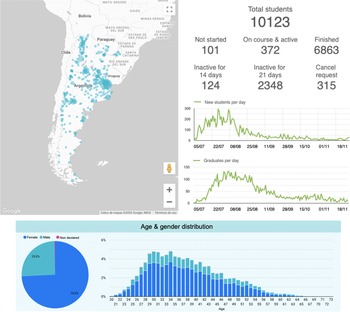
We monitored the usage metrics and goal accomplishment through ad hoc SQL queries that were generated on Moodle for data extraction. To assess the educational processes and outcomes on learners we measured the finalization rate, curse duration, success rate, overall satisfaction rate (along a 5-point scale), potential implication in practice, and how likely the students were to recommend the course to colleagues. These files were analyzed with R software and RStudio®. A Google Data Studio® dashboard was built for daily monitoring of students’ behavior, and report-making for the financial sponsors (Figure 1). Descriptive analysis is provided as quantity (n) and percentage (%) for categorical variables, median, and interquartile range (IQR) for numerical variables, and the results of the bivariate analysis are provided by χ2 test with Yates correction and Wilcoxon rank-sum test for categorical and numerical variables, respectively. When we considered it appropriate, we reported 95% confidence intervals (95% CI) by the Clopper-Pearson method. All data from the course were analyzed, so a sample size calculation was not needed. Given that these data do not include any personal information from the students and that all the data we used were aggregated, an Ethics Committee evaluation was waived.
Monitoring dashboard.

Results
General Characteristics
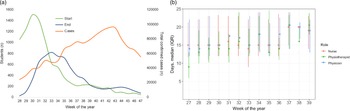
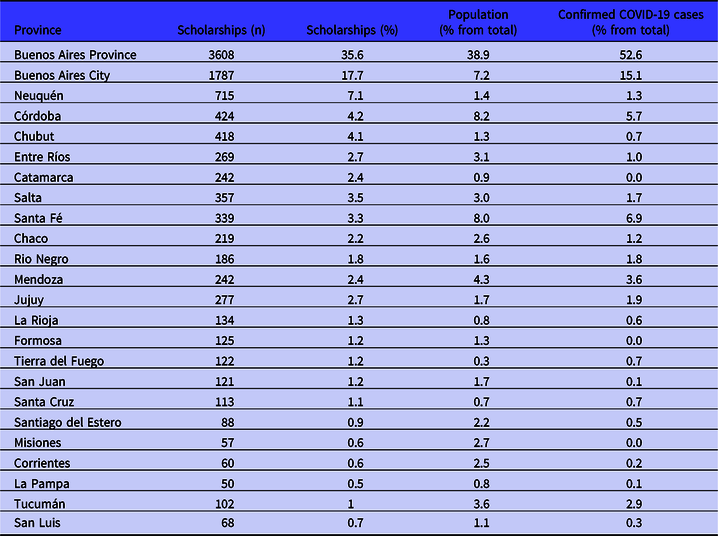
Up to November 30, 2020, a total of 10,123 students had registered, 6863 (67.8%) of whom had completed the PARES course; 2,945 (29.1%) were still taking it, and 315 (3.1%) were inactive with their scholarships being reassigned (Figure 2a). Most students were female (74.2%), and the age distribution was (median, IQR): 37 y old (31-44). The students’ professions were distributed as 5717 (56.5%) nurses, 3661 (36.2%) physicians, and 745 (7.4%) physiotherapists. There were no differences in age distribution between professions: 37 y old (31-43) for nurses, 37 y old (31-44) for physicians, and 38 y old (31-46) for physiotherapists. The nurses group showed a significantly higher proportion of women: 80.0% (95% CI 78.9-81.0) versus 66.9% (95% CI 65.4-68.4) versus 65.6% (95% CI 62.1-69.0), respectively. From the whole sample, 21.2% manifested that they were currently working in intensive or intermediate care areas. This subgroup did not show a different completion rate when compared to the rest: 67.5% versus 67.9%. The geographical distribution of scholarships resembled that of the ongoing pandemic (Table 1).
Students (n) according to the week of the year when they started or ended the course and its relationship with the evolution of confirmed cases at the national level (a); Course duration by the week of the year where the students started (b).


Country Coverage
Among the group that finished the course (n = 6863), there were professionals from 661 hospitals from 328 cities of the 24 autonomous districts from the country (Table 1). Scholarships were almost entirely assigned to professionals working in public institutions (95.7%), and the remainder went to private facilities; 89.2% of the professionals worked in general hospitals, while the rest belonged to pediatric facilities.
Tutorials
At the moment of this communication, 137 tutorials had been given to 790 attendees from all over the country. Over 300 interactions were generated in response to 150 questions that were posted on the asynchronous forum with 3 topics being the most consulted: airway management, mechanical ventilation, and personal protective equipment.
Students’ Follow-up
As related to the students’ follow-up process, more than 70,000 emails and 40,000 chat interactions were generated to keep track of each special situation. Independently of these efforts we made, as previously reported, 29.1% have not finished the course yet. None of those students took any units from the third module (pediatric) and, on average, they explored 70.2% of the contents from the first module, 41.7% from the fourth, and 26.2% from the second one.
Course Metrics
Median time from the first interaction with the course website to a passing grade on the exam was 15 d (12-23), with no difference between professions: 15 (12-22) for nurses, 14 (11-20) for physicians, and 15 (13-23) for physiotherapists. We did not find any associations between the course duration and the moment when the students started (Figure 2b). Physiotherapists were more likely to finish the course: 77.2% (95% CI 74.0-80.1) versus 68.6% (95% CI 67.1-70.1) for physicians, and 66.0% (95% CI 64.8-67.3) for nurses. We found no significant between-gender differences in the course finalization rate: 68.2% (95% CI 67.2-69.3) for women and 66.6% (95% CI 64.8-68.4) for men.
Over two-thirds of the students (69.7%) passed the final test in their first attempt, 87.5% did so after the second attempt, and 93.5% after the third. Regarding the specific questions, 12 of 15 had a success rate of over 75%. The 3 ones with a rate below that threshold were related to the use of filters in mechanical ventilators and the management of septic shock.
In the posttest survey with a 26.3% retrieval rate, 48.3% answered they did not have any experience in critical care. The overall satisfaction had a mean of 4.4 points (standard deviation [SD], 0.9) on a 5-point scale, and 90.7% answered that they considered they were able to apply the course contents to their everyday practice. In this sample, 97.7% said that they would recommend this course to their colleagues.
Strengths and Limitations
This study has strengths and limitations. One of the strengths is showing the complex interactions between multiple and diverse stakeholders that worked simultaneously to bring a rapid and effective solution to 1 of the issues for the preparedness of the health system to COVID-19 pandemic surge. The study also shows different educational techniques that were implemented to avoid the problems of virtual learning. One of the limitations is the low response rate of the post-test survey, which could bias its results. Another limitation is that we cannot be sure that the acquired new concepts were actually used in real-world settings or if the course could effectively close the gap between demand and supply in the disaster-like environment of the COVID-19 pandemic.
A couple of challenging aspects remain: although tutorials with critical care practitioners were available from the early beginning, they were not used as we expected. We think that we might have fallen short in the dissemination of these activities, and several learners informed having had problems with their Internet connection and some degree of conflict with their working schedule. In addition, we graded the performance in the discussion forums as not entirely satisfying because of the high redundancy in questions and the low feedback from the learners. We think these 2 should be the next areas to focus on.
Discussion
This study presents the ins and outs of the creation and implementation of a completely new course that was developed during a pandemic and that included general aspects of hospital preparedness and intensive care focused on the current situation. We found a high finalization rate, success rate, and satisfaction among students.
There were learning experiences about disaster response, as FCCS©, FDM©, and ADMR©, but those courses—usually given in our country—were not ready to be delivered online in Argentina at the time of the first pandemic surge in the country. Courses like those from the Society of Critical Care Medicine, 8 the European Society of Intensive Care Medicine, 11 and others Reference Bhattacharya, Singh and Hossain23 were not fully available in Spanish at the beginning of the COVID-19 pandemic. As stated by others, Reference Seddighi, Seddighi and Salmani24 the collaboration between scientific societies and private funding companies was key to developing the course materials on time, and the collaborative association with the public system was essential for its implementation at the right moment and its delivery to the personnel with the highest needs.
Recent technical advancements, such as online collaborative work, rapidly developed animated and interactive videos, and access by means of a readily available learning management system (MoodleTM) made it possible to develop the course in this short period, filling the gaps between official and scientific recommendations and their actual implementation. Reference Kato, Miyakuni and Inoue25 Some issues to be addressed: women’s proportion across the 3 professional groups resembled the gender distribution in Argentina, which is nearly 5 to 1 for nurses and physiotherapists, and 2 to 1 among physicians. 26 We could not compare the age distribution of PARES© students with that from the general health-care community due to lacking data.
As stated in a recent review, there are some issues about open online courses such as a high dropout rate (nearly 90%), Reference Khalil and Ebner27,Reference Meinert, Alturkistani and Brindley28 low interaction between students, and the not-so-clear role of the educator or facilitator. We hypothesize that we may have reduced the dropout rate by addressing the interaction between students and with educators through online synchronous tutorials. In addition, the implementation of a mixed-methods and progressive approach (no interaction, automatic messaging, personalized messaging, and phone calls) may have leveraged the completion rate. Reference Firmansyah and Timmis29 Another explanation for the low dropout rate may relate to the profiles of the learners, who were university-graduated professionals in their vast majority. Reference Jia, Gong and Luo30 In the Q&A forum, learners highlighted the innovative features of the course and the interactivity of the classes as the most remarkable factors on several occasions. As others have pointed out, these characteristics may engage students, as many of them explicitly manifested their desire to participate in courses on other topics using this kind of methodology. Reference Chan, Barchino and Medina-Merodio31
Conclusions
In conclusion, this study shows the rapid development of an online course for the training of nonintensivist professionals throughout a Latin-American country to support the limited staff available during the COVID-19 pandemic. The allocation strategy within the framework of a scholarship program, the use of different virtual educational techniques (short video-based lessons, synchronous tutorials and forum chat), and the close follow-up of the students led to a low dropout rate and a high percentage of course success rates and student satisfaction. The public–private collaboration was an effective strategy for the development of this complex educational program. This educational framework could be applicable to other raid evolving disaster-like situations.
Data availability statement
De-identified individual participant data will be available on request from researchers, after approval of the proposal.
Author contributions
Design L.B., R.K., and J.B. Data gathering E.M., M.I.A., and N.C. Analysis E.Z., L.B., R.K., B.L., M.I.A., and N.C. Writing E.Z. and R.K. Critical review E.M., L.B., R.K., J.B., B.L., M.I.A., N.C., R.R., P.S., C.O., V.G., and J.N.
Funding statement
The founding organization did not have any intervention in the organization, design, interpretation or reporting.
Conflict(s) of interest
Nothing to disclose.