Introduction
Before the advent of herbicides, tillage was relied on for weed control and seed bed preparation in crop production systems (Lal Reference Lal2009). Adaptation of production practices to allow expansion across a wider range of environments has led to changes in the types of tillage implements and cultivation methods. The most dramatic of these changes have occurred over the past century, after mechanization of agriculture. With an extended history of use, there is a thorough understanding of the principles involved in tillage-based weed control (Liebman Reference Liebman2001; Zimdahl Reference Zimdahl2013).
The introduction of highly effective, in-crop selective herbicides in the 1980s enabled the widespread adoption of conservation cropping systems by reducing the need for preseeding cultivations for weed control. From the 1990s onward, these herbicides provided more efficient weed control and enabled the widespread adoption of conservation cropping practices with higher yield potentials and enhanced sustainability (Derpsch et al. Reference Derpsch, Friedrich, Kassam and Hongwen2010; Kassam et al. Reference Kassam, Friedrich, Derpsch, Lahmar, Mrabet, Basch, González-Sánchez and Serraj2012; Llewellyn et al. Reference Llewellyn, D’Emden and Kuehne2012). The efficacy of conservation agriculture is threatened, however, by the loss of these herbicide resources. Widespread resistance evolution, fewer herbicide discovery programs, increased regulation, and public concern about herbicide use are combining to deplete the current (and potentially future) availability of herbicides (Chauvel et al. Reference Chauvel, Guillemin, Gasquez and Gauvrit2012; Duke Reference Duke2012; Heap Reference Heap2018). To ensure profitability and sustainability of cropping systems, it is vital that alternative, nonchemical weed control technologies are developed to mitigate the threat to current herbicide-reliant conservation cropping systems.
A greater understanding of the impact of weeds and an appreciation of the risks of herbicide resistance have driven Australian producers to adopt a zero tolerance approach to weeds in production fields. Weed densities in Australian conservation cropping systems are relatively low (i.e.,<1.0 plant m−2) and continue to decline as growers recognize the value of low populations in the management and avoidance of herbicide resistance (Peterson et al. Reference Peterson, Collavo, Ovejero, Shivrain and Walsh2018). Low weed densities are being achieved through diligent use of routine weed-control options, including more efficient application and timing of herbicide treatments, harvest weed-seed control systems (Walsh et al. Reference Walsh, Newman and Powles2013, Reference Walsh, Ouzman, Newman, Powles and Llewellyn2017), and crop competition for weed suppression. As well as these routine practices, strategic weed control tactics, such as moldboard ploughing (Dang et al. Reference Dang, Seymour, Walker, Bell and Freebairn2015), fallow, hay/silage (Gill and Holmes Reference Gill and Holmes1997), and cover crops (Flower et al. Reference Flower, Cordingley, Ward and Weeks2012) are being implemented when weed populations increase to unacceptably high levels (e.g., >5.0 plants m−2) (Walsh et al. Reference Walsh, Broster, Chauhan, Rebetzke, Pratley, Pratley and Kirkegaard2019). The combined use of routine and strategic practices has allowed growers to reduce and maintain weed densities at very low levels (<1 plant 10 m−2) (Peterson et al. Reference Peterson, Collavo, Ovejero, Shivrain and Walsh2018). The resulting benefits are a production system where weeds have only a low impact on yield and grain quality, increased flexibility with crop rotation, and more timely planting opportunities.
The now-frequent occurrence of low weed densities in cropping fields is driving grower demand for site-specific weed control technologies (e.g., spot spraying) that remove the need for wasteful whole-field treatments. The ability to directly target individual weeds provides the opportunity for the introduction and use of alternate weed-control technologies. One reason for the lack of development of these technologies is the unacceptably high energy (and hence, cost) requirements for effective weed control (Coleman et al. Reference Coleman, Stead, Rigter, Xu, Johnson, Brooker, Sukkarieh and Walsh2019). The research of Coleman et al. (Reference Coleman, Stead, Rigter, Xu, Johnson, Brooker, Sukkarieh and Walsh2019), however, highlighted that the site-specific weed control approach that, due to the substantial energy and cost savings, creates the opportunity to develop alternative, nonchemical weed-control technologies for large-scale crop production systems.
An as-yet unrealized opportunity offered by the site-specific approach is the use of nonchemical weed-control technologies for large-scale cropping systems. Optical sensors have been used for accurate fallow weed detection (Scotford and Miller Reference Scotford and Miller2005) and application of site-specific weed-control treatments for many years in Australia (Felton Reference Felton1990), offering substantial savings (60% to 90%) in herbicide treatments (Timmermann et al. Reference Timmermann, Gerhards and Kühbauch2003). These sensors detect reflectance from living plant material and so create the opportunity to use nonselective, physical weed-control treatments such as tillage to site-specifically control weeds in fallow or preplanting. Low weed densities and the availability of optical sensing technologies provide the immediate opportunity to introduce “targeted tillage” where small areas (<5%) of fields are disturbed for weed control, thereby preserving the fundamental soil conservation approach of the crop production system.
Tillage, and even site-specific weed control, has been in use for millennia. Hand hoeing and manual weed pulling are the earliest forms of weed control and were in use well before Jethro Tull introduced the horse-drawn hoe for weed control in the 17th century (Lal Reference Lal2009). The use of large-scale targeted tillage for site-specific weed control in low weed-density cropping situations has not been investigated, to our knowledge. Our aim, then, for this research was to develop a practical, rapid response tine system that, when triggered, would quickly engage with the soil to cultivate targeted weeds. This essentially represents the mechanization of hand hoeing, where the incorporation of current commercially available detection technologies facilitates the targeted tillage of weeds.
Materials and Methods
Targeted Tillage Concept
The initial concept for this research was conceived during meetings in 2012 of leading Western Australian grower innovators and with growers in herbicide resistance–affected northern grains regions (i.e., Queensland and New South Wales). Subsequently, with the availability of funding, the project team of weed scientists, agricultural engineers, machinery manufacturers, and farmer innovators was formed to develop the targeted tillage system. The initial step was the identification of the design parameters for this system.
Design Parameters
The logistics of weed control in large-scale cropping systems is a major constraint to the use of any weed management practice, including targeted tillage. Hence, for any targeted tillage system to be of value, it must be able to be used effectively across large areas within a narrow time frame and in demanding conditions (e.g., hot, dusty, rugged terrain). A rapid response tine system for targeted soil disturbance to control weeds was designed with the following design requirements:
-
Weed density of less than 1.0 plants 10 m−2. Targeting greater weed densities would lead to excessive levels of soil disturbance and potential negative impacts on soil health.
-
Restricted soil disturbance for weed control. Limited depth and duration of cultivation required for effective weed control.
-
An operational speed of 10 km h−1. A targeted tillage system must be capable of effective use across large areas within in a narrow time frame (e.g., 3,000 ha in 14 to 21 d).
-
Implement dimensions are compatible with controlled-traffic farming systems (e.g., nominal 12-m implement, though a modular design [e.g., 6 m] could demonstrate feasibility).
-
Individual rapid response tines capable of 1 cycle (cultivation) m−1.
-
Site-specific fallow weed control. Current commercially available weed-sensing technologies are limited to the accurate detection of weeds in fallow situations.
-
Facilitate rapid adoption of developed technology. Base the design on a widely recognized tine-system methodology to increase grower acceptance (in terms of familiarity/relatability and serviceability [i.e., readily available parts]) and technology awareness.
Development and Testing of the Rapid Response Tine System
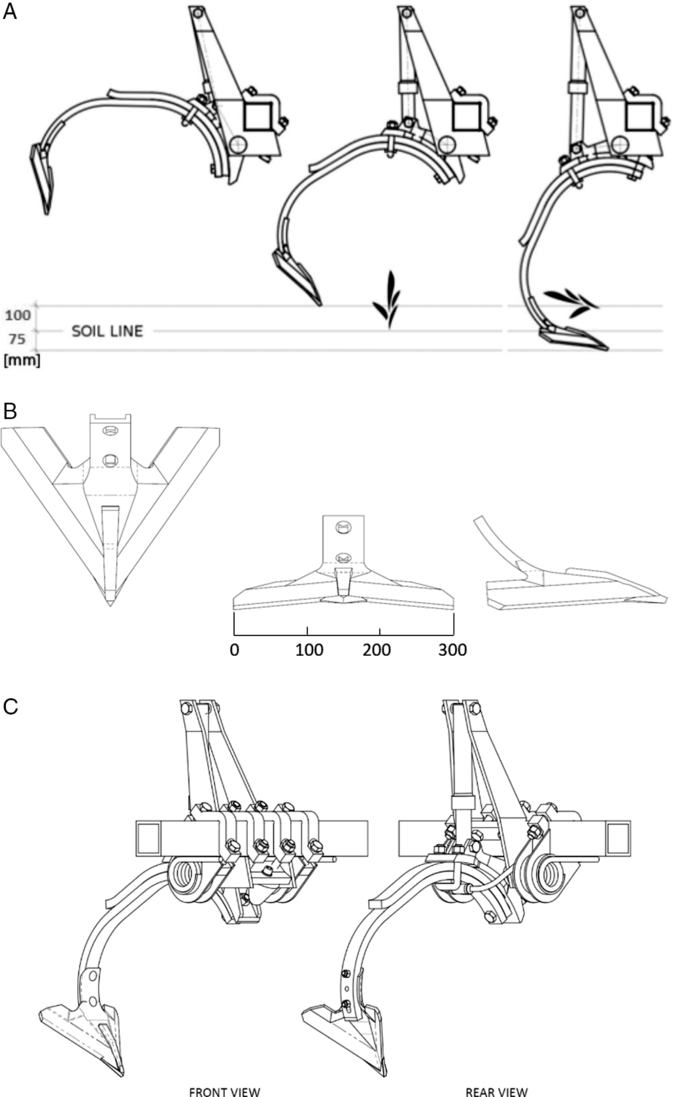
Although some engineering designs can get overly sophisticated when developing optimal solutions, the design philosophy of the project team was on timely development and wide user acceptance. This philosophy led to the development of a rapid response tine focusing on the repurposing of a current, commercially available hydraulic “breakout” tine system. The Shearer Trashworker (Quick, Reference Quick2007) was selected as the base module from which the rapid response tine was developed. The Trashworker base module and a standard tillage sweep are shown in Figure 1A and 1B, respectively.
Desired functionality of (A) the Shearer Trashworker base module, (B) conventional cultivator sweep design, and (C) final aesthetical of mechanical system to achieve functionality.

When repurposed for targeted tillage, the response tine is held just above the soil surface in a standby position. The detection of a weed signals the opening of the hydraulic solenoid, allowing a high volume of high-pressure oil to quickly flow to the cylinder, which moves the tine rapidly to engage with the soil to “chip out” the weed. When the signal is switched off, the tine returns to the standby position through incorporation of the return spring. The tine’s hydraulic breakout capacity is maintained. This desired functionality is depicted in Figure 1A and the embodiment to achieve this is shown in Figure 1C.
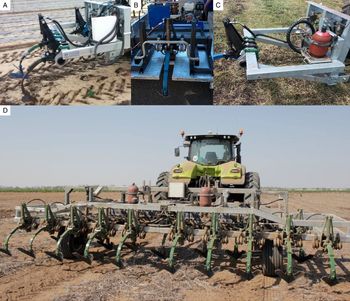
The initial physical proof-of-concept rig (Figure 2A) was used for detailed engineering testing, including assessing the response time and actuation system. There were two additional rigs—a trailer-mounted system with its own hydraulic powerpack used in the Narrabri field trials and a three-point linkage tractor-mounted system used in Toowoomba for weed control efficacy testing (Figure 2B and 2C).
(A) Initial proof-of-concept rig, (B) trailer-mounted, self-powered rig, (C) three-point-linkage rig, and (D) pre-commercial rig, the Weed Chipper, used in the testing and validation of targeted tillage fallow weed control.

Weed control trials with the small-scale prototypes used a simple reflectance detection system to automatically trigger the response tine. A reflector was aligned at a set distance from a targeted weed in the plot trials and, together with the known travel speed, the system was calibrated to trigger the rapid response tine when the light beam aligned with the reflector.
Field testing was conducted at three locations using trailer-mounted (Narrabri, New South Wales) and three-point linkage–mounted (Warwick and Gatton, Queensland) rapid response, single-tine rigs. In all three field trials, a standard 30-cm sweep was used in evaluating weed control efficacy of the response tine.
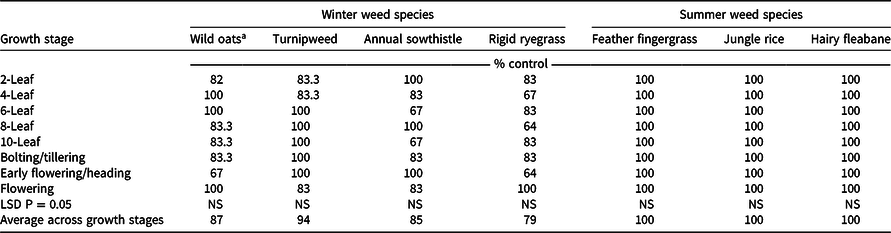
At Narrabri, the rapid response tine was evaluated for its efficacy in controlling winter weed species (rigid ryegrass [Lolium rigidum Gaudin], wild oats [Avena fatua L.], annual sowthistle [Sonchus oleraceus L.], and turnipweed [Rapistrum rugosum L.]) and summer annual weed species (jungle rice [Echinochloa colona (L.) Link.], feather fingergrass [Chloris virgata Sw.], and hairy fleabane [Conyza bonariensis (L.) Cronq.]) present in fallows at eight growth stages (Table 1).
Response-tine efficacy on four winter and three summer weed species at eight growth stages during the 2017 winter and 2017/2018 summer growing seasons, Narrabri New South Wales.

a Abbreviation: NS, nonsignificant.
To enable accurate targeting, weeds were planted along defined, shallow cultivation lines generated by a steel rod attached to the drawbar of a tractor using global positioning system (GPS) guidance. This same tractor was then used in the subsequent testing of the rapid response tine by driving along this same path. Each weed species was planted on a separate line in a randomized complete block design. Trials evaluating control of winter weed species were conducted over the 2017 winter growing season (May to October), where 2- to 3-leaf seedlings of each weed species were planted on eight occasions at 14-d intervals commencing on June 9. At each planting, six seedlings (replicates) were established for each weed species. The sequential planting resulted in the establishment of eight distinct growth stages for each of the four weed species at the time of rapid response tine testing on September 4, 2017. Similarly, over the 2017/18 summer growing season (December to April), the same trial design was used to evaluate rapid response tine efficacy on the three summer weed species. This trial commenced with the initial planting of 2- to 3-leaf weed seedlings on January 29 with tine testing on May 18. On both occasions, a 10-cm cultivation depth was used for targeted tillage treatments.
At Warwick and Gatton, field testing evaluated the rapid response tine for its efficacy in controlling winter and summer weed species present in fallow fields at three growth stages (Table 2). The trials at each site and in each season used a randomized complete block design with three replicates, with each replicate containing two lines of weeds per species × planting time combination. Before planting, a shallow cultivation line was marked using a tractor with GPS guidance to ensure weed seeds were planted in a straight line. Each line contained 20 (Warwick) or 18 (Gatton) positions at 2-m intervals where weed seed of a single species was planted. Over the 2017 winter growing season, seed of wild oats and annual sowthistle were planted and then irrigated on three occasions at 21-d intervals commencing June 26 (Warwick) and July 10 (Gatton). After the first planting, wild oats did not germinate in sufficient quantity at both sites, so positions were replanted with cultivated oats (A. sativa cv. Mannus) to act as a mimic weed.
Response-tine efficacy on three growth stages of two winter and two summer weed species at Warwick and Gatton, 2018.

a Abbreviation: NS, nonsignificant.
b Cultivated oats was substituted for wild oats.
After emergence, weeds at each designated position were manually thinned to a single plant. The sequential planting resulted in the establishment of three distinct growth stages for each weed species at the time of rapid response tine testing. The three-point linkage rapid response tine system was mounted on a tractor with GPS guidance for testing on October 27 (Warwick) and September 27 (Gatton). Over the 2017/18 summer growing season, a re-randomized trial design was used to evaluate tillage tine efficacy on jungle rice and feather fingergrass. These trials commenced with the initial seed planting on January 29 (Warwick) and on January 22 (Gatton), and tine testing occurred on April 30 (Warwick) and May 2 (Gatton). A 10-cm cultivation depth was used for all targeted tillage treatments.
At all three locations, visual assessments of the weed control efficacy of the response tine were conducted 14 d after treatment. At Narrabri, surviving plants were counted and their distance from the central impact point of the tine was noted. At Gatton and Warwick, visual ratings on a 0 to 100 scale of plant damage were used, with 0 indicating no effect and 100 indicating plant death.
Development and Testing of the Weed Chipper
After successfully demonstrating weed control efficacy in small-scale field trials, a larger-scale, 6-m targeted tillage rig, hereafter referred to as the Weed Chipper (Figure 2D), was constructed for use in commercial-scale validation trials. The Weed Chipper is fitted with 17 response tines, with 45-cm sweeps spaced 30-cm apart and arranged across two rows. Four WEEDit (Croplands, Dry Creek, South Australia) cameras are included for weed detection and triggering of the response tines.
Initial tests of the WEEDit cameras and controller on the 3-tine module at The University of Western Australia demonstrated functionality and suitability of the system (Figure 2A) for weed detection and subsequent targeted tillage. A single WEEDit camera module has five channels for its field of view and is capable of sending five separate detection signals; thus, each camera was mounted at a height of 1.5 m, generating a field of view that was also 1.5 m. Each camera’s field of view consists of five 30-cm bandwidths, allowing the independent triggering of five response tines according to the location of the detected weeds.
Weed Chipper evaluation trials focused on large-scale weed control efficacy and soil disturbance levels. Performance was assessed in three separate fallow field areas of 3.2, 9.8, and 3.9 ha, respectively, on the University of Sydney’s Llara farm, Narrabri, New South Wales (30.26°S, 149.87°E). Testing was conducted on three consecutive days commencing on April 17, 2019. The weeds present across these sites included Russian-thistle (Salsola tragus L.), windmillgrass (C. truncata R. Br.), turnipweed, puncturevine (Tribulus terrestris L.), as well as volunteer cotton plants (Gossypium hirsutum L.). Weed plants ranged in size from 5- to 50-cm diameter with average density of not more than 1.0 plant 10 m−2 across the three trial sites. The Weed Chipper cultivation depth was set at 10 cm. Before and immediately after testing, each field was mapped using a Mavic 2 Pro UAV (DJI, Shenzhen, China) with an in-built Hasselblad L1D-20C 20MP digital camera (Hasselblad, Gothenburg, Sweden) flying at 60-m altitude and 4 m s−1 with 80% front and lateral overlap. Collected images were stitched together with Pix4DMapper (Pix4D, Lausanne, Switzerland), creating a composite whole-field image for additional analysis. Composite images were georeferenced and analyzed using ArcGIS (Esri, Redlands, CA). To validate weed control efficacy 30 to 50 representative weeds were marked with pin flags in each field before using the Weed Chipper. The survival of these marked plants was assessed using the procedures described in the previous section. Chip locations were counted in the postchipping composite image, with individual chip and soil throw areas manually annotated on 50 randomly selected points.
Statistical Analyses
Testing the weed control efficacy of the rapid response tine was repeated across three locations. Narrabri, Gatton, and Warwick, with the results from the Narrabri site analyzed separately because a larger range of weed growth stages was assessed there. Weed control data for each of the seven weed species evaluated in the Narrabri trials were analyzed in a one-way ANOVA (Genstat, version 18) (VSN International, Hemel Hempstead, United Kingdom) to examine the effect of growth stage on weed control efficacy of the response tine. The weed control efficacy data from Gatton and Warwick trial sites were analyzed in a two-way ANOVA by which it was determined that there was not a significant interaction (P > 0.05) for site-by-growth stage effects. Weed control data was then pooled across sites and a one-way ANOVA was used to examine the effect of growth stage on the efficacy of the response tine. For these studies, the means separation was performed using a Fisher protected LSD with statistical significance set at P = 0.05. The soil disturbance and weed-control efficacy data for the large scale Weed Chipper trials were used to calculate percentage soil disturbance area and weed control efficacy, respectively.
Results and Discussion
Rapid Response Tine Testing
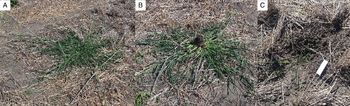
The very high (approximately 100%) weed control efficacy achieved in field testing by the rapid response tine clearly demonstrated the potential for site-specific, cultivation-based weed control in conservation cropping systems. When evaluated in field trials at the three locations at the prescribed operational speed of 10 km h−1 on low-density weed populations (<1.0 weed 10 m−2), the rapid response tine consistently achieved 64% to 100% control of the targeted weeds (Tables 1 and 2). The aggressive cultivating action resulting from the rapid engagement of the response tine was sufficient to sever roots and remove targeted weeds from the soil, resulting in plant death (Figure 3). With no difference in control efficacy (P > 0.05) due to growth stage for any of the weed species, these results clearly highlighted the weed control efficacy of the tine action at each of the three locations (Tables 1 and 2).
Wild oat (A) before targeted tillage, (B) after targeted tillage, and (C) the resulting divot, Narrabri 2017.

The lack of complete control of targeted weeds in the field trials identified the need for cultivator sweeps specifically designed for targeted tillage. At the Narrabri site, there was 100% control regardless of growth stage, when weeds were impacted by the central (third) portion of the cultivator sweep (Table 1). In all instances, weeds survived only if they were impacted by the outer wings of the sweep. The cultivator sweeps used in the field trials are pointed with swept wings and specifically designed for continuous soil cultivation (Figure 1B). When used in a chipping-type action, there are varying levels of soil disturbance across the sweep. There are higher levels of soil disturbance in the central point area, and this disturbance decreases with distance from this point, due to the reduced time that the outer wings of the sweep were engaged with the soil. The consequence was that there was reduced efficacy when the weed was not struck by the central point of the sweep (Table 1). Clearly then, more suitably designed sweeps are required for response tines to ensure weed control across the full working width of the sweep.
Weed Chipper Testing
The use of the Weed Chipper in commercial-scale field testing determined that this targeted tillage system delivered the high-level weed control required for commercial application. When used according to the design parameters of operating speed in fallow fields with low weed density, 88% weed control efficacy was observed, similar to the small-scale field trial results. This high level of weed control across a range of species and growth stages confirmed the commercial weed-control efficacy of the Weed Chipper. Similar to the small-scale trials, any weed survival was due to partial contact of the weed with the outer edges of the sweep blade. Thus, despite the use of larger sweeps, the standard sweep design still allowed the survival of weeds impacted by the outer edges of the sweep.
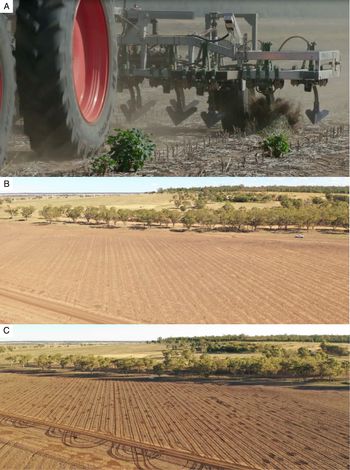
The commercial operation of the Weed Chipper according to the designated parameters of speed, cultivation depth, and weed density resulted in a sufficiently low level of soil disturbance that would be acceptable for routine use in conservation cropping systems. The resulting divot size was 0.3 m2 (±0.04 m2) and the soil throw from these cultivated areas was spread over 2.2 m2 (±0.3 m2) in the direction of travel (Table 3; Figure 4). The average weed density across the three fields was 0.6 plants 10 m−2. The targeting of these weeds resulted in 5,055 targeted tillage actions across the three sites, with a total soil disturbance area of 642 m2, or just 1.8% of the total area. This minimal area of soil disturbance preserves the integrity of a reduced tillage system and, therefore, is appropriate for conservation cropping systems.
Area of trial, cultivation, and soil throw resulting from the commercial-scale evaluation of the weed chipper, Narrabri, 2019.

a Values in brackets are the SE for the mean of 50 replicates.
(A) Weed Chipper in operation. (B) Fallow field pretargeted tillage. (C) After targeted tillage.

The Weed Chipper is, to our knowledge, the first nonchemical, site-specific weed control system for large-scale conservation crop production systems. The results from this study highlight the potential for targeted tillage to effectively and site-specifically control weeds. With the action of the rapid response tine resulting in minimal soil disturbance, this weed control approach is well suited for use in conservation cropping for the control of low weed densities.
The development of a tillage-based, site-specific weed control innovation within a 3-y project time frame is testament to the effectiveness of the multiskilled team assembled for this undertaking. With the focus of delivering a technology that requires only a small change for growers that adopt it, the project team has achieved the overall aim of providing a new weed control technology for Australian growers. The use of targeted tillage, however, is restricted to fallow and preplant use by the current, commercially available weed detection technology. Research activities, in time will produce more sophisticated weed-recognition systems that will permit the use of nonselective physical weed control technologies, such as tillage for in-crop weed control in low weed-density situations.
Acknowledgements
The authors are grateful to Allan Spurling and Karl Teune from David Nowland Hydraulics for their assistance in developing the hydraulic systems. The guidance and support from the advisory team, Ray Harrington, Michael Fels, and Geoff Glen, are also gratefully acknowledged. This work was funded by a grant from the Grains Research and Development Corporation (through grain-grower levies). No conflicts of interest have been declared.