1 Introduction
Generating a Phrase Table is a primary step in a phrase-based machine translation system. A Phrase Table should have parallel phrases, instead of whole sentences, of source and target language, and at the same time avoid redundant or useless entries. The quality of entries in a Phrase Table impacts the translation quality directly as the translations are derived from the entries of the Phrase Table. Using the Phrase Table entries and the input phrase to be translated, similarity measurement techniques are applied to identify the closest matched phrase of the source language. Thereafter, the corresponding target language translation is used to generate the translation of the given input phrase.
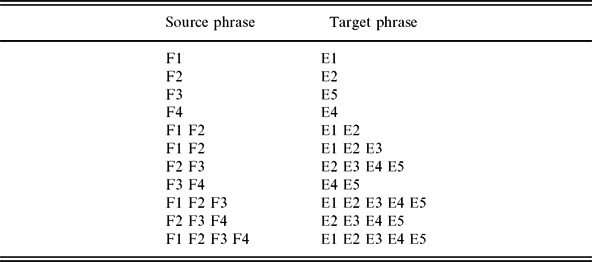
A basic requirement for building a translation system using phrases is to construct the Phrase Table for which phrases are extracted from a large training set of parallel sentence pairs. A very first step toward achieving this is alignment of words in the large parallel sentence corpus.Footnote 1 Once the words are aligned, a set of phrases, and their possible translations are extracted from the parallel corpus. Figure 1 shows an example of word alignment between a source language sentence (F1 F2 F3 F4), and its corresponding target language translation (E1 E2 E3 E4 E5), where Fi’s and Ej’s are words in the respective languages. The word alignments as shown in Figure 1 are (F1, E1), (F2, E2), (F3, E5) and (F4, E4). In practice, there can be cases when the words in one of the language pairs are not aligned with any word in the other language. For example, in Figure 1, E3 is not aligned to any word in the foreign language sentence. Also, there may be cases of cross alignment between the words of the sentences in the language pair, e.g. (F3, E5).
An example parallel sentence pair and word alignment.

In the absence of any phrase segmentation information in the word-aligned sentence pair, all pairs of source word sequence and target word sequence that are consistent with word alignments are considered. Hence, for the parallel phrase pair generation, out of all the possible pair of word sequences of source and target language, only those are retained in which the aligned words of the source and the target language are part of a single phrase (Och, Tillmann and Ney Reference Och, Tillmann and Ney1999). This is computed by using the following two constraints:
• The phrase consisting of the words of one language have at least one corresponding aligned word of the other language in the parallel phrase.
• The source and the target phrases are continuous sequences of words from the respective sentences, and not just collection of words that are not continuous in the sentence.
Table 1 shows the ten phrase pairs that are consistent as per the above definition for the given sentence pairs in Figure 1.
Possible phrases using word alignment

Although the above scheme provides all possible phrase pairs for a given pair of source and target language sentences, the resultant Phrase Table generated thereby may be too huge. The exact number of parallel phrases generated depends on the word alignment. But the Phrase Table is expected to grow many-fold from the parallel sentence pairs. As mentioned in Chooi-Ling and Sumita (Reference Chooi-Ling and Sumita2009), Table 2 shows a comparison of size of parallel sentence pair vis-a-vis the size of the parallel phrase pairs. The alignment is done using GIZA++Footnote 2 and the Phrase Table is generated using the methods described in Koehn, Och and Marcu (Reference Koehn, Och and Marcu2003).
A comparison of the number of parallel phrase pairs and corresponding phrase pairs

Once parallel phrases are generated, a machine translation system using phrases can be used to translate an input sentence after fragmenting it into phrases. The phrases generated are compared to the Phrase Table entries, to find the similarity measure of the phrases of the input sentence with each of the entries of the Phrase Table. The target language translations of the most similar phrases, on the basis of the underlying similarity metric, are used for generating the translation of the given input sentence. However, the whole scheme suffers from some major challenges as follows:
(1) The size of the Phrase Table becomes a serious bottleneck as it increases too fast to afford real time computations in general.
(2) Efficient retrieval of required phrase pair(s) becomes difficult unless efficient data structures and indexing schemes are used.
(3) Some phrase translation pairs generated from the training data have been observed to cause poor translation quality. These are the phrase pairs which do not provide a correct translation of the source phrase. The reason for such phrase pairs can be wrong word alignment or difference in the language structure of source and target languages.
Consequently, the need arises to filter the Phrase Table in an appropriate way for both efficiency and translation quality (Johnson et al. Reference Johnson, Martin, Foster and Kuhn2007; Yang and Zheng Reference Yang and Zheng2009).
In this work, we propose a novel scheme for reducing the size of the Phrase Table for Hindi to English machine translation using phrases and a similarity measurement technique to identify similarity of the phrases from the Phrase Table and the input sentence for translation. The Phrase Table pruning scheme uses the syntactic information of Hindi and Marker Information of English to prune the Phrase Table. Marker words in a language are a set of words that helps to structure the remaining (i.e. non-Marker) words of a sentence, to express their meaning (Green Reference Green1979). This is known as the Marker Hypothesis. The hypothesis also states that the syntactic structure of a language is marked at the surface level by a closed set of Marker words. For English, the Marker words (e.g. determiners, quantifiers, prepositions, pronouns and articles) indicate the boundary of English phrases (Sánchez-Martínez and Way Reference Sánchez-Martínez and Way2009). For example, consider the following English sentence:
Ram spent all day working in his garden.
The Marker words present in this sentence are all (quantifier), in (preposition), his (pronoun). These words help to identify the structure of the sentence as follows:
Ram spent 〈quantifier〉 day working 〈preposition〉〈pronoun〉 garden.
The Marker words serve as placeholders and are shown in 〈〉in the above example. They can be replaced by any other Marker Word of the same group to create similar sentence. For example, replacing all by one, in by at and his by their, the resulting sentence is “Ram spent one day working at their garden” which is legitimate English sentence.
Since the Marker words specify the structure of the English sentence, we propose to use this information to identify candidate phrases that can be pruned from the Phrase Table without significant loss of the translation quality. The segmentation of the English sentence using the Marker words indicates a Phrase boundary, and this information is utilized in the proposed scheme for Phrase Table Pruning.
The paper is organized as follows. Section 2 describes some background work in the direction of Phrase Table Pruning as has been used with respect to machine translation primarily between European languages. Section 3 explains the proposed scheme for Phrase Table Pruning. Section 4 shows the results of experiments conducted using the proposed Phrase Table Pruning scheme. Section 5 discusses the classical ways of similarity measurement between sentences. Section 6 proposes a phrase-based similarity measurement scheme for the phrases retained in the Phrase Table using the reduction scheme proposed in Section 4. Section 7 provides the results of experiments conducted for the effectiveness of the proposed Similarity Measurement scheme. Section 8 provides the details and the results of an overall translation system using the proposed Phrase Table Pruning and Similarity measurement technique. Finally, Section 9 concludes the paper by enlisting some future research directions.
2 Existing schemes for Phrase Table reduction
A significant amount of work has already been done for Phrase Table reduction and maintaining the translation quality simultaneously. The approaches can be broadly categorized as follows:
(1) Input-specific filtering of the phrases based on the input text that is to be translated.
(2) General approaches of filtering without the advance knowledge of the input text.
Koehn (Reference Koehn2004) proposes a scheme where the input source sentences are analyzed, based on the phrase pairs that are selectively loaded in the memory. A more sophisticated approach in this direction is described in Badr et al. (Reference Badr, Joanis, Larkin and Kuhn2007), where the relationship between different translation models are considered for obtaining a much smaller set of phrases associated with each sentence to translate. With this approach, about fifty-nine per cent reduction of the Phrase Table is achieved.
These schemes thrive upon the underlying policy that only the phrases that can contribute for the translation of a given input sentence are filtered. This helps in maintaining the translation quality. On the other hand, these schemes cannot be used for generating the translation of sentences in general, because the pruning mechanism is based on the specific input text to be translated, and therefore is not a source-independent mechanism.
In the second group of approach where the advance knowledge of input text is not considered for the Phrase Table Pruning, the motivation is to identify the phrase pairs that are redundant. Redundancy of entries in the Phrase Table can be due to the following:
(1) Phrase pairs that do not add to the quality of the translation results. This means the phrases do not have a value addition in the translation results. Their retention or omission in the Phrase Table does not affect the quality of the output translation.
(2) Phrases that may lead to erroneous translation outputs. These are the phrase pairs which do not provide an appropriate/usable translation of the source phrase.
Consequently, removal of those phrase pairs is not expected to degrade the performance of the system. On the other hand, their omission should reduce the memory and processing requirements of the translation system. Sections 2.1–2.3 provide some broad classification of the techniques for pruning a Phrase Table.
2.1 Statistics based
These techniques use the statistical information of any phrase pair to decide whether that entry should be kept in the Phrase Table or to be pruned. It can be classified under the following heads.
2.1.1 Absolute pruning
Absolute pruning (Zens, Stanton and Peng Reference Zens, Stanton and Peng2012) relies only on the statistical information (count and probability) of a single phrase pair (f, e), where f is the source language and e is the target language. Hence, they are independent of the counts of the other phrases in the Phrase Table. Absolute pruning techniques are primarily of two types:
• Count based: In this pruning mechanism, the count of each phrase pair (f, e), is calculated. If the count of the phrase pair in the Phrase Table is less than a threshold value, the phrase pair is discarded from the Phrase Table. The underlying assumption of this pruning technique is that if any Phrase Table entry is instrumental for generating a quality translation, then it would occur multiple times in the Phrase Table.
• Probability based: In this pruning mechanism, instead of the count of the phrase pairs, the probability of a phrase pair is used as the deciding factor to retain the phrase in the Phrase Table, where probability of a phrase (f, e) is
(1) \begin{equation}
{\rm {prob}}(f,e) = \frac{{{\rm {count}}(f,e)}}{{{\rm {Totalcount}}}}
\end{equation}

Here, count (f, e) = number of occurrence of the Phrase Pair (f, e) in the Phrase Table and Total count is the total number of phrases in the Phrase Table.
As the absolute pruning techniques do not consider phrases generated from other parallel sentences of the corpus, it may result in pruning all phrases of a given source phrase, if none of them satisfy the pruning threshold. The relative pruning technique explained in Section 2.1.2 overcomes this drawback.
2.1.2 Relative pruning
Here, the full set of target phrases is considered for a specific source phrase. Two main pruning techniques in this category are the following (Zens, Stanton and Peng Reference Zens, Stanton and Peng2012):
• Threshold pruning: In this method, phrases that are far worse than the best target phrase for a given source phrases are discarded. Given a pruning threshold k, 0 < k <1, a phrase pair (f1, e1) is discarded if
(2)
\begin{equation}
{\rm {prob}}(e1|f1) < k*\mathop {{\rm {max}}}\limits _f ({\rm {prob}}(e1|f))
\end{equation}

where
• prob(e1|f1) = the probability of a source phrase f1 getting translated to target language phrase e1; and
•
$\mathop {{\rm {max}}}\limits _f ({\rm {prob}}(e1|f))$ = the maximum probability of any arbitrary source language phrase f getting translated to target language e1in the Phrase Table.

The value of the constant k is determined experimentally based on the percentage of pruning required of the Phrase Table. The higher the value of k is, the more is the number of phrases to be discarded.
• Histogram pruning: In this method, for each source phrase, the n best target phrases are preserved, and the rest are discarded, where n is a pre-decided number. Here too, the value of n is determined experimentally. The more the value of n is, the more is the size of the Phrase Table.
2.2 Significance pruning
Significance pruning is used for testing whether the chance of co-occurrence of a source-target phrase pair is higher than they occur together ‘just by-chance’ (Johnson et al. Reference Johnson, Martin, Foster and Kuhn2007). The following statistics help to derive a 2 × 2 contingency table, as shown in Table 3, for a phrase pair
• Count of source phrase N (f).
• Count of target phrase N (e).
• Co-occurrence count of source and target phrase N (f, e).
• Number of sentences in the bilingual corpus N.
Two-by-two contingency table for a phrase pair (f, e)

Thereafter, the probability of the phrase pair occurring together is calculated using a hypergeometric distribution as follows:
 \begin{equation}
p\left( {N(f,e)} \right) = \frac{{\left( \begin{array}{@{}l@{}}N(f)\\
N(f,e) \end{array} \right)\left( \begin{array}{@{}l@{}}N - N(f)\\
N(e) - N(f,e) \end{array} \right)}}{{\left( \begin{array}{@{}l@{}}N\\
N(e) \end{array} \right)}}
\end{equation}
If the probability is less than a pruning threshold, which is determined experimentally based on the reduction of the Phrase Table required, the phrase pair is pruned.
2.3 Entropy-based pruning
Entropy-based pruning (Ling et al. Reference Ling, Graca, Trancoso and Black2012) defines a metric for each phrase pairs in the parallel Phrase Table. This metric is a measure of how much will the translation model be affected if the phrase pair is discarded/pruned from the parallel Phrase Table. It is typically observed, that by removing some longer phrase pairs which can be derived from smaller phrase pairs, it is possible to reduce the parallel Phrase Table size significantly with minimum impact on translation quality.
In addition to the above-mentioned Phrase Pruning techniques, there had been various hybridization techniques in the domain of machine translation also. The hybridization involves augmenting the Phrase Table entries with the translation obtained using various techniques (Recassen and Costa-Jussa Reference Recassen, Costa-Jussà and Fonollosa2015). But none of them focus on retaining the effective phrase pairs in the Phrase Table and pruning the rest of the entries.
The major drawback of the above-mentioned pruning techniques is that they rely primarily on statistical information of the parallel phrase entries, and do not leverage any syntactic information of the source or target language sentence to identify the phrases to be pruned.
In the work of Cao, Finch and Sumita (Reference Cao, Finch and Sumita2010), syntactic information of the source language is taken into consideration for the proposed pruning mechanism. The scheme filters out the non-syntactic source language phrases only when the first or last word of the phrase is not aligned with any word in the target phrase. Though the scheme results in a 24.38 per cent reduction of the phrase pair with a 0.52 BLEU score improvement, there is no further indication if the same scheme can be applied for any other language pair as well. Also, this scheme does not consider the target language information at all. For translation between languages of different origin, e.g. Hindi and English, the sentence structure for both the language pair can provide useful information about identifying phrases to be pruned from the Phrase Table. With this motivation, the solution is proposed in Section 3 for filtering parallel phrases from the Phrase Table. The proposed solution can be considered as an extension to the work of Cao et al. (Reference Cao, Finch and Sumita2010), in which more phrases are pruned resulting in a much reduced Phrase Table size (60–70 per cent Phrase Table size reduction), and resulting in comparable translation quality as is obtained by using the complete Phrase Table.
3 Proposed solution for Phrase Table pruning
The proposed scheme of parallel phrase pair filtering uses the syntactic information of the source language (Hindi) and the Marker information of the target language (English) together to reduce the size of the Phrase Table. The scheme focusses on finding the redundant phrases which do not add to the quality of the translation. Redundant phrases are those phrase pairs that can be derived from various combinations of other phrase pairs as well. Hence, this scheme is an extension to the entropy-based pruning technique using the syntactic information of the source and the target language pair.
A ‘syntactic phrase’ is defined as a word sequence covered by a single subtree in a syntactic parse tree (Imamura Reference Imamura2002). Many different language parsers are available that parse a given input sentence, and output the generated phrases, such as Noun Phrase, Verb Phrase. In our work, we used the LTRC Shallow ParserFootnote 3 for Hindi which gives the analysis of a sentence in terms of morphology, POS tagging, Chunking and few others. Apart from the final output, it also provides the intermediate output of individual modules. All outputs are given in Shakti Standard Format (Bharati, Sangal and Sharma Reference Bharati, Sangal and Sharma2007). For illustration, given the Hindi input sentence,

the LTRC Shallow Parser generates the following Syntactic Phrases:
(1)
(raam ne)→Ram(2)
(ravi ko)→Ravi(3)
(apne ghar par)→to his house(4)
(khaane)→food(5)
(khaane ke liye)→to eat(6)
(bulaayaa thaa)→ had called


On first analysis and study of limited examples, a system designer tends to feel that syntactic phrases are the key to machine translation using phrases. Hence, a realistic general tendency is to retain only syntactic phrases and discard all other phrases from being considered in the Phrase Table. However, Koehn et al. (Reference Koehn, Och and Marcu2003) showed that restricting phrasal translation to only syntactic phrases yields poor translation performance – the ability to translate other phrases (such as ‘there are’, ‘note that’ and ‘according to’) turns out to be critical. Similar translation issues exist for Hindi phrases as well which do not form a part of the syntactic category. For example,  (jaise kii) →like,
 (kahte hai ki) →said that.
For such phrases, literal translation (e.g.  (kahte hai ki) → that is to say) is not appropriate. Hence it is imperative that such phrases should be considered completely, and not as sub-parts like
 (kahte),
 (hai ki). The correct translation of such phrases is important because of the high frequency of these appearing in Hindi texts.
In the proposed approach, the knowledge of the source and target language sentence structure is used to identify the useful phrase pairs, and discard the rest of the Phrase Table entries. For the source language, Hindi in our case, the syntactic phrases are considered as indicators of valid phrase construct. For this purpose, a Hindi Shallow Parser generates the syntactic phrases.
For the target language, i.e. English, the Marker words (Sánchez-Martínez and Way Reference Sánchez-Martínez and Way2009) (e.g. prepositions, pronouns, articles) indicate the boundary of English phrases. This is based on the Marker Hypothesis (Green Reference Green1979) which states that “there is a closed set of words that provide the structure for the remaining words in a sentence, to express their meaning”. This means that the syntactic structure of a language is marked at the surface level by a closed set of Marker words, and the proposed scheme takes the advantage of the Marker words to identify the phrase boundaries of the English sentence.
The following is the proposed scheme for identifying phrase pairs that should be retained in the Phrase Table. The rest of the phrases are pruned.
• Step1: Syntactic phrases are generated for the input Hindi sentence and the resulting phrases are retained. This implies that the parallel phrases that contain one or more complete syntactic segment for the Hindi sentence are retained.Footnote 4
• Step2: For the Hindi phrases obtained in Step1 corresponding English translations are retrieved from the Phrase Table. There are cases when multiple English phrases are mapped to the same Hindi Phrase. Out of the set of these phrase pairs only those are retained in which the English Phrase starts with a Marker word. This choice is based on the Marker Hypothesis stated above. Note that the Marker boundary to be defined for the starting and ending of the phrase will make the technique more restrictive. Because of this reason we only chose to retain phrases starting with Marker word.
The following example illustrates the proposed phrase filtering scheme in a systematic manner. Consider the following parallel sentence pair:

(mujhse Mr Rajesh Mohan ke liye reference letter bhi zaroor lekar jaanaa)
→ Also take from me the reference letter for Mr. Rajesh Mohan.
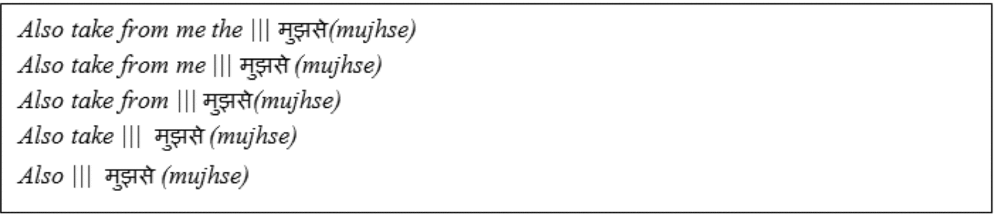
The output from MOSES generates 47 phrase pairs in the parallel Phrase Table from the above sentence. Some useful ones of them are shown in Figure 2. The output of Figure 2 shows the aligned phrases from MOSES and the statistical information for each of them. For the present work, these statistical informations corresponding to every phrase is not relevant and henceforth will not be shown in the output. But many of the outputs generated by MOSES seem meaningless also, as given in Figure 3.
MOSES sample output.

Redundant Parallel Phrases from MOSES.

To prune the meaningless phrases from the parallel Phrase Table using the proposed scheme, following is the systematic approach using the proposed technique.
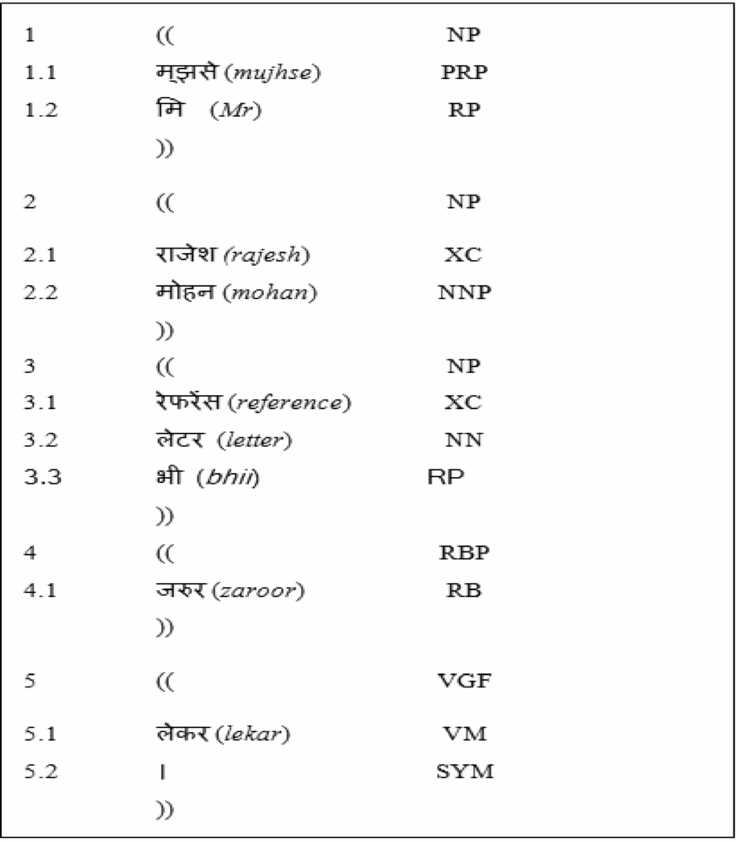
• Step 1: First we should identify the source language (Hindi) syntactic phrases. This is done using the Hindi parser. The parse output of the given Hindi sentence

is shown in Figure 4.
Output of hindi parser for syntactic phrases.

The syntactic phrases generated by the Hindi Parser are the following:
(1)
(mujhse mr) (From)(2)
(rajesh mohan ke liye) (for Rajesh Mohan)(3)
(reference letter bhii) (Also reference letter)(4)
(zaroor) (definitely)(5)
(lekar jaanaa) (take)


• Step 2: In this step, the Marker information of target language (English) is used. The Marker words in the given English sentence are: ‘from,’ ‘me,’ ‘the’ and ‘for.’
Using the above two steps, only those phrases are retained for which
(1) the Hindi part has one or more complete syntactic phrase (Step 1), and
(2) the English counterpart starts with a Marker word (Step 2), and
for example, some of the phrase pairs that are retained are listed in Figure 5. The complete set of twenty-eight phrase pairs retained out of the forty-seven phrase pairs is mentioned in Appendix A.
Example phrases retained after pruning scheme.

After applying the proposed filtering scheme that uses the syntactic structure for Hindi and marker words of English, the number of phrase pair for the given parallel sentence pair reduced from forty-seven to twenty-eight. Thus there is almost 40 per cent reduction in the Phrase Table size. This scheme is applied on UMC002-English Hindi parallel corpus having nearly 45,000 parallel sentences and IIT Bombay English–Hindi Corpus containing 1.49 million parallel sentences and the BLEU score is measured to observe the effect of reduction of Phrase Table entries in the translation quality. The details of the experiments and the results are given in Section 4.
4 Experiments for Phrase Table pruning
For conducting the experiments to evaluate the proposed pruning technique, two Hindi English parallel corpuses have been used.
The first is UMC002 (Bojar et al. Reference Bojar, Stranák, Zeman, Jain and Damani2010) and is published by Charles University in Prague, UFAL. It contains nearly 45,000 parallel sentences. Apart from that, there are parallel tokens for both the languages. These tokens are obtained from Wikipedia named entries for the years 2008 and 2009. The tokenization was performed for all the source sentences using the Trainable Tokenizer. Parallel phrases have been extracted from the UMC002 using the MOSES toolkit.
The second parallel corpus is the IIT Bombay English–Hindi Corpus (Kunchukuttan, Mehta and Bhattacharya Reference Kunchukuttan, Mehta and Bhattacharyya2017). The corpus has been compiled from various existing sources available in public domain (primarily OPUS (Tiedemann, Reference Tiedemann2012), HindEn (Bojar et al., Reference Bojar, Diatka, Rychly, Stranak, Suchomel, Tamchyna and Zeman2014) and TED (Abdelali et al., Reference Abdelali, Guzman, Sajjad and Vogel2014)) as well as corpora developed at the Centre for Indian Language Technology, IIT Bombay over the years. The corpus contains almost 1.49 million parallel sentences from various domains. Due to the limitation in computing resources, we performed the experiments in three sets (Set 1, Set 2 and Set 3) each containing 450,000 sentences, and finally taken an average BLEU score and computational time for the results.
In both the cases, the MOSES toolkit uses the bi-phrases extracted from GIZA++ word alignment directly. The size of the Phrase Table containing the parallel phrases is almost 6.75 GB for the 40,000 sentences of the UMC002, and almost 96.57 GB for every 450,000 sentences from the IIT Bombay English–Hindi Corpus. The experiments are conducted for six different phrase reduction techniques for reducing the size of the Phrase Table. Statistical machine translation is performed using the MOSES translation engine using the complete and the pruned Phrase Table and the BLEU score (Papineni, Roukos, Ward and Zhu Reference Papineni, Roukos, Ward and Zhu2002) is calculated for measuring the translation quality. Following are the phrase reduction techniques tried in this work:
(1) Stratified Phrase pair reduction
(2) Phrase length based reduction
(3) Entropy-based reduction
(4) Source language (Hindi) Syntax-based reduction
(5) Target language (English) Marker-based reduction.
(6) Combination of Syntactic- and Marker-based technique for reduction
The first three techniques do not contribute to the proposed pruning scheme. The first and second technique is based on the statistical parameters of the Parallel Phrase Table. The third technique is a standard technique of Phrase Table pruning, as explained in Section 2.3. The last three schemes are proposed in this work and contribute to the pruning mechanism. Here, schemes 4 and 5 are combined to get scheme 6. Individually, either scheme 4 or 5 are not resulting in good results hence a combination of them is needed.
Thus, for each of the six phrases reduction techniques the BLEU scores of the translation results of 5,000 test sentences are obtained. Note that for the UMC002 corpus out of the 45,000 parallel sentences, a set of 40,000 parallel sentences are used to prepare the training data. Similarly, for every run of the IIT Bombay Parallel Corpus 450,000 parallel sentences are used for preparing the training data. For both the corpuses, these numbers include the 500 sentences used for tuning the MOSES system using the minimum error rate training (Och, Reference Och2003) tuning algorithm. A set of 5,000 sentence pairs are used for testing which are not a part of the training and tuning data set. The details of the experiments are given from Sections 4.1–4.6.
4.1 Stratified phrase pair reduction
In stratified phrase pair reduction scheme, the phrases chosen for reduction are randomly picked from the cluster of phrases generated from each parallel sentence pair. For example, suppose we have a parallel sentence pair of Hindi and English sentences as H1 and E1, respectively. From this parallel sentence pair, we generate forty parallel phrases. For reducing the whole parallel Phrase Table by say ten per cent, we will reduce four phrases chosen randomly from this forty parallel phrases. Similarly, if another pair H2, E2 generates sixty parallel phrases, six of them would be chosen for pruning.
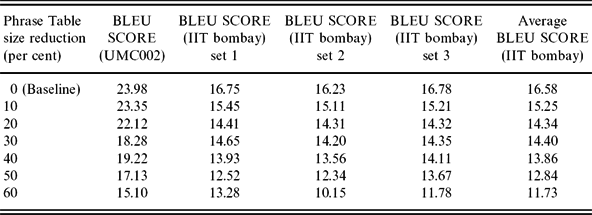
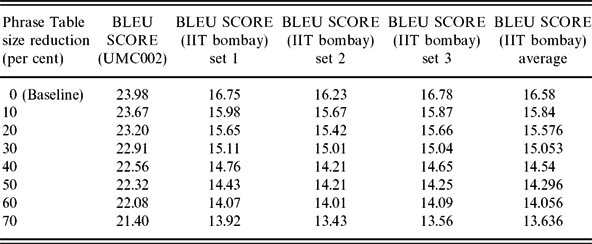
This scheme of clustering the phrases based on the parallel sentence pairs, and reducing evenly from each cluster ensures that the entries in the Phrase Table do not discard any complete sentence pairs. Table 4 shows the correlation of the BLEU score with the reduction of the Phrase Table size for 5,000 sentence translations for UMC002 and IIT Bombay Parallel Corpus.
BLEU score variation with stratified phrase pair reduction

The results of Table 4 show that the resultant BLEU score of the Stratified Phrase Pair reduction scheme is random. This is because of the random selection of phrases being pruned from the Phrase Table and there can be cases of important phrases to be pruned from the Phrase Table.
4.2 Phrase length based reduction
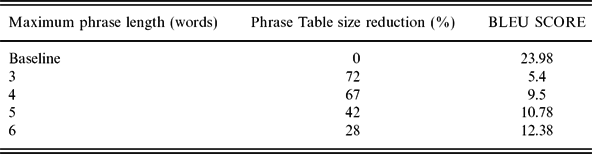
In this scheme, the phrases to be pruned are decided on the basis on the number of words in the phrases. This means that the phrases which have word length greater than a threshold are pruned. Table 5 shows the correlation between the maximum word count of a phrase in the Phrase Table, with the percentage reduction of the Phrase Table, and the corresponding effect on the translation quality.
BLEU score variation with phrase length based reduction for UMC002

As shown in Table 5, by applying the maximum word count of a phrase limitation the size of the Phrase Table is reduced. For illustration, if the maximum word count allowed for a phrase is three, all the phrases from the Phrase Table having word count higher than three are pruned, and the Phrase Table is reduced by seventy-two per cent. With this reduced Phrase Table, the translations generated for 5,000 sentences have BLEU score of approximately 5.4 for the UMC002 Corpus. Similarly, with the same maximum word count allowed for a phrase of three, the Phrase Table for IIT Bombay Corpus is reduced by 66.3 per cent, and the average BLEU score is 6.21 using this reduced Phrase Table.
Tables 5 and 6 show that retention of the long phrases improves the translation quality significantly when the phrases have maximum word count of four. This is shown by the higher increase of BLEU score when max size of phrases is four as against three, whereas the variation remains less significant when the maximum phrase size is made five or six.
BLEU score variation with phrase length based reduction for IIT bombay parallel corpus

Also, Table 5 shows that in the Phrase Table almost twenty-eight per cent phrases are smaller than length four. This is derived from the fact that when we keep the max phrase word limit as three, seventy-two per cent of the Phrase Table is pruned. Hence, twenty-eight per cent phrases are unary, binary or ternary in the Phrase Table. Using this data, we can conclude that there is a significant percentage of phrases which are long (greater than three words) and without retaining those phrases in the Phrase Table the translation quality is significantly poor (BLEU score is approximately six).
4.3 Entropy-based reduction
This is a standard pruning technique as explained in Section 2.3. The authors of this technique have done experiments with Chinese–English and Portuguese–English parallel corpus. For comparisons with the proposed pruning technique, the Entropy-based pruning scheme is implemented for conducting the experiments on Hindi–English parallel corpus.
Table 7 shows the variation of the BLEU score of 5,000 test sentences from UMC002 and IIT Bombay Parallel corpus, with the changing Phrase Table reduction size done by the Entropy-based Pruning technique.
BLEU score variation with entropy-based phrase pair reduction

The variation of the BLEU score with the reduction in Phrase Table size is following a uniform trend in this case. These results are compared to the proposed technique in Section 4.6 and finally in Section 8.
4.4 Source language (Hindi) syntax-based reduction
In this scheme only the source language structure is utilized for filtering the entries of the Phrase Table. Here, only the phrases having one or more complete syntactical phrases in them are retained. As explained in the Step 1 of the proposed technique in Section 3, the source language sentence Hindi is parsed using a shallow parser, and from there the syntactical phrases are identified. From the phrase pairs present in the Phrase Table only the phrases that contain the complete Hindi syntactic phrase (the phrase should contain all the words of one or more syntactic phrase and not a subset of the words) are retained and the rest of the Phrase Table entries are pruned.
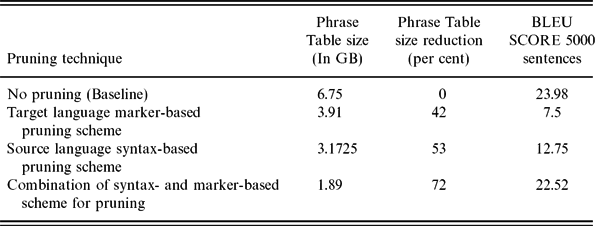
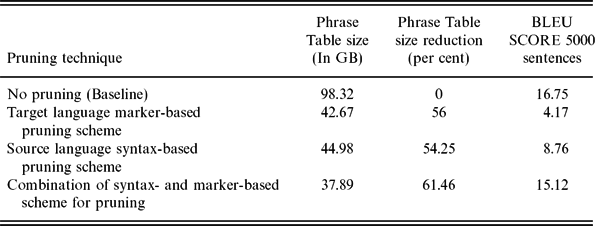
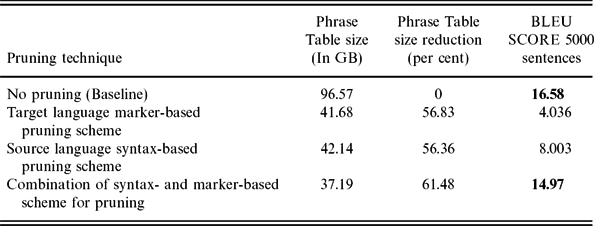
For UMC002, this resulted in a reduction of almost fifty-three per cent phrases, and the resultant BLEU score for translating 5,000 sentences using the reduced table is 12.75. For IIT Bombay Parallel Corpus, the Phrase Table reduction was almost 56.36 per cent, and the resultant BLEU score for translating 5,000 sentences using the reduced table is 8.003. The reason of such a low BLEU score can be accounted to the fact that the resulting parallel Phrase Table after pruning contains only the syntactic phrases of Hindi.
4.5 Target language (English) marker-based reduction
In this scheme, the target language (English) structure is used to identify the phrase that can be pruned from the Phrase Table. This is done using the Marker words of the English language. As explained in the Step 2 of Section 3, English phrases which start with a Marker word are retained in this scheme. The phrases which do not fit in this criterion are pruned from the Phrase Table.
With this approach for UMC002 Corpus the Phrase Table size is reduced by almost forty-two per cent, but the BLEU score for translating 5,000 sentences is dipped to 7.5. For IIT Bombay Parallel Corpus, the Phrase Table reduced by 56.83 per cent, with an average BLEU score of 4.036 for 5,000 sentences. This is because in this scheme the source language sentence structure information is not considered at all.
4.6 Combination of syntactic and marker based technique for reduction
The results of Sections 4.4 and 4.5 indicate the effect of using the sentence structure information of the source language and target language to identify the entries of the Phrase Table to be pruned.
In Section 4.4 by considering only, the source language (Hindi) sentence structure information for pruning, the translation system which uses the Pruned Phrase Table lacks the ability to translate non-syntactic portions of the sentence. This is as per the explanation in the Section 3 from the analysis of (Koehn et al. Reference Koehn, Och and Marcu2003) which showed that restricting phrasal translation to only syntactic phrases yields poor translation performance.
In Section 4.5, only the target language (English) sentence structure information is used for pruning. With this the translation quality further worsens as depicted by a BLEU score of 7.5 though the Phrase Table size is 3.91 GB. The dip in the BLEU score indicates that the phrase pairs that result in good quality translation are pruned from the Phrase Table. The reason for this is the difference in the sentence structure between the source (Hindi) and the target (English) language. Unlike similar structured language pairs like English–French and English–Spanish, Hindi–English sentence structure is very different. For similar structured language pairs, the Marker words serve as delimiters indicating phrase boundaries, and can be utilized for pruning the Phrase Table entries as given in (Sánchez-Martínez and Way Reference Sánchez-Martínez and Way2009). Because of the difference in Hindi English sentence structure, there is no direct mapping between the marker-based chunks of English phrase to its corresponding Hindi counterpart. Because of this difficulty, as explained in Section 3, the marker information in the proposed scheme is used only for the cases when multiple English phrases are mapped to the same Hindi Phrase. In such a scenario, only those phrase pair are retained in which the English Phrase starts with a Marker word.
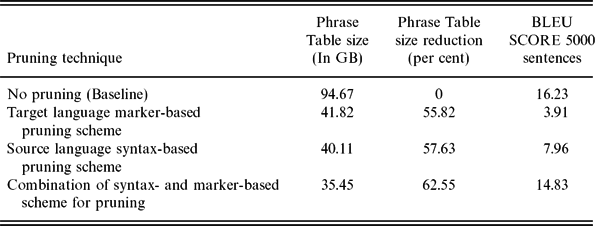
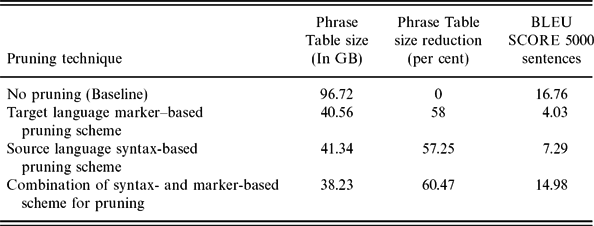
Since the approaches of Sections 4.4 and 4.5 do not individually produce good translation results, they were combined to utilize the source and target language information simultaneously. With the combined approach of Sections 4.4 and 4.5, the Phrase Table is reduced by 72 per cent and 61.48 per cent for UMC002 and IIT Bombay Parallel Corpus, respectively. The BLEU score of the translation of 5,000 test sentences is 22.52 and 14.97, respectively, i.e., much higher than either of the results of Sections 4.4 and 4.5. Tables 8 and 12 show the comparative results obtained by schemes given in Sections 4.4–4.6 for UMC002 and IIT Bombay Parallel Corpus. With similar reduction in the Phrase Table size (72 per cent), the BLEU score of Entropy-based pruning technique for UMC002 is 20.96, which is slightly lesser than the one obtained by the proposed pruning technique. Also, with 61.48 per cent Phrase Table size reduction for IIT Bombay Parallel Phrase Table, the BLEU Score of Entropy-based pruning technique is 14.01.
BLEU score variation with no pruning, syntax based, marker based and combined scheme for UMC002

BLEU score variation with no pruning, syntax based, marker based and combined scheme for IIT bombay parallel corpus set 1

BLEU score variation with no pruning, syntax based, marker based and combined scheme for IIT bombay parallel corpus set 2

BLEU score variation with no pruning, syntax based, marker based and combined scheme for IIT bombay parallel corpus set 3

BLEU score variation with no pruning, syntax based, marker based and combined scheme for IIT bombay parallel corpus average

As shown in Table 8, for UMC002 corpus without using any pruning technique and utilizing the complete 6.75 GB of parallel phrases the translation BLEU score was 23.98. This shows that with the parallel Phrase Table size being reduced by 72 per cent, the translation quality has a minor dip of 1.46 BLEU score. Having a reduced Phrase Table size requirement can be useful for real-time translation systems, where the pruned parallel Phrase Table can help in getting faster results due to lower computational overhead. The comparison of average translation time for Hindi sentences with various Phrase Table pruning techniques are mentioned in Section 8, where a complete translation system is explained using the proposed and the Entropy-based pruning.
5 Existing schemes for similarity measurement
Once the Phrase Table is prepared, and the redundant entries are pruned, the next step for translation is to have a phrase similarity measurement metric. Using the phrase similarity metric, phrases similar to the input phrase are obtained from the Phrase Table to derive the translation of the input sentence. Various schemes for similarity measurement for a complete sentence are available in literature, but none of them is specific for sub-sentence (or phrase) level similarity. Nevertheless, they provide a broad level understanding of the techniques to identify similarity between two sentences. They can be categorized as follows:
5.1 String-based and word-based similarity
In the string-based techniques, typically the character-based distances are employed to measure similarity. The problem of determining the distance between one string of characters and another is analogous to the edit-distance problem.Footnote 5 Determining such string distances is carried out using well-established dynamic programming techniques, such as Levenshtein distance,Footnote 6 defined between two strings as the minimum number of edits needed to transform one string into the other, with the allowable edit operations being insertion, deletion, or substitution of a single character.
String-based metrics, although easily implementable, have their own disadvantages. Often candidate strings semantically closer to the source string would be overlooked in favor of less desirable matches, due to a larger edit-distance score. For illustration, if one wants to measure the similarity of the source sentence ‘The President agrees with the decision’ with the following two sentences:
(a) The President disagrees with the decision.
(b) The President concurs with the decision.
Then a character-based distance metric will consider the sentence (a) to be more similar, whereas sentence (b) is semantically more similar to the source sentence.
In order to address the problems of string-based distances, many translation systems make use of a word-based measure of similarity, employing information from dictionaries and thesauri to determine relative word distances in terms of a semantic hierarchy (Sumita, Lida and Kohyama Reference Sumita, Lida and Kohyama1990; Nagao Reference Nagao, Elithorn and Banerji1984). Using such matching techniques would correctly select (b) in the above example because of the closer relative semantic distance between the words ‘concurs’ and ‘agrees.’
In recent years, the Paraphrase DatabaseFootnote 7 is being utilized for a variety of languages, including Arabic, Chinese, English, German, French, Italian, Polish and Spanish. The initial version of the Paraphrase Database (Ganitkevitch, Van Durme and Callison-Burch Reference Ganitkevitch, Van Durme and Callison-Burch2013) assumes that two English strings if translate to the same foreign string have the same meaning. An improved version of the Paraphrase Database 2.0 (Pavlick et al. Reference Pavlick, Rastogi, Ganitkevitch, Van Durme and Callison-Burch2015) includes a re-ranked set of paraphrases that achieve a higher correlation with human judgments than the previous version’s heuristic rankings. Bhargava et al. (Reference Bhargava, Baoni, Jain and Sharma2016) are working for detecting paraphrases for Hindi, which has not yet been evaluated in the scope of our work.
5.2 Tree-based similarity
Approaches based on more traditional EBMT models make use of structured examples consisting of annotated tree structures (Maruyama and Watanabe Reference Maruyama and Watanabe1992), and employ complex tree-structure matching. During the matching process, parts of the parsed input string are matched against the annotated fragments, and the corresponding annotated target fragments are extracted and recombined to produce the final translation. Translation memory based machine translation techniques (Zhechev and Genabith Reference Zhechev and Genabith2010; Nayak et al. Reference Nayak, Pal, Naskar, Bandyopadhyay and Genabith2016) also use state of the art sub-tree alignment to generate translations using SMT.
Although each of the above techniques can find the similarity between two sentences, these do not fit directly to phrase similarity measurement. This is because while measuring similarity between phrases the POS tags associated with each constituent word play a significant role, which is not considered in any of the above techniques. Also, as seen in the sentence similarity measurement (in Section 5.1), the semantic similarity is important for words in phrases as well; and it needs to be captured in the phrase similarity measurement metric. Section 6 proposes a similarity measurement technique for phrases by combining both syntactic and semantic similarity through a weighted sum approach.
6 Proposed solution for similarity measurement
Once the Phrase Table contains the filtered entries, an SMT scheme generates phrases from the input sentence to be translated. The input sentence phrases are compared with the phrases in the filtered Phrase Table to find the similar parallel phrases. The translations of the identified similar phrases are used for generating the translation of the input sentences’ phrases. As discussed in Chatterjee (Reference Chatterjee2001) similarity measurement between sentences for a translation system can be defined in three ways:
(1) Semantic – refers to thesaurus or dictionary-based similarity i.e., sentences having same or similar words.
(2) Syntactic – where structural similarity is used for measurement of similarity between sentences.
(3) Pragmatic – where two sentences having the same practical significance are considered similar.
Taking the cue from the above, we propose to utilize the above metrics for phrases as well. However, in the proposed approach we use only the syntactic and semantic factors, and a hybridization of them. In the proposed approach proper weights (i and j) have to be assigned to the similarity values generated by each of the factors (semantic and syntactic similarity), to get a final similarity score. The weights (i and j) are experimentally determined to maximize the precision of the retrieved phrases with the condition that i+j = 1. The algorithm for calculation of the similarity metric between any two phrases is given in Figure 6. The algorithm mentioned in Figure 6 uses Hindi WordNet Based Similarity and Syntactic Phrase Similarity to calculate the total Phrase Similarity. If the phrases under consideration for similarity are not of the same syntactic type the similarity score is 0. The details of each of the different similarity criterion are explained in Sections 6.1 and 6.2.
Algorithm for similarity measurement for any two phrases.

6.1 Hindi WordNet based similarity
The Hindi WordNetFootnote 8 (Bhattacharyya Reference Bhattacharyya2010) is a system for bringing together different lexical and semantic relations between the Hindi words. This is similar to the concept of English WordNetFootnote 9 developed by Ted Peterson, which is a large lexical database of English. Nouns, verbs, adjectives and adverbs are grouped into sets of cognitive synonyms (synsets), each expressing a distinct concept.
Given two Hindi words w 1 and w 2, the semantic similarity between them is calculated in the following way:
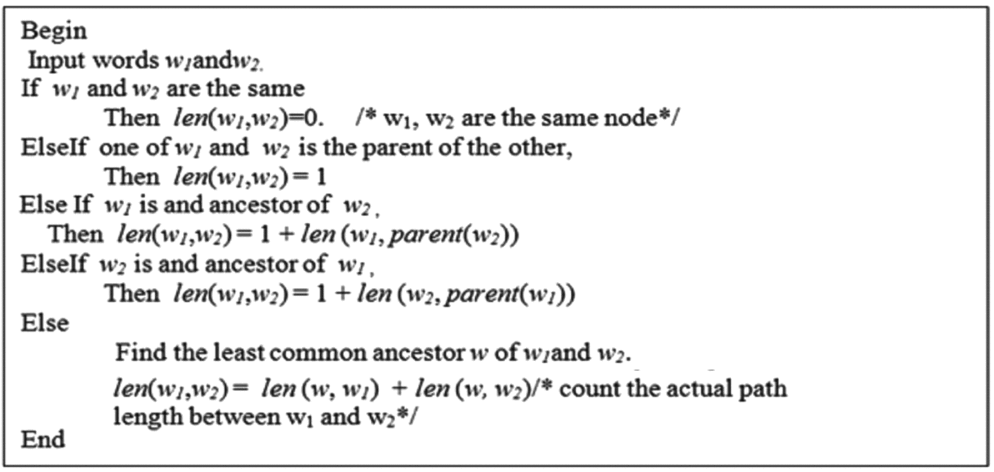
(1) Path Length: the semantic distance between two words in the word net graph. The Path Length from w 1 to w 2 can be determined using the algorithm given in Figure 7. Obviously, if w1 and w 2 are two distinct words then
(4)
\begin{equation}
\sum \limits _{i = 1}^n {\sum \limits _{j = 1}^k {{s_{ij}}} }
\end{equation}
(2) Depth of the common ancestor: Consideration of the depth of an ancestor in a WordNet graph as a similarity metric is based on the idea that the words that share a deeper common ancestor in the WordNet graph are more similar than the words for which the common ancestor is more close to the root of the WordNet graph. This is because as the WordNet graph node become deeper (far from the root); the word categories become more specific. Hence, the deeper the common ancestor in the WordNet graph of the words w 1, w 2, the higher is their similarity.

Algorithm for calculating WordNet-based semantic distance.

Based on the above two factors, the similarity of words in the two Hindi phrases under consideration is calculated. The Total WordNet-based similarity between two words w 1and w 2 is
 \begin{equation}
2*{\rm {max}}\;{\rm {depth}}\;{\rm {of}}\;{\rm {Word}}\;{\rm {Net}}\;{\rm {Tree}} - {\rm {len}}(w1,w2) + {\rm {depth}}\;{\rm {of}}\;{\rm {commonancestor}}(w1,w2)
\end{equation}
 \begin{equation}
\sum \limits _{i\, = \,1}^n {\sum \limits _{j\, = \,1}^k {{s_{ij}}} }
\end{equation}
6.2 Hindi syntactic phrase similarity
The Hindi syntactic phrase similarity is calculated by identifying the syntactic type of the phrases under consideration. The current work identifies the syntactic similarity for the noun phrase and verb phrase. Once the syntactic type of the phrase under consideration is identified using the LTRC shallow parser, the corresponding similarity metric is calculated. The following section explains the details of calculating the noun phrase and verb phrase similarity value.
6.2.1 Noun phrase similarity
In Hindi, as is in English, there are five types of nouns namely:

(vyakti vaachak sangyaa) [Proper Noun],

(jaati vaachak sangyaa) [Common Noun],

(bhaav vaachak sangyaa) [Abstract Noun],

(samudaay vaachak sangyaa) [Collective Noun] and

(dravya vaachak sangya) [Material Noun]. In that respect Hindi is very close to English. However, in dealing with nouns Hindi has its own characteristics that make translation from Hindi to English challenging. These are:

(ling) [Gender],

(vachan) [Number] and

(kaarak) [Case]. Each of these cause declensions in the Hindi nouns as explained below:
(1)
(ling) [Gender]. Unlike English, Hindi grammar supports only two types of genders: Masculine, Feminine. So all nouns of neuter gender are categorized with masculine or feminine. Moreover, the categorization is somewhat arbitrary. For example, ‘rice’ in Hindi is masculine, but ‘bread’ in Hindi is feminine. Furthermore, in Hindi the verb of a sentence is modified according to the gender, number and case of the subject. However, as in English the gender of a noun does not play any role in verb modification, unlike in Hindi, therefore, for similarity measurement from Hindi to English text translation gender of a Hindi noun does not play any role. Hence in our approach for Hindi to English machine translation the other two factors i.e., vachan and kaarakare used for similarity measure.(2)
(vachan) [Number]. As in English, Hindi also has two types of numbers: singular and plural. The number of the Subject noun of the sentence plays a major role in the verb modification. For illustration, consider the following sentences:


Here,  (daud rahaa hai) [is running] is the verb for a singular noun Subject,
 (baalak)[boy], whereas the verb
 (daud rahe hain) [are running] is the verb for the plural form
 (kai baalak) [Many boys].
(3)
(karak) [Case]. In Hindi the following type of case declensions exist

•
(kartaa) [Nominative] – represented by Hindi word ne•
(karm) [Objective, Accusative] – ko•
(karan) [Instruments] – se, ke dwara•
(sampradaan) [Dative] – ko, keliye•
(apadaan) [Ablative] – se•
(sambandh)[Genetive, Possessive] – ka, ki, ke•
(adhikaran) [Locative] – me, par•
(sambodhan) [Vocative] – Hey!, Arrey!


Since these case declensions are identified based on few words e.g., ne, ko, they help in identifying the structure of a Noun Phrase.
Considering the number and case declensions of noun, given two noun phrases NP1 and NP2, with the head nouns n 1 and n 2, respectively, the similarity between NP1 and NP2 is calculated as given in Figure 8. An important difference between Hindi and English nouns is the case of Compound Nouns. In English juxtaposition of more than one noun is often treated as a compound noun (e.g., rubber ball, golf course and database), which may occur separately or joined. However, such compound nouns are missing in Hindi, where appropriate prepositions/postpositions are required to convey the true sense (Balyan and Chatterjee Reference Balyan and Chatterjee2015). In this work, we have not dealt with compound nouns separately.
Noun phrase similarity measurements.

6.2.2 Verb phrase similarity
Singh (Reference Singh2003) made a formal classification of Hindi main verbs based on their form and also compared them with English verbs.
(a)
(saraldhaatu) [Simple root]: These verbs consist of single words. In Hindi (ubalanaa) [boil] is an intransitive verb and (ubaalanaa)[boil] is a transitive verb. English also has these verbs, but the form remains same in both the transitive and the intransitive usage.(b)
(samasikdhaatu) [Composite root] is formed from two words which are related to each other in meaning and separated by a hyphen, e.g., (padha-likha) [to become literate].(c)
(mishrakriya) [Complex verb] is formed by combining a noun or an adjective with a verbalizer (kar) [do] or (ho) [do]. For instance, in (taariif karanaa) [to praise], (taariif) [praise] is a noun, and (karanaa) [to do] is a verb.(d)
(sanyukta kriya) [Compound verb] is formed with two verbs. The first forms the root and the second takes the tense and aspect information. The verb (ro padanaa) [to start crying] is a compound verb.


While defining similarity between two verbs, the idea is that if the two verb phrases have the same role of the main verb, then they are more similar, as against a phrase in which the main verb plays a different role. For illustration, consider the following three Hindi sentences, and their corresponding English translations

Although sentences S1 and S2 have the same root main verb  (khaa) [eat], here S1 and S3 have been assigned the same category of main verb (viz. Compound verb) as per the classification. Hence in our proposed scheme they have been assigned higher similarity. Thus, the similarity value of verb phrases VP1 and VP2 is calculated on the basis of the category of the respective main verbs. It is 1 if they have the same category, otherwise set to 0.
The Total Phrase Similarity is then calculated using the formula given in (7):
 \begin{equation}
i*{\rm {Word}}\;{\rm {net}}\;{\rm {similarity}}\; + j*\;{\rm {Syntactic}}\;{\rm {Phrase}}\;{\rm {Similarity}}
\end{equation}
The values of the relative weights i and j are varied in repeated experiments that is explained in detail in Section 7. For every input phrase, the similar phrases obtained using the similarity metric are checked for precision against the ‘gold standard set.’ We experimented with different values of the weights i and j to obtain the best set of values that maximizes the precision.
7 Experiments for similarity measurement
In order to conduct experiments for similarity measurement a gold standard set of similar phrases is created for each input phrase. By ‘gold standard set’ we mean the set of twenty most similar phrases for a given input phrase. This gold standard set is created with the help of human judges who are linguistic expert of Hindi. Section 7.1 discusses in detail how the gold standard set is created. Section 7.2, on the other hand, explains the details of the evaluation of the proposed similarity measurement technique, where we evaluate to which extent the similarity metric proposed in Section 6 gives the similar phrases that are also found in the above-mentioned golden standard set. The extent of similarity is measured using the average precision value for the similar phrases obtained using the metric proposed in Section 6 with the golden standard set.
7.1 Gold standard creation for similarity measurement
We have used the Hindi English parallel corpus from UMC002 and Set 1 of IIT Bombay parallel corpus for conducting the experiments for similarity measurement. The corpus details are already explained in Section 4. For UMC002, the Parallel Phrase Table is generated using a set of 40,000 sentence pairs chosen from the above corpora, and the resulting Phrase Table is pruned using the experimental setup explained in Section 4.6. The remaining 5,000 parallel sentences serve as the test set. For Set 1 of IIT Bombay parallel corpus, the first 450,000 parallel sentences generate the Phrase Table, which thereafter is pruned using the experimental setup explained in Section 4.6.
Out of the 5,000 test sentences of the UMC002 corpus, the first 100 sentences have been used for the experiment. Phrases are generated for these hundred sentences using GIZA++. This resulted in a set of 1,057 phrases in total. For each of the 1,057 phrases every entry of the pruned Phrase Table is judged by fifty human experts having knowledge of Hindi Grammar and each phrase is scored in a scale of zero to ten for similarity, zero denoting least similarity and ten denoting complete similarity, respectively. The scores from fifty experts are then added to get a total similarity score for each phrase of the Phrase Table against every phrase of the 1,057 test phrases. From this top twenty similar phrases for each 1,057 phrases are extracted which get the maximum score to create the gold standard set of similarity.
Similarly, for Set 1 of IIT Bombay Parallel Corpus, the first 100 test sentences generate 1,370 phrases. For each of the 1,370 phrases, using the above-mentioned scoring criterion the ‘gold standard set’ of similarity is created.
7.2 Evaluating the proposed similarity technique
For evaluating the proposed similarity metric, the 1,057 and 1,370 phrases (generated from UMC002 and IIT Bombay Parallel Corpus) and were compared for similarity with the phrases of the pruned Phrases Table, using the scheme proposed in Section 6. Different values of i and j have been used in the Total Phrase Similarity formula (7) by varying them manually in the range (0, 1) so that i + j = 1.
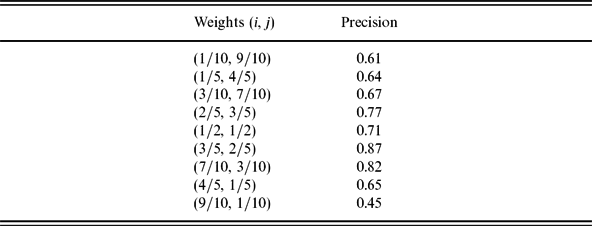
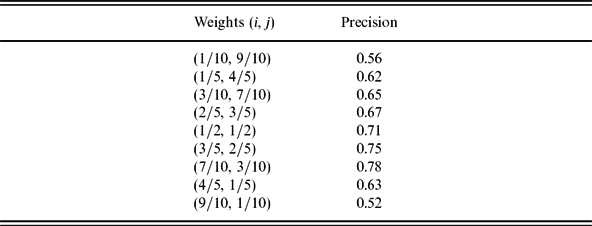
Based on the results obtained by the similarity metric, the corresponding precision is calculated for every input phrase. Tables 13 and 14 illustrate the average precision value using different values of i and j. The value of i and j for which the average precision is maximized is (3/5, 2/5) for the UMC002 corpus. For the IIT Bombay Parallel Corpus value of i and j resulting in the maximum precision is (7/10, 3/10). The impact of translation using the similarity measurement metric with these values of i and j is shown in Section 8.
Weights for similarity measurement and their effect on average precision for UMC002

Weights for similarity measurement and their effect on average precision for Set 1 of IIT bombay parallel corpus

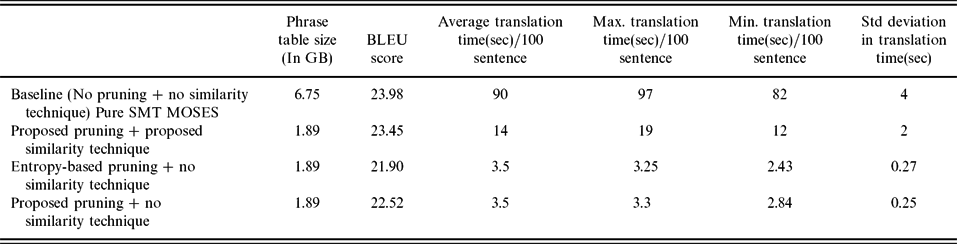
BLEU score, Phrase Table size and average translation time comparison using various techniques for UMC002

8 Overall translation system using the proposed pruning and similarity measurement technique
The proposed Phrase Table pruning mechanism and the similarity measurement technique together is useful to develop a Machine Translation System which is using phrases and the MOSES toolkit of Statistical Machine Translation. The overall system looks as shown in Figure 9.
Overall proposed phrase based translation system.

The system is built using the UMC002 and the IIT Bombay Parallel Corpus. The Parallel Phrase Table generated for both these corpuses is pruned using the Entropy based and the proposed pruning scheme explained in Section 4.6. Thereafter, a set of 5,000 test sentences (which are not a set of the training data) are passed into the translation system.
The impact of the proposed similarity measurement scheme explained in Section 7 is also considered in the translation system in the following manner. Phrases are generated for the input sentences, and for each input sentence phrase, similar phrases are extracted from the parallel Phrase Table using the proposed similarity scheme.
The top twenty similar Phrase Table entries for each input phrase are then considered as translation example, and fed into the MOSES translator for translation output generation. To illustrate the same, consider that for a given input sentence ‘n’ phrases are extracted. For each of the ‘n’ phrases twenty similar phrases are extracted from the pruned Parallel Phrase Table, making a set of n ×20 parallel phrases. These n ×20 parallel phrases now comprise the new limited Phrase Table for the MOSES decoder for generating the translation of the given input sentence. Note that the proposed translation system is utilizing the language model and the tuning information from the MOSES setup; hence the recombination of the phrases and the smoothening of the output generated is taken care by the MOSES toolkit. Following are the versions of the supporting tools needed to run the MOSES decoder:
• GIZA++ and mkclsFootnote 10: Google Code 1.0.2
• SRI Language Model Toolkit (SRILM)Footnote 11: 1.5.7
• IRSTLMFootnote 12: 5.20.00
• MOSESFootnote 13: -r 2014 from svn
The overall system is used for a comparative analysis of the following experimental setups:
(1) Pure SMT MOSES translation (Setup 1): In this experiment, the MOSES translation system is used on the complete training data without any pruning mechanism for translating the test sentences.
(2) Proposed Pruning and Proposed Similarity Measurement (Setup 2): In this experiment, the combination of the proposed pruning mechanism and the proposed similarity measurement technique is used.
(3) Entropy-based Pruning (Setup 3): In this experiment, the parallel phrase table is pruned using the Entropy-based technique. No additional similarity measurement technique is applied on the top of it, and the pruned Phrase table is used as an input to the MOSES translator.
(4) Proposed Pruning Technique Only (Setup 4): In this experiment, the parallel Phrase Table is pruned using the proposed pruning technique. No additional similarity measurement technique is applied on the top of it, and the pruned Phrase Table is used as an input to the MOSES translator.
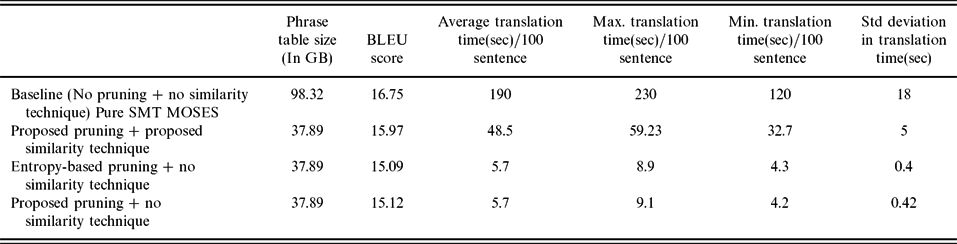
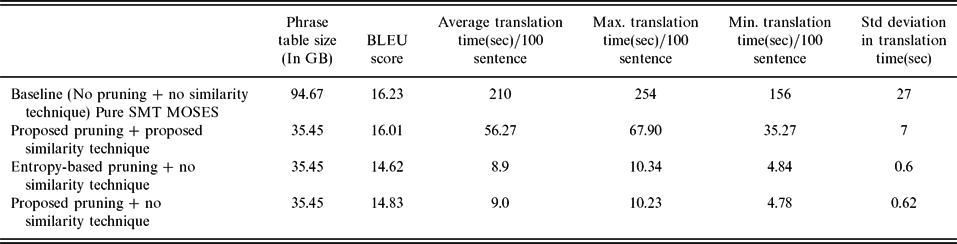
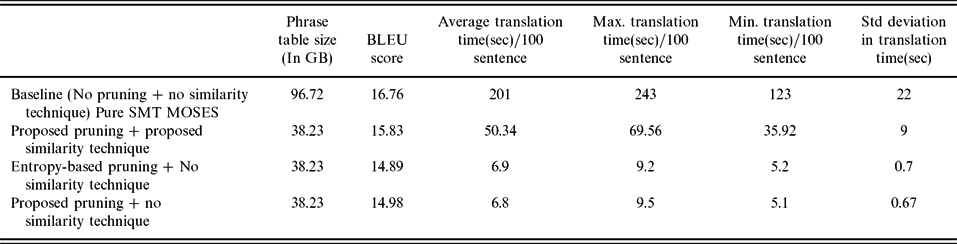
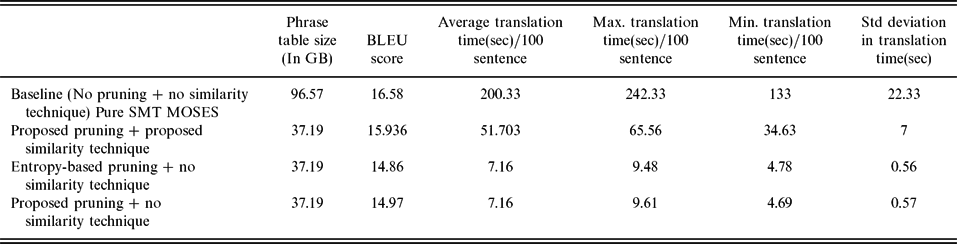
The results from the above experiments are compared based on the following factors. Table 10 presents the results in a concise manner for comparison for UMC002. Tables 16–18 present the results for each set of 450,000 sentences of IIT Bombay Parallel Corpus, and finally Table 19 presents the average result of the IIT Bombay Corpus.
(1) Phrase Table Size: The complete Parallel Phrase Table of 6.75 GB (for UMC002) and an average size of 96.57 GB (for IIT Bombay Parallel Corpus) are used for the Baseline comparison. The pruned Phrase Table using the Entropy based and the proposed pruning scheme reduces the Phrase Table size by 72 per cent (1.89 GB) and 61.5 per cent (37.19 GB) from the original size.
(2) Quality of Translation: BLEU score is used to measure the translation quality of the four setups mentioned above. The best translation quality (23.98 and 16.58 BLEU Score) is achieved when the complete Phrase Table data is used for the MOSES translator. However, for the case of UMC002 the results from Setup 2, is having a minor dip of 0.53 BLEU Score (2.2 per cent), with an appreciable improvement in translation time (6.4 times faster). When the quality of translation is compared for Entropy based (21.90) and the proposed pruning technique (22.52) in Setup 3 and 4, it is observed that the result with Setup 4 is better by 0.62 BLEU score. Similar trend is also observed for the IIT Bombay Parallel Corpus as can be seen in Table 19.
(3) Translation Time: The maximum translation time (90 sec/100 sentences) is required when no pruning mechanism is used. This is because the translator has to process the complete 6.75 GB of Phrase Table data to generate the results. When the Entropy-based pruning and proposed pruning mechanism is used in Setup 3 and 4, respectively, the translation time is significantly reduced to 3.5 sec/100 sentences (and 7.16 sec/100 sentences for IIT Bombay Parallel Corpus). This indicates that the pruned Phrase Table can be used to generate translation results much faster.
BLEU score, Phrase Table size and average translation time comparison using various techniques for IIT bombay parallel corpus set 1

BLEU score, Phrase Table size and average translation time comparison using various techniques for IIT bombay parallel corpus set 2

BLEU score, Phrase Table size and average translation time comparison using various techniques for IIT bombay parallel corpus set 3

BLEU score, Phrase Table size and average translation time comparison using various techniques for IIT bombay parallel corpus average

Tables 15–19 also show the maximum and minimum translation time, and their standard deviation. With the experiments of the proposed pruning mechanism (Setup 2 and Setup 4), the standard deviation of the translation time is 2 and 0.25 sec, respectively. The low standard deviation is an indicator that the average translation time is a true reflection of the translation time of the sentences, and hence can be relied on well. Hence, the proposed pruning technique is helping to achieve a better translation quality (as against the Entropy-based pruning technique) in a much lesser time (than the baseline non pruned Pure SMT translation).
9 Conclusion and future work
This paper contributes in two major areas of machine translation using phrases: Phrase Table construction and similarity measurement between the phrases.
In the proposed solution for Phrase Table pruning both the source language syntactic structure information and the target language Marker information have been used for identification of phrases that are useful for generating the translation. Using the proposed pruning technique, a significant reduction in the Phrase Table size (72 per cent and 61.48 per cent) has been observed. The overall system considering the pruning and similarity measurement techniques proposed in this work result in 6.4-fold improvement in translation time, with a reduction of quality of 2.2 per cent BLEU score as seen in the results for UMC002 Corpus. Similarly, for the IIT Bombay Parallel Corpus, the translation time is reduced by 1/4th with a minor dip of 3.8 per cent BLEU score. The results given in Section 8 provide a comparison between translation quality, and the translation time for the proposed pruning technique and Entropy-based pruning. Further, the quality of translation is better when the proposed pruning technique is used (without the proposed similarity measurement technique) as against the Entropy-based pruning.
The work can be extended in several possible ways:
(1) In the present work, we have not made any use of the lexicons of source and target languages. However, we feel that their effects on translation can be studied and improvement to the filtering methodology can be done in future.
(2) The Phrase Table may be further filtered by identifying phrases that are similar, and therefore may be considered as redundant entries. Such entries increase the size of the Phrase Table without adding to the quality of translations generated. The proposed Phrase Similarity metric may be used for identifying similar entries in the Phrase Table, and appropriate pruning scheme may be designed accordingly.
(3) Currently only a limited set of phrases are considered to derive weights for the various components of the similarity measurement formula, such that the precision is maximized. This can be extended to a larger test set and the impact of the domain of the test data can also be considered on the weights of the similarity measurement formula.
(4) The current Phrase Similarity Metric does not include any handling to resolve ambiguity and score the similar sense words with a higher score. This can be added in the metric to improve the similarity measurement scheme.
(5) The variation of the BLEU score with the Phrase Table Size Reduction can be analyzed for the different pruning techniques in detail.
In literature, some work may be found in the direction of Phrase Table Adaptation that essentially considers a limited set of phrases for translation that it finds relevant, as against the complete Phrase Table entries (Niehues and Waibel Reference Niehues and Waibel2012). Moreover, techniques have been developed for identifying candidate phrases for generating translation (Deng, Xu, and Gao Reference Deng, Xu and Gao2008). Such techniques need to be studied to identify limited phrases to be considered for translation on the fly. This can result in improved performance of the translation system. Presently, we are working in this direction.
Appendix A. List of Phrase Pair Retained After Phrase Pruning
For the given parallel sentence

The following is the list of twenty-eight Phrase Pairs retained after applying the Phrase Table Pruning scheme explained in Section 3.
(1) Also take |||
(zaroor)(2) Also take |||
(zaroorlekarjaanaa)(3) Also take from me |||
(zaroor)(4) Also take from me |||
(zaroorlekarjaanaa)(5) Also take from me the reference letter |||
(zaroor)(6) Also take from me the reference letter |||
(zaroorlekarjaanaa)(7) Also take from me the reference letter |||
(reference letter bhi)(8) Also take from me the reference letter |||
(reference letter bhizaroor)(9) Also take from me the reference letter |||
(reference letter bhizaroorlekarjaanaa)(10) Also take from me the reference letter |||
(mujhse Mr Rajesh Mohan keliye)(11) Also take from me the reference letter |||
(mujhse Mr Rajesh Mohan keliyereference letter bhi)(12) Also take from me the reference letter |||
(mujhse Mr Rajesh Mohan keliyereference letter bhizaroor)(13) Also take from me the reference letter |||
(mujhse Mr Rajesh Mohan keliyereference letter bhizaroorlekarjaanaa)(14) Also take from me the reference letterfor Mr. Rajesh Mohan |||
(mujhse Mr Rajesh Mohan keliye reference letter bhizaroorlekarjaanaa)(15) from me |||
(mujhse Mr Rajesh Mohan keliye)(16) from me the reference letter |||
(mujhse Mr Rajesh Mohan keliye)(17) from me the reference letter |||
(mujhse Mr Rajesh Mohan keliye reference letter bhi)(18) from me the reference letter |||
(mujhse Mr Rajesh Mohan keliye reference letter bhizaroor)(19) from me the reference letter |||
(mujhse Mr Rajesh Mohan keliye reference letter bhizaroorlekarjaanaa)(20) from me the reference letterfor Mr. Rajesh Mohan|||
(mujhse Mr Rajesh Mohan keliye reference letter bhi)(21) from me the reference letterfor Mr. Rajesh Mohan|||
(mujhse Mr Rajesh Mohan keliye reference letter bhizaroor)(22) the reference letter |||
(reference letter bhii)(23) the reference letter |||
(reference letter bhiizaroor)(24) the reference letter |||
(reference letter bhiizaroorlekarjaana)(25) the reference letter for Mr. Rajesh Mohan |||
(mujhse Mr Rajesh Mohan keliye reference letter bhi)(26) the reference letter for Mr. Rajesh Mohan |||
(mujhse Mr Rajesh Mohan keliye reference letter bhizaroor)(27) the reference letter for Mr. Rajesh Mohan |||
(mujhse Mr Rajesh Mohan keliye reference letter bhizaroorlekarjaanaa)(28) for Mr. Rajesh Mohan |||
(mujhse Mr Rajesh Mohan keliye)