1. Introduction
Environmental pollution is a typical example of a negative externality, which, if left to private rational decision of economic agents, is oversupplied. One way to correct such externalities is through pollution taxes. Informational asymmetry hampers optimal internalization of externalities through taxation, and many authors have proposed government intervention through regulation as the solution (Stigler, Reference Stigler1961). Suggested remedies take the form of regulatory standards that have to be adhered to. These regulatory measures are typically enforced through the coercive power of the state and have been considered to be an effective solution to the problem of externalities under the assumption that the state would carry out its duties efficiently in the interests of the people at large.
The literature on the quality of state intervention in economic activities has increasingly questioned this assumption. It has been suggested that the state could be acting to further its own self-interest by maximizing its political support and any welfare that results from the government action is only a by-product. The principal agent model as applied to governments in a democracy predicts that when information is difficult to be verified by the principal (the common people), the agent (the state/regulator) can shirk in enforcing the standards. Under these circumstances, there are essentially two ways out of the problem: change the government in the next elections, or use informal regulation for redress if elections are not likely to happen in a reasonable time frame. A second route is through the legal system. Legal action can be initiated by the victims by way of private litigation or class action.
The first is based on the assumption that a strong civil society is the ultimate watchdog of governments in a democracy to check the problem of moral hazard. Informal regulation such as community pressure and campaigns against polluters have generated the correct signals and resulted in an improvement in environmental quality in developed countries (Kau and Rubin, Reference Kau and Rubin1982; Naysnerski and Tietenberg, Reference Naysnerski and Tietenberg1992; Riddel, Reference Riddel2003; Damania et al., Reference Damania, Fredriksson and Neumayer2005). One of the main reasons for their success is that such actions generate public information, which puts pressure on the polluters/government to take action. A number of studies have analyzed the importance of publicly available information that motivates the citizens to demand better services to combat corruption and government inaction in the countries where the regulatory and legal institutions are weak and corrupt (Besley and Burgess, Reference Besley and Burgess2002; Besley and Prat, Reference Besley and Prat2007; Perotti and Volpin, Reference Perotti and Volpin2007). In developing countries, however, while the problems of regulatory failure/capture are compounded by a lack of public awareness and information, civil society itself is not strong enough to generate the pressure for change.Footnote 1
The second line of defense would be initiating legal action against inaction of governmental agencies. However, this route has two main problems. First, private law may not be the best way to address regulatory failures since it requires locus standi of the concerned parties. Second, even if the first is fulfilled, private litigation in the form of class action itself is subject to the problems of coordination failures, high transaction costs of obtaining information, and free riding.
The above discussion points to several institutional problems that seem to be pervasive in developing countries: First, participatory democracy is still in its infancy because of the fact that large sections of the society have very low levels of education and constitute a blind vote bank for political parties. Second, this has the effect of compounding the problems that public choice theorists have indicated, i.e., governments can pursue an agenda that keeps them in power rather than acting in the interests of welfare. This is typically achieved by the two branches of the government – the legislature and the executive – by enacting weak policies (legislative capture) and/or slack implementation of standards and norms (executive capture). Thus, a country can get trapped into a situation where successive governments can reap the private benefits of their actions (or inaction as the case may be) with little regard for the public good. The third branch of the government – the judiciary – in India has been seen to take on the role of a regulator, thus indicating that a second-best solution may emerge as an outcome of the persistence of weakness in the other branches of the government. Such a possibility and its consequences have not been theorized to date and suggest that an institutional failure and solutions to the problems may generate qualitatively different forms of institutional structures as unintended consequences; for example, the judiciary taking on the role of a regulator.
In India, an increasing number of problems related to the environment have been addressed, with apparent success, through the institution of public interest litigation (PIL) by ‘public-spirited’ citizens. This institution, which was an innovation in the law, overcomes problems of conventional litigation and generates public information, on the inaction of local government bodies, as an externality. The apparent success that this form of legal innovation has enjoyed warrants a closer examination of its characteristics and functioning, especially from an economic perspective.
We examine the case of a PIL filed in India and uncover some of the conditions that this form of redress generates that make it successful in controlling environmental harm. We hypothesize that a PIL combines the advantages of formal mechanisms to elicit enforcement from governmental bodies and, by default, generates information on a large scale, which exposes regulatory capture and failure.Footnote 2 In order to test our hypothesis, we analyze the impact of the PIL filed and the subsequent Supreme Court (SC) intervention on air pollution in New Delhi. To test the impact of public information that was generated by the PIL, we collect the information on media coverage from newspaper archives and test the statistical significance of media coverage on pollution reduction. A number of control variables such as per capita income and the lagged values of pollution series are used to evaluate the impact of SC directives in an autoregressive distributed lag model.
The paper is organized as follows. Section 2 discusses the problem of environmental regulation and why PIL as an innovation in the law has emerged as an alternate form of redress. Section 3 focuses on the case of air pollution in New Delhi and reviews the problems associated with standards setting and enforcement by the concerned authorities. In addition, we provide heuristic evidence of ex ante and ex post regulatory failure. A brief description of the PIL filed in New Delhi and the resulting SC orders is presented. Section 4 contains the data, and econometric methodology evidence on the directives issued by the SC is used to construct an index of Supreme Court intervention (i.e., SCI), which is used in the econometric model. The results and interpretations are discussed in section 5. Concluding remarks include a critical evaluation of this institution. In spite of the apparent success of PIL, it is argued that the emergence of institutions of this kind cannot be a permanent solution and is indicative of major weaknesses of existing institutions.
2. Problem of environmental regulation and PIL
Environmental problems are typically not addressable by the market and private law to redress harm. Regulation by the state is the commonly suggested alternative. Environmental disclosure has been suggested as the third alternative to bring about a reduction in pollution levels, when regulation in the form of emission standards and market-based instruments in the form of taxes and tradable permits do not work efficiently.
However, Public Disclosure Programs (PDP) are designed to reduce the costs, to a regulator, of monitoring and enforcing standards due to information asymmetries and the consequent moral hazard that it creates. Thus, the problem setting is in terms of reducing the regulator's burden. Disclosing data has proved to be successful in developed countries to create incentives for polluters to reduce emission levels (Konar and Cohen, Reference Konar and Cohen1997). However, the problem of monitoring and enforcement has another dimension to it. In this view, the problems of information asymmetries are not so much to do with the noncompliance of the polluters but with slack enforcement by regulators.
The PDP assumes that the regulator works in the public interest. The positive or capture theory of regulation (Stigler, Reference Stigler1971; Peltzman, Reference Peltzman1976) argues that environmental protection is traded for political support and the rents due to regulation will be transferred to the lobby groups. The industrial interest groups, knowing the strength of opposing interests in the democratic process, would accept to have a general principle of regulation on the books dubbed as ‘window dressing’ that seems to protect the larger interest of the society. Typically, the lobby groups would strive for lenient standards and weak enforcement of enacted laws (Peltzman, Reference Peltzman1976). Edelman (Reference Edelman1964, p. 215), in the context of theory of government regulatory commissions, puts it succinctly as follows:
[V]oters are plagued with vague fears about and a sense of powerlessness over certain phenomena they cannot control . . . In order to gain votes, politicians make symbolic gestures to placate these fears – in this case, the formation of regulatory commissions. But, once in place, the commissions . . . are quickly captured in the familiar way by those they were supposed to regulate. Thus a quite different mechanism maintains them once created; they serve the function of cartelizing the industry and are kept in business by the political action of that industry.
In a democracy, periodical elections will discipline the elected representatives and check the abuse of power. However, the threat of losing in an election might not be a credible threat when there are severe informational asymmetries, i.e., citizens do not have verifiable information that the legislators enjoy (Persson et al., Reference Persson, Roland and Tabellini1997). Wide availability of information would reduce moral hazard in the democratic process by generating public awareness of noncompliance and put public pressure to comply with the standards. There is ample empirical evidence of public pressure from the developed countries that brings about compliance (Greve, Reference Greve1990; Pargal et al., Reference Pargal, Hettige, Singh and Wheeler1997). These studies show that public availability of pollution data would show the polluters in the poor light of noncompliance and bring about government action.
Most of the developing countries also follow regulation as the means of controlling environmental degradation. However, reporting of pollution by government regulators or by the media is completely missing.Footnote 3 It is not surprising that, in India, awareness of the voters about the local environmental problems is minimal. Kathuria (Reference Kathuria2007) shows that local pressure measured by the number of pollution-related newspaper articles is correlated to a reduction in pollution. However, a number of socioeconomic factors, such as low level of education and low per capita income, may limit the effectiveness of informal regulation as deliberate means of controlling pollution (Huq and Wheeler, Reference Huq and Wheeler1993; Pargal et al., Reference Pargal, Hettige, Singh and Wheeler1997). In cases where the institutional mechanisms are weak, civil society pressure has been known to take a violent turn (Santhakumar, Reference Santhakumar2003).
To summarize, weakness of enforcement of environmental standards by regulators is a prime cause of environmental degradation in many developing countries. One of the possible reasons for this slack could be regulatory capture by powerful interest lobbies. In most of the developing countries, there is no obligation by regulators to disclose information either on the levels of pollution or on polluters. Private law is ineffective due to the requirement of locus standi to move courts. It would seem that under such circumstances a low level of environmental quality would be perpetuated. The persistence of this low quality of environment in developing countries is indicative of an equilibrium that has all the characteristics of a trap. What is required in developing countries is a concerted effort by third parties to bring the system out of a low quality equilibrium to a higher quality equilibrium.
2.1 PIL as an alternative form of control
The apparent failure of one of the branches of the state, the executive, to do its job needs a corrective mechanism. India seems to have gone the legal way to get out of this quagmire. However, this route took the form of an innovation in law that enabled citizens to overcome some of the limitations that traditional legal methods had posed.
Public interest litigation is an action initiated in a court, including all the proceedings therein, for the enforcement of public interest by any public-spirited individual on behalf of people, who individually are unable to have access to the courts in the face of injustice. By relaxing locus standi and seeking only ‘sufficient interest’ of the litigant as against ‘person aggrieved’, the SC opened its doors by empowering any concerned citizen to have a voice in the court on behalf of the public and made the judicial process more participatory (Cunningham, Reference Cunningham1987). The legal justification for PIL was based on the argument of ‘access to justice’ for the underprivileged masses (Baxi, Reference Baxi, Tiruchelvan and Coomaraswamy1987). By relaxing the locus standi, the SC has empowered any environmentally aware citizen to function as a whistleblower.
There are several features of this innovation that greatly reduce the transaction costs associated with legal forms of redress:
(a) PILs are filed only in the high courts or the SC, thereby circumventing the problems associated with the lower courts, such as pendency and corruption.Footnote 4
(b) Moreover, since the matter at hand concerns the SC rulings, a failure to comply is a serious offence and can attract the contempt of court. This can result in penalty and/or imprisonment of concerned officials.
(c) Verdicts by high courts and the Apex Court set precedence for the future. Such verdicts can have sweeping applicability on all similar cases, thus obviating the need for casewise litigation.
(d) Because of continuing mandamus, a PIL produces a sustained flow of information over a period of time on compliance with court orders till the executive orders are fully complied with.
(e) There is another important deterrent effect that a PIL has on potential polluters: In developing countries, it is not uncommon for polluting industrial estates to buy out the potential litigators who are victims of the pollution, thereby effectively bringing down the probability of litigation to zero. A PIL, on the other hand, theoretically increases the set of potential litigants to an impossibly large number, thus removing the incentive for a polluter to act strategically.
(f) Finally, PIL in India seems to have a spillover effect: The media in India is particularly interested in reporting rulings of the Supreme Court and the High Courts. This is because the SC rulings are usually on matters of national importance and have often produced countrywide debates on the issues. Huge media coverage of PILs and the follow-up of court verdicts bring information into the public domain, which has the same effect as that of informal regulation.
Thus, from an economic perspective, it is clear that PIL combines a formal mechanism by invoking the powers of the judiciary in matters relating to enforcement and generates externalities of bringing information into the public domain. This in effect acts like an informal regulatory mechanism by enhancing the incentives for compliance.
On the other hand, the downside of allowing third party PIL in cases where the polluter and the victims are easily identifiable is that it may work against the Coasian bargaining between the aggrieved and the polluters (Santhakumar, Reference Santhakumar2003). Further, Santhakumar (Reference Santhakumar2003, p. 15) goes on to show that ‘citizens’ actions (in the form of citizens’ suits and actions of civil disobedience) may not be that effective in avoiding the social loss associated with pollution, and may aggravate it under some conditions . . . such citizens’ actions may not be beneficial in a context where the enforcement of the general rule of law is weak’. However, in mass pollution cases, such as Delhi air pollution, and many similar cases such as the pollution of rivers, deforestation, or depletion of water bodies, the problems are rational apathy and coordination failures where very often the victims and the tortfeasor are the same set of people. Coasian bargaining does not apply in such cases and regulation is the only solution. Thus, PIL may serve as a tool to aggregate the preferences and effectively communicate them to all the stakeholders, including different arms of the government.
3. The Delhi air pollution case
This section describes the Delhi pollution case, especially the substantive law, regulatory standards, and the compliance before the PIL on Delhi air pollution was filed. Then we go on to test whether the judicial directives that followed the PIL and the subsequent spillover effect of publicity that was given in the media was effective in getting the state to enforce the norms.
3.1 The substantive law on pollution
The Air (Prevention and Control of Pollution) Act 1981 envisaged establishing pollution control boards (PCB) in the states to monitor and control air and noise pollution levels through licensing. The Environment (Protection) Act 1986 included a nationwide strategy for controlling air pollution and was further strengthened in 1994. A National Ambient Air Quality Standard for the country was set through notifications in 1982 and 1994. There were specific policy initiatives for Delhi state alone. The Delhi Master Plan (perspective) 2001 was introduced in the 1980s, which set out the pollution emission standards in the National Capital Territory (NCT) of Delhi. Different standards have been specified for industrial, residential, and sensitive zones. The National Ambient Air Quality Monitoring Program and National Ambient Air Quality Standard were set up by the Central Pollution Control Board (CPCB) to identify and monitor the pollution level and regularly appraise pollution control programs in the city.
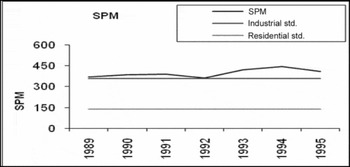
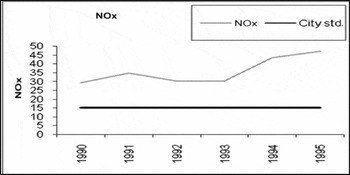
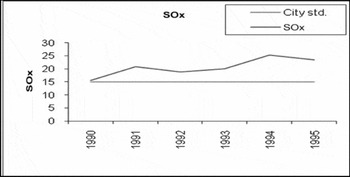
Hence, there is no reason to believe that an absence of law is responsible for the environmental problems, since the law on the books was quite extensive and substantive. However, pollution data show that the pollution level of sulfur oxide (SOx), nitrogen oxide (NOx), and suspended particulate matter (SPM) recorded in New Delhi was rising in the early 1990s (see figures 1–3). Figures 1–3 indicate that in spite of the statues enacted and the standards set, the government machinery responsible for pollution control did not succeed in effectively controlling air pollution in NCT Delhi. In particular, SPM was phenomenally high (averaging around 400 μg/m3) compared to the Indian standard of 360 μg/m3 for industrial areas, and 140 μg/m3 for city standard.Footnote 5 SOx and NOx are also much above the prescribed city standards. Thus, laxity in enforcement by regulatory bodies could be one of the root causes of alarming levels of pollution.Footnote 6
Time plot of SPM

Time plot of NOx

Time plot of SOx

To summarize, PCBs were ineffective and the political willingness to curb pollution was minimal. There was no evidence of any outcry in the media or otherwise, in terms of citizen protests, prior to the PIL case in the early to mid-1990s. One major reason for public apathy could be the lack of information on pollution levels and enacted standards. As was discussed earlier, there has been no public reporting on air quality by the government or any regulatory body in any of the cities in India. This, in turn, considerably weakened the civil society's strength to act as a watchdog on government's actions or inactions. The workings of PCBs and other regulatory bodies seldom caught the attention of media and were therefore removed from the public knowledge domain. Under such conditions, regulatory failure was unchecked.
3.2 The PIL and Supreme Court directives
The Supreme Court of India in 1990, replying to a PIL filed in 1985 by M.C. Mehta, demanded that the city administration submit a complete list of actions taken against the environmental tortfeasors, mostly industries, and also directed the state to explore the possibilities of reducing pollution.Footnote 7 The SC has evolved a new procedure called ‘continuing mandamus’, where a series of interim orders was given to the executive and their performance monitored through demanding periodic reports on progress (Divan and Rozencranz, Reference Divan and Rozencranz2001).
Subsequently, the Court asked the government to form a high-powered committee, the K.N. Saikia Committee, to assess low-cost technological alternatives and new legal solutions.Footnote 8 The Court was active throughout this period as it was concerned with carrying out the prosecution of defaulters.Footnote 9 The first concrete order given by the SC to reduce pollution was issued to the Delhi Transport Corporation buses ordering them to change from gasoline to natural gas.Footnote 10 The Division Bench of the SC, consisting of Justices Kuldip Singh and Saghir Ahamad, in 1995, directed the Delhi Government to set up a committee to study industrial concentration in nonconforming areas, such as colonies and other residential pockets. In May 1992, the SC had ordered all stone crushers along the Delhi–Faridabad border to close or shift away from Delhi as they were polluting NCT Delhi air. In the subsequent notifications, the SC had made its point clear that firms that were noxious and hazardous should move out within four years and eventually more than 1,300 industrial units were closed.
Regarding vehicular pollution, the SC came out with a series of orders that directs the pollution control authorities to execute the standards set by various committees and boards.Footnote 11 As more than two-thirds of the pollution could be attributed to vehicles, particularly the diesel-run two-wheelers, the Court had ordered that all the new diesel vehicles registered after June 1999 in NCT Delhi should abide by Euro 1 emission norms and vehicles registered after April 2000 should abide by EURO 2 emission norms.Footnote 12 All vehicles that were 15 years and older were phased out. The Court accepted the suggestions of the Bhure Lal Committee constituted under Section 3 of the Environment Protection Act 1986 by the government in 1998 and urged the government to do the needful to convert most vehicles to compressed natural gas (CNG). In the light of the above directives, the next section is concerned with testing the hypothesis whether the SC intervention was effective in improving the enforcement of standards and controlling pollution in NCT Delhi.
4. Data, descriptive statistics, and econometric methodology
Annual averages of SOX, NOX, and SPM for the years 1987–2004 were collected from the reports of the Department of Environment, Government of Delhi and Central Pollution Control Board (CPCB, 2001). All these pollution series are measured in μg/m3 and SPM is measured as the total suspended particulate matter in the ambient air with a diameter larger than 0.25 μg/m3. Data on Index of Industrial Production, number of industrial units functioning in NCT Delhi, and the number of vehicles registered in NCT Delhi are also obtained from the reports of the Department of Environment, Government of Delhi and CPCB. Information on the media coverage on ‘Delhi air pollution’ and ‘Public Interest Litigation’ is collected from newspaper archives for the 1987 to 2004 period.
Simple plotting of the pollution series at their absolute levels shows that SPM is fluctuating around its mean value of 400 μg/m3, whereas NOx showed consistent increase over the considered period. Levels of SOX exceeded the city standards, although the levels were well within the limits for industrial areas. SPM was consistently above the specified maximum ambient quality standard of 360 μg/m3 for industrial areas. It is extremely high when compared to the standard for residential areas (140 μg/m3), and sensitive areas (70 μg/m3).
Further, the growth in number of vehicles registered in NCT Delhi was enormous in the period considered. Given the moderate increase in the number of industrial units coupled with vehicle growth, it is expected that the ambient air quality would worsen over time. When the data are corrected for these increments, all pollution series considered show consistent reduction, implying that per vehicle and per industrial unit pollution has gone down.Footnote 13 This reduction is prominent for pollution corrected for number of vehicles. This simple plotting of corrected data lends credence to our hypothesis that the SC intervention has helped in moderating pollution level in NCT Delhi.
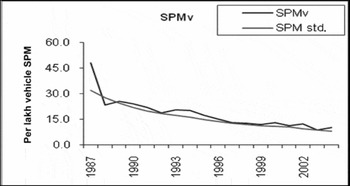
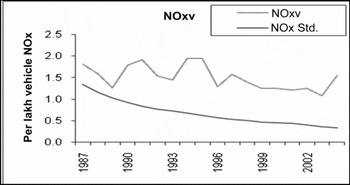
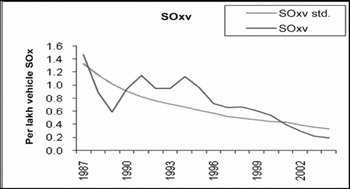
In figure 4, we have plotted the actual level of SPM corrected for increment in number of vehicles and ought-to-be per vehicle standard in order to maintain the ambient air quality within the prescribed limits. The difference between these two would show the effectiveness in implementation. The gap seems to be narrowing in the case of SPM or moderated over time, whereas SOx shows a phenomenal reduction as the actual level of pollution has gone below the standard (see figure 5). However, NOx shows consistent increase (see figure 6).
Time plot of SPM corrected for the number of vehicles

Time plot of NOx corrected for the number of vehicles

Time plot of SOx corrected for the number of vehicles

As the corrected data show some kind of moderation over time, we use a number of techniques to statistically test that this moderation is due to the SC intervention in the 1990s.
4.1 The policy variable (SCI)
Using the yearwise SC directions to the concerned authorities in NCT Delhi, we generate a variable called ‘Supreme Court Intervention’ (SCI). We club all the directivesFootnote 14 into the following three broad categories: (i) For directives that have only indirect effects, e.g., to set up fuel testing laboratories etc., the variable will carry a weight of 1, (ii) directives that are of local importance, such as restrictions on the plying of heavy vehicles will carry a weight of 2, and (iii) the directives that would impact the pollution in a big way, such as switching to CNG by all public transport vehicles and phasing out old vehicles, will carry the maximum weight of 3. The index shows that the SCI peaked in the late 1990s; there were 10, 8, and 6 directives in 2000, 1998, and 1996, respectively.
4.2 Information spillover and other control variables
To account for general awareness of environmental standards and the level of pollution among the citizens that was generated by the PIL, we use the number of newspaper articles published related to NCT Delhi air pollution as a proxy. Media coverage in India is still dominated by newspapers. Newspapers are the largest circulating form of information, as they are available in all Indian vernaculars. There is good evidence to believe that what is reported in the English press on larger issues finds its place in the vernacular press as well. Visual media has started playing a larger role in recent times only.
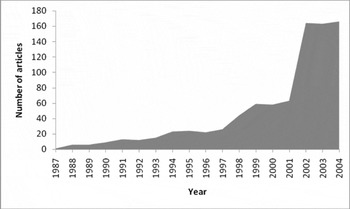
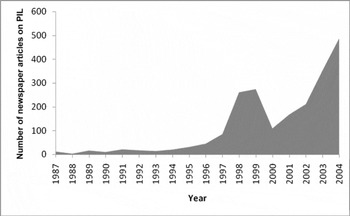
The data on number of articles containing ‘Public Interest Litigation’ and ‘Public Interest Litigation + air pollution + New Delhi’ were collected from newspaper archives. The number of articles containing ‘Public Interest Litigation + air pollution + New Delhi’, named PILDelhi, is then used in the analysis as a proxy for the general availability of information on the level of pollution and action taken in New Delhi.Footnote 15 Annual time plot of number of newspaper articles appearing during the study period show that the coverage on Delhi air pollution and PIL increased tremendously from the late 1990s (see figures 7 and 8).
Time plot of number of newspaper articles on NCT Delhi air pollution

Time plot of number of newspaper articles on PIL

Apart from the court intervention, there could be other factors, such as increase in economic activity, that affect the level of ambient air quality. Since it is suggested in the literature that increase in per capita income serves as a proxy for higher willingness to have clean environment and better availability of cleaner technology, we have used state per capita GDP (PGDP) of Delhi as a control variable. The data on PGDP are taken from various economic surveys of Delhi, planning department, and government of NCT of Delhi.
4.3 Methodology
We first tested for structural breaks in the time series data. Structural breaks in univariate time series are usually caused by an exogenous change in surrounding conditions that would result in a break in the conditional mean and the variance of the series.Footnote 16 In the conventional time series analysis, to account for this kind of structural breaks, a change point dummy variable is specified a priori to capture the mean shift between two periods. The shortcoming of this method is that it cannot detect the time of policy intervention when there are significant implementation lags. One would end up overestimating or underestimating the significance of break point because of this data dredging, more so when the point of intervention or policy change is not clear. When the change point is not known a priori or implementation lags are not cognizable, diagnostic methods or nonparametric methods are used to locate the time and the number of change points in the series endogenously. In this case, the SCI was over a period of time and there was no objective a priori method to state a single break point.
To overcome this difficulty, we have used a number of unit root techniques, such as Zivot and Andrews (Reference Zivot and Andrews1992) and Clemente et al. (Reference Clemente, Montanes and Reyes1998), to identify the breaks in the individual time series endogenously. These techniques are meant to test for unit root in a time series accounting for structural break. If an optimal break point is identified endogenously, then conventional regression models could make use of this information to test if these breaks are associated with policy changes.
Zivot and Andrews (Reference Zivot and Andrews1992) have developed a procedure to identify a single break point in the intercept and/or the trend in the series. The obvious weakness of this test is that it cannot identify when there is more than one break point, especially when the shock is innovational rather than a one-shot exogenous shock. To overcome this shortcoming, Clemente et al. (Reference Clemente, Montanes and Reyes1998) have developed a procedure allowing for a gradual shift in the mean to test more than one break point. In Clemente et al. (Reference Clemente, Montanes and Reyes1998) there are two different ways a shock could affect a series, i.e., an additive outlier, where break is assumed to be instantaneous and an innovational outlier, where the break is gradual. In the Delhi air pollution case, there were a series of interventions by the Court in the form of directives issued at different points of time, so we expect the impact to be gradual.Footnote 17
We further specify autoregressive and distributed lag models, where each pollution series is modeled as a linear function of its own and lagged values of SCI along with other control variables. We used information criteria such as the Akaike Information Criterion (AIC) and Schwarz Bayesian information criterion (BIC) to identify the number of lags in the model. As it is common for the time series regression to suffer from serial correlation, we used feasible generalized least squares estimator, and heteroskedasticity and autocorrelation consistent (HAC) standard errors.
5. Econometric models and the results
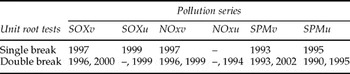
The results of the Clemente et al. (Reference Clemente, Montanes and Reyes1998) test for multiple endogenous structural break points in a single series show that all the pollution series have a break in the mid-1990s. Especially SPM and SPM corrected for vehicle and industrial activities show a break in the latter half of the 1990s; however, the SOx series show in the first half with high level of significance (see table 1, and figure A1 in Appendix available at http://journals.cambridge.org/EDE).
Unit root test for structural break

Note: We have utilized two-break unit root tests provided in Clemente et al. (Reference Clemente, Montanes and Reyes1998) and the simpler one-break tests of Perron and Vogelsang (Reference Perron and Vogelsang1992) to identify the year of structural break in the pollution series.
The results show that all the series except SPMv and SPMu are nonstationary at levels and stationary in first difference. The single break test proposed in Perron and Vogelsang (Reference Perron and Vogelsang1992) confirms the results obtained in the above analysis. If all the variables in the model do contain unit roots, it is a standard routine to check for co-integration among the variables in a multivariate analysis. However, the Johansen multivariate co-integration test results show that the pollution series do not coevolve.Footnote 18
The results of structural break analysis point to the necessity of detailed empirical analysis to identify the factors that caused the reduction in pollution in NCT Delhi in the 1990s. The optimal break identified by the above unit root tests could be used to examine whether the SC intervention had any impact on pollution levels. We specify a dynamic linear regression model, where each pollution series is modeled to be a function of its own lagged values, ‘SCI’ and a number of control variables, such as the state GDP and the level of public awareness measured by the number of newspaper articles related to Delhi air pollution.
To measure SCI, we consider the date of commencement as the date of directive. Owing to implementation and response lags, we expect pollution levels would react to these changes with some lags; thus, a number of lags are introduced in each model. The autoregressive and distributed lags are decided using information criteria such as AIC and BIC. To identify the impact of SCI on each pollution series, we run the following regression with a number of SCI lags, the own lagged value of the pollution series, and control public awareness measured by number of newspaper articles and per capita income:

where Yt stands for the pollution series, Yt −1 is the first lag of pollution series, SCIt −i stands for the lags of SCI, and Zt is the vector of controls.
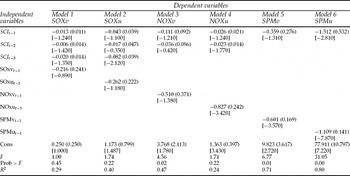
Table 2 summarizes the results of basic regressions that specify the pollution series as the function of its own lagged values and the lagged values of SCI. The contemporaneous effect of SCI is insignificant in all the models and dropped subsequently. Further, we have used the Huber–White robust standard errors for ordinary least squares, which is reliable even in the presence of heteroskedastic and autocorrelated errors. To start with, we discuss the most parsimonious specification without much attention to the omitted variable bias.
Basic regression results

Note: The dependent variable is the log value of air pollution in NCT Delhi named at the top of each column, where ‘v’ implies that the series is corrected for the increase in number of vehicles in NCT Delhi in the sample period and ‘u’ implies that the series is corrected for the number of industrial units located in NCT Delhi. The independent variables are given in the first row. The number of lags of independent variables is determined by AIC. The data set comprises annual state-level observations for NCT Delhi for the period 1987–2004. The Huber–White robust standard errors are given in parentheses and t-statistic is given in square brackets. All the series except SPMv and SPMu are nonstationary at levels and stationary in first difference.
Even though most of the lags of SCI variable are insignificant, they have the expected sign indicating a negative relationship between the court intervention and the level of ambient air pollution in NCT Delhi. However, very small R 2 values indicate that this model does not fit the data well. Poor fitness and insignificant values for SCI parameters in the basic regression could be attributed to the problem of omitted variable bias. Introducing the PGDP as a control for increased economic activity does improve the model to some extent, but the first lags SCI still turns out to be insignificant.
As discussed at the onset, we have introduced media diffusion measured by the number of newspaper articles on PIL related to Delhi air pollution along with the SCI variable. Introducing media diffusion would reduce the omitted variable problem to a large extent, as it is one of the key variables in raising the level of political accountability (Besley and Prat, Reference Besley and Prat2007).
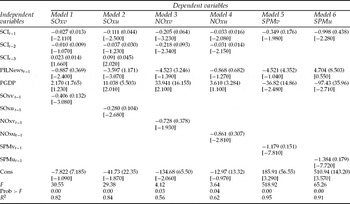
The main regression that includes all the covariates and controls shows the presence of a strong negative trend in all the pollution series, as the first lagged values introduced are negative and highly significant in all the models (see table 3). The first lag of SCI has turned out to be highly significant and also has the correct sign in the new specification, i.e., SCI has a negative effect on pollution level. The second lag of SCI is significant in reducing NOx corrected for industrial units and vehicles in NCT Delhi. However, the third lag of SCI introduced in SOx is insignificant. The overall results suggest that the SC intervention is substantial in reducing pollution with a lag of one to two years.
Regression estimates of the relationship between air pollution, Supreme Court intervention and the media with controls

Note: Regressions are identical to those in table 2, except that a media diffusion variable and a control variable state per capita GDP are introduced in the model along with the covariates. The Huber–White robust standard errors are given in parentheses and t-statistic is given in square brackets.
More interestingly, the lagged value of number of newspaper articles related to Delhi air pollution case, the proxy for the media attention and public awareness, has the right sign in all the cases but is significant only in the case of SOx. The results show that public awareness measured by media diffusion also dampens the ambient air pollution by creating an environment for stringent ambient air quality standards. However, it could be expected that this variable might be correlated with the SCI variables since the Court intervention would also produce newspaper articles. The correlation between the variables (see table A1 in Appendix available at http://journals.cambridge.org/EDE) shows that there is hardly any correlation between the media variables (PILDELHI and PIL) and the Supreme Court initiatives. On the other hand, the relationship between per capita income (PGDP) and pollution is ambiguous. PGDP is significantly negatively correlated with SPM, whereas it is inconclusive in the case of the other two pollutants. The reason for the ambiguous results could be that economic growth would mean more economic activity and high pollution in the first place, but also may lead to preference for better quality environment with higher standards of living. The overall regression fit measured by R 2 also improves considerably, indicating the improved model explains the reduction in air pollution considerably.Footnote 19
6. Conclusion
We tested whether the reduction in the level of air pollution in NCT Delhi was due to the PIL filed against the authorities and whether public information generated thereof is statistically correlated with reduction in pollution after controlling for PGDP and the level of economic activity measured by the number of vehicles and industrial units in NCT Delhi. PILs and Supreme Court's environmental activism have resulted in moderating ambient air quality in NCT Delhi.
Despite the apparent success of this institution, several questions remain. As an institution, PIL has come under severe criticism. Anant and Singh (Reference Anant and Singh2002) argue that the three branches of the state, viz., the executive, the legislature, and the judiciary have been essentially given separate powers because the arrangement minimizes the transaction cost of governance. Any deviation from this norm would be inefficient. The solution in the light of any one branch failing to operate efficiently is, according to their argument, to set right the ailing institution and not as the PIL route suggests, by other branches stepping in to do the work that was not meant for them. One reason that this fosters inefficiency is that the judiciary does not have the expertise to carry out the job of a standard setter and may take decisions that are not efficient to begin with. Another strand of literature is critical of what has come to be called ‘judicial activism’ and it is feared that it may lead to undemocratic decision-making.
While this paper reserves judgment on whether PIL is an ‘efficient’ route to take in the wake of considerable regulatory slack, it points to a symptom of a larger imperfection of the regulatory framework and its enforcement. The role played by PIL is particularly important in that it provides a cost-effective and viable alternative as compared to a traditional form legal redress to empower citizens in the developing countries. Had the government machinery acted with a reasonable amount of accuracy and commitment, the need for a PIL would not have arisen in the first place. The PIL route makes up for the lack of viable traditional alternatives to get out of what we call the ‘low environmental quality trap’. It is of course obvious that it is not the first-best solution. It can at most be a second-best solution that would send signals to the executive to change its ways. However, in many instances this may be the best that can be achieved.