1 Introduction
In the thin-double-layer limit, the electrophoretic mobility of particles which are suspended in an unbounded fluid domain is given by Smoluchowski’s formula. This formula does not apply in the presence of nearby boundaries; given the ubiquity of confined geometries in electrokinetic processes, the role of boundaries has been of interest ever since the pioneering analysis of Morrison & Stukel (Reference Morrison and Stukel1970). A prototypic configuration consists of a dielectric sphere which is suspended near a dielectric wall, with an electric field applied parallel to the wall. This configuration, originally studied using reflection methods (Keh & Anderson Reference Keh and Anderson1985), was analysed by Keh & Chen (Reference Keh and Chen1988) using eigenfunction expansions in spherical bipolar coordinates. Keh & Chen (Reference Keh and Chen1988) noted that the rectilinear and angular velocities of the particle increase as the gap separation reduces, eventually becoming infinite. These observations are in stark contrast to sedimentation phenomena, where particle mobilities actually vanish in that limit. Keh & Chen (Reference Keh and Chen1988) suggested that the electro-osmotic flow due to the intense electric field within the gap overcomes the large viscous retardation associated with the relative motion between the two solid surfaces.
Being force-free, particle electrophoresis at zero Reynolds number is described by a well posed problem even in two dimensions. Indeed, the analysis of circular-cylinder electrophoresis has been central in the classical electrokinetic literature (Henry Reference Henry1931; Morrison Reference Morrison1971; Stigter Reference Stigter1978). Using bipolar coordinates, Keh, Horng & Kuo (Reference Keh, Horng and Kuo1991) analysed the two-dimensional counterpart of the sphere–wall problem of Keh & Chen (Reference Keh and Chen1988), namely the electrophoresis of a circular cylinder near a dielectric wall due to a field which is applied parallel to the wall. An attractive feature in their analysis is the closed-form expressions obtained for the electrophoretic mobilities; this resembles the calculation of wall effects on resistance coefficients, where a two-dimensional analysis (Jeffrey & Onishi Reference Jeffrey and Onishi1981) provides closed-form expressions, absent in the three-dimensional case (Dean & O’Neill Reference Dean and O’Neill1963; O’Neill Reference O’Neill1964).
Keh et al. (Reference Keh, Horng and Kuo1991) noticed that the electrophoretic mobilities increase monotonically as the ratio
 $\unicode[STIX]{x1D6FF}$
of gap separation to cylinder radius decreases, with an eventual divergence with
 $\unicode[STIX]{x1D6FF}^{-1/2}$
when
 $\unicode[STIX]{x1D6FF}\rightarrow 0$
(see also Chen & Keh Reference Chen, Keh and Hsu1999). This divergence is significantly stronger than that observed in the three-dimensional problem. The goal of the present contribution is to provide insight into the physical mechanisms giving rise to this singular behaviour. Thus, following Yariv & Brenner (Reference Yariv and Brenner2003) we focus here from the outset upon the asymptotic limit
 $\unicode[STIX]{x1D6FF}\ll 1$
, obtaining approximate descriptions of the pertinent electrokinetic transport processes. Our approach is inspired by the work of Jeffrey & Onishi (Reference Jeffrey and Onishi1981), who supplemented their exact mobility expressions by a detailed asymptotic derivation in the near-contact limit. As in Jeffrey & Onishi (Reference Jeffrey and Onishi1981) we employ the method of matched asymptotic expansions, where the fluid domain is conceptually decomposed into an ‘inner’ gap region, where the electric field and shear stresses are intense, and the remaining ‘outer’ region, where the gap appears as a point singularity.
Keh et al. (Reference Keh, Horng and Kuo1991) also analysed the case of an electric field which acts perpendicular to a conducting plane, on which the standard homogeneous Neumann condition governing the electric potential was replaced by a homogeneous Dirichlet condition. While the latter condition may appear appealing for a conducting wall, it is important to note that the boundary conditions in the quasisteady thin-double-layer framework, at any surface in contact with the fluid, are effective in nature – representing asymptotic matching with the diffuse-charge layers surrounding that surface rather than a literal description at the genuine surface (Yariv Reference Yariv2010a ). Since that framework describes Ohmic transport within the electro-neutral fluid residing outside the diffuse-charge layers, a field acting perpendicular to a wall can only exist at steady state if the wall is chemically reactive, allowing for the passage of ionic current. Ristenpart, Aksay & Saville (Reference Ristenpart, Aksay and Saville2007) suggested that such electrodes may be modelled at steady state by a uniformly prescribed current density emitted into the fluid. That model was employed by Yariv (Reference Yariv2010b ) to analyse sphere–electrode interactions; we employ it here to investigate the comparable problem of cylinder–wall interactions. (An homogeneous Dirichlet condition, of the sort used by Keh et al. (Reference Keh, Horng and Kuo1991), may apply as an effective condition in the case of high-frequency fields, see Yariv & Schnitzer Reference Yariv and Schnitzer2013.)
For convenience we analyse here electro-osmotic flow about a stationary cylinder. Once the associated hydrodynamic (referred to here as ‘electro-osmotic’) forces and torques on such a cylinder have been obtained, the resulting rectilinear and angular velocities of a comparable freely suspended cylinder are readily determined using the available resistance coefficients pertaining to the cylinder–wall geometry (Jeffrey & Onishi Reference Jeffrey and Onishi1981). This decomposition into pure electro-osmosis and pure rigid-body motion is useful in isolating the different singular scaling associated with each component.
2 Formulation
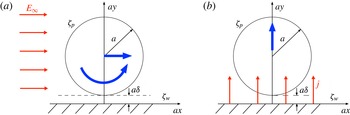
The problem considered herein is described in figure 1(a). An infinite dielectric cylinder of circular cross-section (radius
 $a$
) is held stationary within an electrolyte solution (dielectric permittivity
 $\unicode[STIX]{x1D716}$
, viscosity
 $\unicode[STIX]{x1D707}$
) with its axis parallel to an adjacent dielectric solid wall. The separation distance between the cylinder and the wall is
 $a\unicode[STIX]{x1D6FF}$
. The cylinder–liquid system is exposed to an otherwise uniform electric field, of magnitude
 $E_{\infty }$
, which is applied perpendicular to the cylinder axis and parallel to the wall. We employ the standard thin-double-layer description, applicable when the diffuse-charge layers surrounding the cylinder and wall surface are thin compared with both
 $a$
and
 $a\unicode[STIX]{x1D6FF}$
. The zeta potentials of the cylinder and wall surfaces are denoted by
 $\unicode[STIX]{x1D701}_{p}$
and
 $\unicode[STIX]{x1D701}_{w}$
, respectively; as in Keh et al. (Reference Keh, Horng and Kuo1991) we neglect surface conduction; this is valid provided the zeta-potential values are smaller than or comparable to the thermal voltage (Schnitzer & Yariv Reference Schnitzer and Yariv2012).
(a) Circular cylinder under a uniform electric field parallel to an adjacent wall. As a result of the electro-osmotic flow, a stationary cylinder experiences a hydrodynamic force in the
 $x$
-direction and torque in the
 $z$
-direction. (b) Circular cylinder under a uniform current perpendicular to an adjacent reactive electrode. As a result of the electro-osmotic flow, a stationary cylinder experiences a hydrodynamic force in the
 $y$
-direction.

We normalise all length variables by
 $a$
and employ a Cartesian coordinate system where the
 $x$
-axis lies along the wall and perpendicular to the cylinder axis while the
 $y$
-axis passes through the cylinder axis. The wall then coincides with the
 $xz$
-plane while the cylinder boundary
 $\mathscr{S}$
is
 $x^{2}+(y-1-\unicode[STIX]{x1D6FF})^{2}=1$
. The electric potential
 $\unicode[STIX]{x1D711}$
, normalised by
 $aE_{\infty }$
, is governed by (i) Laplace’s equation in the fluid domain; (ii) the no-flux condition on the cylinder,
 $$\begin{eqnarray}\displaystyle \frac{\unicode[STIX]{x2202}\unicode[STIX]{x1D711}}{\unicode[STIX]{x2202}n}=0\quad \text{on}~\mathscr{S}, & & \displaystyle\end{eqnarray}$$
wherein
 $\unicode[STIX]{x2202}/\unicode[STIX]{x2202}n=\hat{\boldsymbol{n}}\boldsymbol{\cdot }\unicode[STIX]{x1D735}$
is the normal derivative, in which
 $\hat{\boldsymbol{n}}$
a unit vector normal to
 $\mathscr{S}$
, pointing into the liquid; (iii) the no-flux condition on the wall,
 $$\begin{eqnarray}\displaystyle \frac{\unicode[STIX]{x2202}\unicode[STIX]{x1D711}}{\unicode[STIX]{x2202}y}=0\quad \text{at}~y=0; & & \displaystyle\end{eqnarray}$$
and (iv) the far-field approach to the uniformly applied field,
 $$\begin{eqnarray}\displaystyle \unicode[STIX]{x1D711}\sim -x\quad \text{as}~|\boldsymbol{x}|\rightarrow \infty , & & \displaystyle\end{eqnarray}$$
wherein
 $\boldsymbol{x}=x\hat{\boldsymbol{e}}_{x}+y\hat{\boldsymbol{e}}_{y}+z\hat{\boldsymbol{e}}_{z}$
is the position vector.
Once
 $\unicode[STIX]{x1D711}$
is determined, the flow field may be calculated. We normalise velocity variables by the Helmholtz scale
 $\mathscr{U}=\unicode[STIX]{x1D716}\unicode[STIX]{x1D701}_{p}E_{\infty }/\unicode[STIX]{x1D707}$
; stress variables (as well as the pressure
 $p$
) are accordingly normalised by
 $\unicode[STIX]{x1D707}\mathscr{U}/a$
, while forces and torques (per unit length) are normalised by
 $\unicode[STIX]{x1D707}\mathscr{U}$
and
 $\unicode[STIX]{x1D707}\mathscr{U}a$
, respectively. The fluid velocity
 $\boldsymbol{u}$
is governed by: (i) the continuity and Stokes equations; (ii) the Helmholtz slip condition on the cylinder
 $$\begin{eqnarray}\displaystyle \boldsymbol{u}=\unicode[STIX]{x1D735}\unicode[STIX]{x1D711}\quad \text{on}~\mathscr{S}, & & \displaystyle\end{eqnarray}$$
and the wall,
 $$\begin{eqnarray}\displaystyle \boldsymbol{u}=\unicode[STIX]{x1D6FE}\unicode[STIX]{x1D735}\unicode[STIX]{x1D711}\quad \text{at}~y=0, & & \displaystyle\end{eqnarray}$$
wherein
 $\unicode[STIX]{x1D6FE}=\unicode[STIX]{x1D701}_{w}/\unicode[STIX]{x1D701}_{p}$
; and (iii) the far-field approach to the uniform electro-osmotic flow associated with the applied field,
 $$\begin{eqnarray}\displaystyle \boldsymbol{u}\rightarrow -\unicode[STIX]{x1D6FE}\hat{\boldsymbol{e}}_{x}\quad \text{as}~|\boldsymbol{x}|\rightarrow \infty . & & \displaystyle\end{eqnarray}$$
It is evident from the above formulation that
 $\boldsymbol{u}=u\hat{\boldsymbol{e}}_{x}+v\hat{\boldsymbol{e}}_{y}$
and that all pertinent fields in this two-dimensional problem are independent of
 $z$
. Our interest is in the resulting hydrodynamic loads (per unit length) which act on the cylinder. Standard Stokes-flow symmetry arguments (Leal Reference Leal2007) imply here that the hydrodynamic force acts in the
 $x$
-direction, say
 $F_{x}\hat{\boldsymbol{e}}_{x}$
, while the hydrodynamic torque acts in the
 $z$
-direction, say
 $T\hat{\boldsymbol{e}}_{z}$
.
3 Near-contact limit
The bipolar-coordinate analysis of Keh et al. (Reference Keh, Horng and Kuo1991) provides exact expressions for the hydrodynamic loads on the stationary cylinder, which in the present notation read:
 $$\begin{eqnarray}F_{x}=4\unicode[STIX]{x03C0}(1-\unicode[STIX]{x1D6FE})\frac{\coth 2\unicode[STIX]{x1D713}}{\unicode[STIX]{x1D713}},\quad T=\frac{4\unicode[STIX]{x03C0}(1-\unicode[STIX]{x1D6FE})}{\sinh \unicode[STIX]{x1D713}\sinh 2\unicode[STIX]{x1D713}},\end{eqnarray}$$
where
 $\unicode[STIX]{x1D713}$
is defined by
 $$\begin{eqnarray}\displaystyle \cosh \unicode[STIX]{x1D713}=1+\unicode[STIX]{x1D6FF}. & & \displaystyle\end{eqnarray}$$
For
 $\unicode[STIX]{x1D6FF}\ll 1$
, these loads diverge with
 $\unicode[STIX]{x1D6FF}^{-1}$
. We here illuminate the mechanism underlying this singular behaviour by focusing upon the limit
 $\unicode[STIX]{x1D6FF}\ll 1$
from the outset. This singular limit is analysed using matched asymptotic expansions, where the inner region describes the narrow gap between the cylinder and the wall while the outer region corresponds to the cross-sectional unity length scale. The inner region is analysed using the stretched Cartesian coordinates
 $(X,Y)$
, defined by (Jeffrey & Onishi Reference Jeffrey and Onishi1981)
 $$\begin{eqnarray}x=\unicode[STIX]{x1D6FF}^{1/2}X,\quad y=\unicode[STIX]{x1D6FF}Y;\end{eqnarray}$$
in terms of these coordinates, the cylinder boundary
 $\mathscr{S}$
becomes
 $Y=H(X)+O(\unicode[STIX]{x1D6FF})$
, wherein
 $H(X)=1+X^{2}/2$
.
4 Electric field
We begin with the calculation of the electric field. Denoting the (unknown) electric-potential scaling in the inner region by
 $\unicode[STIX]{x1D712}(\unicode[STIX]{x1D6FF})$
, we write
 $$\begin{eqnarray}\displaystyle \unicode[STIX]{x1D711}=\unicode[STIX]{x1D712}(\unicode[STIX]{x1D6FF})\unicode[STIX]{x1D6F7}. & & \displaystyle\end{eqnarray}$$
The
 $O(1)$
field
 $\unicode[STIX]{x1D6F7}$
satisfies Laplace’s equation,
 $$\begin{eqnarray}\displaystyle \frac{\unicode[STIX]{x2202}^{2}\unicode[STIX]{x1D6F7}}{\unicode[STIX]{x2202}Y^{2}}+\unicode[STIX]{x1D6FF}\frac{\unicode[STIX]{x2202}^{2}\unicode[STIX]{x1D6F7}}{\unicode[STIX]{x2202}X^{2}}=0\quad \text{for}~0<Y<H(X), & & \displaystyle\end{eqnarray}$$
together with the no-flux condition on the cylinder,
 $$\begin{eqnarray}\displaystyle \frac{\unicode[STIX]{x2202}\unicode[STIX]{x1D6F7}}{\unicode[STIX]{x2202}Y}=\unicode[STIX]{x1D6FF}X\frac{\unicode[STIX]{x2202}\unicode[STIX]{x1D6F7}}{\unicode[STIX]{x2202}X}\quad \text{at}~Y=H(X)+O(\unicode[STIX]{x1D6FF}), & & \displaystyle\end{eqnarray}$$
and wall,
 $$\begin{eqnarray}\displaystyle \frac{\unicode[STIX]{x2202}\unicode[STIX]{x1D6F7}}{\unicode[STIX]{x2202}Y}=0\quad \text{at}~Y=0. & & \displaystyle\end{eqnarray}$$
Since the inhomogeneous far-field condition (2.3) does not apply in the inner region, the preceding problem is homogeneous. The scaling pre-factor
 $\unicode[STIX]{x1D712}(\unicode[STIX]{x1D6FF})$
may only be determined by asymptotic matching with the outer solution.
We postulate for
 $\unicode[STIX]{x1D6F7}$
an asymptotic expansion of the following generic form:
 $$\begin{eqnarray}\displaystyle G(X,Y;\unicode[STIX]{x1D6FF})=G_{0}(X,Y)+\unicode[STIX]{x1D6FF}G_{1}(X,Y)+\cdots . & & \displaystyle\end{eqnarray}$$
From the leading-order balances of (4.2)–(4.3) we readily find that
 $\unicode[STIX]{x1D6F7}_{0}$
is independent of
 $Y$
and is accordingly a function of
 $X$
alone, say
 $\unicode[STIX]{x1D6F7}_{0}(X)$
. This function is determined from the solvability condition
 $$\begin{eqnarray}\displaystyle \frac{\text{d}}{\text{d}X}\left(H\frac{\text{d}\unicode[STIX]{x1D6F7}_{0}}{\text{d}X}\right)=0, & & \displaystyle\end{eqnarray}$$
which emerges from the
 $O(\unicode[STIX]{x1D6FF})$
balances of (4.2)–(4.3). It follows that
 $$\begin{eqnarray}\displaystyle H(X)\frac{\text{d}\unicode[STIX]{x1D6F7}_{0}}{\text{d}X}=-J, & & \displaystyle\end{eqnarray}$$
wherein
 $J$
is an integration constant. Note that (4.7) represents an integral charge-conservation equation, specifying a constant net current
 $J$
along the gap. Integration of (4.7) yields the electric potential,
 $$\begin{eqnarray}\displaystyle \unicode[STIX]{x1D6F7}_{0}=-J\sqrt{2}\arctan \frac{X}{\sqrt{2}}+\text{const}. & & \displaystyle\end{eqnarray}$$
To determine
 $J$
and
 $\unicode[STIX]{x1D712}(\unicode[STIX]{x1D6FF})$
we now consider the outer problem, where the cylinder virtually touches the wall and the gap appears as a point singularity. Given condition (2.3), the outer potential is clearly
 $O(1)$
; we accordingly employ the obvious outer expansion,
 $\unicode[STIX]{x1D711}(x,y;\unicode[STIX]{x1D6FF})=\unicode[STIX]{x1D711}_{0}(x,y)+o(1)$
. The leading-order potential
 $\unicode[STIX]{x1D711}_{0}$
has already been determined in an analogous irrotational-flow problem (Milne-Thomson Reference Milne-Thomson1962); in the present notation:
 $$\begin{eqnarray}\displaystyle \unicode[STIX]{x1D711}_{0}=-\unicode[STIX]{x03C0}\,\text{Re}\left\{\coth \frac{\unicode[STIX]{x03C0}}{x+\text{i}y}\right\}. & & \displaystyle\end{eqnarray}$$
Asymptotic matching reveals that
 $$\begin{eqnarray}\unicode[STIX]{x1D712}=1,\quad J=\sqrt{2}.\end{eqnarray}$$
The
 $x$
-component of the gap-scale electric field (normalised by
 $E_{\infty }$
) is therefore
 $O(\unicode[STIX]{x1D6FF}^{-1/2})$
. Writing it as
 $\unicode[STIX]{x1D6FF}^{-1/2}E$
, the
 $O(1)$
variable
 $E$
possesses an expansion of the form (4.5); in particular,
 $$\begin{eqnarray}\displaystyle E_{0}(X)=\frac{\sqrt{2}}{H(X)}. & & \displaystyle\end{eqnarray}$$
5 Flow
Consider now the gap-scale flow. With an
 $O(\unicode[STIX]{x1D6FF}^{-1/2})$
electric field in the
 $x$
-direction, the slip conditions (2.4)–(2.5) imply a similar scaling for
 $u$
, the
 $x$
-component of the velocity field. We introduce the corresponding lubrication scaling
 $$\begin{eqnarray}u=\unicode[STIX]{x1D6FF}^{-1/2}U(X,Y;\unicode[STIX]{x1D6FF}),\quad v=V(X,Y;\unicode[STIX]{x1D6FF}),\quad p=\unicode[STIX]{x1D6FF}^{-2}P(X,Y;\unicode[STIX]{x1D6FF}),\end{eqnarray}$$
where the
 $O(1)$
fields
 $U$
,
 $V$
and
 $P$
possess asymptotic expansions of the form (4.5). At leading order we find from the Stokes equation in the
 $y$
-direction that
 $P_{0}$
is independent of
 $Y$
, say
 $P_{0}(X)$
. The leading-order balance in the
 $x$
-direction then reads
 $\text{d}P_{0}/\text{d}X=\unicode[STIX]{x2202}^{2}U_{0}/\unicode[STIX]{x2202}Y^{2}$
. Integration in conjunction with the slip conditions (cf. (2.4)–(2.5))
 $$\begin{eqnarray}U_{0}(Y=0)=-\unicode[STIX]{x1D6FE}E_{0}(X),\quad U_{0}(Y=H)=-E_{0}(X),\end{eqnarray}$$
readily yields
 $$\begin{eqnarray}\displaystyle U_{0}=\frac{1}{2}\frac{\text{d}P_{0}}{\text{d}X}(Y^{2}-YH)-(1-\unicode[STIX]{x1D6FE})\frac{YE_{0}}{H}-\unicode[STIX]{x1D6FE}E_{0}. & & \displaystyle\end{eqnarray}$$
The associated volumetric flux
 $Q=\int _{0}^{H}U_{0}\,\text{d}Y$
(per unit length in the
 $z$
-direction) is
 $$\begin{eqnarray}\displaystyle Q=-\frac{H^{3}}{12}\frac{\text{d}P_{0}}{\text{d}X}-\frac{1+\unicode[STIX]{x1D6FE}}{2}E_{0}H. & & \displaystyle\end{eqnarray}$$
Since the cylinder is stationary, integral-mass conservation necessitates that this flux is independent of
 $X$
and is accordingly constant. We therefore obtain the first-order ordinary differential equation governing
 $P_{0}(X)$
:
 $$\begin{eqnarray}\displaystyle \frac{H^{3}}{12}\frac{\text{d}P_{0}}{\text{d}X}+\frac{1+\unicode[STIX]{x1D6FE}}{2}E_{0}H+Q=0. & & \displaystyle\end{eqnarray}$$
While no boundary condition is provided by the inner-region equations, the conditions
 $$\begin{eqnarray}\displaystyle P(-\infty )=P(\infty )=0 & & \displaystyle\end{eqnarray}$$
follow from asymptotic matching with the outer region, where
 $p=O(1)$
. In principle, these conditions serve to determine both
 $Q$
and the additional constant that emerges from integration of (5.5).
In the present problem, there is actually no need to carry out that integration: indeed, substitution of (4.11) into (5.5) reveals that
 $\text{d}P_{0}/\text{d}X$
is given by the ratio of a constant to
 $H^{3}$
. As this is an even function of
 $x$
which does not change its sign, it follows that its integral from
 $-\infty$
to
 $\infty$
is non-zero unless the constant vanishes. Given the zero pressure drop associated with (5.6) we conclude that
 $\text{d}P_{0}/\text{d}X$
(and whence
 $P_{0}$
) vanishes altogether. With
 $Q=-(1+\unicode[STIX]{x1D6FE})/\sqrt{2}$
, the associated dimensional flux turns out to be proportional to the sum of the two zeta potentials.
Since the
 $O(\unicode[STIX]{x1D6FF}^{-1/2})$
velocity component
 $u$
varies along
 $O(\unicode[STIX]{x1D6FF})$
distances, the
 $xy$
-component of the shear stress is
 $\unicode[STIX]{x1D6FF}^{-3/2}[\unicode[STIX]{x2202}U_{0}/\unicode[STIX]{x2202}Y+o(1)]$
. The contribution of the inner region to the hydrodynamic force
 $F_{x}$
scales as the product of that stress with the
 $O(\unicode[STIX]{x1D6FF}^{1/2})$
gap length and is accordingly
 $O(\unicode[STIX]{x1D6FF}^{-1})$
. As the outer contribution to that force is at most
 $O(1)$
we conclude that
 $$\begin{eqnarray}\displaystyle F_{x}=\unicode[STIX]{x1D6FF}^{-1}[F_{x0}+o(1)], & & \displaystyle\end{eqnarray}$$
where the leading term is dominated by the inner contribution, namely
 $$\begin{eqnarray}\displaystyle F_{x0}=-\int _{-\infty }^{\infty }\left.\frac{\unicode[STIX]{x2202}U_{0}}{\unicode[STIX]{x2202}Y}\right|_{Y=H(X)}\,\text{d}X. & & \displaystyle\end{eqnarray}$$
Integration yields
 $$\begin{eqnarray}\displaystyle F_{x0}=(1-\unicode[STIX]{x1D6FE})\unicode[STIX]{x03C0}, & & \displaystyle\end{eqnarray}$$
in agreement with (3.1a
). Similar arguments readily show that the hydrodynamic torque
 $T$
is also
 $O(\unicode[STIX]{x1D6FF}^{-1})$
,
 $$\begin{eqnarray}\displaystyle T=\unicode[STIX]{x1D6FF}^{-1}[T_{0}+o(1)], & & \displaystyle\end{eqnarray}$$
with
 $T_{0}=F_{x0}$
, in agreement with (3.1b
).
6 Cylinder–electrode interactions
We now consider the case where the cylinder is held in the vicinity of a reactive electrode, emitting a uniform current density
 $j$
into liquid: see figure 1(b). Upon identifying
 $E_{\infty }$
with
 $j/\unicode[STIX]{x1D70E}$
(
 $\unicode[STIX]{x1D70E}$
being the electric conductivity of the liquid) we may retain the preceding dimensionless notation. The electrostatic problem is again governed by Laplace’s equation and the no-flux condition (2.1), but with the no-flux condition (2.2) replaced by the imposed-current condition,
 $$\begin{eqnarray}\displaystyle \frac{\unicode[STIX]{x2202}\unicode[STIX]{x1D711}}{\unicode[STIX]{x2202}y}=-1\quad \text{at}~y=0. & & \displaystyle\end{eqnarray}$$
The far-field condition (2.3) is consistently replaced by
 $$\begin{eqnarray}\displaystyle \unicode[STIX]{x1D711}\sim -y\quad \text{as}~|\boldsymbol{x}|\rightarrow \infty . & & \displaystyle\end{eqnarray}$$
The flow-problem formulation remains valid provided the electro-osmotic condition (2.6) is replaced by the requirement of far-field velocity decay. (For a justification of the use of the Helmholtz slip condition (2.5) on the electrode, see Yariv (Reference Yariv2010b
)). Due to the obvious symmetry, the hydrodynamic force (per unit length) acting on the stationary cylinder is perpendicular to the wall, say
 $F_{y}\hat{\boldsymbol{e}}_{y}$
.
Consider the inner electric potential. The presence here of an inhomogeneous condition, namely (6.1), readily determines the scaling
 $\unicode[STIX]{x1D712}=1$
in (4.1), identical to that in the imposed-field problem. The inner potential
 $\unicode[STIX]{x1D6F7}$
is still governed by (4.2) and (4.3), with (4.4) replaced by
 $$\begin{eqnarray}\displaystyle \frac{\unicode[STIX]{x2202}\unicode[STIX]{x1D6F7}}{\unicode[STIX]{x2202}Y}=-\unicode[STIX]{x1D6FF}\quad \text{at}~Y=0. & & \displaystyle\end{eqnarray}$$
Applying the generic expansion (4.5) we again find from the leading-order analysis that
 $\unicode[STIX]{x1D6F7}_{0}$
is a function of
 $X$
. Here, the
 $O(\unicode[STIX]{x1D6FF})$
problem provides the following solvability condition,
 $$\begin{eqnarray}\displaystyle H(X)\frac{\text{d}^{2}\unicode[STIX]{x1D6F7}_{0}}{\text{d}X^{2}}+X\frac{\text{d}\unicode[STIX]{x1D6F7}_{0}}{\text{d}X}+1=0, & & \displaystyle\end{eqnarray}$$
namely a first-order ordinary differential equation governing
 $\text{d}\unicode[STIX]{x1D6F7}_{0}/\text{d}X$
. This equation possesses the general solution
 $(M-X)/H(X)$
,
 $M$
being an integration constant. While the inner problem does not provide any boundary condition to determine that constant, the requisite symmetry about the
 $yz$
-plane implies that
 $M=0$
. (Alternatively, that value of
 $M$
may have been determined via asymptotic matching with the outer solution, where the above-mentioned symmetry is explicitly imposed by condition (6.2).) Note that the above expression for
 $\text{d}\unicode[STIX]{x1D6F7}_{0}/\text{d}X$
could have been obtained using the integral charge-conservation equation,
 $$\begin{eqnarray}\displaystyle H(X)\frac{\text{d}\unicode[STIX]{x1D6F7}_{0}}{\text{d}X}+X=0, & & \displaystyle\end{eqnarray}$$
equating the current entering through the electrode to that flowing through the gap (cf. Jeffrey & Chen Reference Jeffrey and Chen1977). For comparison with (4.11) we note that here the leading-order
 $O(\unicode[STIX]{x1D6FF}^{-1/2})$
electric field in the
 $x$
-direction is
 $$\begin{eqnarray}\displaystyle E_{0}(X)=\frac{X}{H(X)}. & & \displaystyle\end{eqnarray}$$
In analysing the consequent lubrication flow we observe that (5.1)–(5.5) remain valid, although the flux
 $Q$
must here vanish because of the problem symmetry. Using (6.6) we therefore obtain
 $\text{d}P_{0}/\text{d}X=-6(1+\unicode[STIX]{x1D6FE})X/H^{3}$
. Integration in conjunction with (5.6) gives
 $P_{0}(X)=3(1+\unicode[STIX]{x1D6FE})/H^{2}$
. The push of the
 $O(\unicode[STIX]{x1D6FF}^{-2})$
gap-scale pressure on the
 $O(\unicode[STIX]{x1D6FF}^{1/2})$
wide cylindrical surface gives rise to an
 $O(\unicode[STIX]{x1D6FF}^{-3/2})$
hydrodynamic force (per unit length) in the
 $y$
-direction. Since the outer contribution to that force is at most
 $O(1)$
we write (cf. (8.3))
 $$\begin{eqnarray}\displaystyle F_{y}=\unicode[STIX]{x1D6FF}^{-3/2}[F_{y0}+o(1)], & & \displaystyle\end{eqnarray}$$
wherein (cf. (5.8))
 $$\begin{eqnarray}\displaystyle F_{y0}=\int _{-\infty }^{\infty }P_{0}(X)\,\text{d}X. & & \displaystyle\end{eqnarray}$$
Integration yields
 $F_{y0}=3\unicode[STIX]{x03C0}(1+\unicode[STIX]{x1D6FE})/\sqrt{2}$
. Note that the corresponding dimensional force is proportional to the sum of the zeta potentials.
7 Electrophoretic mobilities
When the solid cylinder is freely suspended in the liquid, it is considered force- and torque-free (see however § 8). The same symmetry arguments used above for predicting the directions of the electro-osmotic loads now imply that, under a uniform field in the
 $x$
-direction, the cylinder acquires a rectilinear velocity in the
 $x$
-direction and an angular velocity in the
 $z$
-direction. These velocities are readily obtained using the available expressions for the resistance coefficients appropriate to the cylinder–wall geometry. In particular, as translation and rotation are uncoupled in that geometry (Jeffrey & Onishi Reference Jeffrey and Onishi1981), translation in the
 $x$
-direction results in hydrodynamic drag (per unit length) in the negative
 $x$
-direction, proportional to the respective rectilinear velocity, while rotation in
 $z$
-direction results in a hydrodynamic torque (per unit length) in the negative
 $z$
-direction, proportional to the respective angular velocity. In the limit
 $\unicode[STIX]{x1D6FF}\ll 1$
, Jeffrey & Onishi (Reference Jeffrey and Onishi1981) found that both resistance coefficients are
 $O(\unicode[STIX]{x1D6FF}^{-1/2})$
, identical at this leading order, namely:
 $$\begin{eqnarray}\displaystyle 4\unicode[STIX]{x03C0}(2\unicode[STIX]{x1D6FF})^{-1/2}+O(1). & & \displaystyle\end{eqnarray}$$
Making use of (8.3)–(5.10) we find that the rectilinear and angular velocities (respectively normalised by
 $\mathscr{U}$
and
 $\mathscr{U}/a$
) of the force- and torque-free cylinder are identical at leading order, given by
 $$\begin{eqnarray}\displaystyle (1-\unicode[STIX]{x1D6FE})(8\unicode[STIX]{x1D6FF})^{-1/2}+O(1). & & \displaystyle\end{eqnarray}$$
These
 $O(\unicode[STIX]{x1D6FF}^{-1/2})$
approximations agree with the small-
 $\unicode[STIX]{x1D6FF}$
limit of the exact mobility expressions provided by Keh et al. (Reference Keh, Horng and Kuo1991), see (3.17) in that paper.
In the problem of particle–electrode interaction the velocity of a freely suspended cylinder in the
 $y$
-direction is provided by the ratio of
 $F_{y}$
to the resistance coefficient appropriate to motion perpendicular to a solid wall. In the limit
 $\unicode[STIX]{x1D6FF}\ll 1$
this coefficient is (Jeffrey & Onishi Reference Jeffrey and Onishi1981)
 $$\begin{eqnarray}\displaystyle 12\unicode[STIX]{x03C0}(2\unicode[STIX]{x1D6FF})^{-3/2}+O(\unicode[STIX]{x1D6FF}^{-1/2}). & & \displaystyle\end{eqnarray}$$
Since
 $F_{y}$
is also
 $O(\unicode[STIX]{x1D6FF}^{-3/2})$
, we conclude that the cylinder acquires a velocity which approaches a finite limit, namely
 $(1+\unicode[STIX]{x1D6FE})/2$
, as
 $\unicode[STIX]{x1D6FF}\rightarrow 0$
. (This singular behaviour is in sharp contrast with the mobility suppression which is predicted by the use of a homogeneous Dirichlet condition in the same geometry, see Keh et al.
Reference Keh, Horng and Kuo1991.)
8 Electric force
Electrophoretic analyses in the thin-double-layer limit tend to ignore the influence of electric forces which act on the particles, treating them as force- and torque-free. The common justification for this neglect is that, within the macroscale description appropriate to that limit, the particle ‘boundary’ encloses a body of zero net charge (namely the sum of the interfacial charge and that in the screening diffuse layer). This ‘net neutrality’ argument is actually flawed when the liquid domain is bounded (Yariv Reference Yariv2006, Reference Yariv2016a
). In what follows we accordingly consider the electric (sometimes referred to as ‘dielectrophoretic’) force (per unit length) on the cylinder. Using now
 $\unicode[STIX]{x1D716}aE_{\infty }^{2}/\unicode[STIX]{x1D707}$
as the velocity scale
 $\mathscr{U}$
, this force is given by
 $$\begin{eqnarray}\displaystyle \boldsymbol{F}=\oint _{\mathscr{S}}\,\text{d}l\,\hat{\boldsymbol{n}}\boldsymbol{\cdot }\left(\unicode[STIX]{x1D735}\unicode[STIX]{x1D711}\unicode[STIX]{x1D735}\unicode[STIX]{x1D711}-\frac{1}{2}\unicode[STIX]{x1D735}\unicode[STIX]{x1D711}\boldsymbol{\cdot }\unicode[STIX]{x1D735}\unicode[STIX]{x1D711}\,\unicode[STIX]{x1D644}\right); & & \displaystyle\end{eqnarray}$$
here
 $\unicode[STIX]{x1D644}$
is the idemfactor,
 $\text{d}l$
is a differential length element (normalised by
 $a$
), and the integration is carried out along the cross-sectional boundary. (Consistently with the calculation of the hydrodynamic loads, that boundary is understood to be located at the outer edge of the diffuse-charge layer.) Given the linearity of the Stokes equations, the velocities acquired by the rod due to force (8.1) is simply superimposed upon the velocities of a force-free object, provided in § 7.
In the first problem considered in this paper, where the cylinder is exposed to an external field in the
 $x$
-direction, symmetry arguments show (see Yariv Reference Yariv2006) that the electric force acts in the
 $y$
-direction,
 $\boldsymbol{F}=F\hat{\boldsymbol{e}}_{y}$
. Making use of the no-flux condition (2.1) we then find:
 $$\begin{eqnarray}\displaystyle F=-\frac{1}{2}\oint _{\mathscr{S}}\,\text{d}l\,\hat{\boldsymbol{n}}\boldsymbol{\cdot }\hat{\boldsymbol{e}}_{y}\unicode[STIX]{x1D735}\unicode[STIX]{x1D711}\boldsymbol{\cdot }\unicode[STIX]{x1D735}\unicode[STIX]{x1D711}. & & \displaystyle\end{eqnarray}$$
Consider now the near-contact limit. In the inner region
 $\hat{\boldsymbol{n}}\boldsymbol{\cdot }\hat{\boldsymbol{e}}_{y}\sim -1$
, while the electric field is approximately
 $\unicode[STIX]{x1D6FF}^{-1/2}E_{0}(X)$
in the
 $x$
-direction. With the integrand in (8.2) being
 $O(\unicode[STIX]{x1D6FF}^{-1})$
, we find an
 $O(\unicode[STIX]{x1D6FF}^{-1/2})$
inner contribution to the integral. As the respective outer contribution is at most
 $O(1)$
, it is subdominant to the inner one; we conclude that
 $$\begin{eqnarray}\displaystyle F=\unicode[STIX]{x1D6FF}^{-1/2}[F_{0}+o(1)], & & \displaystyle\end{eqnarray}$$
wherein
 $$\begin{eqnarray}\displaystyle F_{0}=\frac{1}{2}\int _{-\infty }^{\infty }E_{0}^{2}(X)\,\text{d}X. & & \displaystyle\end{eqnarray}$$
Substitution of (4.11) then gives
 $F_{0}=\unicode[STIX]{x03C0}/\sqrt{2}$
. Using the resistance coefficient (7.3) we find that the freely suspended cylinder acquires the velocity
 ${\sim}\unicode[STIX]{x1D6FF}/6$
in the
 $y$
-direction.
In the second problem considered here, where the cylinder is exposed to a uniform current emanating from an adjacent electrode, the electric force again acts in the
 $y$
-direction. Since the inner fields possess the same scaling as in the first problem, this force is also
 $O(\unicode[STIX]{x1D6FF}^{-1/2})$
, with (8.2)–(8.4) remaining valid. Substitution of (6.6) into (8.4) gives here, incidentally, the same expression for
 $F_{0}$
as before,
 $\unicode[STIX]{x03C0}/\sqrt{2}$
. In this problem, however,
 $F$
is subdominant to the
 $O(\unicode[STIX]{x1D6FF}^{-3/2})$
electro-osmotic force; we accordingly do not bother with the calculation of the associated particle velocity.
9 Concluding remarks
We have employed singular perturbations to analyse the near-contact singularities appearing in the electrophoretic mobilities of a circular cylinder near a solid wall. We have considered two prototypic problems: in the first, motivated by the analysis of Keh et al. (Reference Keh, Horng and Kuo1991), electrophoresis is due to an ambient electric field parallel to the wall; in the second, it is due to an ambient electric current emanating from the wall. In the first problem, the
 $O(\unicode[STIX]{x1D6FF}^{-1})$
electro-osmotic force and torque give rise to
 $O(\unicode[STIX]{x1D6FF}^{-1/2})$
mobilities; the corresponding dimensional mobilities are proportional to the difference in the zeta potentials of the cylinder and wall. In the second problem, the
 $O(\unicode[STIX]{x1D6FF}^{-3/2})$
electro-osmotic ‘lift’ force give rise to a finite mobility in the limit
 $\unicode[STIX]{x1D6FF}\rightarrow 0$
; the corresponding dimensional mobility is proportional to the sum of the zeta potentials. In both problems the actual motion of the cylinder is affected by an
 $O(\unicode[STIX]{x1D6FF}^{-1/2})$
repulsive electric force.
The analysis of the first problem constitutes the two-dimensional counterpart of the comparable three-dimensional analysis of Yariv & Brenner (Reference Yariv and Brenner2003), motivated in turn by the mobility divergence observed by Keh & Chen (Reference Keh and Chen1988). As in the original three-dimensional problem, evaluation of the inner gap-scale electric field necessitates asymptotic matching with the electric field in the outer region, whereas no such matching is required in the hydrodynamic analysis. Similarly, the analysis of the second problem constitutes the two-dimensional counterpart of the comparable three-dimensional particle–electrode analysis of Yariv (Reference Yariv2010b ); in both these calculations, determination of the leading-order repulsion does not require analysing the outer region. With the leading-order forces being essentially determined using a lubrication analysis it is expected that both problems may be easily generalised to account for additional electrokinetic mechanisms. In particular, incorporation of surface conduction into the first problem would allow for comparison with Wang & Keh (Reference Wang and Keh2011) who extended the analysis of Keh et al. (Reference Keh, Horng and Kuo1991) to finite Dukhin numbers.
Another possible extension of the present analysis is motivated by the breakdown of the asymptotic approximation (8.3) when
 $\unicode[STIX]{x1D6FE}$
is close to unity, see (5.9). This breakdown is associated with the suppression at equal zeta potentials of the intense gap-scale shear in the parallel-field problem. It is expected to be relevant in situations where the cylinder and wall are made of the same material. There is a similar breakdown in the perpendicular-field problem when
 $\unicode[STIX]{x1D6FE}$
is close to
 $-1$
, corresponding to zeta potentials which are equal in magnitude and opposite in sign; this breakdown is less relevant to realistic applications.
Finally, while the present analysis has been originally motivated by the divergence observed by Keh et al. (Reference Keh, Horng and Kuo1991), it can also serve as a starting point for the analysis of two-dimensional near-contact problems in various phoretic phenomena; as such, and given the general interest in the near-contact limit (Stone Reference Stone2005; Khair Reference Khair2013), its importance goes beyond the specific problem of electrophoresis. For example, given the recent surge of interest in the influence of boundaries upon phoretic self-propulsion (Ibrahim & Liverpool Reference Ibrahim and Liverpool2015; Uspal et al. Reference Uspal, Popescu, Dietrich and Tasinkevych2015; Mozaffari et al. Reference Mozaffari, Sharifi-Mood, Koplik and Maldarelli2016; Yariv Reference Yariv2016b ) and the qualitative similarity between two- and three-dimensional phoretic motion, there is a clear interest in pertinent two-dimensional descriptions (Crowdy & Or Reference Crowdy and Or2010; Crowdy & Samson Reference Crowdy and Samson2011; Crowdy Reference Crowdy2013). Our analysis, constituting what may be the simplest near-contact investigation of phoretic particle–wall interactions, can be naturally extended to address related self-propulsion phenomena.
Acknowledgement
This work was supported by the Israel Science Foundation (grant no. 184/12).