

We present the results of stable carbon and nitrogen isotope studies performed on human remains and faunal bones from the delta of the Paraná River (Argentina) in order to understand prehispanic diets. Previous isotopic analyses carried out by the authors in the Pampas, the region adjacent to the Paraná Delta, were also assembled (Bonomo et al. Reference Bonomo, Scabuzzo and Leon2013; Politis et al. Reference Politis, Scabuzzo and Tykot2009; Scabuzzo and González Reference Scabuzzo, Isabel González, Bayón, González, Flegenheimer, Pupio and Frére2007). Stable isotope studies are an alternative line of evidence to address past diets and they should not be used in isolation (Barberena et al. Reference Barberena, L'Hereux, Borrero, Civalero, Fernández and Guráieb2004; Sealy Reference Sealy2006). Consequently, the isotopic data in this paper are contextualized as well as contrasted with results from zooarchaeological and archaeobotanical studies of the archaeological sites. Although different lines of evidence can be considered complementary, some discrepancies should be expected (Barberena Reference Barberena2002; Parkington Reference Parkington2001). These discrepancies are due to preservation problems, differences between individual and group scales, the nature of the information about consumed resources provided by different kinds of data, and their temporal resolution (see Bailey and Milner Reference Bailey and Milner2002; Gil et al. Reference Gil, Neme and Tykot2010). That is, although stable isotopes of human bones provide information concerning the main resources consumed by an individual over the last 10–15 years of life, the faunal and botanical remains found at archaeological sites give evidence of typical resources used by human groups at different time scales ranging from a few days (e.g., at temporary camps) to centuries (at permanent villages). It is also worth noting that isotopic analyses do not make it possible to differentiate between the consumption of wild and domesticated plants with the same photosynthetic pathway (Cadwallader et al. Reference Cadwallader, Beresford-Jones, Whaley and O'Connell2012).
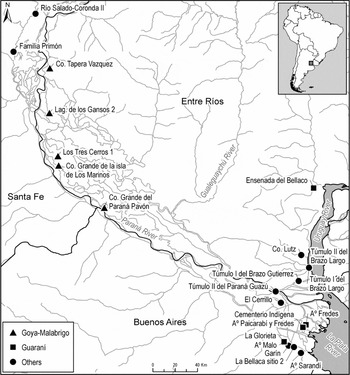
Our objective is to analyze paleodiets and explore the role of crops among the different populations that inhabited the Paraná Delta during prehispanic times. We present environmental information from the studied area, along with isotopic data (δ15N and δ13C performed on collagen and apatite fractions) from food resources and human remains recovered at sites assigned to different archaeological entities (Goya-Malabrigo, Guaraní, and others without an archaeological entity or cultural attribution) on the islands of the Paraná Delta and the adjacent littoral environments in the Paraná River floodplain (Figure 1). We present new isotopic data and review data published by other authors (e.g., Feuillet Terzaghi Reference Feuillet Terzaghi2008; Loponte and Acosta Reference Loponte, Acosta, Bayón, Pupio, González, Flegenheimer and Frère2007; Loponte and Kozameh Reference Loponte and Kozameh2009; Scabuzzo and González Reference Scabuzzo, Isabel González, Bayón, González, Flegenheimer, Pupio and Frére2007).
Study area with the main archaeological sites mentioned in the text.

Study Area Environment
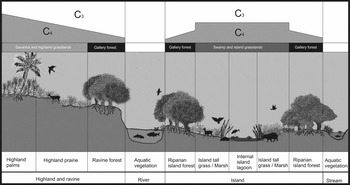
The biodiversity—current and in the recent past—of the Paraná Delta and the Lower Paraná floodplain is the result of complex factors that have to be taken into consideration in order to understand its biological composition. The region is a hydrological and geomorphological complex that receives the water of huge basins that form the La Plata Basin. According to its biotic composition, the study area is composed of different Neotropical components (sensu Morrone Reference Morrone2014) belonging to the Uruguayan District (Cabrera Reference Cabrera and Kugler1976), the Pampean Province (Morrone Reference Morrone2014), and the Campos District, with megathermal grasslands in Uruguay and southern Brazil. The region also contains the Espinal District, which has xeric components linked to the Chaco and Patagonian regions, and the Forest District. The latter consists of multilayered forests located close to rivers and wetlands. This mixture of components is most evident in the Paraná Delta, where these components coexist within a mosaic landscape of fluvial, wetland, and terrestrial environments (Burkart Reference Burkart1975). The physiognomic profile of the delta vegetation comprises multilayered riparian forests and wetlands, and local expressions of temperate grasslands, scrublands, and savannahs. The last are more dominant in Central and North Entre Ríos (Figure 2).
Profile vegetation reconstruction of the Paraná Delta with an estimate of C3 and C4 plant abundance.

Considering its vascular plant diversity (Zuloaga et al. Reference Wilmson1999), the Mesopotamic region presents impoverished biodiversity indexes in Misiones, Corrientes, and Entre Ríos Provinces, with Entre Ríos possessing the least diversity and the fewest endemic taxa. Its thermal requirements according to the 1948 Thornthwaite classification (adapted to South America by Burkart [Reference Burkart1975]) are microthermal (climate with low annual mean temperatures, generally between 0 and 14°C, short summers, and potential evaporation between 14 and 43 cm), mesothermal (climate that lacks persistent heat or persistent cold, with potential evaporation between 57 and 114 cm), and megathermal (climate with persistent high temperatures and abundant rainfall, and potential annual evaporation in excess of 114 cm). This is important because it implies seasonal differences in the grassland vegetation during winter-spring-summer (mainly micro- or mesothermal C3 grasses) and summer-autumn (mainly megathermal C4 grasses).
Burkart (Reference Burkart1975) makes a clear differentiation between the mega- and microthermal grasslands of South America, which in terms of the grasses’ photosynthetic pathway would predominantly consist of C4 and C3, respectively, (megathermal grassland has some BEP clade components that are C3—Bambusoideae and Oryzoideae—while Pooideae, the other C3 component, is principally present in microthermal austral grasslands). The mesothermal grasslands, with intermediate temperature requirements and mesothermal components, along with a mix of megathermal and microthermal tribes (Bambuseae, Arundineae, Aveneae, Agrosteae, Triticeae, Phalarideae, Danthonieae, Pappophoreae, Meliceae, Sporoboleae, Stipeae, Chlorideae, Eragrosteae, Aristideae, Paniceae, and Andropogoneae), predominate as environmental conditions change during the year. Specifically, microthermal components (C3) predominate in the Pampean region, while mega-thermal components (C4) are dominant in the Campos region of southern Brazil and Uruguay. The Entre Ríos grasslands (Mesopotamic prairie sensu Cabrera Reference Cabrera and Kugler1976) provide the best mesothermal example, with marked winter and summer phases (Burkart Reference Burkart1975). Therefore, some herbivores (with mixed C3/C4 diet, such as capybaras) have seasonal and landscape changes (feeding on microthermal grasses in winter and megathermal grasses in summer, or different compositional grasses between the highlands and wetlands); this is different from other herbivores that have a marked selectivity in their intake (such as coypus and cervids).
Badano and Burkart (Reference Badano and Burkart1972) analyzed native grass components of the grasslands of Argentina (in Buenos Aires and Entre Ríos Provinces) and Uruguay. In the region, their results show the presence of megathermal tribes (59.07 percent), with Paniceae and Andropogoneae as the most abundant; mesothermal tribes (2.92 percent); and microthermal tribes (38.01 percent), with Festuceae and Stipoideae as the most abundant.
The majority of the Paraná Delta fauna belongs to the Subtropical Domain (Subregion Guyano-Brasileña) and the Mesopotamic District (sensu Ringuelet Reference Ringuelet1961). It also has characteristics of the Pampean District. Cervids (Blastocerus dichotomus, Ozotocerus bezoarticus, Mazama guazoupira) were abundant in the delta and its adjacent plains in the distant past and in recent times. Rodents (Hydrochaeris hydrochaeris, Myocastor coypus, Cavia aperea), canids (Chrysocyon brachyurus, Cerdocyon thous, Lycalopex gymnocercus), and felines (Puma concolor, Panthera onca, and Oncifelis geoffroyi), among many others, also were common. Reptiles (Tupinambis merinae and Phrynops hilarii) and birds (including different families such as Podicipedidae, Phalacrocoracidae, Ardeidae, and Psittacidae) are still very abundant and diverse. Predominant freshwater fish comprise the orders Characiformes (e.g., Salminus brasiliensis, Leporinus obtusidens, Pochilodus platensis, and Hoplias malabaricus) and Siluriformes (e.g., Pterodoras granulosus, Pimelodus clarias, Rhamdia sapo, and Pseudoplatysto macorucans).
The Archaeological Scenario
Two main archaeological cultures have been defined for the Paraná Delta: Goya-Malabrigo and Guaraní. The hunter-gatherers and fishers who inhabited the alluvial plain of the Middle and Lower Paraná and Lower Uruguay Rivers from ca. 2000 14C years B.P. until the seventeenth century are called Goya-Malabrigo by archaeologists (Ceruti Reference Ceruti2003). Their settlements consisted of different sorts of sites, anthropogenic earth mounds (locally called cerritos) being the most visible. These mounds were used as living spaces as well as burial places, which included complex mortuary treatments in primary and secondary burials (with high MNI, not in urns). The Goya-Malabrigo archaeological entity (Ceruti Reference Ceruti2003; Politis and Bonomo Reference Politis and Bonomo2012) has distinctive pottery with incised decorative designs (drag and jab), zoomorphic appendages (especially birds but also mammals, reptiles, and mollusks), closed-mouth vessels, spouted spoons, beads, and spindle whorls. Truncated cone-shaped pottery pieces modeled with bird head appendages called campanas (bells) are also characteristic. Subsistence was based on mammal hunting for animals such as coypu (Myocastor coypus), capybara (Hydrochaeris hydrochaeris), wild cavy (Cavia aperea), and cervids (Blastocerus dichotomus [marsh deer], Ozotoceros bezoarticus [Pampas deer], and Mazama sp. [brocket deer]) and fishing (Characiformes and Siluriformes). To a lesser extent, Goya-Malabrigo people also exploited birds, reptiles, and freshwater mollusks (Bastourre Reference Bastourre2014; Bonomo et al. Reference Bonomo, Castro and Silva2014; Cornero et al. Reference Cornero, Solomita, Curetti, Oliva, de Grandis and Rodríguez2007; Piccoli Reference Piccoli2015). It was hypothesized that there was consumption of some cultivated plants at Goya-Malabrigo (e.g., Serrano Reference Serrano1972) based on early colonial accounts referring to local ethnic groups named Chaná-timbú (e.g., García Reference García and Madero1902 [1528] and Ramírez Reference Ramírez and Madero1902 [1528]), who were the ethnographic expression of Goya-Malabrigo during early colonial times.Footnote 1 More recent starch and phytolith analyses have demonstrated evidence of maize, beans, and squash in many prehispanic Goya-Malabrigo sites (Bonomo, Aceituno, Politis, and Pochettino Reference Bonomo, Aceituno, Politis and Pochettino2011; Colobig et al. Reference Colobig, Sánchez and Zucol2015; Cornero and Rangone Reference Cornero and Rangone2013; Sánchez et al. Reference Sánchez, Milagros Colobig, Zucol, Politis, Bonomo and Castiñeira2013). These new findings support the inference that there was consumption and cultivation of these crops, raising new perspectives and research problems that can be addressed via isotope analyses.
Guaraní sites are identified in the Paraná Delta on the basis of a highly distinctive corrugated and polychrome pottery, polished axes, and burial urns. The Guaraní speak a language related to Tupí, which originated in the Amazon basin (Noelli Reference Noelli1993). They initiated their diffusion throughout the La Plata Basin at around 2000 years B.P. (see model of expansion in Bonomo et al. Reference Bonomo, Angrizani, Apolinaire and Noelli2015), reaching the Paraná Delta around 690 14C years B.P. (Loponte and Acosta Reference Loponte, Acosta, Bayón, Pupio, González, Flegenheimer and Frère2007). These groups also intensively exploited mammals from aquatic environments (marsh deer, capybara, and coypu) and fish (Bogan Reference Bogan2005; Loponte et al. Reference Loponte, Acosta, Capparelli and Pérez2011). Based on human bone isotopic data from Guaraní sites, Loponte and Acosta (Reference Loponte, Acosta, Bayón, Pupio, González, Flegenheimer and Frère2007) have proposed that these people ate maize. This coincides with the available ethnohistorical information on the Guaraní from the sixteenth to nineteenth centuries (see Noelli Reference Noelli1993). On the regional scale, it has been proposed that Guaraní farmers brought cultivation practices to this area (e.g., Rodríguez Reference Rodríguez2004; Schmitz Reference Schmitz and Kern1991). Local populations such as the Goya-Malabrigo people, whose economy had depended solely on hunting, fishing, and gathering, adopted horticulture from the Guaraní or exchanged crops with them.
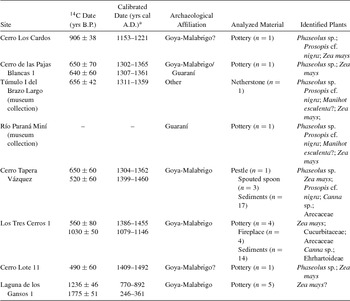
In order to assess the hypothesis that Guaraní groups introduced horticulture to the Paraná Delta and to determine the vegetal components of prehispanic diets in the study area, we have conducted interdisciplinary studies with archaeobotanical and paleobotanical specialists since 2006 (Bonomo, Aceituno, Politis, and Pochettino Reference Bonomo, Aceituno, Politis and Pochettino2011; Bonomo, Colobig, Passeggi, Zucol, and Brea Reference Bonomo, Milagros Colobig, Passeggi, Zucol and Brea2011; Colobig et al. Reference Colobig, Zucol, Bonomo and Politis2014; Sánchez et al. Reference Sánchez, Milagros Colobig, Zucol, Politis, Bonomo and Castiñeira2013). As a result, micro- and macrobotanical remains from Goya-Malabrigo and Guaraní sites, along with sites without any cultural attribution, have been studied. The botanical microremains include 53 samples of pottery, lithic grinding artifacts, hearths, and sediments from six archaeological sites in the Upper Delta of the Paraná River and two museum collections from the Lower Delta (Table 1). In these sites, dated between 1775 and 409 14C years B.P., phytoliths and starches of several plants were registered: palm (Arecaceae), algarrobo (Prosopis cf. nigra), achira (Canna sp.), and wild rice (Ehrhartoideae). All plants occur naturally in the area and have economic or medicinal properties. The local palms, yatay (Butia yatay) and pindó (Syagrus romanzoffiana), have edible fruits with high economic value, big leaves that are used elsewhere for dwellings (especially for roofs), and diverse artifacts and trunks that are used as beds for larvae (Bonomo and Capeletti Reference Bonomo and Capeletti2014). Algarrobo is a useful plant for producing flour, bread, fermented drinks, and jelly, and its use has been widely reported in other regions of Argentina (e.g., Pastor and López Reference Pastor, López, Korstanje and Quesada2010). Achira tuber is an edible plant with medicinal properties. Wild rice is rare in the area but its presence might represent a subsistence exploitation, as is often illustrated in the ethnographic record from the La Plata river Basin (Eremites de Oliveira Reference Eremites de Oliveira1995).
Summary of the Identified Plants in the Paraná Delta.

aUsing Calib 7.0.4 Software, 1 Sigma Ranges and the SHcal13 Calibration Curve
Microremains of crop plants were also recorded: cucurbits (Cucurbitaceae), Phaseolus beans (Phaseolus sp.), maize (Zea mays), and possibly domestic manioc (Manihot esculenta) (Bonomo, Aceituno, Politis, and Pochettino Reference Bonomo, Aceituno, Politis and Pochettino2011; Bonomo, Colobig, Passeggi, Zucol, and Brea Reference Bonomo, Milagros Colobig, Passeggi, Zucol and Brea2011; Sánchez et al. Reference Sánchez, Milagros Colobig, Zucol, Politis, Bonomo and Castiñeira2013). Beans and maize were the most frequently recorded taxa in the delta. They have been recorded in all the analyzed sites (except that beans have not been recorded in the Los Tres Cerros 1 site). Maize represents the earliest of any recorded domestic plant in the delta. Phytoliths from the lower levels of Los Tres Cerros 1 indicate the presence of this crop prior to 1030 14C years B.P. There is some preliminary evidence of maize starches in the Laguna de los Gansos 1 site, dated between 1236 and 1775 years B.P. (Colobig et al. Reference Colobig, Zucol, Bonomo and Politis2014), but this has yet to be confirmed. The use of flotation technique made it possible to find charred maize seeds at levels dated to ca. 580 and 860 years B.P. at Los Tres Cerros 1 (Colobig et al. Reference Colobig, Sánchez and Zucol2015). These three kinds of proxies (phytoliths, starches, and macroremains) bring us direct evidence of the presence of a widespread American complex of seed crops in the Paraná Delta: the triad of the corn-bean-squash complex (Landon Reference Landon2008; Smith Reference Smith1992; Wilmson Reference Wilmson1999:64–65). The results of our studies confirm the presence of domestic plants among the Guaraní and Goya-Malabrigo populations, even though the latter have been traditionally considered dependent on hunting, gathering, and fishing. Recent studies have also corroborated the presence of crops in other Goya-Malabrigo sites from the Middle Paraná River (Colobig and Ottalagano Reference Colobig and Ottalagano2013; Cornero and Rangone Reference Cornero and Rangone2013; Piccoli Reference Piccoli2015). Thus, in order to evaluate the diet components of the different populations that inhabited the area during the Late Holocene, in recent years we have begun the isotopic studies that we present below (see also Loponte and Kozameh Reference Loponte and Kozameh2009; Ottalagano and Loponte Reference Ottalagano and Loponte2016).
Materials
This work presents for the first time the results of the isotopic analyses of the compositional variations of δ13C—from collagen and apatite—and δ15N conducted on 22 human samples (mostly adult individuals) from 15 archaeological sites in the Paraná Delta and adjacent plains dated 2000 years B.P. and later. Only well-preserved samples were included in the selection. Some bone collagen δ13C values were reported along with AMS radiocarbon assays, and others were obtained from laboratories specializing in isotopic studies. When both data sources of δ13CCOL values were available, the results from specialized laboratories were used.
In addition, isotopic data from 16 human samples published by other research teams working in and near the study area were analyzed (Arrizurieta et al. Reference Arrizurieta, Mucciolo, Musali, Berón, Luna, Bonomo, Montalvo, Aranda and Carrera Aizpitarte2010; Feuillet Terzaghi Reference Feuillet Terzaghi2008; Loponte and Acosta Reference Loponte, Acosta, Bayón, Pupio, González, Flegenheimer and Frère2007; Loponte and Kozameh Reference Loponte and Kozameh2009; Loponte et al. Reference Loponte, Acosta, Capparelli and Pérez2011). Ottalagano and Loponte (Reference Ottalagano and Loponte2016) reported new isotopic data for Goya-Malabrigo human samples, which we also briefly discuss. Finally, isotopic values of 37 samples from the 7 extant and archaeological faunal resources from the Paraná Delta, the Salado River Depression, and the northern Pampas region are presented (Corriale and Loponte Reference Corriale and Loponte2015; Loponte and Corriale Reference Loponte and Corriale2013; Scabuzzo and González Reference Scabuzzo, Isabel González, Bayón, González, Flegenheimer, Pupio and Frére2007). In summary, we compiled 123 isotopic analyses from 75 human and faunal samples consisting of samples from sites and collections investigated by the authors (n = 24) and from published scholarship (n = 51).
The data from the samples analyzed by Loponte and Acosta (Acosta and Loponte 2002/Reference Acosta and Loponte2004:Tables 1 and 2; Loponte Reference Loponte2008:Table 7.3.1; Loponte and Acosta Reference Loponte, Acosta and Mengoni Goñalons2004:Table 4, 2007:Table 1; Loponte et al. Reference Loponte, Acosta, Musali, Grier, Kim and Uchiyama2006:Figure 10; Loponte and Corriale Reference Loponte and Corriale2013:Table 1) have been partially included. We detected several inconsistencies in the values for the same samples, namely, differences between the values of δ13CCOL (discrepancies in the data on samples UGA-8780, UGA-9905, UGA-9906, and Beta-148237), δ13CAP (samples UGA-8780, UGA-9905, and UGA-9906), and δ15N (UGA-8780), between the radiocarbon dating and their standard deviations (Beta-148237, AA-97458, AA-97467), and in the laboratory codes (the same data have different codes: Beta-147108 and Beta-177108; AIE-11719/25 and AIE 11725). Minor variations were found between published radiocarbon dates associated with isotopic values, and it was not specified if they correspond to the same sample or if they are part of other materials dated on the site. There are also discrepancies between the identified species in the samples before their laboratory processing. For example, Beta-147109 in Loponte and Corriale (Reference Loponte and Corriale2013:Table 1) is described as a B. dichotomus bone tissue sample, whereas in prior papers (e.g., Loponte Reference Loponte2008:286; Loponte and Acosta Reference Loponte, Acosta and Mengoni Goñalons2004:Table 1) this sample was described as splinters of undetermined Mammalia. Finally, according to the Museum of La Plata catalogue numbers (MLP- N° 6630 and 6631), the samples AIE-12365/409 and AIE-11719/25, listed as coming from the Arroyo Malo archaeological site (e.g., Loponte Reference Loponte2008:Table 7.3.1) correspond to the La Glorieta site. These inconsistencies reduce the potential of this dataset to be compared and discussed with the results obtained in the present study.
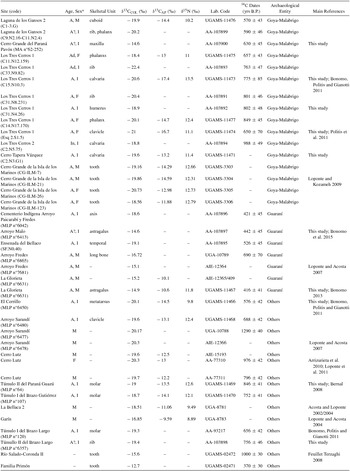
Human Bone Isotopic Values from Sites Assigned to Goya-Malabrigo, Guaraní, and Others Group.

aA: adult; Ad: adolescent; In: infant; M: male; F: female; I: indeterminate.
The isotopic data on potential faunal resources from archaeological sites (n = 20 samples) and current fauna (n = 17; Corriale and Loponte Reference Corriale and Loponte2015) include medium-to-large herbivores (Ozotoceros bezoarticus and Blastocerus dichotomus cervids), rodents (Myocastor coypus and Hydrochaeris hydrochaeris), aquatic birds (Anatidae or Rallidae), and fishes (Rhamdia sapo and Pimelodidae). The isotopic data obtained from these species correspond to 37 δ13CCOL values (most of which were reported along with AMS radiocarbon datings), 5 δ13CAP values, and 5 δ15N values (Supplemental Table 1). Finally, isotopic values from some of the wild and domesticated C3 plants (Prosopis sp., Lagenaria sp., Phaseolus vulgaris, and Cucurbita maxima) and C4 plants (Zea mays), which are represented in the archaeological record of the Paraná Delta, were also registered. As there are no available isotopic data for vegetables in the study area, published information from other areas (Gil et al. Reference Gil, Neme and Tykot2010; Laguens et al. Reference Laguens, Fabra, Santos and Demarchi2009) was used instead (Supplemental Table 2).
The analyzed samples from human remains were divided into three groups according to their attributed sites (Goya-Malabrigo and Guaraní sites) or the “Others” category, which represents a heterogeneous assemblage of sites that have not been assigned to Guaraní or to Goya-Malabrigo (Table 2). This is either because the information is insufficient or the sites are associated with the archaeological record generated by other populations (e.g., hunter-gatherer sites from the northern Pampas, or Lower Delta sites that are seemingly not Goya-Malabrigo).
The human remains from Goya-Malabrigo sites include 16 samples from 6 archaeological sites that add up to 36 isotopic values of δ13CCOL, δ13CAP, and δ15N (Table 2 and references therein). A total of 7 samples of human remains from 5 Guaraní sites were analyzed, consisting of 10 isotopic values (Table 2). The group Others includes 30 isotopic values of δ13CCOL, δ13CAP, and δ15N from 11 sites on the Lower Paraná (Table 2). The methodological principles and steps involved in sample processing are included in the Supplemental Material (Supplemental Text 1).
Results
The Exploited Resources
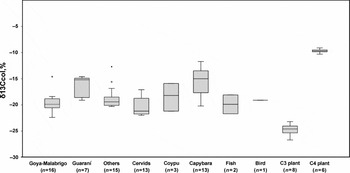
The medium-to-large herbivores show a range of δ13CCOL values between −22‰ and −17.1‰ (
 $\bar{x}$
= −20.4‰). This indicates a predominant consumption of C3 plants (Loponte and Corriale Reference Loponte and Corriale2013; Figure 3). Regarding the marsh deer, there is a difference of close to 5‰ in δ13CCOL values, which shows consumption of diverse vegetal formations. The only δ15N datum in this group (5.2‰) is consistent with the expected values for animals with herbivore habits (Supplemental Table 1).
δ13CCOL values of the three analyzed groups and of the potential resources.

Among the small mammals, the coypu has δ13CCOL values between −21.2 and 15.9‰. This ample range indicates the consumption of C3 plants and, in the case of the isotopic datum from the La Guillerma 5 site, C4 plants as well (Scabuzzo and González Reference Scabuzzo, Isabel González, Bayón, González, Flegenheimer, Pupio and Frére2007). The consumption of C4 plants is also supported by the enriched δ13CAP value. On the other hand, the capybara shows δ13CCOL values between −20.2 and −11.7‰ (
$\bar{x}$
= −15.7‰), reflecting primary consumption of C3 plants, even though the more enriched values indicate C4 plant intake (Corriale and Loponte Reference Corriale and Loponte2015). Among the continental fishes, the δ13CCOL values come from catfish and Pimelodidae family fishes, which vary between −21.7 and −18.9‰. These impoverished δ13CCOL values overlap with the large and medium mammal signals. Both fish species have δ13C data from the inorganic fraction (
$\bar{x}$
= −8.66‰) and two δ15N values (6.1 and 7.9‰) that are consistent with values for animals that inhabit continental water bodies. Aquatic birds present values from the three types of isotopes. The impoverished δ13CCOL values overlap with medium and large mammal values and with coypu and fresh water fish values (Figure 3). The highest δ15N resembles fish values and it is separate from the coypu and the pampas deer (Supplemental Table 1).
As shown in Supplemental Table 2, the mean δ13CCOL values for C3 plants is 24.7‰, and it ranges between −26.7 and −23.2‰ (Figure 3), while the δ15N varies between 5.5 and 13.1‰, with an average of 9.4‰. Maize presents the highest δ13C values (
$\bar{x}$
= −9.6‰; Figure 3) and δ15N values ranging from 3.9 to 10.2‰ (
$\bar{x}$
= 6.8‰). It is interesting to note the enrichment of some of the 15N values on vegetables with both photosynthetic pathways, which in some cases are even higher than those obtained for the herbivores from the area. Future work should address this fundamental aspect by obtaining isotopic results for the local flora.
To sum up, considering all δ13CCOL values from faunal and plant resources, we note that three groups can be isotopically distinguished: 1) C3 photosynthetic pathway vegetables with values lower than −23.2‰; 2) medium-to-large herbivores (cervids), coypu, capybara, fish, and birds (small prey) with values between −22 and −12‰; and 3) C4 plants with values greater than −10.3‰ (Figure 3).
Human Remains
The human remains from Goya-Malabrigo sites have a δ13CCOL value ranging from −22.4 to −14.6‰ (
$\bar{x}$
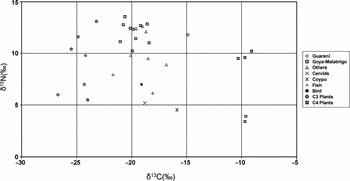
= −19.6‰; Table 2 and Figure 3). The average value is the lowest of the three groups and resembles the one obtained for cervids and continental fish. This shows that C3 plants were an important resource in this group's diet and that C3 plant-consuming terrestrial animals and continental fish were also added to the diet. However, the most enriched isotopic signal (−14.6‰) from Cerro Grande del Paraná Pavón sample would be consistent with the intake of C4 plants, as well as the consumption of small animals such as capybara, which can sometimes show high values. The δ15N vary between 10.2 and 13.5‰ (
$\bar{x}$
= 12‰; Figure 4), reflecting an important meat component in the diet, even though human δ15N values are remarkably enriched in relation to the δ15N averages of herbivores and continental fishes (
$\bar{x}$
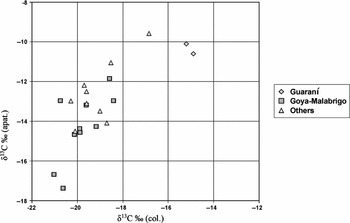
= 6.1‰; Figure 4). This difference could indicate the consumption of some other resource with high 15N values. On the other hand, the δ13CAP isotopes range between −17.4 and −11.8‰ (
$\bar{x}$
= −14.3‰; Figure 5). These values fall into the expected range for herbivore and omnivore diets based on wild or domesticated C3 plants (Gil et al. Reference Gil, Neme and Tykot2010). In the Cerro Grande de la Isla de los Marinos site, the isotopic values were attributed to the consumption of C3 plants and terrestrial animals that consumed these vegetables (Loponte and Kozameh Reference Loponte and Kozameh2009).
Correlation of the δ13CCOL and δ15N values for the human groups and resources.

Relationship between δ13C values in collagen and apatite for human groups.

The Guaraní sites present 7 δ13CCOL values with an average of −16.3‰ and a range between −19.1 and −14.6‰ (Table 2 and Figure 3). In general terms these more enriched isotopic signals indicate that diets based on C3 plant-consuming herbivores and continental fish would have incorporated a greater amount of food with higher levels of δ13C values, such as C4 plants (see Loponte and Acosta Reference Loponte, Acosta, Bayón, Pupio, González, Flegenheimer and Frère2007) or meat of small herbivores such as capybara or coypu. Two samples from the La Glorieta site provided two δ13CAP values of −10.6 and −10.1‰ (Figure 5). They are notably higher than those from the Goya-Malabrigo group and show greater C4 plant intake. Finally, the only 15N value obtained for Guaraní is 11.8‰, which is close to the average for Goya-Malabrigo (Figure 4).
In the Others group, the δ13C data from the organic fraction range between −20.3 and −12.7‰, thus presenting the greatest dispersion (Table 2 and Figure 4). The average (−18.66‰) indicates diets based on C3 plant-consuming herbivores, continental fish and, in some cases, the direct consumption of C3 plants (Figure 3). The most enriched δ13C values from the Garín, Río Salado-Coronda II, and Familia Primón sites represent intakes of food with high levels of 13C, such as C4 plants or some small herbivores (see Loponte and Acosta Reference Loponte, Acosta, Bayón, Pupio, González, Flegenheimer and Frère2007 for the Garín site). The data from Río Salado-Coronda II (δ13C #x003D; −15.6‰) and Familia Primón (δ13C = −12.7‰) sites were obtained from tooth samples (Feuillet Terzaghi Reference Feuillet Terzaghi2008). Depending on what tooth was analyzed, it might reflect the individual's diet at different times during infancy, childhood, or youth. The apatite δ13C values range from −14.5 to −9.6‰ and show an average of −12.6‰; this is an intermediate value in relation to those calculated for the other two groups (Figure 5). The δ15N values range between 8.8 and 12.6‰ (Figure 4), with an average of 10.8‰, which indicates that the individual's diet included a variable amount of protein from aquatic and terrestrial animals.
Discussion
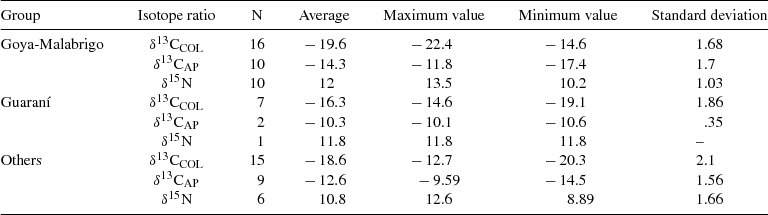
The isotopic data from samples of human remains as a group present a δ13CCOL range from −22.4 to −12.7‰ (n = 38), a δ13CAP from −17.4 to −9.6‰ (n = 21) and a δ15N from 8.89 to 13.5‰ (n = 17) (Table 3). The comparison among the three groups of averages for δ13CCOL showed statistically significant differences (ANOVA, p < .05) between Goya-Malabrigo and Guaraní sites. This indicates that Goya-Malabrigo and Guaraní groups used different protein sources. Not enough data are available to carry out statistical tests on δ13CAP and δ15N.
Descriptive Statistics of δ13C (Collagen and Apatite) and δ15N by Human Group.

Isotopic results for human skeletons from Goya-Malabrigo sites indicate a diet largely based on a substantial intake of C3 plants, terrestrial animals that were C3 plant-consumers, birds, and freshwater fish. Some individuals have high δ13CCOL values, which suggests the consumption of C4 plants or small mammals. These results coincide with the archaeofaunal and archaeobotanical deposit records, which include abundant bones of freshwater fish, coypu, capybara, and large cervids as well as algarrobo, bean, and squash microremains. On the other hand, the δ13CAP values, which are good indicators of vegetable consumption, strongly suggest the intake of C3 plants.
In contrast, the high levels of 15N in Goya-Malabrigo samples show the consumption of some 15N enriched resources. The intake of marine food could be a possibility, but recurring consumption of these resources is not consistent with the geographic location of the sites (most are more than 200 km away from the coast) or with the archaeofaunal record. Even though there are some isolated records of marine mammals in archaeological sites from the floodplains of the Lower Paraná Delta, they do not seem to have influenced the diet. Marine resource consumption would also enrich δ13CCOL, which is not observed in these samples. A more realistic possibility is the consumption of fish and birds (or other fluvial resources) with higher nitrogen values (
$\bar{x}$
= 7‰) than terrestrial herbivores. A third possible explanation for the high nitrogen value may be vegetables (algarrobo and squash), which show high 15N values in some casesFootnote
2
(Supplemental Table 2). The available isotopic data do not favor either of the last two possibilities.
The average ranges and values of δ13CCOL (−19.4‰) and δ15N (11.8‰) presented for Goya-Malabrigo by Ottalagano and Loponte (Reference Ottalagano and Loponte2016) coincide with ours, although their range for δ13CAP is smaller (between −14.6 and −11.9‰). These authors interpret the enriched N and depleted C levels as resulting from a “strong emphasis on fish consumption and, certainty, limited direct consumption of plant resources” (Ottalagano and Loponte Reference Ottalagano and Loponte2016:8). However, a higher consumption of C3 plants cannot be ruled out, because they have depleted δ13CCOL and δ13CAP and, as we show in Supplemental Table 2, an enriched δ15N.
Regarding the isotopic results on samples of human remains from Guaraní sites, the higher δ13C values mark the intake of C4 plants, which include maize and other wild vegetables (e.g., Sarcocornia ambigua, Chenopodium hircinum). Nevertheless, none of the values fall within the ranges established for diets rich in C4 plant consumption (higher than −14‰, sensu Gil et al. Reference Gil, Neme and Tykot2010). The same tendencies have been observed regarding the δ13C values from the inorganic fractions.
Traditionally, it has been proposed that it was Guaraní groups who introduced horticulture into the region (Rodríguez Reference Rodríguez2004; Schmitz Reference Schmitz and Kern1991). According to this hypothesis, once the Guaraní had settled in areas such as the Paraná Delta, the local hunter-gatherer-fisher groups adopted horticultural practices into their economies, or they obtained crops by exchanging with the Guaraní. Some researchers (Loponte and Acosta Reference Loponte, Acosta, Bayón, Pupio, González, Flegenheimer and Frère2007; Loponte et al. Reference Loponte, Acosta, Capparelli and Pérez2011; Ottalagano and Loponte Reference Ottalagano and Loponte2016) are still influenced by this idea and, based on the isotopic results of some individuals, they regard all non-Guaraní groups (named Goya-Malabrigo and Others in this study) from the Middle and Lower Paraná River as complex hunter-gatherers. From their perspective, the presence of crops among non-Guaraní populations is considered the result of their “manipulation” and exchange with Guaraní groups.
Many archaeobotanical studies show that the local populations, like those represented by the Goya-Malabrigo archaeological entity, were able to produce their own food. The earliest evidence of domestic plants in the Paraná Delta is dated before ca. 1030 years B.P. and comes from Los Tres Cerros 1, a Goya-Malabrigo site. This chronology could be even ca. 700 years earlier if the presence of maize is confirmed at the Laguna de los Gansos site (1775 14C years B.P.). On the basis of the available data, the earliest Guaraní settlement in the delta is dated at ca. 690 14C years B.P. Therefore, there is evidence of crops in the area between 300 and 1,000 years before the arrival of the Guaraní. Moreover, the cultivation of the crop triad coincides with the historical account from the very first contact related to the Chaná-timbú groups: “los Carcarais y tinbus sienbran abati [maize] y calabaças [squash] y habas [beans]” (Ramírez Reference Ramírez and Madero1902 [1528]:400, among several others).
The archaeobotanical evidence from several centuries before the arrival of the European conquerors and archaeofaunal studies of the sites show that the Goya-Malabrigo economy combined wild and domesticated resources (Bonomo, Aceituno, Politis, and Pochettino Reference Bonomo, Aceituno, Politis and Pochettino2011; Politis and Bonomo Reference Politis and Bonomo2012). For this reason, we believe it can be classified as a mixed economy (Bonomo et al. Reference Bonomo, Castro and Silva2014; Gianotti and Bonomo Reference Gianotti and Bonomo2013) in which hunting, fishing, and gathering were combined with horticulture. The concept of mixed economyFootnote 3 has been used previously in the archaeology of the region (Ledesma Reference Ledesma1993:3) and elsewhere in South America (e.g., Dillehay Reference Dillehay2013; Iriarte Reference Iriarte2006; Medina et al. Reference Medina, Pastor and Berberián2014) to refer to a great variety of intermediate economies that are not entirely hunting-gatherers or dependent on intensive agriculture. The general concept of a combination of different subsistence choices (Kent Reference Kent1989) should not be confused, as in the case of Ottalagano et al. (Reference Ottalagano, Darigo, Pereyra, Brancatelli and Iannelli2015), with the concept of mixed diets, since it refers to the intake of C3, C4, and CAM resources (Gil et al. Reference Gil, Neme and Tykot2010) or the combination of terrestrial with marine resources (Barberena Reference Barberena2002), and it is established by intervals of δ13C and δ15N values. Consequently, what we have proposed is the existence of a mixed economy, not mixed diets. Therefore, the criticism made by Ottalagano et al. (Reference Ottalagano, Darigo, Pereyra, Brancatelli and Iannelli2015) becomes meaningless, because they confuse two different concepts: diet and economy.
Ottalagano and Loponte (Reference Ottalagano and Loponte2016) repeat the same mistake and make a new one. They recently stated that the archaeobotanical identification of microremains from maize, squash, and beans in Goya-Malabrigo contexts “led some authors [Bonomo, Aceituno, Politis, and Pochettino Reference Bonomo, Aceituno, Politis and Pochettino2011; Bonomo, Colobig, Passeggi, Zucol, and Brea Reference Bonomo, Milagros Colobig, Passeggi, Zucol and Brea2011] to suggest the existence of a mixed economy, which would imply a significant degree of dependence on plant products” (Ottalagano and Loponte Reference Ottalagano and Loponte2016:2). This statement is wrong. First, in one paper (Bonomo, Colobig, Passeggi, Zucol, and Brea Reference Bonomo, Milagros Colobig, Passeggi, Zucol and Brea2011) we do not even mention a mixed economy and in the other (Bonomo, Aceituno, Politis, and Pochettino Reference Bonomo, Aceituno, Politis and Pochettino2011) we proposed a mixed economy in which the crops were integrated into a hunter-gatherer-fisher subsistence. Second, as we have clearly stated in many papers (e.g., Bonomo, Politis, and Gianotti Reference Bonomo, Politis and Gianotti2011; Politis and Bonomo Reference Politis and Bonomo2012), we proposed that squash, beans, and maize were cultivated in “house-gardens” and that horticulture was small scale. Therefore, we have never proposed that a “significant degree of dependence” or “significant role” of cultivars existed in the Goya-Malabrigo economy.
The archaeobotanical evidence summarized above does not provide detailed information about the diet composition of the different populations from the Paraná Delta. In this sense, a multidisciplinary approach combining archaeo-botanical data with stable isotopes seems to be the most fruitful research strategy. In the first place, a series of limitations should be taken into account when interpreting the obtained results. The δ13CCOL stable isotopes make it possible to identify C4 plants only when there was intensive consumption by many individuals. Among the crops often identified within the botanical microremains in the delta Goya-Malabrigo sites, maize could be isotopically differentiated if it was intensively consumed. Other important crops with the C3 photosynthetic pathway, such as beans and squash, are isotopically undifferentiated from other C3 plants that are present in the environment and were possibly consumed (Arecaceae and Ehrhartoideaeand Canna sp., among other edible wild plants). Beyond this discussion regarding maize, the impoverished values of 13C in organic and inorganic fractions show the consumption of C3 vegetables, which could be either wild or cultivated (such as beans and squash). In order to analyze their contribution to the prehispanic diet, isotopic analyses are needed on both wild and domesticated local plants. It is also necessary to include a greater number of δ13C studies from the inorganic fraction, since it has been widely established that the consumption of plant resources is detectable through these analyses (Ambrose and Norr Reference Ambrose, Norr, Lambert and Grupe1993; Gil et al. Reference Gil, Villalba, Ugan, Cortegoso, Neme, Michieli, Novellino and Duran2014; Tieszen and Fagre Reference Tieszen, Fagre, Lambert and Grupe1993).
Agricultural and horticultural food production are not restricted to maize (see discussion of the maize-centric perspective in Hastorf Reference Hastorf and Oyuela-Caycedo1994:146–151 and Iriarte 2007:174–176). The earliest evidence of maize in Panamá (7800 years B.P.; Dickau et al. Reference Dickau, Ranere and Cooke2007), Colombia (7000 years B.P.; Aceituno and Loaiza Reference Aceituno and Loaiza2007), and Ecuador (7000 years B.P.; Piperno and Pearsall Reference Piperno and Pearsall1998) shows that a considerable part of the Holocene (more than 2,000–3,000 years) went by before this crop became a staple element in the diet. For several millennia, maize remained a minor and subsidiary crop (Vrydaghs and Denhan Reference Vrydaghs, Denham, Denham, Iriarte and Vrydaghs2007), and it was incorporated into the diet probably not to meet calorie needs, but perhaps for symbolic purposes or to accompany other activities at specific times (Hastorf Reference Hastorf and Oyuela-Caycedo1994:144). All this indicates an extended period in which, although maize was a component of the diet, it is not likely to be isotopically detected.
In neighboring regions, such as Uruguay, in societies first characterized as hunter-gatherers, evidence of crops has been found from very early times, more than 4000 years B.P. (Beovide Reference Beovide, Feuillet, Colasurdo, Sartori and Escudero2011; Iriarte Reference Iriarte2006, Reference Iriarte, Denham, Iriarte and Vrydaghs2007), or in more recent times, around 1500 years B.P. (del Puerto and Inda Reference del Puerto and Inda2015). Both alternative chronologies correspond to pre-Guaraní contexts. The record of maize, beans, achira, and squash in archaeological contexts from the lowlands of eastern Uruguay are comparable to the case analyzed here, because they represent the occupation of aquatic environments by “mound-builders” with mixed economies (del Puerto and Inda Reference del Puerto and Inda2015; Iriarte Reference Iriarte2006). Stable isotope studies made by Bracco and colleagues (Reference Bracco, Fregeiro, Panarello, Odino, Souto, Durán Coirolo and Bracco Boksar2000) on 14 samples of human bones from these Uruguayan contexts do not show a strong maize signal. They obtained δ13CCOL values between −21.4 and −18.5‰ for samples dating between 2500 and 220 years B.P. Far from being interpreted as contradicting the use of cultigens, these results were explained as the consequence of a restricted contribution of maize to the diet. More recently, del Puerto and colleagues (Reference del Puerto, Bracco, Capdepont and Inda2014) have developed isotopic analyses on 12 human skeletons recovered from earthmounds. They have δ13CCOL values varying between −21.62 and −14.2‰, and δ15N between 9.18 and 18.6‰. Based on the δ13CAP values of two individuals (<−10‰), they proposed the existence of a mixed diet with maize contributions. These new studies conclude that maize was not a staple food and that its incorporation occurred later, as a supplement to a diet based mainly on animals and wild plants.
In the mountain ranges of Córdoba Province, located approximately 300 km west of the delta area, crops were incorporated into subsistence around 2500 years B.P. (Pastor and López Reference Pastor, López, Korstanje and Quesada2010). Studies of stable isotopes from 10 samples of human skeletons (δ13CCOL = −17.7 to −11.8‰; δ15N = 6.7 to 11.6‰) show mixed diets based on hunting and gathering of wild C3 species, such as algarrobo, and clear signs of maize about 1000 years B.P. (Laguens et al. Reference Laguens, Fabra, Santos and Demarchi2009). A similar situation is observed in Cuyo, a region adjacent to Córdoba, where maize, beans, squash, and algarrobo are also recorded. Here there are macroremains of maize dated at 2200 years B.P., although the new isotopic data show clear evidence of significant consumption of C4 plants only in the last 1100 years B.P. (Gil et al. Reference Gil, Neme and Tykot2010; Gil et al. Reference Gil, Villalba, Ugan, Cortegoso, Neme, Michieli, Novellino and Duran2014). Studies in Uruguay, Córdoba, and Cuyo show that although maize was known earlier, this does not necessarily imply that its importance in the diet grew rapidly (Gil et al. Reference Gil, Neme and Tykot2010:498, and references therein).
Conclusions
The isotopic analyses developed on Goya-Malabrigo samples in the present study have indicated diets that included a varied food repertoire. The signals of C4 vegetable consumption are almost absent, except at the Paraná Pavón site, which could indicate the intake of both domesticated and wild plants of this type. We emphasize the consumption of domesticated C3 plants, such as beans and squash, which have not been generally considered in paleodiet discussions. In this regard, one of the contributions of the present study is the inclusion of δ13CAP analyses in order to visualize the consumption of plants.
Studies of prehispanic diets in the Paraná Delta should not be based on a dichotomy between Guaraní farmers and local hunter-gatherers. The results obtained in this study suggest a much more complex scenario of heterogeneous economies among the groups defined in this paper. This is due to an overlapping of culinary traditions and shared preferences that are the expression of group belonging, as well as individual choices based on particular histories (Le Breton Reference Le Breton2007). A greater reliance on domesticated plants, especially on maize as a dominant staple, is clearer in the Guaraní case, even though some individuals do not show intensive or daily consumption of this resource. There was no intensive consumption of maize by most individuals of the Goya-Malabrigo group. On the other hand, the δ13C values show a predominant consumption of C3 plants that could have included wild and domesticated species. In consequence, as proposed previously based on microbotanical remains, the Goya-Malabrigo group did not rely on horticulture, in which domesticated plants supplement a diet based on wild resources. Theirs was a mixed economy that combined the provisioning of wild resources through hunting, river fishing, and gathering shellfish, fruit, and plant seeds (algarrobo, and eventually palms and wild rice). This wild resource-based diet was supplemented with food production by practicing small-scale horticulture of the maize-squash-bean triad, probably in house-gardens. In these house-gardens, several domestic plants could have been cultivated, often mixed with specimens of wild plants (C3 and C4) that were useful for humans.
The combination of extractive and productive economic strategies is the result of historical trajectories and adaptive processes of particular forms of plant and animal management within the rich aquatic environments found in the floodplain of the Paraná River. The consolidation of these mixed economies in the South American lowlands, where indigenous people did not depend on a few resources, seems to have been partly the key to their adaptive success in the extensive and rich flooded environments (Gianotti and Bonomo Reference Gianotti and Bonomo2013).
The Paraná Delta area has abundant animal and wild vegetal resources. Therefore, crops do not seem to have been introduced to meet food scarcity. As proposed by Hastorf (Reference Hastorf and Oyuela-Caycedo1994) for other regions, rather than satisfying a need for daily food intake, the presence of corn in Goya-Malabrigo sites might be better associated with the social and symbolic uses of food or stimulant drinks (chicha beer) consumed on special occasions such as rituals, ceremonies, and feasts. The record of some skeletons in the Goya-Malabrigo context with enriched δ13C values could be attributed to the existence of some individuals with specific ritual or social functions who consumed more maize than the rest of the population. Obviously, more data is needed to test this hypothesis.
Finally, we propose two possible explanations for the presence of horticulture among Goya-Malabrigo groups, excluding the proposal that it was the result of a local domestication process, since there is no supporting evidence. One possibility is that the crop complex was integrated into preexisting local hunter-gatherer-fisher economies. This could have been the result of contact with neighboring farmers who would have arrived at the Paraná Delta before the Guaraní. The other possibility is that the Goya-Malabrigo entity actually represents the outcome of a migration of people with a mixed economy, which would have generated an ethnogenesis process that created a scenario for the introduction of these crops into the Paraná Delta (see discussion in Politis and Bonomo Reference Politis and Bonomo2012). In order to test these two hypotheses, it is necessary to refine and increase isotopic analyses in the Paraná Delta and neighboring areas and also study the origin and spread of the Goya-Malabrigo archaeological entity further.
Acknowledgments
We would like to thank Ramiro Barberena and Luciano Valenzuela for their critical review and valuable comments on the manuscript, and Eduardo Apolinaire for his assistance in statistical data processing. We also wish to thank Mirta Bonnín and Andrés Izeta (Museo de Antropología de Córdoba) for providing the samples from Cerro Grande del Paraná Pavón. This research has been supported by the National Geographic Society's Committee for Research and Exploration (grant no. 9328-13) and the Wenner-Gren Foundation (grant no. 8149). We are also grateful to the five anonymous reviewers who helped us improve our work.
Data Availability Statement
Bone samples from Arroyo Malo, La Glorieta, Cementerio Indígena del Arroyo Paicarabí y Fredes, El Cerrillo, Arroyo Sarandí, Túmulo II del Paraná Guazú, Túmulo I del Brazo Gutiérrez, and Túmulo II del Brazo Largo archaeological sites are curated in the Anthropology Division of La Plata Museum, Facultad de Ciencias Naturales y Museo, Universidad Nacional de La Plata (Buenos Aires Province, Argentina). The samples from the Ensenada del Bellaco site are curated at the Museo Arqueológico Manuel Almeida in Gualeguaychú (Entre Ríos Province, Argentina), and the Cerro Grande del Paraná Pavón samples are curated at the Museo de Antropología de Córdoba (Córdoba Province, Argentina). Samples from the archaeological sites Laguna Los Gansos 1 and 2, Cerro Tapera Vázquez, and Los Tres Cerros 1 and 2 are in temporary curation in the Archaeology Division of La Plata Museum (Buenos Aires Province, Argentina).
Supplemental Materials
Online supplemental materials are linked to the online version of this paper, which is accessible via the SAA member login at https://doi.org/10.1017/laq.2016.6. These include the following tables and text:
Supplemental Table 1. Faunal Isotopic Values from Paraná Delta Sites and from the North and the Salado River Depression Areas in the Pampas Region.
Supplemental Table 2. Isotopic Values from Different C3 and C4 Plants.
Supplemental Text 1. Isotopic Principles and Sample Processing.