Introduction
The introduction of the Hopkins rod-lens system in otolaryngology has transformed surgical techniques. The design resulted in significantly enhanced light delivery, optical quality and superior visualisation of the sinonasal cavity. Functional endoscopic sinus surgery (FESS) has become the first-choice technique for treating chronic rhinosinusitis refractory to medical therapy.Reference Fokkens, Lund, Hopkins, Hellings, Kern and Reitsma1 The combination of narrow sinonasal spaces, inflamed mucosa and increased vascularity of tissue may lead to intra-operative bleeding and therefore reduced visibility. This can increase the risk of complications even in the hands of the most competent surgeon.Reference Alsaleh, Manji and Javer2
Day-case surgery requiring no overnight admission has rapidly expanded as a low cost and resource conserving surgical pathway, and FESS is one such candidate to be performed in this setting. Intra-operative bleeding can affect the ability of FESS to be performed successfully as a day case surgery because of increased complication rates.
As rhinologists strive for a bloodless visual field, many pre-operative and peri-operative techniques have been trialled in FESS for chronic rhinosinusitis. The use of pre-operative intranasal or oral corticosteroids have both been shown to reduce bleeding and increase visibility.Reference Albu, Gocea and Mitre3,Reference Pundir, Pundir, Lancaster, Kirkland, Cornet and Lourijsen4 Other techniques include a wide variety of topical and injectable sinonasal vasoconstrictors, the reverse Trendelenburg position, topical tranexamic acid and ensuring optimal anaesthesia.Reference Higgins, Hwang, Kingdom, Orlandi, Stammberger and Han5–Reference Jahanshahi, Hashemian, Pazira, Bakhshaei, Farahani and Abasi7
Hot saline irrigation is widely used in endoscopic skull-based surgery and neurosurgery. Its first documented use in otolaryngology was in 1884 by NL Guice for refractory epistaxis.Reference Stangerup, Dommerby and Lau8 Hot saline irrigation has previously been used as treatment in epistaxis,Reference Stangerup, Dommerby and Lau8 post-adenoidectomy haemorrhage,Reference Özmen and Özmen9 post-partum haemorrhageReference Bakri, Amri and Abdul Jabbar10 and more recently the technique has been utilised in FESS.Reference Gan, Alsaleh, Manji, Habib, Amanian and Javer11–Reference Al-Ississ, Al-Khaldi and Maayah13
The haemostatic mechanism of hot saline irrigation is still poorly understood. However, Stangerup and Thomsen found that rabbit nasal mucosa exposed to water at a temperature of 50°C led to mucosal oedema and dilatation of capillary vessels without any detrimental toxic effects or necrosis.Reference Stangerup and Thomsen14 It was then postulated that the mucosal oedema and narrowing of the intra-nasal lumen contributed to compression of tissue and bleeding vessels. The mucosal vasodilation reduces the intravascular pressure and flow which in turn induces stasis of blood.Reference Stangerup and Thomsen14 The flow of water also clears blood coagulation products from the nose. Another added benefit of hot saline irrigation is that it cleans the endoscopic lens.Reference Thongrong, Kasemsiri, Carrau and Bergese15 Hot saline irrigation is cheap, readily available and has no documented adverse events, whereas many other techniques used to improve visibility during sinonasal surgery have documented limitation, potential side effects or they increase costs.
This study aimed to review existing evidence on the role of hot saline irrigation in sinonasal surgery. The primary aim was to establish whether hot saline irrigation affects the visibility of the surgical field, operating time or estimated total blood loss. Although some rhinologists already use hot saline in sinus surgery for haemostasis, there is a lack of systematic review and meta-analysis on the topic. The authors hope a review of evidence will lead to more consistency in clinical practice.
Materials and methods
Search criteria
The review was conducted and reported with reference to the Preferred Reporting Items for Systematic Reviews and Meta-Analyses statement.Reference Liberati, Altman, Tetzlaff, Mulrow, Gøtzsche and Ioannidis16 A search of PubMed, Cochrane Register of Controlled Trials, Ovid (including Embase, Medline and Allied and Complementary Medicine Database) databases as well as Google Scholar was performed on 24 September 2020. The following terms were used: (‘hot’ OR ‘warm’) AND (‘saline’ OR ‘water’) AND ‘irrigation’ AND ‘sinus’ AND ‘fess’. When using Google Scholar, the phrase ‘hot saline irrigation’ AND ‘fess’ AND ‘sinus’ was used to ensure results were relevant. The databases were searched for randomised, controlled trials. No restrictions were placed on the study date, language or status. The searches were conducted independently by DR and JR.
Study selection and data extraction
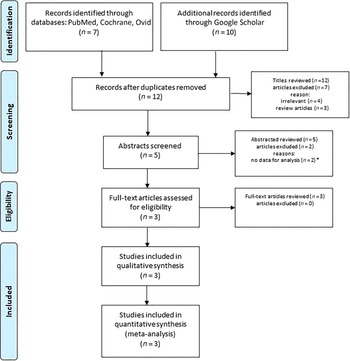
DR and JR performed data selection and extraction based on the predetermined criteria in a two-stage process. In the first stage, the titles and abstracts from the electronic searches were scrutinised, and the full manuscripts of all citations that met the predefined selection criteria were obtained. Final inclusion criteria or exclusion decisions were made on examination of the full manuscripts. In cases of duplicate publications, the most recent or complete version was selected. We documented our justifications for the exclusion of studies (Figure 1).
Consort diagram of the study selection process. Two articles were registered Cochrane control trials. The author was contacted with regard to these, but no data were available.

Study characteristics
Study characteristics and participant features were examined for each study. This included study characteristics such as the setting, design and method of data analysis. For the participant group this included the study population, number of participants, and inclusion and exclusion criteria. For the intervention group, the dose, route of administration and duration of treatment, follow up and outcomes were examined. Inconsistencies between reviewer's data were resolved through discussion with a third reviewer (PS) until a consensus was reached. After identifying the studies for inclusion, for any study where additional data were needed, a request was sent by electronic mail to the corresponding author of each study. If no response was received, a second request was sent two weeks later by electronic mail.
Inclusion criteria
This review included randomised, controlled trials of patients with chronic rhinosinusitis undergoing FESS. Studies where randomised, controlled trials also contained patients undergoing FESS or septoplasty and turbinoplasty or septorhinoplasty were also included. The intervention group receiving hot saline irrigation was compared with the control group who received room temperature saline irrigation.
Outcome measures
Extracted data included the name of the principal author, publication year, type of surgery performed, overall sample size, number of patients in each study group, pre-operative treatment, and details of the general and local anaesthetic techniques (total intravenous anaesthesia or inhalation anaesthesia, application of vasoconstrictors, visibility of the surgical field, estimated total blood loss and operating time). There are two known subjective means of grading visibility of the surgical field: the Boezaart 6-point scale and the Wormald Bleeding Scale.Reference Boezaart, van der Merwe and Coetzee17,Reference Athanasiadis, Beule, Embate, Steinmeier, Field and Wormald18 All included studies used Boezaart scoring. We also assessed the possible adverse effects of the intervention.
Study bias
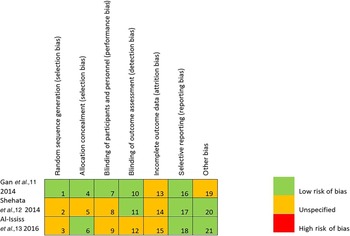
The methodological quality of the included studies was assessed and an evaluation of the risk of bias was undertaken, taking into account the method of randomisation, allocation concealment, blinding of participants, personnel and outcomes, incomplete data outcome, selective reporting, and other forms of bias. The Cochrane Collaboration Risk of Bias toolReference Higgins, Altman, Gøtzsche, Jüni, Moher and Oxman19 was used for each of these criteria, and the level of bias was assessed as low, unspecified or high (Figure 2). Contact was made with each corresponding author to clarify any missing methodology including pre-operative corticosteroid use, types of anaesthesia used during induction and maintenance, operative patient positioning, and blinding.
Risk of bias summary showing each risk of bias item for each included study. 1 = computer block – randomised; 2 = patients randomly selected from ENT department lists. Not specified how they were randomly selected; 3 = not specified how they were randomly selected; 4 = closed envelope system; 5 = not specified; 6 = sealed envelopes were used; 7 = nurse who was not involved in patient pre-operatively or peri-operatively opened envelope and water temperature of fluid warmer was concealed from surgeon; 8 = surgeon was blinded to patient group. Not specified regarding blinding of participants; 9 = not specified; 10 = blinded surgeon scored outcome measures; 11 = blinded surgeon scored outcome measures; 12 = not specified; 13 = no reported loss to follow up or dropouts. Measures were also in place: withdrawal, violation of study protocol or loss to follow up would be included in final analysis; 14 = not specified; 15 = not specified; 16 = all pre-specified outcomes were reported; 17 = all pre-specified outcomes were reported; 18 = all pre-specified outcomes were reported; 19 = operating surgeon could request an additional lavage but the number is not documented; 20 = no other bias detected; 21 = no other bias detected. Contact was made with each corresponding author to clarify any missing methodology.

Statistical analysis
Meta-analysis was performed in line with recommendations from the Cochrane Collaboration and the Quality of Reporting of Meta-analysis guidelines.Reference Moher, Cook, Eastwood, Olkin, Rennie and Stroup20 It was possible to pool results of three outcome measures into the meta-analysis: visibility of the surgical field, total blood loss and operating time. Heterogeneity of the exposure effects was evaluated statistically using the I2 statistic to quantify heterogeneity across studies. The I2 value for the visibility of the surgical field data was more than 50 per cent, which was taken as evidence of substantial heterogeneity; therefore a random effect model was used. A chi-squared test for heterogeneity was also performed and the p-values are presented. Statistical analyses were performed using RevMan 5 review management software.
Results
The search strategy identified 17 results across the databases (Figure 1). Five duplicates were identified and removed. The remaining 12 results were screened. Seven records were excluded; three were review articles and four were found not to meet inclusion criteria. The four articles that did not meet inclusion criteria, despite containing the search terms, were not on the topic of haemostasis in sinus surgery.
Five abstracts were screened. Two articles were excluded; one was a published abstract, and the other was a registered clinic trial without results. Both were found on the Cochrane Register of Controlled Trials and the author was contacted. Both articles were preliminary registrations for the Gan et al. randomised, controlled trialReference Gan, Alsaleh, Manji, Habib, Amanian and Javer11 and no extra data were available. Three full-text articles were assessed for eligibility using the inclusion criteria. All three randomised, controlled trials were included in the systematic review.Reference Gan, Alsaleh, Manji, Habib, Amanian and Javer11–Reference Al-Ississ, Al-Khaldi and Maayah13 From the studies, a total of 237 patients were assigned to the control or intervention groups (Table 1 and 2).
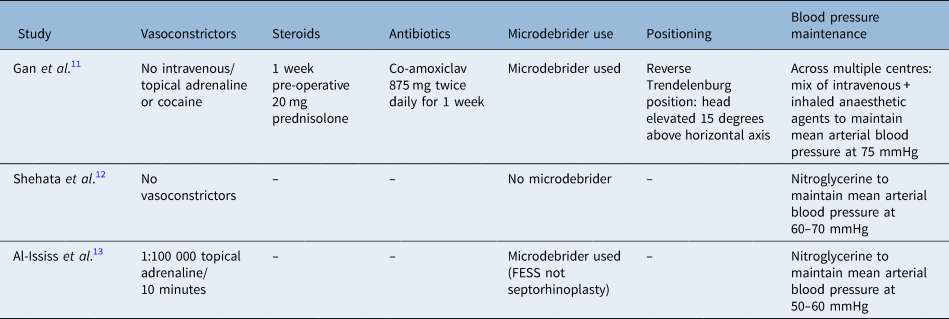
Summary of included studies

Summary of included studies

FESS = functional endoscopic sinus surgery
Assessment of clinical heterogeneity
The method of saline administration across two of the studies was with 20 ml of saline for irrigation every 10 minutes.Reference Gan, Alsaleh, Manji, Habib, Amanian and Javer11,Reference Al-Ississ, Al-Khaldi and Maayah13 Shehata et al. used the saline for packing and irrigation both during and after the surgery but did not specify the quantity or the intervals at which it was administrated.Reference Shehata, Ibrahim and Abd-El-Fattah12
Two of the studies compared hot saline irrigation to room temperature saline irrigationReference Gan, Alsaleh, Manji, Habib, Amanian and Javer11,Reference Al-Ississ, Al-Khaldi and Maayah13 whereas the third study compared hot saline irrigation, room temperature saline irrigation and topical tranexamic acid.Reference Shehata, Ibrahim and Abd-El-Fattah12 Patients receiving topical tranexamic acid were excluded.
The temperature of hot saline used for irrigation in the intervention group was similar across all three studies. Gan et al. used a temperature of 49°C,Reference Gan, Alsaleh, Manji, Habib, Amanian and Javer11 Shehata et al. used 50°CReference Shehata, Ibrahim and Abd-El-Fattah12 and Al-Ississ et al. used 48°C.Reference Al-Ississ, Al-Khaldi and Maayah13 All studies used medical-grade fluid warmers to maintain the temperature for the hot saline irrigation. The temperature of the saline wash outs in the control group was 18°CReference Gan, Alsaleh, Manji, Habib, Amanian and Javer11 and 20°CReference Al-Ississ, Al-Khaldi and Maayah13 whereas the third study only specify it as room temperature saline.Reference Shehata, Ibrahim and Abd-El-Fattah12
Intra-operative blood pressure was maintained during the procedure. Gan et al. kept the mean arterial blood pressure at about 75 mmHg during the procedure as a routine measure of reducing intra-operative blood loss.Reference Gan, Alsaleh, Manji, Habib, Amanian and Javer11 Al-Ississ et al. maintained mean arterial blood pressure between 50 and 60 mmHg by administration of a nitroglyercine infusion.Reference Al-Ississ, Al-Khaldi and Maayah13 Shehata et al. used a similar technique to control the mean arterial blood pressure between 60 and 70 mmHg.Reference Shehata, Ibrahim and Abd-El-Fattah12
Gan et al. gave a 1 week course of 20 mg prednisolone pre-operatively to each patient.Reference Gan, Alsaleh, Manji, Habib, Amanian and Javer11 The other two papers did not report any pre-operative steroids.Reference Shehata, Ibrahim and Abd-El-Fattah12,Reference Al-Ississ, Al-Khaldi and Maayah13 Two of the studies did not use injectable or topical vasoconstrictors,Reference Gan, Alsaleh, Manji, Habib, Amanian and Javer11,Reference Shehata, Ibrahim and Abd-El-Fattah12 whereas Al-Ississ used 1:100 000 topical adrenaline trans-nasally at 10-minute intervals.Reference Al-Ississ, Al-Khaldi and Maayah13
Gan et al. included patients above the age of 19 years with chronic rhinosinusitis with or without polyps, refractory to medical management.Reference Gan, Alsaleh, Manji, Habib, Amanian and Javer11 Shehata et al. included patients aged 20–50 years with chronic rhinosinusitis with or without nasal polyps.Reference Shehata, Ibrahim and Abd-El-Fattah12 Patients who had undergone previous FESS were excluded. Al-Ississ et al. included patients aged 28–58 years with chronic rhinosinusitis.Reference Al-Ississ, Al-Khaldi and Maayah13 They do not specify if it was only patients with polyps or also those without. All three papers included patients with American Society of Anaesthesiologists classification of two or less and excluded those with coagulation disorders.Reference Gan, Alsaleh, Manji, Habib, Amanian and Javer11–Reference Al-Ississ, Al-Khaldi and Maayah13 None of the papers specify chronic rhinosinusitis related co-morbidities such as asthma or aspirin sensitivity.
Visibility of the surgical field
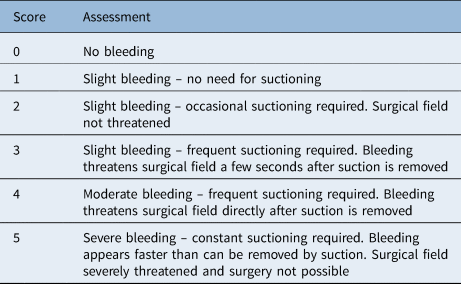
Three studies described the effect of hot saline irrigation on the visibility of the surgical field using Boezaart's 6-point scale.Reference Gan, Alsaleh, Manji, Habib, Amanian and Javer11–Reference Al-Ississ, Al-Khaldi and Maayah13 The Boezaart scale grades the visibility of the surgical field using a grading system ranging from 0 to 5 (Table 3). Two of the studies summarised their results using means and standard deviations (SD),Reference Gan, Alsaleh, Manji, Habib, Amanian and Javer11,Reference Shehata, Ibrahim and Abd-El-Fattah12 whereas the third tallied the number of patients falling into each Boezaart score category.Reference Al-Ississ, Al-Khaldi and Maayah13 Mean and SD was calculated from the data.Reference Al-Ississ, Al-Khaldi and Maayah13 Two of the studies found a significant improvement in the visibility of the surgical field in the intervention groupReference Shehata, Ibrahim and Abd-El-Fattah12,Reference Al-Ississ, Al-Khaldi and Maayah13 whereas the third showed no significant improvement.Reference Gan, Alsaleh, Manji, Habib, Amanian and Javer11 The three studies were pooled into meta-analysis. Pooling of the results showed that visibility of the surgical field was significantly better in the hot saline irrigation intervention group when compared with the room temperature saline irrigation control group (mean difference = −0.51; 95 per cent confidence interval (CI) =−0.84 to −0.18; p = 0.003). I2 was 72 per cent suggesting significant heterogeneity (chi-square = 7.21, p = 0.03) (Figure 3).
Forest plot of visibility of the surgical field. SD = standard deviation; IV = inverse variance; CI = confidence interval; df = degrees of freedom

Boezaart score: category scale for assessment of intra-operative surgical field

In order to homogenise the studied cohorts, subgroup analysis was run with the two studies in which no injectable or topical vasoconstrictors were used.Reference Gan, Alsaleh, Manji, Habib, Amanian and Javer11,Reference Shehata, Ibrahim and Abd-El-Fattah12 Meta-analysis showed an improvement in the visibility of the surgical field in the hot saline irrigation intervention group that was not statistically significant (MD = −0.42; 95 per cent CI = −0.89 to 0.05; p = 0.08). I2 was 75 per cent suggesting significant heterogeneity (chi-square = 4.03, p = 0.04).
Subgroup analysis was run excluding the study in which pre-operative steroids were given.Reference Gan, Alsaleh, Manji, Habib, Amanian and Javer11 Meta-analysis showed no significant improvement in the visibility of the surgical field when comparing the groups (mean difference = −0.44; 95 per cent CI = −0.91 to 0.03; p = 0.07).Reference Shehata, Ibrahim and Abd-El-Fattah12,Reference Al-Ississ, Al-Khaldi and Maayah13 I2 was 84 per cent suggesting significant heterogeneity (chi-square = 6.08, p = 0.07).
Total blood loss
All three studies reported estimated total blood loss.Reference Gan, Alsaleh, Manji, Habib, Amanian and Javer11–Reference Al-Ississ, Al-Khaldi and Maayah13 Estimated total blood loss was found to be significantly lower in all studies when the hot saline irrigation intervention group was compared with the room temperature saline irrigation control group. The three studies were pooled into meta-analysis. Pooling of results showed that total blood loss was significantly lower in the hot saline irrigation intervention group when compared with the room temperature saline irrigation control group (mean difference = −56.40ml; 95 per cent CI = −57.30 to −55.51; p < 0.0001). I2 was 0 per cent suggesting minimal heterogeneity (chi-square = 0.22, p = 0.9) (Figure 4). Subgroup analysis using the two studies that did not use topical vasoconstrictorsReference Gan, Alsaleh, Manji, Habib, Amanian and Javer11,Reference Shehata, Ibrahim and Abd-El-Fattah12 also showed a significant reduction in the estimated total blood loss (mean difference = −56.41 ml; 95 per cent CI = −56.41 to −55.51; p < 0.0001). I2 was 0 per cent suggesting minimal heterogeneity (chi-square = 0.20, p = 0.66).
Forest plot of estimated total blood loss. SD = standard deviation; IV = inverse variance; CI = confidence interval; df = degrees of freedom

Operating time
Three studies compared the overall operating time in the hot saline irrigation and room temperature saline irrigation groups.Reference Gan, Alsaleh, Manji, Habib, Amanian and Javer11–Reference Al-Ississ, Al-Khaldi and Maayah13 One group found there to be no difference in the total operating time.Reference Gan, Alsaleh, Manji, Habib, Amanian and Javer11 Two studies found the operating time to be significantly reduced in the hot saline irrigation intervention group (p < 0.001, p < 0.05).Reference Shehata, Ibrahim and Abd-El-Fattah12,Reference Al-Ississ, Al-Khaldi and Maayah13 The three studies were pooled into meta-analysis. Pooling of results showed that operating time was significantly lower in the hot saline irrigation group when compared with the room temperature saline irrigation group (mean difference = −9.02 minutes; 95 per cent CI = −11.76 to −6.28; p < 0.0001). I2 was 0 per cent suggesting minimal heterogeneity (chi-square = 1.59, p = 0.45) (Figure 5). Subgroup analysis excluding the paper that used topical adrenalineReference Al-Ississ, Al-Khaldi and Maayah13 did not show a significant reduction in operating time (mean difference = −7.01 minutes; 95 per cent CI = −15.65 to 1.63; p = 0.11). I2 was 34 per cent suggesting minimal heterogeneity (chi-square = 1.52, p = 0.22).
Forest plot of operating time. SD = standard deviation; IV = inverse variance; CI = confidence interval; df = degrees of freedom; OT = operating time

Risk of bias
Only one study used a second non-operating surgeon to contribute to the average Boezaart score to minimise experimental error that may result from the subjective nature of this assessment.Reference Gan, Alsaleh, Manji, Habib, Amanian and Javer11 Intra-operative bleeding and therefore visibility of the surgical field may also be affected using vasoconstrictors. Gan et al. did not use any injectable or topical vasoconstrictors before or during operating.Reference Gan, Alsaleh, Manji, Habib, Amanian and Javer11 Shehata et al. did not use vasoconstrictors or a microdebrider.Reference Shehata, Ibrahim and Abd-El-Fattah12 Al-Ississ et al. used adrenaline as a topical vasoconstrictor in both the intervention and control group.Reference Al-Ississ, Al-Khaldi and Maayah13 The three studies maintained the mean arterial blood pressure at different values intra-operatively: 75 mmHg,Reference Gan, Alsaleh, Manji, Habib, Amanian and Javer11 60–70 mmHg12 and 50–60 mmHg.Reference Al-Ississ, Al-Khaldi and Maayah13 Controlled hypotension reduces blood pressure and therefore sinonasal mucosal bleeding. The difference in mean arterial blood pressure may account for a difference in mucosal bleeding. Although Al-Ississ et al. reported the use of envelopes to randomly divide patients into groups, there is no explicit documentation of whether this was to blind participants, the surgeon or both.Reference Al-Ississ, Al-Khaldi and Maayah13
Discussion
Principle findings
The results of this systematic review and meta-analysis suggest that haemostasis during FESS is significantly better in the hot saline irrigation interventional group compared with the room temperature saline irrigation control group. This was based on three studies where Gan et al.,Reference Gan, Alsaleh, Manji, Habib, Amanian and Javer11 Shehata et al.Reference Shehata, Ibrahim and Abd-El-Fattah12 and Al-Ississ et al.Reference Al-Ississ, Al-Khaldi and Maayah13 used a Boezaart scoring system to rate the visibility of the surgical field as well as estimated total blood loss and operating time as measures of haemostasis. Further subgroup analysis excluding the use of a topical vasoconstrictor showed a significant reduction in total blood loss, although visibility of the surgical field and operating time did not differ.Reference Gan, Alsaleh, Manji, Habib, Amanian and Javer11,Reference Shehata, Ibrahim and Abd-El-Fattah12
Strengths of the review
Total blood loss and operating time, two indirect measures of surgical field visibility are included in this review. All three studies show a significantly reduced total blood loss and this was confirmed on meta-analysis.Reference Gan, Alsaleh, Manji, Habib, Amanian and Javer11–Reference Al-Ississ, Al-Khaldi and Maayah13 Hot saline irrigation reduced intra-operative blood loss by 56 ml, which is a 20 per cent reduction when compared with the control group. Intra-operative bleeding is the main contributor to reduced visibility of the surgical field. As the Boezaart score was significantly lower in the hot saline irrigation experimental group, it may not be surprising that there is also a significant reduction in total blood loss. As total blood loss is an objective measure in haemostasis in endoscopic sinus surgery, it may give a stronger indication of the effects of hot saline irrigation on the visibility of the surgical field. All three studies took precautions to prevent blood from being ingested. Two of the studies used gauze packs in the nasopharynxReference Shehata, Ibrahim and Abd-El-Fattah12,Reference Al-Ississ, Al-Khaldi and Maayah13 while the third used a Merocel® surgical sponge.Reference Gan, Alsaleh, Manji, Habib, Amanian and Javer11 However, only two of the studies counted blood-soaked gauze in their calculationReference Shehata, Ibrahim and Abd-El-Fattah12,Reference Al-Ississ, Al-Khaldi and Maayah13 while the third did not elucidate this.Reference Gan, Alsaleh, Manji, Habib, Amanian and Javer11
Gan et al. gave a week-long course of prednisolone to both control and intervention groups.Reference Gan, Alsaleh, Manji, Habib, Amanian and Javer11 A systematic review has shown that oral steroids reduce total blood loss by an average of 28 ml.Reference Pundir, Pundir, Lancaster, Kirkland, Cornet and Lourijsen4 Given the significant heterogeneity in the visibility of the surgical field meta-analysis, despite the exclusion of vasoconstrictors, subgroup analysis excluding Gan et al. was run to explore the impact of oral corticosteroid on the results.Reference Gan, Alsaleh, Manji, Habib, Amanian and Javer11 However, heterogeneity was increased from 72 to 84 per cent, suggesting this is unlikely to be the cause for the lack of homogeneity. Subgroup analysis excluding Al-Ississ et al. shows a significant reduction in total blood loss in the hot saline irrigation group.Reference Al-Ississ, Al-Khaldi and Maayah13 This suggests the use of topical vasoconstrictors in our group did not significantly impact on intra-operative bleeding.
The direct measure of the visibility of the surgical field was using the Boezaart scoring system. Two of the studies showed significant improvement in the visibility of the surgical field with hot saline irrigation.Reference Shehata, Ibrahim and Abd-El-Fattah12,Reference Al-Ississ, Al-Khaldi and Maayah13 Gan et al. showed no significant difference between visibility of the surgical field using hot saline irrigation versus room temperature saline irrigation when analysing the group as a whole.Reference Gan, Alsaleh, Manji, Habib, Amanian and Javer11 However, the relationship between Boezaart score and hot saline irrigation was not linear, and secondary analysis where cases were divided into long (more than 120 minutes) or short (less than 120 minutes) cases showed a statistically significant improvement in visibility of the surgical field in long cases (p = 0.04). When the three studies were pooled for meta-analysis, the visibility was significantly better in the hot saline irrigation intervention group. Improved visibility is vital in endoscopic surgery because bleeding causing reduced visibility of the surgical field has been objectively shown to be the main stressor on surgeons.Reference Stelter, Theodoraki, Becker, Tsekmistrenko, Olzowy and Ledderose21
A reduction in a Boezaart score from 3 to 2 is the difference between suction being needed regularly and suction only being needed sometimes (Table 1 and 2). A mean difference of −0.51 therefore suggests a potentially clinically significant difference in the visibility of the surgical field as well as a statistically significant difference.
Shehata et al. and Al-Ississ et al. found the operating time to be reduced in the patients who underwent irrigation with hot saline.Reference Shehata, Ibrahim and Abd-El-Fattah12,Reference Al-Ississ, Al-Khaldi and Maayah13 Meta-analysis of three studies showed a significantly shorter operating time when compared with the control group.Reference Gan, Alsaleh, Manji, Habib, Amanian and Javer11–Reference Al-Ississ, Al-Khaldi and Maayah13 Shorter operating time suggests a better surgical visibility throughout the case and is important in maximising the daily use of the operating theatre.
There are no reported side effects or adverse events reported by the authors when using hot saline intra-operatively.Reference Gan, Alsaleh, Manji, Habib, Amanian and Javer11–Reference Al-Ississ, Al-Khaldi and Maayah13 However, it must be noted that there is no documented patient follow up in any of the studies.
Weaknesses of the review
The Boezaart endoscopic field of view scores rely on the surgeon's subjective perspectives, which may result in bias and experimental error. Gan et al. tried to reduce the bias by blinding both the patients and the surgeons.Reference Gan, Alsaleh, Manji, Habib, Amanian and Javer11 They also used a second non-operating surgeon to contribute to the scores. Shehata et al. also blinded the surgeons to the allocation of patients but did not specify patient blinding.Reference Shehata, Ibrahim and Abd-El-Fattah12 Al-Ississ et al. did not specify if there was blinding of participants or surgeons.Reference Al-Ississ, Al-Khaldi and Maayah13
Gan et al. had a higher distribution of individuals with nasal polyps in the 18°C saline group when compared with the 49°C saline group (85.0 per cent vs 51.6 per cent) despite randomisation.Reference Gan, Alsaleh, Manji, Habib, Amanian and Javer11 There is evidence that bleeding and visibility are worse in patients with chronic rhinosinusitis with nasal polyps because of increased inflammation and vascularity.Reference Wormald, van Renen, Perks, Jones and Langton-Hewer22
A wide variety of topical sinonasal vasoconstrictors have been employed in sinus surgery including adrenaline, noradrenaline and cocaine.Reference Higgins, Hwang, Kingdom, Orlandi, Stammberger and Han5 Adrenaline has been shown to be as effective as the topical formReference Lee, Huang, Chang, Chang and Chen23 in improving surgical visibility during FESS. Given one study used topical adrenaline,Reference Gan, Alsaleh, Manji, Habib, Amanian and Javer11 it is possible the mean difference between the control and intervention group may be reduced and this may impact the Boezaart score, estimated total blood loss and operating time.
Placing a patient in the reverse Trendelenburg position has been shown to reduce venous return and blood pressure and therefore improve visibility during FESS.Reference Ko, Chuang and Su6 The optimum reverse Trendelenburg position has been investigated in subsequent studies and shown to be 20 degrees.Reference Gan, Habib, Rajwani and Javer24 Only one paper specified the intra-operative patient position.Reference Gan, Alsaleh, Manji, Habib, Amanian and Javer11
There are numerous anaesthetic techniques employed to induce deliberate hypotension including active vasodilation, decreasing the heart rate or reducing cardiac contractility.Reference Alsaleh, Manji and Javer2 Given that there was no standardised mean arterial blood pressure between the three studies, it may have an effect on sino-nasal bleeding.
The mean difference in total blood loss between intervention and control groups in the three studies was 70.70 ml,Reference Gan, Alsaleh, Manji, Habib, Amanian and Javer11 −56.41 ml12 and −55.91 ml.Reference Al-Ississ, Al-Khaldi and Maayah13 However, as the total blood loss SD varies from 123.4 ml,Reference Gan, Alsaleh, Manji, Habib, Amanian and Javer11 1.45Reference Shehata, Ibrahim and Abd-El-Fattah12 and 14.7Reference Al-Ississ, Al-Khaldi and Maayah13 in the hot saline irrigation groups, it raises questions about methods of recording total blood loss between the studies, and the weighting of the studies in the meta-analysis heavily favours those with a small SD.
An attempt was made by the authors to standardise methods across the three randomised, controlled trials. Two attempts were made with each corresponding author to provide clarification regarding the methods used. Only Gan et al.Reference Gan, Alsaleh, Manji, Habib, Amanian and Javer11 responded for clarification. The authors have significant concerns regarding potential study bias from two of the papers.Reference Shehata, Ibrahim and Abd-El-Fattah12,Reference Al-Ississ, Al-Khaldi and Maayah13 Further large randomised, controlled trials are needed using standardised inclusion criteria and standardised methods, including the use of vasoconstrictors and anaesthesia techniques.
Conclusion
This is the first systematic review that addresses hot saline irrigation for haemostasis in FESS. The results suggest that irrigation with hot saline in FESS for chronic rhinosinusitis may significantly improve visibility of the surgical field, reduce total blood loss by 20 per cent and decrease operating time by 9 minutes. Hot saline irrigation is a cheap and readily available intervention with low risk of morbidity or adverse events. However, there are limitations of the study because of significant heterogeneity of methods, quality and size of the studies.
Competing interests
None declared