Introduction
This article presents key outcomes of an investigation into certain aspects of cultural identity as it affects the lives of people with dementia in Scottish long-term care settings. The research process used to reach these conclusions will also be discussed. Throughout, a standpoint influenced by social constructionist conceptions of the nature of ‘self’ provided the philosophical backdrop, as elaborated in the work of Sabat (Reference Sabat2001). Social constructionism holds that all knowledge is historically and culturally specific. In this sense, selfhood and social reality itself is ‘constructed’ via the discursive practices which occur between people. Perceptions of what and who we are exist within, and are defined by, the social interactions taking place throughout our lives. Dementia is often associated with the progressive erosion of self within individuals, although this commonly held belief has been challenged (Sabat Reference Sabat2001). Nevertheless, people with dementia may be particularly vulnerable to loss of identity and damage to selfhood in long-stay care settings (Chaudhury Reference Chaudhury2008). This results from any number of factors: loss of long-familiar social/environmental anchors, the effects of organisational policies, constraints on revenue budgets, variations in staff training, the personal traits of staff, and so on.
The study took as its initial focus the cultural component of the construction of self (Sabat Reference Sabat2001). It illuminated potential weaknesses, and little-recognised strengths, in the recognition and treatment of formative culture in maintaining selfhood as part of claimed ‘person-centred’ approaches in individual care home residents in different locations in Scotland. The study found that cultural identity as it bears upon the fields of health and social care, most especially that which shapes us as human beings early in our lives, and which binds us to others within specific cultural groups, represents a much more complex set of phenomena than has hitherto been acknowledged. This assertion must be considered alongside the fact that recognised facets of culture and dementia, such as those associated with ethnic diversity stemming from comparatively recent waves of immigration, have been poorly researched worldwide, and, moreover, a particular lack of investigation has characterised British health and social care contexts (Bowes and Wilkinson Reference Bowes and Wilkinson2003). To this end, relevant theory, and health and social care policy as they are deemed to relate to these contexts, are reviewed and discussed here. The research methods employed by the study are described, the findings outlined, and conclusions given. In summary, the contention will be made that the outcomes of the study cast light on virtually unrecognised strengths in the treatment of selfhood as it emerges from shared cultural identity in different Scottish care settings for people with dementia. This has import for the development of more relevant and effective person-centred approaches in the social and cultural contexts inhabited by modern-day Scots.
Background
Individual cultural background and the older person with dementia
The necessity of considering the needs of people from diverse cultural backgrounds in health and social care settings is widely acknowledged in the literature, and is best known in the work of Madeleine Leininger (Reference Leininger1997). She conceived the theory of ‘transcultural nursing’, believing that nurses should possess knowledge of the ‘symbols, expressions and meanings’ of the cultures they are likely to encounter during their working lives. Adherents of this approach point out that an individual's cultural background will greatly influence how he or she makes sense of the world around them (as part of the socially constructed self), including how they engage with health and social care services (Shenk and Groger Reference Shenk and Groger2006). ‘Cultural competence’ refers to the capacity of systems and staff to provide culturally appropriate care to people with diverse values, beliefs, lifestyles and histories, and derives in the main from Leininger's work (Betancourt et al. Reference Betancourt, Green, Carrillo and Ananeh-Firempong2003). Kitwood's (Reference Kitwood1997) oft-quoted model of ‘person-centred care’, which was formulated specifically for people with dementia, calls for consideration of the diversity of people's backgrounds. Clearly, it is vital to acknowledge cultural diversity as it bears on health and social care, and the Scottish government imbue an associated focus in policy. In Fair for All: Improving the Health of Ethnic Minorities and the Wider Community in Scotland (Scottish Executive Health Department 2002) and All Our Futures: Planning for a Scotland with an Ageing Population (Scottish Executive 2007: 20), the Scottish Government pledge to ‘encourage all to understand the needs of older people in all their diversity’. In the National Dementia Strategy (Scottish Executive 2010), Holyrood assures a personalised approach to care, promising that the needs of minority groups will not be missed. These assertions are matched in policy documents emanating from Westminster. These statements occur in the rhetoric of governments of other developed countries, most notably those with substantial immigrant populations (Cox Reference Cox2007). However, the aforementioned dearth of research into these phenomena inhibits the formulation of practical approaches to understanding the health and social care needs of older people which are bound up with cultural diversity, especially in the United Kingdom. It must be emphasised here that a profound lack of awareness of the nature of cultural difference, which is not necessarily dependent upon a person's membership of a ‘recognised’ or widely acknowledged minority ethnic or cultural group, compounds these deficiencies. This article will also posit that lack of awareness of certain aspects of cultural commonality within long-established white population groups in Scotland, and how these affect person-centredness in health and social care, could be argued to be much more profound; this statement encapsulates the most significant findings coming from the study. The following section will explain these assertions more thoroughly.
Issues for investigation
As noted, this article deals with certain specific findings of the research study in question, and this section will lay these out. A number of potential problems can be found in theoretical and political approaches to the practical effects of cultural differences and dementia in Scotland, and in the United Kingdom (UK) as a whole. Culley (Reference Culley2006) describes a lingering failure in developed countries such as Britain to recognise and cater for the multifarious influences which impart a fluid, ever-changing and elusive nature to culture. He associates this with the influence of traditional transcultural models of care, which tend to depict cultural manifestations of diversity/identity as inevitably fixed, well-defined, visible and easily addressed. Also, as seen in Fair for All (Scottish Executive Health Department 2002), Scottish government policy invariably associates cultural diversity among service users with immigrant populations only. This standpoint assumes the cultural homogeneity of modern-day Scots whose forebears have been in the country for many hundreds of years. However, such a view flies in the face of history.
Trevor-Roper (Reference Trevor-Roper and Hobsbawm2003: 15) describes in detail the breadth of cultural diversity which existed in Scotland among long-established ancestral population groups, and which ceased to be recognised in the eighteenth century as the result of a wholly artificial process labelled by him as ‘the creation of tradition’. Although one Scottish national culture now dominates, remnants of the older diverse mix still exist. In today's Scotland, there remain indigenous population groups who do not see themselves as Scots. Examples are many of the people of the Shetland and Orkney Islands, who have no history of Gaelic, speak dialects heavily suffused with Old Norwegian words and look to Scandinavia for cultural links. Indeed, research reveals a definite rejection of Scots identity in these areas (Cartrite Reference Cartrite2009). Shetlanders and Orcadians represent the self-conscious vestiges of a historical Scotland which was inhabited by culturally diverse white population groups (Cartrite Reference Cartrite2009; Mitchison Reference Mitchison2002). Hickman et al. (Reference Hickman, Walter, Morgan and Bradley2000), in discussing the UK as a whole, describe ‘the myth of homogeneity of “white” British society’. It has to be acknowledged, nevertheless, that the Office for National Statistics (2014) now covers the concept of white ethnicity in more appropriate detail, although this remains associated in general with relatively recent incomers to Scotland. Indeed, in one of the relatively few in-depth studies to look at a Scottish long-term care environment, Kayser-Jones (Reference Kayser-Jones1990: 58) concluded that ‘Scotland is a homogenous country’, justifying this statement rather simplistically by describing how all the people in that care facility were white and mostly members of the Church of Scotland. The notion of diversity between the geographically scattered white population groups which have existed in Scotland since time immemorial in different geographical locations has little contemporary currency, and it may be supposed that this is not likely to change under a centrally based nationalist political administration. Glaser (Reference Glaser2007: 251) discusses political initiatives to mainstream ‘Scottishness’ in the guise of Gaelic culture, and Zumkhawala-Cook (Reference Zumkhawala-Cook2008) describes a national Scottish grand narrative which today mystifies perceptions of historical cultural difference by asserting the overarching reality of one distinctive identity. In summary, exploring whether diversity/commonality in cultural identity among ancestral Scots population groups impacts on care processes in ways that have hitherto not been recognised was central to this study, and formed a key research question. As noted, the findings which emerged from the line of enquiry were somewhat unexpected, not only illuminating relevant effects of shared cultural identity, but also tying this to a powerful age-old sense of place and community. The next section will give further clarity to this statement.
Dementia and cultural identity: a special challenge for long-term care
Stevenson (Reference Stevenson2010) describes how human beings have an inbuilt ability to adapt to changing social and cultural environments. However, certain individuals can progressively lose this facility, such as many older people with significant dementia. Indeed, these people may inhabit a psychological reality suffused with the cultural patterns of their formative years, which have vanished or have significantly mutated, and which may have hugely reduced relevance in contemporary contexts. Edvardsson and Nordvall (Reference Edvardsson and Nordvall2008) sum this up as being ‘lost in the present but confident of the past’ (my italics). As outlined by Sabat (Reference Sabat2001), selfhood is inextricably linked to, and constructed via, life/lived contexts. In people who experience difficulty in adapting to the sudden and drastic changes of context represented by moving to live in a care home, an established sense of self can be greatly challenged. They may not ‘fit’ in their new social environment, and might have limited cognitive capacity to personally tackle that. To this end, Orulv (Reference Orulv2010) points out the importance of constructing care home situations which are ‘in line with resident's previous experience’ which allows them to ‘find their place’ in the here and now. The study planned to take consideration of this, but also set out to explore whether broader links to the parent communities in which care homes are located helped people with progressive cognitive impairment to ‘find their place’. As it transpired, a more accurate phrase would have been ‘to maintain their place’. Discussion now proceeds to describing the research settings.
The research context
Places and people
Six care homes were selected: three in the Scottish cities of Aberdeen and Glasgow and three in the remote Shetland Islands, one of the aforementioned parts of Scotland in which local cultural identity does not always resonate with that of the rest of the country. The homes on the Scottish mainland were all located in city suburbs. One of the Shetland homes was in the main town, another was in a rural setting around 20 miles from that town and one was on a separate island which was accessed from the Shetland mainland by ferry. The Shetland homes were, on average, half the size in terms of residents than the city homes. The names of all research participants and care homes involved in the research were replaced with pseudonyms to preserve anonymity. Care home staff and residents took part in the study, criteria for participation being the following:
• Care home residents: an existing diagnosis of dementia.
• Care home workers: ‘hands-on’ direct care staff (social care workers and registered nurses).
A total of 16 care workers and nurses took part in both participant observation and ethnographic interview. Eleven residents, all with significantly progressed dementia, were involved just in participant observation. Reasons for not interviewing them are outlined in the section ‘Potential limitations’.
Ethical considerations
Bartlett and Martin (Reference Bartlett, Martin and Wilkinson2002) explain that debate exists as to the ethical principles of involving people with dementia in research, particularly people with dementia who have lost legal capacity to make decisions. They describe different perspectives. One holds that beneficence can never be properly enacted in social research involving people who lack decision-making capacity, as there is seldom direct benefit to the individual (although such research could clearly result in increased knowledge and future improvements in care). Using this approach, it is unethical to involve such people in social research. The alternative is to adopt a stance congruent with non-maleficence, and accept that lack of mental competence alone should not exclude people from participation in research, providing appropriate safeguards are observed. Indeed, the ethical quandary posed by excluding people with dementia from social research simply because of their diagnoses could be questioned. In Scotland, research proposals involving people who come under the remit of the Adults with Incapacity (Scotland) Act (2000) must be reviewed by ‘Scotland A’ Research Ethics Committee, members of which are appointed by Scottish Government ministers (Chief Scientist's Office 2011). The research proposal which preceded this study was considered and approved by ‘Scotland A’ Research Ethics Committee. This was necessary here under two specific UK-wide legal requirements: (a) it proposed involving people who lacked decision-making capacity, due to the effects of significantly progressed dementia; and (b) it proposed involving people who were cared for in residential care homes (Department of Health 2009).
An approved structure for obtaining informed consent/selection of participants, minimising the potential for causing distress to care home residents and storing data was adhered to throughout the research.
Methodology and methods
While the overall study did not position itself as ‘comparative’, it should be noted that the elements of the research design which this article gives focus to are comparative, in that they emerged from the application of the same questions to participants in two kinds of settings within Scotland: urban and remote/rural. Lor (Reference Lor2011: 2) holds that comparison is inherent in all social science, and is relevant to study of ‘cultural, societal and linguistic groups that are distributed within or across countries’. He provides the caveat that there is ‘little agreement in the social sciences’ as to whether ‘the comparative method’ should be viewed as a distinct subfield (Lor Reference Lor2011: 2). Nevertheless, ethnography as method/methodology is frequently associated with comparative studies, and Wolcott (Reference Wolcott2008: 92) explains that the ethnographer should accept that comparison is implicit in what they are doing. These statements characterise the research ethos of this study. Spradley's (Reference Spradley1979, Reference Spradley1980) ethnographic techniques of participant observation and interview were used to gather data in research venues, which was then analysed using his ‘cultural domain analysis’ approach. Parker's (Reference Parker1992) method of poststructural discourse analysis was used to interpret the cultural themes emerging from cultural domain analysis.
Spradley's approach: participant observation
The researcher spent between nine and ten full working days in each care home observing the interactions between participants in the common areas of each venue. Under Spradley's framework, the researcher's status was nominally that of passive participant, although it could be argued that his background as an older people's clinical nurse specialist meant that he stepped occasionally into the realm of moderate participation: that is, balancing status as an outsider with status as an insider. The passive observer is always present at the scene but does not interact with other people to any great extent (Spradley Reference Spradley1980). In this sense, observation takes place from ‘the corner of the room’.
Data from participant observation was categorised into ‘analytical cultural domains’. A ‘cultural domain’ is a ‘category of cultural meaning that includes other smaller categories’, which results from the propensity of human beings to organise, classify and group things in terms of description (Spradley Reference Spradley1980: 88). He describes different types of cultural domains, two of which will be used here: (a) analytical domains and (b) folk domains.
Analytical domain analysis: participant observation
‘Analytical domains’ occur when meanings must be inferred from the language used by observed people. This is necessary because, as noted, the cultural meanings embedded within observed social behaviour are often tacit. Thus, the use of analytical domain analysis best fits the exploration of observed behaviour, and was used in the study to categorise data, in the form of raw fieldnotes, which arose from observation.
Analytical cultural domains emerged which were deemed to represent interactions between workers/residents characterised by culturally effective ‘person-centred’ care. A wide search of the literature provided baseline criteria for defining interactions which supported ‘good’ culturally effective person-centred care, such as ‘taking time to speak to residents’ or ‘knowing personal history of residents’. The same process was used to identify and categorise interactions which could be seen to inhibit culturally effective person-centred care. The number of times each domain recurred was taken to indicate the prevalence of a particular pattern of ‘supporting’ or ‘inhibiting’ interaction. A pseudo-statistical means of tabulating and comparing these patterns of prevalence in kinds of interaction using large worksheets was adopted, and broader cultural themes could then be seen to emerge from overview of the data. This follows Spradley's guidance on making ‘cultural inventories’ (Reference Spradley1980: 155–9), and ‘culture’ in this statement is taken to refer to that occurring as, or affecting, ‘ways of working’ in the different care homes. The worksheets will not be presented here because of their quantity and very large sizes, but the strongest of the resulting themes are outlined below.
Shetland
• The Shetland homes were located in, and were very much part of, culturally homogenous and distinct communities across the isles, even within Shetland itself. These patterns were replicated in the care home population: both workers and residents tended to come from the surrounding localities, and most identified very strongly with these communities. Membership of these socio-cultural groups appeared to bestow a powerful mutuality, with each person having their defined place in the branches of the tree. By and large, this mutuality appeared to far outweigh other aspects of socio-cultural difference, such as those occurring between the generations here.
• This being so, a form of ‘in-built’ person-centred care existed. This was most apparent in the care of people with significant cognitive impairment. To workers, residents were still the people they had been all their lives. The tight and intimate shared net of social and cultural knowledge ensured that, even when a resident began to lose agency because of the insidious progression of dementia and could not actively express aspects of selfhood themselves, an external set of scaffolding existed which comprehensively fulfilled this function.
Glasgow/Aberdeen
• Workloads for the staff in the mainland homes were seen to be very high. Many care workers moved at a virtual running pace. Beyond task-based care, they often had little time to spend with individual residents, and it has to be acknowledged that lack of time certainly appeared to affect the quality of worker–resident interactions adversely.
• In the Glasgow home, the staff in general were of the same cultural stock as the residents: white working-class Glaswegians. Two of the residents were white non-Glaswegians, one of whom had almost completely lost his command of English as his second language due to his dementia. It was clear that care staff and nurses struggled to engage with him, even at a basic level. The other resident was a Gael, and used either English or Gaelic interchangeably on an ongoing basis. Her cognitive impairment meant that she inhabited a ‘returned reality’ suffused with the devout religious observances of her younger years, and this permeated her outlook on the world. In cultural terms, most staff could not seem to reach out to her and truly make a connection.
• Much more of a ‘staff–resident divide’ seemed to exist in the urban care homes. When care tasks were finished and free time did arise, little interaction, in comparison to the Shetland homes, was observed between residents and staff. Interaction between tasks was readily apparent among staff, though this was usually at a distance away from the residents. In these circumstances, it was difficult to discern examples of naturally occurring person-centred/culturally effective care, such as those which were observed in the Shetland homes. A large percentage of non-UK nationals were in the workforces of the mainland homes, although it could not be said that interactions between ‘local’ care workers and residents appeared to be any more ‘knowing’ or person-centred than interactions between workers of non-national origins and residents.
These themes characterised the constitution and delivery of care in each care home, and occurred to a lesser or greater degree in the different care homes. The remote/rural homes, for example, tended to display more palpable socio-cultural links with their parent communities. The mainland homes appeared to exist more-or-less independently of the communities in which they were located: within them without being part of them. The impression was of ‘staff (us) and residents (them)’. This did not happen to anything like the same degree in Shetland, where ‘us’ was a more accurate descriptive term. Moreover, the more isolated and relatively unchanged the community, the more likely this was to be.
The results of this process are condensed and shown in Table 1.
Frequencies of occurrence of supporting and inhibiting analytical domains per care home

Folk domain analysis: interviews
Data from interviews of staff were categorised into ‘folk cultural domains’, which were subjected to a similar process of analysis. This part of the data analysis differed only in that the size, rather than the number of domains, was used to indicate strengths of ‘supporting’ and ‘inhibiting’ interactions. The size of folk domains stemming from individual interviews were taken to represent the focus and importance the interviewee ascribed to specific facets of life in the care home, which could be ‘supporting’ or ‘inhibiting’ of person-centredness. The patterns derived from this mirrored almost exactly those seen in analytical domain analysis, in terms of being supporting or inhibiting of person-centred care. Examples from the two care homes with, respectively, the largest supporting and inhibiting domains are given below.
Rosetree Care Centre, Shetland
These are the four largest folk domains out of 16 and were shared by all the interviewees:
1. Promoting (residents’) happiness.
2. Maintaining a sense of continuity in life (for residents).
3. ‘Knowing’ the person.
4. Maintaining links with the community.
Westmont Care Home, Aberdeen
These are the four largest folk domains out of 18 and were shared by all the interviewees:
1. Pressures on time (as they affect care processes).
2. ‘Knowing’ the person.
3. Dynamics that inhibit ‘knowing’ the person (expressed as ‘a lack of time’ and ‘communication problems’).
4. ‘Problems with teamwork’.
Using folk domain analysis, the actions, beliefs and attitudes of individual workers could be aggregated to give understandings of the dominant patterns of person-centred/culturally effective care in specific care home environments. Of course, this also gave insights into patterns of interaction which were ineffective, or which actively inhibited these patterns. Along with the patterns discerned from analytical domain analysis, these were viewed as broad cultural themes bearing on person-centredness in these setting. It was recognised that, just as individuals working and living in care homes are affected by dynamics occurring within these specific contexts, care homes themselves exist within greater socio-cultural contexts suffused with pressures which shape these dynamics. This being so, understandings of individual and local contexts will only come when the broader socio-cultural context is also scrutinised. Parker's (Reference Parker1992) poststructural discourse analysis was used to give recognition of broader socially located reasons why particular themes in specific care homes were prominent, e.g. in accepting that short-staffing contributed significantly to a dominant theme in a care home, considering why not enough staff were working in that home at that time.
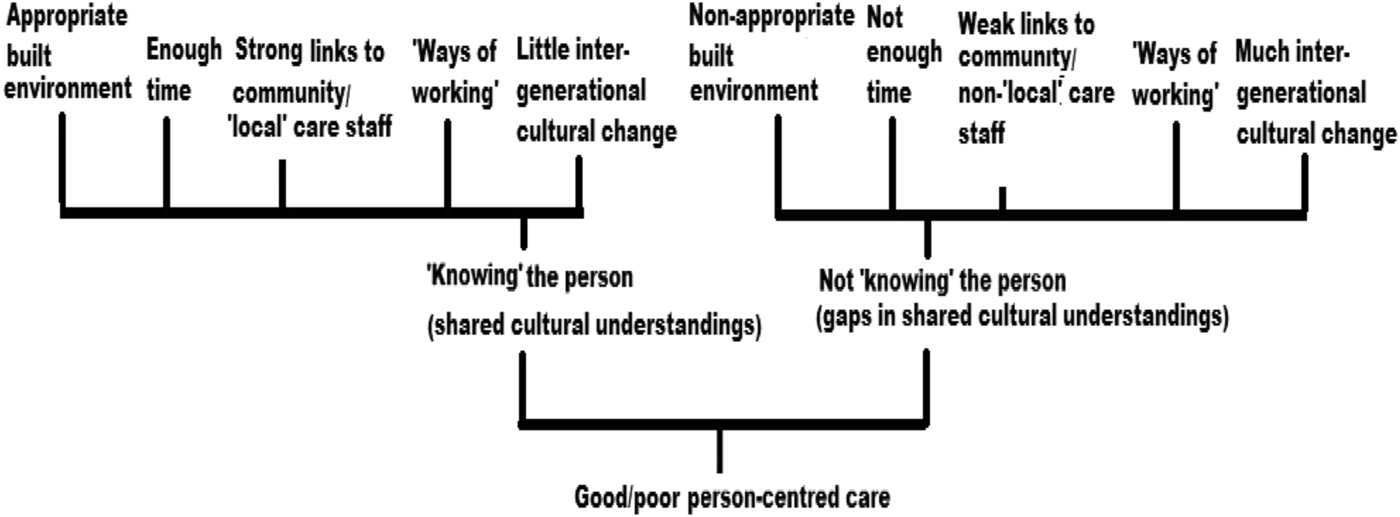
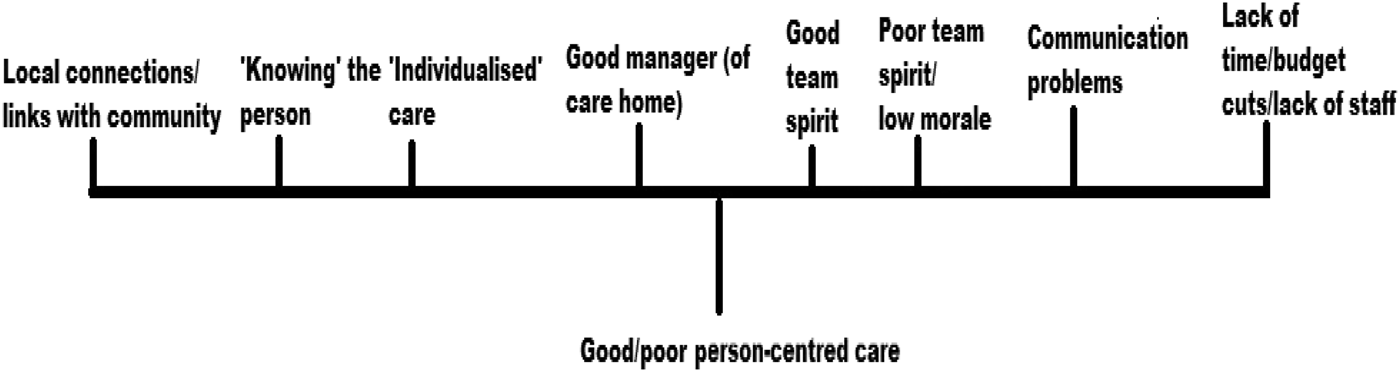
The main discursive themes deriving from cultural domain analysis were depicted as texts to facilitate consideration, as recommended by Parker (Reference Parker1992). For clarity, they were depicted as shown in Figures 1 and 2.
Discourses derived from themes emerging from analytical domain analysis.

Discourses derived from themes emerging from folk domain analysis.

Following this, using Parker's approach, these themes were linked to the wider socio-cultural discourses influencing the themes/texts portrayed in the figures. These discourse diagrams could, if desired, be expanded upwards to encompass other influencing discourses originating outwith the care homes, all of which would ultimately bear upon good or bad culturally effective, person-centred care. The outcomes of the research process as a whole are laid out below.
Outcomes from participant observation: analytical cultural domain analysis
Community, mutuality and identity
Broadly, as evidenced by the observational ‘analytical cultural domain analysis’, significantly better culturally effective/person-centred took place in the care homes in Shetland. In that very remote/rural setting, the local authority, which owned and ran all participating homes there, had followed a policy of constructing the units in local areas, and residents often came from these ‘parent’ districts. This had a number of benefits. Residents were still living in the communities in which they had spent much, if not all of their lives. In two of the three homes there, well-considered built design allowed residents to observe ongoing local crofting and maritime activity, which were cultural staples for most of them. The care teams were mostly local people too, and had generally known the person before they had developed dementia. Indeed, centuries-long inhabiting of the same community meant workers often had some form of material kinship with residents, be that by blood or by marriage. Of course, this means that potential difficulties stemming from the employment of workers of non-UK origins, such as in communication (Froggatt, Davies and Meyer Reference Froggatt, Davies and Meyer2009), are less likely to occur. Moreover, these bonds of mutuality, based on shared personal and cultural understandings, and reinforced by the location of the care environment, meant that ‘community’ and ‘place’ played a huge part in reinforcing selfhood/personhood for residents with dementia. The term ‘mutuality’ was used by Kellaher (Reference Kellaher2000) to describe residents in care homes who shared a specific socio-cultural template through which they viewed the world, based on religious belief. She pondered whether ‘mutuality’, and the potential benefits she perceived to be associated with that, could exist when religious affinity is not present. It was possible to conclude that, for the people in the districts where the care homes were located, affinity was found in the fact that individual identity was often inextricable from community identity. This assertion is supported by the conclusions of anthropologist Anthony Cohen, who studied one of the communities in question: ‘there is a pervasive sense of rootedness, of belonging, as if people were as immovably and inherently part of the island as the very features of its landscape’ (Reference Cohen1987: 3). As he goes on to say: ‘home is not just where one resides at present … it is “lineage”, territory, the tiny, finite space in which much of one's history is located. As such, it is a fundamental referent of personal identity’ (Reference Cohen1987: 108). He concluded that islanders were so sensitised by the distinctiveness of their island community that it often intruded on their ‘total experience of social life’; to them, their community was everything (Reference Cohen1987: 82).
The fact that most care workers there shared cultural values and norms with the bulk of the residents was evidently of great value, although several instances were observed of much younger care workers who clearly found it difficult to tune in to the ‘ways of seeing the world’ displayed by residents. These care workers were of the same ethnic stock as residents, and often blood relatives. In workers, this was generally accompanied by a lack of ability to speak the local dialect, and was often compounded by loss of the ability to speak standard English among residents because of encroaching dementia.
‘Ways of working’ and resources
In Shetland, ‘ways of working’ were also often strongly influenced by events in the community. For example, if a wedding took place in one local area it was customary for food from the meal to be sent to the home for residents to enjoy, so that they could ‘take part’. ‘Newsing’ was a major activity, in which different local people would just drop in to the homes and relay community happenings, which very frequently developed into major discussions involving the visitors, residents and staff. It was very rare indeed to see workers approaching residents with dementia, and not interacting with them as they would a cognitively intact person, even when residents were completely unable to communicate. It was clear that their perception of ‘who the resident was’ was often deep, historical and based on shared community-mediated knowledge and identity. On more than one occasion staff said, while dementia ‘certainly changed folk, they're still just who they've always been’.
Of course, this was helped in no small measure by the fact that this local authority is comparatively wealthy. The homes are well-staffed, certainly in comparison to the participating homes on the Scottish mainland. Without a doubt, good staff to resident ratios allowed all of the aforementioned patterns to exist and to flourish.
In all three homes on the Scottish mainland, the amount of time a care worker could spend with a resident was always more sparse. This affected the nature of care. ‘Ways of working’ in these homes were overwhelmingly dominated by a focus on just getting through daily tasks, and this was observed to be something of an ongoing challenge. ‘In-built’ mutuality was generally absent because these homes were situated in urban contexts with greater catchment areas, and many of the workers were from very different formative cultural backgrounds from residents, often of recent immigrant status. Regardless of this, workers simply did not have the time to learn much about the people they were looking after. Also, it is probably unfair to criticise the physical location of these urban homes in comparison to those in Shetland, although other issues arose related to built environment which were seen to impact on the staff's opportunities to interact meaningfully with residents. The urban homes were much bigger, and two of them were designed to have large communal living/eating areas where the bulk of residents congregated. These comparatively large groups of people with dementia in communal areas, with very few staff among them, were the locus of significant verbal and physical conflict between residents; much more than was seen in the smaller, more heavily staffed Shetland homes. Staff had to spend a significant part of their time addressing this, rather than being able to put that scarce resource to better use.
Outcomes from ethnographic interview: folk domain analysis
Community, identity and ‘person-centred care’
During interview, care staff in Shetland were more likely to speak at length (indeed, to focus) on the importance of strong mutual connections to the surrounding community and how that assisted them immeasurably in ‘kennin’ (knowing) residents, as a prerequisite for good care processes. ‘Dir wir ain’ (‘they are our own people’) featured several times as a statement in interviews. Negative pressures on care processes were rarely described by workers, and were never the main focus of their answers. Interestingly, if asked specifically about ‘person-centred’ care, they tended to elaborate a truncated ‘textbook’ appreciation of ‘individualising’ care, rarely linking this to their actual practice or to what constituted ‘good’ care in their particular place of work. It could be inferred that, although their interactions with residents were paralleled by many tenets of theoretical person-centred care, they thought that ‘official’ person-centred care was simply ‘care of the individual’. Brooker (Reference Brooker2007) affirms that this is often the case in the minds of practitioners, managers and policy makers. These workers appeared to perceive person-centred care as something of an externally originating ‘party line’, which they should know about, and were meant to subscribe to (while in their own words rarely linking person-centred care to what they described as most necessary for ‘good’ care, which, paradoxically did often coincide with the theory of person-centred care). It is interesting to speculate that, even if Kitwood had never penned his seminal body of work, care processes in these locations would probably have been person-centred anyway. Brooker (Reference Brooker2007: 12) argues that, in many settings, care is person-centred in name only; she considers that a major ‘challenge for this century’ is how to get person-centred theory into everyday practice. In these Shetland care homes, the opposite was broadly true. Many aspects of care were very person-centred with little apparent awareness that this was the case. This was less likely to be so in the mainland homes.
Care staff in the mainland homes usually divulged something of what they thought ‘person-centred’ care should be, again, usually focusing on care of the ‘individual’. ‘Links to the community’ or the care home's place in the community were almost completely absent from their responses, and the focus of their stories was very often on what prevented good, person-centred or culturally effective care occurring in their place of work. Lack of staff/lack of time, ongoing budget cuts and communication problems were chief among these. This article will be concluded in a summary of the most important points stemming from the research, after a section which looks at potential limitations of the research.
Potential limitations
A number of factors exist which may have affected the study's findings.
Firstly, the small size of the study, involving only six care homes, means that claims to broad generalisability of the conclusions have to be viewed with caution. Rather, the study should be treated as a pilot, and the conclusions as questions for further research.
Additionally, in work which is by definition deeply interpretive, conclusions have been reached using a degree of intuition. Thus, the potential for outcomes to be skewed by the influence and perceptions of the researcher will always be present, beginning with the ‘Hawthorne effect’ on observed behaviour, and extending to the researchers own culturally bound worldview (Draper Reference Draper2010). Perhaps the most significant potential limitation was that residents were not interviewed. The decision was taken to go down that route when it became clear that the residents involved in observation were all very significantly cognitively impaired. Having said this, it may have been possible to interview some of these people using sensitively considered approaches, after considerable work on how to go about doing this had taken place. Nevertheless, there is a definite chance that valuable insights were lost to this study.
Conclusions
There are few studies which investigate the connections between cultural differences and processes of care in Scottish care homes, and few which have examined claimed person-centred approaches being enacted. There are fewer still which explore cultural commonality or ‘mutuality’ as a dynamic. As noted, there is a general worldwide dearth of literature on the interplay between ethnicity, culture and dementia, and very little research evidence that person-centred care takes place at all in Scottish care homes. If it can be accepted that an individual's cultural make-up is a vital component of their sense of self, that maintaining a sense of self is fundamental to person-centred care and that selfhood may be particularly vulnerable when people with dementia go to live in care homes, the significance of this lack of knowledge looms large. If this is coupled with the contentions made in this article that existing perceptions of the nature and effects of cultural diversity and commonality on Scottish health and social care populations are weak, then further ramifications begin to appear. In short, if current discourses which structure care delivery for people with dementia in long-term care in Scotland show little acknowledgement of the socio-cultural processes which combine to make people who they actually are as people, many claims to person-centred approaches must be questionable. Of particularly significant interest is the observation that ‘natural’ person-centred approaches are likely to be in ongoing action in Scottish communities, albeit in virtually unnoticed ways. This study suggests that ‘mutuality’, and the benefits associated with that, can occur via a shared sense of ‘community/place’. While a major ‘challenge for this century’ is how to get person-centred theory into everyday practice, this study suggests that it might be equally valid to seek and acknowledge natural person-centred approaches where they occur, and draw lessons from these back into theory/practice guidelines for wider application. Thus, more focus must be given to looking for some of these answers between people, among groups and in specific communities. In this way, ‘community-centred care’ might be developed with new emphasis as intrinsic to grounded, useable and locally relevant person-centred care, in a true bottom-up approach. Furthermore, insights into the socio-cultural phenomena which predispose particular affinity groups of people to better care for members with dementia could be used in developing new service approaches with utility to areas which lack this natural tendency. This study is one small, tentative step in that direction.
Key points
1. ‘Person-centred care’, regardless of stated organisational philosophies and the understandings of front-line staff, is likely to occur in a very haphazard manner in different Scottish care homes.
2. The effects on such care processes of cultural differences between care workers and residents, and sometimes between care workers, are likely to be significant at times, and are currently not well understood.
3. The effect on care processes of cultural affinity between care workers and residents within defined communities is barely acknowledged in the literature. Nevertheless, these dynamics do exist, and if investigated more thoroughly could represent a repository of insights which might be tapped to expand/enhance the ‘person-centred’ school, and increase the immediate applicability of service provision to discrete communities. Indeed, when an individual owes much of selfhood to being part of a distinct community, it might be argued that ‘person-centred’ approaches should equally be framed as ‘community-centred’.
Acknowledgements
The authors would like to express their gratitude to Dr Clive Bowman, Medical Director of the British United Provident Association (BUPA) at the time the study was ongoing, for his unstinting support throughout the process. The PhD study discussed in this article was fully funded by BUPA. Ethical approval to conduct the research discussed in this article was granted by ‘Scotland A’ Research Ethics Committee on 22 February 2010 (Reference 09/MRE0083). All named authors made a substantial contribution to the conception and design, the drafting of the article, its critical revision for intellectual content and approval of the final version for publishing. There are no conflicts of interest.