


%20--%3e%3c!DOCTYPE%20svg%20PUBLIC%20'-//W3C//DTD%20SVG%201.0//EN'%20'http://www.w3.org/TR/2001/REC-SVG-20010904/DTD/svg10.dtd'%3e%3csvg%20version='1.0'%20id='Layer_1'%20xmlns='http://www.w3.org/2000/svg'%20xmlns:xlink='http://www.w3.org/1999/xlink'%20x='0px'%20y='0px'%20width='64px'%20height='64px'%20viewBox='5.5%20-3.5%2064%2064'%20enable-background='new%205.5%20-3.5%2064%2064'%20xml:space='preserve'%3e%3cg%3e%3ccircle%20fill='%23FFFFFF'%20fill-opacity='0'%20cx='37.785'%20cy='28.501'%20r='28.836'/%3e%3cpath%20fill='%23595959'%20d='M37.441-3.5c8.951,0,16.572,3.125,22.857,9.372c3.008,3.009,5.295,6.448,6.857,10.314%20c1.561,3.867,2.344,7.971,2.344,12.314c0,4.381-0.773,8.486-2.314,12.313c-1.543,3.828-3.82,7.21-6.828,10.143%20c-3.123,3.085-6.666,5.448-10.629,7.086c-3.961,1.638-8.057,2.457-12.285,2.457s-8.276-0.808-12.143-2.429%20c-3.866-1.618-7.333-3.961-10.4-7.027c-3.067-3.066-5.4-6.524-7-10.372S5.5,32.767,5.5,28.5c0-4.229,0.809-8.295,2.428-12.2%20c1.619-3.905,3.972-7.4,7.057-10.486C21.08-0.394,28.565-3.5,37.441-3.5z%20M37.557,2.272c-7.314,0-13.467,2.553-18.458,7.657%20c-2.515,2.553-4.448,5.419-5.8,8.6c-1.354,3.181-2.029,6.505-2.029,9.972c0,3.429,0.675,6.734,2.029,9.913%20c1.353,3.183,3.285,6.021,5.8,8.516c2.514,2.496,5.351,4.399,8.515,5.715c3.161,1.314,6.476,1.971,9.943,1.971%20c3.428,0,6.75-0.665,9.973-1.999c3.219-1.335,6.121-3.257,8.713-5.771c4.99-4.876,7.484-10.99,7.484-18.344%20c0-3.543-0.648-6.895-1.943-10.057c-1.293-3.162-3.18-5.98-5.654-8.458C50.984,4.844,44.795,2.272,37.557,2.272z%20M37.156,23.187%20l-4.287,2.229c-0.458-0.951-1.019-1.619-1.685-2c-0.667-0.38-1.286-0.571-1.858-0.571c-2.856,0-4.286,1.885-4.286,5.657%20c0,1.714,0.362,3.084,1.085,4.113c0.724,1.029,1.791,1.544,3.201,1.544c1.867,0,3.181-0.915,3.944-2.743l3.942,2%20c-0.838,1.563-2,2.791-3.486,3.686c-1.484,0.896-3.123,1.343-4.914,1.343c-2.857,0-5.163-0.875-6.915-2.629%20c-1.752-1.752-2.628-4.19-2.628-7.313c0-3.048,0.886-5.466,2.657-7.257c1.771-1.79,4.009-2.686,6.715-2.686%20C32.604,18.558,35.441,20.101,37.156,23.187z%20M55.613,23.187l-4.229,2.229c-0.457-0.951-1.02-1.619-1.686-2%20c-0.668-0.38-1.307-0.571-1.914-0.571c-2.857,0-4.287,1.885-4.287,5.657c0,1.714,0.363,3.084,1.086,4.113%20c0.723,1.029,1.789,1.544,3.201,1.544c1.865,0,3.18-0.915,3.941-2.743l4,2c-0.875,1.563-2.057,2.791-3.541,3.686%20c-1.486,0.896-3.105,1.343-4.857,1.343c-2.896,0-5.209-0.875-6.941-2.629c-1.736-1.752-2.602-4.19-2.602-7.313%20c0-3.048,0.885-5.466,2.658-7.257c1.77-1.79,4.008-2.686,6.713-2.686C51.117,18.558,53.938,20.101,55.613,23.187z'/%3e%3c/g%3e%3c/svg%3e)
%20--%3e%3c!DOCTYPE%20svg%20PUBLIC%20'-//W3C//DTD%20SVG%201.0//EN'%20'http://www.w3.org/TR/2001/REC-SVG-20010904/DTD/svg10.dtd'%3e%3csvg%20version='1.0'%20id='Layer_1'%20xmlns='http://www.w3.org/2000/svg'%20xmlns:xlink='http://www.w3.org/1999/xlink'%20x='0px'%20y='0px'%20width='64px'%20height='64px'%20viewBox='5.5%20-3.5%2064%2064'%20enable-background='new%205.5%20-3.5%2064%2064'%20xml:space='preserve'%3e%3cg%3e%3ccircle%20fill='%23FFFFFF'%20fill-opacity='0'%20cx='37.637'%20cy='28.806'%20r='28.276'/%3e%3cg%3e%3cpath%20fill='%23595959'%20d='M37.443-3.5c8.988,0,16.57,3.085,22.742,9.257C66.393,11.967,69.5,19.548,69.5,28.5c0,8.991-3.049,16.476-9.145,22.456%20C53.879,57.319,46.242,60.5,37.443,60.5c-8.649,0-16.153-3.144-22.514-9.43C8.644,44.784,5.5,37.262,5.5,28.5%20c0-8.761,3.144-16.342,9.429-22.742C21.101-0.415,28.604-3.5,37.443-3.5z%20M37.557,2.272c-7.276,0-13.428,2.553-18.457,7.657%20c-5.22,5.334-7.829,11.525-7.829,18.572c0,7.086,2.59,13.22,7.77,18.398c5.181,5.182,11.352,7.771,18.514,7.771%20c7.123,0,13.334-2.607,18.629-7.828c5.029-4.838,7.543-10.952,7.543-18.343c0-7.276-2.553-13.465-7.656-18.571%20C50.967,4.824,44.795,2.272,37.557,2.272z%20M46.129,20.557v13.085h-3.656v15.542h-9.944V33.643h-3.656V20.557%20c0-0.572,0.2-1.057,0.599-1.457c0.401-0.399,0.887-0.6,1.457-0.6h13.144c0.533,0,1.01,0.2,1.428,0.6%20C45.918,19.5,46.129,19.986,46.129,20.557z%20M33.042,12.329c0-3.008,1.485-4.514,4.458-4.514s4.457,1.504,4.457,4.514%20c0,2.971-1.486,4.457-4.457,4.457S33.042,15.3,33.042,12.329z'/%3e%3c/g%3e%3c/g%3e%3c/svg%3e)
Introduction
Community-acquired pneumonia (CAP) treatment is a common cause of antibiotic overuse in hospitals. Reference Vaughn, Flanders and Snyder1 Antimicrobial stewardship targets for CAP include preventing excess duration and unnecessary fluoroquinolone use through education on best practice prescribing and feedback on antibiotic use. Reference Vaughn, Flanders and Snyder1,Reference Werner, Hecker, Sethi and Donskey2
Critical access hospitals (CAHs), defined as <25 inpatient beds and located >35 miles from another hospital, play a critical role in the rural safety net, accounting for over a quarter of acute hospitals in the United States. Reference Joynt, Harris, Orav and Jha3,Reference Kassamali-Escobar, Hartlage and Chan4 Compared to larger institutions, CAHs often have limited resources for antibiotic stewardship (eg, limited on site infectious disease or information technology [IT] support) Reference Joynt, Harris, Orav and Jha3,Reference Kassamali-Escobar, Hartlage and Chan4 Because CAHs were exempt from The Joint Commission performance measure program until 2023 and are not currently required to participate in the Hospital Quality Alliance national public reporting program, we do not know how CAHs perform on CAP stewardship metrics. Reference Joynt, Harris, Orav and Jha3,5
In 2021, the University of Washington Center for Stewardship in Medicine (UW CSiM) created an Intensive Quality Improvement Cohort (IQIC) implementing antimicrobial stewardship in CAHs. Reference Kassamali-Escobar, Hartlage and Chan4 In 2023—to help obtain a baseline estimate of CAP antibiotic use to inform stewardship and investigate the feasibility of data collection—9 CAHs in the mountain west collected antibiotic use data for CAP.
Methods
Study design and setting
This prospective multisite IQIC included 9 CAHs. Each CAH identified a stewardship champion, usually a pharmacist, who collected data, set a quality improvement goal for improving antibiotic selection and duration, and engaged local stakeholders at their site. Reference Ciarkowski, Imlay and Bryson-Cahn6 Participation in IQIC included virtual monthly learning labs and quarterly individualized mentoring. Learning labs focused on best practices for CAP stewardship including shorter antibiotic durations (≤ 6 d) and avoiding fluoroquinolone use. Reference Vaughn, Flanders and Snyder1,Reference Werner, Hecker, Sethi and Donskey2 This project was reviewed by the University of Utah IRB and received “exempt” status. We followed STROBE Reference Cuschieri7 reporting guidelines for observational studies.
Data collection
Between 10/2023 and 7/2024, CAH stewardship champions submitted deidentified clinical and treatment data via a standardized REDCap form on a convenience sample of 3 CAP cases per month for 10 months. This goal was chosen to obtain 30 total cases per CAH, the minimum threshold for measuring reliability. Reference White, Bidwell Goetz and Jones8 Prior data suggests CAHs admit, on average, 36 CAP cases per year. Reference Casey and Burlew9 CAP cases were identified via the CAH’s Electronic Health Record (EHR)/stewardship tools or manually by the stewardship team. Patients were excluded if they were <18 years old, had a history of cystic fibrosis, had a pulmonary complication, required intensive care unit monitoring during the encounter, were transferred to another hospital, did not have chest imaging, or had a concomitant non-CAP infection requiring antibiotics. Data were abstracted manually by the stewardship champion and collated into bimonthly reports which benchmarked the CAHs to their peers and historic national data. Barriers to data collection and CAP stewardship were discussed in small group sessions.
Outcomes and statistical analysis
Primary outcomes, characterized using descriptive statistics, were excess antibiotic duration Reference Jones, Ramirez and Oren10 (defined as >6 d) and inappropriate fluroquinolone use Reference Werner, Hecker, Sethi and Donskey2 (defined as fluoroquinolone use without a penicillin or cephalosporin allergy). We assessed correlation between median antibiotic duration and inappropriate fluoroquinolone use across hospitals using Pearson correlation. A P value < .05 was considered significant.
Results
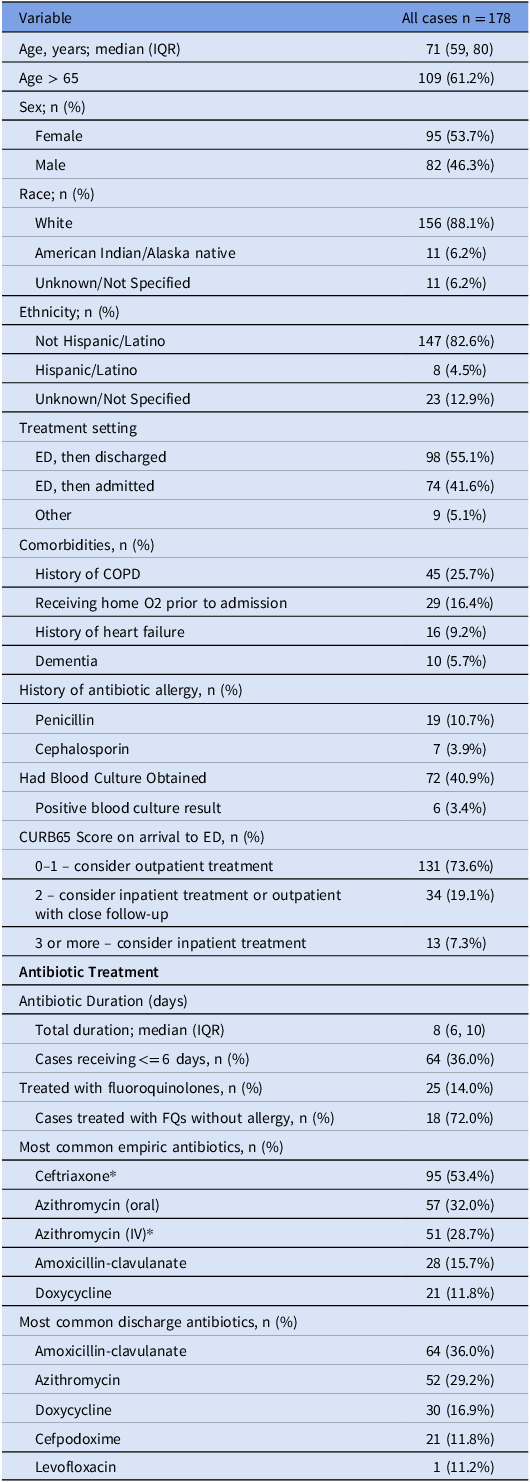
A total of 178 cases—median 17 (IQR 10,30) per site—were abstracted from the 9 hospitals. Only 3 hospitals met the 30-case abstraction goal. Patient characteristics are shown in Table 1. Patient acuity was low: 55% (98/178) of patients were seen in the emergency department (ED) and discharged while 74% (131/178) had a documented CURB65 score between 0 and 1. Only 7% (13/178) had a CURB65 score ≥3 for which inpatient care is recommended.
Demographic and antibiotic treatment

Table 1. Long description
A table summarizing demographic and antibiotic treatment data for 178 cases. The table has 21 rows and 2 columns. The columns are labeled ‘Variable’ and ‘All cases n = 178’. Row 1: Age, years; median (IQR), 71 (59, 80). Row 2: Age > 65, 109 (61.2 percent). Row 3: Sex; n (percent), Female, 95 (53.7 percent). Row 4: Sex; n (percent), Male, 82 (46.3 percent). Row 5: Race; n (percent), White, 156 (88.1 percent). Row 6: Race; n (percent), American Indian/Alaska native, 11 (6.2 percent). Row 7: Race; n (percent), Unknown/Not Specified, 11 (6.2 percent). Row 8: Ethnicity; n (percent), Not Hispanic/Latino, 147 (82.6 percent). Row 9: Ethnicity; n (percent), Hispanic/Latino, 8 (4.5 percent). Row 10: Ethnicity; n (percent), Unknown/Not Specified, 23 (12.9 percent). Row 11: Treatment setting, ED, then discharged, 98 (55.1 percent). Row 12: Treatment setting, ED, then admitted, 74 (41.6 percent). Row 13: Treatment setting, Other, 9 (5.1 percent). Row 14: Comorbidities, n (percent), History of C O P D, 45 (25.7 percent). Row 15: Comorbidities, n (percent), Receiving home O 2 prior to admission, 29 (16.4 percent). Row 16: Comorbidities, n (percent), History of heart failure, 16 (9.2 percent). Row 17: Comorbidities, n (percent), Dementia, 10 (5.7 percent). Row 18: History of antibiotic allergy, n (percent), Penicillin, 19 (10.7 percent). Row 19: History of antibiotic allergy, n (percent), Cephalosporin, 7 (3.9 percent). Row 20: Had Blood Culture Obtained, 72 (40.9 percent). Row 21: Positive blood culture result, 6 (3.4 percent).
IQR, interquartile range; O2, supplemental oxygen; ED, emergency department; COPD, chronic obstructive pulmonary disease; IV, intravenous; CURB65, confusion/uremia/respiratory rate/blood pressure/age of 65 or greater. CURB-65 Scores of 0–1 indicate low risk or outpatient care. Scores of 2 are considered moderate risk or inpatient care, and scores of 3–5 are considered high risk or ICU level care.
* Azithromycin typically given with ceftriaxone.
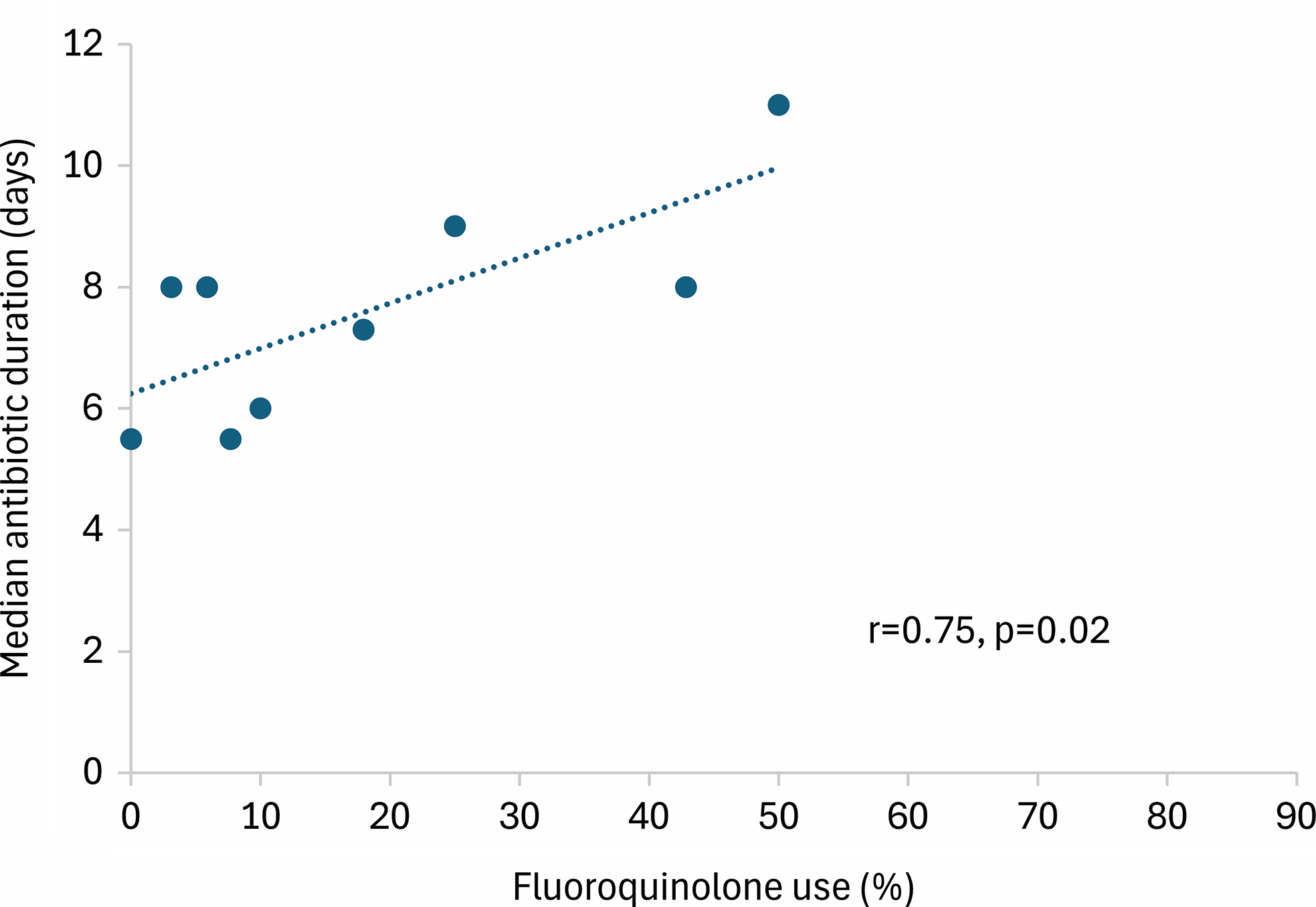
The median total length of antibiotic therapy was 8 days (IQR 6,10) with 64% (114/178) receiving a duration >6 days. Among the 14% (25/178) of patients who received a fluoroquinolone, 72% (18/25) were classified as inappropriate. Hospitals with a higher median antibiotic duration also had higher proportion of inappropriate fluoroquinolone use (r = 0.75, P = .02; Figure 1).
Relationship between antibiotic duration and fluoroquinolone use for community-acquired pneumonia in critical access hospitals.

Challenges to CAP data collection reported in the mentoring sessions included identifying patients with limited IT support, and small number of patients with CAP.
Discussion
We found excess antibiotic duration was common. Because the majority of patients were discharged from the ED, most received a single dose of antibiotics in the ED followed by a discharge prescription for >6 days. Given that trials suggest some patients can be safely treated with a 3-day duration Reference Jones, Ramirez and Oren10 —and that most CAH patients were low acuity—the opportunity to optimize treatment duration in CAHs may be even larger. Nationally, fluoroquinolone use for CAP has declined, and the prescribing rate observed in our study (14%) is comparable to estimates from more recent national data. Reference Vaughn, Flanders and Snyder1 Notably, only 1/3 of fluoroquinolone use occurred in beta-lactam allergic patients, suggesting another opportunity for stewardship. While there was heterogeneity of practice across CAHs, we found that institutions with higher median antibiotic duration also tended to have higher fluoroquinolone prescribing. This suggests hospital culture could impact multiple facets of unnecessary antibiotic use. Of note, CAHs have a small clinician pool; a single clinician outlier could easily impact performance for all CAP.
Across 9 participating CAHs, collecting data on antibiotic overuse for CAP was challenging. However, given the reported high rates of antibiotic overuse (particularly excess duration) in our study, antibiotic stewardship for CAP is critical for CAHs. Despite having clear buy-in with stewardship champions, collecting CAP cases presented challenges with only one-third of participating CAHs able to achieve the goal of 3 cases per month. We identified three potential reasons for this. First, unlike larger hospitals, most sites were unable to identify patients electronically via ICD-10 codes. Many CAHs lacked IT support for automated antimicrobial reporting. Stewardship champions worked around IT issues by identifying patients during workflows (eg, through pharmacist activities) or by antibiotics prescribed (eg, ceftriaxone and azithromycin). To help CAHs with stewardship, EHR vendors could automate disease or antibiotic-specific reports. Second, it was harder to identify patients discharged from the ED (a large percentage of CAH CAP) than those admitted. For example, if a patient was seen in the ED after hours and then discharged, the pharmacist may not be able to flag the encounter for later review. Finally, while CAP is recorded as 7% of admissions to CAH, the actual case count per hospital is low Reference Casey and Burlew9 (36 cases/hospital/year)—so 30 cases is nearly all patients with CAP. Our findings add to the growing literature on the myriad challenges CAHs face—including staffing shortages, turnover, and lack of bandwidth Reference Kassamali-Escobar, Hartlage and Chan4 —to measuring and improving healthcare in the rural populations they serve.
Study limitations include a small number of cases submitted and convenience sampling. Sampling bias also could have occurred due to difficulty in identifying cases. Nonetheless, our quality improvement project allowed CAHs to benchmark their baseline performance to peers for more meaningful data to inform their future stewardship efforts.
In summary, optimization of antibiotic use for CAP remains an opportunity for CAHs, particularly antibiotic duration. Improved EHR and IT solutions are needed to better identify patients and track antibiotic use, especially among patients discharged from the ED. CAHs face unique barriers that limit their ability to collect data to inform CAP quality improvement. Aggregating and benchmarking data across CAHs over a longer period would facilitate peer-supported learning and improve antibiotic use in rural settings.
Acknowledgements
This work was supported by a grant from the Gordon and Betty Moore Foundation to V.M.V (# 8839.02) and support from the Centers for Disease Control and Prevention Project Number 1U54CK000602.
We would like to acknowledge the stewardship champions whose hard work went into collecting data for this project and the Flex coordinators in Arizona, Idaho, Oregon, Utah, and Washington Flex for support of the pilot IQIC project.
Competing interests
All other authors have no conflict of interest.
Patient consent statement
This study does not include factors necessitating patient consent.

 Open access

