INTRODUCTION
Macrobenthos are often considered as an indicator of the coastal ecosystem conditions, because the patterns of their occurrence and abundance considerably reflect the in situ environmental conditions due to their limited mobility (e.g. Grall & Glémarec, Reference Grall and Glémarec1997; Dauvin et al., Reference Dauvin, Ruellet, Desroy and Janson2007; Elliott & Quintino, Reference Elliott and Quintino2007). However , for a clear understanding, knowledge on the detailed ecology and life history of the key species as well as the dominant species is required. The life-history characteristics play a significant role in community assembly and succession in benthic communities (Grassle & Grassle, Reference Grassle and Grassle1974; Connell & Slatyer, Reference Connell and Slatyer1977; Pearson & Rosenberg, Reference Pearson and Rosenberg1978), and an understanding of the life history of macrobenthos is essential for a detailed evaluation of the ecosystem conditions in aquatic environments.
Sternaspid worms are a polychaete with a unique peanut-shaped body. They are common and often abundant in oceans worldwide (Rouse & Pleijel, Reference Rouse and Pleijel2001), and their occurrence pattern may provide useful information for understanding the ecosystem conditions of a particular site if their detailed ecology is known. According to previous studies, they are subsurface deposit feeders and lie head down just under the surface of the substrate, with their branchiae spread over the sediment surface and the ventral shield covering the burrow (Dales, Reference Dales1963; Hutchings, Reference Hutchings, Beesley, Ross and Glasby2000; Rouse & Pleijel, Reference Rouse and Pleijel2001). Although they inhabit various sediments from coarse sand to soft mud (Sendall & Salazar-Vallejo, Reference Sendall and Salazar-Vallejo2013), a few studies report positive associations between the organic load and the abundance of the sternaspid worms (Lim & Hong, Reference Lim and Hong1996; Harmelin-Vivien et al., Reference Harmelin-Vivien, Bănaru, Dierking, Hermand, Letourner and Salen-Picard2009). However, little is known about their ecology and life history, particularly about reproductive features and the development mode of sternaspid species around the world (Rouse & Pleijel, Reference Rouse and Pleijel2001).
Currently, sternaspid worms are composed of 17 sternaspid species belonging to three genera, and only one species, Sternaspis costata, is known to occur in Japanese coastal waters (Sendall & Salazar-Vallejo, Reference Sendall and Salazar-Vallejo2013). Sternaspis costata was firstly described on the basis of a specimen collected from an inner part (called ‘Bay of Miya’ at that time) of Ise Bay in central Japan, though the inner part has been almost completely reclaimed by the land occupied by Nagoya City (Sato & Sattmann, Reference Sato and Sattmann2009). Later, this species was regarded as a junior synonym of S. fossor (Stimpson, 1853) by Marenzeller (Reference Marenzeller1890) and of S. scutata (Ranzani, 1817) by Imajima & Hartman (Reference Imajima and Hartman1964) and Uchida (Reference Uchida1992), who regarded S. scutata as a cosmopolitan species. Subsequently, S. costata has been resurrected by Sendall & Salazar-Vallejo (Reference Sendall and Salazar-Vallejo2013), with evidence showing marked difference in the morphology of the ventral shield between this species and other congeners (Sendall & Salazar-Vallejo, Reference Sendall and Salazar-Vallejo2013). In Japan, S. costata have been known to frequently occur in the bay of meso-eutrophic waters since the 1970s at least (Kikuchi, Reference Kikuchi1975 described as S. scutata) and it has been suggested that they can be used as an indicator species for evaluating the influence of offshore water (Kitamori, Reference Kitamori1975). Nevertheless, no study has been investigated for their detailed ecology and life history. Therefore, elucidating the life history of the Japanese sternaspid species will not only provide an ecological perspective of this family but also enhance the value of this worm as an indicator species.
The inner part of Ariake Bay, Japan, is an ideal site for examining the life history of this worm. In this site, summer hypoxia has been noted to frequently occur, particularly in the mud bottom of the western area since the 2000s (Tsutsumi, Reference Tsutsumi2006), and the effects of hypoxia on the bottom habitats are of a greater concern (Yoshino et al., Reference Yoshino, Hamada, Yamamoto, Hayami, Yamaguchi and Ohgushi2010). Thus, benthic monitoring has been frequently performed to assess the health of the ecosystem in this area (e.g. Yoshino et al., Reference Yoshino, Yamamoto, Hayami, Hamada, Kasagi, Ueno and Ohgushi2007, Reference Yoshino, Katano, Ito, Hamada, Fujii and Hayami2014), and it has been found that the sternaspid polychaete, S. costata, is a dominant species of the mud bottom even under such a stressful condition (Yoshino et al., Reference Yoshino, Yamamoto, Hayami, Hamada, Kasagi, Ueno and Ohgushi2007, Reference Yoshino, Katano, Ito, Hamada, Fujii and Hayami2014 as S. scutata). In the present study, to understand the life-history characteristics of this sternaspid species, we analysed the pattern of temporal changes in the population densities, body-size frequency and the abundance of ovigerous females using the sternaspid specimens collected during the benthic monitoring of the inner part of Ariake Bay.
MATERIALS AND METHODS
Study site and sample collection
Ariake Bay is located on the west coast of Kyushu Island, Japan. The inner part corresponds to the northern region along the coast of Saga and Fukuoka Prefectures, and the tidal range reaches approximately 6 m in this area (Sato & Takita, Reference Sato, Takita and Sato2000; Tsutsumi, Reference Tsutsumi2006). The inner part can be further divided into four zones by the sediment types (Yokoyama & Ishihi, Reference Yokoyama and Ishihi2009), and sternaspid worms are particularly abundant in the western muddy site among the four zones (Yoshino et al., Reference Yoshino, Yamamoto, Hayami, Hamada, Kasagi, Ueno and Ohgushi2007). In this study we collected sternaspid specimens monthly from May 2010 to May 2011, with additional specimens in July and September 2011, at 14 subtidal stations (5–25 m deep) in the muddy site (Figure 1). Connectivity among worms within this site is unknown because no population genetic data are available at present. However, we regarded sternaspid worms in this site as a single population, assuming that the large tide of this area allowed sufficient gene flow that prevented genetic diversification among stations in the present spatial scale (~10 km). The data from each station were thus treated as replicates from a single population.
The location of the study site and 14 sampling stations (×). The star symbol indicates the location of the Ariake Sea Monitoring Tower of Saga University.

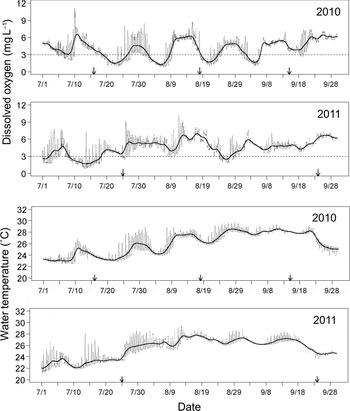
In this site, summer hypoxia frequently occurs (Tsutsumi, Reference Tsutsumi2006; Yoshino et al., Reference Yoshino, Hamada, Yamamoto, Hayami, Yamaguchi and Ohgushi2010, Reference Yoshino, Katano, Ito, Hamada, Fujii and Hayami2014). Therefore, we also referred to the continual data of the concentration of dissolved oxygen and water temperature at the bottom layer (0–50 cm from the bottom) determined using a multiple water quality sensor (AAQ1183, JFE Advantec Co. Ltd) by the Ariake Sea Monitoring Tower of Saga University, Japan (Figure 1) from July to September in 2010 and 2011. Hypoxia was defined as a condition with less than 3 mg l−1 dissolved oxygen according to the definition by Diaz & Rosenberg (Reference Diaz and Rosenberg1995) (2.8 mg L−1). In 2010, four episodes of hypoxia were noted from late July to early September, whereas in 2011, two episodes of hypoxia were noted from early July to late August (Figure 2). After those hypoxic episodes, no hypoxia was detected from the tower data in both the years (data not shown). The water temperature showed similar variation in both the years since late July; however, in early July, the water temperature presented higher fluctuations in 2011 compared with those in 2010 (Figure 2).
Concentration of dissolved oxygen and the water temperature of the bottom water at the Monitoring Tower of Saga University from July to September in 2010 and 2011. Dotted lines indicate the raw data and solid lines indicate smoothing by the Nadaraya–Watson estimator. The downward arrows indicate the sampling date during the period.

Duplicate sediment samples were collected at each station from the boat using a handy grab (22.5 × 22.5 cm). One of the samples was used to collect the sternaspid worms, and the sediments were sieved through a 1 mm mesh. The residue was fixed in 80% ethanol, and sternaspid worms were sorted and counted in the laboratory. The other sediment sample was used for environmental analyses. Three cylindrical cores were inserted into the sediments; the top 1 cm layer was taken from one core to examine the total organic carbon (TOC) content, and the layer up to 5 cm was collected from the rest of the two cores to examine the contents of mud (silt and clay) particles. For TOC analysis, the samples were powdered after drying in an oven at 60°C and immersed in 1.2 N HCl to remove carbonates; the immersion was repeated until no CO2 gas occurred. After rinsing with distilled water, the samples were dried again and analysed with an elemental analyser (JM-10 J Science Lab Co. Ltd). For the mud content analysis, the samples were dried at 105°C and about 10 g of the sediments were sieved with a 63 μm mesh under running water with a plastic brush. The residue was dried again and weighed, and the mud content was calculated as the weight percentage of particles passing through the 63 μm mesh.
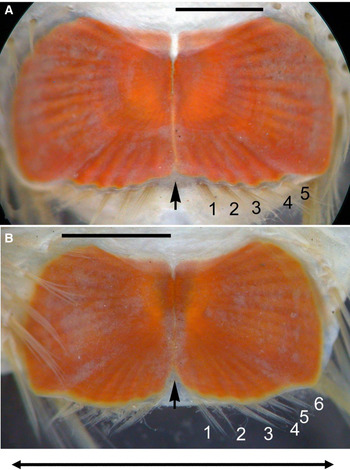
For each specimen of the sternaspid worms collected, we measured the maximal width of the ventral shield made of two lateral plates (hereafter, WS) (Figure 3) using an ocular micrometer on a stereo microscope nearest to 0.01 mm. Although sternaspids are usually collected as a whole, their soft body part is highly elastic and its size is unstable compared with the chitinized shield. Moreover, the size of the shield acts as a body-size indicator of the sternaspid worms, as demonstrated in the study by Lim & Hong (Reference Lim and Hong1996), who measured the width of a half plate of the ventral shield and body weight, showing a good association between them (R 2 = 0.962; figure 6 in Lim & Hong, Reference Lim and Hong1996). To evaluate the sexual maturity of these worms, we dissected each worm on a glass slide with forceps to observe the coelomic contents under a compound microscope. We identified only females by the presence of oocytes, because it was not easy to distinguish male gametes from the other coelomic somatic cells. If oocytes were found from a female, diameters of up to 20 oocytes were measured using an ocular micrometer to 0.1 μm.
The ventral shield of two lateral plates in Sternaspis costata. (A) A standard type with five posterior chaetal fascicles (1–5) on the posterior margin of right and left plates each. (B) An occasional type with six chaetal fascicles (1–6). The small arrows indicate the median notch of the posterior margin of the fan. The large two-headed arrow indicates the width of the shield (WS) as an indicator of body size of this worm in the present study. Scale bar = 1 mm.

Data analyses
All the analyses were performed using the freeware R software ver. 2.13.10 (R development Core Team, 2013). The temporal variation in abundance was analysed for the monthly data (i.e. from May 2010 to May 2011) using generalized linear models (GLM) with negative binomial error distribution. Multiple comparisons were performed between the sequential months with Holm's procedure for controlling type I error rate. To evaluate the preferable sediment conditions for this worm, we followed the method reported by Anderson (Reference Anderson2008), who performed quantile regression with B-spline basis for constructing a unimodal relationship of the abundance with environmental parameters. This analysis was performed for only adult individuals from all stations, because larvae may not be able to select habitats and many juveniles could occur in unsuitable habitats. The quantile regression for the upper quantile functions as an envelope of the data and is useful when a true association is masked by other unmeasured variables (Cade & Noon, Reference Cade and Noon2003; Cade et al., Reference Cade, Terrell and Schroeder1999, Reference Cade, Noon and Flather2005). In the present study, we performed 90 percentile quantile regression using B-spline basis for TOC and silt-clay content and estimated those values that presented peak abundance. Furthermore, we constructed 95% confidence intervals for the peak values by the bias-corrected and accelerated percentile method (BCa method; Efron & Tibshirani, Reference Efron and Tibshirani1993) based on 5000 bootstrapped samples. The quantile regression was performed with the function rq () in the quantreg package in combination with the function bs () in the spline package. In addition, we also performed cohort separation for size histogram data by assuming that the data were a mixture of a few normal distributions. The function normalmixEM () in the mixtools package was used for cohort separation, and the optimal number of cohorts was selected by finite sample size-corrected AIC (Burnham & Anderson, Reference Burnham and Anderson2002).
RESULTS
Species identification
A total of 1929 sternaspid worm specimens were collected, all of which were identified as S. costata according to the key reported by Sendall & Salazar-Vallejo (Reference Sendall and Salazar-Vallejo2013). The ventral shield of this species is characterized as follows: (1) rounded anterior margins and shallow anterior depression, (2) rounded lateral margins (expanded medially), (3) angular posterior corners and (4) fan markedly notched medially. The morphology of the ventral shield of the present specimens agreed well with those of the descriptions of the holotype (Marenzeller, 1879) and the neotype and non-type specimens (Sendall & Salazar-Vallejo, Reference Sendall and Salazar-Vallejo2013) of S. costata, although the depth of the median notch of the posterior margin of the fan varied from deep to shallow (Figure 3), as determined by Marenzeller (Reference Marenzeller1890).
In most of the specimens collected in the present study, five posterior chaetal fascicles were arranged in a roughly linear pattern on the posterior margin of each of the right and left parts of the fan in the ventral shield (Figure 3A). This is another diagnostic characteristic of S. costata (Sendall & Salazar-Vallejo, Reference Sendall and Salazar-Vallejo2013). However, in some specimens, six posterior chaetal fascicles were observed as a probable intraspecific variation (Figure 3B). The largest worm had a WS of 4.8 mm (8 mm in body width), which is comparable with that of the largest S. costata (10 mm in body width) reported by Sendall & Salazar-Vallejo (Reference Sendall and Salazar-Vallejo2013).
Life-history characteristics of S. costata
Because the WS of the smallest ovigerous females was 1.8 mm, we defined worms with a WS ≥ 1.8 mm as adults. In addition, we also conveniently defined worms with a WS ≤ 1.2 mm (the mean WS of the newly formed cohort as described below) as small juveniles, which seem to be recruited recently, and the worms between 1.2 and 1.8 mm WS as large juveniles. GLM analysis for the temporal changes in the total abundance of the monthly part showed that the mean density significantly decreased from 182 ind m−2 in September to 38 ind m−2 in October (Z = −3.16, P = 0.018), and that the density continued to be low until March (Figure 4A). The population density significantly increased in April (Z = 2.86, P = 0.043) because of an increase in the abundance of large juveniles (Figure 4B) and recovered to the level before the drastic decrease or became higher in May 2011 (Figure 4A, B). Although ovigerous females were observed throughout the year, except in October 2010 and March 2011, their density tended to increase from July and reached a peak in September in both 2010 and 2011 (Figure 4B). The ovigerous rate (number of ovigerous females/number of adults) was the highest in September (43.8% in 2010, 33.2% in 2011) (Figure 4C). Although a high ovigerous rate was also observed in April 2011 (30.8%), the density of the ovigerous females was low during that period (Figure 4B).
The densities of (A) the total worms and adults, (B) ovigerous females and small juveniles (less than 1.2 mm WS) and (C) ovigerous rate (total number of ovigerous females/total number of adults) from May 2010 to September 2011 (mean ± SE). For the visibility of the overlapping plots, the locations were intentionally displaced in (A) and (B).

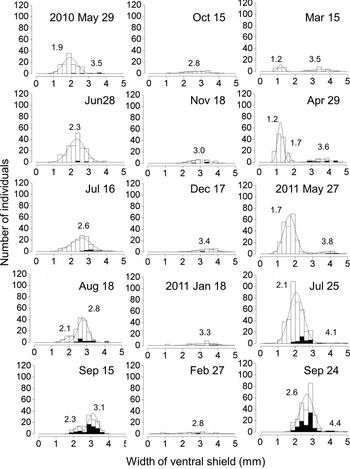
The temporal changes in the body size composition are shown in Figure 5. Two cohorts were recognized in May 2010. The large-WS cohort was not significantly detected in June and July 2010, although large adults with a WS of around 4 mm were observed. In August, two cohorts were detected, probably because of the difference in growth rate among individuals. The two cohorts were maintained until September 2010, when many ovigerous females occurred over all the body-size classes. In October 2010, the number of individuals drastically decreased over all the body-size classes, resulting in a single cohort with a broad WS range. This situation continued until February 2011. The small juveniles with a WS around 1 mm were found from January 2011, and their number markedly increased in March and April 2011, when a single and two cohorts with a WS less than 2 mm appeared, respectively. In May 2011, two cohorts, i.e. a major cohort of small individuals (mean WS: 1.7 mm) and a minor one of large individuals (3.8 mm), were recognized with the same pattern as that noted in May 2010. Ovigerous females occurred in the small-WS cohort in July 2011 and the ovigerous rate increased in September 2011.
Body-size histogram with fitted normal curves from May 2010 to September 2011. The body size was represented by the width of ventral shield (WS). Black bars indicate ovigerous females. The number above each curve indicates the mean WS of the cohort. The data of all the stations were pooled for each month. Note that the mesh size of sample collection is 1 mm and smaller individuals than this size may not be sufficiently represented.

The diameter of oocytes ranged from 79 to 168 μm, and the mean oocyte diameter varied from 89 to 155 μm among the females. Most of the females had oocytes larger than 140 μm in diameter in September 2010 and 2011 (Figure 6). There was no significant correlation between the mean oocyte diameter and body size in September in both the years (Pearson's r 2010 = 0.18, P = 0.19, N 2010 = 57; r 2011 = 0.09, P = 0.36, N 2011 = 90; Figure 7).
Mean diameter of coelomic oocytes in each ovigerous female. The number at the top indicates the number of ovigerous females examined. No ovigerous females were collected in October 2010 and March 2011.

Associations between body size represented by the width of ventral shield and mean diameter of coelomic oocytes in ovigerous females collected in September 2010 (top) and 2011 (bottom).

Field sediment conditions and worm density
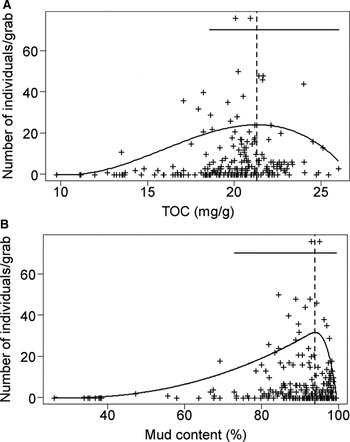
Although the mud contents varied from 26.2 to 99.9% among all the stations during the entire sampling period, their average values in all the stations ranged from 80 to 95% (Figure 8A). The TOC values varied from 9.8 to 26.0 mg g−1 among all the stations during the entire sampling period, with their monthly average values in all the stations ranging from 18 to 22 mg g−1 (Figure 8B). The BCa confidence intervals of the TOC values and mud contents at which adult worm abundance was the highest by quantile regression spline ranged from 18.6 to 26.0 mg g−1 and from 69.1 to 99.4%, respectively (Figure 9), which almost included the maximum range of variations in the field sediment conditions.
(A) Mud and (B) TOC contents of the sediment of the study area (mean ± SE).

Associations between (A) TOC and the population density of Sternaspis costata and (B) between mud content and the population density of S. costata in all sampling sites. The curves were drawn by the 90% quantile regression splines. The values of TOC and mud contents at which the population density was the highest are indicated by vertical dotted lines with their 95% confidence intervals by bootstrapping (solid horizontal lines).

DISCUSSION
To the best of our knowledge, the present study is the first to investigate the life-history characteristics of S. costata through monthly sampling. Its population dynamics was characterized by two drastic changes in the population density, i.e. the decrease in October and the increase in April. These changes were not attributable to either summer hypoxia or the fluctuation of sediment conditions at the study site. First, severe hypoxic events occurred four times intermittently from July to August in 2010 (Yoshino et al., Reference Yoshino, Katano, Ito, Hamada, Fujii and Hayami2014) and once in early September 2010. After then, no severe hypoxia was detected in 2010; therefore, a decrease in population density in October is not because of hypoxic stress. Because there were no significant changes in the density in August or September 2010, this worm appeared to be tolerant to the environmental hypoxic stress. Second, the confidence intervals of the optimal sediment TOC and mud contents were 18.6 to 26 mg g−1 and 69.1 to 99.4%, respectively, which almost covered the temporal variation range of these factors in the field. In other words, all the sediment conditions in this area could be suitable for this worm. In fact, no clear correlation was found between seasonal changes in mean adult density and TOC (Figures 4 & 8). Although it is still possible that the decrease in the population density in October is because of the decrease in the mud contents, a high adult density is observed in July 2011, when the mud contents were similar to those observed in October 2010. Therefore, the temporal variation in the population density of this worm could not be ascribed to that in the sediment and hydrographical condition of this area but purely to the life-history characteristics of this species.
Our data showed the clear seasonality of reproduction in this worm species. The ovigerous females were most abundant in September 2010 and 2011, when most of them had large oocytes irrespective of their body size. At that time, we found some mature males, in which the coelom was filled with the whitish coelomic sperm mass but did not find any indication of hermaphrodites. These results indicate that S. costata is dioecious, having a highly synchronized reproductive period in September. The maximum ovigerous rate of 44% implies almost a 1:1 sex ratio. The drastic decrease in the population density in October appeared to be caused by the mass death of the adult worms after spawning. Furthermore, our data showed that the marked increase in the population density in April was caused by the appearance of many juveniles, though we could not determine the exact period of the recruitment because our sampling method using a 1 mm mesh sieve could not collect smaller juveniles just after settlement. Most of the recruits grew to adults in September of the same year, when most of the adults spawned and died. These results indicated that S. costata is semelparous, usually with a 1-year longevity.
Despite the highly synchronous reproduction in September, a few ovigerous females with large eggs occurred in other months, except October 2010 and March 2011. The absence of these females in these months could probably be attributed to sampling error caused by the low density of adults during these periods. In general, non-synchronous reproduction throughout the year often contributes to population persistence under frequently disturbed sites, as observed in our site accompanying seasonal hypoxia and also reported by Yoshino et al. (Reference Yoshino, Hamada, Yamamoto, Hayami, Yamaguchi and Ohgushi2010). For example, the semelid bivalve Theora fragilis, a dominant species at our site (Yoshino et al., Reference Yoshino, Katano, Ito, Hamada, Fujii and Hayami2014), also reproduces throughout the year and can quickly recover from population density reduction by hypoxic disturbances (reviewed by Saito et al., Reference Saito, Ueno and Hayashi1998). Similarly, several Capitella spp. also reproduce in all seasons (Tsutsumi & Kikuchi, Reference Tsutsumi and Kikuchi1984) and can rapidly increase their population density after disturbance (Grassle & Grassle, Reference Grassle and Grassle1974). However, thriving in disturbed sites is possible even in synchronized reproducers. The spionid Paraprionospio form A (Yokoyama, Reference Yokoyama1990) has synchronized reproductive periods and can thrive by recruiting during the period in which the number of other species is less as a result of disturbance (Yokoyama, Reference Yokoyama1990). The survival of S. costata at our site may merely be attributed to its high tolerance to hypoxia rather than to the existence of whole-year reproducers.
The egg size is related to the life-history pattern of invertebrates. Thorson (Reference Thorson1950) pointed out that species with eggs with a diameter of less than about 150–180 μm have a planktonic larval phase, whereas those with eggs with a diameter greater than 180 μm may exhibit direct development without a planktonic phase. Giangrande (Reference Giangrande1997) also reviewed similar features in polychaetes, and found each family tends to have its own association between egg size and developmental mode. The maximum diameter of the coelomic oocytes of S. costata was about 170 μm, suggesting that this species has a planktonic larval phase. In the European species of S. scutata with an egg diameter of 150 μm, the planktonic larvae appeared to be lecithotrophic with a short pelagic phase (less than 2 days) (Rouse & Pleijel, Reference Rouse and Pleijel2001). The larvae of S. costata may also be lecithotropic with a short pelagic phase.
One interesting aspect of the life history of this semelparous worm is that most individuals demonstrated synchronous reproduction in the main reproductive season irrespective of their body size (Figure 5). Fecundity increases with body size in general (e.g. Yokoyama, Reference Yokoyama1990; Bridges et al., Reference Bridges, Levin, Cabrera and Plaia1994). Why small individuals do not delay reproduction until the next year, and reach a larger size that allows higher fecundity is unclear. Small reproducers may simply represent a passive consequence of energetic constraints, for example, because of food shortage, and/or hypoxic stress, which imposes energetic trade-offs between physiological defence and growth (Petes et al., Reference Petes, Menge and Harris2008; Sokolova et al., Reference Sokolova, Frederich, Bagwe, Lannig and Sukhotin2012). In addition, once oogenesis begins, the process may be irreversible, as observed in nereid polychaetes (Olive, Reference Olive1995). Alternatively, our results suggested that growth rate after September was low until spring and the survival to the next September was also low (Figure 5). Hence delaying reproduction may not confer a greater fitness advantage than synchronous reproduction, which can confer various benefits (Ims, Reference Ims1990; Olive, Reference Olive1995). These hypotheses need to be tested in future studies.
Although most of the individuals reproduce synchronously in September, the reproductive efforts in polychaetes are significantly affected by water temperature (Levin & Creed, Reference Levin and Creed1986; Olive, Reference Olive1995; Olive et al., Reference Olive, Fletcher, Rees and Desrosiers1997) and food conditions (Levin & Creed, Reference Levin and Creed1986; Qian & Chia, Reference Qian and Chia1991; Prevedelli & Zunarelli Vandini, Reference Prevedelli and Zunarelli Vandini1999). The high occurrence of females with small oocytes in July 2011 may represent such a situation. Although the food condition in July (surrogated as TOC content) did not differ between the 2 years (Figure 8), the upper limit of the water temperature in early July was higher in 2011 than in 2010 (Figure 2). This difference may have facilitated earlier oocyte development in 2011 than in 2010. Some fraction of females in 2011 may have consequently matured and reproduced in August 2011, leading to a lower frequency of ovigerous females in September 2011 than in 2010.
Lim & Hong (Reference Lim and Hong1996) studied a population of S. scutata in depths of 10–30 m in Chinhae Bay, southern Korea, and showed that relatively high population densities (around 100 individuals m−2) were constantly maintained throughout the year at a site where the sediment TOC was 20–40 mg g−1, and that the recruitment of juveniles appeared to occur throughout the year, with a peak in summer. This pattern is markedly different from that of S. costata examined in the present study in the Ariake Bay, where recruits with a WS < 1.2 mm were found from January to July, with a peak in spring. Sternaspis costata appeared to prefer a lower range of TOC (18–26 mg g−1) than S. scutata (25–35 mg g−1; Lim & Hong, Reference Lim and Hong1996). The body size of the largest worm of S. scutata reported by Lim & Hong (Reference Lim and Hong1996) is much larger (~WS: 9 mm) than that of S. costata examined in the present study (~WS: 5 mm). These differences suggest that S. scutata reported by Lim & Hong (Reference Lim and Hong1996) is not S. costata but is a different species with a different life-history mode.
In summary, we investigated the life-history characteristics of S. costata. Their reproductive period was found to be highly synchronized irrespective of their body size and most of the individuals were noted to reproduce in September and probably die after spawning. They will be exposed to summer hypoxia at this site until they are ready for spawning, but they are highly tolerant to the stress. Although the precise settlement period is not known, the recruits became sexually mature and reproduced in the following September. Thus, this worm is fundamentally a semelparous species with a 1-year longevity. However, a few individuals were found with matured eggs throughout the year, suggesting that some individuals may actually spawn other than in the main period. Further investigation is warranted for a more detailed understanding of the life history of this worm, including the development mode and plasticity of the reproductive timing.
ACKNOWLEDGEMENTS
We thank Mr M. Ukon and K. Fujii for sampling from the ship. The authors would like to thank Enago (www.enago.jp) for the English language review. Dr A. Giandrande and the anonymous reviewer gave invaluable comments for improving this paper.