

Introduction
In-group lexicons have long been of special interest to sociolinguistic theory because they bring into sharp relief the relationship between language and social structure. Research on gay slang varieties, for example, has demonstrated how certain lexicons can function as anti-languages (Halliday Reference Halliday1976) by providing gay men with a means to build in-group solidarity through the valorization of distinctive cultural practices and thus help them to resist their social marginalization (e.g. Hayes Reference Hayes and Chesebro1981; Manalansan Reference Manalansan and Rafael1995; Leap Reference Leap1996; Wong & Zhang Reference Wong and Zhang2000; Baker Reference Baker2002; Boellstorff Reference Boellstorff2004; see also Cameron & Kulick Reference Cameron and Kulick2003:ch. 4). In this article, I present an analysis of an in-group lexicon, called oxtšit, as it is described and used by gay men in Israel. Yet unlike many of the lexicons described previously, I do not argue that oxtšit represents a subversive and/or self-affirming variety for the men who use it. Instead, I make use of the concept of vari-directional voicing (Bakhtin Reference Bakhtin1984; Rampton Reference Rampton1995, Reference Rampton2006; Hill Reference Hill2008) to suggest that the men use oxtšit as a form of mockery (Goffman Reference Goffman1974), which enables them to indirectly index their own gender normativity through the derisive construction of an aberrantly gendered other. In other words, I claim that the men do not use oxtšit in order to affirm their affiliation with the cultural formation that oxtšit represents, but rather to ridicule that formation and construct identities for themselves that exist in opposition to it.
My primary goal in arguing this point is to provide an analysis of the social meaning of oxtšit that is situated in the contexts within which I observed the variety used. Through this discussion, I also hope to address an issue that is relevant for sociolinguistic theorizing more broadly. What I have in mind here are conceptualizations of “groupness,” and particularly the relationship between macro-social categories (like “gay”) and individuals’ lived experiences. Oxtšit is a gay-identified variety. With very few exceptions, it is used and understood exclusively by gay men in gay settings, and its use results in the linguistic construction of a gay persona. Yet, crucially, I argue that the gay persona constructed through oxtšit is distinct from the persona with which the variety is affiliated. Rather, I suggest that users of oxtšit deploy it as a means to disrupt an ideology of gay homogeneity, a belief in a unified gay male “group,” and to instantiate in its place a culturally salient boundary between distinct articulations of Israeli gay identity. In this respect then, my analysis parallels previous research on in-group crossing and/or mockery (Johnstone Reference Johnstone1999; Chun Reference Chun2004, Reference Chun2009; Shankar Reference Shankar2008) and provides additional insight into the ways in which speakers use language to negotiate larger sociodemographic categories and inflect them with local meaning.
Oxtšit
An Israeli gay lexicon
I was first exposed to oxtšit while conducting a larger examination of language and sexuality in Israel (Levon Reference Levon2010). For that project, I spent more than 500 hours over twelve months as a participant-observer in numerous lesbian and gay activist associations ranging across the Israeli political spectrum, including everything from a centrist political lobby to a queer anarchist group. During this time, I participated as fully as possible in the regular activities of the groups I was observing, which included meetings, discussion sessions, political activities, and social gatherings. I also conducted individual sociolinguistic interviews with fifty-seven group members (twenty-one women; thirty-six men), beginning about halfway through my research period. These informants were all core members of their respective groups from whom I solicited interviews after having gotten to know them through my participant-observation. I selected these particular informants for interviews (who together represent approximately thirty percent of the total number of group members with whom I interacted) in an effort to achieve as balanced a representation as possible of the diversity of lesbian and gay experiences in Israel. In addition to differences in political affiliations, which were the primary focus of my research, informants were also varied in age (ranging from twenty to sixty), region (roughly, Tel Aviv, Jerusalem, and Haifa), ethnicity (Aškenazi and Mizraxi; see below), relationship/family status, and religion/level of religious observance.
From the moment I began conducting the fieldwork for this project, my informants spoke to me about a particular kind of Israeli gay man called an oxtša (pl. oxtšot), a term original to Hebrew that is most likely derived from the Arabic for “my sister.”Footnote 1 As they were always described to me, oxtšot are young, effeminate gay men of Middle Eastern or North African descent (what are called in Israel Mizraxim, lit. ‘Orientals’) who are physically slight, wear makeup and the latest designer clothing, and are obligatorily passive during sex.Footnote 2 In addition to these bodily characteristics, oxtšot are also notably distinguished by their use of language, which is usually characterized in terms of exaggeratedly high speaking pitch, wide pitch ranges, and high levels of pitch dynamism all laid over a distinct and unique set of lexical items. These lexical items, known collectively as oxtšit, were in fact the most salient aspect of my informants’ descriptions, mentioned every time as an essential component of the oxtša persona.
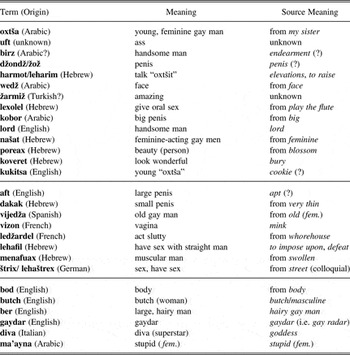
Because of the frequency with which they were described to me across my informant population, I began to investigate the extent to which oxtšot exist as a salient persona-type in Israeli society more broadly. I quickly discovered that while all of my lesbian and gay informants were, to varying degrees, familiar with the words of oxtšit, people not affiliated with the Israeli gay and lesbian “scene” had never heard of oxtšot nor had any knowledge of their characteristic language style. In this respect then, oxtšit is a “secret” lexicon whose domain of relevance does not extend beyond certain institutionalized configurations of Israeli lesbian and gay life. Yet unlike some of the other secret gay lexicons described in the literature, oxtšit is a very restricted code. While Baker (Reference Baker2002), for example, lists over 400 words that make up the Polari lexicon, the most comprehensive list of oxtšit words I have been able to find contains only twenty-eight entries (see Table 1).Footnote 3
An oxtšit lexicon.

The words in Table 1 are divided into three sections. These divisions are empirical ones, and reflect the extent to which the words can be reliably categorized as oxtšit forms. The topmost section contains words that were spontaneously offered to me as examples of oxtšit by my informants. These are also the words that I myself heard used most often, and can thus be identified as part of the core oxtšit vocabulary. The middle section, by contrast, contains words that are listed in a published lexicon of oxtšit (see n. 3) but were never corroborated by my informants (note too that all of the words in the top section also appear in the published lexicon). The status of these words is therefore more peripheral. Finally, the bottom section of Table 1 contains words that are listed in the published lexicon and that I heard used, but that are identical in form and in use to their source forms and are thus perhaps more accurately described as borrowings (question marks in the table refer to source languages and meanings that have been suggested but that I have been unable to verify).
In examining Table 1, it is immediately clear that the majority of the words listed all refer to a restricted set of semantic domains, primarily concerned with issues of feminine gendered practice (e.g. našat ‘feminine gay man,’ koveret ‘look wonderful,’ poreax ‘beauty’), the physical attributes of men (e.g. birz ‘handsome man,’ kobor ‘big penis,’ menafuax ‘muscular man’) and sex (e.g. lexolel ‘give oral sex,’ ledžardel ‘act slutty’). This is something that oxtšit shares with many of the gay lexicons described in the literature (e.g. Penelope & Wolfe Reference Penelope and Wolfe1979; Leap Reference Leap1996). When we consider the origins of the words listed, we find that roughly two-thirds are derived from languages other than Hebrew, nearly evenly split between Arabic (six words), English (seven words) and other European languages (five words), including Spanish, French, Italian, and German. These words of foreign origin are structurally largely unaltered from their source languages, aside from a slight adaption to Hebrew phonological and morphological patterns. So, for example, the English word apt becomes [aft] in oxtšit, presumably due to a normal process of postvocalic spirantization in Hebrew. In another case, the German noun Strich, literally ‘line’ but colloquially used to mean ‘street’ in expressions like Strichjunge ‘male prostitute’ and auf den Strich gehen ‘walk the streets,’ is borrowed as a noun, but is then also transformed into a verb (lehaštrex) through a normal process of Hebrew morphological derivation.
For the remaining eight words of Hebrew origin, a combination of morphological, phonological, and semantic innovation has taken place. Phonologically, two of the words are derived by simply altering one vowel of their standard Hebrew counterparts. The initial root vowel of the Hebrew verb lexalel ‘play the flute’ is changed to derive lexolel ‘give oral sex.’ Similarly, changing the second vowel in Hebrew dakik ‘very thin’ results in the innovative form dakak ‘small penis’ (perhaps in phonetic reference to the English cock). In terms of morphology, three oxtšit words are distinct from their corresponding standard Hebrew source forms. The word našat ‘feminine gay man’ is a (nonstandard) combining form of the Hebrew adjective naši ‘feminine’; the noun poreax ‘beauty’ is derived from the verb of the same form (meaning ‘to blossom’) rather than the expected nominal form prixa; and the adjective menafuax ‘muscular man’ is derived via the addition of a pleonastic stative prefix to the standard Hebrew adjective nafuax ‘swollen.’ Finally, all eight Hebrew-origin words take on specialized semantic meanings in oxtšit, either through metaphorical extension (e.g. koveret ‘look beautiful’ and hence ‘bury’ the competition), ludic iconization (e.g. lexolel) or synecdoche (e.g. ledžardel ‘act slutty’ as one acts in a ‘whorehouse’).
Based on this overview, it would seem that oxtšit is a prime example of what Halliday (Reference Halliday1976) famously describes as an anti-language, a secret language variety used by a socially marginalized population as a means of creating and maintaining an alternative (and, at times, subversive) identity without fear of censure or reproach. In formal terms, Halliday argues that anti-languages will normally exhibit certain distinctive structural characteristics that set them apart from other kinds of language varieties. These include: relexification, or an abundance of terms in the anti-language for describing the semantic domains typical of the activities and interests of the group; semantic specialization, wherein denotationally similar words take on individual, connotative meanings within the anti-language and do not remain direct semantic variants of one another; and metaphor, by which Halliday means the introduction in the anti-language of innovative linguistic forms across all levels of structural organization, including phonology (exemplified by processes such as metathesis and syllabic insertion), morphology (e.g. suffixation and compounding) and semantics (e.g., synecdoche).
When we compare oxtšit to Halliday's description, we find that oxtšit is a domain-specific relexicalized alternative to Hebrew. The relexicalization that characterizes it, moreover, is realized via processes of structural metaphor that apply on phonological, morphological, and semantic levels. Functionally, oxtšit would also be well suited to serving as the means through which an alternative oxtša identity is constructed and maintained. The fact that the lexicon is made up of either foreign words or Hebrew terms that have been fundamentally altered in some way means that oxtšit can serve both as a language of secrecy and as a way to establish a communal oxtša identity that excludes those not familiar with the variety (Irvine Reference Irvine, Eckert and Rickford2001). Oxtšit's domains of reference are, furthermore, specific to those aspects most stereotypical of oxtša life, and which stand in explicit contrast to normative ideologies of gender and sexuality in Israel. As I have argued elsewhere (Levon Reference Levon2009, Reference Levon2010), men in Israel are subject to a particular conceptualization of hegemonic masculinity (what has been called the “men as soldiers model”) that prizes taciturn virility and links it to standard definitions of Israeli national identity. Oxtšit, by virtue of its portrayal of a stereotypically histrionic hyper-femininity, valorizes and linguistically encodes a contravention of this norm, rendering it a potentially very potent form of political resistance and a basis for in-group cohesion. Halliday, however, is careful to state that these formal properties are only secondary characteristics, and do not serve as sufficient evidence for the identification of an anti-language:
An anti-language is not something that we shall always be able to recognize by inspection of a text. It is likely to be characterized by some or all of the various features mentioned, and hence to be recognizable by its phonological or lexicogrammatical shape as a metaphoric alternant to the everyday language. But in the last resort these features are not necessary to an anti-language … An anti-language, while it may display variation [of phonological and lexico-grammatical forms], is to be defined, on the other hand, as a systematic pattern of tendencies in the selection of meanings to be exchanged. (Halliday Reference Halliday1976:582)
The “meanings” that Halliday has in mind here are the alternative ones. In essence, Halliday is claiming that what distinguishes anti-language from language is the fact that the former encodes the beliefs and values of the marginalized group, while the latter encodes those of society-at-large. Yet, he insists that this encoding is not static; it is not an identifiable property of a text. Rather, Halliday characterizes it in terms of an “exchange,” arguing that alternative meaning, and thus the anti-language itself, can only ever be defined in interaction. In other words, only when a variety is used to create and maintain an alternative/subversive identity does that variety become an anti-language.
When it comes to oxtšit, however, there is little evidence to suggest that gay men in Israel are using it as a means to express an alternative, oxtša identity. On the most superficial level, in the twelve months I spent conducting fieldwork in Israel (in addition to another two dozen months spent in the country over the years for both personal and professional reasons) I never met an oxtša. This is not to say that I never heard oxtšit words in conversation or that I did not meet young, effeminate gay men. But I never met anyone who either self-identified as an oxtša or who exhibited the various characteristics—both physical and linguistic— that I had been hearing about. If oxtšit were indeed being used in the ways envisaged by Halliday's theory, my lack of firsthand knowledge of oxtša as an embodied identity would be surprising. That said, it is also entirely possible that I was just not in the right place at the right time or in some other way did not gain access to oxtšot. My discussion is necessarily restricted to the people and practices I was able to observe, and no matter how representative I endeavored to be it is certain that my methodological choices meant that there were certain things that I failed to see. Yet, that methodological caveat notwithstanding, I believe that it is nevertheless telling that none of the gay men that I observed, interviewed, or interacted with while in Israel identified as oxtšot, even if they occasionally used elements of oxtšit in their speech.
In making this claim, I also do not mean to imply that in order for oxtšit to function as an anti-language, oxtšot must in some essentialized sense exist. Like any other distinctive variety, oxtšit is a linguistic abstraction—an enregistered voice (Agha Reference Agha2003)—that is ideologically linked to the reified category oxtša. My point, however, is that in order for a voice to function as an anti-language, we must have evidence that speakers are using it in what Bakhtin (Reference Bakhtin1984) would call a unidirectional fashion—that is, as a means to performatively align themselves with the persona that the voice indexes (see also Rampton Reference Rampton and Auer1998). This is what is lacking in my observations in the Israeli context, where, as I outline below, oxtšit was not used as a way to claim affiliation with oxtšot.
Speaking Oxtšit
In the interviews I conducted with my informants in Israel, I would ask whether it is possible to determine if someone is gay or lesbian simply by speaking with them on the telephone. While the women were relatively nuanced in their responses, the men all answered that it was possible (at least when speaking with other men), and when pressed for more details invariably made reference to oxtšit.
(1) ani lo xošev še ze naxon, lema'et oxtšit meduberet. [tsoxek] ani tsoxek ki kaxa, lefaxot kaxa korim le ze etsleinu. še mištamšim be'eize šehu slang … ze be'emet be'ikar ma še anaxnu korim oxtšot. limrot še gam ani lefamim jaxol lehaxnis milim ka'ele bišvil hatsxok. mešaše'a besax hakol.
‘I don't think it [determining someone's sexuality over the telephone] is possible, except for oxtšit. [laughs] I'm laughing because, at least that's what we call it. It's using a kind of slang … I mean it's really mostly what we call oxtšot [who use it]. Even though sometimes I'll throw in some of those words just for fun—it's entertaining.’
The extract in (1) comes from my interview with Gilad, a thirty-one-year-old man from Tel Aviv.Footnote 4 In his comments, Gilad claims that the only salient linguistic clue to (male) sexuality in Israel is oxtšit. And while he primarily associates this “slang” with others (“what we call oxtšot”), Gilad also admits to using it himself sometimes, though only for comic effect (“even though sometimes I'll throw in some words just for fun”).
Oren, a thirty-four-year-old man from Jerusalem, similarly identifies the use of “certain words” as the only way to linguistically determine if an Israeli man is gay.
(2) ješ kama, bo nagid, milim bodedot še efšar- še mišehu omer otan hu o homo o še haxevre šelo homo'im. lehagid oxtša, lemašal, ze- ata tsarix lehijot mi hamilje hazot keday lehavin mima medubar.
‘There are certain, let's say, distinct words that it's possible- when someone says them he's either gay or his friends are gay. So saying oxtša, for example, it's- you need to be from this milieu in order to know what it's about.’
For Oren, knowing a word like oxtša requires an intimate familiarity with Israeli gay life (“when someone says them he's either gay or his friends are gay”). When I asked him where these distinctive words come from, Oren replied that they come from oxtšit, and went on to describe the people who normally use them:
(3) ze sfat ha oxtšot. sfat gever naši, im mexevat guf še hen našijot, adinot. ktsat rofes kaze ulay. ješ leze gam hevtim joter raxavim. bxinat ta'am belavuš, bemuzika.
‘It's the language of oxtšot. The language of a feminine man, with feminine mannerisms, delicate mannerisms. Maybe even kind of limp-wristed. There are also other aspects to it [being an oxtša]. In terms of taste in clothing, in music.’
Oren's description contains many of the familiar tropes regarding oxtšot, including an emphasis on femininity (“a feminine man, with feminine mannerisms”) and the identification of a distinctive set of tastes and habits (“taste in clothing, in music”). When asked, however, whether he uses oxtšit words himself, Oren's reply contrasts sharply with that of Gilad above.
(4) ani lo. ani lo oxtša, ve ani lo mi ele še mištamšim basteriotip. kelumar, ješ hamon homophobia- afilu mi homo'im še hem joter gavri'im klapey homo'im še hem joter naši'im, klapey ha oxtšot. veješ hamon sina klapey ha oxtšot. kelumar hen arbe pe'amim ktsat muktsot. az ani lo ose et ze.
‘Me, no. I'm not an oxtša, and I'm not one of those people who uses the stereotype. I mean, there's a lot of homophobia- even from gays that are more masculine toward gays that are more feminine, toward oxtšot. And there is a lot of hatred of oxtšot. I mean, they are even outcast a lot of the time. So I don't do that.’
While Gilad admits to sometimes using it “for fun,” Oren sees oxtšit as a language style uniquely affiliated with oxtšot (“I'm not an oxtša”). He nevertheless recognizes the fact that people who are not oxtšot can also make use of the variety (“people who use the stereotype”). Oren, however, views this practice unfavorably as a manifestation of what he calls “homophobia” among gay men, and explicitly rejects the idea of doing it himself (“so I don't do that”).
Gilad's and Oren's comments together are representative of the responses I received on the topic from the men I interviewed. The men all commented on the salience of oxtšit as a variety, even as they maintained that it is spoken primarily, or even “authentically,” by others (i.e. oxtšot). Even so, some of the men (like Gilad) acknowledged using certain oxtšit words, at least on occasion. These uses, however, were consistently described as light-hearted and entertaining, never serious or “identity-claiming.” By contrast, other men echoed Oren's response and denied using oxtšit whatsoever, stating either that it was irrelevant to them or that they did not approve of the intolerance they felt its use implied.
The men's own descriptions of their uses/non-uses of oxtšit parallel what I was able to observe of oxtšit in practice, which was admittedly not very much.Footnote 5 While very frequently a topic of conversation and meta-commentary, the actual use of oxtšit terms was relatively rare. When this use did occur, it was in my experience predominantly at bars or other social gatherings where it was used between friends as a means of commenting on someone else. So, for example, the oxtšit word for ‘face’ (wedž) would be used in a sentence like “What a lovely face,” or the oxtšit word for ‘ass’ (uft) in a statement like “I want a piece of that ass.” Contrary to what we might anticipate, these expressions of sexual desire were usually serious in that they referred to people that the speaker found sexually attractive. In other words, it was not the case that oxtšit was used to ironically comment upon men that speakers perceived to be effeminate or otherwise “oxtša-like.” Rather, oxtšit was used as a means to honestly express sexual desire. This desire, however, was not conveyed to the individual concerned using oxtšit; I never heard anyone say to someone else “You have a lovely wedž“ (though the corresponding sentence without the oxtšit term was common). Instead, oxtšit only ever seemed to be employed in indirect commentary.
I also occasionally heard oxtšit being used to recount past sexual exploits. In one example, an informant told me and a group of his (male) friends about a man he had met in a club the night before. My informant described how a lord (oxtšit for ‘handsome man’) had approached him on the dance floor, emphasizing that the man was xatix kaze ve šriri ‘attractive and well-built.’ My informant went on to recount his sexual relations with the man later that night, ending his story with the statement ve haja lo žož anak ‘and he had a huge penis,’ using the oxtšit word žož for ‘penis.’ Here, as above, oxtšit was used as a way to express (or, in this case, recount) male homosexual desire, once again in a situation in which the object of that desire was not directly addressed.
Though brief, these examples provide a representative snapshot of my observations of oxtšit being used as a way to indirectly address the subject of homosexual desire in social situations. This already rather specialized function of the variety was, moreover, even further restricted by speaker such that only a specific subset of the men I interacted with employed oxtšit words with any frequency (as alluded to in Gilad's and Oren's comments). Interestingly, this division among the men into those who use oxtšit and those who do not falls along salient ethnographic lines. In previous work (e.g. Levon Reference Levon2010), I have argued that my male informants can be divided roughly into two camps based on the extent to which their own beliefs and practices correspond to dominant Israeli conceptualizations of gender and national belonging. The men in the first of these camps (what I call the “Mainstream” group) believe in the importance of reconciling what they call their gay “lifestyle” with Israeli models of normative masculinity. The men in the second camp (the “Radical” group), by contrast, reject this integrative inclination and argue instead for a total reconfiguration of the Israeli gendered order. These two positions are articulated through a number of symbolic practices that serve to distinguish the men of the two groups from one another, not the least of which includes a tendency for the Mainstream men's speech to conform to Israeli sociolinguistic gender norms while the Radical men's speech subverts them (Levon Reference Levon2009).
In contrast to what we might expect given this broader ethnographic context, it is the Mainstream men (including Gilad) who are the predominant users of oxtšit. The Radical men (like Oren) hardly use it at all. What this means is that the men who use oxtšit are the same men whose stated beliefs contradict everything that oxtšit represents. In other words, oxtšit—an explicitly feminine speech style that controverts Israeli sociolinguistic gender norms—is used almost exclusively by the men most invested in maintaining those norms. If, as I argue above, we take unidirectional voicing as a necessary condition of anti-languages, then an anti-linguistic account of oxtšit appears to be ethnographically unjustified.
Instead, I would argue that the Mainstream men's use of oxtšit is an example of vari-directional voicing (Bakhtin Reference Bakhtin1984). Unlike its unidirectional counterpart, vari-directional voicing does not involve a performative alignment between the speaker and the persona indexed through the act of speaking. Rather, vari-directional voicing is a form of distancing via comparison, a way for a speaker to layer a socially salient voice over her own in order to demonstrate the opposition between the two. That this is indeed what the Mainstream men are doing when they use oxtšit is supported by the characteristics of their use that have already been described.
First of all, there is the apparent incongruence between the beliefs the Mainstream men maintain and the social stances oxtšit can be said to index. Rather than confounding an analysis of the social meaning of oxtšit, this incongruence is central to a vari-directional account. Second, there is the fact that oxtšit seems to be used only for indirect commentary among friends, not directly or to “outsiders.” This is a common feature of vari-directionality (see e.g. Rampton Reference Rampton1995 on avoidance) that helps to ensure that this kind of voicing is in fact interpreted as such, and not, for example, unidirectionally. Third, and related to this, is the fact that the Mainstream men consistently describe their use of oxtšit as “fun” or “entertaining.” Vari-directional voicing is, after all, a form of parody (Bakhtin Reference Bakhtin1984:199), one that is often employed in a seemingly comic and light-hearted way. Finally, there is the fact that all instances of oxtšit that I observed occurred in conversations that specifically addressed male homosexual desire. This is, I think, meaningful because, as Yosef (Reference Yosef2005) argues, explicit discussions of gay male sex threaten the dominant discourse of heteronormativity upon which Israeli conceptualizations of gender and the nation rest. For the Mainstream men—men for whom accommodating to Israeli gender norms is important—discussing gay male sex could therefore be a delicate matter, one in which sexual and national identity are brought into overt discursive conflict. Previous research (Rampton Reference Rampton1995:152–53; Baker Reference Baker2002:81–84) has argued that vari-directional voicing is common in situations of “inner conflict” like this because it provides speakers with a means to symbolically distance themselves from the content of their speech and hence mitigate a perceived infraction of prevailing in-group norms.
In summary, my observations and experiences of oxtšit in Israel lead me to reject an understanding of it as a voice speakers use unidirectionally, and thus as a potential identity-affirming anti-language. Instead, I propose that the men who use it do so vari-directionally, an assertion that I would argue is supported by both their own descriptions of their use and the situations in which I was able to observe that use occurring. In the next section, I broaden the scope of my inquiry to include an examination of how oxtšot and their associated language style are represented in Israeli gay cinema. I do so in order to develop a clearer understanding of the role played by oxtšit in the Israeli gay imaginary and so gain further insight into what I suggest is the Mainstream men's vari-directional practice.
Representing Oxtšit
Two recent Israeli films have made at least indirect reference to oxtšot and the language style with which they are stereotypically affiliated. The Bubble, directed by Eytan Fox and released in 2006, includes a brief scene in which a character is identified as an oxtša and in which the positionality of oxtšot in Israeli society is explicitly discussed. In Antarctica, directed by Yair Hochner and released in 2008, oxtšot are not overtly identified or discussed, though indirect reference is made to the language style oxtšit. In this section, I consider both of these representations of oxtšot/oxtšit in turn as a means to metapragmatically situate the uses of oxtšit among the Mainstream men described above.
The Bubble tells the story of three young Israeli friends—two gay men (Noam and Yali) and one straight woman (Lulu)—who are forced to look beyond their sheltered Tel Aviv lives (i.e. their “bubble”) and confront the sociopolitical realities of the Israeli/Palestinian conflict. This confrontation is brought about, in the first instance, by a chance-encounter-cum-love-affair between Noam and a young Palestinian man (named Ashraf). Male homosexuality thus plays a pivotal role in The Bubble. Structurally, it provides the primary narrative impetus of the film, motivating the development of the storyline throughout. On a symbolic level, the institutionalized expression of gay male identity (as in the bars, parties, and other venues that Noam and Ashraf frequent) provides the film with a means to contrast a “liberated” Israeli society with a “repressive” Palestinian one.
The scene of interest to us here is part of a secondary plotline in the film that revolves around Yali (the other gay male protagonist) and his romantic involvement with a man named Golan. The scene itself narrates Yali and Golan's first date in a trendy Tel Aviv bar. At the start of the scene, Yali is approached and greeted by Miki Buganim, an acquaintance who is a renowned hairstylist and makeup artist in Tel Aviv. Miki's brief appearance incites a subsequent conversation between Yali and Golan in which views about appropriate ways to embody gay male sexuality in Israel are discussed. The scene is transcribed in its entirety in (5).Footnote 6
(5) Imagining gay male sexuality in The Bubble

The scene in (5) opens with a somewhat campy exchange between Yali and Miki. Yali's response to Miki's simple greeting (“Hi”) is a lengthened “He::y,” featuring a high pitch accent immediately followed by a steep drop in contour to the end of the word. Because of its indexical associations in Israel (Levon Reference Levon2010), this sort of pitch dynamism serves to mark Yali's speech as affected and/or effeminate. Miki responds in kind, complimenting Yali on his shirt using the Hebrew word mehamemet (lit. ‘amazing’), a word stereotypically associated with women and gay men (much like ‘fabulous’ in English). This brief interchange is brought to a close when Miki's friend (called “A” in the transcript) pulls Miki away to a table elsewhere in the bar.
As soon as Miki and A leave, Golan expresses exasperation (ja ala ‘Oh God’) at “all of those oxtšot,” a category of person that he clearly affiliates with Miki. When Yali asks if anything is the matter, Golan continues in line 9 to state quite frankly that he does not like oxtšot, equating them with abnormal femininity in a man (“that I'm gay doesn't mean I need to be feminine”). Golan's statement to this effect is a straightforward articulation of a so-called assimilationist view of gay identity—that is, the belief that gay men should be as normatively masculine as their heterosexual counterparts (Vaid Reference Vaid1995; Levon Reference Levon2010). In line 10, Yali counters by arguing instead for a more liberal understanding of gender as a form of individual choice (“they want to be feminine”). Interestingly, though, Yali is careful to avoid associating himself with people who may choose to adopt nonnormative gender practices, making exclusive use of the third person plural (masculine) pronoun hem in his comments.
Golan immediately rejects Yali's proposal, latching a disdainful “are you kidding me?” to the end of Yali's turn before going on to ask (rhetorically) why anyone would choose to be an oxtša. Golan frames his question by juxtaposing the stereotypically masculine vocative ax šeli (lit. ‘my brother’) with the labeling of oxtšot as “biters” (or men who adopt the passive position in penetrative sex). In doing so, Golan establishes an opposition between “real” men (i.e. Golan and “his brother” Yali) and the emasculated oxtša. When Yali, however, in line 12 appears not to understand the reference, Golan begins to tease him and, in so doing, insinuate that Yali is himself a “biter.” The teasing is initiated by a demonstration of apparent incredulousness at Yali's ignorance of the term, linguistically materialized through Golan's repetitive questioning at the start of line 13. Golan then goes on to ironically suggest that the reason that Yali does not know the word “biter” is because Yali is actually a “fudge packer” (a man who adopts the active position in anal sex). When this tactic also elicits no response, and following a 1.5 second pause, Golan finally reassures Yali that he is only joking about Yali's being a “biter” and laments what he sees as Yali's naïveté. The scene ends with Yali unable or unwilling to respond, signaling a tacit acceptance of Golan's point of view.
Taken as a whole, I believe that this scene in The Bubble works to delineate what are considered to be “acceptable” articulations of gay male identity in Israel, and that it does so in such a way as to categorically exclude oxtšot. From the outset, oxtšot are described as abhorrent (“Don't like it”), impotent (“biters”) and ontologically distinct from gay men (“that I'm gay doesn't mean that I need to be feminine”). And while there is some evidence of a diversity of opinion between Golan's more assimilationist view and Yali's more liberal one (“they can do what they like”), both of these perspectives result in a portrayal of oxtšot as sexually pathological (Warner Reference Warner2000)—deviant individuals whose existence needs to be explained and/or justified and who stand in obvious contrast to the sexually “normal.” This deviance, moreover, is interactionally instantiated later in the scene when, toward the end, Golan uses the image of oxtšot as a source of banter or antagonistic play (Jaworski & Coupland Reference Jaworski and Coupland2005). That he then goes on to explicitly mark his insinuation that Yali is a “biter” as nothing more than a joke underscores the perceived danger such a label could pose if applied seriously. In short, I would argue that by the end of the scene oxtšot are positioned as both discursively and interactionally liminal; they are an aberrant person-type that neither Yali nor Golan seems willing to recognize as a viable embodiment of gay male sexuality in Israel.
A similar rejection of oxtšot can also be found in the second film I consider, Yair Hochner's Antarctica. Like The Bubble, Antarctica recounts the story of a small circle of lesbians and gay men in Tel Aviv. It is, however, a self-avowedly less political film and focuses exclusively on the more mundane social and sexual encounters of its characters. As I state above, oxtšot are never explicitly identified or discussed in the film as such. Nevertheless, in one scene an oxtšit language feature is used and is immediately the subject of dispute and meta-linguistic commentary. The feature, one that I have not yet described, involves using feminine gender morphology when referring to men. Similar in form to calling a man “she” in English, this is a highly salient stereotype of oxtša speech in Israel that was frequently offered to me as an example of the kind of thing that oxtšot do (though I, interestingly, never heard anybody actually use this feature in practice).Footnote 7 Symbolically, the association of oxtšot with feminine gender morphology is one of direct indexicality, where grammatical form is understood as straightforwardly encoding the inherent femininity by which oxtšot are characterized.
The scene in question narrates an encounter between two secondary characters: a woman, Michal, who is the ex-lover of the film's female protagonist, and her friend, Eytan, a man who is infatuated with one of the film's male protagonists. At the start of the scene, Eytan is pictured sitting drinking a cup of coffee alone in the bar that Michal owns. Michal enters, spots Eytan sitting alone and goes to sit next to him. The ensuing dialogue is transcribed in (6).
(6) Rejecting oxtša language in Antarctica

The scene begins with Michal plaintively calling out to Eytan, elongating her creaky-voiced vowel to create a recognizably “whiney” voice. While at first concerned that something may be the matter (“what's wrong”), Eytan soon becomes visibly annoyed by what we can infer is Michal's regular complaining about her ex-lover (“Enough (.) You're still in love with her?”). Michal seemingly misinterprets Eytan's reply, thinking that it may indicate that he has new information about the situation. Eytan's response, though, is dismissive and critical, and ends with his trying to understand why the ex-lover is so “cold” (“What's her story?”). Michal, however, does not want to begin a long conversation on the topic, and replies the she cannot handle talking about her ex-lover anymore (en li ko'ax ledaber al ze, lit. ‘I don't have the strength to talk about it’). At this, Eytan's mounting irritation erupts and he responds with an emphatic rhetorical question (“You still can't handle talking about it?”) before attempting to silence Michal with the forceful imperative “Don't talk.”
Rather than being silenced, however, Michal issues her own imperative (“Calm down”) in an even louder voice. Interestingly, she does so using the feminine form of the verb (teragi) rather than the masculine form that we would normally expect. This is immediately and negatively commented upon by Eytan, who, in a deeper voice than he was using previously, tells Michal not to address him using feminine forms. This negative sanctioning effectively ends this part of the conversation, and after having had a sip of his coffee, Eytan attempts to change the subject (“What is this new coffee?”). Michal seems at first to have agreed to the topic shift, responding cooperatively that it is a new Jamaican blend. A moment later, however, Michal references what transpired just before by jokingly flaunting Eytan's prohibition on referring to him using feminine forms. Instead of taking offense once again, this time Eytan joins Michal in laughter as the scene ends.
What is of primary interest to us here is the use (line 9), rejection (line 10), and subsequent re-use (line 13) of a feminine grammatical form to refer to a man—a practice stereotypically associated in Israel with oxtšot. Michal's initial use of this feature is open to a number of interpretations. First, the feminine verb form could serve as a means of indexing Eytan's prior behavior as in some way “feminine.” In the turn immediately preceding Michal's, Eytan was increasingly agitated: his voice rose higher and he began to visibly lose his temper. A great deal of research on gender in Israel (e.g. Katriel Reference Katriel1986) has argued that this sort of emotional display in a man runs counter to normative ideologies of Israeli masculinity, which instead require men to be laconic and reserved. Michal's choice of grammatical form could therefore be interpreted as a way of highlighting Eytan's deviation from this standard (i.e. his abnormal femininity).
A second, and in certain ways similar, interpretation of Michal's practice is that it has to do with an assertion of power in the conversation. By the time she speaks in line 9, Michal has already been the recipient of two commands from Eytan (“Enough” in line 4 and “Don't talk” in line 8). Using the feminine form in line 9 could therefore represent an attempt on Michal's part to emasculate Eytan interactionally and unseat him from a position of conversational dominance. This interpretation once again relies upon a deployment of Israeli ideologies of masculinity, such that Michal's “feminizing” of Eytan is interpreted as a threat and hence an effective means of establishing conversational control. The final interpretation that I suggest is related to both of the previous two, though it is less concerned with an assertion of power or an imputation of deviance as it is with the maintenance of an interpersonal status quo. What I have in mind here is Rampton's (2008) discussion of stylization as embedded within interaction ritual, whereby Michal's shift to a marked form in line 9 could be seen as a demand for remediation, an insistence that she and Eytan's prior “friendly” relations be restored. From this perspective, the fact that Michal issues this demand by temporarily identifying Eytan as feminine (and hence in some way nonnormative) would serve to heighten the demand's intensity and perhaps increase its chance of success (Rampton Reference Rampton2008:162).
All three of these interpretations crucially rely upon a belief that the identification of men with overt femininity is abnormal or undesirable. Whether the feminine verb form indexes Eytan's gender deviance, weakens his conversational power, or enacts a request that he soften his combative tone, the interactional force of Michal's utterance rests on a prior association between feminine men and social liminality. Eytan's response in line 10 is then direct metapragmatic evidence that he too shares this opinion. He firmly refuses any implication that he would be the type of man willing to be referred to with the feminine form, thus implicitly demonstrating his categorical distinction from men who do engage in this practice (i.e. oxtšot).Footnote 8 Michal does not dispute Eytan's position, and goes on to cement their common bond by jokingly repeating a feminine form in line 13. Eytan here accepts the joke for what it is, and the “abnormal” femininity that is indexed by the feminine verb form is definitively marginalized in the interaction. Thus while certainly less overtly than in The Bubble, I argue that this scene in Antarctica is also a depiction of what is to be considered “normal” for gay men in Israel. Crucially, this normality is characterized as in opposition to the perceived gender deviance of oxtšot.
The portrayal of oxtšot as socially abject in The Bubble and Antarctica reflects and reproduces dominant Israeli ideologies of gender and sexuality. Even before the start of Jewish settlement in Palestine in the late nineteenth century, Zionist theoreticians bemoaned what they viewed as the chronic passivity and weakness of Jews in Europe (Biale Reference Biale1997). For them, the establishment of a Jewish national homeland was an opportunity not only to escape persecution, but also to create a so-called “new Jew” (Almog Reference Almog2000; Kimmerling Reference Kimmerling2001) who would be strong and virile and able to overcome any attempts at subjugation. Thus from the earliest possible moment, Israeli national identity has been intimately bound up with an insistence on hegemonic masculinity among men. When, in the 1980s and 1990s, lesbian and gay activism began to emerge in Israel, calls for the inclusion of gays and lesbians in society were consistently couched in an assurance that nonnormative sexuality does not imply nonnormative gender (Walzer Reference Walzer2000; Gross Reference Gross and Barak-Erez2002). In other words, the prevailing strand of lesbian and gay politics did not challenge the centrality of Israeli normative gender roles and instead argued that gays and lesbians are equally able to accommodate them.
This belief in the necessity of “normalcy” continues to animate dominant configurations of Israeli lesbian and gay life, both on-screen and off (Yosef Reference Yosef2005). Like the characters in Antarctica and The Bubble, the men and women I observed are all keenly aware of the expectation that they will adhere to traditional gender roles or risk being marginalized and labeled as aberrant. What is interesting about the films discussed here is that they depict in very clear terms what adhering to traditional masculine gender roles means in practice—which behaviors are to be considered acceptable and which, crucially, are not. Thus while the reality of gay life in Israel is certainly more complex and nuanced, its cinematic representation provides informative insight into how oxtšot are positioned as a sort of exemplary “other,” an embodiment of the passivity and effeminacy that stands in symbolic counterpoint to everything that “normal” Israeli gay men are supposed to be. This information is critical to building an account of the Mainstream men's use of oxtšit since it helps us to understand the field of indexical meanings within which the language style is situated. In the next section, I combine this understanding of the meanings of oxtšit with my earlier assertion that the Mainstream men use it vari-directionally to propose an analysis of the purpose that such a use serves.
Voicing Alterity
It has been a commonplace of research since Goffman (Reference Goffman1974) that voices, speakers, and selves need not always be aligned. In his well-known theory of production formats, Goffman outlines four participant roles in conversation with which to categorize the relationship between a speaker and an utterance: author, the person responsible for the utterance; animator, the person voicing the utterance; principal, the person whose views are expressed by the utterance; and figure, the social persona or “character type” indexed by the uttering. When canonically aligned, these four roles are embodied by a single individuala speaker who performs an utterance (animator) of her own making (author) that expresses her own views (principal) and through which she is able to engender a desired presentation of self (figure). But this sort of alignment is only one of the typological possibilities that exist. In so-called “natural talk,” Goffman (Reference Goffman1981: 128) argues that speakers often strategically misalign these various roles as a means of managing interaction and of positioning themselves in the larger social world within which that interaction takes place.
Of Goffman's four roles, it is the figure that is of primary interest to us here. While author, animator, and principal are for the most part concerned with the mechanics of language production, the concept of figure is a way to model reception, a way to establish a link between talk-in-interaction and its socially meaningful interpretation. In other words, figures represent the interactional next-step of linguistic indexicality. They model the different ways in which speakers deploy meaningful voices, and help us to understand that deployment as a form of social action (Keane Reference Keane2000).
In his original formulation, Goffman (Reference Goffman1974) identifies five figure types along a descending cline of correspondence between the embodied reality of a speaker (i.e. the “self”) and the persona portrayed through the act of speaking: (i) natural figures, (ii) staged figures, (iii) printed figures, (iv) cited figures, and (v) mockeries or say-fors. Natural figures are those that are the closest to what a person is (or desires to be); they are, in essence, acts of identity through which speakers animate a claim to a particular identity category. The other four figure types, by contrast, all involve a discernable break between the speaker who animates an utterance and the figure the utterance portrays. For staged and printed figures, this break is grounded in the genres of theatrical performance and fiction-writing respectively. Cited figures refer to the use of reported speech, where not only are the animator and the figure unaligned but the distinction between the two is emphasized. The final figure type, mockeries, is like cited figures in that it entails the quotation of speech explicitly attributed to another. Yet unlike straightforward citation, mockeries involve a focus on the form of an utterance, not its content, as a way of ridiculing the category of people with which that form is ideologically linked.
Building on Goffman's work, Hastings & Manning (Reference Hastings and Manning2004) elaborate a theory of indexical language use that rests on a contrast between what they call figures of identity, natural figures that correspond to a speaker's image of self, and figures of alterity, mockeries that serve to interactionally construct an alternate “other.” Crucially, however, they argue that the end-result of using either figural type is the same: the emergence of a speaker's desired presentation of self. In other words, both figures of identity and figures of alterity allow speakers to portray “identity” in interaction. The difference is one of method, whereby figures of identity involve explicit ascription to a particular category while figures of alterity involve the creation of a “monstrous or deviant [other], with respect to which the (normal) identity of the speaker emerges as the unmarked ground to the figure of abnormal alterity” (Hastings & Manning Reference Hastings and Manning2004:304).
I bring in Hastings & Manning's redevelopment of Goffman because I believe that it provides a useful way for describing the interactional function of oxtšit among the men I observed. In essence, I suggest that oxtšit represents a figural voice of alterity for the Mainstream men—that they use it in order to portray an aberrantly gendered “other” in conversation and that in doing so they are able to indirectly index their own gender normativity. To use Goffman's terminology, I propose that oxtšit is the presentation of a “not-self” and that the purpose of the Mainstream men's using it is to construct a normative (gay) self in interaction. I would argue, moreover, that the structural, pragmatic, and metapragmatic features of oxtšit outlined above support this interpretation.
In terms of pragmatics, Hastings & Manning claim that figural voices of alterity are “for the most part words of another that are never found in the mouth of another … they are never forms found indexing speaker identity” (2004:306). This is, I argue, the situation of oxtšit in Israel, at least among the men that I observed. As the comments by Gilad and Oren attest, oxtšit is seen as being the words of an identifiable other, the oxtša. Yet, as I say before, I never encountered anyone who self-identified as an oxtša or who used elements of oxtšit to index an oxtša-affiliated identity. For my informants, then, oxtšit appears to be an exceptional (as opposed to unmarked) language variety, one that is never used to represent an embodied expression of identity. Rather, I suggest that my informants only ever employ oxtšit vari-directionally.Footnote 9
From a meta-pragmatic perspective, the Mainstream men rationalize their use of oxtchcit as “fun” or “entertaining.” But the fact that it is only the Mainstream men who use the variety, and that even they only use it when discussing particular topics in social situations, seems to indicate that this use serves a more serious interactional purpose. In the words of Hastings & Manning, oxtšit appears to be a form of personation, an act of performative mimicry that makes use of parody to contrast the putative “normality” of the speaker with the abnormality of the voice (see, e.g., Chun Reference Chun2004; Hill Reference Hill2008). We saw examples of this in both of the film scenes discussed above, where the image of oxtšot (if not necessarily oxtšit) was instrumentalized in antagonistic play as a way to build solidarity between characters through the exclusion of an out-group other. Thus while I do not dispute that the Mainstream men do indeed find their use of oxtšit amusing, I would argue that this amusement is grounded in a mockery of the iconic abnormality of oxtšit.
Up to this point, I have focused on the ways in which oxtšit seems to serve as an index of “difference” in interaction (i.e. as the language style associated with a salient “other”). My final point, in contrast, involves the structural characteristics of oxtšit, which I argue are themselves a concrete manifestation of Israeli ideologies of alterity. In their discussion of how certain speech styles come to denote the “monstrous deviant” of alterity, Hastings & Manning claim that “‘abnormal speech types’ … are ‘imitative’ in speech, not of speech, but rather of other forms of alterity” (2004:305, emphasis in the original). In other words, the language used to denote an “other” is formally derived from the linguistic iconization (Irvine & Gal Reference Irvine, Gal and Kroskrity2000) of the social characteristics that serve to identify that other as different. As an example, Hastings & Manning cite cases in which speech abnormalities are incorporated into figural voices of alterity as a means of representing some other physical, social, or emotional “abnormality” of the people in question (the stereotype of the “gay men's lisp” seems to be a case in point). In addition to physical abnormalities, Hastings & Manning also consider the possibility of alterity being linguistically encoded via changes in the morphology, phonology, and local versus foreign origins of words (see also Hill Reference Hill1998, Reference Hill2008).
We find many of these iconic representations of alterity in oxtšit. First, I describe above how the majority of oxtšit words are drawn from non-Hebrew sources. While perhaps seemingly anodyne, this diversity of origins is laden with ideological baggage in Israel. A key component of the formation of Israeli national identity was the revitalization and adoption of Hebrew as a symbol of Jewish national rebirth (Spolsky & Shohamy Reference Spolsky and Shohamy1999; Kuzar Reference Kuzar2001). The promotion of Hebrew was accomplished through a range of language-planning efforts, not the least of which included the association of competing languages (e.g. Arabic, German, Yiddish) with the perceived weakness and passivity of Diaspora Jewish life. It is therefore telling that oxtšit makes such extensive use of non-Hebrew source words, as the “foreignness” of the variety is in direct opposition to gendered ideologies of the nation. Second, for those oxtšit words that are of Hebrew origin, the majority have undergone either morphological or phonological change (or both) and all have been semantically repositioned so as to refer to stereotypically feminine characteristics and concerns. Finally, the exaggerated pitch ranges and high levels of pitch dynamism that are said to accompany oxtša speech can be interpreted as a marked departure from a normatively masculine Israeli prosodic style (Katriel Reference Katriel1986; Levon Reference Levon2010).
In short, I would argue that oxtšit involves the kind of structural iconization of difference that Hastings & Manning associate with figural voices of alterity. The use of words of non-Hebrew origin, the changes in the morphology and phonology of Hebrew words, the semantic realignment of meanings and the divergence from normatively prescribed prosody all serve to encode a profoundly “abnormal” other. This “other” (the oxtša) is the polar opposite of standard Israeli conceptualizations of masculinity and identity: he is foreign, effeminate, and passive. By deploying this figure of alterity in conversation, I argue that Mainstream men affirm the “normality” of their own gay identities (they are not foreign; they are not effeminate; they are not passive). Cast in theoretical terms, the Mainstream men's natural figures emerge as the presupposed ground to the mockery that is oxtšit (Goffman Reference Goffman1974; Hastings & Manning Reference Hastings and Manning2004).
Conclusion
In the preceding analysis, I argue that unlike many of the other gay lexicons that have been described in the literature oxtšit does not function as an anti-language for the men who use it. While anti-languages require speakers to use them unidirectionally as a means to construct an anti-identity (Halliday Reference Halliday1976), I claim that the Mainstream men make vari-directional use of the variety so as to symbolically distance themselves from all that oxtšit represents. I develop this argument further by subsequently examining representations of oxtšit/oxtšot in Israeli cinema. There, I demonstrate how oxtšot are depicted as existing on the periphery of Israeli gay male life; they are aberrant figures whose deviance stands in marked contrast to normative articulations of gay sexuality in Israel. Finally, I bring these two strands of the analysis together to propose that the purpose of the Mainstream men's use of oxtšit is the presentation of a figural voice of alterity in interaction (Hastings & Manning Reference Hastings and Manning2004). Based on a close reading of the structural, pragmatic, and metapragmatic features of the variety, I argue that oxtšit is best characterized as a linguistic materialization of “difference” that the Mainstream men employ in conversation as a way of indirectly portraying their own normatively gendered selves.
That the Mainstream men use oxtšit in this way is interesting because it underscores the idea that social identities do not exist in isolation; they are instead refracted through a host of other beliefs, values, and affiliations (Cameron & Kulick Reference Cameron and Kulick2003; Bucholtz & Hall Reference Bucholtz and Hall2005, inter alia). In essence, I believe that the Mainstream men use oxtšit as a way to resist classification as straightforwardly, or simply, “gay.” I do not, however, mean to imply that the men reject identification as “gay” entirely, but rather that they make use of in-group mockery in order to subdivide that category and inflect it with local meaning (see Johnstone Reference Johnstone1999; Chun Reference Chun2004). In concrete terms, I propose that the strategic deployment of oxtšit allows the Mainstream men to symbolically instantiate two kinds of Israeli gay male identity: a gender-normative one that they themselves embody and a gender-aberrant one that they reject. To my mind, their reason for doing so is grounded in the men's own conceptualization of the intersection of “gay” and “Israeli” identities, and their firm belief in the necessity of reconciling the expression of gay male sexuality with dominant ideologies of gender and the nation. In other words, I argue that vari-directionally voicing oxtšit provides the Mainstream men with a means to negotiate the competing demands of overlapping fields of social subjectification and present an identity that is at once both “gay” and “Israeli.” In doing so, the men demonstrate not only how larger ideological imperatives can be incorporated and, to a certain extent, refashioned within groups to suit more local, in-group needs (Abu-Lughod Reference Abu-Lughod1990; Mahmood Reference Mahmood2005), but also how language plays a central role in this process.
Appendix: Transcription conventions
- ::
vowel lengthening
- __
prosodic emphasis
- ?
question (rising intonation)
- (.)
pause
- -
short pause
- (n)
length (in seconds) of longer pause
- =
latching (no audible break between turns)
- ><
more rapid speech
- [ ]
transcriber comment
- (( ))
nonlinguistic action