Although modernization theory has been disputed by many scholars, modernization has led to democratization in South Korea.Footnote 1 The country achieved remarkable economic growth, referred to as ‘the miracle of the Han’ under the dictatorship of Park Chung-hee in the 1960s and 1970s. While ‘the miracle’ continued after Park was assassinated in 1979, Korea underwent a successful democratization throughout the 1980s. Consistent with modernization theory, the economic development of Korea resulted in its successful democratization ultimately. On 19 December 2012, however, Park Geun-hye, the daughter of Park Chung-hee, won the presidential election, leaving many overseas observers baffled about what had transpired in the country. After her father was assassinated, Park Geun-hye was abandoned by so many people including even close associates of her father that she felt ‘a personal betrayal’ (Chugandonga, 22 July 2013). Apparently, few, if any, saw political prospects for ‘the strong man's daughter’ (Times, 17 December 2012). Barely two decades after the celebrated democratization of the country, however, Park Geun-hye has returned to power with the support of a majority of voters in Korea. How should we understand the surprising return of ‘the strong man's daughter’?
The goal of this paper is to elaborate a theory which can explain the seemingly puzzling comeback of Park Geun-hye. Although Korea is often regarded as ‘the dream case’ of modernization theory, the recent victory of Park Geun-hye along with the so-called ‘Park Chung-hee syndrome’ exposes a major weakness of the theory (Przeworski and Limongi, Reference Przeworski and Limongi1997: 162). In particular, modernization theory is overly process-oriented; that is, the process of economic growth will lead to a successful process of democratization with some temporal gaps. The experience of Korea, however, suggests that it is necessary to shift our focus from process to agency. First, if modernization brings democratization, who leads the process of modernization in those cases? In other words, who are the so-called ‘modernizers’ supporting a dictatorship for the long-term economic benefits of the country? Second, if modernization leads to democracy in some cases, who leads the process of democratization? Who are the so-called ‘democratizers’ fighting against a dictatorship despite repression? Finally, what happens if the temporal gap between modernization and democratization is relatively short, whereby modernizers and democratizers occupy the same political landscape, vying for power?
In answering these questions, the South Korean case provides interesting theoretical insights into modernization theory, especially when we shift our focus from process to agency. First, ‘modernizers’ and ‘democratizers’ were different in the South Korean experience. Whereas Park Chung-hee and his followers initiated a rapid process of economic development under a dictatorial government, it was the progressive liberals who fought hard against a dictatorship and finally democratized the country. Second, there was little temporal lapse between modernization and democratization in South Korea as that ‘modernizers’ and ‘democratizers’ are currently competing for power with opposing credentials (i.e., ‘We built the country’ vs. ‘We built democracy’). Under such circumstances, reconciliation between the two agents of modernization theory is difficult to achieve, not only because they are political rivals but also because there is bad blood between them; that is, ‘democratizers’ suffered from cruel persecution by ‘modernizers’ during the military dictatorship.
It is under such circumstances that modernization and democratization, the two proud achievements of South Korea, have turned into the source of its deep social divisions in recent years. Indeed, the country seen from inside looks quite different from its outward image. To the outside world, South Korea may be a great inspirational story, especially to developing countries that are striving to achieve the elusive goals of economic growth and political democracy at the same time. Seen from inside, however, South Korea is a deeply divided society with severe fault-lines running between modernizers and democratizers on many issues. As will be shown, the return of ‘the strong man's daughter’ in the 2012 presidential election is another manifestation of South Korea as a seriously fractured society. It is the result of past divisions, a symbol of current schisms, and the possible cause of future ruptures between those who have led modernization and those who have led democratization in Korean society.
Refocusing modernization theory: from process to agency
When Seymour M. Lipset proposed the idea that ‘increased wealth is . . . related causally to the development of democracy’ (Lipset, Reference Lipset1959: 72, 83), modernization theory received strong support from many quantitative analyses (Bollen, Reference Bollen1979; Bollen and Jackman, Reference Bollen and Jackman1985; Cutright, Reference Cutright1963; Jackman, Reference Jackman1973). Soon the theory was established as an ‘iron law . . . almost beyond challenge’ (Burkhart and Lewis-Beck, Reference Burkhart and Lewis-Beck1994: 903). Over time, however, doubts began to emerge because scholars noted that earlier supportive studies suffered from the problem of a small sample size. As the theory did not withstand a test with larger samples, the ‘iron law’ faltered (Arat, Reference Arat1988; Gonick and Rosh, Reference Gonick and Rosh1988). Also troubling was the substantial regional variation. While it received robust support from the data based on European countries, modernization theory became powerless when it was applied to non-Western regions, especially Latin America. As a result, some scholars elaborated ‘European exceptionalism’ (Burkhart and Lewis-Beck, Reference Burkhart and Lewis-Beck1994; Londregan and Poole, Reference Londregan and Poole1996), while others considered ‘Latin American exceptionalism’ (Mainwaring and Perez-Linan, Reference Mainwaring and Perez-Linan2003).
Under such circumstances, the most severe blow came from Adam Przeworski. After differentiating two democratization scenarios, Przeworski demonstrated that while economic development did not give birth to democracy (thus, democracy was not ‘endogenous’ to modernization), it nurtured and stabilized democracy once the latter had been established; thus, democracy was ‘exogenous’ to modernization (Przeworski and Limongi, Reference Przeworski and Limongi1997: 157). As a result, modernization theory had ‘little, if any, explanatory power’ (Przeworski et al., Reference Przeworski, Alvarez, Cheibub and Limongi2000: 137). Przeworski ‘hit the field of political development like a bolt of lightning and immediately changed the landscape’ (Boix and Stokes, Reference Boix and Stokes2003: 517). In the study of democratization which had long been known for controversial debates and disputes, ‘an uncharacteristic lull seems to have descended, a lull we attribute to . . . Przeworski’ (Epstein et al., Reference Epstein, Bates, Goldstone, Kristensen and O'Halloran2006: 551). As Przeworski's findings were treated as received wisdom, many scholars have endeavored to theorize why modernization and democratization show ‘little causal effect’ despite a strong correlation (Acemoglu and Robinson, Reference Acemoglu and Robinson2006: 56–7). In particular, they searched for an ‘omitted variable’ which might play an intervening role, such as ‘inequality’ (Andersen, Reference Andersen2012; Boix, Reference Boix2003), ‘cultural values’ (Inglehart and Welzel, Reference Inglehart and Welzel2010), or ‘a regime vulnerability’ (Miller, Reference Miller2012). They suspected that modernization caused something else (e.g., an economic equality, more civic-minded values, an autocratic regime vulnerability), which then led to democratization.
For many developing countries born after World War II, the implications of modernization theory were attractive. Although they might currently suffer from a cruel dictatorship and desperate poverty, the seemingly unachievable ideal of a dual achievement – modernization and democratization – could be accomplished so long as the economy grew. In this respect, the experience of Korea was inspiring in that it seemed to corroborate modernization theory. Its rapid modernization in the 1970s led to democratization a decade later. It was a great success story with a happy ending, where protagonists striving under hardship finally arrived at an elusive ‘oasis’, so to speak. Even Przeworski, whose views were the death knell for modernization theory, acknowledged that Korea was the ‘dream case’ of modernization theory, where the otherwise debunked theory seemingly maintained explanatory power (Przeworski et al., Reference Przeworski, Alvarez, Cheibub and Limongi2000: 99).
A view from inside, however, reveals a different story that diverges from the supposed happy ending. Despite its economic prosperity and stable democracy, Korea is severely divided with emotional scars running deep in the minds of its people. The following passage describes the so-called ‘divided holiday’ which has become a routine phenomenon in contemporary Korean society:
Yesterday was the 60th anniversary of our national liberation from Japan in 1945 . . . It was, however, a divided holiday. There were two opposite celebrations with different ideas, arguments and slogans. The abyss between conservatives and progressive liberals, who despise and hate each other, was deeper than ever . . . The only positive outcome that came out of yesterday was that despite the two huge demonstrations being held nearby with polar opposite views, there was fortunately no physical clash. (Chosun Ilbo, 16 August 2005)
Why is Korea so severely divided that its people could not even join together to celebrate their national liberation? In a country where economic prosperity and a stable democracy – notoriously elusive achievements for many developing countries – have been achieved, why is there a ‘divided holiday’ where people are expressing dislike and even hatred instead of a common celebration? The question reveals a critical shortcoming of modernization theory, a shortcoming resulting from its overly process-oriented analysis. In a nutshell, modernization theory maintains that economic development leads to a political process of democratization with a certain temporal gap between the two processes. In other words, long-term economic growth will dig the grave for the authoritarian regime and will usher in an era of democracy eventually.
What is lost in the language of process, however, is ‘the efficacy of human action’: that is, the agency question (Sewell, Reference Sewell2005: 125). Social realities differ from natural phenomena which often have a human agent-proof quality, such as a tectonic movement or natural erosion by wind. By contrast, the most important aspect of social phenomena is that they involve the question of human agency in that people act, individually or in groups, with intentions to preserve or change the social settings around them. Even when there are unintended consequences, the irony is not in the lack of willful actions by the people but in the mismatch between their purposeful actions and the final outcome which has betrayed them. As a result, there has been ‘a craze’ for the agency question which is regarded as ‘the central problem’ in social theories (Archer, Reference Archer1988: x; Fuller, Reference Fuller and Sica1998: 92). In this respect, there is a conspicuous hole in modernization theory because, in the words of Przeworski, ‘no one does anything to bring democracy about’ in its framework. Instead, democracy is treated as a long-term effect of economic growth. It is obvious that democracy is not a byproduct or side-effect of economic development. Instead, democratization (and modernization too) is ‘achieved by political actors pursing their goals’ (Przeworski and Limongi, Reference Przeworski and Limongi1997: 176–7). As a result, it is time to raise the agency question.
When we shift our focus from process to agency, several interesting questions emerge with theoretical implications. First, if modernization brings about democratization in some cases, who are the agents of modernization in this process? Who are the so-called ‘modernizers’ or ‘industrializers’ supporting an authoritarian regime in return for economic development? Second, if modernization sometimes leads to democracy, who are the agents of democratization or the so-called ‘democratizers’ making sacrifices in a struggle against the dictatorship? Finally, if there is a temporal gap between modernization and democratization, what will be the long-term effects of such a gap? Depending on the length of the temporal gap, we can suggest two different scenarios. On the one hand, when there is a substantial lapse between modernization and democratization so that the agents of modernization have departed, those who democratized the country can afford to be magnanimous toward their predecessors because the latter have become history. Reconciliation is possible because ‘the evil’ is resting in peace. On the other hand, when there is a short interval between the two processes, modernizers and democratizers occupy the same political landscape, contending for power while using opposing credentials (i.e., ‘We brought prosperity’ vs. ‘We built democracy’). In such a scenario, ‘the evil’ is not a historical relic but an ominous political contender to be reckoned with. Reconciliation between modernizers and democratizers is harder to achieve not only because they are political contenders but also because there is a deep animosity from the recent past: namely, ‘democratizers’ suffered from cruel persecution by ‘modernizers’ during the dictatorship. It is under such circumstances that ‘a divided holiday’ has become a routine phenomenon in Korean society. As will be shown throughout the paper, the recent victory of Park Geun-hye is another manifestation of Korea as a fractured society with social divisions running deep between modernizers and democratizers. The return of ‘the strong man's daughter’ is the tip of the iceberg, below which deep social fractures are inching dangerously toward the core.
Analyzing the Korean case
Park Chung-hee: ‘developmental dictatorship’
According to a ‘developmental state’ theory, the meteoric rise of Japan was a consequence of the Japanese state imbued with a ‘plan rationality’ ethos. Unlike a ‘regulatory’ state (e.g., the US) with minimal government intervention in the economy, the Japanese state was determined to guide the economic development of the country with systematic intervention into the economy. Simply put, the Japanese state was ‘developmental’ (Johnson, Reference Johnson1982: 23). Standing at the center of the developmental state was a competent bureaucracy called the Ministry of International Trade and Industry (MITI), which played the role of the brain in manufacturing the Japanese miracle. MITI could maintain its autonomy from capital interests or labor pressures because it wielded ‘extra-legal powers of administrative guidance’ (Woo-Cumings, Reference Woo-Cumings1999: 28). Such autonomy, however, was not absolute because MITI operated within a thick web of ties to various social actors, especially large corporations. As a result, its autonomy was ‘embedded’ (Evans, Reference Evans1995: 59).
Applied to the Korean case, a developmental state theory finds its usual characteristics. For instance, the system of political rule undergirding the hyper-growth of Korea in the 1960s and 1970s was thoroughly bureaucratic, spearheaded by the Economic Planning Board (EPB: the Korean counterpart of the Japanese MITI). The decisive difference, however, was that the elite economic bureaucracy was driven by its creator, Park Chung-hee with unchecked discretionary power. The key policy decisions to put Korea on the path of rapid economic growth (e.g., to deepen its industrialization from light industries to heavy and chemical industries in 1973) were determined by Park Chung-hee himself, often against strong resistance from elite bureaucrats. As a result, Park Chung-hee once recollected, ‘Experts only try to discourage me by identifying risks and obstacles. Had I listened to their advice, I would have ended up doing nothing’ (Kim and Vogel, Reference Kim and Vogel2011: 12). Unlike the Japanese model, there was the personalized version of a developmental state in the Korean case.
The economic success of the Park Chung-hee era can be best understood when compared to the experience of North Korea because there was no substantial difference in their ethnic, linguistic, religious, historical, and cultural heritages. After liberation from Japan in 1945, the two countries embarked on different paths to economic development. Whereas South Korea pursued export-oriented development under Park Chung-hee and became a successful model of a ‘developmental state’, North Korea under Kim Il-sung pursued a chuch'e (self-reliant) economy with limited trade with the outside world other than the socialist bloc. Initially, the different economic approaches of the two countries did not yield a noticeable difference. As the South Korean economy began to accelerate in the late 1960s, however, a virtual tie was quickly replaced by a lopsided comparison. In 1970, the South Korean economy with its GNP at $7.9 billion was twice as large as the North Korean GNP stagnating at $3.9 billion. By 1979, when Park Chung-hee was assassinated, the South Korean economy ($60 billion GNP) dwarfed its northern counterpart ($13 billion GNP). For the next two decades, the miserable failure of North Korea has only highlighted the economic success of the Park Chung-hee era because the economies of the two countries had been practically identical until Park Chung-hee in the south and Kim Il-sung in the north took different approaches to the same goal of modernizing their countries.
Rise of progressive liberals
Park Chung-hee rose to power with a military coup in 1961. The illegal nature of his dictatorship worsened after the introduction of the Yushin system in 1972, which guaranteed him a life-term presidency. As his dictatorship deepened, social resistance and a fight for democracy intensified as well. The long journey to democracy had thus begun, with sacrifices borne by opposition politicians, civil rights activists, liberal religious leaders, and mostly young college students, all of whom were known as ‘progressive liberals’ (Nam, Reference Nam2009: 583). In their struggle for democracy, progressive liberals revealed interesting ideological traits distinct from the ruling philosophy of Park Chung-hee and the ‘conservatives’ who supported him: that is, a priority on distribution over growth, a sympathetic understanding of North Korea, and a critical stance towards the United States.
First, when Park Chung-hee seized power, the country lacked capital despite the availability of inexpensive labor. In response, Park Chung-hee fostered rapid capital accumulation in the hands of a few chaebŏl (big conglomerates) such as Samsung and Hyundai, although they were meted a ‘harsh punishment’ when they proved economically unproductive or politically unreliable (Kim and Park, Reference Kim, Park, Kim and Vogel2011: 293). At the same time, he maintained a repressive labor policy so that chaebŏls could exploit cheap labor. The result was increasing economic inequalities in the midst of rapid growth. In response, progressive liberals strived for the rights of those lagging behind, especially laborers, peasants, and the urban poor. While the economic policies of Park Chung-hee were creating winners and losers, progressive liberals were determined to stand behind the ‘losers’ in Korean society. As a result, they prioritized fair distribution over rapid growth, struggling to introduce social safety nets for the less fortunate.
Second, progressive liberals also displayed a sympathetic understanding of North Korea, thus provoking the so-called ‘textbook debate’ in Korean society. From its inception, the Ministry of Education was given the right to author, authorize, and sponsor elementary textbooks. In this way, the government maintained ‘the monopoly of legitimate education’ in which everyone used the same textbook in elementary schools (Gellner, Reference Gellner1983: 34). In particular, in the subject called Todŏk (Ethics or ‘Right Way to Live’), the government explained to young students how they should view North Korea. While conservatives were in power under a dictatorship, they adopted the ‘pang'ong’ (anti-communism) curriculum (1955–87), in which North Korea was described as a ‘red wolf’ lurking in the darkness to attack South Korea (Todǒk: 3rd Curriculum 1973–81, 3rd Grade, 2nd Semester). As a result, it was the target of deep hatred. By contrast, when progressive liberals rose to power after democratization, they carried out a textbook reform with the ‘t'ongil’ (unification) curriculum (1988–2009), which negated the previous curriculum as teaching incorrect attitudes towards North Korea. Gone was the memorable image of a red wolf. Instead, North Korea was described as a ‘new classmate’ moving into a neighborhood, who needs to be embraced because ‘our wish is unification even in dreams’ (Todǒk: 6th Curriculum 1992–7, 2nd Grade, 1st Semester and 5th Grade, 2nd Semester). Progressive liberals were imagining North Korea differently.
Finally, the most controversial aspect of progressive liberals was their critical stance toward the United States. The Korean War (1950–3) consolidated the status of the US as a blood ally of South Korea. As a result, pro-Americanism constituted an ‘untouchable’ value for most people (Cho, Reference Cho2006: 14–17). The Kwangju massacre (1980), however, changed the situation. When Chun Doo-hwan illegally seized power with a bloody massacre, many people raised questions regarding the US role. What was ‘our blood ally’ doing while innocent citizens were brutally massacred? Why would President Reagan invite Chun Doo-hwan, ‘the butcher of Kwangju’, to the White House even before the blood on the streets of Kwangju had dried, thus officially giving him a coronation in the eyes of many? Such was the beginning of the re-reckoning of the US among progressive liberals, especially young college students. When it was over, the conventional image of the US as the beacon of democracy was gone. Instead, the ideological contour of progressive liberals ranged from ‘anti-Americanism’ of the far left to yŏngmiron (to use America for Korean interests) of the moderate right (KDF, 2006: 403). For most Koreans, however, the radical stance of progressive liberals to the US was neither persuasive nor popular. Under such circumstances, young students displayed a remarkable flexibility by temporarily dropping their anti-American agenda in the critical months leading to the June Democratic Revolution (1987), thus making a vital link to the ordinary people in a struggle against the dictatorship (Kim, Reference Kim1999; 254). In this way, progressive liberals emerged as the social force that brought down the military dictatorship. As a result, they were often referred to as the minjuhwaseryŏg (democratizers).
Conservatives come back
Initially, the conservatives were silent after the 1987 democratic revolution. As they had long been in cahoots with the military dictatorship, there was little room for the conservatives in a new political landscape that was democratizing rapidly. When progressive liberals took controversial steps displaying their pro-North Korean mentality and anti-American stance, however, conservatives found an opening. On 14 August 1988, Kim Yong-gap (a former military officer turned conservative politician) shocked the country by arguing that the real agenda of progressive liberals was ‘not democratization of our country but a communist revolution’ because ‘the arguments of those young college students are practically copied words of Kim Il-sung’. If conservatives did not protect the country, he warned, Korea ‘will become another Vietnam’ (Chosun Ilbo, 14 August 1988). Yang Dong-An (a professor) also published an article entitled ‘Are Conservatives Dead?’ In this article often referred to as the ‘Conservative Manifesto’, he urged conservatives to fight against ‘communists inside the country’. Otherwise, the ‘conservatives are all dead’ (Yang, Reference Yang1988: 154–69). In response, leading conservatives created the ‘Free 300 Intellectuals’, the first conservative association established after the fall of the dictatorship (Donga Ilbo, 4 October 1989).
Under such circumstances, the ‘sunshine policy’ of the Kim Dae-jung administration (1998–2003) provided a great opportunity for conservatives. On 14 June 2000, the first inter-Korean summit was held between Kim Dae-jung and Kim Jong-il. After three days of negotiation that riveted the attention of Koreans, the summit concluded with the 6.15 Agreement which promised further cooperation between the two Koreas. When the initial enthusiasm for the summit subsided, conservatives pointed out a glaring gap in the 6.15 Agreement; namely, it did not mention the North Korean nuclear program. Considering that the North Korean nuclear threat was one of the gravest concerns of many people, its omission was difficult to defend. On 27 November 2000, about 200 conservative associations formed a united front called the ‘Free Citizens’ Alliance of Korea’ and demanded termination of the sunshine policy (Donga Ilbo, 28 November 2000). When the sunshine policy was inherited by President Roh Moo-hyun (2003–08), the angry voices of conservatives sharpened further, especially because the colorful new president proved much more progressive than his predecessor.
Although the sunshine policy provided an opening for conservatives, their political comeback as the ruling party of the country (Minjadang → Sinhan'guktang → Hannaradang → Saenuridang) was long and complicated. At the time of the 1987 democratization, there were four major political parties in South Korea. They were Minjujŏngŭidang (a ruling conservative party led by the 1980 military coup leaders), Sinminjugonghwadang (a conservative party led by the 1961 military coup leaders after the death of Park Chung-hee), T'ongilminjudang (a democratic party led by Kim Young-sam), and Pyŏnghwaminjudang (a democratic party led by Kim Dae-jung). After the loss in the 1987 presidential election and a poor performance in the following parliamentary election, Kim Young-sam shocked the country by joining hands with Roe Tae-woo (one of the 1980 coup leaders) and Kim Jong-pil (one of the 1961 coup leaders), creating a grand conservative coalition party called Minjadang.
As one of the two prominent leaders (the other being Kim Dae-jung) among democrats, Kim Young-sam's decision to join Minjadang with a dictatorial past caused a stir among his supporters. In response, he legitimized his controversial decision with an old Korean saying that ‘you need to enter tigers’ den to catch one’ (Donga Ilbo, 17 March 1992). In other words, Kim Young-sam intended to transform the ruling conservative party with an authoritarian past into a democratic one. What followed afterwards, however, was the opposite of what he had intended: that is, a gradual disappearance and absorption of his democratic faction by the grand conservative coalition party. The political peak of Kim Young-sam and his faction was when he became the presidential candidate of Minjadang after an intense intra-party struggle and then won the 1992 presidential election. Within a few years, however, the popularity of Kim Young-sam reached a nadir due to a series of political setbacks, such as corruption scandals involving his son and the 1997 Asian financial crisis, which hit the country hard.
As the initial popularity of Kim Young-sam dwindled, conservative tendencies within Minjadang, which had already been very strong from its inception, grew even stronger for two reasons. First, Lee Hoi-chang, who replaced Kim Young-sam as the leader of Minjadang, held more conservative values than his predecessor. Moreover, in his political struggle against Kim Young-sam, Lee Hoi-chang tried hard to erase Kim's legacy within the party, by forcing him to leave the party and then renaming it Sinhan'guktang. Second, after Lee Hoi-chang had lost two presidential elections to democrats (first to Kim Dae-jung in 1997 and then to Roh Mu-hyun in 2002), many leading figures of the Kim Young-sam faction left Sinhan'guktang in order to join a new democratic party called Yŏllinuridang, which was created in 2003 by newly elected president Roh Moo-hyun. In this way, a series of conservative turns were made in Sinhan'guktang (now renamed Hannaradang). As will be shown later, a conservative turn accelerated even further under Park Geun-hye who renamed the party Saenuridang in 2011.
When conservatives lost presidential elections to democrats first in 1997 and then in 2002, South Korea was in a deep economic recession triggered by the 1997 Asian financial crisis. As a result, progressive liberals had to struggle with one of the worst economic shocks in decades when they finally had a chance to rule the country. The average growth rate during the Kim Dae-jung administration (1998–2003) was 4.4%, barely above the global average. The figure dropped below the global average during the Roh Moo-hyun administration (2003–08). In response, conservatives popularized a catchy rhetoric of ‘a lost decade’ and made a successful appeal to the people weary of economic hardships. Although several scholars pointed out that there was little performance difference between an authoritarian period (7.9% annual growth rate from 1961 to1987) and a democratic period (6.7% annual growth rate from 2008), conservatives skillfully reformulated their image from ‘dictators’ to ‘industrializers’ and ‘modernizers’ who had achieved ‘the miracle of Han’ under Pack Chung-hee (Im, Reference Im, Kim and Vogel2011b: 596). As a result, the struggle was no longer portrayed as between dictators and democratizers. Instead, it was described as between those who had built the economy and those who were wrecking it. Under such circumstances, conservatives chose Lee Myung-bak as their candidate in the 2008 presidential election. Lee's remarkable career as a legendary businessman who had risen from a salaried employee to the CEO of Hyundai made him the greatest political asset of the conservatives. As many observers noted at that time, his victory had been sealed months before the presidential campaign even began. After ten years in the dark, conservatives came back to power to rule the country.
Return of ‘the strong man's daughter’
By the early 2000s, Korea became an ideologically divided society between conservatives and progressive liberals with many contentious issues, such as the economic debate (growth vs. distribution), the North Korean debate (a threat vs. ‘our brother’), the US debate (a blood ally vs. a self-centered superpower), the textbook debate (anti-communism vs. unification), and so on. Among these contentious issues, what was particularly relevant to the 2012 election was the ‘history debate’: namely, how to understand Park Chung-hee and his legacy in Korean history.
Remembering differently: legacies of Park Chung-hee
From the viewpoint of conservatives, Park Chung-hee was the modernizer who saved the country from the chronic poverty that had tormented it for thousands of years. Without his effort, conservatives argue, there would have been a different Korea: a poor Korea. According to progressive liberals, however, such a view makes a beauty out of the beast because Park Chung-hee did not maintain a dictatorship for the economic benefit of the country. Instead, he seized power with a coup, imposed a brutal dictatorship, and then resorted to his economic success in order to legitimize his illegal rule. As a result, the ‘stick’– brutal dictatorship – was the essence of the Park Chung-Hee rule, whereas its ‘carrot’ – economic prosperity – was a concession to make the stick less unbearable to the people.
Conservatives emphasize that Park Chung-hee prioritized the economic development of the country over everything else, including democracy. He maintained that ‘the mirage (pitchoŭn kaesalgu) of democracy is meaningless to our people suffering from poverty’. The phrase he chose to describe democracy, pitchoŭn kaesalgu, was revealing in that it referred to a certain fruit that had a good appearance but was poor in taste. For Park, such were the characteristics of democracy. As a result, the ‘road for our nation’ was to achieve rapid economic development or the ‘miracle of the Han’ (Park, Reference Park1962: 2 and 226–8). Park also insisted that neither national independence nor the fight against communism was possible ‘without an economic development’ (Park, Reference Park1963: 259–60). Accordingly, only one question haunted him: ‘Isn't there a way to get out of poverty ?’ (Park, Reference Park1962: 1). There is a general consensus among conservatives that the current prosperity of Korea would not have been possible without the leadership of Park Chung-hee. All the sufferings during his reign were unfortunate costs for the long-term benefits of the country. Although later generations might ‘spit on [his] grave’, the great prosperity they enjoyed was made possible by Park Chung-hee (Cho, Reference Cho1998).
Progressive liberals were outraged by the conservative claim that their country was in debt to Park. From their viewpoint, Park Chung-hee was characterized by his unwavering will to power. First, Park came to power through an illegal coup in 1961. Although he promised to return to the army, Park broke his promise and ran for the 1963 presidential election. He even made a secret plan to nullify the election if he lost (Kim, Reference Kim2004: 342). Second, after winning the 1967 election, Park faced a constitutional obstacle which barred a third-term presidency. In response, he ordered an illegal amendment by blocking opposition parties from the National Assembly. Third, after his re-election in 1971 by a narrow margin, Park introduced the Yushin (reform) system which ‘turned back the clock on South Korea's constitutional progress’ (Im, Reference Im2011a: 233). Under the Yushin system, the president was elected by the newly created National Assembly for Unification. Since Park was its chairman, the new institution guaranteed his life-term presidency. In addition, he was given the right to appoint one-third of the National Assembly and to issue an Emergency Decree that stood above the constitution (Sim, Reference Sim2004: 228–30). Progressive liberals point out a consistent pattern in Park's political resume; that is, he was a cruel dictator determined to stay in power by any means. Moreover, there was a dark side behind his economic success, such as widespread labor abuse, deepening regional inequality, rampant political corruption, and the legacy of a military dictatorship, which was continued by Chun Doo-hwan. Later generations are still paying for the enormous ‘hidden costs’ of the Park era, including delayed democratization, radicalized labor movements, and regional rivalries (Chosun Ilbo, 18 March 2005). From the viewpoint of progressive liberals, the ghost of Park Chung-hee is still haunting the country decades after his death.
‘The strong man's daughter’ returns
The metaphor of Park's ghost haunting the country became more than metaphoric when the conservative party Saenuridang nominated Park Geun-hye, ‘the strong man's daughter’, for their presidential candidate in 2012. Initially, Park Geun-hye did not show much interest in politics, studying abroad after she had graduated from a college. When her mother was assassinated by a Japanese-born North Korean sympathizer in 1974, however, Park Geun-hye was catapulted to the central stage of the Blue House at the age of 22. For the next six years, she would perform the role of a de facto first lady, appearing along with her father in major news items on a daily basis. After her father was assassinated in 1979, Park Geun-hye disappeared from public life for the next 20 years, chairing several scholarship foundations established in memory of her parents. In 1997, Park Geun-hye then announced that she would enter politics, by publishing an unapologetic article regarding the legacy of Park Chung-hee. A year later, she was picked up by Lee Hoi-chang (leader of conservative Hannaradang) to run for a parliamentary election in Daegu, the political home of Park Chung-hee. For the next ten years, she would gradually emerge as one of the top leaders of Hannaradang, acquiring her nickname as ‘the queen of elections’ due to her uncanny ability to win electoral victories even when her party was in deep trouble. Although she suffered a political setback when she lost to Lee Myung-bak in the presidential primary of Hannaradang in 2007, Park Geun-hye emerged as the favored candidate of conservatives for the 2012 presidential election.
What did she represent in terms of policy? As many noted at the time of the 2012 presidential election, there was little between conservative Park Geun-hye and progressive Moon Jae-in as both candidates proposed ‘comparable policies’ (Washington Post, 19 December 2012). The unusual similarity between the two candidates occurred when Park Geun-hye with the firm support of the conservatives made a clever political move to capture moderate voters in the middle, by presenting herself as the best candidate for ‘political impartiality’, ‘reconciliation’, and ‘national harmony’ (New York Times, 20 December 2012). To substantiate such an image, Park Geun-hye on the campaign trail then made election pledges which had long been regarded as major items on the agenda of progressive liberals, such as to cut college tuition fees in half, free childcare programs, state-sponsored full medical coverage for major diseases, various welfare programs for the elderly. Indeed, when she officially announced that ‘economic democratization’ (i.e., reducing economic inequality) was her top election pledge, Park Geun-hye seemed more progressive than progressive liberals, at least on paper (The Economist, 13 October 2012; Yonhap, 20 December 2012).
As little difference was found between conservative Park and progressive Moon in terms of policy, the 2012 presidential election quickly turned into a referendum on their legacies, especially ‘Park's family legacy’ (Washington Post, 19 December 2012). In this process, Park Geun-hye did little to diffuse the suspicion of progressive liberals that she was unapologetic for the Park Chung-hee era. Only at the last moment of the 2012 presidential election, when her victory seemed in danger, did she finally issue a public apology for human rights abuses committed by her father. Even then, however, her ‘unwillingness to fully renounce her father’ was quite clear, ‘describ[ing] his 1961 coup as necessary’ (BBC, 1 November 2013). In her words, ‘my father knew that he would be criticized by later generations, but still his desire to make our country rich at all prices was real and sincere’ (Joongang Ilbo, 24 September 2012).
Not surprisingly, progressive liberals were quick to point out that her last-minute apology was little more than a ‘political theater’ without sincerity (AP, 2 November 2012). They reminded the public of the way Park Geun-hye had chosen to announce her decision to enter politics; that is, she began her political career in 1997 by publishing a controversial article entitled ‘Reevaluating Park Chung-hee’, in which she was unconditionally unapologetic for the Park Chung-hee era:
Whenever I visited my father’ graveyard, I prayed for the day when people would finally realize his achievements and love for the country . . . Did he not know how to get applause from the people? Did he not know how to get popular, by avoiding necessary tasks? If he had walked that path, however, the prosperity of nowadays would have been impossible . . . Those raising issues with human rights abuses under my father would not take responsibility if something had gone wrong with the country . . . Democracy is not achieved with empty words . . . The path my father chose to walk was a shortcut to democracy that was a hundred times faster than empty rhetoric about democracy. (Park, Reference Park1997: 166–8)
Even before Park Geun-hye was nominated as the presidential candidate of conservatives, Progressive liberals were determined not to extend another conservative rule, especially after the Lee Myung-bak administration (2008–13), which they considered not only conservative but also anti-democratic. Moreover, the last thing they could allow was for the daughter of Park Chung-hee to become the elected president of the country. For progressive liberals, the return of ‘the strong man's daughter’ would be a political anathema, which might seem to approve of the Park Chung-hee era posthumously. As a result, the 2012 presidential campaign became intense as the two sides locked their horns in a fierce struggle.
The intensity of the 2012 election was shown in its unusually high voter turnout. Understandably, the highest voter turnout was recorded in 1987 when there was the first presidential election since Park Chung-hee had abolished it in 1972. Over time, the voter turnout declined to a record low in 2007 at 63%. As shown in Figure 1, however, the declining trend was reversed in the 2012 election with a 75.8% voter turnout. As conservatives tried to avoid ‘another lost decade’ while progressive liberals were determined to prevent the return of ‘the strong man's daughter’, the election quickly turned into an intense struggle. In fact, the 2012 presidential election was so fiercely fought that it was called ‘a war with votes’ or ‘an election war’ (Kukmin Ilbo 25 December 2012).
Voter turnout in presidential elections (1987–2012)

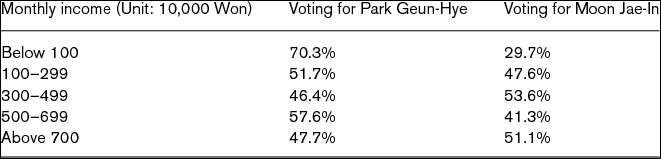
The 2012 presidential election confirmed a severe ideological divide in Korean society. As shown in Table 1, conservatives voted overwhelmingly for Park Geun-hye (80.8%). By contrast, progressive liberals did exactly the opposite, voting predominantly for Moon Jae-In (84.8%). Interestingly, such an ideological fault-line did not coincide with the usual suspects: namely, socio-economic cleavages. Contrary to the popular perception that ideological divisions often overlap with socio-economic fractures because the poor tend to vote for liberal parties whereas the affluent often support conservative parties, Table 2 shows that Koreans voted ideologically, regardless of their socio-economic status. In fact, it was the poorest section that passionately supported conservative Park Geun-hye (70.3%). In all other income levels, people were more or less equally divided between Park and Moon. The huge mismatch between socio-economic status and ideological orientation (especially among the poor) prompted scholars to conclude that the 2012 presidential election was characterized by ‘class betrayal voting’ (Han, Reference Han2013: 9; Kang, Reference Kang2013: 6; Kyung, Reference Kyung2013: 398).
Ideological division in the 2012 presidential election

Source: Kyung (Reference Kyung2013: 404).

When the ideological division was first detected in the early 2000s, scholars suspected that it might be a reflection of the ‘regionalism’ which had long tormented Korean politics. When the Kim Dae-jung administration (1998–2003) launched the sunshine policy, it was supported enthusiastically in his political home Honam (southwestern Korea), yet received a much cooler response in Honam's regional rival Yŏngnam (southeastern Korea). As a result, the ideological chasm was seen as a new manifestation of the old ‘regional politics’ (Choi, Reference Choi2001; Kim and Kim, Reference Kim and Kim2000). After Kim Dae-jung retired, however, the ideological division deepened further without clear regional cleavages because Roh Moo-hyun who continued the sunshine policy was from Yŏngnam (Namgung, Reference Namgung2003: 149). As many scholars eventually discovered, the increasing ideological division between conservatives and progressive liberals corresponded to neither regional factors nor other socio-economic variables, such as income, gender, religion, and occupation. Simply put, it was not associated with any of the ‘usual suspects’ of socio-economic cleavages (Kang, Reference Kang2004: 71–3).
‘Divided we stand’: emerging generational fractures
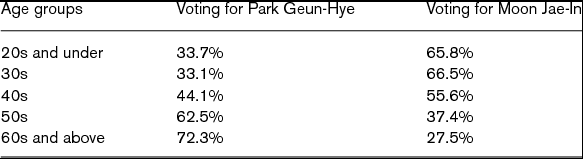
There was, however, one factor which overlapped with the ideological division in Korea: a generation gap. As shown in Table 3, about two-thirds of the younger generations (those in their 40s and younger) voted for liberal Moon Jae-In. Exactly the opposite pattern, however, was seen in the older generations (those in their 50s and older). About two-thirds of South Koreans in their 50s and older voted for conservative Park Geun-hye. The 2012 presidential election thus revealed that the ideological division was turning into a generational fracture between old conservatives and young liberals. As some scholars point out, the ideological division is ‘overlapping and interchangeable with the generational fracture’ in contemporary Korean society (Park, Reference Park2013: 69; Park, Reference Park2010: 82).
Generational division in the 2012 presidential election

Source: KBS/MBC/SBS Exit Poll (19 December 2012).
Standing at the front of the generational fault-line are the so-called ‘486’ generation. The term ‘486’ denotes progressive liberals who are currently in their 40s (thus, 4), attended colleges in the 1980s (thus, 8), and were born in the 1960s (thus, 6). The 486 generation refers to former college students who had fought against the military dictatorship and achieved democratization in the 1980s (Byun, Reference Byun2011: 182). Two decades later, these ‘democratizers’ in their 40s are now well positioned to propagate their liberal views in academia, the mass media, political parties, civic associations, school systems, labor unions, cultural arenas, and so on (Noh et al., Reference Noh, Jung-min and Kang2013: 134). Simply, the progressive liberals have been successful in their ‘war of position’, making their views resonate among the younger generations (Gramsci, Reference Gramsci1971: 57–8). By contrast, the older generations in their twilight years are those who had achieved ‘the miracle of the Han’ under Park Chung-hee. As ‘modernizers’ of the country, old conservatives are indignant at young liberals who have discounted their achievements to achieve an unprecedented prosperity.
Under such circumstances, Korea has become a contentious society where the younger generations with liberals views and the older generations with conservative outlooks do not see eye to eye on many issues, such as the history debate (opposite evaluations of Park Chung-hee), the economic debate (growth vs. distribution), the North Korean debate (a threat vs. ‘our brother’), and the US debate (a blood ally vs. a self-centered superpower).
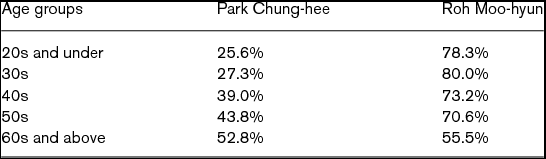
First, how to interpret the Park Chung-hee legacy is one of the most divisive issues in Korea. As shown in Table 4, the fault-line in the ‘Park Chung-hee debate’ is formed along the generational fracture between young liberals and old conservatives. The older one is, the more one is likely to believe that Park had taken public opinion into consideration when formulating policies. In particular, there is a stark contrast between the young generation and the old one in this respect. Whereas only about 25% of those in their 20s and younger believe that Park considered the will of the people, the figure rises to 53% among those in their 60s and older. By contrast, the pattern is reversed when the same question is asked about Roh Moo-hyun, the most progressive Korean president yet. Although only 56% of those in their 60s and older think that Roh considered public opinion seriously, the figure rose to almost 80% among those in their 20s and younger. In fact, the oldest generation (those in their 60s and older) see little difference between Roh Moo-hyun (55.5%) and Park Chung-hee (52.8%) as far as the degree to which both leaders reflected the will of people, despite the fact that Park was a dictator. For the older generations, Park Chung-hee was a dictator who reflected their view, will, and opinion.
Do you believe that our leaders reflected a public opinion in making policies?

Source: The 2010 SBS Survey (N = 1,009; 28 September 2010 to 11 October 2010).
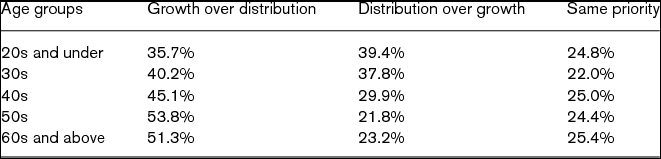
Second, the ‘economic debate (growth vs. distribution)’ is another contentious issue which has caused a rift in recent years. Young liberals point out that Park Chung-hee produced a dark side of compressed growth and many people had fallen behind in the process. As a result, they adopted ‘an active welfare stance’ so as to take care of those lagging behind, especially workers, farmers, and the urban poor (Lee and Kim, Reference Lee and Kim2013: 447). By contrast, old conservatives maintain that ‘the miracle of the Han’ should continue without paying too much attention to distributive issues (Park, Reference Park2010: 88–9). Otherwise, Korea may repeat the mistakes of other developing countries which ‘popped a champagne cork too early’ (Han'gukkyŏngje, 1June 2011). As shown in Table 5, the ‘economic debate’ has played out along a generational division. The younger one is, the more one is likely to be sympathetic to distributive issues and welfare spending. By contrast, the older one is, the more growth-oriented one tends to be. In particular, the biggest gap is found between the youngest generation and the oldest one in this respect. Whereas only 23% of those in their 60s and older prefer fair distribution to growth, the figure rises to 40% among young people in their 20s and younger. In contemporary Korea, the younger generations pay much more attention to welfare issues and distributive agenda than their predecessors.
What is more important between growth and distribution?

Source: The 2010 SBS Survey (N = 1,009; 28 September 2010 to 11 October 2010).
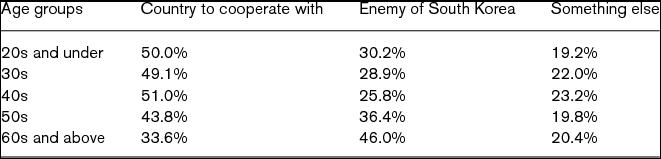
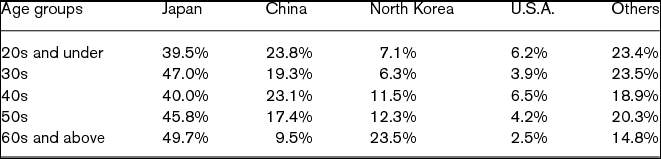
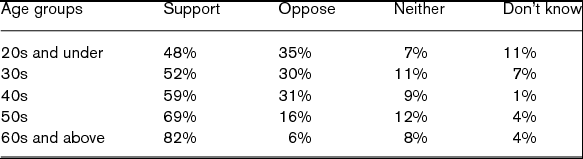
Third, the North Korean debate (a threat vs. ‘our brother’) has also caused ‘a generational rift’ (Kang, Reference Kang2013: 13). For old conservatives who had experienced the Korean War, North Korea is the threat of the country (or ‘the red wolf’ in the anti-communism curriculum). By contrast, young liberals tend to look upon North Korea as ‘our brother’ who needs to be embraced (or ‘a new friend’ in the unification curriculum). As shown in Table 6, the ideological rift in the North Korean debate is formed along a generational dimension. Whereas 49–51% of the younger generations (those in their 40s and younger) regard North Korea as a country to cooperate with, only 26–30% of them consider it to be ‘the enemy’. By contrast, almost the opposite pattern is seen in the older generations. While 34–44% of the older generations in their 50s and older view North Korea as a partner to work with, 38–46% of them fear the security threat it poses. A similar generational gap is seen in Table 7 as well. Although most Koreans identify Japan and China as their least favorite country, there is a generational difference with respect to North Korea. While almost 25% of South Koreans in their 60s and older choose North Korea as the country they hate most, the figure drops to only 6–7% among the younger generations in their 30s and younger. Under such circumstances, it is not surprising that the conservative North Korean policy of Park Geun-hye, which has cancelled the sunshine policy of the past liberal administrations, has received mixed responses among South Koreans. As shown in Table 8, while 70–80% of the older generations approve the firm stance of Park in dealing with Pyongyang, the figure declines to 50% among the younger generations. While the younger generations prefer a more flexible approach to ‘our brother’, the older generations favor a harsh stance against ‘our enemy’ (Byun, Reference Byun2011: 194).
What do you think of North Korea?

Source: The 2010 SBS Survey (N = 1,009; 28 September 2010 to 11 October 2010).
What is your least favorite country?

Source: The 2012 Gallup Poll (N = 1,500; 14 June 2012 to 29 June 2012).
What is your position on President Park Geun-hye's North Korean policy?

Source: The 2014 Gallup Poll (N = 907; 10 February 2012 to 12 February 2014).
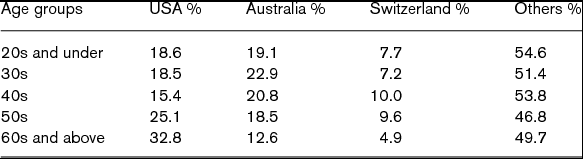
Finally, the last divisive issue in contemporary Korean society is the ‘US debate’ (a blood ally vs. a self-centered superpower). From the viewpoint of old conservatives, the United States is ‘our blood ally’ with whom they have fought together at battlefields in Korea and Vietnam against the common threat of communism. By contrast, young liberals have elaborated a different view since the Kwangju massacre (1980) that America is a shrewd superpower preoccupied with its narrow national interests, thus comfortably in bed with dictators like Park Chung-hee and Chun Doo-hwan. As shown in Table 9, the major battle line in the ‘US debate’ is along a generational divide. When asked to identify their favorite country, about 25–33% of the older generations (those in their 50s and older) put the United States at the top, followed by Australia and Switzerland. By contrast, the figure is reduced to 15–19% among the younger generations (those in their 40s and younger) who, in fact, prefer Australia to the United States as their favorite country. The pattern is reversed, however, when South Koreans are asked to choose the country they dislike most. As shown in Table 7, the younger one is, the more one is likely to choose the United States as the least favorite country. Although it is a stanch ally to the older generations, the United States has become much less attractive in the minds of the younger generations in Korean society.
What is your most favorite country?

Source: The 2012 Gallup Poll (N = 1,500; 14 June 2012 to 29 June 2012).
As shown so far, contemporary Korean society is deeply divided between old conservatives and young liberals as they do not compromise on many issues, such as the economic debate (growth vs. welfare), the Park Chung-hee legacy (the modernizer vs. the dictator), the North Korean debate (the threat vs. ‘our brother’), the United States debate (a blood ally vs. a self-centered superpower), and so on. It is against such a background that the 2012 presidential election proceeded with ‘an unprecedented generational conflict’ in Korean history (Park, Reference Park2013: 71). Whereas the older generations as ‘modernizers’ of Korea worked fervently for the victory of Park Geun-hye, the young generations as ‘democratizers’ of the country fought hard but eventually failed to stop her victory. The recent victory of ‘the strong man's daughter’ in the 2012 presidential election is only the tip of the iceberg, below which lies Korea as a deeply fractured society, both ideologically and generationally.
Conclusion
‘A house divided cannot stand for long’ (Kim, Reference Kim2002: 432). When Kim Gu emotionally conveyed such a message before he crossed the 38° parallel to negotiate with Kim Il-sung in 1948, the house he was referring to was the entire Korean nation that was on the verge of being divided between the north and the south. At that time, the old nationalist leader could not foresee that in 60 years or so, his words would again resonate among many South Koreans, because the house already divided is now in danger of another fracture: this time, within its southern half. In this respect, the 2012 presidential election has revealed an unprecedented level of generational conflict between the older generations which supported Park Geun-hye and the younger generations who tried to prevent the return of ‘the strong man's daughter’. In fact, the generational conflict during the election was so intense that even after it was over, significant aftershocks were felt. For instance, days after Park won the election with support predominantly from the older generations, several initiatives were proposed by younger people to eliminate various programs for the elderly, such as free passes for old people in public transportations, reserved seats for the elderly in subways. The rational was that since old conservatives were in favor of growth over welfare, they should not benefit from welfare programs for the elderly as well (Kukchesinmun, 24 December 2012). Although these attempts went nowhere (and rightly so), they are indicative of how severely Korea is fractured along generational lines between young liberals and old conservatives with increasingly hostile weltanschauung.
In the coming years, South Korea will be a good example for or against the common wisdom that a country divided cannot endure for long, especially in the case of a democracy (Przeworski et al., Reference Przeworski, Alvarez, Cheibub and Limongi2000: 124–5). On the one hand, there is good reason to be concerned about the future of Korea because its generational and ideological conflicts are growing more intense, passionate, and divisive over time. In a survey conducted by the Gallup Korea in 2010, about 80% of Koreans expressed a concern that internal divisions in their country were a serious problem to be reckoned with (www.gallup.co.kr). In other words, most Koreans, regardless of their generational differences and ideological orientations, share a concern that the so-called ‘south–south conflict (namnam kaldŭng)’ is a dangerous phenomenon with explosive implications for the future of the country. Indeed, they fear that a house divided may not stand for long. On the other hand, there are reasons to suspect that the increasing bifurcation in contemporary Korean society may not be a long-term problem. If old conservatives continue to fail to spread their ideas among the younger generations and young liberals continue to successfully spread their ideology among the coming generations (as they have for the past two decades), the country will no longer be divided in the future because the conservative voices of the past will gradually die. In such a case, a newly united house could be sheltering under the roof of much more progressive ideas than those held currently. Since nothing is written in stone, time will tell whether current social schisms in Korean society are a temporary anomaly to disappear or a major issue of concern with increasingly dangerous implications.
As a final note, it is worth noting that a return of ‘the strong man's daughter’ in South Korea does not seem an exceptional case. As some scholars have noted, a puzzling feature of autocratic regimes is ‘the success of public figures identified with them [i.e., dictators] in free elections after the overthrow of the regime’ (Chehabi and Linz, Reference Chehabi and Linz1998: 20). In other words, ‘authoritarian nostalgia’ often surfaces in a country that has democratized from its dictatorial past (Suh, Reference Suh2015: 9). For instance, Keiko Fujimori, the daughter of Alberto Fujimori, almost won the 2016 presidential election in Peru. In Nigeria, Muhammadu Buhari was elected to the president in 2015 despite his dictatorial past as the leader of the 1983 military coup. In spite of his famous family background that was closely associated with Somoza, Arnoldo Aleman also won the 1996 presidential election in Nicaragua. Although he had long acted as the second man under Trujillo, Joaquin Balaguer also repeatedly won presidential elections in Dominica over several decades. What is common in all these cases along with the South Korean experience is that ‘the strong man's daughter’ (or, even the strong man himself) has returned to power on several occasions. What is also common in these cases is that the dictator left enough legacies behind (typically in the form of modernization of the country) which his families or close associates have utilized later for political gains. In this sense, ‘authoritarian nostalgia’ may be seen as political capital that is reaped belatedly by the agents of modernization or their decedents.
About the author
Hyung-min Joo received a Ph.D. from the University of Chicago. He is currently a Professor in the Department of Political Science at Korea University. His recent publications include ‘Hidden Transcripts in Marketplaces: Politicized Discourses in the North Korean Shadow Economy’, Pacific Review (2014), ‘Is North Korea Putting All of Its Eggs in One Basket?’, North Korean Review (2011), ‘Visualizing Invisible Hands: The Shadow Economy in North Korea’, Economy and Society (2010).