

Introduction
The artistic and cultural life of Austria after World War I has often been presented in a gloomy light. As one contributor to a recent multivolume history of Austrian art commented, “the era between the two world wars is for long periods a time of indecision and fragmentation, of stagnation and loss of orientation … the 20 years of the First Republic of 1918–1938 did not provide a unified or convincing image.”Footnote 1 For many this sense of disorientation and stagnation is symbolized poignantly by the deaths in 1918 of three leading creative figures of the modern period, Otto Wagner, Gustav Klimt, and Egon Schiele, two of whom succumbed to the influenza epidemic of that year. According to this view, war not only led to the collapse of the Habsburg monarchy (and a dramatic political caesura), it also caused or, at the very least coincided with, a profound interruption to artistic life and brought Vienna's cultural preeminence in central Europe to an end. The inhabitants of the newly constituted Austrian Republic were forced to contend with significant challenges as to how they might relate to the recent past. On the one hand, some—including, most famously, Stefan Zweig—sought refuge in a twilight world of nostalgic memory; others, such as Adolf Loos, used the events of 1918 as the opportunity to advance a distinctively modernist agenda that sought to create maximum distance from the Habsburg monarchy.
Yet while the year 1918 is commonly understood to have marked a break with the past, such a characterization runs the risk of simplifying the complex relation of the new republic to the past, particularly in the domain of cultural symbolism and its politics. As this article argues, 1918 was not an unbridgeable gulf between two eras; although there were undeniable discontinuities arising out of the war and its aftermath, clear patterns of continuity were also to be observed. The complexity of Austria's negotiation with the meaning of the postwar world is graphically illustrated in its handling of the theme that forms the focus of this article: its baroque artistic and cultural heritage. As a consequence of the wealth of historic buildings from the late seventeenth and early eighteenth centuries throughout Vienna and the other provinces of Austria, the baroque loomed large in the historical imagination before the war. At the same time, however, representatives of the modern movement had long critiqued what was sometimes thought of as a pathological fixation, as early as the 1880s. This simple dualism of modern versus baroque has to be tempered by the fact that the way the baroque was imagined was shaped by a multilayered negotiation with its meaning in which the concept became a kind of floating signifier that could be both modern and antimodern, one that communicated the contrast between the present and the past as well as the rootedness of the present in the past. It is these shifting images that are examined in the rest of this discussion, as a means of addressing the wider issue of the historical significance of the year 1918 in Austria cultural life.
Architecture and the Passage to Modernity
On 25 March 1937, the Exposition Internationale des Arts et Techniques Appliqués à la Vie Moderne (International Exposition of Art and Technology in Modern Life) officially opened in Paris. Lasting for some six months, the exhibition has achieved notoriety for the ways in which it provided a theater for the presentation of political conflict. As of July, Picasso's Guernica was displayed in the Spanish pavilion by the Republican government as an explicit artistic comment on the civil war (the town of Guernica had been bombed on 26 April of that year) and a call to arms for supporters. In addition, the placing of the pavilions of Hitler's Germany and the Soviet Union opposite each other offered the chance for a dramatic staging of the ideological antagonism between their two regimes. These have rightly been the object of considerable critical attention; but the pavilions of other states provide equally telling insights into how governments sought to use architectural design and exhibitionary practice to convey notions of identity to international mass audiences.Footnote 2
It is the less-discussed pavilion of the Austrian Republic (fig. 1) that is the focus of attention here, however. As with the pavilions at other World Fairs in which Austria participated, it is instructive as an index of the visual identity the Austrian state sought as a means of self-promotion.Footnote 3 Designed by the architect Oswald Haerdtl (1899–1959), it was a textbook illustration of the fact that international modernism had come to define the architectural language with which the republic sought to present itself. Constructed with a large concave glass front facade divided into equally sized panes, the pavilion embodied modernist notions of transparency; a fragile structure made of wood, it also stood in contrast to the cold, ponderous classicism of the pavilion of Nazi Germany.
Anonymous photograph of the Austrian pavilion at the International Exposition of Art and Technology in Modern Life, Paris, 1937. Source: Imagno/Austrian Archives.

Haerdtl, a professor of architecture at the School of Design in Vienna, had designed a similar pavilion for Austria for the Brussels World Fair of 1935 (fig. 2), but the pavilion of two years later was all the more striking in that its interior was directly visible from the outside. Specifically, the wall of the vestibule was entirely covered by an enlarged photographic montage (fig. 3) of the Alps traversed by the serpentine loops of the recently completed Großglockner High Alpine Road, meandering across the landscape. This montage image and its architectural setting provided a clear visual message that drew attention to Austria's Alpine identity (and concomitant notions of nature, hygiene, and health), stressing its status, too, as a site of leisured modernity.
Anonymous postcard of the Austrian pavilion of the International Exposition (Exposition Universelle et Internationale), Brussels, 1935. Source: Author's collection.

Anonymous photograph of the photographic montage in the entrance hall of the Austrian pavilion at the International Exposition of Art and Technology in Modern Life, Paris, 1937. Source: Imagno/Austrian Archives.
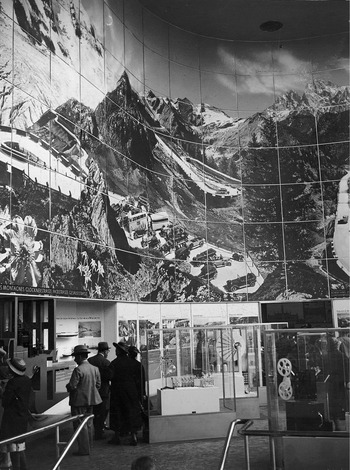
Presenting Austria as primarily a tourist destination had a particular political resonance, given that the German government had only recently lifted a punitive “tourist tax” (Tausend-Mark-Sperre) on its citizens traveling to Austria. It contributed to the creation of an Austrian identity that has continued to define the country since. Successive governments have sought to deploy the Alpine landscape to present an alluring image that, especially after 1945, has also served to deflect attention away from questions about its political history.
Haerdtl's designs for the Austrian pavilions of 1935 and 1937 were not the first time that the republic had opted to present itself in the idiom of the avant-garde; in 1925 it had selected Josef Hoffmann to design the Austrian pavilion for the International Exposition of Modern Industrial and Decorative Arts in Paris, a project on which Haerdtl had also worked as Hoffmann's assistant. A cofounder of the Wiener Werkstätte, Hoffmann was, of course, strongly associated with the modernism of prewar Vienna, and his design looked back to the language of his earlier work rather than to contemporary currents absorbed by Haerdtl. Nevertheless, this turn toward these two architects by the new republic was striking given the visual identity Austria-Hungary had adopted before 1918.
The architectural representation of the Habsburg state had drawn on historical models that also unintentionally revealed its political and cultural disunity. The best known example of this was the entry to the Paris Universal Exhibition of 1900, where, in contrast to the other European powers, the Austro-Hungarian display was organized into three separate buildings, representing Hungary, Austria, and Bosnia-Herzegovina. The Bosnian pavilion (fig. 4) was based on a pastiche of Balkan vernacular architecture that incorporated Ottoman decorative elements; Hungary was represented by a faux-medieval pastiche that drew heavily on Hunyadi castle in Hunedoara, Transylvania; while the Austrian pavilion (fig. 5) was a Viennese neobaroque palazzo built by Ludwig Baumann (1853–1936). The Hungarian and Austrian administrations thus sought to define themselves in primarily historical terms and also drew attention to architectural forms strongly marked by their associations with distinctive national traditions. Comparison with the Austrian pavilions of 1935 and 1937 throws into sharp relief the sociocultural changes that had taken place, particularly in the intervening years since the fall of the ruling dynasty.
Anonymous postcard of the Bosnian pavilion at the Universal Exposition (Exposition Universelle), Paris, 1900. Source: Author's collection.

Anonymous photograph of the Austrian pavilion at the Universal Exposition (Exposition Universelle), Paris, 1900. Source: Author's collection.

Such visual comparisons can be compelling, but they can also be misleading. On the one hand it is hardly novel to state that Vienna after 1918 became an important site of modernist planning and building, especially in relation to municipal housing. Its interwar engagement with functionalist architecture has long been associated with the motif of “Red Vienna,” which makes clear the interplay between aesthetic innovation and the political imperatives of the city council.Footnote 4 On the other hand, however, the adoption of modernist architecture was contested. Its embrace was made possible by the administrative uncoupling of the capital from the rest of Lower Austria, as a result of which the progressive politics of the Vienna City Council were increasingly estranged from that of the rest of Austria, including the national government, which remained provincial and backward-looking. The bombardment of the Karl-Marx-Hof in the civil war of February 1934 was consequently not merely a military exercise against supporters of the regime's political opponents. It can also be read as a symbolic attack on the most prominent visual emblem of the social and cultural avant-garde in the city. The dictatorships of Dollfuß and, later, Schuschnigg did not enact the repressive artistic and cultural policies of Nazi Germany, but they were nevertheless hostile to modernist and avant-garde art.
Haerdtl may have won the Austrian state prize for architecture in 1937, but, equally, the late expressionist painter Herbert Boeckl (1894–1966), renowned for the pious Catholic subject matter in his works, had been awarded the first state prize for oil painting three years earlier for his triptych Hymn to Mary.Footnote 5 Conservative political currents were thus accompanied by similar tendencies in the visual arts; this had been noted in the mid-1920s by the Viennese art critic and historian Hans Tietze, who had observed the reactionary mood that had set in since 1918, in which experimentation had been replaced by an introspective turn back to nature as a source of reassurance. As Tietze noted acerbically, “authors about whom we heard nothing for years have resurfaced; masters of kitsch are demanding to be taken seriously. Interest in new, strong, and original creations now counts once more as suspicious.”Footnote 6 Avant-garde and antimodern elements thus coexisted, and this reflected the wider contradictory sociocultural situation of postwar Austria. Indeed, even Haerdtl's adoption of the language of modernism was ambiguous, for his choice of wood denoted something entirely different: the continuity of vernacular building traditions, with antimodern völkisch associations.
Baroque Vienna, before and after 1918
The contradictions that beset cultural attitudes in Austria are illustrated in a striking manner when one considers the phenomenon of the baroque and its treatment before and after 1918. Its popularity in the late nineteenth century as a semiofficial style, visible in the Austrian pavilion of 1900, stands in contrast to the apparent victory over it by the modern movement in Vienna by the time of the outbreak of World War I. Yet a deep attachment to baroque culture persisted in Austrian society throughout the decades after its end.
The cult of the baroque in Viennese architecture is commonly linked to the development of the Ringstraße in the 1860s and 1870s and the construction of significant public buildings, such as August Sicard von Sicardsburg and Eduard van der Nüll's Opera House (1861–69), the University Building by Heinrich von Ferstel (1877–84), or the Burgtheater (1874–88) designed by Gottfried Semper and Karl von Hasenauer.Footnote 7 The earlier buildings of this period are more accurately described as Neorenaissance, but during the course of the next three decades it was the massiveness of baroque architecture, coupled with its formal exuberance, that served as the primary points of reference. Neobaroque architecture was of course a Europe-wide phenomenon. With its grandiose statements, it provided the ideal language for articulating the imperial pretensions of the European states; but in Vienna, seat of the imperial court, it had a particular resonance given its aristocratic associations.
The Viennese neobaroque culminated in the construction of the Neue Burg of the Hofburg (1869–1913).Footnote 8 Although there was no formal architectural or cultural policy, neobaroque served as a semiofficial style, which, in the absence of any other kind of cultural, linguistic, or social unity, provided the cities of the empire with visual uniformity. Indeed, while much critical attention understandably lingers on Vienna, neobaroque played a vital role elsewhere, where it was drawn into the cultural politics of the late nineteenth-century Habsburg realm. In Budapest, to take one example, it was willingly adopted by the Hungarian authorities in order to project the role of the new capital as the equal of Vienna. Miklós Ybl's grandiose Opera House (1875–84) on Andrássy Avenue, for instance, was partly modeled on Charles Garnier's recently completed opera house in Paris, but it was also clearly designed to surpass its Vienna counterpart. Both in its size and the lavishness of its external facade and internal furnishings it provided an unambiguous statement of the administration's ambition for Budapest to rank among the great European cities of culture.Footnote 9
In other cases the neobaroque was disseminated across the empire thanks to a combination of imperial patronage and the successful marketing of the style as a suitable idiom for public buildings. The architectural firm of Fellner and Hellmer is perhaps the best known agent of this latter process; between 1871 and 1914, it constructed nearly fifty theaters and concert halls across the empire in locations as diverse as Brno (1882), Bratislava (1886), Prague (1887), Budapest (1900), Salzburg (1900) and Czernowitz (1905), all of them in a neobaroque architectural language, and all of them contributing to the creation of a common visual identity for the cities of the Habsburg state that sought to link the fostering of civic society to the building of dynastic loyalty.Footnote 10
This is a well-known chapter in the history of Habsburg architecture.Footnote 11 Particular attention has recently been paid to the role of the art historian Albert Ilg, sometimes credited with being instrumental in turning baroque art and architecture into subjects of serious academic study.Footnote 12 A curator at the Kunsthistorisches Museum and a loyal and forceful spokesman for the dynastic order, he was a highly vocal advocate of the baroque as the appropriate language of public building. Perhaps his best known and most important intervention was the pamphlet The Future of the Baroque Style, which he published in 1880 under the pseudonym of Bernini the Younger.Footnote 13 The pamphlet contained a fierce critique of what he regarded as the debased neobaroque style of the Ringstraße; but rather than dismiss the style outright, his aim was more to advocate a more refined and informed use of the baroque, which should serve, he argued, as the basis for the distinctive architectural identity for the city in the future.
Ilg celebrated the baroque unapologetically as the visual representation of the ancien régime, and in particular he championed it as a universal architecture, for “no other style encompasses all the arts, techniques, and forms of handiwork with the same universality.…”Footnote 14 This quality alone made it suitable as an official imperial architecture, for it was “equipped for everything,” including “buildings of state, the bourgeois house, the theater with all its facilities, as well as the villa and its park, proud prelates’ foundations, and the idyllic hermitage.…”Footnote 15 Such universality had political implications, too, since it stood in contrast to “every other style of recent times” which was “limited, merely national.”Footnote 16 In contrast, the baroque was supranational, and it was this that made it singularly appropriate for the present, given that “the intimate contact between all races and peoples, the easy traffic and exchange in intellectual life would not tolerate fetters that kept them apart.…”Footnote 17 As a “universal style” it had been able to “merge individual peoples” and was thus the clearest expression of the legitimizing cosmopolitan narrative of the empire. Moreover, even though France had laid claim to the baroque as a national style—numerous prominent public buildings in Paris had recently been constructed under the rule of Napoléon III—it was Austria, Ilg stated, that had the strongest claimed to be the home of baroque. Vienna was full of baroque architecture that could serve as a model for contemporary architects: “The cold classicism of Schinkel and Bötticher [in Berlin] would have been impossible here; the different character of the people demanded a warmer sense of life, more diversion, more lively ornament, greater refinement, color and suppleness.”Footnote 18
After publishing his pamphlet Ilg maintained this focus on the baroque by writing a large-scale scholarly monograph on Johann Fischer von Erlach the Elder (1656–1723) and his son Johann Emanuel Fischer von Erlach (1693–1742), in which he presented the architects, in particular the elder Fischer von Erlach, as the embodiment of the Austrian spirit.Footnote 19 For Ilg the architects’ crowning work, the Karlskirche (1716–37), brought together imperial power and adherence to Catholicism, and at a time when many were concerned to differentiate between the Habsburg Empire and Wilhelmine Germany, this contrast between the Catholicism of Austria and the Lutheranism of Prussia—particularly after the Kulturkampf of the 1870s—provided a useful means of doing so.
Ilg was an assertive advocate for the Catholic Church. He celebrated the baroque as the signifier of victory over “the bleakness and desolation of the evangelical liturgy,”Footnote 20 but his advocacy was primarily driven by the recollection of past glory and the fact that he saw the era of Francis Joseph as the beginnings of a new golden era. This vision underpinned Austria's participation in the Paris Exposition in 1900. While the Austrian entry to the applied arts section foregrounded the best contemporary work by Josef Olbrich, Koloman Moser, and other leading designers, the visitor to Baumann's pavilion—which, as the German art critic Julius Meier-Graefe noted, would not have looked out of place in Vienna's Herrengasse—was greeted by staff dressed in livery evoking the reign of Maria Theresa, with a ground floor interior dominated by an ornate baroque staircase.Footnote 21
Ilg's pamphlet had met with a positive reception from many, including Camillo Sitte, but neobaroque was not without its critics. August Köstlin, editor of the Allgemeine Bauzeitung, complained about the “bacillus of national baroque,” and the design historian Jakob von Falke bemoaned the fact that “baroque has become the solution in contemporary life.”Footnote 22 In one of his earliest essays Adolf Loos famously dismissed Vienna and the Ringstraße in particular as a “Potemkin city”: “when I stroll along the Ringstraße I always have the impression that some modern Potemkin had wanted to fulfill the task of instilling the belief that one had been transplanted into a city comprised purely of the nobility.”Footnote 23 Likewise, in his short history of art and architecture in Vienna published in 1918, the art historian Hans Tietze dismissed neobaroque as a decadent “coarsening” of mid-century historicism. Singling out the Burgtheater and the Hofburg for particular criticism, Tietze stated: “[Hasenauer's] talent lacks discipline, his decorative abilities degenerate into luxuriance, his powers are directed brashly and unashamedly at mere effect. He shows for the first time the alarming symptoms of an illness that has suddenly appeared in Viennese art: talent but no character.”Footnote 24
Yet for all these criticisms the baroque continued to define the artistic and cultural identity of Vienna. The emergence of the Secession did little to challenge this situation; indeed, Otto Wagner's early reliance on neobaroque was well known. Contemporaries noticed the historical references in his designs; the review in Ver Sacrum of Wagner's building for the Schönbrunn Stadtbahn station noted the correspondences between Wagner's design and the baroque forms of the eighteenth-century palace nearby, and as the Graz-based art historian Josef Strzygowski commented eight years later, the building's cupola had “echoes of the times of Fischer von Erlach.”Footnote 25 The preference of Secessionist architects for lavishly ornamented facades was thus a reworking of baroque in a new architectural idiom rather than a significant departure. In this context, Loos's later famous polemic in “Ornament and Crime” against their use of lavish decoration was a continuation of his earlier critique of the Ringstraße.Footnote 26
The aesthetic affinities between Secessionist architecture and neobaroque historicism reflected a deeper ideological continuity. The art critic Ludwig Hevesi, one of the most outspoken advocates of the Secession, whose words “Der Zeit ihre Kunst, der Kunst ihre Freiheit” (“To every age its art, to every art its freedom”) adorned Olbrich's Secession building, was also the author of gushing praise for Francis Joseph. In his history of Austrian art in the nineteenth century published in 1903, Hevesi characterized the era in question as an artistic renaissance that was due almost entirely to the enlightened policies of the emperor.Footnote 27 Celebration of the achievements of imperial artistic patronage stood on a continuum with advocacy of neobaroque as an aristocratic architectural style that brought back the splendors of eighteenth-century Vienna.
After 1918, the political context that had underpinned this fascination with the baroque evaporated. The collapse of Habsburg rule, the dismemberment of Austria-Hungary, and with it, the loss of the territories that had been so integral to Austria's imperial splendor, undercut the basis for the discourse of the baroque. Responses to the new situation were varied. Adolf Loos, writing in 1919, believed that the abolition of the monarchy created an opportunity to enact a reorientation of cultural sensibilities and to embrace modern architecture.Footnote 28 For many others, however, the events of 1918 were traumatic and presented profound threats to the meaning of Austria and the nature of its historic cultural identity. The grounds for the cult of the baroque had shifted, yet due to the wider disorientation of the postimperial situation, the fascination with this golden age, far from fading into the distance, enjoyed a considerable renaissance. It served as a compensatory gesture and, as Eva Michel has argued, came to play an important role in constructions of Austrian identity during the 1920s and 1930s.Footnote 29
A remarkable aspect of this phenomenon is that it was embraced by figures with a broad range of divergent ideological positions. Hence, although he was dismissive of Hasenauer, Tietze celebrated the baroque art and architecture of the early eighteenth century as a “glorious chapter in Austrian art history, firmly rooted in a strong national recovery. National pride … was now in receipt of sustenance; the possibility of the linguistic unity of Germany and of a national literature gained—first of all among a few leading spirits—more certain ground.”Footnote 30 Conservatives were understandably drawn to dwelling on Austria's historic glories, especially given the uncertainties of the present; but modernist artists, including Oskar Kokoschka, also identified with the myth of baroque Austria. Kokoschka cited the eighteenth-century Austrian painter Franz Anton Maulbertsch (1724–96) as one of his models and explicitly placed himself within a tradition of Austrian painters that included Ferdinand Waldmüller (1793–1865) and Anton Romako (1832–89). Similar references to the baroque were made in relation to other young painters, such as Anton Kolig (1896–1950) or Anton Faistauer (1887–1930). Kolig, for example, was described by the Viennese art historian Otto Demus as the baroque painter of his times: “Baroque is in his blood … he is a late-born painter of the baroque.”Footnote 31 In parallel fashion, Faistauer saw himself as heir to the baroque heritage of Austria, a view that was supported by a number of commentators at the time.Footnote 32 The use of an exuberant palette by Faistauer, Kolig, and Kokoschka, the overt references in their works to historical paintings from the seventeenth century, the deployment of allegorical motifs, and the theatricality of many of their images encouraged such a reading; but it is indicative of the social, political, and intellectual environment that many were also drawn to see them in these terms. Hermann Bahr attempted to view the entire Austrian cultural tradition as an expression of the baroque spirit:
All our classic poetry is merely an attempt on the part of the word to master the Baroque through discourse, all romanticism is Baroque (often misunderstanding itself), German music from Bach to Mahler is Baroque, and the result of the spiritual strivings of my generation is that we are no longer satisfied with that first Baroque, that the latter was merely a preface to that second Baroque which we are now struggling with in the name of Expressionism. Baroque began to sprout in the thirteenth century, in the seventeenth century it united the Latin with the Goth, let us hope that in the twentieth it will, by turning that vertical movement into a horizontal one, achieve a reconciliation of Rome and Byzantium. This my lifelong belief is confirmed by the fact that everywhere unsuspecting witnesses appear to the extent to which we are everywhere already in the middle of a second Baroque.Footnote 33
Bahr's hyperbolic rhetoric and creative reading of history may have been distinctive characteristics of his writing, but his perspective converged with that of many contemporaries.
The most visible sign in Vienna of the revival of interest in baroque art was the opening in 1923 of the Baroque Museum, the name of the new gallery of seventeenth- and eighteenth-century art in the Lower Belvedere. This was part of a wider reorganization of museums in the city that was initiated by Tietze. The core of the collection had been built up before 1914 but its works were dispersed across various different galleries; hence the museum was the product of a major curatorial reorganization of existing collections rather than an entirely new institution.Footnote 34 Nevertheless, its continuing development was driven forward by substantial investment during the interwar period in the acquisition of new works, including twelve paintings by Maulbertsch.Footnote 35 Given the straitened economic circumstances of the new republic, this represented a clear recognition of the symbolic role of the gallery and of baroque art. Thus, when discussing the new museum shortly after it opened, Tietze reiterated the importance of the baroque as a visual symbol of Austrian identity: “Austrian baroque is not merely a style, rather it is the one style that most clearly expresses the artistic gifts of this tribe [Stamm].…”Footnote 36 Its rise to maturity coincided with the political ascent of Austria, he noted, and he highlighted the fact that the museum was also a celebration of the Belvedere itself, and of the aristocratic tastes of Prince Eugene.
Thus, even progressive figures—and Tietze was one of the most important advocates of modern art in Vienna in the interwar period—were seduced by the allure of the baroque. As the national style, he noted, it was always there, latent in the Austrian psyche, requiring only a “favorable historical constellation to appear once more in its full glory.”Footnote 37 As an official guide of 1925 to the museums of Vienna stated unequivocally, “the collections in Vienna … are one of the most important instruments for the spiritual reconstruction of the German people and Austria itself, and are not merely a matter of public administration.…”Footnote 38
Throughout the interwar period, therefore, a concern with the baroque persisted among Austrian intellectuals. In the final years of his life, the professor of art history at the University of Vienna, Max Dvořák (1874–1921), wrote a number of works on the art of the period, including a study of ceiling painting that focused on the work of Maulbertsch.Footnote 39 The most prominent author in this regard, however, was the art historian Hans Sedlmayr (1896–1984). Sedlmayr's doctoral dissertation was devoted to Fischer von Erlach the Elder, and this was followed with a study of Francesco Borromini (1599–1667), one of the major influences on the Austrian architect.Footnote 40 In the same year that his Borromini book appeared, Sedlmayr also published a broader study of Austrian baroque architecture.Footnote 41
Writing at a different time, Dvořák and Sedlmayr mostly avoided the explicit equation of baroque with imperial politics of a kind once familiar from the work of Ilg; Sedlmayr was instead concerned with articulating the aesthetic and formal characteristics of baroque architecture. In the later 1930s, however, he directly addressed the political dimensions of Austrian baroque. It was an imperial style (Reichstil), he argued, that projected imperial power both by means of its formal qualities and also with the iconographical programs decorating the major buildings.Footnote 42 The fact that its origins could be traced back to Fischer von Erlach was significant, since the latter's career coincided with the resurgence of Habsburg military and political power at the end of the seventeenth century and the beginning of the eighteenth.
It was outside of Vienna, however, that the postwar baroque revival took on its most spectacular form in the Salzburg Festival, founded in 1920 by Hugo von Hofmannsthal. Used as a vehicle for staging Hofmannsthal's plays Jedermann and then, later, Das Salzburger große Welttheater, the festival was supported and promoted by the creation of a myth of Salzburg that went beyond its historical associations with Mozart to encompass the idea of the city as the heart of southern German Catholicism and, ultimately, the center of a revived sense of national identity. As Michael Steinberg has argued, with its inaugural performance of Jedermann performed on the steps of the cathedral of Salzburg, the city became “the baroque stage/altar on which Austrian identity could be re-sanctified.”Footnote 43 The myth of Salzburg drew on well-established ideas about the city's place in Austrian and European culture. In 1904 Dvořák's predecessor at the University of Vienna, Alois Riegl (1858–1905) had delivered a lecture on “Salzburg's Place in the History of Art” that had emphasized its role as a point of convergence of Italian and German art, and as such the city served as a microcosm of Austria as a whole.Footnote 44 Hans Tietze's assertion two decades later that “Austria's raison d’être was and is to mediate between north and south, east and west … culturally this remains the essential purpose of our land,” was thus recapitulating a trope that had been integral to Habsburg political discourse, and Salzburg provided the ideal site where this ideology could be displayed.Footnote 45
Hofmannsthal was also influenced by the writings of the literary historian Josef Nadler, whose multivolume history of German literature published between 1912 and 1928 had emphasized the centrality of ethnic character in the shaping of literary output and had made regional geography a crucial formative element in the determination of character.Footnote 46 Hofmannsthal reiterated these basic ideas in the pamphlet “The Salzburg Festivals,” which he wrote in 1919 to promote its establishment.Footnote 47 Due to Salzburg's location at the center of Europe, he argued, it was the only possible location for the cultural revival to be undertaken by the festival.Footnote 48
This reorientation away from the Viennese metropolis was part of a wider shift that sought to anchor Austrian identity in its smaller towns and its rural hinterland. One prominent cultural expression of this was the rise of Heimatkunst, an artistic and literary genre centered on the sentimental depiction of provincial life and hostility to the big city. It had existed in Germany and Austria from the late nineteenth century, but it took on a renewed impetus between the wars: both in Germany, where it was assimilated to the cultural politics of the Nazi regime, and in Austria, where it acquired a specifically Catholic inflection. In novels such as The Beloved Soil: Farming Stories (1930) or City without Meaning: Novel of a Simple Person (1934), authors such as Hans Stiftegger (1885–1954) and Guido Zernatto (1903–43) turned their backs on the big city, which had previously loomed so large in the literary imagination, and attended instead to the appeal of the pious countryside.Footnote 49 This was increasingly promoted in the 1930s by the authoritarian regime of the Ständestaat, both because it was in line with its own authoritarian Catholicism, and also because, as Andrew Barker has suggested, it served as a means of distinguishing Austria from its opposites: the atheistic cultures and politics of Nazi Germany and the Soviet Union.Footnote 50
This reshaping of the geographic imaginary in Austria extended to include a re-envisioning of the meaning of the Alps. The mountains had long served as a site of relaxation and tourism, and during the nineteenth century alpinism had become an established form of leisure.Footnote 51 After 1918, however, they became increasingly politicized, serving as a locus of Austrian identity.Footnote 52 Hofmannsthal's concern with Salzburg's location by the mountains exemplified this phenomenon. The festival was linked to an image of the Alps that gave it an increasingly prominent role as the site of an imagined cultural continuity in opposition to Vienna, which, as the epicenter of Austrian modernity, was a “place of distraction” (Ort der Zerstreuung) and the seat of discontinuity and disruption. The Alps took on a symbolic function for others, too. Counterintuitively, the art critic Stefan Poglayen-Neuwall emphasized the importance of the Alps as the site of baroque art. No longer an expression of imperial power in the capital, baroque now counted as the pious art of the Alpine hinterland. In an article on Faistauer he offered the now familiar reading of the painter as heir to the baroque tradition; but this time he linked it to Faistauer's working-class origins in the town of Sankt Martin bei Lofer, near Salzburg, which made him the representative of an age-old vernacular culture rooted in the Alps, a crucial factor that underpinned the “connection and continuity of the baroque in their work, as it was in the Alpine countries—the home of the baroque masters—where this phase of art achieved its greatest bloom.”Footnote 53 Although very much against the grain of the traditional image of the baroque as the art of imperial power, this assertion was not as eccentric as might at first appear. One of the greatest early Austrian painters, Michael Pacher (1435–98), had been born in Brixen, and it was possible to point to a succession of important artists who originated in Salzburg and the Tyrol, ranging from Franz Anton Ebner (1698–1756) and Johann Michael Rottmayr (1654–1730), painter of the frescoes in the Abbey of Melk, to Klimt's teacher, Hans Makart (1840–84). Maulbertsch, too, had come from Langenargen on the northern shores of Lake Constance, just on the German side of the Alpine border with Vorarlberg. As subsequent commentators have observed, many significant baroque artworks and buildings were produced in often quite remote regions far from the major political and cultural centres.Footnote 54
Against this background the image of the Alps in the Austrian pavilion for the 1937 Paris International Exposition takes on a new resonance, as does the inclusion of the Großglocknerstraße. The apparent binary opposition of nature and technology in this image is undercut by the multilayered meanings of the motorway. Edward Dimendberg has argued, for example, that when they were first built motorways did not always function as unambiguous signifiers of modernity. The construction of the autobahn in Hitler's Germany was accompanied by a discourse of technological romanticism that emphasized its ability to bring Germans closer to nature. The routes of the autobahn sometimes deliberately engineered so that they would pass through more scenic landscapes, the experience of driving was to “project[ ] driver and passenger alike into an idealized natural environment of an earlier preindustrial German past.”Footnote 55
On its assumption of power, the Dollfuss dictatorship sought to emulate Hitler's motorway building program, and the Großglocknerstraße, winding through spectacular mountain passes and connecting Salzburg to Carinthia, took on a similar range of meanings. On the one hand, it functioned as a symbol of Austria's technical prowess and capacity to deal with the scourge of the time: unemployment. Yet, on the other, it permitted immersion in the overwhelming experience of the natural environment. In addition, it took on a further set of meanings that were quite particular to Austria, for, as Franz Schausberger has suggested, the highway linking either side of the Großglockner was taken as a visual emblem of the historical mission of Austria as a bridge between north and south.Footnote 56
We are thus presented with an unlikely constellation, Alps–baroque art–motorway, connecting a symbolic image of Austrian identity to harmony with nature to a sense of rootedness in the past and the promise of the future. For many, therefore, the Alpine road provided a less alienating image of modernity than the functionalist architecture of Red Vienna with its suspicious political overtones, and it exemplified a broader process whereby Austrian identity in the interwar period came to be located in sites away from Vienna and more in the provinces.
Baroque Ambivalences
Examination of the motif of the baroque underlines the complex patterns of continuity and discontinuity in Austrian cultural and intellectual life before and after 1918. On the one hand the persistence of the baroque as an art-historical and cultural topos testified to the very real sense of a connection to the past that was widespread, although particularly prevalent in conservative social and political circles. Yet it was, at the same time, an ideological construct intended to create the illusion of continuity when faced with the massive political and social convulsions of the early twentieth century. Its political character comes to the fore as it becomes clear that the meaning of the baroque underwent a number of shifts in response to the circumstances at the time. In this sense, the figure was ironically the most discontinuous feature of all.
Although the notion of pietas austriaca had been an important element in the reception of the baroque during the nineteenth century, indeed remaining central to the performance of Habsburg rule, it was its associations with Habsburg political and cultural preeminence that had sustained the neobaroque revivalism from the 1870s onward. Even before Ilg had published The Future of the Baroque Style, his teacher at the university, Rudolf von Eitelberger (1817–85), had published a lengthy discussion of recent Viennese art that had praised the city's identity as an international artistic center that had attracted artists from across Europe. From being a “city on the periphery of the German Reich it became the center of a great monarchy” and, crucially, Eitelberger argued that “the more prominent the interest of the empire, the more powerful the pulse of Austrian consciousness in Vienna, the more both state and art flourish.”Footnote 57 This was a celebration of state patronage of the arts in the baroque era that also brought political dividends, and Eitelberger saw his own times and the support for the arts by Francis Joseph as inaugurating a new golden era after the decline and stagnation of the first half of the nineteenth century.
Parallels were thus drawn between the two eras. In his essay on nineteenth-century architecture in Vienna for the so-called Kronprinzenwerk, Karl von Lützow, professor at the Technische Hochschule in Vienna, declared that “The splendid rebuilding of the imperial city, undoubtedly one of the most significant achievements of modern architecture, is separated from the baroque era by a number of decades that lie between them like a belt of desert between two abundant regions of fruit.”Footnote 58 For authors such as Lützow, Eitelberger, and Ilg the arts played a crucial role in projecting Habsburg state power and dynastic authority. The ubiquity of neobaroque architecture was reflected in the belief not only that the ancien régime could be looked back on with a proud historical gaze but also that it could be reconstituted, a highly visible testament to the persistence of state patriotism and loyalty to imperial symbolism.Footnote 59
After 1918, this was no longer possible, and consequently the meaning of the style underwent significant transformations. One of these transformations was the fact that only after 1918 was the baroque thematized as the subject of a museum. In other words, it had become an object of merely historical reflection. Its relegation to the past was evident in other fields, too. Hermann Bahr's brief period as director of the Burgtheater had begun before the end of World War I, and he had tried to recreate it as a specifically baroque theater that would patriotically serve the monarchy and the state.Footnote 60 He was overtaken by events, however; he left after only six months following a lukewarm reception by audiences to his staging of historic plays and lack of support from others in the theater. It was only with the Salzburg Festival that the idea of baroque theater achieved lasting success, but it was not the “second baroque” that Bahr had envisaged. With the exception of his own dramas, Hofmannsthal's program consisted entirely of historic works such as the operas of Mozart, Glück, or plays by Molière, Shakespeare, Schiller, and Goethe. Even the Salzburg Festival was consequently a living museum.
A similar phenomenon could be seen in the Vienna State Opera. Even though Richard Strauss returned to the city from Berlin after the war, the emphasis of the Staatsoper was not on the commissioning of new works (although, exceptionally, Strauss's The Woman without a Shadow was performed in 1919) but on the performance of classics from the historical repertoire. In part this was due to the risks involved in the staging of new works, but it was also linked to a shift toward greater emphasis on quality of performance. As Andreas Giger has argued, there was a parallel with the Salzburg Festival in terms of the ideological significance of performance and theater.Footnote 61 In both cases, theatricality and performance were to become constitutive features in the construction of Austrian identity. Comparisons of the musical life of Vienna in the 1920s with that in the baroque likewise did not suggest that there was a resurgence of contemporary musical creativity—representatives of the Second Vienna School, for example, did not come into consideration—but rather that the past could be evoked by the high-quality performance of baroque music.
There was a further modulation in the meaning of the baroque after 1918, and this was linked to its relation to the “clerical fascism” of Austria in the 1930s. Although its associations with the Counter-Reformation were prominent before 1918, it was the secular meanings of the baroque that were emphasised. It signified the cultural and political differences between Austria and Germany, or the victory of the Habsburgs over the dissenting Czechs in the seventeenth century, or the rise to power of Austria after 1683. Even where the importance of Italy was stressed, as in Riegl's lecture on Salzburg, this was framed in terms of aesthetic and vaguely defined cultural influences. Religious affiliation was mostly absent from such accounts, even though ecclesiastical buildings formed the centerpiece of discussion.Footnote 62
After World War I, however, the meaning of the baroque was increasingly shaped by the commitment to Catholicism. The beginnings of this shift can be seen in the writings of Max Dvořák. In a lecture on El Greco delivered in 1920 and published in 1924, Dvořák argued for a reassessment of the painter, based on a changed understanding of his work.Footnote 63 Where it had previously been overlooked, dismissed as incomprehensible and artistically incoherent, it deserved renewed attention, he argued, as the expression of a specific world view. El Greco had enjoyed a remarkable resurgence of interest among modernist critics in the early twentieth century, and Dvořák's lecture fitted into this larger context.Footnote 64 However, his reading of the painter differed from that of contemporaries in Germany. Whereas many others focused on the formal and aesthetic aspects of El Greco's work, seeing it as a forerunner of the modernist painting at the turn of the century, Dvořák focused on its visionary qualities. Specifically, he argued that the painter gave powerful visual expression to the Counter-Reformation culture of “contemplation, meditation and ecstasy.”Footnote 65 He contended that the subsequent neglect of the painter had been a reflection of the uncomprehending gaze of the scientific and materialist age that had followed, the “years dominated by the natural sciences, by mathematical thought and a superstitious regard for causality, for technical development and the mechanization of culture.…”Footnote 66
El Greco was thus a Counter-Enlightenment figure whose spiritual vision had been eclipsed by the rise of modern rationalism. Significantly, at the conclusion of his lecture, Dvořák looked forward to the end of this age of scientific materialism and the emergence of a new “spiritual, antimaterialistic age.” El Greco preceded the Austrian baroque by over a century, yet the historical looseness in the treatment of the baroque meant that he was seen as its precursor and hence bound up with it. Indeed, in his essay on baroque ceiling painting, Dvořák wrote of the work of Maulbertsch in similar terms; it was visionary and represented an idealized world: “After this last high point, this development [of ceiling painting] was brought to an abrupt end. The turn to rationality took place and set limits on the artistic elevation of the supernatural.…”Footnote 67 As with El Greco, so the work of Maulbertsch made visible how much the Enlightenment had robbed art of its spiritual values.
The idea of the spiritual in Dvořák's later lectures and essays has been intensively discussed and has often been seen as part of a wider response in Germany and Austria to the experience of World War I.Footnote 68 In the Austrian context it took on a particular meaning inasmuch as it anticipated the association, in the interwar era, of the baroque with the (re-)sacralization of culture. This was central, for example, to Hofmannsthal's installation of the Salzburg Festival. His collaborator, Max Reinhardt, was equally committed to the project of turning theater once more into a space of sacred performance rather than mere entertainment.Footnote 69 Reinhardt drew on a tradition of thinking that could be traced back to Nietzsche's interest in Greek tragedy as the locus of a renewed form of modern ritual, and there were clearly, too, affinities with Bayreuth; but the specifically Catholic qualities of this sacral vision gave it a distinct character. Until the 1930s, this sacralization of the baroque could have been seen as the project of a limited conservative cultural and intellectual elite that had chosen to base itself in the provinces rather than the capital; as of 1934, however, changing political circumstances meant that it became closely aligned with the authoritarian clerical ideology of the national government and its self-appointed mission as guardian of Catholicism.
The scientific work of art historians was thus an integral part of a wider ideological field. This was visible, too, in the writings of Hans Sedlmayr. Indeed, the latter's commitment to Catholicism led him to look further beyond baroque art to the Gothic architecture of the Holy Roman Empire, where art had been an integral part of religious life.Footnote 70 There were also important differences. Writing in the final years of the war and shortly after, Dvořák had been optimistic that there would be a collapse of modern rationality, inaugurating a return of spiritual values. By the 1930s, in contrast, Sedlmayr had lost the sense that such a revival was possible. His devotion to baroque art remained, but it was accompanied by a melancholic ambivalence. This was most visible in his strident conservative critique of modernity, Loss of the Center. Published in 1948, it nevertheless drew on ideas and material that he had developed a decade or more earlier.Footnote 71 In baroque art, he argued:
[T]he world is a great stage for the appearance of God and the deeds of Man. The idea of “theater” gained great importance for all areas of art and life. The inner disposition of Man is a fiery, passionate enthusiasm. The attitude to the world is boundless optimism and confidence in the world; only in the baroque era was it possible for someone to regard this as the “best of all possible worlds.”Footnote 72
This image, which echoed Hermann Bahr's earlier characterization of the baroque as a play with pure appearance, stood in contrast with the revolutionary spirit of the later eighteenth century, which, with its separation of God and Man, was the polar opposite of the world of baroque faith.Footnote 73
Like Dvořák, Sedlmayr traced the origins of the disenchantment of the world back to the Enlightenment, but in an essay published in 1934 on Pieter Bruegel the Elder, he saw it anticipated in the work of the Flemish painter, thereby offering an altogether bleaker picture of the sixteenth century.Footnote 74 Using the idea of the “macchia,” or “stain,” of the nineteenth-century Italian writer and critic Vittorio Imbriani (1840–86), Sedlmayr drew attention to the way that Bruegel's paintings reduced human beings, animals, and objects to mere shapes and patches of color, bringing about a disintegration of the picture.Footnote 75 This quality was the product of an estranged vision, Sedlmayr argued, that was alienated from humankind. “The worlds of primitives, children, the blind and cripples, the crowd, madness and apes precisely those liminal worlds in which the nature of man becomes dubious … the human figure becomes alien, is viewed anew and with suspicion.…”Footnote 76 Although this alienated vision, which viewed other humans from a purely “external” perspective, could be viewed as a pathological symptom of the individual artist, Sedlmayr's emphasis was on interpreting Bruegel as the representative of a particular cultural moment. Specifically, Bruegel's work was the product of a culture with a heightened sense of the gulf between external appearances and inner realities that viewed external appearances as a mere mask. This reading made explicit reference to Dvořák's lecture on El Greco, but rather than offering the latter's image of a comforting withdrawal into inner spirituality, or indeed Bahr's sketch of the baroque embrace of the theatricality of pure appearance, Sedlmayr evoked the specter of a haunted uncanny world: “The mask … renders things alien; it makes their features turn rigid, it conceals the ‘real’ behind something that does not belong to the organism; it arouses doubt, ‘mixed feelings,’ fear and curiosity.”Footnote 77
For all his conservative Catholic beliefs and hankering for the Habsburg past, Sedlmayr's account of Bruegel ironically had much in common with what is now recognized as one of the most important early twentieth-century interpretations of the baroque: Walter Benjamin's 1928 study The Origin of German Tragic Drama.Footnote 78 Benjamin had reviewed a programmatic essay by Sedlmayr on art-historical method, and although he became increasingly absorbed in historical-materialist cultural criticism, he maintained a recurrent interest in the work of Viennese art historians.Footnote 79 Hence, in a reading that bears notable similarities to that of Sedlmayr, Benjamin's study of the tragic drama viewed the allegorical conceits and play of masks typical of the baroque dramas of authors such as Andreas Gryphius (1616–64) and Pedro Calderón de la Barca (1600–85) as signifiers of an estranged world drained of meaning and divinity. For Benjamin, baroque allegory marked the inception of a disenchanted modernity, indeed, would later come to have a much wider set of meanings in his work, underpinning in particular his critique of the modern world of commodity exchange.Footnote 80 Benjamin's inclusion of Calderón has particular pertinence here, too, for the latter's 1655 play El gran teatro del mundo had served as the basis for Hofmannsthal's 1922 drama Das Salzburger große Welttheater, the centerpiece of the Salzburg Festival during the 1920s.
Conclusion
During the period stretching from the publication of Ilg's The Future of the Baroque Style to Sedlmayr's Loss of the Center, a preoccupation with the baroque remained a constant for Austria's artistic and intellectual elite. As a powerful visible symbol of cultural identity, it also accrued political significance and was adopted and promoted under a variety of administrations, from the late Habsburg monarchy to the clerical authoritarian Ständestaat of the 1930s. Whether interpreted as the signature of ancien régime power or as a theatrical staging of Catholic piety, baroque art and culture remained a recurrent element in the collective self-representation of Austria. In this sense it provided considerable continuity during the transition from Austria-Hungary to the postwar settlement. The recurring fascination with the baroque as a cultural symbol highlights the extent to which focus on the political caesura of 1918 can overlook deeper continuities between the situation before the war and that afterward.
Yet this conclusion has to be treated with caution, for the meaning of the term “baroque” was in constant flux. Associated with secular imperial power during the Habsburg era, it subsequently played an increasingly central role in an attempted sacralization of culture, which was an attempt at dealing with the disenchanted world of postwar modernity. Moreover, while it was connected, for some, with the nostalgic desire to restore the world of yesteryear, for others it was part of a more widely embracing vision of the spiritual fate of Europe in which Austria was held to have a privileged place. Overburdened with demands, the idea of the baroque could thereby become entangled in contradictions. The fact that Sedlmayr could view it as an era in which Man was still in communion with God, but then later see in it a foreshadowing of the modern alienation from the world, reveals how contradictory and slippery the term “baroque” could be. The significance of this discussion goes far beyond a matter of mere historiographic analysis, however. Given its central position in the cultural imaginary, the baroque serves as a powerful emblem of the political and social dilemmas of Austria after 1918: bound to history but also set apart from it, searching for new meanings in the present yet seeking reassurance in the past.



