1. Introduction
The topic of stress assignment in English compounds has quite a long tradition in the phonological literature. This is especially true of the generative literature, where one of the most influential and well-known discussions is found in Chomsky & Halle (Reference Chomsky and Halle1968: 15ff., 91ff.). Chomsky & Halle assume that stress in English compounds is governed by the Compound Stress Rule. This rule invariably assigns primary stress to the left constituent of English binary nominal, adjectival, and verbal compounds. The result is that, at the surface level, the stress pattern of these compounds is different from that of syntactic phrases: compounds are left-prominent, phrases are right-prominent. Chomsky & Halle's example illustrating this distinction is the difference between the compound bláckboard and the phrase black bóard. An example of a nominal compound is chémistry laboratory (Chomsky & Halle Reference Chomsky and Halle1968: 92).
However, it is also well-known that not all English noun–noun compounds are left-prominent. Examples of both left-stressed and right-stressed noun–noun compounds are provided in (1). The most prominent syllable is marked by an acute accent.
(1) ópera glasses steel brídge
wátch-maker morning páper
clássroom silk tíe
Óxford Street Madison Ávenue
Rightward stress is far from exceptional, and the nature of the observable variability is still rather unclear. Recent investigations (e.g. Plag Reference Plag2006, Plag, Kunter & Lappe Reference Plag, Kunter and Lappe2007, Plag, Kunter, Lappe & Braun Reference Plag, Kunter, Lappe and Braun2008) have shown that categorical approaches (such as the Compound Stress Rule) are unsuccessful in making correct predictions about compound stress assignment. This paper will present an analysis of the variation in compound stress assignment in exemplar-based models. Two current exemplar-based algorithms, TiMBL (Daelemans et al. Reference Daelemans, Zavrel, Sloot and Bosch2007) and AM::Parallel (henceforth AM; Skousen & Stanford Reference Skousen and Stanford2007), will be used to investigate whether an exemplar-based approach to compound stress is empirically more adequate than a categorical model. We will use the data from the two Plag et al. (Reference Plag, Kunter and Lappe2007, Reference Plag, Kunter, Lappe and Braun2008) studies. These data comprise all noun–noun compounds extracted from the Boston University Radio Speech Corpus (BURSC, Ostendorf, Price & Shattuck-Hufnagel Reference Ostendorf, Price and Shattuck-Hufnagel1996) and all compounds extracted from the CELEX lexical database (Baayen, Piepenbrock & Guilkers Reference Baayen, Piepenbrock and Guilkers1995).Footnote 2
The paper is structured as follows. In Section 2 we will set the stage, introducing our theoretical assumptions (Section 2.1) and the BURSC and CELEX data and coding (Section 2.2). After a brief outline of the architecture of the two exemplar-based algorithms (Section 3), we will proceed to presenting our findings in Sections 4 and 5. The paper ends with a conclusion and directions for future research.
2. Setting the stage
2.1 English compound stress
Whereas it is still general common ground that the Compound Stress Rule is the major predictor of compound stress, there are three types of approaches that deal with the observable variation in compound stress assignment. We will follow Plag (Reference Plag2006) in labelling them syntactic, semantic, and analogical approaches.
In syntactic approaches, differences in stress among noun–noun combinations are taken to be a reflex of differences in syntactic and/or lexical status. For example, Liberman & Sproat (Reference Liberman, Sproat, Sag and Szabolcsi1992) suggest a strictly categorical approach, arguing that left-stressed noun–noun combinations are N0 projections, whereas right-stressed noun–noun combinations are N1 projections. They also show, however, that the stress criterion is the only criterion on which this difference in syntactic status can be based – in particular, it does in their view not correlate with any other distinctive criterion, be it syntactic (i.e. interpreting modifiers in N1 constructions as adjectives) or semantic. Another syntactic approach is found in Giegerich (Reference Giegerich2004), where he claims that argument–head compounds such as bookseller are lexical (i.e. non-syntactic) entities and thus generally left-stressed, whereas modifier–head compounds are generally stressed on the right. Apparent exceptions such as left-stressed ópera glasses are the result of the lexicalisation of an originally phrasal structure.
In semantic approaches, right stress is assumed to be triggered by specific semantic relations between left and right constituents (see e.g. Sampson Reference Sampson1980; Fudge Reference Fudge1984; Ladd Reference Ladd, Gibbon and Richter1984; Olsen Reference Olsen2000, Reference Olsen, Booij and Marle2001; Spencer Reference Spencer, Booij, DeCesaris, Ralli and Scalise2003). Often-cited relations are material, temporal, locative, and predicative relations as in steel brídge, summer dréss, Boston hárbor, and woman-dóctor. In terms of their theoretical scope, semantic approaches fall into two groups. One group comprises approaches which consider semantic factors to be subsidiary to syntactic factors, motivating exceptions to the (syntactic) Compound Stress Rule. For example, Fudge (Reference Fudge1984) and Liberman & Sproat (Reference Liberman, Sproat, Sag and Szabolcsi1992) essentially advocate a syntactic approach, but provide a semantic classification especially of right-stressed constructs, suggesting that right stress is especially frequent in certain semantic classes. By contrast, Olsen (Reference Olsen2000) rejects a syntactic approach and claims that semantic factors are the central determinants of compound stress. In general, the syntactic and semantic approaches formulated in the literature differ in terms of the level of generality and formality which they employ in formulating their predictions. Still, it is generally noted that the rules proposed are not exceptionless.
One often-cited reason for the existence of exceptions is the idea that exceptional stress may be the effect of analogy (e.g. Schmerling Reference Schmerling1971, Liberman & Sproat Reference Liberman, Sproat, Sag and Szabolcsi1992, Giegerich Reference Giegerich2004), with compounds having the same right or left constituent sharing the same stress pattern. Standard examples are street names, which are stressed on the left constituent if the right constituent is street, but stressed on the right constituent if the right constituent is avenue or lane (as in Óxford Street vs. Oxford Ávenue, Oxford Láne). Crucially, in all these approaches the role of analogy is subsidiary in nature – it is assumed that analogy ‘kicks in’ in those cases where the alleged regular determinants – be they syntactic or semantic – fail to predict the attested output pattern.
Syntactic, semantic, and analogical approaches have recently been empirically tested against large amounts of data by Plag et al. (Reference Plag, Kunter and Lappe2007, Reference Plag, Kunter, Lappe and Braun2008); Plag (Reference Plag2010); and Plag & Kunter (Reference Plag, Kunter and Olsen2010).Footnote 3Plag et al. (Reference Plag, Kunter and Lappe2007) investigate the relevance of syntactic, semantic, and analogical determinants of compound stress assignment in several thousands of noun–noun compounds extracted from the CELEX corpus. CELEX contains mostly dictionary, i.e. lexicalised, data.
Plag et al. (Reference Plag, Kunter, Lappe and Braun2008) are concerned with syntactic and semantic factors in compounds extracted from a very different corpus, the Boston University Radio Speech Corpus (BURSC), which contains audio recordings of radio news texts. Plag (Reference Plag2010) and Plag & Kunter (Reference Plag, Kunter and Olsen2010) use data from both CELEX and BURSC as well as from a third corpus to investigate the effects of different types of constituent family information. Methodologically, all studies mentioned use stochastic models to test whether the stress distribution observed in the corpora can be predicted with the help of the syntactic and semantic, and, in the case of Plag (Reference Plag2010) and Plag & Kunter (Reference Plag, Kunter and Olsen2010), analogical determinants mentioned in the literature. In addition, for the CELEX data Plag et al. (Reference Plag, Kunter and Lappe2007) also test the analogical approach with the help of an exemplar-based model (using the TiMBL algorithm).
An important conclusion to be drawn from this group of studies is that neither the Compound Stress Rule nor any of the syntactic or semantic or analogical factors proposed in the literature can adequately explain compound stress in a categorical fashion. Thus, there is no set of predictor variables that could be derived from the literature that would convincingly predict stress category in the data. This does not mean, however, that the categories suggested in the literature are irrelevant. A considerable number of them does turn out to function as statistically significant predictors in a stochastic regression model. Overall, however, we still find a relatively large amount of unexplained variation. Such variation is found among compound types as well as among tokens of the same type. Furthermore, the extent of variation as well as the effects found are highly robust. Thus, Plag et al. (Reference Plag, Kunter and Lappe2007, Reference Plag, Kunter, Lappe and Braun2008) investigate compounds from two very different corpora (BURSC and CELEX), but find largely the same effects and the same degree of variation.
On a theoretical level, then, these findings raise the question of which kind of grammatical theory would most adequately account for compound stress. We have seen that, traditionally, compound stress has been accounted for in a categorical, rule-based framework, where syntactic or semantic factors work as categorical rules, and where exceptions to the rule have a status in the grammatical system (as irregular) that is different from that of ‘well-behaved’, regular items. From an empirical perspective (Plag et al. Reference Plag, Kunter and Lappe2007, Reference Plag, Kunter, Lappe and Braun2008; Plag Reference Plag2010; Plag & Kunter Reference Plag, Kunter and Olsen2010), such an approach faces two serious challenges: First, stress in English compounds is decidedly noncategorical. Secondly, analogy seems to be more widespread than is expected by a framework in which analogical cases can only be modelled as exceptional cases.
An alternative approach is to assume a grammatical theory where the distinction between regular and irregular items is inexistent because linguistic categorisation is inherently gradient and emergent. One such theory is exemplar theory (see e.g. Bybee Reference Bybee2001, Pierrehumbert Reference Pierrehumbert, Bybee and Hopper2001, Gahl & Yu Reference Gahl and Yu2006, Bod & Cochran Reference Bod and Cochran2007 for linguistic applications). A key feature of exemplar-based approaches to linguistic categorisation is that there is no categorical rule mechanism; instead, linguistic generalisations emerge from similarity-based computation, comparing new input to exemplars of previously encountered linguistic experiences that are stored in the lexicon. As a consequence, regularities as found in the data are noncategorical and emergent: Since classification of new input crucially depends on the stored properties of similar exemplars in memory, these may be different for each new input.
A second feature that makes exemplar theory attractive for a model of compound stress is the fact that it offers a principled account of analogical effects. Although the exact nature of how exemplars are to be represented is still debated in the literature (see e.g. Bybee Reference Bybee2001: Chapter 6 for discussion), it is clear that exemplar representation requires a lesser degree of abstraction than the symbolic features that linguistic rules traditionally take as their arguments. We find a growing number of evidence for the important role of such less abstract representations not only in occasional remarks on analogical effects in compound stress assignment (e.g. Schmerling Reference Schmerling1971: 56; Ladd Reference Ladd, Gibbon and Richter1984), but also – and, more recently – in studies of other aspects of derivational morphology and compounding (e.g. Gagné Reference Gagné2001, Krott et al. Reference Krott, Schreuder, Baayen and Skousen2002, Chapman & Skousen Reference Chapman and Skousen2005). In exemplar theory, then, the often-noted analogical effects that we find in stress assignment between compounds with the same constituents receive a very natural interpretation: Information about individual compound constituents is readily available to the algorithm that computes similarity and, hence, to stress assignment.
The present study offers a first step towards an exemplar-based theory of English compound stress. Specifically, we will test whether the two features of exemplar theory just discussed – non-categoriality and the integration of less abstract features – help to produce a better model of English compound stress – ‘better’ in the sense of meeting the empirical facts more accurately than a rule-based model. In order to do this, we will set two exemplar-based algorithms, TiMBL (Daelemans et al. Reference Daelemans, Zavrel, Sloot and Bosch2007) and AM (Skousen & Stanford Reference Skousen and Stanford2007), to the task and compare their performance with the performance of a categorical approach.
It is important to note at this point that, focussing on non-categoriality and non-abstract features, the present study does not integrate all features of a full-fledged exemplar-based model of English compound stress. In particular, we will use type corpora as our data and will not attempt to incorporate token-related information (such as, for example, frequency information).Footnote 4
2.2 The coding
As an empirical basis, we use the data from the Plag et al. studies, as well as their coding of the data. In order to test the effects of argument structure, semantics and analogy, Plag et al. first extracted all noun–noun structures from BURSC and CELEX.Footnote 5 The total number of noun–noun compounds extracted from BURSC is 4410 tokens, which are distributed among 2476 different types. The total number of noun–noun compounds extracted from CELEX is 4491 (types).
In the present study we used subsets of the two corpora which comprise those compounds that have a constituent family, i.e. for which there are other compounds that share the same right or left constituent, and excluded all those types that did not have a family. The rationale behind this choice was that we wanted to ensure that all features that could act as potential determinants of stress – argument structure, semantics, and analogy – were available for all compounds. For reasons of consistency, we used the same subsets in all experiments. For BURSC the total number of compounds in our subset is 722. The corresponding number for CELEX is 2643. All compounds were coded in terms of
• the orthographic representation of their left and right constituents,
• the structural and semantic features held to be responsible for stress assignment in the literature, and
• the stress category (left or right).
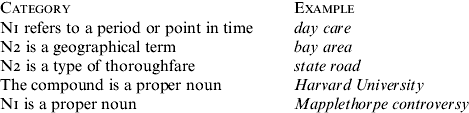
For each compound, the structural and semantic features were coded independently by two raters. The coding categories are given in (2)–(4). We broadly distinguish between three types of feature: argument structure, semantic categories, and semantic relations. The argument structure feature codes the syntactic argument status of the first constituent with respect to the head noun. It thus applies only to compounds in which the head is a deverbal noun. The semantic categories comprise a pool of those that have most often been cited in the pertinent literature (e.g. Fudge Reference Fudge1984: 144ff.; Gussenhoven & Broeders Reference Gussenhoven and Broeders1981, Zwicky Reference Zwicky1986, Liberman & Sproat Reference Liberman, Sproat, Sag and Szabolcsi1992). The semantic relations comprise a set of presumably language-independent predicates most of which have been proposed by Levi (Reference Levi1978; see Plag et al. Reference Plag, Kunter, Lappe and Braun2008 for discussion).Footnote 6 In what follows we will use the terms ‘argument structure’, ‘semantic categories’, and ‘semantic relations’ as convenient labels to refer to these sets of features.
(2) Syntactic argument status of N1 with respect to N2


(3) Semantic category of constituent or compound
(4) Semantic relation between the constituents of the compound

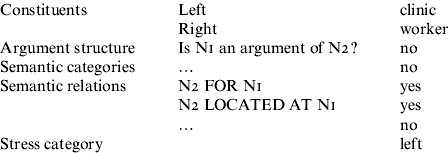
Due to the well-known fact that many compounds are ambiguous and can be interpreted as belonging to more than one of the above semantic categories, each of the semantic categories had to be coded individually for each compound as a binary category (with ‘yes’ and ‘no’ as values). In addition to the categories in (2)–(4), the data were coded according to left and right constituents. These were given in their orthographic form. Finally, each compound in the corpus was coded for its stress category, left or right. With regard to CELEX we relied on the classification of stress information as given in the corpus. Here stress is treated as an invariant property of the compound lemmata. For BURSC, the stress category of each compound token was determined acoustically by two independent raters who hold a degree in English linguistics. There were 1805 tokens, distributed over 722 types. Raters agreed on a stress category in 1395 (i.e. 77.3%) of the cases. We then used only those tokens for which the two raters agreed in their judgements, assigning the stress category of the majority of tokens to the pertinent compound type.Footnote 8 In cases of a tie, the compound was excluded from the corpus. Of course this procedure, combined with the requirement outlined above that every compound should have a constituent family among the data, led to a further reduction of the dataset. The final BURSC dataset to be used in the analysis is comprised of 536 compound types. A sample of a coded item is given in (5).
(5) The coding of clinic worker (BURSC)
3. The models – TiMBL and AM
In the present paper we will pursue a quite radical and computationally testable analogical approach to compound stress and compare this approach to a more traditional, rule-based approach. By the latter we mean a rule system that is categorical in the sense that it does not predict variation for any given input, and that it requires the ordering of subrules to be fixed.Footnote 9
We will tease apart the different aspects that distinguish these two sets of approaches (analogical and rule-based) and see in how far they contribute to the performance of our models on empirical data. Specifically, we will focus on three important aspects:
• Symbolic, rule-based models vs. exemplar-based models. Which approach is empirically more adequate, measured in terms of its predictive power for the corpus data?
• Abstract vs. non-abstract features in TiMBL and AM. How abstract do features have to be for a successful computation of compound stress?
• Nearest neighbours vs. Analogical Set. Do differences between TiMBL and AM in terms of their computational architecture have an effect on their performance?
The first aspect concerns the question of whether TiMBL and AM are empirically more accurate than categorical, rule-based models. To this end, we will compare the two models' predictive accuracies with the predictive accuracies that the pertinent rule-based models reach for the same data.
The second aspect concerns the question of which features are relevant for the representation of generalisations about compound stress. We will compare predictions based on relatively abstract information about the semantic, syntactic, morphological, or semanto-syntactic status of a compound with predictions based on less abstract constituent family information. For ease of reference, we will from now on refer to the former as ‘abstract’ features and to the latter as ‘non-abstract’ features, acknowledging, of course, that ‘abstractness’ is a matter of degree here.
Both TiMBL and AM are exemplar-based algorithms that classify new items online by comparing a new test item with similar items that are stored in memory. TiMBL is a k-Nearest Neighbour (k-NN) system that encompasses several different implementations of memory-based learning techniques (see Daelemans et al. Reference Daelemans, Zavrel, Sloot and Bosch2007 for more details). The classification of a new item is extrapolated from similar exemplars that are explicitly stored in memory (the item's nearest neighbours), via a majority vote (which may optionally be weighted according to the distance between a given neighbour and the test item). Nearest neighbours are selected from a distance space k. The experimenter can manipulate k, so that she has some control over how narrow this space should be for a given experiment. Also for the computation of similarity, the experimenter can choose from a variety of different similarity measures, which conceptually fall into two different classes. In one class of measures, similarity is computed in terms of the simple number of matching values for all features given in the new input (overlap metric). Alternatively, the degree to which matches between input features and features of stored exemplars are relevant for the computation of similarity is influenced by feature weights, or by weights which are able to distinguish between different values for a single feature. Again, there are different ways in which feature weights may be computed. Crucially, however, the features weights are computed on the basis of the whole dataset that the system is given as training data. As a consequence, if feature weights are used in an experiment, they will be the same for every new input that is to be classified. Thus, for example, if the algorithm has found that in the training set the right constituent is more informative than the syntactic relation, it will assign to the right constituent of every exemplar in memory a higher weight value than to the syntactic relation. For every new input, similarity will thus be computed using the same feature weights.
AM treats feature weights differently. In AM, the relevance of features for the classification of a given item is answered for every single new input on an individual basis. The set of exemplars that is relevant for classification of a given input is termed the exemplar's Analogical Set. For every input, the algorithm checks all conceivable combinations of feature values (termed contexts) and determines whether or not these contexts behave in a homogeneous way with respect to the target category (i.e., in our case, stress assignment). Only exemplars with homogeneous contexts will then be included in the Analogical Set (see Skousen Reference Skousen1989, Reference Skousen and Skousen2002a, Reference Skousen and Skousenb for details). Note, however, that ‘homogeneous’ does not necessarily mean ‘deterministic’. The definition of homogeneity of a context crucially hinges on the fact that in AM-related contexts are ordered hierarchically in terms of their level of generality (more general contexts act as supracontexts of more specific subcontexts). A homogeneous context is a context whose subcontexts behave identically (see e.g. Skousen Reference Skousen and Skousen2002a for details). Another interesting consequence of the ordering of context relations in AM is that contexts which are more general and, hence, less similar to the context of the test item may also end up in the Analogical Set.
Apart from the large processing demands that computation of Analogical Sets in AM entails, an interesting difference between TiMBL and AM lies in the degree to which different features may play a different role for different inputs. Here AM seems to be more flexible.
In all experiments in the present study, we tested the corpus on itself, which means that every item in the corpus was classified on the basis of all other items present in the same corpus. Both TiMBL and AM provide parameter settings that can be used to implement this kind of experimental setup. In TiMBL, the relevant procedure is the so-called leave-one-out procedure. In AM, we used the same dataset for both training and testing. Every context was made unique by introducing an additional dummy variable which had a different value for every compound in the database, but no relevance to the classification task. We then used the available option in AM that classification of test items is to be based only on contexts in the training file which are not identical to the test item.Footnote 10
4. The predictive power of rule-based approaches
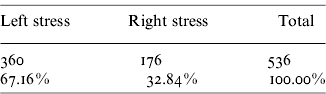
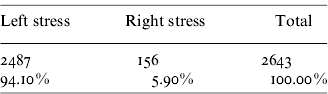
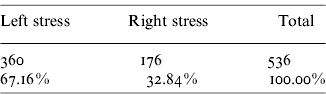
Tables 1 and 2 provide an overview of the actual distribution of stresses in the corpora. The distribution in Table 1 shows that the prediction of left stress as expected by the Compound Stress Rule does not correspond to the data. We will see in the analyses below that there is a huge amount of variation, no matter according to which of the predictor categories we subdivide the data. As a consequence of that variation, not only the Compound Stress Rule but also other traditional rule-based approaches to compound stress fail to account for the data. This has been shown in detail in Plag et al.'s (Reference Plag, Kunter, Lappe and Braun2008) BURSC study.
Distribution of stresses in the BURSC data.
Distribution of stresses in the CELEX data.
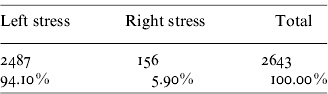
As is shown in Table 2, a major difference between the compound data from BURSC and CELEX lies in the proportion of right stresses. This difference is exactly parallel to the differences in the distribution of stress categories in the much larger compound corpora extracted from BURSC and CELEX that were used in Plag et al. (Reference Plag, Kunter and Lappe2007, Reference Plag, Kunter, Lappe and Braun2008). As discussed in detail in Plag et al. (Reference Plag, Kunter and Lappe2007), the high proportion of left stresses in CELEX is most likely due to the fact that very many of the CELEX compounds derive from dictionaries, i.e. are highly lexicalised data. By contrast, the distribution of stress categories in the BURSC data comes very close to what is generally estimated to be the proportion of right and left stressed compounds in the literature (see Plag et al. Reference Plag, Kunter, Lappe and Braun2008 for discussion). Even though, however, the CELEX data contain only some 6% of right stresses, it is clear that even the CELEX data pose a challenge to the Compound Stress Rule.
For both BURSC and CELEX, empirical studies are available which test the empirical adequacy of structural and semantic approaches to compound stress (Plag et al. Reference Plag, Kunter, Lappe and Braun2008 and Plag et al. Reference Plag, Kunter and Lappe2007, respectively). Specifically, these studies test the predictive accuracy of approaches using argument structure (as proposed in Giegerich Reference Giegerich2004), semantic categories, and semantic relations (as proposed, e.g., in Fudge Reference Fudge1984: 144ff.; Zwicky Reference Zwicky1986; Olsen Reference Olsen2000), as predictors of compound stress. For both BURSC and CELEX, the central finding that emerged is that none of these three sets of predictors can adequately account for the variation that we find in the data. This is true for each set in isolation (argument structure, semantic categories, semantic relations) as well as for a combination of features from the three sets. This generalisation is independent of whether the features are conceptualised as predictors in a categorical rule model or in a logistic regression model. In what follows, we will show that a rule-based account along traditional lines is unsatisfactory also for the subset of the BURSC and CELEX compounds used in the present studies.Footnote 11
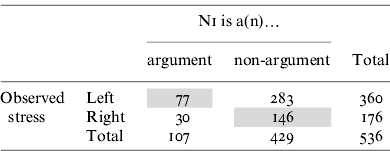
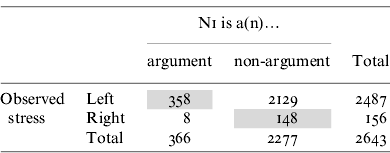
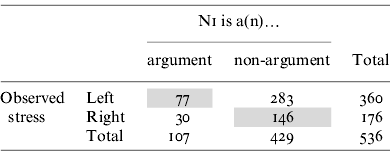
According to a categorical stress rule based on argument structure, we should find in our data that compounds in which N1 is an argument of N2 are left-stressed, whereas all other compounds are right-stressed. The contingency tables in Tables 3 and 4 show how argument status of the first constituent w.r.t. the head of the compound (argument or non-argument) is distributed among left- and right-stressed compounds in our datasets. Cells for which the categorical rule just cited makes the right predictions are shaded.
Observed stress vs. argument status of N1 w.r.t. N2 in the BURSC data (N=536).
Observed stress vs. argument status of N1 w.r.t. N2 in the CELEX data (N=2643).
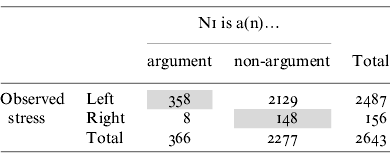
For the BURSC data, a rule based on argument structure would make the right predictions for only 77+146=223 of 536 compounds. This amounts to an overall predictive accuracy below chance level (41.60%). For the CELEX data, predictive accuracy is even much worse (19.14%). We also note in Tables 3 and 4 that the argument structure rule is better at predicting right stresses than it is at predicting left stresses. Thus, only 21.39% (BURSC) and 14.39% (CELEX) of all left-stressed compounds are predicted to be left-stressed, but 82.95% (BURSC) and 94.87% (CELEX) of all right-stressed compounds are predicted to be right-stressed.
These findings may seem surprising, but note that they are fully in line with what Plag et al. (Reference Plag, Kunter and Lappe2007, Reference Plag, Kunter, Lappe and Braun2008) found for a much larger subset of BURSC and CELEX compounds. Although significant effects of argument structure were detected in the data, argument structure turned out to be the weakest of all predictors tested in these studies, to the extent that it could be eliminated from the final, stochastic models without a significant loss of predictive accuracy.Footnote 12
At this point a note is in order about how we will measure the predictive power of rules and models in this paper. The distributions in Tables 3 and 4 provide a nice illustration of why it is not always a good idea to measure predictive accuracy solely in terms of what we have called above ‘overall predictive accuracy’, i.e. the percentage of items predicted correctly. First of all, we note that predictive accuracy can be very different for different target categories (i.e., in our case, left and right stress). Secondly, given that the distribution of observed stresses in both datasets is skewed towards left stress, overall predictive accuracies will reflect that uneven distribution. To take an extreme case as an example, imagine a (hypothetical) model that predicts only left stresses. For the BURSC data, this model would reach an overall predictive accuracy of 67.16%, for CELEX it would even reach a predictive accuracy of 94.1%. Conversely, a model that predicts only right stresses would reach a predictive accuracy of only 32.84% for BURSC and 5.9% for CELEX. Thus, in order to measure the predictive power of rules and models, we require a measure that somehow takes into account the uneven distribution of target categories and tells us how well our model predicts each of them, on average.
One measure commonly used in information theory is the F-score (see e.g. Daelemans & Bosch Reference Daelemans and Bosch2005: 48ff.; 78–79; Daelemans et al. Reference Daelemans, Zavrel, Sloot and Bosch2007: 31–32 for details). F-scores are computed for each target category, in our case for left and right stress. Let us take the target category ‘left stress’ in the rule model exemplified in Table 3 above as an example to see how F-scores work. The F-score for left stress is the harmonic mean of two ratios, both of which can assume a value between 0.0 and 1.0. The first ratio, termed ‘recall’, is what we have called above ‘accuracy for left stress’. It gives us the number of items for which the model correctly predicts left stress divided by the number of items which are indeed left-stressed. It thus tells us how well the model is able to find left-stressed items in the corpus. According to Table 3, then, the rule model's recall for left stress is  .
The second ratio is termed ‘precision’, and it gives us the number of items for which the model correctly predicts left stress divided by the number of items for which the model predicts left stress. Given the distributions in Table 3, the rule model's precision for left stress is  . The F-score for left stress is the harmonic mean of precision and recall:

For the target category ‘right stress’ in Table 3 we can likewise compute the F-score, which is 0.4826. In order to obtain one final measure of the predictive power of our model, we can now compute an average F-score for left and right stress:

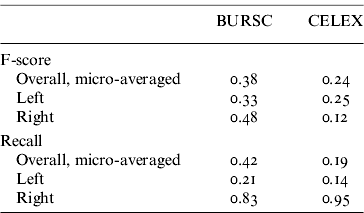
Note that this averaged F-score is a weighted mean; each F-score is weighted proportionally according to the observed stresses of the relevant category in the dataset. This is termed ‘micro-averaging’ (see Daelemans et al. Reference Daelemans, Zavrel, Sloot and Bosch2007: 32).Footnote 13 From now on, we will document the predictive power of the rules and models discussed in this paper using micro-averaged F-scores. For reasons of conceptual simplicity, predictive accuracies (i.e. recall scores) will also be given, but not discussed.
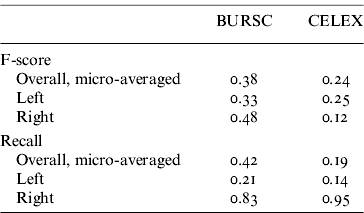
Table 5 compares the performance of the argument-structure rule for the BURSC and CELEX data. We see that, if measured in terms of F-scores, the rule's alleged good performance for the prediction of right stress turns out to be less convincing. For CELEX, F-scores for right stress are even worse than those for left stress. This is due to the fact that for the CELEX data, even though recall of right stress is quite high (0.95), precision is very low (0.06).
Predictive accuracies and F-scores for the argument-structure rule.
The second rule-based approach to be tested here uses the semantic characteristics of compounds as predictors. Here the question arises which of the many semantic features coded should be included in a semantic rule system. Our categorical approach will be based on a subset of the features that have been mentioned in the semantic approaches that were discussed in Section 2.1. The subset comprises those semantic features that have been found to show significant stress effects in the Plag et al. studies (Plag et al. Reference Plag, Kunter and Lappe2007 for CELEX, Plag et al. Reference Plag, Kunter, Lappe and Braun2008 for BURSC). By excluding features whose predictive power for the data at hand is poor, we thus ensure that our categorical semantic model is as powerful as it can get.
For the BURSC data, a semantic rule based on the semantic properties and relations would assign right stress if a compound exhibits at least one of the following semantic characteristics:
Semantic properties
N1 refers to a period or point in time
N2 is a geographical term
N1 and N2 form a proper noun
N1 is a proper noun
N1 and N2 form a left-headed compound
Semantic relations
N2 IS MADE OF N1
N1 IS N2
N2 IS LOCATED AT N1
N2 DURING N1
N2 IS NAMED AFTER N1
Elsewhere, the rule would assign left stress.
For the CELEX data, the semantic rule based on Plag et al.'s (Reference Plag, Kunter and Lappe2007) findings would assign right stress essentially to the same categories as the rule for the BURSC data, with the exception of the two semantic categories ‘N2 is a geographical term’ and ‘N1 and N2 form a left-headed compound’, which turned out to be insignificant in the Plag et al. (Reference Plag, Kunter and Lappe2007) study.
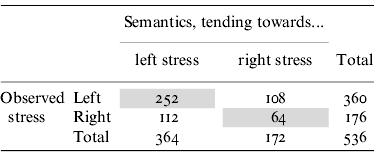
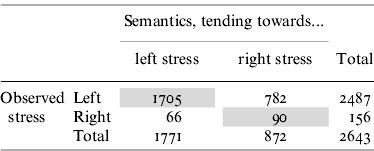
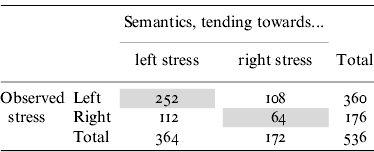
Tables 6 and 7 show how the stress categories predicted by the semantic rule are distributed among the observed stresses in our subsets of the BURSC and CELEX compounds. As in the previous tables, cells representing correct predictions are shaded.
Observed stress vs. semantics in the BURSC data (N=536).
Observed stress vs. semantics in the CELEX data (N=2,643).
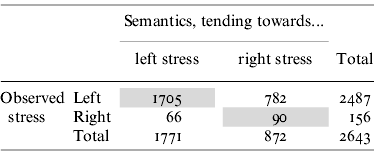
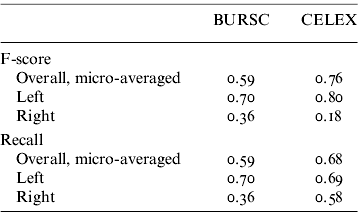
The performance of the semantic rule is assessed in Table 8. For the semantic rule, averaged F-scores are substantially higher than those for the argument structure rule. Still, a major weakness of the semantic rule is the prediction of right stress. This is especially true for the CELEX data.Footnote 14
Predictive accuracies and F-scores for the semantic rule.
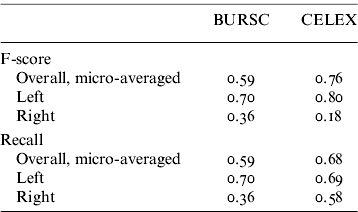
An obvious question that emerges from our findings so far is whether the predictive power of the approaches based on argument structure and semantics could be improved if they joined forces. As is clear from the tables, however, we cannot expect much improvement under a rule-based paradigm. The reason is that the semantic rule predicts right stress for a subset of those compounds for which the argument-structure rule predicts right stress (i.e. modifier–head compounds which exhibit the semantic characteristics specified above). As a consequence, a combined rule can never reach better accuracies for right stress than the semantic rule. As we have seen above, however, prediction of right stress is the major weakness of that rule.
In what follows, we will document how the two exemplar-based models, TiMBL and AM, are able to predict compound stress in our data. We will deal with the two corpora, BURSC and CELEX, in turn.
5. Exemplar-based modelling of the BURSC data
5.1 Step 1: All features as information source
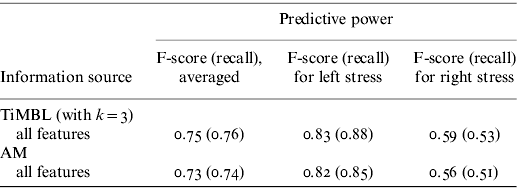
Table 9 provides an overview of the performance of TiMBL and AM if the algorithms are given all coded features as information source. The table gives both F-scores and, in parentheses, recall (i.e. predictive accuracy). The relevant parameter settings for all BURSC experiments are given in Appendix A.
Classification accuracies for BURSC, all features used as predictors.
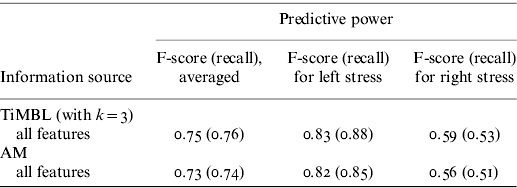
We see that accuracy rates for TiMBL are slightly higher (about 2%) than those for AM. What is much more striking, however, is that both TiMBL and AM clearly outperform the rule-based models discussed above if they are given all features as information source. Whereas averaged F-scores for the rule-based approaches are 0.38 (argument-structure rule) and 0.59 (semantic rule), the exemplar-based models reach F-scores between 0.73 and 0.75. Also in terms of F-scores for left and right stress, both TiMBL and AM are superior to the rule-based models.
In order to better understand where this discrepancy in predictive power could come from, we will take a closer look at those aspects of the architecture of the two exemplar-based models which make them fundamentally different from rule-based approaches.
The first obvious difference lies in the nature of the algorithms. Rule-based models capture the syntactic or semantic predictors of compound stress in terms of both necessary and sufficient conditions which obligatorily trigger rule application. In TiMBL and AM, stress assignment is extrapolated from the stress category of the majority of the most similar items that are stored in memory. To take an example, the compound Massachusetts company would (correctly) be assigned right stress in both rule-based and exemplar-based approaches, but on different grounds. For the rule-based approach the only thing that is relevant is that there is a locative relation between N1 and N2, which would provide a sufficient condition for the compound to be assigned right stress.
In TiMBL and AM, by contrast, the most similar compounds that are stored in memory are Massachusetts market and Massachusetts veteran. They are similar to Massachusetts company in that their codings all share the value for the locative semantics (‘yes’), the first constituent (‘Massachusetts’), and all other semantic and syntactic categories (‘no’). The stress categories of Massachusetts market and Massachusetts veteran will thus be the categories that have the greatest say in determining the stress category of Massachusetts company. Other locative compounds in memory will be less influential or not influential at all.
Thus, for example, the item Massachusetts administrator is less similar to Massachusetts company than the two other compounds. The reason is that, even though Massachusetts company and Massachusetts administrator both have locative semantics and the same first constituent, the coding of semantic relation between constituents in Massachusetts administrator has a ‘yes’ value not only for a locative relation, but also for a purpose relation (N2 FOR N1). Other locative compounds will be even further away from Massachusetts company. An example is bank window, which shares the locative semantics with Massachusetts company, but has a different first and second constituent and, in addition, a ‘yes’ value for a possessive semantic relation between N1 and N2 (N1 HAS N2). In TiMBL, the question of how similar an item must be in order to be incorporated into the nearest-neighbour set depends on how the distance space k is set. If k is set to 1, only Massachusetts market and Massachusetts veteran will form the nearest neighbour set of Massachusetts company. If k is set to 2, the model will additionally incorporate compounds like Massachusetts administrator. Models with k=3 will incorporate even less similar items like bank window, and so forth.
In AM, the question of how similar an item must be in order to be incorporated into the Analogical Set is resolved differently. The algorithm checks all contexts defined by the feature combination of a given target (Massachusetts company) for homogeneity in terms of stress classification. It will then take all homogeneous contexts into account in the classification task, whereby those contexts most similar to the target context will have the greatest say in the voting procedure.
Compared to the rule-based model, then, stress classification in TiMBL and AM is more local in the sense that it is usually based not on one single global categorial system, but on a restricted set of the most similar items in the lexicon. In the case of a model that incorporates all coded categories as an information source (as in Table 9 above), predictive power in TiMBL was optimal if k was set to 3.
The second major difference between the rule-based model discussed in this paper and models like TiMBL and AM is intricately linked to the characteristics just discussed. Thus, it is clear that in both rule-based and exemplar-based models classification accuracies will depend on the type of features that the models are given as an information source. In the rule-based models these features are of a relatively abstract nature, i.e. semantic or syntactic features or a combination of both. For exemplar-based models it is perfectly natural to take also less abstract features as information source; in fact, many of the existing exemplar-based theories assume that detailed phonetic representation is stored and available for grammatical classification. In the pertinent models tested in this paper, orthographic form of the compound constituents acts as a proxy for detailed levels of representation of that kind. Thus, our exemplar-based models include the compound constituents themselves (N1, N2) as information source.
Finally, rule-based models differ from TiMBL and AM in that they postulate that rules must be ordered. As a consequence, every determinant feature has the same relevance for every data item. In exemplar-based models this may be different, but to different degrees. In this respect, TiMBL and AM do not behave alike. During the training phase, TiMBL uses an entropy-based algorithm to assign informational weight to the features processed. This information weight is then used to compute similarity, such that features with higher weights are given preference over features with lower weights.
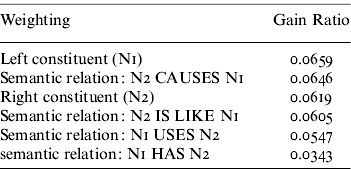
Table 10 provides an overview of the information weight scores assigned to the features used in our TiMBL experiment. For reasons of readability, only the six highest scores are shown.
Gain Ratio values for BURSC.
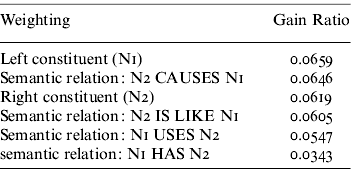
Several points are noteworthy here. First of all we see that, with the exception of one semantic relation (N2 CAUSES N1), highest Gain Ratio weights are assigned to the non-abstract features ‘left constituent’ and ‘right constituent’. It is these features that TiMBL regards as most important in the computation of similarity among compounds in the corpus.
With respect to the four semantic relations that are listed in Table 10, it is important to see that three of them – N2 CAUSES N1, N2 IS LIKE N1, N1 USES N2 – hardly ever occur in the corpus; items coded as ‘yes’ for any of these relations range between one (N1 USES N2) and three (N2 CAUSES N1). By contrast, N2 HAS N1, ranked sixth in terms of Gain Ratio values, is pertinent for 149 compounds in the corpus.
The second point that is interesting is that, among the two non-abstract features, the left constituent has a higher Gain Ratio score than the right constituent. This runs counter to what is often assumed about analogical stress assignment in English compounds, i.e. that similarity is computed on the basis of the head of the compound (e.g. street vs. avenue compounds; but see e.g. Schmerling Reference Schmerling1971 and Liberman & Sproat Reference Liberman, Sproat, Sag and Szabolcsi1992 for approaches which consider both constituent families to be relevant for analogical effects).
Finally, it is important to note that the relation between Gain Ratio scores of the features and the question which compounds end up in the nearest-neighbour set of a given compound in the corpus is a complex one. For example, we have seen above that for Massachusetts company the most similar compounds are those that share both the first constituent and the semantics with the target. However, in an experiment in which the k value is set to 3 (as is the case in the experiment represented in Table 9), the nearest neighbour set also includes compounds that do not share any of the constituents with the target compound (such as bank window, as discussed above). For other compounds, this is not the case. An interesting example is minority area. Here the most similar item is lead area, which does not have the same first constituent as its target, but the same second constituent and a similar semantics (a locative relation between N1 and N2). Further away in the distance space (k=2) we find the neighbour minority woman, which shares the first constituent with the target, but differs from the target in terms of its semantics. Finally, in the space defined by k=3, we find minority voter, whose relation to minority area is similar to that of minority woman, with the additional difference that the head is a deverbal noun. Thus, in an experiment in which k is restricted to 3, all nearest neighbours of lead area share either the first or the second constituent with the target. The way in which nearest neighbour sets are selected therefore explains why combinations of different features (e.g. syntactic, morphological, semantic) affect classification accuracy in TiMBL very differently from rule-based approaches.
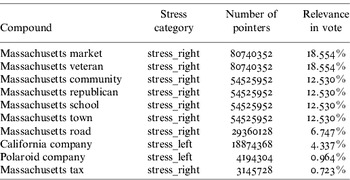
In terms of the selection of relevant neighbours, AM's behaviour is even more radical than that of TiMBL. Table 11 (below) provides an overview of the compounds in the Analogical Set for our example Massachusetts company.
Analogical Set for Massachusetts company.

As in TiMBL, the most similar items turn out to be Massachusetts market and Massachusetts veteran, i.e. items which share with the target the first constituent and all other abstract features. However, these exemplars are chosen to be most relevant on different grounds. In AM these two compounds are in the Analogical Set because they are, like all other compounds in the Analogical Set, exponents of a context that behaves in a homogeneous way with respect to stress classification (all items with this context are right-stressed). Additionally, they are more relevant than other compounds in the Analogical Set (i.e. each has 18.554% of the vote) because among all homogeneous contexts, they represent the most specific context (i.e. they are most similar to the target). Less relevant than Massachusetts market and Massachusetts veteran, but still getting 12.53% of the vote each, we find compounds like Massachusetts community. They share with the target the first constituent and all other coded features, except for the fact that, in addition to a locative semantic relation, they also have a ‘yes’ value for a possessive semantic relation (N1 HAS N2). Now recall that at this point the Analogical Set in AM deviates from the nearest-neighbour set in TiMBL, which had Massachusetts administrator at a distance of k=2 instead, a compound that has been coded for an additional purpose relation rather than a possessive relation. This is because, on the basis of its global weighting of features for their informativity (Gain Ratio), TiMBL makes the principled assumption that a deviation from the semantic relation of the target weighs less heavily if a purpose relation is affected than if a possessive relation is affected. This is assumed for all compounds. AM does not make such global assumptions. Instead, it finds that for the context defined by the features of the target Massachusetts company, the subcontext that is characterised by a different second constituent and an additional possessive relation of the type N1 HAS N2 behaves homogeneously, whereas the subcontext defined by an additional purpose relation does not. This decision is, however, specific to Massachusetts company and may be different for other targets. Another difference between the Analogical Set in Table 11 above and the nearest-neighbour set in TiMBL is that in the former we also find two compounds (California company, Polaroid company) that share with the target the right constituent, but not the left constituent.
To sum up, we have seen in this section that the two exemplar-based algorithms are superior to rule-based approaches if they are given the richest feature combination conceivable as information source. We have also seen that this could be due to basically two fundamental differences between the approaches: either the nature of the algorithm, where the exemplar models often act more locally and are somewhat more flexible in terms of relevant features, or the nature of the information source, where exemplar models may take into account more specific, non-abstract information (i.e. N1 and N2). In what follows we will investigate these two alternative explanations. If differences between rules and exemplar-based approaches are due to the nature of the algorithm, we should find that TiMBL and AM will outperform rule models also if they are given only the abstract features as information source. If differences reside in the possibility to include constituent family information, then we should find that TiMBL and AM will perform well also without the abstract features. We will set TiMBL and AM to the two tasks in turn.
5.2 Step 2: The abstract features as information source
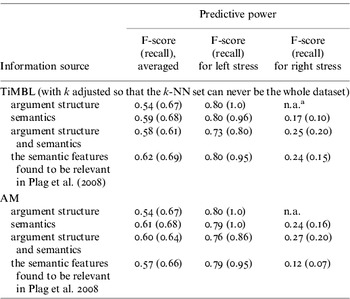
Table 12 provides an overview of classification accuracies of four sets of models: those which test syntactic and semantic features in isolation, one which tests them in combination, and one which uses only those features that have been found to be relevant in Plag et al.'s (2008) study.
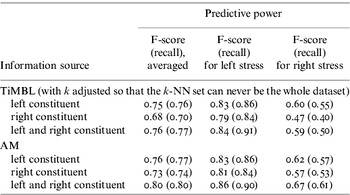
Classification accuracies for BURSC, abstract features.

a In this experiment, all items are predicted to be left-stressed, no right stress is predicted. As a consequence, the F-score for right stress is not defined, as the computation involves division by 0. We follow the convention applied in TiMBL and use 0 as the limit of the harmonic mean as the F-score instead. The same procedure will be applied in all other experiments in which no right stress is predicted.
Unlike the syntactic rule, TiMBL and AM predict only left stress to occur if they base classification only on argument structure information. If they are given semantic information, performance is about similar to that of the corresponding rule model (with an F-score of 0.59 and 0.61 for the exemplar-based models as compared to an F-score of 0.59 for the rule-based model). The table also shows that a combination of syntactic and semantic information sources does not considerably enhance predictive power; on the contrary, F-scores for combinations of syntactic and semantic features are often lower than those for either syntactic or semantic features in isolation. If we use a subset of the most relevant semantic features, TiMBL's performance is able to profit from this smaller number of predictors (the F-score rises to 0.62) whereas performance of AM drops to an F-score of about 0.57. What is particularly noteworthy, however, is that, no matter which combination of abstract features we use, performance of TiMBL and AM never even nearly reaches the level it reached in our first experiment, where we included non-abstract N1 and N2 as predictors, and where F-scores were 0.75 (TiMBL) and 0.73 (AM), respectively. This suggests that it is precisely this ability to include non-abstract features as predictors that makes the exemplar-based models superior to classical rule-based approaches. To see whether this is true, we now turn to the third step in our experimental series.
5.3 Step 3: The non-abstract features as information source
We now give AM and TiMBL only the left and the right constituents of the compounds as information source. Recall that in the subset of BURSC that we are using every test item has a constituent family for both its left and its right constituent. We carried out three experiments, testing the two constituents in isolation and in combination. Table 13 (below) provides an overview of the results.
Classification accuracies for BURSC, non-abstract features.

For both TiMBL and AM, F-scores are optimal if a combination of left and right constituents is used as information source. In this combination, the models perform better than in any of the tests in which they were trained on abstract features. AM even reaches a higher F-score than in the first experimental series, where the model was trained on all features including the left and right constituent (compare F-scores of 0.73 and 0.80, respectively). This is not the case for TiMBL, where predictive power is about the same in the two series (about 0.75).
We also note that, if given left and right constituents as predictors, AM is more successful in predicting right stresses than it was in all previous test series.
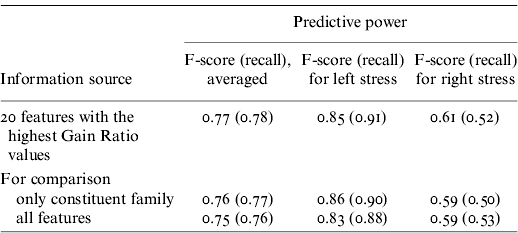
In a final test series, we tried whether predictive power on the basis of constituent family could be enhanced by adding a selection of abstract features to the constituent family information. For practical reasons, we conducted this test series with TiMBL only, because in TiMBL it is possible to determine the most powerful feature combination with the help of the features' Gain Ratio scores. Thus, a series of experiments was run in which for each experiment one feature was added as an information source, starting with only the feature with the highest Gain Ratio score and proceeding in a stepwise fashion to features with lower Gain Ratio scores. The results of the experiment with the most powerful combination (measured in terms of its averaged F-score) are given in Table 14. To facilitate a comparison, the table also repeats the results of the experiments where all features were used as information source and where only constituent family was used as information source.
Optimising feature combinations in TiMBL.
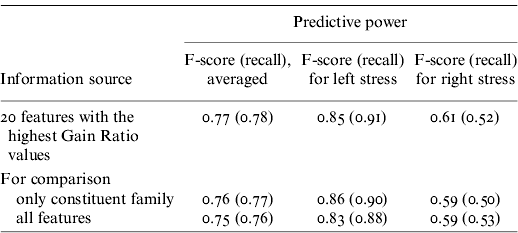
Predictive power was optimal if TiMBL was given the 20 features with the highest Gain Ratio scores as information source. These include the constituent families of N1 and N2 as well as a set of syntactic and semantic features.Footnote 15 Note, however, that the model is not able to benefit greatly from the inclusion of abstract features in addition to constituent family information. The difference between the optimal feature combination and the experiment that is based on constituent family only is just about no greater than 0.01.
5.4 Intermediate summary
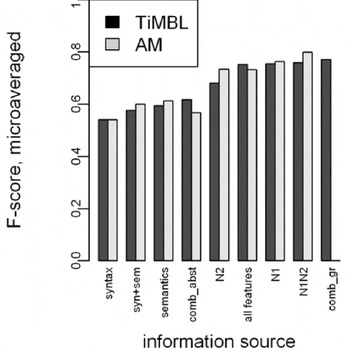
We have seen that both TiMBL and AM are far better at predicting compound stress assignment in the BURSC corpus than rule-based approaches. This is partly due to fundamental differences in the architecture of rule-based and exemplar-based approaches. However, the main factor that makes exemplar-based models more powerful than rule-based approaches is that the former are able to accomodate constituent family information as predictor. Figure 1 provides an overview of the averaged F-scores achieved in our TiMBL and AM experiments, ordered by the results of the TiMBL experiments.
Results of TiMBL and AM models, BURSC.

Experiments which are based solely on abstract features (‘syntax’, ‘semantics’, ‘syn+sem’, i.e. the combination of all abstract features, and ‘comb_abst’, i.e. the combination of abstract features found relevant in Plag et al. Reference Plag, Kunter, Lappe and Braun2008) reach F-scores around 0.6 the most. If either a combination of abstract features and constituent family (‘all feat’ and ‘comb_gr’, i.e. the combination of features with the highest Gain Ratio values) or constituent family information alone (‘N2’, ‘N1’, ‘N1N2’) are used as information sources, F-scores rise by about 10–20%. Among the experiments including constituent family information, the selection of features chosen does not make much of a difference for TiMBL, as long as the experiment is not solely based on N2 constituent families. This is remarkable, given that N2 constituent family is the factor that has been most widely discussed in the literature on analogical effects in compound stress assignment (e.g. Schmerling Reference Schmerling1971: 56; Ladd Reference Ladd, Gibbon and Richter1984).
For AM, differences are somewhat more pronounced, highest F-scores are reached in experiments based on N1 and N2 constituent families. If we compare TiMBL and AM, we see that despite the differences in the models' general architecture, results are remarkably similar. With the exception of two experiments, AM performance is slightly above that of TiMBL.
In the next section we will consider a parallel set of experiments that were conducted using the CELEX lexical database. We will see that, although the database is very different, the results point into the same direction that we have seen in the BURSC data.
6. Modelling compound stress in CELEX
6.1 Step 1: All features as information source
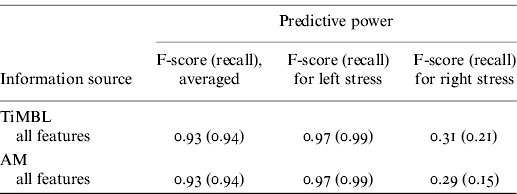
In the first set of experiments we again use all features, abstract and non-abstract, as information source. Table 15 summarises the results. The relevant parameter settings for all CELEX experiments are given in Appendix B.
Classification accuracies for CELEX, all features used as predictors.
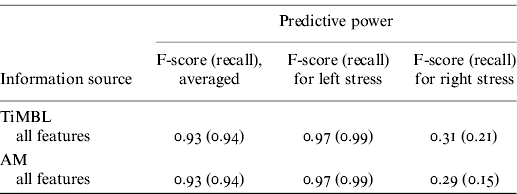
As in the BURSC simulations, TiMBL and AM produce very similar results which clearly outperform the rule-based approaches that were discussed at the beginning of this paper. For the rules, micro-averaged F-scores in Tables 5 and 8 ranged between 0.24 (the syntactic rule) and 0.76 (the semantic rule). By contrast, both TiMBL and AM reach F-scores of more than 0.93 when fed with all features. Table 15 also reveals a major weakness of the exemplar-based models: The asymmetry in predictive power of left and right stress, which we already saw in some of the BURSC simulations, is much more pronounced in the CELEX experiments. Thus, whereas predictive power is very strong for left stress, it is very weak for right stress. Note, however, that this problem was also present in the stronger of the two rule-based approaches (the semantic rule, compare F-scores of 0.80 for left stress and 0.18 for right stress).
In what follows abstract and non-abstract features will again be compared in terms of how they influence the predictive power of our models.
6.2 Step 2: The abstract features as information source
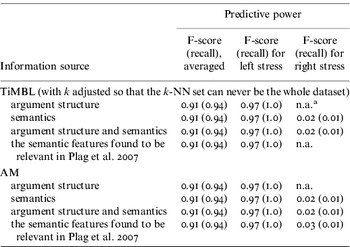
Table 16 presents the results of the set of experiments in which TiMBL and AM use only abstract features as information source. Averaged F-scores are slightly below those reached when both abstract and non-abstract feature sets are given as information source (compare F-scores of around 0.93 in Table 15 with F-scores of around 0.91 in Table 16). However, when we compare the two sets of experiments in terms of how well they predict our two stress categories, left and right stress, we see that the small differences in averaged F-scores gloss over a rather big difference between the two sets of experiments. Whereas differences in F-scores for left stress are rather small (about 0.01), the two sets of experiments vastly differ in terms of how well right stress is predicted. When all features are given as information source, F-scores for right stress are about 0.31 (TiMBL) and 0.29 (AM), respectively. When, however, only abstract features are given, F-scores for right stress fall to values between 0.00 and 0.03. In the experiments using argument structure as information source, no right stress is predicted at all, neither by TiMBL nor by AM. In the experiment in which those features are used which have been found to have a significant influence on stress assignment in Plag et al.'s (Reference Plag, Kunter and Lappe2007) study of CELEX compounds, TiMBL does predict some right stress, but not for compounds which actually are right-stressed. In sum, the relatively high averaged F-scores that are reached on the basis of abstract features only (i.e. those in Table 16) are to a large extent an effect of our averaging method (micro-averaging, cf. above), in which more weight is given to target categories that are strongly represented in the corpus. For a corpus like the CELEX compounds, where actual stress distribution is strongly biassed towards left stress (compare 94.1% left vs. 5.9% right stresses), this means that differences between models in their predictions of right stress do not come out as pronounced effects in averaged F-scores.
Classification accuracies for CELEX, abstract features used as predictors.

a In the experiments marked ‘n.a.’, all items are predicted to be left-stressed, no right stress is predicted. As a consequence, the F-score for right stress is not defined, as the computation involves division by 0. We follow the convention applied in TiMBL and use 0 as the limit of the harmonic mean as the F-score instead. The same procedure will be applied in all other experiments in which no right stress is predicted.
6.3 Step 3: The non-abstract features as information source
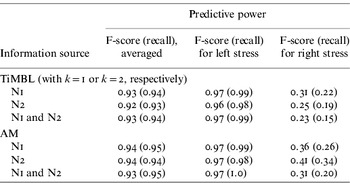
As in our BURSC experiments, we now feed TiMBL and AM with the left and right constituents both in isolation and in combination. The results are given in Table 17.
Classification accuracies for CELEX, non-abstract features used as predictors.

As in the BURSC experiments, classification accuracies in this set of simulations are above those in the experiments based on the abstract features. If fed with only N1 as information source, TiMBL reaches about the same classification accuracy as it did in the experiment in which all features were given (compare averaged F-scores of about 0.93 in Tables 15 and 17). If given N2 or both N1 and N2, there is a very slight drop in predictive power. AM, by contrast, makes slightly better predictions if given only the non-abstract features as information source than if given all features (see Table 15). Again, however, we find interesting differences between models when we look at how well they perform predicting right stress. Whereas TiMBL is best at predicting right stress if given only N1 or if given all features, the optimal information source for the prediction of right stresses in AM is the non-abstract features only, with highest F-scores for right stress in the experiment that uses solely N2 as information source. Here F-scores for right stress in AM experiments are generally higher than those in TiMBL experiments.
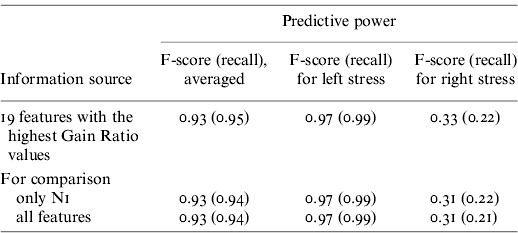
In a final step, we test whether a combination of the most informative features from both the abstract and the non-abstract set would optimise predictive power in TiMBL beyond the levels reached in previous experiments. We use the same procedure as in the BURSC experiments (see Section 5.3) and restrict ourselves to TiMBL as the computational algorithm. The results are given in Table 18.
Optimising feature combinations in TiMBL.
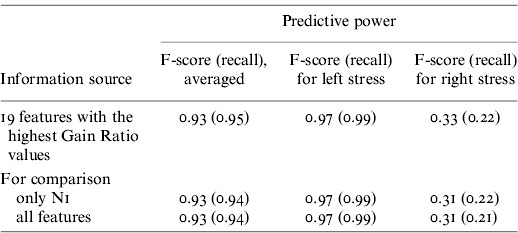
Predictive power was optimal when the 19 features with the highest Gain Ratio scores were used as information source. We see, however, that not much is to be gained from the optimisation procedure. Thus, the overall F-score hardly rises above the level it reaches when only N1 is used as information source.Footnote 16 Note, however, that for right stress improvement is slightly better, with an F-score difference of some 0.02.
6.4 Intermediate summary
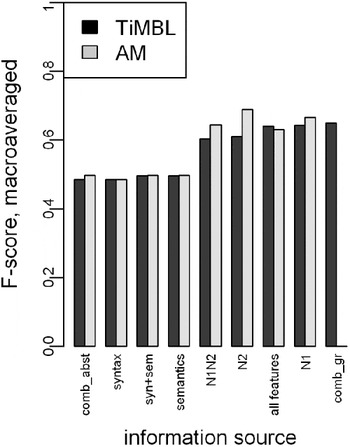
Figure 2 summarises the experiments discussed in this section. For better illustration, however, notice that we deviate here from our usual method of averaging F-scores. Thus, up until now F-scores were micro-averaged, i.e. F-scores for left and right stress were combined in such a way that weighing of F-scores reflects biasses in the distribution of actual left and right stresses in the data. In figure 2 now we show macro-averaged F-scores, which are simply calculated as the harmonic mean of left and right F-scores. Thus, F-scores for left and right stress are treated as equals in the formula. For the CELEX data, this has the advantage that differences between models stand out visually more clearly than if we use micro-averaged F-scores. Note, however, that the choice of the averaging method does not affect the general outcome of the comparison of models made in this paper.
Results of TiMBL and AM models, CELEX.

In the CELEX experiments we find that, although the corpus is very different from the BURSC corpus in terms of its internal composition, results almost exactly mirror those of the BURSC experiments. Thus, both TiMBL and AM are superior to rule-based models in predicting stress distributions. Furthermore, the most useful information source turns out to be constituent family information, which may or may not be combined with other abstract features. Crucially, models using only abstract features as information source are significantly worse than those including non-abstract features, no matter which combination of abstract features we use.
The one point in which the CELEX experiments differ substantially from the BURSC experiments is that in most simulations, both TiMBL and AM grossly overpredict left stress. Strikingly, the one series of experiments in which both models predict at least a substantial amount of right stresses is the series that uses only the two ‘non-abstract’ features, the constituents, as an information source.
7. Conclusion
The present study of English compound stress has brought to light strong evidence in favour of an exemplar-based model of compound stress. In terms of predictive power, we have shown that, if trained solely on the right and left constituents of each compound, computational models like TiMBL or AM are more successful in predicting the locus of stress than any categorical rule that has been proposed in the literature, including the Compound Stress Rule. More specifically, the predictive accuracy of right-hand stress improves if the model is trained on the left and right constituents. Thus, our findings suggest that the level of abstraction needed to compute stress in compounds over stored exemplars does not require abstract syntactic and semantic features. A representation of left and right constituents suffices. This is in line with recent findings concerning the role of constituent families in compound semantics and compound morphology (e.g. Gagné Reference Gagné2001, Krott, Baayen & Schreuder Reference Krott, Baayen and Schreuder2001, Krott et al. Reference Krott, Schreuder, Baayen and Skousen2002). It is also paralleled by other recent studies, which argue that word stress assignment is influenced by stress of phonologically similar items in the lexicon (see e.g. Daelemans, Gillis & Durieux Reference Daelemans, Gillis and Durieux1994, Eddington Reference Eddington and Skousen2002 for computational models, Guion et al. Reference Guion, Clark, Harada and Wayland2003 for experimental evidence on English), but contrary to much work in metrical phonology, where it is generally assumed that stress is part of the lexical representation of individual items only in cases of ‘exceptional’ stress assignment.
Comparing the performance of TiMBL and AM, we see that there are no large differences in overall performance. However, we also note that AM is consistently a little better than TiMBL in most experiments.
Finally, we need to emphasise that research in exemplar-based modelling of compound stress cannot stop here. In this paper we have presented only the first, necessary step. Although TiMBL and AM outperform categorical models, they still produce a considerable amount of classification errors. At this point it is important to note that our TiMBL and AM simulations do not incorporate token information (see Section 2.1 above for discussion). The incorporation of such information is desirable, because it would allow us to model two types of effect that are expectable in an exemplar-based model of compound stress assignment: within-type variability of stress and token frequency effects. For the existence of within-type variability, we have evidence from case studies from the BURSC corpus. Kunter Reference Kunter2009 shows that, contrary to prevalent tacit assumptions in most of the pertinent literature, there is inter- as well as intra-speaker variability of stress assignment in compounds. Crucially, compounds differ in terms of the extent to which they exhibit such variability. These facts support an exemplar-based approach to compound stress where different individual realisations of a single compound are assumed to be stored in memory. The question that arises, then, is whether or not we can enhance predictive accuracy by having our test items classified continuously. Unfortunately, neither the BURSC nor the CELEX data are suitable to assess token variability in compound stress beyond the case studies analysed in Kunter Reference Kunter2009.
Token frequency effects are expected in an exemplar-based model because, among stored exemplars, we would expect highly frequent types to exert a stronger influence in classification than less frequent types. However, the issue of how exactly token frequency is to be implemented in an exemplar-based model in general is still under debate in the literature (see especially Bybee Reference Bybee2001: 50ff., 138ff. for an overview discussion), where proposals differ in terms of how they model the relation between type and token representations. In view of the theoretical debate as well as the practical considerations discussed in Section 2.1, we leave it to future research to see whether the incorporation of tokens will yield a stronger exemplar-based model than the implementation introduced in the present paper.
APPENDIX A
Parameter settings in TiMBL and AM for the BURSC experiments
In TiMBL, highest classification accuracies were reached if similarity was computed using a simple overlap metric for the left and right compound constituent and the Jeffrey Divergence metric for all other features. Feature weighting was based on Gain Ratio values. Using a distance-weighted similarity metric for left and right constituents proved disadvantageous for the classification task, presumably because these features are represented in our corpora only as a single orthographic form. Potentially informative phonological characteristics like the number of syllables, syllable structure, rhythmic patterns were not represented. The system was thus not given suitable information that would allow it to establish similarities between different values for left and right constituents.
In experiments in which the algorithm was presented with a large number of features, classification was most successful if the distance space over which nearest neighbours were defined was set to k=3. In experiments in which fewer features were used, k was adjusted so as to make sure that the nearest neighbour set never included the whole training corpus. The voting procedure that produced best results was simple majority voting.
In our AM experiments we had the algorithm compute Analogical Sets using pointers, not occurrences (see Parkinson Reference Parkinson and Skousen2002 for a general outline of the options provided by AM).
APPENDIX B
Parameter settings in TiMBL and AM for the CELEX experiments
As in the BURSC simulations, TiMBL achieved best results with the Jeffrey Divergence metric as a distance metric and Inverse Distance voting among nearest neighbours. The distance space k was set to 3, except in experiments in which fewer than three features were used as information source. Gain Ratio was used to weigh features.
In AM we used the same parameters as in the BURSC experiments. We also included a dummy variable that is unique for each item where appropriate.