Implications
This paper indicates that growing goats, consuming one of three species of grass hay, required supplementation in order to achieve positive BW gains. In a second experiment, supplementation of protein or energy alone did not result in increased nitrogen retention or fiber digestibility. When feeding low and medium quality grass hays to growing meat goat kids, producers should consider supplementation of both protein and energy simultaneously to achieve increases in protein accretion via nitrogen retention.
Introduction
Interest in raising meat goats in North America has grown in recent years for many reasons, including the loss of government support for mohair production, the introduction of Boer goat genetics and the increasing demand for goat meat (Cameron et al., Reference Cameron, Luo, Sahlu, Hart, Coleman and Goetsch2001). Changes in ethnic diversity in the USA continue to increase demand for goat meat (Oman et al., Reference Oman, Waldron, Griffin and Savell1999; Coffey, Reference Coffey2002; Mauldin, Reference Mauldin2005). The number of goats slaughtered in the USA is more than four times what it was in the 1980s, increasing from less than 100 000 in 1981 (Oman et al., Reference Oman, Waldron, Griffin and Savell1999), to over 827 000 in 2007 (NASS USDA, 2008).
Due to highly selective browsing and grazing, goats are known for their ability to survive and produce when foraging low quality, brushy or woody diets (Peterson, Reference Peterson2002). This advantage may be lost in pen-fed goats because of the decreased diversity of available feedstuffs. Feeding grain-based commercial supplements may reduce this species’ ruminal pH and decrease fiber digestibility, thereby decreasing dry matter (DM) intake (Moore et al., Reference Moore, Poore and Luginbuhl2002). Therefore, supplementation strategies must be chosen that will improve rates of gain, while minimizing negative effects on forage digestibility.
In much of the southwestern United States, goats are fed in areas containing improved pastures and/or are pen-fed grass hays common to the region. The three varieties of hay chosen for this study are commonly fed in the southwestern United States and were thus chosen for inclusion in this study. Others have reported energy and protein requirements of growing meat goat kids (Fernandes et al., Reference Fernandes, Resende, Tedeschi, Fernandes, Silva, Carstens, Berchielli, Teixeira and Akinaga2007), but few investigations of energy and protein supplementation of forage-fed meat goat kids are available. Earlier research in our laboratory (Packard et al., Reference Packard, Muir and Wittie2007a and Reference Packard, Muir, Wittie and Harp2007b) indicates that grass hay does not promote sufficient rates of growth in meat goat kids. The purpose of this study was to contribute to our understanding of the effects of dietary protein and energy supplements on growth, performance, feed intake and grass forage digestibility in growing meat goat wethers.
Material and methods
The Tarleton State University Institutional Agricultural Animal Care and Use Committee approved all experimental protocols.
Experiment 1
Study design
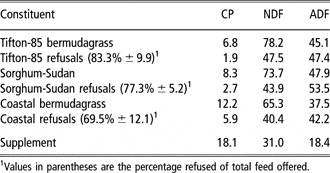
In all, 72 wether Boer-cross goats (average initial BW 27.8 kg; 8 to 10 months of age) were randomly assigned to one of seven treatments (two pens per treatment) for 70 days. Prior to the study, the goats were allowed 20 days to adjust to their diet and environment. Goats were housed in 9.1 × 3.0 m2 pens with east- or west-facing barns for shelter. Nutrient analyses for feed ingredients for Experiment 1 are shown in Table 1. Goats on the control treatment (C) received ad libitum access to a commercial 18% CP goat ration only. Goats on hay-only treatments had ad libitum access to one of three hays: coastal bermudagrass (Cynodon dactylon; CB), Tifton-85 bermudagrass (C. dactylon; T), or sorghum-Sudan grass (Sorghum bicolor; SS). Supplemented (+) hay treatments consisted of ad libitum access to each of the three species of hay with supplemental levels (1% of total goat BW/day) of the same complete goat ration used as C and were abbreviated as CB+, T+ and SS+, for supplemented coastal bermudagrass, Tifton-85 and sorghum-Sudan grass hays, respectively. The C group consisted of 12 goats, divided into two pens of six goats each. The remaining 60 goats, 10 goats per treatment, were divided into pens containing five goats each according to treatment. Water was available ad libitum at all times through the course of the experiment. Goats were weighed every 14 days for calculation of supplement offering. Supplement amount was calculated using the total pen weight, and was adjusted to reflect the most recent 14-day weight. Average daily gain (ADG) was calculated on a pen basis using the initial and final weights for the 70-day feeding study.
Hay, hay refusals and supplement analysis for Experiment 1 on a dry matter basis (%)

1Values in parentheses are the percentage refused of total feed offered.
Refusals (orts or rejected hay) were collected to estimate daily hay intake on days 14, 28, 42 and 56. Hay troughs were cleaned of hay and tarpaulins (2.5 m × 4.9 m) were placed under the hay troughs, 24 h prior to ort collection. Hay was then weighed and administered to the goats. Additional hay was added during the day if necessary. Excess or discarded hay was gathered after 24 h and reweighed to determine hay intake by difference. Representative samples of supplement, hay and refusals were collected weekly throughout the experiment. These samples were composited by treatment and period, ground in a Wiley mill to pass through a 1-mm screen, and stored for later analysis.
Analytical methods
Supplement, hay and refusal samples were analyzed for DM, acid detergent fiber (ADF) and Kjeldahl N (AOAC, 1990). Neutral detergent fiber (NDF) was analyzed using method reported by Goering and Van Soest (Reference Goering and Van Soest1970).
Statistical analysis
Because treatments (hays and supplement) were offered to the entire pen of goats, pen was used as the experimental unit. Effects of hay and/or complete goat ration supplementation on pen ADG were analyzed using the MIXED procedure of SAS (SAS Institute Inc., Cary, NC, USA) with repeated measures. The model contained the effects of treatment and period. Pen was included as the random variable. The effect of treatment on hay intake was analyzed using PROC GLM of SAS. The model contained the effect of treatment and pen was used as the replicate in the analysis. The LSMEANS statement was used to calculate means. When significant differences were detected (P < 0.05), the PDIFF option was used for mean separation.
Experiment 2
Study design
Four Boer-cross wether goats (average initial BW 34.2 kg; 8 to 9 months of age) were arranged in a 4 × 4 Latin square design. Goats were placed in metabolism crates to facilitate full urine and fecal collection. The treatments consisted of control (ad libitum access to sorghum-Sudan hay, 6.9% CP; 36.3% ADF; 65.4% NDF), ad libitum access to sorghum-Sudan hay with supplemental urea (EMD Chemicals Inc., Gibbstown, NJ; 200 mg/kg BW daily), dextrose (Tate and Lyle, Decatur, IL; 0.2% BW daily) or urea and dextrose (200 mg/kg BW daily and 0.2% BW daily, respectively). Water was available ad libitum at all times during the experiment.
The experiment consisted of four, 21-day periods, in which each goat received a different treatment for each period. The goats were weighed at the beginning of each period to determine the amount of dextrose or urea they received per day for the entire 21-day period.
Sampling
Total fecal and urine samples were collected separately once daily, on days 15 through 21 of each period. Feces were weighed daily and a sub-sample (10%) was taken, composited by period and stored at −20°C for later analysis. Urine was collected in buckets containing 100 ml 6 N HCl, to decrease the loss of ammonia. Total urine weight was measured daily; a sub-sample (2.5%) was taken, composited by period and stored at −20°C for later analysis.
Analytical methods
Fecal samples were dried in a forced-air oven at 55°C for 48 h. Dried samples were then ground with a Wiley mill to pass through a 1-mm screen. Fecal samples were analyzed for DM, organic matter (OM), ADF, lignin and Kjeldahl N, as described in Experiment 1. Urine samples were thawed at room temperature for 12 h prior to analysis for Kjeldahl N.
Statistical analysis
Effects of dextrose and/or urea supplementation on forage digestion and N balance were analyzed using the MIXED procedure of SAS. The model contained the effects of goat, period and treatment. The LSMEANS statement was used to calculate means. When significant differences were detected (P < 0.05), the PDIFF option was used for mean separation.
Results and discussion
Experiment 1
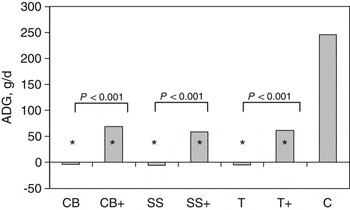
The objective for Experiment 1 was to determine goat performance, feed intake, ADG and efficiency of gain for goats consuming CB, CB+, SS, SS+, T or T+ as compared to those in the C group. Daily individual hay intake (647 to 721 g/day) was similar (P = 0.71) across treatments. Average daily gains for hay-alone treatments (−3.8, −6.6 and −5.0 g/day for CB, SS and T, respectively) were slightly negative and did not differ (P > 0.05) from each other (Figure 1) or zero. Gains near zero have been reported earlier (Packard et al., Reference Packard, Muir and Wittie2007a) for goat kids consuming bermudagrass hays without supplemental N and/or energy. Because T has broader leaves and thicker stems than CB, we hypothesize that goats consuming T alone select more leaves and thus gain more than those on SS and CB, due to their selective capability, even when foraging hay (Packard et al., Reference Packard, Muir, Wittie and Harp2007b). This is supported by the greater refusal rate of T (83.3%) when compared to CB (69.5%) and greater selection for CP. For T, 28% of original CP concentration was found in refusal whereas goats offered CB refused 48% of original CP (Table 1).
Average daily gain (ADG) of goats consuming coastal bermudagrass (CB), Tifton-85 (T), or sorghum-Sudan grass (SS) alone or supplemented at 1% of BW (+) with a commercially available 18% CP goat ration (C). Bars with asterisk are different (P < 0.05) from C by Mixed model ANOVA. Effect of supplementation within forage species by Mixed model ANOVA is shown above each forage type.

Supplementation increased ADG for all treatments (69.2, 58.1 and 61.6 g/day for CB+, SS+ and T+, respectively) when compared to their respective hay-alone treatment (Figure 1). There was no difference in ADG among supplemented treatments. In view of the large differences in nutrient concentration of the three forages, measured on a whole-plant basis, this lack of ADG differentiation may be a result of forage selectivity by the goats. Refusal rates were high and nutritive analysis vis-à-vis the presented material indicates that goats selected for CP and NDF but against ADF (Table 1). Goats receiving C had a greater ADG (245.8 g/day) than those consuming other diets (Figure 1).
These data confirm the Packard et al. (Reference Packard, Muir and Wittie2007a and Reference Packard, Muir, Wittie and Harp2007b) conclusion that growing, grass hay-fed kids require at least some supplementation to achieve BW gain. Gains of 58 to 69 g/day (as achieved with 1% of BW with C diet) are modest, yet offer some increase in BW and should result in increased animal value and improved health through drought months or droughty years when grass hay is fed as emergency forage. The level of supplement may also have been a factor. Energy supplements as low as 0.5% BW, in the form of maize (Zea mays) grain, improve goat ADG on low-quality rangelands but greater rates are required to see an increase in gains on improved pasture (Muir and Weiss, Reference Muir and Weiss2006).
Experiment 2
The objective of this experiment was to determine forage intake and forage digestion of a sorghum-Sudan diet with supplemental levels of dextrose and/or urea.
Forage intake
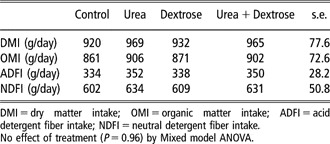
Supplementing energy and/or N, in the form of dextrose and urea, had no effect on goat hay intake. Intakes of DM, NDF, ADF and OM (OMI) were undifferentiated among treatments (Table 2). Earlier studies looking at protein supplementation of low-quality forage diets, which excluded selectivity by goats, indicate that protein supplements can increase forage intake (Ali and Mustafa, Reference Ali and Mustafa1984; Lallo, Reference Lallo1996; Negesse et al., Reference Negesse, Rodehutscord and Pfeffer2001). These results differ from our results, possibly because goats in our trial were allowed sufficient hay quantity to permit selectivity that resulted in diets greater in quality, compared to the original hay, as indicated by low CP and higher ADF concentrations in refusals, compared to offered hay (Table 1).
Forage intake by goats for Experiment 2

DMI = dry matter intake; OMI = organic matter intake; ADFI = acid detergent fiber intake; NDFI = neutral detergent fiber intake.
No effect of treatment (P = 0.96) by Mixed model ANOVA.
Earlier research also shows that energy supplemented to goats consuming low-quality forages does not always positively affect total intake (Ali and Mustafa, Reference Ali and Mustafa1984; Lallo, Reference Lallo1996). Simple sugars, such as the dextrose used in this trial, are readily available in the rumen and should be a suitable substrate for many species of ruminal microbes. In this experiment, supplemental dextrose had no effect of forage intake. Olson et al. (Reference Olson, Cochran, Jones, Vanzant, Titgemeyer and Johnson1999) reported that starch, at a level of 0.15% BW, decreased forage OMI in cattle, a bulk-grazer with much less capacity for selectivity than goats. It is not clear what the effect of dextrose would have been in the cattle of Olson et al. (Reference Olson, Cochran, Jones, Vanzant, Titgemeyer and Johnson1999). The difference in the ruminal availability of starch and dextrose could be used to explain the differences in responses between dextrose and starch, since even different sources of starch result in differing goat forage intake (Abijaoudé et al., Reference Abijaoudé, Morand-Fehr, Tessier, Schmidely and Sauvant2000).
Forage digestibility
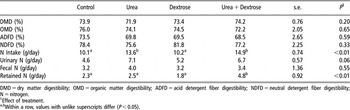
Forage digestibility data is shown in Table 3. Apparent DM digestibility (73.4% as average) and were not affected by energy and/or protein supplementation. Apparent digestibilities of ADF, NDF and OM were as average 70.3%, 78.4% and 74.3%, respectively, and were similar. These results differ from those reported by Islam et al. (Reference Islam, Abe, Terada, Iwasaki and Tano2000), who found that the inclusion of starch (not dextrose) increased apparent digestibility of nutrient components of a low-quality diet whose uniformity did not allow for goat selectivity.
Forage digestibility and nitrogen balance data for Experiment 2

DMD = dry matter digestibility; OMD = organic matter digestibility; ADFD = acid detergent fiber digestibility; NDFD = neutral detergent fiber digestibility; N = nitrogen.
1Effect of treatment.
a,bWithin a row, values with unlike superscripts differ (P < 0.05).
Nitrogen balance
Nitrogen balance data is shown in Table 3. Treatments resulted in different (P < 0.05) N intakes due to the N contained in the urea for urea-containing treatments. Urinary N tended (P = 0.06) to be affected by treatment; however, fecal N was not affected by treatment. Nitrogen retention for dextrose alone (1.8 g/day) and urea alone (2.5 g/day) did not differ from control (2.3 g/day). Nitrogen retention for urea + dextrose (4.8 g/day) was greater (P < 0.01) than the other two treatments and control. These results agree with results from Experiment 1, where we observed an increase in ADG when forage-fed goats were supplemented with a complete feed. Given the increase in performance in Experiment 1, we had hypothesized that an observable difference in intake and/or digestibility would be present in Experiment 2. However, the increased N retention for the goats receiving urea + dextrose is clearly not the result of improved ruminal forage utilization.
General discussion
Dietary energy and protein supplements could be used to increase the productivity of hay-fed goats. Protein supplements increase intake and utilization of low-quality forages in cattle (Köster et al., Reference Köster, Cochran, Titgemeyer, Vanzant, Abdelgadir and St-Jean1996), as do high-protein concentrates (Negesse et al., Reference Negesse, Rodehutscord and Pfeffer2001) and leguminous forage (Osuji and Odenyo, Reference Osuji and Odenyo1997) supplementation to goats. However, it has been shown that protein supplements have little effect on feed intake of cattle consuming forages with CP concentrations above approximately 6% (Mathis et al., Reference Mathis, Cochran, Heldt, Woods, Abdelgadir, Olson, Titgemeyer and Vanzant2000). This number may be greater in growing goats whose minimum DM dietary protein concentration for maintenance is estimated at 6.0% to 8.5% depending on age (National Academies Press, 2007). Fernandes et al. (Reference Fernandes, Resende, Tedeschi, Fernandes, Silva, Carstens, Berchielli, Teixeira and Akinaga2007) reported that the protein requirements of growing meat goats are higher than requirements established for dairy breeds. An additional confounding factor is the goat’s capability for selective foraging, which often results in higher quality dietary intake than the pasture or hay on offer (Packard et al., Reference Packard, Muir and Wittie2007a and Reference Packard, Muir, Wittie and Harp2007b). For example, urea supplementation of goats on Brazilian caatinga range did not increase weight gains of young growing kids (Schacht et al., Reference Schacht, Kawas and Malechek1992).
Energy supplements high in starch are often incorporated to meet the energy requirements of cattle when feeding warm-season forages such as coastal bermudagrass or sorghum-Sudan hybrids. Garcés-Yépez et al. (Reference Garcés-Yépez, Kunkle, Bates, Moore, Thatcher and Sollenberger1997) showed that energy supplements increase ADG and gain-to-feed ratio in cattle and forage OM digestibility in sheep. Further, the effect of carbohydrate energy supplement often depends on the source and level of carbohydrate and the amount of degradable intake protein available (Heldt et al., Reference Heldt, Cochran, Stokka, Farmer, Mathis, Titgemeyer and Nagaraja1999). In addition, the advantage inherent in selective browsing by goats is dependent on sufficient forage quantity to allow such selectivity. For example, goats on late dry-season rangeland with limited browse availability increased weight gains only when both urea and molasses were fed as supplements, compared to protein and energy fed separately (Schacht et al., Reference Schacht, Kawas and Malechek1992). This energy/protein interaction is confirmed by Islam et al. (Reference Islam, Abe, Terada, Iwasaki and Tano2000) who found that starch supplemented to goats increased alfalfa (Medicago sativa L.) DM apparent digestibility, and increased N retention by reducing N losses. However, these interactions are complex. For example, small amounts of starch supplement increase ADG of goats on rangeland much more than on better quality cultivated pasture (Muir and Weiss, Reference Muir and Weiss2006).
In the current study, when feeding warm-season or subtropical grass hay to growing meat goat kids, supplementation was required to achieve BW gains. Differences in hay species morphology or total-plant CP did not affect ADG because goats were able to select for higher quality portions of the hay, thereby refusing the lower quality stem material. The lower the nutritive value of the hay, the greater the refusal rates and the greater the selection in favor of CP concentration. These results indicate that goats, given sufficient hay, will selectively ingest the more nutritious portions, much as they do on pasture or rangeland.
Supplementation at 1% of BW with a complete 18% CP goat ration resulted in an additional 58 to 69 g/day of ADG above the control treatment, depending on the hay and supplement combinations. Data from Experiment 2 suggest that these increases are not due to greater forage intake and/or apparent digestibility resulting from an increase in dietary N or dextrose. Further research is needed to determine the effects of supplemental N and/or carbohydrates on goat performance and forage digestibility when growing goats are unable to selectively ingest hay components.