Introduction
Chronic fatigue syndrome (CFS), also called myalgic encephalomyelitis, is a complex, chronic and serious illness, characterized by extreme fatigue affecting various body systems (Katafuchi et al., Reference Katafuchi, Kondo, Yasaka, Kubo, Take and Yoshimura2003). CFS patients usually have sleep disturbance (Josev et al., Reference Josev, Jackson, Bei, Trinder, Harvey, Clarke, Snodgrass, Scheinberg and Knight2017; Pajediene et al., Reference Pajediene, Bileviciute-Ljungar and Friberg2018), accompanied by multiple clinical symptoms such as decreased motor function, sexual dysfunction, insufficient physical activity, loss of appetite, loss of weight, impaired immune function and imbalance of intestinal flora (Vergauwen et al., Reference Vergauwen, Huijnen, Kos, Van de Velde, van Eupen and Meeus2015; van der Schaaf et al., Reference van der Schaaf, Roelofs, de Lange, Geurts, van der Meer, Knoop and Toni2018). In the 21st century, CFS has become a new killer affecting human physical and mental health. Under various pressures, more and more people are suffering from CFS, and the incidence of CFS is increasing year by year with the rapid pace of work and life in modern society (Jiang et al., Reference Jiang, Yan and Fang2004). CFS is more common in women compared with men (Boneva et al., Reference Boneva, Lin and Unger2015). Epidemiological investigation found that the incidence of CFS was much higher in 31–50-year-old women of reproductive age with a high level of education and work pressure compared with in men (McInnis et al., Reference McInnis, Matheson and Anisman2014). Female patients with CFS often have multiple gynaecological problems, including menstrual disorders, endometriosis, pelvic pain and sexual dysfunction (Boneva et al., Reference Boneva, Lin and Unger2015; Yeh et al., Reference Yeh, Su, Tzeng, Muo and Wang2018).
Blastocyst implantation and placenta development are dependent on trophoblastic cells. Abnormal differentiation and invasion of placenta trophoblast cells led to spontaneous abortion, preeclampsia, fetal growth restriction, hydatidiform mole and other gestational diseases (Barrientos et al., Reference Barrientos, Pussetto, Rose, Staff and Blois2017). Recent studies have found that the Wnt/β-catenin signalling pathway is involved in the regulation of placenta formation processes such as decidual transformation of uterine stromal cells, trophoblastic cell invasion, chorioallantoic fusion and reconstruction of maternal and fetal vasculature (Zhang et al., Reference Zhang, Wang, Zhang, Shi, Wang and Yan2017; Wang et al., Reference Wang, Zhang, Zeng, Wang, Zhang, Song and Shi2018). The mental and physical health of women before pregnancy is directly related to the growth and intellectual development of the offspring. Our previous study found that CFS significantly reduced the levels of oestrogen and progesterone in serum, as well as learning and memory. The hypothalamus–pituitary–gonadal axis function was disturbed in female mice with chronic fatigue syndrome (CFS) and before pregnancy. The F1 generation also suffered from congenital hypothyroidism (CH) (Liu and Qian, Reference Liu and Qian2011, Zhao et al., Reference Zhao, Yao, Qian, Chen, Yang and Wu2016a; 2016b). So far, there have been no reports about placenta formation and embryo development in CFS pregnant mice. In this study, we aimed to establish a female mouse model of CFS by multiple stimuli, and investigated the influence of CFS on placenta morphology and embryo development and the underlying molecular mechanisms.
Materials and methods
Animal study design
ICR mice were purchased from the laboratory animal centre of Chongqing Tengxin Biotechnology Co., Ltd (Chongqing, China), and raised in the Institute of Laboratory Animal Science in Guizhou University of Traditional Chinese Medicine. After acclimation for 3 days, the female mice were divided randomly into the control group and the CFS group. The mice were fed with a standard pellet diet and distilled water ad libitum. The temperature of the animal facility was 22 ± 2°C, and lighting was under a 12 h : 12 h, light : dark cycle (lights on at 8:00 h). The CFS mouse model was induced by multiple different stimuli including confinement, repeated forced swimming, and tail clipping (Zhao et al., Reference Zhao, Yao, Qian, Chen, Yang and Wu2016a; 2016b). The mice were treated with three different stimuli every day, confinement, forced swimming and tail clipping. For confinement, the mice were placed individually in a centrifuge tube (50 ml) for 10 min for the first 3 days, and 30 min on days 4–35. For repeated forced swimming, each mouse was placed in a cylinder filled with water (about 28°C) for 10 min for the first 3 days, and 30 min on days 4 to 35. For tail clipping, an oval forceps was used to clip the root of the tail for 15 s for 35 days. Moreover, the mice were treated with the following four stresses every week; 4 days were randomly selected from each week. The mice were forced to swim in cold water (about 4°C), stopped feeding for 1 day, stopped water supply for 1 day, and subjected to a reversed cycle of day and night for 1 day. Control mice did not receive any treatment. After successful induction of CFS, the female mice were mated with the control male mice. The mating was confirmed by the presence of a copulatory plug the next morning following mating (1 day post coitum). On days 7–19 post coitum, pregnant mice were sacrificed. Serum and implanted site tissues were collected. Placentas and embryos on days 12 and 14 were isolated and weighed. The implantation sites and uterine tissues were fixed by 4% paraformaldehyde in PBS (pH 7.2) at room temperature for 24 h and embedded in paraffin for histologic examination. The serum was isolated by centrifugation using serum separator tubes.
Haematoxylin and eosin staining
The uterine implantation sites and placenta were fixed overnight in 4% paraformaldehyde (v/v). After washing with 70% ethanol, the tissues were processed, embedded in paraffin, and sectioned. Sections of paraffin-embedded tissues (section thickness, 5 μm) were stained with haematoxylin and eosin. Photographs were obtained from a light microscope (BX51; Olympus, Tokyo, Japan).
Assays of oxidative stress and antioxidase
The oxidative stress and antioxidase levels in serum, uterus and placenta were detected using the corresponding kits. The kits for oxidative stress assay included a reactive oxygen species assay kit (ROS; QY-X16254; Qiaoyu, Shanghai, China), reactive nitrogen assay kit (RNS; QY-Y26312; Qiaoyu, Shanghai, China), malondialdehyde assay kit (MDA; QY-Y23136; Qiaoyu, Shanghai, China). The kits for antioxidase assay included superoxide dismutase assay kit (SOD; QY-S13521; Qiaoyu, Shanghai, China), total antioxidant capacity assay kit (T-AOC; QY-Y61124; Qiaoyu, Shanghai, China), glutathione peroxidase assay kit (GSH-Px; QY-T11542; Qiaoyu, Shanghai, China), peroxidase assay kit (POD; QY-X35410; Qiaoyu, Shanghai, China) and catalase assay kit (CAT; QY-Y32512; Qiaoyu, Shanghai, China).
Quantitative real-time PCR
Total RNA was extracted from placentas on days 12 and 14 using TRIzol regent (DP405-02, Tiangen, Beijing, China) and purified in accordance with the manufacturer’s instructions. In total, 2 mg RNA were reverse transcribed with a PrimeScript™ RT reagent kit (RR047B, TaKaRa, Liaoning, China). Real-time PCR was performed using a TaKaRa SYBR® Premix Ex Taq™ II kit (RR82LR, TaKaRa, Liaoning, China) and on an ABI Prism 7500 Real-Time PCR system (Applied Biosystems, Foster, CA, USA). Each sample was tested in triplicate in a 20-µl volume for reaction with 2 µl cDNA, 10 µl 2× Master Mix, 1 µl PrimeScript RT Enzyme Mix, 1 µl RT Primer Mix, 4 µl 5× Prime Script Buffer 2 and 4 µl RNase free H2O. The PCR amplification program was initiated at 95°C for 30 s, followed by 40 thermal cycles of 5 s at 95°C and 40 s at 60°C, annealing temperature for 20 s and 72°C for 20 s. The comparative CT method was used to analyze the obtained data. The sequences of primers were as follows: Wnt4 Forward: 5′-CATCGAGGAGTGCCAATACCA-3′, reverse: 5′-GGAGGGAGTCCAGTGTGGAA-3′, Wnt5α forward: 5′-GGCGAGCTGTCTACCTGTGG-3′, reverse: 5′-GGCGAACGGGTGACCATAGT-3′; SFRP1 forward: 5′-TGAGGCCATCATTGAACATC-3′, reverse: 5′-TCATCCTCAGTGCAAACTCG-3′; SFRP3 forward: 5′-CAAGGGACACCGTCAATCTT-30, reverse: 5′-CATATCCCAGCGCTTGACTT-30; DKK1 forward: 5′-TCCGAT CATCAGACTGTGCCG-3′, reverse: 5′-TGGGAGCCTTTCCGTTTGTGC-3′; β-catenin forward: 5′-TGGAGGAGATAGTAGAGGGTG-3′, reverse: 5′-AGACATTCGGAATAGGACAGC-3′; β-actin forward: 5′-CGTTGACATCCGTAAAGACCTC-3′, reverse: 5′-ACAGAGTACTTGCGCTCAGGAG-3′. All data were normalized to β-actin and expressed as fold change relative to the control group.
Western blotting
Proteins were extracted from placentas on day 12 and day 14 with a whole cell lysis buffer (50 mM HEPES, 150 mM NaCl, 1 mM EGTA, 10 mM sodium pyrophosphate, 1.5 mM MgCl2, 100 mM NaF, 10% glycerol, and 1% Triton X-100) containing a cocktail of protease inhibitor (1 mM phenylmethylsulfonylfluoride, 10 mg/ml aprotinin, and 1 mM sodium orthovanadate). Equal amounts of denatured protein were subjected to SDS-PAGE in accordance with standard protocols. Separated proteins were transferred electrophoretically onto PVDF membrane (Millipore, Burlington, MA, USA). After being blocked with 5% skimmed milk for 1 h at room temperature, the membrane was sequentially incubated with primary antibodies against Wnt4 (1:1000, bs-6134R; Bioss Antibodies, Beijing, China), Wnt5α (1:1000, bs-1948R; Bioss Antibodies), SFRP1 (1:500, bs-1303R; Bioss Antibodies), SFRP3 (1:500, bs-1618R; Bioss Antibodies), DKK1 (1:1000, RS-12162R; Bioss Antibodies), β-catenin (1:500, bs-1165R; Bioss Antibodies) and β-actin (1:1000, bs-1165R; Bioss Antibodies) overnight at 4°C, and washed three times (10 min per wash) with TBST. Then, the membrane was incubated with horseradish peroxidase-linked secondary antibody (1:5000; Beyotime, Shanghai, China) for 1 h at room temperature in 5% skimmed milk, and washed three times (10 min per wash) with TBST. Immunoreactive bands were detected using an enhanced chemiluminescence kit (Pierce Chemical Co, Rockford, IL, USA). β-Actin was used as an internal control.
Immunohistochemistry
Sections were preincubated with 10% normal goat serum in PBS (pH 7.5) and then incubated with anti-Wnt4 (1:500, bs-6134R; Bioss Antibodies), anti-Wnt5α (1:500, bs-1948R; Bioss Antibodies), anti-SFRP1 (1:400, bs-1303R; Bioss Antibodies), anti-SFRP3 (1:400, bs-1618R; Bioss Antibodies), anti-DKK1 (1:300, RS-12162R; Bioss Antibodies), anti-β-catenin (1:300, bs-1165R; Bioss Antibodies) in 10% normal serum in PBS (pH 7.2) overnight. On the following day, sections were washed in PBS and incubated with a biotinylated secondary antibody (8029 and 8003; ZSGB-BIO, Beijing, China) for 1 h at room temperature. Immunoreactivity was detected using a DAB Substrate kit (ZLI-9017, ZSGB-BIO). Immunoreactivity was visualized as brown staining. Sections incubated with no primary antibody were used as a negative control. Photographs were obtained from a light microscope (BX51; Olympus, Tokyo, Japan).
Statistical analyses
Data were expressed as mean ± standard deviation (SD) and were analyzed by paired Student’s t-test for comparison between normal and CFS groups. Differences at P < 0.05 were considered to be statistically significant.
Results
Comparison of pregnancy status between the control and CFS groups
In a previous study, we found that the hypothalamus–pituitary–gonadal axis (HPG) was disordered in the CFS mouse (Liu and Qian, Reference Liu and Qian2011). Learning and memory in the F1 generation was impaired, and this could be used as an animal model of congenital hypoidism (congenital hypothyroidism, CH) (Liu and Qian, Reference Liu and Qian2011). In this study, we also analyzed the number of implantation sites, stillbirths, live births and others on day 7, day 11, day 15 and day 19 in CFS pregnant mice. As shown in Tables 1 and 2, we found that the number of implantation sites, stillbirths and the lengths of embryos on day 15 and day 19 in CFS pregnant mice were significantly decreased (P < 0.01) (Tables 1 and 2).
Number of implantation sites, stillbirths, live births on day 7, day 11, day 15 and day 19 in normal and CFS pregnant mice

*P < 0.05, **P < 0.01 vs. normal group.
Weight and length during growth of the placenta and embryos on day 15 and day 19 in normal and CFS pregnant mice

*P < 0.05, **P < 0.01 vs. normal group.
Comparison of the morphology of placenta between the control and CFS groups in pregnancy mouse
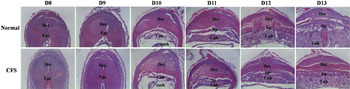
As shown in Fig. 1, we found that the placenta structure of the CFS group began to change on day 10 in CFS pregnant mice. The labyrinth layer of the placenta began to appear on day 10 in the control pregnant mice, while the placenta had not yet differentiated in the CFS group (Fig. 1). As shown in Fig. 2, we found that the area of the three-layer structure of the placenta in the CFS group was smaller compared with that in the normal control group on day 13. The numbers of blood cells in the labyrinth area of the placenta were lower in the CFS group (Fig. 2).
Morphology of placenta from day 8 (D8) to day 13 (D13) in normal and CFS pregnant mice (×40 magnification). Normal, normal group; CFS, chronic fatigue syndrome group; Dec, Decidua basalis; emb, embryo; Epc, ectoplacental cone; Lab, Labyrinth; Sp, spongiotrophoblast.

Morphology of labyrinth in placenta on day 13 in normal and CFS pregnant mice (×400 magnification). CFS, chronic fatigue syndrome group; normal, normal group.

Comparison of oxidative/antioxidant stress index between control group and model group
Differences in the oxidative/antioxidant stress index in pregnant mice in the normal and CFS groups were assessed. Values for the oxidative stress index (ROS, RNS, MDA; Table 3) were significantly lower in the serum and uterus and on day 13 placenta in the normal group compared with CFS group by colorimetric analyses, Further experimental research showed that values for the antioxidant stress index (T-AOC, CAT, SOD, GSH-Px, POD) were higher in the normal control group compared with that in the CFS group (P < 0.01) (Table 3).
Indicators of oxidative stress in serum and uterus and on day 13 placenta in normal and pregnant mice

*P < 0.05, **P < 0.01 vs. normal group.
Alterations of Wnt/β-catenin signalling in placenta during implantation
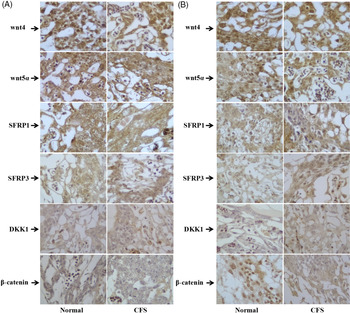
As mentioned above, these results demonstrated that the numbers of implantation sites and embryo length were decreased and numbers of absorbed fetuses and stillbirths were significantly increased. The morphological structure of the placenta was abnormal. The Wnt pathway is closely associated with implantation and differentiation of trophoblasts (Zhang et al., Reference Zhang, Wang, Zhang, Shi, Wang and Yan2017). We next investigated whether the Wnt signalling pathway in CFS pregnant mice was involved in abnormal placenta formation. As shown in Fig. 3, SFRP1, SFRP3 and DKK1 mRNA were highly expressed, while Wnt4, Wnt5α and β-catenin were significantly downregulated in the CFS group (P < 0.01; Fig. 3A,B ). Western blot analyses revealed that the protein levels of Wnt5α and β-catenin in the placenta were decreased in the CFS group on day 12, while SFRP1 was significantly highly expressed (P < 0.01) (Fig. 4A ). The expression levels of Wnt4, Wnt5α and β-catenin in the placenta were significantly reduced in the CFS pregnant mice on day 14. However, SFRP3 and DKK1 were highly expressed in the CFS group on day 14 (P < 0.05) (Fig. 4B ). As shown in Fig. 5, on day 12 and day 14, most placenta cells from the CFS group were positive for Wnt4, Wnt5α, SFRP1, SFRP3, DKK1 and β-catenin. However, nuclear β-catenin staining was present less often in the CFS group (Fig. 5A,B ). The results demonstrated that the Wnt signalling pathway in the placenta may play a role in abnormal placentation in CFS mice.
mRNA expression of Wnt/β-catenin associated genes of placenta on day 12 (A) and day 14 (B) in normal and CFS pregnant mice. n = 10 mice per group. CFS, chronic fatigue syndrome group; normal, normal group. *P < 0.05, **P < 0.01 vs. normal group.

Protein expression of Wnt/β-catenin associated genes of placenta on day 12 (A) and day 14 (B) in normal and CFS pregnant mice. n = 10 mice per group. CFS, chronic fatigue syndrome group; normal, normal group. *P < 0.05, **P < 0.01 vs. normal group.

Representative images of immunostaining of Wnt/β-catenin associated proteins in placenta on day 12 (A) and day 14 (B) in normal and CFS pregnant mice. n = 10 mice per group.

Discussion
Recent studies have found that brain function, energy metabolism, acetylcholine and adrenalin signalling were disordered in CFS patients (Mensah et al., Reference Mensah, Armstrong, Reddy, Bansal, Berkovitz, Leandro and Cambridge2018; Scheibenbogen et al., Reference Scheibenbogen, Loebel, Freitag, Krueger, Nauer, Antelmann, Doehner, Scherbakov, Heidecke, Reinke, Volk and Grabowski2018; Shan et al., Reference Shan, Finegan, Bhuta, Ireland, Staines, Marshall-Gradisnik and Barnden2018). Epidemiological survey results have shown that 20–25% of the world’s population has CFS, with more than 4 million patients in the USA. In China, 10–25% of the urban population and in Britain 1.9% of 16 year olds suffer from this disease (Collin et al., Reference Collin, Norris, Nuevo, Tilling, Joinson, Sterne and Crawley2016). At present, immune function disorder, central nervous system (CNS) abnormality and oxidative stress are considered to be the basic pathological mechanisms of CFS (Zinn et al., Reference Zinn, Zinn, Valencia, Jason and Montoya2018; Cliff et al., Reference Cliff, King, Lee, Sepúlveda, Wolf, Kingdon, Bowman, Dockrell, Nacul, Lacerda and Riley2019; Polli et al., Reference Polli, Van Oosterwijck, Nijs, Marusic, De WAndele, Paul, Meeus, Moorkens, Lambrecht and Ickmans2019).
The Wnt protein family contains important signalling regulatory proteins and secreted glycoproteins. Wnt signalling is closely related to cell proliferation and differentiation as one of the main pathways that regulates various physiological and biochemical processes such as cell morphology, movement, adhesion, proliferation, differentiation, carcinogenesis and development (Xu et al., Reference Xu, Gu and Zhang2017). Multiple genes, including Fox, Sox, Gata, Tead and Wnt, play important roles during placental development. Among them, the Wnt signalling pathway is involved in the regulation of the whole process of placenta formation (Nayeem et al., Reference Nayeem, Arfuso, Dharmarajan and Keelan2016). Migration and invasion of trophoblast cells are regulated by Wnt signalling through transcription factor T-cell factor-4 (TCF-4) (Meinhardt et al., Reference Meinhardt, Haider, Haslinger, Proestling, Fiala, Pollheimer and Knoffler2014). Wnt7 is highly expressed in human placental tissues. Wnt5α can inhibit the migration and invasion of HTR-8 cells by reducing integrin β1 levels through activating NF-AT to regulate intercellular adhesion factor-1 (ICAM-1) and vascular cell adhesion factor-1 (VCAM-1) (Herr et al., Reference Herr, Horndasch, Howe, Baal, Goyal, Fischer, Zygmunt and Preissner2014). The proliferation, differentiation and deciduation of endometrial stromal cells is regulated by Wnt4 (Logan et al., Reference Logan, Yango and Tran2018). As inhibitory proteins of the Wnt signalling pathway, secreted frizzled-related proteins 1, 3, 4 (SFRP1, SFRP3, SFRP4) and dickkopf1 (DKKl) play important roles in the formation of the placenta (Zmijanac Partl et al., Reference Zmijanac Partl, Karin, Skrtic, Nikuseva-Martic, Serman, Mlinareac, Curkovic-Perica, Vranic and Serman2018). It has been found that SFRP1 and SFRP3 are highly expressed in placenta with intrauterine growth restriction (IUGR) (Partl et al., Reference Partl, Fabijanovic, Skrtic, Vranic, Martic and Serman2014). Low expression of β-catenin protein and high expression of DKK1 and SFRP4 may be involved in the occurrence of severe eclampsia and unexplained recurrent spontaneous abortion (Zhang et al., Reference Zhang, Zhang, Zhang, Jia, Wang and Gap2013, Reference Zhang, Leng, Li, Yuan, Yang, Li, Yuan, Shi, Yan and Cui2019). In addition, oxidative stress is involved in the regulation of the Wnt/β-catenin signal pathway by upregulating C/EBP-β, and influencing the activity of matrix metalloproteinases (MMPs), therefore participating in the pathogenesis of preeclampsia (Zhuang et al., Reference Zhuang, Luo, Rao, Li, Shan, Liu and Qi2015). As can be seen from the above findings, oxidative stress and the Wnt/β-catenin signalling pathway play a very important role in the regulation of placenta formation. So far, there have been no studies regarding placental morphology, oxidative stress and Wnt/β-catenin signalling pathway in the CFS placenta. In this study, we established a CFS mouse model in female mice using multiple stimuli (Zhao et al., Reference Zhao, Yao, Qian, Chen, Yang and Wu2016a; 2016b). This female mouse model described a significant reduction in locomotor activity, spatial memory and learning (Zhao et al., Reference Zhao, Yao, Qian, Chen, Yang and Wu2016a; 2016b). These results were consistent with previous findings that described the CNS as involved in the pathogenesis of CFS (Glassford, Reference Glassford2017; Ohba et al., Reference Ohba, Domoto, Tanaka, Nakamura, Shimazawa and Hara2019). Therefore, we believe that our CFS mouse model was able to simulate the pathology of CFS. Alterations in placenta morphology, oxidative stress and the Wnt/β-catenin pathway were investigated.
In this study, we found that the numbers of implantation sites and stillbirths and the length of embryos on day 15 and day 19 were significantly decreased in CFS pregnant mice (Tables 1 and 2). The labyrinth layer of the placenta began to appear on day 10 day in the normal control pregnant mice, while the placenta was not differentiated in the CFS group (Fig. 1). We also found that the area of the three-layer structure of the placenta in the CFS group was smaller compared with that in the normal control group on day 13. The numbers of blood cells in the labyrinth area of the placenta were decreased in the CFS group (Fig. 2). To further investigate the underlying mechanisms of the abnormal morphology of placenta in CFS pregnant mice, oxidative stress and the Wnt/β-catenin signalling pathway were quantified. Our results showed that oxidative stress was significantly increased in serum, the uterus and the placenta in the CFS group, and might be associated with downregulation of antioxidases in the CFS group (P < 0.01). SFRP1, SFRP3 and DKK1 mRNA were strongly expressed in CFS placenta, while mRNA expression of Wnt4, Wnt5α, and β-catenin was decreased (P < 0.01) (Fig. 3B ). Protein levels of Wnt4, Wnt5α and β-catenin were decreased on day 14 in the CFS placenta. Furthermore, the protein levels of SFRP1 and SFRP3 were decreased (P < 0.01) (Fig. 4B ).
By using a female CFS mouse model, we found that the numbers of implantation sites and length of embryos were decreased. The numbers of absorbed fetuses, stillborn fetuses and malformed fetuses significantly increased over time in CFS pregnant mice. In addition, the placenta had an abnormal morphology. Oxidative stress in serum, uterus and placenta were increased. Levels of antioxidase were decreased in CFS pregnant mice. We also found that the expression levels of Wnt signalling pathway key factor β-catenin protein was significantly decreased, and the expression levels of inhibitory factors SFRP1, SFRP3 and DKK1 were increased in the placenta of CFS pregnant mice. Therefore, we speculated that the abnormal placental structure in CFS pregnant mice was caused by oxidative stress though a dysregulated Wnt/β-catenin signalling pathway, finally resulting in impaired growth and development in the F1 generation in CFS patients. These results shed new light on the influence of CFS on placenta formation. Drugs targeting oxidative stress and the Wnt/β-catenin signalling pathway might be effective for the treatment of CFS-induced abnormalities of the placenta.
In conclusion, multiple gynaecological problems such as irregular menstruation, endometriosis and pelvic pain and the incidence of sexual dysfunction are significantly increased in female patients with CFS. The present study investigated the influence of CFS on placenta formation. Our results showed that CFS caused abnormal formation of the placenta, as revealed by the decreased number of implantation sites and live births, increased numbers of stillbirths, and decreased weights of implantation sites, placenta, and embryos. Further studies found that oxidative stress in serum, the uterus and the placenta were increased in CFS pregnant mice. The levels of antioxidase were decreased. In addition, CFS inhibited the Wnt/β-catenin signalling pathway. Therefore, it can be speculated that abnormal expression of the Wnt/β-catenin signalling pathway and oxidative stress are involved in abnormal formation of the placenta in CFS pregnant mice.
Acknowledgements
First of all, I would like to extend my sincere gratitude to my supervisor, Professor Shuguang Wu, who gives me many valuable suggestions, and made necessary corrections. I am deeply grateful for her help in the completion of this study. I am also deeply indebted to all my friends for their help with translation.
Financial support
The present study was supported by a Guizhou Education Department Youth Science and Technology Talents Growth Project grant (Qian teach KY[2017]182), Guizhou Provincial Key Laboratory Project of Miao Medicine (Guizhou Miao Medicine K[2017]025) and the special funds for science and technology development guided by the central government (Guizhou branch of the central source [2016]4007).
Conflicts of interest
None.
Ethical standards
All procedures related to animal care and treatment were approved by Animal Ethics and Welfare Committee at Guizhou University of Traditional Chinese Medicine.