Introduction
Maikhanellids are early Cambrian small shelly fossils (SSFs) with cap-like shells generally decorated with scales and/or brick-tiled protrusions. They are widely distributed in the Terreneuvian Series strata in many regions including China (Yang and He, Reference Yang and He1984; Qian and Bengtson, Reference Qian and Bengtson1989; Ding et al., Reference Ding, Zhang, Li and Dong1992; Feng et al., Reference Feng, Sun and Qian2001; Steiner et al., Reference Steiner, Li, Qian and Zhu2004, Reference Steiner, Yang, Hohl, Zhang and Chang2020; Guo et al., Reference Guo, Li and Li2014; Yang et al., Reference Yang, Steiner, Li and Keupp2014; Yu, Reference Yu2014; Shao et al., Reference Shao, Wang, Liu, Tang, Li, Zheng, Zhu, Liu, Qin, He and Liu2015; Liu et al., Reference Liu, Zhang, Shao, Tang, Jiang, Wang, Cheng, Dong, Liang, Dai and Xue2016; Pang et al., Reference Pang, Wang and Lin2017a), Mongolia (Zhegallo, Reference Voronin, Voronova, Grigor'eva, Drozdova, Zhegallo, Zhuravlev, Ragozina, Rozanov, Sayutina, Sysoev and Fonin1982; Bengtson, Reference Bengtson1992; Esakova and Zhegallo, Reference Esakova and Zhegallo1996), Siberia (Qian, Reference Qian1999; Kouchinsky et al., Reference Kouchinsky, Bengtson, Landing, Steiner, Vendrasco and Ziegler2017; Parkhaev, Reference Parkhaev2017), France (Kerber, Reference Kerber1988; Devaere et al., Reference Devaere, Clausen, Steiner, Javier and Vachard2013), and Iran (Hamdi et al., Reference Hamdi, Brasier and Jiang1989).
Despite some uncertainties, general phylogenetic opinions consider maikhanellids to be related to mollusks (Bengtson, Reference Bengtson1992; Li et al., Reference Li, Steiner, Zhu, Yang, Wang and Erdtmann2007), a conclusion that has been supported by studies on the microstructure of their shells (Kouchinsky, Reference Kouchinsky1999; Parkhaev, Reference Parkhaev2004, Reference Parkhaev2014; Vendrasco et al., Reference Vendrasco, Li, Porter and Femandez2009, Reference Vendrasco, Porter, Kouchinsky, Li and Fernandez2010, Reference Vendrasco, Checa and Kouchinsky2011; Vendrasco and Checa, Reference Vendrasco and Checa2015). Previous studies considered the maikhanellids to be related to monoplacophorans (Qian and Bengtson, Reference Qian and Bengtson1989; Feng et al., Reference Feng, Sun and Qian2001; Yu, Reference Yu2014) due to general morphological similarities in shell shape, although a detailed analysis based on muscle scar imprints or ultrastructure never established this relationship. However, it is understood that maikhanellids are among the oldest stem-group mollusks with mineralized shells (Feng et al., Reference Feng, Sun and Qian2001; Ponder et al., Reference Ponder, Parkhaev and Beechey2007; Parkhaev and Demidenko, Reference Parkhaev and Demidenko2010; Parkhaev, Reference Parkhaev2017; Vinther et al., Reference Vinther, Parry, Briggs and Van Roy2017; Qin et al., Reference Qin, Liu, Liu, Zhang, Zhang, Wang, Shao, Wu, Gao and Zhang2019).
A detailed study of the morphological evolution among different maikhanellid groups would facilitate our understanding of molluscan origination and early evolution. Here, we present our study on the morphological features and temporal variations of cap-shaped molluscan shells from the Terreneuvian deposits at the northern margin of the Yangtze Platform with the purpose to better understand their taxonomic and evolutionary relationships.
Geological setting
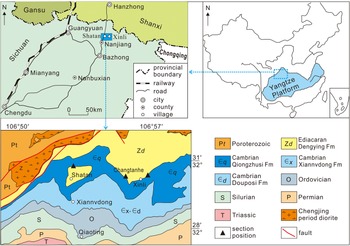
The studied sections at North Shatan (32°30′43″N, 106°52′49″E), Changtanhe (32°29′54″N, 106°55′41″E), and Xinli (32°31′20″N, 106°58′03″E) are located in Nanjiang County of northeastern Sichuan Province, China, on the northern margin of the Yangtze Platform (Fig. 1).
Map of localities of SSF-bearing sections in northeast Sichuan, China (modified from Pang et al., Reference Pang, Lin, Ma and Huang2010, Reference Pang, Steiner, Shen, Feng, Lin and Liu2017b).

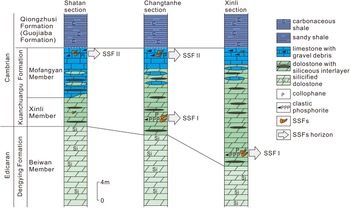
The Dengying, Kuanchuanpu, and overlying Qiongzhusi formations are exposed in these sections (Fig. 2). The uppermost portion of the Dengying Formation has previously been subdivided, in ascending order, into the Beiwan, Xinli, and Mofangyan members. The Xinli and Mofangyan members are herein assigned to the Kuanchuanpu Formation due to the presence of a significant amount of phosphatic bio- and lithoclasts (Steiner et al., Reference Steiner, Yang, Hohl, Zhang and Chang2020), although the basal Cambrian carbonates can be locally dolomitized. The Beiwan Member is composed of silicified dolostone. The Xinli Member is mainly composed of dolostone containing phosphatic or collophanite layers with well-developed chert beds or laminae as well as siliceous interbeds at the base and a variable thickness of 5–16 m. The overlying 4.5–9.5 m of Mofangyan Member is mainly composed of dark gray limestone with bitumen tar and dolomitic limestone and with well-developed siliceous bands or laminae. New stratigraphic data show that the Xinli and Mofangyan members represent a continuous sequence and have a gradual relationship, however, they can be lithologically distinguished by the degree of dolomitization. In some areas, the strata at the top of the Mofangyan Member are missing. The black shales of the Qiongzhusi Formation (a synonym of Guojiaba Formation; Steiner et al., Reference Steiner, Li, Qian and Zhu2004) overlie the Kuanchuanpu Formation with a disconformity (Fig. 2). The Kuanchuanpu Formation is mostly of Terreneuvian age, based on SSF assemblages.
Stratigraphic columns of the cap-shaped molluscan shell-bearing sections in northeastern Sichuan, China.

Materials and methods
Field and laboratory methods
The fossils were extracted from the carbonates of the Kuanchuanpu Formation of the northern Shatan and Changtanhe sections and from limy collophanite at the Changtanhe and Xinli sections. The carbonates were dissolved in 3–15% buffered acetic acid and then sieved for fossil residues. SSFs were picked and observed under a binocular microscope (Olympus SZX7). Selected fossils were studied under a Quanta250 FEG scanning electron microscope (SEM) at the State Key Laboratory of Oil Gas Reservoir Geology and Exploitation, Chengdu University of Technology.
Repository and institutional abbreviation
All fossil specimens are deposited in the Palaeontology and Historical Geology Laboratory at the Institute of Sedimentary Geology, Chengdu University of Technology (CDUT), China. Station numbers in the text identify areas, sections, and identification numbers of the fossil samples, e.g., NC01-4-3 indicates Nanjiang area, Changtanhe section, and fossil sample 01-4-3.
The distribution of cap-shaped mollusks
Maikhanellids and other cap-shaped molluscan fossils collected from Fortunian stata in the Nanjiang region are assigned to the upper part of the first SSF assemblage zone (SSF I, the Anabarites trisulcatus-Protohertzina anabarica Assemblage Biozone). A younger bed contains many typical SSFs of SSF assemblage II (SSF II, Paragloborilus subglobosus-Purella squamulosa Assemblage Biozone).
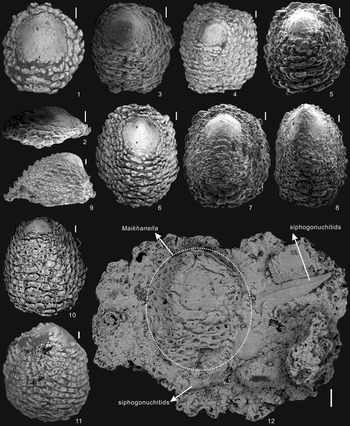
SSF I occurs in the phosphatic beds of the Kuanchuanpu Formation (Xinli Member) in the Changtanhe and Xinli sections of the Nanjiang area. The cap-shaped mollusks of this assemblage exclusively consist of maikhanellids (Fig. 3), including Maikhanella pristinis (Jiang, Reference Jiang1980), M. multa Zhegallo in Voronin et al., Reference Voronin, Voronova, Grigor'eva, Drozdova, Zhegallo, Zhuravlev, Ragozina, Rozanov, Sayutina, Sysoev and Fonin1982, M. perelegans Feng, Sun, and Qian, Reference Feng, Sun and Qian2001, M. cambrina (Jiang in Luo et al., Reference Luo, Jiang, Wu, Song and Ouyang1982), M. superata Feng, Sun, and Qian, Reference Feng, Sun and Qian2001, and M. cf. M. superata.
SEM micrographs of maikhanellid cap-shaped shells from the Anabarites trisulcatus-Protohertzina anabarica Assemblage Zone of the Changtanhe section, Nanjiang County, Sichuan: (1, 2) Maikhanella pristinis (Jiang, Reference Jiang1980) (NC01-04-1-2); (3–5) Maikhanella multa Zhegallo in Voronin et al., Reference Voronin, Voronova, Grigor'eva, Drozdova, Zhegallo, Zhuravlev, Ragozina, Rozanov, Sayutina, Sysoev and Fonin1982: (3) NC01-04, from Pang et al., Reference Pang, Wang and Lin2017a (reproduced with permission); (4) NC01-04-1-3; (5) NC01-04-1-4; (6, 7) Maikhanella perelegans Feng, Sun, and Qian, Reference Feng, Sun and Qian2001: (6) NC01-04-2-9; (7) NC01-04-2-10; (8) Maikhanella cambrina (Jiang in Luo et al., Reference Luo, Jiang, Wu, Song and Ouyang1982) (NC01-04-3-7); (9, 10) Maikhanella superata Feng, Sun, and Qian, Reference Feng, Sun and Qian2001: (9) NC01-04-5-22; (10) NC01-04-5-23; (11) Maikhanella cf. M. superata (NC01-04-4-2); (12) a specimen of Maikhanella (NC01-04-3) preserved in a cluster with some spiphogonuchitid spines. Apical views (1, 3, 4–8, 10, 11), lateral views (2, 9). Scale bars = 0.1 mm.

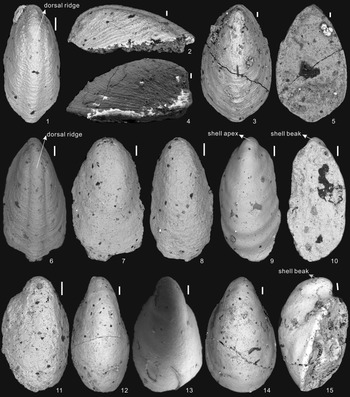
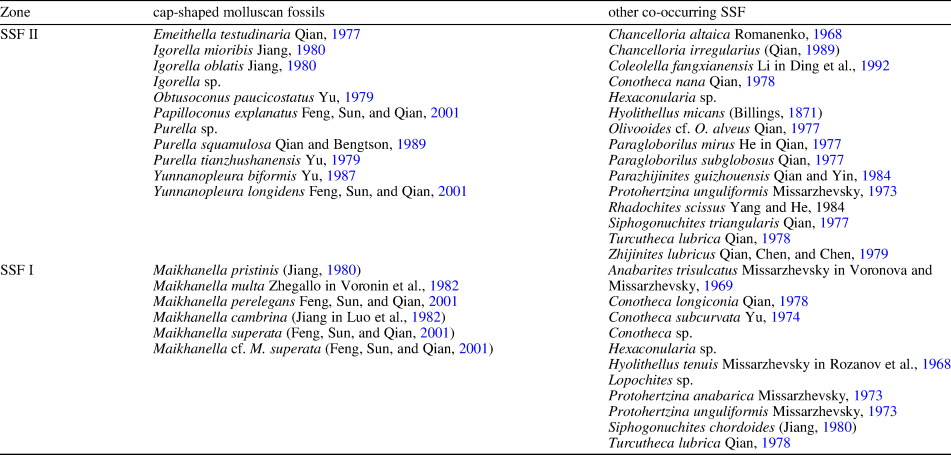
Abundant cap-shaped molluscan shells were recovered from the upper bed of the Kuanchuanpu Formation (Mofangyan Member) in the northern Shatan and Changtanhe sections of Nanjiang County. The assemblage contains maikhanellids (Fig. 4), including Purella tianzhushanensis Yu, Reference Yu1979, Purella squamulosa Qian and Bengtson, Reference Qian and Bengtson1989, Purella sp., Yunnanopleura longidens longidens Feng, Sun, and Qian, Reference Feng, Sun and Qian2001, Y. biformis Yu, Reference Yu1987, and helcionellid univalved shells, e.g., Igorella oblatis Jiang, Reference Jiang1980 (see Table 1 for complete faunal list).
SEM micrographs of cap-shaped mollusks from the Paragloborilus subglobosus- Purella squamulosa Assemblage Zone of the northern Shatan section, Nanjiang County, Sichuan: (1, 6) Purella tianzhushanensis Yu, Reference Yu1979: (1) NSQ6-10-3; (6) NSQ6-17; (2–5) Purella squamulosa Qian and Bengtson, Reference Qian and Bengtson1989 (NSQ6-13-1); (7, 8) Yunnanopleura biformis Yu, Reference Yu1987: (7) NSQ6-11-3; (8) NSQ6-11-4; (9, 10) Yunnanopleura longidens Feng, Sun, and Qian, Reference Feng, Sun and Qian2001 (NSQ6-15-1); (11) Igorella sp., (NSQ6-18-1); (12) Igorella oblatis Jiang, Reference Jiang1980 (NSQ6-14-2); (13–15) Igorella mioribis Jiang, Reference Jiang1980: (13) NSQ6-S063, from Pang et al., Reference Pang, Wang and Lin2017a (reproduced with permission); (14, 15) NSQ6-12-1. Apical views (1, 3, 6–9, 11–14), apertural views (5, 10), lateral view (2, 4, 15). Scale bars = 0.1 mm.

The complete fauna list in these two fossil assemblage zones from the Nanjiang area of northern Sichuan.

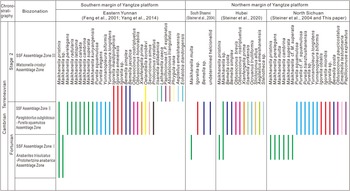
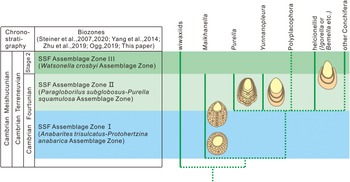
The distribution of maikhanellids in the two studied assemblages is generally consistent with those in other regions of the Yangtze Platform. At the southwestern margin of the Yangtze Platform, the maikhanellids are distributed in SSF Assemblage zones I and II (Fig. 5). In SSF I, cap-shaped molluscan shells are exclusively represented by Maikhanella Zhegallo in Voronin et al., Reference Voronin, Voronova, Grigor'eva, Drozdova, Zhegallo, Zhuravlev, Ragozina, Rozanov, Sayutina, Sysoev and Fonin1982 in eastern Yunnan and Hubei (Luo et al., Reference Luo, Jiang, Wu, Song, Ouyang, Xing and Tao1984; Feng et al., Reference Feng, Sun and Qian2001; Yang et al., Reference Yang, Steiner, Li and Keupp2014; Steiner et al., Reference Steiner, Yang, Hohl, Zhang and Chang2020). However, the few Maikhanella species that range into SSF II are accompanied by other maikhanellid genera, such as Purella Missarzhevsky, Reference Missarzhevsky, Zuravleva and Rozanov1974 and univalved helcionellids (Jiang, Reference Jiang1980; Luo et al., Reference Luo, Jiang, Wu, Song, Ouyang, Xing and Tao1984; Feng et al., Reference Feng, Sun and Qian2001; Yang et al., Reference Yang, Steiner, Li and Keupp2014). Protoconus crestatus Yu, Reference Yu1979 always co-occurs with species of Maikhanella (Yang et al., Reference Yang, Steiner, Li and Keupp2014) and likely represents the steinkern preservation of Maikhanella. Here, we report Maikhanella occurring in the upper SSF I in Nanjiang County, confirming its range from SSF I to SSF II in other regions (Fig. 5). Other maikhanellid taxa, including Purella and Yunnanopleura Yu, Reference Yu1987, and the helcionellid Igorella Missarzhevsky in Rozanov et al., Reference Rozanov, Missarzhevsky, Volkova, Voronova, Krylov, Keller, Korolyuk, Lendzion, Michniak, Pykhova and Sidarov1969 occurred in SSF II, of which only the helcionellid Igorella has been reported to range into the even higher SSF Assemblage Zone III (Fig. 4). Generally, it can be confirmed that Maikhanella is the earliest known shell-bearing molluscan taxon, succeeded by Purella, Yunnanopleura, and many univalved helcionellids, e.g., Igorella.
Stratigraphic distribution of univalve molluscan fossils on the Yangtze Platform. Taxa that do not otherwise appear in the text are: Absidaticonus triangulatus Yue in Xing et al., Reference Xing, Ding, Luo, He and Wang1983, Aegitellus emeishanensis He in Yin et al., Reference Yin, Ding, He, Li and Shen1980, Bemella costa Zhou and Xiao, Reference Zhou and Xiao1984, Bemella jacutica Missarzhevsky in Rozanov and Missarzhevsky, Reference Rozanov and Missarzhevsky1966, Bemella simplex Yu, Reference Yu1979, Igorella emeiensis (Yu, Reference Yu1987), Igorella maidipingensis (Yu, Reference Yu1974), Ilsanella atadabanica (Missarzhevsky in Rozanov and Missarzhevsky, Reference Rozanov and Missarzhevsky1966), Lathamella caeca Liu, Reference Liu1979, Maikhanella calvata (Jiang in Luo et al., Reference Luo, Jiang, Wu, Song and Ouyang1982), M. kunyangensis (Feng, Sun, and Qian, Reference Feng, Sun and Qian2001), M. latispina (Feng, Sun, and Qian, Reference Feng, Sun and Qian2001), M. radularis (Qian and Bengtson, Reference Qian and Bengtson1989), Obtusoconus honorabilis (Qian, Chen, and Chen, Reference Qian, Chen and Chen1979), Obtusoconus rostriptuetus (Qian, Reference Qian1978), Oelandiella korobkvi Vostokova, Reference Vostokova1962, Phrygula nana (Chen and Zhang, Reference Chen and Zhang1980), Purella elegans Yu, Reference Yu1979, Strictoconus altus Qian and Bengtson, Reference Qian and Bengtson1989, and Xiafengella prima He and Yang, Reference He and Yang1982.

Morphological terminology and features
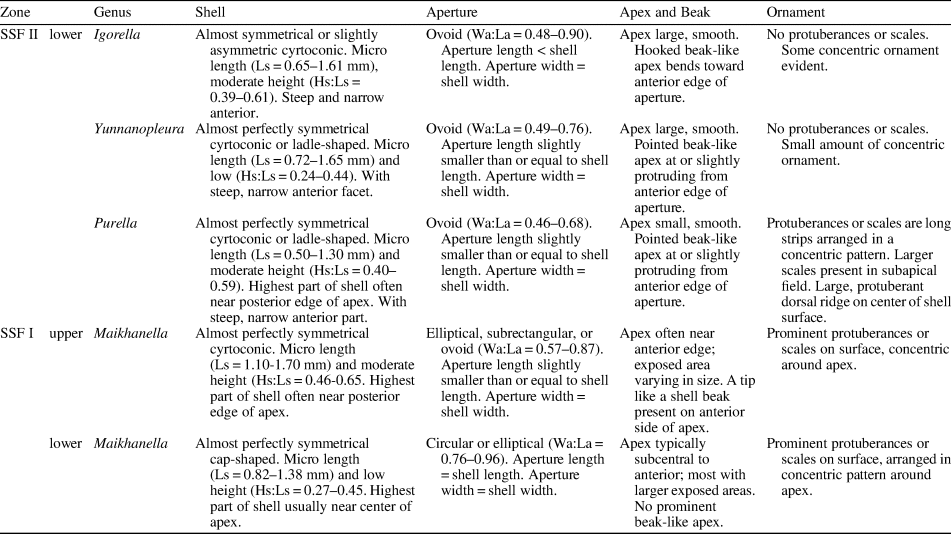
Cambrian small shelly fossils of the Yangtze Platform generally have undergone diagenesis, e.g., secondary phosphatization (Zhu et al., Reference Zhu, Qian, Jiang and He1996; Chen et al., Reference Chen, Chu, Zhang and Zhai2016; Pang et al., Reference Pang, Steiner, Shen, Feng, Lin and Liu2017b; Ji et al., Reference Ji, Pang, Wen and Hu2019). Therefore, their primary shell ultrastructure is mostly obliterated by diagenesis and generally the soft tissues have decayed. Fortunately, the external morphological features of their cap-shaped shell plates are often relatively well preserved (Figs. 3, 4). Thus, it is tested here whether evolutionary relationships can be inferred from a morphometric analysis of early molluscan shells, even though their soft-tissue organization can be fundamentally different. Description of the characters for the morphometric analysis is given in Table 2.
Features of maikhanellid and some other cap-shaped molluscan shells of SSF Assemblages I and II from Nanjiang County, Sichuan.

Quantitative and qualitative characters
The morphometric measurements include linear dimensions such as shell length (Ls), width (Ws), and height (Hs), and aperture length (La) and width (Wa) (see Table 2 for comparison).
The morphological terms of Jacquet and Brock (Reference Jacquet and Brock2016) have been applied: categorization of size is noted as micro (Ls < 5 mm), macro/small (≥ 5 mm to < 10 mm), or macro/large (≥ 10 mm). Height-length ratio (Hs:Ls) is used to define categories of height profiles, including low (≥ 0. 25 to < 0. 5), moderate (≥ 0. 5 to < 0. 75), high (≥ 0. 75 to < 1. 0), or tall (≥ 1. 0). Width-length ratio (Wa:La) of the aperture provides a measure of apertural outline and can be differentiated as laterally compressed (< 0. 25), elliptical (≥ 0. 25 to < 1), or circular (= 1). The ratio (Ls-La)*10/Ls represents the developing beak. In addition, the term ‘ovoid’ expresses that the aperture expands toward one end, and ‘subrectangular’ means with parallel sides.
Comparison of morphological characteristics
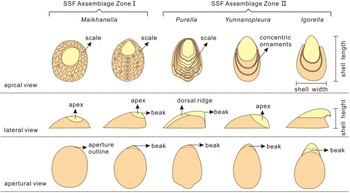
Most taxa of maikhanellids, e.g., Maikhanella and Purella, have a highly radially symmetrical shell (Figs. 3, 4, 6). They all have ornament arranged in a concentric pattern around the shell apex. The apices are well developed and are located at the center or at the anterior/posterior edges of cap-shaped shells (the anterior/posterior orientation of apices remains uncertain until complete scleritomes are recovered). Some maikhanellids, e.g., Maikhanella superata (Feng, Sun, and Qian, Reference Feng, Sun and Qian2001) and Purella spp., developed an inclined apex with a beak-like appearance. They all have a large aperture, the width of which is equal to the width of the shell. The inside of the shell did not preserve imprints of muscles or cells.
Comparison of morphological aspects of the apices and beaks of cap-shaped mollusks from the Fortunian Age of the early Cambrian.

The maikhanellid taxa and univalved helcionellids of the different stratigraphical horizons show systematic differences in morphological characteristics. Later species of maikhanellids, e.g., Maikhanella superata (Figs. 3.9, 3.10, 6) are cyrtoconic to various degrees, whereas early species show low cap-shaped shells without cyrtoconic construction. The protrusions or scales on the surface of early maikhanellids are arranged in a concentric pattern around the shell apex, whereas later maikhanellids forms (e.g., Purella) have typical concentric ribs. The apex position and the morphological features of the beaks vary among taxa. The apices of Maikhanella pristinis and M. multa are located near the center of the relatively large and convex shells without beaks (Figs. 3.1–3.5, 6). The apices of the later species of Maikhanella, e.g., M. superata, lie near the anterior/posterior edge of the shell with a prominent tip creating a beak-like structure (Figs. 3.9, 3.10, 6). The apices of Purella and Yunnanopleura lie at the anterior/posterior edge of the shell with a small, sharp beak-like appearance (Figs. 4.1–4.10, 6).
Cluster analysis
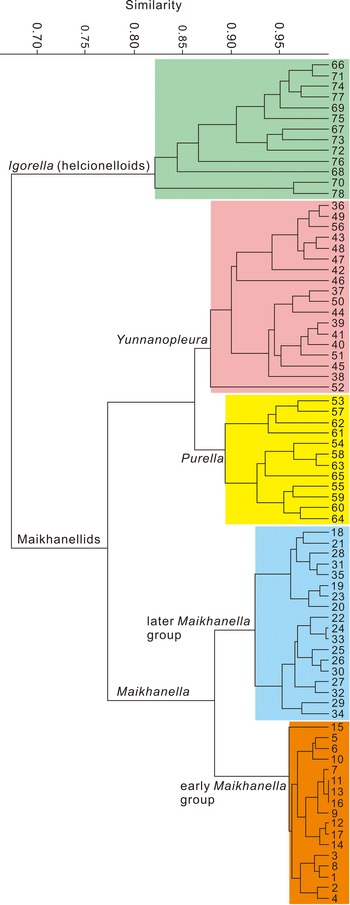
A cluster analysis based on the character matrix in Supplementary Table 1 was carried out using Past 3 software (Huang et al., Reference Huang, Harper and Hammer2013) with Bray-Curtis Distance. The clustering results (Fig. 7) show that the studied fossils can be categorized into five groups, the early Maikhanella (M. multa, M. pristinis, etc.), the later Maikhanella (M. cambrina, M. superata, etc.), the Purella, the Yunnanopleura, and the Igorella groups. This clustering result is consistent with the results of empirical morphological observations (Table 2). Among them, the early and the late Maikhanella groups are closely related to each other and the Purella group is clustered with the Yunnanopleura group (similarity > 0.75). In contrast, the Igorella group is clustered more distantly from all maikhanellid groups (similarity > 0.65).
Cluster analysis chart of the shell characteristics of the main univalve fossils from Fortunian strata (see Supplemental Table 1 for the data).

The similarity pattern presented in Figure 7, together with stratigraphic occurrences, suggests that the Igorella group (helcionelloids) is not a direct descendant of maikhanellids, although the cap-shaped shells bear some similarity. The shell structure of Maikhanella, with a mesh-like pattern on the inner side of shell, is quite different from that of Igorella.
Morphological evolution in early Cambrian cap-shaped mollusks
In general, the diversity of cap-shaped mollusks increased throughout the Terreneuvian Epoch (Fig. 5). In the first assemblage, maikhanellids (e.g., Maikhanella) developed large cap-shaped shells with some prominent ornament of spinose structures (Fig. 3). Studies on molluscan sclerites demonstrate the high morphological variability in biomineralized molluscan skeletons (Parkhaev, Reference Parkhaev, Ponder and Lindberg2008). Studies of Halkieria Poulsen, Reference Poulsen1967 and Maikhanella resulted in a reconsideration of the idea that coeloscleritophoran and molluscan exoskeletons are not homologous (Bengtson, Reference Bengtson1992). The scales of maikhanellid shells are in principle comparable to the co-occurring tubular sclerites of siphogonuchitids (Qian, Reference Qian1999; Liu et al., Reference Liu, Zhang, Shao, Tang, Jiang, Wang, Cheng, Dong, Liang, Dai and Xue2016), but are strikingly different from the ornamentation of univalved helcionellid shells. Here, we also report a specimen of Maikhanella preserved in a cluster with some spiphogonuchitid spines (Figs. 3–12), which supports the hypothesis that sclerites of Maikhanella and Lopochites Qian, Reference Qian1977 or Siphogonuchites Qian, Reference Qian1977 belonged to the same scleritome.
The apical parts of maikhanellid shells did not reveal protoconchs, as is typical in many helcionellid species (Parkhaev, Reference Parkhaev2017). This indicates that the early ontogenetic development of maikhanellids and helcionellids was different. The helcionellids developed a single shell early that covered the larva, whereas the potentially multiple biomineralized shells of maikhanellids might have developed at a slightly later stage, covering only part of the dorsal integument. In particular, maikhanellids are distinct from helcionellids by their scaly shell ultrastructure, the lack of a protoconch, and symmetric construction.
It is assumed here that the scleritome of maikhanellids was organized as in other stem-group aculiferans, with one or two of the large, cap-shaped shells anteroposteriorly positioned on a slug-like soft body. Besides the large cap-shaped shell plates, the maikhanellid scleritome had numerous hollow and elongated sclerites of siphogonuchitids, e.g., Lopochites and Siphogonuchites, arranged in concentric zones, and covered the dorsal side of mantle between the cap-shaped maikhanellid plates. Although no complete scleritomes or soft parts have been found for maikhanellids with high cap-shaped shells, such cap-shaped shell plates have been documented in many scleritomes, e.g., Halkieria (Vinther, Reference Vinther2015), Calvapilosa Vinther et al., Reference Vinther, Parry, Briggs and Van Roy2017, Oikozetetes Conway Morris, Reference Conway Morris1995 (Paterson et al., Reference Paterson, Brock and Skovsted2009; Jacquet et al., Reference Jacquet, Brock and Paterson2014), and Orthrozanclus Conway Morris and Caron, Reference Conway Morris and Caron2007 (Zhao et al., Reference Zhao, Smith, Yin, Zeng, Li and Zhu2017). Other enigmatic cap-shaped shells of SSF II and SSF III, e.g., Ocruranus finial Liu, Reference Liu1979, Ocruranus trulliformis (Jiang, Reference Jiang1980), and Eohalobia diandongensis Jiang in Luo et al., Reference Luo, Jiang, Wu, Song and Ouyang1982, could represent cap-shaped shell plates of the stem group Aculifera as well. This preliminary hypothesis is supported by the fact that maikhanellids and siphogonuchitids (e.g., Lopochites, Siphogonuchites) co-occur in the same strata and are closely associated in some specimens (Figs. 3–12). The morphology of the larger protrusions or scales of the maikhanellids is very similar to the morphology and construction of siphogonuchitids.
In SSF II, the diversity of maikhanellids (e.g., Purella and Yunnanopleura) and in particular those of the helcionellids (e.g., Igorella and Obtusoconus Yu, Reference Yu1979) increased considerably (Fig. 4), thereby demonstrating a stepwise expansion in generic diversity. The stepwise increase in generic diversity in northern Sichuan is consistent with the early–mid Meishucunian trend in diversity increase on the Yangtze Platform (Li et al., Reference Li, Steiner, Zhu, Yang, Wang and Erdtmann2007). Moreover, this diversity increase is comparable with the global diversity increase through the Nemakit-Daldynian to the Tommotian (Li et al., Reference Li, Steiner, Zhu, Yang, Wang and Erdtmann2007; Maloof et al., Reference Maloof, Porter, Moore, Dudsas, Bowing, Higgins, Fike and Eddy2010; Kouchinsky et al., Reference Kouchinsky, Bengtson, Runnegar, Skovsted, Steiner and Vendrasco2012, Guo et al., Reference Guo, Li and Li2014). This pretrilobitic diversity increase, which is mainly due to the diversification of SSFs, has been interpreted as the first stage (Qian, Reference Qian1999) or the first pulse (Maloof et al., Reference Maloof, Porter, Moore, Dudsas, Bowing, Higgins, Fike and Eddy2010) of the Cambrian Bioradiation Event.
The overall shape, symmetry, apical appearance, and scaly ornamentation of the maikhanellids provide key parameters for the discussion of the morphological evolution.
(1) Most maikhanellids developed one or two symmetric cap-shaped shell plates with a low profile. Later forms of maikhanellids have higher, symmetric cap-shaped shells with stronger inclination of the apex toward the anterior/posterior edge, e.g., in Maikhanella superata. This kind of higher cap-shaped shell plate is also common in univalved helcionellids, e.g., Igorella oblatis or Securiconus simus Jiang, Reference Jiang1980; in addition, these univalved shells are often slightly asymmetric.
(2) The position of the apex and the development of a beak-like apex varied among different genera. The apex of Maikhanella multa (or M. pristinis) is located near the center of the shell with no evident beak. The apex of the later species of Maikhanella, e.g., M. superata, lies near the anterior/posterior facet of the shell, which is laterally contracted resulting in a beak-like apex on the anterior/posterior side. The apices of Purella and Yunnanopleura lie at the anterior/posterior facet of the shell forming a small but prominent beak-like apex. The univalved shell developed in Igorella is similarly cap-shaped with a beak-like apex, however, the apex noticeably extends beyond the front edge of the aperture and bends toward the front part of the aperture.
(3) The protrusions or scales on the surface of maikhanellid shells are arranged in concentric pattern around the shell apices, which culminate in the appearance of typical concentric ornamentation. The protrusions and scales have a similar construction as the co-occurring disarticulated sclerites of sinosachitids. The inner side of slightly eroded Maikhanella shells appears like a mesh. Other enigmatic cap-shaped shells of SSF II and SSF III, e.g., Ocruranus finial, O. trulliformis, and Eohalobia diandongensis, could represent cap-shaped shell plates of the stem group Aculifera as well. These taxa developed shell plates with concentric ornamentation typical of Igorella or other related helcionellids. The cap-shaped plates grew by marginal accretion, adding mineralized areas in a concentric pattern.
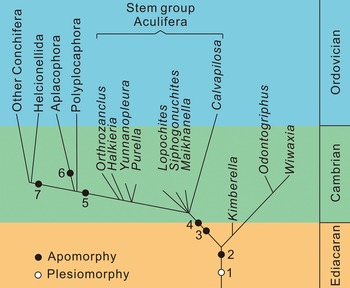
Generally, it can be recognized that Maikhanella is the earliest known shell-bearing molluscan taxon, succeeded by Purella, Yunnanopleura, and many univalved helcionellids, e.g., Igorella. The morphological similarity study (Fig. 7), the dissimilarity in shell structure (mesh vs. solid shell), and the stratigraphic occurrence pattern suggest that the Igorella group (helcionelloids) is not a direct descendant of the maikhanellids. These distinctive features and progressive changes of the earliest molluscan shells provide new evidence that the genus Maikhanella is the most primitive stem group of aculiferan discovered so far. An evolutionary trend is proposed for cap-shaped mollusks during the Fortunian Age of the Cambrian on the Yangtze Platform, based on the overall shape, symmetry, appearance of apex, and the presence of scaly ornamentation in maikhanellids (Fig. 8). The earliest molluscan stem group representatives in the Ediacarian and earliest Cambrian likely had a slug-like body plan organized in concentric zones, similar to that of Kimberella Wade, Reference Wade1972. This was likely a plesiomorphic character shared with the brachiopod stem group (Steiner et al., Reference Steiner, Yang, Hohl, Li and Donoghue2021). One main apomorphy of all molluscan clades is the presence of a radula (Fig. 9). Two lineages have been derived from soft-bodied Ediacaran ancestors without sclerites: one developing unmineralized multiple scales (wiwaxiids clade), and the other developing a chitinous cuticle with multiple carbonatic sclerites and aesthete canal systems (stem group Aculifera) (Fig. 9). The earliest representatives of the stem group Aculifera were the maikhanellids and related siphogonuchitids. Maikhanellid animals had slug-like bodies covered by numerous spinose and one or two platy, cap-shaped sclerites. The cap-shaped sclerites of the early maikhanellids were covered by coarser scaly ornamentation. In later maikhanellids (e.g., Purella) the scaly ornamentation was reduced and more solid cap-shaped sclerites formed. As the protrusions (scales), apices, and beak-like structures were transformed chronologically, the diversity of molluscan taxa increased. The apical location in these shells shows a gradual progression as it shifted from a subcentral position to the anterior edge of shell. Simultaneously, the apex changed from a convex circle into a pointed shape, with a progressively more pronounced beak-like structure and development of a moderately high cyrtoconic morphology. Later, the helcionellids developed a single solid shell without an aesthete canal system (Fig. 9) beginning to appear slightly asymmetric compared to the symmetric cap-shaped sclerites of maikhanellids. This is likely related to the fact that the soft tissues had to be completely covered by a single shell and the body plans and organ placement were adapted to this. The general trend from unmineralized slug-like ancestral mollusks, via stem group aculiferans (partially covered by spinose and few larger cap-shaped sclerites of loosely or more consolidated tubular scales) toward helcionellids (with a single solid shell) was likely driven by the strongly increasing predatory pressure during the Cambrian Bioradiation Event.
Hypothetical evolutionary trend of cap-shaped mollusks during the Fortunian Age of the Cambrian on the Yangtze Platform.

Phylogenetic tree of aculiferan evolution based on the record of cap-shaped mollusks from the Fortunian Age of the Cambrian and the hypothesis of evolution of apomorphic characters: (1) slug-like body plan organized in concentric zones; (2) radula; (3) dorsal chitinous/ proteinaceous cuticle with multiple carbonatic sclerites and a ventral foot and mantle; (4) aesthete canal system; (5) differentiation of hypostracum for a fixation of platy sclerites; (6) reduction of carbonatic sclerites; (7) single sclerite with hypostracum of nacre and reduction of aesthete canals (modified from Vinther et al., Reference Vinther, Parry, Briggs and Van Roy2017). Taxa that do not otherwise appear in the text are: Lopochites Qian, Reference Qian1977, Odontogriphus Conway Morris, Reference Conway Morris1976, and Wiwaxia Walcott, Reference Walcott1911.

In general, the stratigraphic analysis of the sclerites of early Cambrian mollusks shows a continuous increase in taxonomic diversity and morphological evolution of various aspects. The variations possibly indicate environmental and ecological adaptions during the Cambrian Bioradiation Event. In contrast to the biomineralized mollusks that first occurred in early Cambrian carbonate settings, the Ediacaran biota with the potential soft-bodied stem group mollusk inhabited sandy environments commonly sealed by microbial mats. Predatory pressure during this time was low, so that biomineralized skeletons did not provide an advantage in selectivity. The early Cambrian Mollusca, e.g., the maikhanellids, began to secrete calcareous (mostly aragonitic) skeletons to protect their soft bodies from oceanic predators. This hypothesis unifies the existence of the enigmatic soft-bodied Ediacaran stem group mollusk and the early Cambrian biomineralized mollusks, which can help resolve Darwin's paradox about the unique biological evolution at the Precambrian-Cambrian boundary.
Acknowledgments
We thank T.-G. He (Chengdu), W.-M. Feng (Nanjing), and B. Pan (Nanjing) for their help and valuable advice with the manuscript. We are very grateful to the thoughtful and constructive comments and suggestions from J. Vinther (Bristol), G.-A. Brock (Sydney), J. Maletz (Berlin), and T.-M. Claybourn (Uppsala). We are grateful for the helpful comments by the editors, J. Ebbestad and J.-S. Jin, and by C.-B. Skovsted and one anonymous reviewer. The research presented in this paper was funded by the National Natural Science Foundation of China (41872007, 91755215, 41972026) and Sichuan Science and Technology Program (2018JY0491).
Data availability statement
Data available from the Dryad Digital Repository: https://doi.org/10.5061/dryad.vt4b8gtts.