From the beginning of the twentieth century until American entry into World War I, J. Stitt Wilson's reputation as a public speaker and his election as mayor of Berkeley, California, in 1911 made him a well-known figure on the American Left. His published speeches preserve his views in great detail. Historian Douglas Firth Anderson has carefully analyzed his application of Christianity to socialism, the subject of many of these speeches.Footnote 2 The maternalist feminism that was integral to his concept of socialism has received little attention, although it led him to campaign vigorously for women's suffrage in California in 1911 as well as in New York in 1915 and Iowa in 1916 and also influenced the appeals he made in other campaigns during this period.
Wilson was by all accounts a gifted speaker in an era when public speaking was still a major form of entertainment. A typical newspaper comment from the period describes his speaking style as “forceful and eloquent.” His speeches sometimes read rather awkwardly, with repetitions for emphasis appropriate to the platform rather than the page. They reflected the current thinking of several American reform movements of the period and are designed to persuade rather than to develop new ideas, though he was not without creativity.
During the successful California women's suffrage campaign of 1911 and for several years afterward, Wilson emphasized his view that women's equality is essential to development of a socialist society. The maternal ethic of care, he argued, provides the necessary basis for a society based on cooperation rather than competition. Only a socialist society, in turn, would allow full realization of the ethic of care. Wilson advocated women's equality not simply because he believed women were equal human beings, but because he sought a social revaluation of feminine or maternal values, a revaluation that he saw as essential to social transformation. These beliefs mirrored those of many leading progressive and socialist women of the times. Wilson thus provides a rare example of a male activist and intellectual for whom women's equality was fundamental to his beliefs rather than auxiliary to them. At the same time, his belief that class conflict would continue as long as capitalism endured separated him from most progressive feminists.
Becoming a Socialist
Jackson Stitt Wilson was born in Auburn, Ontario, Canada in 1868 to a devout Methodist family. He married in 1889 and began studies for the Methodist ministry at Garrett Biblical Institute in Evanston, Illinois, the following year, after which he studied for a BA at Northwestern University.Footnote 3 As he worked toward ordination, he served for a time at the Northwestern University Settlement House and became a pastor at a working-class church in Chicago, where he witnessed the effects of economic depression and the use of federal troops to break the nationwide railroad strike in support of the Pullman workers. As Stitt Wilson described his experience, “I have buried children who did not have enough rags to cover them in their coffins. I have slept with men to keep them from committing suicide. I have seen the great armies of the unemployed live worse than animals, hungry in the streets.”Footnote 4 After Eugene V. Debs, the leader of the railroad strike, was released from jail, Wilson invited him to speak at his church.Footnote 5 Greatly influenced by George D. Herron's Christian socialism, Stitt Wilson withdrew from the ministry in 1897 and formed the Social Crusade, a group of ministers, including his brother Benjamin Franklin Wilson, who toured the Midwest holding evangelical-style, socialist Christian meetings. They also made two trips to England to learn about the labor movement there and developed ties with the newly formed Independent Labor Party. In 1901 Wilson participated in the Indianapolis convention that founded the Socialist Party under Debs's leadership. He then took his crusade to California and decided to move to there, settling in Berkeley.Footnote 6
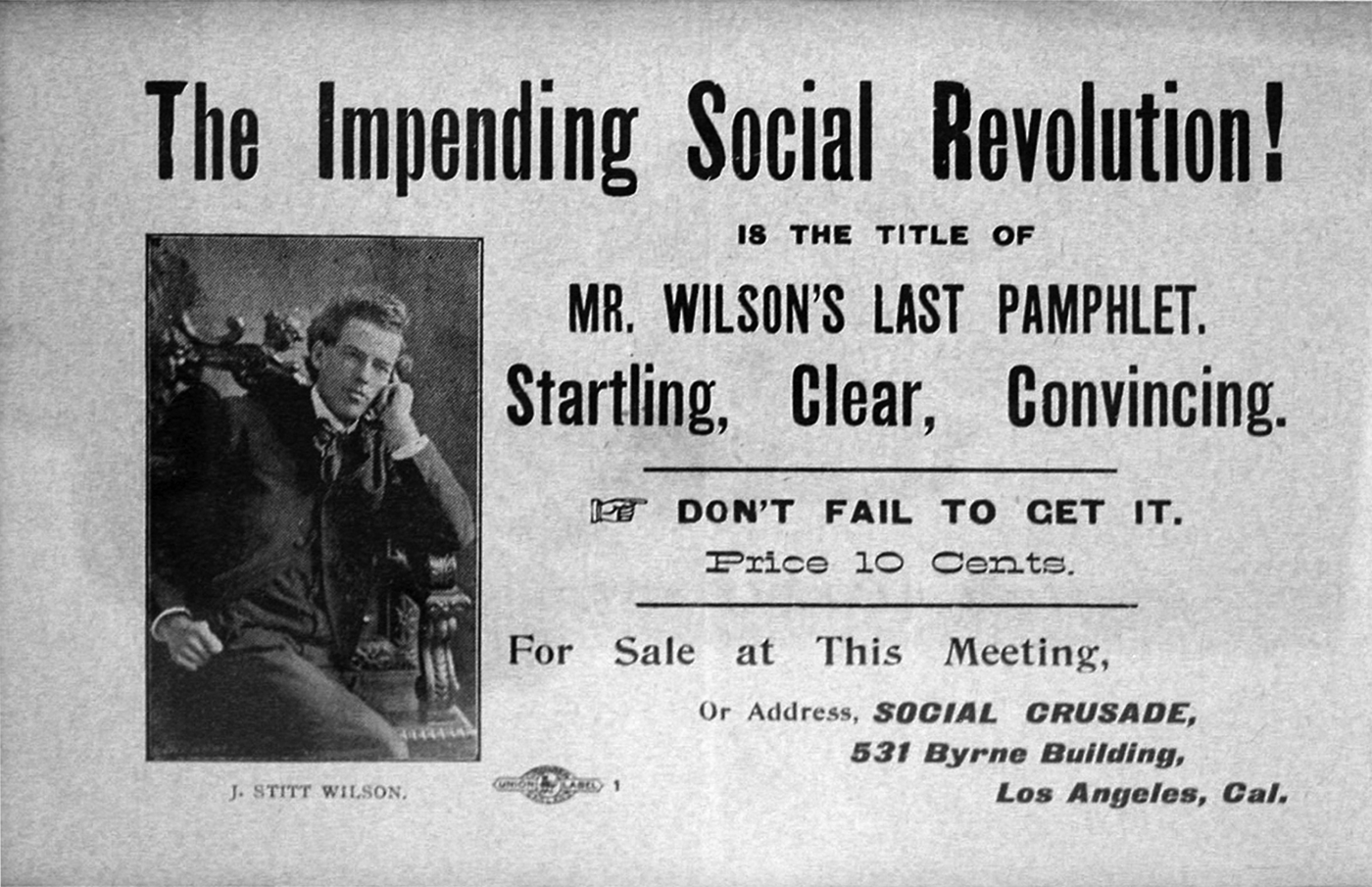
Advertising flier used at Social Crusade meetings in 1902 after Wilson's move to California. Author's collection.

Stitt Wilson was active in the Socialist Party of California and, after dissolution of the Social Crusade, in the Christian Socialist Fellowship. He spent a large part of 1907–1909 in England and Wales, preaching Christian socialism before crowds that sometimes numbered in the thousands, working with the Independent Labor Party, and returning periodically to the United States to speak on developments in England and to campaign for Socialist candidates, including Debs and his brother Ben Wilson, who ran for Congress in Kansas in 1908.Footnote 7 Despite or perhaps in part because he had not been closely involved in Socialist politics in California for several years, on his return the Socialist Party chose the forty-two-year-old J. Stitt Wilson as their candidate for governor. In November 1910 he received 12 percent of the vote, the highest statewide total ever received by a Socialist candidate. A few months later he ran for mayor of Berkeley, whose population of over 40,000 people made it the fifth largest city in California at that time.
Berkeley's Socialist Mayor
In his campaign for mayor, Stitt Wilson stated that “it is the business of the city administration to secure the necessities of city life and all possible advantages of city life for the use and enjoyment of the humblest family … at the lowest possible cost for the best possible service.”Footnote 8 The Socialist Party candidates for mayor and city council called for municipal ownership of utilities, regulation to lower utility and streetcar rates, free textbooks, kindergartens and playgrounds for children, city beautification, additional taxation of vacant land, and efficient municipal government.
The incumbent Mayor Beverly L. Hodghead was a socially prominent attorney and reformer, and no one active in Berkeley politics filed to run against him, leaving Stitt Wilson as his sole opponent. Hodghead argued that he was already working to expand municipal services, had helped write the new 1909 city charter that authorized the city to run public utilities, and had provided a businesslike administration, while the Socialists promised more than could be realistically done with available resources.Footnote 9 He had, however, offended the Republican editor of the Berkeley Gazette, one of Berkeley's two daily newspapers, which ran favorable articles on Stitt Wilson throughout the campaign. Footnote 10
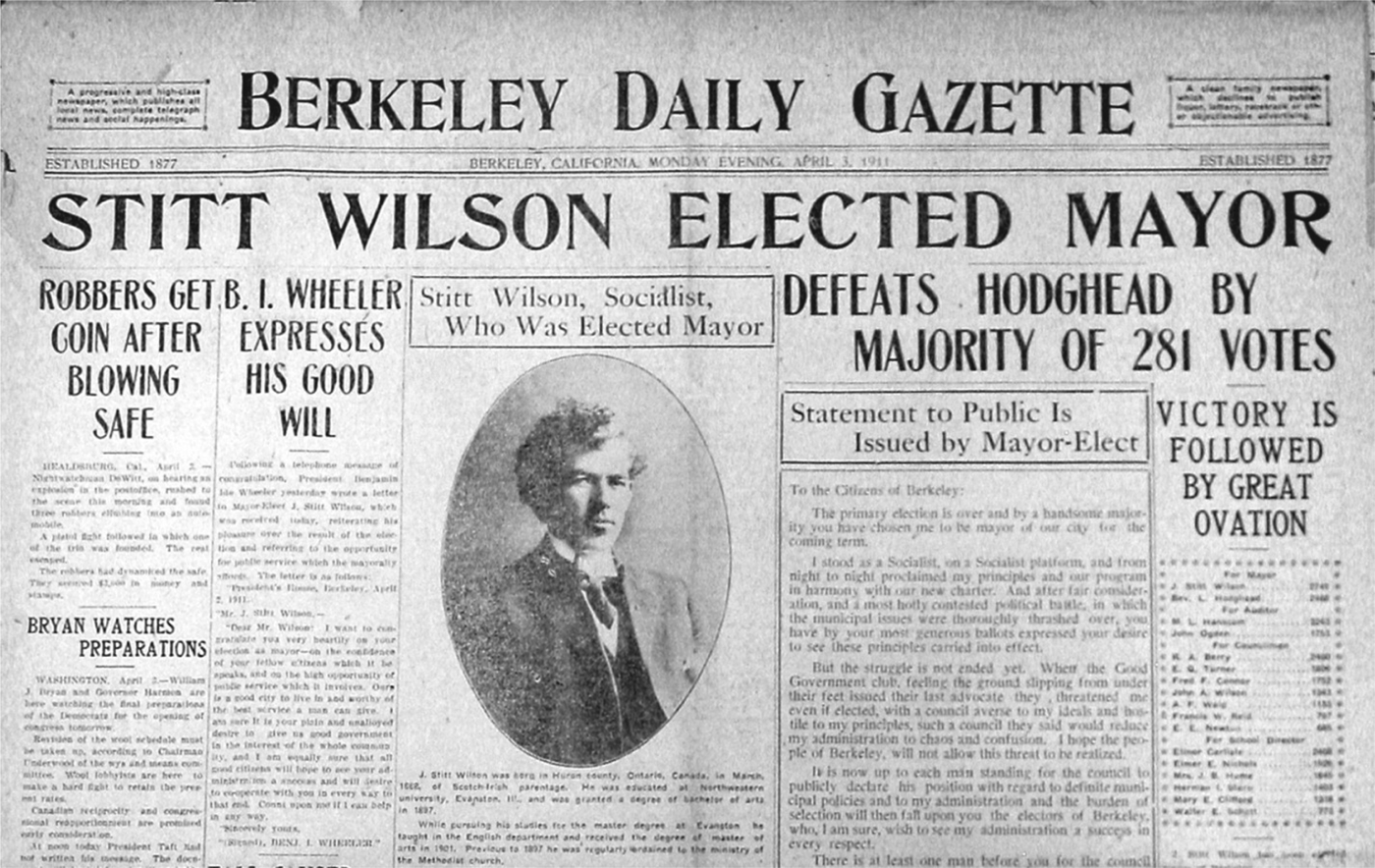
On April 1, 1911, voters chose Wilson over Hodghead by 2,749 to 2,468. He became one of eight Socialist Party mayors elected in 1911 in cities with populations of over 30,000, following the Socialist breakthrough in Milwaukee in 1910. The eight included two other Christian socialists: Rev. Lewis Duncan in Butte, Montana; and Rev. George Lunn in Schenectady, New York.Footnote 11 In the runoff election for city council three weeks later, Berkeley voters elected another Socialist, John A. Wilson (no relation) and an independent, E. Q. Turner, who had committed to working closely with the Socialists, so the new mayor believed he had a working majority on the five-person city council to implement his program.Footnote 12
The Berkeley Daily Gazette announces Stitt Wilson's narrow victory in April 1911. Courtesy Berkeley Historical Society.
After taking office on July 1, 1911, Stitt Wilson immediately plunged into multiple campaigns at the state, regional, and local levels. Statewide he was committed to campaigning for the equal suffrage amendment to the California constitution coming up for a vote at a special election on October 10. He also pushed for an amendment to the California constitution to allow cities and counties to replace the standard property tax with land value taxation. He promoted regional cooperation between Berkeley, Oakland, Alameda, and San Francisco to convert water, electric, and telephone service to public ownership. In Berkeley he successfully worked to improve safety in the commuter railway system, establish municipal health inspections for meat and milk, create a municipal employment bureau, expand and improve the city's parks, pass a sewer bond, improve garbage disposal by building a municipal incinerator, and strengthen the city's ability to deliver public safety and public works.Footnote 13 He persuaded the city to lease a house in the center of town for the homeless to sleep, operated by the municipal charity commission.Footnote 14 In addition, he supported striking workers, most notably during a strike at the Pacific Gas & Electric Company, when he used the city's regulatory powers to pressure the company to settle and had the police keep a close watch on the company's armed strikebreakers in Berkeley.Footnote 15
Wilson's position as mayor compelled a major change in his lifestyle. As he noted, “There is a sense in which I am living in a smaller world now than I was before in my extensive travels and large meetings and meeting with public personalities, but I am right at my work every day and indeed every night and I may say that I am fanatically devoted to this municipal task and if I fail it will be because of lack of head and not for lack of heart, for my very soul is in the matter.”Footnote 16 When a critic accused him of neglecting his duties to campaign for women's suffrage, he responded, “I am in the fourth month of my official capacity as Mayor of the City of Berkeley. During that time I have never missed a Council meeting. I have never missed a committee meeting, nor have I ever been late to a single meeting of the Council or committee. … I have never been away from the City Hall but one day since the first day of July.”Footnote 17 After Wilson had been three months in office, the president of the Berkeley Chamber of Commerce commented that “the record made by Mayor Wilson since he took office is such that the people are proud of the manner in which he is conducting his office and is deserving the support of all good citizens.”Footnote 18
All of this was typical of Socialist Party mayors and their programs. Building on the experience of Milwaukee, as well as Berkeley and other cities, the 1912 Socialist Party Convention adopted a suggested program for municipal and state candidates. It called for local governments to improve conditions for government workers, use their regulatory powers to support private-sector workers, create publicly owned utilities and municipal markets, engage in city planning, carry out extensive public health programs, provide parks and playgrounds, and support public education and kindergartens.
This reformist program was controversial within the Socialist Party, where there was frequent conflict between proponents of different visions of socialism and strategies for bringing it about. One important divide was between the “evolutionary” socialists, as Stitt Wilson described himself, who believed in democratic elections and reforms starting at the local level as the route to socialism, and revolutionary socialists, who believed that socialism could only come about after election of a socialist national government or industrial action culminating in a general strike. The “right-wing” evolutionary socialists argued that successful, efficient, honest socialist administration of municipal governments and publicly owned utility companies would provide a concrete demonstration that the government and economy should be reorganized along socialist lines, while expansion of government activities to improve the health, homes, and lives of residents would further demonstrate the value of the socialist vision. The “left-wing” revolutionaries believed that running for local office was valuable only to educate the public on the need for socialism and to keep the police from being used to break strikes. This faction had little patience with anything less than an immediate transition to socialism.Footnote 19
Historian Richard Judd finds that Socialist administrations generally needed support from middle-class reformers as well as from their working-class base in order to gain and hold office. From 1910 to 1915, they were remarkably successful at this, in part because many middle-class progressives regarded the Socialists as “an ethical, ingenious and somewhat unconventional reform movement” and did not take the Socialists' socialism seriously. The program Stitt Wilson called “constructive municipal socialism” was very similar to that of the social reform tendency in progressivism, exemplified by Samuel “Golden Rule” Jones in Toledo, Hazen Pingree in Detroit, and Tom Johnson in Cleveland.Footnote 20 Indeed, Stitt Wilson knew Jones, having worked on his campaign for governor of Ohio in 1899, given a talk at his company picnic, and lectured on Christian socialism at Golden Rule Hall in Toledo before he moved to California.Footnote 21 Unlike Wilson, most Socialist mayors won with pluralities in races against both Democrats and Republicans. When Socialist supported strikes and other forms of class conflict, they were usually defeated for reelection by Democratic-Republican fusion tickets. When they made compromises to keep middle-class support, they often faced the second most frequent cause of defeat for Socialist elected officials: expulsion from the Socialist Party by their local chapters.Footnote 22
J. Stitt Wilson had strong support from the Berkeley branch of the Socialist Party, which recognized the need for middle-class support. Indeed Socialist city council member John A. Wilson was a small businessman who had the Eagle Motorcycle franchise in Berkeley.Footnote 23 Instead, the revolutionary socialists broke away and formed a small West Berkeley branch, which criticized the mayor unrelentingly for working with non-socialist reformers.Footnote 24 Wilson commented early in his term that his only difficulty came from “the Extremists in the Socialist Party who seem to have no patience with anything except something of a radical and impossible nature.”Footnote 25 When Mayor Wilson and the Socialist-dominated school board promoted a program in which school children helped beautify the parks by planting flowers and shrubs, he was denounced in the pages of Revolt, the voice of the revolutionary Left in the San Francisco Bay Area, for “making young scabs” and using “unpaid slaves.”Footnote 26 Nonetheless, Wilson believed strongly in the necessity of a “social revolution”; supported the labor movement; and vehemently attacked capitalism, “plutocracy,” and the churches that supported them.
Maureen Flanagan argues that urban middle-class women's organizations played a major role in supporting the efforts by “social reform” progressives to “secure a common welfare” for all who made the city their home, as opposed to middle-class men's more frequent focus on simply making the city a good place to conduct business.Footnote 27 Her findings parallel the observation of Frederic C. Howe in 1906 that “back of the settlement, the small park, the kindergarten, the crèche, the juvenile court, the schools, the libraries … back of many a movement for betterment of the conditions of life in home, shop or factory is the influence of woman,” who “sees the city in light of the home” while “to man the city is primarily a centre of industry.”Footnote 28 Socialist feminists had developed ideas that they hoped would help create a coalition between the progressive elements of the women's movement and the working-class movement. Drawing on these ideas, J. Stitt Wilson believed that women's suffrage would broaden support for the socialist movement.
J. Stitt Wilson in the California Women's Suffrage Campaign of 1911
American socialists had a history of support for equal suffrage, particularly those influenced by Edward Bellamy's utopian novel Looking Backward, published in 1888. The Second International, the worldwide organization of socialist parties, endorsed women's suffrage in 1900, and the Socialist Party of America, founded in 1901, became the only American party that allowed women to be members and elected officers. Its charismatic leader, Eugene Victor Debs, was a fervent advocate of women's equality.Footnote 29 Women were only a small percentage of the Socialist Party's national membership, but they played a substantial role in the Socialist Party of California, where they organized independent socialist women's associations, formed a statewide Woman's Socialist Union of California, and provided strong support to the short-lived Woman's National Socialist Union.Footnote 30
California's socialist women included many who were active in organizations such as the Woman's Christian Temperance Union, whose national leader Frances Willard had espoused Christian socialism over the decade before her death in 1898. Stitt Wilson had met many of them when he toured California on behalf of the Social Crusade, the Christian socialist organization he helped found after leaving the Methodist ministry in 1897. In August 1901 Wilson spoke on Christian socialism to the Congress of Reforms held by the Northern California WCTU.Footnote 31 The leaders of both the Northern and Southern California chapters of the WCTU were Christian socialists and became friends of Wilson after his move to California.Footnote 32 Berkeley was a stronghold of the WCTU, and the city's Frances Willard Middle School commemorates its world-famous president.Footnote 33
There appears to be no record of Stitt Wilson speaking on women's issues during his initial years with the Social Crusade. In February 1902, soon after his move to California, he spoke on “Woman, Her Present Status and Future Freedom” to the newly formed Women's Socialist Union in Los Angeles. He argued that the family exemplified “the principle of socialism, as opposed to ruthless individualism.” Understanding the truth of women's equality and awakening women to “the superior dignity of her calling” would lead to women's enfranchisement and to socialism. In November 1902, he spoke to the San Francisco Women Suffrage Association at a meeting in honor of Elizabeth Cady Stanton, who had died a month previously.Footnote 34 By 1910 equal suffrage was a major statewide political issue. At the start of his campaign for governor in July 1910, Wilson stated unambiguously, “I stand openly and aggressively for votes for women. I have done so through all my public career…. Whether the woman suffrage movement supports my candidacy or not, I will make votes for women one of my main points in the campaign.”Footnote 35
When the California legislature placed equal suffrage on the statewide ballot for October 10, 1911, it was one of twenty-three ballot measures. Governor Hiram Johnson allowed the measure to go to the voters because the Republican Party platform had endorsed it, but he was personally ambivalent and took no public position on the measure. He and his progressive male political supporters focused their own efforts on passing measures to establish the initiative and referendum, recall of elected officials, and railroad regulation. They left the campaign for women's suffrage in the hands of the organized women, who brought in male allies such as J. Stitt Wilson to assist in the campaign.Footnote 36
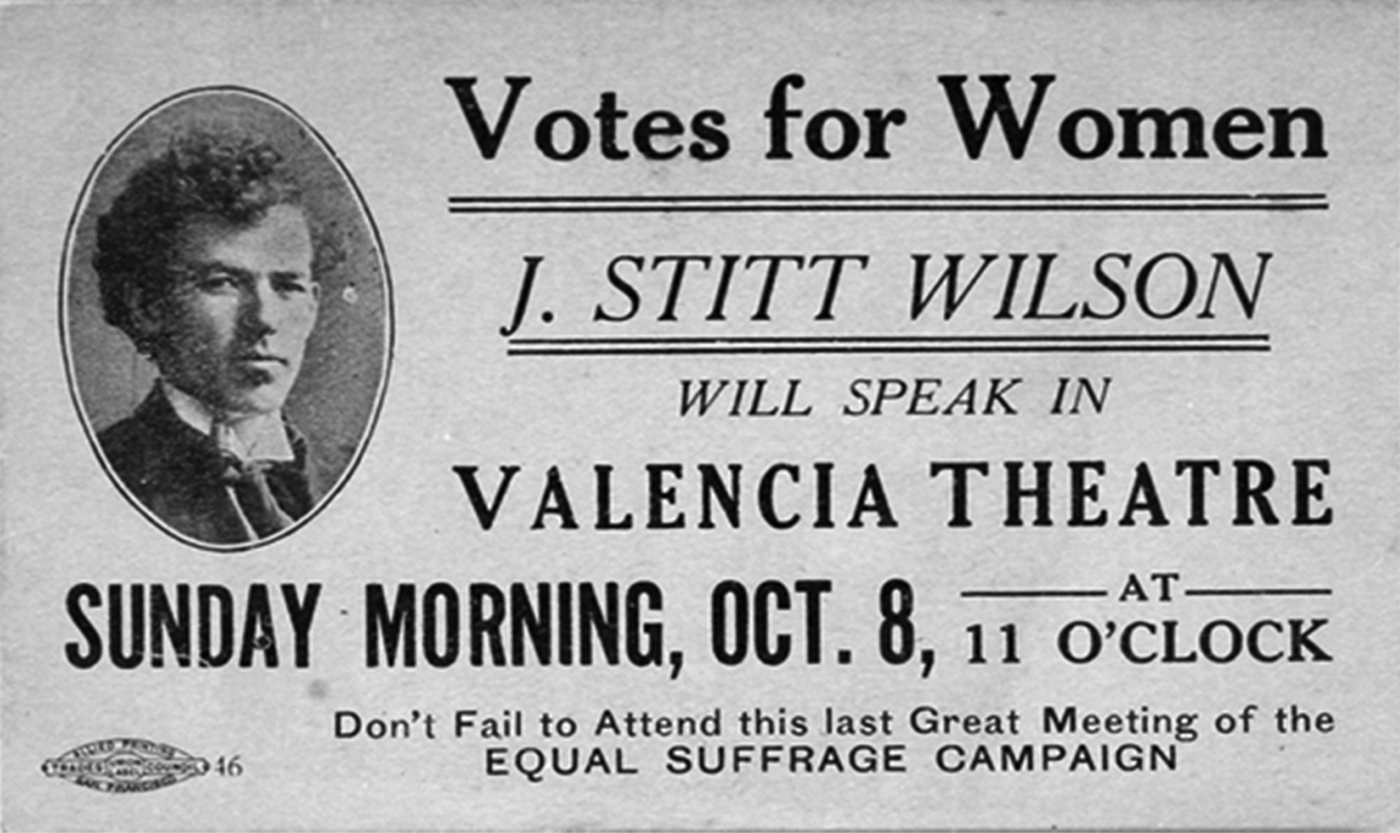
Announcement for one of Wilson's numerous pro-suffrage speeches in San Francisco, October 1911. Author's collection.
Soon after taking office, Wilson was actively campaigning for votes for women, with frequent speaking engagements in San Francisco as well as Oakland, Berkeley, Alameda, Hayward, Richmond, and San Rafael. The San Francisco Call and the San Francisco Chronicle reported on twenty-two events where he was a speaker in the two months between August 11 and Election Day on October 10, and the Berkeley newspapers mention several more. On October 4 the Berkeley Independent reported that “Mayor Wilson is an exceedingly busy man these days. Taking an active interest in the suffrage campaign and being an eloquent speaker, he is in great demand… . Mayor Wilson spoke three times last evening in different parts of San Francisco. He was hurried from one point to another in an automobile, and several thousand people heard his eloquent addresses.”Footnote 37
Wilson clearly loved public speaking. At one event in Berkeley the previous speaker joked that “the Mayor would not enjoy his usual health unless he had a chance to make at least one speech a day.”Footnote 38 Still, the strain of serving as mayor while continuously campaigning shows in a letter to Hester Harland, leader of the equal suffrage campaign in Berkeley: “Everybody seems to press me just a little too hard for various kinds of service. I find I have four meetings scheduled for next week and three for this week, but I shall endeavor to see you.”Footnote 39
Socialist support was generally welcomed by women's suffrage organizations in California, despite opponents' efforts to use that support to discredit the movement. The largely upper middle-class leadership worked to reach out to working-class women and their organizations.Footnote 40 The cross-class relationships were not always easy, especially in San Francisco, where the upper middle-class women's club organizations infuriated the activist women in the Waitresses Union and the Wage Earners Suffrage League with their support for use of police to help break the street car strike of 1907 and their support for the graft prosecution of the former Union Labor Party mayor Eugene Schmitz and allied members of the city's Board of Supervisors.Footnote 41 The working women's organizations were nonetheless strong supporters of women's suffrage, looking at it as a means to increase working-class voting power. California's suffrage campaign steering committee managed to bring together the entire range of suffrage supporters, from the clubwomen to the Wage Earners and the Socialists.
The Socialist Party in San Francisco was relatively weak because the city already had a successful working-class third party, the Union Labor Party, which won control of San Francisco City Hall from 1901–1907 and 1909–1911. It was led in 1909–1911 by Mayor P. H. McCarthy, the former head of the carpenters union, and was largely dominated by the Building Trades Council, which had a strong labor-oriented political program. This program overlapped substantially with the reform elements of the Socialist Party program, including support for publicly owned utilities, producer cooperatives, land reform, and the single tax, as well as the closed shop, the eight-hour day, and public works to provide work for the unemployed. The Union Labor Party had supported women's suffrage since 1908, and McCarthy did one joint appearance with Stitt Wilson. But with the city primary election coming on September 26, only two weeks before the statewide special election, the Union Laborites were mostly focused on their unsuccessful effort to maintain control of San Francisco city government.Footnote 42
San Francisco's Socialist women's organization supported the suffrage campaign by holding public meetings with notable speakers. The San Francisco Call ran a daily listing of “meetings scheduled for equal suffrage” to be held in the city. From September 30 to October 8, the paper ran twenty-one meeting notices with the sponsors listed. Five meetings were sponsored by the College Equal Suffrage League, four by the Women's Committee of the Socialist Party and another by the Bay View Socialist Club, four by the Clubwomen's Franchise League, three by the California Equal Suffrage Association, and four by miscellaneous groups.Footnote 43 Stitt Wilson was a featured speaker at most of the socialist meetings and many others as well.
The Socialist Party, which lacked major public figures in San Francisco, would not have been able to play an important role in the campaign there without Wilson. The mayor of Berkeley was a major public figure, the highest-ranking elected official in the California Socialist Party. His background as a former Methodist minister and Christian socialist who supported unions, women's suffrage, and prohibition with equal fervor helped him reach across class lines, appealing to the educated middle class as well as to workers. (He stayed away from the prohibition issue during the suffrage campaign, presumably because many workers feared that women's suffrage would strengthen the prohibition forces.) He could speak to the Oakland Council of Churches or a meeting of businessmen in downtown San Francisco and then move on to a meeting in the working-class Mission district under the auspices of the Wage Earners Suffrage League. These events typically had multiple speakers. Wilson most frequently shared the platform with Charles Aked, a prominent Congregational minister; Margaret Haley, founder of the Chicago Teachers Union; and Helen Todd, a Chicago factory inspector associated with Hull House.
Stitt Wilson's Views on Suffrage and Women's Equality
Some historians of the suffrage movement argue that its success was made possible by a change from advocacy of women's political equality with men, based on ideas of justice and natural rights, to advocacy of votes for women on the pragmatic grounds that this would bring women's moral influence to bear on increasingly powerful and active local, state, and national governments.Footnote 44 Mead suggests that “the development of many rationales” for equal suffrage was critical in its success.Footnote 45 For Stitt Wilson these ideas were not different approaches but an inseparable unity. Stitt Wilson's speeches were notable for their emphasis on justice and fairness as arguments for women's political equality, but underlying this was the idea that society needed to give greater importance to values that are held by women, especially women as mothers, in order to realize justice for all.
Stitt Wilson's speech that closed the campaign on the evening of October 9, 1911, provides a forceful statement of his egalitarian views:
Politics or government is the effort of a people to get together for the purpose of accomplishing those things necessary for the good and welfare of all. …
Sex is not a determining quality in human rights or responsibilities. A PERSON has rights. Not a male person or a female person.
Man may be classified as first, a moral or spiritual being; second, an intellectual being; third, a physical being. (Let us compare) men and women morally, intellectually and physically. There can be little dispute on the comparison of men and women morally. A larger percentage of men are confined in prisons and the women are the bulwark of the churches. (Intellectually,) the records of schools and colleges show that women are as good students as men. …
Referring to the argument of Col. Irish that “force is the basis of government” … certainly our mothers have rendered a greater physical service in bearing children than any man has killing them when they reached maturity… . The ability to carry a gun and shoot the son that some other mother has borne is not the true test of citizenship.
If woman morally, intellectually, and physically is equal to man, then why should she not be allowed to go to the polls and peacefully, orderly and silently express her opinion … regarding the affairs of government?Footnote 46
Wilson believed women were both equal and different, that women generally carried a maternal ethic of care that would naturally incline women to support a more humane, socialist society and would make voting women into agents of change:
We are praying for reinforcements in the great struggle toward the triumph of humanity, or human compassion. To the women we must look for these reinforcements. Let us follow out the logic of our sense and give woman what she so justly claims.Footnote 47
Many socialists, including many Socialist Party women, argued that since women could only achieve equality under socialism, the struggle for socialism should take priority over the struggle for women's rights. Some feminists had developed an alternative theory that it was womanly virtue that would provide the necessary basis for the moral reconstruction of society.Footnote 48 Elizabeth Cady Stanton, who espoused socialism toward the end of her life, developed a synthesis of these two views; she argued that replacing competition with cooperation was essential to enable women to develop their human potential, but at the same time femininity provided the essential basis for a cooperative society. “Before we can realize the dream of socialism we must establish the equilibrium of the masculine and feminine elements in humanity.”Footnote 49 This view, in which women are essential agents in social transformation, pervades Stitt Wilson's speeches. However, he gave much more emphasis to motherhood than Stanton did, as did many socialist women, and he said nothing about the idea, important to Stanton and many Socialist Party women intellectuals, that society had evolved from an original matriarchy to capitalist patriarchy. Socialist feminists, including Wilson, hoped that a coalition of the women's movement and the labor movement would create majority support for the “cooperative commonwealth.” This view, as historian Sherry Jean Katz has shown, was particularly strong among women socialists in California.Footnote 50
Wilson incorporated his feminism into his campaigns on the apparently unrelated issue of municipal taxation. On October 25, in between speaking at celebrations of the victory of women's suffrage, J. Stitt Wilson attended the annual meeting of the League of California Municipalities in Santa Barbara. There he led a successful effort to gain the support of the league for a ballot measure on “Home Rule Taxation,” which would amend the state constitution to allow local governments to replace the standard property tax with land value taxation. This was a major reform movement based on the work of Henry George, who argued that land value taxation was the fairest and most economically efficient tax system because land values were created by society as a whole rather than by the enterprise of the land owner.Footnote 51
Henry George had argued in Progress and Poverty (1879) that “(land) rent, the creation of the whole community, necessarily belongs to the whole community.”Footnote 52 Yet this “unearned increment” in land value was siphoned off by land owners and other “monopolists.” George argued that a “single tax” on the rental value of land should replace all other taxes, and that this tax, accompanied by public ownership of monopolies such as the railroads and utility companies, would end land speculation, strengthen the bargaining power of labor by making more land available for workers to start small farms and small businesses, fund provision of bountiful public services, and end exploitation and poverty. George opposed the socialists, with their focus on extraction of surplus value in the workplace and their solution of public ownership of the means of production. For their part, socialists agreed with his idea of taxing away land rent, seeing it as a useful reform and a step toward public ownership of land.
The California campaign opened on October 19–20, 1911, with New York Congressman Henry George Jr. speaking on the single tax at mass meetings in San Francisco and Berkeley, accompanied by J. Stitt Wilson and many other local notables.Footnote 53 Wilson's speech the following week to the League of California Municipalities was clearly influenced by months of intense participation in the suffrage campaign. The Berkeley mayor developed an unusual perspective that combined the insights of Henry George on the social nature of land values with a socialist feminist vision of city government:
As the community grows, site values and land values increase… . These site values … arising out of the association of men are socially created… . The wealth the individual creates should go to the individual. The values which are created by the social body by its very sociality should go to the social body. That social body is as much a reality as the individual person. It is the city or the state. And the city or the state has great public needs which must be supplied. If we should personify the city or state we would say that this Social Mother, in whose household we all live, needs streets and sewers for us all; schools for all our children; peace officers and fire fighters; and social administrators of all these affairs. She, the city, provides or ought to provide social necessities, public utilities, communal enjoyments and civic equipment for all the people. And to do these things she must have money. She must have her own purse. That purse must fill and refill from her own earnings. She is well able to take care of herself. She has no need to be a pauper, or a beggar, or a thief. The social body, the city or state, should pay its own bills out of that wealth which it has itself socially created. Let the values she herself socially creates fall into her own treasury, and from this, her own treasure, let her pay her own bills (using) taxation on land values.Footnote 54
Wilson's vision of the city as a Social Mother who creates enough value to support herself represented a creative leap, made under the influence of the suffrage campaign concluded only two weeks previously. Bringing in Henry George's approach to land value solved a significant problem in linking socialism and feminism. The standard socialist economic theory of the time focused entirely on the exploitation of wage workers and the resulting class conflict. In this view, women as mothers and homemakers had only the indirect role of supporting male family members unless the women were also working in factories and shops and could join unions. The feminist argument that the city was an extension of the home, a “municipal household” that required feminine, maternal values to fulfill its functions, left both women and the city in an auxiliary role in the predominantly male industrial economy. Henry George had demonstrated that the city, as a community, created economic value that was taken by private landowners. In this speech, Stitt Wilson brought these viewpoints together and pointed out that the collective “social mother,” a community of men and women together, created economic value that was exploited by private appropriation through rent and land speculation. This meant that women had a significant role in the urban economy, in combating this exploitation, and in creating a city that provided “social necessities” and “communal enjoyments” to its people.
In describing the city as a Social Mother, Stitt Wilson was drawing on a feminist argument that went back more than thirty years. The Woman's Christian Temperance Union, under the leadership of Frances Willard from 1879 until her death in 1898, had argued that women needed to be involved in politics for “Home Protection.”Footnote 55 Initially this simply meant protection of the home from the effects of alcoholism on the man of the house, but over time the concept of the home broadened to encompass the surrounding city, and home protection broadened to include a demand for the right to vote. Willard wrote, “Men have made a dead failure of municipal government, just about as they would of housekeeping, and government is only housekeeping on the broadest scale.”Footnote 56 Having come to the conclusion that poverty was a major cause of alcoholism, she then looked at ways to end poverty. In the late 1880s, influenced by Edward Bellamy and by George Herron, the Christian socialist who later inspired Wilson to found the Social Crusade, she declared herself a Christian socialist.Footnote 57 Historian Ellen Carol Dubois even claims that “the WCTU was virtually a conduit into socialism.”Footnote 58 This broader social perspective was particularly strong in WCTU chapters in the western states such as California.
Even though it is not clear whether Wilson ever met Willard, he was very familiar with the WCTU and its leader, whose beliefs in temperance, women's suffrage, labor rights, and Christian socialism were reflected in his own. He described Willard as “that noble American woman” and as one of the “three great women” who headed “three of the greatest moral movements of the last half century.”Footnote 59 Evanston, Illinois, where Willard lived until her death in 1898 and where the WCTU had its headquarters, was the site of the two Methodist educational institutions: the Garrett Biblical Institute and Northwestern University, where J. Stitt Wilson studied between 1890 and 1901.
Wilson also described how, as a student working at the Northwestern University Settlement, he was greatly influenced by Jane Addams, founder of Hull House in Chicago.Footnote 60 Addams was a major proponent of the idea that women should have the right to vote because they could not fulfill their traditional housekeeping function within the home without the support of a local government engaged in municipal housekeeping, such as ensuring that milk and food were kept pure and free of disease and that refuse was properly disposed of.Footnote 61 Hull House staff had close ties to the labor and socialist movements. Mary Collson, who worked at Hull House as its chief juvenile probation officer from 1899 to 1901, became a friend and admirer of Wilson in those years. Under his influence, she became, briefly, an enthusiastic socialist and founded a Hull House chapter of the Social Democratic Party.Footnote 62 Wilson also receives a passing mention in Addams's autobiography.Footnote 63
Many leading male supporters of women's suffrage accompanied their support for women's rights with reassertions of their own masculinity and the importance of manhood. In 1910–12, many of the Bay Area's Protestant churches, including those supporting women's suffrage, were engaged in the Men and Religion Forward Movement, reassuring men that “Christianity is peculiarly a man's religion.”Footnote 64 In the 1912 presidential campaign, equal suffrage was endorsed in the Progressive Party platform of Theodore Roosevelt, proponent of “the strenuous life,” and his vice presidential candidate, California governor Hiram Johnson. They also emblazoned most of their campaign literature with a quote from Rudyard Kipling, “But there is neither East nor West, Border nor Breed nor Birth, when two strong men stand face to face, though they come from the ends of the earth!”Footnote 65
At times, Wilson made appeals to manhood, but they are infrequent and show no signs of defensiveness or a need to assert his own. For example, during the women's suffrage campaign he asked voters to “be men at the election and vote as sane men for the sake of your mothers and wives.”Footnote 66 He was also critical of the rhetoric of masculinity. He described Roosevelt's “strenuous life” as simply another way of saying “every man for himself.”Footnote 67 During the suffrage campaign he referred to “the masculine function of always doing the expedient thing.”Footnote 68 Later, at an equal suffrage victory banquet in San Francisco, he told those present:
Pardon me, you new voters, if I give you a little advice. Don't imitate the men. The world is saturated with masculinity, in politics, art, literature… . What the world needs is the mothering instinct in its affairs. The problem of the child is the next problem before the world. It cannot be handled by the mastering power of men. It must be met by women…. Woman will be true to her work if she is true to her particular genius and the ballot box will mean the release of that genius of women.Footnote 69
Wilson believed that a socialist government must be shaped by feminine as well as masculine values. His argument for government to become both more powerful and more feminine would have required a major shift in worldview for most men to take it seriously. Theda Skocpol has suggested that “one may speculate that many male reformers connected to the American settlement movement were themselves affected by the presence of strong women leaders… . They may have come to think in more female-centered ways about basic issues of social policy.”Footnote 70 J. Stitt Wilson is clearly an example of this, although in his case the WCTU plays at least an equal role with the settlement movement.
After the Women's Suffrage Campaign: Optimism and Disappointment
On Sunday, October 22, 1911, Berkeley mayor J. Stitt Wilson opened a packed meeting in San Francisco's Valencia Theater, celebrating the victory of women's suffrage in California by asking: “how we human beings can secure the physical, mental and moral conditions by which every person in the world can attain to the highest development of his being?”Footnote 71 For Wilson, of course, the answer was through socialism, and he was optimistic about the Socialist movement in California after his own election and the success of women's suffrage. In a letter dated November 5, 1911, he urged support for his friend Job Harriman, the Socialist candidate for mayor of Los Angeles: “My victory in Berkeley has turned the tide of battle & if Los Angeles wins we will carry the state in 1914.”Footnote 72
In April 1912, Stitt Wilson led a successful campaign against the recall of the majority of the Berkeley School Board. Targeted for recall were fellow Socialists John A. Wilson, whose city council role included membership on the school board; and elected school board member Herman Stern; as well as Elinor Carlisle, former president of the Bay Federation of Mothers Clubs and a women's suffrage activist who worked closely with the Socialists. Each received around 5,700 votes to 3,800 for their opponents in the special recall election.
Wilson then ran for Congress in the November 1912 election. His oldest daughter, Gladys Viola Wilson, a star of stage and screen under the name Viola Barry, returned to the Bay Area and raised funds for his campaign by producing and starring in The Landslide, a play about the election of a Socialist governor.Footnote 73 Organized labor formed a J. Stitt Wilson Union Labor Club, led by the president of the Alameda County Building Trades Council. The mayor expected that his work for equal suffrage would win support from newly enfranchised women.Footnote 74 His “Open Letter to the Women of Alameda County” urged women to see socialism as the way to apply maternal values to society:
You have come into this right to vote at an hour when giants of injustice and oppression stalk through the land, and it is your most imperative and sacred duty to use your ballot to undo these wrongs and let the oppressed go free.… It is your business—surely it is the business of women as mothers—if little children are forced from the school into the mill and the shop, there to be physically and mentally stunted and morally degraded, only that their nimble fingers and hustling little feet may add greater profits to the already uncounted gold of the plutocracy.Footnote 75
Although defeated for Congress by the Republican candidate Joseph R. Knowland, who received 54 percent of the vote to Stitt Wilson's 40 percent (the Democrat received only 6 percent), the Socialist considered it an encouraging showing. He also helped organize and served as president of the California League for Home Rule in Taxation, which gathered signatures and placed the Home Rule Taxation initiative on the state ballot in November 1912, with support as well from the League of California Municipalities. The initiative failed, although it received a respectable 41 percent of the vote statewide.
Then, surprisingly given his popularity and success, Stitt Wilson declined to run for reelection as mayor of Berkeley in 1913. He gave two reasons.Footnote 76 First, he stated that he was unwilling to continue to serve as mayor in the face of a “reactionary” majority on the city council. He claimed that there was “a bare chance” that he would secure a majority in the 1913 elections but that the changes he wanted were so sweeping that he would likely need support from not merely three but four out of the five council members. He was unwilling “to take such a risk,” as without a majority he would “feel compelled to resign.” Second, that he believed that he could help change the State of California and indeed the nation by campaigning throughout the state and by building a “temple” of socialism at which he and other speakers would generate “a spiritual and ethical revival” among the multitudes who would soon attend the Panama Pacific Exposition planned for 1915. Subsequent historians have accepted the first reason at face value. It is, however, an inaccurate description of the political situation in Berkeley, contradicted by other statements by Wilson. Scholars have ignored the implausible grandiosity of the second reason.
With two Socialists on the five-member city council already, Mayor Wilson needed only one more Socialist victory in the next election to have an outright majority. In fact, the 1913 election did give the Socialist Party control over the Berkeley School Board. Only a few days before his withdrawal, Wilson claimed to expect such a victory and argued for delaying a bond measure for creation of a municipal electric lighting plant until after the election because that would ensure implementation by a council majority who supported rather than opposed the idea.Footnote 77 The official newspaper of the Socialist Party of California listed Stitt Wilson as the candidate for mayor of Berkeley and appealed to Berkeley voters to give him a working majority on the council.Footnote 78 It is hard to reconcile Stitt Wilson's belief that socialism was sweeping the state and the nation, supported by the real gains of the Socialist Party during that period, with pessimism about the Berkeley City Council election.
Even his portrayal of an implacable opposition is an exaggeration, perhaps initially made for campaign purposes. It is easy a century later, with no significant socialist or labor party and with electricity, gas, and telephone service in the San Francisco Bay Area still almost entirely provided by privately owned companies, to envision a beleaguered Wilson faced with “reactionaries” who opposed his platform. But public ownership of utilities had broad support in Berkeley in 1913, including among non-Socialist members of the city council.Footnote 79 Creation of public utilities in the fragmented Bay Area required cooperation among cities, which added to the difficulties of the task, and Wilson was undoubtedly impatient with the slow pace of governmental change. Despite strong public support, it was not until 1923, after passage of state legislation to allow creation of a multicounty special district, that the East Bay Municipal Utility District finally replaced the privately owned water company that served Berkeley, Oakland, and nearby cities.
I would suggest that Wilson, a devoted husband and father, declined to run again at least in part due to overwhelming grief over the death of his youngest son, Melnotte Wilson, who succumbed to diphtheria at the end of November 1912 at the age of seven. The mayor also had concerns for his wife, Emma Agnew Wilson, who had contracted diphtheria at the same time, although she recovered. The couple had previously lost their one-year-old son, Jackson Stitt Wilson Jr., to diphtheria in 1903. Perhaps Wilson felt the need to withdraw from the scene of family tragedy and from the “smaller world” of day-to-day administration and return to the life of speaking to large audiences and the deeper emotions of socialist revival meetings. Two years later in 1915, he campaigned for mayor again as candidate of the Socialist Party, when the chances of a large Socialist majority were certainly no better than in 1913, and he ran again as an independent in 1917 without a slate of supporting candidates, all of which is consistent with passing through a mourning period and regaining his interest in local affairs.
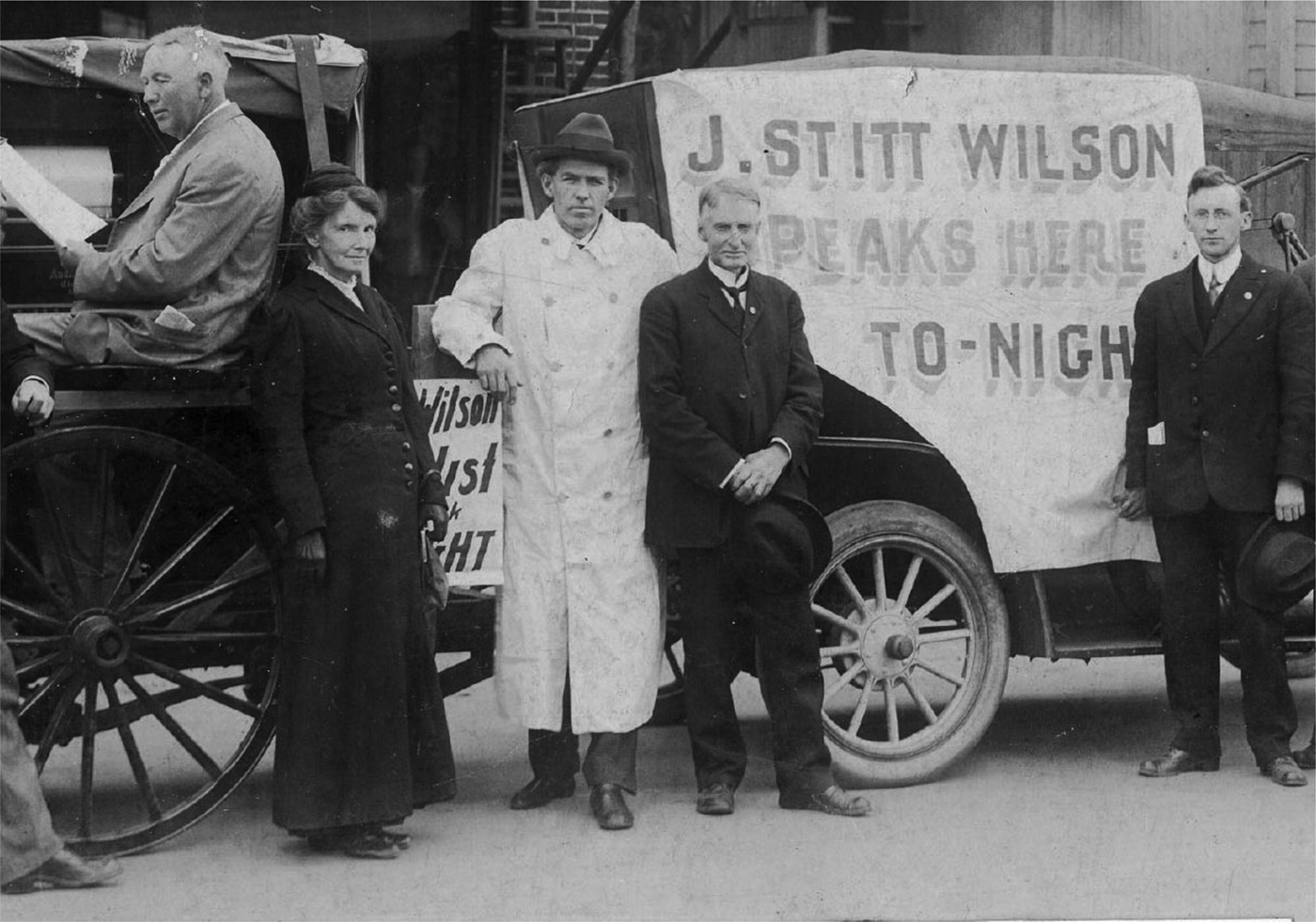
Selma, California, November 11, 1913. Stitt Wilson is in the center. On the left are A. M. Salyer 3rd and Martha Y. Salyer, both active in the Socialist Party. Martha Salyer was also active in the Women's Socialist Union of California and women's suffrage organizations. Photo courtesy of Kent Kanouse.
Over the next year, Wilson continued lecturing and giving Sunday socialist sermons in San Francisco; these remained his main sources of income. He spoke to socialist meetings throughout California, including a socialist women's conference in June 1913, where he called for equal pay for equal work and argued that women's self-realization was essential to the improvement of society as a whole.Footnote 80 He continued to appeal to women to vote for socialism as the only way to create a just society.Footnote 81
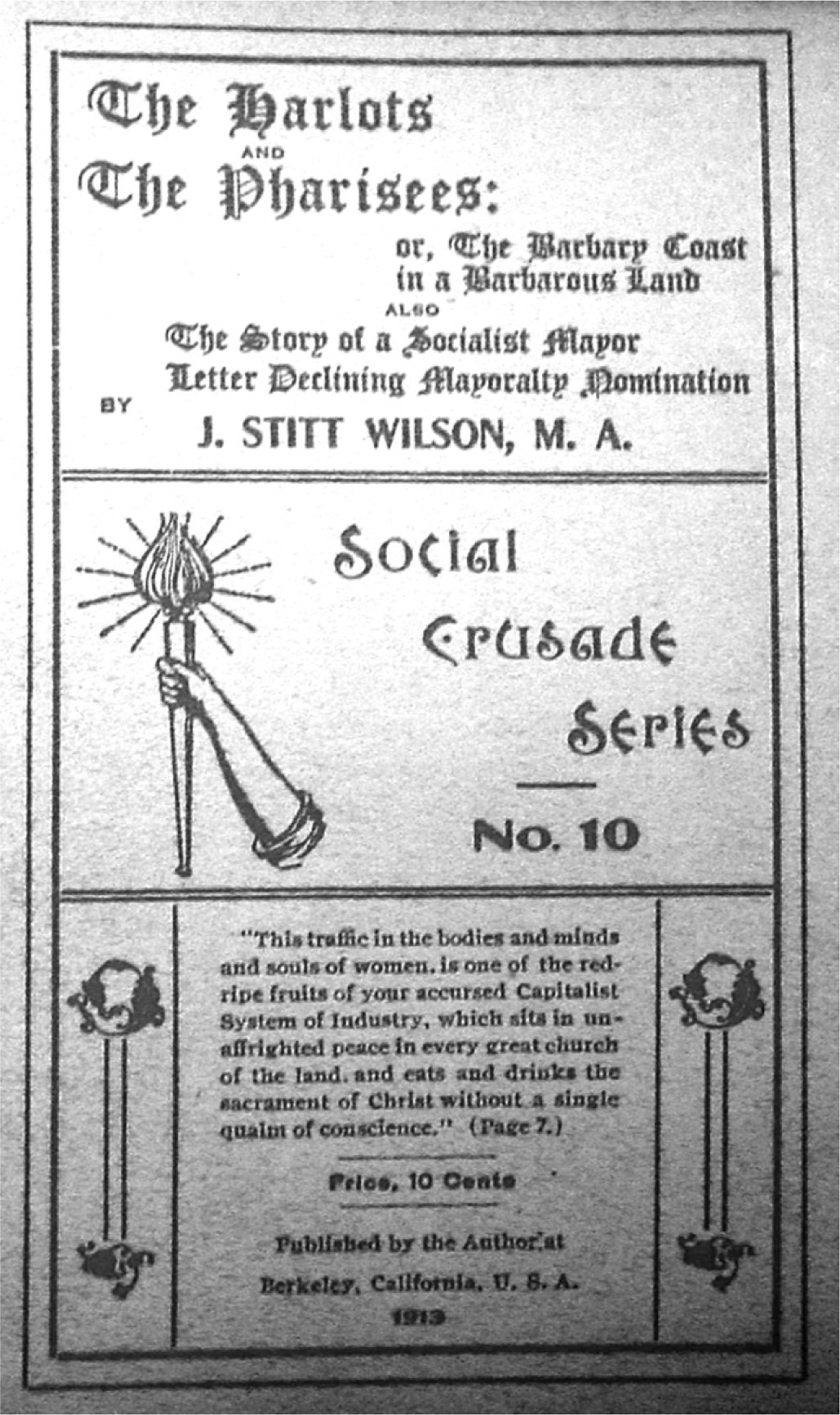
In the women's suffrage campaign, Wilson had worked closely with a broad coalition and made his arguments primarily based on equal rights for women rather than on his vision of a socialist society. He soon came into conflict with former allies, who, he felt, were simply proposing palliatives or attacks on symptoms, when fundamental change was needed. Once equipped with the vote, many of the women's organizations plunged into anti-vice campaigns of the moralistic sort that Wilson's Christian socialism led him to deplore.Footnote 82 In September 1913, Wilson responded with a scathing speech to his Sunday socialist congregation, published a month later as a pamphlet entitled The Harlots and the Pharisees: Or, the Barbary Coast in a Barbarous Land. Wilson ridiculed those engaged in the current campaign against San Francisco's vice district, “the Barbary Coast,” including some of the same people he had worked with during the suffrage campaign such as the women's clubs. He denounced his former speaking partner, the Congregational minister Charles Aked:
The order went forth: “The Barbary Coast must go.” Shouts of victory! The great task is accomplished—the addresses of some unfortunate women will be changed to some other part of the city—and—over five hundred little sisters—dancing girls—are to be thrown … upon the care of the clubwomen of San Francisco… . The Mayor of San Francisco, the editor of the Examiner, Dr. Chas. F. Aked, Prof. Barrows and all the others know in their heart of hearts that all this work is “making clean the outside of the cup.”Footnote 83
Wilson pointed out that most prostitutes come from the ranks of the poor and the unemployed and recounted in graphic terms the role of capitalists in holding down women's wages and generating poverty and unemployment. It was the very people engaged in this “clean-up spasm,” he insisted, who created and sustained the problem in the first place through their support for a system of exploitation of workers: “At the door of this legalized, church-sanctioned Capitalism I lay the crime of this social rape of woman in the twentieth century.”Footnote 84
Cover of the October 1913 pamphlet publication of Wilson's speech, “The Harlots and the Pharisees.” Author's collection.
This led to an acrimonious public exchange with Reverend Aked, who wrote a newspaper column that described Wilson's speech as “a sneer in three columns and a rant in the remaining two.” Aked expressed mystification that Wilson did not support this effort to cleanse the city, since “commercialized vice” was engaged in “crimes of capital—the crime of making profit out of the bodies and souls of women.”Footnote 85 Wilson countered by publicly asserting that Aked “does not wound me,” while reiterating that capitalism as a whole was a system for making a profit from destroying bodies and souls. The solution, he reiterated, was abolition of capitalism, because otherwise it would be impossible to eliminate this particular form of exploitation.Footnote 86 In 1917, as new anti-vice campaigns followed the previous ones, he again argued the necessity of systemic economic change, making “A Plea for Mary Magdalene.”Footnote 87
Around this time, Wilson shifted his main focus to education reform, publishing a pamphlet entitled Vocational Education and studying Montessori methods in the hope that the public education system could be used to develop the skills of cooperation and critical thinking on which a new, cooperative society could be built.Footnote 88 In the summer of 1915, Wilson, his wife Emma, and his younger daughter Violette all graduated from Maria Montessori's Third International Training Course for teachers, offered during the Panama Pacific Exposition in San Francisco.Footnote 89
Wilson also supported Violette in her protests against existing women's roles. Violette was strongly influenced by the bohemian Berkeley milieu in which the Wilson family lived, where the arts, theater, literature, mysticism, and spiritualism mixed with feminism and socialism.Footnote 90 She wore riding pants to protest local laws against wearing “clothes of the opposite sex” and entered and then dropped out of the University of California, claiming the institution stifled her individuality.Footnote 91 Ex-mayor Wilson endorsed her actions: “Violette … is a girl of the new type. … She has rebelled and her mother and I are heartily in sympathy with her.”Footnote 92
In 1913 he was elected to a two-year term on the Socialist Party's five-person National Executive Committee and in 1914 joined in two efforts to amend the California constitution. One was another initiative to allow local governments to use land value taxation, which received 42 percent of the vote. The other was prohibition of the sale of alcoholic beverages, which also failed to pass. In April 1915 he ran again for mayor of Berkeley on the Socialist slate, coming in second in a three-way race. He then lost the runoff with 4,517 votes to 7,308 for his opponent, businessman Samuel C. Irving. In fall 1915, he spent a month campaigning in support of an unsuccessful ballot measure for women's suffrage in New York State and did the same for Iowa's unsuccessful ballot measure in spring 1916.Footnote 93 As in California, his speeches emphasized human rights and justice for all.
As World War I began, Stitt Wilson joined the Socialist Party's efforts to have the United States stay out of the war and instead mediate an end to it. In January and February 1915, he gave a series of lectures on “Militarism and World Peace,” in which he drew on the work of Charlotte Perkins Gilman, attributing wars to “our androcentric culture,” while quoting Gilman that “in warfare per se we find maleness in its absurdest extremes.” Wilson stated that “the feminists are right” that to achieve world peace required “the full empowerment of women in affairs of state” and the creation of real “democracy, rule of the world by people, men and women” for “the common good.”Footnote 94 As late as November 1916 he helped lead local Socialist participation in a labor petition campaign for neutrality.Footnote 95 By February 1917, however, he had left the Socialist Party to support U.S. entry into World War I on the side of Great Britain and France to “make the world safe for democracy.”
He filed to run for mayor as an independent against Republican, Democratic, and Socialist Party candidates and this time was narrowly defeated in the runoff election with 6,147 votes to 6,272 for the incumbent Mayor Irving.Footnote 96 He spent the ensuing months using his rhetorical skills to sell war bonds. Personal tragedy struck again in September 1918, when his twenty-five-year-old son William Gladstone Wilson, who had assisted him as a driver in his campaigns and occasionally substituted for him at his Sunday socialist lectures, died in an airplane crash during pilot training in the U.S. Army Air Service.Footnote 97
In 1919, after the war ended, he returned to the Methodist Church and went to work for the Student Department of the International Committee of the Young Men's' Christian Association. For the next decade he traveled to colleges and universities around the country lecturing on the need for “Constructive Christian Democracy,” which he described as “the transformation of our whole economic life from the basis of mad competition and strife for profits to a basis of cooperation and mutual service.”Footnote 98 Although highly regarded for his ability to deliver “an unusually powerful address,” in the more conservative political climate of the 1920s, he was described as “an eccentric and saintly prophet.”Footnote 99
Among his popular lectures was “The Christ-Spirit in the Animal World,” an overview of evolutionary theory in which he argued that maternal love provided the basis for developing cooperation and mutual aid and that these, not competition, formed the real basis for survival and evolutionary progress in the animal kingdom and among people.Footnote 100 Notably lacking in this lecture, given after passage of the equal suffrage amendment to the U.S. Constitution, is any effort to link his analysis with specific policies or to any further proposals for equal rights for women. Instead, he ends by simply asking the students listening to him to pledge themselves to “stand up for the poor, the weak and the oppressed and do my part to establish Christian Democracy, especially in our industrial relations.” He did not give up on politics, however, and made several trips to England, where he spoke at campaign events for the Labor Party.Footnote 101
The Great Depression revived Stitt Wilson's hopes for more immediate change in the United States. The New York Times for September 19, 1931, reports that a conference of religious leaders was “stirred by J. Stitt Wilson” and joined him in calling for a “Socialization Plan.” He campaigned for his friend Upton Sinclair in his run for governor of California in 1934 and remained politically active until his death at his home in Berkeley in 1942 at the age of 74.
J. Stitt Wilson was immersed in several social movements that he believed had an underlying moral and social unity. Through the many speeches preserved in pamphlets, press reports, and proceedings, latter-day readers can see how he drew on and added to the accumulated efforts and creative thinking of other activists. He appealed to widely and deeply held beliefs such as Christianity, the value of motherhood, and democracy. These values, he stressed, could only be fully realized through a new way of life based on socialism and equality for women. He inspired many others to support these ideals.
When he was elected mayor of Berkeley, Stitt Wilson moved from general socialist evangelism to supporting specific reforms in state and local government intended to help build the cooperative commonwealth. His application of Henry George's analysis of urban land values to a socialist and feminist vision of the city as a “social mother” was a particularly creative integration of the ideas of three different movements in support of a specific reform. But after winning the vote in 1911, California's newly enfranchised women did not flock to the banners of either Georgism or socialism. The subsequent ballot measures that Wilson supported were unsuccessful, and he was never again elected to public office. After World War I, Wilson stepped back from the concrete issues of local and state politics and returned to his role as an evangelist for the cooperative commonwealth, continuing to the end his lifelong quest to build “a union of all who suffer, on behalf of themselves and a union of all who love, on behalf of all who suffer.”Footnote 102