The acquisition of language gives infants a powerful, uniquely human tool with which to interact with and learn about the world. Infants learn language in the context of social interactions with adults (Kuhl, Reference Kuhl2007), who scaffold language development through shared activities such as imitation and joint attention, which serve to facilitate infants’ attention to socially salient objects and activities in the environment (Baldwin, Reference Baldwin, Moore and Dunham1995; Bruner, Reference Bruner1983; Gergely, Egyed, & Kiraly, Reference Gergely, Egyed and Király2007). Growth in both receptive and expressive language is thought to stem from foundational social–communicative skills that develop in the first and second years of life, as infants increase the extent to which they engage in turn-taking play, share others’ focus of attention, and use gestures to express their needs and desires (Baldwin, Reference Baldwin, Moore and Dunham1995; Carpenter, Nagell, Tomasello, Butterworth, & Moore, Reference Carpenter, Nagell, Tomasello, Butterworth and Moore1998; McMurray, Reference McMurray2007).
Understanding the temporal relations between early-emerging social–communicative skills such as imitation and joint attention can inform our understanding of both typical and atypical development. Early behaviors and systems interact with, and build upon, one another in a developmental cascade that results in increasingly complex and sophisticated behavior patterns (e.g., Masten & Cicchetti, Reference Masten and Cicchetti2010; Rogers & Pennington, Reference Rogers and Pennington1991). While several studies have examined the longitudinal development of social–communicative and language skills in infants with typical development (TD infants; e.g., Bates, Benigni, Bretherton, Camaioni, & Volterra, Reference Bates, Benigni, Bretherton, Camaioni, Volterra, Lewis and Rosenblum1977; Carpenter et al., Reference Carpenter, Nagell, Tomasello, Butterworth and Moore1998), few have examined the temporal relation of different social–communicative behaviors over time to investigate how this sequencing might influence language development in both TD children and children with, or at risk for, autism spectrum disorder (ASD; Carpenter, Pennington, & Rogers, Reference Carpenter, Pennington and Rogers2002; Wu & Chiang, Reference Wu and Chiang2014). Identifying the developmental sequences that underlie language emergence has the potential to inform prevention and intervention approaches for the 1.5% of children in the United States who are diagnosed with ASD (CDC, 2014) and the 6%–7% of children in the United States who experience other communication disorders (Pinborough-Zimmerman et al., Reference Pinborough-Zimmerman, Satterfield, Miller, Bilder, Hossain and McMahon2007).
Children with ASD represent an ideal sample from which to learn about the development of language, because impairments in social communication represent a core diagnostic feature of ASD (American Psychological Association, 2013), and their language outcomes are diverse, with some children remaining nonverbal throughout their lives and others achieving verbal fluency (Hus, Pickles, Cook, Risi, & Lord, Reference Hus, Pickles, Cook, Risi and Lord2007; Lord, Risi, & Pickles, Reference Lord, Risi, Pickles, Rice and Warren2004). However, ASD is not typically diagnosed before 24 months (Turner & Stone, Reference Turner and Stone2007), whereas the “language burst” that occurs in TD infants occurs earlier, in the second year of life (Goldfield & Reznick, Reference Goldfield and Reznick1990; McMurray, Reference McMurray2007). As a result, attempts to examine the early developmental trajectories of social-communication and language have focused on infants at elevated risk for ASD by virtue of having an older sibling with an ASD diagnosis (i.e., high-risk [HR] infants). Recent large-scale prospective research has revealed that 7%–19% of HR infants receive an ASD diagnosis themselves (Grønborg, Schendel, & Parner, Reference Grønborg, Schendel and Parner2013; Ozonoff et al., Reference Ozonoff, Young, Carter, Messinger, Yirmiya and Zwaigenbaum2011), and an additional 20% demonstrate language or cognitive delays by 3 years of age (Messinger et al., Reference Messinger, Young, Ozonoff, Dobkins, Carter and Zwaigenbaum2013). The purpose of this longitudinal study is to identify the developmental pathway and temporal sequence in which social–communicative skills build on each other in the second year of life to support language emergence for HR infants compared with infants at average or low risk (LR) for ASD.
Imitating the actions of others (i.e., motor imitation) and responding to joint attention (RJA) are two important social–communicative behaviors that emerge from infants’ developing understanding that others are intentional agents (Tomasello, Reference Tomasello, Moore and Dunham1995). Impairments in both areas have been found in young children with ASD relative to those with TD or developmental delays (e.g., Mundy, Sullivan, & Mastergeorge, Reference Mundy, Sullivan and Mastergeorge2009; Stone, Ousley, & Littleford, Reference Stone, Ousley and Littleford1997). Infants begin to imitate simple, familiar actions with objects by 7–10 months (Carpenter et al., Reference Carpenter, Nagell, Tomasello, Butterworth and Moore1998) and reliably by 8–12 months (Jones, Reference Jones2007). Imitation is one of the earliest ways in which infants and adult partners interact reciprocally (Nadel, Guerini, Peze, & Rivet, Reference Nadel, Guerini, Peze, Rivet, Nadel and Butterworth1999), through back-and-forth bouts of smiles and actions (Ingersoll, Reference Ingersoll2008; McDuffie et al., Reference McDuffie, Turner, Stone, Yoder, Wolery and Ulman2007). The predictability of these early imitative interactions provides a platform for infants to learn about the relation between themselves and others (Meltzoff & Gopnik, Reference Meltzoff, Gopnik, Baron-Cohen, Tager-Flusberg and Cohen1993), as well as an opportunity to engage in early social interactions, which provide an ideal context for language learning. Motor imitation impairments have been found for groups of young children with ASD relative to both TD children and those with developmental delay (Siller & Sigman, Reference Siller and Sigman2008; Stone et al., Reference Stone, Ousley and Littleford1997; Young et al., Reference Young, Rogers, Hutman, Rozga, Sigman and Ozonoff2011); however, little is known about imitation abilities in HR infants as a group, despite their genetic liability for a range of developmental challenges.
RJA occurs when infants visually follow the direction of an adult's attention to an object or event (Mundy et al., Reference Mundy, Delgado, Block, Venezia, Hogan and Seibert2003); examples include tracking an adult's eye gaze, point, or vocalization to locate the target of the adult's attention. RJA typically begins to emerge around 9 months (Carpenter et al., Reference Carpenter, Nagell, Tomasello, Butterworth and Moore1998; Mundy et al., Reference Mundy, Block, Delgado, Pomares, van Hecke and Parlade2007), but does not become robust until 12–15 months of age (e.g., Ibañez, Grantz, & Messinger, Reference Ibañez, Grantz and Messinger2013; Mundy et al., Reference Mundy, Block, Delgado, Pomares, van Hecke and Parlade2007; Tomasello, Reference Tomasello, Moore and Dunham1995). Therefore, entering their second year of life, infants’ imitation abilities may be more well established than their RJA abilities. Impairment in RJA is a central feature of ASD, and group differences in RJA have been found for young children with ASD in comparison to TD children (Mundy et al., Reference Mundy, Sullivan and Mastergeorge2009) as well as those with developmental delay (Dawson et al., Reference Dawson, Toth, Abbott, Osterling, Munson and Estes2004). In addition, studies have found lower levels of RJA in HR infants compared to their LR counterparts in the second year (Presmanes, Walden, Stone, & Yoder, Reference Presmanes, Walden, Stone and Yoder2007; Sullivan et al., Reference Sullivan, Finelli, Marvin, Garrett-Mayer, Bauman and Landa2007), even after removing the children with a later ASD diagnosis from the HR group (Ibañez et al., Reference Ibañez, Grantz and Messinger2013).
Both motor imitation and RJA have been found to predict later expressive language in TD children, children with ASD, and HR infants. In children with ASD, motor imitation at age 2 was found to predict expressive language ability at age 4 (Stone & Yoder, Reference Stone and Yoder2001). In both HR and LR 12- to -24-month-old infants, growth in motor imitation predicted concurrent growth in expressive language (Young et al., Reference Young, Rogers, Hutman, Rozga, Sigman and Ozonoff2011). These findings support the hypothesis that imitation helps create a social context for language learning at the time when infants’ vocabularies are growing most rapidly. With respect to RJA, individual differences from 6 to 18 months were associated with later expressive language development at 2–3 years of age in TD children (Delgado et al., Reference Delgado, Peter, Crowson, Markus, Yale and Schwartz2002; Morales et al., Reference Morales, Mundy, Delgado, Yale, Messinger and Neal2000; Mundy et al., Reference Mundy, Block, Delgado, Pomares, van Hecke and Parlade2007). Individual differences in RJA in 2- to 4-year-old children with ASD also predicted language 2–4 years later (Sigman & Ruskin, Reference Sigman and Ruskin1999; Siller & Sigman, Reference Siller and Sigman2008). In addition, RJA at 15 months was found to predict expressive language concurrently for HR infants (Presmanes et al., Reference Presmanes, Walden, Stone and Yoder2007), and to age 5 for both HR and LR infants (Malesa et al., Reference Malesa, Foss-Feig, Yoder, Warren, Walden and Stone2012). These findings support the idea that by following adults’ attentional focus, infants are more likely to attend to the objects that caregivers are labeling, thus facilitating language development (Baldwin, Reference Baldwin, Moore and Dunham1995).
While motor imitation and RJA both predict later expressive language in HR and LR infants, it is not yet clear how imitation and RJA may be linked to each other throughout early development and how they may interact longitudinally to predict language. Studies have found concurrent relations between motor imitation and RJA in young children with ASD, but not for TD children (McDuffie et al., Reference McDuffie, Turner, Stone, Yoder, Wolery and Ulman2007; Rogers, Hepburn, Stackhouse, & Wehner, Reference Rogers, Hepburn, Stackhouse and Wehner2003). Given some theoretical and empirical findings, a mediation model of development is proposed in which motor imitation development sets the stage for growth in RJA, which mediates the relation between motor imitation and expressive vocabulary (EV). Early imitative play involves infants’ and caregivers’ shared attention to objects (Ingersoll, Reference Ingersoll2008; Toth, Munson, Meltzoff, & Dawson, Reference Toth, Munson, Meltzoff and Dawson2006), which may be essential for conveying the social and learning value of following others’ attentional cues. It is possible that infants’ imitation of adults may facilitate and reinforce the development of RJA (McDuffie et al., Reference McDuffie, Turner, Stone, Yoder, Wolery and Ulman2007); imitation is likely to provide experiences that facilitate increased understanding of what others are attending to, which may scaffold the development of RJA (Tomasello, Reference Tomasello, Moore and Dunham1995). Supporting this directionality are findings that imitation develops before RJA (Mundy et al., Reference Mundy, Block, Delgado, Pomares, van Hecke and Parlade2007; Nadel et al., Reference Nadel, Guerini, Peze, Rivet, Nadel and Butterworth1999) and that training in motor imitation can increase RJA and spontaneous expressive language abilities in 2- to 4-year-old children with ASD (Ingersoll & Schreibman, Reference Ingersoll and Schreibman2006). In addition, a combined measure of initiating and RJA was found to mediate the relation between imitation and conversational skill when all abilities were measured concurrently in 5-year-old, TD children (Farrant, Maybery, & Fletcher, Reference Farrant, Maybery and Fletcher2011).
Given that studies have found associations that differ by ASD diagnosis and risk status when measuring imitation, RJA, and language concurrently (Carpenter et al., Reference Carpenter, Pennington and Rogers2002; Wu & Chiang, Reference Wu and Chiang2014), infants’ risk for ASD will be examined as a moderator in this mediation model. Empirical findings are mixed as to whether associations among imitation, RJA, and expressive language will be stronger or weaker for HR infants. While some studies have found that imitation and later language were associated for children with ASD (Charman, Baron-Cohen, Swettenham, Drew, & Cox, Reference Charman, Baron-Cohen, Swettenham, Drew and Cox2003; Stone et al., Reference Stone, Ousley and Littleford1997; Stone & Yoder, Reference Stone and Yoder2001) and for both HR and LR children (Young et al., Reference Young, Rogers, Hutman, Rozga, Sigman and Ozonoff2011), another study found that imitation was related to concurrent language for TD children but not children with ASD (Rogers et al., Reference Rogers, Hepburn, Stackhouse and Wehner2003). In the second year, one study found that 15-month RJA and 5-year expressive language were associated for both HR and LR children (Malesa et al., Reference Malesa, Foss-Feig, Yoder, Warren, Walden and Stone2012), while another study found that 12- to 23-month RJA and language were concurrently associated for HR children but not LR children (Presmanes et al., Reference Presmanes, Walden, Stone and Yoder2007).
In summary, this study examines the role of RJA as a potential mediator of the relation between motor imitation ability and later expressive language ability in 12- to 18-month-old infants at HR and LR for ASD. It is hypothesized that RJA at 15 months will mediate the association between motor imitation ability at 12 months and EV at 18 months for both HR and LR infants. It is further hypothesized that the indirect effect and direct effect of mediation will be conditional on risk group (i.e., moderation), but the direction of this moderation (e.g., stronger associations in HR or LR infants) is exploratory due to mixed previous findings. This study is the first to examine the sequential contribution of early skills to later language ability in HR and LR infants using a prospective, longitudinal design.
Method
Participants
The initial sample comprised 112 infants recruited into a longitudinal, prospective multisite study investigating the social and emotional development of HR infants and LR infants at (University of Washington, Vanderbilt University, and University of Miami). HR and LR participants were recruited through research centers, clinics, local pediatric offices, and the greater community. Inclusion criteria for both groups included (a) enrollment age between 6 and 12 months; (b) an older sibling >36 months of age; (c) gestational age ≥37 weeks; (d) birth weight at least 2500 g; (e) the absence of severe sensory or motor impairments; and (f) the absence of identified metabolic, genetic, or progressive neurological disorders. For the HR group, the diagnosis of ASD in the older sibling was verified using the Autism Diagnostic Observation Schedule (Lord et al., Reference Lord, Risi, Lambrecht, Cook, Leventhal and DiLavore2000), the Autism Diagnostic Interview—Revised (Rutter, Le Couteur, & Lord, Reference Rutter, Le Couteur and Lord2003), and clinical diagnosis based on DSM-IV (American Psychological Association, 2000). For the LR group, additional requirements were (a) no reported family history of ASD in first-, second-, or third-degree relatives, and (b) a score below 9 on the Social Communication Questionnaire for all older siblings in the family (Rutter, Bailey, & Lord, Reference Rutter, Bailey and Lord2003).
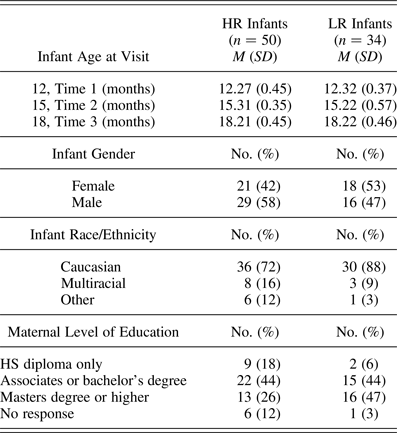
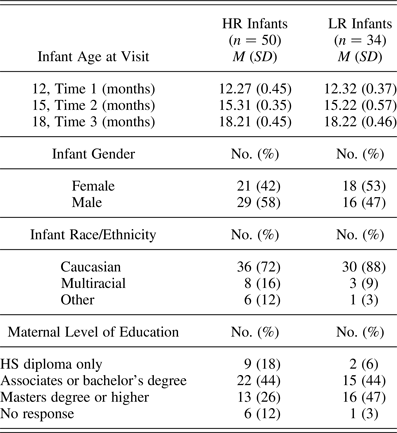
For the present study, an additional inclusion criterion was the availability of data on imitation, RJA, and EV at 12, 15, and 18 months. This criterion reduced the group size to 50 HR and 34 LR infants. Demographic characteristics of the sample are presented in Table 1. No risk group differences were found for maternal education level or for infants’ race/ethnicity, sex, or age at study visits. Most infants had mothers who were Caucasian (72%) and college educated (70%).
Demographic characteristics of the sample
Procedure
Institutional review board approval was obtained from both sites, and all parents provided informed consent prior to participation in research procedures. Infants participated in 1- to 2-hr assessments in the lab at 12, 15, and 18 months. Parents held infants in their laps or sat a short distance away while experimenters administered behavioral measures. Motor imitation was measured at 12 months; RJA at 12 and 15 months; and EV at 12, 15, and 18 months.
Measures
Screening Tool for Autism in Toddlers (STAT)
Motor imitation ability was assessed at 12 months using the motor imitation domain score on the STAT. The STAT is a 20-min play-based assessment with activities in four domains: play, requesting, directing attention, and motor imitation, designed to identify 2-year-olds at risk for ASD (Stone, Coonrod, & Ousley, Reference Stone, Coonrod and Ousley2000; Stone, Coonrod, Turner, & Pozdol, Reference Stone, Coonrod, Turner and Pozdol2004). The STAT is administered by trained examiners with established fidelity, and is scored “live.” Strong psychometric properties have been reported (Stone et al., Reference Stone, Coonrod, Turner and Pozdol2004), and a preliminary screening cutoff score has also been identified for children as young as 14 months (Stone, McMahon, & Henderson, Reference Stone, McMahon and Henderson2008). In addition to its use as an ASD screener, individual domain scores from the STAT have been used to assess specific social–communicative behaviors, including motor imitation (e.g., Presmanes et al., Reference Presmanes, Walden, Stone and Yoder2007; Stone, McMahon, Yoder, & Walden, Reference Stone, McMahon, Yoder and Walden2007; Wu & Chiang, Reference Wu and Chiang2014).
The motor imitation domain comprises four items: shaking a rattle, rolling a car back and forth, banging hands alternately on the table, and hopping a small toy animal across the table. For each item, an examiner performs a distinct action and encourages the child to imitate by saying, “You do it” or “Your turn.” The infant receives up to three opportunities to imitate each item, and the best response for each item is scored live as a “pass” (1 point) or “fail” (0 points). Motor imitation scores range from 0 to 4, with higher scores indicating more successful imitation responses.
Early Social Communication Scales (ESCS)
RJA was assessed at 12 and 15 months using infants’ scores on the gaze following task of the ESCS (Mundy et al., Reference Mundy, Delgado, Block, Venezia, Hogan and Seibert2003). The subscale has established validity as a measure of RJA (Mundy, Sigman, & Kasari, Reference Mundy, Sigman and Kasari1994). The gaze following task consists of eight trials. During each trial, infants were seated in the laps of their caregivers at a table across from an experimenter. The experimenter said the name of the infant three times while pointing to one of four colorful posters around the room; four trials (one to each poster) were administered during two blocks that occurred at different times during the ESCS administration. If the infant turned and looked at the poster to which the experimenter was pointing, RJA was coded as a “pass” for that trial. Scores on the gaze following task range from 0 to 8, with higher scores indicating more frequent RJA. RJA was coded from videotapes by two independent trained coders. Interobserver reliability, as indexed by absolute intraclass correlations (ICCs), was excellent at both 12 months (ICC = 0.94) and 15 months (ICC = 0.98).
MacArthur–Bates Communicative Development Inventories (MCDI)
EV was assessed at 12, 15, and 18 months using the “words said” subscale of the MCDI (Fenson et al., Reference Fenson, Marchman, Thal, Dale, Reznick and Bates2007). The MCDI is a well-validated parent checklist consisting of 396 vocabulary words. Parents endorsed words that their child could both understand and say. The number of words endorsed was the variable of interest.
Analytic plan
Preliminary analyses
Variables were measured at equal time intervals (i.e., 3-month intervals), which facilitated unbiased mediation estimates (Cole & Maxwell, Reference Cole and Maxwell2003). Analyses were conducted in order to ascertain that participants excluded because of missing data did not differ from included participants on any of the variables of interest; that is, the analyses assessed whether data were missing completely at random (MCAR; Schafer & Graham, Reference Schafer and Graham2002). Risk group differences in 12-month motor imitation were analyzed using an independent samples t test. Risk group differences over time for RJA between 12 and 15 months and EV at 12, 15, and 18 months were analyzed using mixed-design analyses of variance (ANOVAs), with risk group as the between-subjects factor and time point as the within-subjects factor. Maternal education, race/ethnicity, and gender were not significantly associated with the 18-month EV outcome, and no risk group differences were found; therefore, these variables were not included as covariates in the models.
Infants’ 12-month early learning composite score (M = 105.53; SD = 11.49) on the Mullen Scales of Early Learning (Mullen, Reference Mullen1995) was examined to determine whether the risk groups differed in cognitive ability and whether cognitive ability was associated with the developmental skills assessed. Infants’ cognitive ability did not differ for HR compared to LR infants, t (81) = –1.61, p > .05. Cognitive ability was not associated with 12-month motor imitation or 15-month RJA for HR or LR infants, but it was associated with 18-month EV for HR infants, r (82) = .36, p < .01. Based on this finding, 12-month cognitive ability was included in the mediation analyses. However, within the initial models, cognitive ability did not predict 15-month RJA or 18-month EV, and it did not affect the mediation results. Therefore, it was not included in the final models, presented below.
Mediation analyses
It was hypothesized that infants’ motor imitation at 12 months would predict their 18-month EV indirectly through their RJA ability at 15 months. This indirect effect was calculated using two separate multiple regression models using the PROCESS macro (Hayes, Reference Hayes2013). One model was conducted to assess the effect of the predictor (12-month motor imitation) on the mediator (15-month RJA; Path a), and the second model assessed the effect of 15-month RJA on the outcome (18-month EV), controlling for 12-month motor imitation (Path b). The indirect effect is the product of the regression coefficients a and b. The direct effect (Path c’) is the relation between motor imitation and EV that remains after calculating the indirect effect. The predictor and mediator variables were centered prior to inclusion in the model.
The levels of the mediator and outcome at earlier ages (infants’ RJA at 12 months and infants’ EV at 12 and 15 months) were centered and included as covariates in the mediation model. This step controlled for previous levels of RJA and vocabulary and allowed a closer analysis of how the early skills of imitation and RJA work together to affect later language, above and beyond the predictive effect of language on itself over time (Cole & Maxwell, Reference Cole and Maxwell2003; Maxwell, Cole, & Mitchell, Reference Maxwell, Cole and Mitchell2011; Selig & Preacher, Reference Selig and Preacher2009). The final model assessed whether motor imitation at 12 months affected later growth in RJA from 12 to 15 months, which then affected EV at 18 months. Risk group (HR vs. LR infants) was tested as a potential moderator of the indirect and direct effect.
Bootstrapping with bias-corrected confidence intervals (10,000 samples) was used to generate the most accurate estimate of the indirect effect and evaluate its significance (Cole & Maxwell, Reference Cole and Maxwell2003; Hayes, Reference Hayes2013; MacKinnon, Fairchild, & Fritz, Reference MacKinnon, Fairchild and Fritz2007; Preacher, Rucker, & Hayes, Reference Preacher, Rucker and Hayes2007).
Results
Preliminary analyses
Missing data
The following percentages of data were missing for each variable of interest in the original 112-participant sample: 12-month motor imitation: 4.5%; 12-month RJA: 15.2%; 12-month EV: 3.6%; 15-month RJA: 17.0%; 15-month EV: 6.3%; and 18-month EV: 6.3%. Analyses were conducted to determine whether data from the full sample were MCAR. Missing values for 18-month EV were not associated with infants’ 12- and 15-month RJA, 12-month motor imitation, sex, risk group, or maternal education (ps > .05). Infants’ 12- and 15-month EV also did not predict the presence of a missing value for 18-month EV (ps > .05). Infants included in the final sample of 84 did not differ from the original 112-participant sample on any of the model variables (ps > .05). These analyses suggested that data in the original 112-infant sample were MCAR. Therefore, all subsequent analyses were conducted on the final sample, which comprised 84 infants with data on all model variables.
Risk group differences
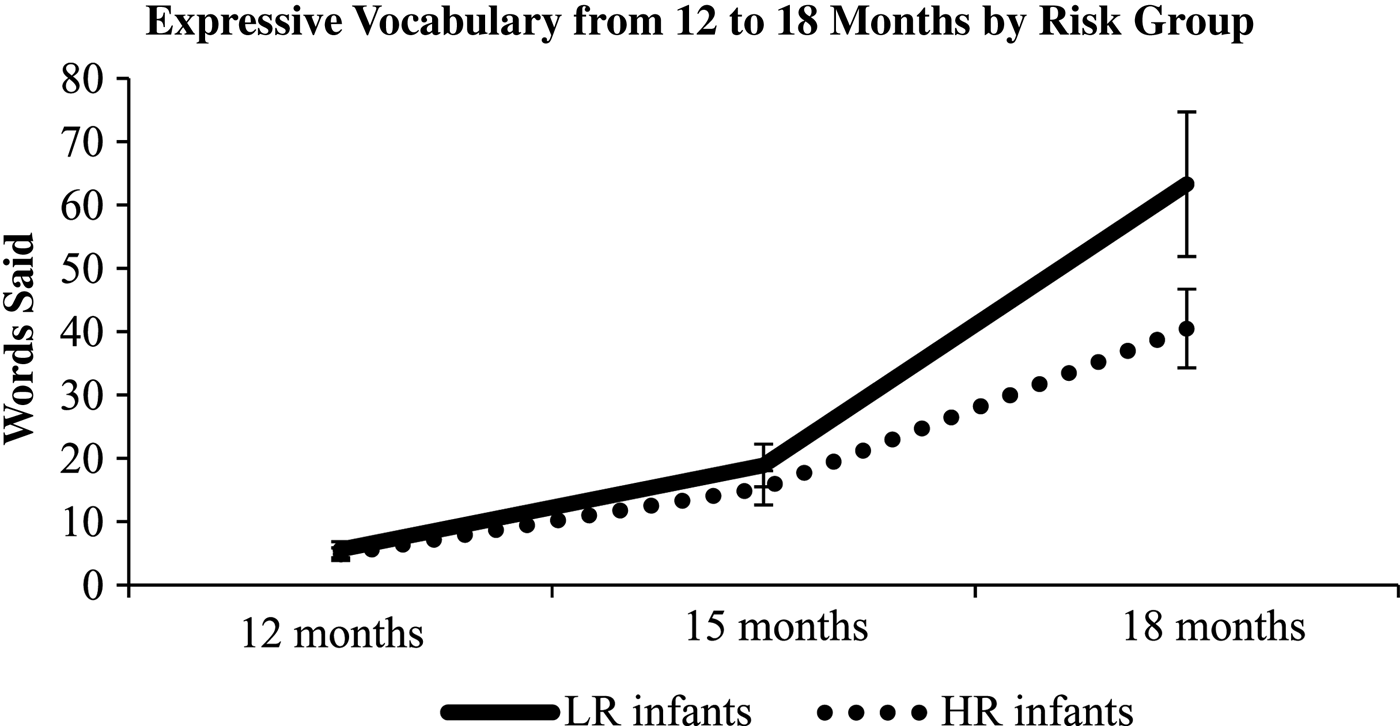
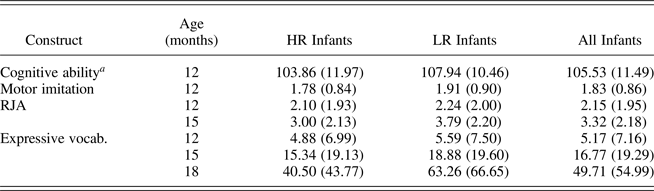
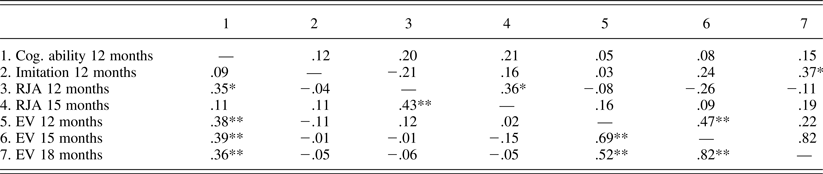
Means and standard deviations for study variables at each time point are presented in Table 2. Pearson product-moment zero-order correlations between study variables by ASD risk group are presented in Table 3. The t tests revealed no group differences between HR and LR infants for motor imitation at 12 months, t (82) = –0.69, p > .05. A mixed-design ANOVA (Age × Risk Group) for RJA revealed no significant main effect of risk group, F (1, 82) = 1.48, p > .05, and a significant main effect of time; RJA increased between 12 and 15 months, F (1, 82) = 23.84, p < .001. No interaction between risk group and time was found for RJA, F (1, 82) = 1.71, p > .05. A second mixed-design ANOVA (Age × Risk Group) for EV revealed no significant main effect of risk group, F (1, 82) = 2.97, p > .05, and a significant main effect of time; EV increased between 12 and 18 months, F (1.08, 88.32) = 62.15, p < .001. Post hoc analyses using a Bonferroni correction revealed that infants’ EV grew significantly at each time point: from 12 to 15 months, t (83) = –6.63, p < .001, from 15 to 18 months, t (83) = –7.33, p < .001, and from 12 to 18 months, t (83) = –7.72, p < .001. The results for both ANOVAs were reported using the Greenhouse–Geisser correction for violation of sphericity. The interaction between risk group and time for EV approached significance, F (1.08, 88.32) = 3.81, p = .05 (see Figure 1).
Expressive vocabulary growth over time. Error bars represent ±1 SE of the mean. LR, Low risk; HR, high risk.

Means (SD) for study variables
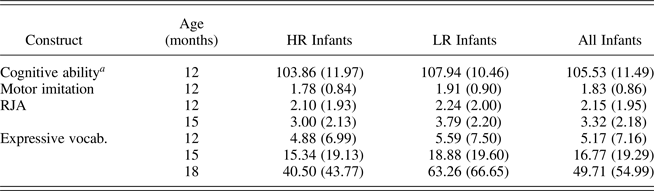
Note: HR, High risk; LR, low risk; RJA, responding to joint attention.
a Cognitive ability was assessed using the Mullen Scales of Early Learning (Mullen, Reference Mullen1995) Early Learning Composite.
Correlations among study variables
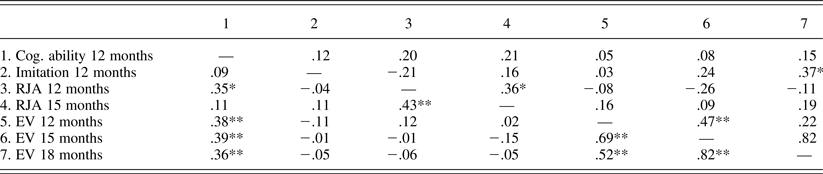
Note: Correlations for low-risk infants are above the diagonal on the upper right, and correlations for high-risk infants are below the diagonal on the lower left. Cog., Cognitive; Imitation, motor imitation; RJA, responding to joint attention; EV, expressive vocabulary.
*p < .05. **p < .01.
Mediation
Model 1: Indirect and direct effects across all infants
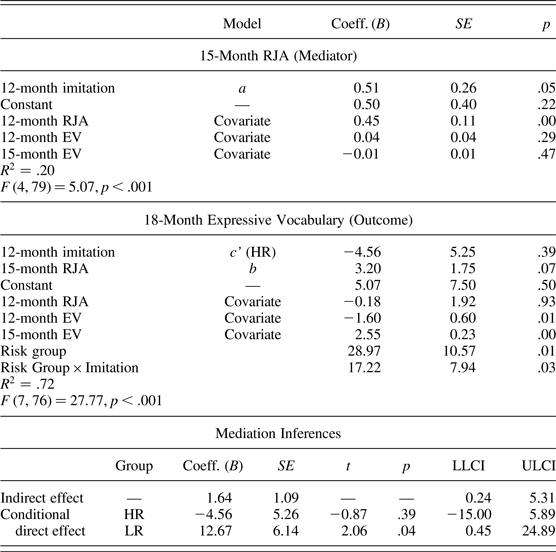
As hypothesized, 12-month motor imitation positively predicted 12- to 15-month RJA growth (Path a) for all infants, B = 0.51, p = .05, and 15-month RJA positively predicted subsequent growth in EV from 15 to 18 months (Path b), B = 3.95, p = .03. The indirect effect, ab = 2.03, indicated that for each additional item infants imitated on the STAT at 12 months, parents reported they could say an average of 2.03 more words at 18 months as a result of 12-month imitation's influence on 15-month RJA, which in turn affected 18-month EV, 95% confidence interval (CI) = (0.34, 6.30). The direct effect was not significant, B = 2.89, 95% CI = (–5.46, 11.23). The total effect was also not significant, B = 4.91, 95% CI = (–3.43, 13.25).
Model 2: Conditional effects by risk group
To assess whether the indirect or direct effects of the model were conditional on risk group, Risk Group × RJA and Risk Group × Imitation interaction terms were estimated. Neither interaction term was significant (ps > .05), indicating that ASD risk did not moderate the indirect effect of 12-month motor imitation on 18-month EV through 15-month RJA. However, the direct effect of 12-month motor imitation on 18-month EV controlling for 15-month RJA (Path c’), did vary by risk group; the direct effect was significant for LR infants, B = 12.46, 95% CI = (0.45, 24.82), but not HR infants, B = –4.43, 95% CI = (–14.97, 6.11).
Final model
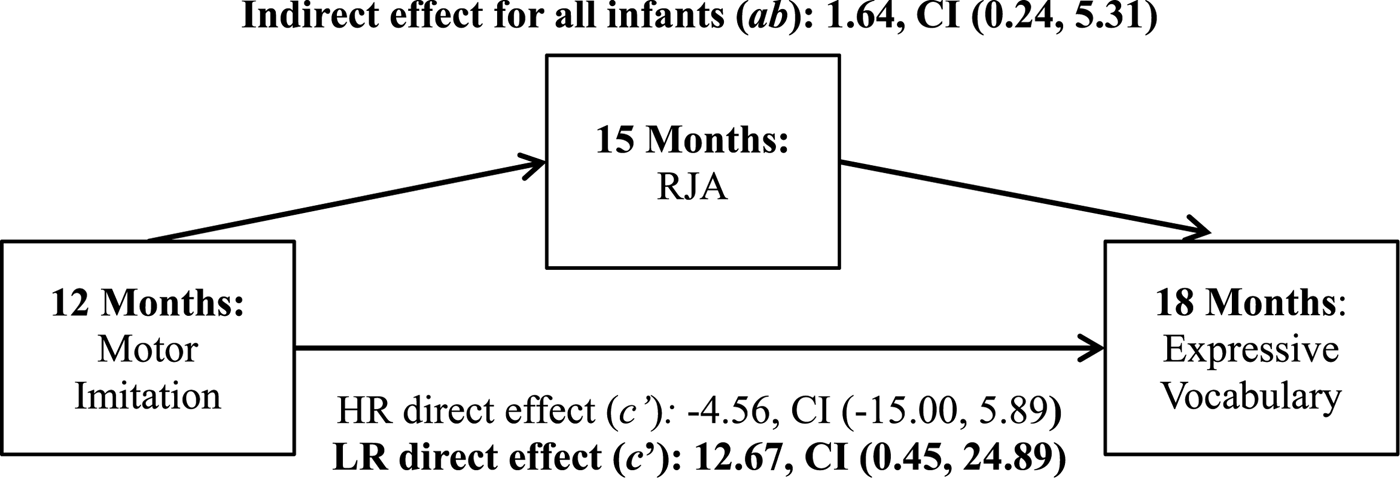
A parsimonious final model was estimated incorporating the significant effects of previous modeling. The final model included a significant nonconditional indirect effect (that did not vary by risk group) and a significant direct effect that was conditional by risk group; see Table 4 and Figure 2. In this model, the indirect effect (ab) equaled 1.64 with a 95% CI of (0.24, 5.31), and for each additional item, infants imitated at 12 months, parents reported they could say an average of 1.64 more words at 18 months.
Final mediation model: Conditional indirect effect for all infants. The indirect effect is significant across all infants, whereas the direct effect is significant for low-risk but not high-risk infants. Values are unstandardized regression coefficients. Significant effects are indicated in bold. CI, Confidence interval; RJA, responding to joint attention; HR, high risk; LR, low risk.
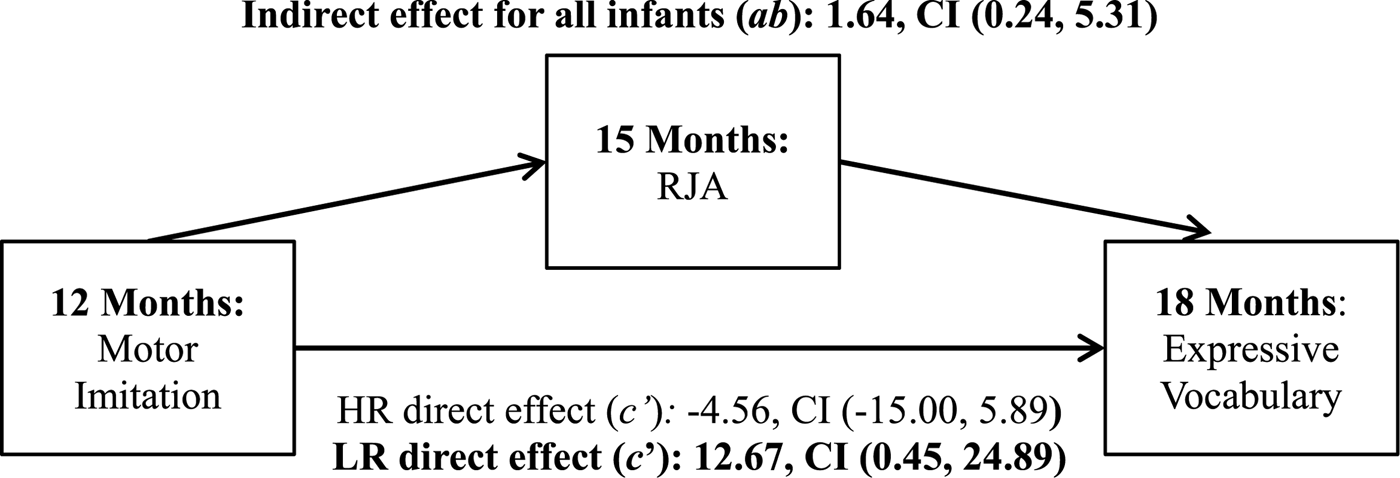
Indirect effect in all infants and direct effect conditional on risk group for the final model
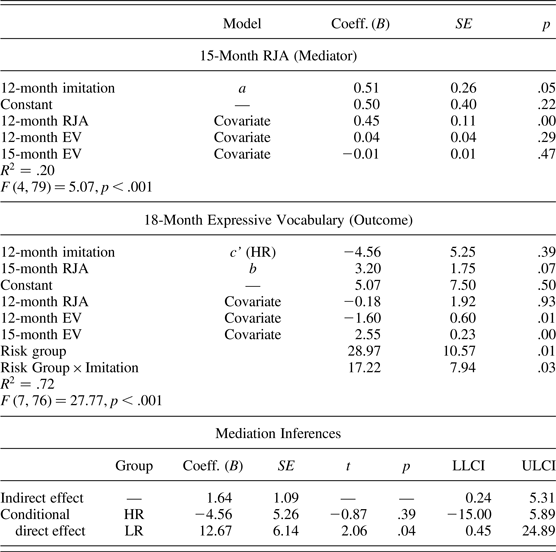
Note: RJA, responding to joint attention; Imitation, motor imitation; EV, expressive vocabulary; HR, High risk; LR, low risk; LLCI, lower limit of 95% confidence interval; ULCI, upper limit of 95% confidence interval. Risk group coded as 0 = HR, 1 = LR.
The direct effect was moderated by risk group; a conditional direct effect was present such that there was a significant direct effect for LR infants, B = 12.67, 95% CI = (0.45, 24.89), but for not for HR infants, B = 1.00, 95% CI = (–15.00, 5.89). Further, the 12-month Imitation × Risk Group interaction term significantly predicted 18-month EV, B = 17.22, p < .05, indicating that the strength of these effects were significantly different. For each additional item that LR infants imitated at 12 months, parents reported they could say 12.67 more words on average at 18 months, above and beyond the indirect effect. For HR infants, however, there was no significant direct effect of 12-month motor imitation on 18-month EV; the indirect effect of motor imitation on EV through RJA comprised the only relation. In addition, the second regression model with 18-month EV as the outcome variable and 12-month imitation, 12- and 15-month RJA, 12- and 15-month EV, and risk group as predictors had an R2 of .72; see Table 4 and Figure 2.
In the final model, the nonconditional indirect effect of ab = 1.64 had a small standardized effect size of b = 0.03, while the conditional direct effect for LR infants of B = 12.67 had a relatively larger standardized effect size of b = 0.17 (Hayes, Reference Hayes2013).
Discussion
This study examined a potential developmental pathway through which basic social–communicative skills impact later language ability for infants at LR and HR for ASD during the first 18 months of life. Specifically, it was hypothesized that infants’ 12-month motor imitation affected their 18-month EV indirectly through 15-month RJA. This indirect effect was hypothesized to be conditional on ASD risk, with different patterns of relations observed between HR and LR infants. Zero-order correlations between scores of motor imitation, RJA, and EV at 12–18 months were largely nonsignificant. However, mediation analyses examining the effect of 12-month motor imitation on 12- to 15-month growth in RJA and 15- to 18-month growth in EV yielded significant results.
As hypothesized, motor imitation ability at 12 months predicted growth in EV from 15 to 18 months indirectly through growth in RJA ability from 12 to 15 months, as indicated by the significant indirect effect for all infants. Imitation may be indirectly related to expressive language through RJA because (a) imitating others reflects and/or fosters social interest that facilitates the development of RJA, a more sophisticated social–communicative skill (Ingersoll, Reference Ingersoll2008; McDuffie et al., Reference McDuffie, Turner, Stone, Yoder, Wolery and Ulman2007), and (b) infants who are following an adult's attention to an object may more readily learn the label for that object (Ahktar, Carpenter, & Tomasello, Reference Ahktar, Carpenter and Tomasello1996; Baldwin, Reference Baldwin, Moore and Dunham1995; Morales et al., Reference Morales, Mundy, Delgado, Yale, Messinger and Neal2000; Walton & Ingersoll, Reference Walton and Ingersoll2013). Regardless of infants’ risk for ASD, early imitation led to higher levels of later expressive language in part through their intermediate RJA behaviors. The fact that this developmental pathway exists across LR and HR infants further supports the hypothesis that basic social–communicative skills interact to build more complex communicative behaviors such as language (e.g., Baldwin, Reference Baldwin, Moore and Dunham1995; Carpenter et al., Reference Carpenter, Nagell, Tomasello, Butterworth and Moore1998).
There are several implications of the similar developmental pathway observed across all infants in the form of the indirect effect. First, it suggests that motor imitation and RJA would both be appropriate targets for intervention. Second, it suggests the importance of offering intervention for RJA and imitation as early as possible for HR infants, even before a potential ASD diagnosis. Early ASD-specialized intervention is associated with improvements in social, cognitive, and adaptive functioning (Dawson et al., Reference Dawson, Jones, Merkle, Venema, Lowy and Faja2012; Rogers & Vismara, Reference Rogers and Vismara2008). Early deficits in social–communicative skills are often found in children who are later diagnosed with ASD, and they may narrow infants’ opportunities to learn from their environment, causing a cascade of impairments (Zwaigenbaum et al., Reference Zwaigenbaum, Bryson, Rogers, Roberts, Brian and Szatmari2005). Interventions for imitation (RIT; Ingersoll, Reference Ingersoll2012) and joint attention (JASPER; Goods, Ishijima, Chang, & Kasari, Reference Goods, Ishijima, Chang and Kasari2013) have already been developed for older children with ASD, but may need to be adapted for use with infants who are at risk, even before they show signs of ASD. Interventions designed to promote RJA development might be especially beneficial for young children at risk for ASD, given that motor imitation may promote later expressive language only indirectly, through RJA, for these children. Interventions targeting skills that are building blocks of imitation and RJA even earlier in development, such as infants’ understanding of others as intentional, gaze shifting, and motor development, may also be effective. It is important to consider that, because motor imitation and RJA develop within a similar time window and both are expressions of infants’ understanding of others’ actions (Tomasello, Reference Tomasello, Moore and Dunham1995), motor imitation and RJA may affect each other in a transactional manner across development as they contribute to later expressive language.
The second hypothesis, that there would be moderation of the indirect and direct effects by ASD risk group, was partially supported. The direct effect of 12-month motor imitation on growth in 18-month EV was moderated by risk group such that the direct effect was significant for LR infants but was nonsignificant for HR infants. This finding did not support the study's hypothesis that both indirect and direct effects would be moderated by ASD risk. There are several possible explanations for this result. The sample size is relatively small when split by risk group (HR = 50, LR = 34), and this small sample size decreases the likelihood that moderation of any effect (direct or indirect) will be found. In particular, there may not have been sufficient power for the model to identify an indirect effect by risk group. The indirect effect had a very small effect size (β = 0.03), while the direct effect had a slightly larger effect size (β = 0.17), making it less likely that we would find moderation of the indirect effect compared to the direct effect.
In addition, for HR infants, RJA may function as a gateway (or barrier) between early imitation and later language. For HR infants, imitation may be most useful for language precisely because it increases infants’ RJA (e.g., Ingersoll, Reference Ingersoll2008). Joint attention is often impaired in children with ASD, and joint attention has been longitudinally associated with social–communicative outcomes for children with ASD, including language (e.g., Anderson et al., Reference Anderson, Lord, Risi, DiLavore, Shulman and Thurm2007; Charman, Reference Charman2004; Mundy et al., Reference Mundy, Sullivan and Mastergeorge2009). RJA is thought to be a “pivotal” skill for children with ASD, and it may also be pivotal for HR infants. In contrast, TD infants’ language may benefit from imitation more directly or through skills other than RJA.
It is also possible that other variables, not measured in this study, account for the relation between motor imitation and language learning. One potential mediator is infants’ use of gesture. Imitation routines help infants learn gestures (e.g., waving “bye-bye” with parents) that scaffold language (McDuffie et al., Reference McDuffie, Turner, Stone, Yoder, Wolery and Ulman2007). Gesture use has been found to relate to later language for both LR infants and HR infants in the second year of life (e.g., Parladé & Iverson, Reference Parladé and Iverson2011), and HR infants have been found to use gestures less frequently than LR infants (Stone et al., Reference Stone, McMahon, Yoder and Walden2007). As a consequence, HR infants may receive less information related to their focus of attention. Infants’ use of gesture may also help adults tailor their verbal input to be more relevant; for example, an infant who points to an object will likely receive a reply related to that object (e.g., Golinkoff, Reference Golinkoff1986), and adults’ replies to infants’ pointing may relate to their later language (e.g., Goldin-Meadow, Goodrich, Sauer, & Iverson, Reference Goldin-Meadow, Goodrich, Sauer and Iverson2007). Future work could include gesture use in a more comprehensive model estimating the temporal contributions of many early social skills to later language.
A direct effect of imitation on EV for LR infants and not HR infants may have been found because of the way in which motor imitation was operationalized in this study. Early imitation is thought to have two main functions: to increase social reciprocity and to help children learn through example (Uzgiris, Reference Uzgiris1981). For LR infants, imitation may enrich the overall interactivity of their social interactions directly, by leading to more engagement and more frequent interactions that foster language, as well as indirectly, by acting through RJA. In contrast, it may be the case that HR infants benefit primarily from the learning function of imitation, rather than from the social reciprocity function, and as such could learn to imitate actions (especially those of functional relevance to them) but may not avail themselves of the social function, which might be the link to learning language. Using measures of imitation that have a greater number of validated, diverse items (e.g., Young et al., Reference Young, Rogers, Hutman, Rozga, Sigman and Ozonoff2011) and that capture qualitative differences in early imitation-related social versus learning functions (e.g., Ingersoll, Reference Ingersoll2012), imitative style (Hobson & Hobson, Reference Hobson and Hobson2008), or intention understanding (Meltzoff, Reference Meltzoff2007) could further elucidate the role of imitation in later expressive language for infants at HR compared to LR for ASD.
In contrast to previous studies that have studied older children (i.e., preschoolers) with ASD (e.g., Ingersoll & Meyer, Reference Ingersoll and Meyer2011; McDuffie, Yoder, & Stone, Reference McDuffie, Yoder and Stone2005; Stone & Yoder, Reference Stone and Yoder2001; Toth et al., Reference Toth, Munson, Meltzoff and Dawson2006), this study found that for children at risk for ASD, there was no significant direct effect between 12-month motor imitation and 18-month EV. One possible explanation for this finding is that imitation in HR infants younger than 12 months may more strongly affect language outcome, while in older children, social–communicative skill deficits may have persisted and stabilized and may therefore have a different functional relation to language ability. One study found that imitation at 20 months predicted 42-month receptive, but not expressive, language (Charman et al., Reference Charman, Baron-Cohen, Swettenham, Drew and Cox2003). The rate at which infants’ language develops complicates efforts to compare research studies on social–communicative skills; different skills may be more predictive of and important for language development at different ages. HR children who are later diagnosed or not diagnosed with ASD may also exhibit differing and more variable developmental trajectories of early social–communicative skills compared to TD children (e.g., Landa, Gross, Stuart, & Flaherty, Reference Landa, Gross, Stuart and Faherty2013), such that the more distal relation between 12-month motor imitation and 18-month EV may be less likely to be significant for HR infants, some of whom will be later diagnosed with ASD, compared to LR infants. The majority of research on language development in relation to ASD has studied children at 3 to 4 years of age, after receiving a diagnosis. In addition, imitation was operationalized and measured differently across these studies. Directly comparing these studies to new prospective studies of HR and LR infants in the first 2 years may lead to misperceptions about the relative importance of social–communicative skills at different ages.
There were several limitations of this study. The sample exhibited high average maternal education level and a lack of racial/ethnic diversity, which hinders the external validity of the results. The motor imitation task used in this study was more directive than naturalistic in nature, preventing us from examining the nuance in types and functions of imitation that might differentially influence language development. EV was measured by parent report, which may have produced a biased estimate; however, parent-report and experimenter-administered measures of expressive language have been found to be strongly correlated at this age (e.g., Luyster, Kadlec, Carter, & Tager-Flusberg, Reference Luyster, Kadlec, Carter and Tager-Flusberg2008; Fenson et al., Reference Fenson, Marchman, Thal, Dale, Reznick and Bates2007), suggesting that parent-reported EV is a reasonable index of this construct. This study may have lacked the power to examine moderation of the mediation model by ASD diagnosis. However, the sample used in this study is of a typical size compared to other studies of HR infants in the literature. This sample characterizes children by ASD risk, not diagnosis. Although only about 7%–19% of infants at risk for ASD will be diagnosed with the disorder, an additional proportion of HR infants experience delays in language and social skills, while the majority of infants do not experience any delays (Constantino, Zhang, Frazier, Abbacchi, & Law, Reference Constantino, Zhang, Frazier, Abbacchi and Law2010; Grønborg et al., Reference Grønborg, Schendel and Parner2013; Messinger et al., Reference Messinger, Young, Ozonoff, Dobkins, Carter and Zwaigenbaum2013). HR infants as a group may therefore display wide variability in early social–communicative skills and language (Stone et al., Reference Stone, McMahon, Yoder and Walden2007). It will be important to conduct further analyses comparing HR infants who are later diagnosed with ASD, HR infants without ASD, and TD LR infants to gain additional information about potentially distinct developmental pathways. Finally, it should be noted that this study demonstrates evidence for one specific developmental model of language growth. We recognize that other potential models employing different constructs and/or time points may also help to explain infants’ language development. This study used a longitudinal correlational design, and as such precludes us from making causal conclusions about the nature of language development.
This study is one of the first to examine the sequential contribution of infants’ early skills to their later language ability in a prospective, longitudinal design. The study used advanced statistical methods to examine the processes of language development. Including infants at both HR and LR for ASD in the same study allowed for comparison between groups and provided evidence that (a) language development occurs via some of the same developmental processes, regardless of ASD risk; and (b) specific early skills, such as RJA, may be especially important for children at risk for ASD.
Future research would benefit from investigating the role of early social–communicative skills such as all types of imitation, RJA, and gesture on infants’ language ability as it continues to increase after 18 months of age. Multiple early skills should be incorporated into more comprehensive, transactional path models to predict language. Understanding how early social–communicative skills build on each other and contribute to language development could potentially reduce both the language and social–communication deficits that are present in many children with ASD.