I. BASICS OF ICE-TEMPLATING
The basic idea of ice-templating is deceptively simple: it is a segregation-induced templating of a second phase by a solidifying solventReference Deville1 (Fig. 1). The second phase can be of practically any nature, from ceramic to metal particles or polymer, as long as it can be dispersed or dissolved in the solvent and is rejected from the growing crystals of the solvent. The solidified solvent is removed by sublimation, leaving a templated porous material where the pores are a replica of the solvent crystals. The resulting green body can either be used as it is or sintered, depending on the nature and characteristics of the materials used and the final material sought. The process is based on the low solubility of the second phase in the solvent, which ensures its segregation during solidification.
Schematic diagram of the ice-templating principles.

Although ice-templating has seen a surge of interest over the last decade, the first observation of the formation of cellular structures upon freezing goes back to over a century ago.Reference Lottermoser2 The idea of using this segregation to obtain specific architectures was only pursued when Mahler et al.Reference Mahler and Bechtold3 froze silica gels to obtain fibers. Processing porous polymers was demonstrated shortly after,Reference Tong, Noda and Gryte4 and ceramists eventually obtained similar macroporous ceramic structures 15 years later.Reference Fukasawa, Ando, Ohji and Kanzaki5 The versatility of the process promoted a renewal of interest in ice-templating, resulting in hundreds of papers over the last 10 years.
In this paper, I shall try to answer the following questions: what did we achieve so far? What have we learned? Where can we get further inspiration? And more importantly, what can we use this process and associated knowledge for? This phenomenon is at a unique intersection of a variety of fields and domains, from materials science to physics, chemistry, biology, food engineering, and mathematics.Reference Bartels-Rausch, Bergeron, Cartwright, Escribano, Finney, Grothe, Gutiérrez, Haapala, Kuhs, Pettersson, Price, Sainz-Díaz, Stokes, Strazzulla, Thomson, Trinks and Uras-Aytemiz6 This paper does not aim to review in detail the achievements obtained to date. A number of review papers have already been published recently.Reference Deville1,Reference Gutiérrez, Ferrer and del Monte7–Reference Li, Lu and Walz10 The objective here is rather to explore the possibilities offered by this natural segregation phenomenon, beyond the processing of macroporous materials.
I shall briefly review how the research around these ideas has evolved starting from the simple idea of processing macroporous, single phase materials before expanding to more complex composite materials, structures, and architectures. Based on these results and ideas, I will describe how other fields could benefit from this approach and vice versa, from physics and self-assembly to ice physics and geophysics, chemistry, life and health science, and finally materials science. The division in these different sections is sometimes obvious, sometimes rather arbitrary, because of the multifaceted nature of the phenomenon.
Scanning the materials science literature on the topic is a more daunting task that one could expect, owing to the variety of names reported so far to mention the phenomenon. What’s in a name? Due to its convenience, water has been the main solvent used to date, resulting in names as specific as ice-templatingReference Deville, Saiz and Tomsia11 or ice segregation induced self-assembly.Reference Gutiérrez, Ferrer and del Monte7 Exploring different solvents, other appellations, more generic, have been proposed which include freeze-casting,Reference Araki and Halloran12,Reference Macchetta, Turner and Bowen13 freeze-drying,Reference Gutiérrez, Ferrer, Mateo and del Monte14 unidirectional freeze-drying,Reference Wu, Liu, Li, Wen, Zhang, Long, Wang, Guo, Xing and Gao15 freeze-gelation,Reference Soltmann16 or phase separation method.Reference Yue, Dong and Wang17 What would be the ideal name? It should comprise the idea of both phase separation and templating, without being specific to a solvent. The multiplicity of names indicates the multifaceted nature of the process, and new names are likely to keep blooming, based on the diversity of backgrounds of scientists hooked by this fascinating phenomenon.
The typical morphologies and applications considered, for a vast majority, revolve around macroporous materials and scaffolds. Most of the work so far has mostly been confined to ceramic and polymer materials. We now move beyond this straightforward approach. Thanks to cross-pollination between different communities, things get more exciting now that we have a better understanding of the process as well as an array of strategies to control and use it.
II. POROUS ANISOTROPIC COMPOSITES
If we want to move beyond the homogeneous, macroporous materials generally observed in the ice-templating literature, the first thing one could do is to add other materials before freezing, hoping to get complex, homogeneous porous composites. Several recent papers revolve around this idea and investigate multi-functional materials.Reference Estevez, Kelarakis, Gong, Da’as and Giannelis18–Reference Hamamoto, Fukushima, Mamiya, Yoshizawa, Akimoto, Suzuki and Fujishiro21 The intuitive idea is that if the initial suspension is homogeneous, one should end up with a macroporous, homogeneous composite material. Compared to most of the other processing routes, we have thus the ability to combine all the components in one step.
When we freeze a mixture of several components, shall we expect to get a homogeneous or a heterogeneous material? The segregation and redistribution of phases induced by the growing crystals depend on many parameters: the nature of the compounds, the size of the discrete entities if the compound is present as particles, the density, thermal conductivity, and surface charge, among others. Many papers and reviews describe the influence of these parameters.Reference Kao and Golovin22–Reference Park, Golovin and Davis27 The main factor is the particle size, which dictates the segregation behavior. The segregation and particle redistribution by a solid/liquid interface is strongly dependent on the particle size. Beyond a critical particle size, particles are encapsulated by the moving interface.Reference Kao and Golovin22 When using different compounds, we should actually expect to get a heterogeneous repartition of the different compounds in the solidified body: large particles should be encapsulated by the moving interface first. This should result in a structural gradient in the intercrystal space, with large particles in the outer regions and small particles segregated in the inner regions. The behaviors observed so far have been different: getting a homogeneous material is the exceptionReference Kim, Tazumi, Okaji and Ohshima28 rather than the norm.Reference Zhang, Long and Cooper29 There are many reasons for this discrepancy. In the various segregation models developed to date, the system is always at equilibrium, the solid/liquid interface more or less planar, and the segregated species can diffuse away from the growing interface. During the actual experiments, the crystals usually adopt a cellular interface. The organization of the rejected compounds takes place in a confined space, between the solvent crystals. In addition, the system is usually out of equilibrium, so that there is not enough time and/or space for a differential segregation to occur. We thus usually end up with a homogeneous, macroporous composite material.
III. BEYOND THE CELLULAR ARCHITECTURE
Beyond the cellular morphology, a variety of architectures (Fig. 2) have been obtained: fibers,Reference Maki and Sakka30–Reference Mukai, Mitani, Murata, Nishihara and Tamon33 core-shell microgel fibers,Reference Shi, An, Tsung, Liang, Zheng, Hawker and Stucky34 wires and networks,Reference Zhang, Edgar, Murray, Rak-Raszewska, Glennon-Alty and Cooper35 extruded-like material tablets,Reference Witte and Ulrich36,Reference Pachulski and Ulrich37 drug delivery systems,Reference Szepes, Ulrich, Farkas, Kovács and Szabó-Révész38 microflakes,Reference Ma, Jin, Xie and Lin39 porous microparticles,Reference Zhang, Edgar, Murray, Rak-Raszewska, Glennon-Alty and Cooper35 and membranes.Reference Mu, Su, Sun, Chen and Jiang40 Possibly inspired by the Italian ice-cream, freeze-form fabrication yielding dense or porous materials has been demonstrated,Reference Li, Thornton, Deuser, Watts, Beaman, Bourell, Crawford, Marcus and Seepersad41–Reference Zhao, Landers and Leu43 expanding the playground of robotic-assisted deposition methods.Reference Smay, Cesarano and Lewis44
Ice templated architectures, beyond simple macroporous materials. Sources: (a).Reference Yan, Wu, Tan, Leng, Asundi and Ecke32 Copyright 2009 Society of Photo Optical Instrumentation engineers. One print or electronic copy may be made for personal use. Systematic reproduction and distribution, duplication of any materials in this paper for a fee or for commercial purposes, or modification of the content of the paper are prohibited (b) copyright (2007) Wiley. Used with permission from Ref. Reference Shi, An, Tsung, Liang, Zheng, Hawker and Stucky34 (c) copyright (2006) Elsevier. Used with permission from Ref.Reference Szepes, Ulrich, Farkas, Kovács and Szabó-Révész38 (d) Reprinted with permission from.Reference Ma, Gao, Li, Gong, Li, Fan and Deng151 Copyright 2009 American Chemical Society (e) Copyright (2007) Wiley. Used with permission fromReference Zhang, Edgar, Murray, Rak-Raszewska, Glennon-Alty and Cooper35 (f) copyright (2010) Elsevier. Used with permission fromReference Mu, Su, Sun, Chen and Jiang40 (g) copyright (2011) Elsevier. Used with permission fromReference Barg, Innocentini, Meloni, Chacon, Wang, Koch and Grathwohl152 (h) copyright (2011) Elsevier. Used with permission from.Reference Huang, Rahaman, Doiphode, Leu, Bal, Day and Liu153

Considering the fundamental mechanisms involved, what can we expect, in terms of architecture? Which factors control the morphology? Such factors can be gathered in four categories: (i) the operational conditions, (ii) the chemistry of the system, (iii) the presence of impurities, and (iv) the physics of ice. I will briefly describe these factors below.
A number of operational conditions can be selected or adjusted before or during solidification. The first and main experimental parameter to adjust is the temperature field, which results from the cooling rate and temperature gradient. The solidification can be unidirectionalReference Fukasawa, Ando, Ohji and Kanzaki5 or not,Reference Nakata, Tanihata, Yamaguchi and Suganuma45,Reference Qian, Ahmed, Foster, Rannard, Cooper and Zhang46 and the temperature gradient can be finely tuned, for instance with double side cooling setups.Reference Schoof, Apel, Heschel and Rau47–Reference Waschkies, Oberacker and Hoffmann49 As a rule of thumb, increasing the cooling rate or the magnitude of the temperature gradient yields smaller crystals which turn into finer pores. The main limit associated with the experimental setups is the homogeneity of the temperature field that can be achieved, and therefore the scale up of the process to samples of larger dimensions. If extreme temperature gradients and cooling rates can be applied,Reference Nishihara, Iwamura and Kyotani50 maintaining such conditions is simply not feasible at larger sizes due to heat transfer limitations. Even for low cooling rates (1 °C/min and lower), getting a homogeneous temperature field for a sample of large dimensions (several centimeters) is difficult. The main issue, compared to the usual solidification routes, is that the behavior of the system is highly sensitive to tiny variations of the temperature. Variations of just a few degrees can have radical consequences, in terms of crystal morphology or interface stability.
Apart from temperature control, which is of course critical to the behavior of the system, electromagnetic fields can be applied during the solidification. Since the water molecule is a dipole, the application of an electric field affects the growth direction of the crystals.Reference Zhang, Hu and Han51,Reference Tang, Zhao, Wei and Qin52 This results in changes to the morphology of the crystals. A rotating magnetic fieldReference Porter, Yeh, Strawson, Goehring, Lujan, Siripasopsotorn, Meyers and McKittrick53 has been used to tweak the particle redistribution behavior of magnetic particles, inducing local changes in the composition of the composite material.
Prior to solidification, the initial composition of the suspension or solution can be adjusted to provide further control of the final architecture. A good example of this approach is the addition of a second phase to perform, after the solidification and freeze-drying steps, a selective leaching or removal of additives. The leaching of PEG domains in a PLLA matrixReference Kim, Taki, Nagamine and Ohshima54,Reference Okaji, Sakashita, Tazumi, Taki, Nagamine and Ohshima55 or the removal of PSHEMA microspheres in a silica matrixReference Kim, Tazumi, Okaji and Ohshima28 have been successfully demonstrated to obtain hierarchically porous materials.
Advantage can also be taken of the system chemistry. The main idea here is to explore the behaviors of the mixture of solvents or compounds exhibiting a useful phase separation behavior. By carefully selecting the composition and solidification trajectory on the phase diagram, complex solidification behavior can be obtained, resulting in more complex architectures. Very few reports can nevertheless be found on this approachReference Münch, Saiz, Tomsia and Deville56 although it certainly is very powerful. A good knowledge of the phase diagram of the investigated system is required, although this usually does not appear as a major hurdle. Since water is the most commonly used solvent, a wide variety of systems can already be investigated, that would move beyond the most obvious cases like water and sodium chloride or water and sucrose.Reference Münch, Saiz, Tomsia and Deville56 A solvent consisting of coke (soda) mixed with water in equal amounts yields remarkable, homogeneous cellular materials [Fig. 3(a)]. The exact formulation of coke being unknown, we tried to reverse engineer the recipe by adjusting the formulation to obtain a similar porous structure. We have been partially successful with a formulation containing citric acid and sucrose [Fig. 3(b)].Reference Münch, Saiz, Tomsia and Deville56
Ice-templated alumina obtained with (a) a 50% coke/50% water solvent (b) citric acid and sugar addition in water, micrograph courtesy of E. Munch, E. Saiz, and A.P. Tomsia, Lawrence Berkeley National Laboratory. Scale bars: (a) 100 µm (b) 200 µm.

The role of additives is probably the most promising and yet the most complex to understand. They can be added to alter the growth behavior of the crystals, which eventually define the final characteristics of the pores. The growth promoting effects of additives can be either kinetic, by retarding the growth velocity, or thermodynamic, by decreasing the surface free energy. For crystals that exhibit anisotropy of the surface energies, such as ice, different additives could absorb differently on different surfaces. They may therefore enhance or diminish this anisotropy.
Both will affect the morphology of the resulting crystals. Using additives in such conditions requires a very fine understanding of the solidification of the solvent, which is still far from being the case with water, for instance. Many books and reviews can be found on the topic.Reference Sangwal57
Finally, several aspects from ice physics can be used to control the morphology during ice templating.
When a colloidal suspension is cooled from below, an initial transient regime systematically occurs in the absence of crystals seeds, corresponding to the initial nucleation and growth of crystals. After this initial transient regime, crystals reach a steady growth regime where their growth kinetics and morphology are sensibly constant. The initial nucleation and growth result in a structural gradient close to the cooling surface, corresponding to the progressive selection for the stable crystal structure.Reference Deville, Maire, Lasalle, Bogner, Gauthier, Leloup and Guizard58 The pore size and density of the materials vary within this zone. This phenomenon has been harnessed to obtain asymmetric membranes,Reference Mu, Su, Sun, Chen and Jiang40 characterized by an remarkable combination of Young’s modulus, maximum stress and water fluxes.
Nucleation can also be controlled to provide further adjustments to the structure yielding complex, ordered patterns of crystals. Several approaches have been demonstrated, from the application of two perpendicular temperature gradients during freeze-tape castingReference Sofie59, Reference Chen, Bunch, Li, Mao and Chen60 to the localization of nucleation,Reference Hostler, Abramson, Gawryla, Bandi and Schiraldi61 or epitaxy techniques.Reference Münch, Saiz, Tomsia and Deville56 A long-range order in the structure (e.g., circular pattern) can, for instance, enhance the crack propagation resistance, a feature observed in natural structures such as spongesReference Aizenberg, Weaver, Thanawala, Sundar, Morse and Fratzl62 or branches.Reference Meyers, Chen, Lin and Seki63 If a particular pattern of crystals is obtained at the end of the transient regime, it will be maintained during the stable growth regime and thus be replicated in the final material.
The control of growth morphologies, based on the physics of crystal growth, is still difficult to achieve in a predictable manner. Additives are used in classical crystallization processes,Reference Sangwal57 providing a control of the growth of crystals by creating supersaturation and supercooling conditions. Although numerous additives have been used so far to modify the crystal morphology,Reference Münch, Saiz, Tomsia and Deville56,Reference Zuo, Zeng and Jiang64–Reference Pekor, Kisa and Nettleship67 a rational approach is still lacking, most certainly because of the complexity of the underlying phenomena. These approaches are further discussed in the life and health science section (Sec. VI).
Advantages could also be taken of a possible differential segregation of different particles, compounds, or species, mentioned earlier. Such control has not been achieved so far. Theoretically, it should be possible to obtain macroporous materials with a local gradient within the microstructure, in the walls separating the macropores. This will be a complex game to play, as introducing a variety of particle sizes can, for instance, trigger instabilities of the growth regimeReference Sobolev68–Reference Elliott and Peppin70 yielding structural defects.Reference Lasalle, Guizard, Maire, Adrien and Deville71
All the above mentioned approaches could ideally be combined, providing a rich toolbox for architectural control of the material structure. Fun or exciting ideas can be envisioned, such as the possibility of getting snowflake-like (i.e., fractal) morphologies. What would it take to get them? The creation of porosity at multiple scales, yielding the so-called hierarchical materials, is the subject of intense research. Although truly creative and fascinating ideas have been demonstrated,Reference Studart, Studer, Xu, Yoon, Shum and Weitz72,Reference Mishchenko, Hatton, Kolle and Aizenberg73 the number of length scale at which structural features can be identified remains nevertheless finite so far, each feature being defined or created by a different mechanism.
A continuous—as opposed to discrete—self-organizing hierarchical architecture could be obtained by fractal growth of the crystals. Working with ice and obvious sources of inspiration give the beautiful and infinitely diverse shapes of snow-flakes. Snow-flake morphologies can be described by two main features: their 6-fold symmetry, and the progressive branching, yielding fractal structures. The variety of symmetrical morphology of snow-flakes is derived from the growth mechanism from a vapor phase, and largely depends on the supersaturation of water in the surrounding environment (Fig. 4), conditions that cannot be reproduced in a straightforward approach in a liquid system. Nevertheless, most of the snow-flake morphologies have been obtained in ice-templated materials (Fig. 4).
Morphology diagram of snowflakes, depending on temperature and supersaturation, and typical pore shapes obtained by ice-templating. Many of the snowflakes morphologies can be obtained, although crystals in ice-templating grow from the liquid phase, while snowflakes grow from the vapor phase. Diagram after,Reference Libbrecht154 adapted from a diagram by Furukawa.

Apart from the inherent aesthetic appeal of such morphologies, the symmetry is most likely of little or no interest for the functional properties. Progressive branching into a fractal structure is more fascinating and possibly easier to replicate. Such branching is typically observed in dendritic solidification, although a maximum of one or two degrees of branching is usually observed. Branched structures are typically obtained with camphene.Reference Araki and Halloran74 We obtained preliminary results in aqueous systems, combined with a crystal-faceting additive (zirconium acetate).Reference Deville, Viazzi, Leloup, Lasalle, Guizard, Maire, Adrien and Gremillard75 Branched crystals with a 6-fold symmetry and secondary crystals initiated at the tip of the primary crystals can be observed. However, we were only able to demonstrate one degree of branching. Further development toward a fractal structure will require additional degrees of branching. Such a structure could be certainly of interest, e.g., in catalytic applications by providing a combination of high specific surface area and accessibility of the reactants to the reaction sites at the surface of the macropores.
Freezing colloids is a peculiar phenomenon. Being encountered in so many different natural and technological situations, we, as materials scientists, can benefit from the knowledge obtained in other fields. The reverse is also true, as what we learn and develop can also be useful for other fields well outside the realm of materials science. In the rest of the paper, I will thus focus on what we can use ice templating for, and which domains can benefit from what we learn with ice templating. Conversely, these domains provide an ever expanding source of inspiration for further developments in materials science.
IV. CRYSTAL GROWTH, A DRIVING FORCE FOR ASSEMBLY AND SELF-ASSEMBLY
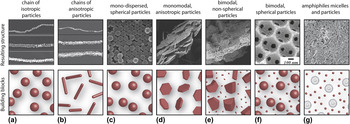
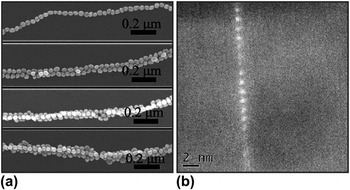
The basic principle of ice-templating is the assembly of a second phase, usually particles, triggered by their progressive concentration increase in the inter-crystal space. Using commercial technical ceramic powders, the particle size distribution and the irregular shape of particles prevent the apparition of any structural organization of the particles when they concentrate: particles follow random packing laws. However, this self-assembly can be extended to model systems of monodispersed particles, providing new insights in the self-assembly mechanisms involved (Fig. 5). Macroporous colloidal crystals have been obtained using monodispersed PSHEMA spheres combined with colloidal silica,Reference Kim, Tazumi, Okaji and Ohshima28 and these experiments help us understand the behavior of suspensions containing bimodal particle size distribution with nonspherical particles.Reference Hunger, Donius and Wegst76 Such experimental results can also be compared with the output of simple molecular dynamics models.Reference Barr and Luijten77 Lowering the volume fraction of particles in this initial suspension, freezing leads to the homogeneous assembly of chains of nanoparticlesReference Shen, Chen, Li, Zhu, Wang, Liu, Wang, Xiong and Chen78 at the grain boundaries of ice crystals. Some structures obtained with monodispersed spherical particles, for instance, do not exhibit any particular order. What does it take to get order, then? A monodispersed particle size or bimodal distribution is required, along with a moderate solid/liquid interface velocity. Equilibrium must be reached locally so that particle rearrangement can occur when the local concentration increases. If the interface is moving too fast, ordering is limited to the first layers of particles.Reference Barr and Luijten77
Assembly and self-assembly of isotropic and anisotropic building blocks induced by the growth of the surrounding ice crystals. Sources: (a, b) Reprinted (adapted) with permission from.Reference Shen, Chen, Li, Zhu, Wang, Liu, Wang, Xiong and Chen78 Copyright (2011) American Chemical Society (c) frozen colloidal silica, micrograph by A. BognerReference Bogner155 (d, e) Copyright (2012) Elsevier. Used with permission fromReference Hunger, Donius and Wegst76 (f) Reprinted (adapted) with permission from.Reference Kim, Tazumi, Okaji and Ohshima28 Copyright (2009) American Chemical Society (g).Reference Amirouche, Klotz, Viazzi, Deville and Guizard85

Moving beyond spherical, isotropic particles, freezing can also be used to induce ordering of anisotropic particles. Particles exhibiting a shape factor will tend to align, provided that certain kinetic conditions are encountered. Examples include bundles of nanowires,Reference Romeo, Hoppe, López-Quintela, Williams, Minaberry and Jobbágy79 plateletsReference Hunger, Donius and Wegst76,Reference Hunger, Donius and Wegst80 and polymer fibers.Reference Lee and Deng81 What is the driving force for the particle organization? Two mechanisms have been proposed to date: (i) shear by solvent removal when the concentration increases and (ii) a rotational movement induced by the growth of the crystals. Although both mechanisms possibly occur at the same time, direct movement induced by the growth of the ice crystals seems intuitively more efficient than a local shear flow. Such a flow could theoretically be enhanced if the solidifying solvent shows a volume decrease upon solidification, as opposed to the volume increase of water upon freezing.
Colloidal particles, unless functionalized, are usually inert. The structural organization obtained when concentrating such systems will be dictated almost exclusively by sterical considerations predicting the densest packing that can be achieved.Reference Henzie, Grünwald, Widmer-Cooper, Geissler and Yang82 More complex behavior can be observed using building blocks exhibiting self-assembly behavior, such as amphiphiles. The self-assembly of such molecules is usually driven by a progressive increase of concentration, which can be induced by a controlled evaporation of the solvent.Reference Israelachvili, Mitchell and Ninham83,Reference Brinker, Lu, Sellinger and Fan84 We can also induce the concentration and self-assembly of the molecules and particles by performing a directional solidification of the suspension. We thus take advantage of the growth of crystals in two ways: (i) the solidification of the solvent locally and progressively increases the concentration of the amphiphiles, which triggers both their self-assembly into micelles and the self-assembly of micelles into an organized structure, and (ii) the solvent crystals serve as a template for macroporosity in the final structure, and yields materials with a complex, hierarchical porous architecture. These preliminary resultsReference Amirouche, Klotz, Viazzi, Deville and Guizard85 open a new domain for the exploration of the self-assembly of amphiphiles molecules or similar self-assembly systems, in addition to providing increasingly elaborate architectures.
V. ICE PHYSICS AND GEOPHYSICS
Anyone who lives in a place cold enough to experience freezing in winter is familiar with frozen colloidal suspensions in nature. Ice growth and its physics is a major topic of investigations in geophysics. From the freezing of moist soils in northern countries to the growth of sea ice, the solidification of colloidal suspensions still largely remains a puzzling phenomenon. Understanding the growth patterns and colloid redistribution is a complex and yet necessary endeavor. Two occurrences of colloid freezing can be related to the work done on ice-templating: (i) the freezing of sea ice and the formation of brine channels, and (ii) frost-heave and the formation of ice lenses.Reference Style, Peppin, Cocks and Wettlaufer86,Reference Style and Peppin87
A. Frozen soils
Frost heave refers to a phenomenon where repeated freezing and thawing cycles in cold regions induce deformations and uplift of the soil surface. These deformations are a major source of damage to rocks, plants, buildings, and infrastructure. These degradations induce, for instance, costly repairs to the roads. Although one could intuitively believe that the water expansion upon freezing is responsible for the uplift of the soils, the underlying phenomenon is unrelated to this peculiar behavior of water. Frost heave occurs when ice is formed in the soil with part of it being connected to an unfrozen liquid region. The formation and growth of segregated ice draws warmer water from the underlying liquid reservoir (Fig. 6). This added volume of ice close to the soil surface causes visible uplift and deformation of the ground. Upon thawing, the soil can eventually collapse, yielding an uneven surface. The most spectacular occurrences of this phenomenon are the so-called “drunken forests,” where such soil collapse leads to trees falling or growing at unnatural angles.
Frost heave of a road, schematic representation. Adapted from.156

The freezing of soils is an occurrence of colloid freezing that is far from model or ideal. The soil is characterized by a complex mix of colloids of different sizes, granulometry distributions, and composition. The many ionic species dissolved in the soils greatly affect the nucleation and growth of ice. The model systems investigated in ice-templating are very different from these real-life conditions, and yet both investigations are increasingly closely related. The main feature of frost-heave is the formation of ice lenses: lens-shaped regions of pure ice, dividing the segregated colloids. The rejection of colloids by growing crystals therefore largely controls the phenomenon. Frost-heave occurs when soils are slowly frozen in winter, the cooling rates and corresponding growth kinetics are therefore very slow (less than 1 μm/s), in comparison to the growth velocities used for processing materials (5–100 μm/s). Ice-lenses were observed only for slow growth velocities and flat solid/liquid interface, a characteristic on which the corresponding models were built upon. However, recent work on ice templatingReference Deville, Maire, Lasalle, Bogner, Gauthier, Leloup and Guizard69,Reference Lasalle, Guizard, Maire, Adrien and Deville71,Reference Landi, Valentini and Tampieri88,Reference Fu, Rahaman, Dogan and Bal89 revealed the occurrence of ice lenses for faster growth velocities (>5 μm/s), where the solid/liquid interface adopts a cellular morphology. Although ice lenses of similar morphology are observed in both cases,Reference Anderson and Worster90 the underlying mechanisms are somewhat different.
The occurrence of ice-lenses for cellular interfaces is currently explained by the nonequilibrium segregation of the colloids by the growing crystals upon freezing.Reference Elliott and Peppin70 Particle encapsulation by the interface is characterized by size-dependence of the particles. Conversely, for a given particle size, encapsulation is characterized by a velocity dependence. Encapsulation thus occurs over a range of interface velocity and particle size. For the typical size range (0.2–5 µm) of technical ceramic powders, the encapsulation velocity falls typically within the velocity range obtained under the usual processing conditions (5–50 µm/s). Fluctuations of the interface velocity, due to nonequilibrium conditions, lead therefore to variations of the encapsulation behavior. Regions with a lower particle concentration see the development of ice lenses. The diffusive behavior of the colloidal particles provides additional complexity to the phenomenon. For moderate interface velocity (10 μm/s), diffusion of the colloids ahead of the moving interface tends to stabilize the system. An increase of the interface velocity triggers an abrupt transition to a diffusionless growth regime, which favors particle encapsulation.Reference Sobolev68
Ice lenses formed with planar interfaces arise for very different reasons. The morphology of the ice lenses in such situations is reminiscent of the formation of stress-induced cracks in materials. One current explanation is based on the accumulation of tensile stresses in the freezing regions due to the volume expansion of ice. A model based on fracture mechanicsReference Style, Peppin, Cocks and Wettlaufer86 proposed that when the accumulated stresses exceeds the yield strength of the soil, cracks will nucleate and propagate in the frozen soils provided that the growth of ice is thermodynamically possible. A geometrical supercooling situation has thus been introduced, analogous to the freezing of alloys and dilute particle suspensions where constitutional supercooling situations can develop. In addition to its inherent simplicity, which reconciles a large number of very different experimental observations of ice-lenses, this model offers a powerful predictive tool. If we focus on the ice physics, the freezing of colloids is a nightmare to understand in real life situations, where the colloids are composed of particles of different nature and sizes, in addition to the various ionic species. If the formation of ice lenses is ultimately only dependent on the cohesive strength of the soil and supercooling ahead of the interface, such properties can easily be assessed. Modifying the formulation of the soils to avoid frost heave is a completely unrealistic idea, albeit a fun one. Understanding and predicting the phenomenon would still be a good step forward.
Challenging questions remain to be elucidated, though. In particular, the geometrical supercooling conditions suitable for ice-lens growth imply a permeability of the soils much lower than currently estimated. Style et al.Reference Style, Peppin, Cocks and Wettlaufer86 mentioned three possible mechanisms to reduce the permeability of the soil directly ahead of the warmest ice lens: “(i) The appearance of a frozen fringe, (ii) having a highly compressible soil matrix, and (iii) desaturation of the soil ahead of the ice lens.” The existence of a frozen fringe ahead of the ice lens is the preferred explanation so far, although it has not been experimentally observed. On the other hand, desaturation ahead of the growing crystals has already been observed experimentally.Reference Lasalle, Guizard, Maire, Adrien and Deville71 Estimations of the permeability of the soils so far have been nevertheless based on the random packing of monodispersed particles. In real soils and technical colloids—such as ceramic powders—colloids are characterized by a size distribution. Small particles pack in the interstices between the large particles, which drastically reduces the permeability. Permeability calculations accounting for the size distribution, based on a modified Kozeny-Carman equation,Reference Thies-Weesie and Philipse91 lead to permeability values lower by several orders of magnitude than for a packing of monodispersed particles, a change that might reconcile the previous discrepancies in the models. Further experimental investigations are required to validate or rule out the existence of ice lenses. The reality might eventually prove to be more complex than expected, illustrated for instance by the recent experimental observations of desaturation of the soil ahead of the solid/liquid interface.Reference Lasalle, Guizard, Maire, Adrien and Deville71 In a colloidal suspension, not all crystals are born ice lenses, though. Understanding the growth morphologies remain a major challenge of ice physics, which goes way beyond the scope of this paper.
I focused on ice crystals thus far. Although the redistribution behavior of particles is also much more difficult to investigate, particles play a major role in the phenomenon. Countless articles can be found on the quantitative behavior of a single particle in front of a solid/liquid interface,Reference Kao and Golovin22–Reference Park, Golovin and Davis27 but predicting the behavior of concentrated systems is much more difficult. The particle-particle and multiple particle-interface interactions considerably affect the behavior of the growing crystals and the particle redistribution. The dynamics of colloidal particles during solidification and in ice was investigated by small angle x-rays scattering (SAXS) by Spannuth et al.,Reference Spannuth, Mochrie, Peppin and Wettlaufer92 and this first exploration in this complex phenomenon raised more questions than it provided answers. During solidification, a major role is played by the fluid flow between particle and the surface of the crystals along with the forces exerted by the growing crystals. The hard-sphere colloid approach has been assumed so far. Although considerably simpler, this might not be a suitable approach for the interparticle interactions in the case of many particles. SAXS is able to probe quantitatively the local structure of the particle arrangement during freezing and in the frozen body, at a length scale of one to several times the particle radius −32 nm colloidal silica sphere in this case. The first surprising result came from the investigation of the frozen structure: particles are in contact, which is currently not predicted by the theory. At the breakthrough concentration,Reference Shanti, Araki and Halloran93,Reference Deville and Bernard-Granger94 the concentration is low enough that particles are not necessarily in contact. The SAXS results nevertheless indicate that a percolating network of particles is present. In addition, the authors mentioned that “variations in ice nucleation temperature, and hence freezing rate, do not translate into variations in particle spacing.” This behavior might be explained by granular materials considerations. When particles are concentrated by the growing crystals, the formation of a percolating network of particles (jamming) is more likely than the situation where concentrated particles remain perfectly separated from each other. An intriguing consequence is derived from this behavior, as the authors noted that “the observation of particle aggregates whose attractive Van der Waals interaction is sufficient to maintain their integrity after melting suggests the possibility of creating macroscopic freeze-cast materials without the need for special binding or sintering techniques.” This prediction was independently achieved the same year by Winnubst et al.,Reference Zheng, Salamon, Lefferts, Wessling and Winnubst95 using colloids with a bimodal particle size. Small particles provide the Van der Waals interactions to stick everything together, so that the freeze-drying stage becomes unnecessary.
The completion of freezing is not the end of the story, though. The frozen structure continues to evolve once the sample is frozen, due to a combination of Ostwald ripening of the crystals and premelting of ice around the particles. The recrystallization is discussed in the final section of the article, in particular regarding the influence of particles on the movement of ice grain boundaries.
B. Sea ice and frozen lakes
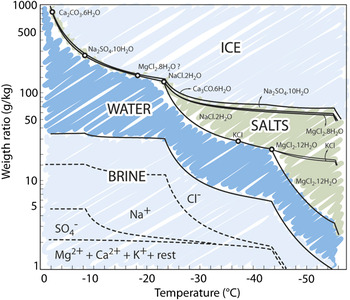
The freezing of seawater and the growth of sea ice is certainly the most common and spectacular occurrence of the freezing of colloids on Earth. It is also probably one of the most complexes. The growth of ice crystals in seawater leads to the formation of a complex network of ice crystals, which delimits the so-called brine channels. Owing to the extremely low solubility of almost any compound in the crystal lattice of ice, any compound and colloid present in seawater will be rejected by the growing crystals. The phase diagram of sea ice (Fig. 7) is thus complex. The rejection of salts,Reference Lake and Lewis96 microorganisms, gases, minerals, and other organic macromolecules into the brine channelsReference Worster and Wettlaufer97 yields a complex ecosystem where life can flourish in winter. The increase of salt concentration lowers the freezing point of seawater, maintaining a liquid environment at low temperature. If the temperature conditions remain suitable for life, organisms must nevertheless cope with the very high concentration of salts. The structure of sea ice is thus that of a complex multiphase material, comprising solid, liquid, and gas phases, which have been through multiple melting and freezing cycles.Reference Hunke, Notz, Turner and Vancoppenolle98 The concentration of salts and impurities varies constantly across the vertical cross-section of sea ice. The porous ice structure depends strongly on the salinity and its thermal history.Reference Petrich and Eicken99 The increase of salt concentration leads to an increase of the density, providing a natural drainage of brine in the channels,Reference Wettlaufer and Worster100 carrying along its flow the nutrients and microorganisms entrapped in the brine channels. A spectacular consequence of this behavior was filmed recently by the BBC,101 with the formation of so-called “brinicle.” The sinking brine escaping from the brine channels is both denser and colder than the seawater causing the water around to freeze. Further growth of this brinicle eventually reached and froze the sea bed and froze to death the sea urchins and starfish. These movements also help regulate the thermal exchanges between the oceans and the atmosphere. The environment is thus highly dynamic, and the local phase equilibrium always shifting.
Phase diagram of sea ice. After.Reference Assur157

Representing and modeling such a complex system implies a certain degree of assumption and simplification. The model developed for the solidification of colloidal suspensionsReference Style, Peppin, Cocks and Wettlaufer86,Reference Peppin, Elliott and Worster102,Reference Peppin, Majumdar and Wettlaufer103 is certainly a step in the right direction for modeling sea ice growth, too.
The structure of sea ice is often lamellar, similar to that obtained by ice templating. The growth kinetics and temperature conditions are nevertheless very different. The crystalline orientation of sea ice and frozen lakes has been largely investigated, experimentallyReference Perey and Pounder104–Reference Müller-Stoffels, Langhorne, Petrich and Kempema109 or theoretically.Reference Maus110,Reference Kawano and Ohashi111 Unfortunately, there are no simple relationships between the growth rate and the crystalline orientation. In lamellar sea ice, the c-axis of the crystal usually lies perpendicular to the temperature gradient, that is, perpendicular to the lamellar structure. We have now experimental evidenceReference Deville, Viazzi, Leloup, Lasalle, Guizard, Maire, Adrien and Gremillard75 that during ice templating, the c-axes of crystals nearly or perfectly align along the temperature gradient, and thus parallel to the lamellar crystals. Further work is thus required to elucidate this behavior. The nucleation period, much longer in the formation of sea ice, probably plays a critical role.
Beyond the orientation of individual crystals, the long range organization of crystals has also been investigated.Reference Gow106,Reference Eicken, Weissenberger, Bussmann, Freitag, Schuster, Delgado, Evers, Jochmann, Krembs, Gradinger, Lindemann, Cottier, Hall, Wadhams, Reisemann, Kuosa, Ikävalko, Leonard and Shen112 The orientation texture results from the complex interplay of nucleation and water fluxes induced by wind or currents. Lessons can be learned for ice templating structures. The control of the orientation texture of crystals can be critical, in particular to obtain model, anisotropic materials, suitable for in-depth structural and mechanical investigations.Reference Launey, Munch, Alsem, Barth, Saiz, Tomsia and Ritchie113 If inducing an orientation texture cannot be achieved in the lab using slow currents, for practical reasons, the control of nucleation is a suitable route. The application of two temperature gradients to obtain long range order of the crystal orientation has also been demonstrated,Reference Sofie59 albeit unintentionally.
VI. ICE IN LIFE AND HEALTH SCIENCES
Water is the solvent sustaining life. It should not come as a surprise that ice plays a particular role in many topics of interest for life and health sciences. For life to be sustainable below the freezing point of water, the damage inflicted by the nucleation and growth of ice crystals must be avoided. Organisms have evolved several strategies to avoid or overcome such a damage which can be of two different natures:
(i) Formation of ice, a separate phase, implies removing water from the organism. The concentration of all water-soluble compounds in the organism is therefore locally increased, eventually leading to very high osmotic stresses. Water must thus be able to redistribute through the plasma membrane if the cells cannot bear the osmotic stress.
(ii) Irreversible physical damages induced by the growth of ice crystals, in particular to the cells.
A. Colligative control of ice growth in nature
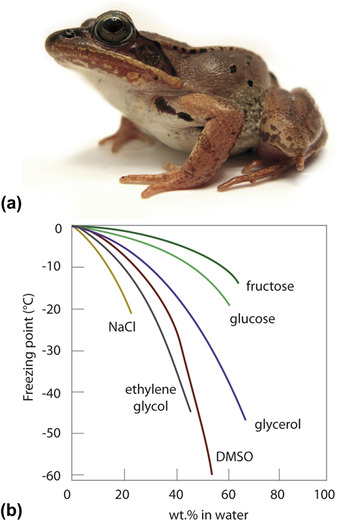
The first strategy is the use of cryoprotectants, which act in a colligative manner.Reference Storey and Storey114 The freezing point of water can be decreased colligatively using common compounds such as glucose or glycerol (Fig. 8), which act in addition to the serum solutes. The most well-known example is the frog Rana Sylvatica (Fig. 8), whose liver is able to rapidly produce large amounts of glucose when the temperature drops in winter.Reference Devireddy, Barratt, Storey and Bischof115 The progressive concentration of glucose within the cells of the organs protects the frog from the ice-inflicted damages. Such compounds usually prevent the formation of intracellular ice. Cryoprotectants have nevertheless a limited potential, for they can rapidly display high cytotoxic effects. This is particularly true for synthetic compounds such as dimethylsulfoxide (DMSO), commonly used for the cryopreservation of tissues and organs. Cytotoxicity is of course not an issue if cryoprotectants such as glycerolReference Fu, Rahaman, Dogan and Bal89,Reference Zhang, Hu, Han and Jiang116 are used to control the structure of ice-templated materials.
(a) Wood frog Rana Sylvatica. Picture: Dave Huth, license CC-BY 2.0158 (b) colligative freezing point depression of water induced by common compounds.

B. Noncolligative control: Proteins and peptides
The second strategy to keep water in its liquid state involves chemical agents known as antifreeze proteins or peptides (AFPs) and glycopeptides (AFGPs). The corresponding concentrations encountered in organisms are too low to decrease significantly the freezing point of water by a colligative effect. Although the exact mechanism is still being investigated,Reference Franks117 such compounds directly bind to the ice surface, thereby blocking or selectively controlling further growth. Their interaction with ice results in three different properties, which are not mutually exclusive:
(i) Ice recrystallization inhibition. This notion is familiar to materials scientists. Ice recrystallization can occur through Ostwald ripening, if held for long enough. AFPs can slow down considerably or inhibit such growth, ensuring that ice crystals retain a small size.
(ii) Thermal hysteresis. If the freezing point in the presence of AFPs is lower than predicted through colligative effects and lower than the melting point, ice crystals held isothermally within this temperature range (typically 0–6 °C) are stable. This range is referred to as the thermal hysteresis, which can be as large as a few degrees.Reference Amornwittawat, Wang, Duman and Wen118,Reference Scotter, Marshall, Graham, Gilbert, Garnham and Davies119
(iii) Ice shaping/crystal habit modification: in the presence of particular kinds of AFPs known as ice shaping proteins (ISPs), ice crystals will develop sometimes radically different morphologies. Such change of the macroscopic shape reflects a modification of the crystal habit at a molecular level. This implies that ISPs are interacting with the ice surface at a molecular level.
Binding to the ice surface can be achieved through Van der Waals interactions or hydrogen bonds. Van der Waals interactions are not directional and are weak until both surfaces come in very close contact, it thus requires a perfect structural match between the compound and the surface of ice. We now have ample evidence that such mechanisms are involved in the interactions between natural ice-structuring proteins (ISPs) and ice. Almost all ISPs comprise a long organic chain with amphiphatic structures. The methyl groups of the pending threonine residues act as the ice recognition sites.Reference Davies, Baardsnes, Kuiper and Walker120 Irreversible absorption to ice can be achieved with ISPs.
Hydrogen bonds are stronger and highly directional, thus impurities or compounds forming hydrogen bonds with crystal faces can be very selective. A periodical repetition of the bonding is probably more efficient in terms of ice structuring properties.
The antifreeze mechanisms might be more complex than initially believed. Recent results of terahertz spectroscopy and molecular simulationsReference Meister, Ebbinghaus, Xu, Duman, DeVries, Gruebele, Leitner and Havenith121 have shown that ISPs yield a quasi-liquid layer around the ice binding site, inducing organization of the water molecules up to 20 Å away from the ice-binding site. An essential contribution to the antifreeze activity, in the case of the beetle Dendroides canadensis, is thus derived from these long-range protein–water interactions.
C. Toward tailor-made additives
Control of the ice growth morphologies is also of huge interest for various industrial applications, from crystallization to food engineering. Unsurprisingly, the development of synthetic ice-structuring compounds draws inspiration from the natural compounds and their ice-structuring mechanisms (Fig. 9). Understanding these mechanisms is therefore of interest in life sciences, chemical engineering, and materials science. A selective control of the growth can be achieved with synthetic compounds. Several noncolligative synthetic compounds have been developed so farReference Wowk, Leitl, Rasch, Mesbah-Karimi, Harris and Fahy122–Reference Gibson124 including polyvinyl alcohol,Reference Inada and Modak125 block copolymers,Reference Mastai, Rudloff, Cölfen and Antonietti126 and synthetic peptides.Reference Chakrabartty, Yang and Hew127 Their interaction with ice is still weaker than the natural ISPs, mainly because of the difficulty to obtain a perfect match between the compound and the surface of ice.
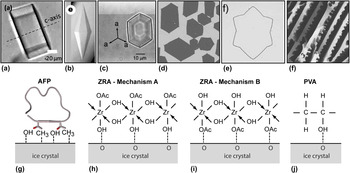
Ice crystals and ice-templated pores in the presence of ISPs and compounds, and corresponding mechanisms of interaction with the crystal surface. (a) Ice crystals in the presence of antifreeze glycoproteins analogue. Reprinted (adapted) with permission from.Reference Peltier, Evans, DeVries, Brimble, Dingley and Williams159 Copyright (2010) American Chemical Society. (b) Ice crystals in the presence of fish type I AFP from the winter flounder. Copyright (2000) nature publishing group. Used with permission from.Reference Graether, Kuiper, Walker, Jia, Sykes and Davies160 (c) Ice crystals in the presence of β-helical antifreeze protein from Tenebrio molitor. Reprinted (adapted) with permission from.Reference Bar, Celik, Fass and Braslavsky161 Copyright (2008) American Chemical Society. (d) Ice templated pores in 8Y-TZP in the presence of ZRA. (e) Ice crystals in the presence of PVA. Copyright (2007) Wiley. Used with permission from.Reference Budke and Koop130 (f) Ice templated pores in alumina in the presence of PVA. (g) Adapted from.Reference Mizrahy, Bar-Dolev, Guy and Braslavsky129

Lessons learned from ice-templating can be applied to this domain. The control of ice growth during ice-templating is even more complex, since any compound introduced to interact with the ice crystals must be insensitive to the presence of particles in the suspension. The particles almost always have an electrical surface charge, and are thus very keen to interact with anything around them. Therefore, if a compound is found to have some effect on ice growth in the presence of particles, its effect without particles is likely to be enhanced. A good illustration was obtained recently with the work on zirconium acetate, which was initially shown to induce 6-fold faceting on ice crystals during ice templating.Reference Deville, Viazzi, Leloup, Lasalle, Guizard, Maire, Adrien and Gremillard75 Zirconium acetate is thought to polymerize and reversibly absorb at the surface of iceReference Deville, Viazzi and Guizard128 (Fig. 9), thereby slowing down the growth of the ice crystals. Binding to the ice surface is achieved either through the hydrophobic side and hydrogen bonding of the hydroxyl group [Fig. 9(h)], or through the hydrophilic side and Van der Waals interactions of the methyl groupReference Mizrahy, Bar-Dolev, Guy and Braslavsky129 [Fig. 9(i)], a mechanism very similar to that of AFPs [Fig. 9(g)]. Curiously, zirconium hydroxylacetate, which does not induce any faceting of ice in the presence of particles, exhibits ice structuring properties in the absence of particles,Reference Mizrahy, Bar-Dolev, Guy and Braslavsky129 a good illustration of the perturbing role of particles. In addition to ice shaping, zirconium acetate and hydroxylacetate were shown to inhibit recrystallization and have a small thermal hysteresis activity,Reference Mizrahy, Bar-Dolev, Guy and Braslavsky129 making them good candidates for applications that warrants good control of ice growth. PVA, on the other hand, is able to induce faceting of ice crystalsReference Budke and Koop130 [Fig. 9(e)], but its effect disappears when added in the presence of particles [Fig. 9(f)]. A compound having a rigid backbone seems thus more effective to control ice growth.
D. Cryopreservation
Understanding the interaction between growing ice crystals and cells is also a critical issue in life and health science, for its implication in the cryopreservation of cells and tissues. The knowledge obtained through the investigation of inert, inorganic colloids in front of a solidifying interface can be applied to the behavior of cells, with a few additional tweaks. Ice growth in a biological fluid leads to high concentrations of solutes around the interface, which can decrease the viability of cells exposed to this concentration for a long time (in the case of slow freezing rate). Cells entrapped between the growing crystals, similar to particles during ice templating, can be subjected to a mechanical deformation of the membrane due to continuing crystal growth. Above a critical stress, an irreversible rupture of the membrane can occur. This behavior is thus largely similar to the behavior of bubbles interacting with a solidifying interface.Reference Kao and Golovin22,Reference Park, Golovin and Davis27,Reference Azouni and Casses131 Depending on their size, bubbles can deform to accommodate the mechanical stress induced by the solidifying interface.Reference Tao, Peng and Lee132 Such systems are therefore investigated both from an experimentalReference Ishiguro and Rubinsky133 and theoreticalReference Chang, Dantzig, Darr and Hubel134 point of view. Typical growth features such as tip splitting or tip termination can be observed. Similar to the case of inorganic particles, the interactions between the cells have been largely ignored so far. Some of the work done on ice templating could thus be beneficial to this domain.
E. Ice and the emergence of life
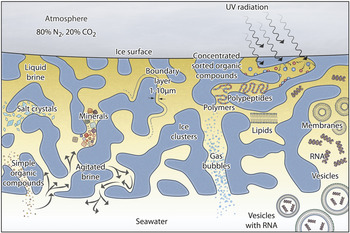
The emergence of life on earth would not have been made possible without the ability of early molecules or compounds to self-replicate. Before the apparition of membraneous protocellular structures, such self-replication would have been difficult, if not impossible, in the absence of some sort of compartmentalization. In the earliest stages of life with low sophistication, that is, before the apparition of membranes and vesicles, the environment must have been able to provide both compartmentalization and catalysis of the building blocks reaction, and to do so in a quotidian way. If the building blocks (nucleotides) are dispersed in water (Fig. 10), which is considered as the medium in which life first appeared, their concentration is likely to be too low for any interaction to occur. In addition, diluted biomacromolecules will undergo hydrolysis rather than polymerization. The intricate structure of ice crystals in a saline environment is able to concentrate efficiently any compound initially present in water. This is true for salt and microorganisms, which are entrapped in the brine channels. If biomacromolecules such as RNA are present in water, their exclusion from the growing ice and concentration within the interstitial space lead to an acceleration of their polymerization,Reference Attwater, Wochner, Pinheiro, Coulson and Holliger135 without the need for enzymes to catalyze these reactions.
Proposed life-promoting reactions in sea ice. After.Reference Trinks, Schröder and Biebricher162

It has been demonstratedReference Attwater, Wochner, Pinheiro, Coulson and Holliger135–Reference Monnard, Kanavarioti and Deamer137 that this freezing-induced concentration provides an efficient path to reach a critical concentration of compounds required for the polymerization. The ribozyme is responsible for RNA self-replication. The action of the ribozyme requires critical concentration of ribonucleotide triphosphates and magnesium salts. If their concentration is too low, the ribozyme activity is strongly reduced. The growth of ice allows starting from very dilute suspensions. Solute rejection by the growing crystals can eventually lead to a >200-fold increase of concentration, so that a high concentration will always be reached locally, in the intercrystal space. The presence of NaCl is a beneficial side effect, as a high concentration of it has been found to initiate the condensation of amino acids into peptides.
The effect goes beyond the simple concentration of reactants, though. Ice growth was also shown to “supports high-fidelity RNA replication but also greatly stabilizes the RNA polymerase ribozyme, enabling extended RNA replication [and] slow down ribozyme diffusion by more than three orders of magnitude, providing de facto compartmentalization of RNA replication.Reference Attwater, Wochner, Pinheiro, Coulson and Holliger135” The surface of ice can be highly reactive, and its catalytic properties have been demonstrated.Reference Ferris138,Reference Graham and Roberts139
A fascinating proof of principle experiment was carried out by Trinks et al.Reference Trinks, Schröder and Bierbricher140 They froze, under ultraviolet light mimicking that of the young earth,Reference Zahnle and Walker141 sea water containing alanine, phenylalanine, serine, tryptophan, and isoleucine. A couple of days later, a reticulated network of high molecular weight biomacromolecules was found within the ice, covering the ice cavities. This organic network was resistant to melting, dissolution and hydrolysis.
Thus, life could have emerged in ice, because sea ice provides a favorable environment for both compartmentalization and catalysis of the initial biomacromolecules. Ice could also be responsible for maintaining life longer on a planet. Looking for evidences of life on Mars, it has been suggested to look into seepage channels.Reference Wynn-Williams, Cabrol, Grin, Haberle and Stoker142 The lower freezing point in brine channels could have extended the period during which life on earth would have been possible. The relics of these channels could thus be good places to start digging into the Martian soil. It is not the choice that was ultimately made for the current NASA mission with the Curiosity rover, though.
VII. ICE AND MATERIALS SCIENCE: BEYOND MATERIALS PROCESSING
There is a lot of room for ice in materials science, beyond macroporous materials and materials processing. If ice can be used as a structural material,Reference Ball143 the main interest probably relies in its use as a model for investigating fundamental phenomena of materials science and solid state physics. I will describe a few of such phenomena that could use ice and particles as a model system.
Solidification and crystallization are at the very heart of materials science. The crystallization of any compound is highly sensitive to the presence of impurities, which presence in crystalline solids—even as traces—can drastically affect their mechanical or functional properties. Impurities can be any compound present in the initial solution. Impurities can accelerate (growth promoter) or decelerate (growth inhibitor) crystal growth. Understanding the interactions between such compounds and the growing crystals is core to crystallization. Colloidal particles are such impurities. Investigating the behavior of colloidal particles interfering with ice crystal growth is thus of interest for solidification problems. There are nevertheless many fundamental differences between atomic segregation at grain boundaries and particle trapping at ice grain boundaries. With such limitations in mind, we might still attempt a comparison, where at least two domains could be of particular interest:
(i) The redistribution of colloidal particles during solidification (Fig. 11). The concentration of captured impurities can generally be classified as (a) sectorial (nonuniform distribution of impurities), (b) zonal (growth bands, striation), or (c) structural (incorporation within the crystalline network). These different behaviors can easily be reproduced using aqueous colloidal suspension, by controlling the growth velocity of ice and the colloidal particle size. The system has thus many advantages for such investigations: growth is slow (a few microns per second, thus easily observable), temperature is low, and the system is transparent if the amount of impurities is low. In addition, colloids can diffuse, but do so with much lower diffusion coefficient than atoms.Reference Peppin, Elliott and Worster102 Tracking colloids is thus much easier than tracking atoms (Fig. 11).
(ii) The distribution of impurities during recrystallization, which occurs by Ostwald ripening. Ice-templated frozen bodies with a low concentration of particles could be used to investigate the role of impurities or particles on the movement of grain boundaries during recrystallization. Using the sectorial, zonal, or structural distribution of particles in the initial ice crystals, a variety of situation can be investigated.Reference Yoshizawa, Okuzono, Koga, Taniji and Yamanaka144 Similar configurations are already explored with colloidal crystals, which are easier to investigate experimentally.Reference Yoshizawa, Okuzono, Koga, Taniji and Yamanaka144,Reference de Villeneuve, Dullens, Aarts, Groeneveld, Scherff, Kegel and Lekkerkerker145 Yet, this is nevertheless a very peculiar system, because of the unique properties of water and ice. A few specificities will have to be taken into account, such as the role of the premelted film around the particles,Reference Wettlaufer and Worster146 which might affect the recrystallization behavior, and the movement of the particles relative to the moving solid/solid interface.
(a) Colloidal particles at grain boundaries in ice crystals. Reprinted (adapted) with permission from.Reference Shen, Chen, Li, Zhu, Wang, Liu, Wang, Xiong and Chen78 Copyright (2011) American Chemical Society. (b) Atoms at grain boundaries in polycrystalline ceramics. Copyright (2007) Elsevier. Used with permission from.Reference Dillon, Tang, Carter and Harmer163

Another intriguing interest of ice for materials science might arise from its protonic conductivity.Reference Workman, Truby and Drost-Hansen147–Reference Bullemer, Engelhardt and Riehl149 Proton conductors are in increasing demand for a number of applications in materials science, mostly concerning electrochemical systems. Because of the hydrogen bond network, water is a proton conductor. In ice, the hydrogen bond network is more extensive, making it a better conductor. Although the protonic conductivity of ice is relatively modest compared to the current protonic conductors under development, the ability to precisely control the crystal size and orientation could make of ice a nice model system. More specifically, the role of impurities at interfaces—a major issue in proton conducting materials—described in the previous point could also be investigated.
VIII. CONCLUSIONS AND PERSPECTIVES
Ice templating has been used so far mostly to obtain macroporous, cellular materials. Nevertheless, considering the variety of occurrences of colloids freezing, it is clear that we only scratched the surface. It is a perfect example of a materials science topic that could largely benefit from a multidisciplinary approach, for its natural and technological occurrences are many. Beyond its capabilities to synthesize a variety of materials and structures, it is also an appealing model system for investigating various fundamental phenomena in materials science and beyond.
Different ice growth morphologies are the result of the interplay between structural, kinetic, and thermodynamic factors. Can we hope to understand the freezing behavior one day, considering the huge number of factors involved, and the unknown of ice physics? The one thing we probably need now is a thermodynamic and kinetic phase diagram of the system ice/colloids. Although various partial data have been obtained,Reference Deville, Maire, Lasalle, Bogner, Gauthier, Leloup and Guizard69,Reference Elliott and Peppin70,Reference Waschkies, Oberacker and Hoffmann150 consolidating and rationalizing such phase diagrams face two main problems, inherent to the system:
(i) We are usually out of equilibrium, due to relatively fast solidification kinetics.Reference Sobolev68–Reference Elliott and Peppin70,Reference Peppin, Majumdar and Wettlaufer103
(ii) First-order like phase transitions can occur. Discontinuities exist in the behavior of the system, such as the breakthrough concentration of particlesReference Shanti, Araki and Halloran93 or the dependence of the diffusivity of colloids over the concentration and particle size.Reference Sobolev68
Nailing down the relative importance of the main factors and the global behavior of the system will thus be a long and complex endeavor. In the meantime, wandering out of materials science is an incredible source of inspiration to further tweak the freezing of colloids and the resulting structures. For the time being, knowing that ice templating might ultimately be responsible for the very existence of life on Earth is just the icing on the cake.
ACKNOWLEDGMENT
I am indebted to Adam Stevenson for his comments, suggestions, and corrections on the manuscript.