Introduction
More than one-third of community-dwelling older adults (aged 65+ years) fall each year, half of fallers fall more than twice a year, and 10–15% of them are seriously injured (e.g., fractures, severe tissue damages, etc.) (Tinetti et al., Reference Tinetti, Doucette, Claus and Marottoli1995; Tinetti et al., Reference Tinetti, Speechley and Ginter1988; Rubenstein and Josephson, Reference Rubenstein and Josephson2002; Iaboni and Flint, Reference Iaboni and Flint2013). This places falls as a leading cause of injury-related deaths in this age group (Batra et al., Reference Batra, Melchior, Seff, Frederick and Palmer2012).
In order to prevent severe consequences caused by falls, one strategy is to identify risk factors and to act on those that are modifiable. Results of previous studies suggested that older people (Oosterink et al., Reference Oosterink, De Jongh and Hoogstraten2009; Deandrea et al., Reference Deandrea, Lucenteforte, Bravi, Foschi, Vecchia and Negri2010; Rossat et al., Reference Rossat2011; Grundstrom et al., Reference Grundstrom, Guse and Layde2012), females (Biderman et al., Reference Biderman, Cwikel, Fried and Galinsky2002; Bloch et al., Reference Bloch, Thibaud, Dugue, Breque, Rigaud and Kemoun2010; Deandrea et al., Reference Deandrea, Lucenteforte, Bravi, Foschi, Vecchia and Negri2010; Fabre et al., Reference Fabre, Ellis, Kosma and Wood2010; Rossat et al., Reference Rossat2011; Ferrer et al., Reference Ferrer, Formiga, Plana-Ripoll, Tobella, Gil and Pujol2012; Launay et al., Reference Launay, De Decker, Annweiler, Kabeshova, Fantino and Beauchet2013), and less educated (Fabre et al., Reference Fabre, Ellis, Kosma and Wood2010) were associated with a higher occurrence of falls.
Various medical conditions have also been linked to falls, such as osteoporosis (Lynn et al., Reference Lynn, Sinaki and Westerlind1997; Sinaki et al., Reference Sinaki, Brey, Hughes, Larson and Kaufman2005), rheumatoid arthritis (Stanmore et al., Reference Stanmore2013; Armstrong et al., Reference Armstrong, Swarbrick, Pye and O’Neill2005; Laylor et al., Reference Laylor, Patel and Ebrahim2003; Hayashibara et al., Reference Hayashibara, Hagino, Katagiri, Okano, Okada and Teshima2010), cardiovascular diseases and associated conditions (e.g., diabetes) (Carey and Potter, Reference Carey and Potter2001; Laylor et al., Reference Laylor, Patel and Ebrahim2003; Deandrea et al., Reference Deandrea, Lucenteforte, Bravi, Foschi, Vecchia and Negri2010; Mayne et al., Reference Mayne, Stout and Aspray2010), pulmonary diseases (Laylor et al., Reference Laylor, Patel and Ebrahim2003; Roig et al., Reference Roig2011), poor vision (Delbaere et al., Reference Delbaere, Van Den Noortgate, Bourgois, Vanderstraeten, Tine and Cambier2006; Fabre et al., Reference Fabre, Ellis, Kosma and Wood2010; Salonen and Kivela, Reference Salonen and Kivela2012; Reed-Jones et al., Reference Reed-Jones, Solis, Lawson, Loya, Cude-Islas and Berger2013), number of medications (Woolcott et al., Reference Woolcott2009; Al-Aama, Reference Al-Aama2011; Launay et al., Reference Launay, De Decker, Annweiler, Kabeshova, Fantino and Beauchet2013), and use of benzodiazepine (Laylor et al., Reference Laylor, Patel and Ebrahim2003; Pariente et al., Reference Pariente, Dartigues, Benichou, Letenneur, Moore and Fourrier-Réglat2008; Rossat et al., Reference Rossat2011).
Other studies have further shown that falls are related to older people's physical capacities. Indeed, a prospective study conducted over 12 months on community-dwelling older adults found that a low score on the Physical Performance Test (PPT), followed by decreased maximal handgrip strength were the strongest predictors of subsequent falls, although variables from different categories (e.g., medical, psychological, sensory, physical, and postural) were also significant (Delbaere et al., Reference Delbaere, Van Den Noortgate, Bourgois, Vanderstraeten, Tine and Cambier2006). Results of previous studies also revealed that slow walking speed (Muraki et al., Reference Muraki2013), irregular gait pattern (Deandrea et al., Reference Deandrea, Lucenteforte, Bravi, Foschi, Vecchia and Negri2010), and low level of mobility (measured by the Timed Up and Go test (TUG); Beauchet et al., Reference Beauchet, Fantino, Allali, Muir, Montero-Odasso and Annweiler2011) significantly increased the likelihood of falling among older people.
It has also been suggested that unhealthy life habits, such as drinking, smoking, and physical inactivity (i.e., sedentary lifestyle), were associated with falls in elderly adults (mainly because of decreasing muscle mass and contributing to the development of osteoporosis; Law and Hackshaw, Reference Law and Hackshaw1997; Todd and Skelton, Reference Todd and Skelton2004; Kanis et al., Reference Kanis2005; Cawthon et al., Reference Cawthon2006).
Moreover, a recent systematic review and meta-analysis, including 27 studies, concluded that both global cognitive impairments (often based on the Mini-Mental State Examination (MMSE) scores) and executive function impairments (often measured by the Trail Making test, part B) were significantly associated with an increased risk of fall in community- and institution-dwelling older adults (Muir et al., Reference Muir, Gopaul and Montero Odasso2012). Taken together, these results suggest that several socio-demographic, medical, physical, and cognitive factors are associated with falls in older people.
However, the fall risk assessment remains incomplete without considering the presence of depressive symptoms (i.e., symptoms of depression not meeting full Diagnostic and Statistical Manual of Mental Disorders (DSM) criteria for a specific mood disorder), a psychological state frequently associated with falls in literature (Biderman et al., Reference Biderman, Cwikel, Fried and Galinsky2002; Deandrea et al., Reference Deandrea, Lucenteforte, Bravi, Foschi, Vecchia and Negri2010; Launay et al., Reference Launay, De Decker, Annweiler, Kabeshova, Fantino and Beauchet2013). Similar to falls, depressive symptoms are also frequently reported by community-dwelling older adults, affecting up to one-third of them (Heun et al., Reference Heun, Papassotiropoulos and Ptok2000; Blazer, Reference Blazer2003). The nature of the relationship between depressive symptoms and falls remains somewhat unclear, as the many factors they share in common may provide confounding information (Iaboni and Flint, Reference Iaboni and Flint2013). Indeed, many studies suggest that depression is significantly related to factors that may also be associated with falls such as deficits in cognitive functioning (Austin et al., Reference Austin, Mitchell and Goodwin2001; Kizilbash et al., Reference Kizilbash, Vanderploeg and Curtiss2002; Baune et al., Reference Baune, Suslow, Arolt and Berger2007) and decline in physical performance among older adults (Penninx et al., Reference Penninx, Guralnik, Ferrucci, Simonsick, Deeg and Wallace1998; Stuck et al., Reference Stuck, Walthert, Nikolaus, Bula, Hohmann and Beck1999; Everson-Rose et al., Reference Everson-Rose, Skarupski, Bienias, Wilson, Evans and De Leon2005). Moreover, the use of antidepressant drugs and the presence of sleep problems, two conditions often related to depression, are further associated with falls in older population (Leipzig et al., Reference Leipzig, Cumming and Tinetti1999; Brassington et al., Reference Brassington, King and Bliwise2000; Laylor et al., Reference Laylor, Patel and Ebrahim2003; Hill et al., Reference Hill, Cumming, Lewis, Carrington and Couteur2007; Kerse et al., Reference Kerse2008; Stone et al., Reference Stone, Ensrud and Ancoli-Israel2008). To date, no study has examined the independent association between depressive symptoms and recurrent falls after controlling for all these shared factors. Therefore, this study aimed to determine if depressive symptoms are independently associated with recurrent falls in older people.
Methods
Recruitment and assessment procedure
This is a secondary analysis of a clinical trial that involved comprehensive medical assessment prior to physical exercise intervention in sedentary and frail older adults (Langlois et al., Reference Langlois, Vu, Chasse, Dupuis, Kergoat and Bherer2013). Eighty-two community-dwelling older adults were enrolled in this study. They were 79.2% women and had a mean age of 72.13 ± 6.11 years (range: 61 to 89 years). Participants were recruited via advertisements placed in newspapers and posted at locations near the research center where the study took place (e.g., pharmacies, banks, and hospitals). All participants signed a consent form approved by the ethical committee of the research center.
Participants were assessed in three different sessions. The occurrence of falls (in the last 12 months), the presence of medical conditions or life habits (e.g., physical inactivity) potentially associated with falls, and the use of medications were assessed by a geriatrician (session 1). Participants’ physical capacities were evaluated by a kinesiologist (session 2). Finally, cognitive functioning, presence of depressive symptoms, and sleep quality were assessed by a neuropsychologist (session 3). Patients were given at least one day of rest between each session and were excluded if they showed signs of dementia (scores <25 at MMSE; Folstein et al., Reference Folstein, Folstein and Mchugh1975).
Measures
Assessment of falls: Fall was defined as “an unexpected event in which the participants come to rest on the ground, floor, or lower level” (Lamb et al., Reference Lamb, Jorstad-Stein, Hauer and Becker2005). The occurrence and number of falls were assessed using the following question: “Did you fall in the last 12 months, and if so, how many times?” For the purpose of this study, participants were divided into three groups: The first group consisted of participants reporting no fall. The second group comprised participants reporting one fall. The last group consisted of participants reporting two falls or more during the previous year.
Assessment of depressive symptoms: The Geriatric Depression Scale (GDS: 30-item version; Yesavage, Reference Yesavage1988) was used to evaluate the presence of depressive symptoms. This self-reported questionnaire, specifically designed to assess depression among older people, has shown good psychometric properties (Montorio and Izal, Reference Montorio and Izal1996).
Other variables potentially associated with recurrent falls: In order to isolate association between depressive symptoms and falls, the following variables were controlled:
-
1. Socio-demographic characteristics, including gender, age, and level of education.
-
2. Cardiovascular diseases and associated conditions comprising arterial hypertension, orthostatic hypotension, arrhythmia, heart failure, myocardial infarction, pulmonary embolism, and diabetes mellitus.
-
3. Musculoskeletal disorders and associated conditions, including arthritis, osteoporosis, fractures, poor standing posture, and irregular gait pattern. Posture and gait were visually assessed by the geriatrician who asked participants to stand up and walk normally in the office.
-
4. Pulmonary diseases comprising asthma and chronic obstructive pulmonary disease (COPD).
-
5. Sensory impairments, including visual or hearing loss.
-
6. Consumption and life habits comprising tobacco and alcohol use as well as level of physical activity.
-
7. Sleep quality according to the Pittsburgh Sleep Quality Index (PSQI; Buysse et al., Reference Buysse, Reynolds, Monk, Berman and Kupfer1989). This self-administrated instrument, specifically designed to evaluate sleep quality over the previous month, has demonstrated good psychometric properties in older adults (Smyth, Reference Smyth2008).
-
8. Use of medications, including the number of daily medications, antidepressant, and benzodiazepine consumption.
-
9. Physical capacities, including functional capacities (Modified PPT; Brown et al., Reference Brown, Sinacore, Binder and Kohrt2000), grip strength (hand-held dynamometer), physical endurance (Six-Minute Walk test; Enright, Reference Enright2003), mobility (TUG test; Podsiadlo and Richardson, Reference Podsiadlo and Richardson1991), and gait speed (mean score of comfortable and maximum gait speed; Bohannon, Reference Bohannon1997).
-
10. Cognitive functioning, which includes assessment of global cognitive functioning (MMSE; Folstein et al., Reference Folstein, Folstein and Mchugh1975), processing speed (Digit-Symbol Coding subtest of the Wechsler Adult Intelligence Scale-III (WAIS-III); Wechsler, Reference Wechsler1997), Trail Making test, part A (Chamberlin et al., Reference Chamberlin, Fulwider, Sanders and Medeiros2005), and Modified Stroop Color-Word test (color naming and color reading conditions; Tiedemann et al., Reference Tiedemann, Sherrington and Lord2005), working memory (Letter-Number Sequencing and Backward Digit-Span subtests of the WAIS-III (Wechsler, Reference Wechsler1997), episodic memory (Rey Auditory Verbal Learning test; Myers et al., Reference Myers, Fletcher, Myers and Sherk1998), and executive functions (Trail Making test, part B and Modified Stroop Color-Word test, interference, and flexibility conditions; Chamberlin et al., Reference Chamberlin, Fulwider, Sanders and Medeiros2005; Tiedemann et al., Reference Tiedemann, Sherrington and Lord2005).
Statistical analyses
Univariate linear regressions were first used to access the association between the number of falls and other factors. Multivariate sequential regression was then employed to determine if addition of information regarding depressive symptoms improved prediction of the number of falls beyond that afforded by significant univariate factors (p ≤ 0.1). Factors were considered significant in the multivariate model at p ≤ 0.05. Analyses were performed using SPSS software (version 19.0).
Results
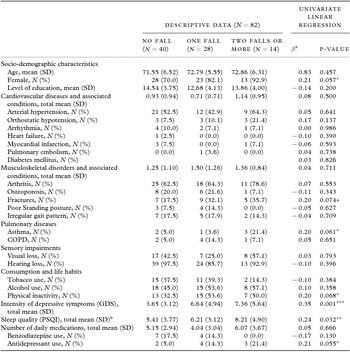
The sample comprised 78% women. The mean age was 72.40 years (SD = 6.13) and the mean level of education was 13.69 years (SD = 3.96). Almost half of the participants (N = 40) reported no fall, 34% (N = 28) reported one fall, and 17% (N = 14) reported two falls or more during the previous year. As detailed in Table 1, the number of falls (previous year) was positively and significantly correlated with gender (women) (β = 0.21; p = 0.057), fractures (β = 0.20; p = 0.074), asthma (β = 0.20; p = 0.061), physical inactivity (β = 0.20; p = 0.068), presence of depressive symptoms (β = 0.35; p = 0.001), complaints about quality of sleep (β = 0.24; p = 0.032), and use of antidepressant drugs (β = 0.21; p = 0.055).
Participants’ socio-demographic and medical characteristics according to the number of falls during the previous year

Notes: aThe standardized coefficient (β) is equivalent to Pearson's r.
bA lower score on PSQI indicates better quality of sleep.
SD = Standard deviation; GDS = Geriatric Depression Scale; PSQI = Pittsburgh Sleep Quality Inventory; COPD = chronic obstructive pulmonary disease.
*p ≤ 0.1; **p ≤ 0.05; ***p ≤ 0.001.
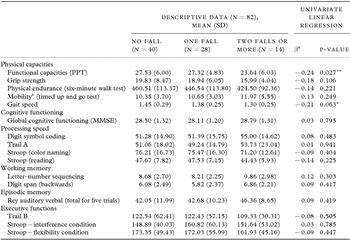
Results shown in Table 2 further indicated that the number of falls (previous year) was negatively and significantly related to functional capacities (β = −0.24; p = 0.027) and gait speed (β = −0.21; p = 0.063). No significant associations were found between the number of falls and cognitive functioning.
Physical capacities and cognitive functioning of participants according to the number of falls during the previous year

Notes: aThe standardized coefficient (β) is equivalent to Pearson's r.
bA lower score indicates better mobility.
PPT = Physical Performance Test; MMSE = Mini-Mental State Examination.
*p ≤ 0.1; **p ≤ 0.05.
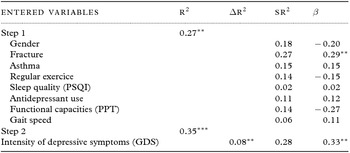
Table 3 displays the standardized regression coefficients (β), the semipartial correlations (SR2), and R2 after entry of all independent variables (IVs). R-value was significantly different from zero at the end of the first step and when all IVs were entered into the equation after the second step, F(9, 71) = 4.23, p = 0.000. At the end of the first step, when all significant univariate factors (except depressive symptoms) were entered, the explained variance was 27%, F(8, 72) = 3.31, p = 0.003. At the second step, with the addition of depressive symptoms, explained variance increased to 35%, F(1, 71) = 8.72, p = 0.004. Addition of depressive symptoms in the equation results in a significant increment in R2, suggesting that they are significantly and independently linked to recurrent falls after controlling for other factors.
Sequential regression analysis showing the unique contribution of depressive symptoms on the number of falls during the previous year

Notes: SR2 = semipartial correlation: corresponding to the percentage of reduction of R2 if the variable is removed from the equation.
PSQI = Pittsburgh Sleep Quality Inventory; PPT = Physical Performance Test; GDS = Geriatric Depression Scale.
*p ≤ 0.05; **p ≤ 0.01; ***p ≤ 0.001.
Discussion
This study aimed to determine if depressive symptoms are independently associated with recurrent falls in older people. After controlling for several shared factors, such as antidepressant drugs use and sleep problems, our results indicate that depressive symptoms are independently and significantly associated with the number of falls (previous year) in a community-dwelling sample of older adults. In particular, our results reveal that individuals who fell twice or more obtained a mean score of 7.36 (SD = 5.64) on the GDS, which is double the average score of non-fallers (mean (M) = 3.65; SD = 3.12). This value (i.e., 7.36) is below the cut-off value of 11, usually used to identify clinically depressed older adults (Yesavage et al., Reference Yesavage1982; Neal and Baldwin, Reference Neal and Baldwin1994), but close to the mean score of 8.63 obtained in a sample of older people with subthreshold depression (Adams and Moon, Reference Adams and Moon2009). In our sample, nearly 36% of the participants reporting two falls or more scored above 8.63 on the GDS. This proportion decreases to 32.1% in older people reporting one fall and to 7.5% among non-fallers. Moreover, the absence of significant associations between the number of falls and cognitive functioning could be explained by the exclusion of participants showing signs of dementia (MMSE score < 25).
Altogether, these results suggest that depressive symptoms, even at a subthreshold level, may be associated with recurrent falls in older adults. Although other research has found an association between depressive symptoms and falls (Biderman et al., Reference Biderman, Cwikel, Fried and Galinsky2002; Deandrea et al., Reference Deandrea, Lucenteforte, Bravi, Foschi, Vecchia and Negri2010; Launay et al., Reference Launay, De Decker, Annweiler, Kabeshova, Fantino and Beauchet2013), this is the first study to simultaneously control for a large numbers of medical, physical, cognitive, and psychological factors that may confound this relationship.
The strengths of this study include the exhaustive clinical evaluation made by a team of health professionals as well as a large number of confounding factors statistically controlled in order to isolate association between depressive symptoms and the number of falls. However, some limitations must be taken into account. First, the non-inclusion of some variables (e.g., arthritis, visual loss, etc.) in a multivariate model may be explained by the small sample size (i.e., lack of power). Second, the participants’ recall of falls may lead to underreporting. Third, the presence of anxiety was not assessed. Previous studies have shown that geriatric anxiety was associated to depression (Beekman et al., Reference Beekman, De Beurs, Van Balkom, Deeg, Van Dyck and Van Tilburg2000; Kvaal et al., Reference Kvaal, Mcdougall, Brayne, Matthews and Dewey2008) and falls (Hadjistavropoulos et al., Reference Hadjistavropoulos, Delbaere and Fitzgerald2011; Hull et al., Reference Hull, Kneebone and Farquharson2013). Current results should thus be interpreted in light of this limitation. Fourth, given the cross-sectional nature of this study, longitudinal studies are warranted to investigate the causal relationship between depressive symptoms and recurrent falls. Depressed older adults may be at higher risk of fall, and falls can in turn trigger depressive symptoms.
Despite these limitations, results of the current study strengthen the importance of assessing depressive symptoms during a fall risk assessment. If clinicians better understand how depressive symptoms are related to falls among their older patients (a cause, a consequence, or both?), they should be able to better treat them.
Conflict of interest
None.
Description of authors’ roles
Sébastien Grenier conducted the literature searches, performed the analyses, and wrote the manuscript. Marie-Christine Payette, Francis Langlois, Thien Tuong Minh Vu, and Louis Bherer revised the manuscript and contributed to its content and interpretation of data. Francis Langlois designed the study.
Acknowledgments
This study was supported by a grant from the Comité Aviseur pour la Recherche Clinique (CAREC) of the Institut universitaire de gériatrie de Montréal. S. Grenier was supported by a postdoctoral fellowship from the Canadian Institutes of Health Research (CIHR), F. Langlois was supported by a PhD fellowship from CIHR, and L. Bherer was supported by the Canadian Research Chair Program (Tier 2).