Introduction
As a preventative approach, establishing the developmental antecedents to chronic illness is important. One area that has received attention is the exploration of health outcomes for those born either prematurely or at low birth weight (LBW: <2500 g). Children born preterm or at LBW have higher rates of asthma, poor vision and poor academic performance than those born at term or of appropriate weight for gestation.Reference Farooqi, Hägglöf and Sedin 1 , Reference Hack, Taylor and Drotar 2 Effects of poor birth outcomes persist throughout life with increased rates of cardiovascular disease and non-insulin-dependent diabetes mellitus in adulthood.Reference Barker, Godfrey and Gluckman 3 For LBW offspring, the probable physiological pathway follows fetal under-nutrition with subsequent adaptations leading to hormone changes related to growth, insulin resistance and inflammation. Infants born with LBW tend to have early compensatory postnatal growth, having adapted to a biologically anticipated environment of poor nutrition.Reference Barker, Eriksson and Forsén 4 Disease risk is likely to be increased due to the combination of LBW and subsequent catch up growth – the risk of hypertension and Type II diabetes mellitus is elevated for every incremental drop in birth weight and rise in adult body mass index (BMI).Reference Barker, Eriksson and Forsén 4
It is important to consider developmental determinants of poor health outcomes among Indigenous people. Globally, Indigenous populations have increased rates of LBW, as well as increased rates of small for gestational age (SGA) at birth.Reference Gluckman, Hanson and Pinal 5 , Reference Gracey and King 6 Aboriginal and Torres Strait Islander peoples (Indigenous Australians) have a prevalence of preterm and LBW babies that is almost twice that of non-Indigenous women. 7 In New South Wales (NSW), 7.4% of all infants are born preterm, that is, before 37 weeks’ gestation but 13.2% of Indigenous infants are born preterm. A study of Indigenous pregnant women in rural and remote NSW found that the rate of preterm birth is slightly higher than that found in the whole of NSW, with 13.9% born before 37 weeks.Reference Pringle, Weatherall and Corbisier de Meaultsart 8 In terms of LBW, the rate in NSW for non-Indigenous infants is 5.9% but 11% of Indigenous infants are born under 2500 g. 7 Pringle et al.Reference Pringle, Weatherall and Corbisier de Meaultsart 8 found that maternal obesity, smoking and renal impairment are associated with poor birth outcomes in Indigenous pregnant women in NSW. Thus, both maternal health and pregnancy-related conditions may contribute to poor birth outcome rates in Indigenous Australians.
In addition, Indigenous Australians also experience higher rates of chronic diseases. The adult obesity rate is 1.7 times greater in Indigenous compared to non-Indigenous Australians.Reference Wright and Lewis 9 In a study comparing Australian, New Zealand, Canadian and American Indigenous health disparities, it was noted that Indigenous Australians experience the largest difference in life expectancy.Reference Bramley, Hebert and Jackson 10 Non-Indigenous Australians had the longest life expectancy of all four countries studied but Indigenous Australians had the shortest. Indigenous Australians had higher rates of all diseases studied compared with non-Indigenous Australians. The diseases studied included numerous cancer types, ischemic heart disease, cerebrovascular disease, chronic obstructive pulmonary disease, diabetes mellitus, pneumonia, influenza and intentional self-harm. The Australian Government mounted a campaign, ‘Close the Gap’ in response to the disparate health outcomes.
One potential contributor to rates of poor birth outcomes is stress in pregnancy. A recent review reported that stress in pregnancy is associated with preterm labor, LBW and pregnancy-induced hypertension.Reference Cardwell 11 This review identified sources of stress including socio-economic status, marital status, level of education, substance abuse, ethnicity and the pregnant woman’s quality of relationship with both her partner and mother. Another study measured major life stress events. It found that each unit increase in prenatal life stress events was significantly associated with a decrease in birth weight.Reference Wadhwa, Sandman and Porto 12 In addition, when prenatal anxiety was quantified, each unit increase was associated with a 3-day decrease in gestational length.Reference Wadhwa, Sandman and Porto 12 Arguably, the most severe clinical consequence of stress is the development of post-traumatic stress disorder (PTSD). An international review established that the rate of PTSD in non-Indigenous pregnant women is approximately 4%.Reference Wosu, Gelaye and Williams 13 In a study of over 16,000 births, the prevalence of prematurity in pregnant women with a diagnosis of PTSD was 9.2%; 35% higher than seen in women without PTSD (odds ratio 1.35; 95% confidence interval 1.14–1.61). This was after adjusting for co-morbid medical or other psychiatric diagnoses.Reference Shaw, Asch and Kimerling 14 Glynn et al. (2001) examined pregnant women following a major earthquake.Reference Glynn, Wadhwa and Dunkel-Schetter 15 The earlier in pregnancy the earthquake occurred, the more stressful women found it and the shorter their pregnancies. A number of other studies have shown that increased prenatal stress, particularly in the first trimester of pregnancy, associated with major disasters have reduced gestational length and birthweight.Reference Lederman, Rauh and Weiss 16 , Reference Dancause, Laplante and Oremus 17 These findings suggest that the gestation at which a major life event occurs can critically influence pregnancy outcomes.
Since colonization, Indigenous Australians have been subjected to various forms of trauma associated with government policies resulting in removal of children and culture.Reference Raphael, Swan and Martinek 18 This has led to marked inequities between Indigenous and non-Indigenous Australians. 19 Indigenous infant mortality is twice the rate of non-Indigenous infants, life expectancy is 20 years lower and cause of death is more frequently from accidental or violent methods for Indigenous Australians. Indigenous women are 45 times more likely to be experiencing domestic violence than non-Indigenous women. 19 These concerning facts lead to the need to explore the well-being of any pregnant Indigenous Australian woman.
Regarding the rates of stress or psychological distress in Indigenous Australians, the most recent National Aboriginal and Torres Strait Islander Health Survey (2012–2013) provides some insight. 20 Indigenous Australians report high or very high rates of psychological distress at almost three times the rate of non-Indigenous Australians (30.1 and 10.7%, respectively). The rate is higher in Indigenous women (35.8%) compared with Indigenous men (24.0%). Of more concern is the finding that the rate of high or very high psychological distress in Indigenous women of child-bearing age (18–44 years) is greatest at 36.3%. 20
The first step in considering whether the developmental origins of Indigenous adult chronic disease is precipitated by stress-induced poor pregnancy outcomes is to establish the extent and severity of stress during pregnancy in Indigenous populations. Although the prevalence of antenatal depression has been examined in pregnant Indigenous women internationally,Reference Bowen, Duncan and Peacock 21 very few studies have examined the incidence of stress or psychological distress in Australian pregnant Indigenous women. We have recently examined the rate of self-reported PTSD symptoms in pregnant Indigenous women living in rural and remote communities of NSW.Reference Mah, Weatherall and Burrows 22 Extremely high rates were found with approximately 40% experiencing symptoms. The mean score was higher than numerous other studies of various populations that had used an identical measure, indicating an increased symptom severity.
Identification of developmental contributors to health inequalities experienced among Indigenous populations is a critical target for policy and health system reform. We aimed to explore the relationship between psychological stress and the development of health conditions during the pregnancy or poor birth outcomes in Australian Indigenous pregnant women.
Method
Study
The Gomeroi gaaynggal study is a prospective longitudinal cohort design, recruiting women early in their pregnancy and following them until their children are 5 years of age. Both mothers and infants are followed in the postpartum years. The Gomeroi gaaynggal study recruits women pregnant with an Indigenous infant in rural and remote areas of NSW, Australia. This current analysis of stress in pregnancy is limited to reviewing data from maternal pregnancy until delivery of the infant.
Recruitment of participants
Recruitment to the study began in early 2010 and is ongoing. The research team seek to recruit participants early in their pregnancy, with the exact timing dependent on the gestation of their first presentation to antenatal clinics. Consent was sought from women carrying an Indigenous infant during their pregnancy while attending antenatal clinics. All women were approached by an Indigenous researcher who explained the study aim, study requirements and answered any questions from the women and their family members before consent. Participants were recruited from all ages but for those under the age of 16 years consent was obtained from both the participant and her guardian.
General study measures
Although all efforts are made to have all measures completed for all participants, many of the participants in the study have significant family and career responsibilities and this is not always possible. Study data were collected and managed using Research Electronic Data Capture (REDCap) electronic data capture tools hosted at University of Adelaide.Reference Harris, Taylor and Thielke 23 REDCap is a secure, web-based application designed to support data capture for research studies.
Women identified their Indigenous status, self-reported previous obstetric history and current health conditions. Women were asked to self-report their pre-pregnancy weight, which was then used to calculate a pre-pregnancy body mass index (ppBMI: kg/m2). If they were unsure and at less than 12 weeks’ gestation at recruitment, this weight was used as a proxy. If they were unsure and at more than 12 weeks’ gestation, no pre-pregnancy weight was recorded. Hence, data are reported with options for no, yes, not sure/can’t recall. Maternal blood pressure was collected at each visit using a Riester re-champion blood pressure machine and cuff.
Psychosocial measures
Participants were asked to complete the Kessler 10 (K10), Impact of Events Scale (Revised) (IOE-R) and the stressful life events scale (SLE) on every visit to the clinic. This was undertaken using a handheld iPad with an online questionnaire to ensure each participant could complete measures in a private and quiet space. Therefore, questionnaires may have been answered at multiple time points between enrolment and giving birth to the child. If the questionnaires were answered multiple times over the course of the pregnancy, the scoring for the K10 and IOE-R was averaged according to the number of questionnaires completed when compared to birth outcomes or scored as an individual time point when used as a comparison across the pregnancy. Only the first SLE completed was used to compare against birth outcomes.
The K10 is a 10-item questionnaire designed for determining serious mental illness, particularly depression, anxiety and psychological distress.Reference Kessler, Andrews and Colpe 24 It has been used effectively with Indigenous Australians and pregnant women.Reference Spies, Stein and Roos 25 , Reference McNamara, Banks and Gubhaju 26 Scoring for the K10 may range between 10 and 50. Categorization for the K10 is defined as likely to be well (10 to <20), likely to have a mild mental disorder (20–24), likely to have a moderate mental disorder (25–29) and likely to have a severe mental disorder (30 and above).Reference Coombs 27 The SLE is a list of major life events, including death of a close friend or family member, moving house, etc. that participants select, if they have been exposed to that event in the past 30 days. The SLE version used has been taken from the National Aboriginal and Torres Strait Islander Health survey and has been validated for use in Australian Indigenous populations. 28 This is scored as the number of events in the past 30 days. In two samples from Indigenous populations, the SLE achieved Cronbach’s α coefficients above 0.80, indicating high internal consistency.Reference Kowal, Gunthorpe and Bailie 29 The IOE-R scale is used to determine the psychological impact of major life events and severity of symptoms related to PTSD. The IOE-R has a score range of 0–88 and categorization of PTSD symptoms has been defined here as no PTSD symptoms (0–9), minimal symptoms (10–14), mild symptoms (15–20), moderate symptoms (21–30), severe symptoms (31–40), very severe symptoms (41–63) and extreme symptoms (64–88).Reference Yu, Hu and Li 30
Samples collected
At each study visit participants had urinary and non-fasting ethylenediaminetetraacetic acid plasma blood samples collected by an Indigenous research assistant. Samples were centrifuged as needed and aliquots were sent to Pathology New England (Tamworth, NSW, Australia) for analysis.
Biological measures
Participant samples were tested for a number of biomarkers, including urinary protein, albumin and creatinine, and plasma glucose. The normal clinical ranges during pregnancy for glucose <5.1 mmol/l (from fasting sample), albumin/creatinine are ≥3 mg/mmol and protein/creatinine are ≥30 mg/mmol. For the purpose of this analysis, we have used a <5.1 mmol/l glucose concentration.
Birth outcome measures
a) Gestational length: Gestational age was determined by ultrasound in the first trimester of pregnancy using Phillips Cx50 portable diagnostic ultrasound with 5 MHz convex transducer. Date of delivery was recorded from the participants’ clinical notes, and gestation at birth was calculated.
b) Birth weight: Infant weight was measured by the midwifery team present at delivery of the infant and transcribed to participant file. LBW was considered to be <2500 g, irrespective of gestational age. 31
c) Birth weight centiles were calculated using the GROW Birth Centile calculator [v.6.7.8.2 (AU), 2016].Reference Gardosi and Francis 32
d) Babies were considered to be preterm if born before 37 weeks’ gestation.
Ethics
The Gomeroi gaaynggal study received approval from Hunter New England Local Health District Human Ethics Committee (Ref. no. 08/05/21/4.01), the NSW Human Research Ethics Committee (Ref. no. HREC/08/HNE/129) and the Aboriginal Health and Medical Research Council Ethics Committee (Ref. no. 654/08).
Sample size calculation
Using a ratio of 10 subjects per variable,Reference Bentler and Chou 33 recent research sample sizes of 250–500 are common. Considering the number of variables, a sample size of 300 participants were required to show statistically significant differences between stress measures and poor pregnancy outcomes based on 80% power with α<0.05.
Statistical analysis
Women were included in the analysis if they had a singleton pregnancy, completed at least one IOE-R, K10 or SLE questionnaire during their pregnancy and birth outcome information was available. Descriptive statistics were used to describe participant demographics. Responses were given as a percentage of the included cohort to account for missing data, with the total number of responses collected listed.
Measures of maternal blood pressure and stress indicators were collected at each visit the mother made to the clinic. Therefore, the relationship between these factors was assessed by linear regression, including ppBMI, maternal age, smoking status and identified chronic maternal hypertension as initial confounders, with interactions between ppBMI and age, and clustering to account for possible multiple time points per woman. Confounders were removed in a stepwise manner, based on P-values of more than 0.2, which did not significantly reduce the R-squared value if the number of clusters was greater than the degrees of freedom. Post-estimation tests assessed residuals for normality.
For data relating to stress indicators and biological samples, such as the urinary albumin/creatinine ratio and protein/creatinine ratio, data were transformed if the post-estimation tests for normality in the residuals were not met. Best fit from transformation was assessed through quantile-normal plots and again, residuals tested for normality. Data that could not be transformed successfully (such as those with bi-modal distributions) were categorized according to ranges for clinical significance, used in a logistic (odds ratio) regression and tested for model fit using Hosmer–Lemeshow χ2 goodness of fit. Only biological/anthropometric data taken at time of stress survey completion was used in the models.
Similar regression methods were used for data relating to baby and maternal outcomes. Confounders for length of gestation were maternal smoking status and parity. If a model could not be fit for linear regression, a clinically significant point was used to dichotomize the data and used in a logistic regression; for example, classification as pre-term birth. Confounders for baby birth weight included maternal smoking status and ppBMI. Logistic regressions with robust estimators of variance were used for determining association between stress indicators and small and large for gestational age (LGA) classification. Confounders for SGA and LGA included maternal smoking and diabetes status (any kind during pregnancy) and ppBMI, with model fit tested with Hosmer–Lemeshow χ2 goodness of fit.
A t-test was performed between SLE results for those who were and were not asked about whether drug-related problems were a SLE that they experienced to show the effect of this missing question. Analyses of data were performed using Stata/IC 13.1 (StataCorp, College Station, TX, USA).
Results
Delivery data and outcomes were available for 268 of the 303 pregnancies recruited between 2010 and 2017. Missing data were due to incomplete medical records and/or a lack of biological or self-reported data from the participant. A total of 169 women had completed at least one IOE-R, K10 or SLE questionnaire in their pregnancy, had birth outcomes available and were included in the final analysis.
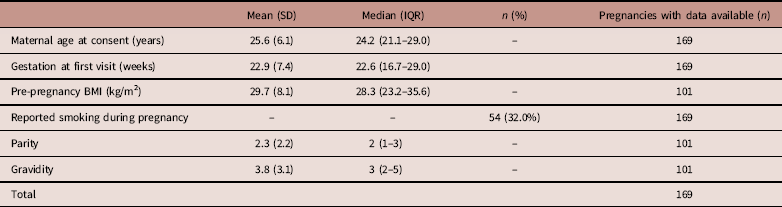
The median age of the women in this study was 24.2 years [interquartile range (IQR) 21.1–29.0] and 32% of the cohort (n=169) reported smoking during their pregnancy. The pre-pregnancy BMI was obtained for 101 women and indicated a median BMI of 28.3 (IQR 23.2–35.6) at the upper end of the overweight BMI range, which is 25–29.9. Median parity was 2 (IQR 1–3, n=101) and gravidity was 3 (IQR 1–5, n=101) (Table 1).
Maternal characteristics

BMI, body mass index; IQR, interquartile range.
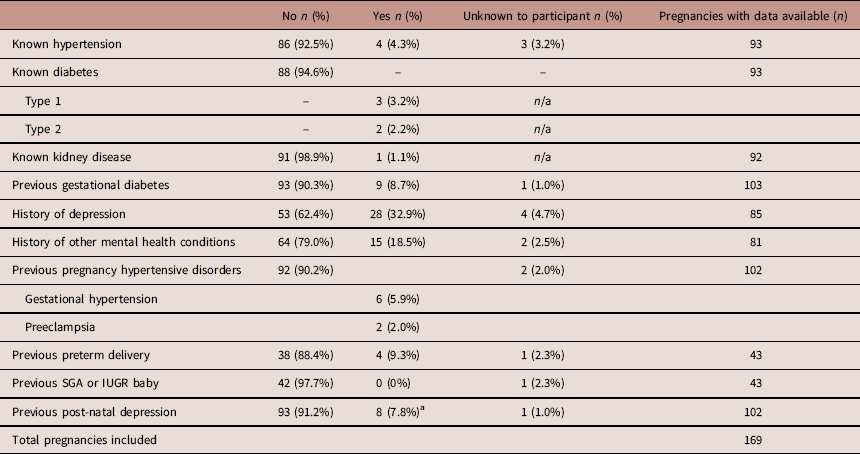
At baseline, women in the cohort self-reported having known hypertension, diabetes, kidney disease, previous mental health disorders as well as previous complications in pregnancy, including preeclampsia and preterm delivery (Table 2).
Pre-existing conditions and previous obstetric history self-reported by participants

BMI, body mass index; SGA, small for gestational age; IUGR, intrauterine growth restriction.
a Includes (n=2) participants who answered ‘probably, but never got diagnosed.’
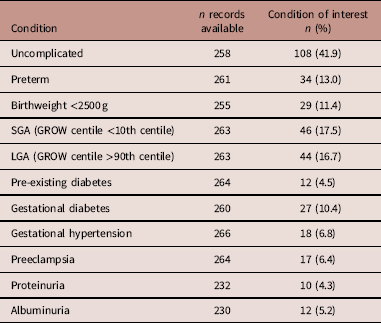
Of the 268 with delivery information, there are also missing data: 41.9% of women in the cohort had uncomplicated pregnancies and 42.4% delivered female infants (n=109); 11.37% of infants were born <2500 g; 41.4% of these were female (Table 3). Pregnancy outcomes in this cohort include: 13.03% preterm deliveries (<37 weeks, median preterm was 35.64 weeks, IQR 34.57–36.21), 17.49% infants SGA (GROW centile <10th centile) and 16.73% LGA (GROW centile >90th centile).
Pregnancy outcomes for the current study

SGA, small for gestational age; LGA, large for gestational age.
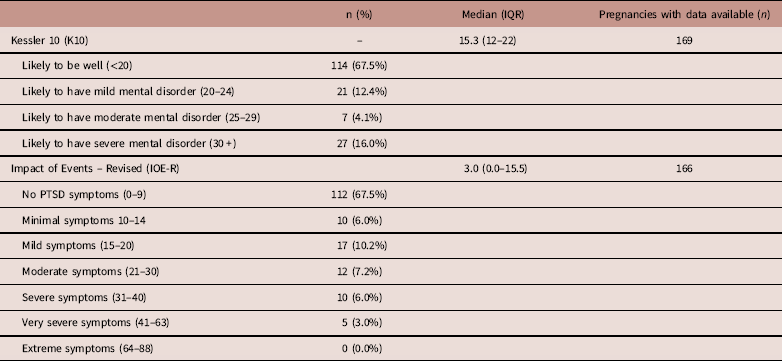
The median K10 score for the cohort was 15.3 (IQR 12–22, n=169) and for the IOE-R was 3 (IQR 0–15, n=169) (Table 3). Scores for the SLE ranged between 0 and 4, with 99% of values ranging between 0 and 2 stressful events occurring during the past 30 days. A t-test of those who, undertaking the SLE, had responded to ‘In the last 30 days have “drug problems” been a problem for you?’, against those who had not responded, showed no significant differences between groups (P=0.740). K10 values indicated that 67.5% of respondents were likely to be well (a score of <20) and 67.5% of participants had IOE-R values (0–9) identifying that they were without any symptoms of PTSD. As indicated in Table 4, K10 scores highlight that 20.1% of participants are likely to have moderate to severe symptoms of anxiety and depression during their pregnancy. In addition, the IOE-R highlights 32.4% of this cohort self-reported symptoms of PTSD.
Depression, anxiety and PTSD symptoms in Indigenous women during pregnancy

K10 measures anxiety and depression; IOE assesses PTSD symptoms.
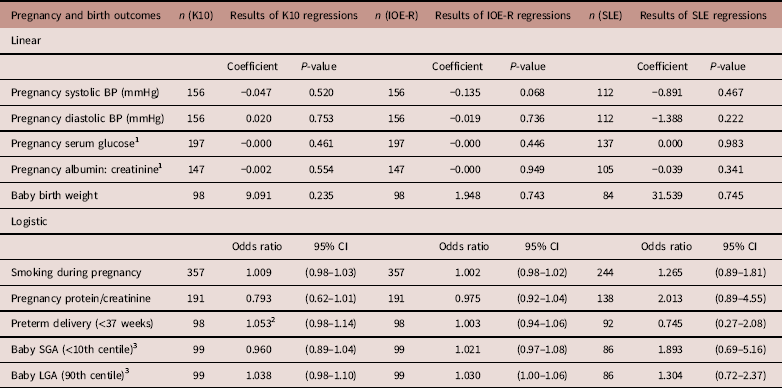
Despite the poor birth outcomes shown in Table 3 and high rates of mental health symptoms in Table 4, associations between the two were not identified as shown in Table 5.
Associations between pregnancy and birth outcomes with anxiety and depression and PTSD

CI, confidence interval; PTSD, post-traumatic stress disorder.
1 Data transformed using 1/square root;
2 Hosmer–Lemeshow P=0.0031 indicating model is not a good fit
3 Birth centile calculated using GROW centile
Discussion
Our results found that Australian Indigenous pregnant women had high rates of adverse birth outcomes known to be associated with long-term chronic health risks for their infants. They also had very high rates of self-reported anxiety, depression and PTSD symptoms. Unfortunately, this study was underpowered, due to incomplete data, to show an effect of maternal stress upon pregnancy outcomes. A strength of this study is the recruitment of perhaps the largest international cohort of pregnant Indigenous women into a longitudinal study of this kind. The team’s strategy to place no pressure on completion of measures for participants is perhaps the reason recruitment and retention has been strong in this cohort. Another strength of this study is the availability of the distribution of K10 and IOE-R scores in this population for the calculation of new sample size calculations to occur. Our data suggest that a sample size of 540 would be required to determine associations of maternal distress measured by K10 on infant birthweight (power of 0.8, α<0.05). Alternatively, to establish the association between PTSD symptoms as measured by IOE-R and infant birthweight, a sample size of 5212 would be required.
On a positive note, data from this cohort identified that only 32% of these women smoked during their pregnancy. This finding is lower than 2014–2015 data from Indigenous people of 18–24 years of age (41%) and 25–34 years of age (50%), as well as rates from Indigenous females during pregnancy (ages unspecified 46%). 34 We have previously published smoking rates of 47.6% in our cohort and this current result is a significant reduction.Reference Pringle, Rae and Weatherall 35 While we would like to attribute this reduction to participant engagement with our program, at this stage we cannot be clear why we have seen this change in smoking rates. In addition to the lower rate of smoking during pregnancy, this study also found no significant association between smoking status and any of the distress measures (see Table 5).
The finding of very high rates of psychological distress (20.1% of participants with moderate to severe symptoms of anxiety and depression and 32.4% with symptoms of PTSD) should not be ignored. There is significant evidence from others that poor mental health during pregnancy has significant effects on pregnancy outcomes. There is additional evidence that stress during pregnancy is associated with altered response to stress in the offspring, so reduction of maternal stress is an important focus area. Although studies address the issue of prevalence of psychological distress during pregnancy and the perinatal period for Indigenous populations,Reference Bowen, Duncan and Peacock 36 there is a paucity of studies establishing an evidence base for the effectiveness of interventions for distressed pregnant Indigenous women that are culturally acceptable. A recent Cochrane meta-analysis on postnatal depression interventions did not include any studies specific to Indigenous populations.Reference Dennis and Dowswell 37
It is equally important to consider the effect upon the infant of being raised by a distressed mother who is still likely to be residing in an environment with a similar number of social challenges. Some studies have examined outcomes for the affected child.Reference Brugha, Wheatley and Taub 38 Those exposed to a higher number of adverse childhood experiences are at higher risk of chronic adulthood diseases. A large retrospective cohort study of over 13,000 adults found a strong positive association between the number of adverse childhood experiences and adult diseases such as ischemic heart disease, cancer, chronic lung disease, liver disease and mental illness.Reference Felitti, Anda and Nordenberg 39 In addition to physical illness, poor mental health is also associated with childhood adversity. A child exposed to excessive levels of stress in utero is likely to reside in a social environment of similar adversity which would compound the effects of starting life as either LBW <2500 g (11.37%), SGA (17.49%) or premature (13.01%) of which this study reports as higher than the wider Australian population. The Gomeroi gaaynggal cohort is relatively closely aligned with national Australian data that shows 11.8% of Indigenous babies are born LBW compared with 6.6% of non-Indigenous infants and 14% of Indigenous infants are delivered prematurely compared with 8.6% of non-Indigenous infants. 40
To prevent distress during pregnancy for Indigenous women there are numerous areas that could be improved. These include establishment of an evidence base of interventions that are culturally acceptable to various populations, engagement of Indigenous women into early antenatal care, the establishment of health services that are welcoming to Indigenous clients and broader social interventions to reduce community adversity.
The success of engaging Indigenous women into early antenatal care must be scrutinized when considering the effects of psychological distress on pregnancy outcomes. It has been established that Indigenous women are less likely to engage in antenatal health care during the first trimester due to fear of judgment and lack of trust in health professionals.Reference Hanson 41 , Reference Emanuel, Leisenring and Williams 42 Increased incidence of both prematurity and LBW has been related to poor engagement in first trimester antenatal care.
Although efforts to increase engagement of Indigenous women in first trimester antenatal care are continuing, health services providing this care should consider how culturally sensitive it is. An audit of Western Australian antenatal health care services found that 75% did not comply with recommendations to increase culturally responsive care for Aboriginal and Torres Strait Islander clients.Reference Reibel and Walker 43 These recommendations included ensuring easy access to the service (transport and availability of un-booked appointments), having both a specific Aboriginal antenatal care program and protocol and the employment of an Aboriginal Health Worker.
In addition to the need for culturally acceptable health care during pregnancy, the effect of racism upon birth outcomes should be considered for Indigenous women. Giscombe and Lobel postulated that racism or perceived racism are important factors in the development of stress-induced pregnancy complications including preterm delivery and LBW.Reference Giscombe and Lobel 44 Although this study examined for African American women, the description of institutionalized racism such as differential access to health care is important to consider for Indigenous populations internationally. Many studies examining this issue for Indigenous populations have highlighted the difficulties in provision of equitable health care access.Reference Peiris, Brown and Cass 45 , Reference Hayman, White and Spurling 46
A more complex approach to reducing distress in pregnant Indigenous women is to provide broader social interventions to decrease community adversity. This concept is highlighted in a review in the Lancet emphasizing the importance of social determinants for the health of Indigenous persons internationally.Reference Gracey and King 6 Australian specific papers also consider the need for social interventions. The Australian Federal Government’s 2017 Budget Position paper cites social interventions as one of nine priorities established to ‘Close the Gap’ for Aboriginal and Torres Strait Islander health inequality.Reference Commission 47 A Canadian paper similarly identifies the need for social resources and access to education to ensure adequate health for First Nations people.Reference Richmond and Ross 48
Indigenous pregnant women experience higher rates of psychological distress during pregnancy and adverse pregnancy outcomes than non-Indigenous women. The provision of culturally acceptable health services for antenatal care is essential, as well as the development of culturally appropriate mental health interventions to sensitively support women during pregnancy. In addition, research design for Indigenous populations should also be culturally responsive. Adequate time must be allowed for the development of trust and traditional sample size calculation does not adequately allow for this in Indigenous populations. Studies should be designed with larger sample sizes than needed for purely statistically significant results. It should be understood that participants may not be comfortable participating in all aspects of a study and increased participant numbers should be planned for. The high rates of both adverse pregnancy outcomes and mental health symptoms must not be ignored when considering the developmental origins of disease in Indigenous populations.
Acknowledgements
The authors wish to pay their respects to elders, past and present, and extend that respect to any Indigenous readers. The authors of the paper would like to acknowledge the Gomeroi gaaynggal Aboriginal Steering committee for their ongoing advice for the Gomeroi gaaynggal studies. Dr Shalem Yiner-Lee Leemaqz has assisted the investigators with software issues related to management of the data set. The authors would like to gratefully recognize the women and children who dedicate their time to participate in the Gomeroi gaaynggal study.
Financial support
This work was supported by the National Health and Medical Research Council (Grant numbers 569239, APP1026733, APP1063123). KGP is supported by an ARC Future Fellowship (FT150100179). CTR is supported by a Lloyd Cox Professorial Research Fellowship from University of Adelaide.
Conflicts of interest
None.