

1. Introduction
Intergenerational income mobility, the extent to which income levels change between parents and their children, is traditionally believed to affect social equality [Fortin and Lefebvre (Reference Fortin, Lefebvre and Corak1998)]. Higher intergenerational income mobility across generations generally indicates that parents’ economic statuses have little effect on their children's adult incomes, indicating that children from low-income and high-income families have relatively equal opportunities to become high-income adults. This thus promotes a society with higher social equality encourages its members, regardless of their family background, to take advantage of their resources and abilities to achieve their economic potentials [Fortin and Lefebvre (Reference Fortin, Lefebvre and Corak1998)]. Conversely, in a society with low intergenerational income mobility, children's adult incomes are more affected by their parents’ income levels than by their own intelligence, abilities, and diligence, resulting in lower social equality. In this regard, the issue of intergenerational income mobility has gained considerable attention because of its importance to social equality.
Over the past several decades, the global economic map has undergone a dramatic change. Remarkably, as a developing country with the world's largest population, China has witnessed rapid economic growth with a high average annual growth rate (more than 9%) in gross domestic product, much higher than the world economy's average annual growth rate of about 3% [Liu (Reference Liu2010), Shi et al. (Reference Shi, Bang and Li2016)]. Income per capita and living standards in China also increased sharply. Unfortunately, along with the rapid economic development, the phenomenon of low intergenerational income mobility has also occurred in China and become much more severe in recent years. Studies show that the gain from China's remarkable growth of the past 35 years has not been evenly shared, especially through the intergenerational transmission of income. The country has changed from a very equal society into a deeply unequal one [The Economist (2016)]. According to China's National Bureau of Statistics, the Gini coefficient in China, the most commonly used measure of inequality, reached 0.469 in 2014, exceeding the international warning level of 0.4. In a typical Chinese family, parents play an important role in their children's access to the labor market through their own social networks and educational investments, which, in turn, can affect the children's adult incomes [Gong et al. (Reference Gong, Leigh and Xin2012)]. As a result, income inequality could occur through intergenerational transmission of family background. For all those reasons, intergenerational income mobility has been a hot topic in China, receiving ever-increasing attention [Guo and Min (Reference Guo and Weifang2008), Gong et al. (Reference Gong, Leigh and Xin2012), Deng et al. (Reference Deng, Gustafsson and Shi2013), Chen and Cowell (Reference Chen and Cowell2017)].
To address this concern, taking advantage of data from the China Health and Nutrition Survey (CHNS) during the period 1989–2011, we estimate the intergenerational income elasticity (IGE) to examine the extent to which fathers’ incomes affect their children's adult incomes. Meanwhile, using a two-stage least squares estimation technique, we explore the likely transmission mechanisms and find that fathers’ investments in their children's education and occupation are the main channels of intergenerational income mobility in China.
Compared with previous studies, this paper can make contributions in at least four important ways. First, data used in this paper include information on both urban and rural China, which extends and enriches earlier studies, such as Gong et al. (Reference Gong, Leigh and Xin2012) and Deng et al. (Reference Deng, Gustafsson and Shi2013) that concentrate on urban China. The use of the pooled rural and urban data enables us to provide an overall picture of intergenerational income mobility in China and to conduct an international comparison of the estimated IGE. Second, the sample period of our research is from 1989 to 2011, which is longer to reflect the trend of intergenerational income mobility in China. Third, there will be a downward estimation bias of IGE when using annual income as proxy for lifetime income [Solon (Reference Solon1992)], which is considered in this paper. To achieve this, we use fathers’ average income from 1989 to 2011 to represent the lifetime income and adjust for the effect of persistent transitory fluctuations using a reliability ratio to present a more accurate estimation of IGE in China. Forth, as suggested by Chetty et al. (Reference Chetty, Hendren, Kline and Saez2014), we measure both relative and absolute mobility to compare the estimated IGE in China.
The rest of the paper is structured as follows. Section 2 provides a literature review of intergenerational income mobility. Section 3 demonstrates the methodology applied to estimate IGE. Section 4 shows the data and descriptive statistics. Section 5 reports the trends in IGE in China. Section 6 explores the likely transmission mechanisms, and Section 7 presents conclusions and policy implications.
2. Literature review
The most extensively researched topic about intergenerational income mobility is the measurement of its extent and comparisons across time and between countries, which is usually measured by IGE [Blanden et al. (Reference Blanden, Gregg and Macmillan2007)]. Using a family utility function spanning several generations, Becker and Tomes (Reference Becker and Tomes1979) find that the equilibrium income of children is determined by their market and endowed luck, the income and endowment of their parents, the degree of inheritability, and the propensity to invest in children. Since then, considerable attention has been given to improving the estimation of intergenerational income mobility. Behrman and Taubman (Reference Behrman and Taubman1985) find that the intergenerational correlation in earnings is 0.2 or less. To obtain better estimates of permanent income capacity, Solon (Reference Solon1992) takes averages of income figures across several different years and points out that the intergenerational correlation in long-run income is at least 0.4, indicating dramatically less mobility than suggested by earlier research [Chadwick and Solon (Reference Chadwick and Solon2002)]. Using income tax information on father–son pairs, Corak and Heisz (Reference Corak and Heisz1999) estimate the intergenerational earnings elasticity to be about 0.2.
Relevant factors have also been included in previous studies to obtain better estimations of IGE. For instance, Björklund and Chadwick (Reference Björklund and Chadwick2003) reconsider the definition of father; Lindahl (Reference Lindahl2008) examines birth-order position and family sizes; Pekkarinen et al. (Reference Pekkarinen, Uusitalo and Kerr2009) explore the Finnish comprehensive school reform; and taking account of gender, Dearden et al. (Reference Dearden, Machin and Reed1997) and Chadwick and Solon (Reference Chadwick and Solon2002) estimate the effects of fathers’ income on their sons’ and daughters’ incomes, respectively. In addition, Peters (Reference Peters1992) finds relatively greater intergenerational income mobility in the USA, as Bratberg et al. (Reference Bratberg, Anti Nilsen and Vaage2005) do for Norway. On the other hand, Ng (Reference Ng2013) finds relatively lower intergenerational income mobility in Singapore, as Guo and Min (Reference Guo and Weifang2008), Gong et al. (Reference Gong, Leigh and Xin2012), and Deng et al. (Reference Deng, Gustafsson and Shi2013) do in urban China; Björklund et al. (Reference Björklund, Roine and Waldenström2012) do for the top of the income and earnings distributions in Sweden; and Corak (Reference Corak2013) do in the USA. Other studies include Atkinson (Reference Atkinson1980) and Atkinson et al. (Reference Atkinson, Trinder and Maynard1978) for Britain, Pekkala and Lucas (Reference Pekkala and Lucas2007) for Finland, Pascual (Reference Pascual2009) for Spain, and Lee and Solon (Reference Lee and Solon2009) for the USA.
As claimed in Solon (Reference Solon2002), one reason why international comparative studies of intergenerational income mobility are particularly important is that each study of a particular country characterizes important features of that country's income inequality. Another reason is that international comparative studies may yield valuable clues about cross-country differences in intergenerational earnings mobility. For example, Björklund and Jäntti (Reference Björklund and Jäntti1997) and ÖSterberg (Reference Österberg2000) compare intergenerational income mobility between Sweden and the USA; Takenoshita (Reference Takenoshita2007) compares intergenerational mobility in East Asian countries, including Japan, Korea, and China; Blanden et al. (Reference Blanden, Haveman, Smeeding and Wilson2014) examine the relative intergenerational mobility in the USA and Great Britain and find that offspring education and occupation are the primary channels of intergenerational persistence in the two countries, respectively; and Cervini-Plá (Reference Cervini-Plá2015) finds that intergenerational mobility in Spain is similar to that in France, lower than in the Nordic countries and Britain, and higher than in Italy and the USA. Using a non-parametric technique, Bhattacharya and Mazumder (Reference Bhattacharya and Mazumder2011) analyze black–white differences in intergenerational income mobility in the USA and the factors determining these differences. They find that blacks experience much less upward mobility across generations than whites and that differences in cognitive skills during adolescence can be the primary reason for that gap. In addition, Ichino et al. (Reference Ichino, Karabarbounis and Moretti2011) highlight the importance of politico-economic institutions, suggesting that international comparisons of IGE are not particularly informative about fairness without considering differences in politico-economic institutions among countries.
Another strand of research on intergenerational income mobility has concentrated on the transmission mechanisms through which income statuses pass from parents to children. The key contributors identified in previous studies include education [Blanden et al. (Reference Blanden, Gregg and Macmillan2007), Guo and Min (Reference Guo and Weifang2008), Gong et al. (Reference Gong, Leigh and Xin2012)], occupation [Cheng and Dai (Reference Cheng and Jianzhong1995), Takenoshita (Reference Takenoshita2007), Gong et al. (Reference Gong, Leigh and Xin2012)], cognitive ability and non-cognitive traits [Galindo-Rueda and Vignoles (Reference Galindo-Rueda and Vignoles2005), Heckman et al. (Reference Heckman, Stixrud and Urzua2006), Blanden et al. (Reference Blanden, Gregg and Macmillan2007)], labor market experience [Stevens (Reference Stevens1997), Gregg and Tominey (Reference Gregg and Tominey2005)], and marriage [Lam and Schoeni (Reference Lam and Schoeni1994), Ermisch et al. (Reference Ermisch, Francesconi and Siedler2006)]. Among them, education has been widely believed to be the primary channel.
However, most previous studies are undertaken in developed countries, especially in the USA and Great Britain. A small number of studies are conducted in China, with particular emphasis on the IGE estimation. For example, using data from the Urban Household Education and Employment Survey 2004 (UHEES) and the Urban Household Income and Expenditure Survey 1987–2004 (UHIES), Gong et al. (Reference Gong, Leigh and Xin2012) find that the IGE was 0.63 in urban China. Similarly, using urban data from China Household Income Project (CHIP) over the period 1995–2002, Deng et al. (Reference Deng, Gustafsson and Shi2013) also suggest a low intergenerational income mobility, with the IGE of 0.47 in 1995 and 0.53 in 2002, respectively. Unexpectedly, using the five waves of available CHNS data (1991–2004), Labar (Reference Labar2007) finds lower IGEs in China, ranging from 0.25 to 0.29.
The trend in intergenerational income mobility in China has also been examined. Using the microdata from CHIPS (1988–2002) and Chinese General Social Survey (CGSS, 2006), Yuan and Chen (Reference Yuan and Lin2013) point out that intergenerational income mobility has improved since 1988 but it shows a deteriorating trend after 1995. Using the CHNS data over the period 1989–2011, Chen and Cowell (Reference Chen and Cowell2017) find higher mobility in rural China and suggest a decreasing rank mobility trend as China moves into the new millennium. That is to say, it will be more difficult for those on the bottom rungs of the economic ladder to move upwards but it will be easier for those on the top rungs to stay there. By restricting the attention to temporal patterns of cross-sectional inequality in urban China, Fan et al. (Reference Fan, Junjian and Junsen2015) address a decreasing trend in intergenerational income mobility using the data from CHIPs in 1995 and 2002.
With respect to transmission mechanisms, the role of education has been widely examined [Guo and Min (Reference Guo and Weifang2008), Emran and Sun (Reference Emran and Yan2015), Gong et al. (Reference Gong, Leigh and Xin2012)]. According to Golley and Kong (Reference Golley and Tao Kong2013), the difference of intergenerational transmission persistence of education between urban and rural China can aggravate rural–urban disparity in China. Yang and Qiu (Reference Yang and Muyuan2016) suggest that direct subsidies to poor parents can be the most efficient and effective policy for increasing poor families’ investment in children's early education. In addition, Yuan and Chen (Reference Yuan and Lin2013) find that human capital, social capital, and wealth together explain more than 60% of intergenerational income mobility in China, with wealth contributing the largest proportion. The remarkable role of the parent-to-offspring investment in human capital is also highlighted by Qin et al. (Reference Qin, Tianyu and Chen Zhuang2016) using a three-period overlapping-generations model.
3. Methodology
The mobility can be divided into absolute mobility and relative mobility [Chetty et al. (Reference Chetty, Hendren, Kline and Saez2014)]. Absolute mobility aims to evaluate the outcomes of children from families with a given income level in absolute terms. As suggested by Chetty et al. (Reference Chetty, Hendren, Kline and Saez2014), the absolute upward mobility  $\bar{r}_{25}$, indicating the mean rank of son whose father is at the 25th percentile of the national father income distribution, can be used to measure the absolute intergenerational mobility in China. The other measure is the difference between the expected ranks of son born to father at the top and bottom of the income distribution, which is expressed as
 $(\bar{r}_{100}-\bar{r}_0)$. As a result, the absolute mobility at percentile p can be defined as:
 $$\bar{r}_p = \lambda + \gamma \times p$$
where λ and γ are the intercept and slope of the rank–rank relationship by regressing son rank on father rank.
On the other hand, the relative mobility aims to evaluate the relative outcomes of children from different family backgrounds. To achieve this, IGE is estimated to reflect the responsiveness of children's incomes to a change in their parents’ incomes. Following Becker and Tomes (Reference Becker and Tomes1979), IGE can be derived by estimating below equation:
 $$\ln Y_{1i} = \alpha + \beta \ln Y_{0i} + \varepsilon _i$$
where lnY 1i is the log of children's permanent incomes in family i; lnY 0i is the log of parents’ permanent incomes in family i; α is the intercept term and εi is an error term which is identically and independently distributed with zero mean and homoscedasticity. As a result, β is the IGE. Moreover, a higher β indicates that children's incomes are largely affected by their parents’ incomes, resulting in less mobility in a given society. Conversely, a lower β suggests higher intergenerational income mobility across generations [Blanden et al. (Reference Blanden, Gregg and Macmillan2007)]. Taking into account the potential age profiles in parents’ and children's incomes, below empirical model controls the age variable including children's age (age1i), parents’ age (age0i), children's age squared  $({\rm age}_{1i}^2 )$, and parents’ age squared
 $({\rm age}_{0i}^2 )$ [Solon (Reference Solon1992), Blanden et al. (Reference Blanden, Gregg and Macmillan2007), Lee and Solon (Reference Lee and Solon2009), Cardak et al. (Reference Cardak, Johnston and Martin2013)].
 $$\ln Y_{1i} = \alpha + \beta \ln Y_{0i}{\rm +} \mu _1{\rm ag}{\rm e}_{1i} + \omega _1{\rm age}_{1i}^2 {\rm +} \mu _0{\rm ag}{\rm e}_{0i} + \omega _0{\rm age}_{0i}^2 + \varepsilon _i$$
Theoretically speaking, the underlying relationship between children's and parents’ permanent incomes is our real interest in. Nevertheless, it is well recognized that no one can observe the permanent income, bringing a challenge in estimating IGE. A convenient and natural solution is to use the observed single-year income as a proxy for the permanent income. Unfortunately, earlier studies point out that the use of short-run proxies significantly underestimates the true IGE of permanent income [Solon (Reference Solon1992), Blanden et al. (Reference Blanden, Gregg and Macmillan2007), Pascual (Reference Pascual2009)]. To estimate IGE more precisely, Solon (Reference Solon1989) suppose that the relation between parents’ current-year incomes  $(Y_{0i}^c )$ and permanent incomes
 $(Y_{0i}^p )$ can be specified as:
 $$Y_{0i}^c = Y_{0i}^p + \upsilon _{0i}$$
where υ0i is an error term, representing transitory fluctuations around permanent earnings caused by both actual transitory movement and random measurement error. The standard textbook analysis of errors in variables implies that β is downward estimated:
 $$\beta ^c = \beta \displaystyle{{\sigma _{Y_{0i}^p} ^2} \over {\sigma _{Y_{0i}^p} ^2 + \sigma _{\nu _{0i}}^2}} \lt \beta $$
That is, the proxy leads to an underestimation of the true IGE.
As discussed in previous studies, two alternative methods have commonly been used to improve the estimation of IGE. The first method refers to multiple-year measures of income. The average income over several different years can be taken as a proxy for permanent income, which is likely to achieve a more accurate estimator of IGE [Solon (Reference Solon1992), Mazumder (Reference Mazumder2005)]. Consider T-year measures of income. Using a T-year average income as a proxy for permanent income, equation (5) can be rewritten as:
 $$\beta ^A = \beta \displaystyle{{\sigma _{Y_{0i}^p} ^2} \over {\sigma _{Y_{0i}^p} ^2 + \sigma _{\nu _{0i}}^2 /T}} \lt \beta $$
From equation (6), the estimated IGE (β A) will become closer to its true value (β) as T becomes larger. The second solution assumes that the current income in each year follows a first-order autoregressive process with parameter δ [Solon (Reference Solon1992)]. The estimated IGE (β AR) is:
 $$\beta ^{AR} = \beta \displaystyle{{\sigma _{Y_{0i}^p} ^2} \over {\sigma _{Y_{0i}^p} ^2 + \alpha \sigma _{\nu _{0i}}^2 /T}}{\rm =} \beta \lambda _T \lt \beta $$
 $$\alpha = 1 + 2\delta \displaystyle{{T-[(1-\delta ^T)/(1-\delta )]} \over {T(1-\delta )}}$$
where λ T is an attenuation factor (also called the reliability ratio) and it is used to estimate how much signal year income is provided by the measure relative to the total variance (signal plus noise). Using a value of 0.5 for δ and a 5-year average of fathers’ earnings, Mazumder (Reference Mazumder2005) finds that the estimated IGE was 0.69. In this paper, we combine the two alternative methods to improve the estimation of IGE in China. In addition, as suggested by Chetty et al. (Reference Chetty, Hendren, Kline and Saez2014), we also consider the correlation between child and parent ranks, termed as rank–rank slope, to measure the relative mobility by regressing the child's rank on his father's rank.
4. Data and descriptive statistics
Generally speaking, a suitable dataset spanning at least two generations is crucial in examining intergenerational income mobility. The CHNSFootnote 1 conducted by an international team of researchers with backgrounds in nutrition, public health, economics, sociology, Chinese studies, and demography provides rich information not only on health and nutritional status, but also on households’ economic, occupational, and educational status, and has thus been used extensively to investigate intergenerational income mobility in China. The survey has been carried out periodically in nine provinces during the past three decadesFootnote 2 [Wang (Reference Wang2005), Ding and Wang (Reference Ding and Yougui2008), Chen and Cowell (Reference Chen and Cowell2017)]. Moreover, CHNS 2011 is ready for public use. Taking advantage of the integrated master files that longitudinally link households and individuals, we are able to carry out a longitudinal analysis in this paper.
Taking account of the following two reasons, we restrict our attention to fathers and the eldest son in each family. The primary reason is the sons’ responsibilities in a representative Chinese family. The sons usually take more responsibilities of taking care of the parents and become a majority of the labor supply in many Chinese families. While a married daughter has to take more responsibilities of taking care of the parents-in-law and her income depends not only on her father but also on her husband and father-in-law. The second reason is that father–son pairs can provide integrated information about educational investment. Due to the son bias, some families are less likely to invest in their daughters. This raises the question of data quality, i.e. the daughters’ educational information is sometimes missing, which cannot facilitate the further investigation of the explanatory power of education. Consequently, using the nine waves of available CHNS data (1989–2011), we collected a sample size of 310, 371, 372, 147, 187, 113, 102, 106, and 126 father–son pairs from the respective census. In addition, we use observations only between ages of 20 and 65 to take into account the working ages of Chinese adults.
We consider the following variables: individual's annual income, age, type of area, years of education, and type of occupation. To remove the effect of inflation and obtain fathers’ and sons’ real incomes in terms of 2011 RMB, we used the Consumer Price Index in the China Statistical Yearbook to adjust the income variable and make comparisons possible. In the single-year measure of income, the age variable takes the value of the father's age when the census was conducted, whereas in the multiple-year measure of income, the age variable takes the average of the father's ages across different years. We applied years of education and type of occupation to indicate education and occupation through which fathers’ incomes can affect sons’ incomes. Averagely speaking, occupation can directly determine a person's income and therefore become a reflection of the social-economic status. Suggested by the International Standard Classification of Occupations (ISCO-08), occupations can be divided into six broad categoriesFootnote 3. They are agricultural workers with the value of one, unskilled and service workers with the value of two, technical and office workers with the value of three, professionals with the value of four, art workers with the value of five, and managers and administrators with the value of six. Due to particular culture and tradition in China, a greater value of occupation generally represents more prestige and higher social-economic status [Erikson and Goldthorpe (Reference Erikson and Goldthorpe2002)].
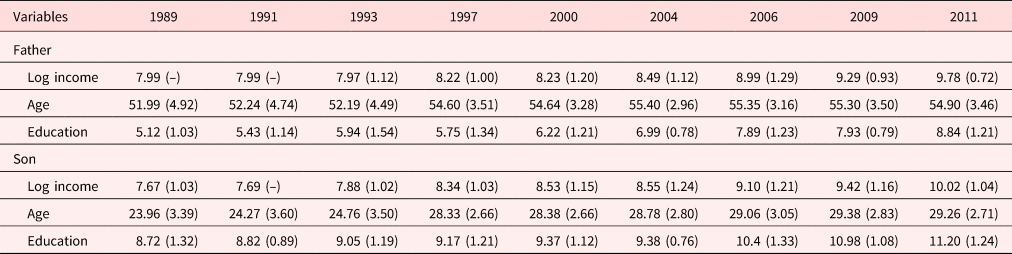
Table 1 reports the descriptive statistics of variables over the period 1989–2011. From Table 1, both the fathers’ average annual income (in log), ranging from 7.97 in 1993 to 9.78 in 2011, and the sons’ average annual income (in log), ranging from 7.67 in 1989 to 10.02 in 2011, show an upward trend. Averagely, sons’ incomes exceed fathers’ income after 1997 potentially because sons have higher incomes as their working time and educational time increase. With respect to age, the fathers’ average age is between 52 and 55 years old, and the sons’ average age is between 24 and 29 years old. In this regard, if we suppose a 25–30-year difference between fathers and sons, the sample time is long enough for sons to reach the same stage in the life cycle by 2011 that their fathers were in 1989, leading to a relatively small life cycle bias. A close inspection of Table 1 reveals that the fathers’ average years of education rise from 5.12 years in 1989 to 8.84 years in 2011, for a 72.66% increase across the whole period. The sons’ average educational time, as expected, increases from 8.72 years in 1989 to 11.20 years in 2011. Moreover, sons receive more education than fathers in each census, indicating that education receives increasing attention.
Descriptive statistics for variables

Note: The mean values with standard deviation in parentheses are reported.
Source: Authors’ calculations from CHNS data over 1989–2011.
5. Trends in intergenerational income mobility
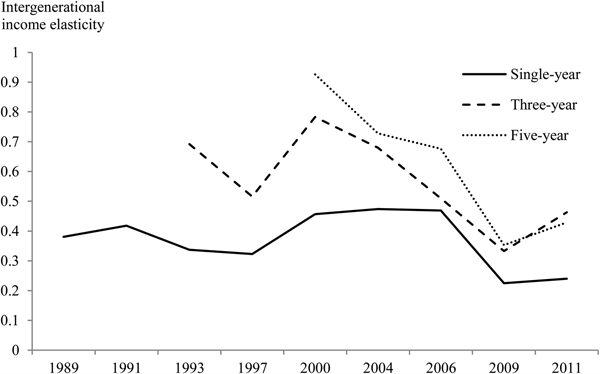
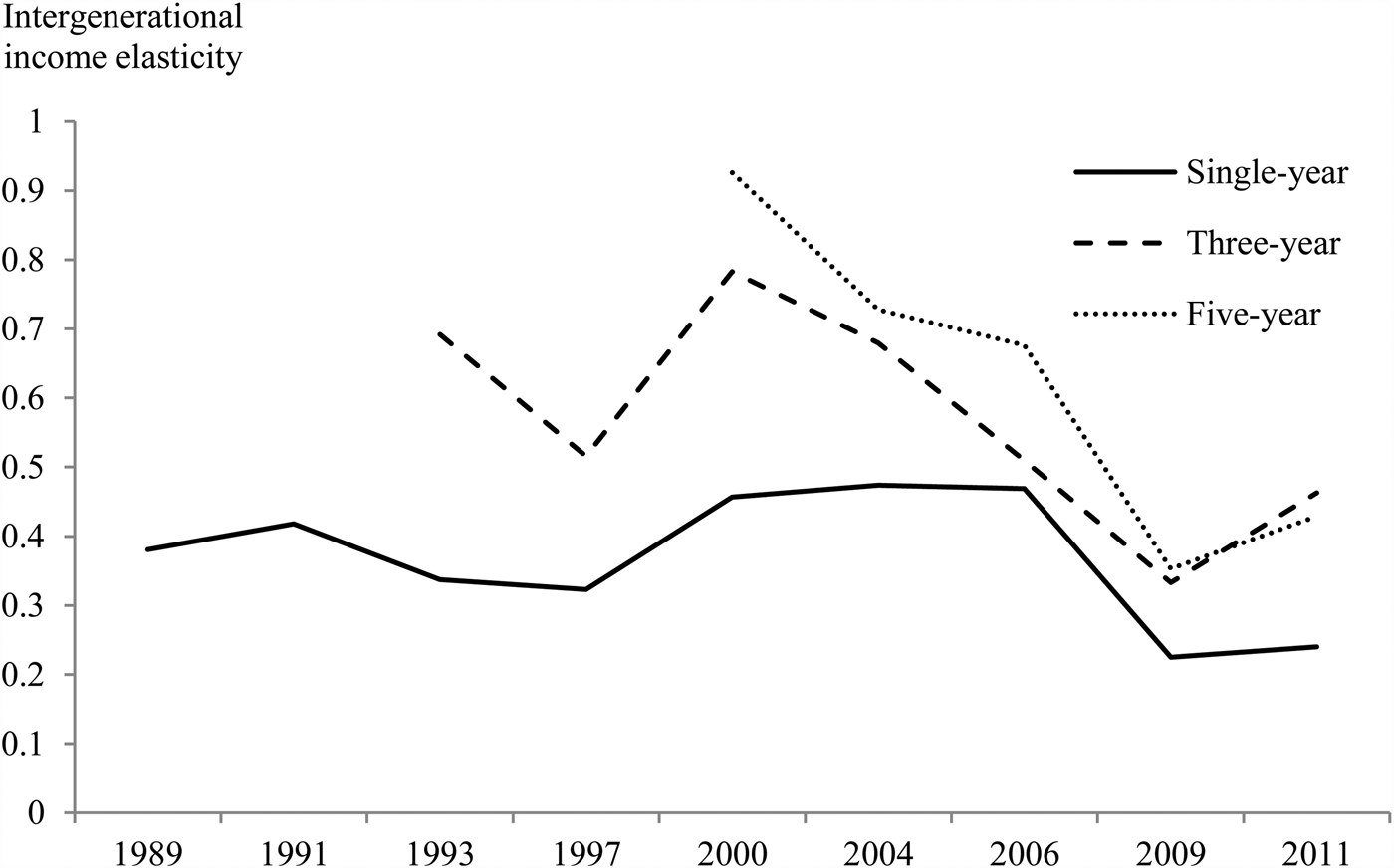
Now we are able to focus on IGE estimation to investigate trends in intergenerational income mobility in China using data from CHNS over 1989–2011. To provide a benchmark for comparison, we begin by estimating IGE using single-year income as a proxy for permanent income. As shown in Table 2, all the estimated intergenerational income elasticities are statistically significant, ranging from a minimum of 0.225 in 2009 to a maximum of 0.474 in 2004. Relatively high intergenerational income elasticities can be observed in the years 2000, 2004, and 2006, indicating that China experienced relatively low intergenerational income mobility in those years. In fact, with the reform and opening-up of China, a large number of surplus rural laborers migrated into cities in the early 1990s, resulting in a diversity of revenue sources in China. On the other side, however, the accumulation of labor hindered the continuous transformation and reform of state-run enterprises in the late 90s created a large number of laid-off workers. Under those circumstances, competition in the labor market intensified. A son from a high-income family was more likely to succeed in the labor market because of his family background. In other words, fathers’ incomes have greater effects on their sons’ incomes when the economy is in a recession.
Estimation of IGE

Source: Authors’ calculations.
Referring to Solon (Reference Solon1992), Zimmerman (Reference Zimmerman1992), and Blanden et al. (Reference Blanden, Gregg and Macmillan2007), we estimated IGE using multiple-year income as a proxy for permanent income and computed permanent income as a time average over 3 and 5 years. In the 3-year measure of income, the estimates of IGE (Table 2 and Figure 1) are statistically significant, fluctuating between 0.333 and 0.783. Relatively higher elasticities are found in 1993, 2000, and 2004. With 5-year measure of income, the highest elasticity appeared in 2000 with a value of 0.926, and the lowest elasticity appeared in 2009 with a value of 0.353. Compared with the years 2009 and 2011, elasticities were higher over 2000–2006, reflecting lower intergenerational income mobility in those years. In addition, both the single-year and multiple-year measures of income indicate that China experienced relatively low intergenerational income mobility during 2000–2006, which is reflected by greater values of elasticity, especially in the years of 2000 and 2004. This situation has improved in recent years, reflected by smaller elasticities in 2009 and 2011. The result is in line with those of Chen and Cowell (Reference Chen and Cowell2017) who suggest that income mobility in China has carried on increasing. Members of society, regardless of their backgrounds, have more equal opportunities to become high-income individuals than before. It also means that personal resources and abilities, rather than parental economic status, play a primary role in determining their incomes.
Trends in intergenerational income elasticities.
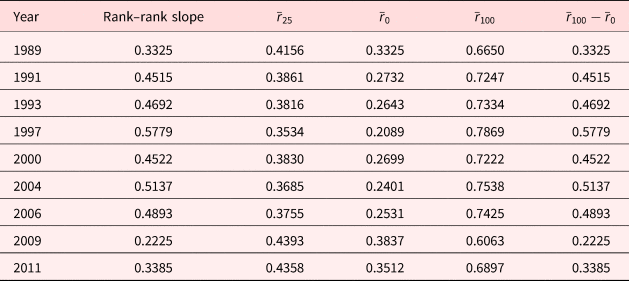
Subsequently, Table 3 reports the results of rank–rank slope to make comparison of IGE estimation. The slope ranges from 0.223 in 2009 to 0.578 in 1997. Higher rank–rank slopes appeared over the period 1991–2006, while lower slopes appeared after 2006. That is, China had experienced relatively low intergenerational income mobility over the period 1991–2006, especially in 1997, 2004, and 2006. This finding confirms the estimated IGE. The slopes in 2009 and 2011 showed that a 1% increase in father rank was associated with 0.223% and 0.339% increase in the son's mean rank, respectively, reflecting an increase in intergenerational income mobility after 2006.
Results of rank–rank slope and absolute mobility measures

Source: Authors’ calculations.
Turning to the absolute mobility in Table 3, we find that sons from below-median families, represented by  $\bar{r}_{25}$, were higher in income distribution in 2009 and 2011, compared with the period before 2006. Meanwhile, the ranks of sons born to father at the bottom of the income distribution
 $(\bar{r}_0)$ increased in 2009 and 2011, while those at the top
 $(\bar{r}_{100})$ decreased. The difference between expected ranks of sons from families extremely rich and extremely poor
 $(\bar{r}_{100}-\bar{r}_0)$ showed a decline after 2004. In line with relative mobility measures, the absolute mobility confirms an increase in intergenerational income mobility in 2009 and 2011.
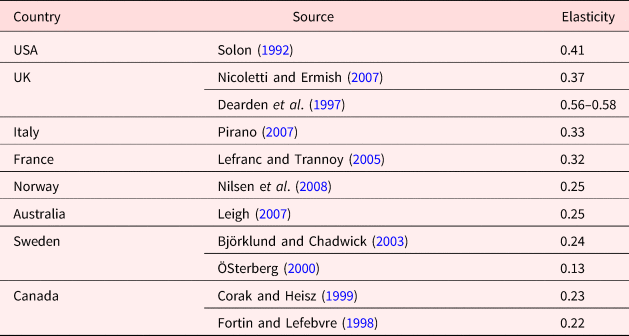
Again, to gain further insight into the latest intergenerational income mobility in China, we estimate equation (3) using a 9-year measure of income, yielding a statistically significant coefficient of 0.456. As stated by Mazumder (Reference Mazumder2005), the estimated IGE is 0.466 using a value of 0.5 as the autoregressive coefficient and 0.978 as the reliability ratio. Although the recent IGE in China has decreased slightly, it remains high. For example, in 2011, one unit change in a father's log income resulted in about 0.466 unit change in the son's log income. In this respect, parents’ economic statuses, to a large extent, profoundly affect their children's incomes. The estimation of the IGE enables us not only to investigate trends in intergenerational income mobility in China by observing how elasticities evolved over time, but also to conduct a cross-country comparison by comparing elasticities in different countries. From Table 4, it is clearly seen that the estimated IGEs are higher than those for several developed countries, implying that the degree of intergenerational income mobility in China is lower than those developed countries like Britain, Germany, and Canada. On the other hand, the intergenerational income mobility in the USA is slightly lower than China.
IGE for sons–fathers in various countries

Sources: Gong et al. (Reference Gong, Leigh and Xin2012); Deng et al. (Reference Deng, Gustafsson and Shi2013).
6. Transmission channels of intergenerational income in China
When analyzing intergenerational income mobility, a further issue is to explore the likely transmission channels through which fathers’ incomes affect sons’ incomes. As suggested by Blanden et al. (Reference Blanden, Gregg and Macmillan2007), the decomposition approach is efficient to achieve the objective and it requires the estimation of univariate relationships between transmission variables and parental income, which are then combined with their respective returns that are found in earnings equation. As such, we decompose the effect of fathers’ incomes on sons’ incomes into an investment process, capturing the effect of fathers’ incomes on an intermediate variable (Z j), and a return process, describing the effect of Z j on sons’ incomes. The key determinants, e.g. education, occupation, cognitive ability, non-cognitive traits, labor market experience, and marriage, have been identified in the existing literature to show how income status passed across generations. Among them, education and occupation have been widely believed to play critical roles in accounting for intergenerational income mobility, which are regarded as intermediate variables in this paper to reconsider their contribution to the observed IGE in China [Blanden et al. (Reference Blanden, Gregg and Macmillan2007), Takenoshita (Reference Takenoshita2007), Gong et al. (Reference Gong, Leigh and Xin2012)]. Then, below two-stage regression technique can be used to assess the explanatory power of Z j for the observed IGE in China.
 $$Z_j = \theta _0 + \theta _j\ln Y_{0i} + u_1$$
 $$\ln Y_{1i} = \lambda _0 + \lambda _j\sum\limits_{\,j = 1}^2 {Z_j} + u_2$$
where θ j is the rate of investment, indicating that one unit change in fathers’ log incomes results in θ j units change in Z j, while λ j is the rate of return, indicating that λ j units of change in sons’ log incomes are caused by one unit change in Z j. Combining equations (3) and (8), the explanatory power of Z j for the estimated IGE in year i is:
 $$\varpi _j = \displaystyle{{\theta _j\lambda _j} \over {\beta _i}}$$
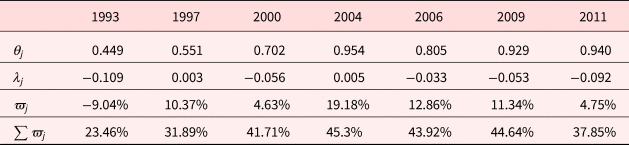
Using 3-year average income as a proxy for permanent income, equations (8) and (9) are estimated and reported in Tables 5 and 6. It is worth mentioning that the effect of age variable has been taken into account when using equation (10) to estimate the explanatory power of intermediate variables. As for other variables such as the number of hours worked and experience, they are hard to be quantified, especially for families in rural areas. Actually, for a representative Chinese family in the rural area, family members are usually self-employed to engage in agriculture. Their working hours and experience are difficult to be obtained, which are not provided by the CHNS data.
Explanatory power of education for IGE

Source: Authors’ calculations.
Explanatory power of occupation for IGE

Source: Authors’ calculations.
According to Mansur et al. (Reference Mansur, Kogid and Jessica Madais2010), human capital is a form of productive investment, including ability, skill, appearance, and health resulting from investments in education, training, and health care. Particularly, educational investment has a crucial role in affecting employment opportunities and permanent incomes, which can, in turn, explain social outcomes and long-term income mobility [Mocetti (Reference Mocetti2007)]. Unlike low-income families, high-income fathers are willing and able to invest more in children's education. As a result, children from high-income families are more likely to obtain more and better employment opportunities when they grow up, resulting in their higher incomes. As shown in Table 5, the rate of education investment has increased from 1.160 in 1993 to 1.648 in 2004, an increase of 42.69%. However, it remained below 1.5 and varied between 1.379 and 1.491 in the following years. The rate of education return increased by 209.30% from 1993 to 2004, but it exhibited a downward trend after 2004 and reached 0.047 in 2011. As for the overall explanatory power of education, it presented an upward trend from 7.21% in 1993 to 32.24% in 2004, and then it showed a downward trend, reaching 21.30% in 2011.
The observed decline in the explanatory power of education after 2004 can be partially explained by the decreasing rate of return resulting from the enrollment expansion of colleges and universities which started in 2000. College and university enrollments in 2000 were five times the enrollments in 1998. The enrollment expansion policy in China first led to an imbalance between the demand for and supply of education resources, potentially reducing the rate of return. On the other hand, a sizable labor surplus arising from the enrollment expansion policy was seen after 2004. A low increase in employment opportunities could not match a high increase in labor supply, also bringing a decline in the rate of return. In addition, a government policy on education can also affect the amount of parents’ education investment. For example, a progressive educational policy generally indicates that the government invests more in the public educational system, which increases human capital of children from low-income and high-income families. However, taking account of fierce competition in labor market and bandwagon effect in educational consumption, a progressive educational policy is likely to increase high-income families’ education investment, which potentially decreases intergenerational income mobility in China. Overall, the identified education channel in China can explain more than 20% of IGE since 2000. Therefore, there is no doubt that education remains an important channel through which parents transmit their incomes across generations.
Likewise, the explanatory power of occupation can be decomposed into the rate of investment and rate of return. As illustrated in Table 6, the highest rate of investment appeared in 2000 with a value of 0.918, the lowest rate appeared in 2009 with a value of 0.467, and the remaining rates varied between 0.551 and 0.711. The rate of return ranged from 0.091 in 1997 to 0.168 in 2000. Taking account of the investment and return processes together, the overall explanatory power of occupation for IGE is above 10% in each surveyed year, with a maximum of 18.54% in 2000 and a minimum of 10.76% in 1997. Averagely speaking, the occupation channel in China can explain around 15% of IGE, indicating its important role in explaining intergenerational income mobility. As a measure of the initial income distribution, a person's occupation plays a decisive role in determining his or her income. Meanwhile, occupation is also a reflection of a person's social-economic status, which is to some extent represented by his or her social network (so-called “guanxi”). Once “guanxi” is established between two people, each can ask a favor of the other with the expectation that the debt incurred will be repaid sometime in the future [Yang (Reference Yang1994)]. Usually, a people of high income can establish more “guanxi” than low-income groups. Taking advantage of his “guanxi”, a father can affect a son's occupation decision by helping him be acquainted with specific groups of people who can help the son in his career [Yuan and Chen (Reference Yuan and Lin2013)]. In this regard, the father's “guanxi” can provide the son with more social resources, reducing the son's costs of hunting for a job. This in turn brings more possibilities for the son to enter advantageous occupations with higher incomes as well as higher social-economic status. Benefiting from the father's occupational investment, children from high-income families are more likely to attain better occupations through the referral mechanism, which increases their adult incomes [Mocetti (Reference Mocetti2007)]. In addition, as reported in Table 7, the rate of educational investment outweighs occupational investment in most cases, highlighting education's particular role in transmitting parents’ incomes across generations. Nevertheless, occupation's importance is ever increasing and enjoys higher rate of return in most surveyed years. Overall, approximately 40% of elasticity can be explained by the identified education and occupation channels, making them be important transmission mechanisms for intergenerational income.
Gap between the explanatory power of education and occupation

Source: Authors’ calculations.
7. Conclusions
The low intergenerational income mobility challenges social equality and draws considerable attention in China. To address this concern, we estimate IGE using data from the CHNS over the period 1989–2011 to examine the extent to which sons’ incomes are determined by their fathers’ incomes. Also, to explore the underlying pathway through which income passes across generations, we decompose the effects of fathers’ incomes on sons’ incomes into investment and return processes using the intermediate variable approach. In doing so, we reconsider education and occupation in China and reassess their explanatory powers using the two-stage regression technique. The main findings can be summarized here.
From the trend analysis, we find that China has experienced relatively low intergenerational income mobility over 2000–2006, especially in 2000 and 2004. Although a downward tendency can be observed in recent years, it still remains high. Using 9-year average income as a proxy for permanent income, we find relatively low intergenerational income mobility with an elasticity of 0.466 in 2011. That is, sons’ incomes are affected by their fathers’ economic status largely. A cross-country comparison shows that China has lower intergenerational income mobility than other developed countries. In addition, we confirm roles of education and occupation in explaining intergenerational income mobility. For a typical Chinese family, education has a higher rate of investment than occupation, indicating that parents generally invest more in children's human capital, but occupation has a higher rate of return in most surveyed years, reflecting its increasing importance. Moreover, approximately 40% of elasticity can be explained by the identified education and occupation channels.
Our analysis not only provides empirical evidence of trends and pathway for intergenerational income mobility in China, but also has significant policy implications for increasing mobility and improving social equality. For one thing, because of education's importance to intergenerational income mobility, the government should increase education funding in poor areas and among low-income families to guarantee the efficient implementation of compulsory education. This policy can provide relatively equal educational opportunities to children from low-income families, giving them relatively equal opportunities to become high-income adults when they grow up. The government can also make substantial contributions to help children from low-income families complete their college and university education by providing student loans and improving the student financial aid system. Considering the fact that occupation has a higher rate of return than education in most surveyed years, an alternative option would be making and implementing more appropriate policies, laws, and regulations to ensure openness and transparency in the labor market, providing more equal employment opportunities to children from low-income families.
Despite its strengths, this paper still has some potential limitations that should not be neglected. For example, due to the existence of rural–urban disparities in China, intergenerational income mobility in different areas could present different patterns, which is not considered here. A comparative analysis of intergenerational income mobility between pairs like low-income, middle-income, and high-income groups; biological and non-biological father groups; and father/son and father-in-law/son-in-law groups will also be interesting. In addition, some variables affecting the dynamics of investment and return equations are not considered in this paper, such as the number of hours worked, and work experience. All of these limitations open up new perspectives and avenues for the future research.