Introduction
Tracheal agenesis incidence is reported to be less than 1 in 50 000 births.Reference Demircan, Aksoy, Ceran and Kafkasli1 Most cases represent part of either the ‘VATER’ association (vertebral defects, anal atresia, tracheoesophageal fistula with oesophageal atresia, and radial or renal dysplasia), the ‘VACTERL’ association (vertebral defects, anal atresia, tracheoesophageal fistula with oesophageal atresia, and radial or renal dysplasia, plus cardiovascular and limb defects) or the ‘TARCD’ association (tracheal agenesis or atresia, radial ray defects, complex congenital cardiac abnormalities, and duodenal atresia).Reference Wei, Rodeberg and Thompson2 Aetiology is not yet clear and management is challenging.
We present 3 cases of tracheal agenesis that presented to the Norfolk and Norwich University Hospital within a 6-week period between October and December 2014, despite the birth rate of 10 000 births per year in Norfolk.3 All three cases were fatal.
Case report
Case one
A female twin infant was born at 30 weeks plus 2 days by emergency caesarean section to a 31-year-old mother following the normal vaginal delivery of her twin sister. Immediately after delivery, there was severe respiratory distress, cyanosis and no audible cry. Bag-and-mask ventilation was commenced and a nasogastric tube was passed. Ventilation became ineffective and endotracheal intubation was subsequently attempted. At this point, air bubbles were noted to drain from the nasogastric tube, indicating probable oesophageal intubation with ventilation via a tracheoesophageal fistula. This necessitated referral to a quaternary care centre.
En route, the baby deteriorated and was redirected to a closer tertiary unit. Microlaryngobronchoscopy showed no visible trachea and a bronchoesophageal fistula, which was being used for ventilation. Following discussion of the case with the parents, a decision to withdraw the treatment was made. A post-mortem was not performed.
Case two
A male infant was delivered at 33 weeks plus 1 day by emergency caesarean section to a 30-year-old mother after amniodrainage resulted in fetal bradycardia. Antenatally, duodenal atresia and cardiac abnormalities were suspected based on the ultrasound scans. Following delivery, there was respiratory distress, with reduced oxygen saturation and cyanosis. Bag-and-mask ventilation was not successful in relieving the respiratory distress. Subsequent intubation was unsuccessful, despite visualisation of the arytenoid cartilages, because of an obstruction that prevented advancement of the endotracheal tube past the vocal folds. An ENT surgeon was called; the surgeon was again unable to intubate and proceeded to surgical tracheostomy. The larynx was identified; however, no trachea or oesophagus were present on neck exploration. At this point, a decision was made by the clinical team to withdraw resuscitation. The parents declined a post-mortem.
Case three
A female infant was born at 29 weeks plus 6 days by emergency caesarean section to a 28-year-old mother following the spontaneous onset of labour and breech presentation. Antenatally, there was polyhydramnios and no stomach observed on an ultrasound scan, indicating a tracheoesophageal fistula. Again, respiratory distress following delivery led to several attempts at intubation, which were unsuccessful. An emergency tracheostomy was attempted by an ENT surgeon; no trachea was found in the neck and a decision to stop resuscitation was made. Post-mortem revealed an oesophagus connected to the main bronchus, and no trachea.
Discussion
To have three such cases in such a short time frame was deemed unusual and led to a multidisciplinary meeting between the specialties involved, with consultation with geneticists and the local coroner. No linking factor between the families was found and no prenatal exposure to any teratogens was identified.
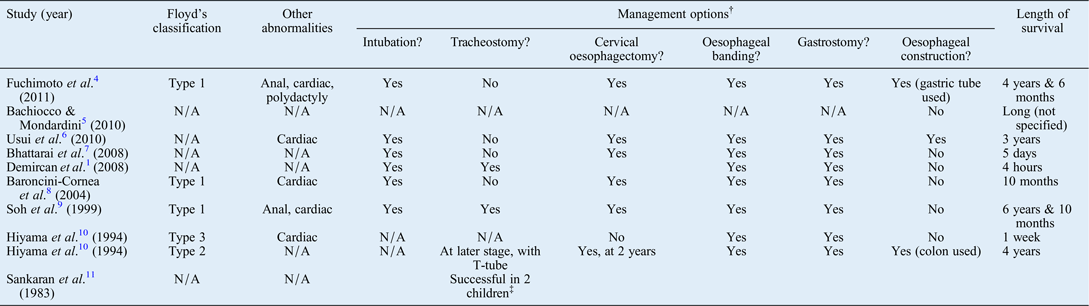
A literature search of the PubMed database was performed using the following combination of Medical Subject Heading terms: ‘tracheal’ (all fields), with ‘agenesis’ (all fields), ‘atresia’ (all fields) or ‘aplasia’ (all fields) and ‘humans’ (all fields). The search returned 522 results (from 1950 onward). There were 186 reported cases of tracheal agenesis. Survival was very rare, although some attempts at reconstruction were made. Reported cases of survived tracheal agenesis (in which reconstruction attempts led to survival, even if just for a short time) are summarised in Table I.Reference Demircan, Aksoy, Ceran and Kafkasli1, Reference Fuchimoto, Mori, Takasato, Tomita, Yamamoto and Shimojima4–Reference Sankaran, Bhagirath, Bingham, Hjertaas and Haight11
Reported cases of survived tracheal agenesis* and their management

*Cases in which reconstruction attempts led to survival, even if just for a short time. †Management options included one or more of the following: intubation, tracheostomy, cervical oesophagectomy, oesophageal banding, gastrostomy and oesophageal construction. ‡Short atretic segment of trachea meant that tracheostomy was successful in the two reported cases (this was the only paper reporting more than one case). N/A = information not available
Tracheal agenesis was classified into three types by Floyd et al.Reference Floyd, Campbell and Dominy12 In type one, the trachea is absent except for a short distal segment with normal carina. In this type, there is a tracheoesophageal fistula connecting the distal part of the trachea to the oesophagus. In type two (the most common), the trachea is absent completely; the two main bronchi join at the carina and in almost all cases there is a carino-oesophageal fistula. In type three, the trachea and carina are absent and each of the main bronchi join the oesophagus from either side.
Little is known about the aetiology of tracheal agenesis. Genetic abnormalities (such as the genes NOGReference Que, Choi, Ziel, Klingensmith and Hogan13 and ASCIZReference Jurado, Smyth, van Denderen, Tenis, Hammet and Hewitt14) are suspected to play a role.
The actual incidence of tracheal agenesis in the UK is difficult to estimate in view of the incomplete data of congenital anomalies.
Antenatal diagnosis of tracheal agenesis is difficult. Hyperechogenic lungs can signify complete tracheal occlusion alongside: dilated airways, flattened or inverted diaphragms, massive ascites, oligohydramnios or polyhydramnios, and large breathing movements.Reference De Luca, De Carolis, Capelli, Gallini, Draisci and Pinto15
The only management of tracheal agenesis is surgical reconstruction, which is complex, with variability between surgeons performing such procedures, as seen in Table I. There are two main options; if tracheal agenesis is suspected prenatally, it is possible to conduct further investigative imaging such as fetal magnetic resonance imaging to delineate structural abnormalities more precisely. Delivery at a specialised unit can be arranged and an ex utero intrapartum treatment (‘EXIT’) procedure performed if deemed necessary.Reference Dijkman, Andriessen, van Lijnschoten and Halbertsma16, Reference Ahmad, Abdullah, Mokhtar and Fadzil17 However, if prenatally there is no suspicion of the condition, the situation is more challenging.
A diagnosis of tracheal agenesis should be considered in cases of respiratory distress with immediate hypoxia in a baby with no audible cry and where there is a mechanical inability to intubate.Reference Demircan, Aksoy, Ceran and Kafkasli1 If tracheal agenesis is suspected postnatally, then a trial of intubation of the oesophagus is recommended. Such a recommendation is based on the possibility of the presence of a patent tracheoesophageal fistula, as in the first case we described. If this fails, a tracheostomy should be attempted; however, success is dependent on finding at least some tracheal tissue (e.g. partial agenesis with a short segmentReference Dijkman, Andriessen, van Lijnschoten and Halbertsma16) that can be intubated. If the neonate is stabilised successfully, then diagnosis should be confirmed with laryngoscopy.
Imaging is vital, not only to assess the tracheal anatomy but also to assess for other congenital abnormalities (such as those seen in the vertebral defects, anal atresia, tracheoesophageal fistula with oesophageal atresia, and radial or renal dysplasia syndrome). Such investigations inform multidisciplinary management that includes the opinions of obstetricians, neonatologists, anaesthetists, otolaryngologists and paediatric surgeons.
• Tracheal agenesis is rare; it is difficult to diagnose prenatally and is almost always fatal
• Multidisciplinary management is essential
• Ex utero intrapartum treatment (‘EXIT’) procedures and tracheal grafts may improve future survival rates
Our literature search highlights that surgical reconstruction is rare, with poor outcomes. Withdrawal of treatment is the most probable outcome. In the future, tissue-engineered tracheal grafts may be used in reconstruction.Reference Fuchimoto, Mori, Takasato, Tomita, Yamamoto and Shimojima4
Conclusion
Tracheal agenesis is a rare condition. Clinicians need to be aware of the condition and prepared for the possibility of encountering it, as our case series highlights. Identifying cases prenatally would allow for appropriate counselling of parents and enable clinicians to plan multidisciplinary management at delivery.