Introduction
The world's population is ageing as a consequence of increased longevity and lower fertility rates (Robine and Michel Reference Robine and Michel2004). Although these demographic changes are a positive progress for the population as a whole, some groups have benefited more from them than others. Socio-economic position has been repeatedly found to predict health, and there is a well-established relationship between higher socio-economic positions, better health and longer life expectancies, while lower socio-economic positions are associated with poorer health and shorter life expectancies (Power and Kuh Reference Power, Kuh, Siegrist and Marmot2006; Stringhini et al. Reference Stringhini, Dugravot, Kivimaki, Shipley, Zins, Goldberg, Ferrie and Singh-Manoux2011). A recent Swedish study showed that socio-economic disadvantage, both in childhood and during mid-life, is associated with an increased risk of premature mortality, i.e. mortality before the age of 70 (Fors, Lennartsson and Lundberg Reference Fors, Lennartsson and Lundberg2011). Earlier studies also show a relationship between living conditions during childhood and health in later life (Barker Reference Barker2012; Ben-Shlomo and Kuh Reference Ben-Shlomo and Kuh2002; Ferraro, Shippee and Schafer Reference Ferraro, Shippee, Schafer, Bengtson, Silverstein, Putney and Gans2009; Fors, Lennartsson and Lundberg Reference Fors, Lennartsson and Lundberg2009; Lundberg Reference Lundberg1997; Schafer and Ferraro Reference Schafer and Ferraro2012, Reference Schafer and Ferraro2013). As adults, those who experienced poorer socio-economic conditions during childhood face a greater risk of developing cardiovascular diseases (Campbell et al. Reference Campbell, Conti, Heckman, Moon, Pinto, Pungello and Pan2014; Galobardes, Smith and Lynch Reference Galobardes, Smith and Lynch2006; Rosvall et al. Reference Rosvall, Chaix, Lynch, Lindström and Merlo2006), musculoskeletal diseases (Schafer and Ferraro Reference Schafer and Ferraro2013), psychological diseases (Gilman et al. Reference Gilman, Kawachi, Fitzmaurice and Buka2002; Schafer and Ferraro Reference Schafer and Ferraro2013) and diseases of the respiratory system (Lawlor et al. Reference Lawlor, Sterne, Tynelius, Davey Smith and Rasmussen2006). Agahi, Shaw and Fors (Reference Agahi, Shaw and Fors2014) found social and economic conditions in childhood to be associated with earlier onset and faster progression of functional health problems such as mobility limitations in mid-life and old age.
Although there is growing agreement on the importance of childhood living conditions for shaping adult health, the causal mechanisms generating these relationships are still largely obscure. In a seminal paper, Ben-Shlomo and Kuh (Reference Ben-Shlomo and Kuh2002) suggested that health in adulthood is shaped by physical and social exposures throughout the lifecourse, from gestation to old age. Exposures during critical or sensitive periods may be particularly important as they can have long-lasting and irreversible effects on adult health. For example, events during critical or sensitive periods such as foetal life or early childhood might affect biological development and increase vulnerability to subsequent health problems (Barker Reference Barker1994; Kuh and Ben-Shlomo Reference Kuh, Ben-Shlomo, Kuh and Ben-Shlomo2004). Social disadvantages experienced during sensitive periods may attribute to social inequalities in adult health and mortality both by affecting adult health directly, and by affecting adult socio-economic position which, in turn, may affect adult health. Another possible mechanism behind the development of health problems is the accumulation of risk – the aggregation over time of risk factors from different life stages. This can take form as an independent accumulation when risk factors are independently associated with the outcome. It can also be seen through additive accumulation where adverse exposures enter chains of risks in which one adverse experience leads to another. Disadvantage increases exposure to risk, which in turn may lead to further disadvantage (Kuh et al. Reference Kuh, Ben-Shlomo, Lynch, Hallqvist and Power2003; Schafer and Ferraro Reference Schafer and Ferraro2012). Lundberg (Reference Lundberg1993) describes this as an unhealthy life career. In other words, childhood living conditions may serve as important stepping stones in lifelong sequences of exposures and experiences that shape health.
Most of the research in the field has explored the association between childhood living conditions and mortality by using a single indicator of socio-economic status, most often parental occupation, but few studies have investigated how various measures of childhood conditions affect various health outcomes. However, some studies have investigated economic and social indicators separately, thus enabling more specific explorations of the relationships between childhood adversities and health later in life. For example, a study by Fors, Lennartsson and Lundberg (Reference Fors, Lennartsson and Lundberg2009) showed that conflicts in the family during childhood were associated with lower levels of cognitive functioning in old age. Lundberg (Reference Lundberg1993) found that exposure to financial hardship during childhood was associated with illness during adulthood, but that exposure to social adversities such as growing up without both biological parents or conflicts in the family during childhood had an even greater impact on adult health than financial difficulties. Schafer and Ferraro (Reference Schafer and Ferraro2012, Reference Schafer and Ferraro2013) found that higher levels of abuse and financial hardship during childhood were associated with adulthood psychosomatic symptoms and with a lower probability of being free of disease in mid-life.
Moreover, the bulk of the research on the associations between childhood conditions and morbidity later in life has focused on health outcomes in mid-life. Less attention has been paid to health outcomes in old age. This study aims to explore the relationship between different measures of socially and financially adverse childhood living conditions, education and morbidity in old age.
Method
Data
The study used a cohort design, and the study population was assembled from the 1968 Swedish Level of Living Survey (LNU) and the 2011 longitudinal Study of Living Conditions of the Oldest Old (SWEOLD). LNU is an ongoing longitudinal and nationally representative study that examines the level of welfare of and resource allocation in the Swedish population: it includes questions about work, family, health, social contacts, housing and personal finances. The participants are between the ages of 15 and 75. LNU was conducted for the first time in 1968, and new waves were performed in 1974, 1981, 1991, 2000 and 2010. Similarly, SWEOLD is an ongoing nationally representative study that serves as an extension of LNU, encompassing the participants who no longer fulfil the LNU inclusion criteria because they have reached the upper age limit of 75. The purpose of SWEOLD is to gather data about the living conditions of the oldest population and to provide more longitudinal information about living conditions in this population. The first wave of SWEOLD took place in 1992 and consisted of participants who had been interviewed in LNU between 1968 and 1981. New SWEOLD surveys have since been conducted in 2002, 2004 and 2011. Data were collected through face-to-face interviews. In SWEOLD, when the participant could not be interviewed, proxies (such as close relatives and care-givers) were interviewed instead. LNU 1968 had a response rate of 90.8 per cent (N = 5,922); SWEOLD 2011 had a response rate of 86 per cent (N = 674, proxies N = 12.5 per cent). For a more detailed description of SWEOLD, see Lennartsson et al. (Reference Lennartsson, Agahi, Hols-Salén, Kelfve, Kåreholt, Lundberg, Parker and Thorslund2014). A total of 591 persons fulfilled the inclusion criteria for this study, namely that they were 76 years or older, and had participated in LNU 1968 and in SWEOLD 2011 (1,850 persons had died by 2011, and 103 persons did not respond for other reasons). The study population was born between 1909 and 1934. The mean age of the participants was 41 years in 1968 and 84 years in 2011.
Measurements
Data on morbidity (self-reported current health status) were obtained from SWEOLD 2011. In the current study, four health indicators were used to assess morbidity: (a) musculoskeletal disorders, (b) cardiovascular disease, (c) self-rated health and (d) impaired mobility. To assess the first two indicators, SWEOLD 2011 participants were asked a number of questions about their health status during the previous 12 months. Three response alternatives were provided: ‘no’, ‘yes, mild problems’ and ‘yes, severe problems’. The International Classification of Diseases, Tenth Revision (ICD-10) was used as a basis for classifying responses regarding musculoskeletal disorders and cardiovascular disease.
Musculoskeletal disorders were assessed using the questions: ‘Have you experienced pain or ache in the shoulders, back, hips, sciatic nerve, hands, elbows, legs or knees?’ and ‘Do you have rheumatism?’ Those who reported mild pain or ache in at least three areas or severe pain or ache in at least one area, and those who reported rheumatism were classified as having musculoskeletal disorders. A similar index has previously been used in studies exploring the relationship between social conditions and musculoskeletal disorders (Fors, Lennartsson and Lundberg Reference Fors, Lennartsson and Lundberg2008; Lundberg Reference Lundberg1993).
Questions about the presence of heart weakness, irregular heart rhythm, high blood pressure, brain haemorrhage, stroke, thrombosis or myocardial infarction were used to assess cardiovascular disease. Those who reported mild or severe problems in any of these areas were classified as having cardiovascular disease. The question: ‘How would you assess your general state of health?’ was used to assess self-rated health. The response alternatives were ‘good’, ‘bad’ or ‘neither good nor bad’. ‘Good’ was treated as a high level of self-rated health and ‘bad’ and ‘neither good nor bad’ as sub-optimal self-rated health. Proxy answers were excluded because of the subjective nature of the measure of self-rated health.
A single question on the ability to walk 100 meters without difficulties was used to assess impaired mobility. Those who reported not being able to do so were classified as having impaired mobility.
Measurements of childhood living conditions were obtained through retrospective self-report in LNU 1968. The participants were asked questions about four economic and social childhood living conditions during the first 16 years of their lives. The included childhood living conditions were selected on the basis of prior literature (Agahi, Shaw and Fors Reference Agahi, Shaw and Fors2014; Fors, Lennartsson and Lundberg Reference Fors, Lennartsson and Lundberg2009; Lundberg Reference Lundberg1993; Wadsworth Reference Wadsworth1997; Wamala, Lynch and Kaplan Reference Wamala, Lynch and Kaplan2001). Each indicator was coded in a dichotomous form, reflecting adversities during childhood. The first condition was the financial situation during childhood. Participants were asked: ‘Did your family experience financial hardship during your upbringing?’ Possible answers were ‘yes’ or ‘no’.
The second condition was being part of a large family, which was defined as having been brought up with four or more siblings. A large family was classified as an adverse childhood condition because of the assumption that the more children in a family, the less time, care and money could be invested in each child. This indicator of family size has previously been used in several studies of childhood conditions and health later in life, and has been shown to predict educational attainment and adult health (Lundberg Reference Lundberg1993, 1997, Fors, Lennartsson and Lundberg Reference Fors, Lennartsson and Lundberg2009, Reference Fors, Lennartsson and Lundberg2011). These findings are in line with the results from a study by Wamala, Lynch and Kaplan (Reference Wamala, Lynch and Kaplan2001) that also showed an association between having grown up in a large family and illness during adulthood.
A question about whether the participant grew up with both their biological parents was used to assess the third condition, growing up without one or both biological parents. Losing one or both parents because of death, divorce or other reasons has been associated with illness later in life (Lundberg Reference Lundberg1993).
The last condition was the social class of the father, which was measured as father's main occupation. Occupations were classified according to the Swedish Socio-economic Classification (SEI) system. The SEI classification is based on the individual's position in the labour market, which is categorised by ownership, the educational requirements, performance of specific work tasks and levels of responsibility (Andersson, Erikson and Wärneryd Reference Andersson, Erikson and Wärneryd1981). Father's social class was treated as a categorical variable. The categories were ‘higher or intermediate non-manual workers’, ‘lower non-manual workers’, ‘manual workers’ and ‘self-employed people’.
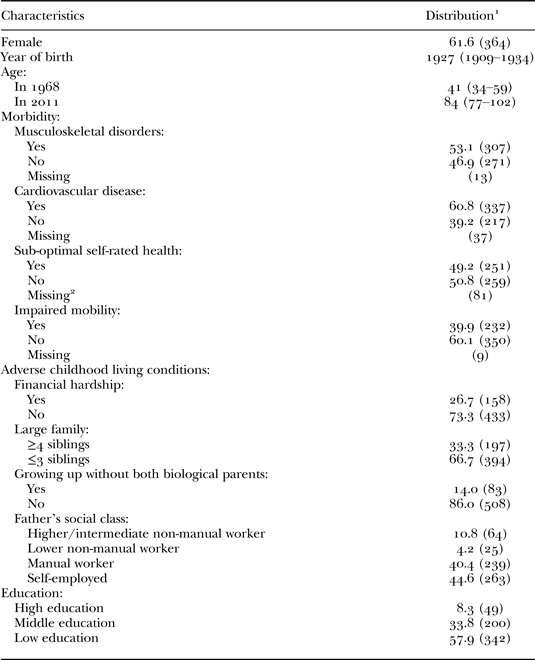
The participants' socio-economic positions in adulthood were classified on the basis of level of education using data gathered from 1967 national registers. As educational variation is limited in these cohorts, education was divided into three categories: (a) compulsory education, (b) lower secondary education or vocational training, and (c) high education. A total of 57.9 per cent of the participants had a compulsory education, 33.8 per cent had lower secondary education or vocational training, and 8.3 per cent had upper secondary education or university degree. Henceforth we will refer to compulsory education as ‘low education’, lower secondary education or vocational training as ‘middle education’, and upper secondary education or university degree as ‘high education’. More characteristics of the sample are described in Table 1.
Characteristics of the sample

Notes: N = 591. 1. Percentages are shown for categorical variables; actual numbers are provided in parentheses. Means are shown for continuous variables, ranges in parentheses. 2. Proxy interviews treated as missing data.
In the 2011 survey, the non-response rate was 14 per cent, and previous studies have shown that non-response in elderly participants is associated with increased health problems and mortality (Hardy Reference Hardy2009; Kelfve, Thorslund and Lennartsson Reference Kelfve, Thorslund and Lennartsson2013). An additional variable was created to assess which participants in the 1968 survey were lost to follow-up by 2011 because of mortality or non-response. This variable distinguished between participants from the 1968 survey who participated in SWEOLD 2011 and those from the same birth cohorts (born 1909–1934) who did not participate in SWEOLD 2011. The variable was used to assess the extent to which childhood conditions and education predicted selection into the 2011 sample.
Statistical analysis
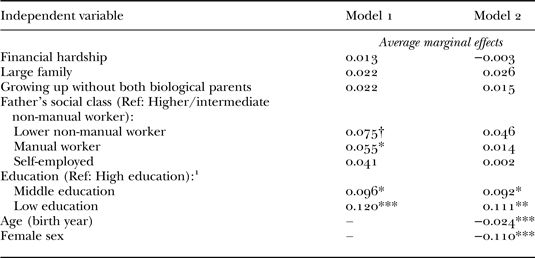
To explore the associations between childhood living conditions, education and morbidity in old age, analyses were performed using binary and multinomial logistic regressions. As odds ratios are notoriously difficult to interpret, and do not allow for comparisons of estimates across models, the results of the analyses are presented as average marginal effects (Mood Reference Mood2010). Average marginal effects range between −1 and 1 and denote the average difference in the probability of the outcome for each stepwise change in the independent variable or, for categorical variables, the difference in probability as compared to the reference category. All analyses were adjusted for age and sex. No adverse childhood living conditions, a father of higher or intermediate non-manual working class, no reported illness, and/or an education of upper secondary level or university degree were used as reference categories. Moreover, in order to explore the impact of selective attrition on the associations between childhood conditions, education and old-age morbidity, a selection variable was created. The selection variable is based on the propensity scores from an analysis of the likelihood of not being in the sample at follow-up (due to mortality or non-response). This analysis is presented in Model 2 of Table 2. These propensity scores were then divided into quartiles and entered into the analyses as a categorical variable in order to allow for non-linear associations.
Results of logistic regression analyses with adverse childhood living conditions and low education as predictors of not being part of the sample in 2011
Notes: N = 2,544. Ref: reference category. Analyses have been adjusted for sex and age. Model 1: variables entered one at a time. Model 2: variables entered simultaneously. 1. N = 2,385.
Significance levels: †p < 0.10, *p < 0.05, **p < 0.01, ***p < 0.001.
Finally, possible differences between women and men and between age cohorts (1909–1921, 1922–1934) were studied through sex- and age-stratified analyses. In addition, interaction analyses of sex, childhood living conditions and education were performed.
Results
As this is a study of the oldest old, the first step in the analysis was to explore to what extent our data were affected by selective mortality prior to the follow-up and selective non-response during the follow-up. A previous study, based on the same baseline data, has shown that childhood disadvantage was associated with premature mortality (Fors, Lennartsson and Lundberg Reference Fors, Lennartsson and Lundberg2011). Moreover, Kelfve, Thorslund and Lennartsson (Reference Kelfve, Thorslund and Lennartsson2013) showed that non-response in an earlier wave of SWEOLD was associated with increased mortality risk, suggesting that non-response is also, at least partly, driven by health problems. Further, a mortality analysis of those lost to follow-up by 2011 (not shown) confirmed that 73 per cent (N = 1,850) of the participants in the 1968 survey who were part of the 1909–1934 birth cohorts had died prior to the 2011 survey.
As those who participated in the study constituted a highly selected group (having survived to 2011 and taken part in the survey), we wanted to investigate whether childhood living conditions and education predicted selection into the 2011 sample. This was explored in the analyses reported in Table 2. In Model 1, all childhood variables were entered into the analysis one at a time. The results show an association between father's social class and the likelihood of not being in the 2011 study. The probability of not being part of the 2011 survey was more than five percentage points higher for participants whose fathers were manual workers than for participants whose fathers were higher or intermediate non-manual workers. Model 2 shows that when we adjusted for education, the point estimates for father's social class were attenuated and rendered non-significant, which suggests the associations were largely mediated by education. Those with low education or middle education had an about ten percentage point higher probability of not being part of the 2011 study than those with high education after adjustment for father's social class. In other words, education was an important predictor of loss to follow-up: those with low education were less likely to be alive and participate in the 2011 survey than those with high education. Stratified analyses (not shown) showed that these patterns were similar for women and men, and for different age cohorts.
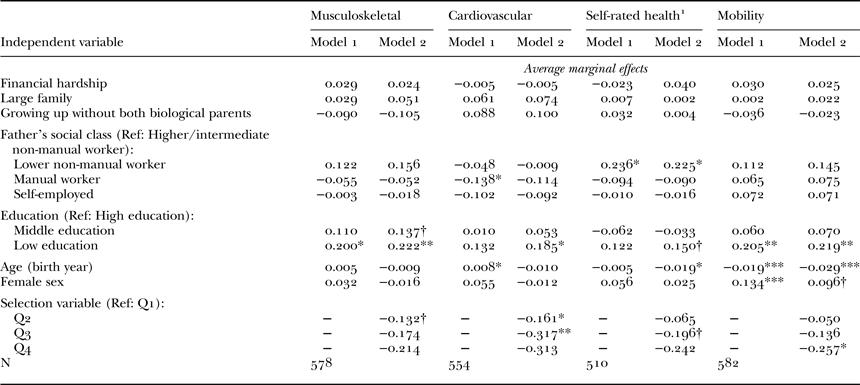
Next, the associations between adverse childhood living conditions, education and morbidity were explored. The results in Table 3 show that, out of the adverse childhood living conditions investigated here, only the social class of the father was significantly associated with morbidity. In Model 1, where all independent variables are entered simultaneously, participants whose fathers were lower non-manual workers had a 23.6 percentage points higher probability of reporting sub-optimal self-rated health in old age compared with those whose fathers were higher or intermediate non-manual workers. Individuals growing up with a father who was a manual worker had a 13.8 percentage points lower probability of reporting cardiovascular disease than those growing up with a father who was a higher or intermediate non-manual worker. In Model 2, when selection was adjusted for, the association between having a father who was a lower non-manual worker and reporting sub-optimal self-rated health remained. However, the association between father's social class and cardiovascular disease was rendered statistically non-significant.
Results of logistic regression analyses with adverse childhood conditions and low education as predictors of morbidity in old age
Notes: Ref: reference category. Q: Quartile. Model 1: variables entered simultaneously. Model 2: variables entered simultaneously, and adjusted for selection prior to follow-up. Interaction analyses showed no statistically significant interactions for women and men. 1. Proxy interviews treated as missing data.
Significance levels: †p < 0.10, *p < 0.05, **p < 0.01, ***p < 0.001.
The results also showed a relationship between low education and an increased risk of morbidity. All indicators of morbidity followed a similar pattern of association; individuals with low education were more likely to report health problems. However, these findings were only statistically significant for musculoskeletal disorders and impaired mobility (in Model 1). Those with low education had an around 20 percentage point higher probability of reporting musculoskeletal disorders, and impaired mobility, than those with high education. After adjustment for selection (Model 2), the association between low education, and musculoskeletal disorders and impaired mobility was somewhat strengthened and remained statistically significant. Finally, when adjusting for selection low education was also significantly associated with cardiovascular disease. Individuals with low education had an 18.5 percentage points higher probability of reporting cardiovascular disease compared to individuals with high education. Exploratory analyses (not shown) showed that there were no significant statistical interactions between sex, childhood living conditions and education, and no clear pattern of divergence between women and men, or between the different age cohorts.
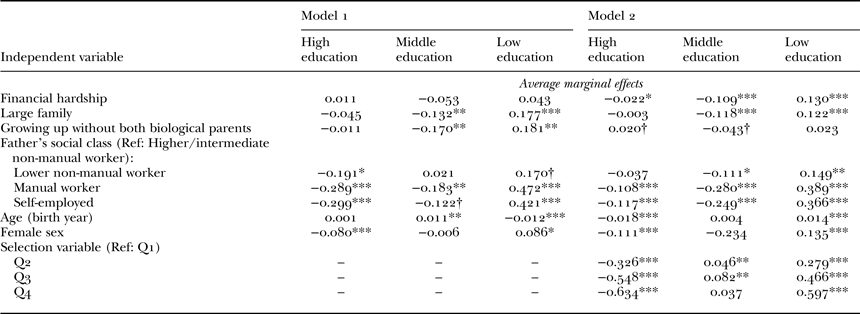
As low education was associated with morbidity – but few direct associations between adverse childhood living conditions and morbidity were found – we wanted to explore the associations between childhood conditions and educational attainment. Table 4 shows the extent to which adverse childhood living conditions predicted level of education.
Model 1, in which all childhood conditions were included simultaneously, shows that those with adverse childhood living conditions were substantially less likely to attain middle or high education. All adverse childhood living conditions, except financial hardship, were statistically significantly associated with low education. Compared with participants whose fathers were higher or intermediate non-manual workers, those whose fathers were manual workers had a 28.9 percentage points lower probability of attaining high education, and a 18.3 percentage points lower probability of attaining middle education. Similarly, those whose fathers were self-employed had a 29.9 percentage point lower probability of attaining high education than children of higher and intermediate non-manual workers.
The probability of attaining middle education was 13.2 percentage points lower among individuals who grew up in large families than among those who grew up in smaller families, and 17.0 percentage points lower among individuals who grew up without both biological parents than among those who did not.
Model 2, where the analysis was adjusted for selection, shows that all adverse childhood living conditions, except growing up without both biological parents, were statistically significantly associated with low education. Those who experienced financial hardship during their upbringing had a 10.9 percentage point lower probability of attaining middle education than those who did not experience such hardship. Individuals growing up in a large family had an 11.8 percentage point lower probability of attaining middle education than those who grew up in a small family. In comparison with participants whose fathers were higher or intermediate non-manual workers, those whose fathers were lower non-manual workers had an 11.1 percentage point lower probability of attaining middle education. Those whose fathers were manual workers had a 10.8 percentage points lower probability of attaining high education and a 28.0 percentage points lower probability of attaining middle education. Additionally, those whose fathers were self-employed had a 11.7 percentage point lower probability of attaining high education and 24.9 percentage point lower probability of attaining middle education. The sex- and age-stratified analyses showed no significant interaction effects, nor did the result differ notably for women and men, or between the different age cohorts.
To conclude, having grown up with financial hardship, a large family, without both biological parents or with a father of lower social class (i.e. lower non-manual workers, manual workers or self-employed) was, statistically significantly, associated with lower educational attainment.
Discussion
The aim of these analyses was to explore the relationship between adverse childhood living conditions, education and morbidity in old age. The main finding was that the adverse childhood living conditions included here, namely financial hardship, large family, broken home and father's social class, were not consistently associated with morbidity in old age. However, there were independent relationships between adverse childhood living conditions and education and between education and morbidity in old age. Adverse childhood living conditions were associated with a decreased probability of attaining an education beyond the compulsory level, and low education in turn was associated with an increased probability of reporting musculoskeletal disorders and impaired mobility. Another important finding was that education affected the attrition rates, where those with middle and low education were more likely to be deceased or non-responders by 2011 than those with high education.
The results should be interpreted with caution. One caveat is that the study is based on retrospective self-reports of childhood living conditions, some of which concern sensitive issues. Thus, the results may be influenced by recall bias, selective non-response and social desirability. However, previous studies have shown that recalled measures of father's occupation agree with objective measures (Krieger, Chen and Selby Reference Krieger, Chen and Selby2001), suggesting that father's occupation can be used as a valid indicator of childhood socio-economic conditions. Other concerns included the use of subjective measures and the manner in which some of the questions about childhood conditions were formulated. The participants subjectively interpreted the questions, for example what was experienced as financial hardship by one person could have been judged differently by another. On the other hand, a strength of subjective measures is that they make it possible to measure different features of socio-economic status at the individual level and enable researchers to capture a diversity of experiences and perceptions (Demakakos et al. Reference Demakakos, Nazroo, Breeze and Marmot2008; Singh-Manoux, Marmot and Adler Reference Singh-Manoux, Marmot and Adler2005). Yet another point of concern was the issue of reversed causation; that is, the possibility that the participants' assessment of their childhood living conditions was affected by their current health status. However, because data on childhood living conditions were collected 43 years before data on health status were collected, we assumed that most of the recollections of living conditions in childhood were not being contaminated by current health status. Previous work, which shows that subjective measures of socio-economic status in childhood are reliable predictors of health status later in life, supports this assumption (Demakakos et al. Reference Demakakos, Nazroo, Breeze and Marmot2008). Another limitation of the study is the crude and subjective measures of morbidity in old age as they are based on self-reports of diseases and symptoms experienced during the previous 12 months.
The main finding, that adverse childhood living conditions did not predict morbidity consistently, contradicts the findings of many previous studies. A large body of research has shown direct links between adverse childhood living conditions and morbidity and mortality (Fors, Lennartsson and Lundberg Reference Fors, Lennartsson and Lundberg2009, Reference Fors, Lennartsson and Lundberg2011; Galobardes, Smith and Lynch Reference Galobardes, Smith and Lynch2006; Gilman et al. Reference Gilman, Kawachi, Fitzmaurice and Buka2002; Lawlor et al. Reference Lawlor, Sterne, Tynelius, Davey Smith and Rasmussen2006; Lundberg Reference Lundberg1993; Rosvall et al. Reference Rosvall, Chaix, Lynch, Lindström and Merlo2006; Schafer and Ferraro Reference Schafer and Ferraro2012, Reference Schafer and Ferraro2013). These contradictory findings may be a consequence of exploring morbidity among those aged 76 years and older. Most previous research on the associations between childhood living conditions and health later in life has focused on people in mid-life. In this study selective mortality during younger ages may have led to cohort inversion. Cohort inversion occurs when selective mortality removes those with poor health first, thereby inverting previous associations and making groups that were initially disadvantaged appear advantaged (Ferraro and Shippee Reference Ferraro and Shippee2009). These effects may then be compounded by selective non-response if the non-responders tend to have worse health than the responders.
In the study, we estimated the impact of selective attrition using selection models. The selection models showed that: (a) the sample is indeed selected by socially patterned attrition, where those with lower education were more likely to be lost to follow-up than those with higher education, and (b) that, when accounting for the selective attrition the association between education and old-age morbidity tended to appear somewhat stronger. Thus, these results suggest that the selective attrition, mainly driven by mortality, may serve to attenuate the association between education and health in old age.
Another contradictory result was the ambiguous relationship between having grown up in a working-class home and the probability of cardiovascular disease in old age. Some of the results suggested a lower risk of cardiovascular disease for individuals whose fathers were manual workers than among those whose fathers were higher or intermediate non-manual workers – a result likely to be caused by cohort inversion. These findings may, in this sense, mirror earlier research results of increased mortality from cardiovascular diseases among manual working-class middle-aged men in Sweden (Diderichsen and Hallqvist Reference Diderichsen and Hallqvist1997).
The relationship we found between education and health in the oldest old is in agreement with findings of previous research, which shows consistent associations between low education and health problems throughout the lifecourse (Lawlor et al. Reference Lawlor, Sterne, Tynelius, Davey Smith and Rasmussen2006; Stringhini et al. Reference Stringhini, Dugravot, Kivimaki, Shipley, Zins, Goldberg, Ferrie and Singh-Manoux2011). Childhood living conditions seem to be connected to morbidity in old age through an additive accumulation of risks. Individuals who were exposed to adverse social and financial living conditions during their first 16 years of life appear to have entered a chain of risks where their childhood exposure decreased the likelihood of attaining an education beyond compulsory school which, in turn, was associated with more health problems in old age.
This study highlights the importance of education in shaping health in old age, and it illuminates the crucial interplay between childhood living conditions and education. We found that both social and economic childhood living conditions were important predictors of educational attainment and that trajectories starting early in life contributed to health differentials almost a century later. However, it is important to keep in mind that, among these birth cohorts, higher education was relatively rare. It is possible that the association between education and old-age health will differ for later cohorts where the educational distribution has shifted towards higher education (Dowd and Hamoudi Reference Dowd and Hamoudi2014). Thus, it is probably not possible to extrapolate these findings beyond the cohorts under study. However, it is worth noting that among adults, if anything, the association between education and health seems to have increased over time in large parts of the developed world (Mackenbach Reference Mackenbach2012).
In sum, the results suggest that policies designed to improve educational support for children from socially and financially disadvantaged families may prove efficient in breaking the links between early life disadvantage and health throughout the lifecourse and, thus, reduce health inequalities. Future research should focus on the mechanisms and pathways that link education with health in old age.
Results of multinomial regression analyses with adverse childhood living conditions as predictors of education level
Notes. N = 591. Ref: reference category. Q: Quartile. All analyses have been adjusted for sex and age. Model 1: variables entered simultaneously. Model 2: variables entered simultaneously, and adjusted for selection prior to follow-up. Interaction analyses showed no statistically significant interactions for women and men.
Significance levels: †p < 0.10, *p < 0.05, **p < 0.01, ***p < 0.001.
Acknowledgements
This work was supported by the Swedish Council for Working Life and Social Research (grant 2011-1330, 2012-0761, 2012-1704). The authors declare no potential conflicts of interest with respect to the research, authorship and/or publication of this article.