State and local public health workers play a critical role as first responders. They are often responsible for providing immediate community services and direct care as disaster events unfold, as observed during recent hurricanes including Harvey, Irma, and Maria in 2017 and Florence in 2018. Public health workers living in disaster-affected communities often experience significant personal challenges related to the disaster’s impact while concurrently providing care to others. Consequently, public health workers who respond to disasters may have acute and long-term posttraumatic distress and posttraumatic stress disorder (PTSD).Reference Akbayrak, Oflaz and Aslan1-Reference Kerasiotis and Motta4 Studies have examined the psychological consequences of disaster in large samples of public health workersReference Benedek, Fullerton and Ursano2, Reference Bai, Lin and Lin5-Reference Witteveen, Bramsen and Twisk11; however, responses to multiple disasters have received relatively less attention. Further, the possibility of protective characteristics such as collective efficacy, defined as social cohesion among neighbors along with their willingness to intervene for the common good,Reference Sampson, Raudenbush and Earls12 mitigating the impact of longer-term psychological consequences following disasters has not been often addressed.
Collective efficacy can be both an individual-level perception and a community-level capacity.Reference Fullerton, Ursano and Liu6, Reference Ursano, McKibben and Reissman9 The majority of disaster mental health studies, which address neighborhood and social processes, measure and analyze them as individual-level variables.Reference Benight13, Reference Norris, Stevens and Pfefferbaum14 Individual-level perceptions of collective efficacy were examinedReference Benight13 1 year after the small community of Buffalo Creek, Colorado was destroyed by a forest fire and then a flood within a 2-month period in 1996. Perceived social support, resource depletion, and psychological distress 3 to 8 weeks postdisaster predicted perceived collective efficacy at 1 year. Results suggest that social resources, such as social support and perceptions of collective efficacy, had buffering effects against psychological distress under conditions of high resource loss following a disaster.Reference Benight13 Common experiences during a disaster, such as the 2010 Chilean earthquake, often foster a shared social identity and perceived within-group similarity, which results in efforts to act together towards the common goodReference Drury15, Reference Drury, Brown and Gonzalez16 and promotes community resilience. Alternatively, perceived collective efficacy was found to decrease in individuals who were exposed to the 2011 Queensland, Australia, flood and cyclone events.Reference Fay-Ramirez, Antrobus and Piquero17 Reduction in collective efficacy postdisaster was most pronounced in those who were already socially and economically vulnerable and perhaps lacking the social network and resources that would aid recovery.Reference Fay-Ramirez, Antrobus and Piquero17
Multiple community characteristics influence health outcomes,Reference Sampson, Raudenbush and Earls12, Reference Gapen, Cross and Ortigo18 particularly following a disaster. At the community level, the willingness of community members to intervene for the common good depends on mutual trust and solidarity among neighbors.Reference Sampson, Raudenbush and Earls12, Reference Coleman19 Collective efficacy involves both informal social control and social cohesion, or attachment between individuals and their communities based on shared values, belongingness, and cooperation.20 Collective efficacy is associated with neighborhood poverty, delinquency, violence, and disadvantage.Reference Sampson, Raudenbush and Earls12, Reference Cohen, Farley and Mason21-Reference Xue, Leventhal and Brooks-Gunn26 Specifically, increases in community collective efficacy are protective and positively influence mental health outcomes. Higher levels of collective efficacy are related to lower levels of depressive symptomsReference Vaeth, Ramisetty-Mikler and Caetano27 and a higher likelihood of general and mental health wellness.Reference Lowe, Joshi and Pietrzak28 Collective efficacy also modifies the relationships of depressionReference Matlin, Molock and Tebes29 and family attachment and supportReference Maimon, Browning and Brooks-Gunn30 to suicidal behaviors. Further, communities with higher levels of collective efficacy were found to have a lower prevalence of intimate partner violence, antisocial behavior in adolescence, and neighborhood crime.Reference Sampson, Raudenbush and Earls12, Reference Odgers, Moffitt and Tach23, Reference Sapouna24, Reference Browning31, Reference Hembree, Galea and Ahern32
The 2004 Florida hurricane season was unprecedented. Four hurricanes (Charley, Frances, Ivan, and Jeanne) and one tropical storm (Bonnie) made landfall within a period of 7 weeks.Reference Acierno, Ruggiero and Galea33, 34 The $4.85 billion in costs35 incurred for hurricane relief accounted for nearly 88% of the total disaster aid in 2004. In 2005, there were 27 named storms, 14 of them hurricanes, resulting in the most hurricanes identified in a single season.36 Hurricanes Dennis, Katrina, Rita, and Wilma were among the strongest that made landfall in Florida, with Katrina, Rita, and Wilma identified as category 5 strength. They together incurred over $124 billion in losses.36 Hurricane Katrina itself resulted in more than 1300 deaths and incurred over $100 billion in losses, making it one of the most destructive and costly hurricanes in US history.
The 2004 and 2005 hurricane seasons provided a unique opportunity to examine public health workers of the Florida Department of Health (FDOH) who experienced both personal hurricane-related injuries and high levels of community storm damage. This study examined the association of individual-level perceived collective efficacy with risk of PTSD and frequent mental distress in this population of FDOH public health workers. To our knowledge, this is the only disaster mental health study to use perceived collective efficacy to predict PTSD and frequent mental distress responses to multiple disasters.
METHODS
Participants and Procedures
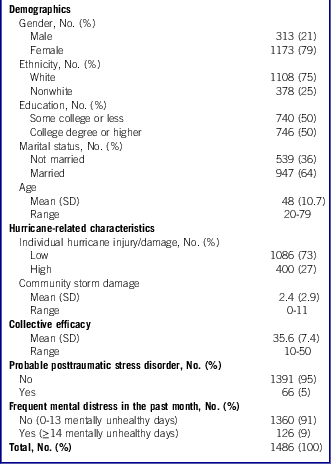
The current study is the second wave of a larger study of FDOH personnel who worked during the 2004 and/or 2005 hurricane seasons and was carried out in June 2006 (for description of the first wave, please see Ursano et al., 2014).Reference Ursano, McKibben and Reissman9 Participants were 1486 public health workers whose ages ranged from 20 to 79 years (mean, 48; SD, 10.7). The majority of the participants were female (79%, n = 1173), white (75%, n = 1108), and currently married (64%, n = 947), and half of the participants had a BA/BS degree or higher (50%, n = 746).
Study participation was voluntary. Questionnaires and a project description were distributed to FDOH employees using the personnel e-mail distribution lists. All participants indicated agreement to participate by completing and returning a questionnaire that was transmitted electronically and anonymously. Participants were informed that the questionnaire included items regarding their work and personal experiences during and since the 2004 hurricane season. The study was approved by the Institutional Review Board of the Uniformed Services University of the Health Sciences in Bethesda, Maryland.
Measures
Posttraumatic Stress Disorder
PTSD symptom severity scores and probable PTSD were assessed with the 17-item PTSD Checklist (PCL-17).Reference Weathers and Ford37 The PCL-17 lists all symptoms of PTSD outlined in the DSM-IV. Respondents rated how much they had been bothered by each problem in the past month on a scale ranging from 1 (not at all) to 5 (extremely). Each question was worded so as to be related to the respondent’s experience with the hurricanes. Responses were summed to produce PTSD symptom severity scores ranging from 17 to 85.
Studies in primary care settings with populations similar to ours have validated a PCL-17 score of 30 or greater as indicative of probable PTSD (sensitivity, 0.78-0.82; specificity, 0.71-0.76) and positive and negative likelihood ratios of 3.40 and 0.24, respectively; Cronbach α was 0.96 for the total PCL score.Reference Lang, Laffaye and Satz38, Reference Walker, Newman and Dobie39 In this study, participants were rated as having probable PTSD if they had scores of 30 or greater and also met the following DSM-IV symptom distribution criteria: 1 intrusion, 3 avoidance, and 2 hyperarousal symptoms, each present at the level of moderate or higher during the previous month.
Distress: Mentally Unhealthy Days
We measured distress using a single item from the Centers for Disease Control and Prevention (CDC) Health-Related Quality of Life (HR-QOL) questionnaire’s Healthy Days Core Module, which assessed the number of mentally unhealthy days in the past month.40 This single item asks, “Now thinking about your mental health, which includes stress, depression, and problems with emotions, for how many days during the past 30 days was your mental health not good?” with scores ranging from 0 to 30. Items on the HRQOL-4, and the mentally unhealthy days item in particular, exhibit good construct and concurrent validity as a measure of frequent mental distress and quality of life deficits and acceptable correlations with related SF-36 scales including depression and anxiety (r’s ranging from 0.61 to 0.71). In this study, report of 14 or more mentally unhealthy days was categorized as presence of frequent mental distress, and 13 or fewer days identified absence of frequent mental distress, which corresponds with the CDC’s definition of frequent mental distress based on responses to this item.
Collective Efficacy
Collective efficacy was assessed with the 10-item scale (range, 10-50) employed by Sampson and colleagues.Reference Sampson, Raudenbush and Earls12 The scale has 5 items in each of 2 domains: informal social control and social cohesion/trust. Each individual’s response to the two 5-item, 5-point Likert scales (ranging from very likely to very unlikely and from strongly disagree to strongly agree) were summed to a total score for individual-level collective efficacy. Informal social control includes 5 items that ask how likely it would be that their neighbors could be counted on to intervene if (a) children were skipping school and hanging out on a street corner, (b) children were spray-painting graffiti on a local building, (c) children were showing disrespect to an adult, (d) a fire broke out in front of their house, and (e) a fire station closest to their home was threatened with budget cuts. The social cohesion/trust scale includes 5 items that assess the extent to which participants agreed that in their home neighborhood (a) people are willing to help their neighbors, (b) it is a close-knit neighborhood, (c) people can be trusted, (d) people generally get along with each other, and (e) people share the same values. Higher scores indicate greater collective efficacy. Sampson and colleaguesReference Sampson, Raudenbush and Earls12 demonstrated high between-neighborhood reliability (ranging from 0.80 to 0.91) across 343 neighborhoods in Chicago, Illinois. There was a strong association between social cohesion and informal social control across neighborhoods (r = 0.80, P < .001), which suggests that these scales were measuring aspects of the same latent construct.
We also examined a shorter version of the collective efficacy scale that consisted of a single item from the social cohesion/trust subscale that assessed how strongly participants agreed that people in their neighborhood were willing to help their neighbors. This item correlated strongly with the full collective efficacy (r = 0.76, P < .001), which suggests good concurrent and predictive validity, and was included in the current study to determine whether it performed similarly as a predictor of posttraumatic stress symptoms and may potentially serve as a brief surveillance tool.
Individual Hurricane Injury/Damage
Injury/damage at the time of the hurricanes was assessed with the following question: “What kinds of problems or damage did you experience during the 2005 hurricane season?” The individual-level hurricane injury/damage variable was calculated on the basis of whether participants had experienced any of the following 6 events during each of the 4 hurricanes: loss of electrical power, damage to vehicle, injury or harm to self, injury or harm to spouse/significant other, injury or harm to children, or injury or harm to pets. Those reporting at least 2 of the events during the 5 hurricanes were considered to have high hurricane-related injury/damage (27%, n = 400).
Community Hurricane Damage
Using US Federal Emergency Management Agency (FEMA) county data for all 4 storms,35 we identified the zip code level of FEMA public and individual assistance received. Each zip code was scored based on its highest community storm damage across the 4 storms to index the level of individual and public assistance received. We combined levels to create 5 levels of public assistance and, therefore, community storm damage. The level of community storm damage ranged from none (0) to individual assistance only (1) to increasing levels of public assistance with FEMA categories A to G (scored 2, 3, and 4). This level-two variable was then centered.
Statistical Analysis
Potential individual- and community-level risk factors for probable PTSD and frequent mental distress post-hurricanes in FDOH employees were analyzed using logistic regression analyses. All analyses excluded missing cases across all covariates (N = 1486). Mean levels of collective efficacy and rates of PTSD and frequent mental distress in the past month were computed using descriptive statistics and presented in Table 1. Preliminary univariate logistic regression analyses examined sociodemographics (age, gender, education, race, and marital status), hurricane-related characteristics (individual injury/damage and community storm damage), and individual collective efficacy as predictors of PTSD and frequent mental distress. Separate multivariate models investigated the relationship of collective efficacy to PTSD and frequent mental distress, adjusting for demographic and hurricane-related characteristics. We examined the 2-way interactions of collective efficacy with significant sociodemographic and hurricane-related characteristics (ie, collective efficacy × individual injury/damage; collective efficacy × marital status) predicting PTSD and frequent mental distress, respectively, to determine whether associations of collective efficacy with PTSD and frequent mental distress were modified by other characteristics. Logistic regression coefficients for categorical predictors were exponentiated to obtain odds ratios (OR) and 95% confidence intervals (CI). Population-attributable risk proportions (PARP)Reference Rothman and Greenland41 were calculated to identify the proportions of PTSD and frequent mental distress that would not have occurred if the population was reduced to reference levels of collective efficacy (ie, high collective efficacy, based on identifying those in the top 80%, with collective efficacy scores of 31 or higher), assuming that coefficients in each model represent causal effects of the predictors. Statistical analyses were conducted using SAS software,42 version 9.4.
Demographics, Hurricane-Related Characteristics, Collective Efficacy, and Mental Health (PTSD, Frequent Mental Distress)

RESULTS
Almost 2 years (ie, 21 months) after the 2004 hurricanes, 5% (n = 66) of FDOH workers met PTSD criteria according to the PCL diagnostic algorithm, and 8.5% (n = 126) reported frequent mental distress (≥14 mentally unhealthy days in the past month). The mean number of mentally unhealthy days was 3.05 (SD, 6.76), and the average score for individual-level collective efficacy was 35.7 (SD, 7.4). Among the 126 participants who reported frequent mental distress, the average age was 47 (SD, 11.55), and 85.7% (n = 108) were female, 80.2% (n = 101) were white, 53.2% (n = 67) were unmarried, and 51.6% (n = 56) had a BA/BS degree or higher.
Posttraumatic Stress Disorder
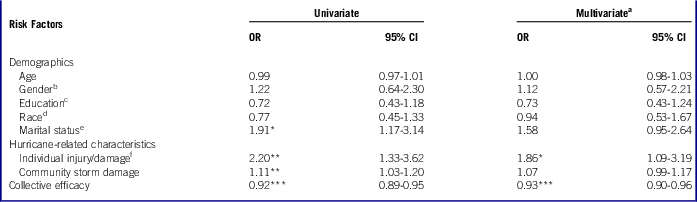
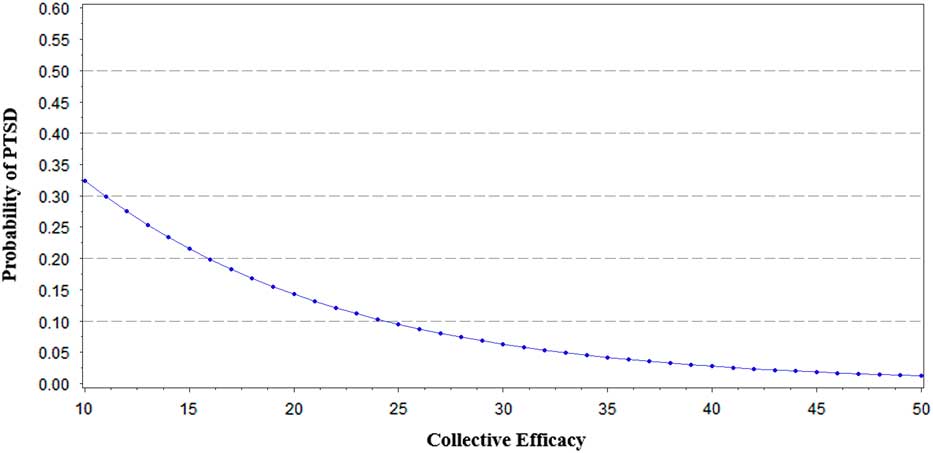
In a univariate model, FDOH employees who were unmarried were at greater odds of having PTSD (OR, 1.91; 95% CI, 1.17-3.14) (Table 2). Further, those who reported individual injury/damage were more than twice as likely to have PTSD (OR, 2.20; 95% CI, 1.33-3.62). Residing in communities that had more storm damage was associated with increased risk of PTSD (OR, 1.11; 95% CI, 1.03-1.20). FDOH workers who reported lower collective efficacy were also at increased risk of PTSD (OR, 0.92; 95% CI, 0.89-0.95). In a separate, similar model using the short collective efficacy variable, we found a similar relationship with PTSD as we found with the full collective efficacy scale (OR, 0.59; 95% CI, 0.46-0.75; P < .001). The probability of PTSD based on collective efficacy score is depicted in Figure 1.
Relationship of Collective Efficacy to Posttraumatic Stress Disorder Following the 2004 Florida Hurricanes

Note: N = 1457.
*P ≤ .05, ** P ≤ .01, *** P ≤ .001.
a Adjusted for demographics (age, gender, education, race, and marital status), individual hurricane injury/damage, and community storm damage.
b Gender: male = 0, female = 1.
c Education: some college or less = 0, college degree or higher = 1.
d Race: nonwhite = 0, white = 1.
e Marital status: married = 0, unmarried = 1.
f Individual hurricane injury/damage: low (0-1) = 0, high (≥2) = 1.
Probability of Posttraumatic Stress Disorder Predicted by Collective Efficacy

In a multivariate model predicting PTSD, adjusted for sociodemographics and other hurricane-related characteristics, results for individual injury/damage and collective efficacy were similar. Odds of PTSD were higher among FDOH employees who reported more individual injury/damage during the hurricanes (OR, 1.86; 95% CI, 1.09-3.19). Similarly, multivariate analyses found that lower collective efficacy was associated with PTSD diagnosis (OR, 0.93; 95% CI, 0.90-0.96). Community storm damage, however, was not significantly related to PTSD. The 2-way interaction between collective efficacy and individual injury/damage was nonsignificant, which indicates that the association of collective efficacy with PTSD was not modified by the effects of individual injury/damage. In a separate analysis using the short collective efficacy scale, we found a similar relationship of collective efficacy to PTSD (OR, 0.60; 95% CI, 0.47-0.78; P < .001). The PARP for low collective efficacy (categorized by the lower 20%, or scored 30 or less on the collective efficacy scale) based on the full multivariate model was 25%, suggesting that PTSD might be reduced by as much as 25% if we could improve the level of collective efficacy of all FDOH workers with low collective efficacy.
Frequent Mental Distress
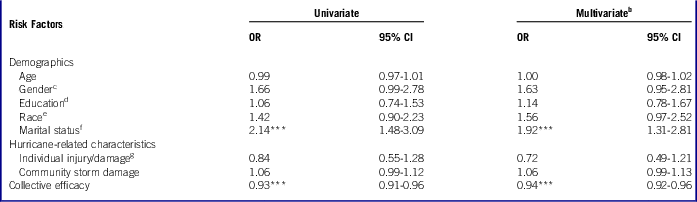
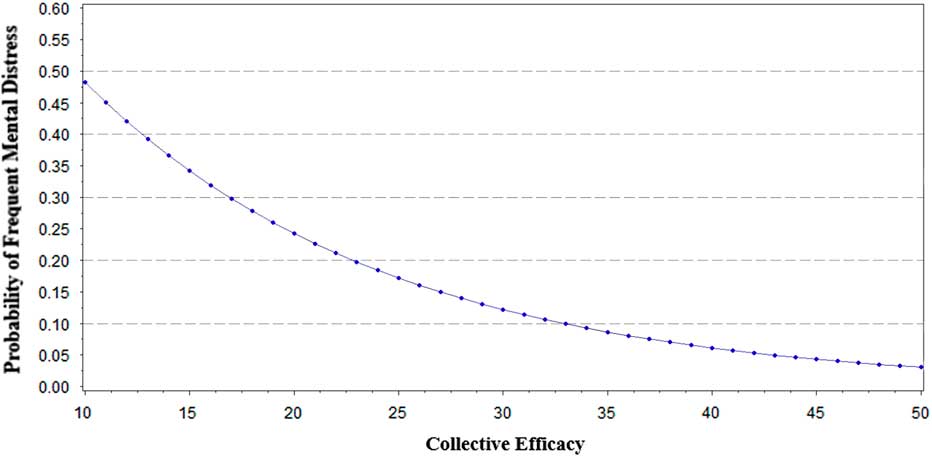
A similar series of logistic regression analyses were conducted with frequent mental distress (identified by 14 or more mentally unhealthy days within the last 30 days) as the outcome (Table 3). Univariate analyses again found that being unmarried was related to a higher risk of frequent mental distress (OR, 2.14; 95% CI, 1.48-3.09), and those with lower collective efficacy were at increased risk of frequent mental distress (OR, 0.93; 95% CI, 0.91-0.96). The probability of frequent mental distress based on collective efficacy score is presented in Figure 2. In a separate univariate model, the short collective efficacy scale revealed a similar relationship with frequent mental distress as the full collective efficacy scale (OR, 0.64; 95% CI, 0.53-0.77; P < .001).
Relationship of Collective Efficacy to Frequent Mental Distressa Following the 2004 Florida Hurricanes

Note: N = 1486.
*P ≤ .05, ** P ≤ .01, *** P ≤ .001.
a Frequent mental distress: 0 to 13 mentally unhealthy days in the past 30 days = 0, ≥14 days = 1.
b Adjusted for demographics (age, gender, education, race, and marital status), individual hurricane injury/damage, and community storm damage.
c Gender: male = 0, female = 1.
d Education: some college or less = 0, college degree or higher = 1.
e Race: nonwhite = 0, white = 1.
f Marital status: married = 0, unmarried = 1.
g Individual hurricane injury/damage: low (0-1) = 0, high (≥2) = 1.
Probability of Frequent Mental Distress Predicted by Collective Efficacy
Note: Frequent mental distress is defined by the US Centers for Disease Control as 14 or more mentally unhealthy days in the past month.40

After adjusting for demographics and hurricane-related characteristics, the relationships of marital status (OR, 1.92; 95% CI, 1.31-2.81) and collective efficacy (OR, 0.94; 95% CI, 0.92-0.96) to frequent mental distress remained significant, with those who were unmarried and those with lower collective efficacy at increased risk for frequent mental distress. Neither individual injury/damage nor community damage were significantly associated with frequent mental distress. Inclusion of the 2-way interaction of collective efficacy and marital status in a separate model was not significant, which indicates that marital status did not modify the effects of collective efficacy on frequent mental distress. Examination of the short collective efficacy scale in a separate analysis found a similar relationship to frequent mental distress as was found with the full scale, with lower collective efficacy associated with an increased risk of frequent mental distress (OR, 0.65; 95% CI, 0.53-0.79; P < .001). The PARP for low collective efficacy was 25%, which indicates that if we could improve the collective efficacy of FDOH workers with low collective efficacy (the lower 20%, or those who scored 30 or less on the collective efficacy scale), frequent mental distress might be reduced by as much as 25%. To account for the possibility that the FDOH worker sample may be relatively healthier than the general Florida population, we also categorized frequent mental distress using a lower threshold of 8 or more mentally unhealthy days (versus 14+ days in the past 30 days). Using this lower cutoff value for frequent mental distress, lower collective efficacy continued to be associated with increased risk for frequent mental distress (OR, 0.95; 95% CI, 0.93-0.97), after adjusting for demographics and hurricane-related characteristics.
DISCUSSION
First responders, including public health workers, have a critical role in the community during and following a disaster. Recent community responses to hurricanes Harvey, Irma, and Maria in 2017 involved extensive immediate and long-term support from local and national first responders. The impact of hurricane exposure, and the responsibility of responding to a disaster while simultaneously experiencing personal injury and property damage, can have significant psychological and behavioral effects. Although professional training provides disaster workers with strategies to help protect themselves and reduce stress, disaster exposure can result in patterns of both acute and long-term distress and dysfunction in disaster workers.Reference Benedek, Fullerton and Ursano2, Reference Carson, Paulus and Lasko3, Reference Bills, Levy and Sharma43-Reference Hobfoll, Tracy and Galea46 Public health workers, in particular, experience acute and long-term posttraumatic stress disorderReference Akbayrak, Oflaz and Aslan1-Reference Carson, Paulus and Lasko3, Reference Ursano, McKibben and Reissman9, Reference Hobfoll, Tracy and Galea46 and depressive symptoms.Reference Fullerton, Ursano and Liu6 For workers who live in the disaster-affected community, as in this study, the neighborhood can serve as an additional resource, promoting resilience. Approximately 5% of FDOH employees met criteria for hurricane-related PTSD, and 9% reported frequent mental distress (14 or more mentally unhealthy days in the past month). The observed PTSD rate is similar to the conditional probability of PTSD (3.8%) found in populations exposed to natural disasters.Reference Breslau, Kessler and Chilcoat47
Community resources, such as collective efficacy, are important predictors of mental health and resilience outcomes following disasters.Reference Benight13, Reference Lowe, Joshi and Pietrzak28, Reference Hobfoll, Tracy and Galea46 In the present study, we examined the relationship of perceived collective efficacy to PTSD and psychological distress in public health workers following exposure to multiple Florida hurricanes. Disaster workers who reported higher perceived collective efficacy had a lower likelihood of PTSD and frequent mental distress, even after adjusting for individual sociodemographic variables, community socioeconomic characteristic variables, individual injury/damage, and community storm damage. These relationships suggest that one’s perception of their community as cohesive, with neighbors willing to intervene during adverse circumstances for the common good of the community, are important characteristics that may foster disaster-related recovery. The mutual trust and solidarity found in communities with higher collective efficacy also promote experiences of safety, calming, optimism, and social support.Reference Hobfoll, Watson and Bell48 This is particularly important following a disaster, when residents in communities with higher collective efficacy are more likely to work together to make resources available for rebuilding, as well as provide mutual support and assistance. In addition, there may be greater use of health care that can prevent or mitigate disorders such as PTSD and persistent distress. Each of these factors may enhance recovery from acute stress, promote general and mental health wellness,Reference Norris, Stevens and Pfefferbaum14, Reference Lowe, Joshi and Pietrzak28 and lead to lower rates of PTSD.
The costs of posttraumatic stress and PTSD may be considerable.Reference Fontana and Rosenheck49-Reference Tanielian and Jaycox52 Following hurricanes Katrina and Rita, the cost of adequate mental health response for the storm-affected population of 11 million people was $1133 per person, or $12.5 billion in total.Reference Schoenbaum, Butler and Kataoka53 Our findings indicate that PTSD and frequent mental distress might each be reduced by as much as 25% if the perceived collective efficacy of those who report low levels could be improved. Increased collective efficacy could be accomplished through the actions of community and workplace leaders. Efforts to strengthen collective efficacy in communities and public health workplaces during a period of stability will also prepare neighborhoods to effectively respond in the event of a subsequent disaster. These improvements could have a substantial impact on the mental health and economic recovery of the community after a disaster. Due to the similar relationships of the short and full collective efficacy scales to PTSD and frequent mental distress, the short version of the scale can have potential practical use as a brief surveillance assessment following disaster exposure, informing intervention efforts.
The present findings must be interpreted in terms of methodological considerations. Since this is a cross-sectional study, further research using longitudinal designs is recommended. This study focuses on an important population of public health workers and will directly inform research on first responders; however, its generalization to other populations is limited and requires further study.
This study demonstrates the significant relationship of perceived collective efficacy to mental health outcomes, specifically posttraumatic stress disorder and frequent mental distress, following disaster response in FDOH workers. Awareness of the importance of collective efficacy in the community highlights the needs to incorporate methods that increase neighborhood cohesion and promote resilience. Community-level intervention is often cost-effective and practical, and may reach individuals who may not seek or have available individual interventions after a disaster. This access may be particularly important for public health workers who are dedicated to supporting the community, but may not request assistance and support themselves.
Acknowledgments
The opinions expressed in this manuscript are those of the authors and, therefore, do not necessarily reflect the views of the US Department of Defense and the Uniformed Services University of the Health Sciences.