Introduction
From the late-eighteenth century, official anxiety was expressed whenever British colonial authorities in South Asia drew close to religious institutions and sensibilities. Despite this, over the next 150 years, layers of legislative, judicial, and scholarly authority gradually accumulated at sites of native devotional observance.Footnote 1 This paper explores one such legislative episode—the Ancient Monument Protection Act in 1904—and its operation and contestation at the site of the Hindu temple. It charts a gradual shift in the government's disposition during the 40 years after the Act was passed, through a variety of local disagreements and dissonances between the implicit and explicit doctrines enshrined in the Act and the practices of popular Hinduism. Once temples were registered under the Act, activities that could be defined as vandalism ranged from the pouring of libations, the drying of pulses, the smearing of cow-dung, the holding of school classes, the offering of fruits, and the renovation of sculpture. Aside from the variety of purposes to which an unused medieval temple could be put, the greatest tension was that between the codes of archaeological conservation and those of popular Hindu ritual. There was a clear conflict between the aesthetics of conservation, distilled from European affective registers, and those of popular Hindu ritual practice: matte was preferred over luminosity, plainness over ornament, sight over touch, patina over renewal. Precise aesthetic codes of conservation were not established under the Act, although some elaboration was provided in Director General of Archaeology John Marshall's Manual of Conservation composed in 1923.Footnote 2 This paper questions the assumption that the conservation of monuments ‘amounted to their effective museumization’.Footnote 3 From a point of departure where monuments were defined as entirely and definitely separate from religious usage, the sovereignty of temple deities met and mastered both the aesthetic codes and the bureaucratic formulas of the Ancient Monuments Protection Act. This change is traced through three interlinking themes. First, material from Bhubaneswar is used to examine the endeavour of archaeological and revenue officers to locate their own authority and secure stable contracts for conservation under the terms of the Act. Secondly, the paper explores the anxieties about ‘creeping’ religiosity at temples under the care of archaeological conservation, a (well-founded) fear that no space could be sealed against devotional claims. The third theme runs throughout the argument: the clash of aesthetics that lies at the heart of the conflict between conservationism and popular Hindu religious practice.
When it was passed in 1904, the Ancient Monuments Protection Act procured for the colonial government new rights, and obligations, over India's material past. In South Asia, physical antiquities provided the material evidence for the trajectory of decline that ended in an imperial present. The ‘discovery’ and classification of antique grandeur was both indicative of, and necessitated by, the cultural nadir to which the dependent territory had now sunk. The Act created a three-fold categorization of standing antiquities and set out the rules by which the British Indian state could acquire custody, by negotiation or compulsion. This custody, in theory, gave officers of the Archaeological Department complete control over the physical fabric of listed monuments. In 1902, fewer than 150 buildings in British India were under the protection of the state, many of them British monuments build in the nineteenth century. By 1915, that number had risen to over 700.Footnote 4 The Act appeared to offer the colonial state licence to impose conservation to a degree unknown in Europe, and especially in Great Britain, where the passage of similar acts was subject to a variety of caveats. Not until 1913 was an act passed in Great Britain that gave the state similar abilities to intrude on private rights—and it still excluded all ecclesiastical buildings in religious use.Footnote 5 The Indian Act was an expression of a very specific European consensus, itself developed over centuries of cultural and religious debate about the meanings, significance, and material manifestations of antiquity.Footnote 6 The ruins of classical antiquity provided ideals of representative and architectural form. However, bourgeois debate and anxiety concerning the form and fabric of a pre-modern past in Great Britain was most pointedly played out across the Christian church. From the 1840s, Anglo-Catholic church restoration had favoured dramatic intervention, and set out the centrality of the ‘original’:
To restore is to recover the original appearance, which has been lost by decay, accident or ill-judged alteration. The method of the restoration depends upon the idea of the original which the architect may form.Footnote 7
The Anglo-Catholic taste for ‘eclectic’ restoration—which permitted selective destruction and rebuilding—took place amid a ‘massive’ project of church construction and restoration in the mid-nineteenth century.Footnote 8 Those tastes, however, gave way later in the nineteenth century to the ‘anti-scrape’ movement, which aggressively decried the destructive and imitative practices of restoration. John Ruskin and William Morris, through the Society for the Protection of Ancient Buildings (founded in 1877), successfully promoted the sanctity of the fabric of origin as it had come to rest in the present and rejected any attempt to replicate the medieval genius of sculpture.Footnote 9 The convictions of preservation were underwritten by a complex of explicit and coded sensibilities towards the fabric and aura of antiquities: Protestant aloofness from the material mediation of worship; irreversible, Hegelian time; and an aesthetic order affronted, and wounded, by industrialized modernity.
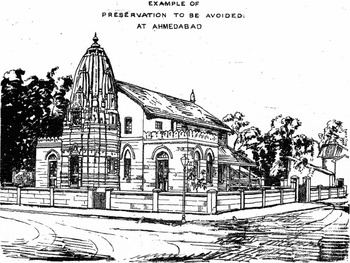
The Ancient Monuments Protection Act in British India was a blunt, legislative distillation of the victorious sensibilities of the anti-scrape movement. By the time the Act was passed, the preservation of monuments had detached itself entirely from the decades of the previous century when Britain's churches and cathedrals were piously remodelled. The ‘intention’ of the building, which had been a foremost consideration of church restorers, was now entirely lost in its significance as a ‘monument’. Elaborate bureaucratic practices were set in place—if not, as we shall see, in motion—to facilitate the monument's upkeep and invigilation. The Act placed an emphasis upon physical custody that was unprecedented in British India. Under the first state-funded archaeological surveys, led by Alexander Cunningham in the 1860s, the fate of archaeological materials was of far less importance than their assessment and documentation. Indeed, Cunningham was given licence to take a share of the objects he discovered.Footnote 10 However, the proprietorial claim of the government to standing monuments had grown at the end of the nineteenth century, not least under pressure from advocates of conservation in Britain. During the second phase of the surveys, from 1871, the importance of preserving exemplars from within emerging taxonomies of architectural history was raised.Footnote 11 The reports of Henry H. Cole, during his short-lived appointment as curator of ancient monuments (1881–1883), encapsulate the growing concern with appropriate custody and maintenance of antiquities as part of a landscape. Cole considered Ahmedabad, for example, to be ‘one of the most picturesque and artistic in the whole of the Bombay Presidency’ and brought to the government's attention the ‘readiness, on the part of both Natives and Europeans, to utilise ancient architectural memorials for domestic purposes’.Footnote 12 Cole employed a striking sketch of a temple in the city to illustrate his point (see Figure 1). The documentation and collection required by earlier phases of the Archaeological Department's work were now supplemented by the need to actively intervene in the fabric of buildings identified as antiquities and desired as monuments. John Marshall, appointed in 1902 as the first director general of the reorganized and reinvigorated Archaeological Survey of India, touted the treatment of India's material past as representative of the shift from colonial power to imperial authority.Footnote 13 The process of making monuments suggested new purposes and new publics for these buildings. However, the ‘national past’ was far less a cogent claim in the colonial context than it was in Europe. An expectation that the protection provided would elicit gratitude from colonial subjects was expressed in terms of (divided) national, racial, and religious interests. Viceroy George Nathanial Curzon's reiteration of the strict impartiality that would be observed in dealing with India's antiquities serves only to underline that Curzon extended his principles of political rule to the classification and interpretation of South Asia's material past:
To us the relics of Hindu and Mahommedan, of Buddhist, Brahmin, and Jain are, from the antiquarian, the historical and the artistic point of view, equally interesting and equally sacred. One does not excite a more vivid and the other a weaker emotion. Each fills a chapter in Indian history. Each is part of the heritage which Providence has committed to the custody of the ruling power.Footnote 14
Converted temple in Ahmedabad.

John Marshall, as director general, endorsed ‘the vast educative influence which resides in the monuments of a great past’ and stressed the importance of ‘convert[ing] the monuments into places of popular resort’.Footnote 15 However, the custody of monuments as places of ‘public resort’ introduced new tensions. The first was the presumed capacity of the Archaeological Department to control access to and modes of behaviour around these monuments, and the second, a tacit preference for monuments classified as non-Hindu.
Between 1905 and 1915, the majority of the outlay of the governments of the Central Provinces, Bombay, and Madras was directed towards the conservation of Hindu monuments, specifically temples. However, the single paragraph on ‘Hindu monuments’ in Marshall's 1915 report is dry in comparison with his effusive treatment of Islamic buildings. Bhubaneswar was described as possessing a ‘crowd of temples’. The temples of South India, with no adjectival endorsement, were subject to an ‘active and systematic campaign of protection and repair’.Footnote 16 The comparatively purse-lipped treatment of temple conservation reflects an aesthetic preference for certain favoured Islamic monuments in northern India. The palaces, throne rooms, and gardens of the Sultanate and Mughal past provided a fitting ceremonial inheritance for the colonial state and received ebullient treatment in Marshall's reports to the Indian and home governments. In their case, imitation and restoration were acceptable. Marshall reported that by 1905, the monuments of Delhi had ‘been restored to their former beauty or put into a thorough state of repair and defence against their natural enemies. . . Around the tomb of Humayun a barren wilderness is being converted into a stately garden, that shall be worthy of the glorious resting place of so great an Emperor.’Footnote 17 The attention paid to the Islamic monuments around Delhi increased when the new capital was laid out in the second and third decades of the century. The Sultanate and Mughal remains, which inhabited Lutyen's New Delhi as curated monuments, appealed as remnants of an elite culture less remote to the British than the material culture of ‘ancient’ Hindu dynasties. The geometric form and adornments of these monuments created by fellow emperors were found to be more sympathetic to the eye of dominant, Protestant European sensibilities.
Custody of the Bhubaneswar temples
The many medieval temples in Bhubaneswar, now in the state of Orissa, had been subject to a series of conservation measures before the 1904 Act came into force. James Fergusson, who established some of the enduring taxonomies of temple architecture in his History of Indian and Eastern Architecture, regarded the temples as the most ‘perfectly pure’ example of Indo-Aryan architecture in India.Footnote 18 The temples, built between the eighth and twelfth centuries, were believed to have escaped the ‘ravages which devastated the principal Hindu cities in the earlier and more intolerant age of [Muhammadan] power’.Footnote 19 The Lingaraj temple, built in the eleventh century, was described by Fergusson as the ‘finest example of a purely Hindu temple in India’.Footnote 20 Conservation had been carried out between 1898 and 1902 by the Archaeological Department and in 1900 when John Woodburn, as lieutenant governor of Bengal, granted an annual allowance of Rs400 to the Lingaraj temple for its maintenance. The grant was withdrawn three years later when the temple authorities refused to allow European officers to enter temple compound to inspect it.Footnote 21 The question of access simmered throughout the decades following the legislation and when occasional grants were made for the repair and upkeep of the temples. In 1911 the question of the temple's repair and custody was again reopened after the Lingaraj Temple Committee and the Public Works Department made simultaneous and almost identical complaints to the government.Footnote 22 The Temple Committee protested against the destruction of a subsidiary shrine next to the Ananta Basudev temple by the Public Works Department. Babu Pryanath Chatterji, member-in-charge of the Temple Committee, complained that the shrine had been ‘mythologically connected’ to the Ananta Basudev temple and that its removal ‘cripple[d] the idea of beauty and congruity’.Footnote 23 In turn, the superintending archaeologist complained about the Committee's dismantling of a Padmeswari temple within the Lingaraj enclosure. The neglect of ‘obvious formalities’ had, claimed archaeologist Albert Henry Longhurst, led the Temple Committee to ‘feel justified not only in obstructing measures recommended by competent official authority, but also to demolish minor structures on their own account and remove the materials into another compound for use in the restoration of a totally distinct building in no way connected with the one destroyed’.Footnote 24 Although Longhurst conceded that the Committee had cause to protest against the demolition of the shrine, the conservation note that required the destruction of the Ananta Basudev shrine asked for the dismantling of five further shrines in different enclosures in Bhubaneswar.Footnote 25 The destruction was, claimed D. Brainerd Spooner, the subsequent superintendent of Archaeology in the Eastern Circle, preferable to reconstruction as this involved the introduction of new materials and would ‘destroy in large measure the authenticity of the building’.Footnote 26 Better, it seemed, to destroy the building than its integrity as an antiquity. In what Spooner regarded as a flagrant disregard of this principle, stones from the dismantled Padmeswari temple were now being used to repair the Lingaraj temple. The Temple Committee also, he claimed, felt themselves empowered to grant permission for the restoration of the Gauri temple, close by the Lingaraj temple, without any reference to the government. ‘[I]t ought to be made legally impossible,’ he asserted, ‘for anyone to tamper with the Bhuvaneswar temples without the full knowledge and express permission of Government’.Footnote 27 This control could only be sought under the terms of the Act and a list of temples was now prepared for the purposes of placing them under the care of the state.
In theory, the Temple Committee provided a reliable partner for conservation under the terms of the Act. The extent of the Committee's jurisdiction over the various temples in Bhubaneswar, however, was unclear and was disputed by Spooner as superintending archaeologist. A report was commissioned from the tahsildar (local revenue officer) of Kurda, B. S. Mardraj, to establish the forms of custody and usage of 14 of the Bhubaneswar temples.Footnote 28 An ‘idol’ existed in every temple except the Raja Rani and Chitrakarani temples. He reported that the first six temples on the list—Bhaskareswar, Mugheswar, Brahmeswar, Parasurameswar, Maitreswar, and Sari Deul—were not ‘used for religious purposes’. However, in all but the Sari Deul, some attendance was made for the offering of bhog (food) or water libations by sevaks.Footnote 29 The Bhaskareswar, Mugheswar, and Brahmeswar sevaks held a land grant for the provision of water libations. Even in the absence of public worship mediated by a pujari (officiating priest), therefore, the presence of a deity was marked by devotional attendance, albeit irregular. The other temples were all ‘used for religious purposes’ and though Mardraj provided brief sketches of the claims and practices he found, he recommended that the government address the Lingaraj Temple Committee for fuller information.Footnote 30
The subsequent debate on the presumption of custody of the temples under the Act of 1904 illustrates the complexity entailed in the search for a contract for conservation. Under the terms of the Act, archaeological officers acquired control over all repairs, but this did not include financial responsibility on the part of the government. The principal argument made against notification, therefore, was not one of control, but of cost. Priyanath Chatterji objected to any agreement that designated the Committee as the owner of the temple and therefore liable for the costs of any repairs deemed necessary by government. He insisted that responsibility for repairs, as opposed to the management of a temple's affairs, lay fully with the government. The endowments possessed by a temple were not, Chatterji insisted, meant for repair but only to meet the cost of puja (the care and worship of the deities presiding in the temples). The specifics of ownership were moot, not least in the archives of the state. The only endowment that passed to the Committee under the 1863 Religious Endowments Act was the Lingaraj temple; however, the Committee had been entered as the owners of 12 temples under the previous Revenue Settlement. The Committee's management of the other, smaller temples in Bhubaneswar had simply been assumed, by the Committee and the state alike. In the context of negotiations over custody for the purpose of registering the temples as monuments, the Temple Committee disclaimed ownership.Footnote 31 The government of Bengal now recommended that the collector, as district revenue officer, assume guardianship over the all temples. A division of custody would be introduced between the civil authorities and the Temple Committee: the structure of the temples would be controlled and repaired by the Public Works Department, under instructions from archaeological officers, and the Committee would continue to oversee worship.Footnote 32 This separation, however, presumed far too much, not least that custody of the deity and custody of the building over which the deity presided could be neatly divided. The Temple Committee would not cede their control over the temple's physical care, even if they refused to meet the costs. What is more, in any agreement reached, Chatterji wanted reference to the Ancient Monuments Protection Act to be avoided. The cost of repairing the temples, he claimed, should be met by the government under the terms of both Act 19 of 1810 (Bengal Charitable Endowments, Public Buildings and Escheats Regulation) and the Religious Endowments Act of 1863, neither of which, he pointed out, had been repealed by the Act of 1904. Chatterji's appeal calls to attention the variant lives of legislation in different phases of the colonial intervention in India. The 1863 Religious Endowments Act was designed specifically to distance the colonial state from religious institutions with which it found itself deeply embroiled. Viceroy Curzon himself, however, had claimed in the Legislative Council that the 1904 Act was the fulfilment of section 23 of the Act of 1863, a claim that invented an illusion of legislative continuity and consistency.Footnote 33
In 1913, as negotiations over the Lingaraj temple stalled, Government Pleader G. C. Paharaj offered a solution. He suggested that since no endowment existed to meet the repairs of the temple, the Committee's agreement to the government securing custody of the temple's fabric was unnecessary.Footnote 34 Paharaj went even further, even questioning the custody of the Temple Committee over the deity. He argued that the government, not the Temple Committee, were in fact the trustees of the god Lingaraj. Paharaj used the legal concept of a ceste que lui trust to define a jurisdiction whereby the god owned the temple but the government were legally responsible for it.Footnote 35
Paharaj's interpretation placed the Ancient Monuments Protection Act within a longer tradition of the bond of interdependence and co-patronage between kingly and divine sovereignty in South Asia. The government's claim over the custody of the fabric of the temple was legitimized not despite, but by virtue of, divine sovereignty. Indeed, the government's claim was greater than that of the Temple Committee, the legitimacy of which rested solely in colonial legislation. Paharaj's argument was accepted and in November 1913, the commissioner of Orissa was declared ‘guardian’ of the 14 temples.Footnote 36 However, despite Paharaj's argument—and the fact that devotion took place in the majority of temples taken into custody—the Lingaraj temple was not included in the list of temples to be notified under the Act but remained under the authority of the Temple Committee. In a further measure against causing direct offence, a commitment was made under the terms of the notification that only Hindus would carry out repair or restoration work in temples where worship took place. This pragmatic commitment was made by E. H. Johnston, an under-secretary in the Bengal government and a Sanskrit scholar.Footnote 37 This listing was short-lived and in 1918, registration of all but the Raja Rani temple (in which no tradition of worship existed) had been withdrawn due to differences with the Temple Committee over the ‘appropriate manner of their preservation’. The government agreed to finish repair works before handing control over all 13 temples back to the Temple Management Committee.Footnote 38
In the same year that protection was withdrawn, there were two very different reactions to the question of the temples’ protection in two distinct realms of British-Indian administration. Sir Chettur Sankaran Nair, member for Education on the Viceroy's Council, recommended an accommodation between the terms of the 1904 Act and the temple authorities, in particular on the matter of restricting entry to Hindus, in order, he said, to ‘restore confidence’ and ‘demonstrate the real feelings underlying [government's] policy towards distinguished monuments of the country’.Footnote 39 Simultaneously John Marshall, as director general of Archaeology, expressed his incredulity on learning that worship had been allowed to continue in temples notified under the Act. If temples were government property, he asked, ‘how is it possible for worship to be resuscitated in them? If they are Government property, they should be fenced round, put under lock and key and a notice put up without delay stating that they belong to Government and are not in use for religious purposes.’Footnote 40 Marshall regarded the preservation of the Bhubaneswar temples as the first work of the superintendent of Archaeology in eastern India. However, he was convinced that the variety of architectural specimens in the town would allow any temples where worship was carried out to be excluded from the register of protected monuments.Footnote 41 Beyond the division he assumed could exist between the divine and the antique, Marshall was preoccupied by reversing the work that had been carried out on the Bhubaneswar temples between 1898 and 1902. He had been stung by architectural historian James Burgess's virulent criticisms of temple repair in Bhubaneswar. In his revisions and additions to James Fergusson's History of Indian and Eastern Architecture (first published in 1876), Burgess had contrasted the lack of damage wrought to the temples by ‘the Muhammadans’ to the ‘sordid proceedings’ of the Public Works Department. During Theodor Bloch's restoration work, carried out in 1902, broken and missing carvings were replaced by stone masons, an innovation which incensed Burgess: ‘It is pitiable to think of the barbarity of 20th century imitations, or supposed—but very inferior—imitations being inserted in these venerable structures.’Footnote 42 Marshall believed that Burgess's criticism were, at least in part, the result of personal malice. Bloch had ‘vexed’ Burgess in the past and Marshall had refused Burgess access to the Archaeological Department's drawings after he had exhibited as his own the work of a superintendent.Footnote 43 However, Marshall was prepared to revisit the repairs and evaluate Burgess's public criticism of the Department. If allowed to remain, stated Marshall, the ill-executed repair work would be a ‘standing monument to the discredit of Government’.Footnote 44 By 1918, the temples of Bhubaneswar had become not only medieval archetypes but exemplars of the mistakes that could be made in the course of their protection.Footnote 45
Marshall's desire to see the correction of the ill-judged 1902 work temporarily superseded the need to separate archaeology from worship. At the Lingaraj temple, the list of repairs was extensive: ‘Modern wall-paintings and hideous figures and men and beasts, white-washing, new plastering, visitor's names scribbled in charcoal and all such modern accretions inside and outside the temple should be removed. Some sculptural friezes have been wrongly restored; the hands of the image of Ganesa in the southern niche have been misplaced when last restored. This should be set right.’Footnote 46 Discussions stalled on the question of the Temple Committee's obligations once the works financed by government had been completed. Ultimately the government of India refused to sanction money unless the Lingaraj temple was notified under the 1904 Act.Footnote 47 In 1919, the officially perceived recalcitrance of the Committee culminated in a plan to use the ‘scandalous mismanagement’ of the Lingaraj Endowments as a way of replacing the Committee with ‘something more efficient and more reasonable’ for the purpose of pursuing repairs to the temple.Footnote 48 The negotiations and intrigue over the temple's repairs were interrupted in 1920 by the Reforms Scheme, introduced with the aim of slashing imperial expenditure. Under its terms, the financial commitments to monuments under the care of the Archaeological Department were frozen and the protection of all unnotified monuments, including the Lingaraj temple in Bhubaneswar, became a provincial responsibility. This division ended the centralized control of conservation that was fundamental to the 1904 Act.Footnote 49
Hindu temples as antiquities
The debate triggered by the repair and conservation of the Bhubaneswar temples drew into sharp focus the tension between Marshall's dictums of archaeological preservation and Hindu rituals of devotion. Early in the second decade of the twentieth century, conservation work was separated from research and was made the primary responsibility of the assistant superintendent of Archaeology in each circle.Footnote 50 The purview of the superintending archaeologists spread over thousands of miles and every order for structural repair and conservation work had, in theory, to be checked and passed by the director general of Archaeology from his offices in Delhi and Simla. Executive control of work, therefore, was spread so thinly that centralized enforcement of the tenets of conservation was made impractical. The approval of estimates by the director general and their subsequent passage through provincial government meant that even when expenses were approved, they could often not be incurred within the financial year.Footnote 51 The difficulties caused by this bureaucratic impediment were compounded by the reductions on spending imposed on the department and the 20 per cent fee charged on all estimates by the Public Works Department.Footnote 52 They were further exacerbated by the poor opinion many archaeological officers had of conservation work. Although consistently recommended as the ‘principal work’ of the Archaeology Department, scholarly archaeologists regarded it as a distraction from exploration and research.Footnote 53 Jean Philippe Vogel, who replaced John Marshall as director general for 18 months in 1910, was clear that he regarded conservation as a diversion, if not a waste of time.Footnote 54 The extent to which conservation work was directly overseen by a superintending archaeologist varied enormously and, in practice, the work was divided between the Public Works Department and parties who claimed devotional custody of the temple.
The physical conservation of temples invariably required some degree of intervention, from the clearing of vegetation to the complete dismantling and rebuilding of the structure. The greater the degree of physical intervention, the more potential there was for what the upper echelons of the Archaeological Department regarded as misjudged repairs. Reading through inspection notes, it becomes clear that contraventions of the proper order of conservation were incessant. The archaeological authorities no more trusted those ordered to carry out sanctioned conservation or restoration work—generally officers of the Public Works Department—than they trusted temple managers and devotees who claimed the temples for religious usage.Footnote 55 Once structures had been listed as monuments and work had been carried out, archaeological surveyors were placed in a state of perpetual frustration and dismay. Almost every inspection by the superintendent lambasts what was regarded as incompetent and inadequate restoration. Affronts range from the ‘smearing’ of concrete pointing across the sculpted surface of the temple, whitewashing (which was condemned by conservation but deemed necessary for temple restoration), and the replacement and recarving of decorative and iconic sculpture.Footnote 56 The last category of repair work was the greatest area of contention. In keeping with the preference for the repair and restoration of categories of monument defined as ‘Muhammadan’ in northern India, Marshall admitted that ‘the reproduction of geometric designs is sometimes admissible, particularly in living monuments of the Muhammadan epoch’.Footnote 57 However, in the case of Hindu temples, ‘The repair of divine or human figures is never to be attempted and that of free floral designs only in very exceptional cases. Empty niches should remain empty, if their images are lost; and the spaces occupied by images in friezes and string courses should, in repaired portions, be left blank.’Footnote 58
Reconstruction—to a lesser or greater extent—was inevitable, even if that reconstruction simply meant reinforcing masonry by adding cement. New plaster or masonry was stained to achieve an ‘authentic’ appearance. It was important that walls did not, as one conservation note commented, ‘appear as though they had been coated with sugar’.Footnote 59 John Marshall was a particular exponent of stains to be applied to any new work, supplying his own recipes and requiring all applications to be tested by local engineers on stones that could be sent to archaeologist's office for approval (although, in keeping with the gulf between Marshall's determination and his ability to control repair work, no evidence exists that this was done). Dyes included burnt coconut, red oxide, coal-tar dissolved in petrol or turpentine, dhobi nut dissolved in spirit, and liquid glue mixed with powdered charcoal. However, when one of Marshall's recipes was used at Bhubaneswar, it produced a ‘bright pinky colour which is as conspicuous as it is unsuitable’. Engineers charged with carrying out the work, pointed out that ‘harmonious staining of the repairs is a well nigh impossible task’, first, because the stain tended to wash off in the rains and, secondly, because the original builders of the temple under conservation, Parasurameswar, used different shades of stone:
[T]his variated surface must originally have received a uniform coat of colour or paint, otherwise it would have been intolerable from the beginning. . . with the lapse of centuries, this original stain has so largely worn off, that the basic medley of colours is now disclosed, complicated in parts by the varying effects of the colour first applied. There is thus really no prevailing colour for the [Public Works Department] to match and I must acknowledge that short of giving a uniform colour-stain to the entire surface and one thick enough to overcome the variation now existing, I really do not see how aesthetically satisfying results can ever be attained.Footnote 60
Staining, which suited the European conservationists’ taste for surfaces that appeared unadorned, was neither authentic nor practicable. In stark contrast to the ‘stain’ was the prevalent habit of whitewashing surfaces in the service of cleaning and restoration. Marshall loathed whitewashing and orders for the removal of whitewash become standard in yearly inspection notes (sometimes traceable over two decades of inspection notes for the same monuments).Footnote 61 Nevertheless, although reviled by Marshall, who described it as ‘revolting’, whitewashing did enter the lexicon of conservation techniques. In 1919, a dispute broke out between two archaeologists in the Madras Circle as to whether the inclusion of ‘a few handfuls of surki [brick dust] and cowdung’ acceptably transformed ‘whitewash’ into ‘colourwash’.Footnote 62
Proper conservation required a reordering of the temple's physical environment. If a temple was unused, conservation measures were carried out in a concentrated expenditure of labour and money. These measures were specifically designed to make the temple more conspicuous. This was achieved by cleaning vegetation and debris from the area immediately surrounding the temple; by establishing a clearly demarcated, and preferably walled, temple courtyard; by preventing the incursion of any ‘everyday’ activity around the temple; by erecting notices to warn the public not to interfere with the ‘monument’ and, more rarely, by placing bilingual ‘cultural notice-boards’ which purported to explain the architectural significance of the temple. Iron gates were erected to protect the garbhagriha (inner sanctum) and, if possible, the mandapa (outer hall). These concerted attempts to reconfigure the temple as a monument required the rearrangement of movable sculpture. No attempt was to be made, according to Marshall's 1923 Manual, to re-erect fallen or displaced sculptures. Sculptures that were not fixed within the temple or that were lying in the compound were collected and rearranged according to form and chronology on substantial, purpose-built platforms, ideally covered and surrounded by barbed wire and notices. There was an implicit preference for a single temple to be enclosed within a compound, a taste at odds with the tendency of additional shrines to accumulate within or adjacent to existing temples.Footnote 63 Referring to a small Hindu shrine nearby an eleventh-century Jain shrine in Durg in Berar, the conservation notes written by Albert Henry Longhurst urged that, ‘all this rubbish [should be] removed from the compound, together with the object of worship. . . they are of no interest to us and only make the place look untidy’.Footnote 64 Once conservation work was completed, funds could be provided for a chowkidar and, in theory, regular inspections of the monuments would take place.
Where sculpted surfaces were damaged, before or after repair, the established policy, advocated in Marshall's Manual, was to leave ‘blanks’ as visible interruptions of sculpted surfaces. These flat stones made it clear that a temple was the recipient of official conservation and not popular, religious repair. The blank stone—monolithic and contrasting very obviously with the sculpted surfaces—is an apposite summary of the paradoxes of the conservationist practice which combined ostensible aesthetic modesty with both structural interventions and explicit attacks on the aesthetic mores of those inhabiting the temple's cultural space. The blank stone is the clearest manifestation of the Protestant, conservationist desire to coyly suspend the present and to defer to the creativity of a past from which both the monument and archaeologist were separated.
The interplay of additions made during repairs came to the fore in the case of the Mahadeo/Mahadeva temple in Gandai (now in Chattisgarh State). The temple was rebuilt entirely by J. F. Blakiston between 1914 and 1917, and by the 1930s it had come back into religious use. As part of the rebuilding, extensive sculptural work was carried out by a team of masons from Agra who, ‘in their enthusiasm’ and despite instructions to the contrary, recarved and replaced missing sculptures. Most of this work was removed and replaced with ‘blank’ stones on the orders of Blakiston. However, one figure on the eastern side of the temple was not spotted until 1937 when the ‘incongruous’ work was ordered to be removed.Footnote 65 Despite the pursuance and removal of new sculptural work, a report from the 1930s, which described the rebuilding of the temple, claimed that the assistant engineer had placed newspapers and coins in the temple's new block foundations.Footnote 66 This inclusion of concealed but very deliberate markers of time provides a fascinating contrast between the coy historicism of archaeological conservation and the Hindu inclination to renew and rejuvenate.
Although this was rarely explicitly stated, all aspects of temple conservation were designed to encourage and enhance a new public gaze. A conserved temple and its associated sculptures were objects to be looked at, a preference at odds with darshan (the devotional act of seeing and being seen), which requires an interaction between the sculpture as deity and the devotee. In contrast to the single, large-scale interventions, which were followed by regular policing and light maintenance, devotion combined, where possible, cycles of renewal with the possibility of substantial sponsored rebuilding and restoration.Footnote 67 The curated temple, therefore, was surrounded by colonial subjects seemingly intent on destroying, altering, misplacing or, at the very least, entirely misunderstanding its antiquity. The directions provided in Marshall's Manual assumed that once a temple was registered, the archaeological authorities operated with unlimited authority to remove any material culture associated with the practices of Hindu devotion.
The Manual ordered the removal of ‘modern and undesirable accessories’ such as ‘red lead (sandur) or ghi. . . lamps, pictures, coloured rags and the like’. However, Marshall directed that this was to be done in a manner that did not ‘offend the religious sensibilities of people who have an acknowledged interest in the building’.Footnote 68 Such ‘acknowledged interests’ were legitimate only if they had been defined and affirmed during the registration of the temple as a monument under the terms of the Act. Section 5 (2) of the Act did allow for the continuation of worship in notified temples, with the caveat that the government would be fully responsible for both the cost and execution of any repairs. In determining the course of conservation on sites where religious activity continued, legislation drew attention to the ‘now’ of the conservationist moment (which archaeological practice tried so hard to negate): if religious practice was ongoing in a structure at the time when it was registered, it could not be halted. However, once a structure was registered as a monument, it could not (in theory) be restored to religious use. At the moment of conservation, local civil administrators, usually from the Collector's Office, would be charged with compiling a clear description of extant rights to a temple. In cases where the temple was not in use, these rights were usually invested in local landholders. There were two principal concerns associated with the ongoing use, or resumption, of buildings for religious purposes after state-funded conservation. The first was that occupation would disfigure the work carried out by the state, corrupting—or recorrupting—the form carefully cultivated by conservation. The second, which chimed with the financial conservatism of imperial government, was the possibility that the resumption of religious usage would result in the closure of a structure that had become a public monument on which public monies had been spent. To address the latter concern, a clause was added to agreements in 1922 that required any funds expended by the government to be returned on the closure of a monument. This clause was applicable to those cases where the monument could not ‘be acquired compulsorily by the Government’.Footnote 69 No archival evidence has come to light of the clause ever being enacted. By the 1920s, despite Marshall's insistence to the contrary, antiquity and divinity coexisted and archaeologists shared custody with a range of claims made by temple managers, sevaks or shebaits,Footnote 70 and pujaris.
Far from facilitating the centralized control of monuments, the Act resulted in nomination for registration becoming diffuse and localized. The state lost the initiative and was placed in a position that was largely reactive, inspecting temples nominated for repair, investigating proprietorial claims, and often rejecting the desired or existing repairs.Footnote 71 Temples were nominated for protection by those who saw no contradiction between the financial benefits of state custody and the continuation or resuscitation of religious usage. Beyond the supposed oversight of the director general of Archaeology, agreements for protection were formulated that reached pragmatic, if problematic, compromises with local caste-based practices. An agreement reached for the conservation of a temple at Buguda, in Gangam district in the Madras Presidency, required that, although access to the public was to be provided, it was to be limited to ‘such classes as are by the Shastric injunctions or by custom entitled to admittance’.Footnote 72
Anxieties about the reintroduction of religious use at conserved sites were expressed in terms of corruption and creeping contamination. At the beginning of the twentieth century, before the passage of the Act, Bodh Gaya in Bihar was held up as an example of an instance where conservation had been followed by the assertion of ‘spurious Hindu worship’.Footnote 73 The temples of Bhubaneswar and Konarak were considered to be at particular risk in eastern India.Footnote 74 At Konarak, concerns were expressed over the restoration of the navgraha (the lintel from the side of the temple) which was regarded at risk of contamination by worship. The sculpted lintel, weighing over 24 tonnes, had been moved some distance away from the Sun temple in the late-nineteenth century in an aborted effort to appropriate it for the India Museum in Calcutta. The stone was subsequently covered with a shed to protect it from the weather and to act as a museum for the sculpture.Footnote 75 Restoring the lintel to its proper place was entirely in keeping with the principles of proper restoration. However, the stone was, by the first decade of the twentieth-century, subject to worship, and moving it back to the unused temple risked the restitution of worship at the main temple site.Footnote 76 After the Sun temple was notified under the Act in 1915, a complaint was received from the sevaks who attended the navagraha. The sevaks claimed a continuity of tradition with the use of the principal temple and complained that their access to the stone was impeded by the Archaeological Department's control of the structure that housed the navagraha. A chowkidar (watchman) opened the shed to the pujari and facilitated the entry of visitors whose interest in the museum's exhibits crossed from secular tourism to pilgrimage. The colonial authorities held documentation which stated that in 1896 the temple of Konarak had been listed as ‘entirely deserted. i.e. not in the custody of anybody’.Footnote 77 The collector of Puri, R. E. Russel, advised extreme caution in the treatment of the Brahmins officiating over the worship of the navagraha stone lest the Archaeological Department find the museum transformed, effectively, into a temple.Footnote 78 It was feared that formalizing the arrangement that prevented the priest from being occasionally locked out would transform the museum into a temple and risk the exclusion of non-Hindus. However, no suggestion was made that the priests should be excluded from the museum.
The collector of Puri described the worship as ‘an anomaly according the Hindu ideas’, given that it sidestepped the need for mahasnana (a purification ceremony) and was therefore ‘irregular and improvised’.Footnote 79 The magistrate of Puri, Mr Deb, also categorically rejected the claims of the sevaks. ‘The Navagraha images,’ he wrote, ‘are no more worshipped than the outrageously obscene images on the walls of the temple. . . These are not “Thakurs” [divine lords] but evil spirits and are never worshipped by Hindus.’Footnote 80 Regardless of these attempts to undercut the sevaks’ claims by reference to orthodoxy, the colonial state could not marshal the precepts of Hinduism in the same way they could (even impotently) deploy the claims of scientific archaeology. The converse, however, was not the case. The petition of the navagraha sevaks claimed that ‘the images will be more carefully preserved by our worship, by application of butter which keeps the stone images in better condition than if they were left untouched’.Footnote 81 Both the formalization and refusal of the right of the pujaris to enter the museum were potentially risky. At length, and in keeping with the habits of colonial administration, no decision was taken. The position of the Archaeological authorities on the question of reuse was one of nervous fragility. In cases where reuse seemed probable or imminent, the only course of action available to the Archaeological Department was the physical closure of the temple, using iron grills, and the surveillance of the temple by a chowkidar.Footnote 82 If, despite these measures, the temple was reinhabited by a deity and puja (devotional rituals) instituted, there was nothing the authorities could or would do to prevent the sacralization of the temple.
The case of a temple (listed then, as now, as the ‘Stone temple’) in Garui in Burdwan district illustrates the inability of the department to enforce its authority against Hindu devotion. When the Garui temple was declared protected in 1924, no worship was ‘in evidence’.Footnote 83 Four years later, in 1927, ‘owners’ of the temple were registered under the terms of the Act and, simultaneously, declared their intention to reinstall an image in the temple after the Archaeological Department had completed repairs.Footnote 84 In 1932, villagers in Garui gifted a piece of land containing a well to the Archaeological Department. The gift was made on condition that the well was included within the temple compound and a gate constructed to give the villagers free access to the site, ‘enabling the petitioners to use the water for the purpose of worshipping the “Deity” to be reinstalled in the temple’.Footnote 85 The reinstallation of the idol was placed within a historical narrative. After the construction of the temple, the deity had been stolen and the temple damaged in the Maratha bargir raids in the mid-eighteenth century.Footnote 86 When the family who originally endowed the temple regained their fortune, a new Vishnu was acquired but was worshipped in the homes of the temple shebaits. The shebaits made clear that they regarded the repair works that were being undertaken by the Public Works Department, on behalf of the Archaeological Department, to be readying the temple for the reinstallation of the idol.Footnote 87 In 1935 the shebaits complained directly to the Archaeological Department that repairs to the temple were still wanting: the ‘interior needs complete cleaning, plastering and white-washing where the crest. . . requires a pointed “iron Trident”’. The same petition requested a copy of the agreement made in 1927 and stated that it had given them the right ‘to re-instal our “Deity Vishnu” in the said Temple just after its completion’. Within a year, permission was given by the superintendent of the Archaeological Survey for the reinstallation of the idol within the temple.Footnote 88 In a little over ten years then, the stated policy of the Archaeology Department—that a dead temple could and must stay beyond the reach of devotion—had not only been reversed, but the work of the department had been appropriated—indeed demanded—for the purpose of speeding the reinstallation of the deity and the resumption of worship.
In 1932 the Sewara community of Kharod petitioned for the return of the Savari temple in Bilaspur,Footnote 89 having raised Rs500 for its repair and maintenance. The temple had been declared protected in 1917 and ownership was assumed by the commissioner on behalf of the government. The petition claimed that the repairs undertaken in the 15 years when the government had had responsibility for the temple were inadequate. The commissioner of Bilaspur capitulated and entered into an agreement with the Sewara community for the temple's maintenance without any reference to the Archaeological Department. A year later, in 1933, the Archaeological surveyor, on seeing the repairs carried out on behalf of the Sewara community, described them as ‘sickening’ and ‘hideous’ and asked for the ‘stolen’ warning noticeboard to be replaced.Footnote 90
The conservation carried out under the hybrid ordinances of central legislation and district authority were a constant source of outrage for archaeological officers during their occasional tours in the second and third decades of the twentieth century. Marshall's purist, Edwardian determination to invigilate all works carried out was based on his—well-evidenced—conviction that much conservation activity transgressed both the letter and spirit of the conservation manual. However, by the 1930s, a broad symmetry had evolved between monument and devotional protection. The dissonance between conservation and devotion lessened as the appointment of a largely Indian staff into the Archaeological Department allowed devotion to combine with skills in archaeological engineering. Provincial practices were increasingly premised upon negotiations with shebaits, temple managers, and donors. A significant reversal was made in the arrangement of the sculptural assemblage of the temple. Whereas previously such fragments were to be stored nearby—but emphatically outside—the temple, by the early 1940s, loose sculptures were to be gathered and stored within temple grounds.Footnote 91
In 1941, N. K. Karandikar from the Poona Archaeological Department spent two months overseeing a scheme for the repair of temples in Bastar. In a long and largely technical report on the conservation of the Mama Bhanja temple in Barsus, he stated, under the heading ‘Final touches to the work done’, that, ‘On the 21st of May, the Shrine room was thoroughly washed clean and the image of Ganesh was placed on a seat of concrete slab with due sacred sence [sic] and ceremony.’ Karandikar does not specify whether he observed the formal ritual of ashtabandhanam (rituals associated with fixing an idol to its pedestal), but he clearly thought that the rededication of the temple was the proper work of the department. Karandikar then tidied the compound and left the site on 23 May after ‘offering my prayers to God Ganesh for his having blessed me in safely executing my assigned duty’.Footnote 92 There is nothing to suggest that Ganesh would have any connection with this temple before a Marathi Brahmin archaeologist oversaw the temple's repair and renewal. Karandikar's work at the nearby Narainpal temple included the provision of an ‘ornamental seat for the image of Sree Vishnu’. He reported his suspicion that the lack of a plinth for the god suggested that the ‘proper ceremony’ of Pran Pratistha had not been carried out, noting also the absence of Garud, Vishnu's bearer. The creation of such a ‘massive architectural construction’ without ‘a simple but prominent seat for the image to be worshipped,’ Karandikar concluded, ‘is an unusual and incomprehensible thing to the Hindu mind’.Footnote 93 He also suggested dispensing with the noticeboard at repaired temples, doubting that ‘people take least notice of it’.Footnote 94 Karandikar's alterations, and effective rededication, were hardly out of place in the history of temples in South Asia. The Archaeological Department had merged into the history of successive interventions and modifications of the medieval Hindu temple. At the start of the twentieth century, the tenets of conservation were held to be implacably opposed to the aesthetics of Hindu worship. Forty years later, those rules could be transformed into a vehicle for Hindu devotional practice.
Conclusion
In Britain, the Society for the Protection of Ancient Buildings bypassed the ecclesiastical authorities whose restoration work enraged them and instead focused their attention on those who provided the subscription funds for such work.Footnote 95 Moreover, the aesthetic codes of metropolitan conservation were deeply embedded in existing cultural mores. Protestant aloofness from the material mediation of devotion made it conceivable and desirable to set apart material antiquity from the present. In India, the spartan conservationist aesthetic had little, if any, cultural purchase and state-enforced rules of conservation were not very appealing to the majority of Hindu donors. The project of conserving Hindu temples from religious practice was so futile that it was immediately compromised. Although conservation might be considered as a ‘predatory. . . recollection’,Footnote 96 to borrow Arjun Appadurai's term, not only did it fail to exert any authority over the material practices of Hinduism in temples where archaeological custody was claimed, but the interventions of archaeologists could precipitate the renewal of living relationships with deities within the temples. The particular and singular meanings of linear time and authentic form tacit in archaeological conservation collided with, and were submerged beneath, the more flexible but absolute sovereignty of the Hindu deity.
Epilogue
A new Ancient Monuments Act was passed in 1958 which reordered, though did not repeal, its predecessor. One fundamental distinction was the removal of the distinction—and order of precedence—assumed by the earlier Act to exist between antiquity and religion. The 1958 Act made the state, through the local collector, responsible for the prevention of ‘pollution or desecration’ in a place of religious worship covered by the Act.Footnote 97 It reordered the two competing orders of veneration, returning full sovereignty over the temple to the deity.
Two cases from the 1970s, one from Bhubaneswar, the other from Puri in Orissa, illustrate this relationship between archaeology and devotion. At the beginning of the 1970s, amid attempts to beautify the landscapes around the temples in Bhubaneswar in order to attract (secular) tourism, Lieutenant-Governor Basappa Danappa Jatti of Pondicherry lobbied the chief minister of Orissa and the Archaeological Survey of India with a proposal to install a Sivalingam in the Rajarani temple and to replace a broken image of Kartikaya in one of the minor shrines in the compound of the Lingaraj temple (by this time under the protection of the Survey).Footnote 98 Jatti, who was shortly himself to become the governor of Orissa, mobilized considerable political support and claimed to be acting on behalf of ‘people from Bhubaneswar’ and the Lingaraj Temple Committee.Footnote 99 Opposition to this plan necessitated involving the redoubtable Debala Mitra, director of Monuments for the Archaeological Survey of India, and B. B. Lal, director general of Archaeology. The archaeological authorities successfully prevented the installation of a deity in the Raja Rani temple, where no tradition of worship existed. However, the only way they were able to do this was to place the temple under padlock and increase surveillance.Footnote 100 In the case of the Lingaraj temple, not even the intervention of the director general could prevent the installation of a renewed deity. Jatti met with the local conservation assistant in the Lingaraj temple compound and informed him in no uncertain terms that the image would be replaced, regardless of the Archaeological Survey of India's objections.Footnote 101 In temples where worship took place, the claims made on behalf of the deity took precedence over any considerations of archaeological practice.
In 1978, in litigation between a deity—Lord Jagannath of Puri—and the Union of India, both sides appealed to the principles laid down by Marshall's Manual of Conservation. The sevaks of Jagannath temple claimed that the Archaeological Survey of India, in ‘deplastering’ portions of the temple, had damaged sculptures. In response to the government of Orissa's suggestion that the Archaeological Survey of India repair the damage to the sculptures, the director general of India explained that ‘such renovation would greatly impair the historical value and authenticity of the temple and this practice was not in conformity with international standards and usage’.Footnote 102 The director general, however, was not the only litigant who employed the principles of conservation. The Jagannath petition came to rest on the assertion that the plaster, having been added to the exterior of the temple around 300 years before, was itself a ‘historical monument’. Its removal, claimed the litigants, would reduce the Jagannath temple to the condition of the ruined, and dead, temple of Konarak.Footnote 103 The cycles of jeernodharan—‘making new what has decayed’—could be defended in the registers of both devotion and antiquity.
Marshall had envisaged that archaeologists, employed by the government and empowered by the 1904 Act, would be the decisive agents of conservation, arbitrating and controlling all matters pertaining to the fabric of monuments. In practice, that authority was inhibited by its own material limitations and undermined, locally—shrine by shrine—by compromise. After the passage of the 1958 Act, archaeologists have faced careers punctuated by public challenges and even state reprimand.Footnote 104 Though the dictums of conservation were not forgotten (by either archaeologists or devotees), the Archaeological Survey found itself reduced to service provider. In 1970, the executive officer of the Lingaraj Temple Committee complained, successfully, to the director general:
[The temple is] very dirty and is emitting [a] bad smell. . . Generally people come to the temple with clean dress. Ladies mostly wear costly silk saris. During rush hours where they are pressed to lean against the walls, they spoil their dresses and saris. In the interest of people and to keep up a sense of sacredness, it is requested that steps may kindly be taken immediately to wash the walls and to give some chemical treatment. . . at an early date.Footnote 105