Exposure to violence in childhood is a powerful predictor of psychopathology across the lifespan (Green et al., Reference Green, McLaughlin, Berglund, Gruber, Sampson, Zaslavsky and Kessler2010; Keyes et al., Reference Keyes, Eaton, Krueger, McLaughlin, Wall, Grant and Hasin2012; McLaughlin et al., Reference McLaughlin, Green, Gruber, Sampson, Zaslavsky and Kessler2012; Molnar, Buka, & Kessler, Reference Molnar, Buka and Kessler2001; Ward, Flisher, Zissis, Muller, & Lombard, Reference Ward, Flisher, Zissis, Muller and Lombard2001). In particular, violence exposure in childhood is a strong predictor of aggressive behavior in childhood, adolescence, and adulthood (Bingenheimer, Reference Bingenheimer2005; Dodge, Bates, & Pettit, Reference Dodge, Bates and Pettit1990; McCloskey & Lichter, Reference McCloskey and Lichter2003; Widom, Reference Widom1989), especially when violence exposure occurs within the family. Current estimates indicate that approximately one in four US children have been exposed to some form of maltreatment or domestic violence in their lifetime (Finkelhor, Turner, Shattuck, & Hamby, Reference Finkelhor, Turner, Shattuck and Hamby2013), highlighting the critical need to identify mechanisms underlying the cycle of violence.
Social information processing deficits have frequently been studied as a key mechanism linking violence exposure with aggression and violence perpetration (Dodge, Pettit, Bates, & Valente, Reference Dodge, Pettit, Bates and Valente1995; Dodge et al., Reference Dodge, Bates and Pettit1990; Weiss, Dodge, Bates, & Pettit, Reference Weiss, Dodge, Bates and Pettit1992). Social information processing is comprised of a variety of specific processes that are relevant for interpreting and responding to social behavior in other people, particularly in ambiguous social situations—including attention to and encoding of relevant social cues, interpretations of those cues, access to appropriate behavioral responses, and understanding of the consequences and desirability of different behavioral responses (Crick & Dodge, Reference Crick and Dodge1994, Reference Crick and Dodge1996). Existing evidence suggests that exposure to harsh discipline and family violence can influence each of these processes, producing elevated risk for externalizing problems later in development (Dodge et al., Reference Dodge, Bates and Pettit1990; Dodge et al., Reference Dodge, Pettit, Bates and Valente1995; Weiss et al., Reference Weiss, Dodge, Bates and Pettit1992). Prior research on this topic has largely relied on children's verbal or written responses to specific vignettes or videotaped social scenarios to evaluate these social information processing mechanisms. To date, scant research has examined other social cognition abilities related to social information processing and that might be altered following interpersonal violence exposure. The current research addresses this gap in knowledge by examining whether theory of mind—a core social cognitive ability that is central to many aspects of social information processing, particularly interpretations of social behavior and attributions about the intentions driving that behavior—is altered in children who have been exposed to violence within the family. Identification of social-cognitive processes that are influenced by exposure to violence has the potential to reveal novel mechanisms in the cycle of violence and provide new targets for interventions directed at reducing externalizing psychopathology (Smith, Reference Smith2006).
Theory of mind refers to the ability to infer another person's thoughts, beliefs, intentions, and feelings (Baron-Cohen, Leslie, & Frith, Reference Baron-Cohen, Leslie and Frith1985; Perner, Reference Perner1991; Wellman, Reference Wellman1992). Recent evidence suggests that theory of mind considers both a cognitive component, which involves understanding other's thoughts, intentions, and beliefs, and an affective component, which involves understanding other's feelings (Sebastian, Fontaine, et al., Reference Sebastian, McCrory, Cecil, Lockwood, De Brito, Fontaine and Viding2012), and the neural networks underlying cognitive and affective theory of mind are at least partially dissociable (Kalbe et al., Reference Kalbe, Schlegel, Sack, Nowak, Dafotakis, Bangard and Kessler2010; Shamay-Tsoory & Aharon-Peretz, Reference Shamay-Tsoory and Aharon-Peretz2007). Children who experience violence within the family environment exhibit an information processing style that prioritizes the identification of social threat (McLaughlin & Lambert, Reference McLaughlin and Lambert2017; Pollak, Cicchetti, Hornung, & Reed, Reference Pollak, Cicchetti, Hornung and Reed2000; Pollak & Kistler, Reference Pollak and Kistler2002; Pollak & Sinha, Reference Pollak and Sinha2002; Pollak & Tolley-Schell, Reference Pollak and Tolley-Schell2003; Shackman & Pollak, Reference Shackman and Pollak2005; Shackman, Shackman, & Pollak, Reference Shackman, Shackman and Pollak2007); this pattern reflects an adaptation that likely facilitates safety when growing up in an environment characterized by danger. Although work on social information processing biases suggests that exposure to violence within the family leads children to attribute hostile intent to other's behavior more frequently than among children without a history of violence exposure (Dodge et al., Reference Dodge, Pettit, Bates and Valente1995; Dodge et al., Reference Dodge, Bates and Pettit1990; Weiss et al., Reference Weiss, Dodge, Bates and Pettit1992), it is possible that more basic aspects of theory of mind are also influenced by these experiences. Because children living in violent households must focus on salient concerns regarding threat and safety, interpretations of social behavior may be focused primarily on determining whether someone has hostile intent or not, constraining the range of possibilities considered when evaluating the thoughts, beliefs, and intentions of others. As a result, children living in violent environments may have fewer opportunities to consider the full range of internal experiences of others, hindering the development of cognitive theory of mind. When these challenges in perspective-taking are paired with the well-established difficulties in identifying and understanding emotional cues in others that have been observed among children who have experienced family violence (e.g. Pollak et al., Reference Pollak, Cicchetti, Hornung and Reed2000; Pollak & Kistler, Reference Pollak and Kistler2002; Pollak & Sinha, Reference Pollak and Sinha2002), this may produce particularly pronounced differences in affective theory of mind. Indeed, a growing body of evidence indicates that children who have experienced violence perform more poorly on tasks assessing both cognitive and affective theory of mind than children who have never experienced violence (Barahal, Waterman, & Martin, Reference Barahal, Waterman and Martin1981; Burack et al., Reference Burack, Flanagan, Peled, Sutton, Zygmuntowicz and Manly2006; Cicchetti, Rogosch, Maughan, Toth, & Bruce, Reference Cicchetti, Rogosch, Maughan, Toth and Bruce2003; O'Reilly & Peterson, Reference O'Reilly and Peterson2015; Pears & Fisher, Reference Pears and Fisher2005).
Initial evidence suggests that children exposed to violence have worse performance on cognitive theory of mind tasks than children who have never experienced violence, demonstrating difficulty with false belief understanding—the ability to understand that others may have inaccurate beliefs about the world based on knowledge that differs from one's own (Cicchetti et al., Reference Cicchetti, Rogosch, Maughan, Toth and Bruce2003; O'Reilly & Peterson, Reference O'Reilly and Peterson2015; Pears & Fisher, Reference Pears and Fisher2005). This prior research has been conducted largely with young children, as cognitive theory of mind develops rapidly during the preschool period (Wellman, Cross, & Watson, Reference Wellman, Cross and Watson2001), and it indicates that associations between family violence and difficulties in this domain of social cognition emerge early in childhood. O'Reilly and Peterson (Reference O'Reilly and Peterson2015) additionally tested children up to age 13 in their sample, providing preliminary indication that problems with cognitive theory of mind in children exposed to violence could persist into adolescence. Similarly, family violence exposure has been negatively associated with performance on Chandler's Bystander Cartoons Test across childhood and adolescence (Burack et al., Reference Burack, Flanagan, Peled, Sutton, Zygmuntowicz and Manly2006). This task involves narrating a cartoon sequence, first from the perspective of the main character, and then it requires the child to set aside knowledge of the full sequence of events to re-tell the story from a bystander character's perspective. Although a weakness of this study design is an overreliance on children's verbal abilities and memory, these findings provide further evidence that family violence may disrupt cognitive theory of mind ability well into adolescence. It is important to note than many studies of maltreatment and cognitive theory of mind have included children who were abused or neglected (Cicchetti et al., Reference Cicchetti, Rogosch, Maughan, Toth and Bruce2003; O'Reilly & Peterson, Reference O'Reilly and Peterson2015), or they included an even wider range of adverse experiences such as abuse, neglect, lack of supervision, and exposure to domestic violence (Burack et al., Reference Burack, Flanagan, Peled, Sutton, Zygmuntowicz and Manly2006). This heterogeneity in sample composition makes it difficult to isolate the specific role of violence versus other types of childhood adversity on cognitive theory of mind. Cicchetti et al., (Reference Cicchetti, Rogosch, Maughan, Toth and Bruce2003) conducted the only study that examined the relative influence of adversity types separately, finding that physical abuse, but not neglect, predicted poor cognitive theory of mind. This finding suggests that there may be specificity in the association of violence, as opposed to other types of adversity, with cognitive theory of mind development in children, although greater research is needed to confirm this pattern.
Adolescents exhibit worse performance on tasks of affective theory of mind than adults, suggesting that this ability follows a more protracted developmental course than cognitive theory of mind, which largely develops in early childhood (Wellman et al., Reference Wellman, Cross and Watson2001). Relatively little research has examined the association between family violence exposure and the affective component of theory of mind. Three studies have found that children who experienced family violence were less accurate on tasks wherein they were directed to predict the emotion of a story character whose expectations were or were not met (O'Reilly & Peterson, Reference O'Reilly and Peterson2015; Pears & Fisher, Reference Pears and Fisher2005), a puppet who acted in a way that was either emotionally congruent or incongruent to how a child would likely react in a similar situation (Pears & Fisher, Reference Pears and Fisher2005), and a puppet whose affect slowly changed from the beginning to the end of a story (Barahal et al., Reference Barahal, Waterman and Martin1981). Surprisingly, no studies to date have examined associations between violence exposure and affective theory of mind in adolescents, despite evidence that affective theory of mind continues to develop throughout adolescence (Sebastian, Fontaine, et al., Reference Sebastian, McCrory, Cecil, Lockwood, De Brito, Fontaine and Viding2012). This study will be the first to examine associations of violence exposure and other forms of childhood adversity with both cognitive and affective theory of mind in a large sample comprised of both children and adolescents.
Children who are less able to understand the thoughts, beliefs, intentions, and emotions of others may be more likely to engage in externalizing behavior than children with better abilities in these domains. If a child is sensitive to early warning signs of violence, for example a menacing expression from a caregiver or an unprompted remark from a stranger, he or she will be poised to enact behavioral strategies to promote safety. Detection of danger, real or imagined, is likely to be reinforced over time when safety-seeking behavior is facilitated and anticipated threat is either avoided through escape or prevented through aggression. Although this pattern represents an adaptation in dangerous environments, a proclivity to perceive threats of violence in safe social contexts may ultimately predispose children to engage in a variety of externalizing behaviors. These children may become so distracted by signs of danger they have difficulty attending to schoolwork, chores, and social interactions. They may break rules more frequently because they misunderstand or distrust the directions of authority figures. These children may also act aggressively in an unnecessary bid for self-protection. Indeed, there has been extensive theoretical speculation that deficits in social cognition underlie antisocial and aggressive behavior in youth (Blair, Reference Blair2005; Davidson, Putnam, & Larson, Reference Davidson, Putnam and Larson2000; Herpertz & Sass, Reference Herpertz and Sass2000; Hoffman, Reference Hoffman2001; Raine, Venables, & Mednick, Reference Raine, Venables and Mednick1997; Zahn-Waxler, Cole, Welsh, & Fox, Reference Zahn-Waxler, Cole, Welsh and Fox1995). Initial evidence for weaker cognitive theory of mind ability among children who are aggressive has emerged from several studies of false-belief understanding (Malti, Gasser, & Gutzwiller-Helfenfinger, Reference Malti, Gasser and Gutzwiller-Helfenfinger2010; Olson, Lopez-Duran, Lunkenheimer, Chang, & Sameroff, Reference Olson, Lopez-Duran, Lunkenheimer, Chang and Sameroff2011; Renouf et al., Reference Renouf, Brendgen, Séguin, Vitaro, Boivin, Dionne and Pérusse2010; Shakoor et al., Reference Shakoor, Jaffee, Bowes, Ouellet-Morin, Andreou, Happé and Arseneault2012). Research examining the question of whether aggression is associated with affective theory of mind in youth is both limited and mixed. One study has examined this relationship among toddlers, finding that bullying was positively associated with emotion recognition and identification of relevant contextual causes of emotions but not with recognition of mixed emotions and hiding of emotions (Belacchi & Farina, Reference Belacchi and Farina2010). However, a neuroimaging study of 47 adolescent boys with and without significant conduct problems found no significant association between diagnosis and behavioral performance on an affective theory of mind task (Sebastian, McCrocy, et al., Reference Sebastian, McCrory, Cecil, Lockwood, De Brito, Fontaine and Viding2012). Notably, this study will be the first to examine the association of cognitive and affective theory of mind with externalizing symptoms and associated mental health problems, specifically oppositional defiant disorder and conduct disorder, in girls and boys across childhood and adolescence.
A final goal of our study was to evaluate whether interpersonal violence exposure has a unique association with theory of mind in children and adolescents or whether other types of adversity also exhibit a similar pattern of association. Childhood adversity is defined as “exposure during childhood or adolescence to environmental circumstances that are likely to require significant psychological, social, or neurobiological adaptation by an average child and that represent a deviation from the expectable environment” (McLaughlin, Reference McLaughlin2016, p. 363). These adverse experiences encompass a broad range of severe and chronic negative experiences ranging from abuse and neglect to institutionalization, poverty, and parental mental illness, and they have been linked to an equally broad range of deleterious long-term mental and physical health consequences (e.g., Cicchetti & Rogosch, Reference Cicchetti and Rogosch2001; Cicchetti & Toth, Reference Cicchetti and Toth2005; Felitti et al., Reference Felitti, Anda, Nordenberg, Williamson, Spitz, Edwards and Marks1998; Green et al., Reference Green, McLaughlin, Berglund, Gruber, Sampson, Zaslavsky and Kessler2010; McLaughlin et al., Reference McLaughlin, Green, Gruber, Sampson, Zaslavsky and Kessler2012). Despite evidence that interpersonal violence and other forms of adversity influence social-cognitive processes, the pattern of results is highly variable across types of adversity. For example, although both neglected and physically abused children show atypical patterns of emotion perception, evidence suggests that neglected children show discrimination difficulty across many emotions, whereas abused children tend to show a specific pattern of overidentification of anger (Pollak et al., Reference Pollak, Cicchetti, Hornung and Reed2000). As such, a critical next step in this area of research is to identify how specific aspects of social-cognitive processing are disrupted as a result of specific forms of adversity. Recent conceptual models (McLaughlin & Sheridan, Reference McLaughlin and Sheridan2016; McLaughlin, Sheridan, & Lambert, Reference McLaughlin, Sheridan and Lambert2014) argue for the importance of distinguishing between experiences of threat that involve harm or threat of harm (i.e., exposure to violence, physical and sexual abuse) and experiences of deprivation that involve an absence of expected material and emotional inputs from the environment (i.e., neglect, institutional rearing, poverty) and their downstream consequences on developmental outcomes. Building on that framework, this study will specifically examine the associations of abuse and domestic violence, clear forms of potential threat to a child's physical integrity, with theory of mind and its role in increasing risk for externalizing symptoms and psychopathology related to aggression.
The current study examines behavioral performance during cognitive and affective theory of mind as a potential pathway linking exposure to interpersonal violence with externalizing psychopathology in children and adolescents. This cross-sectional study will provide a necessary first step in demonstrating the plausibility of our model, one we hope to substantiate in further longitudinal research. The following hypotheses will be examined. First, we expect that violence exposure (including abuse and domestic violence) will be associated with slower reaction times and lower accuracy during both cognitive and affective conditions of a theory of mind task. Second, we expect that these differences in performance on cognitive and affective theory of mind will be associated with greater externalizing problems primarily characterized by aggression, and the overall results will help to explain the association between violence exposure and externalizing psychopathology. Finally, we expect that associations of interpersonal violence with performance on cognitive and affective theory of mind tasks will persist while controlling for adversities reflecting material and emotional deprivation, including poverty and emotional neglect, respectively, demonstrating a specific influence of violence on theory of mind.
Method
Sample
Children aged 8–16 years and a parent or guardian were recruited to participate in a study examining child trauma exposure, emotion regulation, and psychopathology. A total of 262 children aged 8–16 years were enrolled into the study. Exposure to maltreatment and other inclusion and exclusion criteria were assessed during the first study visit along with several behavioral tasks and self-report measures. Children and caregivers were recruited for participation at schools, after-school and prevention programs, adoption programs, food banks, shelters, parenting programs, medical clinics, and the general community in Seattle, Washington between January 2015 and June 2017. Recruitment efforts were targeted at recruiting a sample with variation in exposure to maltreatment-related trauma. To do so, we recruited from neighborhoods with high levels of violent crime, from clinics that served a predominantly low-SES catchment area, and agencies that work with families who have been victims of violence (e.g., domestic violence shelters, programs for parents mandated to receive intervention by Child Protective Services). Inclusion criteria for the maltreated group included exposure to physical, sexual, or emotional abuse or direct witnessing of domestic violence. Children in the control group were matched to children in the maltreated group on age, sex, and handedness; inclusion criteria required an absence of exposure to maltreatment or other forms of significant interpersonal violence. Exclusion criteria included an IQ score less than 80, presence of pervasive developmental disorder, active psychotic symptoms or mania, active substance abuse, and presence of safety concerns. Of the 262 children enrolled in the first study visit, three were excluded from all analyses due to: low IQ (n = 1), presence of pervasive developmental disorder (n= 1), and presence of psychotic symptoms and drug abuse (n = 1). Thirteen participants were excluded because they did not complete the theory of mind task. The total sample size for the present analysis was 246 children and adolescents (mean age = 12.61, SD = 2.60; 46.7% girls). Approximately 26.0% of the sample identified as Black (n = 64), 11.8% as Hispanic/Latino (n = 29), 11.4% as Asian (n = 28), 40.7% as White (n = 100), and 10.2% as members of other racial/ethnic groups (n = 25).
During the first study visit, participants and a caregiver completed assessments of violence exposure, maltreatment, and symptoms of psychopathology; children and adolescents additionally completed the theory of mind task. A subsample of participants (n = 168) completed two additional study visits, one of which involved an MRI (which is not the focus of the current report). Only maltreated children who had experienced interpersonal violence within the family (i.e., physical or sexual abuse, domestic violence exposure) were eligible for continued participation in the MRI portion of the study. For those children completing an MRI, a clinical interview was also completed to evaluate the presence of mental disorders. Analyses with externalizing disorders as the outcome variable use this smaller sample. Both the first and second study visits took place in a university psychology laboratory an average of 46 days apart.
All procedures were approved by the Institutional Review Board at the University of Washington. Written informed consent was obtained from legal guardians; children provided written assent. Maltreatment not previously reported to the relevant authorities was reported to Child Protective Services using standard clinical procedures. Children with active safety concerns were not enrolled in the study. See Table 1 for sociodemographic characteristics of the sample.
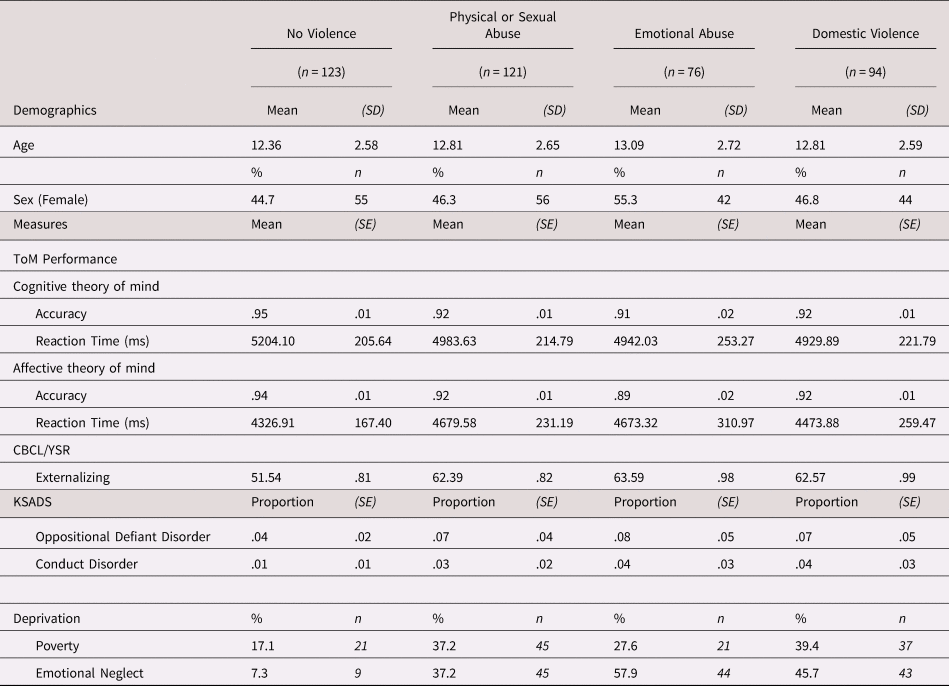
Distributions of demographic and deprivation information, means and standard error of age, theory of mind task performance, externalizing symptoms, and proportion and standard error of ODD and CD diagnoses by violence group

Procedure
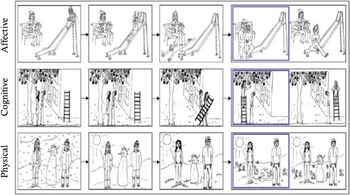
Children completed a task assessing both cognitive and affective components of theory of mind during the first study visit (Figure 1). This task has been used in prior research on theory of mind with older children and adolescents (Sebastian, Fontaine, et al., Reference Sebastian, McCrory, Cecil, Lockwood, De Brito, Fontaine and Viding2012). Stimuli were 30 cartoons depicting a story that appeared in three frames. Before each trial, an instruction screen with the text “What happens next?” appeared for 3 seconds. One cartoon then appeared in sequence, with each of the three frames displayed for 2 seconds before the next frame appeared (6 seconds total). Following presentation of the cartoon, two response options appeared and participants were asked to select the appropriate conclusion to the story depicted in the cartoon using a key press response. There was no time limit within which they had to make a response. The cartoons were divided into three conditions: cognitive theory of mind, affective theory of mind, and physical causality. Trials in the cognitive theory of mind condition required children to interpret the thoughts, beliefs, and intentions of the characters in the story, whereas trials in the affective theory of mind condition required children to interpret how one character was likely to respond emotionally to another character. In contrast, physical causality cartoons simply required children to understand cause and effect relationships (e.g., that sunshine will cause snow to melt) but did not require understanding of the mental states of other people. The physical causality condition is typically included as control condition for neuroimaging studies (Sebastian, Fontaine, et al., Reference Sebastian, McCrory, Cecil, Lockwood, De Brito, Fontaine and Viding2012) but is of no interest to the study questions examined here. These trials were included because we wanted to use a task that has been previously validated in the age range of our sample and it was unclear how removing these trials might alter performance on the conditions of interest. The order of cartoon presentation was randomized across participants. Cognitive and affective theory of mind accuracy scores reflect the proportion of correctly answered items within each respective condition. Reaction time scores were calculated by averaging the participants’ response times across items within each condition.
Theory of Mind Task. Cognitive and affective theory of mind were assessed using a task designed to be developmentally appropriate for children and adolescents (Sebastian, Fontaine, et al., Reference Sebastian, McCrory, Cecil, Lockwood, De Brito, Fontaine and Viding2012). Participants viewed cartoon stories and were asked to select the appropriate ending. Some trials require the ability to imagine another person's thoughts or beliefs (cognitive) and others require the ability to imagine another's feelings (affective). A control condition simply requires understanding of physical causal relationships (e.g., heat melts snow).

Measures
Maltreatment exposure
We used a multi-informant, multimethod approach for assessing exposure to child maltreatment. Children completed two interview measures with a trained member of our research team to assess child maltreatment experiences and exposure to interpersonal violence: the Childhood Experiences of Care and Abuse (CECA) Interview (Bifulco, Brown, & Harris, Reference Bifulco, Brown and Harris1994) and the Violence Exposure Scale for Children-Revised (VEX-R) (Raviv et al., Reference Raviv, Erel, Fox, Leavitt, Raviv, Dar and Greenbaum2001; Raviv, Raviv, Shimoni, Fox, & Leavitt, Reference Raviv, Raviv, Shimoni, Fox and Leavitt1999). The CECA assesses caregiving experiences, including physical and sexual abuse and emotional neglect. We modified the interview to ask parallel questions about witnessing domestic violence (i.e., directly observing violence directed at a caregiver). Inter-rater reliability for maltreatment reports is excellent, and validation studies suggest high agreement between siblings on maltreatment reports (Bifulco, Brown, Lillie, & Jarvis, Reference Bifulco, Brown, Lillie and Jarvis1997). The VEX-R assesses the frequency of exposure to different forms of violence. Children are presented with a cartoon and caption depicting a child of the same sex witnessing a type of violence (e.g., “Chris sees a person slap another person really hard.”) and experiencing that same type of violence (e.g., “A person slaps Chris really hard.”). Children are then asked to report how frequently they have witnessed or experienced that type of violence (e.g., “How many times have you seen a person slap another person really hard?” “How many times has a person slapped you really hard?”) on a Likert scale ranging from 0 (Never) to 3 (Lots of times). We added follow-up questions for each item that was endorsed to gather additional information (e.g., the perpetrator, age of onset). The VEX-R demonstrates good reliability, and it has been validated with children as young as second grade (Raviv, et al., Reference Raviv, Erel, Fox, Leavitt, Raviv, Dar and Greenbaum2001; Raviv, et al., Reference Raviv, Raviv, Shimoni, Fox and Leavitt1999).
Children also completed two self-report measures: the Childhood Trauma Questionnaire (CTQ) (Bernstein, Ahluvalia, Pogge, & Handelsman, Reference Bernstein, Ahluvalia, Pogge and Handelsman1997) and the UCLA PTSD Reaction Index (PTSD-RI) (Steinberg, Brymer, Decker, & Pynoos, Reference Steinberg, Brymer, Decker and Pynoos2004). The CTQ is a 28-item scale that assesses the frequency of maltreatment during childhood, including physical, sexual, and emotional abuse. Validated thresholds for exposure to physical, sexual, and emotional abuse (Walker et al., Reference Walker, Unutzer and Rutter1999) were applied here in evaluating abuse exposure based on the CTQ. The CTQ has excellent psychometric properties including internal consistency, test-retest reliability, and convergent and discriminant validity with interviews and clinician reports of maltreatment (Bernstein, et al., Reference Bernstein, Ahluvalia, Pogge and Handelsman1997; Bernstein, Fink, Hondelsman, Foote, & Lovejoy, Reference Bernstein, Fink, Handelsman, Foote, Lovejoy, Wenzel and Ruggiero1994). To adapt this measure for children under the age of 12, a trained experimenter read the items aloud to ensure that the child understood the questions and the responses. The PTSD-RI includes a trauma screen that assesses exposure to numerous traumatic events, including physical abuse, sexual abuse, and domestic violence, and this measure additionally assesses PTSD symptoms. The PTSD-RI has good internal consistency and convergent validity (Steinberg et al., Reference Steinberg, Brymer, Kim, Briggs, Ippen, Ostrowski and Pynoos2013).
Caregivers completed three self-report measures: the Conflict Tactics Scale-Parent Child Version (CTS) (Straus, Hamby, Finkelhor, Moore, & Runyan, Reference Straus, Hamby, Finkelhor, Moore and Runyan1998), the Juvenile Victimization Questionnaire (JVQ) lifetime caregiver report (Finkelhor, Hamby, Ormrod, & Turner, Reference Finkelhor, Hamby, Ormrod and Turner2005), and the caregiver version of the PTSD-RI. The CTS includes 22 items assessing caregiver responses to child disobedience or misbehavior in the past year. Caregivers indicate how frequently they have used each strategy (e.g., shook him/her) on a Likert scale ranging from 0 (This has never happened) to 6 (more than 20 times in the past year), and they can also indicate if they have used the strategy in the past but not in the last year. The CTS has adequate reliability and good discriminant and construct validity (Straus, et al., Reference Straus, Hamby, Finkelhor, Moore and Runyan1998). The JVQ includes 34 items assessing exposure to crime, child maltreatment, peer and sibling victimization, sexual victimization, and witnessing and indirect victimization, and it has excellent psychometric properties, including test-retest reliability and construct validity (Finkelhor, et al., Reference Finkelhor, Hamby, Ormrod and Turner2005). Caregivers endorsed whether their child had experienced each event in his/her lifetime. Caregivers also completed the trauma screen included in the PTSD-RI, described above. A trained interviewer followed up with caregivers who endorsed any form of abuse or domestic violence to gather additional information about the experience.
Children were classified as experiencing physical or sexual abuse if abuse was endorsed by the child (on the CECA interview, PTSD-RI trauma screen, or above the validated CTQ threshold) or parent (on the CTS, JVQ, or PTSD-RI trauma screen). A total of 121 children (49.2%) experienced physical or sexual abuse. Inter-rater reliability was good for child and caregiver reports (82.0% agreement; kappa = .62). Exposure to emotional abuse (on the CECA, or above the validated CTQ threshold) and domestic violence (on the VEX-R interview or PTSD-RI trauma screen) was determined based on child report only. A total of 76 children (30.9%) reported experiencing emotional abuse, and 94 (38.2%) reported witnessing domestic violence. For the children exposed to violence, we created a categorical variable to reflect whether they had experienced one, two, or all three kinds of violence. Among these children (n = 123), 42.3% (n = 52) were exposed to one type of violence, 19.6% (n = 28) were exposed to two types of violence, and 35.0% (n = 43) were exposed to all three types of violence. Finally, we used the total score on the VEX-R as a continuous variable to reflect the frequency of exposure to all forms of violence experienced by each child.
Externalizing psychopathology
During the first study visit, children and caregivers completed the Youth Self-Report (YSR) and Child Behavior Checklist (CBCL) (Achenbach, Reference Achenbach1991). The YSR/CBCL scales are among the most widely used measures of youth emotional and behavioral problems, and both use extensive normative data to generate age-standardized estimates of symptom severity. Although originally designed for youth 11 to 18 years of age, multiple studies have demonstrated the reliability and validity of the YSR among younger children (Ebesutani, Bernstein, Martinez, Chorpita, & Weisz, Reference Ebesutani, Bernstein, Martinez, Chorpita and Weisz2011; Kolko & Kazdin, Reference Kolko and Kazdin1993; Yeh & Weisz, Reference Yeh and Weisz2001). Self-reported psychopathology was assessed using the broad-band externalizing scale, comprised of rule-breaking behavior (e.g., “I don't feel guilty after doing something I shouldn't.”) and aggressive behavior (e.g., “I physically attack people.”) subscales. The externalizing scale has demonstrated validity in discriminating between youths with and without psychiatric disorders (Achenbach, Reference Achenbach1991; Chen, Faraone, Biederman, & Tsuang, Reference Chen, Faraone, Biederman and Tsuang1994; Seligman, Ollendick, Langley, & Baldacci, Reference Seligman, Ollendick, Langley and Baldacci2004). We used the highest T-score from the parent or child report for this measure.
Clinical interviews were completed with children and caregivers in the subsample (n = 168) who completed the second study visit. Specifically, we administered the Kiddie Schedule for Affective Disorders and Schizophrenia (KSADS—Present and Lifetime Version (Kaufman et al., Reference Kaufman, Birmaher, Brent, Rao, Flynn, Moreci and Ryan1997). Here, we focused on disruptive behavior disorders that are associated with aggressive behavior, including oppositional defiant disorder (ODD) and conduct disorder (CD). Oppositional defiant disorder was assessed only by caregiver report, and both children and caregivers reported on CD. Diagnostic thresholds were applied based on DSM-IV, as the DSM-5 version was not yet available when we began the study. Current CD and ODD diagnoses were included in this study. A total of 6 children (4%) met criteria for CD, and a total of 10 children met criteria for ODD (6%), consistent with population prevalence estimates of these disorders (Nock, Kazdin, Hiripi, & Kessler, Reference Nock, Kazdin, Hiripi and Kessler2007; NSCH, 2007; NSCH, 2012; Perou et al., Reference Perou, Bitsko, Blumberg, Pastor, Ghandour and Gfroerer2013). Clinical interviews were conducted by a licensed clinician, doctoral graduate student, or full-time study staff with extensive diagnostic and clinical training. Diagnoses were reviewed and confirmed by a licensed clinician who supervised all clinical interviewing procedures.
Deprivation
Caregivers provided information about total household income that was used to assess whether the family was living in poverty, a measure of material deprivation. The income-to-needs ratio was calculated by dividing total household income by the 2015 U.S. census-defined poverty line for a family of that size, with a value less than one indicating that a family was living below the poverty line. This ratio was used to create a dichotomous poverty variable indicating whether the participant met criteria for living in poverty. Emotional deprivation was assessed using an eight item self-report measure assessing the frequency of neglectful parenting behaviors that is embedded in the CECA interview (Bifulco, Bernazzani, Moran, & Jacobs, Reference Perou, Bitsko, Blumberg, Pastor, Ghandour and Gfroerer2005). This measure was completed separately in reference to neglectful behaviors on the part of each caregiver for children living with two caregivers. We elected to use this measure rather than the emotional neglect subscale of the CTQ because this measure more closely aligns with accepted definitions of neglect (Straus & Kantor, Reference Straus and Kantor2005) by assessing neglectful behaviors (e.g., “She would leave me unsupervised before the age of 10.”), unlike the CTQ, which focuses largely on appraisals (e.g., “My family was a source of strength and support.”). Participants who reported levels greater than predefined cutoff scores (Bifulco et al., Reference Perou, Bitsko, Blumberg, Pastor, Ghandour and Gfroerer2005) for either parent were classified as emotionally neglected.
Statistical analysis
We evaluated the role of theory of mind ability as a potential mechanism linking interpersonal violence exposure to externalizing psychopathology using several methods. First, we examined associations of violence exposure with externalizing psychopathology using univariate analysis of covariance (ANCOVA) for continuous symptom scores and logistic regression for diagnostic outcomes. We examined several forms of interpersonal violence: exposure to physical or sexual abuse, emotional abuse, and domestic violence, as well as a continuous variable reflecting the total frequency of violence exposure in the child's life. Next, we examined the associations of each of the three interpersonal violence variables with performance on the theory of mind task (i.e., cognitive and affective accuracy and reaction time) using ANCOVA for dichotomous exposure variables and linear regression for frequency of violence exposure. We additionally used multivariate analysis of covariance (MANCOVA) to test whether there were differences in cognitive and affective theory of mind accuracy and reaction time among children exposed to one, two, or three kinds of violence (the independent categorical variable). We then examined the associations of accuracy and reaction time on the theory of mind task with externalizing symptoms using linear regression and with diagnostic outcomes using logistic regression. Finally, we conducted a mediation analysis with SPSS software using the PROCESS test (Hayes, Reference Hayes2013), a standard bootstrapping approach that provides confidence intervals for indirect effects in statistical mediation estimated from 1000 resamples of the data (Preacher & Hayes, Reference Preacher and Hayes2008), to determine whether poor theory of mind performance mediated the association of violence exposure with externalizing psychopathology. The PROCESS test of mediation is particularly advantageous as it employs a bootstrapping method to address non-normal data distributions, accepts dichotomous dependent variables, and it is particularly suited to small sample sizes (Preacher & Hayes, Reference Preacher and Hayes2008). When zero is not included in the lower and upper endpoints of the bias-corrected bootstrap confidence interval provided by PROCESS, the indirect effect is interpreted as significant.
Following the analysis of our three main models, we conducted several hypothesis-driven sensitivity analyses. First, we examined whether other adversities unrelated to threat exposure—including poverty and child-reported emotional neglect—were associated with theory of mind performance and whether they were significant after controlling for violence exposure. When covarying violence exposure, we used a dichotomous variable indicating whether participants had experienced any physical abuse, sexual abuse, emotional abuse, or domestic violence. Second, we examined whether associations between violence and accuracy and reaction time during cognitive and affective theory of mind remained significant after controlling for these other forms of adversity.
We also conducted several exploratory analyses. Given the wide age range of the sample and age differences in theory of mind across development (Sebastian, Fontaine, et al., Reference Sebastian, McCrory, Cecil, Lockwood, De Brito, Fontaine and Viding2012), we examined the effects of age on theory of mind performance. We also evaluated (a) whether the associations of violence exposure with theory of mind varied by age by creating interaction terms between the age and violence exposure variables and (b) whether the associations of theory of mind with psychopathology varied by age by creating interaction terms between age and theory of mind performance. We used linear regression to test whether the interaction terms predicted outcome measures (i.e., theory of mind and externalizing psychopathology, respectively) using standard methods (Hayes & Matthes, Reference Hayes and Matthes2009).
In all models predictors were mean-centered to ensure that effects were always within the range of the data and to reduce multicollinearity (Hayes, Glynn, & Huge, Reference Hayes, Glynn and Huge2012). Age and sex were controlled for in all models, given established age and sex-related differences in both violence exposure and externalizing psychopathology. All analyses were conducted using SPSS software Version 19.
Results
Descriptive statistics
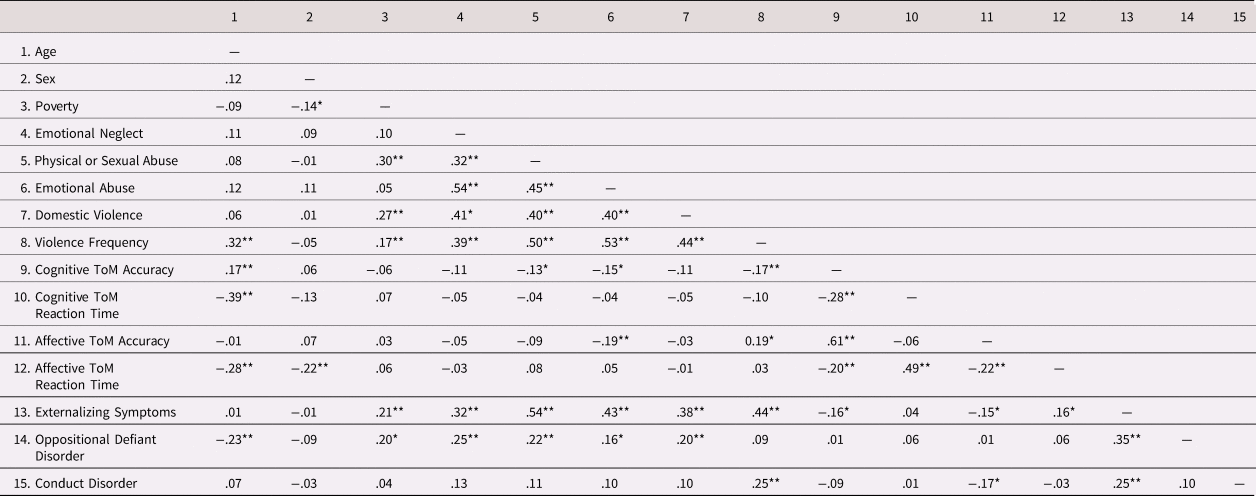
Table 1 provides the means and standard deviations of all measures separately by group. Table 2 provides the zero-order correlations among all measures of violence exposure, other adversities, covariates, cognitive and affective theory of mind, and externalizing psychopathology.
Correlations of violence exposure, theory of mind task performance, and externalizing symptoms and diagnosesa

a Bivariate Pearson correlations estimated using two-tailed significance tests.
* p ≤ .05.
** p ≤ .01.
Interpersonal violence exposure and externalizing psychopathology
We observed strong and consistent associations between exposure to violence and externalizing psychopathology. Physical and sexual abuse, emotional abuse, domestic violence exposure, and the frequency of violence exposure were all strongly associated with our continuous measure of externalizing problems (r = .38–.54, all p < .001; see Table 2). Exposure to violence was also associated with externalizing disorder diagnoses, particularly ODD. Specifically, physical and sexual abuse (odds ratio [OR] = 12.18, p = .021), emotional abuse (OR = 4.33, p = .039), and domestic violence (OR = 5.31, p = .024) were each associated with an elevated probability of ODD (see Table 2). None of these exposures were associated with conduct disorder. Frequency of violence exposure, however, was significantly associated with both ODD (OR = 1.09, p = .018) and conduct disorder (OR = 1.08, p = .028), such that each additional point on the violence exposure total score was associated with an 8% and 9% increase in the likelihood of ODD and conduct disorder symptoms, respectively.
Interpersonal violence exposure and theory of mind
Cognitive theory of mind
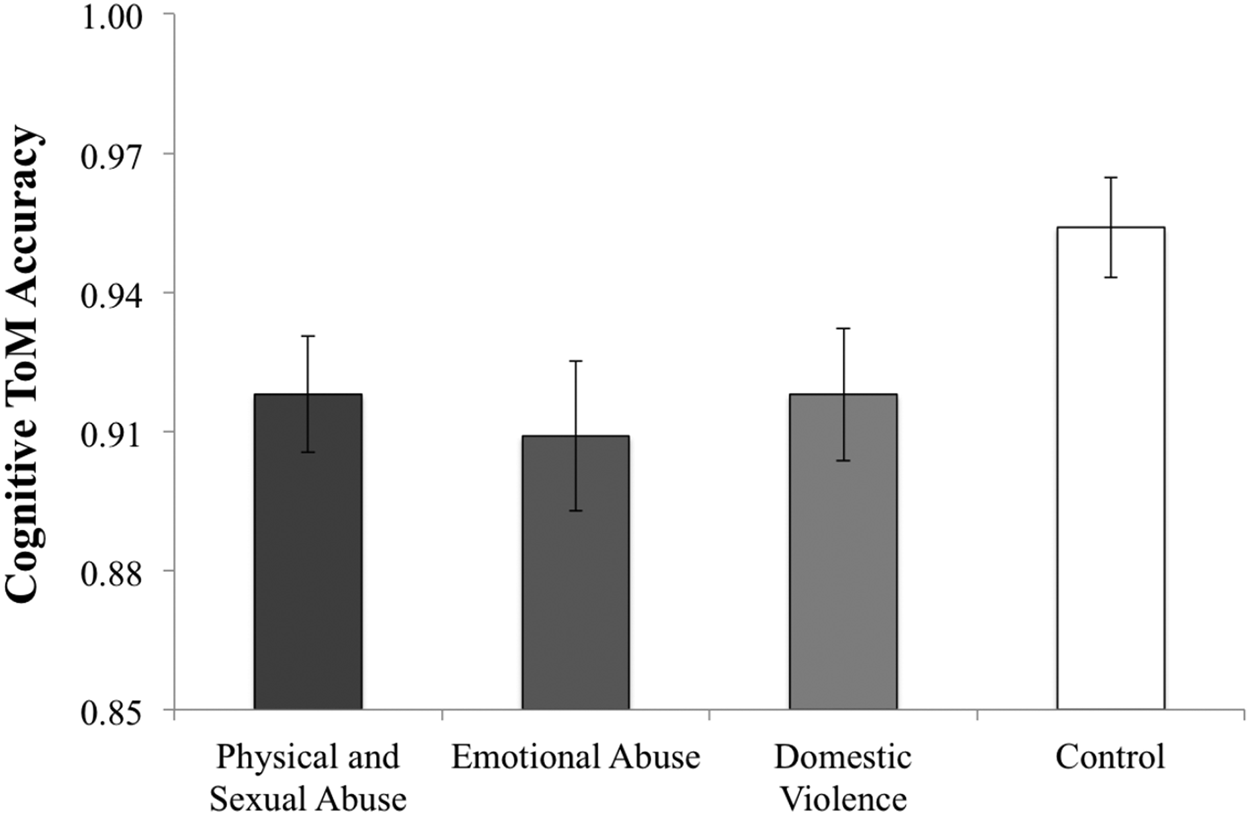
Although performance was generally high on the cognitive theory of mind task, violence was associated with task accuracy across multiple forms of exposure (Figure 2). Specifically, accuracy on cognitive theory of mind was lower among children who experienced physical or sexual abuse, F (1, 245) = 5.38, p = .021, and emotional abuse, F (1, 245) = 7.71, p = .006, than among children who never experienced each form of violence (Table 1). The frequency of exposure to violence was also associated with worse performance on cognitive theory of mind, β = −0.24, p < .001. Exposure to domestic violence and exposure to more than one type of violence were not significantly associated with cognitive theory of mind accuracy. Violence exposure was not significantly associated with reaction time during cognitive theory of mind.
Mean cognitive theory of mind accuracy by type of violence exposure. Note: Children were not classified into distinct groups, therefore some overlap exists among children represented by each of the violence bars.

Affective theory of mind
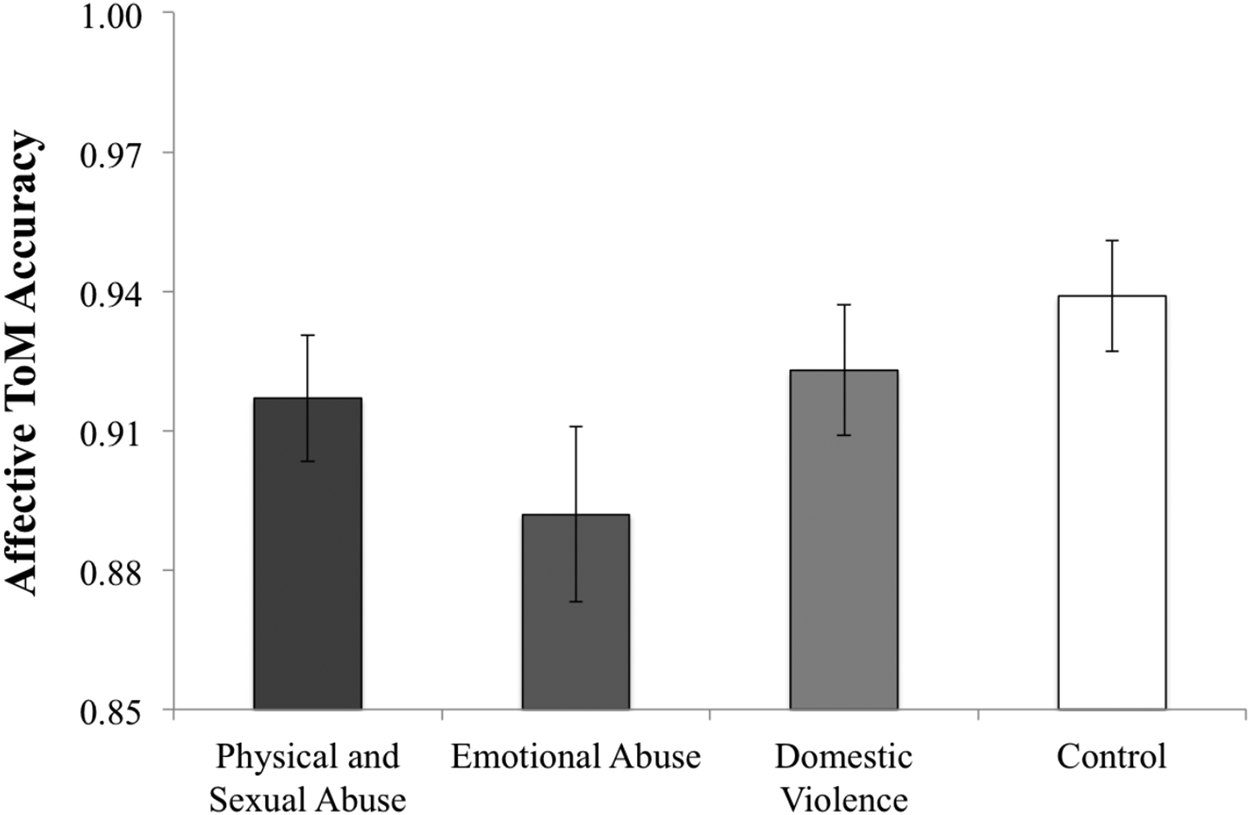
Accuracy was also relatively high on the affective theory of mind task. Despite generally good performance across the entire sample, differences in affective theory of mind accuracy emerged as a function of violence exposure (Figure 3). In particular, children who experienced emotional abuse performed significantly worse on affective theory of mind than children who had never experienced that form of interpersonal violence, F (1, 245) = 9.84, p = .002, (Table 1). There was also a significant main effect of exposure to more than one kind of violence on affective theory of mind accuracy, F (1, 123) = 4.93, p = .009, such that children exposed to two (mean(SD) = 0.87(0.19)) and three (mean(SD) = 0.90(0.16)) types of violence were significantly less accurate at affective theory of mind than children exposed to only one type of violence (mean(SD) = 0.96(0.07)). We re-ran our analysis of the association between emotional abuse and affective theory of mind accuracy while covarying exposure to physical or sexual abuse and domestic violence. The association remained significant, F (1, 245) = 8.39, p = .004, suggesting that it is not driven by exposure to other kinds of violence. We also observed an association between frequency of violence exposure and accuracy on affective theory of mind, β = -0.20, p = .003, such that greater exposure frequency was associated with worse performance. Neither physical and sexual abuse nor domestic violence was associated with affective theory of mind accuracy. Violence exposure was not significantly associated with reaction time during affective theory of mind.
Mean affective theory of mind accuracy by type of violence exposure. Note: Children were not classified into distinct groups, therefore some overlap exists among children represented by each of the violence bars.

Theory of mind and externalizing psychopathology
Cognitive theory of mind
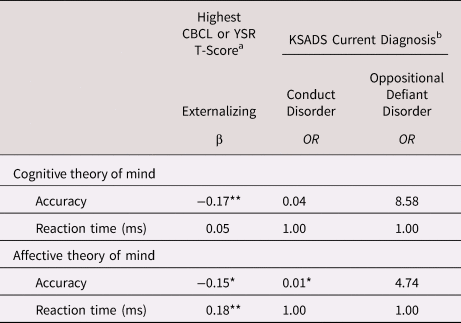
Lower accuracy and slower reaction time during cognitive theory of mind were each associated with externalizing problems, though not with diagnoses of ODD or conduct disorder (Table 3).
Cognitive and affective theory of mind task performance and externalizing problems

a Linear regressions controlling for age and sex.
b Logistic regressions controlling for age and sex.
*p ≤ .05. **p ≤ .01.
Affective theory of mind
Lower accuracy during affective theory of mind was significantly associated with higher levels of externalizing problems and greater odds of meeting criteria for conduct disorder (Table 3). Reaction time during affective theory of mind was significantly associated with higher levels of externalizing behavior but not with diagnoses of ODD or conduct disorder (Table 3).
Indirect Effects
We tested indirect effects using a multiple mediator approach. Specifically, we examined performance on cognitive and affective theory of mind simultaneously as mediators of the associations between violence exposure and externalizing psychopathology. We only included mediators that were associated with violence exposure in each model. We examined a total of three indirect effects models: (a) the indirect effects of physical and sexual abuse on externalizing symptoms through cognitive theory of mind accuracy, (b) the indirect effect of emotional abuse on externalizing symptoms through cognitive and affective theory of mind accuracy, and (c) the indirect effect of frequency of violence exposure on externalizing symptoms through cognitive and affective theory of mind accuracy. We did not include a domestic violence model as no association was observed between domestic violence and cognitive and affective theory of mind performance. Although exposure to violence occurred at an earlier point in development than our theory of mind assessment, because theory of mind and externalizing psychopathology are measured at only one time point, caution is warranted in interpretation of these mediation results as providing evidence for theory of mind as a mechanism linking violence exposure and externalizing problems (Maxwell & Cole, Reference Maxwell and Cole2007).
In our first model, we found a significant indirect effect of physical and sexual abuse on externalizing problems through cognitive theory of mind performance (95% CI [0.051, 1.084). The indirect effects of emotional abuse and frequency of violence exposure on externalizing problems through cognitive and affective theory of mind performance did not reach statistical significance. These findings suggest that relative reductions in the ability to understand the thoughts and intentions of others is a potential mechanism linking physical and sexual abuse with externalizing problems in children and adolescents.
Sensitivity analyses
Deprivation-related adversities and theory of mind
Poverty
Poverty was not significantly associated with reaction time or accuracy during cognitive or affective theory of mind, either in bivariate analysis or when controlling for violence exposure.
Emotional neglect
Emotional neglect was not significantly associated with reaction time during cognitive theory of mind or with accuracy or reaction time during affective theory of mind. Children who reported being emotionally neglected were less accurate at cognitive theory of mind than children who had never experienced emotional neglect, F (1, 245) = 4.50, p = .040. This association was no longer significant when controlling for violence exposure. Associations between emotional neglect and cognitive theory of mind reaction time and affective theory of mind reaction time and accuracy were also not significant when controlling for violence exposure measured dichotomously. To ensure sensitivity of these analyses, we reran them controlling for all four primary violence exposure variables together and in four separate models and still found no significant associations.
Interpersonal violence and theory of mind—controlling for emotional neglect and poverty
To determine whether violence exposure was associated with theory of mind over and above the effects of other co-occurring forms of adversity reflecting deprivation, we conducted two sets of sensitivity analyses. In the first, we adjusted for poverty, which is well established to be associated not only with increased risk for violence exposure but also deprivation in material, emotional, and cognitive domains (see McLaughlin, Sheridan, & Lambert, Reference McLaughlin, Sheridan and Lambert2014; Sheridan & McLaughlin, Reference McLaughlin, Sheridan and Lambert2014; Reference McLaughlin2016 for reviews). A total of 17 participants declined to provide information on family income, which reduced our sample size for these analyses. Adjusting for poverty had no effect on the associations of violence exposure with cognitive and affective theory of mind performance. All associations that were significant without inclusion of poverty as a covariate remained statistically significant (see Supplemental Table 1).
We additionally completed a more stringent sensitivity analysis adjusting for exposure to emotional neglect, which is a more extreme form of deprivation. Notably, after adjustment for exposure to emotional neglect, violence exposure continued to be associated with both cognitive and affective theory of mind performance. The only meaningful differences were that the association of physical and sexual abuse with cognitive theory of mind accuracy was reduced to trend-level significance, and domestic violence was no longer associated with cognitive theory of mind accuracy. All other associations were unchanged (see Supplemental Table 1).
Exploratory analyses
Variation by age
Age was associated with higher theory of mind accuracy, β = 0.17, p = .009, and faster reaction times, β = −0.38, p < .001, during the cognitive condition of the task. Age was also associated with faster affective theory of mind reaction times, β = −0.26, p < .001. Interactions between age and violence were added to regression models examining the associations between violence and theory of mind performance. None of these interactions were statistically significant (Supplemental Table 2). Age was also associated greater likelihood of being diagnosed with oppositional defiant disorder (OR = 5.31, p = .024). Interactions between age and theory of mind performance were added to each of the models examining theory of mind performance and externalizing psychopathology to determine whether associations varied by age. In no cases did these interactions reach statistical significance (Supplemental Table 3).
Discussion
Prior research has documented that interpersonal violence exposure in childhood is a powerful predictor of externalizing problems across the lifespan (Bingenheimer, Reference Bingenheimer2005; Dodge et al., Reference Dodge, Bates and Pettit1990; McCloskey & Lichter, Reference McCloskey and Lichter2003; Widom, Reference Widom1989). Although deficits in social information processing have been demonstrated to be a core mechanism in this association (e.g., Dodge et al., Reference Dodge, Bates and Pettit1990; Reference Dodge, Pettit, Bates and Valente1995), few studies have investigated forms of social cognition related to social information processing deficits, such as theory of mind. Furthermore, prior research examining social cognitive abilities following adversity has largely ignored whether associations are due specifically to violence exposure versus other forms of adversity, such as emotional neglect and poverty, with notable exceptions (Cicchetti et al., Reference Cicchetti, Rogosch, Maughan, Toth and Bruce2003). The current study addressed these gaps in the literature by examining whether interpersonal violence influences cognitive and affective theory of mind in ways that may ultimately contribute to externalizing behavior in a community-based sample of children and adolescents with a high concentration of exposure to interpersonal violence. Although it is not possible to establish that alterations in theory of mind are preceded and driven by violence exposure rather than inherited traits in a cross-sectional study, our findings contribute to accumulating evidence that theory of mind development is strongly affected by nonheritable environmental factors (Cutting & Dunn, Reference Cutting and Dunn1999; Hughes et al., Reference Hughes, Jaffee, Happé, Taylor, Caspi and Moffitt2005). First, we found that exposure to interpersonal violence was associated with altered theory of mind performance, including greater difficulty understanding thoughts, beliefs, and intentions of others (i.e., cognitive theory of mind) as well as lower accuracy when predicting emotional states of others (i.e., affective theory of mind) in a variety of social situations. Second, difficulty across these domains was associated with externalizing psychopathology. Finally, worse performance on cognitive and affective theory of mind mediated the association between many measures of violence exposure with externalizing psychopathology. Importantly, this pattern of results was nearly identical after controlling for co-occurring forms of adversity reflecting material and emotional deprivation. Taken together, these findings suggest that atypical theory of mind development may be an additional social cognitive mechanism that contributes to risk for externalizing problems among children who have experienced interpersonal violence.
Consistent with our hypotheses and a great deal of prior research (e.g., Bingenheimer, Reference Bingenheimer2005; Cicchetti & Toth, Reference Cicchetti and Toth2005; McLaughlin et al., Reference McLaughlin, Green, Gruber, Sampson, Zaslavsky and Kessler2012), we found strong associations of interpersonal violence exposure with externalizing problems in children and adolescents. More covert, nonviolent forms of rule-breaking behaviors are quite common among children exposed to violence (Miller, Wasserman, Neugebauer, Gorman-Smith, & Kamboukos, Reference Miller, Wasserman, Neugebauer, Gorman-Smith and Kamboukos1999; Mrug & Windle, Reference Mrug and Windle2010). Although it may be adaptive to distrust the demands of authority figures following prior experiences with dangerous individuals, oppositional behavior is likely to arouse frustration and rejection in otherwise safe school and home environments. Higher engagement in aggressive behavior also likely reflects a developmental adaptation to a dangerous environment. For children growing up in environments characterized by threat, reacting with aggression may be a strategy intended to promote safety. However, a tendency to engage in these behaviors is particularly problematic for a number of reasons. First, and most obvious, adolescent aggressive behavior is associated with a wide range of negative interpersonal, educational, legal, and health outcomes (Huesmann, Dubow, & Boxer, Reference Huesmann, Dubow and Boxer2009; Kokko & Pulkkinen, Reference Kokko and Pulkkinen2000). Second, a tendency to behave aggressively is likely to provoke a similar response in others. Indeed, bidirectional relationships have been observed between children's aggressive behavior and both peer victimization and harsh parenting (Anderson, Lytton, & Romney, Reference Anderson, Lytton and Romney1986; Brunk & Henggeler, Reference Brunk and Henggeler1984; Reijntjes et al., Reference Reijntjes, Kamphuis, Prinzie, Boelen, van der Schoot and Telch2011). As a result, children who develop externalizing behaviors create more opportunities for revictimization, a well-established finding among youths who have experienced violence (Classen, Palesh, & Aggarwal, Reference Classen, Palesh and Aggarwal2005; Desai, Arias, Thompson, & Basile, Reference Desai, Arias, Thompson and Basile2002; Hosser, Raddatz, & Windzio, Reference Hosser, Raddatz and Windzio2007). This is particularly concerning because the risk for virtually all forms of psychopathology, including externalizing psychopathology, increases with each traumatic experience (Copeland, Keeler, Angold, & Costello, Reference Copeland, Keeler, Angold and Costello2007; McLaughlin et al., Reference McLaughlin, Green, Gruber, Sampson, Zaslavsky and Kessler2012). Thus, while aggressive and rule-breaking responses may emerge in order to promote safety in the short-term they have many deleterious long-term outcomes. Identifying the mechanisms through which interpersonal violence may alter how children interact with their social environment in ways that increase risk for externalizing problems is of critical importance. Here, we provide evidence that a fundamental social cognitive ability—theory of mind—may play a meaningful role in these associations.
Children in our sample who experienced many forms of interpersonal violence demonstrated difficulty with the cognitive component of theory of mind, which involves understanding others’ thoughts, beliefs, and intentions. This finding is in line with a growing body of research that has largely been conducted on younger samples of children (Barahal et al., Reference Barahal, Waterman and Martin1981; Burack et al., Reference Burack, Flanagan, Peled, Sutton, Zygmuntowicz and Manly2006; Cicchetti et al., Reference Cicchetti, Rogosch, Maughan, Toth and Bruce2003; O'Reilly & Peterson, Reference O'Reilly and Peterson2015; Pears & Fisher, Reference Pears and Fisher2005). We extend this prior research by demonstrating that violence produces an atypical pattern of cognitive theory of mind well into adolescence. While all forms of violence exposure were unassociated with reaction time during cognitive theory of mind, physical and sexual abuse was associated with lower accuracy when identifying other peoples’ thoughts and intentions across different contexts. Moreover, the overall frequency of violence exposure was strongly associated with cognitive theory of mind performance, suggesting that children who experience more frequent interpersonal violence are particularly likely to have difficulty with cognitive theory of mind. These associations remained consistent for most forms of violence exposure even after accounting for deprivation-related adversities, including poverty and emotional neglect. Although emotional neglect was associated with cognitive theory of mind, this association was no longer significant after adjusting for exposure to violence. These findings suggest that difficulties with cognitive theory of mind are largely driven by exposure to threatening early environments rather than by experiences of poverty and emotional neglect. What might explain this pattern? One possibility is that children exposed to more chronic violence become hypersensitive to potential cues of hostile intentions, a positive adaptation that facilitates the quick decision making necessary for escaping from or responding to dangerous individuals (Dodge et al., Reference Dodge, Bates and Pettit1990; Pollak & Kistler, Reference Pollak and Kistler2002). Although advantageous in dangerous circumstances, the tendency to assume that others are harboring malevolent thoughts and plans may undermine children's ability to learn antecedents to neutral and prosocial behaviors. As a result, these children can fail to accurately predict other peoples’ thoughts and intentions in a variety of safe contexts. Indeed, extensive evidence suggests that children exposed to violence exhibit these types of hostile attribution biases (Dodge et al., Reference Dodge, Bates and Pettit1990; Reference Dodge, Pettit, Bates and Valente1995; Weiss et al., Reference Weiss, Dodge, Bates and Pettit1992). Another possibility is that children who experience violence have less experience with perspective taking. Caregivers who engage in abusive and violent behaviors frequently model inappropriate emotional and behavioral responses, and children raised in these environments likely have few opportunities to observe adaptive perspective taking. A growing body of research also suggests that parents of children raised in neighborhoods with higher rates of violence exposure are more likely to limit their children's social activities in order to limit exposure to more violence (Garbarino, Kostelny, & Dubrow, Reference Garbarino, Kostelny and Dubrow1991; Letiecq & Koblinsky, Reference Letiecq and Koblinsky2004). This parenting practice is protective in dangerous areas, yet it may inadvertently restrict exposure to a wide range of interpersonal peer and adult interactions that could stimulate theory of mind development.
In addition to difficulties with cognitive theory of mind, we found that children who have experienced violence also performed more poorly at affective theory of mind, which required them to understand how another person might feel in a specific context. This pattern of poor performance during affective theory of mind was specific to threat-related adversity (i.e., violence exposure), was unrelated to poverty and emotional neglect, and remained similar with respect to associations with violence even after controlling for these deprivation-related adversities. Moreover, emotional abuse and the total frequency of violence exposure were the adversities that had the strongest associations with affective theory of mind. How might interpersonal violence, and emotional abuse in particular, alter affective theory of mind? Violence typically reflects an emotional reaction that is inappropriate to the situation at hand. Over time, repeated encounters with extreme negative emotion and difficulty controlling behavioral responses to those emotions may alter children's views about the situations that trigger negative emotions, the intensity of these emotions, and appropriate corresponding behavior. As a result, we would expect that children who have routinely experienced violence would have more difficulty with affective theory of mind. Here, we found that poor performance on affective theory of mind in children was associated with greater frequency of violence exposure. These findings extend those of a prior study showing that young children who were bullied had more difficulty identifying relevant contextual causes of emotions (Belacchi & Farina, Reference Belacchi and Farina2010). Children who experienced emotional abuse also had particular difficulty with the affective theory of mind task. Because emotional abuse involves subjecting children to threats of violence and emotional cruelty, it is unsurprising that this form of maltreatment may limit a child's ability to understand and predict a broader range of prosocial emotions in others.
Our second goal was to examine whether atypical performance across cognitive and affective theory of mind accounted for greater levels of externalizing behavior and conduct problems in children. Although children and adolescents with high levels of externalizing problems performed just as quickly as children who were not aggressive when considering the thoughts, intentions, and beliefs of others, they were less accurate at cognitive theory of mind. This finding builds upon prior research linking difficulties in cognitive theory of mind with aggression in younger children (Cicchetti et al., Reference Cicchetti, Rogosch, Maughan, Toth and Bruce2003; O'Reilly & Peterson, Reference O'Reilly and Peterson2015; Pears & Fisher, Reference Pears and Fisher2005) by demonstrating that this association persists well into adolescence. Consistent with expectations, we also found that lower accuracy predicting how others might be feeling across a variety of social situations was associated with greater levels of externalizing problems and higher likelihood of receiving a conduct disorder diagnosis. Slower reaction times during affective theory of mind were also associated with greater levels of externalizing behavior. These findings extend the literature by highlighting the potential importance of difficulties with the affective dimension of theory of mind for children with a variety of externalizing psychopathology symptoms, a topic that has been studied infrequently. Our finding is consistent with the limited existing evidence that children and adolescents with conduct problems exhibit problems not only with cognitive but also affective forms of theory of mind (Hughes, Dunn, & White, Reference Hughes, Dunn and White1998). This pattern is also broadly consistent with the well-documented difficulties with social information processing observed among children with externalizing problems (Dodge et al., Reference Dodge, Bates and Pettit1990), which often emerge in situations where the intentions and emotions of others are ambiguous or unclear. Anticipation of negative interpersonal consequences, specifically the victim's immediate negative emotions and the resulting negative judgment from peers and adults, provides a strong rationale for inhibiting rule breaking and aggression. Failure to anticipate these consequences may contribute to externalizing behavior in adolescents with theory of mind deficits. However, not all youth with impairments in perspective taking behave aggressively. For example, a sizable proportion of children and adolescents with autism spectrum disorders are not aggressive (Kanne & Mazurek, Reference Kanne and Mazurek2011). The specific pattern of cognitive difficulties characterized by difficulty understanding the intentions and feelings of others paired with a tendency to assume hostile emotions and intentions in ambiguous social situations (i.e., hostile attribution bias; Dodge et al., Reference Dodge, Bates and Pettit1990; Molano, Jones, Brown, & Aber, Reference Molano, Jones, Brown and Aber2013; Pornari & Wood, Reference Pornari and Wood2010) may differentiate children whose difficulties with theory of mind contribute to risk for aggressive behavior from those who do not become aggressive. As a result of their inaccurate predictions of others’ thoughts and feelings, these children may also need more time to consider why people are feeling contrary to their expectations in any given situation.
Our findings suggest that alterations in cognitive and affective theory of mind represent a plausible mechanism that may contribute to risk for externalizing problems among children who have experienced violence. It is possible that difficulties with cognitive and affective theory of mind may contribute to the well-established social information processing biases that have previously been identified as a mechanism in the cycle of violence (Dodge et al., Reference Dodge, Bates and Pettit1990; Reference Dodge, Pettit, Bates and Valente1995). Moreover, our indirect effects models indicate that difficulty accurately predicting others’ intentions and emotions might represent a vulnerability factor for a broader range of externalizing behaviors that emerge specifically after exposure to forms of early adversity that involve a high degree of threat (i.e., violence exposure) but not following exposure to material and emotional deprivation. For children who experience violence, the most critical time to accurately evaluate other people's mental states occurs when there is a possibility that someone is hostile or threatening. Developing hypersensitivity to cues that someone may be angry or hostile is a positive adaptation to living in dangerous environments, alerting children to seek safety either by escaping or responding aggressively for self-protection. Attunement to what other people are thinking or feeling during more routine interactions may be far less important for adapting to an environment characterized by threat. Indeed a small number of studies indicate that children exposed to interpersonal violence exhibit impairments in social cognition and emotion perception characterized by high sensitivity to hostility in others yet insensitivity to other types of emotions and cognitions (Barahal et al., Reference Barahal, Waterman and Martin1981; Bowen & Nowicki, Reference Bowen and Nowicki2007; Cicchetti et al., Reference Cicchetti, Rogosch, Maughan, Toth and Bruce2003; Elbedour, Baker, & Charlesworth, Reference Elbedour, Baker and Charlesworth1997; Pollak et al., Reference Pollak, Cicchetti, Hornung and Reed2000; Pollak & Kistler, Reference Pollak and Kistler2002; Pollak & Sinha, Reference Pollak and Sinha2002; Pollak & Tolley-Schell, Reference Pollak and Tolley-Schell2003; Shackman & Pollak, Reference Shackman and Pollak2005; Smetana, Kelly, & Twentyman, Reference Smetana, Kelly and Twentyman1984). Together with our findings, these patterns suggest that hypersensitivity to threat and hostility in others comes at the expense of understanding the full range of intentions, beliefs, and emotions that other people experience among children who have experienced violence. Although this pattern of social information processing may promote safety in dangerous environments, it also appears to confer risk for externalizing problems.
Our findings should be interpreted with caution given the following limitations. First, these data are cross-sectional, which precludes us from examining deficits in theory of mind and changes in externalizing and conduct problems over time or making strong conclusions about the role of theory of mind as a mechanism in the cycle of violence. For this reason, we interpret the results of the indirect effects models with caution. An important next step will be to replicate these findings in longitudinal studies, which we intend to do once the longitudinal portion of this study is complete. Second, children and adolescents may have been motivated to under-report their own aggressive behavior (e.g., Cantwell, Lewinsohn, Rohde, & Seeley, Reference Cantwell, Lewinsohn, Rohde and Seeley1997). However, this limitation was addressed by including parent reports of aggression and externalizing symptoms and parent diagnostic interview data. Third, the theory of mind task was originally designed for use in a neuroimaging study (Sebastian, Fontaine, et al., Reference Sebastian, McCrory, Cecil, Lockwood, De Brito, Fontaine and Viding2012), where constrained variability in task accuracy is advantageous, to ensure neural processes are specific to the cognitive processes of interest. Indeed, our sample generally performed near ceiling on this task, suggesting it may not be capturing the more complex social situations requiring perspective taking that are relevant for older children and adolescents. At the same time, poor performance on this task likely reflects particularly severe impairment in theory of mind, suggesting that our findings are robust even when using conservative measures of theory of mind. It will be important for future research to develop assessments that are sensitive to a broader range of theory of mind abilities, in particular affective theory of mind. Fourth, we relied on child and parent report of maltreatment rather than substantiated records provided by Child Protective Services. While it is possible that some families may have withheld abuse histories from study investigators, prior research has demonstrated that reliance on CPS records results in significant underclassification of maltreatment exposure (Widom, Weiler, & Cottler, Reference Widom, Weiler and Cottler1999). Finally, because we did not include a measure of physical neglect in our sensitivity analyses, we cannot conclude that violence exposure has greater effects on theory of mind than all forms of deprivation.
We provide novel evidence for the potential role of difficulties with cognitive and affective theory of mind in the cycle of violence. Children exposed to a many forms of interpersonal violence demonstrated greater difficulty in predicting other people's thoughts, intentions, and beliefs, and they were less accurate at identifying others’ emotions across a variety of contexts. This pattern of poor theory of mind ability appears to be specific to adverse environments characterized by danger, as other forms of adversity characterized by emotional and material deprivation—including poverty and emotional neglect—were unassociated with theory of mind after accounting for violence exposure. The same pattern of difficulties with cognitive and affective theory of mind observed among children exposed to violence was associated with externalizing problems. These findings suggest that preventive interventions that target perspective taking may be useful for preventing the development of externalizing behavior among children who have experienced violence. It may also be useful to consider supplementing evidence-based trauma treatments (e.g., trauma-focused cognitive behavioral therapy; see Dorsey et al., Reference Dorsey, McLaughlin, Kerns, Harrison, Lambert, Briggs and Amaya-Jackson2017 for a review) with modules that specifically target these social-cognitive abilities. Future longitudinal research is needed to further disentangle the ways in which violence exposure in childhood alters the development of social cognitive processes in ways that increase risk of aggression. Identifying these mechanisms is critical for breaking the cycle of violence.
Supplementary material
The supplementary material for this article can be found at https://doi.org/10.1017/S0954579419000725.
Funding Statement
This research was supported by a Doris Duke Fellowship for the Promotion of Child Wellbeing to Charlotte Heleniak, and by grants from the National Institute of Mental Health to Charlotte Heleniak (F31-MH108245) and to Katie McLaughlin (R01-MH103291).