Introduction
The Russo-Japanese war of 1904–1905 was the first major conflict of the twentieth century. The hostilities attracted much attention since reporting of the various actions was more detailed than for any previous conflict. The prime cause of the war was rivalry between the two powers concerning rights to exploit the resources of Korea and Manchuria, neither of which were possessions of either. There had been diplomatic hostilities between the two before actual warfare started. But a more proximal cause arose from the Sino-Japanese war of 1893–1894 as a result of which the Japanese had acquired the peninsula protruding into the Yellow Sea on which was the excellent harbour of Port Arthur. The western powers, France, Germany and Russia, issued an ultimatum, described as ‘advice’ although there is no reason to believe that the Japanese were deceived regarding its true nature, that they withdraw from the area whereupon, to add insult to injury, it was taken over by the Russians who had long coveted it as a ‘warm’ water naval base. Their other base in the far east, Vladivostok, was subject to freezing for at least three months of the year. The Japanese realised that they could not defy such a group of powers and appreciated that what they needed for the future was an ally. This they acquired in the form of the United Kingdom, with which they signed a treaty on 30 January 1902 providing that in the event of war concerning one of the contracting parties, the other would intervene if a second power became involved on the other side. Thus provided with such a guarantee Japan was able to adopt a more forward policy concerning Russian incursions into territories close to themselves (Warner and Warner Reference Warner and Warner2002).
The war started on 9 February 1904 with a surprise attack by the Japanese upon the now developed Russian naval base at Port Arthur at which was based the Pacific squadron of the Russian navy. This was before declaration of war but after the withdrawal of the Japanese ambassador from St. Petersburg. The British press, which was supportive of its ally throughout the war, necessitating circumspection when using British sources, hailed this as a coup but it failed to disable any significant proportion of the Russian fleet. An example of British bias is afforded by a very substantial and, it must be said, useful and attractive compilation of the reports of the military correspondent of The Times that, eschewing impartiality, he dedicated to none other than the Emperor of Japan (Military Correspondent of The Times 1905).
From then on successful but very hard fought and costly Japanese naval and ground operations effectively removed the Russians from Port Arthur, which fell after a long siege on 1 January 1905 (Warner and Warner Reference Warner and Warner2002: 427–440). The Japanese army also advanced northwards along the railway line leading into Manchuria. By autumn 1905 they had defeated the Russians in several major engagements but had never succeeded in achieving a crushing victory as was Cannae in 216 BC or Sedan in 1870. But the trans-Siberian railway was now fully functioning and the Russians were being reinforced daily while the Japanese losses had been very large and such that significant reinforcement was not possible from the manpower available in the homeland. There was unrest in Russia and it was suspected that this might result in a full scale insurrection. So both sides were ready for peace and both accepted, in July 1905, the offer of a peace conference in Portsmouth, New Hampshire, from Theodore Roosevelt, President of the United States.
However it is important to note that by this time, despite one minor incursion, described below, no Russian territory per se had actually been occupied, even temporarily, by the Japanese, and this was perceived by them as a weakening of their posture at a peace conference. In order to strengthen this they now proceeded to resolve matters by a major invasion of the sub-Arctic island of Sakhalin.
So far as is known to the writer there has been no comment on these operations in any Arctic journal and almost none elsewhere. Research on the matter presents considerable difficulties but it is hoped that this brief account based upon western sources and on translations of Russian and Japanese publications will be of interest to readers touching, as it does, on almost unknown aspects of sub-Arctic history. But before proceeding to Sakhalin, we must address a very curious incident indeed.
The Japanese in Kamchatka 1904
Japanese rule over the Kuril Islands had been confirmed in the Treaty of St Petersburg with Russia in 1875 (Stephan Reference Stephan1974: 237–238; Lensen Reference Lensen1959: 501–504) and from then on they made various efforts to colonise the islands. One of these consisted in the establishment of settlements on the islands of Shumshu and Shiaskotan at the northern end of the chain led by Gunji Shigetada, a patriotic reserve naval lieutenant. An early associate of his was Shirase Nobu who remained there for a fraught winter and who later led the first Japanese expedition to the Antarctic (Headland Reference Headland2009: 253). By 1904, despite various disasters and loss of life, largely due to the severity of the northern Kuril climate, Gunji's settlement on Shumshu was moderately well established. The main economic activity was fishing. The initial 60 colonists who had settled there in 1896 had increased and were reinforced in the summer by some 2500 seasonal workers and the island had a cannery, some stout buildings, and a school.
But when news of the start of the war reached this outpost, with the southern tip of Russian Kamchatka in full view from the Shumshu settlement, it was intolerable to a patriotic Japanese, as Gunji certainly was, that nothing should be done to damage the enemy. So he arranged an impromptu invasion of the Russian empire using the fishing boats available to him with some hundred enthusiastic Japanese volunteers. The target was the small port of Ozernoe (now Ozernovskiy) approximately 30 km from Mys Lopatka, the southern tip of Kamchatka. The Japanese went ashore with no opposition, on 6 June 1904. Gunji immediately declared martial law and erected a sign in poor Russian:
This territory is occupied by Japan
Anyone who touches this plaque will be shot.
Gunji Shigetada, Japanese Military Commander
But Japanese rule in southern Kamchatka only lasted as long as it took the Russians to organise a column of infantry to march thither from Petropavlovsk-Kamchatskiy. Rather contrary to the popular perception of their character, the Japanese promptly surrendered and Gunji spent the rest of the war in a Russian prison camp, being repatriated in December 1905 (Stephan Reference Stephan1974: 116–117).
The cruiser Novik
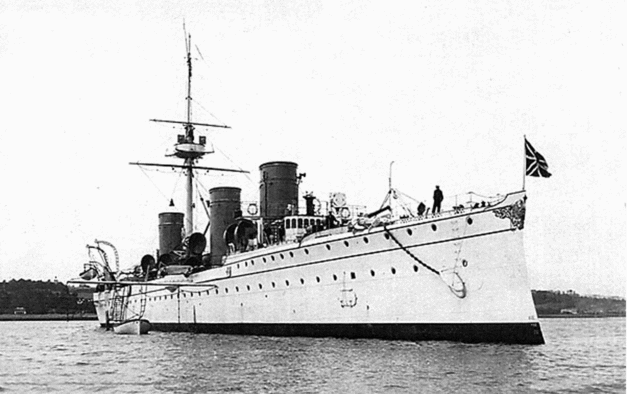
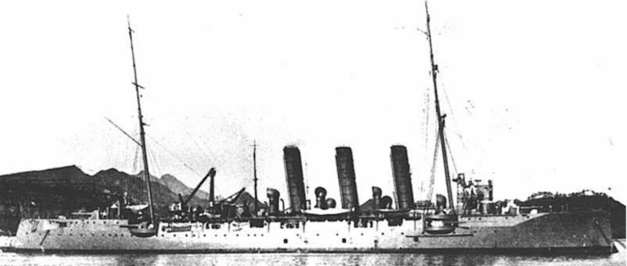
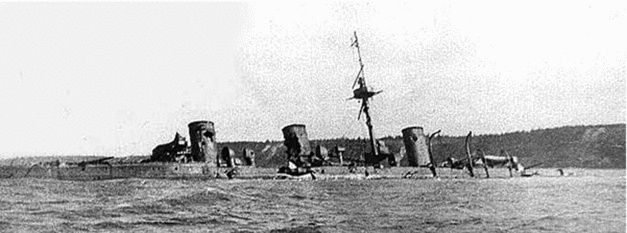
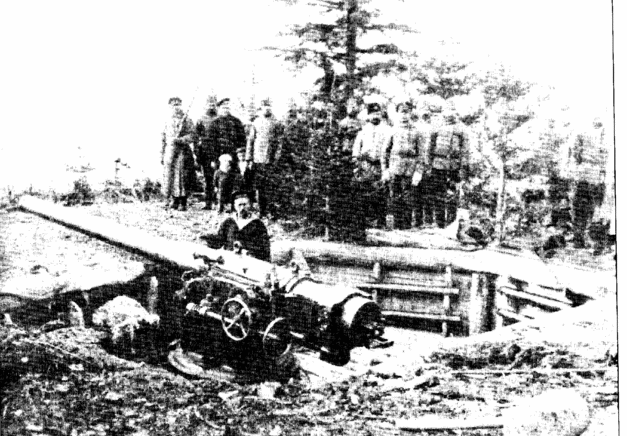
In 1904 naval operations were largely confined to the Yellow Sea. The Russians attempted to force a way out of Port Arthur and this resulted in the Battle of the Yellow Sea fought on 10 August (Olender Reference Olender2009: 67–76). This action was by no means a disgrace for the Russians but most of their vessels were driven back into Port Arthur with very few escaping. One of these was the light cruiser Novik [Novice in English] (Fig. 1) under Commander M.F. Schul’ts who was clearly an enterprising officer. Being short of fuel, Schul’ts put into Tsingtao on 11 August. This port is on the southern coast of the Yellow Sea and was a German possession, and hence neutral. Schul’ts succeeded in loading 250 tons of coal and avoided having his ship interned. Putting to sea he elected to try to reach Vladivostok by passing round the east side of the Japanese islands and heading west through the straits between Hokkaido and Sakhalin. Novik, suffering from boiler breakdown, put into the Russian port of Korsakov in southern Sakhalin on 20 August. She had been sighted en route and was intercepted by the larger but less speedy Japanese cruiser Tsushima (Fig. 2) supported by a second cruiser Chitose, in Aniwa Bay on which the port is situated. The engagement lasted some 1.5 hours and in the event Novik was severely damaged and had to return to the port (Cassell no date II: 67–76). Here she was scuttled (Fig. 3; Olender Reference Olender2009: 78–79) but not before Schul’ts had unloaded several of his ship's guns and established an ad hoc battery of two 4.7 inch and two 3 pounders, defending the town (Fig. 4; Great Britain Reference Great1920: 101). On 30 August, Novik's crew then set out on a daunting 600 km march northwards and eventually reached mainland Russia but some gunners were left behind to man their weapons should a Japanese invasion of Sakhalin took place. On 6 September a Japanese force arrived aiming to destroy the wreck of Novik, but this was frustrated by well aimed rifle fire from the shore (Great Britain Reference Great1920: 101). After the end of the war, the Japanese raised and refitted the cruiser and she served in the Imperial navy for several years.
The Russian cruiser Novik.

The Japanese cruiser Tsushima.
Novik after scuttling.
Battery established at Korsakov using guns from Novik.
The invasion of Sakhalin
In contrast to Gunji's amateur operation, the Japanese attack on Sakhalin was thoroughly prepared and executed albeit that the preparations had to be completed in a short period of time before the, by then, inevitable peace conference (Fig. 5). An essential prerequisite to any maritime operation was the removal of any Russian naval threat to the invading forces and this was accomplished in the battle of Tsushima, on 27/28 May 1905 in which the Russian fleet that had journeyed thither from the Baltic, still the longest ‘approach march’ in history, was destroyed. The Russian cruiser squadron based at Vladivostok, the performance of which had certainly been the best of any unit of their navy, had also been neutralised by attrition and battle damage.
Map of Sakhalin indicating the main points of action in the campaign.
The Russian defences of Sakhalin comprised some 6000 men (Stephan Reference Stephan1971: 78) or 7000 (Olender Reference Olender2010: 229) of whom most were regulars but about a third were convicts or ex-convicts in the settlements that were scattered throughout the island (commented upon by Anton Chekhov Reference Chekhov1967) and who had been induced to join the army on the strength of offers of release at the end of the war. The governor General Liapunov deployed his forces in different parts of the perimeter of the island most notably around Korsakov approximately 1160 men (Great Britain Reference Great1920: 835) on the south coast with the remainder at Alexandrovsk and Dué on the west coast. There was a small stiffening of specialist troops, notably artillery. The Japanese, on the other hand, assembled a newly formed full division, the 13th, 14,000 strong in two brigades with adequate support troops, under General Haraguchi Kanenari and a considerable naval force, under Admiral Kataoka Shichiro, comprising more than 50 ships, to transport them and to prevent any Russian interference. The Russians were therefore hugely outnumbered.
The Japanese determined on a two pronged strategy. There was to be a landing in the south near Korsakov to be followed some time later by further landings near Alexandrovsk. During these operations it was confidently expected that the Russian forces would easily be destroyed but in the event the Russian resistance was rather more vigorous than the Japanese expected.
The first landings, after mine clearance operations (The Times (London) 11 July 1905), took place on 7 July 1905, to the east of Korsakov and were unopposed. But later when the Japanese landed at the town itself, they found themselves under fire from the battery constructed from weapons retrieved from Novik. According to some sources Russian resistance was ‘brief but bitter’ and they burnt the town (Stephan Reference Stephan1971: 79) but according to others there was little resistance (The Times (London) 11 July 2005). The balance of forces was such that the Russians had no choice but to withdraw northwards and this they did in five separate groups. The Japanese following up were able to drive them onwards with the Russians continuing their retreat. The division of their forces into groups was a successful strategy on the part of the Russians since, even though they were greatly outnumbered, the difficulties of the trackless terrain meant that it was difficult for the Japanese actually to get to grips with their foe. However sheer pressure of numbers told and resistance ceased soon after 11 July. But some of the Russians escaped. One detachment under Captain Buikov, 226 strong, seems to have performed very well. They inflicted no fewer than 85 casualties on the Japanese, who were a battalion and a half strong from the 50th Infantry Regiment, in ‘a stiff fight’ at Otradna and then moved northwards, eventually securing a steamer to take them to Nikolaevsk on the Amur River where they arrived on 2 September 1905 with total losses of 54 men. However some of the other groups seem not to have fought at all while one was surrendered by its commander on the grounds that he ‘was suffering with sore feet’. Doubtless disgusted at this pusillanimity some 50 of his men broke away and joined Buikov's group (Great Britain Reference Great1920: 836–837).
More serious landings took place on 24 July in the area of Alexandrovsk and the nearby town of Arkovo on the western coast of the island. The Japanese put ashore, to no resistance, most of their division and rapidly attacked the Russian forces in the area. At the same time they effected a landing on the Asiatic mainland at De Castries Bay directly opposite Alexandrovsk in order to secure their rear against any attempt by the Russians in that region to interfere with operations on the island (The Times (London) 28 July 1905). The Japanese rapidly pushed inland and again the Russians, who numbered some 5900 men adopted the strategy of dividing their forces into essentially guerilla groups. In this case there were four. The Japanese moved forward in two columns. The Russian strategy was fairly effective for a short time but eventually they were surrounded at Onor and Liapunov had little choice but to surrender which he did on 1 August. The number of Russians going into captivity was some 70 officers and 4318 men (Stephan Reference Stephan1971: 79) or 64 officers and 3819 men (Great Britain Reference Great1920: 838). Japanese casualties seem to have been some 500 (Olender Reference Olender2010: 230). A large number of Russians were ‘missing’ reflecting poor morale (Great Britain Reference Great1920: 839) while some 182 had been killed and 278 managed to escape across the straits to the mainland with further small units taking refuge in the forest in which they were hunted down by the Japanese by the end of August (Stephan Reference Stephan1971: 79). That was the conclusion of the war in terms of direct hostilities in the Sakhalin theatre but there are fascinating, but very sketchy, references to Japanese naval reconnaissance in the Sea of Okhotsk and on the eastern side of Kamchatka (The Times (London) 11 August 1905). There are even cryptic notes to Japanese landings on the Siberian coast and at Nikolaevsk in the estuary of the Amur river (The Times (London) 31 July 1905) and these, if they had taken place, would have been the most northerly operations of the war. The Japanese occupation of Sakhalin was Russia's only territorial loss in the war.
Treaty of Portsmouth
As noted above, both sides had accepted an invitation, proposed on 9 June 1905, from President Theodore Roosevelt to negotiate an end to the war. Both were exhausted and it is a matter for conjecture which protagonist was the more so. By this time the Trans-Siberian railway was complete and despite the threat of internal strife in Russia, they were finding it possible to strengthen their forces in Manchuria so that they would have a significant margin of superiority in numbers over their opponents if the war continued. The Japanese had reached the end of their human resources and so the balance was swinging decisively in favour of the Russians and this would continue the longer the war went on.
The negotiations, at Portsmouth, New Hampshire, were conducted skillfully by Count Witte, the Russian plentpotentiary who appreciated the strength of his position. As far as the sub-Arctic was concerned, the eventual outcome set out in the Treaty of Portsmouth signed on 5 September, was that the Japanese annexed the southern part of Sakhalin, to the south of 50° N, and called it Karafuto.
Conclusion
The Japanese operations in this minor theatre of the Russo-Japanese war were, apart from the slightly farcical landings in Kamchatka in 1904, conducted with considerable military skill. Their plan for attacking Sakhalin derived from the desirability of securing the island's large mineral resources of coal, and possibly oil, pending a conclusion of the war, thus enhancing their negotiating position and while it was impossible to embark on it until after the destruction of the Russian navy at Tsushima, events were then pressed forward with great speed and efficiency. But the Japanese were surprised that the Russians were able to mount any resistance at all and that they were able to do so reflects credit on them. It is a matter for reflection concerning how far Japanese experiences in Sakhalin influenced their amphibious operations in the Pacific in both World Wars but it would be surprising if there were not some parallels.