Introduction
Generalized anxiety disorder (GAD) is a severe mental condition that is characterised by excessive and persistent worry (American Psychiatric Association, 2013). In a recent global cross-sectional general population survey conducted in 26 countries, GAD had a lifetime prevalence of 3.7% (Ruscio et al., Reference Ruscio, Hallion, Lim, Aguilar-Gaxiola, Al-Hamzawi, Alonso and Bunting2017), which is consistent with a previous survey reporting 4.3% in the US general population (Kessler, Petukhova, Sampson, Zaslavsky, & Wittchen, Reference Kessler, Petukhova, Sampson, Zaslavsky and Wittchen2012). It is well-documented that females are more likely than males to experience GAD (McLean, Asnaani, Litz, & Hofmann, Reference McLean, Asnaani, Litz and Hofmann2011; Vesga-López et al., Reference Vesga-López, Schneier, Wang, Heimberg, Liu, Hasin and Blanco2008). GAD usually has a chronic course, with most patients referred for treatment only after 6–12 years (Revicki et al., Reference Revicki, Travers, Wyrwich, Svedsäter, Locklear, Mattera and Montgomery2012). Mental health comorbidity is often observed, and in most cases is comorbid with major depression or other anxiety disorders (Kessler et al., Reference Kessler, Petukhova, Sampson, Zaslavsky and Wittchen2012; Mennin, Fresco, O'Toole, & Heimberg, Reference Mennin, Fresco, O'Toole and Heimberg2018; Wittchen & Jacobi, Reference Wittchen and Jacobi2005). Given the high prevalence and health relevance of GAD, there is a growing need to develop and expand effective treatments.
Several beneficial treatment options are available for treating GAD, including pharmacological treatments such as selective serotonin reuptake inhibitors (SSRIs) and serotonin and noradrenaline reuptake inhibitors (SNRIs; Baldwin, Hou, Gordon, Huneke, & Garner, Reference Baldwin, Hou, Gordon, Huneke and Garner2017; Carl et al., Reference Carl, Witcraft, Kauffman, Gillespie, Becker, Cuijpers and Powers2020; Chen, Huang, Hsu, Ouyang, & Lin, Reference Chen, Huang, Hsu, Ouyang and Lin2019; Guaiana, Barbui, & Abouhassan, Reference Guaiana, Barbui and Abouhassan2018; Perna, Alciati, Riva, Micieli, & Caldirola, Reference Perna, Alciati, Riva, Micieli and Caldirola2016). Pharmacological treatments are often the first choice for clinicians and patients because of the cost and resource constraints of psychological alternatives (Slee et al., Reference Slee, Nazareth, Bondaronek, Liu, Cheng and Freemantle2019). Recent guidelines consider SSRI as the first-line pharmacological treatment for GAD (Baldwin et al., Reference Baldwin, Hou, Gordon, Huneke and Garner2017; Katzman et al., Reference Katzman, Bleau, Blier, Chokka, Kjernisted and Van Ameringen2014). The findings from systematic reviews and meta-analyses indicate that SSRIs are superior to pill placebo for the treatment of GAD (Baldwin et al., Reference Baldwin, Hou, Gordon, Huneke and Garner2017; Slee et al., Reference Slee, Nazareth, Bondaronek, Liu, Cheng and Freemantle2019). However, SSRIs are not sufficient as only a minor percentage of patients with GAD taking an SSRI experience full remission (Mitte, Reference Mitte2005; Slee et al., Reference Slee, Nazareth, Bondaronek, Liu, Cheng and Freemantle2019). Moreover, psychiatric medications use are not without problems and a considerable percentage of patients when receiving SSRIs suffer from side effects including suicidality, sexual dysfunction, weight gain, sleep disturbances, relapse, and recurrence (Baldwin et al., Reference Baldwin, Hou, Gordon, Huneke and Garner2017; Schatzberg & DeBattista, Reference Schatzberg and DeBattista2015; Zemestani, Ommati, Rezaei, & Gallagher, Reference Zemestani, Ommati, Rezaei and Gallagher2021; Zemestani et al., Reference Zemestani, Salavati, Seyedolshohadayi, Petersen, Ong, Twohig and Ghaderi2020). Therefore, while SSRIs are often used, many patients with GAD do not wish to stay on medication for long-term periods, or cannot tolerate the side effects, leading to poor adherence rates (Carl et al., Reference Carl, Witcraft, Kauffman, Gillespie, Becker, Cuijpers and Powers2020; Mitte, Reference Mitte2005). Thus, there is growing interest in psychotherapy alternatives to long-term SSRI use as a means to prevent relapse.
Treatment guidelines typically recommend different types of psychological interventions such as cognitive behavioral therapy (CBT), psychodynamic therapy, and applied relaxation (AR) (Bolognesi, Baldwin, & Ruini, Reference Bolognesi, Baldwin and Ruini2014; Covin, Ouimet, Seeds, & Dozois, Reference Covin, Ouimet, Seeds and Dozois2008; Gonçalves & Byrne, Reference Gonçalves and Byrne2012; Otte, Reference Otte2011; Roemer & Orsillo, Reference Roemer, Orsillo and Barlow2014; Wells et al., Reference Wells, Welford, King, Papageorgiou, Wisely and Mendel2010) as first-line GAD treatment. Treatment outcome research that adheres to rigorous scientific standards suggests that (Chambless & Hollon, Reference Chambless and Hollon1998) CBT is an evidence-based first-line treatment for GAD (Szkodny, Newman, & Goldfried, Reference Szkodny, Newman and Goldfried2014). Specifically, CBT has been found, in randomized controlled trials (RCTs) to be more efficacious for worry and GAD than treatment-as-usual or a waiting list (Covin et al., Reference Covin, Ouimet, Seeds and Dozois2008; Gonçalves & Byrne, Reference Gonçalves and Byrne2012; Hanrahan, Field, Jones, & Davey, Reference Hanrahan, Field, Jones and Davey2013; Hunot, Churchill, Teixeira, & de Lima, Reference Hunot, Churchill, Teixeira and de Lima2007). Based on the extant literature, and consistent with meta-analyses, CBT has been found to have medium to large effect sizes compared to waitlist or medication conditions (Carl et al., Reference Carl, Witcraft, Kauffman, Gillespie, Becker, Cuijpers and Powers2020; Chen et al., Reference Chen, Huang, Hsu, Ouyang and Lin2019; Cuijpers, Cristea, Karyotaki, Reijnders, & Huibers, Reference Cuijpers, Cristea, Karyotaki, Reijnders and Huibers2016; Hanrahan et al., Reference Hanrahan, Field, Jones and Davey2013; Zemestani & Fazeli Nikoo, Reference Zemestani and Fazeli Nikoo2020). However, when applying criteria for clinically significant change (Jacobson & Truax, Reference Jacobson and Truax1991), only 50% of individuals meet criteria for recovery, and this is even lower at 6- and 12-month follow-up (Borkovec, Newman, Pincus, & Lytle, Reference Borkovec, Newman, Pincus and Lytle2002; Dugas et al., Reference Dugas, Ladouceur, Léger, Freeston, Langolis, Provencher and Boisvert2003; Ladouceur et al., Reference Ladouceur, Dugas, Freeston, Léger, Gagnon and Thibodeau2000; Wells et al., Reference Wells, Welford, King, Papageorgiou, Wisely and Mendel2010). It seems reasonable to conclude that traditional CBT leads to significant but not always sufficient improvement for many patients with GAD (Clark & Beck, Reference Clark and Beck2011; Dugas et al., Reference Dugas, Savard, Gaudet, Turcotte, Laugesen, Robichaud and Koerner2007; Waters & Craske, Reference Waters, Craske, Antony, Ledley and Heimberg2005; Wells et al., Reference Wells, Welford, King, Papageorgiou, Wisely and Mendel2010).
The need to improve effective intervention is supported by the observation of no or limited recovery in a considerable proportion of GAD patients after CBT. Newer versions of CBT for GAD that incorporate specific features of the disorder may be promising (Robichaud, Reference Robichaud2013). One such adaptation of GAD includes a focus on Intolerance of Uncertainty (IU; Dugas, Gagnon, Ladouceur, & Freeston, Reference Dugas, Gagnon, Ladouceur and Freeston1998; Dugas, Laugesen, & Bukowski, Reference Dugas, Laugesen and Bukowski2012; Dugas & Robichaud, Reference Dugas and Robichaud2012; Robichaud, Reference Robichaud2013; Robichaud, Koerner, & Dugas, Reference Robichaud, Koerner and Dugas2019). A dispositional incapability of enduring one's own negative response that has been triggered by the perception of uncertainty, IU results in various emotional, cognitive, and behavioural responses for avoidance and/or resolution of the aversive experience (Carleton, Reference Carleton2016). It is considered as a transdiagnostic causal mechanism with a key role in the aetiology and maintenance of several emotional disorders, especially in GAD (Carleton, Reference Carleton2016; Hebert & Dugas, Reference Hebert and Dugas2018; Ouellet, Langlois, Provencher, & Gosselin, Reference Ouellet, Langlois, Provencher and Gosselin2019; Renjan, McEvoy, Handley, & Fursland, Reference Renjan, McEvoy, Handley and Fursland2016; Rosser, Reference Rosser2019; Shihata, McEvoy, Mullan, & Carleton, Reference Shihata, McEvoy, Mullan and Carleton2016; Zemestani, Didehban, Comer, & Kendall, Reference Zemestani, Didehban, Comer and Kendall2021).
Theoretical models in the context of CBT literature suggest that individuals who are intolerant of uncertainty may be at risk for developing GAD because they tend to (1) make threatening interpretations of ambiguous information; (2) perform poorly in moderately ambiguous situations; and (3) have particularly low confidence in their decisions when anxious (Dugas & Robichaud, Reference Dugas and Robichaud2012). Particularly, IU is thought to contribute to GAD and worry via other variables including cognitive avoidance (i.e. the use of covert strategies such as distraction or thought suppression to reduce intrusive images of the feared outcomes and distress), positive beliefs about worry (i.e. dysfunctional appraisals about the nature of worries, including the belief that worrying may be necessary to prevent or lessen the impact of the feared outcomes), and negative problem orientation (i.e. a tendency to view problems as ‘threats’ that will either be difficult to prevent or to cope with if they occur; Dugas et al., Reference Dugas, Gagnon, Ladouceur and Freeston1998; Dugas & Ladouceur, Reference Dugas and Ladouceur2000).
A version of CBT that targets IU (CBT-IU) is a newer GAD-specific treatment option that has received some empirical support (Dugas et al., Reference Dugas, Ladouceur, Léger, Freeston, Langolis, Provencher and Boisvert2003, Reference Dugas, Brillon, Savard, Turcotte, Gaudet, Ladouceur and Gervais2010; Koerner & Dugas, Reference Koerner, Dugas, Graham and Wells2006; van der Heiden, Muris, & van der Molen, Reference van der Heiden, Muris and van der Molen2012). The CBT-IU is based on the Dugas et al. (Reference Dugas, Gagnon, Ladouceur and Freeston1998) model of excessive worry/GAD and includes worry awareness training, exposure to uncertainty and worry content, and cognitive restructuring to target four putative mediators of worry: intolerance of uncertainty, cognitive avoidance, positive beliefs about worry, and negative problem orientation. Limited studies have investigated the comparative effects of CBT-IU with an evidence-based treatment for GAD (Dugas et al., Reference Dugas, Brillon, Savard, Turcotte, Gaudet, Ladouceur and Gervais2010; Hebert & Dugas, Reference Hebert and Dugas2018; van der Heiden et al., Reference van der Heiden, Muris and van der Molen2012). In a recent RCT, Dugas et al. (Reference Dugas, Brillon, Savard, Turcotte, Gaudet, Ladouceur and Gervais2010) compared CBT-IU to both a waitlist condition and an AR condition. CBT-IU had superiority to waitlist, and marginal superiority to AR: however, continued gains post-treatment emerged only for participants receiving CBT-IU. The remission rates for CBT-IU were 70% at post-treatment, 76, 84, and 77% at 6-, 12-, and 24-month follow-up, respectively. In another RCT, van der Heiden et al. (Reference van der Heiden, Muris and van der Molen2012) compared the effectiveness of metacognitive therapy (MCT) and CBT-IU. MCT and CBT-IU both resulted in significant decreases in GAD symptoms at post-treatment and 6-month follow-up, while MCT exhibited significant superiority.
As mentioned above, only a few studies have investigated the comparative effects of CBT-IU with an evidence-based treatment (Dugas et al., Reference Dugas, Brillon, Savard, Turcotte, Gaudet, Ladouceur and Gervais2010; Hebert & Dugas, Reference Hebert and Dugas2018; van der Heiden et al., Reference van der Heiden, Muris and van der Molen2012). Furthermore, CBT-IU and SSRIs are the two most effective treatments for patients with GAD; however, to the best of our knowledge, no published study has compared the relative efficacy of CBT-IU and SSRI in patients with GAD. Therefore, additional clinical trials are needed, including the examination of the comparative effects of CBT-IU with SSRIs in non-Western countries. Without such trials, it is uncertain which one of these therapies are more effective in reducing mental health problems in non-Western countries (Cuijpers et al., Reference Cuijpers, Eylem, Karyotaki, Zhou, Sijbrandij, Stein, Bass and Hofmann2019). Given that the present work was conducted in Iran and prior works were conducted in other cultures, the findings would demonstrate that the evidence-based treatments of GAD are effective cross-culturally. Moreover, given that CBT-IU appears to be comparably effective to existing empirically supported treatments for GAD, examining the comparative effects of CBT-IU versus SSRIs in parallel fashion may provide insight into how different types of psychological therapy and pharmacotherapy may be similarly or differentially helpful for patients with GAD.
The present research evaluated the relative effectiveness of (1) CBT-IU and (2) SSRIs for Iranian women with GAD. Consistent with previous empirical work, it was hypothesized that participants in the CBT-IU condition, compared to those in the SSRI condition, would have larger reductions in GAD symptoms over time. We also predicted the CBT-IU condition would decrease self-reported worry (WW-II), intolerance of uncertainty scale (IUS), and negative problem orientation (NPOQ) compared to the continued SSRI condition.
Method
Participants
Participants were recruited from public and private outpatient psychiatric centres in Sanandaj, Iran. Female patients with GAD were asked to take part in an investigation of anxiety symptom improvement. After informed consent procedures, a trained and experienced master's-level clinical psychologist administered a structured clinical interview (SCID-5; First & Williams, Reference First and Williams2016). After determining eligibility, background information was gathered. Primary inclusion criteria included meeting DSM-5 criteria for GAD, female gender, being aged >18 years, and voluntary participation. The exclusion criteria included severe psychiatric disorders, substance abuse or dependence, prominent active suicidal ideation/intent.
Procedure
The study followed a pretest–posttest design with two treatment conditions. The trial was registered at the Iranian Registry of Clinical Trials (IRCT) and the entire research procedure was approved by the Kurdistan University of Medical Sciences’ ethics committee. A total of 41 patients with GAD were evaluated for eligibility, and following the clinical assessment process, 30 eligible patients were randomised to either the CBT-IU (n = 15) or SSRI (n = 15). A computer-generated block of random numbers was used for randomisation by an independent assessor not involved in recruitment or post-treatment assessment. Data were gathered by two master's degree students in clinical psychology blind to condition and not involved in the intervention.
Treatments
Pharmacotherapy
The pharmacotherapy management condition involved the continuous utilisation of SSRIs at the same levels before the research began and included no psychological treatment. All patients receiving pharmacotherapy were on optimal target doses of SSRI medications including Citalopram (Celexa, 20–40 mg/day), Sertraline (Zoloft, 50–100 mg/day), and Fluoxetine (Prozac, 20–50 mg/day), and the selection of medication was done by the prescribing psychiatrists. Patients continued to be monitored by their psychiatrists once a month for 3 months in 30-min sessions. Participants who took medicine were given instructions not to change anything during the active treatment. Medication adherence was assessed at each visit by verbal report and by pill counts. Once the study was completed, all the participants in the SSRI management condition received the CBT-IU treatment.
Cognitive behavior therapy targeting intolerance of uncertainty
CBT-IU is a modern GAD-specific CBT with growing empirical support for the treatment of GAD. CBT-IU is different from classic CBT for GAD with targeting IU components. The CBT-IU is based on the Dugas et al. (Reference Dugas, Gagnon, Ladouceur and Freeston1998) model of excessive worry/GAD and specifically focuses on underlying features of worry/GAD. The CBT-IU program was composed of 12 individual weekly 1-h sessions that were delivered over a period of 12 weeks (see Table 1). The rationale, model, objectives, and themes of the treatment were based on the CBT-IU treatment manual (Dugas & Robichaud, Reference Dugas and Robichaud2012; Robichaud, Reference Robichaud2013). All sessions involved critical purposes, including homework assignment review and event discussion between sessions. There was a central theme in each session based on CBT-IU manual and treatment modules consisted of psychoeducation, cognitive-emotional exposure including exposure to uncertainty and worry, tolerating negative emotions caused by uncertainty, and cognitive restructuring to target four putative mediators of worry: intolerance of uncertainty, cognitive avoidance, positive beliefs about worry, and negative problem orientation.
Overview of the CBT-IU Protocol for Generalized Anxiety Disorder (GAD)

Note: CBT-IU = cognitive behavior therapy targeting intolerance of uncertainty.
Therapist and treatment fidelity
A clinical psychologist at the master's level with specialised training in CBT for anxiety and at least 2 years of clinical experience in delivering CBT for GAD conducted the CBT-IU sessions. Prior to the study, the therapist had received 16 h of additional training. The patients consented to audiotaping, which was applied to all sessions to ensure treatment fidelity, and one session was selected randomly for each patient to be rated for therapist competence and protocol adherence by a doctoral-level supervisor. A supervisor reviewed sessions each week to ensure that each session adhered to CBT-IU.
Measures
Structured Clinical Interview for DSM-5 (SCID-5; First & Williams, Reference First and Williams2016): The SCID-5 is a diagnostic clinical interview for the assessment of psychiatric disorders based on DSM-5 criteria (American Psychiatric Association, 2013). This tool was used for initial clinical interview and evaluation in this study. The SCID-5 has shown good validity and adequate inter-rater and internal consistency reliability (Shankman et al., Reference Shankman, Funkhouser, Klein, Davila, Lerner and Hee2018).
Penn State Worry Questionnaire (PSWQ; Meyer, Miller, Metzger, & Borkovec, Reference Meyer, Miller, Metzger and Borkovec1990): The PSWQ is a 16-item questionnaire for measuring worry as the core feature of GAD. The items are scored according to a 5-point Likert scale (1 = Not at all typical of me; 5 = Very typical of me). It has high internal consistency (α = 0.86–0.95) and its retest reliability is good (r = 0.74–0.93; Molina & Borkovec, Reference Molina, Borkovec, Davey and Tallis1994).
Why Worry-II (WW-II; Gosselin et al., Reference Gosselin, Ladouceur, Langlois, Freeston, Dugas and Bertrand2003): The WW-II is a self-report questionnaire composed of 25 items designed for measurement of positive beliefs about worry. Items are scored according to a 5-point Likert scale (1 = Not at all true; 5 = Absolutely true). The questionnaire exhibits good internal consistency (α = 0.93) and retest reliability (r = 0.88; Hebert, Dugas, Tulloch, & Holowka, Reference Hebert, Dugas, Tulloch and Holowka2014).
Intolerance of Uncertainty Scale (IUS; Freeston, Rhéaume, Letarte, Dugas, & Ladouceur, Reference Freeston, Rhéaume, Letarte, Dugas and Ladouceur1994): The IUS includes 27 items designed to measure how differently individuals react to ambiguous situations, imply uncertainty, and attempt to control the future, with the total scores varying between 27 and 135. The scale demonstrated good internal consistency (α = 0.94), and convergent and divergent validity (α = 0.74; Freeston et al., Reference Freeston, Rhéaume, Letarte, Dugas and Ladouceur1994).
Negative Problem Orientation Questionnaire (NPOQ; Robichaud & Dugas, Reference Robichaud and Dugas2005): The NPOQ is a 12-item scale evaluating the dysfunctional attitudes of an individual towards problem solving. The items appear as statements, and a 5-point Likert scale is used by the participants to show how precisely they are described by each statement (1 = Not all true; 5 = Completely true). In the original study by Robichaud and Dugas (Reference Robichaud and Dugas2005), evaluation of the psychometric features revealed a single-factor structure and they reported good internal consistency and retest reliability (α = 0.92 and r = 0.80, respectively).
Data analysis
IBM SPSS Statistics 22.0 (IBM SPSS Statistics, New York, USA) was used to analyze the data by an independent statistician who was blinded to group allocation. The analyses were based on the intention-to-treat principle (ITT). Dropping data were handled using the last observation-carried-forward (LOCF) method. For comparison of the impact of CBT-IU and SSRI on the outcome measures (i.e. PSWQ, WW-II, IUS, and NPOQ), a series of 2 (Time: baseline, post-treatment) × 2 (Intervention: CBT-IU vs. SSRI) repeated measures Analysis of Variance (ANOVA) were conducted with scores on outcome measures as the repeated within-group variables and treatment modality as the between-group variable. Normality distribution and variance equality were examined using Kolmogorov–Smirnov and Leven's methods (p < .05), along with parametric tests carried out for statistical analysis.
Results
Results of Leven's test for homogeneity of variances demonstrated that none of the dependent variables exhibited significant levels, and hence the assumption of the homogeneity of variances was confirmed and it can be ensured that the scatter distribution of the two groups is the same (p < .05). The results of the M box test on equality of covariance matrix also showed that homogeneity assumption of variance–covariance matrix is established (Box's M = 114.69, p = .425, F = 1.02). Therefore, the assumption of using ANOVA is confirmed. Also, results of Mauchly's test of sphericity does not rule out establishment of spherical conditions, as the multivariate statistics do not require sphericity, and thus, with no sphericity assumption, Greenhouse–Geisser correction test was used to test score of PSWQ, WW-II, and NPOQ in two times measurement and to measure effects of inter-subjects.
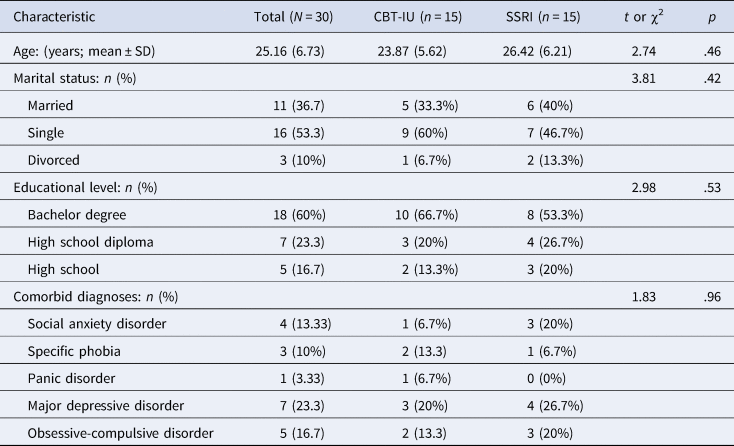
For all of the baseline characteristics, there were no significant pre-treatment differences (ps > .05) between the two groups (independent samples t-tests and the chi-square tests; see Table 2). The means and standard deviations for PSWQ, WW-II, IUS, and NPOQ at baseline and post-treatment in CBT-IU and SSRI groups, and results of the repeated measure ANOVA are shown in Table 3.
Demographic and Clinical Characteristics of All Randomized Participants at Baseline

Notes: CBT-IU = cognitive behavior therapy targeting intolerance of uncertainty; SSRIs = selective serotonin reuptake inhibitor.
Baseline and Post-Treatment Scores on Outcome Measures, and Results of the Repeated Measure ANOVA (Time × Condition Interactions)

Notes: CBT-IU = cognitive behavior therapy targeting intolerance of uncertainty; SSRI = selective serotonin reuptake inhibitor; PSWQ = Penn State Worry Questionnaire; WW-II = Why Worry-II; IUS = Intolerance of Uncertainty Scale; NPOQ = Negative Problem Orientation Questionnaire.
*p < .05.
The repeated measures ANOVA indicated that the levels of worry improved more in the CBT-IU condition than in the SSRI condition. For PSWQ, the analysis results showed the significant impact of Time × Group interaction (F = [12.59], p = .002, ηp2 = .36). For WW-II, results also showed the significant impact of Time × Group interaction, F = [11.82], p < .002, ηp2 = .35. Results also indicated that the levels of IU improved more in the CBT-IU condition than in the SSRI condition. For IUS, the results showed the significant impact of Time × Group interaction, F = [42.55], p < .0001, ηp2 = 0.65. Results also indicated that the levels of negative problem orientation improved more in the CBT-IU condition than in the SSRI condition. As to NPOQ, results showed the significant impact of Time × Group interaction, F = [9.83], p < .005, ηp2 = .30.
In addition, findings from Bonferroni post hoc comparisons indicated significant decreases in the CBT-IU group in the levels of worry, intolerance of uncertainty, and negative problem orientation from baseline to post-treatment, with the scores remaining significantly lower than in the SSRI group (ps < .0001; see Table 4).
Results of the Bonferroni Post Hoc Test for Pairwise Comparisons Between CBT-IU and SSRI Groups

Notes: PSWQ = Penn State Worry Questionnaire; IUS = Intolerance of Uncertainty Scale; WW-II = Why Worry-II; IUS = Intolerance of Uncertainty Scale; NPOQ = Negative Problem Orientation Questionnaire.
a Positive values denote a decrease between timeframes.
*p < .05.
Discussion
Results of the current study revealed that symptoms ameliorated over time, following both CBT-IU and SSRI, supporting both as effective treatments for GAD. However, the levels of symptoms improved more in the CBT-IU condition than in the SSRI condition. The within-group effect sizes for CBT-IU condition were larger than in the SSRI condition, and the clinically meaningful changes occurred in high proportions. Additional significant differences were found between the two groups in worry, IU, and positive beliefs about worry, again with greater benefits associated with CBT-IU. The observed consistency between the present results and the previous findings demonstrated that CBT-IU was effective for patients with GAD (Dugas et al., Reference Dugas, Ladouceur, Léger, Freeston, Langolis, Provencher and Boisvert2003, Reference Dugas, Brillon, Savard, Turcotte, Gaudet, Ladouceur and Gervais2010; Dugas & Ladouceur, Reference Dugas and Ladouceur2000; Koerner & Dugas, Reference Koerner, Dugas, Graham and Wells2006; Ladouceur et al., Reference Ladouceur, Dugas, Freeston, Léger, Gagnon and Thibodeau2000; Robichaud, Reference Robichaud2013; van der Heiden et al., Reference van der Heiden, Muris and van der Molen2012).
In general, the findings have clinical and practical implications for clinicians working in mental health centres treating GAD by non-pharmacological interventions. The main implication of our results is that clinicians could consider adding a ‘tolerating uncertainty’ component to treatment of their patients with GAD. What makes the above finding particularly promising is the ability to deliver a novel CBT protocol in a circumscribed number of sessions. On that basis, GAD symptoms can be reduced through exclusive targeting of IU via CBT-IU specific strategies.
IU is a hallmark of anxiety, originally conceptualised as playing an important role in GAD symptom development and maintenance. Theoretical models and empirical data support a causal relationship between IU and worry, and it has been proposed that worry and GAD symptoms can potentially be reduced by psychological treatment through reduction of IU (Bomyea et al., Reference Bomyea, Ramsawh, Ball, Taylor, Paulus, Lang and Stein2015; Carleton, Reference Carleton2016). Based on the results of the present study, significant changes can be made in both IU and GAD symptoms by CBT-IU aimed at beliefs about uncertainty. These findings are consistent with cognitive mediation theories of anxiety, wherein anxiety symptom changes can result from changes in underlying beliefs (e.g. Beck, Reference Beck1976). The present treatment involved CBT-IU strategies specifically aimed at the negative uncertainty beliefs resulting in GAD symptoms. Thus, the theoretical model is supported indirectly by the finding that GAD symptoms were decreased by CBT-IU.
Findings of clinical and experimental psychopathology studies suggest that patients with GAD suffer from particular vulnerability to negative cognitive styles by which anxiety onset or relapse is triggered, and anxiety symptoms are prolonged (Llera & Newman, Reference Llera and Newman2014). These negative cognitive styles are activated by stressful life events including perseverative negative thinking patterns like worry, IU, and negative problem orientation, which can be aggravated to the onset or relapse of anxiety if they persist (Robichaud et al., Reference Robichaud, Koerner and Dugas2019). It is emphasised in the theoretical model forming the basis of CBT-IU that these thought patterns should be identified as they arise and regarded as temporary mental phenomena, not as facts or realities that are to be identified with or reacted to (Hebert & Dugas, Reference Hebert and Dugas2018). CBT-IU is focused on reduction of anxiety and the tendency to worry through assistance of patients in development of the capability of tolerating, coping with, and accepting uncertainty in their routine lives (Dugas & Robichaud, Reference Dugas and Robichaud2012; Robichaud, Reference Robichaud2013; Robichaud et al., Reference Robichaud, Koerner and Dugas2019; van der Heiden et al., Reference van der Heiden, Muris and van der Molen2012).
Regarding the other components studied in this trial, results revealed that there is a significant difference between the two treatments in terms of effectiveness on positive beliefs about worry and negative problem orientation. That is, CBT-IU was more effective than SSRI concerning positive beliefs about worry and negative problem orientation in patients with GAD. These findings are consistent with previous studies (Dugas et al., Reference Dugas, Ladouceur, Léger, Freeston, Langolis, Provencher and Boisvert2003, Reference Dugas, Brillon, Savard, Turcotte, Gaudet, Ladouceur and Gervais2010; Koerner & Dugas, Reference Koerner, Dugas, Graham and Wells2006; Robichaud, Reference Robichaud2013; van der Heiden et al., Reference van der Heiden, Muris and van der Molen2012), indicating that CBT-IU can help patients with GAD change their beliefs about worry and problem orientation.
Positive beliefs about worry are associated with the benefits and usefulness of involvement in specific cognitive activities such as worry, rumination, and threat monitoring (Wells et al., Reference Wells, Welford, King, Papageorgiou, Wisely and Mendel2010). Positive beliefs about worry is a metacognitive factor that leads to negative reinforcement of worry and helps develop and maintain GAD (Hebert et al., Reference Hebert, Dugas, Tulloch and Holowka2014; Wells, Reference Wells2005; Zemestani, Davoodi, Honarmand, Zargar, & Ottaviani, Reference Zemestani, Davoodi, Honarmand, Zargar and Ottaviani2016). As Dugas and Robichaud (Reference Dugas and Robichaud2012) noted, most patients with GAD are not completely aware of their beliefs about worry and, because they secure secondary gains from them, may tend not to disclose them. These patients may not express their beliefs about worry for releasing them from uncertainty. Despite the fact that the majority of patients with GAD believe that worry is beneficial, some of these patients have little or no trust in these beliefs.
A negative problem orientation refers to the tendency to view problems as threatening, to have doubts about one's problem-solving abilities, and to be pessimistic about problem-solving outcomes (Ladouceur et al., Reference Ladouceur, Dugas, Freeston, Léger, Gagnon and Thibodeau2000). Negative problem orientation may promote the maintenance or even escalation of worry and anxiety, because it interacts with cognitive avoidance and negatively reinforces worry and interferes with emotional processing (Dugas et al., Reference Dugas, Savard, Gaudet, Turcotte, Laugesen, Robichaud and Koerner2007). Some findings suggest that there may exist more effective methods of targeting both positive beliefs and negative problem orientation — by targeting them directly. MCT, which specifically and directly deals with modification of patient's positive beliefs about worry and negative problem orientation, may be effective (Wells, Reference Wells2005; Wells et al., Reference Wells, Welford, King, Papageorgiou, Wisely and Mendel2010).
Overall, the results of this RCT provide preliminary support for CBT-IU as effective treatment for Iranian patients with GAD. It should be noted that this RCT was conducted in a Middle East country while much of the CBT-IU literature arises from North America, Canada, and Europe. Given that the present work was conducted in Iran and prior work was conducted in other cultures, the findings demonstrate that the evidence-based treatments of GAD are effective cross-culturally. The results from the present RCT provide cross-cultural support for CBT-IU as an effective treatment of GAD in non-Western cultures.
Study limitations merit being noted. The relatively small number of participants per group is a major limitation of this study. The number and types of statistical analyses that could be made was limited by the size of our sample. The sample of Iranian women limits the generalisation of findings. Using self-report measures cannot remove unwanted sources of internal invalidity as self-report methods are prone to several biases (e.g. socio-cultural bias, recall bias, social desirability bias, etc.). We did not assess comorbid disorders in this study, as comorbidity is regularly reported in GAD and could affect the results. The lack of follow-up does not allow examination of post-test endurance of the treatment effectiveness and maintenance of treatment gains. The generalisation of findings requires further studies. Thus, it is suggested that similar studies are carried out on samples with larger size and comorbid disorders using multimethod assessment methods, and follow-up studies are conducted to investigate long-term effectiveness/maintenance of treatment. Also, it is suggested that this therapeutic model is compared with other psychological interventions.
Authors’ contribution
MZ: conceptualised and designed the study, coordinated and supervised CBT-IU treatment and data collection, discussed the results and provided data interpretation, wrote the first draft of the manuscript. NB: conducted literature searches, collected the data and contributed to the statistical analysis plan and data analysis. FR: coordinated and supervised pharmacotherapy and revised the manuscript critically for important intellectual content. PCK: commented on and edited several versions of the manuscript and revised the manuscript critically for important intellectual content.
Acknowledgements
The authors thank all of the participants and those who have cooperated in the study.
Funding
None.
Declaration of interest
The authors declare that there are no conflicts of interest.
Ethical standards
All study procedures complied with the Declaration of Helsinki regarding research on human participants. The ethical conditions of participation including voluntary participation, privacy, anonymity and confidentiality were explained to the participants. Participants were informed that participation was voluntary and they had the right not to participate and withdraw from the study. The study was registered in the Iranian Registry of Clinical Trials (IRCT) and received ethical approval from the Kurdistan University of Medical Sciences’ ethics committee.
Data availability statement
The data that support the findings of this study are available upon reasonable request.