Barnyardgrass has historically ranked and continues to rank at the top of the most prevalent and troublesome weed species in southern U.S. rice fields (Dotray Reference Dotray2004; Norsworthy et al. Reference Norsworthy, Bond and Scott2013; Reynolds Reference Reynolds2000; Vencill Reference Vencill2008; Webster Reference Webster2012). Thus, interference from barnyardgrass and attempts to control it add to the costs of these rice production systems. The evolution of herbicide resistance in barnyardgrass populations (e.g., Norsworthy et al. Reference Norsworthy, Bond and Scott2013) has further complicated the management of this weed. Alternative or supplemental suppression of barnyardgrass using approaches such as improved cultural practices or more competitive cultivars might be beneficial.
Recent studies in Asia have demonstrated improved yield or weed suppression with increased rice-seeding rates (Chauhan et al. Reference Chauhan, Singh, Kumar and Johnson2011; Chauhan and Abugho Reference Chauhan and Abugho2013; Chauhan and Johnson Reference Chauhan and Johnson2011; Zhao et al. Reference Zhao, Bastiaans, Atlin and Spiertz2007), and in other weed research, Harker et al. (Reference Harker, Clayton, Blackshaw, O’Donovan and Stevenson2003) found that elevated seeding rates of hybrid canola (Brassica napus L.) combined with early weed removal resulted in more than a 40% increase in yield and greater weed control. Although increasing seeding rates above those recommended levels would add to input costs, such costs might be offset if weed-suppression levels or yields were improved adequately. Likewise, reducing seeding rates below conventional levels might lower input costs, but would not be feasible unless available cultivars were sufficiently competitive/allelopathic and high yielding so as to compensate for the anticipated loss of weed suppression under these conditions.
Rice cultivars grown in the southern United States typically require the application of herbicides to cope with barnyardgrass and other weed infestations common in conventional cropping systems (Norsworthy et al. Reference Norsworthy, Bond and Scott2013). Indica cultivars (such as ‘PI 312777’) and commercial hybrid cultivars, however, can aggressively suppress this and other grass weeds (Gealy et al. Reference Gealy, Moldenhauer and Duke2013a, Reference Gealy, Anders, Watkins and Duke2014). In previous research on the effects of reduced herbicide inputs, these cultivar groups were shown to be as productive at medium herbicide rates, as were conventional inbred cultivars at higher rates (Gealy et al. Reference Gealy, Anders, Watkins and Duke2014). Weed-suppression activity of PI 312777 has been attributed to combinations of allelopathic activity (Fang et al. Reference Fang, He, Wang, Qiu, Wang, Zhuang, Xiong and Lin2010; Kong et al. Reference Kong, Li, Hu, Xu and Wang2006, Reference Kong, Hu, Wang and Wu2008; Seal and Pratley Reference Seal and Pratley2010; Song et al. Reference Song, Xiong, Fang, Qiu, Lin, Liang and Lin2008), high-tillering potential (Gealy et al. Reference Gealy, Moldenhauer and Jia2013b; Gealy and Yan Reference Gealy and Yan2012), and a dense, spreading root system that proliferates in the upper soil profile (Gealy et al. Reference Gealy, Moldenhauer and Duke2013a). Related research in rice systems (Bastiaans et al. Reference Bastiaans, Kropff, Kempuchetty, Rajan and Migo1997; Pérez de Vida et al. Reference Pérez de Vida, Laca, Mackill, Fernandez and Fischer2006; Zhao et al. Reference Zhao, Atlin, Bastiaans and Spiertz2006) as well as other cereal crops (Hoad et al. Reference Hoad, Topp and Davies2008; Murphy et al. Reference Murphy, Dawson and Jones2008; Vandeleur and Gill Reference Vandeleur and Gill2004) has identified key crop traits that confer natural competitiveness against weeds, including rapid early root and leaf growth, high early or midseason tillering, large aboveground biomass, and tall plant height.
The influence of seeding rates on weed suppression and productivity of rice germplasm that is diverse for weed-suppression traits has not been investigated in U.S. systems. We hypothesized that cultivars exhibiting proven natural weed suppression might respond to increased or decreased seeding rates differently from conventional inbred cultivars. Thus, the objectives of this study were (1) to determine the degree to which increasing or decreasing seeding rates from levels recommended for conventional inbred rice cultivars would affect crop growth and yield and natural weed suppression by conventional and weed-suppressive cultivars in drill-seeded rice culture, and (2) to identify variables or key traits providing predictive insights into weed-suppression ability or yield of rice cultivars under competition with weeds.
Materials and Methods
Cultivar Selection
Five rice cultivars were evaluated in field studies conducted across two field seasons (2007, 2008). ‘Wells’ (Moldenhauer et al. Reference Moldenhauer, Lee, Bernhardt, Norman, Slaton, Wilson, Anders, Cartwright and Blocker2007), was included as a “nonsuppressive” commercial standard; the weed-suppressive or high-tillering Asian Indica cultivars PI 312777 (T65*2/Taichung Native 1), ‘4612’ (PI 615039; Dilday et al. Reference Dilday, Yan, Moldenhauer, Gibbons, Lee and Bryant2001), and ‘Rondo’ (4484-1693; Gealy and Yan Reference Gealy and Yan2012; Yan and McClung Reference Yan and McClung2010) and the proprietary commercial hybrid ‘XL723’ were included as proven weed-suppressive lines.
Field Plots
The experiment was conducted at the University of Arkansas Rice Research and Extension Center at Stuttgart, AR (34.49°N, 91.55°W) in field plots that were naturally infested with barnyardgrass. The experimental plot area was managed in a 1-yr rice/1-yr soybean [Glycine max (L.) Merr.] rotation. Thus, rice plots were planted on land that had produced soybean the previous year. The rice plot area received 22.4 kg P ha−1 as triple superphosphate and 56 kg K ha−1 as potassium chloride (muriate of potash) each year after initial spring land-leveling prior to crop planting, as previously described (Gealy et al. Reference Gealy, Moldenhauer and Duke2013a). The soil was a DeWitt silt loam soil (fine smectitic, thermic, Typic Albaqualfs) with a surface pH of 5.8 in water and an organic matter content of 12 g kg−1 (or 1.2%).
Rice was drill seeded 1.9-cm deep on May 7, 2007, and May 19, 2008, at densities of 160, 320, and 480 seeds m−2, henceforth referred to as “low,” “medium,” and “high” seeding rates, respectively. The low seeding rate was similar to that recommended for hybrid cultivars only, and the medium rate was that recommended for drill-seeded conventional inbred cultivars in Arkansas (Wilson et al. Reference Wilson, Wamishi, Lorenz and Hardke2013). Plots were 3-m long with nine rows spaced 18-cm apart. Rice was 80% emerged on May 14, 2007, and May 27, 2008. Barnyardgrass stands were established in weedy plots from natural soil infestations and by evenly broadcasting supplemental seeds after rice planting at 11.5 kg barnyardgrass seeds ha−1 (Gealy et al. Reference Gealy, Moldenhauer and Duke2013a) to help ensure the uniformity of the barnyardgrass populations.
The experimental design was a randomized split-plot block design with a factorial arrangement of five cultivars by three seeding rates as the main plots, two weed levels (weed-free or weedy, with barnyardgrass) as the subplots, with four replicate blocks. Two weedy plots without rice were included in each replication to serve as a standard for weed growth unencumbered by rice competition. Natural rainfall was supplemented periodically with flush irrigation to maintain healthy rice plants until fertilizer (112 kg N ha−1 as urea) was broadcast applied to moderately dry soil on June 12, 2007, and June 19, 2008. This was followed by the establishment of the permanent flood on June 13, 2007, and June 19, 2008, respectively.
Weed-free plots only were sprayed POST with a tank mixture of propanil and quinclorac (4.4+0.275 kg ai ha−1) (June 1, 2007, and June 10, 2008), and with fenoxaprop-p (Ricestar® HT, Bayer CropScience LP, Research Triangle Park, NC) and Peptoil® (Drexel Chemical Company, Memphis, TN) (0.09 kgaiha−1+1% v/v) (June 6, 2007). The second herbicide application in 2007 was needed due to poor initial performance of the herbicides applied at the earlier date. Weed-free plots were also hand weeded periodically to eliminate all weeds. Both weedy and weed-free plots were sprayed POST on June 11, 2007, and June 18, 2008, with a tank mixture containing propanil at one-fourth of its normally recommended rate (1.1 kg ai ha−1; to mildly stunt barnyardgrass growth) and bentazon and acifluorfen (0.55+0.28 kgaiha−1; to control broadleaf weeds). All herbicides were applied using a CO2-pressurized backpack sprayer with 8001 flat-fan nozzles on 51-cm centers on a shielded boom that was calibrated to deliver 94 L ha−1 at 159 kPa at a speed of 0.894 m sec−1, as described previously (Gealy and Yan Reference Gealy and Yan2012).
Plant Measurements
Rice plant density was recorded pre-flood (May 30, 2007; June 12, 2008) from 0.5-m lengths within the seven interior rows in each plot, and the heights and leaf stages of five representative rice plants from these samples were determined nondestructively in all weed-infested and weed-free plots. Heights of 10 rice plants were similarly sampled and recorded at midseason and before harvest. The pre-flood numbers of weed plants in two 0.25-m by 0.25-m quadrats within weedy and weed-free plots also were recorded, and the growth stages and heights of three plants selected randomly within these quadrats were determined nondestructively.
In destructive midseason samplings completed 66 and 63 d after emergence on July 19, 2007, and July 29, 2008, respectively, rice tiller numbers and total rice aboveground biomass from two 0.25-m by 0.25-m quadrats in each plot were determined and expressed on a per area basis, not a per hill basis. The determination of rice tiller numbers and aboveground biomass on a per area basis facilitates interpretations and inferences from the data that will be most relevant to the productivity of rice and its interactions with weeds in the drill-seeded system employed in these experiments and on rice farms. All weed plants were removed from the same two quadrats in weedy plots and separated into “barnyardgrass” and “other” species. Biomass of weed and rice stem/leaf tissue was determined after drying to a constant weight at 60 C. Visual weed-suppression ratings of 0% (no apparent difference in growth and appearance compared with barnyardgrass plants in weedy–no rice check plots) to 100% (complete control) were recorded in weedy plots after the barnyardgrass plants transitioned to the reproductive stage. Rice was harvested from 2-m lengths from each of the five interior rows on September 20–21, 2007, and September 29, 2008.
The number of days from rice emergence to 50% heading was obtained from visual estimates of the proportion of plants with panicles in each plot, recorded three times per week during the reproductive stage. Rough rice yield (adjusted to 12% moisture) was determined by cutting an interior 2-m section from the five middle rows of each plot. To establish baseline productivity levels for the rice cultivars, rough rice grain yield and other biological variables were determined for the weed-free checks. The relative impact of weeds on the different rice cultivars was assessed by calculating a percent reduction of productivity variables compared with the weed-free rice plots, as described previously (Gealy and Moldenhauer Reference Gealy and Moldenhauer2012).
Statistical Analysis
Data from the rice and weed response variables were modeled using a mixed-models approach (PROC GLIMMIX; SAS v. 9.3, SAS Institute, 100 SAS Campus Drive, Cary, NC 27513-2414). Block and year were considered to be random effects. Block by cultivar was the whole-plot error term. Least-squares means were compared to address specific hypotheses of interest, and the Tukey-Kramer adjustment was used to control for type 1 error for multiple comparisons. Multivariate analysis also was conducted, and pairwise correlations are presented (SAS v. 9.0.2, 2010, JMP 11, SAS Institute, 100 SAS Campus Drive, Cary, NC 27513-2414).
Results and Discussion
Rice Growth Traits and Yield Potential under Weed-Free Conditions
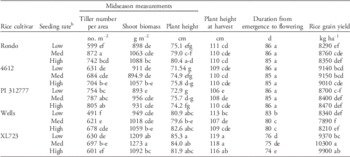
The weed-free growth potential of rice cultivars at the three seeding rates is presented in Table 1 (the sources of variation and P-values are presented in Supplemental Table 1). At the low seeding rate, midseason rice tillering potential (per area basis) was the greatest for PI 312777, the lowest for Wells, and intermediate for the other cultivars (Table 1). Tillering potentials of PI 312777, 4612, and Wells increased with seeding rate (per area basis) and were maximized at the high rate, whereas tillering potentials of XL 723 and Rondo increased to a maximum at the medium rate but declined at the high rate (Table 1). As a general comparison, tillering potentials of PI 312777 and Rondo averaged 18% greater than that of XL742 and Wells, and tillering potentials at the medium and high rates averaged 16% greater than that of the low rate.
Growth traits and yield of Indica and commercial rice cultivars in weed-free plots at three seeding rates in a 2-yr field study.Footnote a

a Values in table are least-squares (LS) means over 2 yr. LS means within columns followed by the same lowercase letter or letters (a–g) are not different according to an LS means test at P≤0.05.
b Low, med, and high seeding rates correspond to 160, 320, and 480 seeds m−2, respectively.
Midseason rice shoot biomass of XL 742 at the low seeding rate was 32% greater than the average of the other four cultivars, whereas at the high seeding rate, biomass was similar for all cultivars (Table 1). As a general comparison, midseason biomass, when averaged over seeding rates, was 27% greater for XL723 than for the average of PI 312777 and 4612, and when averaged over cultivar, was 7.3% greater at the high and medium rates than at the low rate.
The midseason plant height of XL 723 was greatest at the low seeding rate and the lowest at the high rate, whereas the other cultivars exhibited an inverse trend in which plant heights typically were the greatest at the high rate and least at the low (Rondo, 4612, Wells) or medium rate (PI 312777) (Table 1). Generally speaking, midseason rice heights at the high rate averaged 2 cm greater compared with the low rate. At harvest, XL 723 was the tallest and PI 312777 was the shortest cultivar (cultivar main effect, P<0.0001), but the main effect for seeding rate was not significant for harvest height (P=0.124). These harvest height comparisons among cultivars were consistent with earlier experiments in Arkansas in which the allelopathic PI 312777 Indica was shorter than most of the commercial inbred cultivars and hybrids tested and yet maintained high levels of weed suppression (Gealy et al. Reference Gealy, Moldenhauer and Duke2013a, Reference Gealy, Anders, Watkins and Duke2014; Gealy and Yan Reference Gealy and Yan2012). Rice emergence to heading for XL 723 and Wells was 2 to 3 d later at the low seeding rate compared with the high rate but was similar among rates for all other cultivars (Table 1).
All cultivars had similar yield potential at the three seeding rates, except for XL 723, which had a 10% greater yield at the medium rate compared with the low rate (Table 1). Further, yields of XL 723 at the medium rate were greater than for all other cultivars at all seeding rates (Table 1). Generally speaking, average yield potential was greatest for XL723 and lowest for PI 312777, Rondo, and Wells.
Influence of Weeds and Seeding Rates on Rice
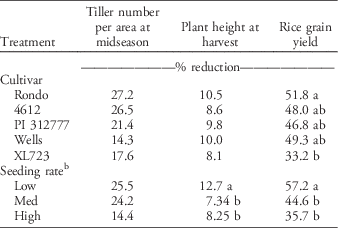
The influence of weeds on rice growth as a percentage reduction compared with weed-free growth is presented for selected traits in Table 2 (the sources of variation and P-values are presented in Supplemental Table 2). Weeds reduced tiller production per area by an average of 25% at the low and medium rate and by 14% at the high seeding rate (P=0.0521), and reduced average harvest heights at the high and medium seeding rates by 7.8%, or nearly 40% less than at the low rate (P=0.0012) (Table 2). The presence of weeds did not affect the time from rice emergence to heading in any meaningful way and changed this parameter less than ±1 d among all cultivars (unpublished data). Weeds reduced yields of XL 723 and Rondo by 33% and 52%, respectively, with the other cultivars being intermediate between these two (P=0.0272; Table 2). The yield reduction by weeds at the medium and high seeding rates averaged 30% lesser than that of the low rate (seeding rate main effect, P<0.0001; Table 2).
Percent reduction of selected growth traits and yield of Indica and commercial rice cultivars due to weeds in weed-infested plots at three seeding rates in a 2-yr field study.Footnote a

a Cultivar by seeding rate interactions were not significant for any “percent reduction” variable, and main effects and interactions at midseason for percent reduction of rice dry weight and percent reduction of rice height were not significant; thus, these data were omitted from the table. Values in table are least-squares (LS) means over 2 yr. Within columns of a given section, LS means followed by the same letter are not different according to an LS means test at P≤0.05. LS means not followed by any letter indicate that the F-test for the mixed model was not significant for the mixed model at P=0.05.
b Low, med, and high seeding rates correspond to 160, 320, and 480 seeds m−2, respectively.
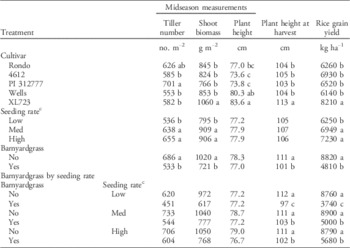
The complete analysis of rice growth traits in weed-infested and weed-free plots is presented in Table 3 (the sources of variation and P-values are presented in Supplemental Table 3). Tiller numbers for PI 312777 were 22% greater than the average of 4612, Wells, and XL 723, with Rondo intermediate between the two groups (cultivar main effect, P=0.006; Table 3). These results are consistent with the relatively greater tillering potential observed in PI 312777 and Rondo from the analysis of weed-free plots (Table 1). Tiller numbers were 21% greater for the average of the medium and high seeding rates than for the low rate (seeding rate main effect, P=0.0010) and were 29% greater for the weed-free than the weedy plots (weed main effect, P<0.0001; Table 3). Midseason rice biomass per area of XL 723 was 29% greater than the average of the other cultivars (cultivar main effect, P=0.0001; Table 3). Rice biomass was 14% greater averaged over the medium and high rates than at the low rate (seeding rate main effect, P=0.042) and was 41% greater in the weed-free than the weedy plots (weed main effect, P<0.0001; Table 3).
Growth traits and yields of Indica and commercial rice cultivars in weed-infested and weed-free plots at three seeding rates in a 2-yr field study.Footnote a , Footnote b

a Values in table are least-squares (LS) means over 2 yr. Within columns of a given section, LS means followed by the same letter are not different according to an LS means test at P≤0.05. LS means not followed by any letter indicate that the F-test for the mixed model was not significant at P=0.05.
b Grain yield values for the cultivar by seeding rate interaction are presented in Figure 1.
c Low, med, and high seeding rates correspond to 160, 320, and 480 seeds m−2, respectively.
Heights of Wells and XL 723 averaged 22% and 10% taller than the three Indica cultivars, respectively, at the pre-flood stage (unpublished data), and at harvest, XL 723 alone averaged 9% taller than the other cultivars (cultivar main effect; Table 3). Rice heights in weed-free and weed-infested plots were similar until the late season, when rice in weed-infested plots was 9% less compared with weed-free plots (weed level main effect; Table 3). At this time, there was also an interaction for weed level by seeding rate in which rice heights in all weed-free plots were similar, but when compared with the weed-infested plots, averaged 14% taller at the low seeding rate and 9% taller at the medium and high seeding rates (Table 3). Emergence to heading for Wells and XL 723 were 5% (4.2 d) and 12.1% (10.3 d) less, respectively, compared with the Indica cultivars (cultivar main effect), and for the medium and high rates, averaged 1.4% (1.2 d) less than for the low rate (seeding rate main effect; unpublished data). Thus, heading date affected suppression or tolerance of weeds minimally.
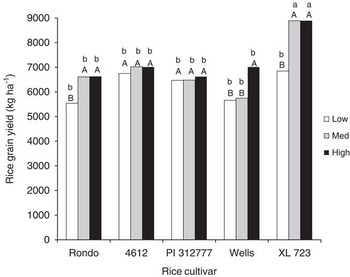
There was an interaction for weed level by seeding rate in which rice yields in all weed-free plots were similar, but when compared with the weed-infested plots, were 136% greater at the low seeding rate and 65% greater at the medium and high seeding rates (Table 3). There was a cultivar by seeding rate interaction in which yield of XL 723 at the medium and high rates was 30% greater compared with the low rate, and its low rate produced a yield similar to that for all other cultivars and rates (Figure 1). Interestingly, the yields of PI 312777 and 4612 were similar (P=0.95 and 0.83, respectively) at all three seeding rates, whereas yields of the other three cultivars increased from the low to high seeding rates (P<0.05) (Figure 1). Thus, PI 312777 and 4612 appeared to tolerate or suppress weeds at the low seeding rate nearly as well as they did at the highest rate, suggesting that these Indica cultivars might not benefit from increased seeding rates. Yields of Wells and Rondo also tended to be very low at the low seeding rate, but were similar to PI 312777 at the high rate, suggesting that Wells and Rondo are relatively intolerant of weed pressure at low seeding densities but are able to benefit substantially from high seeding rates. Most of the difference in yields of XL 723, Wells, and Rondo between low and high seeding rates was attributable to the effects of weeds because, except for XL 723, cultivar yields among the seeding rates were similar in all weed-free plots (Supplemental Figure 1; Supplemental Table 1).
Effect of seeding rate on yield of five rice cultivars. Low, med, and high seeding rates correspond to 160, 320, and 480 seeds m−2, respectively. Values presented on the graph are least-squares (LS) means averaged over the weed-free and weedy plots. LS means accompanied by the same lower case letter are not different according to an LS means test at P≤0.05 and can be compared directly among all combinations of cultivar and seeding rate. LS means within a cultivar accompanied by the same uppercase letter are not different according to an LS means test at P≤0.05. In this analysis, the P-values for Rondo, 4612, PI 312777, Wells, and XL 723 were 0.047, 0.832, 0.946, 0.012, and <0.0001, respectively. Accompanying grain yield data from this analysis for other statistically significant main effects and interactions can be found in Table 3.

The weed level by seeding rate interactions for harvest height and yield apparently occurred in part because they exhibited large differences between weedy and weed-free plots at the low rate but not at the medium and high rates. This suggests that very low seeding rates might be a risky practice for rice in general, particularly when omitting conventional herbicides or curtailing their rates. On the other hand, high seeding rates would appear to be advantageous agronomically for Wells, Rondo, and the XL 723 hybrid, but this practice might not be justified economically, particularly for hybrids, which already demand a high premium in price for seed.
XL 723 might have tolerated weeds and maintained high yields across seeding rates in part because of its hybrid vigor, superior early shoot biomass, greatest mature plant height, and ability to grow tall in weedy plots (Table 3). Although Wells was the tallest cultivar earlier in the season, it did not exhibit the other beneficial traits mentioned for XL 723. For the cultivar main effect, yields of XL 723 were greater than all other cultivars; for the seeding rate main effect, yields at the medium and high seeding rates averaged 10% greater compared with the low rate; and for the weed level main effect, yield in the weed-free plots was 83% greater than in weedy plots (Table 3).
In an earlier work, Zhao et al. (Reference Zhao, Atlin, Bastiaans and Spiertz2006) showed that traits measured in weed-free and weedy plots in aerobic rice culture often were well correlated. Estimating broad-sense heritabilities of vegetative and harvest traits and their genetic correlation with weed biomass and yield under weed competition, they found that crop vigor 2 to 6 wk after seeding (WAS), canopy ground cover 6 WAS, height at 3 to 4 WAS, tillers per plant at 4 and 8 WAS, vegetative crop biomass at 4 and 9 WAS, and plant erectness at 3 WAS under weed-free conditions were positively correlated with yield in weed-infested plots, and negatively correlated with weed biomass. Generally, traits associated with rapid accumulation of seedling biomass were strongly associated with weed suppression and yield under weed competition. In those studies, weed-free yield and early vigor were used in a selection index that explained 89% and 48% of variation for yield and weed biomass, respectively, under weed competition. Vigor rating and plant height at 4 WAS also were useful selection criteria.
Influence of Rice on Weeds
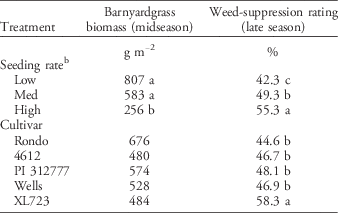
The influence of rice cultivar and seeding rate on barnyardgrass plants at approximately maximum biomass is presented in Table 4 (the sources of variation and P-values are presented in Supplemental Table 4). Barnyardgrass biomass was similar among cultivars, but at the high seeding rate was 68% less compared with the low rate, with an average biomass across all seeding rates of 549 g m−2 (Table 4). The weed biomass across seeding rates for all species other than barnyardgrass averaged only 1.6% that of barnyardgrass (not significant at P=0.05 for this or other main effects or interactions; unpublished data), indicating that barnyardgrass was by far the most dominant weed species in these studies.
Barnyardgrass biomass and weed-suppression rating at three rice seeding rates in a 2-yr field study.Footnote a

a Data were recorded from weed-infested rice plots at peak barnyardgrass biomass production. The total biomass of all other weed species averaged 9 g m−2 across all seeding rates and cultivars and was not significant at P=0.05 for any of the main effects or interactions. Values in table are least-squares (LS) means over 2 yr. Within columns of a given section, LS means followed by the same letter are not different according to an LS means test at P≤0.05. LS means not followed by any letter indicate that the F-test for the mixed model was not significant at P=0.05.
b Low, med, and high seeding rates correspond to 160, 320, and 480 seeds m−2, respectively.
Weed suppression by XL723 was 58.3%, which was 25 percentage points greater compared with the other cultivars, which averaged 46.6% suppression (Table 4). Averaged over all cultivars, weed suppression increased from 42% at the low seeding rate to 55% at the high rate (Table 4). As a general comparison, when considering all combinations of cultivar and seeding rate, average weed-suppression ratings ranged from 37% for Rondo at the low rate to 68% for XL723 at the high rate (P=0.0851; unpublished data). Consistent with the above results, reduction in rice yield relative to the weed-free check ranged from 66% for Rondo at the low seeding rate to 20% for XL723 at the high rate (unpublished data). PI 312777 and 4612, which averaged an increase of only 8% in weed suppression from the low to high seeding rate, exhibited greater stability in suppression across seeding rates compared with the other cultivars, which averaged 48% increased suppression (P=0.039 for cultivar by rate interaction [data not shown]; Table 4).
The trend in rice yield for the seeding rate by weed level interaction typically followed those for visual weed-suppression ratings (Table 4), with an average increase of 3.2% for PI 312777 and 4612 as seeding rates increased from lowest to highest, compared with a 24% increase for the other cultivars (Table 3). Thus, trait(s) associated with the PI 312777 and 4612 Indica cultivars enable them to produce relatively high yields in weed-infested plots, even at low seeding rates. These observations for PI 312777 are consistent with the allelopathic activity (Fang et al. Reference Fang, He, Wang, Qiu, Wang, Zhuang, Xiong and Lin2010; Kong et al. Reference Kong, Li, Hu, Xu and Wang2006, Reference Kong, Hu, Wang and Wu2008; Seal and Pratley Reference Seal and Pratley2010; Song et al. Reference Song, Xiong, Fang, Qiu, Lin, Liang and Lin2008) and high-tillering potential (Gealy et al. Reference Gealy, Moldenhauer and Duke2013a, Reference Gealy, Moldenhauer and Jia2013b, Reference Gealy, Anders, Watkins and Duke2014; Gealy and Yan Reference Gealy and Yan2012) that are thought to contribute to its weed-suppressive activity. Development of weed-suppressive, allelopathic cultivars have been increasingly pursued as a potential supplement or replacement for conventional weed control (Chen et al. Reference Chen, Hu and Kong2008; Gealy et al. Reference Gealy, Wailes, Estorninos and Chavez2003, Reference Gealy, Moldenhauer and Jia2013b; Ho et al. Reference Ho, Lin, Smeda, Leigh, Wycoff and Fritschi2014; Khanh et al. Reference Khanh, Zuan and Chung2007; Kong et al. Reference Kong, Chen, Hu and Zhang2011; Ma et al. Reference Ma, Shin, Lee, Koh, Park and Kim2006; Worthington and Reberg-Horton Reference Worthington and Reberg-Horton2013; Xuan et al. Reference Xuan, Eiji, Shinkichi and Khanh2004).
Key Correlations among Rice and Weed Traits
In the present study, the difference between rice yields in weed-free and weedy plots was negatively correlated with midseason rice shoot biomass in weedy plots (r=−0.54), visual weed-suppression ratings (r=−0.79), and rice harvest height in weedy plots (r=−0.69), and positively correlated with late-season barnyardgrass biomass in weedy plots (r=0.57) (Supplemental Table 5). Further, visual weed-suppression ratings were highly correlated with rice yield in weed-infested plots (r=0.85) but not with the yield in the associated weed-free plots (r=0.18), suggesting that yield performance under weed pressure might be a better indicator of weed-suppression ability compared with that in a weed-free environment.
In general, rice produced the fewest tillers and the lowest biomass at the low seeding rate (Table 3). These results indicate that at low seeding rates, even the high-tillering or allelopathic cultivars did not consistently provide weed suppression or maintain high yields in the presence of uncontrolled weed pressure, suggesting that overall, medium to high planting rates will continue to be necessary for consistent weed suppression in reduced herbicide–input systems. In terms of yield and weed suppression, XL723 performed well compared with the other cultivars at all seeding rates. Further, its midseason biomass potential was high compared with the other cultivars, particularly at the low seeding rate (Table 1). By comparison, PI 312777 tended to produce the most tillers at all seeding rates, while tillering of XL 723 was lower (Tables 1 and 3). Thus, in these experiments, rapid and early production of high biomass appears to have been more important for yield and weed suppression than was tillering ability.
A previous study in which pregerminated rice was sown on puddled fields showed that initial biomass, biomass at tillering, crop growth rate, and leaf area index of rice affected competitiveness against weeds, with the rice biomass at tillering being the best predictor of competitiveness (Ni et al. Reference Ni, Moody, Robles, Paller and Lales2000). However, relative growth rate and tillering capacity of rice were not associated with weed competitiveness in that study. Their findings agree with the present study, in that XL 723 typically exhibited the greatest midseason shoot biomass (Tables 1 and 3) and the greatest weed suppression (Table 4). Compared with XL 723, PI 312777 produced greater tiller numbers and less biomass at midseason and less yield and weed suppression (Tables 1, 3, and 4; Figure 1).
Consistent with the results of the present study (Tables 1 and 3), in a comparison of rice cultivars under two irrigation regimes and a range of herbicide rates, Gealy et al. (Reference Gealy, Anders, Watkins and Duke2014) showed that PI 312777 and a commercial hybrid produced the greatest yields and weed suppression in both irrigation systems, and among “nonsuppressive” commercial cultivars, Wells and ‘Bengal’ yielded the most. They also found that weed suppression by PI 312777 and the hybrid under “medium” herbicide inputs was similar to that of cultivars with poor weed suppression at the “high” herbicide input level, suggesting that some weed-suppressive cultivars might be able to compensate for suboptimal herbicide inputs or incomplete weed control.
Chauhan et al. (Reference Chauhan, Singh, Kumar and Johnson2011) demonstrated that rice density, tiller number, and biomass increased linearly with rice seeding rate in the presence and absence of weeds, and weed biomass decreased with increasing seeding rates from 15 to 125 kg ha−1. Models predicted that seeding rates of 48 to 80 kg ha−1 for inbred cultivars and 47 to 67 kg ha−1 for hybrid cultivars maximized grain yields in weed-free plots, whereas higher rates (95 to 125 kg ha−1 for inbreds; 83 to 92 kg ha−1 for hybrids) were needed to maximize yields in competition with weeds. They concluded that rice seeding rates greater than 80 kg ha−1 would be advantageous where risks of severe weed competition are great. However, such high seeding rates might be too expensive when seed costs are high, and considerations other than maximum yield would be needed for recommendations that optimize economic returns. In the present study, we observed similar trends, in that increased seeding rate often increased rice tiller number and yield (Tables 1 and 3; Figure 1 [PI 312777 and 4612 being exceptions for yield]) and the level of weed suppression (Table 4) and reduced the depression in yield and tiller numbers caused by weeds (Table 2).
Zhao et al. (Reference Zhao, Bastiaans, Atlin and Spiertz2007) found that increasing seeding rates of aerobic rice from 100 to 300 viable seeds m−2 increased yield and decreased weed biomass, whereas a further increase to 500 seeds m−2 did not improve yield or weed suppression. The greater weed-suppressive ability of a suppressive genotype appeared to be due to stronger competition by individual plants and more rapid canopy closure compared with other genotypes.
Using natural weed infestations and cowpea [Vigna unguiculata (L.) Walp.] (‘KVx396-18’) as a substitute weed, Saito and Futakuchi (Reference Saito and Futakuchi2014) measured “weed” biomass approximately 2 mo after planting as an indicator of weed-suppression activity (WSA) in weed-suppressive upland rice. Finding that rice WSA was heritable for both substitute and natural weeds and was associated with higher biomass accumulation, they concluded that substitute weeds might be an efficient alternative for selecting improved WSA in rice. Simulation models have been used to show that greater weed competitiveness of rice was due mainly to a greater relative leaf area growth rate early in the season and larger maximum plant height (Bastiaans et al. Reference Bastiaans, Kropff, Kempuchetty, Rajan and Migo1997).
This study revealed several interesting contrasts among the cultivar types tested. Overall, PI 312777 produced the most tillers, whereas XL 723 exhibited the greatest midseason shoot biomass and the greatest weed suppression. However, yields of PI 312777 and 4612 changed minimally across all seeding rates when compared with the other cultivars. Thus, these two cultivars tolerated weeds at the low rate nearly as well as at the high rate. Our results indicate that although the high seeding rate generally did not improve weed suppression or yield of PI 312777 or 4612, yields of the conventional inbred cultivar and commercial hybrid appeared to benefit from the high seeding rate. Moderate to high seeding rates are thus likely to remain essential for consistent weed suppression for all of the cultivar types tested. The difference between rice yields under weed-free and weedy conditions was negatively correlated with midseason rice shoot biomass, visual weed-suppression ratings, and rice harvest height in weedy plots, suggesting that these traits might be useful in identifying cultivars with enhanced weed suppression. Visual suppression ratings were positively correlated with rice yield within weedy plots, suggesting that yield performance under weed pressure might be a better indicator of weed-suppression ability compared with that under weed-free conditions.
Acknowledgments
The authors thank Howard Black and Bill Luebke, U.S. Department of Agriculture Agricultural Research Service, Dale Bumpers National Rice Research Center, for their contributions to this research project. Mention of a trademark or proprietary product does not constitute a guarantee or warranty of the product by the USDA or the University of Arkansas and does not imply its approval to the exclusion of other suitable products. The USDA is an equal opportunity provider and employer.
Supplementary material
For supplementary material/s referred to in this article, please visit https:/doi.org/10.1017/wsc.2017.24