Icacinaceae Miers are a family of trees, shrubs, and lianas with a pantropical distribution. This family has been traditionally characterised by having two pendulous ovules (with only one reaching maturity), drupaceous fruits, hermaphroditic flowers, and simple leaves (Kårehed Reference Kårehed2001). However, the lack of clear synapomorphic characters has led to confusion regarding the taxonomy and phylogeny of the family. Indeed, Icacinaceae s.l. included about 54 genera and 400 species classified mostly by wood characters (Engler Reference Engler, Engler and Prantl1897; Sleumer Reference Sleumer and Engler1942). Since the beginning of the 21st Century, multiple phylogenetic studies focused on morphology and molecular data (Soltis Reference Soltis2000; Kårehed Reference Kårehed2001; Lens et al. Reference Lens, Karehed, Baas, Jansen, Rabaey, Huysmans, Hamann and Smets2008; Byng et al. Reference Byng, Bernardini, Joseph, Chase and Utteridge2014; Stull et al. Reference Stull, Duno de Stefano, Soltis and Soltis2015) have greatly clarified Icacinaceae phylogeny, leading to the recognition of a reduced circumscription of the family, including 23 genera and about 160 species. This clade, along with Oncothecaceae Kobuski ex Airy Shaw, is included in the newly recognised order Icacinales (APG 2016), which is sister to all other lamiids (Stull et al. Reference Stull, Duno de Stefano, Soltis and Soltis2015).
Icacinaceae s.s. is well known in the fossil record, especially from the Palaeogene of Europe (Reid & Chandler Reference Reid and Chandler1933; Chandler Reference Chandler1961a, Reference Chandlerb, Reference Chandler1962; Collinson Reference Collinson1983; Knobloch & Mai Reference Knobloch and Mai1986; Cleal et al. Reference Cleal, Thomas, Batten and Collinson2001; Fairon-Demaret & Smith Reference Fairon-Demaret and Smith2002) and North America (Crane et al. Reference Crane, Manchester and Dilcher1990; Manchester Reference Manchester1994, Reference Manchester1999; Pigg & Wher Reference Pigg and Wher2002; Pigg et al. Reference Pigg, Manchester and DeVore2008; Rankin et al. Reference Rankin, Stockey and Beard2008; Stull et al. Reference Stull, Moore and Manchester2011, Reference Stull, Herrera, Manchester, Jaramillo and Tiffney2012; Allen et al. Reference Allen, Stull and Manchester2015). A few records of Icacinaceae have also been reported from South America (Stull et al. Reference Stull, Herrera, Manchester, Jaramillo and Tiffney2012), the Middle East (Soudry & Gregor Reference Soudry and Gregor1997), Africa (Chandler Reference Chandler1954; Chester Reference Chester1955), and Japan (Tanai Reference Tanai1990). Although the fossil record of Icacinaceae includes a notable diversity of genera, the modern genus Iodes is perhaps the most diverse and abundantly represented (excluding the unnatural form genus Icacinicarya). Fruits of modern and fossil Iodes are characterised by an elliptical to globulose shape, an external reticulate pattern, a papillate layer on the inner endocarp surface (locule wall), and the presence of a vascular bundle running from the base to the apex, embedded in the endocarp wall.
Here we describe five species of Icacinaceae fossil endocarps from the late Palaeocene Rivecourt deposit (Oise, France). An initial report on the flora and fauna from the Rivecourt outcrop was presented by Smith et al. (Reference Smith, Rose and Gingerich2014). The present work provides a detailed treatment of Icacinaceae fossils from this outcrop. This represents the first detailed study of Icacinaceae from the Paris Basin, and will be followed by other studies focused on other sites from the basin, which, with the exception of a work on Menispermaceae (Jacques & De Franceschi Reference Jacques and De Franceschi2005), remains understudied in terms of its palaeocarpology.
All the species present in Rivecourt possess the diagnostic characters of the genus Iodes, as described below. Therefore, we generated a key including the fossils from Rivecourt and all other described fossil species of Iodes to aid in the differentiation and identification of fossil Iodes. Moreover, we propose a new combination for Iodes israelii Soudry & Gregor, Icacinicarytes israelii (Soudry & Gregor) Del Rio, Thomas & De Franceschi, because this fossil species lacks the diagnostic morphological and anatomical characters of Iodes. The significance of papillae (i.e., small bumps lining the locule wall) has already been discussed for Iodes fossils from several sites. We propose here a standardisation in terminology of this character in accordance with new data observed on the Rivecourt fossils. A potential link between the late Palaeocene flora of Europe and the modern Asian flora is suggested, based on morphological similarities shared between the fossils presented here and modern species from Asia.
1. Material and methods
1.1. Material
The lignitic fossil specimens were collected from the Rivecourt site (Oise, France) in 2009 and 2012, from lignitic sandy layers of fluvial to fluvio-estuarine deposits. These deposits date from the late Palaeocene (MP6b about 57–56Ma; Smith et al. Reference Smith, Rose and Gingerich2014). Among numerous other plant macrofossils mainly preserved as lignitic, carbonised, or piritised material, about 70 nearly complete endocarps as well as some lignitic fragments assigned to Icacinaceae were collected. Herbarium samples examined for comparison are listed in Appendix 1.
1.2. Method of collection
Almost all specimens were collected by screen washing of fossiliferous sediments on meshes of 5, 2, and 1mm and density-separated from the denser mineralised material in water. The lignite obtained was then washed with tap water and dried in a ventilated oven at 45°C. Sorting was done using binocular microscopes (Mantis Elite). The specimens are kept in plastic boxes with renewed silica gel. All samples are stored at the Muséum national d'Histoire naturelle of Paris for study and will be held at the Musée Vivenel in Compiègne (Oise, France) for permanent storage.
1.3. Method of observation
All specimens were studied with a binocular microscope (Wild M3Z) and imaged with a Leica DFC 420 camera. Measurements were taken using ImagJ Software (Rasband Reference Rasband2016). Cell diameters and papillae were measured ten times for each species, using random selections of the specimens. Samples were coated with gold-palladium for examination by Scanning Electron Microscopy (SEM), using a Jeol JCM6000 instrument, facilitating observation of anatomical features, especially the endocarp wall layers and papillae.
2. Results
2.1. Systematics
All fossils presented here share the common features of Icacinaceae: globular to elliptical shape, bilateral endocarp with asymmetrical apex, presence of a keel surrounding the endocarp, and single-seeded fruit. Moreover, they are consistent with the genus Iodes in possessing a reticulate pattern formed by longitudinal and vertical ridges (which delimit polygonal areoles), a vascular bundle embedded in the wall of the endocarp, papillae on the inner endocarp surface, and a pair of subapical horn-like protrusions (which are present in some, but not all, modern species of Iodes). Additional anatomical and morphological characters permit the differentiation and description of five new species.
The most differentiated endocarp walls are composed of four cell layers of one or several successive cell rows. The outermost cell layer is identified as the ‘apical sclerotic layer,' the second as the ‘isodiametric cell layer,' the third as the ‘basal sclerotic layer,' and the last as the ‘locule epiderma layer.' We follow the same nomenclature for all wall preservations, regardless of their layer development and position (in cases of absence or reduction). We sometimes found seeds in broken endocarps with remnant testa, suggesting that some unbroken specimens might also contain seeds. With a beige colour and a soft texture, these seeds demonstrate the high quality of the lignitic preservation at Rivecourt and a chemical study focused on seeds is in progress.
Icacinaceae Miers
Genus Iodes Blume
Iodes sinuosa Del Rio, Thomas & De Franceschi, sp. nov.
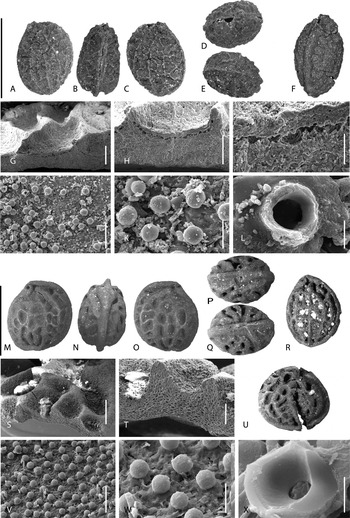
(a–l) Iodes sinuosa sp. nov. (a–e) Holotype specimen (Riv. PPB 157): (a) lateral view of endocarp showing the reticulum pattern of sharp and sinuous ridges; (b) dorsal view showing the keel, open in the middle, surrounding the fruit; (c) lateral view of second face of endocarp; (d) apical view showing the small pair of horns; (e) basal view; (f) lateral view of specimen deformed Riv. PPB 190; (g) SEM view of reticulum of sinuous ridges of Riv. PPB 146; (h) same SEM view with magnification showing wall layers and ridges in transversal section; (i) detail showing the apical sclerotic layer in outermost cell layer, the isodiametric cell layer, and the beginning of the basal sclerotic layer; (j–l) SEM view of sessile, rounded papillae of Riv. PPB 146 in different magnifications. (m–x) Iodes parva sp. nov. (m–q) Holotype specimen (Riv. PPB 188): (m) lateral view of endocarp showing the reticulum of rounded ridges with sub-apical horns; (n) dorsal view showing the keel surrounding the fruit; (o) lateral view of second face of endocarp; (p) apical view showing the pair of horns; (q) basal view; (r) lateral view of Riv. PPB 139; (s) SEM view of endocarp Riv. PPB 18, wall and ridges forming areoles; (t) same SEM view with magnification under wall in transverse section; (u) lateral view of Riv. PPB 165; (v–x) SEM view of sessile, rounded papillae of Riv. PPB 18 in different magnifications. Scale bars=5mm (a–f, m–r, u); 200μm (g, h, s–t); 50μm (i, j, v); 20μm (k, w); 5μm (l, x).

Diagnosis. Endocarp elliptical with reticulate pattern of sharp, thin, and sinuous ridges, which delimit about 16–17 polygonal areoles on each lateral face with few or no freely ending ridgelets. Endocarp possessing a symmetrical pair of horn-like protrusions compressed on the keel, positioned eccentrically and subapically. Endocarp wall 0.22–0.24mm thick and 0.35–0.39mm thick with ridges. Inner endocarp surface densely covered with regularly spaced and sessile, rounded papillae. Length of endocarp: 4.65–5.3mm; width about 3.66mm.
Etymology. ‘sinuosa' refers to the sinuous pattern of the ridges on the endocarp surface.
Holotype. Riv. PPB 157.
Stratigraphy. Late Palaeocene.
Type locality. Rivecourt (Oise, France).
Paratypes. Riv. PPB 146, Riv. PPB 147, Riv. PPB 190.
Description. Endocarp bilaterally symmetrical, unilocular, single-seeded, elliptical, lenticular in transverse section; length 4.65–5.3mm, avg. 4.97mm (standard deviation (SD)=0.61, n=2), width 3.66mm, thickness 2.49mm; outer part of endocarp covered with a reticulate pattern of sharp, thin, and sinuous ridges with 3–4 irregular longitudinal ridges, which delimit 16–17 polygonal areoles on each lateral face with few or no freely ending ridgelets; a keel surrounds the fruit in the plane of symmetry, with the thicker margin containing a vascular bundle embedded in the endocarp wall. Endocarp possessing a symmetrical pair of horn-like protrusions compressed on the keel, positioned eccentrically and subapically on the endocarp faces, with each protrusion containing a central pit or channel. Endocarp wall 0.22–0.24mm thick without ridges, avg. 0.23mm (SD=0.03, n=2), and 0.35–0.39mm thick with ridges, avg. 0.37mm (SD=0.02, n=2). Wall composed of four unicellular and multicellular cell layers, the outermost corresponding to an apical sclerotic layer of two or three cells thick, difficult to distinguish, sometimes absent due to erosion on the areoles showing the layer in one row of isodiametric cells; cells 0.022–0.036mm in diameter (Riv. PPB 146), the basal sclerotic layer forms much of the thickness of the endocarp wall and is composed of numerous cells. Inner endocarp surface densely covered with regularly spaced and sessile, rounded papillae, which correspond to the cell expansions of the locule epiderma layer with interdigitated cells; papillae diameter 0.011–0.015mm (Riv. PPB 146 and Riv. PPB 147); the number of papillae per 0.25mm2 is 600 (Riv. PPB 146).
Remarks. This species is represented by four lignitic endocarps and a few fragments. It is very distinctive from the other species in having sharp, sinuous, and small ridges (Fig. 1g, h), a short overall endocarp length (Fig. 1a–f), and a high density of sessile, rounded papillae (Fig. 1j–l). Iodes sinuosa differs from I. eocenica, I. brownii and I. corniculata in its relatively short length and width. It is close to I. acutiformis in terms of overall length, ridge sharpness, and papillae morphology. Iodes sinuosa has a more obtuse and asymmetrical apex and a more elliptical endocarp. Also, the horn-like protrusions do not exceed the endocarp in the lateral view in this new species, in contrast to specimens of I. acutiformis (see, in particular, Chandler Reference Chandler1962, pl. 13, fig. 1h). Thus, we consider these two species to be closely related but with consistent differences allowing for their separation. The cell wall layer is well preserved (Fig. 1h) with four distinctive unicellular and multicellular layers. This corresponds to the most differentiated wall of the Iodes from Rivecourt's site. Considering that the wall is complete and undamaged, the sharpness of the ridges is considered a genuine taxonomic feature rather than a consequence of taphonomic degradation. Indeed, we do not recognise any abrasion on the external or internal endocarp wall. The inner surface shows papillae in anatomical position (Fig. 1j, k).
Iodes parva Del Rio, Thomas & De Franceschi, sp. nov.
Diagnosis. Endocarp elliptical to globulose with a reticulate pattern of rounded and thin to large ridges, which delimit 11–20 polygonal areoles on each lateral face, with a few or no freely ending ridgelets. Endocarp possesses a symmetrical pair of horn-like protrusions compressed on the keel, positioned eccentrically and subapically. Endocarp wall 0.16–0.26mm thick and 0.4–0.56mm thick with ridges. Inner endocarp surface densely covered with regularly spaced and sessile, rounded papillae. Length of endocarp: 4.38–6.05mm; width of endocarp: 3.49–5.19mm.
Etymology. ‘parva' refers to the small size of the endocarp.
Holotype. Riv. PPB 188.
Stratigraphy. Late Palaeocene.
Type locality. Rivecourt (Oise, France).
Paratypes. Riv. PPB 18, Riv. PPB 131, Riv. PPB 139, Riv. PPB 148, Riv. PPB 153, Riv. PPB 158, Riv. PPB 162, Riv. PPB 165, Riv. PPB 189.
Additional specimens. Riv. PPB 129, Riv. PPB 130, Riv. PPB 132, Riv. PPB 133, Riv. PPB 134, Riv. PPB 135, Riv. PPB 136, Riv. PPB 142, Riv. PPB 143, Riv. PPB 168, Riv. PPB 184, Riv. PPB 192.
Description. Endocarp bilaterally symmetrical, unilocular, single-seeded, elliptical to globulose, lenticular in transverse section; length 4.38–6.05mm, avg. 5mm (SD=0.49, n=7), width 3.49–5.19mm, avg. 4.34mm (SD=0.63, n=7), thickness 2.6–3.53mm, avg. 3.06mm (SD=0.65, n=2); outer part of endocarp with reticulate pattern of rounded and thin to large ridges with 4–6 longitudinal ridges, which delimit 11–20 polygonal areoles on each lateral face with a few or no freely ending ridgelets; a keel surrounds the fruit in the plane of symmetry, with the thicker margin containing a vascular bundle embedded in the endocarp wall. Endocarp possessing a symmetrical pair of horn-like protrusions compressed on the keel, positioned eccentrically and subapically on the apical endocarp, faces each with a central pit; endocarp wall 0.16–0.26mm thick without ridges, avg. 0.21mm (SD=0.04, n=3), and 0.4–0.56mm thick with ridges, avg. 0.51mm (SD=0.07, n=3). Wall composed of three unicellular and multicellular cell layers, the outermost correspond to a layer in one row of isodiametric cells, cells 0.039–0.047mm in diameter (Riv. PPB 158). The basal sclerotic layer forms much of the thickness of the endocarp wall and is composed of 12–14 periclinal cells 0.023–0.031mm high and 0.041–0.054mm wide (Riv. PPB 18). The inner endocarp surface is densely covered by regularly spaced, minute, and sessile, rounded papillae, which correspond to cell expansions of the locule epiderma (uni-stratified layer) with interdigitated cells; papillae diameter 0.010–0.014mm (Riv. PPB 158 and Riv. PPB 18), the number of papillae per 0.25mm2 is 510–1060 (Riv. PPB 158 and Riv. PPB 18).
Remarks. Nine uncompressed specimens, preserved as lignite, represent this species. Additional compressed specimens are assigned to Iodes parva because of the similarity of the anatomical characters, even if they are compressed in the plane of symmetry and, thus, wider and generally fragmented. These differences appear to be due to taphonomic processes. Note that almost all fragmented specimens come from the same trench in the Rivecourt site, perhaps indicating a local accumulation or preservation bias. Iodes parva differs from the other species in having a small endocarp size (Fig. 1m–r, u), rounded thin to large ridges (Fig. 1s, t), and a high density of sessile, rounded papillae (Fig. 1v, w). In particular, I. parva differs from other previously described fossil species by the combination of small endocarp size (compared to I. corniculata, I. eocenia, and I. brownii) and rounded ridges (compared to I. acutiformis and I. sinuosa). This species is perhaps closely related to I. corniculata from the London Clay given their similar pattern of ridges and number of areoles. The first layer of the endocarp wall corresponds to the isodiametric cell layer. These specimens have lost their apical sclerified layer and a part of the isodiametric cell layer. Inside the areoles we can find some remains of this lost apical sclerotic layer but the majority of the exterior endocarp is composed of isodiametric and digitate cells (Fig. 1s, t). The measure of the wall is, therefore, biased and underestimated, which can explain the differences between thin and large ridges between individuals. The basal sclerotic layer of the wall is very well preserved. We show cells with a very thick wall organised in layers (Fig. 1t), from which an upper part is composed of anticlinal cells in order to form the ridges, while the lower part remains periclinal. The locule epidermal layer is preserved with papillae in its anatomical place, very similar to I. sinuosa (Fig. 1v, w).
Iodes reidii Del Rio, Thomas & De Franceschi, sp. nov.
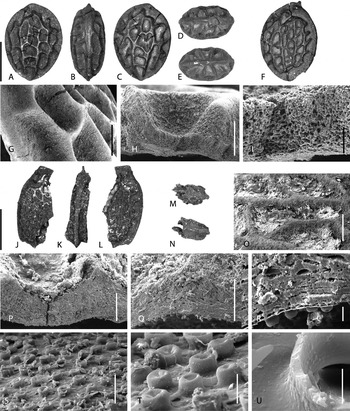
(a–i) Iodes reidii sp. nov. (a–e) Holotype specimen (Riv. PPB 138): (a) lateral view of endocarp showing the reticulum of rounded ridges, which delimit deep areoles, with sub-apical horns; (b) dorsal view showing the keel surrounding the fruit; (c) lateral view of second face of endocarp; (d) apical view showing the pair of horns; (e) basal view; (f) lateral view of Riv. PPB 191 specimen; (g) SEM view of reticulum of Riv. PPB 160; (h) same SEM view with focus on wall in transverse section; (i) detail showing small wall. (j–u) Iodes tubulifera sp. nov. (j–n) Holotype specimen (Riv. PPB 141): (j) lateral view of endocarp showing the sub-apical horns and the reticulum of sharp ridges; (k) dorsal view showing the keel surrounding the fruit; (l) lateral view of second face of endocarp; (m) apical view showing the pair of horns; (n) basal view. (o) SEM view of reticulum ridges. (p) Transverse section of wall showing layers. (q) Detail of cell preservation. (r) Same SEM view with magnification showing basal sclerotic layer and locule epiderma layer with papillae. (s–u) SEM view of tubular papillae in different magnifications. Scale bars=5mm (a–f, j–n); 1mm (g); 200μm (h, p, q); 100μm (i); 500μm (o); 20μm (r, t); 50μm (s); 5μm (u).

Diagnosis. Endocarp elliptical with a reticulate pattern of angular to rounded and thin ridges, which delimit 9–19 polygonal areoles on each lateral face, with few or no freely ending ridgelets. Endocarp possesses a symmetrical pair of horn-like protrusions compressed on the keel, positioned eccentrically and subapically. Endocarp wall 0.25–0.27mm thick and about 0.8mm thick with ridges. Length of endocarp: 9.2–10.8mm; width of endocarp: 6.68–7.55mm.
Etymology. This species is named in memory of Eleanor M. Reid, for her important contributions to Palaeobotany, particularly Palaeocarpology.
Holotype. Riv. PPB 138.
Stratigraphy. Late Palaeocene.
Type locality. Rivecourt (Oise, France).
Paratypes. Riv. PPB 154, Riv. PPB 160, Riv. PPB 191.
Description. Endocarp bilaterally symmetrical, unilocular, single-seeded, elliptical, laterally compressed in the plane of symmetry, lenticular in transverse section; length 9.2–10.8mm, avg. 9.85mm (SD=0.84, n=3), width 6.68–7.55mm, avg. 7.21mm (SD=0.4, n=4), thickness 2.9–4.6mm, avg. 3.75mm (SD=0.8, n=4); outer part of endocarp with reticulate pattern of angular to rounded and thin ridges with 4–5 longitudinal ridges, which delimit 9–19 polygonal areoles on each lateral face, with few or no freely ending ridgelets; a keel surrounds the fruit in the plane of symmetry, with the thicker margin containing a vascular bundle embedded in the endocarp wall. Presence of a symmetrical pair of horn-like protrusions compressed on the keel, positioned eccentrically and subapically on the apical endocarp faces, each with a central pit; endocarp wall 0.25–0.27mm thick without ridges and 0.8mm thick with ridges. Wall contains two unicellular and multicellular cell layers. The outermost corresponds to a layer in one row of isodiametric cells, cells 0.025–0.036mm in diameter (Riv. PPB 160 and Riv. PPB 138). The basal sclerotic layer forms the bulk of the thickness of the endocarp wall and is composed of 12–13 anticlinal rows of isodiametric, thin, walled cells, 0.012–0.022mm high, 0.022–0.040mm wide (Riv. PPB 160). Inner endocarp surface degraded.
Remarks. Four lignitic specimens represent this species. One of them is transversally broken on the basal part (Riv. PPB 160). This species differs from the other species by the smaller size of the endocarp wall and cell walls and the larger size of the thin ridges, which form deep areoles (Fig. 2g–i), as well as the overall large size of the endocarp (Fig. 2a–f). Endocarps of Iodes reidii differ from those of I. corniculata in being slightly longer, with a more elliptical shape, a more acute base, and horn-like protrusions that seem to be more compressed on the keel (see Reid & Chandler 1933, pl. 14, 35–36). They also differ from I. brownii in having a thinner wall, an apex that is less acute, and horn-like protrusions that seem to be more compressed on the keel. Nevertheless, I. brownii was described from specimens on shale-sand siltstones, making a direct comparison with specimens on lignitic sediments difficult. Iodes reidii differs from I. eocenica by its smaller length and width. For all of these reasons we decided to describe a new species, acknowledging its close affinities with I. brownii and I. corniculata. The endocarp wall is abraded on the outermost and on the innermost parts. The apical sclerotic layer and locule epidermal layer are lost in the broken specimen (Fig. 2h). We did not find papillae on the inner surface of the wall (missing layer), but we consider this a result of taphonomic degradation or tearing (see Section 3). The cell walls of the basal sclerotic layer are very thin compared to the cells of I. parva and I. tubulifera.
Iodes tubulifera Del Rio, Thomas & De Franceschi, sp. nov.
Diagnosis. Endocarp elliptical with a reticulate pattern of sharp and thin ridges, which delimit at least 21 polygonal areoles on each lateral face, with few or no freely ending ridgelets. Endocarp possessing a symmetrical pair of horn-like protrusions prominent (i.e., not compressed) on the keel, positioned eccentrically and subapically. Endocarp wall 0.26mm thick and 0.38mm thick with ridges. Inner endocarp surface densely covered with regularly spaced and tubular papillae. Length of endocarp about 10mm.
Etymology. ‘tubulifera' refers to tubular morphology of the papillae on the inner surface of endocarp.
Holotype. Riv. PPB 141.
Stratigraphy. Late Palaeocene.
Type locality. Rivecourt (Oise, France).
Description. Endocarp bilaterally symmetrical, unilocular, single-seeded, elliptical, laterally compressed in the plane of symmetry; length 10mm, width unknown (estimated about 6mm), thickness 2.08mm; outer part of endocarp with reticulate pattern of sharp and thin ridges with at least five irregular longitudinal ridges, which delimit at least 21 polygonal areoles on each lateral face with few or no freely ending ridgelets; a keel surrounds the fruit in the plane of symmetry, with the thicker margin containing a vascular bundle embedded in the endocarp wall and the other part thin. Endocarp possessing a symmetrical pair of horn-like protrusions prominent from the keel, positioned eccentrically and subapically on the apical endocarp faces, each with a central pit; endocarp wall 0.26mm thick without ridges and 0.38mm thick with ridges. Wall composed of four layers of one or several successive cell rows, the outermost correspond to an apical sclerotic layer, cells difficult to distinguish, sometimes absent by erosion on the areoles, which show the isodiametric, uni-stratified cell layer, cells 0.040–0.069mm in diameter. The basal sclerotic layer forming the bulk of the endocarp wall's thickness is composed of 6–8 sclerotised and periclinal cell rows 0.013–0.031mm high, 0.034–0.081mm wide. Inner endocarp surface densely covered with regularly spaced, minute, and tubular papillae, which correspond to a cell expansion of the locule epiderma layer in one row of interdigitated cells; papillae diameter 0.016–0.019mm, about 270 papillae per 0.25mm2.
Remarks. This species is represented by a single specimen (Fig. 2j–n). The specimen is longitudinally broken; thus, the width is not known. It differs from the others in having sharp ridges, a thin endocarp wall (Fig. 2p–r), and low, dense, tubular papillae (Fig. 2s–u). The horns are prominent compared to the keel (Fig. 2j), to a greater extent than other species from this deposit but similar to Iodes brownii and I. corniculata (Reid & Chandler Reference Reid and Chandler1933; Allen et al. Reference Allen, Stull and Manchester2015). However, I. tubulifera differs from both species by its sharp ridges and tubular papillae. The wall is irregularly preserved; one part is differentiated into four layers like I. sinuosa (Fig. 2p), but without a good preservation of the cells, while another part lacks complete layers, but with good cellular preservation (Fig. 2q).
Iodes rivecourtensis Del Rio, Thomas & De Franceschi, sp. nov.
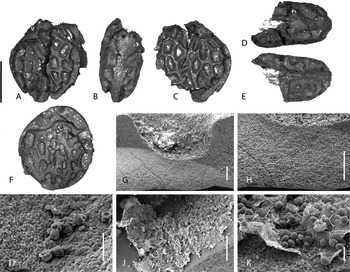
Iodes rivecourtensis sp. nov. (a–e) Holotype specimen (Riv. PPB 156): (a) lateral view of endocarp showing the sub-apical horn and a reticulum of large ridges; (b) dorsal view showing the keel surrounding the fruit; (c) lateral view of second face of endocarp; (d) apical view showing the pair of horns; (e) basal view. (f) Lateral view of Riv. PPB 170 showing the sub-apical horn and a reticulum of particular large ridges. (g) SEM view of endocarp wall and ridges of Riv. PPB 145 in transverse section. (h) Detail showing cell preservation. (i) SEM view of tubular papillae of Riv. PPB 194. (j) SEM view of testa remaining for Riv. PPB 187. (k) Same SEM view with magnification showing papillae present on the testa. Scale bars=5mm (a–f); 200μm (g, h, j); 20μm (i, k).

Diagnosis. Endocarp elliptical to globulose with a reticulate pattern of rounded and large ridges, which delimit 8–22 polygonal areoles on each lateral face, with few or no freely ending ridgelets. Endocarp possessing a symmetrical pair of horn-like protrusions compressed on the keel, positioned eccentrically and subapically. Endocarp wall 0.32–0.7mm thick without ridges and 0.38–1.59mm thick with ridges. Inner endocarp surface densely covered with regularly spaced and tubular papillae. Length of endocarp: 8.2–12.04mm; width of endocarp: 6.2–9.9mm.
Etymology. ‘rivecourtensis' refers to the Rivecourt locality, where these numerous fossils were found.
Holotype. Riv. PPB 156.
Stratigraphy. Late Palaeocene.
Type locality. Rivecourt (Oise, France).
Paratypes. Riv. PPB 19, Riv. PPB 128, Riv. PPB 137, Riv. PPB 140, Riv. PPB 145, Riv. PPB 149, Riv. PPB 150, Riv. PPB 151, Riv. PPB 152, Riv. PPB 155, Riv. PPB 161, Riv. PPB 163, Riv. PPB 164, Riv. PPB 166, Riv. PPB 167, Riv. PPB 169, Riv. PPB 170, Riv. PPB 171, Riv. PPB 172, Riv. PPB 173, Riv. PPB 174, Riv. PPB 175, Riv. PPB 176, Riv. PPB 178, Riv. PPB 179, Riv. PPB 182, Riv. PPB 183, Riv. PPB 185, Riv. PPB 186, Riv. PPB 187, Riv. PPB 193, Riv. PPB 194, Riv. PPB 195, Riv. PPB 196, Riv. PPB 197.
Description. Endocarp bilaterally symmetrical, unilocular, single-seeded, often well preserved, with testa remains, elliptical to globulose, laterally compressed in the plane of symmetry; length 8.2–12.04mm, avg. 9.2mm (SD=0.83, n=21), width 6.3–9.9mm, avg. 9.1mm (SD=0.99, n=13), thickness 2.76–5.9mm, avg. 4.05mm (SD=0.82, n=16); outer part of endocarp with reticulate pattern of rounded and large ridges with 4–6 longitudinal ridges, which delimit 8–22 polygonal areoles on each lateral face, with few or no freely ending ridgelets; a keel surrounds the fruit in the plane of symmetry, with the thicker margin containing a vascular bundle embedded in the endocarp wall. Presence of a symmetrical pair of horn-like protrusions compressed on the keel, positioned eccentrically and subapically on each endocarp face, each with a central pit; endocarp wall 0.32–0.7mm thick without ridges, avg. 0.5mm (SD=0.1, n=24), and 0.38–1.59mm thick with ridges, avg. 1.19mm (SD=0,23, n=23). Wall composed of three layers of one or several successive cell rows, the outermost corresponds to the layer in one row of isodiametric cells, cells 0.015–0.046mm in diameter (13 specimens). The basal sclerotic layer forms the bulk of the thickness of the endocarp wall and is composed of numerous sclerotised cells. Inner endocarp surface is densely covered with regularly spaced, minute, and tubular papillae, which correspond to cell expansions of the locule epidermal layer, with papillae often apparent on the testa; papillae diameter 0.013–0.017mm (Riv. PPB 140), 126–260 papillae per 0.25mm2. Testa with rectangular to polygonal cells, 0.016–0.024mm in diameter.
Remarks. This species is the most abundantly represented at the Rivecourt site, with 36 specimens. It differs from the other species in having large ridges; they represent almost an area wider than that of the areoles (Fig. 3a–f). This species also has a very thick wall and thick ridges (Fig. 3g, h). Endocarps of this species differ from Iodes corniculata by their greater length and width, their larger ridges, their more compressed horn-like protrusions, and their denser papillae. These features also distinguish I. rivecourtensis from I. brownii, but I. rivecourtensis also has a notably thicker endocarp wall, with papillae showing a smaller diameter. Finally, endocarps of I. rivecourtensis differ from those of I. eocenica by their smaller length and width and their denser reticulum pattern on the endocarp surface. Seeds are well preserved, with remains of testa. The first wall layer corresponds to the second one in I. sinuosa. The basal sclerotic layer is composed of numerous sclerotised, intermixed cells (Fig. 3h). The inner surface of the endocarp is generally incomplete due to abrasion, with a few tubular papillae in anatomical place (Fig. 3i). Indentations from the papillae are generally present on the testa (Fig. 3j, k), providing a good indication of the original position of the papillae. However, the shape, diameter, and density are difficult to appreciate on testa (see general discussion).

2.2. Key of fossil species attributed to the genus Iodes
The previous key highlights the differences between Iodes fossil species found in the literature and those described in this study. Rivecourt species are shown in bold.
3. General discussion
3.1. Species included in the key
The key is restricted to fossils traditionally assigned to the modern genus Iodes in the literature and especially in a recent revision (Stull et al. Reference Stull, Neil, Manchester, Sykes and Collinson2016): we agree that the doubtful specimen Iodes israelii (Soudry & Gregor Reference Soudry and Gregor1997) should be excluded from the genus Iodes. The specimen does not possess the features diagnostic of Iodes: presence of vascular bundle embedded in the wall of endocarp and papillae on the inner surface (locule) of the endocarp. The specimen has no anatomically preserved structures. For all these reasons, we transfer the species to the genus Icacinicaryites Pigg, Manchester & DeVore, which encompasses endocarps ‘resembling Icacinocarya but lacking anatomical detail needed for more precise assignment' (Pigg et al. Reference Pigg, Manchester and DeVore2008).
Icacinicaryites israelii (Soudry & Gregor) Del Rio, Thomas & De Franceschi comb. nov.; basyonym: Iodes israelii Soudry & Gregor (Reference Soudry and Gregor1997).
We included Croomiocarpon mississippiensis in this key because it shares numerous features with Iodes, including the presence and position of a vascular bundle. The specimen has no papillae, but this is likely a result of abrasion (see the following discussion of the anatomical significance of papillae). Croomiocarpon perhaps should be considered as a synonym of Iodes. However, the huge size of the specimen and the substantial thickness of the endocarp wall may justify a different genus name.
Iodes eocenica is included in the key as a species with horn-like protrusions because we can observe these structures in the illustration of this species in Figure 13, Plate 15 (Reid and Chandler Reference Reid and Chandler1933). This feature is additionally noted in the legend of the Reid and Chandler figure.
3.2. Anatomical significance of papillae
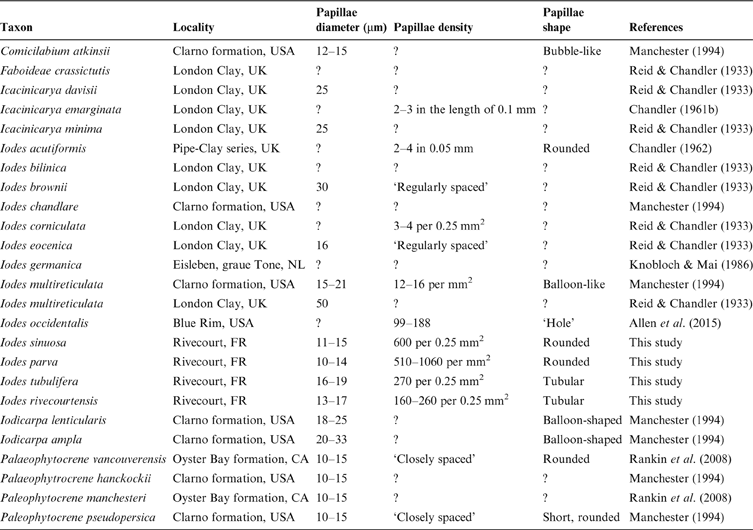
The density and size of the papillae are commonly included in descriptions of Icacinaceae endocarp fossils (Table 1). However, due to a lack of preservation, these characters are often difficult to observe. In the literature, densities were measured in several ways: following a line, within a defined area, or by simple descriptions such as ‘regularly spaced' or ‘closely spaced.' The first mention of this feature is found in Reid & Chandler (Reference Reid and Chandler1933) for Iodes corniculata, presented as the number of papillae per 0.25mm2. More recently, this character formulation was used by Allen et al. (Reference Allen, Stull and Manchester2015) for I. occidentalis. Likewise, we also recommend using this original metric (number of papillae per 0.25mm2) when the fossil is fairly well preserved for a measure of the density.
Comparative table of papillae features of Icacinaceae endocarp fossils

For the new species from Rivecourt, we found a higher density than in all other publications. For example, both Iodes corniculata and I. multireticulata (sensu Manchester Reference Manchester1994) have 3–4 papillae per 0.25mm2. We suppose that the small number of papillae could be explained by taphonomic bias or miscalculation. Additionally, the testa in some cases might tear the inner surface of the endocarp, which supports the papillae (Fig. 3j, k). This tearing might explain the lack of papillae for some specimens in the literature, e.g., Croomiocarpon mississippiensis (Stull et al. Reference Stull, Moore and Manchester2011). The species I. rivecourtensis seems to be a good illustration of this phenomenon. We found the highest densities of papillae in cavities that appeared to be protected from tearing (Fig. 3i). The analysis of the intact testa on the preserved seed shows papillae, but unfortunately not the entire density, which leads to an underestimation of the original density. It is possible to calculate an approximation of the original density by measuring the distance from the closest neighbouring papilla for each papilla. In fact, it seems that all preserved locular epidermal cells potentially wear a papilla and the distance could be estimated as the distance between the centre of two neighbouring cells.
The size of papillae always seems to be between 10 and 20μm. Indeed, we found for the most well-preserved anatomical specimens (Paleophytocrene vancouverensis, P. pseudopersica, Iodicarpa lenticularis, and species from this study) a very similar result. Reid & Chandler (Reference Reid and Chandler1933) measure 50μm for the papillae of Iodes multireticulata, but, according to Manchester's comment (Manchester Reference Manchester1994), these measures might correspond to the hole that is left by the tearing of the papillae. Likewise, the measure of the papillae in Iodes brownii (30μm) is based on the same type of measurement. Furthermore, the size of papillae is difficult to measure on the testa of the seeds because the traces left by the papillae are generally bigger than the original structures.
For a few specimens, the shape of the papillae is defined in the literature. In all articles describing this feature, we found the same general shape, with differences in the papillae elevation. Chandler was the first to use the term ‘rounded' for the shape of the papillae for Iodes acutiformis, while Manchester used terms such as ‘bubble-like,' ‘balloon-like,' ‘balloon-shaped,' or ‘short rounded' for species from the Clarno formation. We suggest using the words ‘sessile, rounded' for the papillae without elevation (Fig. 1j, k, v, w). We designated the new term ‘tubular' for papillae with parallel sides and flattened apex. This type of papilla is evident in well-preserved specimens of I. tubulifera (Fig. 2s–u) and in less well-preserved specimens of I. rivecourtensis (Fig. 3i–k). Generally, this shape is wider than the short, rounded shape, and sparser (Figs 1j–l, 2s–u). Furthermore, the wall of the papillae, visible in broken examples, is less thick in tubular form than short, rounded form (Fig. 2u).
3.3. Biogeographical significance of horns
The fossil species described here are considered a part of the modern genus Iodes. Reid & Chandler (Reference Reid and Chandler1933) highlighted the affinities of Iodes corniculata with the modern species I. africana.
The modern genus Iodes is present in Africa (Boutique Reference Boutique and Robyns1960; Villiers Reference Villiers, Aubréville and Leroy1973), Indo-Malaysia (Sleumer Reference Sleumer and Van Steenis1971; Peng & Howard Reference Peng, Howard, Zhengyi and Raven2008), and Madagascar (De La Bâthie Reference De La Bâthie and Humbert1952). Like Stull et al. (Reference Stull, Neil, Manchester, Sykes and Collinson2016), we did not find any horns on the living African species (Fig. 4a, b), but we did find them on several Indo-Malaysian species, such as Iodes cirrhosa (Fig. 4c, d). These horns are very close to those of I. tubulifera, I. brownii, and I. corniculata; additionally, all species from the Rivecourt Palaeocene site had this feature. According to this shared feature, we suggest a close affinity between the Palaeocene fossil species and modern Asian Iodes. Affinities between Palaeogene European and present Asian floras and faunas are indicated in several studies (Wolfe Reference Wolfe1975; Smith et al. Reference Smith, Rose and Gingerich2006, Reference Smith, Quesnel, De Plöeg, De Franceschi, Métais, De Bast, Solé, Folie, Boura, Claude, Dupuis, Gagnaison, Iakovleva, Martin, Maubert, Prieur, Roche, Storme, Thomas, Tong, Yans and Buffetaut2014), suggesting that modern Indo-Malaysian flora and fauna could be a relict area. A migration of this Iodes group to North America during the Paleocene-Eocene Thermal Maximum (Wolfe Reference Wolfe1975; Manchester Reference Manchester1999), corresponding to tropical habitat expansion (Wing et al. Reference Wing, Harrington, Smith, Bloch, Boyer and Freeman2005), seems likely and would explain the link between I. corniculata and I. brownii (Allen et al. Reference Allen, Stull and Manchester2015).
(a) Lateral view of Iodes klaineana, showing reticulum pattern of ridges; (b) same in apical view, showing the apical hole; (c) lateral view of Iodes cirrhosa, showing sub-apical horn and two major ridges; (d) same in apical view, showing pair of horns. Scale bars=5mm (a, c); 1mm (b, d).

Complete morphological and phylogenetic studies are needed on this clade and other related genera to elucidate the biogeographic history of this group. New fossils from other sites of the Paris Basin, still under study, could also show new character combinations and lead to more accurate biogeographical interpretations.
4. Acknowledgements
We thank Lafarge Granulats for logistical help in carrying out the excavation on the Rivecourt site, the Musée Vivenel for allowing study of the fossil specimens, and the staff of the Paris Herbarium (MNHN P) for the loan of modern endocarp samples and access to herbarium sheets. We thank Gregory Stull for improving the English. This work was supported by a grant from Agence Nationale de la Recherche under the LabEx ANR-10-LABX-0003-BCDiv, in the program ‘Investissements d'avenir' n_ANR-11-IDEX-0004-02 and by the CR2P.
5. Appendix 1. Modern fruit material examined for this study
Herbarium samples examined for comparison are listed below, including the following information: voucher number, locality, date of collection, and bar code of herbarium (P).
Iodes. I. africana Welw. Ex Oliv., A. Bouquet 833, Massia (Congo), 1964, P03951922; I. cirrhosa Turcz., B. Hayata 672, unknown, 1921, P06672331; I. klaineana Pierre, R. P. Klaine 3064, environs de Libreville (Gabon), 1902, P04472306.