Introduction
The climate change arising in parallel with the increase in consumption rates across all sectors disrupts traditional water cycles by causing irregular weather events, leading to prolonged droughts in some regions and intense rainfall in others. This disruption threatens water resources in terms of quantity and quality, jeopardizing food security and the sustainability of ecosystems. Human activities such as excessive pumping of groundwater, unconscious use of surface water, deforestation and urbanization further strain water resources. To address these challenges, emergency measures are crucial. In a proportional analysis of sectoral water usage worldwide, the largest share is typically held by the agricultural sector, often around 70 % (Wallace, Reference Wallace2000; Velasco-Muñoz et al., Reference Velasco-Muñoz, Aznar-Sánchez, Belmonte-Ureña and Román-Sánchez2018; McNabb, Reference McNabb2019). Especially in Asian countries, rice irrigation accounts for up to 90 % of total water consumption, while in Africa and the Mediterranean basin, limited water resources make the implementation of sustainable irrigation practices even more critical (Arouna et al., Reference Arouna, Dzomeku, Shaibu and Nurudeen2023). In this context, implementing strict water conservation policies, promoting efficient irrigation techniques, selecting correct strategies for water management and investing in smart irrigation technologies are fundamental steps, especially in agriculture. One of the primary measures to be taken in agriculture is to change water usage strategies for crops such as rice, which have high water consumption, and adopt them based on physical and economic indicators (Lampayan et al., Reference Lampayan, Rejesus, Singleton and Bouman2015; Graham-Acquaah et al., Reference Graham-Acquaah, Siebenmorgen, Reba, Massey, Mauromoustakos, Adviento-Borbe and Baltz-Gray2019; Samoy-Pascual et al., Reference Samoy-Pascual, Lampayan, Remocal, Orge, Tokida and Mizoguchi2022; Mallareddy et al., Reference Mallareddy, Thirumalaikumar, Balasubramanian, Naseeruddin, Nithya, Mariadoss, Eazhilkrishna, Choudhary, Deiveegan, Subramanian, Padmaja and Vijayakumar2023; Vallejo-Gomez et al., Reference Vallejo-Gomez, Osorio and Hincapie2023).
The manageability and controlled use of irrigation water in agriculture has become easier with the development of irrigation methods. The use of pressurized irrigation methods, which maximize irrigation water savings, is increasing worldwide and especially in Turkey. In many studies, it has been highlighted that drip irrigation methods in rice irrigation can save 22–52 % of irrigation water and that water saved can be used to irrigate more land (Soriano et al., Reference Soriano, Dou, Tabien, Harper and Chen2016; Bhardwaj et al., Reference Bhardwaj, Prajapati, Chaturvedi, Singh, Soman, Bhardwaj and Labh2018; Parthasarathi et al., Reference Parthasarathi, Vanitha, Mohandass and Vered2018; Mallareddy et al., Reference Mallareddy, Thirumalaikumar, Balasubramanian, Naseeruddin, Nithya, Mariadoss, Eazhilkrishna, Choudhary, Deiveegan, Subramanian, Padmaja and Vijayakumar2023). However, many studies have shown that yield losses (14–40 %) occur due to the reduction in irrigation water (Sharda et al., Reference Sharda, Mahajan, Siag, Singh and Chauhan2017; Demirel et al., Reference Demirel, Çamoğlu, Tatar, Nar, Boran, Eroğlu and Genç2020; Çebi et al., Reference Çebi, Özer, Öztürk, Aydın and Çakır2023; Çolak Reference Çolak2021; Yu et al., Reference Yu, Dai, Wei, Wang, Liao and Cui2024). Although the initial investment costs of pressurized irrigation methods (drip irrigation, sprinkler irrigation) are high, these systems are more easily applicable in rice farming due to reasons such as the system’s long-term usability, low labour and irrigation costs, high irrigation efficiency, no levelling expenses and ease of harvesting operations (Ram et al., Reference Ram, Kamboj and Sharma2024). The traditional rice irrigation practice known as continuous flooding maintains water consistently at a certain depth on the soil surface. Therefore, one of the most crucial inputs in paddy farming is the supply and management of irrigation water. Advances in technology have made irrigation water more controllable, leading to significant savings, particularly through pressurized methods. This efficiency in water use is crucial for expanding agricultural land and ensuring sustainable farming practices (Arouna et al., Reference Arouna, Dzomeku, Shaibu and Nurudeen2023; Çebi et al., Reference Çebi, Özer, Öztürk, Aydın and Çakır2023; Yu et al., Reference Yu, Dai, Wei, Wang, Liao and Cui2024).
Studies conducted worldwide on rice indicate that the seasonal water requirement for rice ranges between 788 to 4355 mm (Tuong and Bouman, Reference Tuong and Bouman2003; Lampayan and Bouman, Reference Lampayan and Bouman2005; Tuna Reference Tuna2012; Çebi et al., Reference Çebi, Özer, Öztürk, Aydın and Çakır2023). Research (Shahanila, Reference Shahanila2015; Shaibu et al., Reference Shaibu, Banda, Makwiza and Malunga2015; Soriano et al., Reference Soriano, Dou, Tabien, Harper and Chen2016; Bhardwaj et al., Reference Bhardwaj, Prajapati, Chaturvedi, Singh, Soman, Bhardwaj and Labh2018; Carrijo et al., Reference Carrijo, Akbar, Reis, Li, Gaudin, Parikh and Linquist2018; Singh et al., Reference Singh, Prajapati and Bhardwaj2018) is still ongoing on reducing irrigation water in rice cultivation using alternative wetting and drying (AWD) technique and aerobic cultivation techniques including pressurized irrigation methods. Many studies show that AWD and drip irrigation can save 30–57 % water compared to CF, while yield losses remain minimal, typically between 2–10 % (Mallareddy et al., Reference Mallareddy, Thirumalaikumar, Balasubramanian, Naseeruddin, Nithya, Mariadoss, Eazhilkrishna, Choudhary, Deiveegan, Subramanian, Padmaja and Vijayakumar2023; Yu et al., Reference Yu, Dai, Wei, Wang, Liao and Cui2024). These innovative approaches have demonstrated success in balancing water conservation with maintaining or even increasing productivity.
Assessing irrigation water efficiency requires a dual focus on physical and economic indicators. Physically, metrics such as water use efficiency (WUE), soil moisture monitoring and evapotranspiration rates are pivotal for optimizing water use in crop production. Economically, factors such as the cost of water per unit area, return on investment in irrigation infrastructure and economic yield per unit of water used provide insights into the financial viability of irrigation practices. (Le Grusse et al., Reference Le Grusse, Mailhol, Bouaziz, Zairi, Raki, Chabaca and Ruelle2009; Darouich et al., Reference Darouich, Pedras, Gonçalves and Pereira2014; Loureiro et al., Reference Loureiro, Beceiro, Moreira, Arranja, Cordeiro and Alegre2023; Mallareddy et al., Reference Mallareddy, Thirumalaikumar, Balasubramanian, Naseeruddin, Nithya, Mariadoss, Eazhilkrishna, Choudhary, Deiveegan, Subramanian, Padmaja and Vijayakumar2023). By integrating these indicators, stakeholders can make informed decisions to improve water productivity, ensure sustainable agriculture and address challenges related to water scarcity and food security (Russo et al., Reference Russo, Alfredo and Fisher2014; Assouline et al., Reference Assouline, Russo, Silber and Or2015; Nepal et al., Reference Nepal, Neupane, Koirala, Lautze, Shrestha, Bhatt and Khadka2024; Su and Singh, Reference Su and Singh2024).
Relatively limited research has examined the physical and economic performance of AWD and drip irrigation in rice cultivation simultaneously. This study aims to contribute to this area by providing evidence from a major rice-producing region experiencing acute water scarcity. In this study, conducted in a region where water resources are significantly insufficient in quantity and quality, and where 51 % of the country’s rice production is carried out under anaerobic conditions, for rice crop, alongside traditional irrigation practices, drip and AWD irrigation methods are used to 1) create aerobic conditions, 2) approach anaerobic conditions by applying water exceeding field capacity and to determine the effects of all these strategies on rice yield and quality. Additionally, the aim is to select the appropriate strategy using economic indicators alongside physical indicators.
Materials and method
Experimental site characteristics
The research was conducted in 2015, 2016 and 2017 at the Atatürk Soil, Water and Agricultural Meteorology Research Institute, located 4 km west of Kırklareli province, in the northern part of the Marmara Region. Kırklareli, situated at 41°42′ North latitude and 27°14′ East longitude in the Yıldız (Strandja) Mountains and Ergene Plain areas of the Marmara Region, is at an elevation of 203 m above sea level. In the field where the experiment was carried out, the texture class at 0–60 cm soil depth is sandy loam, 60–90 cm sandy clay loam and 90–120 cm sandy clay. Soil samples were collected from various layers of the experimental plot to assess certain soil chemical properties, including pH, EC and organic matter, as well as physical properties such as soil texture, field capacity, wilting point and bulk density in both disturbed and undisturbed samples (Table 1). Field capacity and wilting point were found to be 377 and 174 mm/90 cm, respectively. The irrigation water used in the experiment was obtained from a deep well in the field and Water samples were analysed using the methods outlined by Richards (Reference Richards1954). Key characteristics of the water used in the study are summarized below in Table 2. The irrigation water used in the experiment was class C3S1.
Some soil properties of the experimental site

SL: Sandy loam; SCL: Sandy clay loam; SC: Sandy clay, EC: Electrical conductivity.
Irrigation water properties of the experimental site

EC: Electrical conductivity; Na+: sodium ion; K+: potassium ion; Ca2+: calcium ion; Mg2+: magnesium ion; Cl−: chloride ion; CO3−2: carbonate ion; HCO3−: bicarbonate; SO4 −2: sulphate ion; C3A1: Water classification according to EC and SAR values (Richards Reference Richards1954).
In the study, ‘Osmancık 97’ paddy variety, which has 90 % cultivation area in the region, high germination rate, production permit, drought resistant, resistant to diseases (Fusarium verticillioides) and high yield (7–10 t/ha), was used. The plant height is around 95–100 cm, sturdy stem and resistant to lodging, the grains are yellow and long and the thousand grain weight is 32–34 g. Medium early and ripening period is 130–140 days. In the study, rice cultivation was carried out using a grain drill machine at a rate of 170 kg/ha of rice seeds. Fertilization was applied in three equal parts (sowing, during the tillering period and during the heading period) at a rate of 60 kg/ha of pure nitrogen as ammonium sulphate using a fertigation system in drip irrigation. In the AWD and continuous flood irrigation methods, the same amount of fertilizer was applied using the spreader method. In the study, two applications of herbicide were made on narrow-leaved (two-leaf stage of weeds) weeds and one on broad-leaved weeds (two-leaf stage of weeds).
In the study, sowing and harvesting were conducted in the 2015, 2016 and 2017 trial years of the study on 05 June and 08 October; 30 May and 14 October; 16 May and 04 October, respectively.
Experimental design
The research was carried out in a Split-Plot design with three replications in randomized blocks. In the experiments, the main treatments were irrigation methods (D: Drip Irrigation, AWD: Alternate wetting and drying) and the sub-treatments were irrigation levels (I1: When soil moisture was around field capacity, 25 % of the water between the saturation point and field capacity was applied, I2: When 25 % of the available water holding capacity was consumed, water was applied up to the field capacity). In addition, in order to make pairwise comparisons, 3 replicate plots were formed for the continuous flooded irrigation method, which is traditionally practiced in the region, except for the factorial experimental design. The area of each experimental plot was 25.0 m2.
In the drip irrigation system; 50 mm outer diameter hard polyethylene (PE) pipes were used for the main pipeline; 16 mm outer diameter soft PE pipes were used for manifold pipelines and 16 mm diameter soft PE pipes with in-line drippers whose intervals and flow rate were determined according to the infiltration rate of the soil were used for laterals. The dripper flow rate was selected as 2 L/h. The dripper spacing and lateral spacing were found to be 0.60 m by field tests (Keller and Bliesner, Reference Keller and Blisner1990).
In the traditional flooded irrigation method and AWD irrigation application; trial plots were levelled and surrounded with 30 cm high dykes, water application was given to the parcels by controlling with a water meter from the manifolds to which water would be brought until the beginning of the field. Irrigation water applications were made according to the determined irrigation subjects.
Irrigation management
In drip irrigation methods, the first 30 cm of soil was kept at the saturation point level until the germination-emergence period was completed. After seed germination was complete, irrigation began 37, 32 and 33 days after sowing due to low air temperatures during the germination phase (∼15°C) and the variety’s long development period (130–140 days) respectively (Table 3). In drip irrigation and AWD application, the irrigation time was determined based on the moisture tension in the soil. These changes were monitored with tensiometers for each 30 cm layer. The net irrigation water applied to I1 and I2 subjects were calculated by using the equations given in 1 and 2, respectively.
 $${d_{nI1}} = \left[ {{{\left( {SP - FC} \right){\rm{*}}0.25} \over {100}}} \right]{\rm{*}}{\gamma _t}{\rm{*}}\,D$$
 $${d_{nI2}} = \left[ {{{\left( {SP - FC} \right){\rm{*}}0.25} \over {100}}} \right]{\rm{*}}{\gamma _t}{\rm{*\,D}}$$
dn: Net amount of irrigation water to be applied in each irrigation, mm, SP: Saturation point %, FC: Field capacity, %.
 ${\gamma _t}$
: Bulk density, g/cm3. D: Effective root depth, mm, values.
In the traditional continuous flooded method, the first 0–30 cm of the soil was kept nearly saturated until the end of the germination-emergence period. After germination-emergence, water was applied at a constant depth (height) of 5 cm until the end of the irrigation season. All irrigations were terminated approximately 2 weeks before harvest.
The total water consumption of the paddy plant was based on the sum of applied irrigation water (I, mm) and rainfall (Reff, mm) using Equation 3 (Tabbal et al. Reference Tabbal, Bouman, Bhuiyan, Sibayan and Sattar2002; Parthasarathi et al., Reference Parthasarathi, Mohandass, Senthilvel and Vered2013; Naik et al., Reference Naik, Reddy, Sreenivas and Rani2015; Ramulu et al., Reference Ramulu, Rao, Devi, Kumar and Radhika2016; Bhardwaj et al., Reference Bhardwaj, Prajapati, Chaturvedi, Singh, Soman, Bhardwaj and Labh2018; Çebi et al., Reference Çebi, Özer, Öztürk, Aydın and Çakır2023). The productivity of water is determined by the following Equations 4 and 5.
 $${\rm{Total \,water \,applied}} = \rm{I + R}$$
 $${\rm{W}}{{\rm{P}}_{\left( {\rm{I}} \right)}} = {\rm{Y}}/{\rm{I}}$$
 $${\rm{W}}{{\rm{P}}_{({\rm{I }} + {\rm{ R}})}} = {\rm{Y}}/\left( {{\rm{I}} + {\rm{R}}} \right)$$
where WP(I): Irrigation water-based water productivity (kg/m3), WP(P + I): WP based on irrigation water + precipitation total (kg/m3). Y: Grain yield (t/ha), I: Seasonal irrigation water (mm). (I + R): The sum of the irrigation water applied to the subjects and seasonal rainfall during the irrigation season (mm).
Yield and yield components
The crop was harvested on October 8 in the first year of the study, on October 14 in the second year and on October 4 in the third year, when 80 % of the grains had a straw colour. Each trial plot was harvested by hand, the harvested plants were dried and thrown into the grain sorting machine to separate the grains, stems, carobs, etc. It was separated from the plant parts.
In order to obtain quality values such as plant height, harvest index, thousand grain weight, milled efficiency, Head yield (%) from each parcel, 10 plants were taken and the necessary counting operations were carried out. Milled efficiency was determined by processing 100 g of brown rice (husked grain) through a yield machine to obtain milled rice (Yaşar Paddy Testing Machine, CRM 125-2T). The weight of the milled rice was measured using a scale with 0.01 g precision, and the percentage of milled efficiency was calculated.
Economic analysis
Total production costs consist of variable and fixed costs. Variable costs comprise labour, machinery, seeds, fertilizers, agricultural chemicals, the annual maintenance and repair expenses of the irrigation system and working capital interest, whereas fixed costs consist of general administrative expenses, land rent, irrigation system investment, depreciation and interest. In the study, to obtain the gross production value, the harvested product quantity was multiplied by the product’s sale price. The following formula were used on the calculation of net profit (Açıl and Demirci, Reference Açıl and Demirci1984; Kıral et al., Reference Kıral, Kasnakoğlu, Tatlıdıl, Fıdan and Gündoğmuş1999). Productivity, defined as the output per unit of input over a specific period (Sadoulet and Janury, Reference Sadoulet and De Janury1995), has been calculated in three ways in Equations 7–9.
 $${\rm{Net \,profit}} = {\rm{Gross \,production }}-{\rm{ Production \,costs}}$$

 $${\rm{Net \,factor \,productivity }} = {\rm{ }}\left( {{\rm{Net \,profit}}} \right){\rm{/}}\left( {{\rm{Production \,costs}}} \right)$$
 $${\rm{Economic \,Water \,Productivity }} = {\rm{ NPavg/Iavg}}$$
where EWP is Economic water productivity (US$/m3), NPavg is the net profit of three years average yield (US$/ha), Iavg is the three-year average irrigation (m3/ha).
Statistical analysis
Analysis of variance was used to determine the level of differences between the yield and yield components obtained from the trial subjects, least significant difference (LSD) test was used to classify the differences, and the relationships between irrigation water and plant water consumption and the mentioned yield components were evaluated by regression equations according to the principles given in Steel and Torrie (Reference Steel and Torrie1980); Yurtsever (Reference Yurtseven1984).
Results
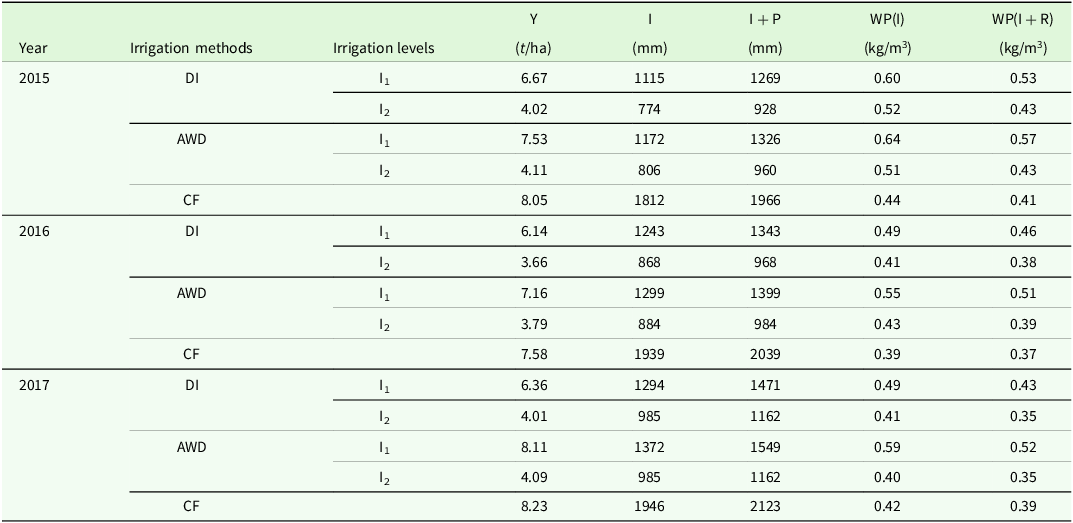
The soil was left saturated until germination and emergence were completed and all treatments received 148 mm of irrigation water in 2015, 166 mm in 2016 and 158 mm in 2017. The amount of irrigation water applied differed depending on the treatment and the year. For drip irrigation, the total water applied was 1115 mm (I1) and 774 mm (I2) in 2015, 1243 mm (I1) and 868 mm (I2) in 2016 and 1294 mm (I1) and 985 mm (I2) in 2017. For AWD, the total water applied was 1172 mm (I1) and 806 mm (I2) in 2015, 1299 mm (I1) and 884 mm (I2) in 2016 and 1372 mm (I1) and 984 mm (I2) in 2017. In contrast, traditional flooded irrigation received 1812 mm, 1939 mm and 1946 mm of water in 2015, 2016 and 2017, respectively (Table 4).
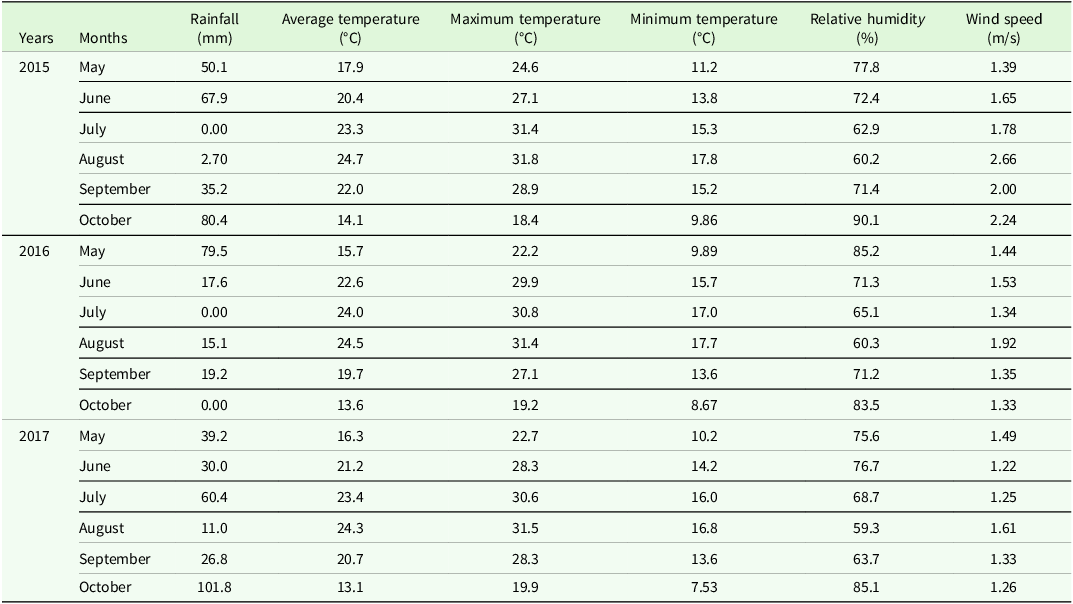
Weather data for the research years

Water use characteristics by irrigation treatments for the years of 2015, 2016 and 2017

DI: Drip irrigation, AWD: Alternative wetting-drying, CF: Continuous flooded irrigation; I1: Application of water equal to 25 % of the water between the saturation point and field capacity when the soil moisture was near field capacity, I2: Application of water to field capacity when 25 % of the available water holding capacity was depleted; Y: Yield, I: Irrigation, WP: Water productivity.
Irrigation WP(I) and WP (I + R) values were between 0.39–0.64 kg/m3 and 0.37–0.59 kg/m3 in different irrigation methods in 2015, 2016 and 2017. In all 3 years, the very low values WP(I) and WP(I + R) values were found in continuous flooded irrigation.
Yield and yield components
The grain yield values obtained from the research treatments varied according to the irrigation method and the amount of irrigation water and these values are given in Table 4. As a result of the homogeneity test (Table 5) between the years, homogeneity was achieved and the years were combined (Table 4). When the trial results of the research in 2015 were evaluated in terms of yield, the average yield was 8.05 t/ha in the continuous flooded irrigation treatments, 6.67 t/ha in the I1 subject of drip irrigation method and 7.53 t/ha in the I1 subject of AWD irrigation, The same way, the average yield was 7.58, 8.23 t/ha in the continuous flooded irrigation treatments, 6.14, 6.36 t/ha in the I1 subject of drip irrigation method and 7.16, 8.11 t/ha in the I1 subject of AWD treatments in 2016 and 2017, respectively.
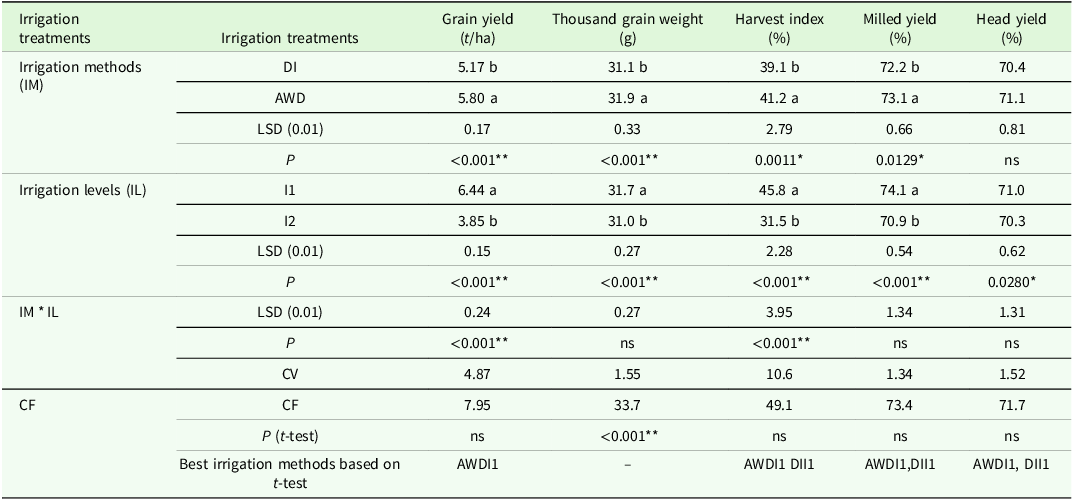
The lowest yields were found in the DI I2 subject with the lowest irrigation water in all 3 years of the experiment. In three years of the experiment, the significantly between irrigation methods, irrigation levels and irrigation method × irrigation levels interactions were statistically significant at p < 0.01 level in terms of yield. The grain yield obtained from the most productive AWDI1 treatment was used in the t-test process with CF and there was no statistical difference between them (Table 6).
Statistical test summary for homogeneity of variance for experimental characteristics by years

DFNum: Degrees of freedom for the synthesised nominator; DFDen: Degrees of freedom for the synthesised denominator.
Combined analysis of variance (ANOVA) based on years for average grain yield and yield components

DI: Drip irrigation, AWD: Alternative wetting-drying, CF: Continuous flooded irrigation; I1: Application of water equal to 25 % of the water between the saturation point and field capacity when the soil moisture was near field capacity, I2: Application of water to field capacity when 25 % of the available water holding capacity was depleted; P: Probability; CV: Coefficient of variation.
In three years of the experiment, the significantly between irrigation methods, irrigation levels were statistically significant at p < 0.01 level in terms of yield (Table 4). As in yield, the highest average thousand grain weight value was obtained from the continuous flooded irrigation method in all 3 years (34.1, 33.6, 33.3 g). Average thousand grain weights obtained from drip irrigation method and AWD application were 31.1, 31.9 g and average yields obtained from irrigation levels (I1 and I2) were 31.6, 31.0 g, respectively. The average thousand grain weight obtained from all treatments was used in the t-test procedure and as a result, a difference (p < 0.01) was found between the treatments.
The average harvest index of 51.5 % was obtained from AWD I1 treatment, followed by CF treatment with 49.2 % and DII1 treatment with 46.8 %. When the average harvest index values were evaluated statistically, irrigation method was found significant at 0.05 level, irrigation level and interaction were found significant at 0.01 level.
Milled and head yield is as important as grain yield in paddy cultivation. In this research, the impact of various irrigation techniques and levels on the milled and head grain yield values was also examined. The highest average milled yield value in the trial was found to be 74.5 % in AWDI I1 and 73.7 and 73.3 % in CF and DI I1 treatments, respectively. In head yield, the highest average value was 71.6 % in CF treatment, 70.9 % in DI I1 treatment and 71.6 % in AWD I1 treatment.
Seasonal total irrigation water applied and yield relations
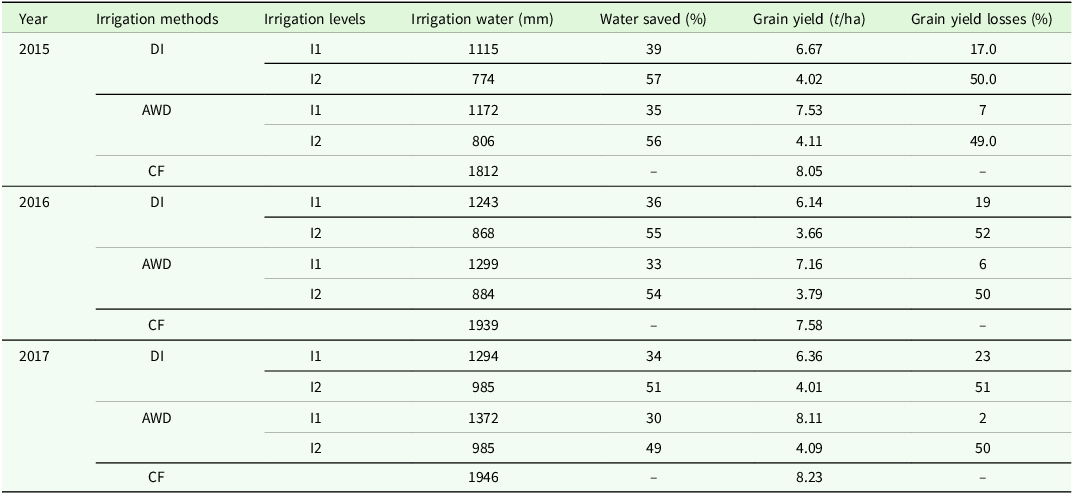
The relationships between total water applied seasonally during the experimental years (2015, 2016 and 2017) and the yield (t /ha) are shown in Figure 1. The figure shows that there is a statistically strong polynomial relationship between total water applied and yield. In 2015, the study found an R 2 value of 0.99, with the relationship being statistically significant at p = 0.0063** (p < 0.01); in 2016, the R² was 0.98, with statistical significance at p = 0.0105* (p < 0.05); and in 2017, the R² was 0.96, with statistical significance at p = 0.0249* (p < 0.05). The average yield values were similar to 2016 and 2017. Generally, yield decreased in parallel with the lower irrigation water in all treatments. The main reason for the decrease in yield is that paddy grows under water and uses the oxygen in the water, and, in addition, the application of the water deficit. When all years are analysed together, it is seen that there is a 2–52 % loss in yield. On the other hand, 30–57 % water-saving was obtained in drip irrigation method and 30–56 % in AWD application (Table 7).
Seasonal total irrigation water applied – yield relations in 2015, 2016 and 2017.

Water saving and grain yield losses values in 2015, 2016 and 2017 years

DI: Drip irrigation, AWD: Alternative wetting-drying, CF: Continuous flooded irrigation; I1: Application of water equal to 25 % of the water between the saturation point and field capacity when the soil moisture was near field capacity, I2: Application of water to field capacity when 25 % of the available water holding capacity was depleted.
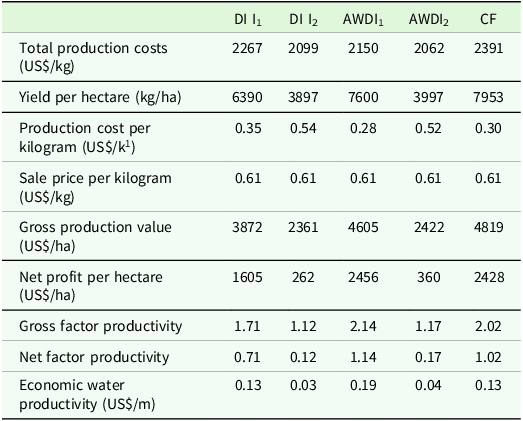
When the results of the economic analysis were evaluated (Table 8), the highest net income was obtained from the AWDI1 (US$2455/ha) treatment, followed by CF (US$2428/ha) and DI1 (US$1604/ha). The highest Economic Water Productivity of US$0.19/m3 was obtained from AWDI1 treatment.
Economic analysis results in rice production

DI: Drip irrigation, AWD: Alternative wetting-drying, CF: Continuous flooded irrigation; I1: Application of water equal to 25 % of the water between the saturation point and field capacity when the soil moisture was near field capacity, I2: Application of water to field capacity when 25 % of the available water holding capacity was depleted.
Discussion
This study thoroughly investigated the effects of various irrigation methods drip irrigation, alternate wetting and drying (AWD) and continuous flood irrigation (CF) on rice yield, water use efficiency and economic returns. The findings revealed critical insights into the interplay between water-saving techniques and rice cultivation outcomes, offering both practical and theoretical contributions to sustainable agricultural practices.
A notable finding of the study is the significant water savings achieved with drip irrigation and AWD methods. Compared to CF, water savings ranged from 34 to 57 % for drip irrigation and 30 to 56 % for AWD. These results align with prior research emphasizing the efficiency of these methods in reducing water usage while maintaining adequate soil moisture for crop growth and also these studies have shown that the mentioned methods provide water savings of 13–80 % (He et al., Reference He, Ma and Tian2022; Ishfaq et al., Reference Ishfaq, Akbar, Zulfiqar, Ali, Shah, Anjum and Farooq2022, Çebi et al., Reference Çebi, Özer, Öztürk, Aydın and Çakır2023; Nabipour et al., Reference Nabipour, Yazdani, Mirzaei, Ebrahimian and Mobaraki2024) Additionally, drip irrigation’s precision in delivering water directly to the root zone has been enhancing water use efficiency, a key advantage over traditional flooding methods (Yang et al., Reference Yang, Wu, Cheng, Fan, Li, Wang and Qian2023). The improved water productivity (WP) values observed in AWD and DI treatments further highlight their potential to support sustainable intensification in rice production systems.
More importantly, these gains in water use efficiency are not limited to technical outcomes but also reflect the physiological responses of rice plants to varying soil water regimes. In particular, alternate wetting and drying (AWD) has been shown to enhance root porosity and improve oxygen availability by introducing periodic aerobic phases. According to the literature (Mote et al., Reference Mote, Rao, Ramulu, Kumar and Devi2022), rice growth traits, yield components, and grain yield under continuous submergence conditions (3 cm from sowing to panicle initiation and 5 cm from panicle initiation to physiological maturity) are comparable to those achieved under AWD regimes, where irrigation is applied 15 days after sowing and whenever the water level in the field tube falls 5–10 cm below the soil surface until a depth of 5 cm is restored. These findings indicate that properly managed AWD regimes can be successfully implemented in rice cultivation without causing significant yield reduction. Root adaptations can stabilize yield by enhancing nitrogen uptake and grain filling, even under reduced irrigation applications. Indeed, previous studies (Xu et al., Reference Xu, Lu, Wang and Li2018; Xu et al., Reference Xu, Song, Lu, Wang and Chen2019) have demonstrated that irrigation regime and nitrogen application rate play a decisive role in determining root morphology and physiology, grain yield and nitrogen use efficiency in rice. In particular, alternate wetting and moderate drying (−20 kPa) has been shown to increase root length, root surface area, root dry weight, root activity and active absorbing area, thereby offering advantages over continuous flooding. Moreover, moderate stress induced by AWD can enhance root depth and stimulate the production of growth hormones such as abscisic acid (ABA). Collectively, these findings indicate that combining AWD with an appropriate nitrogen application rate promotes root development and activity, ultimately improving both grain yield and nitrogen use efficiency in rice.
WP values that indicate irrigation water savings and efficient use of irrigation water become even more important in rice cultivation where large amounts of irrigation water are used. Higher WP values were obtained in the irrigation methods and irrigation levels used in the study compared to the continuous irrigation method, which is in parallel with various studies (Hou et al., Reference Hou, Wei, Liu, Tan, Bi, Liu, Yu, Bi and Luo2023; Gao et al., Reference Gao, Lin, He, Tang, Ma and Sun2024; Yousefian et al., Reference Yousefian, Shahnazari, Ahmadi, Sarjaz and Arabzadeh2024).
Drip irrigation (DI) systems, especially when integrated with fertigation, enhance synchronization of water and nutrient supply, improving nutrient uptake efficiency and reducing nitrogen losses. Despite requiring higher initial investment, DI systems provide long-term benefits such as saving irrigation water, reducing weed pressure and improving nutrient-use efficiency (Rana et al., Reference Rana, Parihar, Jat, Patra, Nayak, Reddy and Abdallah2023). In South Asia’s rice systems, where groundwater depletion and unsustainable practices like flood irrigation and residue burning threaten long-term productivity, combining DI with conservation agriculture (CA) practices offers a promising solution. Sub-surface drip fertigation (SSDF) and drip irrigation integrated with CA have been shown to substantially reduce irrigation water use, increase water productivity (WPI), improve nitrogen use efficiency (NUE) and enhance farm profitability, thereby contributing to sustainable intensification under climate change (Sidhu et al., Reference Sidhu, Jat, Singh, Sidhu, Gupta, Singh and Gerard2019).
The study’s yield results indicate that CF produced the highest yields, but AWD under the I1 treatment yielded comparable results with significantly lower water inputs. These findings resonate with literature suggesting that AWD optimizes aerobic and anaerobic conditions, enabling effective root development and nutrient uptake while minimizing water loss (Ishfaq et al., Reference Ishfaq, Farooq, Zulfiqar, Hussain, Akbar, Nawaz and Anjum2020; Susanti et al., Reference Susanti, Cholidah and Agus2024). Drip irrigation, while achieving slightly lower yields, offers a sustainable alternative for areas with critical water constraints, especially when integrated with advanced technologies such as fertigation to optimize nutrient delivery (Yang et al., Reference Yang, Wu, Cheng, Fan, Li, Wang and Qian2023).
The highest average yield in three years was 7.95 t/ha in CF irrigation, followed by AWDI1 (7.60 t/ha) treatment and DII1 (6.39 t/ha) treatment. Similarly, Tuna (Reference Tuna2012), under comparable climatic conditions, reported the highest yield of 7.97 t/ha under CF irrigation and 7.11 t/ha under drip irrigation. These findings align with those of previous studies (Shaibu et al., Reference Shaibu, Banda, Makwiza and Malunga2015; Beşer et al., Reference Beser, Surek, Sahin, Kaya, Tuna and Cakir2016; Pascual and Wang, Reference Pascual and Wang2016; Gao et al., Reference Gao, Lin, He, Tang, Ma and Sun2024), demonstrating that AWD attains yields comparable to CF while substantially reducing water inputs. The marginal yield advantage of continuous flooding (CF) is primarily due to the maintenance of consistently high soil water content and anaerobic conditions that favour rice growth and tillering. However, this approach entails substantial environmental and resource costs, including excessive water consumption, rapid groundwater depletion and increased methane emissions associated with prolonged anaerobic conditions. In this context, alternative strategies such as alternate wetting and drying (AWD), particularly when combined with slow-release fertilizers (SRF), offer promising solutions. AWD, alone or integrated with SRF, has been shown to improve growth traits, enhance photosynthetic rates and increase nitrogen use efficiency (NUE) and water use efficiency (WUE) in a genotype-specific manner, while reducing water inputs and mitigating environmental impacts (Habib et al., Reference Habib, Islam, Haque, Hassan, Ali, Nayak and Gaihre2023; Lee et al., Reference Lee, Kim, Geem and Sung2025). The findings of this study further demonstrate that while conventional continuous flooding (CF) irrigation provides a yield advantage in rice production, it has significant limitations in terms of water use efficiency. In contrast, alternate wetting and drying (AWD) and drip irrigation strategies emerge as promising approaches for climate-smart rice cultivation. Although these methods may result in slight yield reductions compared to CF, they substantially improve water use efficiency and mitigate environmental impacts. As highlighted in a review by Mallareddy et al. (Reference Mallareddy, Thirumalaikumar, Balasubramanian, Naseeruddin, Nithya, Mariadoss, Eazhilkrishna, Choudhary, Deiveegan, Subramanian, Padmaja and Vijayakumar2023), rice farming often relies on inefficient irrigation practices, leading not only to excessive local water consumption but also to broader sustainability and food security challenges due to virtual water exports through rice trade and the looming global water crisis. In this context, the applicability of water-saving methods such as AWD and drip irrigation should be assessed by considering diverse climatic, soil and socio-economic conditions. However, the slight yield losses observed under DI and AWD (I2) can be attributed to water stress during critical growth stages, such as panicle initiation and flowering, which are known to reduce spikelet fertility and grain filling.
In terms of yield quality traits according to the trial plots; when the values of thousand grain weight, harvest index and yield values are evaluated in general, AWD application comes to the first place and this is followed by drip irrigation method. The fact that the efficiency (milled and Head) values are close to each other and high in all irrigation methods shows that other water-saving methods can be used in paddy cultivation in terms of their contribution to net profit (Zhang and Li, Reference Zhang and Li2017; Ishfaq et al., Reference Ishfaq, Akbar, Batool, Ibrahim, Aslam, Zulfiqar and Ahmad2021, He et al., Reference He, Ma and Tian2022; Dwivedi et al., Reference Dwivedi, Kumar, Natividad, Quintana, Chinnusamy and Henry2023).
From an economic standpoint, the AWD I1 treatment delivered the highest net income and economic water productivity, highlighting its practical relevance. These results align with global studies showing that AWD can improve farmers’ profits by reducing water-related costs while maintaining yields (Lampayan et al., Reference Lampayan, Rejesus, Singleton and Bouman2015; Ishfaq et al., Reference Ishfaq, Akbar, Batool, Ibrahim, Aslam, Zulfiqar and Ahmad2021; Zhang et al., Reference Zhang, Wang, Li, Zhu, Hua, Harrison, Liu, Yang and Liu2023). Panigrahi et al., (Reference Panigrahi, Panda, Rautaray, Raychaudhury, Thakur and Mishra2021) reported that the net income from rice-rice sequence cultivation using Drip irrigation was approximately 455 US$, with an EWP of 0.062 US$/ha. He et al. Reference He, Ma, Yang, Chen, Jia, Cui, Fan, Wang and Li2013, found that the net income of paddy irrigated with drip irrigation method varied between 832–1843 US$/ha and EWP values 0.07–0.17 US$/ha on the basis of subjects. Economic analysis further validated the viability of AWD and drip irrigation, with AWDI1 providing the highest net income, followed by CF. Recent studies echo these findings, reporting AWD’s cost-effectiveness, water-saving and emission-reducing due to reduced water requirements and high yield stability (Zhang et al., Reference Zhang, Du, Duan, Liang, Tang, Li and Yao2024). Drip irrigation, though initially costly, presents opportunities for cost reductions through government subsidies or technology advancements, making it increasingly accessible to farmers. Thus, the superiority of AWD I1 in terms of economic returns highlights its dual role as a water-saving and income-enhancing strategy, supporting its broader integration into sustainable rice production systems.
From an environmental perspective, both AWD and drip irrigation contribute significantly to reducing the carbon and water footprints of rice cultivation. AWD’s capacity to minimize methane emissions by altering soil redox conditions has been extensively documented, providing an additional advantage in mitigating climate change impacts (He et al., Reference He, Batáry, Zou, Zhou, Wang, Liu, Bai, Gong, Zhu, Setelle, Zhang, Qi, Peng, Ma, Lv, Cen and and Wanger2023). Similarly, drip irrigation’s precision reduces risks of nutrient leaching and soil salinization, aligning with broader goals of sustainable agricultural intensification (Yang et al., Reference Yang, Wu, Cheng, Fan, Li, Wang and Qian2023).
While the study provides robust evidence for the benefits of these irrigation methods, certain limitations should be addressed in future research. The experiments were conducted in specific regional conditions, which may limit the generalizability of the findings. Expanding the scope to include different agroecological zones and incorporating long-term assessments of soil health and pest management would provide a more comprehensive understanding.
Conclusion
The study demonstrates that drip irrigation and AWD are highly effective for rice cultivation and reducing water use and improving water productivity, particularly in water-scarce regions. Economically, they offer a sustainable advantage, generating a net income of US$ 2455 ha. While these techniques are a vital strategy for global water conservation, the researchers emphasise that further studies are needed across different soil types and climates to monitor long-term soil health and greenhouse gas emissions.
In conclusion, this study highlights the transformative potential of AWD and drip irrigation in addressing critical challenges related to water scarcity, yield optimization, and environmental sustainability in rice cultivation. Policymakers should consider incentives and subsidies to facilitate adoption, while farmers and other stakeholders are encouraged to apply these methods to reduce costs, enhance water productivity in practice and protect the ecosystem.
Author contributions
S. Özer and Y. Ahi conceived and designed the study, conducted data gathering, performed statistical analyses, and wrote the article.
Funding statement
The author would like to express their gratitude to TAGEM (General Directorate of Agricultural Research and Policies of Türkiye) for providing the necessary facilities for conducting this research. This study was supported under the TAGEM (General Directorate of Agricultural Research and Policies of Türkiye) project with the reference number TAGEM/TSKAD/15/A13/P02/11.
Competing interests
The authors declare that there are no conflicts of interest.
Ethical standards
Not applicable.
Use of AI
Only AI-based Google Gemini 3 language editing tools were used to check the language quality and grammar structure of the text. All authors were informed about the use of these tools at the beginning of the process, and the scientific content, technical accuracy and originality of the work are entirely the responsibility of the authors.