Introduction
Batagay retrogressive thaw slump (RTS) is probably the best known and largest on Earth (Atlas Obscura, 2024), appearing as a huge, thermal denudation landform (Fig. 1) developed by thawing of ice-rich permafrost in hillslope terrain of north-east Siberia, Russia (Nesterova et al., Reference Nesterova, Leibman, Kizyakov, Lantuit, Tarasevich, Nitze, Veremeeva and Grosse2024). Numerous studies have been conducted at this spectacular outcrop of a Pleistocene ice complex, mainly stratigraphical (Ashastina et al., Reference Ashastina, Schirrmeister, Scheidemann, Fuchs and Kienast2017; Murton et al., Reference Murton, Edwards, Lozhkin, Anderson, Savvinov, Bakulina and Bondarenko2017, Reference Murton, Opel, Toms, Blinov, Fuchs, Gärtner and Merchel2022, Reference Murton, Opel, Wetterich, Ashastina, Savvinov, Danilov and Boeskorov2023), paleoenvironmental (Novgorodov et al., Reference Novgorodov, Grigorev and Cheprasov2013; Ashastina et al., Reference Ashastina, Kuzmina, Rudaya, Troeva, Schoch, Römermann and Reinecke2018; Courtin et al., Reference Courtin, Perfumo, Andreev, Opel, Stoof-Leichsenring, Edwards, Murton and Herzschuh2022), cryolithological (Kunitsky et al., Reference Kunitsky, Syromyatnikov, Schirrmeister, Skachkov, Grosse, Wetterich and Grigoriev2013; Opel et al., Reference Opel, Murton, Wetterich, Meyer, Ashastina, Günther and Grotheer2019; Vasilchuk et al., Reference Vasilchuk, Vasilchuk, Budantseva, Vasilchuk and Trishin2019) and geomorphological (Günther et al., Reference Günther, Grosse, Wetterich, Jones, Kunitsky, Kienast and Schirrmeister2015; Vadakkedath et al., Reference Vadakkedath, Zawadzki and Przeździecki2020; Kizyakov et al., Reference Kizyakov, Wetterich, Günther, Opel, Jongejans, Courtin and Meyer2023).
(A) Satellite image showing location of Batagay in northern Yakutia. (B) Topographic map of the Batagay region (from Murton et al., Reference Murton, Opel, Wetterich, Ashastina, Savvinov, Danilov and Boeskorov2023), showing the location of the megaslump. Contours at 20-m intervals, grid spacing at 4 km. Red cross indicates outcrop of slate bedrock. (C) Aerial photograph showing location of the two boreholes (blue circles) and sampling points from modern soils (green circles) and paleosols (red). Credit: Aleksei Lupachev (from Kizyakov et al., Reference Kizyakov, Korotaev, Wetterich, Opel, Pravikova, Fritz and Lupachev2024).

Many publications characterizing Pleistocene deposits that contain syngenetic ice wedges, often named “yedoma” (Shur et al., Reference Shur, Fortier, Jorgenson, Kanevskiy, Schirrmeister, Strauss, Vasiliev and Ward Jones2022; Schirrmeister et al., Reference Schirrmeister, Froese, Wetterich, Strauss, Veremeeva, Grosse and Elias2024), from both northern Yakutia and Alaska, mention the presence of morphologically distinctive dark or brown “soil-like” layers. These layers include physically disintegrated, partially mineralized or even humified organic matter, predominantly residues of vascular plants and mosses, and sometimes consisting almost completely of poorly decomposed plant residues slightly enriched in mineral material (Bolikhovskaya and Bolikhovskii, Reference Bolikhovskaya and Bolikhovskii1979; Andreev et al., Reference Andreev, Schirrmeister, Tarasov, Ganopolski, Brovkin, Siegert, Wetterich and Hubberten2011). Some researchers have interpreted such layers as buried soils, others as mineral layers enriched with organic material (mindful of its possible allochthonous origin). Few publications detail the structure and physico–chemical properties of the buried soils and soil-like layers, and their relation to the host material, and to the underlying and covering deposits (Gubin, Reference Gubin1996, Reference Gubin2002; Anderson and Lozhkin, Reference Anderson and Lozhkin2001; Sanborn et al., Reference Sanborn, Smith, Froese, Zazula and Westgate2006; Murton et al., Reference Murton, Goslar, Edwards, Bateman, Danilov, Savvinov and Gubin2015; Sheinkman et al., Reference Sheinkman, Sedov, Shumilovskikh, Bezrukova, Dobrynin, Timireva, Rusakov and Maksimov2021). Gubin and Lupachev (Reference Gubin and Lupachev2012) have shown that paleopedological studies of Pleistocene ice-complex deposits should be carried out using an integrated approach, including traditional soil morphological and physico–chemical analytical methods along with cryolithological and paleoecological methods of studying permafrost exposures. We maintain that scrutiny of buried soils and soil-like bodies, as well as the pedogenic features in deposits where soil profiles cannot be clearly distinguished, is essential for reconstructing climate and environmental conditions in regions of ancient permafrost.
Pedogenic-related studies at the Batagay RTS have dealt mostly with modern soils (Vasilchuk et al., Reference Vasilchuk, Vasilchuk and Ginzburg2020) or individual biogeochemical aspects, such as organic matter and carbon content and their release during permafrost thaw (Shepelev et al., Reference Shepelev, Kizyakov, Wetterich, Cherepanova, Fedorov, Syromyatnikov and Savvinov2020; Jongejans et al., Reference Jongejans, Mangelsdorf, Karger, Opel, Wetterich, Courtin and Meyer2022; Kizyakov et al., Reference Kizyakov, Wetterich, Günther, Opel, Jongejans, Courtin and Meyer2023, Reference Kizyakov, Korotaev, Wetterich, Opel, Pravikova, Fritz and Lupachev2024). Interpretations of possible pedogenic processes that took place during accumulation of the Batagay deposits have been mainly based on qualitative macromorphological observations, e.g., “relatively darker layers’’ (Kunitsky et al., Reference Kunitsky, Syromyatnikov, Schirrmeister, Skachkov, Grosse, Wetterich and Grigoriev2013) or “reddened horizon” (Murton et al., Reference Murton, Opel, Toms, Blinov, Fuchs, Gärtner and Merchel2022, Reference Murton, Opel, Wetterich, Ashastina, Savvinov, Danilov and Boeskorov2023). The first attempts to characterize the pedogenic influence on microstructure in the Batagay sedimentary sequence were made in 2017, based on just six samples (Murton et al., Reference Murton, Edwards, Lozhkin, Anderson, Savvinov, Bakulina and Bondarenko2017). Nearly all of them showed a structureless mineral mass of silty sand with poorly developed, thin, light-brown coatings of Fe-oxides and individual aggregates, with plant microfossils mainly present as fine silt-sized, decomposed and strongly discolored root remnants. Only one sample showed poorly developed pedogenic features—evidence of clay accumulation and formation of complex microaggregates that include sand grains with thick organic coatings cemented with humus–clay groundmass. However, this preliminary study revealed a high potential for integrated pedological approaches to investigate the permafrost deposits at the Batagay RTS.
Geochemical studies of pedogenic features in thawed cryogenic sequences of loess and loess-like deposits of former periglacial zones are abundant (Liu et al., Reference Liu, Hu, Torrent, Barrón, Zhao, Jiang and Su2010; Kalinin and Alekseev, Reference Kalinin and Alekseev2011; Kovda and Lebedeva, Reference Kovda and Lebedeva2013; Muhs, Reference Muhs2018; Makeev et al., Reference Makeev, Kust, Lebedeva, Rusakov, Terhorst and Yakusheva2019; Kabala et al., Reference Kabala, Musztyfaga, Jary, Waroszewski, Gałka and Kobierski2022). The major and trace elements in the bulk composition of paleosols indicates the intensity of weathering and pedogenic processes during interglacial and/or interstadial periods when relatively stable and long-term pedogenesis occurred (Sheldon and Tabor, Reference Sheldon and Tabor2009). Geochemical ratios and indices constrain the deposits’ origin and source, and the weathering resistivity of different minerals during eolian sedimentation and sorting typical for periglacial environments (Bosq et al., Reference Bosq, Bertran, Degeai, Queffelec and Moine2020; Aquino et al., Reference Aquino, Scardia, Prud’homme, Dave, Lezzerini, Johansson, Marquer, Safaraliev, Lauer and Fitzsimmons2024). The geochemical signature of the parent rocks is retained in the deposits, and elemental ratios characterize bioclimatic conditions of sedimentation and soil formation during glacial and interglacial periods, respectively (Sheldon et al., Reference Sheldon, Retallack and Tanaka2002; Újvári et al., Reference Újvári, Varga and Balogh-Brunstad2008).
Limited accessibility of permafrost exposures, expensive logistics of drilling through permafrost and complicated sampling procedures make geochemical studies of perennially frozen deposits and frozen buried paleosols rare (Alekseev et al., Reference Alekseev, Alekseeva, Ostroumov, Siegert and Gradusov2003; Ulrich et al., Reference Ulrich, Jongejans and Grosse2021). Moreover, geochemical studies of permafrost are mainly focused on ground ice, its isotopic composition and influence on surface water chemistry (Lacelle and Vasilchuk, Reference Lacelle and Vasilchuk2013; Zolkos and Tank, Reference Zolkos and Tank2019). Nevertheless, the significance of these studies is indisputable because the obtained data provide a profound understanding of the bioclimatic and sedimentary conditions of previous Quaternary stages.
Pedogenic processes during the Pleistocene and Holocene have left persistent microstructures and geochemical properties within frozen deposits. Combining micromorphological and geochemical data can elucidate the processes that occurred in the active layer during both syngenetic (glacial periods with active sedimentation) and epigenetic (interglacials and/or interstadials with a significant decrease or cessation of sedimentation) pedogenesis (Gubin, Reference Gubin1996). This interdisciplinary approach is also valuable in studying permafrost cores from sites such as Batagay RTS, which is difficult to sample directly from steep to vertical faces nearly 60 m high. With this approach it is essential to distinguish the biogenic–abiogenic interactions that led to significant changes in the mineral matrix and pedogenic features of organic matter transformation of the sedimentary material.
The main objective of this study is to characterize the pedogenic features at the Batagay RTS in relation to bioclimatic conditions of the Batagay region from the Middle Pleistocene to the Holocene based on microstructure and geochemical properties. Another objective is to compare the evidence for soil formation with that reported elsewhere from Pleistocene permafrost deposits in western Beringia.
Materials and methods
Site description
Batagay RTS (67.58°N, 134.77°E) is located 10 km southeast of the town of Batagay, northern Yakutia, Russia (Fig. 1A). The slump is 260–330 m above sea level, in the saddle between Mount Kirgilyakh and Mount Khatyngnakh—part of the Yana Uplands (Fig. 1B). The slump started to form as a series of thermoerosional gullies in the late 1960s (Kunitsky et al., Reference Kunitsky, Syromyatnikov, Schirrmeister, Skachkov, Grosse, Wetterich and Grigoriev2013), with a gradual increase in the permafrost thawing rate, reaching a width of 840 m and a total area of more than 70 hectares by 2015 (Günther et al., Reference Günther, Grosse, Wetterich, Jones, Kunitsky, Kienast and Schirrmeister2015; Murton et al., Reference Murton, Opel, Wetterich, Ashastina, Savvinov, Danilov and Boeskorov2023). The headwall retreat rate has slowed recently (Savvinov et al., Reference Savvinov, Danilov, Petrov, Makarov, Boeskorov and Grigoriev2018) and currently the maximum width is about 1 km (Kizyakov et al., Reference Kizyakov, Wetterich, Günther, Opel, Jongejans, Courtin and Meyer2023).
The regional climate is subarctic and extremely continental. The mean winter air temperature (1988–2017) was −40.0°C, the mean summer air temperature 13.7°C, the mean annual air temperature −12.4°C, and the mean annual precipitation 210 mm (source of data: Yakutsk Department of the Federal Service for Hydrometeorology and Environmental Monitoring [Roshydromet]). The region hosts continuous permafrost, its thickness about 300 m, and the mean annual temperature of the upper permafrost layers varies from −5.5°C to −7.0°C (Ershov, Reference Ershov1996). Mean annual active-layer thickness varies between 0.2−0.4 m and 1.4−1.6 m, depending on the thickness and properties of the uppermost organic and organo−mineral soil horizons (Ivanova, Reference Ivanova2003; Shestakova et al., Reference Shestakova, Fedorov, Torgovkin, Konstantinov, Vasyliev, Kalinicheva and Samsonova2021).
The surrounding Yana Plateau is dominated by northern taiga deciduous woodlands mainly of larch (Larix gmelinii (Rupr.) Kuzen.), with silver birch (Betula pendula Roth) and less commonly aspen (Populus tremula L.) (Isaev and Timofeyev, Reference Isaev and Timofeyev2010; Savvinov et al., Reference Savvinov, Danilov, Petrov, Makarov, Boeskorov and Grigoriev2018). The ground cover is mainly lichens and mosses, and grasses are common (Ashastina et al., Reference Ashastina, Kuzmina, Rudaya, Troeva, Schoch, Römermann and Reinecke2018). At greater elevations, larch forests are replaced by patches of Siberian dwarf pine (Pinus pumila (Pall.) Regel). Sparse lichen cover appears near summits.
Geology and mineralogy of parent rocks
The bedrock at Batagay RTS comprises mainly dark gray slate of the Kedrovinsk Suite of Late Triassic (Norian) age (Murton et al., Reference Murton, Edwards, Lozhkin, Anderson, Savvinov, Bakulina and Bondarenko2017, Reference Murton, Opel, Wetterich, Ashastina, Savvinov, Danilov and Boeskorov2023). The parent rocks consisted of siltstones and argillites that experienced low-grade metamorphism into slate. The bedrock is exposed in the deepest central parts of the outcrop and in the stream beds on the slump floor as well as on the col crest about 2 km to the south–southeast (red cross on Fig. 1B; Fig. S1 in Supplementary File 2). Argillite slate nearby on the hillslopes of Mount Khatyngnakh is commonly intruded by dykes of diorite porphyry and dolerite of the Derbekin Complex (Late Jurassic), with a mineral composition consisting of plagioclase (from 40 to 70%), amphibole (up to 25%), biotite (from 10 to 30%), augite pyroxene (up to 10%) and quartz (up to 18%) (Vdovina, Reference Vdovina2002). About 15 km south–southeast of the RTS, granite outcrops mark the first phase of the Kolymsky Granite Complex, which intruded the Upper Triassic sedimentary rocks of the region during the Early Cretaceous (Murton et al., Reference Murton, Opel, Wetterich, Ashastina, Savvinov, Danilov and Boeskorov2023).
Cryostratigraphy of the Quaternary sediments
The main body of the Batagay RTS outcrop reveals a stratigraphic sequence of permafrost deposits that accumulated during the Middle and Late Pleistocene (∼700,000-11,000 years ago) and were partially transformed by thawing and gradual refreezing after the Holocene climatic optimum.
Following Murton et al. (Reference Murton, Opel, Toms, Blinov, Fuchs, Gärtner and Merchel2022, Reference Murton, Opel, Wetterich, Ashastina, Savvinov, Danilov and Boeskorov2023), the cryostratigraphy comprises six main sedimentary units overlying bedrock, from the base upwards (Fig. 2): (1) a lower ice complex, sporadically exposed in the central part of the main exposure headwall, assigned to Marine Oxygen Isotope Stage (MIS) 7 or even the MIS 15-17 interval; (2) a lower sand unit of MIS 6 age; (3) a soil-like organo−mineral layer (“reddened horizon”), in places truncated by large erosional cuts (former gullies) filled with fragments of woody debris of the MIS 5e interglacial; (4) an upper ice complex attributed to MIS 4−3; (5) an upper sand unit, absent in the central part of the outcrop, assigned to MIS 3–2; and (6) intermittently present in the headwall, a cover layer of Early Holocene age representing a refrozen active layer, topped by the modern soil. The cryolithology and sedimentary features of the exposed sequence are described in previous papers (Kunitsky et al., Reference Kunitsky, Syromyatnikov, Schirrmeister, Skachkov, Grosse, Wetterich and Grigoriev2013; Ashastina et al., Reference Ashastina, Schirrmeister, Scheidemann, Fuchs and Kienast2017; Murton et al., Reference Murton, Edwards, Lozhkin, Anderson, Savvinov, Bakulina and Bondarenko2017; Opel et al., Reference Opel, Murton, Wetterich, Meyer, Ashastina, Günther and Grotheer2019; 2022, 2023; Lupachev et al., Reference Lupachev, Tikhonravova, Danilov, Zanina, Cheprasov and Novgorodov2024).
Cryostratigraphic units exposed in the Batagay megaslump headwall adjacent to boreholes 1-20 (A) and 3-20 (B).

Soil profiles and borehole cores
In March 2020, two reference boreholes were drilled and 85 samples of permafrost core were collected. Borehole #1-20 was 69 m deep and borehole #3-20 was 35 m deep. Drilling was carried out by drill operators from the M.K. Ammosov North-East Federal University using an URB-2D3 drilling machine (Russian Federation). The core diameter decreased down the boreholes from 132, to 112 and 93 mm. In 2023 and 2024, comprehensive field studies were carried out to obtain a number of morphological descriptions of the exposure walls. Modern and buried soils, frozen sediments and underlying rocks were sampled, and 27 additional samples were collected to provide detailed information on the structure and properties of candidate pedogenic units in the stratigraphic sequence. Samples (200–300 g each) were collected from the frozen exposure wall and the borehole cores, air-dried, ground manually into a homogenous mass and then passed through a 1-mm sieve to separate large plant residues and the coarse mineral fraction. To minimize the sampling gaps (e.g., core intervals within ice wedges) and to detail specific horizons (e.g., modern soils or morphologically distinguished soil-like bodies), a generalized, composite stratigraphic section was compiled. The composite section includes 82 samples from all of the stratigraphic units and the underlying bedrock (Supplementary File 1). It was compiled based on the relative vertical position of samples within and between the stratigraphic units. International (IUSS Working Group WRB, 2022) and Russian (Dokuchaev’s Soil Institute, 2008) soil classification systems were used to designate modern soils and paleosols. Both systems were used to facilitate international communication (e.g., the same soil profile is distinguished as Cryosol by IUSS WRB but as Podbur by Russian soil classification). Cryostructures and texture ice forms were described using the scheme given by Murton (Reference Murton and Schroder2022a, Reference Murton and Schroder2022b).
Physico–chemical analyses
Physico–chemical analyses of soils and sediments used standard methods (Vorobyova, Reference Vorobyova2006). The total carbon (TC) and total nitrogen (TN) contents in the samples were determined on an HCNOS analyzer Elementar Vario El Cube (Germany). Loss on ignition (LOI) was determined by the difference of mass before and after ignition of the weighed portion of the <0.25 mm fraction of soil in a muffle furnace at 900°С for 1 h, accounting for hygroscopic moisture content. Available phosphorus (P-P2O5) was determined by the Kirsanov method (Vorobyova, Reference Vorobyova2006). In soil extracts prepared according to Kirsanov, the content of potassium (K2O) was also determined using flame photometry. The content of non-silicate (dithionite-soluble) iron in the samples was determined by the Mehra–Jackson method; and the content of amorphous (oxalate-soluble) iron, by the Tamm method (Vorobyova, Reference Vorobyova2006). The acidity of the samples was measured by the potentiometric method of measuring pH in soil-water extracts (1:25 for organic horizons and 1:5 for mineral horizons) using the Sartorius Basic PB-11 (USA). Particle-size analysis was carried out by dry sieving and pipette sedimentation using pyrophosphate as a dispersing agent.
Soil micromorphology
Soil microstructure was examined in 40 thin sections under an optical microscope (Carl Zeiss Axioscope A1) equipped with an Axiocam MR5 camera and AxioVision 4.8.2 software (Germany). Thin-section description followed Stoops et al. (Reference Stoops, Marcelino and Mees2010). Thirty-four samples were taken from the 1-20 and 3-20 frozen cores, covering each stratigraphic unit. Six additional samples from units 3 and 1 were collected directly from the slump headwall during 2023 and 2024. Frozen monoliths were put into boxes with soft cotton; texture ice was substituted by a 1:3 mixture of pine resin and ethanol at a temperature below 0°C. Stabilized thin-sections were polished to 0.02–0.03 mm thickness following Gubin and Gulyaeva (Reference Gubin, Gulyaeva, Shoba, Gerasimova and Miedema1997). Features discussed in the text are marked by indices on the microphotographs.
Thin-section micromorphological observations were invaluable in studying borehole cores, where it was impossible to characterize the two-dimensional spatial structure of the paleosol profiles. This was especially important where the material experienced only limited pedogenesis (e.g., incipient buried soil-like bodies and cryopedoliths). The micromorphological approach, first summarized by Kubiena (Reference Kubiena1938) and improved by Stoops (Reference Stoops2003; Stoops et al., Reference Stoops, Marcelino and Mees2010), has proven its efficiency in distinguishing the pedogenic transformation of mineral material, evidence of organo–mineral interaction, microstructure and secondary mineral formation as well as cryogenic imprints in soils (Van Vliet-Lanoe, Reference Van Vliet-Lanoe, Stoops, Marcelino and Mees2010; Nitzbon et al., Reference Nitzbon, Gadylyaev, Schlüter, Köhne, Grosse and Boike2022).
Magnetic susceptibility
Specific magnetic susceptibility (MS) was determined both in the field by a portable KT-6 meter (Russian Federation) and under laboratory conditions using the Kappabridge KLY-2 meter (Czech Republic). MS values typically increase from parent rocks to the mineral mass of derivative soils and then to the uppermost organo–mineral horizons (Le Borgne, Reference Le Borgne1955). Such changes have been attributed to the changes in particle-size distribution and the intensity of oxidation–reduction processes within the soil (Le Borgne, Reference Le Borgne1960; Liu et al., Reference Liu, Hu, Torrent, Barrón, Zhao, Jiang and Su2010). In some eolian loess–paleosol sequences the opposite may occur: lower MS values in the paleosols versus higher values in the loess because of wind carrying coarse magnetic particles during loess sedimentation (Murton et al., Reference Murton, Goslar, Edwards, Bateman, Danilov, Savvinov and Gubin2015).
Bulk element concentration
The bulk concentration of 30 major and trace elements was measured by X-ray fluorescence (XRF) analysis using a desktop WD-XRF crystal diffraction scanning spectrometer “BRUKER JAGUAR S6” (Germany). Each dried and ground ultrafine sample was mixed with wax used as a binder. The sample was pressed using a laboratory press (PARATUS-press, Russian Federation) in a cup made of chemically pure boric acid. The analysis was carried out according to the method of measuring the mass fraction of elements and oxides in tableted samples, compiled on the basis of state standard samples of soils and sediments.
Bulk element concentrations were analyzed in order to obtain the geochemical composition of modern soils and morphologically expressed paleosols, and to identify buried paleosols and soil-like bodies within the borehole cores. Additionally, XRF analyses were used to determine the degree and (if possible) the mechanism of weathering and to establish if the sediment source changed over time.
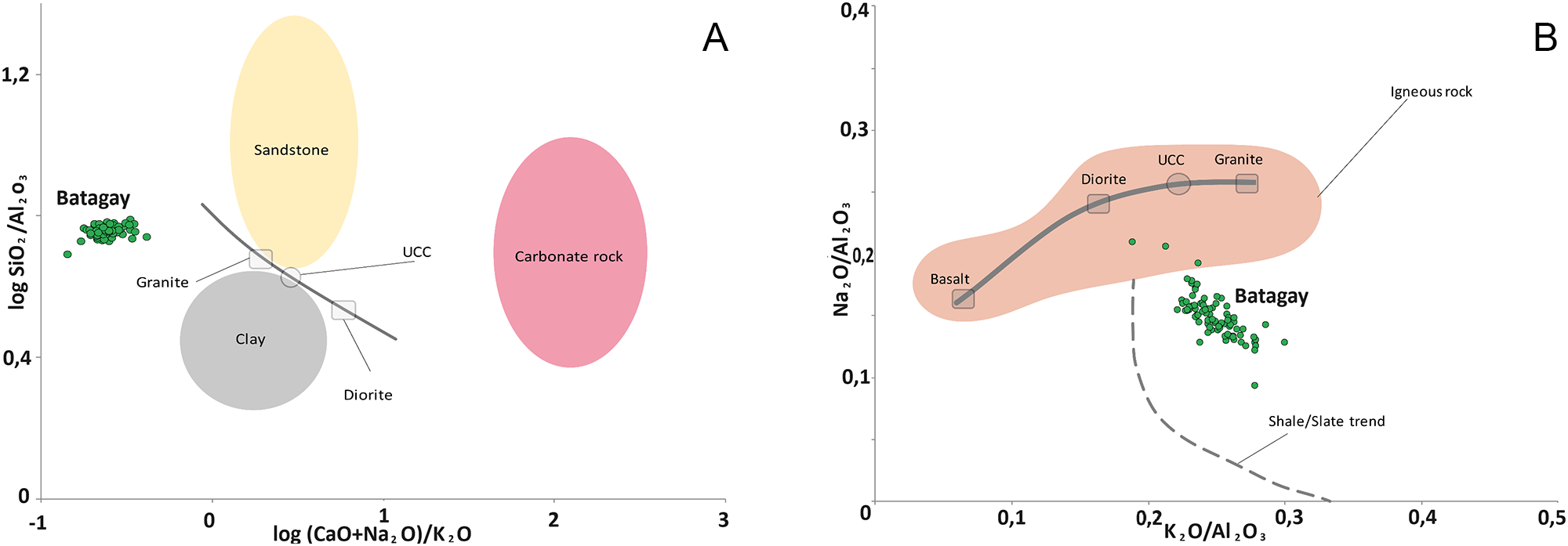
The dependencies of log [(CaO+Na2O)/K2O] from log (SiO2 /Al2O3) and Na2O/Al2O3 from K2O/Al2O3 are widely used for the geochemical characteristics of the sedimentary rocks origin (Garrels and Mackenzie, Reference Garrels and Mackenzie1971). Each oxide here denotes the molecular proportions. The Na2O/Al2O3 ratio distinguishes igneous and sedimentary rocks sources, whereas the K2O/Al2O3 ratio indicates felsic and basic igneous sources. Zr/Sc, La/Sc and Zr/Sc ratios were also used to assess sediment provenance, recycling and sorting (McLennan, Reference McLennan2001; Cai et al., Reference Cai, Guo, Liu, Sui, Li and Zhao2008). The Ti/Zr ratio was used to detect potential sediment source changes associated with departures from uniformity, as discussed previously (Muhs et al., Reference Muhs, Ager, Bettis, McGeehin, Been, Begét, Pavich, Stafford and Stevens2003; Casetou-Gustafson et al., Reference Casetou-Gustafson, Grip, Hillier, Linder, Olsson, Simonsson and Stendahl2020); the rationale here is that the ratio of these two immobile elements is nearly constant with depth in originally homogeneous parent material.
The chemical index of alteration CIA = [Al2O3/(Al2O3+CaO*+Na2O+K2O)]x100 (Nesbitt and Young, Reference Nesbitt and Young1984) was used to estimate the overall intensity of chemical weathering in soil: readily soluble cations (K, Ca and Na) are preferentially leached, whereas less soluble Al remains and becomes more concentrated in the soil (Muhs et al., Reference Muhs, Ager, Skipp, Beann, Budahn and McGeehin2008; Goldberg and Humayun, Reference Goldberg and Humayun2010; Wang et al., Reference Wang, Du, Yu, Algeo, Zhou, Xu, Qi, Yuan and Pan2020). CaO* here is the amount of CaO incorporated in the silicate fraction of the samples measured, excluding CaO of carbonate minerals. If the value of the calculated silicate CaO exceeds the Na2O content, then CaO*=Na2O, because the CaO content of silicate minerals cannot be higher than the Na2O content (McLennan, Reference McLennan1993). The CIA was calculated based on the molecular proportions of each oxide. All other ratios were calculated using the molar proportions of each oxide.
Specific weathering effects and biogeochemical processes were evaluated with additional weathering ratios and geochemical indices. Ba/Rb, Ba/Sr and Rb/Sr ratios were used to estimate the weathering intensity (Gallet et al., Reference Gallet, Borming and Masayuki1996; Chen et al., Reference Chen, An, Wang, Ji, Chen and Lu1999) due to differences in chemical resistivity of micas, K-feldspars and carbonates. The high sorption capacity of Ba and Rb allows their accumulation along with the secondary minerals; thus this ratio also indirectly characterizes the degree of pedogenic biochemical weathering (Heier and Billings, Reference Heier, Billings and K.H1970). The Ba/Sr ratio characterizes the hydrothermal regime during sedimentation and specifically the biochemical leaching of feldspars and carbonates (Retallack, Reference Retallack2003). The (TiO2+Al2O3+Fe2O3+MnO)/SiO2 ratio is a general index that characterizes the degree of sediment weathering, the redistribution of mobile elements and the overall maturity of soil-forming parent material (Yudovich and Ketris, Reference Yudovich and Ketris2000). The P2O5/TiO2 ratio was used to distinguish paleosols enriched in phosphorus and other biogenic elements, which are markers of biological activity and bioproductivity (Kalinin et al., Reference Kalinin, Zanina, Panin and Kudrevatykh2024). The SiO2/Al2O3 ratio shows quartz accumulation in relation to secondary minerals and strengthens the particle-size distribution data, where the finest clay particles are mainly associated with secondary minerals (Yang et al., Reference Yang, Ye, Galy, Fang, Xue, Liu and Yang2021). The molar ratio Na2O/K2O was used to estimate the degree of weathering of Na feldspars compared to the K-feldspars (Wang et al., Reference Wang, Feng and Qui2023), which also characterizes the intensity of the pedogenic processes within the material (Akulshina, Reference Akulshina1971). The ratio (CaO+Na2O)/K2O allows estimation of carbonate and plagioclase accumulation compared with K-feldspar. Lastly, the K/Rb ratio was used to distinguish sediments more enriched by potassium-bearing products of biogenic weathering and processes of pedogenesis from host sediments less affected by pedogenesis (Butler et al., Reference Butler, Bowden and Smith1962).
Statistical analysis
Statistical analysis was performed in RStudio v. 2023.6.1 Build 526 (Posit team, 2023), a graphical user interface for R programming language (R Core team, 2023). Correlation analysis was performed using the package ‘corrplot’ (Wei and Simko, Reference Wei and Simko2021). Cluster analysis was performed as Ward agglomerative clustering with Euclidean distances, using the cluster package (Maechler et al., Reference Maechler, Rousseeuw, Struyf, Hubert and Hornik2022). Principal Component Analysis (PCA) was done using a set of functions from FactoMineR package (Le et al., Reference Le, Josse and Husson2008), and used the realization of Cattell-Nelson-Gorsuch test from the nFactors package (Raiche and Magis, Reference Raiche and Magis2022). This test indicates, based on statistical inference, a number of significant factors to retain in a PCA. Prior to the PCA, an outlier sample, corresponding to the organic-rich layer within unit 1, was removed from the dataset.
Results
Morphology and major physico–chemical properties of modern soils
The near-summit areas of the adjacent Kirgilyakh, Khatyngnakh and Ese-Khaiya mountains are covered by underdeveloped (primitive) rocky soils (Regosols/Leptosols or Petrozems/Lithozems). These consist of a poorly developed organo–mineral horizon with mainly coarse organic residues and less often the initial cambic (grey humic) organo–mineral material above slightly weathered soil-forming rocks. Drainage hollows and the bottoms of small, temporary streams on hillslopes are occupied by Cryic Histosols/Histic Reductaquic Cryosols (or permafrost-affected Organogenic soils/peaty Gleyzems).
On gentle hillslopes near the megaslump most soils are Histic (Spodic) Cryosols/permafrost-affected peaty (podzolized) Podburs (Fig. 3; Tables 1 and 2). The soils have a well-developed, peaty upper horizon about 10 cm thick, poorly to moderately decomposed, under which is a mineral horizon with an ooid (“caviar-like”) post-cryogenic (inherited from ice segregation) soil structure.
Modern soils (Histic Spodic Cryosol/peaty permafrost-affected Podbur) adjacent to the Batagay megaslump. Histic Spodic Cryosol/peaty permafrost-affected Podbur, R-4-M-10 (A); Histic Spodic Cryosol/peaty podzolized permafrost-affected Podbur, R-7-M-10 (B); Histic Cryosol/peaty permafrost-affected Podbur, BTG-23-08 (C). Here and elsewhere soil horizon material indices according to IUSS WRB (2022): fo - folic; hi - histic; sd - spodic; ab - albic; cm - cambic; gl - gleyic; cy - cryic.

Physico–chemical properties of modern soils adjacent to the Batagay megaslump (Figure 3).

Particle-size distribution in the mineral material of modern soils adjacent to the Batagay megaslump (Figure 3).

Mineral horizons of the central parts of soil profiles are of neutral pH, silty-sand texture and have moderately expressed signs of redoximorphic processes and migration of water-soluble organic matter. The TC content does not exceed 1% in the mineral parts of soil profiles. This part of the profile is characterized by a distinctive brownish coloration, indicating the predominance of oxidation over reduction processes. Relatively light-textured soil profiles may show evidence of podzolization/spodification. Evidence of cryoturbation is rare. The suprapermafrost soil horizons (lowermost part of the active layer) are often waterlogged and structureless but rarely showing features of gleyization. The underlying, transient layer of permafrost (Shur et al., Reference Shur, Hinkel and Nelson2005) is about 15−20 cm thick and has a lenticular cryostructure, and less commonly, reticulate and ataxic (suspended) cryostructures.
Pedogenic features in the stratigraphy
Macromorphological observations of the nearly 2-km long headwall of the Batagay megaslump exposure identified three major sedimentary units that included buried soil-like bodies. These were, from the stratigraphically lowest to highest, the lower ice complex (unit 1), the “reddened horizon” (unit 3), and the upper ice complex (unit 4).
The lower ice complex (unit 1) contains a well expressed, subhorizontal paleosol (Fig. 4). This is represented by massive (10−30 cm thick), ice-rich (35−50% by volume) lenses of mainly poorly decomposed peaty material, enriched with fragments of shrubs and mosses and filled with sandy–silty mineral material. The formerly uppermost organomineral horizons are underlain by an extremely ice-rich (40−70% ice by volume) mineral mass with a reticulate and suspended cryostructure, with clearly expressed features of gleyization, decreasing downwards. This paleosol sporadically occurs in the lowermost sedimentary horizon (unit 1) of the megaslump exposure but is almost inaccessible for direct sampling throughout summer.
Buried Histic Reductaquic Cryosol/peaty permafrost-affected Gleezem within the lower ice complex (sedimentary unit 1) (BTG-23-06). Here and elsewhere square brackets define buried horizons.

The “reddened horizon” (sedimentary unit 3) is represented by a subhorizontal, ice-rich paleosol (Fig. 5A). This consists of an organo–mineral horizon enriched with abundant plant roots and twigs (20−30 cm thick), underlain by a thin and intermittent, slightly bleached mineral horizon (about 20 cm), under which lies an ocher–gray horizon (50−70 cm). The paleosol can be traced across nearly the entire length of the outcrop. The overall thickness of the paleosol (including ice volume) is 1−1.5 m. Above the paleosol and in places cutting down through it are irregularly distributed, lens-like accumulations of organic material comprising woody debris, stumps and fragments of branches (5−10 m wide and up to 3 m thick). The woody lenses presumably infill depressions originally eroded by surface runoff, i.e., gullies (Fig. 5B).
Buried Histic Spodic Cryosol/peaty Podbur (A; BTG-23-11) and accumulation of woody debris in paleoerosional cuts (B; BTG-23-07) through the “reddened horizon” (sedimentary unit 3).

In the upper ice complex (sedimentary unit 4), mineral blocks between syngenetic ice wedges sporadically contain as many as three or four shallow (10−30 cm) soil-like layers, mainly observable in the northern part of the exposure. Macromorphologically, the layers are distinguished by their darker color and step-shaped form of the thawing headwall (Fig. 6). Frozen borehole core 3-20 (Fig. 1 and 2B) showed the presence of disintegrated dark-brown peaty material, as well as small (1−2 cm) nearly discolored slightly brownish root detritus and ocher spots (2−3 mm) within the mineral-bearing mass. Different cryostructures replace each other throughout the entire interval: pore, microlenticular, lenticular, and reticulate (subhorizontal, inclined and vertical).
Buried soil-like bodies marked by arrows (presumably Histic Reductaquic Cryosol/peaty permafrost-affected Gleezem) within the upper ice complex (sedimentary unit 4).

Microstructure of modern, buried soils and soil-like bodies and hosting permafrost sediments
Lower ice complex (sedimentary unit 1)
The degree of pedoplasmation (a process by which a parent rock or a sediment loses its original lithic fabric to form soil material [Stoops et al., Reference Stoops, Marcelino and Mees2010]) of the main body of unit 1 (Fig. 7A) is moderate, polymineral grains are rare, mineral and organic material is well-mixed. The basic microstructure mainly has a coarse monic (i.e., randomly oriented, poorly weathered grains without substantial clay formation) mineral grain distribution pattern (Stoops, Reference Stoops2003). Primary mineral grains are little altered, and some are slightly rounded. Massive and lenticular microcryostructures mark the locations of former ice lenses. Overall porosity is moderate; relatively large (0.5−1 mm) presumably post-rootpath pores are present. Silt–clay coatings and other textural pedofeatures are relatively rare, but granular aggregates with loosely-expressed boundaries are common. Fe-oxide coatings are poorly expressed and thin. Soil organic matter is mainly present in the form of 1−2 mm sized fragments of plant detritus, poorly decomposed.
Microstructure of the lower ice complex (sedimentary unit 1). A - mineral mass (left - plane-polarized light, right - cross-polarized light): p - post-rootpath pores; a - initial granular aggregates; d - plant detritus. B - the uppermost horizon of the buried Histic Reductaquic Cryosol/peaty permafrost-affected Gleezem (plane-poralized light): ch - peat-charring; s - silt accumulation; fe - Fe-oxide accumulation; cr - features of cryogenic disintegration.

The organic-rich lenses constituting the former uppermost soil horizons (Fig. 7B) show abundant large plant residues, moss and sedge tissues, and twigs of shrubs, poorly decomposed. Also present are rare evidence of Fe-oxide accumulation and features of peat-charring. The soil mass is loosely packed, cryogenically disintegrated, with large pore volume. The accumulation of fine mineral material (occasionally showing lamination) within the residual mass is common, with sporadic and relatively well-preserved rootpaths.
Lower Sand (sedimentary unit 2)
The degree of pedoplasmation of unit 2 material is relatively low (Fig. 8). Coarse grains are poorly sorted, nearly unaltered, and weathering features are relatively rare. Polymineral grains are abundant. Initial microblocky and microplaty microstructure is common, with narrow and elongated interaggregate volume formed by microlenticular ice segregation. The porosity is low, with relatively large and post-rootpath pores with sharp boundaries. Rare clay coatings are associated with interaggregate crack surfaces. Fe-oxide films and coatings are rare and thin. Soil organic matter occurs as very fine (<0.1 mm), sometimes discolored detritus. No charcoal was observed.
Microstructure of the lower sand (sedimentary unit 2) (left - plane-polarized light, right - cross-polarized light): a - initial microblocky and microplaty aggregates; cg - coarse grains; p - post-rootpath pores; i - interaggregate cracks; fe - initial Fe-oxide coatings.

“Reddened horizon” (sedimentary unit 3)
The degree of pedoplasmation in unit 3 is possibly the highest observed in the sampled material from the Batagay RTS exposure (excluding modern soils). Microaggregates of microblocky, granular and ooid shape with features of pore ice segregation are very abundant in the upper (0−40 cm) part of the paleosol. Granular microstructure of the uppermost horizons with lenticular cryostructure is gradually replaced down the profile by by a more homogenous distribution of coarse/fine particles with pore (structureless) and microlenticular cryostructure. Pores are large (few to several mm long) in the upper part of the profile (Fig. 9A), and their volume decreases downwards through it (Fig. 9B–D). Polymineral grains are very rare, and mineral and organic material is homogeneously mixed. The coarse fraction is less abundant in the upper part, and its alteration is well-expressed: primary mineral grains are often slightly rounded. The abundance of angular coarse grains increases downwards through the profile (Fig. 9D). Unsorted silt and coarse clay accumulation zones with weakly oriented particles are common in the upper part of the profile, and striated features of the micromass that forms thin coatings on coarse grains are sometimes observed. Redoximorphic features are well expressed in the subsurface and middle horizons of the profile (e.g., Fe-oxide infiltration and coloring of plant detritus (Fig. 9B), and as relatively thick coatings on coarse grains, microaggregation via Fe-organic compounds). Monomorphic dark-brown organic material between mineral grains is common in the uppermost soil horizons. Coarse plant residues, light yellowish to reddish brown or dark brown, are very abundant in the subsurface horizons. These horizons are also enriched with relatively large charcoal fragments that have silt–clay coatings (Fig. 9C). Organo–mineral material of the paleosol profile contains a significant amount of spherical, dark-colored fungal fruit bodies (Fig. 9D).
Microstructure of the “reddened horizon” sedimentary unit 3 (buried Histic Spodic Cryosol/peaty permafrost-affected Podbur. A - 0−10 cm; B - 10−20 cm; C - 20−30 cm; D - 30−40 cm (left - plane-polarized light, right - cross-polarized light): a - blocky and granular aggregates; cg - coarse grains; p - post-rootpath pores; fe - initial Fe-oxide coatings; ch - charcoal fragments; s - silt–clay accumulation.

Upper ice complex (sedimentary unit 4)
The degree of pedoplasmation in unit 4 is moderate (Fig. 10). Polymineral grains are rare, the coarse fraction is well sorted, and mineral and organic material is well mixed. The basic microstructure has a coarse, monic distribution pattern. Primary mineral grains are moderately altered and notably rounded. Pore (structureless) and less often lenticular cryostructures are common. Overall porosity is moderate, and small (0.1−0.5 mm) post-rootpath pores are present. Clay coatings and other textural pedofeatures are rare, but the poorly-expressed blocky and granular aggregates with uneven edges may appear. Fe-oxide coatings are poorly expressed and thin. Soil organic matter is abundant in the form of coarse (1−2 mm) and fine (0.1−0.5 mm) plant detritus, poorly decomposed. Charcoal was not observed. The soil-like bodies themselves could not be sampled due to their inaccessibility in the exposure wall, and so only the hosting material was sampled from the 1-20 and 3-20 cores.
Microstructure of the upper ice complex (sedimentary unit 4) (left - plane-polarized light, right - cross-polarized light): d - plant detritus; fe - Fe-oxide accumulation.

Upper sand (sedimentary unit 5)
The degree of pedoplasmation of unit 5 material is low to moderate (Fig. 11). Coarse grains are moderately sorted but nearly unaltered. Weathering features are relatively rare, and polymineral grains are quite abundant. Initial microblocky and microplaty microstructure is common, with narrow elongated interaggregate pore volume formed by microlenticular ice segregation. The porosity is moderate, with relatively large post-rootpath round pores. Rare clay coatings are associated with pore surfaces. Fe-oxide films and coatings are rare and thin. Soil organic matter is presented by both fine (0.1−0.5 mm) and very fine (<0.1 mm), sometimes discolored plant detritus. No charcoal fragments were observed.
Microstructure of the upper sand (sedimentary unit 5) (left - plane-polarized light, right - cross-polarized light): a - initial microblocky and microplaty aggregates; cg - coarse grains; p - post-rootpath pores; d - plant detritus; i - interaggregate cracks; fe - initial Fe-oxide coatings.

Modern soils and the Holocene cover layer (sedimentary unit 6)
The pedoplasmation degree of unit 6, especially the modern soils, is one of the highest obtained. The microstructure is well-expressed and gradually changes downwards through the soil profile and underlying covering layer of permafrost. Granular and ooid microstructure of the uppermost horizons with pore ice cryostructure (Fig. 12A) is replaced down profile by blocky–platy microstructure with reticulate cryostructure in the subsurface horizons (Fig. 12B) and then by blocky and coarse monic c/f pattern with microlenticular and pore cryostructure in the suprapermafrost horizons (Fig. 12C, D). Intra-aggregate pores are large and rounded in the upper part, their volume decreasing down the profile and the shape changes to thin subhorizontal (Fig. 12C). Polymineral grains are rare, and mineral and organic material is homogeneously mixed. The coarse fraction is unevenly distributed and less abundant in the upper part. Its alteration is well expressed, especially in the uppermost soil horizons, where primary mineral grains are often slightly rounded. Unsorted silt and clay accumulation zones are common in nearly the whole unit; striated features of the micromass in coarse grain coatings are rare. Redoximorphic features are well-expressed (Fig. 12A, B), mainly in the subsurface and middle horizons of the profile (e.g., Fe-oxide infiltration and coloring of plant detritus, relatively thick silt-clay coatings on the coarse grains, microaggregation via Fe-organic compounds). Monomorphic, dark-brown organic patches between coarse mineral grains are common through the unit and even in the bottom of the Holocene covering layer (Fig. 12D). Fine plant residues, light yellowish to reddish brown, are very abundant in the modern soil horizons. Coarse detritus is more associated with the underlying upper permafrost. The uppermost soil horizons contain abundant, relatively large charcoal fragments with thick silt–clay coatings, sometimes with striated features in the micromass (Fig. 12A).
Microstructure of the modern permafrost-affected soils (A - 5−10 cm; B - 10−30 cm) and the Early Holocene refrozen intermediate layer (C - 1.6 m; D - 2.3 m), sedimentary unit 6 (plane-polarized light, right - cross-polarized light): a - blocky, granular and ooid aggregates; d - plant detritus; cg - coarse grains; p - post-rootpath pores; fe - initial Fe-oxide coatings; ch - charcoal fragment; s – silt-clay accumulation with striated features.

Bulk element composition and physico–chemical properties
The Batagay deposits are quasi-uniform in element composition and particle-size distribution. Their major components are SiO2, Al2O3, Fe2O3, and K2O, with smaller amounts of Na2O, CaO, MgO and TiO2 (Supplementary File 1). The deposits plot closer to sandstone than limestone on the log[(Ca2O + Na2O)/K2O] vs log(SiO2/Al2O3) graph designed for sedimentary rock classification (Garrels and Mackenzie, Reference Garrels and Mackenzie1971). They are depleted in plagioclase and enriched in K-feldspar (Fig. 13A). According to the K2O/Na2O ratio, normalized by Al2O3 content, the deposits plot in the slate sector close to the upper continental crust composition between the granite and diorite areas (Fig. 13B). Most samples plot below the igneous rock sector, reflecting their alteration due to weathering and sorting processes.
Composition of Batagay sediments on a plot of major element ratios used for geochemical classification of sedimentary (A) and igneous (B) rocks (Garrels and Mackenzie, Reference Garrels and Mackenzie1971). UCC - upper continental crust.

The sand units 2 and 5, and a major part of the upper Ice Complex (IC) deposits (unit 4) have comparable contents of major oxides, although sands are relatively enriched in Fe2O3 and K2O, and IC deposits in TiO2 and CaO (Fig. 14). In these units, the mean ratio of coarse (>0.01 mm) to fine (<0.01 mm) particles content is 9:1, and the aqueous extract pH is shifted toward alkaline and varies generally from 8.2 to 8.8. The total carbon (TC) content is 0.4 to 1.0%, and the C:N ratio is below 9. Sedimentary units containing morphologically expressed pedogenic features (units 1, 3, partly 4 and 6) have the highest median SiO2, Al2O3 and Na2O contents, but the lowest contents of other major oxides. Here, the coarse to fine particle ratio changes to 6:1 and even 4:1, the pH in extract is slightly acidic (<7.0), and the C:N ratio rises to 10−15. The TC content is low in most soil-like units: 0.28 to 0.38% in modern soils, 0.4 to 0.8% in unit 1 paleosol, but increases to over 1.0% to 3.2% in unit 3 paleosol, and to over 7.0% in a single sample, highly enriched by coarse organic material, from unit 6.
Physico–chemical properties and major geochemical ratios that distinguish paleosols and soil-like bodies (green) from less pedogenically-affected (yellow) hosting sediments (i.e. cryopedoliths) in the composite stratigraphic column.

There is a relatively weak geochemical differentiation between the upper and lower sands, but paleosol sedimentary units show significant diversity, having in common only the low median Fe2O3 and TiO2 contents. Both the modern soil and unit 1 paleosol have higher SiO2 content along with lower LOI and TC values and MgO, Zr and Ba content than the upper and lower sand units. Unit 3 paleosol is depleted in silica, but shows the highest values of LOI, Al2O3, Ba and Sr. Among soil units, the modern soils show the highest CaO, but lowest Al2O3 and Na2O contents.
The main geochemical ratios (e.g., CIA; (TiO2+Al2O3+Fe2O3+MnO)/SiO2; Rb/Sr; Ba/Sr) adequately reflect glacial–interglacial cycles by the relatively higher values in the paleosols and modern soils in comparison with the cryopedolith stadial units (see Fig. 14; Supplementary File 1). The average CIA value of the Batagay RTS deposits is 67, which shows the relatively high degree of overall weathering of the material. The difference in CIA values between the cryopedolith material and the modern soils and paleosols is small. Average CIA value for cryopedoliths is around 65. Maximum CIA values are 70 for modern soils, 68 for paleosols of units 1 and 3, and 67 for the soil-like bodies of unit 4.
Major oxide ratios (e.g., SiO2/Al2O3) are slightly lower in paleosols than in cryopedolith units (2 and 4), reflecting higher clay content and the intensity of spodic (Al-Fe-humic) pedogenic processes. In comparison with the average value of 9.6 throughout the whole sequence, the SiO2/Al2O3 ratio is lowest in mineral horizons of modern Cryosols, unit 6 (8.2), and in MIS 5e paleosol, unit 3 (8.5), but not low in the oldest paleosol of unit 1 (mean value 9.8). Compared with the average value of 0.096 through the sequence, the TiO2/Al2O3 ratio is lowest in both modern soil and MIS 5e paleosol (0.082–0.083), but not low in the oldest paleosol of unit 1 (0.097).
MS values have peaks exceeding 10·10-8 m3·kg-1 in four horizons (Fig. 14; Supplementary File 1): (1) from 0 to 0.6 m depth (modern soil; unit 6); (2) from 22 to 23 m (upper IC; presumably incipient MIS 3 paleosols within unit 4); (3) from 44 to 46 m (contact zone between units 3 and 4); (4) from 67 to 71 m (MIS 7 or 16; unit 1). In units 1, 3 and 6 MS reaches 15−20·10-8 m3·kg-1 depending on the coarse organic material content, and exceeds 20 ·10-8 m3·kg-1 in modern soils, whereas in the deposits less affected by pedogenesis (units 2, 5 and the major part of unit 4) it is 10−15·10-8 m3·kg-1.
Overall, the chemical composition of the Batagay RTS deposits suggests three major elemental associations (Suppl. File 2): (1) plagioclase-related CaO and MgO, closely linked to Fe and Ti oxides, water pH and Pb; (2) K-feldspar-related K2O with Ga and V, most other metals, and Fe-Ti-Mn oxides; and (3) an organic matter cluster, including C, N, C:N ratio and LOI, with associated P2O5 and S. Plagioclase- and orthoclase-associated major elements (CaO/K2O and NaO/K2O, respectively) show insignificant to negative linear correlations. The analysis of elemental ratios supports sediment provenance from felsic material, as seen from La/Sc and Zr/Sc ratios; increased sedimentary sorting in unit 4, supported by Zr data. Among major oxides and elements, ratios of Ba and K2O help differentiate samples by the degree of pedogenetic transformation and biochemical weathering, and not all samples from units containing morphologically expressed pedogenic features are equally affected by pedogenesis. Along the same line, the principal component analysis (PCA) shows significant internal variability within units in terms of the degree of pedogenetic transformation (Fig. 15; Supplementary File 2).
The principal component analysis (PCA) biplot for the Batagay RTS deposits grouped by sedimentary units.

Discussion
Paleoenvironmental significance of soils, soil-like bodies and cryopedoliths buried in Beringian permafrost
Ancient permafrost deposits from Late Plestocene containing buried soils and soil-like bodies are well-preserved across Beringia (e.g., northern Seward Peninsula (Höfle et al., Reference Höfle, Edwards, Hopkins, Mann and Ping2000); Dominion Creek and Quartz Creek in the Klondike Goldfields (Sanborn et al., Reference Sanborn, Smith, Froese, Zazula and Westgate2006; Froese et al., Reference Froese, Westgate, Reyes, Enkin and Preece2008), Kolyma Lowland (Anderson and Lozhkin, Reference Anderson and Lozhkin2001; Sher, Reference Sher2010; Murton et al., Reference Murton, Goslar, Edwards, Bateman, Danilov, Savvinov and Gubin2015), Batagay RTS (Kizyakov et al., Reference Kizyakov, Wetterich, Günther, Opel, Jongejans, Courtin and Meyer2023; Murton et al., Reference Murton, Edwards, Lozhkin, Anderson, Savvinov, Bakulina and Bondarenko2017, Reference Murton, Opel, Toms, Blinov, Fuchs, Gärtner and Merchel2022, Reference Murton, Opel, Wetterich, Ashastina, Savvinov, Danilov and Boeskorov2023), Bykovskii Peninsula (Andreev et al., Reference Andreev, Schirrmeister, Tarasov, Ganopolski, Brovkin, Siegert, Wetterich and Hubberten2011). Relatively fast burial of the accumulated and pedogenically reworked material by newly deposited sediment, followed by perennial freezing within permafrost allowed preservation of macro- and microstructures as well as physico–chemical and biological properties of paleosoils. Certain pedogenic features (e.g., structure, aggregates, evidence of migration and accumulation of mobile substances, roots and rootpaths morphology and abundance) and different types of soils themselves may be formed only under certain climatic conditions and related vegetation. The microstructural organization of individual, relatively thin units 1 and 3 within the Batagay RTS deposits, expresses features of epigenetic soil formation, strongly resembles modern adjacent soils (unit 6) and provides new information about the environmental conditions of interglacial and interstadial periods of the Yana Uplands region.
The term ‘cryopedolith’ (proposed by Gubin [Reference Gubin1996, Reference Gubin2002]) denotes a sediment that has experienced incipient pedogenesis along with syngenetic freezing and intensive accumulation of mineral material. The latter is deposited mainly by eolian processes during relatively cold and arid conditions, although other reworking mechanisms may contribute. Both the lower and the upper sand units (2 and 5) represent cryopedoliths, and contain the least pedogenically transformed material within the entire stratigraphy.
Syngenetic pedogenesis coincided with deposition of mineral material and incremental permafrost aggradation during glacial periods, resulting in particular pedogenic features and properties but without forming fully-developed (e.g., epigenetic) soil profiles. According to this mechanism, the structure and properties of host permafrost cryopedolith deposits reflect those of the former soils’ suprapermafrost horizons only (Gubin and Lupachev, Reference Gubin and Lupachev2012); they provide little information about the uppermost and middle parts of syngenetic soils. The closest modern analogues of syngenetic soils on permafrost are ‘loessal grasslands’ and alluvial (including permafrost-affected) soils forming in meandering river floodplains. Studies show that syngenetic soils may sustain grassland and sparse forest vegetation due to the dominance of silt particles and the high rate of evapotranspiration (Laxton et al., Reference Laxton, Burn and Smith1996). Our micromorpological studies also confirm the dominance of graminoids in the vegetation cover during the periods when stadial units of Batagay exposure were formed (units 2, 4 and 5) based on plant detritus size and morphology as well as the former rootpath system.
Similar to yedoma units elsewhere in Western Beringia (Rybakova, Reference Rybakova1990; Gubin and Veremeeva, Reference Gubin and Veremeeva2010; Murton et al., Reference Murton, Goslar, Edwards, Bateman, Danilov, Savvinov and Gubin2015), the syngenetic sandy silt material of these largely stadial units is enriched with thin grass and sedge roots. Additionally, relatively fine and often discolored detritus is present, leaving rootpath pores with sharp boundaries and rare evidence of relatively coarse plant remains (Figs. 8, 10, and 11). The sharp edges of plant detritus particles and their relatively uniform size (0.1−0.5 mm) indicate cryogenic processes as the main mechanism of graminoid plant litter disintegration. Mineralized and partly humified detritus is dispersed within cryopedolith, indicating incipient soil formation, low metabolic activity of microorganisms and relatively rapid incorporation of the material into aggrading permafrost, similar to MIS 2 cryopedolith at Duvanny Yar, Lower Kolyma region (Murton et al., Reference Murton, Goslar, Edwards, Bateman, Danilov, Savvinov and Gubin2015). Evidence of the formation of organogenic coatings on mineral grains and Fe-oxide–humic accumulation is also rare (Fig. 10), indicating poorly expressed redoximorphic conditions that prevented significant mobilization and illuviation of iron in light-textured deposits without long-term water saturation (Stoops et al., Reference Stoops, Marcelino and Mees2010). Collectively, these micromorphological features indicate harsh, cold and dry climatic conditions that almost totally precluded the stage of humic substance formation. Such a mechanism of organic matter decomposition is typical for late-Pleistocene deposits across Beringia, and our micromorphological studies at Batagay RTS correspond well with previous observations (Gubin and Veremeeva, Reference Gubin and Veremeeva2010; Ashastina et al., Reference Ashastina, Schirrmeister, Scheidemann, Fuchs and Kienast2017; Jongejans et al., Reference Jongejans, Mangelsdorf, Karger, Opel, Wetterich, Courtin and Meyer2022). Widespread pore and microlenticular (or “micro-cryostructure”) ice-segregation patterns described for northern Alaskan yedoma deposits by Kanevskii et al. (Reference Kanevskiy, Shur, Fortier, Jorgenson and Stephani2011) and Shur et al. (Reference Shur, French, Bray and Anderson2004) (Fig. 8, 11) also emphasize the relative dryness and low temperatures of the cryopedolith profiles during stadial summers.
Macro- and microstructure of epigenetic buried soils (units 1, 3) and modern soils (unit 6)
The morphological structure of the epigenetic paleosol within the lower ice complex of the Batagay exposure (unit 1) has the appearance of the modern Histic Reductaquic Cryosol/peaty permafrost-affected Gleezem that has well-expressed features of waterlogging, sedge–moss vegetation cover, peat formation and gleyization of the mineral soil horizons. If the 36Cl/Cl dating discussed by Murton et al (Reference Murton, Opel, Toms, Blinov, Fuchs, Gärtner and Merchel2022) proves reliable, this unit was formed during MIS 16 or earlier, period that also known as “Oler” interglacial (Geological Institute of RAS, 2018). According to the studies of the permafrost deposits at the Kolyma Lowland (Sher, Reference Sher2010) a relative climate warming, along with thermokarst processes and waterlogging, could have taken place in the Beringian region during this time interval. Open exposures of such deposits are rare, and buried soil profiles from permafrost deposits of this age (Middle Pleistocene) have not been described in detail before.
The microstructures suggest that during the formation of the unit 1 buried soil its surface was saturated with water, and small shallow ponds developed in low-centered ice-wedge polygons with a thick (in some cases, probably subaqueous) peat cover. The abundant silty particles within the poorly decomposed peat may indicate significant reworking of mineral material by soil-formation processes in situ and its sorting and redeposition in still water in small ponds (Fig. 7B). Microparticle lamination is poorly expressed in the coarse organic material but even occasional zones of microlamination may indicate hydromorphic conditions during soil formation (Stoops et al., Reference Stoops, Marcelino and Mees2010). One of the typical morphological features, indicating waterlogging of nearby ground, is the ice-rich cryostructure of the underlying mineral horizons, including several “ice belts” up to 2−4 cm thick. These pedogenic features of microstructure clearly indicate periods of slower sedimentation and changing environmental conditions to favor pedogenesis.
The most prominent paleosol profile within the Batagay RTS deposits comprises unit 3, and is presumably of MIS 5e age (Murton et al., Reference Murton, Opel, Toms, Blinov, Fuchs, Gärtner and Merchel2022), also known as the Kazantsevo interglacial (Geological Institute of RAS, 2018). The macro- and micromorphological structure of the profile is very similar to the structure of the modern Histic Spodic Cryosol/peaty permafrost-affected Podbur now occupying the study area. The microstructure of buried soils in permafrost deposits of MIS 5 age has rarely been described (Sheinkman et al., Reference Sheinkman, Sedov, Shumilovskikh, Bezrukova, Dobrynin, Timireva, Rusakov and Maksimov2021). Our results assume that soil formation here took place under sparse taiga (mostly coniferous but some broadleaf vegetation), with a fairly high heat supply, periodic changes in moisture/drying regimes and seasonal freeze–thaw cycles. This is evidenced by well-expressed ooid and blocky–platy cryogenic structure and rubification, as well as limited signs of migration of humified organic-rich products and clayey material within the profile (Fig. 9). Thin, light brown coatings of Fe-oxides and clots of dark-colored organic matter on the surface of mineral particles and the presence of the optically non-oriented clay involved in the formation of complex microaggregates also directly indicate the favorable conditions for soil formation under the mixed forest vegetation. Previous studies (Ashastina et al., Reference Ashastina, Kuzmina, Rudaya, Troeva, Schoch, Römermann and Reinecke2018) confirm the formation of open mixed forests during relatively warm conditions, similar to modern ones. A recent microbiomorphic analysis of the unit 3 soil material (Lupachev et al., Reference Lupachev, Tikhonravova, Danilov, Zanina, Cheprasov and Novgorodov2024) allowed us to reconstruct quite diverse herbaceous associations dominated by grasses. The presence of vascular tissues of conifers with sharp and nearly pristine pores and edges suggests their growth nearby and no long-term or active processes of redeposition.
Another significant microstructural feature of this unit 3 buried soil is its enrichment with charcoal fragments. Their morphology, as well as the coarse, well-preserved remnants of trees (e.g., large, 5−10 cm fragments of birch bark within the material of the woody debris in the paleoerosional cuts), support the interpretation of mixed forests (coniferous and broad-leaved deciduous species) here during the MIS 5e interglacial. The abundance of charcoal (Fig. 9C) points to widespread forest fires at that time, which was also mentioned for MIS 5 paleosols from the East European Plain, Russia (Sycheva et al., Reference Sycheva, Pushkina, Golyeva, Khokhlova, Gorbacheva and Kovda2024). The long-term preservation of charcoal within the soil profile is consistent with the formation of relatively thick silt–clay coatings around charcoal fragments. Redox features (e.g., Fe-oxide infiltration and coloring of plant detritus, relatively thick coatings on coarse mineral grains, microaggregation via Fe-organic compounds) indicate a relatively humid soil-water regime, allowing mobilization and redistribution of the mobile forms of iron and organic substances within the light-textured mineral mass (Stoops et al., Reference Stoops, Marcelino and Mees2010).
The MIS 5e interglacial is the most recent sustained interval when climate was warmer than present and is a compelling analogue for anticipated future climate warming (Reyes et al., Reference Reyes, Froese and Jensen2010). Fully developed epigenetic soil profiles of MIS-5 age buried in permafrost have been studied mainly in interior Alaska and Yukon, and are often characterized by poorly sorted, tangled masses of logs, sticks and organic-rich sediment (e.g., Péwé et al., Reference Péwé, Berger, Westgate, Brown and Leavitt1997). Deposits with sharp lower contacts have been associated with permafrost degradation, such as the accumulation of reworked forest detritus in thermokarst ponds or debris from thaw-related mass-movement processes (Reyes et al., Reference Reyes, Froese and Jensen2010). Modern soils and upper permafrost layers marking Early Holocene thawing during the climatic optimum are often similar to these last interglacial ‘forest beds’ (Lupachev and Gubin, Reference Lupachev and Gubin2023). The morphology of unit 3 paleosol is very similar to the structure of the modern soils now occupying the study area, having a well-developed, peaty upper horizon about 10 cm thick, poorly to moderately decomposed, under which is a mineral horizon with an ooid (“caviar-like”) soil structure, and the middle parts of profile have redoximorphic features. By analogy, its formation probably took place under sparse taiga (mostly coniferous but with some broadleaf vegetation), with a fairly high heat supply, periodic changes in moisture/drying regimes, and seasonal freeze–thaw cycles.
Modern soils (unit 6) adjacent to the slump (Histic Cryosols/peaty permafrost-affected Podburs) contain microstructures remarkably similar to those in the “reddened horizon” unit 3 paleosol of MIS 5e age. Some pedogenic processes, such as the formation of silt–clay coatings, are expressed less in modern soils (Fig. 12), which may indicate even more favorable bioclimatic conditions for soil formation during MIS 5e. Significantly, the horizon of the relatively stable blocky aggregate formation in the MIS 5e buried soil is thicker (up to 40 cm from the paleo-ground surface) than in the modern soils (upper 15−20 cm of the mineral part of the profile), although the former includes a contribution from excess ice. Modern soils are also enriched with charcoal fragments from forest fires.
Macro- and microstructure of syngenetic cryopedoliths (units 2, 4, 5)
The most developed soil-like bodies distinguished within Late Pleistocene cryopedolith deposits generally date to MIS 3 (Anderson and Lozhkin, Reference Anderson and Lozhkin2001). In the lowlands of northern Yakutia such deposits are characterized by interlayering of syngenetically frozen sediments and buried, peaty gleyic Cryosols. This interlayering suggests that MIS 3 in northern Yakutia was not a uniform interstadial but included relatively warmer periods with slower sedimentation, accompanied by increasing soil moisture and active layer deepening to around 60 cm depth (Gubin, Reference Gubin1996). Permafrost exposures in the Kolyma Lowland suggest correlation of these soils to former alas–lacustrine complexes with autochthonous peat layers and well-developed gleyic Cryosols, which may indicate increasing thermokarst processes in Beringia during this period (Gubin, Reference Gubin2002). Plant litter horizons may be enriched with stems and twigs of shrubs and even remains of forest tree species (mainly Larix sibirica Ledeb.). Layers enriched with poorly and moderately decomposed organic material are sporadically expressed in the slump headwall (mainly in its northern part). The observed series of three to four shallow (10-30 cm), poorly developed soil-like bodies at the Batagay exposure of MIS 4–3 age (unit 5) with partially preserved former surficial grass–peaty horizons needs further study. Presumably, it can be considered as the uphill analogue of those more developed soils, previously described at the Stanchikovsky and Duvanny Yar sites in the eastern part of the Kolyma Lowland (Gubin, Reference Gubin2002; Gubin and Lupachev, Reference Gubin and Lupachev2012; Murton et al., Reference Murton, Goslar, Edwards, Bateman, Danilov, Savvinov and Gubin2015) and in interior Alaska (Kanevskii et al., Reference Kanevskiy, Shur, Fortier, Jorgenson and Stephani2011). Similar to observations elsewhere, MIS 3 soil-like bodies at Batagay vary from weakly to moderately developed, which may reflect differences of climate and sedimentation conditions with limited soil development and chemical weathering as well as discontinuous plant cover and variable timespans during which they have developed. Murton et al. (Reference Murton, Goslar, Edwards, Bateman, Danilov, Savvinov and Gubin2015) hypothesized that MIS 3 soils were best developed and most organic-rich in interpolygonal bowl-shaped depressions, where more vegetation grew, and preserved only in certain sections of deposits between ice wedges. The morphology of the unit 4 partially supports this assumption because subhorizontal organic-rich layers are penetrated by large syngenetic ice wedges which continued growing at the same time as incipient pedogenesis. A step-shaped headwall relief is determined by the differences in the cryostructure and ice content of the organic-rich and underlying mineral horizons. Ataxic cryostructure and ice belts within the mineral mass, similar to those described for the buried soil of the lower ice complex, thaw first and become inset into the slump headwall, whereas the peaty material with lower thermal conductivity thaws more slowly and so protrudes from the headwall.
Geochemical evidence of pedogenic and weathering features
Elemental ratios and geochemical coefficients allow quantitative assessment of the weathering degree as well as the role and trends of pedogenesis in different sedimentary units. The relatively high average values of the CIA and (TiO2+Al2O3+Fe2O3+MnO)/SiO2 ratios indicate well-expressed weathering of the sediments (Fig. 14), especially during interglacial stages characterized by epigenetic soil formation, when both ratios are highest. Similar CIA values in modern soil (unit 6) and paleosols (units 1 and 3) presumably reflect the similar intensity of biochemical weathering during the Holocene and former interglacials (MIS 5e and MIS 7 or older). Relatively low CIA and Na2O/K2O3 values in the soil-like body of MIS 4–3 age (unit 4) indicate less active biochemical weathering, but even here higher-than-background values of the (Al2O3 + TiO2 + ∑FeO + MnO)/SiO2, Ba/Sr and Rb/Sr ratios suggest active leaching of the mica and feldspar during incipient syngenetic pedogenesis.
The absence of correlation between the Na and Ca associated with plagioclase, and K of K-feldspar (Figs. SI 2 and SI 4 in Supplementary File 2) may indicate their different resistance to weathering processes in the Yana Uplands. Weathering of feldspars within the mineral matrix occurred heterogeneously. We assume that calcium and potassium feldspars were destroyed first, whereas sodium feldspars enriched the paleosols. This may possibly be attributed to accumulation of Na in paleosols as a result of the residual concentration of albite, while less resistant Ca- and partly K-feldspars were leached. Thus, the Na2O and CaO content rises in the interglacial and interstadial paleosols, whereas K2O increases in the stadial cryopedolith units. Interestingly, their content does not correlate with the clay distribution, which excludes their origin from secondary minerals. According to this, the mechanism of smectite formation from mica, chlorite and/or plagioclase is less likely but still possible (Churchman, Reference Churchman1980).
Intensive weathering of K-feldspars is supported by increases in Ba and Rb as well as increased Ba/Sr and Rb/Sr ratios in the MIS 7 (unit 1) and MIS 5e (unit 3) paleosols and even in the incipient MIS 4–3 (part of the unit 4) soil-like body (Fig. SI 3 in Supplementry File 2). Ba and Rb are strongly adsorbed by secondary clay minerals (Retallack, Reference Retallack2003), and this mechanism may determine their accumulation in the paleosols, which contain more clay than the cryopedoliths.
The highest values of Na2O/K2O were in the modern soil and paleosols (units 1, 3 and 6), and together with MIS 4–3 soil-like body (partly unit 4) these sedimentary units are enriched by CaO, P2O5 and S. Here also the index of biological activity P2O5/TiO2 (Kalinin et al., Reference Kalinin, Zanina, Panin and Kudrevatykh2024) significantly increases, which indicates that biochemical weathering and pedogenic processes along with organic matter accumulation and transformation were active during epigenetic pedogenesis and considerable during syngenetic pedogenesis.
Both SiO2/Al2O3 and TiO2/Al2O3 ratios suggest differences in hydrothermal regime and intensity of pedogenic Al-Fe-humic migration processes that significantly differ in intermittently moistened Cryosols with well-expressed spodic features (modern soil and MIS 5e paleosol of unit 3) and in oversaturated Cryosols with features of gleyization (MIS 7 or older paleosol of unit 1). These results agree well with micromorphological observations of Fe-humic coatings and silt–clay accumulation zones in paleosols (Figs. 7, 9, and 12).
Iron content is linearly correlated with TiO2, MnO and several other elements, notably V. This may imply hematite–magnetite association with isomorphic Fe substitutes, i.e., Ti in FeTiO3 (ilmenite), also Ni, V and Mn, in admixtures due to sediments’ enrichment by the debris of Fe-bearing weathered schistose argillites underlying the Quaternary deposits (Fig. SI 1 in Supplementary File 2). While argillites serve as important Fe sources, authigenic Fe minerals could have further significantly enriched the deposits with iron, and coloration of certain layers (e.g., subsurface spodic horizon of MIS 5e paleosol, unit 3) also implies an important magnetite–hematite input (Vodyanitskii et al., Reference Vodyanitskii, Shoba and Lopatovskaya2014). Redox conditions control Fe oxidation state and migration capacity, which is typical for permafrost-affected soils (Patzner et al., Reference Patzner, Kainz, Lundin, Barszok, Smith, Herndon and Kinsman-Costello2022), and spodic and gleyic processes are widely expressed in modern soils adjacent to the Batagay RTS. Sparse preliminary data characterizing the Fe2+/Fe3+ content and ratio show the strong prevalence of the Fe-oxides over the Fe-protoxides in the deposits that belong to the central part of the exposure containing the MIS 5e spodic paleosol. Underlying and overlying deposits are provisionally characterized by the prevalence of slightly reducing conditions, which are common for the ice-complex deposits.
The higher P and S content in the MIS 5e paleosol (unit 3) may relate to the specific adsorption of sulphates at the surface of Fe-humic coatings, which are abundant on the skeletal grains (Fig. 9), protecting them from reductive dissolution (Parfitt and Smart, Reference Parfitt and Smart1978). The significant P enrichment of the MIS 3 incipient Kargin soil-like body is in good agreement with previous studies paleosols of the same age in northern Yakutia (e.g., Kolyma and Yana–Indigirka lowlands [Gubin, Reference Gubin1996, Reference Gubin2002; Gubin and Veremeeva, 2012]).
The Zr/Sc ratio is highest in the lower and upper sand units (units 2 and 5) as well as in the upper ice complex (unit 4), where the median Zr/Sc is over 30. The ratio is lowest in modern soils (unit 6) and paleosols (units 1 and 3), where Zr/Sc is below 15, suggesting more expressed sorting of cryopedolith material and greater weathering of paleosols (Fig. SI 3a in Supplementary File 2). However, within quasi-uniform units, certain samples deviate (e.g., highest La/Sc and Zr/Sc ratios are found in the MIS 5e paleosol, unit 3). In the lower ‘pedogenic’ branch of this plot, the highest La/Sc and Zr/Sc ratios correspond to unit 1. Individual samples (presumably incipient Kargin MIS 3 paleosols) in unit 4 also fall within this lower branch.
Significant variations in La/Sc and Zr/Sc ratios due exclusively to changes in the source of sedimentary material seem highly unlikely because Batagay RTS deposits are relatively uniform in chemical composition and particle-size distribution. Hence we suggest an important role of biochemical weathering (Aide and Aide, Reference Aide and Aide2012) as well as the possible intensification of the slope processes and input of the talus material due to the environmental changes during glacial/interglacial shifts. Supporting evidence for the latter comes from K2O/Rb ratio plotted against La/Sc, where again samples from the modern soil, buried soils and soil-like layers plot in the lower left of the graph (Fig. SI 3b in Supplementary File 2).
The PCA suggests that the first two principal components relate to sand and clay content, i.e., evidence of physical weathering, typical for permafrost in continental climates (Fig. SI 4, left, in Supplementary File 2). Principal components 3 and 4 indicate chemical weathering processes conditioning elemental redistribution in paleosols and cryopedolith material, where Y–Rb and Rb–Sr associations are mostly involved (Fig. SI 4, right, in Supplementary File 2). Soils plot separately from cryopedoliths on the Rb-normalized Ba/K2O graph (Fig. SI 3c, in Supplementary File 2), with higher Ba/Rb ratios and significantly lower K2O/Rb ratios. In contrast, during weathering, Ba tends to be adsorbed by clays and MnO, or precipitate in sulphates and carbonates; in studied samples, Ba shows weak negative correlation with these compounds (p-value below 0.01); hence these stabilization patterns are unlikely. Overall, Ba shows selective immobilization or enrichment in soils compared to Rb and K, with Ba/Rb > 10 and K2O/Ba < 30, highest and lowest across all samples, respectively. We suggest that preferential Ba accumulation in soils relates to higher acidity and/or microbial activity. Preferential leaching of K, Rb and La may result from migration of organic acids (Aide and Aide, Reference Aide and Aide2012).
Conclusion
The deposits at Batagay megaslump originate from well-weathered crystalline granite and diorite debris with significant input of Fe-rich schistose metamorphic slaty argillites most likely transported by the paleo-Batagay River and then deflated from the floodplain and deposited on the surrounding hillslopes.
Well-developed epigenetic soil profiles from interglacial periods (e.g., MIS 7, MIS 5e) are more clearly distinguished but more rarely found in ancient permafrost deposits than pedogenically reworked material of stadial cryopedoliths (e.g., MIS 6, MIS 4–2) that contain sporadic and incipient soil-like bodies. Epigenetic paleosols provide more detailed and direct information about ancient permafrost environments of Beringia, but syngenetic deposits also are a significant source of paleoenviromental information.
Micromorphological and geochemical study identified at least two well-expressed paleosols related to the MIS 7 (or 17–15) and MIS 5e interglacial periods, and soil-like bodies (presumably of Kargin interstadial) within the deposits of MIS 4–3 age.
The oldest paleosol within the lower ice complex (unit 1) (MIS 7 or MIS 17–15) has the morphology and properties of Histic Reductaquic Cryosols (peaty permafrost-affected Gleezems); the buried paleosol of MIS 5e age is very similar in structure to modern Histic Spodic Cryosols (peaty permafrost-affected Podburs) now occupying the study area; and soil-like bodies of MIS 4–3 age (unit 4) are considered to be incipient Histic Reductaquic Cryosols (peaty permafrost-affected Gleezems).
Micromorphological observations reveal well-expressed aggregate and pore formation, Fe-oxide and organic matter redistribution, accumulation of clay particles and other pedogenic processes in modern soils, buried interglacial paleosols and interstadial soil-like bodies. Material of stadial units (cryopedoliths) shows weakly expressed postcryogenic structure and cryogenic disintegration of plant detritus, with rare evidence of accumulation of humic substances.
A thorough geochemical study shows the substantial biochemical weathering, organic matter accumulation and transformation, Al-Fe-humic migration and other soil-forming processes that took place during epigenetic and syngenetic pedogenesis.
Supplementary material
The supplementary material for this article can be found at https://doi.org/10.1017/qua.2024.58.
Acknowledgments
Field expeditions and analytical research have been supported by the Russian Science Foundation (grant project 23-27-00242). Analytical procedures were carried out in the Center of Collective Use at the Institute of Physicochemical and Biological Problems of Soil Science, Russian Academy of Sciences (Pushchino, Russia) and in the Laboratory of Physico–Chemical Methods of Analysis at the Prof. D.D. Savvinov Science Research Institute of Applied Ecology of the North (Yakutsk, Russia). The authors thank Erel Struchkov and Ivan Alekseev for invaluable help in conducting 2023 and 2024 field studies. Associate Editor Mary Edwards and two anonymous reviewers are thanked for their constructive comments on an earlier version of this article.
Data availability
All the experimental data is available upon the direct request to the corresponding author. Physico–chemical properties of the generalized composite stratigraphic section are given in the Supplementary files.
Declaration of competing interests
The authors declare that they have no known competing financial interests or personal relationships that could have appeared to influence the study reported in this paper.