





Introduction
The field of second language (L2) research has entered an open era (Liu & Marsden, Reference Liu, Marsden, Curado Fuentes, Rico García and Fielden Burns2024; Marsden & Morgan-Short, Reference Marsden and Morgan-Short2023; Plonsky, Reference Plonsky and Plonsky2024b). Evidence of the field’s shift to openness ranges from infrastructures such as IRIS (Marsden & Mackey, Reference Marsden and Mackey2014), to publication of dedicated journal special issues (e.g., Andringa et al., Reference Andringa, Mos, Van Beuningen, González, Hornikx and Steinkrauss2024; Kremmel & Isbell, Reference Kremmel and Isbell2024; McManus, Reference McManus2024), and to initiatives that promote various forms of transparency and openness (e.g., Alferink & Marsden, Reference Alferink and Marsden2023; Gurzynski-Weiss et al., Reference Gurzynski-Weiss, Bryfonski and Reagan2024; Liu et al., Reference Liu, Chong, Marsden, McManus, Morgan-Short, Al-Hoorie, Plonsky, Bolibaugh, Hiver, Winke, Huensch and Hui2023; Sato et al., Reference Sato, Chong, Aktar, Cowell, Kong and Shaahdadi2025).
Many of the widely promoted open researchFootnote 1 practices, such as preregistration (i.e., registering the research design before data collection; Huensch, Reference Huensch and Plonsky2024), registered reports (i.e., a publication format where the research design and methods are peer reviewed before the research is conducted; Marsden et al., Reference Marsden, Morgan-Short, Trofimovich and Ellis2018), and open data (i.e., data made publicly available), emerged as a response to the reproducibility crisis in psychology (e.g., Open Science Collaboration, 2012). This point of origin has resulted in a set of standards that are arguably more deliberately tailored for quantitative or experimental methods, which can map unevenly onto qualitative research (Al-Hoorie et al., Reference Al-Hoorie, Cinaglia, Hiver, Huensch, Isbell, Leung and Sudina2024; Liu, Reference Liu2023). By qualitative research we mean not a unitary concept, but a collective of diverse methods and traditions underpinned by a wide range of paradigms, ranging from post-positivist to constructivist and critical perspectives (see Taking stock: from principled resistance to principled engagement and Moving forward: situated-openness framework for further discussion of this). The (unintended) dominance of conceptualizations of openness from a quantitative lens leaves important space for qualitative L2 research to interrogate and reimagine what openness means and how it can be practiced from a qualitative perspective.
Our study aims to contribute to this space by tracing back the development of open qualitative research and offering potential ways to move forward. Specifically, we review five debates that have been central to this conversation, namely replication, preregistration, data sharing, data reuse, and publication policy, and show where consensus is forming and where tensions persist. We then analyze these debates from a study quality lens that integrates transparency, ethics, methodological rigor, and value to society (Plonsky, Reference Plonsky2024a), to shed light on complexity and nuances required for open qualitative L2 research. We then move on to propose the situated-openness framework, paired with an extended research transparency statement (Liu et al., Reference Liu, Al-Hoorie and Hiver2024), to help qualitative L2 researchers consider what to make open, for whom, and why in alignment with their own epistemological and ontological commitments. In addition to providing a practical tool for individual researchers, we hope this framework will also encourage and enable differentiated editorial policies (as opposed to uniform rules) that both address the field’s call for greater openness and uphold the core commitments of qualitative inquiry.
Before we review the debates on open qualitative research, we believe it is important to be transparent and reflexive about our own positionalities. Although our recent publication records are largely situated in quantitative methodology, all of us have published qualitative research. Two of us completed mixed-methods PhD projects with a pragmatist stance, and one of us had early graduate training and initial publications based exclusively on qualitative methodologies, with quantitative approaches adopted only later. This training background informed our approach to this study. We value ontological/epistemological pluralism and are mindful not to impose quantitative standards onto qualitative inquiry (a commitment reflected in our published works as well, e.g., Al-Hoorie et al., Reference Al-Hoorie, Cinaglia, Hiver, Huensch, Isbell, Leung and Sudina2024; Liu, Reference Liu2023). We see our role as initiators of a dialogue that respects the distinct traditions of qualitative research while exploring how open scholarship can benefit the field as a whole.
Looking back: debates on open qualitative research
In this section, we consider several pertinent practices associated with open science in relation to qualitative paradigms. Our aim in reviewing these topics is to examine whether and how they have been taken up by qualitative methodologists and how approachable they might be for qualitative researchers considering adopting such practices more generally.
Replication
One of the most contentious debates regarding open qualitative research revolves around the question of whether replication is meaningful and feasible for qualitative research. Many researchers argue that the philosophical underpinnings of qualitative research render replication, or at least exact replication, problematic. For example, rooted in a social constructivist stance for feminist psychological research, Pownall (Reference Pownall2024) emphasizes that the subjectivity and positionality of the researcher are not biases to be removed but an inherent and intentional part of the research design and, therefore, expecting two researchers to produce an identical interpretive trajectory is neither feasible nor desirable. Taking a transcendental realism stance that views the world as composed of open, fluid, and complex systems, Pratt et al. (Reference Pratt, Kaplan and Whittington2020) further contend that the goal of qualitative research, which is often theory building and in-depth understanding of context-specific phenomena, directly clashes with the goal of replication in quantitative research seeking to test and confirm existing theories. This view favors a “horizontal notion of knowledge cumulation” (Pratt et al., Reference Pratt, Kaplan and Whittington2020, p. 5) where the goal is to build a wide repertoire of tentative theories for unique situations, rather than a vertical cumulation that builds on previously confirmed findings. In this line of view, researchers often refer to existing hallmarks and methods such as trustworthiness, triangulation, and member checking as better alternatives to replication, which is viewed as enforcing a positivist, quantitative, and experimental logic (Pownall, Reference Pownall2024; Pratt et al., Reference Pratt, Kaplan and Whittington2020).
In sharp contrast, other scholars advocate for the value of replication for qualitative research. Challenging the notion that replication is largely opposed by qualitative researchers, Makel et al. (Reference Makel, Meyer, Simonsen, Roberts and Plucker2022) cite evidence from a survey of 1,500 educational researchers to demonstrate that categorical opposition to replication is an infrequent stance, with less than 10% of qualitative researchers actually expressing the belief that it should be completely avoided. Building on this premise, they assert that replication can be applicable to qualitative inquiry in three principal areas. Specifically, replication reinforces methodological values like transparency and intentionality, provides a means to assess the transferability of findings, and can be used to evaluate the influence of researcher reflexivity on study results. Taking a similar stance against the assumption that replication is exclusively for quantitative research, Becker (Reference Becker2019) posits that qualitative replication not only can be done but should be encouraged as a powerful pedagogical tool because it helps novice researchers demystify interpretive decision-making and practice systematic evidence evaluation. Essentially, qualitative replication projects can serve as “training wheels” for novice researchers via a “learning-by-doing” approach (Becker, Reference Becker2019, p. 3).
Moving beyond this for-or-against dichotomy, a third strand of the debate proposes a reconceptualization of replication itself to enhance its compatibility with, and utility for, qualitative research. Porte and Richards (Reference Porte and Richards2012) argue that methodological and technological developments (e.g., stricter analytic standards, online data archives) mitigate earlier objections to replication and render it both meaningful and feasible for qualitative L2 research. Acknowledging that certain branches of qualitative research such as what Nespor (Reference Nespor2006) label as militant particularism (i.e., privileging contextual and local knowledge over generalized knowledge) are “inherently antithetic to replication,” they speak of a replication logic for realist-oriented qualitative research where each case is preserved as an analytic whole embedded in rich contexts yet intentionally sampled to extend or challenge emergent theory (Porte and Richards, Reference Porte and Richards2012, pp. 288–289). Taking a similar stance but situated in ethnomethodological conversation analysis, Markee (Reference Markee2017) proposes comparative reproduction as a modified form of replication, a practice that traces how the same social action is organized across languages or settings, and aims to establish the generality or prototypicality, not universality, of qualitative phenomena. Interrogating replication from a complex dynamic systems perspective, Al-Hoorie et al. (Reference Al-Hoorie, Hiver, Larsen-Freeman and Lowie2021) argue that because complex systems are open and defined by variability, the idea of an exact or direct replication is untenable. Instead of dismissing replication entirely, they propose a broadening of the scope of replication toward substantiation. This substantiation framework reframes the goal away from simple or methodological replication and adopts a more nuanced approach that includes extension, reproduction, and exploration, depending on the maturity of the theory under investigation.
Preregistration
Similar to replication, preregistration, as one of the core practices in mainstream open scholarship, is another source of contention. Critics argue that preregistration originated as a means to enhance hypothesis testing, a logic foreign to and incompatible with the exploratory and theory-building nature of qualitative research. Haven and Van Grootel (Reference Haven and Van Grootel2019) identify three interconnected objections to qualitative preregistration: the absence of testable hypotheses, the iterative nature of the research design, and the subjectivity of the researcher. Because qualitative researchers often refine sampling, adjust data collection strategies, and pursue emergent lines of inquiry, registering a protocol would seem counterintuitive or even counterproductive to skeptics (Haven & Van Grootel, Reference Haven and Van Grootel2019). Bennett (Reference Bennett2021) extends this logic from a feminist standpoint, warning that current open science practices risk further marginalizing methods that privilege listening, reflexivity, and social change over statistical inference. In this view, preregistration is not just unnecessary; it is conceptually misaligned with qualitative paradigms.
Against this backdrop, a growing number of scholars contend that preregistration can be meaningful and feasible insofar as it is tailored to qualitative epistemologies and foregrounds flexibility and reflexivity. Haven and Van Grootel (Reference Haven and Van Grootel2019) argue that making study aims, analytic lenses, and anticipated procedures publicly visible enables wider scrutiny regardless of whether specific confirmable hypotheses exist. The emphasis thus shifts from pre-specifying predictions to documenting theoretical commitments and methodological trajectories. Building on this premise, Haven et al. (Reference Haven, Errington, Gleditsch, van Grootel, Jacobs, Kern, Piñeiro, Rosenblatt and Mokkink2020) conceptualize preregistration as a systematic starting point that should never become a straitjacket. Researchers are free to amend their plans as needed while leaving an auditable trail of decisions. Branney et al. (Reference Branney, Brooks, Kilby, Newman, Norris, Pownall, Talbot, Treharne and Whitaker2023) likewise highlight the capacity of qualitative preregistration templates to render the often invisible “reflexive labor” visible (p. 6). Importantly, infrastructure is catching up with these conceptual arguments: Several journals, including BMJ Open Science, F1000Research, and PeerJ, accept qualitative Registered Reports, and the Peer Community In initiative has begun recommending such submissions, albeit in modest numbers (Branney et al., Reference Branney, Brooks, Kilby, Newman, Norris, Pownall, Talbot, Treharne and Whitaker2023). Parallel efforts to refine templates and guidelines, such as the Qualitative Preregistration template (Haven et al., Reference Haven, Errington, Gleditsch, van Grootel, Jacobs, Kern, Piñeiro, Rosenblatt and Mokkink2020), further enhance the utility of preregistration for qualitative research.
Data sharing
Whether and how qualitative data can and should be shared is another focal point of discussion. Before reviewing this debate, it is helpful to distinguish between data (e.g., transcripts, recordings) and research materials (e.g., interview protocols). The sharing of materials is a crucial step for making the research process transparent and often faces fewer ethical barriers than sharing data. L2 researchers have been sharing materials for quite some time (e.g., the establishment of IRIS, an open repository for research into languages, in 2011), including qualitative research materials. For instance, there are 156 entries of interview protocol/schedule indexed on IRIS (as of January 20, 2026), which evidences existing engagement of qualitative research materials sharing.
In contrast to the uptake in materials sharing, the conversation regarding qualitative data sharing takes place against the backdrop of a growing push from the top down. While large text corpora have long existed as a form of open data in L2 research, and projects such as Languages and Social Networks Abroad Project (Mitchell et al., Reference Mitchell, Tracy-Ventura and McManus2017) have shared qualitative data such as oral interviews, there is an increasing push from funding agencies, publishers, and governments mandating open access to research data to enhance research transparency and maximize return on scientific investment (Bishop & Kuula-Luumi, Reference Bishop and Kuula-Luumi2017; Irwin, Reference Irwin2013). The United Kingdom illustrates how policy and infrastructure can work in tandem. The UK National Data Strategy (2009–2012), for example, expedited the expansion of the UK Data Archive and related specialized services such as the QualiBank repository. The Economic and Social Research Council, a major funder of social research in the UK, has been mandating funded researchers to deposit data into the Qualitative Data Archival Resource (Moore, Reference Moore2007).
Despite this policy push, many qualitative researchers caution against the view that sharing data is unequivocally beneficial. A commonly cited concern is the risk of breaching participant confidentiality despite anonymization (Irwin, Reference Irwin2013; Mauthner et al., Reference Mauthner, Parry and Backett-Milburn1998). De-identification of qualitative data can be labor-intensive, and at times problematic, especially for research on small or marginalized groups where seemingly innocuous details may reveal identity (Prosser et al., Reference Prosser, Hamshaw, Meyer, Bagnall, Blackwood, Huysamen, Jordan, Vasileiou and Walter2023). Relatedly, some researchers perceive sharing data as a potential ethical violation that could undermine the trust between the researcher and the participant (Irwin, Reference Irwin2013). Obtaining informed consent from participants is also deemed tricky as future use of the data may be unknown (Broom et al., Reference Broom, Cheshire and Emmison2009). Opposing stances become strongest when it comes to issues of power imbalances. Couldry and Mejias (Reference Couldry and Mejias2019) warn that publicly hosted data may be mined by outsiders for purposes never intended by the original contributors. Feminist decolonial authors such as Simpson (Reference Simpson2007) and Tuck and Yang (Reference Tuck, Yang, Paris and Winn2013) assert that silence, or the act of withholding information, is a legitimate ethical stance when speaking might expose marginalized groups to harm. Legal and commercial issues also complicate the matter when data are collected in partnership with private organizations that claim ownership or fear competitive disadvantage from data sharing (Zuiderwijk et al., Reference Zuiderwijk, Janssen, van de Kaa and Poulis2016). Additionally, there are also barriers to data sharing on a psychological level for researchers. The fear of premature scrutiny may have unintended consequences that lead to over-sanitized or linear reporting and suppress the messy but creative side of qualitative work (Mauthner et al., Reference Mauthner, Parry and Backett-Milburn1998).
As the debate continues, rebuttals and measures to address these concerns are also mounting in the literature. Countering the anxiety about scrutiny over one’s own research, some researchers reframe openness as a hallmark of credibility rather than a threat. As Elman and Kapiszewski (Reference Elman and Kapiszewski2014) put it, a more thoughtful and comprehensive application of data access and research transparency allows qualitative scholars to better showcase the robustness and rigor of their work and enable a broader audience to understand and interpret their findings. The availability of a detailed account of method and data serves to benefit multiple groups: Experienced researchers can verify or audit the research (DuBois et al., Reference DuBois, Strait and Walsh2017), students can retrace the process for learning purposes (Becker, Reference Becker2019), and the public can gain more trust in research through enhanced transparency (DuBois et al., Reference DuBois, Strait and Walsh2017). The risk of confidentiality breaches can be mitigated as national legislation and archive procedures provide layered protection for sensitive materials. Archives such as the UK Data Archive all maintain “comprehensive systems for protecting data” that include secure servers, access controls, and enforceable end-user licenses, which can also be used for protecting proprietary interests while preserving research access (Bishop, Reference Bishop2009, p. 261). In regard to rebalancing power and preventing abuse, Bishop (Reference Bishop2009) reminds us that researchers hold reciprocal duties not only to protect participants but also to benefit society, duties difficult to fulfill without data access. Importantly, when participants are asked, many consent to data sharing (Kuula, Reference Kuula2011) and endorse this broader vision to advance science (Bishop, Reference Bishop2009). In this sense, data archiving need not reinforce extractive power differentials and instead can honor participants’ wish to inform future scholarship (DuBois et al., Reference DuBois, Strait and Walsh2017).
In addition to mitigating concerns and articulating the benefits, a sub-strand of the pro-sharing literature is dedicated to practical solutions that translate principles into workflows. Joyce et al. (Reference Joyce, Douglass, Benwell, Rhys, Parry, Simmons and Kerrison2023) posit that the methodological traditions of conversation analysis provide a compelling case for the value of sharing qualitative data and offer practical models that other qualitative approaches could adopt. Grounded in ethnomethodology, conversation analysis treats data not as a static record but as a phenomenon constituted for the first time in any specific analysis and thereby dissolves the conventional distinction between primary and secondary data that often underpin contentions about data sharing (e.g., issues of context) (Joyce et al., Reference Joyce, Douglass, Benwell, Rhys, Parry, Simmons and Kerrison2023, p. 649). In addition to the more widely adopted practice of corpus sharing (i.e., archiving the complete dataset on an open repository), Joyce et al. (Reference Joyce, Douglass, Benwell, Rhys, Parry, Simmons and Kerrison2023) recommend a distinctive integrated research practice known as data sessions where recordings and transcripts are scrutinized by researchers outside the immediate project team to enhance the rigor and transparency of the analysis (p. 650). Recognizing the practical and non-trivial challenge of sharing contextually embedded data ethically and responsibly, Abramson and Dohan (Reference Abramson and Dohan2015) propose a more visual solution. They introduce a format called ethnoarray, which arranges coded ethnographic data in an interactive matrix so that secondary readers can trace how specific observations underwrite broader theoretical claims. Both proposals accept that contextualized materials require careful curation, but they maintain that thoughtful design choices can balance openness with ethical considerations. Along similar lines, Thomas and Bowen (this issue) propose participant narratives (i.e., co-constructed accounts developed collaboratively with participants) as an alternative to sharing raw transcripts that can better represent what participants intended to convey while reducing privacy risks.
Data reuse
Closely related to and partly overlapping with the debate on data sharing and replication is data reuse. While various typologies have been proposed to define data reuse (e.g., Heaton, Reference Heaton2004), the use cases can be thought of along two broad categories: verifying the original research findings, and generating new knowledge through reanalysis, the latter of which can be done solely on the original data or in conjunction with other primary or secondary data.
A central concern surfacing in this debate on data reuse (and the debate on data sharing) is the epistemological compatibility of data reuse and qualitative inquiry. As Heaton (Reference Heaton2004, p. 54) succinctly summarized, the crux of the tension lies in three central problems: “the problem of data ‘fit’” (i.e., whether data can be repurposed for new inquiries), “the problem of not having ‘been there’” (i.e., the impact of the secondary analyst’s detachment from the data generation process), and “the problem of verification” (i.e., whether data can be effectively used to confirm or dispute initial conclusions). Building on these concerns, Walters (Reference Walters2009) argues that reanalyzing historical qualitative data is prone to misinterpretation because the information is intrinsically linked to the social, cultural, and political realities of its time. Taking a step further, Mauthner et al. (Reference Mauthner, Parry and Backett-Milburn1998) assert that the notion of data reuse rests on a “naively realist” assumption that interview transcripts and fieldnotes exist as objective entities that can be detached from their contexts (p. 743). Similar reservations can be found in the discussion of participatory action research, where the goal is to empower communities by embedding inquiry within local social relations (Irwin, Reference Irwin2013). In Irwin’s (Reference Irwin2013) words, “it is hard to see what secondary analysis would add to such approaches, nor is data recorded and preserved in such a way that would make secondary analysis possible” (p. 298). Beck (Reference Beck2023) adds to the conversation from a nursing research perspective and warns that bias inherent in the primary dataset may be amplified by a secondary analyst who lacks the insider knowledge and relationship with the original researchers and participants. On the specific issue of whether data reuse can accomplish the task of verification, researchers have also expressed doubts. In Hammersley’s (Reference Hammersley1997) view, the concept of auditing research via archived data is flawed due to its incorrect epistemological foundation, which he refers to as “epistemological foundationalism,” which wrongly assumes that research is a simple deduction from self-evident data (p. 133).
In parallel and counter to the above narrative, some researchers view secondary analysis as a pragmatic and ethically responsible research strategy. An often-cited benefit is the economic advantage gained through reusing and reanalyzing data. Hinds et al. (Reference Hinds, Vogel and Clarke-Steffen1997) lamented that even though quantitative secondary data analysis was a “respected, common, and cost-effective” strategy for maximizing data utility, it was underutilized in qualitative research (p. 408). Subsequent bibliometric evidence suggests the trend may be turning: for instance, the number of qualitative secondary analyses in nursing journals alone has more than doubled each decade since the 1990s (Beck, Reference Beck2023), and a synthesis of 71 studies published between 2006 and 2016 confirms the steady normalization of qualitative secondary analysis across disciplines (Ruggiano & Perry, Reference Ruggiano and Perry2019). Drawing on collaborative, big-team research, Brower et al. (Reference Brower, Jones, Osborne-Lampkin, Hu and Park-Gaghan2019) demonstrate that pooling social media data or open-ended survey responses extends qualitative inquiry to questions that would not be possible to address with fresh fieldwork alone. Additionally, as Mauthner et al. (Reference Mauthner, Parry and Backett-Milburn1998) and Beck (Reference Beck2023) pointed out several decades apart, archived data also have high value as the raw material for historical and documentary analysis, which enables researchers to track emergent social trends by placing past narratives in dialogue with present concerns. Reusing archived interviews can also reduce participant burden and facilitate studies with vulnerable or hard-to-reach populations, an ethical gain when repeated data collection might exacerbate fatigue or risk (Beck, Reference Beck2023).
Notably, counterarguments to the “not having been there” problem (Heaton, Reference Heaton2004) also emerge to reframe a secondary analyst’s remove from the original data as an analytical affordance rather than loss. This essentially shifts the dialogue from “should we reuse qualitative data?” to “how can we do so meaningfully?” Mason (Reference Mason2007) advocates for an “investigative epistemology” that treats archived datasets as springboards for new questions rather than repositories of fixed facts. Echoing the same sentiment, Moore (Reference Moore2007) directly challenges Mauthner and colleagues’ (e.g., 1998) claims by arguing that they are “almost as realist as those they critique, in their implication that because it is not possible to archive everything, including the reflexive production of data, that the possibilities of meaning-making from secondary data are limited” (p. 6). In line with Mason (Reference Mason2002), Moore (Reference Moore2007) argues that anti-reuse views often rest on the mistaken belief that primary researchers and participants hold an exclusive claim to knowledge derived from the study. Instead of viewing reanalysis as an analysis of pre-existing data, it should be understood as an active process of “recontextualizing and reconstructing data” within the current/new project, the value of which lies not in trying to reproduce the past but in attending to the reflexive producing of meaning and context at present (Moore, Reference Moore2007). More recently, Hughes et al. (Reference Hughes, Hughes and Tarrant2022) operationalized this vision by proposing a typology of continuous, collective, and configurative modes of secondary qualitative analysis. These approaches showcase that varying degrees of temporal and epistemic distance from data are not deficits but analytic leverages. Tarrant and Hughes (Reference Tarrant, Hughes, Kara and Khoo2021) extend this logic by reframing reanalysis as an ethical imperative whereby preserving and revisiting data becomes a collective responsibility to safeguard marginalized voices across historical contexts.
Publication policy
A parallel strand in the conversation about open qualitative research asks how journals and professional bodies should provide guidelines for openness. At its center is a governance question: who gets to write the rules, and whose epistemology do those rules serve? Lorenz and Holland (Reference Lorenz and Holland2020) set the tone by warning that any attempt at systemic reform will risk privileging certain paradigms over others and reproducing methodological and epistemological inequity. This concern is echoed in political science, where early criticism of the transparency movement cautioned that imposing a single template on diverse research traditions would ignore the multiple logics of research that characterize qualitative inquiry (Jacobs et al., Reference Jacobs, Büthe, Arjona, Arriola, Bellin, Bennett, Björkman, Bleich, Elkins, Fairfield, Gaikwad, Greitens, Hawkesworth, Herrera, Herrera, Johnson, Karakoç, Koivu, Kreuzer and Yashar2021). While not targeting open science issues per se, Lazaraton (Reference Lazaraton2003) articulated similar concerns regarding L2 journal guidelines that prioritize specific research methodologies. This critique was accompanied by a call for researchers to move beyond simple adherence to methodological checklists and instead critically examine the fundamental principles and evaluative standards that underpin their work (Lazaraton, Reference Lazaraton2003).
Most of the controversies regarding publication guidelines center on sharing data and materials. Prosser et al. (Reference Prosser, Hamshaw, Meyer, Bagnall, Blackwood, Huysamen, Jordan, Vasileiou and Walter2023) point out that many journals gesture toward open data but provide guidance specifically written for quantitative archives. This leaves qualitative authors without adequate support to navigate vague directives that can feel more punitive than enabling. Preparing context-rich datasets for public release is both time-consuming and resource intensive and the burden lands hardest on early-career scholars, colleagues at less well-funded institutions, as well as researchers studying sensitive topics or working in high-risk settings (Jacobs et al., Reference Jacobs, Büthe, Arjona, Arriola, Bellin, Bennett, Björkman, Bleich, Elkins, Fairfield, Gaikwad, Greitens, Hawkesworth, Herrera, Herrera, Johnson, Karakoç, Koivu, Kreuzer and Yashar2021). These considerably higher ethical and practical burdens of making qualitative research open deepen equity concerns over who can afford to publish in leading outlets and what kinds of topics get published.
Just as there is wide agreement that one-size-fits-all prescriptions are ill-suited for the philosophical plurality within qualitative research (Yadav, Reference Yadav2022), there is a general consensus against creating a single set of publication rules for openness. Drawing on an extensive consultative process, Jacobs et al. (Reference Jacobs, Büthe, Arjona, Arriola, Bellin, Bennett, Björkman, Bleich, Elkins, Fairfield, Gaikwad, Greitens, Hawkesworth, Herrera, Herrera, Johnson, Karakoç, Koivu, Kreuzer and Yashar2021) conclude that publication policy should rely on differentiated judgment rather than blanket expectations. Editors are urged to weigh four factors when considering data sharing requests: the intellectual gain to be had, the minimum volume of materials required, the ethical risk to participants, and the labor involved in preparing files for meaningful reuse. Instead of rigid mandates, editors and reviewers might defer to an author’s reasoned justification for their transparency choices (Jacobs et al., Reference Jacobs, Büthe, Arjona, Arriola, Bellin, Bennett, Björkman, Bleich, Elkins, Fairfield, Gaikwad, Greitens, Hawkesworth, Herrera, Herrera, Johnson, Karakoç, Koivu, Kreuzer and Yashar2021). Two very recent sets of journal guidelines exemplify how differentiated judgments are being codified within L2 research. TESOL Quarterly’s (n.d.) open science principles (based on Al-Hoorie et al., Reference Al-Hoorie, Cinaglia, Hiver, Huensch, Isbell, Leung and Sudina2024) outline tiered expectations covering transparent methodological description (required), open materials (required where possible), open data (encouraged), and preregistration (encouraged). Complementing this, The Modern Language Journal (Hiver et al., Reference Hiver, Al-Hoorie and Huensch2026) is rolling out Transparency in Research and Reporting Practices guidelines in 2026 and 2027 that promote open materials, code, and data for all research submitted to the journal. Together, these documents illustrate how publication policy is moving toward structured, yet flexible, expectations that can accommodate epistemic diversity while elevating transparency and rigor. Beyond our field too, many qualitative journals (e.g., Qualitative Inquiry, the International Journal of Qualitative Methods, Qualitative Research, and The Qualitative Report) have positioned themselves as active participants in open science reform by innovating and reframing what open means so that it fits with their particular epistemology, ethics, and practice. There is an increasing move in elite qualitative research journals toward sharing practices that are “as open as possible, as closed as necessary.”
Taking stock: from principled resistance to principled engagement
As our review shows, the debates on open qualitative research, while centered on discrete topics such as replication, preregistration, and data sharing, collectively signal a gradual but significant change among a growing number of researchers: the shift from a stance of principled resistance to one of principled engagement.
Visible across multiple debates is the consistent move beyond for-or-against binaries toward reconceptualization. In the case of replication, the initial resistance that views the practice as antithetical to interpretive work (e.g., Pratt et al., Reference Pratt, Kaplan and Whittington2020) gives way to nuanced proposals like substantiation (Al-Hoorie et al., Reference Al-Hoorie, Hiver, Larsen-Freeman and Lowie2021) and comparative re-production (Markee, Reference Markee2017). Similarly, the early critique of preregistration as a “prison” for iterative inquiry is being addressed not with categorical dismissal but by reframing it as a living document that makes researcher reflexivity part of the open record (Branney et al., Reference Branney, Brooks, Kilby, Newman, Norris, Pownall, Talbot, Treharne and Whitaker2023; Haven & Van Grootel, Reference Haven and Van Grootel2019). Both examples show that the conversation has moved from a defensive rejection of a practice to a creative adaptation of it. In other words, debates on open qualitative research have now reached a new stage where the central question is no longer whether open qualitative research should be done but how it can be done in a meaningful and responsible manner.
Ultimately, these are not debates about isolated practices but about the very definition of research quality in qualitative paradigms. They expose inherent tensions between different, and often competing, principles. Through the lens of Plonsky’s (2024) framework that defines research quality in terms of methodological rigor, transparency, ethics, and societal value, we see how each controversy is, in fact, a negotiation over how to define, prioritize, and balance these core principles.
The controversy around qualitative replication, for example, shows that the fundamental tension lies not so much in the classic positivist vs. interpretivist framing as in competing visions of quality within qualitative research. One vision may be labeled as the particularist vision, which attaches the highest value to the deep and contextualized illumination of a specific case, person, or phenomenon, and privileges the primary researchers and participants as the knowers (Nespor, Reference Nespor2006). The other vision may be termed the cumulative vision, as articulated by Pratt et al. (Reference Pratt, Kaplan and Whittington2020) in their discussion of horizontal knowledge development. It suggests that while universal laws are not the aim, the goal is to create a growing, interconnected repertoire of theories and understandings through synthesis and connection. The tension between these two visions, then, is not just a dispute over methodological rigor, but how it relates to transparency and societal value. The particularist vision defends a form of rigor located in the context-embedded interpretation of the primary researcher. This view implicitly combines rigor with a specific ethic of ownership by original contributors. In contrast, the cumulative vision argues that true rigor must be verifiable. This requires a higher level of transparency in methods and analysis, which in turn serves the societal value of building a more robust and interconnected knowledge base.
The dispute about preregistration reveals tensions between the collective demands for transparency and methodological rigor, and the resulting ethical burden placed on the individual researcher. The proposed solution to this tension (i.e., reframing preregistration as a form of process documentation rather than one of predicting outcomes) reconfigures the relationship between transparency and rigor. Transparency is no longer seen as a threat to iterative exploration but a means to demonstrate its methodological rigor. However, it is worth noting the new ethical burden resulting from this solution. The demand for transparency exposes the researcher’s messy process to the risk of premature scrutiny or potentially punitive review. While the scholarly community gains a more auditable form of rigor, the individual researcher bears the ethical cost of increased vulnerability, a challenge faced by quantitative researchers as well (Liu & De Cat, Reference Liu, De Cat and Plonsky2024).
The ethical paradox is perhaps most pronounced in the debate on data sharing and reuse. The act of making data public is simultaneously framed as potential harm and as ethical empowerment. The arguments against sharing, i.e., the warning of exploitation and broken trust (Couldry & Mejias, Reference Couldry and Mejias2019; Tuck & Yang, Reference Tuck, Yang, Paris and Winn2013), are rooted in the ethical duty to protect individuals. On the other end are arguments for sharing, which are rooted in a competing ethical imperative to generate societal value and greater access by respecting participants’ altruistic motivations (Bishop, Reference Bishop2009), reducing any research burden on vulnerable communities (Beck, Reference Beck2023), and amplifying marginalized voices across history (Tarrant & Hughes, Reference Tarrant, Hughes, Kara and Khoo2021). The demand for transparency brings the latent tension between two equally valid ethical duties (i.e., protecting individual participants vs. generating greater societal value) to the fore and challenges the researchers to mediate between them.
In taking stock, a key insight from this review of debates is that transparency has emerged as the unifying principle of open qualitative research. Every contested practice, from replication to preregistration and data archiving, is ultimately driven by the question of how much of the research should be made visible and to whom. Where scholars appear to disagree, they are most often advancing different operationalizations of transparency: Some emphasize auditable procedural trails, others foreground thick reflexive narratives or power relations, still others build shared repositories or invite comparative reanalysis. Each proposal seeks to make transparent the evidentiary chain that links data, interpretation, and claim, even when the concrete procedures look quite different.
The source of these differing operationalizations lies in the ontological and epistemological commitments that shape what counts as evidence and whose voice is represented. Researchers working from constructivist or feminist positions tend to equate transparency with the exposure of positionality and context, because for them meaning is negotiated rather than discovered. Those who adopt realist or critical realist stances often equate transparency with traceable analytic decisions that allow others to test the transferability of individual patterns. Pragmatists and big-team collaborators focus on documented interoperability and see transparency as a collective resource. These orientations are not competing visions of openness but complementary lenses that reveal different sides of the same core principle and different degrees and types of engagement by qualitative researchers.
Moving forward: situated-openness framework
As shown in our review, while transparency is the unifying principle of open qualitative research, practices can vary depending on the specific research traditions. The practical challenge therefore becomes: How can we open up qualitative L2 research in ways that meet the field’s call for greater openness while remaining faithful to the researcher’s ontological and epistemological stance?
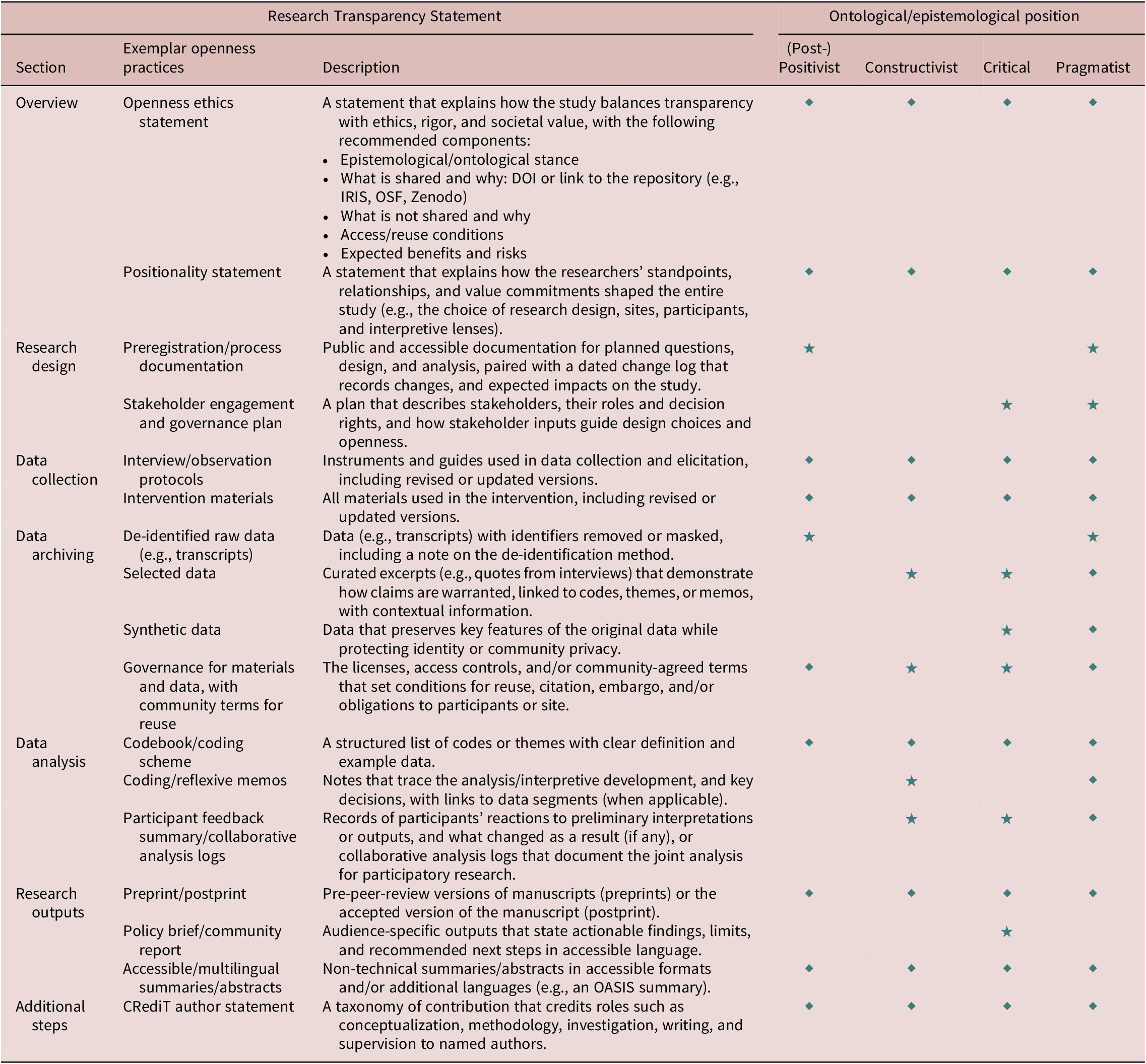
To address this question, we built on Liu et al.’s (Reference Liu, Al-Hoorie and Hiver2024) proposal for a research transparency statement (RTS), a concise appendix in which authors disclose and justify their open practices in five areas: data collection, data archiving, data analysis, research outputs, and additional steps to enhance transparency. To better accommodate the complexity and nuances needed for open qualitative research, we expanded the RTS by adding an Overview and Research Design section. Responding to Chan et al.’s (Reference Chan, Okune, Hillyer, Albornoz and Posada2019) call to contextualize openness, and drawing on insights from our review, we developed the situated-openness framework (Table 1) to help operationalize how specific practices of openness map onto the priorities of various research paradigms.
Situated-openness framework

Table 1. Long description
The table is organized into seven columns. The first three columns define the Research Transparency Statement: Section, Exemplar openness practices, and Description. The final four columns represent Ontological/epistemological positions: (Post-)Positivist, Constructivist, Critical, and Pragmatist. Symbols indicate practice priority: a diamond for recommended non-paradigm-specific practices and a star for paradigm-specific high priority practices.
* Overview: Includes Openness ethics statement and Positionality statement. Both are marked with diamonds across all four positions.
* Research design: Includes Preregistration/process documentation (star for Positivist and Pragmatist) and Stakeholder engagement (star for Critical and Pragmatist).
* Data collection: Includes Interview/observation protocols and Intervention materials. Both are marked with diamonds across all four positions.
* Data archiving: Includes De-identified raw data (star for Positivist and Pragmatist), Selected data (star for Constructivist and Critical, diamond for Pragmatist), Synthetic data (star for Critical, diamond for Pragmatist), and Governance for materials (diamond for Positivist and Pragmatist, star for Constructivist and Critical).
* Data analysis: Includes Codebook/coding scheme (diamond for all), Coding/reflexive memos (star for Constructivist, diamond for Pragmatist), and Participant feedback summary (star for Constructivist and Critical, diamond for Pragmatist).
* Research outputs: Includes Preprint/postprint (diamond for all), Policy brief (star for Critical), and Accessible/multilingual summaries (diamond for all).
* Additional steps: Includes C R E d i T author statement, marked with diamonds across all four positions.
⬥ Recommended practice that is not paradigm-specific.
★ Paradigm-specific high priority practice.
Note. The items and symbols are suggestive and illustrative, not prescriptive. Researchers may select and/or add applicable items and adapt priorities and recommended practices to their own ontological/epistemological commitments, provided the rationale is made transparent in their RTS.
Before we introduce the specific content of the framework, it is important to emphasize that our framework is intended to be heuristic, not prescriptive. Rather than attempting to catalog every qualitative tradition, it groups ontological and epistemological stances into broad families: (post-)positivist, constructivist, critical, and pragmatist. Drawing on Guba and Lincoln’s (Reference Guba and Lincoln1994) classic work on competing qualitative research paradigms, we distinguish the (post-)positivist family by its (critical) realist ontology and aim of explanation, prediction, and control of an external reality. The constructivism family is distinctive in its relativist assumption of multiple and locally created realities created through interaction. The critical family is broadly construed to include neo-Marxism, feminism, materialism, as well as participatory inquiry. We extended this taxonomy by adding pragmatism to account for the utility-based logic underpinning mixed-methods research. We chose these categories not to artificially flatten the field into cleanly separated compartments, but because across the literature we reviewed, they tended to anchor distinctive answers to the question “what must be made visible, and for whom?”
As can be seen in Table 1, each element of the (extended) RTS is accompanied by illustrative (i.e., not exhaustive) exemplar practices mapped against the groups of ontological and epistemological positions. We use black diamonds to indicate recommended practices that are not paradigm-specific and black stars to indicate paradigm-specific priorities. Crucially, this serves as a basic template for researchers to adapt for their own research circumstances. For instance, researchers can work across columns, add a new practice, or downplay a starred one, so long as the rationale is made explicit in their RTS. In this way, the framework functions less as a checklist or protocol than as a negotiating space: It helps authors articulate why certain forms of transparency matter more than others in their particular study, and it helps reviewers and editors evaluate openness without forcing every study through a single mold.
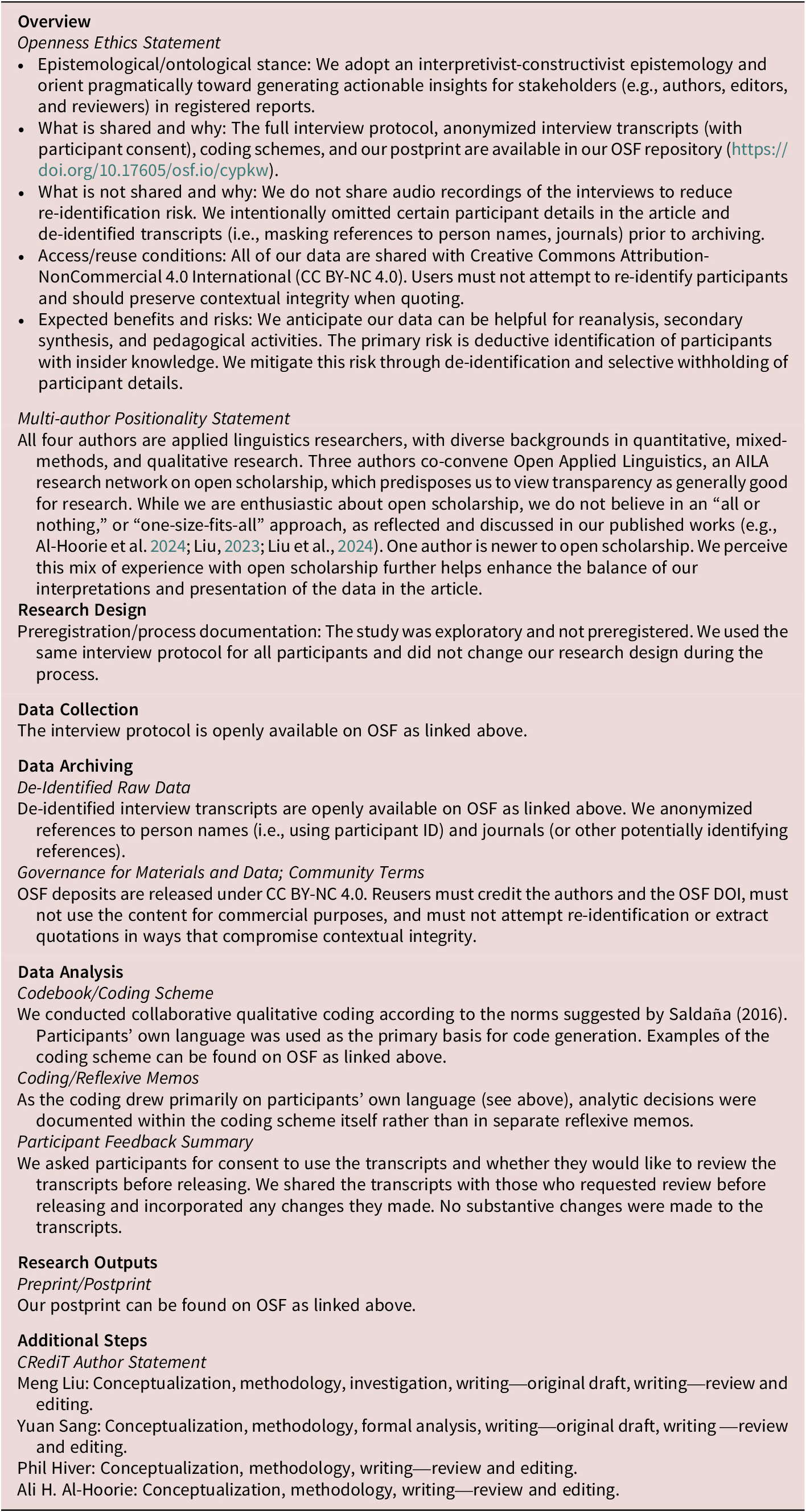
To demonstrate how the framework can be used in practice, we created an RTS for a qualitative study reporting on L2 authors’ experience of conducting registered reports (Liu et al., Reference Liu, Sang, Hiver and Al-Hoorie2025). This example in Table 2 is intended as a practical/field test of our framework and an opportunity for us to reflect more intentionally on our open practices, as it was constructed post-hoc for a study completed before this framework was developed. This retrospective application showcases the framework’s function as both an evaluative and a thinking tool. For instance, a constructivist stance would typically prioritize sharing curated excerpts, but we opted for a higher degree of openness by sharing full de-identified transcripts. This decision was ethically grounded in explicit consent from our participants, many of whom are open science advocates who were supportive of their data contributing to future work. However, this reflective process also made gaps in our open practices visible. We realized, for instance, that we had not shared our postprint or our coding scheme for data analysis at the time of publication. We have since added these materials to our open repository as a result of this self-evaluation. This iterative and reflective process, as reflected in our own work, represents an incrementalist ethos we hope to promote further (Liu et al., Reference Liu2023; Liu & Marsden, Reference Liu, Marsden, Curado Fuentes, Rico García and Fielden Burns2024): to prioritize an open and ongoing commitment to transparency over the (unrealistic) expectation to meet all top standards at the first or at every attempt.
Research transparency statement for Liu et al. (Reference Liu, Sang, Hiver and Al-Hoorie2025)

Table 2. Long description
The table is organized into several thematic sections.
1. Overview. Includes an Openness Ethics Statement adopting an interpretivist-constructivist stance. It specifies that interview protocols and anonymized transcripts are shared on OSF: https://doi.org/10.17605/osf.io/cypkw, while audio recordings are withheld to protect participant identity. Data is shared under C C B Y- N C 4.0. A Multi-author Positionality Statement notes that all four authors are applied linguistics researchers with varying experience in open scholarship.
2. Research Design. States the study was exploratory and not preregistered, using a consistent interview protocol.
3. Data Collection. Confirms the interview protocol is available on O S F.
4. Data Archiving. Details that de-identified transcripts are on O S F with names and journals masked. Governance is under CC BY-NC 4.0.
5. Data Analysis. Describes collaborative qualitative coding based on Saldaña 2016. Analytic decisions were documented within the coding scheme. Participants reviewed transcripts upon request.
6. Research Outputs. A postprint is available on O S F.
7. Additional Steps. Provides a C R e d i T Author Statement. Meng Liu and Yuan Sang handled conceptualization, methodology, and original drafts. Phil Hiver and Ali H. dot Al-Hoorie contributed to conceptualization, methodology, and editing.
Conclusion
Taken together, we have shown that openness and epistemological pluralism are not mutually exclusive but can be integrated meaningfully. The situated-openness framework, along with the research transparency statement, represents our efforts to operationalize this integration in ways that enable researchers to translate their methodological commitments into a visible and defensible narrative of their openness practices. We recognize that implementing this framework may be perceived as an extra burden on already overstretched researchers. As open research advocates, we have firsthand experience of the invisible labor involved (see Liu & Marsden, Reference Liu, Marsden, Curado Fuentes, Rico García and Fielden Burns2024 for a recent discussion of this). With this in mind, we have intentionally designed the research transparency statement to be concise and brief. Ultimately, we believe our framework does not ask for new intellectual work so much as visible work. By making explicit these often-hidden methodological decisions, the rigor of qualitative inquiry can be brought to the fore. We hope our review and our framework will help move the conversation in open qualitative L2 research beyond whether qualitative research can be open to how its unique forms of openness can enrich L2 research and related fields.
Acknowledgments
We would like to express our gratitude to Carlo Cinaglia and Nathan Thomas for their valuable feedback on earlier versions of this manuscript.
This work was supported by the Humanities and Social Sciences Youth Foundation, Ministry of Education of China (Grant Number 24YJC740049).
Competing interests
The author(s) declare none.

 Open access

