Thirty years ago, David Barker (Reference Barker1990) proffered his seminal hypothesis on “the fetal and infant origins of adult disease.” In the intervening years, accumulating evidence has established that experiences of stress in utero are associated with mental and physical health across the lifespan (Doyle & Cicchetti, Reference Doyle and Cicchetti2018; O'Donnell & Meaney, Reference O'Donnell and Meaney2017). The potential programming influences of prenatal maternal psychological distress (i.e., depression, anxiety, perceived stress) on emotional, cognitive, and behavioral outcomes have been of substantial interest. Prospective, longitudinal studies consistently have documented associations between prenatal maternal psychological distress and child cognition, temperament, stress physiology, and psychopathology (see Kingston, McDonald, Austin, & Tough, Reference Kingston, McDonald, Austin and Tough2015; Madigan et al., Reference Madigan, Oatley, Racine, Fearon, Schumacher, Akbari and Tarabulsy2018; O'Connor, Monk, & Burke, Reference O'Connor, Monk and Burke2016; Sandman, Glynn, & Davis, Reference Sandman, Glynn and Davis2016). These associations are presumed to be partially mediated by alterations in fetal brain and neurobehavioral development. In support of this premise, measures of prenatal maternal psychological distress have been linked with brain structure and function from infancy into adolescence (Adamson, Letourneau, & Lebel, Reference Adamson, Letourneau and Lebel2018; Davis et al., Reference Davis, Hankin, Glynn, Head, Kim and Sandman2020; Sandman, Buss, Head, & Davis, Reference Sandman, Buss, Head and Davis2015).
A primary advantage to studying neurobehavioral development in utero is that associations between maternal psychological distress and developmental outcomes can be examined prior to postpartum influences. Measures of fetal brain and neurobehavioral development are more proximal and likely more accurate indicators of fetal exposures (DiPietro, Costigan, & Voegtline, Reference DiPietro, Costigan and Voegtline2015; Sandman, Reference Sandman2015). Very recent advances in fetal functional magnetic resonance imaging have enabled direct observation of brain development during the prenatal period (Thomason et al., Reference Thomason, Hect, Waller, Manning, Stacks, Beeghly and Romero2018; van den Heuvel & Thomason, Reference van den Heuvel and Thomason2016). However, there is a long-standing tradition of assessment of fetal behavior as a noninvasive method of measuring neurodevelopment (see DiPietro et al., Reference DiPietro, Costigan and Voegtline2015). Fetal heart rate (FHR) and fetal movement parameters are established indices of central and autonomic nervous system maturation and function which demonstrate continuity with postnatal outcomes (DiPietro et al., Reference DiPietro, Costigan and Voegtline2015, Reference DiPietro, Kivlighan, Costigan, Rubin, Shiffler, Henderson and Pillion2010; Nijhuis, Swaab, Heuser, Brosens, & Eskes, Reference Nijhuis, Swaab, Visser, Heuser, Finch, Brosens and Eskes2003; Sandman, Reference Sandman2015).
FHR is the most accessible and quantifiable indicator of fetal development and is determined by both neural and nonneural influences (see DiPietro et al., Reference DiPietro, Costigan and Voegtline2015; Sandman, Reference Sandman2015). Primary neural influences are increasing parasympathetic innervation of the heart over gestation, as well as shifts in autonomic control from the medulla oblongata to higher cortical processes around 27 weeks’ gestation (Dalton, Dawes, & Patrick, Reference Dalton, Dawes and Patrick1983; David, Hirsch, Karin, Toledo, & Akselrod, Reference David, Hirsch, Karin, Toledo and Akselrod2007; Martin, Reference Martin1978; Yoshizato et al., Reference Yoshizato, Koyanagi, Takashima, Satoh, Akazawa and Nakano1994). As a result, FHR parameters demonstrate predictable maturational patterns, with decreases in mean rate (FHRM) and increases in variability (standard deviation; FHRV) during rest as gestation advances (Dawes, Houghton, Redman, & Visser, Reference Dawes, Houghton, Redman and Visser1982; DiPietro et al., Reference DiPietro, Caulfield, Costigan, Merialdi, Nguyen, Zavaleta and Gurewitsch2004, Reference DiPietro, Costigan and Voegtline2015; Van Leeuwen, Lange, Bettermann, Grönemeyer, & Hatzmann, Reference Van Leeuwen, Lange, Bettermann, Grönemeyer and Hatzmann1999). FHR patterns in response to external stimuli (Buss et al., Reference Buss, Davis, Class, Gierczak, Pattillo, Glynn and Sandman2009; Kisilevsky & Low, Reference Kisilevsky and Low1998; Sandman et al., Reference Sandman, Glynn, Wadhwa, Chicz-DeMet, Porto and Garite2003; Sandman, Cordova, Davis, Glynn, & Buss, Reference Sandman, Cordova, Davis, Glynn and Buss2011; Sandman, Wadhwa, Hetrick, Porto, & Peeke, Reference Sandman, Wadhwa, Hetrick, Porto and Peeke1997) and to induced maternal arousal (DiPietro, Costigan, & Gurewitsch, Reference DiPietro, Costigan and Gurewitsch2003; DiPietro, Ghera, & Costigan, Reference DiPietro, Ghera and Costigan2008; Monk et al., Reference Monk, Fifer, Myers, Bagiella, Duong, Chen and Altincatal2011) also display consistent maturational trajectories. In addition to reflecting neural maturation, FHR measures index individual differences in autonomic regulation (see DiPietro et al., Reference DiPietro, Costigan and Voegtline2015; Gunnar, Reference Gunnar, Colombo and Fagan1990), demonstrating moderate rank-order stability across gestation and into postnatal life, until at least age 2 (DiPietro, Bornstein, Hahn, Costigan, & Achy-Brou, Reference DiPietro, Bornstein, Hahn, Costigan and Achy-Brou2007; DiPietro, Costigan, Pressman, & Doussard-Roosevelt, Reference DiPietro, Costigan, Pressman and Doussard-Roosevelt2000; DiPietro, Hodgson, Costigan, & Johnson, Reference DiPietro, Hodgson, Costigan and Johnson1996b).
Despite the advantages of measuring development in utero, relatively few empirical studies have examined associations between prenatal maternal psychological distress and FHR parameters. Such associations serve as evidence in support of the hypothesis that maternal distress alters development prior to birth. One study demonstrated that fetuses of mothers with elevated depressive symptoms had higher baseline (prestimulation) late-gestation FHRM at 32–36 weeks’ gestation (Allister, Lester, Carr, & Liu, Reference Allister, Lester, Carr and Liu2001), whereas another investigation reported that elevated maternal depressive symptoms were associated with lower baseline FHRM at approximately the same gestational age (Dieter, Emory, Johnson, & Raynor, Reference Dieter, Emory, Johnson and Raynor2008). DiPietro and colleagues (Reference DiPietro, Hilton, Hawkins, Costigan and Pressman2002b) documented that a greater frequency of maternal pregnancy specific hassles and greater maternal affective intensity were associated with lower resting FHRM at 36 weeks’ gestation. Associations between maternal psychological distress and FHRV also have been reported. In an early investigation, DiPietro and colleagues showed that greater maternal perceived stress was associated with reduced resting FHRV (DiPietro, Hodgson, Costigan, Hilton, & Johnson, Reference DiPietro, Hodgson, Costigan, Hilton and Johnson1996a). In two subsequent investigations, higher levels of maternal pregnancy-specific hassles/stress were associated with higher levels of resting FHRV at 36–38 weeks’ gestation and a steeper increase in the coupling of FHR and fetal movement with advancing gestation (DiPietro et al., Reference DiPietro, Kivlighan, Costigan, Rubin, Shiffler, Henderson and Pillion2010; DiPietro, Hilton, Hawkins, Costigan, & Pressman, Reference DiPietro, Hilton, Hawkins, Costigan and Pressman2002b). In a sample of pregnant adolescents, Doyle et al. (Reference Doyle, Werner, Feng, Lee, Altemus, Isler and Monk2015) demonstrated that higher maternal negative mood was associated with lower FHRM among male but not female fetuses. In terms of FHR reactivity to stimulation, Monk and colleagues have shown that fetuses of women with elevated symptoms of depression and anxiety display a greater increase in FHR during women's exposure to a cognitive challenge (Monk et al., Reference Monk, Sloan, Myers, Ellman, Werner, Jeon and Fifer2004; Monk et al., Reference Monk, Fifer, Myers, Bagiella, Duong, Chen and Altincatal2011, Reference Monk, Fifer, Myers, Sloan, Trien and Hurtado2000; Monk, Myers, Sloan, Ellman, & Fifer, Reference Monk, Myers, Sloan, Ellman and Fifer2003). Allister et al. (Reference Allister, Lester, Carr and Liu2001) demonstrated that fetuses of mothers with heightened depressive symptoms displayed a delay in FHR reactivity and return to baseline following vibroacoustic stimulation at 36 weeks’ gestation. While it is difficult to fully synthesize existing research given variability in study designs, predictors, and outcomes, findings generally indicate that maternal psychological distress is associated with both levels and maturational trajectories of FHR over gestation.
The literature examining the extent to which fetal neurobehavioral measures are associated with postnatal developmental outcomes also is relatively circumscribed. FHR parameters are associated with birth outcomes (Emory & Noonan, Reference Emory and Noonan1984; Sandman et al., Reference Sandman, Cordova, Davis, Glynn and Buss2011), as well as neonatal neurobehavior (Emory & Noonan, Reference Emory and Noonan1984; Figueiredo, Pinto, Pacheco, & Field, Reference Figueiredo, Pinto, Pacheco and Field2017) and neurological maturation (DiPietro et al., Reference DiPietro, Kivlighan, Costigan, Rubin, Shiffler, Henderson and Pillion2010). Higher levels and steeper developmental trajectories of FHRV have been linked with greater mental and motor development and language ability at age 2 (Bornstein et al., Reference Bornstein, DiPietro, Hahn, Painter, Haynes and Costigan2002; DiPietro et al., Reference DiPietro, Bornstein, Hahn, Costigan and Achy-Brou2007). Consistent with their classification as biological indicators of individual differences in reactivity and regulation (DiPietro et al., Reference DiPietro, Ghera and Costigan2008; Gunnar, Reference Gunnar, Colombo and Fagan1990; Rothbart & Bates, Reference Rothbart, Bates, Damon and Eisenberg2007; Snidman, Kagan, Riordan, & Shannon, Reference Snidman, Kagan, Riordan and Shannon1995), studies also have examined continuity between FHR parameters and dimensions of temperament in infancy and childhood. DiPietro and colleagues (DiPietro et al., Reference DiPietro, Hodgson, Costigan and Johnson1996b) reported that higher resting FHRM at 36 weeks’ gestation was associated with lower maternal-reported levels of infant “emotional tone,” predictability, and activity level. In another investigation, fetuses with higher late-gestation coupling of FHR and fetal movement during rest exhibited greater alertness and orienting, better regulatory capacity, and less irritability during neonatal examination (DiPietro, Costigan, & Pressman, Reference DiPietro, Costigan and Pressman2002a). DiPietro, Voegtline, Pater, and Costigan (Reference DiPietro, Voegtline, Pater and Costigan2018) also documented that lower resting FHRM and FHRV at 32 weeks’ gestation were associated with higher maternal-reported behavioral inhibition at 7–14 years of age. In this same sample, higher baseline FHRM was associated with greater maternal-reported behavioral problems. Finally, greater third trimester FHR reactivity to induced maternal physiological arousal has been associated with greater irritability during a developmental exam at 6 weeks of age (DiPietro et al., Reference DiPietro, Ghera and Costigan2008) and with maternal-reported infant negative reactivity and observer-rating infant motor reactivity to novelty at 4 months of age (Werner et al., Reference Werner, Myers, Fifer, Cheng, Fang, Allen and Monk2007). These existing findings broadly support the notion that individual differences in FHR demonstrate continuity with dimensions of temperament in postnatal life.
Additional research is needed to determine the replicability and robustness of associations between maternal psychological distress and FHR parameters, and between FHR parameters and postnatal outcomes. The current study builds upon these literatures by addressing four aims. In a prospective, longitudinal study of 149 maternal–fetal/infant pairs, we examined if (a) prenatal maternal psychological distress was associated with developmental trajectories of resting FHRM and FHRV over gestation and (b) FHR parameters were associated with infant temperament at 3–6 months of age. Building upon established evidence that prenatal maternal psychological distress is associated with infant temperament (see Madigan et al., Reference Madigan, Oatley, Racine, Fearon, Schumacher, Akbari and Tarabulsy2018), we assessed if (c) FHR is a pathway by which prenatal maternal psychological distress is associated with infant temperament. This represents a robust test of the programming influences of prenatal maternal psychological distress on postnatal developmental outcomes. Finally, given established sex differences in associations between prenatal exposures and development (Buss et al., Reference Buss, Davis, Class, Gierczak, Pattillo, Glynn and Sandman2009; DiPietro et al., Reference DiPietro, Costigan and Voegtline2015; Glynn & Sandman, Reference Glynn and Sandman2012; Sandman, Glynn, & Davis, Reference Sandman, Glynn and Davis2013), we examined if (d) identified associations were moderated by fetal/infant sex.
Method
Overview
Women were recruited during the first trimester of pregnancy and completed prenatal laboratory visits at approximately 15 (M = 15.57, SD = 1.13), 19 (M = 19.85, SD = 0.94), 25 (M = 25.80, SD = 0.91), 31 (M = 31.09, SD = 0.76), and 37 (M = 36.83, SD = 0.79) weeks’ gestation. The majority of the sample completed all five prenatal visits (82%); 16% of women completed four visits, and 2% completed three visits. Maternal psychological distress was characterized at each study visit with validated self-report questionnaires. FHR monitoring was performed at the last three prenatal visits. Maternal report of infant temperament was collected at 3 and 6 months postpartum.
Participants
The sample consisted of 149 mother–infant pairs drawn from a prospective, longitudinal study. Pregnant women were recruited from a large university medical center in Southern California. At recruitment, inclusion criteria were: (a) adult (≥ 18 years of age), (b) English-speaking, and (c) intrauterine, singleton pregnancy. Exclusion criteria at recruitment were: (a) presence of uterine or cervical abnormalities, (b) conditions such as endocrine, hepatic, or renal disorders, or use of corticosteroid medication, and (c) self-reported abuse of tobacco, alcohol, or recreational drugs in the pregnancy.
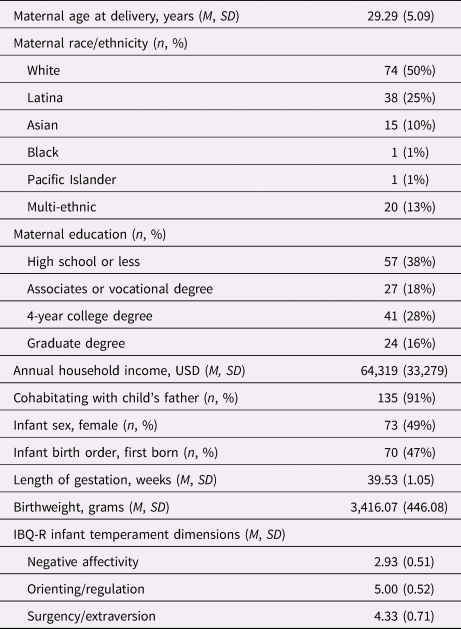
Additional inclusion criteria for the current study were (a) delivery at ≥ 37 0/7 weeks, (b) availability of measures of maternal psychological distress at three or more prenatal visits, and (c) measures of FHR at a minimum of two of the three sessions. Of the 149 mothers, 133 completed measures of infant temperament at 3 and/or 6 months’ postpartum. Dyads without infant temperament measures did not differ from dyads with temperament data by FHR mean (ps > .39) or variability (ps > .13), obstetric risk (p = .76), or socioeconomic status (SES) (p = .96). Mothers who did not complete infant temperament measures had higher levels of prenatal psychological distress at a trend level of significance (t = 1.79, p = .07, Cohen's d = 0.46). Overall sample characteristics are provided in Table 1.
Overall sample characteristics (N = 149)

Note. IBQ-R = Revised Infant Behavior Questionnaire.
This study was approved by the university's Institutional Review Board, and all women provided written informed consent.
Measures
Maternal psychological distress
Maternal psychological distress was characterized using three established self-report questionnaires, which were completed at all prenatal and postpartum visits. These measures are widely used in samples of pregnant women and demonstrate consistent associations with birth outcomes and postnatal developmental outcomes (see Bussières et al., Reference Bussières, Tarabulsy, Pearson, Tessier, Forest and Giguère2015; Madigan et al., Reference Madigan, Oatley, Racine, Fearon, Schumacher, Akbari and Tarabulsy2018).
Women reported their levels of depressive symptoms using the nine-item short form of the Center for Epidemiologic Studies Depression Scale (CESD; Santor & Coyne, Reference Santor and Coyne1997). Symptoms assessed include sadness/depression, sleep problems, difficulty concentrating, and absence of positive affect. Item responses ranged from 0 (rarely or none of the time) to 3 (most or all of the time), for a maximum possible total sum score of 27. The shortened version of the CESD has demonstrated good reliability and validity (Santor & Coyne, Reference Santor and Coyne1997). Cronbach's alphas in the current sample ranged from .85 to .88.
General anxiety symptoms were measured with the 10-item state anxiety subscale of the State Trait Personality Inventory (Spielberger, Jacobs, Crane, & Russell, Reference Spielberger, Jacobs, Crane and Russell1979). Women reported the extent to which they experienced various anxiety-related adjectives (e.g., nervous, tense) on a scale ranging from 1 (not at all) to 4 (very much). Total sum scores ranged from 10 to 40. This subscale displays good psychometric properties (Spielberger et al., Reference Spielberger, Jacobs, Crane and Russell1979; Spielberger & Reheiser, Reference Spielberger and Reheiser2009). Cronbach's alphas in the current sample ranged from .87 to .90.
Levels of maternal stress were characterized with the 10-item Perceived Stress Scale (PSS; Cohen & Williamson, Reference Cohen, Williamson, Spacapan and Oskamp1988). Women reported on experiences on a scale ranging from 0 (never) to 4 (almost always), including how often they were able to successfully manage day-to-day problems and hassles and how often they felt nervous and stressed. Total sum scores range from 0 to 40. This scale demonstrates good reliability and validity (Cohen & Williamson, Reference Cohen, Williamson, Spacapan and Oskamp1988). Cronbach's alphas in the current sample ranged from .87 to .91.
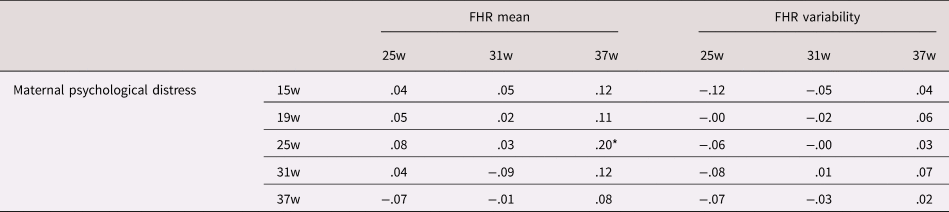
Prenatal depressive symptoms, anxiety symptoms, and perceived stress were moderately to highly correlated within each gestational timepoint (rs = .58–.79), so measures were standardized and averaged to create composite psychological distress variables (Glynn et al., Reference Glynn, Howland, Sandman, Davis, Phelan, Baram and Stern2018). In addition, associations between maternal psychological distress at each timepoint and FHR measures were relatively consistent (see Table 2). Therefore, a single prenatal maternal psychological distress composite was created by averaging scores from the five gestational assessments. The same procedure was used to create a composite of maternal psychological distress measures at 3 and 6 months’ postpartum.
Zero-order correlations between maternal psychological distress and fetal heart rate (FHR) measures

Note. w = weeks’ gestation. *p < .05. Matrix computed using pairwise deletion (overall N = 149).
Fetal development
FHR monitoring was conducted at the 25, 31, and 37-week visits. Mothers reclined in a semi-fowlers position (5–10-degree tilt) on a standard, padded examination table. Pure-tone music was presented though headphones to mask extraneous noise. Transabdominal transducers were attached to measure FHR and were positioned until a robust FHR signal was reliably detected. Monitoring began with a 15-minute baseline (resting) period to allow mother and fetus to adapt. FHR was quantified with a Toitu MT-430 ultrasound fetal monitor, which measured Doppler frequency shifts in a weak ultrasound beam projected on the fetus by an ultrasonic head and extrapolated FHR from fetal movement and uterine contractions. Fetal monitor data were digitized at a 2 kHz sampling rate with Active II (Biosemi Instrumentation) and transferred automatically to an off-line server for analysis. No uterine contractions occurred during the assessment period.
Integrity of the FHR data was assured by examining each tracing to scan for artifacts. An interpolation routine was applied for gaps or artifacts in the tracings of no greater than 10 seconds. Each tracing was examined by a trained observer who made a judgment about the validity of the interpolation. If a segment of the data resulted in unacceptable interpolations (the interval was >10 seconds or the estimate did not match the valid data points), that section of the data was omitted from analyses.
FHR mean (FHRM) and FHR variability (FHRV; calculated as the standard deviation) were computed in 1-minute epochs and averaged over a 3-minute rest period.
Infant temperament
Dimensions of infant temperament (negative affectivity, orienting/regulation, and surgency/extraversion) were assessed with the 191-item Infant Behavior Questionnaire-Revised (IBQ-R; Gartstein & Rothbart, Reference Gartstein and Rothbart2003). To reduce the potential for reporting bias, the IBQ-R asks about concrete infant behaviors (e.g., “How often during the last week did the baby startle to a sudden or loud noise?”) rather than asking the caregiver to make abstract judgments (Gartstein & Rothbart, Reference Gartstein and Rothbart2003). Mothers rated their infants on each item on a scale ranging from 1 (never) to 7 (always). Item responses are averaged to create subscales. The negative affectivity dimension is an average of subscales measuring sadness, distress to limitations, fear, and, reverse scored, falling reactivity/rate of recovery from distress. The orienting/regulation dimension assesses regulatory functioning and is comprised of subscales assessing low-intensity pleasure, cuddliness/affiliation, duration of orienting, and soothability. Finally, the surgency/extraversion factor consists of the approach, vocal reactivity, high-intensity pleasure, smiling and laughter, activity level, and perceptual sensitivity scales. The IBQ-R scales display good reliability (Gartstein & Rothbart, Reference Gartstein and Rothbart2003) and continuity with maternal-reported temperament into childhood (Putnam, Rothbart, & Gartstein, Reference Putnam, Rothbart and Gartstein2008). IBQ-R scales have demonstrated modest convergence with observer ratings of infant temperament, particularly during ecologically valid tasks (Forman et al., Reference Forman, O'Hara, Larsen, Coy, Gorman and Stuart2003; Hane, Fox, Polak-Toste, Ghera, & Guner, Reference Hane, Fox, Polak-Toste, Ghera and Guner2006; Johnson et al., Reference Johnson, Olino, Klein, Dyson, Bufferd, Durbin and Hayden2016; Parade & Leerkes, Reference Parade and Leerkes2008).
A total of 114 mothers completed the IBQ at both 3 and 6 months’ postpartum. Three and six-month scores were moderately correlated (orienting/regulation: r = .53; negative affectivity: r = .45; surgency/extraversion: r = .66). Nineteen mothers completed the measure only at either 3 (n = 15) or 6 (n = 4) months. For participants with data at both timepoints, scores were averaged across the two.
Obstetric complications and birth outcomes
Maternal and infant medical records were reviewed to determine pregnancy dating, pregnancy complications, and birth outcomes (gestational age at birth, birthweight). Pregnancies were dated according to guidelines from the American College of Obstetricians and Gynecologists (ACOG, 2009) by comparison of last menstrual period to estimates based on early ultrasound measurements taken by a research nurse at the first study visit.
An obstetric complications score accounted for prenatal infection, pregnancy-induced hypertension, gestational diabetes, oligohydramnios, polyhydramnios, preterm labor, vaginal bleeding, placenta previa, and anemia. A cumulative score assessing prenatal obstetric complications was derived from the sum of all present risk variables (Hobel, Reference Hobel, Bolognese and Schneider1982). In this low-risk sample, 72% had none of these risk factors, and no woman had more than two risk factors. A dichotomous score (no complications vs. any complications) was used in analyses.
Data analytic strategy
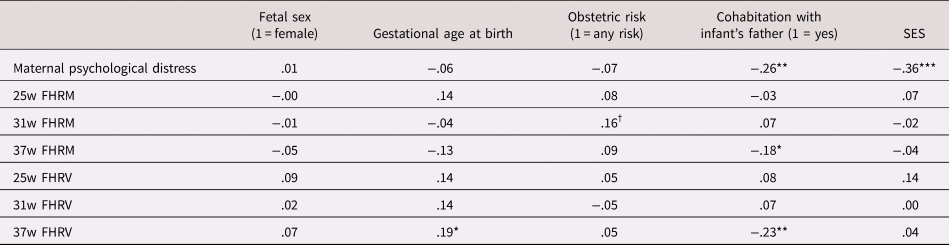
Linear mixed effects models (“lmer” package in R; Bates, Mächler, Bolker, & Walker, Reference Bates, Mächler, Bolker and Walker2015) were fit to examine associations between maternal prenatal psychological distress and trajectories of FHRM and FHRV. Linear mixed effects modeling was used due to unequally spaced measurements of FHR parameters. Marginal and conditional R 2GLMM (“MuMln” package in R; Bartoń, Reference Bartoń2019) and standardized fixed effects estimates (“sjstats” package in R; Lüdecke, Reference Lüdecke2020) were used as measures of effect size. Weeks’ gestation was the longitudinal time variable. Models for FHRM included a random effect of intercept and a fixed effect of linear slope (weeks’ gestation). The slope could not be modeled as a random effect because this resulted in a singular fit (the variance estimate for slope was nearly zero). Models for FHRV included random effects of both intercept and slope. Models were centered at 25, 31, and 37 weeks’ gestation to assess for intercept differences at each of these timepoints. Prenatal maternal psychological distress and covariates (gestational age at birth, obstetric risk, cohabitation with the infant's father, and socioeconomic status (composite of standardized annual household income and maternal years of education)) were included as predictors in the model. Covariates were selected based on previous fetal programming literature and were included if they were associated with maternal distress and/or FHR in the current sample (see Table 3 for zero-order correlations). When maternal distress was associated with a FHR parameter, fetal sex and its interaction with maternal distress were added to the model to assess for sex differences. Simple slopes were calculated via: http://www.quantpsy.org/interact/hlm2.htm.
Zero-order correlations between maternal psychological distress, fetal heart rate (FHR) measures, and covariates

Note. w = weeks’ gestation. †p < .10, *p < .05, **p < .01, ***p < .001. Matrix computed using pairwise deletion (overall N = 149). SES = socioeconomic status (composite of standardized annual household income and maternal years of education).
When maternal psychological distress was associated with intercept differences in a FHR parameter, an unconditional random intercepts model was fit centered at that gestational timepoint, and estimated individual intercept parameters (i.e., fixed effect + conditional modes of random effects) were extracted, so that all participants had an estimated FHR parameter. Associations between estimated FHR parameters and infant temperament dimensions and moderation of these associations by infant sex were then examined in individual regression models.
In the case that prenatal maternal psychological distress and/or a FHR parameter were associated with an infant temperament dimension, a path analysis assessed the conditional indirect effect of prenatal distress on infant temperament via the FHR parameter, with infant sex as the moderating variable. Postnatal maternal psychological distress was included as a covariate to assess whether associations among prenatal maternal distress, FHR, and infant outcomes were independent of concurrent maternal distress. Modeling was performed using the R package “lavaan” (Rosseel, Reference Rosseel2012), with bootstrapped standard errors and confidence intervals generated from 1,000 bootstrapped samples.
Results
Fetal heart rate parameters
As expected, over the course of gestation, resting FHRM decreased (gestational weeks estimate = -0.37, SE = 0.07, t = -5.28, p < .001), and FHRV increased (gestational weeks estimate = 0.18, SE = 0.03, t = 5.74, p < .001). FHRM displayed modest interindividual stability over the three timepoints (r = .29-.43; see Table 4), whereas FHRV was only associated between contiguous timepoints (r = -.06-.18; see Table 4). Within timepoints, FHRM and FHRV were associated only at 37 weeks’ gestation (r = .29, p = .001; see Table 4).
Fetal heart rate (FHR) descriptive statistics and zero-order correlations

Note. w = weeks’ gestation. Bolded values on diagonal are correlations between FHR mean and FHR variability within timepoints. *p < .05, **p < .01, ***p < .001.
Prenatal maternal psychological distress and fetal heart rate parameters
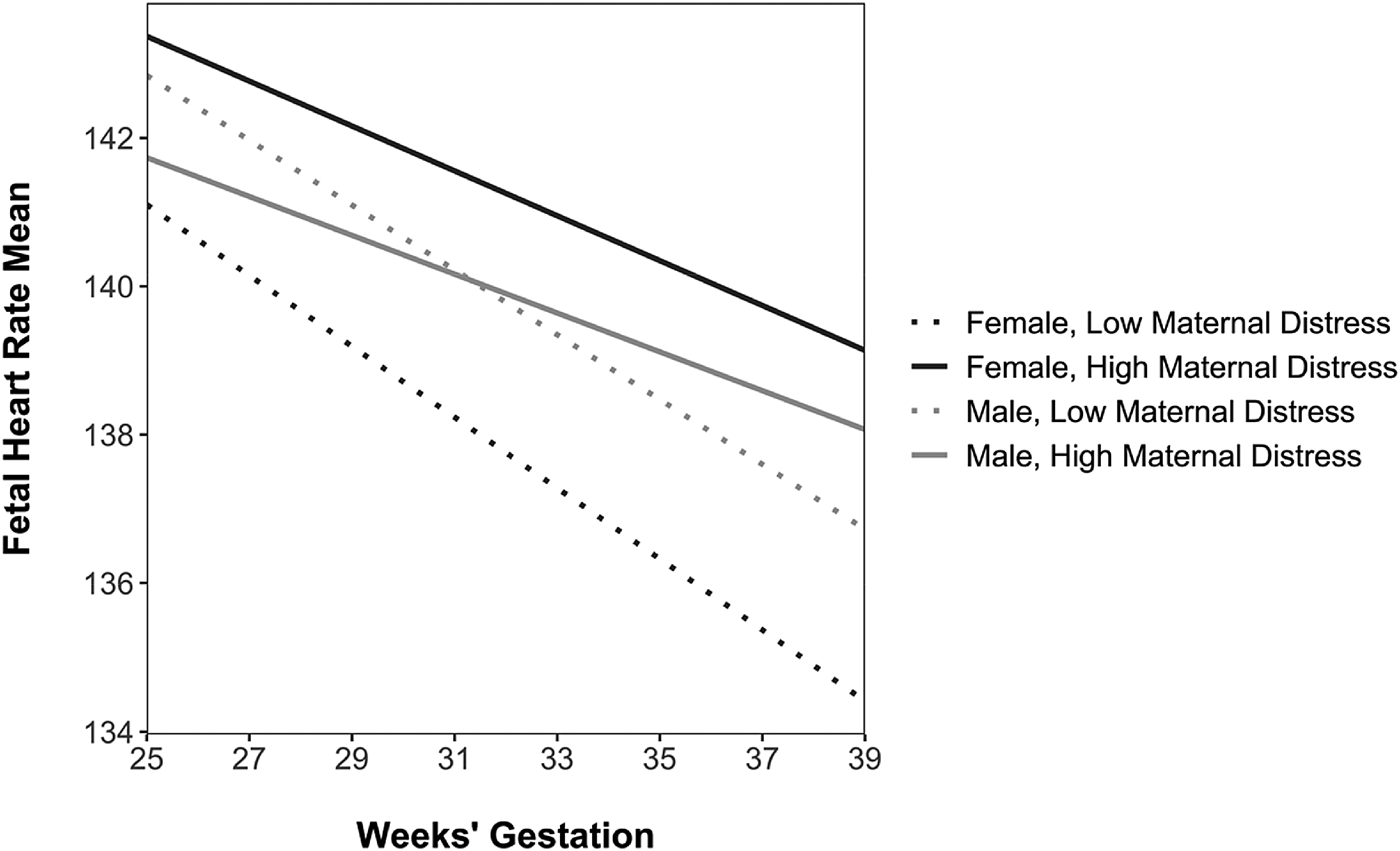
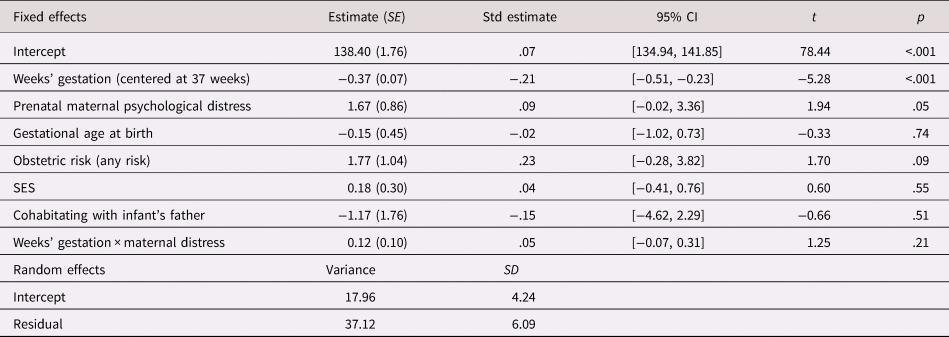
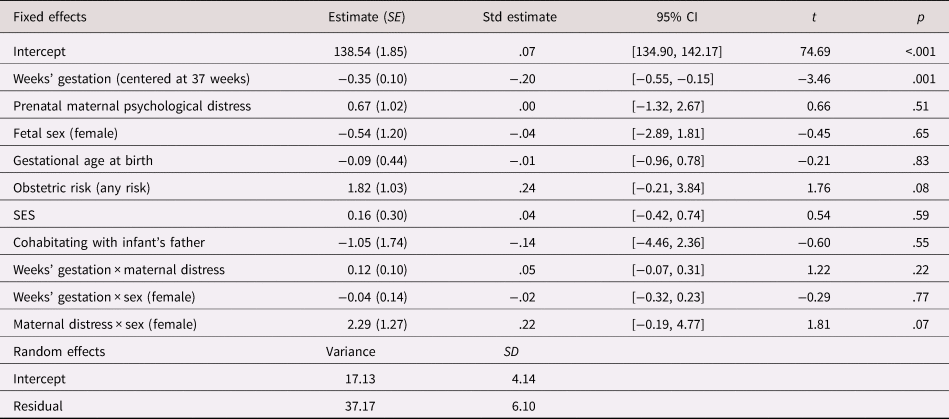
Linear mixed effects models examined if prenatal maternal psychological distress was associated with FHRM and FHRV over gestation. Higher levels of maternal psychological distress were associated with higher levels of FHRM at 37 weeks’ gestation (estimate = 1.76, SE = 0.85, t = 2.06, p = .04; see Table 5). This association was moderated by fetal sex at a trend level of significance (maternal distress x sex (female) estimate = 2.29, SE = 1.27, t = 1.81, p = .07; see Table 6 and Figure 1). Elevated maternal psychological distress was associated with higher 37-week FHRM among female fetuses (simple slope = 2.97, SE = 1.11, z = 2.66, p = .008) but not among male fetuses (simple slope = 0.67, SE = 1.02, z = 0.66, p = .51). Fetuses exposed to higher levels of prenatal maternal psychological distress also had less of the expected decrease in FHRM over gestation, but this slope difference was not statistically significant (estimate = 0.12, SE = 0.10, t = 1.25, p = .21). Maternal psychological distress was not associated with level differences in FHRM at 25 weeks’ gestation (estimate = 0.21, SE = 0.94, t = 0.23, p = .82) or at 31 weeks’ gestation (estimate = 0.94, SE = 0.69, t = 1.50, p = .18).
Trajectories of fetal heart rate mean over gestation. Elevated prenatal maternal psychological distress is associated with higher mean fetal heart rate (FHRM) at 37 weeks’ gestation among female fetuses. Prenatal maternal psychological distress was modeled continuously but is plotted at low (−1 SD) and high (+1 SD) values for illustrative purposes.

Linear mixed effects model examining associations between prenatal maternal psychological distress and mean fetal heart rate (N = 149)

Note. Mean fetal heart rate is the dependent variable. Marginal R2GLMM (variance explained by fixed effects) = .07. Conditional R2GLMM (variance explained by entire model, including fixed and random effects) = .37.
Linear mixed effects model examining sex differences in associations between prenatal maternal psychological distress and mean fetal heart rate (N = 149)

Note. Mean fetal heart rate is the dependent variable. Marginal R2GLMM (variance explained by fixed effects) = .08. Conditional R2GLMM (variance explained by entire model, including fixed and random effects) = .37.
Prenatal maternal psychological distress was not associated with levels or trajectories of FHRV (all ps > .41).
Maternal psychological distress, fetal heart rate, and infant temperament
Higher FHRM at 37 weeks’ gestation was, in turn, associated with dimensions of infant temperament. Higher 37-week FHRM was associated with lower infant orienting/regulation at a trend level of significance (B = −0.03, SE = 0.02, β = −.21, t = −1.76, p = .08), and this association did not differ by infant sex (FHRM × infant sex interaction term: B = −0.01, SE = 0.03, β = −.02, t = −0.18, p = .86). Similarly, higher FHRM was associated with higher negative affectivity at a trend level of significance (B = 0.03, SE = 0.02, β = .21, t = 1.68, p = .09), and this association also was not moderated by infant sex (FHRM × infant sex interaction term: B = −0.02, SE = 0.03, β = −.09, t = −0.74, p = .46). FHRM was not associated with surgency/extraversion (B = −0.02, SE = 0.03, β = −.09, t = −0.72, p = .48). FHRV at 37 weeks’ gestation was not associated with temperament dimensions in either sex (all ps > .24).
Prenatal maternal psychological distress also was associated with infant temperament. Higher prenatal maternal distress was associated with higher maternal-reported infant negative affectivity (B = 0.32, SE = 0.07, β = .45, t = 4.64, p < .001), and this association did not differ by infant sex (maternal distress × infant sex interaction term: B = 0.08, SE = 0.11, β = .07, t = 0.68, p = .50. The association between higher prenatal maternal distress and lower infant orienting/regulation was not statistically significant (B = −0.11, SE = 0.08, β = −.16, t = −1.49, p = .14) and was not moderated by infant sex (B = −0.05, SE = 0.12, β = −.05, t = −0.43, p = .67). Finally, prenatal maternal psychological distress was positively associated with infant surgency/extraversion (B = 0.22, SE = 0.11, β = .23, t = 2.10, p = .04), and this association was evident only among male infants (maternal distress × infant sex interaction term: B = −0.35, SE = 0.17, β = −.22, t = −2.03, p = .04; simple slope for males = 0.22, SE = 0.10, t = 2.13, p = .04; simple slope for females = −0.12, SE = 0.13, t = −0.92, p = .36).
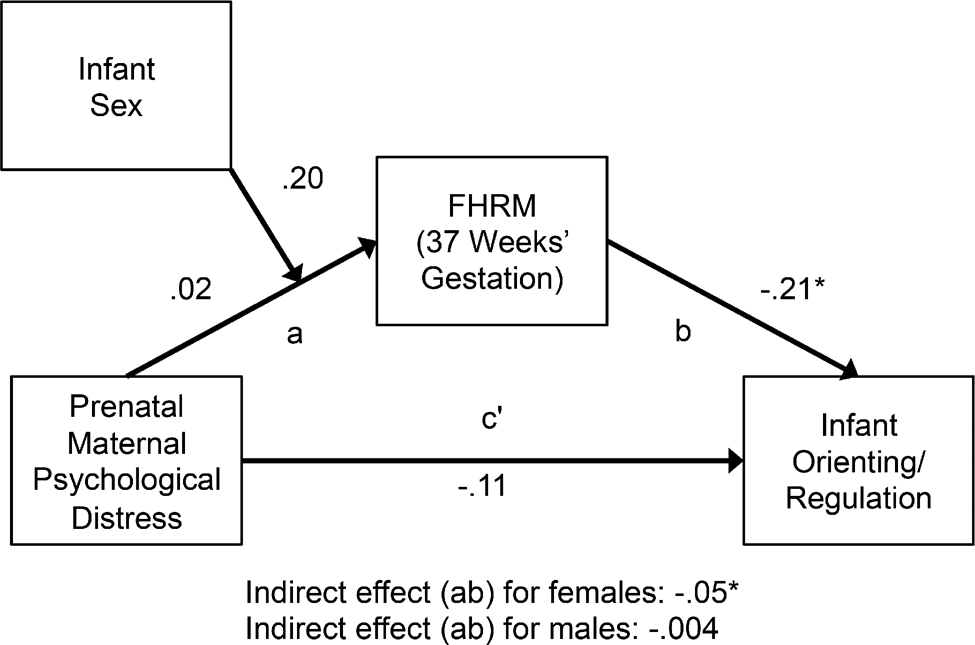
Path analyses examined if FHRM was a pathway by which prenatal maternal psychological distress was associated with infant temperament dimensions. There was an indirect effect of prenatal maternal psychological distress on infant orienting/regulation through FHRM at 37 weeks’ gestation among female infants but not male infants (see Figure 2; females: indirect effect estimate = −0.05, SE = 0.03, 95% CI [−0.15, −0.01]; males: indirect effect estimate = −0.002, SE = 0.02, 95% CI [−0.03, 0.03]). This finding was not explained by postnatal maternal psychological distress.
Results of a path analysis examining direct and indirect pathways from prenatal maternal psychological distress to infant orienting/regulation. FHRM = fetal heart rate mean. All values are standardized estimates. Asterisk indicates estimate is statistically significant (bootstrapped 95% CI does not contain zero).

In a separate path analysis, there was not an indirect effect of prenatal maternal psychological distress on infant negative affectivity through FHRM at 37 weeks for either sex (males: indirect effect estimate = 0.004, SE = 0.01, 95% CI [−0.01, 0.03]; females: indirect effect estimate = 0.02, SE = 0.09, 95% CI [−0.11, 0.26]).
Discussion
In a prospective, longitudinal cohort of 149 maternal–fetal pairs, we documented associations between prenatal maternal psychological distress, fetal neurobehavior, and infant temperament. Our findings are consistent with the hypothesis that exposure to maternal distress in utero has implications for development into postnatal life, specifically for females. In our sample, elevated prenatal maternal psychological distress was associated with higher resting mean fetal heart rate (FHRM) at 37 weeks’ gestation among female but not male fetuses. Late-gestation FHRM was, in turn, associated with dimensions of infant temperament. Specifically, higher FHRM was associated with lower orienting/regulation and with higher negative affectivity. These associations did not differ by infant sex. Moreover, among female infants, there was an indirect effect of prenatal maternal psychological distress on infant orienting/regulation through late-gestation FHRM. There were no associations between prenatal maternal psychological distress and FHRV, nor among FHRV and infant temperament dimensions.
In our sample, FHRM and FHRV demonstrated the expected maturational patterns, with FHRM decreasing and FHRV increasing over gestation (Dawes et al., Reference Dawes, Houghton, Redman and Visser1982; DiPietro et al., Reference DiPietro, Caulfield, Costigan, Merialdi, Nguyen, Zavaleta and Gurewitsch2004, Reference DiPietro, Costigan and Voegtline2015; Van Leeuwen et al., Reference Van Leeuwen, Lange, Bettermann, Grönemeyer and Hatzmann1999). For both male and female fetuses, late-gestation FHRM, an index of autonomic regulation, was associated with the temperament dimension of orienting/regulation during infancy. This finding builds on existing evidence that there is continuity in aspects of regulation from fetal to postnatal life (see DiPietro et al., Reference DiPietro, Hodgson, Costigan and Johnson1996b; DiPietro et al., Reference DiPietro, Costigan and Voegtline2015, Reference DiPietro, Voegtline, Pater and Costigan2018; Snidman et al., Reference Snidman, Kagan, Riordan and Shannon1995). Late-gestation FHRM was also associated with infant negative affectivity in the overall sample, consistent with previous studies documenting that FHR measures are associated with infant irritability (DiPietro et al., Reference DiPietro, Ghera and Costigan2008) and negative reactivity (Werner et al., Reference Werner, Myers, Fifer, Cheng, Fang, Allen and Monk2007).
Our finding that prenatal maternal psychological distress was associated with higher late-gestation FHRM among female fetuses suggests that maternal distress may shape autonomic and central nervous system development prior to birth. It also adds to a growing literature which indicates that females are particularly vulnerable to experiences of stress in utero (Glover & Hill, Reference Glover and Hill2012; Glynn & Sandman, Reference Glynn and Sandman2012; Sandman et al., Reference Sandman, Glynn and Davis2013). Our path analysis indicated that elevated late-gestation FHRM is one pathway by which higher prenatal maternal psychological distress is associated with lower infant orienting/regulation among female infants. This represents robust support for the hypothesis that prenatal maternal psychological distress is associated with postnatal outcomes by way of altering fetal development. As expected, elevated prenatal maternal psychological distress was associated with higher infant negative affectivity and lower infant orienting/regulation in our sample. These associations consistently have been documented in numerous previous investigations (see Madigan et al., Reference Madigan, Oatley, Racine, Fearon, Schumacher, Akbari and Tarabulsy2018, for a meta-analysis).
While one previous study reported higher late-gestation baseline FHRM in fetuses of mothers with elevated depressive symptoms (Allister et al., Reference Allister, Lester, Carr and Liu2001), other studies either have demonstrated that elevated prenatal maternal psychological distress was associated with lower resting FHRM (Dieter et al., Reference Dieter, Emory, Johnson and Raynor2008; DiPietro et al., Reference DiPietro, Hilton, Hawkins, Costigan and Pressman2002b; Doyle et al., Reference Doyle, Werner, Feng, Lee, Altemus, Isler and Monk2015) or have not found statistically significant associations between maternal distress and FHRM (DiPietro et al., Reference DiPietro, Hodgson, Costigan, Hilton and Johnson1996a; Monk et al., Reference Monk, Fifer, Myers, Bagiella, Duong, Chen and Altincatal2011, Reference Monk, Fifer, Myers, Sloan, Trien and Hurtado2000, Reference Monk, Myers, Sloan, Ellman and Fifer2003, Reference Monk, Sloan, Myers, Ellman, Werner, Jeon and Fifer2004). In addition, whereas other investigations have reported associations between maternal psychological distress and FHRV (DiPietro et al., Reference DiPietro, Hodgson, Costigan, Hilton and Johnson1996a; DiPietro et al., Reference DiPietro, Hilton, Hawkins, Costigan and Pressman2002b; DiPietro et al., Reference DiPietro, Kivlighan, Costigan, Rubin, Shiffler, Henderson and Pillion2010), we did not find associations between these variables. It is difficult to reconcile these differences given the dearth of existing studies and their varied methods (Allister et al., Reference Allister, Lester, Carr and Liu2001; Dieter et al., Reference Dieter, Emory, Johnson and Raynor2008; DiPietro et al., Reference DiPietro, Hodgson, Costigan, Hilton and Johnson1996a; DiPietro et al., Reference DiPietro, Hilton, Hawkins, Costigan and Pressman2002b; Doyle et al., Reference Doyle, Werner, Feng, Lee, Altemus, Isler and Monk2015; Figueiredo et al., Reference Figueiredo, Pinto, Pacheco and Field2017; Monk et al., Reference Monk, Fifer, Myers, Bagiella, Duong, Chen and Altincatal2011). Also, most studies have not reported analyses by fetal sex, which may have contributed to discrepancies in findings. A few studies have reported that fetal sex is associated with differences in FHR during rest or in response to stimulation (Buss et al., Reference Buss, Davis, Class, Gierczak, Pattillo, Glynn and Sandman2009; DiPietro et al., Reference DiPietro, Costigan and Voegtline2015), and the direction of findings has been mixed. One study examined sex differences in associations between maternal distress and FHR and reported that higher maternal negative mood was associated with lower FHRM among male but not female fetuses (Doyle et al., Reference Doyle, Werner, Feng, Lee, Altemus, Isler and Monk2015).
Mechanisms by which prenatal maternal psychological distress is associated with FHR development are unknown. Several researchers have proposed that the fetal autonomic and central nervous systems are partially entrained through distress-related changes in maternal physiology (DiPietro, Reference DiPietro2010; DiPietro et al., Reference DiPietro, Costigan and Gurewitsch2003; Monk et al., Reference Monk, Myers, Sloan, Ellman and Fifer2003). Specifically, fluctuations in the uterine sensory environment due to changes in maternal heart rate, respiration, blood pressure, and gastric motility may induce a fetal orienting response (DiPietro, Reference DiPietro2010; Kinsella & Monk, Reference Kinsella and Monk2009). Studies demonstrating alterations in fetal neurobehavioral activity in response to induced maternal sympathetic activation provide support for this hypothesis (DiPietro et al., Reference DiPietro, Costigan and Gurewitsch2003, Reference DiPietro, Ghera and Costigan2008; Monk et al., Reference Monk, Fifer, Myers, Bagiella, Duong, Chen and Altincatal2011, Reference Monk, Fifer, Myers, Sloan, Trien and Hurtado2000, Reference Nijhuis, Swaab, Visser, Heuser, Finch, Brosens and Eskes2003, Reference Monk, Sloan, Myers, Ellman, Werner, Jeon and Fifer2004). Variations in uterine perfusion resulting from maternal vasoconstriction may also alter FHR activity (DiPietro et al., Reference DiPietro, Costigan and Gurewitsch2003; Kinsella & Monk, Reference Kinsella and Monk2009). In addition, several studies suggest that FHR may be influenced by maternal and placental hormones (Doyle et al., Reference Doyle, Werner, Feng, Lee, Altemus, Isler and Monk2015; Monk et al., Reference Monk, Fifer, Myers, Bagiella, Duong, Chen and Altincatal2011; Sandman, Wadhwa, Chicz-DeMet, Porto, & Garite, Reference Sandman, Wadhwa, Chicz-DeMet, Porto and Garite1999).
Strengths of the present investigation include its prospective design, relatively large sample size, tests of indirect effects, and characterization of development across multiple levels of analysis (Cicchetti & Valentino, Reference Cicchetti, Valentino and Masten2007; Masten & Cicchetti, Reference Masten and Cicchetti2010). In addition to these strengths, our study has several limitations. Because we relied on maternal report of infant temperament, it is possible that women who experience higher levels of psychological distress during pregnancy are more likely to have more negative perceptions of their infants’ temperament (see Rothbart & Bates, Reference Rothbart, Bates, Damon and Eisenberg2007). The validity of these reports is strengthened by our adjustment for concurrent maternal distress and our findings that maternal-reported infant orienting/regulation and negative affectivity were associated with an objective, biological indicator of autonomic regulation (FHR). In addition, because our investigation was observational, we cannot rule out the possibility that associations between maternal psychological distress, FHRM, and infant temperament dimensions reflect a shared genetic contribution. Evidence from quasi-experimental human studies and experimental nonhuman animal models suggests that elevated maternal distress in utero has independent influences on fetal development (Rice et al., Reference Rice, Harold, Boivin, Van Den Bree, Hay and Thapar2010; Weinstock, Reference Weinstock2008). Fetal neurobehavioral development and infant temperament are likely multiply determined by both genetic and environmental factors (DiPietro et al., Reference DiPietro, Caulfield, Costigan, Merialdi, Nguyen, Zavaleta and Gurewitsch2004; Rothbart & Bates, Reference Rothbart, Bates, Damon and Eisenberg2007). Finally, we characterized FHRM and FHRV at each gestational timepoint during a 3-minute interval. However, we observed the predictable developmental patterns of FHRM and FHRV over gestation, supporting the validity of these measures.
Links between prenatal maternal psychological distress and postnatal developmental outcomes are now well documented (Howland, Sandman, & Glynn, Reference Howland, Sandman and Glynn2017; Kingston et al., Reference Kingston, McDonald, Austin and Tough2015; Madigan et al., Reference Madigan, Oatley, Racine, Fearon, Schumacher, Akbari and Tarabulsy2018; O'Connor et al., Reference O'Connor, Monk and Burke2016; O'Donnell, Glover, Barker, & O'Connor, Reference O'Donnell, Glover, Barker and O'Connor2014). However, relatively little research has directly focused on the putative mechanism underlying these associations – that prenatal maternal distress alters fetal development. In support of this programming hypothesis, we reported here that exposure to elevated prenatal maternal psychological distress is associated with differences in fetal neurobehavior among female fetuses. In addition, we established that altered fetal neurobehavior is a plausible pathway by which prenatal maternal distress can influence orienting/regulation among female infants. Our results also support the notion that, for both sexes, individual differences in regulation emerge prenatally and are maintained into infancy. Collectively, these findings underscore the utility of direct assessment of the fetus in determining if prenatal experiences are carried forward into postnatal life.
Acknowledgments
The authors thank the families who participated in these projects. We also thank the dedicated staff at the Early Human and Lifespan Development Program and the Women and Children's Health and Well-Being project.
Funding Statement
This research was supported by grants from the National Institutes of Health (NS-41298, HD-51852, and MH-96889).
Conflicts of Interest
None