INTRODUCTION
Only nine species of the Hexactinellida have been reported from Brazil up to now, viz. Aphrocallistes beatrix Gray, 1858, Chonelasma choanoides Schulze & Kirkpatrick, 1910, Dactylocalyx pumiceus Stutchbury, 1841, Euplectella suberea Thomson, 1876, Eurete atlantica Lopes, Hajdu & Reiswig, Reference Lopes, Hajdu and Reiswig2007, Hyalonema (Coscinonema) schmidti Schulze, 1899, Lophocalyx brasiliensis Menshenina, Tabachnick, Lopes & Hajdu, Reference Menshenina, Tabachnick, Lopes, Hajdu, Custódio, Lôbo-Hajdu, Hajdu and Muricy2007, L. reiswigi Menshenina Tabachnick, Lopes & Hajdu, 2007 and Pheronema carpenteri (Thomson, 1869). These originated from several oceanographic expeditions. First among these, the ‘Challenger’ expedition collected E. suberea and P. carpenteri off north-eastern Brazil (Schulze, Reference Schulze1887). The ‘Albatross’ expedition yielded H. schmidti also from north-eastern Brazil (Schulze, 1899). Dactylocalyx pumiceus was first recorded by Mothes de Moraes (1977) and then again by Lopes et al. (Reference Lopes, Hajdu and Reiswig2005), along with A. beatrix, both collected by the Programme REVIZEE. Chonelasma choanoides and E. atlantica were recorded by Lopes et al. (Reference Lopes, Hajdu and Reiswig2007), both collected by the Campos Basin Deep-waters Environmental Assessment Project. The ‘Marion Dufresne’ expedition collected Lophocalyx brasiliensis and the Programme REVIZEE collected L. reiswigi, both recorded by Menshenina et al. (Reference Menshenina, Tabachnick, Lopes, Hajdu, Custódio, Lôbo-Hajdu, Hajdu and Muricy2007).
The notion that only a poor hexactinellid fauna occurs off Brazil is being disproved as new material is being collected and old material is studied, as is the case for the MD55 RV ‘Marion Dufresne’ expedition material described here. Additional material collected by recent Brazilian environmental assessment programmes will also contribute to this better focused view of deep sea biodiversity in the south-western Atlantic.
MATERIALS AND METHODS
The material studied here originated mostly from the oceanographic expedition TAAF MD55 of the French RV ‘Marion Dufresne’, collected in the deep-sea off south-eastern Brazil between 6 May and 2 June 1987. The sponge specimens are deposited in the MNHN (Paris) collection. An additional specimen originated from an ROV collection made at Campos Basin, also off south-eastern Brazil, during ‘Campos Basin Deep-Sea Coral Assessment’, a research project coordinated by CENPES/PETROBRAS; and another from trawling conducted by the RV ‘Thalassa’ off eastern Brazil, during Programme REVIZEE.
The methods employed were the usual ones for preparation of dissociated spicule and thick section microscopic slides, as described elsewhere (Janussen et al., Reference Janussen, Tabachnick and Tendal2004). Abbreviations used throughout the text are: BA (Bahía State); CENPES (Centro de Pesquisas e Desenvolvimento Leopoldo Américo Miguez de Mello); ES (Espírito Santo State); MD55 (RV ‘Marion Dufresne’ 55th oceanographic campaign); MNHN (Muséum National d'Histoire Naturelle, Paris); ROV (remotely operated vehicle); MNRJ (Porifera Collection, Museu Nacional/UFRJ); PETROBRAS (Petróleo Brasileiro SA); REVIZEE (Evaluation of the Sustainable Potential of Life Resources in the Economic Exclusive Zone); RJ (Rio de Janeiro State); TAAF (Terres Australes et Antarctiques Françaises); and UFRJ (Universidade Federal do Rio de Janeiro, Rio de Janeiro).
RESULTS
DIAGNOSIS
Hyalonematidae with mainly bell-like or ovoid body; the everted (when known) atrialia do not form notable rise; basalia are gathered in a compact twisted (in grown specimens) tuft, being represented by toothed anchors (Tabachnick & Menshenina, Reference Tabachnick, Menshenina, Hooper and van Soest2002).
TYPE SPECIES
DIAGNOSIS
Hyalonema with whip-like (rarely spindle-like in overall shape), short spiny pinular ray of dermal spicules, its rhachis is thickest at base; without ambuncinates; macramphidiscs have umbels broader than long, their umbels are 1/2–1/7 as long as the length of the whole spicule (Tabachnick & Menshenina, Reference Tabachnick, Menshenina, Hooper and van Soest2002).
TYPE SPECIES
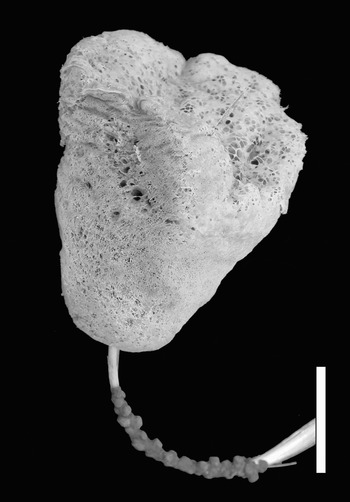
Hyalonema (Cyliconema) conqueror sp. nov. Holotype, view from aside (scale 30 mm).

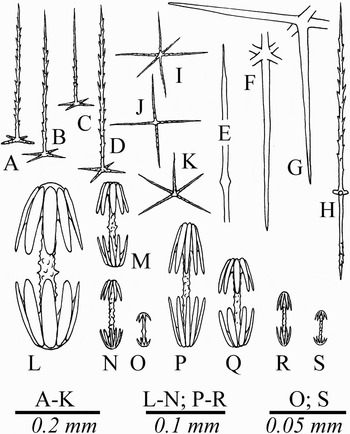
Spicules of Hyalonema (Cyliconema) conqueror sp. nov. holotype. (A–B) Dermal pentactins; (C–D) atrial pentactins; (E) choanosomal diactin; (F) choanosomal hexactin; (G) hypodermal pentactin; (H) atrial pinular diactin; (I) microxyhexactin; (J) microxystauractin; (K) microxypentactin; (L) macramphidisc; (M–N; P–R) mesamphidiscs; (O; S) micramphidiscs; (A–G; I–O) holotype; (H) paratype MNRJ 3342; (P–S) paratype MNHN (fr387).

TYPE MATERIAL
Holotype: MNRJ 10093, Campos Basin Deep-sea Coral Assessment Project, CENPES/PETROBRAS, Station Marlim Leste tr. 900-600 (Campos Basin, RJ, 22°20′58,676″S–39°59′17,914″W), depth 835 m, coll. ROV on board of ROVS ‘Toisa Conqueror’, 12 November 2004.
Paratypes: MNRJ 3342, Programme REVIZEE, Bahia II, Station 0517 (BA, 13°22′173″S–038°36′566″W), depth 750 m, coll. RV ‘Thalassa’, 19 July 2000; MNHN HCL 1500 (KT fr387), MD 55, Station 15 DC 28 (Vitória–Trindade seamounts chain, ES, 20°26′39″S–36°41′66″W), depth 750 m, coll. RV ‘Marion Dufresne’, 14 May 1987.
DESCRIPTION
Body of the holotype is conical, 91 mm long, 67 mm in diameter in the upper part and basalia, 350 mm long; sieve-plate present. The body of the paratype MNRJ 3342 is conical, 76 mm long, 25 mm in diameter in the upper part and basalia, 90 mm long; sieve-plate absent. MNHN HCL 1500 has body conical, 70 mm long and 30 mm in diameter in the upper part, walls about 5 mm thick and vast atrial cavity, basalia broken, longer than 300 mm. Sieve-plate absent in the paratypes.
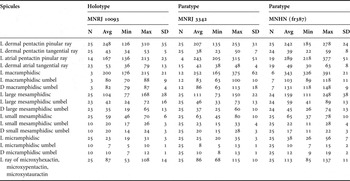
Spicules: choanosomal spicules are diactins (rarely tauactins) and hexactins with conically pointed outer ends. The diactins are 570–2300/5–18 µm. The rays of choanosomal hexactins are 120–60/5–14 µm. Hypodermal pentactins have conically pointed outer ends; tangential rays are 140–770 µm long, proximal ray is 520–990 µm long, the diameter of these rays is about 10–25 µm. Dermalia and atrialia are pinular pentactins (rarely dermal diactins and dermal hexactins) with rays conical in shape with short spines; tangential rays are rough, conically pointed. Dermal pentactins have pinular rays 126–310 µm long, tangential rays 22–59 µm long, their diameter is 5–10 µm. Atrial pentactins have pinular rays 136–377 µm long, tangential rays 30–79 µm long, their diameter is about 5–14 µm.
Microscleres: amphidiscs have rough or tuberculated shafts. Total length of macramphidisc 165–391 µm, the umbel length 63–118 µm, the umbel diameter 63–148 µm. Total length of large mesamphidisc is 73–248 µm, the umbel length 24–89 µm, the umbel diameter 19–74 µm. Total length of small mesamphidisc is 37–80 µm, the umbel length 11–33 µm, the umbel diameter 11–28 µm. Total length of micramphidisc is 19–56 µm, the umbel length 5–15, the umbel diameter 7–19 µm. Microxyhexactins, microxypentactins and microxystauractins have rough rays 53–137 µm, their diameter is 4–8 µm.
ETYMOLOGY
The proposed new name, conqueror, a name in apposition, derives from ‘Toisa Conqueror’, the ROV support vessel conducting the operations on which the holotype of this species has been collected.
REMARKS
The subgenus is well-known in the World Oceans by numerous representatives. This sponge is the first record of H. (Cyliconema) in the South Atlantic. Two other species known in the Atlantic Ocean: H. (C.) infundibulum Topsent, Reference Topsent1896 and H. (C.) thomsoni (Marshall, Reference Marshall1875) are widely distributed in the north-eastern Atlantic Ocean (Schulze, Reference Schulze1887; Topsent, Reference Topsent1896, Reference Topsent1904, Reference Topsent1928; Stephens, Reference Stephens1915; Arnesen, Reference Arnesen1932; Boury-Esnault et al., Reference Boury-Esnault, Pansini and Uriz1994). The new species is well distinguished from the others by presence of mesamphidiscs with elongated umbels (previously not reported in the subgenus) and presence of oxyoidal microscleres: microhexactins and their derivatives micropentactins and microstauractins. Other features of the spicule content of this species are similar to those seen in other species of this subgenus, e.g. the western Indian Ocean species H. (C.) nicobaricum Schulze, Reference Schulze1904; H. (C.) valdivia Schulze, Reference Schulze1904 and H. (C.) tulipa Schulze, Reference Schulze1904. An ovoid shape of mesamphidiscs is known in three species of the subgenus: H. (C.) coniforme Schulze, Reference Schulze1904 (off Somalia Peninsula); H. (C.) globiferum Schulze, Reference Schulze1904 (south-east of Ceylon) and H. (C.) timorense Ijima, Reference Ijima and Weber1927 (off Indonesian Archipelago).
Spicule measurements of Hyalonema (Cyliconema) conqueror sp. nov. (in μm). Avg, average; Min, minimum; Max, maximum; SD, standard deviation; L, length; D, diameter.

MATERIAL EXAMINED
MNHN HCL 1501–1506 (KT fr353–358, respectively)—MD 55, Station 41 CP 07 (Vitória–Trindade seamounts chain, ES, 21°31′S–40°07″W), depth 750–785 m, coll. RV ‘Marion Dufresne’, 10 May 1987.
DESCRIPTION
Body: most of these specimens are fragments and only one sponge fragment MNHN HCL 1501 contains remnants of the body attached to basalia.
REMARKS
These fragments likely belong to another new species of Hyalonema (C.) sp. but their poor preservation condition does not allow its proper description. Unlike the H. (C.) conqueror sp. nov. described above, they have no large mesamphidiscs, no other oxyoidal microscleres apart from microxyhexactins.
DIAGNOSIS
Hyalonema with pinular ray of dermal spicules from spindle-like to finely tapering; macramphidiscs with umbels longer than broad or as long as broad; the teeth of macramphidiscs or large mesamphidiscs have serrated edges (some microstauractins have thick rays with rounded ends (Tabachnick & Menshenina, Reference Tabachnick, Menshenina, Hooper and van Soest2002)).
TYPE SPECIES
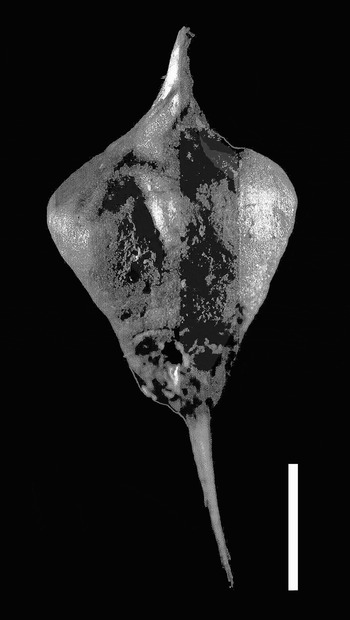
Hyalonema (Prionema) dufresnei sp. nov. Holotype, view from aside (scale 30 mm).

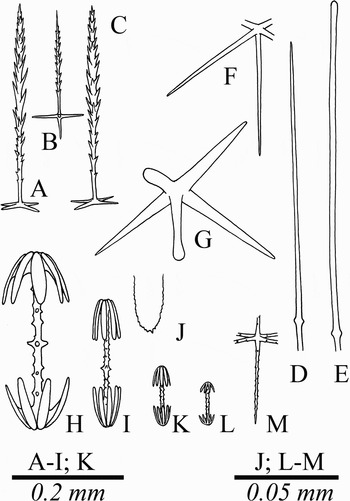
Spicules of Hyalonema (Prionema) dufresnei sp. nov. holotype. (A) Dermal pentactins; (B) dermal hexactins; (C) atrial pentactins; (D–E) choanosomal diactins; (F–G) hypodermal pentactins; (H) macramphidisc; (I) large mesamphidiscs; (J) tooth of large mesamphidiscs; (K) small mesamphidiscs; (L) micramphidisc; (M) microxyhexactin.

TYPE MATERIAL
Holotype: MNHN HCL 1507 (KT fr335), MD 55, Station 42 CB 76 (Vitória–Trindade seamounts chain, ES, 18°58′S–37°49′W), depth 600–637 m, coll. RV ‘Marion Dufresne’, 27 May 1987.
DESCRIPTION
Body: the sponge is clavate, without atrial cavity, with body 100 mm long and long apical cone 30 mm long. The maximal diameter of the sponge is 60 mm, basalia are remnants 40 mm long.
Spicules: choanosomal spicules are diactins 800–1700/5–27 µm with a widening in the middle and with conically pointed or rarely rounded outer ends. Hypodermal pentactins have rays 170–530/8–34 µm long with conically pointed or rounded outer ends; hypoatrial pentactins appear to be entirely absent or very rare. Dermalia and atrialia are pinular pentactins (rarely hexactins) with pinular ray spindle-like in shape and short spines. The length of dermal pinular ray is 190–426 µm, their diameter is 6 µm at base and 9 µm in the thickest part; tangential rays are smooth 30–61 µm, their diameter is 6 µm. Atrialia are pentactins similar to dermal ones in shape. The length of atrial pinular ray is 243–395 µm, their diameter is 7–9 µm at base and 9–14 µm in the thickest part; tangential rays are smooth 30–53 µm, their diameter is 5 µm.
Microscleres: amphidiscs are represented by numerous types: macramphidiscs (umbel broader than long), mesamphidiscs (umbel longer than broad) with smooth and serrated teeth margins, small mesamphidiscs and micramphidiscs. The macramphidiscs and large mesamphidiscs have spiny or tuberculated shafts with a whorl of tubercles in the middle; the other amphidiscs have spiny shafts. Total length of macramphidiscs with smooth teeth is 212–319 µm, the umbel length is 61–91 µm, the umbel diameter is 41–129 µm. Total length of macramphidiscs with serrated teeth is 252–342, the umbel length 77–108 µm, the umbel diameter 72–83 µm. Total length of mesamphidiscs with smooth teeth is 76–192 µm, the umbel length 34–56 µm, the umbel diameter 22–33 µm. Total length of mesamphidiscs with serrated teeth is 218–243 µm, the umbel length 54–70 µm, the umbel diameter 36–59 µm. Total length of small mesamphidiscs is 32–68 µm, the umbel length 11–23 µm, the umbel diameter 11–18 µm. Total length of micramphidiscs is 20–25 µm, the umbel length 5–9 µm, the umbel diameter 6–9 µm. Microxyhexactins have straight spiny rays 23–41 µm long, their diameter is 1–2 µm.
ETYMOLOGY
The proposed new name, dufresnei, derives from ‘Marion Dufresne’, the research vessel conducting the operations on which this species has been collected.
REMARKS
This is the second species of the subgenus found in the Atlantic Ocean. The first was Hyalonema (P.) repletum Reiswig, Reference Reiswig2000, formerly Leiobolidium, from off the Lesser Antilles Islands (16 km, west–south-west of the island of Bequia, USCSS Blake, Station 235, 12°57′10″N 61°25′25″W, 2757 m depth), other species are known mostly in the central east Pacific and one in the central western part of the Indian Ocean. The shape of the pinular ray of the new species is clavate with short spines (unlike H. (P.) repletum with same spicules having stout raphis and long spines); part of macramphidiscs, as well as part of mesamphidiscs have serrated teeth margin. The pinular ray of H. (P.) dufresnei sp. nov. is similar to that of H. (P.) poculum Schulze, 1886 (sensu Schulze, Reference Schulze1887) and H. (P.) agujanum Lendenfeld, 1915; but unlike the macramphidiscs of these species, those found in the new species have umbels which are broader than long, and teeth which have wide, rounded ends. Unlike Hyalonema (P.) crassum Lendenfeld, 1915 the pinular rays in the new species are spindle-like and the teeth of macramphidiscs may have serrated margins.
MATERIAL EXAMINED
MNHN HCL 1508–1512 (KT fr338; fr340; fr337; fr339; fr341, respectively), MD 55, Station 39 CB 68 (Vitória–Trindade seamounts chain, ES, 18°55′S–37°49′W), depth 1220 m, coll. RV ‘Marion Dufresne’, 26 May 1987; MNHN HCL 1513 (KT fr336), MD 55, Station 42 CB 76 (Vitória–Trindade seamounts chain, ES, 18°58′S–37°49′W), depth 600–637 m, coll. RV ‘Marion Dufresne’, 27 May 1987; MNHN HCL 1514 (KT fr333), MD 55, Station 44 CB 78 (Vitória–Trindade seamounts chain, ES, 18°55′S–38°48′W), depth 1200 m, coll. RV ‘Marion Dufresne’, 27 May 1987; MNHN HCL 1515–1516 (KT fr61; fr334, respectively), MD 55, Station 65 CB 107 (Vitória–Trindade seamounts chain, ES, 24°0′S–42°14′W), depth 1020 m, coll. RV ‘Marion Dufresne’, 2 July 1987.
REMARKS
These sponges are represented by poor fragments most of which are referred to H. (P.) with some hesitations. Their pinular rays are clavate in shape and have an apical cone. Two of these sponges (MNHN HCL 1508–1509) definitely belong to this subgenus but their pinular pentactins differ neither from the species described above nor from another species known in the Atlantic (H. (P.) repletum Reiswig, Reference Reiswig2000).
MATERIAL EXAMINED
MNHN HCL 1517 (KT fr253), MD 55, 43 CB 77 (Vitória–Trindade seamounts chain, ES, 19°0′S–37°47′W), depth 900–790 m, coll. RV ‘Marion Dufresne’, 25 May 1987.
REMARKS
The sponge is presented by poor, dead fragments whose specific identification is not possible.
MATERIAL EXAMINED
MNHN HCL 1518 (KT fr243), MD 55, 43 CB 77 (Vitória–Trindade seamounts chain, ES, 19°00′S–37°47′W), depth 900–790 m, coll. RV ‘Marion Dufresne’, 25 May 1987.
DESCRIPTION
Body: small fragment about 4 mm in diameter.
Framework: the dictyonal skeleton is typical for the species. The distance between the centres of the spicules of the rigid skeleton is 200–300 µm; the beams are 30–40 µm in diameter.
Spicules: the loose spicules are very rare. Sarules are 278–340 µm long (N = 10; avg = 307; SD = 22), their heads are 81–111 µm long (N = 10; avg = 92; SD = 9), their diameter is 6–7 µm. Dermal pentactins and hexactins have rays 148–222 µm long, the distal ray of hexactins is 37–44 µm long, their diameter is 7–11 µm. Uncinates are broken about 7 µm in diameter.
Microscleres: not found.
REMARKS
The precise identification of this sponge is impossible due to its poor condition and lack of microscleres. Nevertheless it is very likely that it is Sarostegia oculata known to be distributed in the eastern Atlantic and widely in the Indian Ocean. The sarules are smaller than those re-described from the lectotype but this is likely an intra-specific variation.
MATERIAL EXAMINED
MNHN HCL 1519 (KT fr192), MD 55, 43 CB 77 (Vitória–Trindade seamounts chain, ES, 19°0′S–37°47′W), depth 900–790 m, coll. RV ‘Marion Dufresne’, 25 May 1987.
REMARKS
Absence of loose spicules does not allow identification of these sponges precisely. Nevertheless, it is very likely that the species is identical to A. beatrix previously described from off south-eastern Brazil (Lopes et al., Reference Lopes, Hajdu and Reiswig2005).
MATERIAL EXAMINED
KT fr584 (specimen not found in MNHN collection), MD 55, 16 DC 29 (Vitória– Trindade seamounts chain, ES, 20°26′S–36°41′W), depth 270–350 m, coll. RV ‘Marion Dufresne’, 15 May 1987.
DESCRIPTION
Body: large, excavated sponge, about 230 mm in diameter with walls 30–50 mm in diameter.
Framework: the framework is identical to that described before for both species of Dactylocalyx.
Spicules: hexactins have ray directed outside the body 11–215 (N = 17; avg = 105; SD = 64) μm long, tangential rays 130–851 (N =16; avg = 231; SD =173) μm long, the ray directed inside the body is 407–814 (N = 5; avg = 633; SD = 169) μm long.
The pentactins have tangential rays 144–555 (N = 11; avg = 260; SD =142) μm long, the ray directed inside the body is 252–426 (N = 4; avg = 329; SD = 74) μm long. The diameter of the rays of hexactins and pentactins is 3–7 µm; their outer ends are usually conicaly pointed rarely clavate.
Microscleres: the discohexasters are 44–89 (N = 26; avg = 67; SD = 13) μm in diameter with primary rosette 7–15 (N = 26; avg = 10; SD = 3) μm in diameter.
REMARKS
Dactylocalyx subglobosus is less investigated than another species of this genus, D. pumiceus, which is often mentioned in recent publications (Reiswig, Reference Reiswig, Reitner and Keupp1991, Reference Reiswig, Hooper and van Soest2002; Lopes et al., Reference Lopes, Hajdu and Reiswig2005). The only proof of difference between these species is a single type of microscleres in D. subglobosus and the presence of onychohexasters in the second species (Reiswig, Reference Mothes de Moraes1991). These species may be synonyms as was suggested previously (e.g. Reiswig, Reference Reiswig, Hooper and van Soest2002). Their distribution seems to coincide. However, investigations of many specimens from different locations are necessary to settle this question.
MATERIAL EXAMINED
MNHN HCL 1520 (KT fr104), MD 55, 43 CB 77 (Vitória–Trindade seamounts chain, ES, 19°0′S 37°47′W), depth 900–790 m, coll. RV ‘Marion Dufresne’, 25 May 1987.
REMARKS
This sponge is represented by a dead body 50 mm high and 60 mm in diameter, with walls about 20 mm in thickness, and without loose spicules, thus rendering its specific identification impossible.
MATERIAL EXAMINED
MNHN HCL 1521–1522 (KT fr90; fr91, respectively), MD 55, 43 CB 77 (Vitória–Trindade seamounts chain, ES, 19°0′S 39°47′W), depth 900–790 m, coll. RV ‘Marion Dufresne’, 25 May 1987.
DESCRIPTION
Body: the two specimens are represented by basal parts of the body, 40 mm high and 20 mm in diameter, which contain few microsleres.
Spicules: anchorate spicules present. The principal choanosomal spicules are pentactins, the most numerous choanosomal spicules are tauactins, stauractins, paratetractins and pentactins. Diactins comitalia are situated close to the distal ray of principal pentactins 400–700/4–9 µm. Dermalia are hexactins with rough distal ray 400–800 µm long, tangential rays are 300–400 µm long, proximal ray is 110–200 µm long, their diameter is 14–23 µm.
Microscleres: the microscleres are very rare. The floricome is 104 µm in diameter with primary rosette 19 µm in diameter. The oxyhexaster is 104 µm in diameter with primary rosette 15 µm in diameter.
REMARKS
In spite of their macerated condition, the assignment of these sponges to E. suberea is quite reliable because the choanosomal spicules are very peculiar for the species. It is impossible to discuss the variation of microscleres in these specimens because of their rarity.
MATERIAL EXAMINED
MNHN HCL 598 (KT fr351), holotype; MNHN HCL 599–605 (KT fr343, fr346, fr347, fr348, fr349, fr350, fr383, respectively; paratypes), MD 55, 64 CB 105 (Vitória–Trindade seamounts chain, ES, 23°46′S–42°9′W), depth 597–610 m, coll. RV ‘Marion Dufresne’, 2 July 1987.
REMARKS
Description of this species was given in the publication devoted to revision of Lophocalyx in the Atlantic Ocean (Menshenina et al., Reference Menshenina, Tabachnick, Lopes, Hajdu, Custódio, Lôbo-Hajdu, Hajdu and Muricy2007).
DISCUSSION
The MD55 collection clearly shows how much unexplored the south-western Atlantic is as regards its hexactinellid fauna. Species reported upon here originate in their majority from a narrow latitudinal zone stretching between 18°55′ and 24°0′S, and between the isobaths of 270 and 1220 m depth. In spite of the fragmentary, macerated nature of most of this material, the list of occurrences of Hexactinellida off the Brazilian coast has risen now from nine previously known, to at least 15 species. The updated list is as follows: Aphrocallistes beatrix, Chonelasma choanoides, Dactylocalyx pumiceus, Dactylocalyx aff. subglobosus, Euplectella suberea, Eurete atlantica, Farrea sp., Hyalonema (Cyliconema) conqueror sp. nov., Hyalonema (Cyliconema) sp., Hyalonema (Prionema) dufresnei sp. nov., Hyalonema (Coscinonema) schmidti, Lophocalyx brasiliensis, L. reiswigi, Pheronema carpenteri and Sarostegia aff. oculata.
Lopes et al. (Reference Lopes, Hajdu and Reiswig2005) quoted 14 species of Hexactinellida known from the south-western Atlantic, pointing also to the fact that further richness was expected from study of undescribed material available in different collections. The publication of a few studies in later years (Lopes et al., Reference Lopes, Hajdu and Reiswig2007; Menshenina et al., Reference Menshenina, Tabachnick, Lopes, Hajdu, Custódio, Lôbo-Hajdu, Hajdu and Muricy2007; Tabachnick et al., this work) raised this total to 23 species now. In addition to the Brazilian species listed above, the following nine species are also present in the south-western Atlantic (list corrected from Lopes et al., Reference Lopes, Hajdu and Reiswig2005): Caulocalyx tener Schulze, 1886; Caulophacus abyssalis Tabachnick, 1990; Holascus stellatus Schulze, Reference Schulze1887; Hyalonema (Coscinonema) elegans (Schulze, 1886); Malacosaccus heteropinularia Tabachnick, 1990; Rossella antarctica Carter, 1872; R. nuda Topsent, 1901; R. racovitzae Topsent, 1901 and R. vanhoeffeni (Schulze & Kirkpatrick, 1910).
ACKNOWLEDGEMENTS
We greatly appreciate our French colleagues who provided us the MD55 materials for investigation, Drs N. Boury-Esnault and J. Vacelet, as well as Dr Isabelle Domart-Coulon for her help in ascribing MNHN registration numbers to specimens previously sorted out by K.T. We are grateful to CENPES/PETROBRAS for subsidizing K.R.T.'s visit to Rio de Janeiro, when important collaborative work was undertaken at Museu Nacional/UFRJ, and also for granting access to materials collected through Campos Basin Deep-sea Coral Assessment Project. E.H. and D.A.L. are thankful to CAPES (Coordenação de Aperfeiçoamento de Pessoal de Nível Superior), CNPq (National Council for Scientific and Technological Development) and FAPERJ (Fundação de Amparo à Pesquisa do Estado do Rio de Janeiro) for grants and/or fellowships.