Introduction
Lavandula luisieri (Rozeira) Rivas-Martínez (Rivas-Martínez, Reference Rivas-Martínez1979) [ = L. stoechas L. subsp. luisieri (Rozeira) (Rozeira, Reference Rozeira1964) and = L. stoechas subsp. linneana Rozeira var. luisieri Rozeira (Rozeira, Reference Rozeira1949)] is an aromatic plant endemic to the southern region of the Iberian Peninsula and is a part of the Stoechas section of the Lamiaceae family. This plant is characteristic of the syntaxon Cisto-Lavanduletae, a class which includes thermo- to supra-Mediterranean dry and semi-arid, sub-humid secondary scrub communities producing aromatic compounds (Rivas-Martínez et al., Reference Rivas-Martínez, Díaz, Fernández-González, Izco, Loidi, Lousã and Penas2002a). L. luisieri exhibits ornamental, melliferous and medicinal properties and serves as a natural insect repellent (Eisner et al., Reference Eisner, Deyrup, Jacobs and Meinwald1986). Its essential oil contains a series of compounds with the 1,2,2,3,4-pentamethylcyclopentane (necrodane) structure, which also exhibits insecticidal properties (Garcia-Vallejo et al., Reference Garcia-Vallejo, Garcia-Vallejo, Sanz, Bernas and Velasco-Negueruela1994; Delgado et al., Reference Delgado, Gonçalves, Amaro-Silva, Silva, Caldeira, Castanheira, Oliveira, Alberto, Jacinto, Sousa and Caixinhas2006). Because of these qualities, L. luisieri may be a viable species for alternative crop production in the southern Beira Interior region of central eastern Portugal. Conserving and cultivating the plant may also have important implications for revitalising zones damaged by the wild fires plaguing Portugal in recent decades.
The species L. stoechas displays a high morphological variability, resulting in confusion over the correct taxonomical identification of L. luisieri, as many species and subspecies are commonly referred to as rosmaninho or Portuguese Lavender. Further, the ssp. L. luisieri is part of a distinct taxonomical section, Stoechas Ging. and exhibits the chromosome number 2n = 30 (Suárez-Cervera, Reference Suárez-Cervera1986), derived from the base numbers x = 6 and x = 9. This is the only section in the Lavandula genera maintaining a constant chromosome number, meaning the plant is an amphidiploid (Garcia, Reference Garcia1942; Fernandes and Leitão, Reference Fernandes and Leitão1984) and originates from the hybridisation of two species with a diploid set of chromosomes from each parent. Like other species in the Lavandula genera, L. luisieri can be propagated from seed, by layering and cuttings. In the wild, seed propagation is the dominant means of reproduction, enhancing the species' variability. The flowering period for L. luisieri generally occurs from February to June (Upson and Andrews, Reference Upson and Andrews2004), but in central eastern Portugal, flowering only takes place from March to June, due to the dry, hot spring. The plant's ripening period is from June to July, and bees serve as the main pollinators.
In addition to the varietal characterisation of species, which essentially relies on the use of molecular markers, it is equally important to use morphological traits to identify species present in the field and to serve as a complementary tool to molecular biology, while also considering phytosociological features. The main objective of this study was to identify and quantify the differences and similarities existing among selected L. luisieri populations to determine the extent to which morphological, genetic and ecological factors are able to provide parameters for species characterisation.
Materials and methods
Location selection and plant material
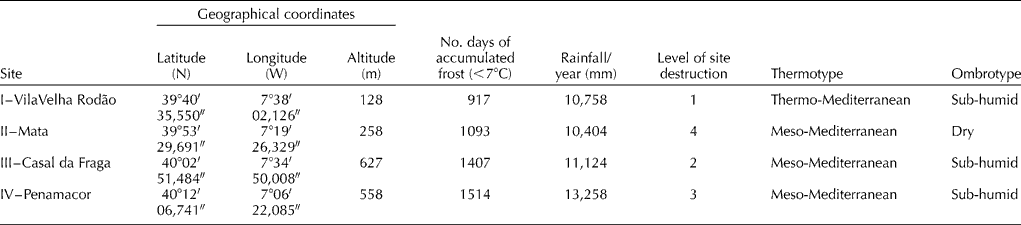
In 2005, wild seeds and whole plants selected from four random populations of L. luisieri in a 50 m2 area of the southern Beira Interior region were collected (Table 1). Thirty plants from each of the four sites were maintained as living collections in an experimental plot at ‘Quinta da Senhora de Mércules – Escola Superior Agrária de Castelo Branco’ (School of Agriculture of Castelo Branco Polytechnic Institute), where the morphological characterisation was conducted.
Characteristics of four collection sites for Lavandula luisieri seeds (9 June 2005) and plants (27 Feb 2005) in central eastern Portugal

Level of site destruction: 1, non-human disturbance; 2, fire and forest destruction; 3, forest management activity; 4, agricultural activity and grazing.
Table 1 shows the characterisation of the selected sites based on geographical, ecological and climatic parameters.
Floristic and environmental data recording
Field sampling was carried out in each of the four L. luisieri sites (Table 1) based on the phytosociological concepts of Braun-Blanquet (Reference Braun-Blanquet1979), modified by Géhu and Rivas-Martínez (Reference Géhu and Rivas-Martínez1981). L. luisieri communities were surveyed using the Mueller-Dombois and Ellenberg (Reference Mueller-Dombois and Ellenberg1974) concept of minimum areas (the smallest areas adequately representing community composition), and each percentage of taxon cover was recorded by adapting the scale of Braun-Blanquet (Reference Braun-Blanquet1964). The study adopted plant nomenclature based on Franco (Reference Franco1984), Franco and Rocha Afonso (Reference Franco and Rocha Afonso2003) and Castroviejo et al. (Reference Castroviejo, Aedo, Cirujano, Lainz, Montserrat, Morales, Muñoz Garmendia, Navarro, Paiva and Soriano1993), Castroviejo (Reference Castroviejo, Muñoz Garmendia and Navarro1997). Syntaxa were named according to Rivas-Martínez et al. (Reference Rivas-Martínez, Fernández-González, Loidi, Lousã and Penas2001, Reference Rivas-Martínez, Díaz, Fernández-González, Izco, Loidi, Lousã and Penas2002a, Reference Rivas-Martínez, Díaz, Fernández-González, Izco, Loidi, Lousã and Penasb).
A phytoecological characterisation was determined for each collection site, including both qualitative and quantitative environmental measurements: (1) bioclimatic values defining thermotypes and ombrotypes (Rivas-Martínez, Reference Rivas-Martínez2005; Monteiro-Henriques, Reference Monteiro-Henriques2009); (2) edaphic variables, including physiographic factors (altitude, aspect and slope), geological factors (substrate rock type) and pedological factors (texture, pH, potassium, phosphorus and organic substrate).
Morphological data recording
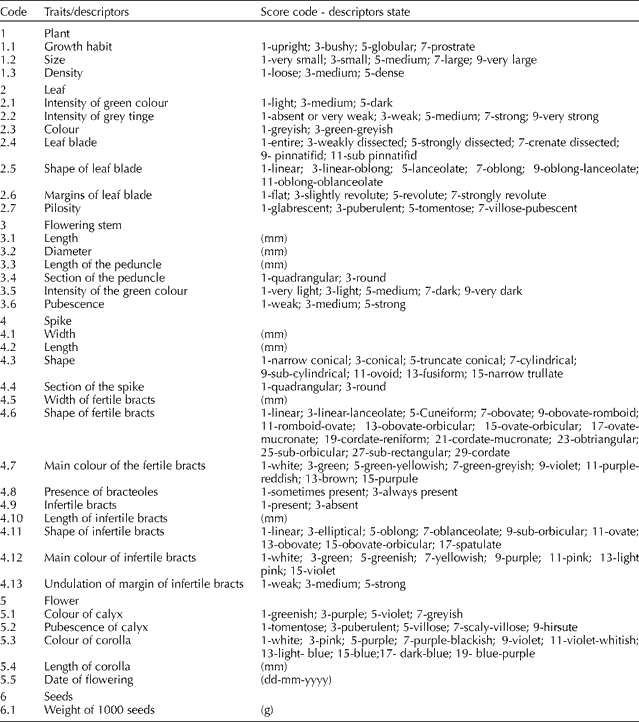
Morphological observations were conducted on ten living plants per population and were distributed in three field replications using 35 morphological traits (Table 2). The list of descriptors and methods of observation and data recording were consistent with those developed by Bettencourt and Dias (Reference Bettencourt and Dias2008). Plant colours were compared and determined using the Royal Horticultural Society (RHS) Colour Chart.
Descriptors for morphological characterisation of Lavandula luisieri

Data were recorded on scale from 1 to 29 (Bettencourt and Dias, Reference Bettencourt and Dias2008).
DNA extraction and amplified fragment length polymorphisms
Leaves from each of the four populations were collected for DNA extraction after seed germination. Plant DNAzol Reagent (Invitrogen®) was used to isolate and extract three genomic DNA samples from each population. Protocols supplied by Applied Biosystems were followed to produce amplified fragment length polymorphisms (AFLPs). Subsets of restriction fragments were amplified using three pairs of selective primers (Eco+ACA/Mse+CTA, Eco+AGC/Mse+CTT, Eco+AAG/MSE+CAA) (Vos et al.,Reference Vos, Rogers, Bleeker, Reijans, Vande lee, Hornes, Fritjers, Pot, Peleman, Kuipe and Zabeau1995). Amplified fragments were separated using an ABI PRISM® 3100-Avant Genetic Analyzer, and only those DNA sequences between 30 and 500 bp were recorded as present. A binary matrix was produced for each selective primer pair combination used.
Statistical analysis of morphological and ecological data
All the quantitative morphological data were analysed according to the ANOVA methodology in order to determine the population effect in ten plants (replications) (Maxwell and Delaney, Reference Maxwell and Delaney2004). Analysis was conducted using SPSS software (version 16.0) to select variables with statistical significance in the order of P < 0.05. Multiple discriminant analysis (Legendre and Legendre, Reference Legendre and Legendre1998) was utilized to select morphological characteristics providing higher discriminant power for the four L. luisieri populations. Of the 35 morphological traits, only quantitative descriptors, and those for which the canonical discriminant functions were significantly different, were used in the analyses.
The relationship between species occurrence and environmental factors was assessed through canonical correspondence analysis (CCA), using CANOCO 4.5 software (ter Braak and Šmilauer, Reference ter Braak and Šmilauer2002), while relationships between ecological, morphological and genetic data were assessed through principal component analysis (PCA). All the data were standardized to improve normality, and a Monte Carlo permutation test (999 permutations) was applied to detect and eliminate select correlated CCA variables found to be redundant in comparison with the ordination models, as well as to identify and select key variables for testing (ter Braak and Šmilauer, Reference ter Braak and Šmilauer2002).
Genetic data
Matrices outlining the presence and absence of polymorphisms between repetitions among the four sites were generated using Microsoft® Office Excel. This was done for each of the three combinations of primer pairs used in DNA fragment amplification. Cluster analyses were then performed and the Jaccard coefficient applied. Data were further analysed using unweighted pair group method with arithmetic mean clustering methodology, and the final dendrogram was generated by Multivariate Statistical Package software.
Results
Phytosociological and ecological analysis
The L. luisieri communities studied represent a sub-serial stage of Holm Oak forests from the series Pyro bourgaeanae-Querco rotundifoliae S. [meso-Mediterranean, dry to sub-humid, silicicolous of Luso-Extremadurense Province (Lousã, Reference Lousã2004)] and Cork Oak forests of the series Poterio agrimonioidis-Querco suberis S. [meso-Mediterranean, sub-humid, silicicolous of Luso-Extremadurense Province (Lousã, Reference Lousã2004)].
Floristic and ecological differences in and between populations were identified through the CCA. Following the Monte Carlo permutation test, altitude, phosphorus and dry ombrotype were selected as the key environmental variables for analysis as they best explained the ordination model (Fig. 1). The total percentage of accumulated variance among species was 78.9%. Three of the four studied populations were determined to be a sub-serial of Poterio agrimonioidis-Quercetum suberis forest, while the remaining population was identified as a sub-serial of Pyro bourgaeanae-Quercetum rotundifoliae forest. The CCA ordination diagram (Fig. 1) illustrates the existing altitudinal gradient between L. luisieri populations, isolating sites III and IV from sites I and II. Axis 1 of the diagram separates the L. luisieri communities associated with Cytisus striatus (Hill) Rothm. and Lavandula pedunculata (Miller) Cav. subsp. sampaiana (Rozeira); these represent the populations of sites III and IV. The L. luisieri communities from Site II, however, occur in dry ombrotype and meso-Mediterranean thermotype and are therefore associated to Retama sphaerocarpa (L.) Boiss. that explains the observed difference in the vegetation series.
Canonical correspondence analysis. Triplot showing sample populations (white circles), species types and environmental variables selected using Monte Carlo permutation tests. Codes are as follows: Adenocom, Adenocarpus complicatus; agrocast, Agrostis castellana; agrotrun, Agrostis truncatula; anarbell, Anarrhinum bellidifolium; andrinte, Andryala integrifolia; asphram, Asphodelus ramosus subsp. ramosus var. ramosus; brismaxi, Brisa maxima; callvulg, Calluna vulgaris; carlrace, Carlina racemosa; cistcris, Cistus crispus; cistlada, Cistus ladanifer; cistpsil, Cistus psilosepalus; crucangu, Crucianella angustifolia; cytistri, Cytisus striatus; dacthisp, Dactylis glomerata subsp. hispanica; daphgnid, Daphne gnidium; elaefoet, Elaeoselinum foetidum; ericarbo, Erica arborea; genitria, Genista triacanthus; haliocym, Halimium ocymoides; helistoe, Helichrysum stoechas; jasimont, Jasione montana; lavasamp, Lavandula pedunculata subsp. sampaiana; leonlong, Leontodon longirostris; philangu, Phillyrea angustifolia; puliodor, Pulicaria odora; pyrbour, Pyrus bourgaeana; querrot, Quercus rotundifolia; retaspha, Retama sphaerocephala; rosmoff, Rosmarinus officinalis; sangmino, Sanguisorba minor subsp. verrucosa; trifangu, Trifolium angustifolium; xolagutt, Xolantha guttata.

Morphological data
According to the phenotypes of L. luisieri, plants from Site I were characterized as small shrubs with bushy growth, while those from sites II, III and IV exhibited a globular growth habit. All the plants studied were of medium size ( < 50 cm), with the colour of bushy plants varying between greyish (RHS191A) and green-greyish (RHS189A). In addition, all the plants exhibited a tomentose, linear and revolute leaf blade with peduncles ranging from 37 to 45 mm. These trait parameters correspond to those outlined by Franco (Reference Franco1984) and Upson and Andrews (Reference Upson and Andrews2004).
Spikes varied from truncate-conical in sites I and II to truncate-conical and cylindrical in sites III and IV. Spikes determined to be 63–68 mm in length by 12–17 mm in width were larger than those defined by the parameters of Franco (Reference Franco1984), Tutin et al. (Reference Tutin, Heywood, Burges, Moore, Valentine, Walters and Webb1981) and Upson and Andrews (Reference Upson and Andrews2004). Bracteoles were found to be both present and absent, while infertile bracts were always present, varying from 26 to 32 mm, consistent with the parameters of Franco (Reference Franco1984) and Upson and Andrews (Reference Upson and Andrews2004). The shape of infertile bracts was predominantly spathulate; however, in sites II and III, a select number were elliptical as referred to in Upson and Andrews (Reference Upson and Andrews2004); Franco (Reference Franco1984) considers the shape to be oblanceolate. The main colour of infertile bracts varied from light pink (RHS N81C) in Site II to violet (RHS N81A) in sites I, III and IV. The calyx was determined to be tomentose, and the colour of the corolla was purple-blackish (RHS N186B); these parameters are consistent with those of Franco (Reference Franco1984).
Of the 35 morphological traits (9 quantitative and 25 qualitative), those contributing most to the variability among populations were related to plant density (medium to dense); leaf colour (intensity of grey tinge; very weak to weak); spike shape (cylindrical to ovoid); shape of fertile bracts (ovate-mucronate to cordate-mucronate); main colour of fertile bracts (green to violet); main colour of infertile bracts [light pink (RHS 83D) to violet (RHS N81A)]; margin undulation of infertile bracts (weak to medium); colour of calyx [greenish (RHS 143D) to violet (RHS 86B)]; length of corolla (6.0 to 6.2 mm in sites I, III and IV; significantly different than Site II with 4.05 mm).
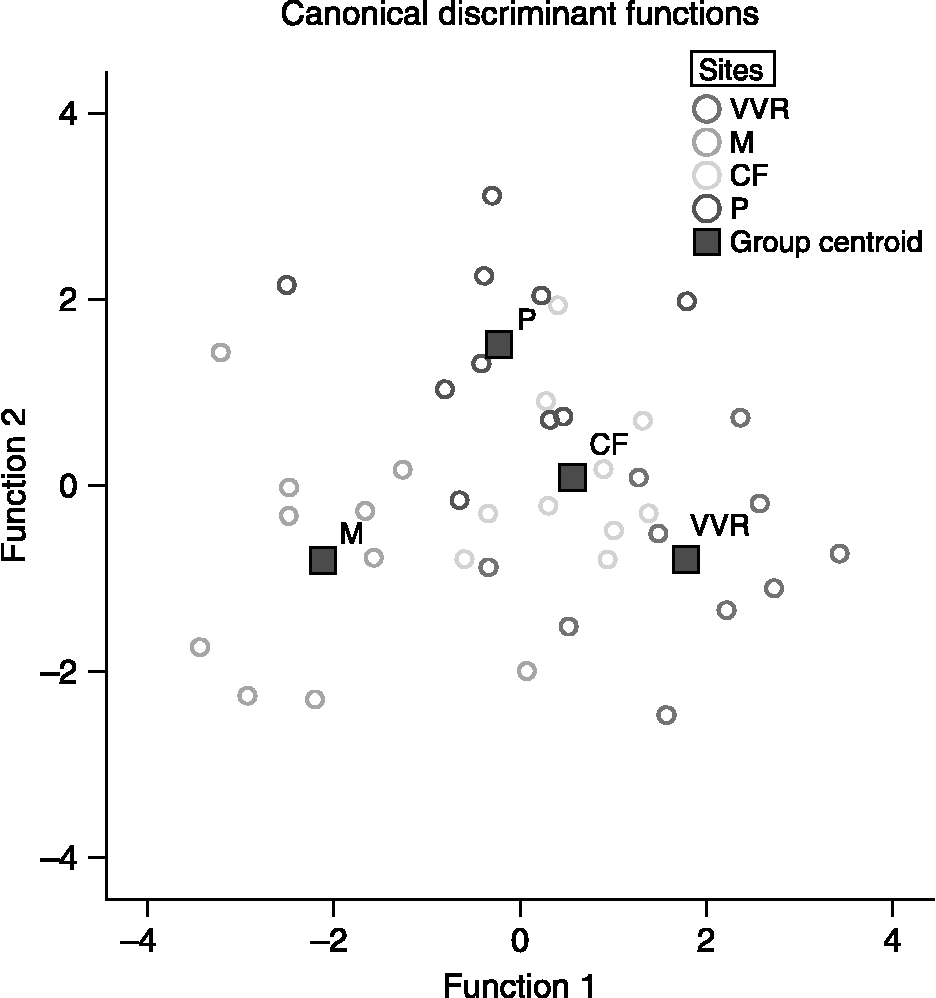
The canonical discriminant analysis (Fig. 2) illustrates the genetic variation within the studied populations for the first two functions: length of corolla (Function 1) and length of peduncle, length of infertile bracts, length of flowering steam and weight of 1000 seeds (Function 2) and based on the eight parameters outlined above. This accounts for 86.9% of the total variance within the dataset. Function 1 displayed the highest percentage of variance among the four populations (60%), while Function 2 represented 26.9% of the total variance within dataset. These first two functions have a discriminatory and significant value of Wilk's Lambda.
Canonical discriminant analysis. Biplot with the quantitative morphological traits. In this figure: VVR, Site I; M, Site II; CF, Site III and P, Site IV.

Genetic analyses
The three AFLP primer combinations generated 550 fragments, of which 458 (83.4%) were polymorphic. The highest number of polymorphic bands originated from the primer combination Eco+ACA/Mse+CTA (174 polymorphisms in 207 fragments), and the highest percentage (77%) of genetic variation within a population was detected in the population of Site I. The percentage of genetic variation within the populations at sites II and IV was 58.5 and 52.4%, respectively. The estimated G st value was 0.525 (H s = 0.549 and H t = 0.261), indicating that both a large amount of variation existed within populations and that the most efficient primer combination for detecting such variations was Eco+AAG/Mse+CAA (G st = 56.1).
Moreover, results revealed that in addition to displaying genetic variation within individual site populations, genetic differences also existed among the L. luisieri communities from the four sites (Fig. 3). The greatest degree of genetic similarity among populations was found between sites III and IV, which exhibited 74% similarity. The population from Site II was also genetically similar to those of sites III and IV, with 66% similarity; however, the Site I population was significantly different from the others, displaying a similarity of only 48%. This reveals the weak geographical-genetic distance relationship at sites II, III and IV and the observed effect of habitat fragmentation at Site I.
The hierarchical dendrogram based on the Jaccard coefficient showing the genetic relationships among the four sampled populations of Lavandula luisieri in central eastern Portugal.

Discussion
The L. luisieri population of Site I occurs in sub-humid ombrotype and thermo-Mediterranean thermotype, in areas with a larger bioclimatic differentiation than those occupied by the other three populations. Site I included high-shrubs such as Pyrus bourgaeana Decne., Phillyrea angustifolia L. and Erica arborea L., indicating a long period of non-human disturbance [according to Rivas-Martinez et al., (Reference Rivas-Martínez, Díaz, Fernández-González, Izco, Loidi, Lousã and Penas2002a, Reference Rivas-Martínez, Díaz, Fernández-González, Izco, Loidi, Lousã and Penasb) these species are characteristic of Quercetea ilicis and Pistacio lentisci-Rhamnetalia alaterni, related to the climatophylous vegetation and high shrub communities]. On the other hand, in sites II, III and IV, species associated with recent human disturbance, such as Cistus crispus L. (Site II), Anarrhinum bellidifolium (L.) Willd. (Site III) and Carlina racemosa L. (Site IV) were identified. Figure 1 clearly illustrates this distinction.
Correlations between morphological and ecological characteristics were analysed using CCA and the Monte Carlo permutation test. The ecological variables of phosphorus and pH were selected for analysis, admitted with P < 0.05, as they best explained the differences in morphological traits. The percentage of accumulated variance of species was 27.1%, of which 12.1% was explained solely by varying pH levels, indicating that a small portion of morphological variability is attributed to environmental factors and the remaining mainly to genetic factors. Figure 4 illustrates a PCA using all the parameters (morphological, ecological and molecular), with 100% of the cumulative percentage of variance for the first two axes. This figure reveals that pH levels were more strongly correlated to colour parameters (colour of calyx and leaf intensity of grey tinge). The first PCA axis separates studied sites according to a function of altitude and temperature, identifying Site I as having a higher degree of polymorphism due to increased temperatures. Otherwise, Site I maintained the lowest degradation degree in relation to the other sites.
Principal component analysis: biplot showing the morphological, environmental and genetic data. In this figure, Site I, 1; Site II, 2; Site III, 3; and Site IV, 4.

The results from the genetic similarity test were surprising. During the electropherograms readings, samples from Site I generated results which could not be replicated. A number of hypotheses were therefore formulated to explain this phenomenon:
(1) A problem in field sampling existed: it is possible that seeds from other species were inadvertently harvested along with L. luisieri seeds, giving the population a high heterogeneous genetic profile.
(2) A phenomenon of sympatric or parapatric speciation: in this case, the population was geographically isolated. The diversity of the ecological niche, the ability to adapt to different habitats and natural selection played a crucial role in the specific differentiation of this population.
(3) A high degree of polymorphism in the genome of individuals within the population is related to biodiversity, genetic variation and adaptation: these results from evolutionary processes whereby traits are inheritable but are modified by natural selection. The AFLP method does not apply only to hardware encoding and it may be that individuals have, through evolutionary processes, generated a significant rate of mutation in the population's genetic heritage. Since the non-coding genome was rarely, if at all, impacted by natural selection forces, it is likely that this brought a level of significant change to the genetic heritage, as explained by the differences revealed in the PCA in Fig. 4. This population exhibited phenotypic characteristics, such as the undulation and main colour of infertile bracts, and was unique from the other populations due to its adaptation to the varying bioclimatic factors and non-human disturbance. This hypothesis would suggest that, due to the high level of genetic variability, the population at Site I was the most ancient.
Conclusions
This paper is the first to report morphological traits analyses and AFLP variation within four wild populations of an endemic plant from the Iberian Peninsula, observed in a one-year ex situ cultivation. It is believed that additional questions about genetic diversity and variability within populations will be generated with further analyses using increased numbers of primer pairs. The results presented by this study embody a remarkable feature: the higher genetic variability of L. luisieri from Site I suggests a strong correlation with non-human disturbance. More than 50 years of habitat fragmentation and non-mobilisation, factors identified in situ as the differences in bioclimatic conditions from the other test sites, did not sufficiently explain the increased level of genetic variability of the Site I population as compared with the others. Therefore, preservation of populations in areas with low human disturbance, through the establishment of genetic reserves, would seem to be the most effective measure for conserving the genetic variability of this valuable, endemic Iberian species.
Acknowledgements
The authors wish to acknowledge Paula Palma and Isabel Castanheira for their support in the development of databases; Tiago Monteiro-Henriques for his contribution on bioclimatic indices and Prof. Doutor João Pedro Luz for the English revision. A portion of this study was supported by the Leonardo da Vinci programme. The morphological characterisation was carried out under the research activities of the project, Agro 800 – ‘National network for conservation and utilisation of aromatic and medicinal plants’ at Escola Superior Agrária (School of Agriculture of Castelo Branco Polytechnic Institute). The ecological analysis was supported by the Foundation for Science and Technology through the PhD project SFRH/BD/29 515/2.