INTRODUCTION
The genus Trypanosoma contains a diverse group of haemoparasites known to infect a broad range of hosts across a variety of habitat types. Infection with these organisms may induce variable consequences; from severe clinical disease of humans or animals, decreased animal production, decreased fitness or no measurable effect. By far the greatest body of information relates to those species known to cause diseases in humans. For example, the best documented of the trypanosomes are Trypanosoma brucei gambiense and T. b. rhodesiense, the causative agents of African sleeping sickness, and T. cruzi, the causative agent of Chagas' disease in South America. Together, these vector-born parasitic infections are responsible for more than 60 000 human deaths each year and cause considerable economic disruption in many of the world's poorest countries (WHO, 2002).
Within Australia, trypanosomes have been found in many wildlife species including Gilbert's potoroo (Potorous gilbertii), platypus (Ornithorhynchus anatinus), eastern grey kangaroo (Macropus giganteus), common wombat (Vombatus ursinus), quokka (Setonix brachyurus), long-necked tortoise (Emydura signata), leeches (Haemadipsidea), and, more broadly, birds, reptiles, fish and amphibians (Mackerras and Mackerras, Reference Mackerras and Mackerras1959; Mackerras, Reference Mackerras1961a, Reference Mackerrasb; Noyes et al. Reference Noyes, Stevens, Teixeira, Phelan and Holz1999; Jakes et al. Reference Jakes, O'Donoghue and Adlard2001; Hamilton et al. Reference Hamilton, Stevens, Gidley, Holz and Gibson2005; Clark and Spencer, Reference Clark and Spencer2006). However, many host species are yet to be investigated for trypanosomes and therefore very little is known of the overall diversity or phylogenetic relationship of Australian trypanosomes to other endemic or introduced species of Trypanosoma. Considering the pathological potential of trypanosomes when encountering a new host species, it is becoming increasingly important to establish the presence and phylogenetic status of parasites within rare or endangered hosts. This is particularly important with respect to species of conservation importance or those that may be encountering severe reductions in population size that cannot be satisfactorily explained by alternative biotic or abiotic processes. Furthermore, a more comprehensive awareness of the parasites associated with native wildlife in general will allow a better understanding of the potential for them to act as reservoir hosts for introduced and potentially harmful parasites that pose a threat to the biosecurity status of Australia (Thompson et al. Reference Thompson, Owen, Puana, Banks, Davis and Reid2003).
In the southwest of Western Australia, the brush-tailed bettong, or woylie (Bettongia penicillata) has recently undergone a dramatic reduction in abundance despite no apparent increase in the number or type of predators in the region and no apparent decrease in natural resources (DEC, 2008). During haematological investigations of the health status of woylies from the affected areas (Upper Warren region, east of Manjimup), a Trypanosoma sp. was detected in blood films by one of the authors (P.C.). Here we report on an investigation based on light microscopy and variations in the 18S rRNA gene (Noyes et al. Reference Noyes, Stevens, Teixeira, Phelan and Holz1999; Hamilton et al. Reference Hamilton, Stevens, Gidley, Holz and Gibson2005) to determine both the prevalence and identity of the trypanosome, and to address the issue of whether it is a recently introduced non-native species, possibly responsible for the decline, or an endemic and more widely distributed species.
MATERIALS AND METHODS
Sample collection and preparation
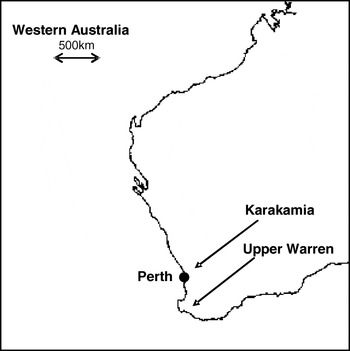
Woylies were trapped in 11 separate fauna monitoring transects (each with 50 traps spaced 200 m apart) that provided spatial representation across the Upper Warren region (approximately 300 000 ha), including Perup Nature Reserve (S34.11528; E116.32362) and the Greater Kingston Proposed National Park (S34.03038; E116.19409). Woylie samples were also sourced from a stable population at Karakamia Wildlife Sanctuary (285 ha) approx 350 km north (S31.82073; E116.24604), which is contained within a ‘predator-proof’ fence and is managed by the non-government conservation organization, the Australian Wildlife Conservancy (Fig. 1).
Map of Western Australia showing the locations of the Upper Warren region and Karakamia Wildlife Sanctuary in relation to Perth city (black circle).

Woylies were live-trapped using Sheffield cage traps baited with a mixture of peanut butter, rolled oats and tinned sardines. Blood samples of <5 ml were collected from the lateral caudal vein from 184 woylies in the Upper Warren region, and from 123 woylies in the Karakamia Wildlife Sanctuary. The Upper Warren samples were collected between March 2006 and November 2007 and the Karakamia samples from July 2006 to November 2007. Whole blood was collected in plain Eppendorf tubes and centrifuged within 4 h to separate the serum from cellular material, with the latter stored separately at −20°C. Genomic DNA was extracted from the blood pellets using the QIAamp Blood DNA Mini Kit (Qiagen, Hilden, Germany) according to the manufacturer's instructions. For morphological investigation, whole blood was mixed with EDTA in commercial tubes (Becton Dickinson, NJ, USA), transported to Murdoch University and analysed within 48 h of collection. Blood films were prepared, air dried, stained with Wright's and Giemsa stains and examined for haemoparasites by light microscopy. The organisms and their host cells were digitally photographed. A stage micrometer was photographed at the same magnification and used to insert scale bars to all micrographs.
Detection of trypanosomes using PCR
To confirm the presence of trypanosome infection in host blood, 10 μl of DNA extract was used as a template in a nested PCR that targeted a variable region of the trypanosome 18S rRNA gene using trypanosome-specific oligonucleotides as described by Noyes et al. (Reference Noyes, Stevens, Teixeira, Phelan and Holz1999). Briefly, for the first round, each 50 μl reaction also contained 10 μl of 5X polymerization buffer with dNTPs (Fisher Biotec, Perth, Australia), 3 mm MgCl2, 1.4U Taq DNA polymerase (Promega, Madison, USA) and 16 pmol of the following external primers: TRY927F (5′ GAAACAAGAAACACGGGAG 3′) and TRY927R (5′ CTACTGGGCAGCTTGGA 3′), for 30 cycles at 94°C for 30 s, 55°C for 60 s and 72°C for 90 s. The products from the first amplification were diluted 1:10 in sterile deionized water. Two μl of the product from each reaction were then used as template for the second-round PCR using the following internal primers: SSU561F (5′ TGGGATAACAAAGGAGCA 3′) and SSU561R (5′ CTGAGACTGTAACCTCAAAGC 3′), and the same cycling conditions as described above. Amplified products were separated on a 1·5% agarose gel run at 100 V for 1 h in Tris-acetate EDTA buffer and visualized by illumination with UV light. Samples producing a band of approximately 600 bp were considered positive.
Purification, cloning and sequencing of amplified products
A band of approximately 600 bp was excised from agarose gels from 4 PCR-positive samples from each location and purified using the Qiagen Gel Purification kit (Qiagen, Hilden, Germany) following the manufacturer's instructions. The resulting products were ligated into pCR®4-TOPO® cloning vector (Invitrogen, Carlsbad, USA). After transformation into TOP10 Escherichia coli chemically competent cells, positive clones were identified by blue/white screening followed by amplification with M13 forward and reverse oligonucleotides. Clones were inoculated into Luria broth overnight at 37°C and plasmid DNA purified using PureLink™ Quick Plasmid Miniprep (Invitrogen, Carlsbad, CA, USA) according to the manufacturer's instructions. Nucleotide sequencing was carried out using ABI 3730 BigDye terminator (Version 3.1) cycle sequencing kit (Applied Biosystems, Foster City, CA, USA). Sequencing reactions were initiated using plasmid DNA template and the insert amplified using M13 forward and reverse oligonucleotides. The sequencing cycles consisted of a 2 min denaturation step at 96°C, 25 cycles of 10 s at 96°C, 5 s at 55°C and 4 min at 60°C. The resulting sequences were analysed on FinchTV™ Version 1.4 (Geospiza Inc, USA).
Phylogenetic reconstruction using the 18S rRNA gene sequences
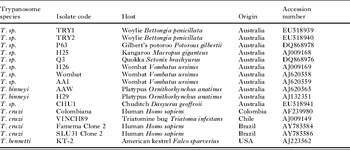
Sixteen 18S rRNA gene sequences from isolates of Trypanosoma were extracted from GenBank using a BLAST search and aligned with the sequences from trypanosomes in woylies using CLUSTALW (Higgins et al. Reference Higgins, Thompson, Gibson, Thompson, Higgins and Gibson1994). The geographical origin, host species and Accession numbers of these Trypanosoma sequences are shown in Table 1. Phylogeny was determined by neighbour-joining, minimum evolution and maximum parsimony methods, implemented with MEGA Version 4.0. The robustness of branches within the resulting trees was tested by 1000 cycles of bootstrap resampling. For distance estimation methods, evolutionary distances were computed using the maximum composite likelihood method. All positions containing gaps and missing data were eliminated from the dataset. There were a total of 432 positions in the final dataset. Trees were rooted with 4 T. cruzi isolates, which together represent an ancient and diverse group of stercorarian trypanosome species (Stevens et al. Reference Stevens, Noyes, Dover and Gibson1999).
Trypanosome species and/or isolate code, host, geographical location and GenBank Accession number for the 16 isolates used in current analysis

RESULTS
Morphological detection
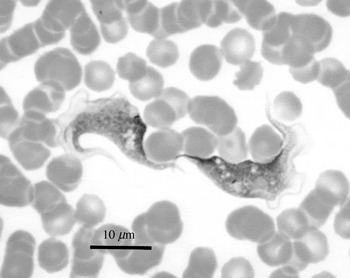
Blood films were examined using light microscopy from a total of 130 woylies; 105 from the Upper Warren region and 25 from Karakamia. Extracellular protozoal organisms with morphology consistent with Trypanosoma were recognized in blood films (Fig. 2.) These had a blade like, triangular to elongated shape that tapered to a posterior flagellum and a pointed anterior. An undulating membrane extended along much of the organisms' length, a dark, basophilic focal kinetoplast was located in the anterior of the organism, and a round, basophilic to amphophilic nucleus was located around the mid-section. The cytoplasm was a pale basophilic colour. These organisms were found in blood films from 45 woylies (43%) sampled from the Upper Warren but were not found in blood films from any of the woylies sampled from Karakamia.
Blood from a woylie illustrating two trypanosomes amidst erythrocytes (Wright's and Giemsa stains).

Molecular detection
In total, 307 samples were screened for the DNA of Trypanosoma species; 184 from the Upper Warren region and 123 from Karakamia. Overall, there was a significant difference in the observed prevalence between the two populations, with 64 woylies (35%, 95% CI=28–42%) from the Upper Warren and 17 woylies (14%, 95% CI=8–21%) from Karakamia testing positive (Fishers Exact Test, P=<0·0001). The amplified products from the trypanosome 18S rRNA gene were cloned and sequenced. All sequencing products were 650 bp long. Sequences from within each geographical area were highly similar, while there was a 99% similarity between the Upper Warren and Karakamia sequences. They were submitted to GenBank, with Accession number EU518939 allocated to the sequence isolated from the Upper Warren region (Trypanosoma sp. TRY1) and EU518940 to the sequence isolated from Karakamia (Trypanosoma sp. TRY2).
Phylogeny
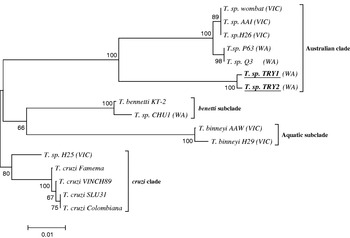
All phylogenetic methods produced essentially the same tree, with no differences in the placement of the trypanosome sequences derived from woylies. The neighbour- joining tree is shown in Fig. 3. The sequences TRY1 and TRY2 found in this study, from trypanosomes in woylies, were grouped within a clade containing a number of trypanosomes previously isolated from native Australian marsupials (e.g. common wombat Vombatus ursinus, quokka Setonix brachyurus, Gilbert's potoroo Potorous gilbertii). The phylogenetic picture is not straightforward, however, because trypanosomes from other Australian marsupials, such as eastern grey kangaroo (Macropus giganteus), and chuditch (Dasyurus geoffroii) were not found in this clade, but were more closely related to quite distinct trypanosomes, such as T. bennetti and T. cruzi (Fig. 3). These relationships may change with a more comprehensive analysis including additional trypanosome isolates.
Neighbour-joining tree based on analysis of the 18SrRNA gene of 16 Trypanosoma sp. taxa. The bootstrap consensus tree inferred from 1000 replicates is taken to represent the genetic distance between partial sequences of the 18S gene of the 16 trypanosome isolates, and may differ from consensus trees generated using the complete 18S sequence. Branches corresponding to partitions reproduced in less than 50% bootstrap replicates are collapsed. The percentage of replicate trees in which the associated taxa clustered together in the bootstrap test (1000 replicates) is shown next to the branches. The tree is drawn to scale, with branch lengths equal to the genetic distance used to infer phylogeny. Genetic distances were determined using the Maximum Composite Likelihood method and are in the units of the number of base substitutions per site. Codon positions included were 1st+2nd+3rd+Noncoding. All positions containing gaps and missing data were eliminated from the dataset. The final dataset contained a total of 432 positions. Phylogenetic analyses were conducted in MEGA4. Place of origin is given in parenthesis for samples from within Australia as follows: Western Australia (WA); Victoria (VIC). Host and geographical origin of all isolates are given in Table 1.

DISCUSSION
This study is the first that we are aware of to isolate and describe a species of Trypanosoma from B. penicillata using morphological and genetic methods. The 99% similarity of the partial sequences available from TRY1 and TRY2, from 2 geographically distinct populations of the host, suggests that it is likely to be the same Trypanosoma sp. associated with B. penicillata in both areas. A comparison of the nucleotide sequences of TRY1 and TRY2 with other trypanosome sequences revealed a close relationship to trypanosomes isolated from other native Australian mammals, although both specific designation and higher-order relationships among species within the genus await a more comprehensive phylogenetic analysis.
Nevertheless, the phylogenetic grouping of the trypanosomes from woylies with others found in Australian marsupials suggests that they are more likely to belong to an endemic or Australasian species rather than a recently introduced one, though we cannot preclude the possibility that they are recently introduced into the local woylie populations, perhaps as a result of an expansion in the range of its vector or via the introduction of an infected animal. At this stage, the mode of transmission of the parasite has not been determined. Towards this end, assuming the Trypanosoma sp. is stercorarian (Hoare, Reference Hoare1972), whereby development occurs in the hind gut of an insect vector and transmission occurs primarily via faecal contamination of a bite wound or feeding site, or via the ingestion of the insect vector by the host, we intend to collect a range of ectoparasites from woylies and several sympatric marsupial species from both the Upper Warren and Karakamia populations.
The role of this Trypanosoma species in the recent decline of woylie populations in Western Australia needs to be further investigated. Relatively little is known about the life history of the majority of Trypanosoma species that occur in non-human hosts. Most species are thought to be host-specific, associated with wildlife, transmitted by insect vectors and relatively benign. However, some exceptions do occur, such as the sexual transmission of T. equiperdum in horses and the economic losses caused by T. congolense and T. vivax in cattle across large parts of sub-Saharan Africa. Some species of Trypanosoma associated with wildlife are also known to be intrinsically pathogenic to their definitive host, such as T. evansi, the causative agent of surra in camels in North Africa (Enwezor and Sackey, Reference Enwezor and Sackey2005).
Increasingly, species of Trypanosoma have been implicated in the decline of wildlife hosts, particularly when the parasite has encountered a new or naïve host species following introduction into a new habitat (Maraghi and Molyneux, Reference Maraghi and Molyneux1989), or an infected host is exposed to additional or increased levels of stress (Brown et al. Reference Brown, Loosli and Schmid-Hempel2000). The extinction of the endemic rat Rattus macleari from Christmas Island following the arrival of R. rattus infected with T. lewisi and their flea vectors on cargo ships from Europe in the 1900s is a case in point (Pickering and Norris, Reference Pickering and Norris1996). It is also thought that vector-borne trypanosomes can be accidentally transmitted by other routes, such as contact with infected blood during aggressive interactions between individuals (Smith et al. Reference Smith, Telfer, Burthe, Bennett and Begon2006) or possibly through the ingestion of trypanosome-infected carcases (Maraghi et al. Reference Maraghi, Wallbanks and Molyneux1995). For example, the death of 12 Royal Bengal tigers (Panthera tigris tigris) in Nandankanan Zoo, India was attributed to infection with T. evansi thought to have arisen via an infected exotic host within the zoo (Parija and Bhattacharya, Reference Parija and Bhattacharya2001).
On the evidence available, we consider it unlikely that the decrease in woylie population numbers in the Upper Warren is due solely to the pathological effects of infection with trypanosomes. First, it appears that the trypanosome species we have found is endemic, rather than recently introduced. Second, infected animals exhibited no haematological or physiological signs of disease (DEC, 2008). Third, the parasite was found not just within the declining woylie population in the Upper Warren, but also in the stable population at Karakamia. However, it has been recognized previously that subclinical effects of infection with trypanosomes or other haemoparasites may decrease the fitness of infected individuals. For example, male Tengelmalm's owls (Aegolius funereus), naturally infected with T. avium had a decreased nest defence intensity against a mustelid predator (Hakkarainen et al. Reference Hakkarainen, Ilmonen, Koivunen and Korpimäki1998). A recent study of the birds preyed upon by either Eurasian sparrowhawks (Accipiter nisus) or Eurasian goshawks (Accipiter gentilis) revealed a greater risk of death due to predation with increased prevalence of haemoparasites (Møller and Nielsen, Reference Møller and Nielsen2007). Such subclinical effects of parasitism may be more pronounced with decreased host immunity, due to poor host condition or stress resulting from starvation or exposure to climatic extremes (Pedersen and Greives, Reference Pedersen and Greives2008).
Furthermore, the presence of a secondary or concomitant infection may further decrease an individual's fitness and increase its susceptibility to predation and other infectious agents (Cox, Reference Cox2001). Toxoplasma gondii, which is present within the declining Upper Warren population but absent from the stable Karakamia population (Parameswaran, unpublished data), has the potential to cause acute disease and to predispose infected individuals to predation. Specifically, mixed infections involving T. gondii and Trypanosoma sp. are known to have a negative impact on the host in excess of T. gondii infection alone. For example, white rats experimentally infected with Trypanosoma lewisi and subsequently infected with T. gondii showed higher levels of T. gondii tachyzoites at periods of 4 and 7 days post-infection than animals with only T. gondii (Guerrero et al. Reference Guerrero, Chinchilla and Abrahams1997). This suggests both an immunosuppressive effect of trypanosome infection and a possible increase in the virulence of T. gondii in concomitant infections (Arrea et al. Reference Arrea, Carmona, Bermudez and Abrahams1998; Cox, Reference Cox2001). With regard to the present investigation, the greater prevalence of trypanosome infection in the Upper Warren (35%) compared with Karakamia (14%) and the greater levels of parasitaemia, as indicated by microscopical identification of parasites only in blood films from Upper Warren woylies, together with the potential for negative synergistic effects with T. gondii, suggests the possibility of trypanosome infection being a predisposing factor in the woylie decline.
In conclusion, the discovery of a novel trypanosome in a threatened species of Australian marsupial not only contributes to our understanding of the incredible diversity of the genus Trypanosoma, but also raises questions concerning the impact of these parasites on the fitness of the hosts in which they have presumably evolved. These questions can only be answered by a more thorough epidemiological investigation of trypanosome infections in declining and stable populations of woylies in Western Australia.
We would like to thank Dr Halina Burmej, and staff from the Department of Environment and Conservation and the Australian Wildlife Conservancy for help in collecting and processing field samples and for providing infrastructure and access to field sites. We would also like to thank Dr Harry Noyes for valuable comments and suggestions throughout the development of this manuscript. This work was funded by the Australian Research Council and the Department of Environment and Conservation under ARC-Linkage Project ID: LP0775356.